Wednesday, June 30, 2004

Only in Canada

Canada Day is upon us. July 1. The height of summer. What better time to discuss your favourite hockey jerseys?

(Were it actually hockey season, one would be far too engrossed in the game to follow such a conversation.)

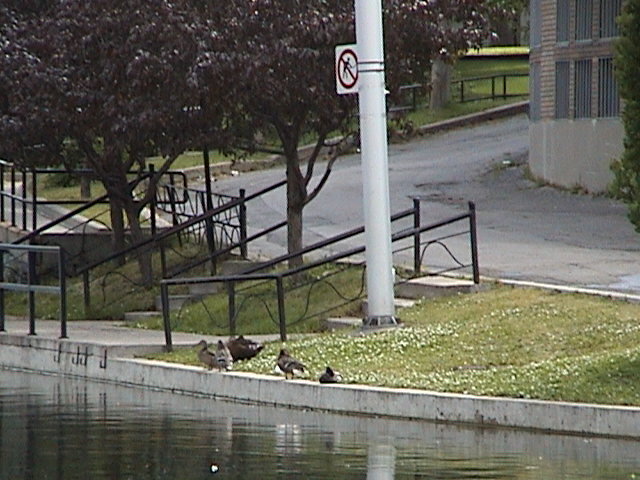
Some odd signs around the park:


The international symbol for No Hockey-Playing. Posted by Hello


That means you, you lazy ducks. Posted by Hello


The international symbol for No Tobogganing. Posted by Hello

The graphic's nothing special (or is it?). I find it amusing primarily for its location — at the bottom of the slope.

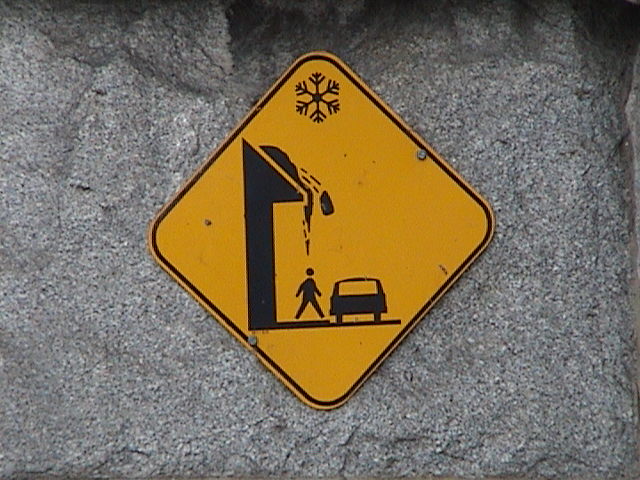
Then there's the near indecipherable:


The international symbol for Looney Tunes Incident In Progress. Posted by Hello

Squirrels with attitude

Consider this post a public service, for all those poor folks who arrive at this blog via their Google search for "aggressive squirrels."


Squirrels are your friends. Kind of. Posted by Hello

We stumbled across this valuable information the other day at the park. According to the signage by the kind people of the Ville de Montréal, squirrel aggression stems from overpopulation and the subsequent competition for food.

The population of squirrels in their natural habitat is kept under control by their natural predators (primarily large birds), of which there are none in the park.

There have been reports of squirrels biting people, but we're not told how many, and it's not clear if those incidents occurred in this park or elsewhere.

If you have been bitten, see a doctor.

But as J-F notes, if the squirrels are vying for your crumbs, you'd think they'd be extra nice to you.


The international symbol for No Squirrel-Feeding Posted by Hello

Tuesday, June 29, 2004

Boring inner world, exciting outer world

Ah, yes. All the debris that was milling about in my head yesterday that I couldn't find time to sweep away.

An article in The New York Times, "Books Make You a Boring Person," by Cristina Nehring, is causing a bit of a stir.

There's a new piety in the air: the self-congratulation of book lovers. Long considered immune to criticism by virtue of being outnumbered by channel surfers, Internet addicts, video maniacs and other armchair introverts, bookworms have developed a semi-mystical complacency about the moral and mental benefits of reading. . . To be a reader these days is to be a sterling member of society, a thoughtful and sensitive human being, a winner.

We assume that reading requires a formidable intellect. We forget that books were the television of previous years — by which I mean they were the source of passive entertainment as well as occasional enlightenment, of social alienation as well as private joy, of idleness as well as inspiration. Books were a mixed bag, and they still are. Books could be used or misused, and they still can be.

There are responses from Maud Newton and Tingle Alley.

The truth is, I am pretty boring. And I do read a ton of crap for pleasure, and I often don't retain much. In one ear (eye?), out the other.

I have sssoooo lost the ability to think critically.

Some people assume I must be smart because I read so much. Honestly, I don't encourage this opinion of me. (I don't really try to dissuade them, though. I'm too lazy for that.)

Maybe my attitude comes from reading too many books and no longer being able to think for myself, but Nehring has a point. We should be active, thinking readers. But fer cryin' out loud, not all the time.

I have to agree with Chicha:

The truth, though, isn’t that books make you boring, but that you can easily pick out a boring person by the way he talks about books.

Another point to be made: If you are a reader of books, don't be a snob about it.

Michel Basilières is contributing a regular column, The Outer Edge, to Maisonneuve that's caught my interest.

This month he discusses "The Treasure Island of SF: Samuel R. Delany’s Nova":

What Ron handed me in 1972 was one of the newer writers, one of those my brother scorned. The author was Samuel R. Delany and the book was Nova. And it changed everything for me. As soon as I started reading it, I was gripped as I never had been before; it really seemed that light was exploding in my head. Reading was no longer just fun. There was something going on in this book, something I’d never seen — or noticed, anyway — in any other book: it wasn’t just about its plot.

For the first time, I understood that writing could be multi-dimensional, that books could mean something as well as just describe, that layers played back and forth in texts. I devoured it.


I'm not familiar with the book or its author (though I may investigate), but I can relate to the sentiment. For me the lightning-bolt book was The Razor's Edge, by W Somerset Maugham. I don't regard it as a "classic" by any stretch of the imagination, but I have a fondness for it and owe it a debt.

In "Death to Realism," Basilières tells us it's the job of science fiction to be ahead of its time.

When William Gibson wrote Neuromancer in the early eighties, it was clearly science fiction. When Pattern Recognition was released last year, it was obviously realism. What’s cool about Gibson is, he still wears the sneakers. He hasn’t changed. The context has.

But we knew that.

Once in a while a really good slap in the face gets published as literary fiction. Just recently Houellebecq’s Elementary Particles was both lauded and derided for this (I’m in the cheering section over here), but does anyone else agree with me that it’s science fiction?

Umm, I don't, not really. It's a dystopian novel. A bit of weird, unrealistic science thrown in toward the end to bring about the utopian society is not enough to qualify it as science fiction. Is it? Just how much science does science fiction need?

It did not provoke outrage in me, but generated profound discomfort.

Coincidentally, I read that on the tail of Oryx and Crake last summer and saw the movie Equilibrium (which we loved) just afterward, and I stood in awe of the triptych these formed before my mind. I was so proud of myself for having written an insightful email, of which I have no record, in a casual correspondence, comparing these dystopias — their reason for being, their means, and where they went wrong. Sadly, those synapses have been unused since, and those musings are now irretrievable.

See? No capacity for information retention or critical thought.

(The Spell Checker wants to replace "dystopian" with "dustbins" and "dystopias" with "Dostoevsky" — how cool is that?)

I love to hate her

Caitlin Flanagan's first Domestic Life column for The New Yorker, "To hell with all that: A mother decides to go to work," appears in the issue of July 5, 2004.

(Is that what I think it's about? How timely.)

Is that on the stands yet? I may have to cut Helena's nap short so we have time to head to the magazine store this afternoon.

Waking up in a democracy

You've got to hand it to the Bloc people. Hard workers. I received my 6th phonecall of the campaign from them last night at 8:35, just to make sure I'd voted. I don't think any other candidate in this riding even bothered to campaign. (Maybe we can get Bruce Cockburn to run next time.) Duceppe by a landslide. Sigh.

On the up side, I'm pleased as punch to note Ed Broadbent will be on hand to help restore the concept of right and honorable to Parliament.

My legs have been really itchy these last few days. Mosquitoes, I thought. Sand ticks, J-F says. From the playground. Whatever it is, I know now that these bumps don't remotely resemble mosquito bites, and I'm afraid I've contracted some rare and horrible disease that's begun to cause stomach upset and disturbed sleep (which logically I know to be an effect of stress). It's probably sand ticks.

The itch comes and goes in waves, and when it comes it's almost unbearable. (But it's not nearly as bad shingles.) Yesterday I was wearing pantyhose, mostly cuz it looked nicer (and it was important to look nice) than my bare splotchy red, insect-bitten legs, and I really didn't want to, cuz pantyhose are generally uncomfortable and I thought it would make the itching worse. But they were silky smooth and their hug so soothing, I'm almost tempted to don some today, even though we're going to the park and the post office, to which in cool conditions such as today I would ordinarily wear jeans.

I had a job interview yesterday. Hence the pantyhose. I haven't interviewed, nor worn pantyhose, for a very long time. I think I may in fact be ready for steady employment. Probably.

Helena will benefit by spending time with people her own age while guided by trained professionals, who have some idea how to capture a toddler's attention and encourage her development, all while not going stircrazy.

(As part of the job process, I wrote a test, on which I did not score perfect. Aurgh. For this I feel as if I deserve to be dipped in a vat of acid. (Maybe that would help the itching.) It's going to take me a while to recover from that stark dose of reality. Imagine — me, not perfect!)

J-F stayed with Helena for the afternoon. He looked utterly exhausted when I returned home. I'm grateful for moments like these, when he appreciates the patience and resourcefulness required to tame the hurricane that is our daughter. Every day.

While I was away, the scamp (Helena) got into my Harry Potter Lego, safely stored on a shelf that was until yesterday beyond her reach. Choking hazards everywhere.

Triangle. Helena says "triangle." And "camera." (OK, she actually says "tingle" and "camma" but we know what she means.)

Helena has just learned that even more effective than whining or repeating "Mama" to get my attention, she can simply walk up to me and grab my hand, pulling me in the direction she needs me to go. It's hard to ignore something like that for "just a second while I finish brushing my teeth/washing this glass/sending this email." Mildly annoying. Infinitely endearing.

Monday, June 28, 2004

Vote

From the Shatnerian comes this window into my household — I swear the sentiments were lifted directly out of J-F's head.

Sunday, June 27, 2004

Halide Edib Adivar

I finished reading Halide's Gift, by Frances Kazan (wife of Elia Kazan, as we are reminded in the book jacket bio and in every other reference to this book). She states:

My novel is loosely based on the early life of Halide Edib Adivar, writer, scholar and Turkish nationalist; but Halide's Gift must not be read as fact. . . The real life Halide did not possess the gift. Apart from describing frequent visits to the fortuneteller with her Grandmother, Halide made no reference to mystical interests in either her memoir, or her writing. Her gift came from my imagination.

The "gift" does not belong in this book. Halide's story should be compelling enough.

Kazan's writing is not compelling. Rather than weave an intricate backdrop of political turmoil, chunks of Turkish history are tossed in inexpertly. They interrupt the story more than they enhance our understanding of the times in which Halide lived.

(I find myself thinking Kazan was striving for but failing to achieve the kind of magic found in Moonlight on the Avenue of Faith, by Gina B Nahai — a story of women of strength and great resource amid difficult times, with an "exotic" sociocultural flavour.)

Halide Edip Adivar was a real person — a remarkable woman — witness to, and agent of, the modernization of Turkey. I find myself wishing to hear her tale told by a master storyteller such as Amin Maalouf.

In the meantime, pure fact will have to do:

A brief biography of Halide Edip Adivar: The Republic of Turkey Ministry of Foreign Affairs.

Halide Edib was active in the women's movement prior to the War of Independence, establishing the Society for the elevation of Women in 1908. She dedicated herself to the improvement of education for Turkish women and to furthering relations between them and European women. She was also involved in relief efforts for women and their families left hungry and homeless by war. But it was her fiery address to the women of Istanbul at the famous Sultanahmet meeting of 1919 following the occupation of Izmir which left the strongest mark on people's minds. From that point on she no longer lived as a private individual.

A historical overview of the women's status in Turkish society: Daughters of Ataturk.

A pioneer of women's literature: The Turkish Daily News.

Women writers were rebellious, criticizing the power of men in Turkish culture and acknowledging the importance of women. On sensitive subjects such as marriage and other moral issues they were cautious in voicing their criticisms, but they criticized nonetheless. In creating female characters, they wanted to demonstrate the talents of women, which were often hidden in a male-dominated society. At a time in which women were generally not permitted an education — only a few lucky women were taught by special tutors — these writers wrote about women who could play musical instruments, speak different languages and talk freely about political and other intellectual issues. They wanted to rescue women who were suppressed and possessed by men.

English translations of Halide's work, fiction and nonfiction, are hard to come by.

Thursday, June 24, 2004

Bonds of many kinds

Miramax Books is signing Charlie Higson (never heard of 'im) to write a series featuring the teenage Bond.

The idea for the "young Bond" series originated with Ian Fleming, the creator of James Bond. Ian Fleming Publications Ltd. is a partner in the deal.

The new Bond series will revolve around a crucial period in the life of James Bond: his school days at Eton College, beginning at about age 13.


Weird, and distasteful in that capitalist let's-milk-this-for-all-its-worth–hey-how-about-a-prequel kind of way, yet compelling.

I'll bet that 6-year-old kid I met at the park the other day will grow up to be Bond.


Quite by accident last night we tuned into the tribute celebrating the 2004 inductees to Canada's Walk of Fame:

Peter Fonda presented the award to John Kay (I didn't know he was Canadian) of Steppenwolf (I really have to read that some day). Rock 'n' roll, man. Born to Be Wild – Easy Rider. See the connection? Now that's a movie-moment song. Rock 'n' roll!

Denys Arcand delivered a brilliant acceptance speech, of which, sadly, I am unable to find a transcript. He talked about his father, how disappointed his father was that he wanted to devote his life to the arts. How he wished his father could see him now, sharing the stage with hockey legend Mario Lemieux — "that for him would've been an epiphany."

Ah, Canadians.

Wednesday, June 23, 2004

Balcony gardens and playground politics

I feel ashamed for the state of my balcony garden boxes.

Helena "helped" to plant a geranium yesterday.

(We have full sun all day long. And this street is a wind tunnel. This makes for great balcony-sitting, so long as one has a firm grasp on one's drink. It does not make for great flower boxes. Every year I want even lower maintenance. Next year I may settle for garden sculpture, sans garden.)

In past years, I might procrastinate getting our outdoor space in order, but there would come a point, usually at the end of May, where I'd say, "Oh I'll just set aside an hour later today and do it — do it all! — plant some stuff, spruce it up, hose down the area."

One geranium yesterday took two hours and a change of clothes for each of us. It produced a planted geranium so desperately over-watered I'm afraid it won't survive. Since it was drizzling outside (too wet for the park but not wet enough to keep us from getting fresh air in a desperate attempt to keep from going stir crazy inside the apartment), and since Helena was in charge of the watering can, we also produced one huge puddle of mud. Today it's not a puddle so much as a really dark stain that raises clouds when the wind gusts over it. I'm not sure how to tackle cleaning it — Helena will want to "help."

Morning glory will fill up the other bare boxes. And that'll have to do.

Helena will help. I just have change my mindset, set it all up as a time-consuming, dirty toddler activity. It's an activity! A day's adventure! I should have the hang of this by next year.

Today we went to park.

Helena was cued up at the top of the slide and waiting momentarily for the bottom of the slide, and for that matter the chute sides with all those grabby parent hands, to clear up. A woman coaxed her granddaughter to walk right over Helena. Walk right over her. Literally. And slide ahead of Helena. Somone coached a child to behave this way.

Helena started crying, I think because this woman spoke loudly and waved her arms a lot in a personal-space-invading kind of way, though I suppose she may have had her fingers stepped on. I could've clocked that woman. But I didn't. I scrambled up to the platform to comfort my child. And I muttered obscenities in this woman's general direction. In English (she was French). And rather quietly, it being a playground with impressionable children within earshot.

Should I have told her off? Corrected the child (had I been close enough, say, to physically bar her with my arm while Helena had her turn)? What is Helena learning from my actions, or lack thereof? Exactly how horrible a mother am I? This playground stuff is really hard.

Helena and I moped about the playground a little while longer, then we left to feed the ducks.

We, moviegoers

What with I, Robot the movie on the way, Cory Doctorow's cover story for this month's Wired Magazine is on Asimov and robots.

Asimov's stories aren't brilliant fiction; he was no prose stylist and his characters, especially women, are wooden and one-dimensional. His work is a kind of proto-fiction, stuff caught in the Burgess Shale of the genre, from a time before the field shed its gills and developed lungs, feet, and believable characters. What makes Asimov's robots stand out, even today, is the resiliency of his imagination. Despite the complete failure of anything like a thinking robot to appear on the scene, the vision endures. Many people still believe that someday soon we'll have thinking robots living among us.

Any day now.

Drinks, milks & pops

The thing that's kept me from purchasing a copy of Lynne Truss's Eats, Shoots & Leaves comes even before the dedication, where Louis Menand (The New Yorker, issue of 2004-06-28) claims the first of the grammatical errors occurs.

I can't get past the front cover. I would've hyphenated the subtitle as follows: The Zero-Tolerance Approach to Punctuation.

Hyphenate an adjectival compound when it comes before the noun it modifies.

However, style guides in recent years tend toward recommending omitting this hyphen so long as it produces no ambiguity. Or if the phrase is sufficiently established in everyday language.

And this is where Truss misses the boat. Acknowledging the fluidity, the differences, the choices, the grey areas.

Though she has persuaded herself otherwise, Truss doesn’t want people to care about correctness. She wants them to care about writing and about using the full resources of the language. “Eats, Shoots & Leaves” is really a “decline of print culture” book disguised as a style manual (poorly disguised). Truss has got things mixed up because she has confused two aspects of writing: the technological and the aesthetic.

The function of most punctuation — commas, colons and semicolons, dashes, and so on — is to help organize the relationships among the parts of a sentence. Its role is semantic: to add precision and complexity to meaning. It increases the information potential of strings of words. . .

What most punctuation does not do is add color, texture, or flavor to the writing. Those are all things that belong to the aesthetics, and literary aesthetics are weirdly intangible.


Menand comes close to correctly identifying the problem, but doesn't, quite.

The problem: punctuation, and grammatical correctness generally, is often a judgement call. When is a phrase "sufficiently established"? When is there no ambiguity? How do you know if a clause is restrictive or nonrestrictive, or when it's been punctuated incorrectly and means something else entirely?

The rest of the article is an interesting discussion of "voice" — the thing writers aspire to imprint on their work and which editors recognize as a thing of great value to be cultivated and preserved.

Grammatical correctness doesn’t insure it. Calculated incorrectness doesn’t, either.

Of course, good writers know when to break the rules, and good editors know when to allow it.

The rules help to carry meaning a far way, but in good writing there's also an ineffable something conveyed. Our aesthetic sensibilities remain largely subjective.

(This is why I love Saramago — his commas pause in the same rhythm as my brain breathes.)

Tuesday, June 22, 2004

Fowl incidents

Why do I do this to myself?

I set aside another book I was reading so I could eat up Artemis Fowl: The Arctic Incident, the second book in Eoin Colfer's series.

I feel similarly disappointed as after reading the first Artemis Fowl adventure. The action bores me. I'm not convinced that the book needs the Fairy People to be Fairy People (and not just regular human supervillains and talented vanquishers of evil). Yet I really want to know more about this mysterious boy genius criminal mastermind. Why is he a genius? Why is he a criminal? How does he relate to his parents? What makes him tick? The whole series seems to be built on this tease of a character, yet he's practically dispensable to the plot.

Aurgh. I should know better than to be reading books intended for 9-year-olds.

Helena and I spent more than three hours at the park yesterday. Thank God today is dark and damp and not conducive to wandering out of doors.

It was a bit chilly for the wading pool, and Helena seemed bored with the playground, so we were off in search of ducks. Around the lake and over the bridge and back again. Quack, quack, quack. My, how they've grown.

One old man was alternately feeding the ducks and throwing inedible, heavy things at them. He bore a remarkable similarity to Ian Holm portraying Professor Seagull.

Helena climbed up on to and down off of about a million park benches. We circled back to the playground.

One little boy was very polite about asking me if he could get in the fire chief's car with Helena. He took care not to bounce too fast for her. And then he sets about to engage me in conversation. He was utterly charming. How old is Helena? What's her name? He is six years old and in the first grade at St. Joseph — do I know it? If I didn't know better, I'd swear he was trying to pick me up. Figured Helena was a little young and not vocal enough, so he'd try for the mom. His French was far better than mine. I know enough to know he was speaking French well, like a grown-up — no childish inflections or simplistic syntax. A smooth-talking, clean-cut kid. Probably holds a steady, sensible job and season opera tickets.

J-F, when I told him about this interaction later: Did he give you his business card with his lemonade stand address? You didn't give him your phone number, did you? Will he be calling to invite you over to his place to play Lego?

Some things I've finally learned about Helena: If I'm cooking them, she likes her carrots steamed (any other cook is allowed to boil the hell out of them). She loves broccoli, but only if I prepare it, very lightly steamed. And only papa's pasta will do.

Monday, June 21, 2004

You don't need to spell it out for me

From a review of Steven Erikson's 10-volume series, "The Malazan Book of the Fallen," these sentiments:

Successful fantasy does not require magic swords, or the triumphant overthrow of whatever Evil Dark Lord of Black Shadow Midnight Murk is currently torturing the poor denizens of Happiland. It doesn't even require a subplot involving a teenage boy (or increasingly often, girl) who becomes a Man (or Woman) while on a dire quest to find (or destroy) the Holy Trinket

Give me, instead, the evocation of a rich, complex and yet ultimately unknowable other world, with a compelling suggestion of intricate history and mythology and lore. Give me mystery amid the grand narrative. There's no need to spell it all out; no prefaces, please, elucidating the history of Middle Earth as if to students in a lecture hall. Instead, give me a world in which every sea hides a crumbled Atlantis, every ruin has a tale to tell, every mattock blade is a silent legacy of struggles unknown.


I don't feel compelled by this review to read Erikson any time soon, but I agree strongly that in writing about alternate worlds, this is how it ought to be done.

Two examples of masters of this, whom I've discovered only relatively recently: Richard K Morgan and China Miéville.

I read some crappy SF as a kid — "fantasy," that is, trashy romance novels wearing elfin costumes. Yuk. But that hint of magic, or just plain "other," keeps drawing me back to further explore the genre, most interesting of course when it blurs category lines.

I'm happy to hear that increasingly more writers are getting SF right.

Window with Glass, blah, blah, blah, and some language stuff

We rented Secret Window the other night. I have nothing to say, really, about the movie itself — there are worse ways to spend a chilly evening at home and it's always a pleasure to watch Johnny Depp.

The scariest thing about the movie was learning that the soundtrack came from Philip Glass. The soundtrack was barely there, which is generally a good thing for soundtracks. But a Philip Glass soundtrack has its own movie presence. I thought.

He should definitely spend less time on film and more time on opera. (I would kill for a recording of "The Making of the Representative for Planet 8.")

We celebrated Father's Day quietly. Helena had picked out a book, On Mars, for Papa when we were downtown earlier in the week (well, she pointed this one out over another I'd suggested from the bargain bin). We had a fancy breakfast, which means we had French toast with stuff instead of regular toast with stuff. It was a nice day.

The Bloc Québécois have been working hard. They've updated all their posters, slapping a big red sticker across them to punctuate their message. "Le 28 juin, on vote!"

The Bloc are to date the only party to have tried contacting me directly. They've phoned no less than four times. Now if they only took a moment to figure out how to pronounce my name (really, it's not that hard), I might give them a minute of my time. Damn ethnic vote.

Helena is happy, happy, happy these days. I swear she was singing (la-la-la-ing) Beethoven's Fifth yesterday (it's our banana song: Bananana. Bananana. Banananabanananabananana...).

Notable new and improved words (in no particular order): up, cup, elbow, mango, belba-a (bellybutton).

Something like "kine" or "cayenne" denotes either crayon or colouring, or both.

Though "cin, cin" comes out "gan, glan" (it is more onomatopoeic), she definitely has the ritual of clinking glasses down pat.

Friday, June 18, 2004

Sliding

The wading pool is open and I'm very excited about this.

Helena doesn't have a clue, yet. She didn't seem to notice that the playground was unusually quiet this afternoon and that just over the fence were delighted squeals and splashes and a lot of rubber ducks.

(After play, I directly proceeded to buy Helena a swimsuit. Very chic.)

She enjoyed the calm of the playground today. One could even say she's staked a certain claim on it, established a comfort zone. And she's standing her ground.

Today she started chasing boys. They weren't bothered; in fact, I'm not sure they noticed. Helena had the time of her life. Just running after boys.

The slide tends to have traffic control problems. The ladder is often congested. The platform is a mass of confusion, toddlers moving in all directions, or just sitting there. Access to the actual slide is haphazard at best. It seems toddlers don't quite have the hang of taking turns.

Today, Helena owned that slide. She was firm, without being nasty. She would not be pushed aside. She would not be rushed. She was readying herself for a run when I think someone poked her. She turned and stared him down. She's doing it her way in her own good time.

Oh, I'm so proud.

It's all so very high school

The Atlantic Monthly reviews 3 books on high school culture, and does a pretty poor job of it. At least, Tom Carson doesn't ask any of the interesting questions arising from the scenarios he presents.

Maybe there's nothing to the issues that spring automatically to my mind, and I guess I'll never know because I'm certainly not likely to look at these books myself. I rather hoped a review would undertake the investigation for me.

The basic difference is that our fellow developed countries treat secondary school as the beginning of responsibility. If little Jean-Pierre's fate is to be a mechanic, the stench of cooked goose is mingling with the incipient reek of motor oil by the time he turns fifteen. But for American teens high school is the beginning of freedom — their first crack at making choices. The autonomy involved is restricted, though not as much as parents might wish, and its purposes are generally frivolous — from the outside, anyhow. But the project of self-definition thus gotten under way is neither.

Strong statements here from our reviewer. Why is it that Europeans see secondary school as a lesson in responsibility and Americans see it as an exercise in freedom? Is Jean-Pierre's fate really sealed by age 15? Where do you get your wacky ideas? Did you learn that in high school?

Carson dismisses the "obvious" research and theories in Freaks, Geeks, And Cool Kids: American Teenagers, Schools, and the Culture of Consumption, by Murray Milner Jr.

Carson is so much a product of this school system that he seems unable to step back from it. Everyone "knows" what high school is like — why bother studying it? He seems happy enough with one of the other books he "reviews," which seems merely to identify and illustrate types (the star athlete, the homecoming queen) we encounter in school. You obviously don't care what makes the American high school unique from others.

"Perhaps the thing that American secondary education teaches most effectively is a desire to consume," Milner asserts early on, and 150-odd pages later, the case still unproved, he's only grown more insistent: "I am suggesting that high school status systems have played an important role in the development of consumerism in the United States." Note that both sentences are structured to slide over the niggling question of agency.

He criticizes Milner, that:

to reduce adolescent behavior to consumerism alone, or to status-seeking alone, discredits the loose and variegated social order that emerges even from this monotonous study. (I suppose stoners are consumers in a sense, but I doubt that's really what Milner has in mind.) Don't we all understand that high schoolers' self-devised categories and peer comeuppances, including the petty cruelties Milner deplores, are just tools for the basic project of adolescence, which is a hunt for identity?

Do European adolescents not hunt for identity? Do they hunt for it elsewhere than in high school? Do they not need to hunt one because it is already defined for them? By which forces?

Conspicuous consumerism does indeed set American culture apart from others. It could be a factor.

How is it that European manage to grow up educated, self-assured, career-minded, and ambitious, all without the identity-forming trappings of an American high school?

Carson learns from this book the obvious, that teen social hierarchies exist. However, Milner had stated that "what I have learned about how status systems operate from studying [Indian] castes significantly clarifies what goes on in our high schools." Carson entirely ignores the question of how and why teen cliques come about in the context of American society. He doesn't seem to realize that might be what the book is trying to be about, and he doesn't care.

The book may have missed the boat, but so does Carson's review.

Tabula rasa


Helena discovers chalk (more ephemeral than crayon), and that the world is her canvas. Posted by Hello

Thursday, June 17, 2004

Us and them

We arrived at the playground yesterday to find it overrun by about 100 kids.

Helena was not impressed.

She climbed onto my lap. We sat and watched. For a long time, it seemed.

What kind of incompetent mother am I that my little girl isn't socialized adequately to cope with "normal" playground dynamics?

I soon realized we weren't alone. As the daycare centre kids reenacted Lord of the Flies, other park regulars (varying in age up to about 4) also sat quietly on or beside their mommies and daddies, all with the same expression on their face: "What the hell just happened here?!"

The hurricane passed, and regular play resumed.

Helena has discovered the tiny playhouse, with the built-in bench and table. A little girl stayed for a while to make chocolate cake with her pail and shovel, which Helena studied intently, and then some older boys stopped by to take Helena's order and enjoy an invisible meal.

She spent well over an hour in there. Her new office.

There are worse ways to while away the heat of the day.

Wednesday, June 16, 2004

The lies Disney sold you

Via Bookninja, this very interesting review of Pinocchio. You know. The book. By Carlo Collodi.

It's Italian and it's dark.

Much is often left out of condensed English-language versions.

The Disney film omits even more of the story, and changes it drastically. Geppetto, Pinocchio's foster father, appears to be a prosperous toymaker, and the town where he lives looks Swiss or Bavarian: his workshop is full of music boxes and cuckoo clocks. In the original story, however, Geppetto is a desperately poor Italian woodcarver. When the film begins Pinocchio is a lifeless wooden toy; he comes to life only when a fairy grants Geppetto's wish for a child. In the book Pinocchio is alive from the start. Though he is only a nameless stick of firewood in the shop of the carpenter Master Anthony, he can already speak and move. When Master Anthony strikes the stick with his axe, it cries out "Ouch! You hurt me!" The carpenter is terrified, and offers the piece of wood to his friend Geppetto, who wants to make a marionette. It continues to act up, mocking Geppetto, and striking Master Anthony, provoking two fistfights between the old friends.

When Geppetto gets home he begins to carve the marionette. But as soon as Pinocchio's mouth is finished he laughs at Geppetto and sticks out his tongue, and once he has arms he snatches Geppetto's wig off his head. When his legs and feet are finished, he runs away.

From the start, Collodi's Pinocchio is not only more self-conscious but far less simple than the cute little toy boy of the cartoon. He is not only naive, but impulsive, rude, selfish, and violent. In theological terms, he begins life in a state of original sin; while from a psychologist's point of view, he represents the amoral, self-centered small child, all uncensored id.


I'm inspired to read it for myself. (I don't know if the version available online is condensed or not.)

In light of what the story of Pinocchio is alleged to be, Roberto Benignis's movie version becomes much more interesting than just plain weird. The "boy" was troubled and obnoxious, infuriating — dare I say evil?

See it with subtitles, and not dubbed (though this makes it harder to share with children). I didn't come across a single favourable review of this film, but then most reviewers freely admitted that the Disney version was their measuring stick. Few if any were familiar with the original text.

The moral (as true today as it was in Collodi's time) is that poor boys who quit school and hang about doing nothing and enjoying themselves are apt to end up as exploited and overworked laborers — or possibly dead.

Some think the story is too dark for children, but that lesson is, in fact, precisely what I want my offspring to know.