Saturday, April 30, 2005

We have normality...

...Anything you still can't cope with is therefore your own problem.

Which Hitch-Hiker's Guide to the Galaxy character are you? (via SFSignal)
You're Ford Prefect! Love to drink. You can't pronounce your own name, and your cousin has three arms, two heads and one recipe for a Pan Galactic GargleBlaster. Hey! Saz that hoopy there, Ford Prefect, now there's a Frood who really knows where his towel is.


Read The Science Creative Quarterly. Because it's funny, and it kind of has to do with science, in a quasi-creative way. (via All My Shoes and Glasses)
Note especially: A dialogue with Sarah, aged 3: in which it is shown that if your dad is a chemistry professor, asking "why" can be dangerous.

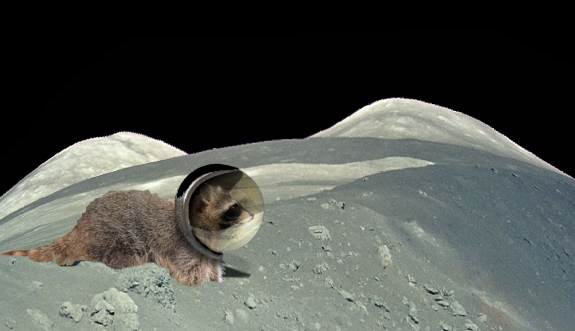
Photographic proof of moon raccoons!

Evidence denied by NASA. Posted by Hello

Friday, April 29, 2005

Thursday, April 28, 2005

The clothes make the woman

I've cleaned out my closet and drawers. Thoroughly. I've been ruthless — if it doesn't fit now, or if it hasn't been worn in the last three years (is that too generous?), away with it.

I threw out my red shoes. The faux-fur-lined red-vinyl lace-up ankle boots that made me feel so... individual in my final year of high school, 18 years ago. They had their day.

Then I opened the trunk. I thought I'd pretty much emptied the trunk; the only thing I remembered storing was a couple articles of maternity clothing, just in case.

The trunk.

My Brave New Waves t-shirt ("with apologies from CBC stereo"), black with pink logo, circa 1986, when Brent Bambury was host, which I won for some contest or other. When I worked late into the night on school projects, listening to Skinny Puppy and Einsturzende Neubauten. When I learned about Philip Glass and John Zorn. When I first heard of Italo Calvino, listened to a reading of If on a Winter's Night a Traveller.

The leather jacket. The black leather motorcycle jacket. My brother's jacket. It was his prize possession when he was in his early 20s; I was barely, not even, a teenager. My punk-ass brother and his jacket were the epitome of cool. Many years later he handed it off to me. It served me well through university. I wore it to London and to Paris. It hasn't really fit me in ages — it was always snug, but there's no hope of ever zipping it up again. But some seasons I still pull it out, feel the weight of it on my shoulders and hug it close. (There's a pin in the lapel, commemorative of Christmas in Italy, 1943 — my father's.)

A wide-brimmed black velvet hat with a spray of roses. I spent a fortune on it ($25 in 1988). I wore it only a couple times — in a photo shoot for a friend, and to a vernissage — because it wouldn't stay put. Also found: receipt for one large pearl hat pin ($1.50 plus tax) from retro shop. Helena is going to love this hat.

Various wearable nostalgia. Two The The concert tour shirts. A t-shirt from a vineyard on Long Island: "Life is a cabernet."

My father's fishing cap.

My mother's early 60s beaver pelt turban-style hat with glittery brooch.

Little black dresses. My mother's little black dresses. The wool dress with the fringed bustline (New Year's Eve 1956). The one tiered in lace ribbon with the wide velvet shoulder straps.

I remember those dresses sheathed in plastic hanging in my mother's closet when I was a little girl. She never wore them. Years later, home visiting from university and worrying over what to wear to some party or event or other, she gave them to me. I wore them a lot, to clubs and cafes and on dates, and I wore them well.

When I rediscovered those dresses in my mother's closet when I was 18, in some sense I discovered my mother, saw her as a woman for the first time. A woman with fashion savvy who went to dances and parties, who had special occasions that didn't involve her children's birthdays, who had a romantic soul, and an obvious sense of nostalgia.

I'm keeping some of my own dresses as well. The skirt and jacket my mother made for me out of red and black brocade upholstery fabric, cuz I asked her to. A couple sexy party dresses. The swishy-skirted dress I treated myself to in Poland. The yellow sundress I was wearing the day I first laid eyes on J-F, waiting at the bus stop with a mutual friend. The skirt and jacket I wore to that same friend's wedding, when I met and fell in love with J-F.

Someday, I expect Helena will be looking for something special to wear, for a party, maybe a date. We'll open up the trunk. Maybe she'll realize something about the woman her mother was before she had a family, and she'll wear that too.

Wednesday, April 27, 2005

Things I don't know what to make of

A.S. Byatt:
"I think about how much thinner literary characters have got since the disappearance of Christianity."

Hmm.

1. When did that happen?
2. There are many great literary characters of whom I can't say I ever considered religion to be the driving force.
3. What does that say about her own characters?

"Without religion we've been reduced to sex and death." And that's bad?

Tuesday, April 26, 2005

Circus of angels

J-F and I went to the circus on Sunday. We'd received tickets for Cirque du Soleil as a Christmas present.

Corteo. I'd heard nothing about the new show.

The anticipation in the hours preceding the matinee performance was palpable. There's nothing like the childlike awe in beholding the whimsical shape and colours of the circus tent and stepping through its flaps into another world.

The curtain was raised on a man on his deathbed. Angels flit about, and he struggles to join him. A parade of life passes him by — I assumed it was his life, his memories — some unseemly characters threatening to thwart his ascent to the angelic orders. This was his struggle to find peace in death, to cross into the afterlife. Angels!

For a full hour, my face was strained from smiling, my jaw dropping at regular intervals. We nudged each other, giggled, and pointed. Breathtaking. Heart-stopping.

At intermission, we darted through the rain to other tents to admire the trophies available for purchase to those lucky enough to be in attendance. Seuss-like hats, masks and wings, full whimsy wardrobes, along with the more conventional programmes and CDs.

The second act, though thrilling, faltered. The pacing was off. One very slow, if beautiful, sequence featuring a proficient whistler accompanied by a glass orchestra was followed up with jugglers interrupted by a torrent of rubber chickens, and then a weak, almost charmless, slapstick midget theatre production.

The music too was uneven. It was unmistakably Cirque, with the usual Mediterranean and Arabic influences incorporated into a soundtrack designed to build suspense. It was perhaps a little jazzier than is typical of their sound, scat even, but sadly it lapsed into Kenny G-type solos and regressed to a style of early 80s rock ballad. Little of it matched the baroque-inspired set, nor were there songs of angels.

As a finale, our dead man achieves full wings and halo.

Reading about the show afterwards, I feel cheated of lofty themes. The premise as written seems more mundane. It was not clear to me that the dead man was a clown among his old troupe. While the parade was felliniesque, I saw in it a quest, a narrative drive, that seems not to have been intentional.


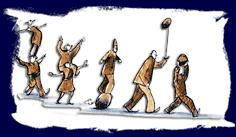
Parade of clowns. Posted by Hello

I enjoyed the show immensely, but I can't deny that in the second half the illusion wore away, the mechanics came into evidence, and a little disappointment crept over me.

What was missing? Children.

Helena was not in attendance. I took mental note of the many elements that would enthrall her. I noted the irony of anticipating the day Helena would be old enough to appreciate such a performance.

Very few kids were in the audience. Very few kids could tolerate a three-hour outing such as this one. Very few parents would spend so much money on a spectacle their children would stop enjoying after an hour. I stopped fully enjoying it after an hour.

While it's well and good that adults should be encouraged to find their inner child, to squeal with delight in awe of human feats of strength and dexterity, it felt phony not to experience it among children.

I look forward to sunny days in the park this summer and hope once again the local circus folk — I mean those regular people who live in this neighbourhood, the ones who have steady jobs with the circus — will come with their kids and practice their backflips and swing from the structures while the children occasionally look up from their sandcastles.

Monday, April 25, 2005

Free books!

See here.

New content below.

Things I need to write about, someday

There just isn't the time these days, with computer-sharing and work and stuff to do, to put down all the things I want to say. I'm lacking the emotional space and perspective.

Some of the points I need to work out:
-mothers and daughters in general
-how desperately I miss Helena when she's not here
-how little I feel I see her when she is here
-how difficult tantrums are
-my mother's implied criticism of my parenting technique (or lack thereof)
-things my mother has told me about mothering in her day
-the general inadequacy I feel as a mother these days

All my current angst relates to home-buying, the process of packing, the prospect of building a home, including the financing of the home, my place in the household. I'm deliberately detaching. There's a lot to do, all there is to do is plow through. While I'm "feeling" a lot of emotions, I'm not really processing them. It's easier to move forward by ignoring the inner turmoils.

And I want to tell you about the nostalgia, the things I'm finding in dark spaces in closets, the relief and freedom in purging oneself of objects and the past. The irony of shedding matter when for the first time I have the space to store it.

Helena is home with me today. We both have head colds. Naps! Movies! Books! Chicken soup! More naps! Ah, lazy day.

The Strad

The New York Times reviews Stradivari's Genius, by Toby Faber.

Highly prized and priced, Stradivaris have been traded, sold, hidden, stolen and even buried. They have been owned by royalty and rabble, played by amateurs and virtuosos, survived wars, floods and other natural disasters. In the right hands, these legendary instruments have made listeners weep, fall in love and believe in God; they have provided romantic fodder for novels like John Hersey's "Antonietta" and films like Francois Girard's "Red Violin." But "Stradivari's Genius," Toby Faber's first book and a work of nonfiction, is more enthralling, earthy and illuminating than any fiction could possibly be.


(Antonietta is an overlooked but wonderful book that may well have inspired The Red Violin. Anyone who loved the movie would do well to search this title out.)

The first, and to my knowledge only, time I heard a Strad up close and personal, it was played by Angèle Dubeau in an intimate chapel at the University of Ottawa. Angelic indeed!

I'd started playing violin when I was 8. There was a time I had talent, but no passion. From time to time the passion has surfaced, but I no longer had the technique.

For a time I toyed with the idea of making violins, partly for the romance of crafting an instrument from which music would resonate, but mostly to crack the mystery of the Stradivari sound. It seemed like the perfect merging of science and art (I hadn't considered that woodworking would be part of it too, or I might've abandoned the idea much sooner). I found books and blueprints, but had not enough passion to pursue this esoteric livelihood.

Related reading:
Delbanco, Nicholas. "The Countess of Stanlein restored: sound and soundness in a Stradivarius violoncello." Harper's Magazine. January 2001. p 39–54.

Atwood on London

The Guardian presents an extract from the soon-to-be-published Curious Pursuits: Occasional Writings by Margaret Atwood.

Atwood recalls the early 60s, the mood of the day, the clothes and hairdos, that set the scene for her first adventure abroad.

The truth is that I didn't have much idea of what I was really doing. Certainly, I had almost no idea at all of where I was really going, and how much it had changed since I'd last checked in via the pages of Charles Dickens. Everything was so much smaller and shabbier than I had imagined. I was like the sort of Englishman who arrives in Canada expecting to find a grizzly bear on every street corner. "Why are there so many trucks?" I thought. There were no trucks in Dickens. There weren't even any in TS Eliot. "I did not know Death had undone so many", I murmured hopefully, as I made my way across Trafalgar Square. But the people there somehow refused to be as hollow-cheeked and plangent as I'd expected. They appeared to be mostly tourists, like myself, and were busy taking pictures of one another with pigeons on their heads.


I'm reminded of the first time I travelled to "Europe," at the age of 19. London was not the destination of choice, but it was the one to which I could afford a plane ticket. There was little money left over for lodging or food. I spent my days looking for a place that would serve me tea with lemon. (I did find such a place — a Polish-run diner where I could also get a salad.)

Like Atwood, I wondered
Had my soul been improved? Possibly, but not in the ways I'd anticipated. What I took back with me was not so much the churches and museums and the postcards of them I'd collected, but various conversations, in buses, on trains, and with the pickup men at the museums.

Saturday, April 23, 2005

Free books to good homes

I'm culling my bookshelves. Really.

If you would like any of the books listed below, email me with your selections and an address to which they might be sent.

Disclaimer:
I'm getting rid of these books because I don't much care for them, on some level or other. In fact, there's a few I really hated, so be warned. I've read all of them except the Blais, because I attended a reading of hers shortly after acquiring the book and she put me to sleep, and the Burgess, which I've owned for about 15 years and I just haven't gotten around to it, but maybe I'll check out the story of the meeting between Shakespeare and Cervantes later today. (But I am keeping a few other unread books I've owned for longer. Go figure.) Frankly, I can't imagine any of you really wanting any of these books.

Fiction
Amis, Martin. Einstein's monsters.
Amis, Martin. Night train. hc
Amis, Martin. Time's arrow.
Barnes, Julian. England, England. hc
Blais, Marie-Claire. These festive nights.
Burgess, Anthony. The devil's mode.
Carey, Edward. Observatory Mansions. hc
Cocteau, Jean. Les enfants terribles.
Deane, Seamus. Reading in the dark.
Grass Gunter. The call of the toad. hc
Hesse, Hermann. Beneath the wheel.
Johnson, Diane. Le mariage. hc
Kazan, Frances. Halide's gift. hc
Leyner, Mark. My cousin, my gastroenterologist.
Mahfouz, Naguib. Miramar.
Malarkey, Tucker. An obvious enchantment. hc
Mantel, Hilary. The giant O'Brien. hc
Morrissey, Donna. Kit's law.
Okri, Ben. The famished road.
Richardson, Bill. Waiting for Gertrude.
Tremain, Rose. The way I found her.
Woolf, Virginia. To the lighthouse.
Yourgrau, Barry. A man jumps out of an airplane wearing dad's head.

Nonfiction
Bergler. The talent for stupidity. (best title ever)
de Botton, Alain. How Proust can change your life.
Dreher, Diane. The tao of inner peace.
Gould, Terry. The lifestyle. hc
Hacking. Mad travelers. hc
McGilvray. Chomsky. hc
Stassinopoulos Huffington, Arianna. Picasso. hc
de Rougemont, Denis. Love in the western world.

Altmann, ed. Cognitive models of speech processing.
Bauer. Introducing linguistic morphology.
Braybrooke. Philosophy of social science.
Coates. Women, men and language.
Cormac. A cognitive theory of metaphor.
Cowan, Rakusan. Source book for linguistics.
Eimas and Galaburda, eds. Neurobiology of cognition.
Harris. How the brain talks to itself.
Jensen. English phonology. (by the most boring prof I ever had)
Ladefoged and Maddieson. The sounds of the world's languages.
O'Grady, Dobrovolsky. Contemporary linguistic analysis.
Ouhalla. Introducing transfomational grammar.
Palmer. Grammar.
Penalosa. Introduction to the sociology of language.
Stillings, Feinstein, Garfield, Rissland, Rosenbaum, Weisler, and Baker-Ward. Cognitive science: an introduction. hc
Wardbaugh. An introduction to sociolinguistics.

That list looks really short, but the pile in the middle of the living room floor looks so big. There's another stack, as big, of books I thought I'd part with, but I'm having second thoughts — I haven't lived with them long enough, or they're inscribed to me personally, or I've forgotten them entirely and their premise suddenly seems fresh and relevant.

Any books you don't want will be dispensed with at... oh, who's kidding whom? I'll just keep them, probably. Except for the Malarkey — it makes me angry to see that one sitting on the shelf. I'll leave it on a park bench.
Thursday, April 21, 2005

These are the buildings in my neighbourhood

Photo essay:
There's a type of urban housing that is more versatile than rowhouses, more human-scaled than apartment buildings and far denser than single-family homes. It's called the plex — but unless you've lived in a select few cities, you've probably never heard of it.


I live in such a city.

We are soon leaving this home (rented and temporary) among the, ahem, "more exclusive plexes...facing Montreal's Parc Lafontaine," to take up residence on the other side of the neighbourhood in one of the city's new urban "condoplexes."

One of the greatest things about living in plexdom is the street life. Plexes — especially Montreal's plexes — are extremely conducive to what urban-planning visionary Jane Jacobs describes as "eyes on the street." The multiplicity of entrances, staircases and balconies maximizes the potential for interaction in the public realm, making plex-lined streets lively and interactive. There's always somebody coming and going and neighbours often stop for idle chit-chat. On warm summer evenings or sunny spring days, balconies fill up with people reading, relaxing or just watching passersby. "The rhythm of the street comes from the diversity of its people," says Dinu Bumbaru, the director of Héritage Montréal. The plex’s orientation towards the street makes that diversity all the more apparent.


Coincidentally, our new street is named for a Montreal architect responsible for some of the landmarks of the neighbourhood (but to my knowledge, he did not design any plexes).

Heralding copyeditors

A few words about and an interview with copyeditors (via Bookninja).

Ringing true:
I work in fits and starts, bitch and moan to others in the business, toy with the idea of leaving everything just as it is, walk around the block when I find myself sarcastically reading passages aloud to myself. When the deadline looms close enough, I sit down and do what I'm being paid to do. You just do your best and wonder why you didn't make a career of grooming poodles or putting wheels on toy trains when you had the chance. And why you didn't have the business sense to whip out a piece of trash and sell it to a publisher for a huge advance.


Of course, the article was pretty much ruined for me about halfway, with the appearance of "CE's" instead of "CEs" (it's plural, not possessive!) throwing me into a fit.

Wednesday, April 20, 2005

Why I'm going to burn in hell

The election of a new pope has established the climate for an Apprentice spin-off.

Picture Joseph Ratzinger in Donald Trump's chair.
We bring you The Inquisitor.
Catchphrase: You're excommunicated! (Or maybe: You're going to burn in hell.)
Theologians vs the pastors.

Among the tasks for contestants:
Run a PR campaign to attract young men to the priesthood.
Convert a small village.
Renovate and repurpose the papal palace at Avignon.
Design a new line of vestments, to be judged by Gammarelli.

Who will be the next Inquisitor?

Colour

I'm not alone in noting the problem of colour perception I alluded to the other day. (Diana gets it.) We all have trouble properly naming shades of aqua and teal, but we can measure the light frequencies and agree on a definition. But how do we know if the experience of the colour is universal?

I remember Stephen Pinker in How the Mind Works briefly addressing this problem that has haunted me for decades, and dismissing it.

I've been scanning the pages, looking for a reference, and found this (p 146):

Might your experience of red be the same as my experience of green? Sure, you might label grass as "green" and tomatoes as "red," just as I do, but perhaps you actually see the grass as having the color that I would describe, if I were in you shoes, as red.


Pinker's answer to this and similar quandaries of subjective experience is "Beats the heck out of me!"

At least for now, we have no scientific purchase on the special extra ingredient that gives rise to sentience. As far as scientific explanation goes, it might as well not exist. It's not just that claims about sentience are perversely untestable; it's that testing them would make no difference to anything anyway.


And so he relegates this topic, and others, to late-night dorm-room bull sessions and similar forums.

There you have it. Do we really see the same colours? Who cares!

Tuesday, April 19, 2005

Don't panic.

Easy for you to say.

Good cause for panic is presented in the extended review of the new movie incarnation of The Hitchhiker's Guide to the Galaxy at the now-closed Planet Magrathea (via Maud Newton). "It's as if someone had filmed Gulliver's Travels but had made the Lilliputians and Brobdingnagians normal-sized and turned the Houyhnhnms from talking horses into yellow triangles. The film-makers, to borrow a phrase, 'just don't get it'."
This film, I'm very sorry to report, is bad.

Really bad. You just won't believe how vastly, staggeringly, jaw-droppingly bad it is. I mean, you might think that The Phantom Menace was a hopelessly misguided attempt to reinvent a much-loved franchise by people who, though well-intentioned, completely failed to understand what made the original popular — but that's just peanuts to the Hitchhiker's movie. Listen.

And so on...


Apparently, "The jokes have gone. The funny bits, the wit, the humour. The clever stuff that made it worth including in the first place.":
There are so many wonderfully quotable lines in Hitchhiker's Guide, most of which are notable by their absence from the film. There are, astoundingly, individual phrases and even words that have been removed. For example, in the Vogon poetry scene which, like Prosser's confrontation, is now so short as to be utterly pointless, Arthur’s line "counterpoint the surrealism of the underlying metaphor", a brilliantly crafted piece of faux literary critique, has become "counterpoint the underlying metaphor." How is that justified? Did someone try to keep the film under two hours by crossing out some of the long words?


A wonderful summary of the book, the story, thus far, and where this version goes wrong:
Somebody who really doesn't understand Hitchhiker's Guide, or who is trying to summarise it without having read/heard/seen it recently, might think that the story was about the search for the Ultimate Question. In fact, the whole central joke of Hitchhiker's, for Zarquon's sake, is that this massive philosophical enquiry into the meaning of it all is a minor subplot. None of the main characters are especially bothered about the Ultimate Question, the concept of which is in any case entirely unknown in our universe except to the Magratheans who built the Earth for beings from a different dimension. Arthur's quest is for a return home and a nice cup of tea; Zaphod's quest is a purely avaricious desire for fabulous wealth and the fame and sex that comes with it; Ford's quest is for a good party — 'a strong drink and a peer group'; and inasmuch as Trillian ever had a quest it was for something more than 'the dole queue again on Monday morning'.

When the possibility of learning the Question crops up, the characters are mildly interested, as who wouldn't be, but they are none of them driven by it — until now. A bunch of people ignoring the possibility of discovering the meaning of life because they are concerned about a party or a cup of tea or whatever is funny. A bunch of people searching for the meaning of life, well, isn't.


Apparently, there is one genuinely funny line of dialogue, "just don't cough while the Magrathean hologram is speaking or you may have wasted 110 minutes of your life instead of just 109 minutes and 30 seconds."

What?
The Hitchhikers Guide to the Galaxy and God. Where's a Babel fish when you need one?

Huh?
Variety.com: The "Hitchhiker" book may be on the high school curriculum in Iceland but it isn't widely read in Idaho. It remains to be seen how Adams' unrepentant atheism will play in the U.S. "God and religion don't do well in this film," Jennings admits.

More tentacles than you can shake a stick at

Tasty octopus pulp!


Sea Devils #21, February 1965,
from DC Publications. "Arms to Spare" cover.
 Posted by Hello

More octupus art, links, and tidbits at Octopia.
(Via Scribbling Woman)


Octopus mama!
A heartwarming story of a mother who wouldn't give up on her eggs.

Last June, the octopus laid tens of thousands of eggs in her ALaska aquarium. It usually takes 6–8 months for eggs to hatch, but it seems to be taking longer because of the colder conditions.

They're hatching!

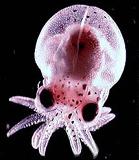
Aww, look at the baby octopus! Posted by Hello

Sadly, "Aurora's fate, though, is sealed. Giant Pacific females usually die about the same time as their eggs hatch, mostly because they stop eating for months and spend their energy defending their eggs."

(Via Collision Detection)

Sunday, April 17, 2005

Papal politics

The conclave
A historical look at conclaves: graph.
On the group dynamics.

The odds
The odds have changed daily over the last 2 weeks. As of this writing Cardinal Ratzinger leads the pack at 3:1.

Bear in mind:
In the last conclave in 1978, Vatican-watchers had concocted lists of potential popes 20 to 30 names long, hoping that would cover all the possibilities. But Karol Wojtyla, the cardinal from Poland who became Pope John Paul II after three days, made practically none of them.


Complete coverage:
CBC
CBS
CNN
The Guardian
The New York Times
NPR

There is some overlap, but all offer different shortlists for the papal successor. NYT and CBC include Canadian Marc Oullet (Friday odds were 80:1; today 50:1). CNN ignores Martini. CBS omits the Jesuit, Bergoglio.

The obvious
According to the New York Times, Ratzinger "appears to command the largest and most cohesive block, and at a minimum, it seems unlikely that the next pope will be chosen without his blessing."

The art
There was considerable leakage of information during the conclave that elected John Paul II in 1978, and the Vatican is taking measures to ensure it doesn't happen again.

Nobody really knows what happens inside the conclave, but there are educated guesses and imagination fills in the blanks.

The New York Times reviews conclaves, papal politics, and the personal struggles of cardinals as presented in books and movies.

Fiction:
The Cardinal, film, Otto Preminger, 1963.
The Shoes of the Fisherman, film, 1968, based on the novel by Morris L West.
White Smoke, Rev. Andrew M Greeley, 1996.
Conclave, Greg Tobin, 2001.
Angels & Demons, Dan Brown, 2003. (excerpt)

Nonfiction:
The autobiography of Pius II, 15th century.
The Making of the Popes, Rev. Andrew M Greeley, 1979.
Conclave: The Politics, Personalities and Process of the Next Papal Election, John L. Allen Jr, 2002.
Selecting the Pope: Uncovering the Mysteries of Papal Elections, Greg Tobin, 2003.
Heirs of the Fisherman: Behind the Scenes of Papal Death and Succession, John-Peter Pham, 2004.
Making of the Pope 2005, Rev. Andrew M Greeley, currently being researched.

I've read the following religious-themed books. Though not specifically focused on the election of a pope, they offer insight into the religious mind as well the workings of the Church.

Fiction:
The Name of the Rose, Umberto Eco, 1983; film, 1986.
On the Third Day, Piers Paul Read, 1991.
The Seville Communion, Arturo Perez-Reverte, 1995.
The Third Miracle, Richard Vetere, 1997; film, 1999.

Nonfiction:
In God's Name: An Investigation into the Murder of Pope John Paul I, David A Yallop, 1984.

If nothing else, they're good mysteries.

Drenched with ritual and cloaked in secrecy, the spectacle of the conclave makes for great theatre.

A lingering curiosity
The text of John Paul II's last will and testament is available in English. Though the media voiced some speculation at the time of the pope's death, I'm left puzzling as to the how and why of the resolution of this wish:
5.III.82 (March 5, 1982)
In connection with the last sentence in my testament of 6.III.1979 (March 6, 1979) ("concerning the site / that is, the site of the funeral / let the College of Cardinals and Compatriots decide") — I will make it clear that I have in mind: the metropolitan of Krakow or the General Council of the Episcopate of Poland. In the meantime I ask the College of Cardinals to satisfy, as far as possible, any demands of the above-mentioned.

Saturday, April 16, 2005

Everything you ever wanted to know about me, but were afraid to ask

Because Rachel wanted to know and wasn't afraid to ask:

1) What's the first "adult" book you ever read, and how old were you? (you may define "adult" however you wish)

Anais Nin's Delta of Venus, when I was 19 and discovering a world of earthly delights.

This is a very interesting question actually, in terms of "grown-up" books. I was reading a lot of Agatha Christie at 9 or 10. In grade 7 we read The Martian Chronicles (around the time the miniseries was aired) and I, Robot, Animal Farm, also Hamlet. Are they grown-up books? They certainly were not written as children's books, but they are accessible to young adults and open up new worlds.

As far as books not on the school curriculum: The Gormenghast Trilogy (which may also be considered a "crossover" work and an introduction to the fantasy genre).

At 14 I stumbled across (I don't know how) Dalton Trumbo's Johnny Got His Gun, and it scarred me. I don't think anyone is ever prepared to read that (I wonder what affect it would have on me now).

2) Whom would you rather date, Miguel de Cervantes or Fyodor Dostoyevsky? (substitutions allowed)

Dostoevsky, hands down. In fact, I think I did date him: a tormented writer — there was much vodka consumption, I generally paid his way. Late nights talking about the natures of Man and God, usually "privileged" to sit among the men. Lots of Polish jokes. But good parties and interesting social circles.

That said, though I still don't know Cervantes all that well, I rather suspect he's someone I'd consider settling down and living happily ever after with, in a mildly adventurous, self-delusional kind of way.

3) What is the most uniquely Montreal thing about living in Montreal?

In an obvious and superficial way:
The staircases, architecturally unique and almost stupid in a city that sees so much snow. Quaint, but positively treacherous in winter.
The general disregard for traffic lights.
The "bilingualism" in such utterances as "I have to stop at the guichet before we get to the dep," how the constant exposure affects your vocabulary and syntax. (Here's a fun list of similar Montreal peculiarities.)

But most striking to me:
Good lighting, by which I mean the restaurants, cafés, etc are darker than in other cities and thus more conducive to intimacy, whether among friends or lovers. It imbues conversations with the sense that they are more meaningful, even if they're about shopping.

4) What were your career aspirations at age 11, and do they make you laugh or cringe?

I do not have a clear recollection of ever wanting to be anything specific when I grew up (damn that lack of direction!), although at about that time I was somewhat enthralled with the idea, the romance, of being a writer or editor, but it's not as if I ever really wrote anything other than crappy angst-ridden teenage poetry. When I was 12, my teacher suggested I pursue philosophy — I was really hung up on the problem of colour perception, how do we know we're all seeing the same colour (and I maintain that we don't, and this explains why we have different tastes in art, fashion, home-decorating, etc).

When I did get my first editing job, someone asked, "Didn't you always want to be an editor when you grew up? What a cool job!" and I said, "Come to think of it, yeah, kind of."

5) If you ever did get around to writing a book, what kind of book would it be?

Mostly fiction. Which is maybe not such a good choice considering I have no imagination. Give me a seed and I can grow it, but I just can't make something out nothing.

I have for a very long time wanted to write a fictionalized account of my mother's experience of wartime — how the family left Poland in 1939, travelled through Russia and the Middle East, and eventually found refuge in India (of all places). But a decade after the idea first occurred to me, I feel as if this type of memoir has been done to death. Also, I suspect my family would be more of a hindrance than a source or a support — which makes it just too big a project to take on, emotionally. For the time-being anyway.

Meanwhile, interestingly, for the last few months, for the first time ever, I feel as if I might have a wholly original novel in me after all. It goes almost without saying that it should be bleak and dystopian, and I'd like to explore the relationship and the disconnect individuals experiences between real life and their online personas. I'm not sure I want to say anything more though, because then I'd feel committed to seeing it through, and I don't need that kind of pressure weighing on my lazy-ass self.

My questions for others I want to know more about will be posted in the days to come.

A people's novelist

Nick Hornby "name-drops with learned affection, lovingly sifting and sorting by class and genre, distilling into Top Five lists. He revels in pop culture and, yes, crafts a kind of poetry from it."

I like Nick Hornby.

Friday, April 15, 2005

Parental film units

Ann Douglas wants to know about parents in the movies. (She's right — this is way more fun than doing my taxes!)

Meanest movie mom ever
Shelly Winters' character in Kubrick's Lolita is horrid. She is to be disliked vehemently, but while she has occasional mean ourbursts, she's more a pathetic figure than a bad mother per se.
So my nomination goes to Mrs. Bates of Psycho. If her son's impressions of her are any indication, she was nasty.

Meanest movie dad ever
Jack Nicholson in The Shining. Jack's pretty creepy to start with — I'd steer clear of him most days. But all work and no play makes Jack one mean and very scary dad.

Best movie mom ever
Juliette Binoche portrays the ultimate mom in Chocolat. Free-spirited and kind, she's a pillar of strength. She live "goodness" and shows that it is not necessarily synonymous with Church or Law. And she runs a chocolate shop — what kid wouldn't love that?
(I have a soft spot also for Duchess of the Aristocats. "We must concern ourselves with self-improvement.")

Best movie dad ever
Roberto Benigni in Life is Beautiful. Because.

Most nauseating movie mom ever
Most nauseating movie dad ever
I am uninspired to nominate anyone for these categories other than the Maria von Trapp and Mrs Doubtfire.

Really, I ought to get out more, or at least rent more movies with families in them (as opposed to aliens, monsters, and lost souls — though a case could be made that it's all the same...).

J-F wants me to nominate Gene Hackman of The Royal Tenenbaums, but for all his struggles in trying to redeem himself, I have trouble fitting him into a category.

As for the film character who most reminds me of myself, and why, that may have to wait for another post. I doubt she's a mom, and may not even be female.

Which movie mom are you?