Thursday, January 27, 2011

A girl and her cat

"No one has any idea, do they, until they have children, what it means. It's all I can do just to keep up with the rush of things, the meals one after another, the food, let alone giving the children the attention they should have. I know that Emily is ready for more than I have time to give her, but she is such a demanding child, so difficult, she always has taken a lot out of me, she want wants to be read to and played with all the time, but I'm cooking, I'm ordering food, I'm at it all day, well you know how it is, there isn't time for what there has to be done, I simply don't have time for the child. I did manage to get a girl for a time last year, but that was really more trouble than it was worth, really, all their problems and their crises and you have to deal with them, she took up as much of my time as Emily does, but I did get an hour to myself after lunch and I put my feet up for a bit, but I did not find I had the energy to read, let alone study, no one knows how it is, what it means, no, children do for you, they do you in, I'm not what I was, I know that only too well I am afraid."

The child on her knee, two or three years old, a heavy passive child dressed in white wool that smelled damp, was being jogged faster now; his eyes were glazing as the world bounced up and down around him, his adenoidal mouth was open and slack, the full cheeks quivering.

The husband, passive but really tense with irritation — with guilt — smoked on, listening, frowning.

"But what can you give out when you get nothing in? I am empty, drained; I am exhausted by lunchtime and all I want is to sleep by then. And when you think of what I used to be, what I was capable of! I never thought of being tired, I never imagined I could become the sort of woman who would never have time to open a book. But there it is."

She sighed, quite unselfconsciously. She was like a child, that tall, solid, confident woman; she needed understanding as a child does. She sat looking inward into the demands of her days and her nights. No one else was there for her, because she felt she was talking to herself: they could not hear, or would not. She was trapped, but did not know why she felt this, for her marriage and her children were what she personally had wanted and had aimed for — what society had chosen for her. Nothing in her education or experience had prepared her for what she did in fact feel, and she was isolated in her distress and her bafflement, sometimes even believing that she might perhaps be ill in some way.

— from The Memoirs of a Survivor, by Doris Lessing.

This is a very weird little book. The Memoirs of a Survivor is described as a dystopia, and by Doris Lessing herself as "an attempt at autobiography." It reads like part fairy tale, part tract, a report from another time and place, not quite like a confessional diary as one might expect from the title.

It is never entirely clear what it is that's being survived, or who is surviving it. There's the girl, Emily, and the woman, the narrator, on whose doorstep she turned up, charged with being responsible for her. And Emily's cat.

While it's the girl who thrives in the outside world, the anarchic, back-to-basics conditions where she establishes herself as a kind of leader (or, at least, a leader's girlfriend), it's clearly the woman who's a survivor of Emily's puberty, teenage years, sexual awakening.

The girl and the woman are incomprehensible to each other, yet also the same. They're at a bit of a standoff. The narrator very sagely recognizes that we too were once children, once young and in love. Yet it's somewhat unsettling, however reasonable, for her to stand back, so detached, and watch Emily grow up, let her grow up all by herself.

Meanwhile, there's the world falling apart outside, we know not why, and the walls of the woman's apartment melting away to show her other realities, past and future. (We know Emily's mother, as excerpted above, only through these glimpses through the wall.)

If you've never read Doris Lessing, I don't recommend this novel as an introduction to her. But even though this novel is kind of all over the place, there are some lovely thought-provoking bits, about children, about growing up, gender politics, etc.

New York Times review, 1975.

I almost think this book's really about the bond between a girl and her cat. Which makes for a pretty remarkable story, really. (I say this as someone who has lately enjoyed a good deal of quality time with her cat; it feels like she's finally chosen me to be hers — we have an understanding, she and I.)

Wednesday, January 26, 2011

The mountain and the shortcut

The path was clear. From the metro station exit, around the corner, down the street, across the parking lot, through the alley, and it's the next building down, across the street. Then it snowed.

Since the first big snow back in December, I've had to cross a mountain to get to work. When they cleared the parking lot, they piled the snow in the back corner, blocking access to the alleyway.

That first day, I wasn't sure it was passable. But I found a path that had been trodden before me. Up and over.

The second day, I met someone coming the other way. Giggling and carrying a plate of cookies. High, I thought. I backed up a couple paces to let her pass and we exchanged some pleasantry. At last I came down on the other side, full with the uncertainty of fresh snow and giggling myself. Silly, slippery snow mountain.

The mountain has changed. The path is now a deep furrow, so narrow that, ironically, it's much harder to get a solid foothold. There is no longer a steady incline. A parking space has been reclaimed by carving into the slope. The way across is a plateau, but the step up to (or down from) it is treacherous.

This week in some stupid -30° weather, a colleague on the way out of the building asked if I knew about the "shortcut." Somehow, after 2 months of employ, I was finally deemed worthy of this secret knowledge, or maybe she just took pity on me in the cold.

Quick across the street and in through an unmarked industrial door beside a loading dock. Two levels of parking, eerily quiet given that most of the city is knocking off work at this hour. A stairwell and a narrow hallway wending back and forth. We exit beside a bank of elevators at the main front entranceway to the building. It's only appropriate that the occupant of the building be a major producer of video games.

Outside across a different parking lot, and now into the stock exchange building. More stairways before hitting the tunnels that join up to the metro.

I don't think it was shorter, but it was warmer for the length of two short city blocks (broken up by a block of the brisk outdoors).

No matter which path I choose on my way to and from work, it seems I choose my own adventure.

Saturday, January 22, 2011

Bookstore

Today we went to the bookstore, me and the kid. Some ridiculous -20° outside, but we made this plan over a week ago, and and we've been looking forward to it.

I've long since (mostly) come to terms with the fact that Helena is not the sort of reader I hoped and expected a daughter of mine to be.

Confession: We do not have regular bedtime stories, and haven't had for years. If it wasn't fun, there didn't seem to be any point to it — more trouble than it was worth. There may not be a lot of support for this sort of strategy in the parenting books (although, I wouldn't know, not being the type to consult that kind of reference), but I think she's growing up to have a reasonable appreciation for books all the same.

We have the occasional evening or weekend afternoon, some spontaneous, some planned, full of books, mine and hers, and often cocoa, on my bed, and it is comfort and joy. And if she does not read every day, I think at least she remembers to make a special time for it.

Helena received a gift card for the bookstore for her birthday some time ago, and just last week was lamenting the fact that she didn't get the one book she really wanted for Christmas. So we made the plan to acquire it.

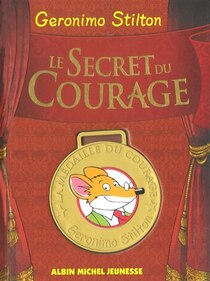
What's cool with second-graders these days and new on our shelf today: Geronimo Stilton: Le secret du courage!

Friday, January 21, 2011

There are days

As much as I love my new job, there are days... There are days I'd rather stay in bed. When it's cold, when the world outside is blanketed in snow, just a day, to rest and replenish myself.

"Momma," she exhorts, "go back to bed. Just look at it outside. You're in no condition for that. You're tired. You deserve to rest. You don't need to worry about me. I can take care of myself. I can go to school by myself. You should stay home today. In bed."

I smile. That kid can be really sweet.

"You deserve a day off, Momma. Really, go back to bed. Don't worry about a thing." She drives her argument home: "I've already arranged everything with your boss."

And for a moment, just a moment, my hopes are raised. For a moment I let myself think, Really?

Thursday, January 20, 2011

About enough

"An attentive reader will always learn more, and more quickly, from good authors than from life. "

I thought I should say a few things about Enough about Love, by Hervé Le Tellier, set for publication in February. My review copy (in e-book format!) has already long since vanished into the ether. I read this back in October, and enjoyed it immensely.

Do I have anything more to say about it? It's proven to be mostly forgettable, but that shouldn't diminish the enjoyability factor. Reminds me a lot of Kundera — kind of philosophy lite, in a relationship-y context. The many reference to weightier works (including none other than Madame Bovary, which I was reading at the time).

[Of her husband, "Anna wants him to be more outgoing, more dazzling. She is actually less eager for him to be successful than for him to want to be successful." It's Emma and Charles all over again!]

On the extensive bookshelves against the far wall, literature rubs shoulders with psychoanalysis in peaceful conflict. Joyce mingles with Pierre Kahn, Leiris is shoehorned against Lacan, a book by Queaneau which has been put back in the wrong place — a good sign for a book — leans up against a Deleuze.

That's a lot of name-dropping. I won't pretend to know the first thing about half the figures Le Tellier mentions. He seems to do so with purpose, and the references do seem to bear some relationship on the plot and character issues at work, whether the nature of love, power politics, creativity, identity, destiny, whatever.

Thomas shakes his head. In these few minutes of his life, he can see a fork in his own destiny. That was the word Anna used in her last session, when she said, "I don't know whether Yves is my destiny." Coming from Anna, the word is ambiguous, somewhere between freedom of choice and the inevitability of fate.

Thomas does not believe in fate. He would have the power of speech and actions shape our lives. To him, that is the point of psychoanalysis, giving the analysand the strength to become the driving force in his or her own life. If the accident just now had actually happened, he likes to think that, against all the odds, he would have known how to play it right, to become one of the people Louise would lean on.

As a teenager, he had endless discussions about the elasticity of individual fates and History (with a capital H, as Perec used to say). The budding Marxist confronted trainee Hegelians. If Hitler had died in a car crash in 1931, would some inertia in the powers that be have doggedly set the war and the Holocaust back on track? Was Stalinism conceivable with a different Stalin? Who could have replaced Trotsky?

Other questions hover. Where did he stand in Louise's story? Did a lover have to turn up at this particular point in her life? Was he interchangeable? Thomas has no idea.

See the review at The Complete Review for a fuller notion of what's going on in this book, and this passionate endorsement.

Excerpt.

It's a romance novel, but with a very mature approach to love as it is among very real, and very smart, grown-ups. I can see myself picking up this novel again.

Monday, January 17, 2011

Simenon's bedrooms

So here finally is a Simenon novel I found less than enthralling. Three Bedrooms in Manhattan doesn't have any criminal elements to speak of — it's more of a romance — and I suspect this has a great deal to do with the fact that this novel on the whole just didn't work for me.

Why did he keep thinking about her? Why had he gone out? He had promised himself that one morning he'd be there in the hallway or on the stairs when she left. But every time, she managed to get up at seven sharp. She didn't need an alarm clock. She didn't bother to wake her friend. Combe never heard them talking in the morning.

Stray sounds from the bathroom, perhaps a kiss on the forehead for the man lying asleep, then she opened the door and slipped out. He imagined her searching briskly for a taxi to take her back to the station.

What did she look like in the morning? Could you make out the night's traces on her face, in her sagging shoulders, her hoarse voice?

That was the woman he wanted to see — not the one who got off the train, brimming with self-confidence, who then showed up at the studio as if she was just dropping in on some friends.

He wanted to see the woman at daybreak, when she went off alone, leaving the man asleep, selfish, stupefied, his damp forehead grazed by her lips.

He came to a corner that seemed vaguely familiar. A club was closing. The last customers were out on the sidewalk, waiting in vain for a taxi. On the corner two men who'd been drinking were finding it hard to say good-bye. They shook hands, pulled apart, then immediately turned back for a final confidence or renewed protestations of friendship.

Combe, too, looked like he'd been in a bar, not like someone who'd just gotten up.

But he hadn't been drinking. He was sober. He hadn't been out listening to jazz. He'd spent the night in the desert of his bed.

All this in considering the unseen woman who visits his neighbour. There are some lovely, moody, poignant bits (I mean, "the desert of his bed"!), and that spare, clipped language drew me forward, but I found Franҫois Combe to be completely abstruse. I don't understand him at all, and I can't believe the character was designed in this way to be so deliberately opaque. And I can't imagine any woman falling in love with him.

It's said that this novel is quite autobiographical; maybe my distaste for Simenon the man is colouring my reading. Perhaps Combe is not so different from Simenon's other (anti)heroes, but without the focus (or perhaps distraction) of some criminal or seedy element, some genuine evil or real meaninglessness (none of this lovelorn bullshit), he is less easy to bear. Less culpable, but less sympathetic. I just didn't get Combe.

Wednesday, January 12, 2011

An almost cosmic sadness

Despite the mildness of the air, he felt cold inside, and he searched fruitlessly for his tweed jacket or his raincoat. He had another lighter jacket in his suitcase. Going around to the back of the car, he opened the trunk, and his expression became one of stupefaction and dismay.

He was filled with a vast sadness that morning, an almost cosmic sadness. The suitcase was gone, but before its removal Nancy's things had been taken out of it — underclothing, sandals, and a swim suit lay scattered among the tools. The toilet kit, which contained among other things his comb, toothbrush, and razor, was also gone.

He did not attempt to think. He was just sad, and would have given a great deal to have things turn out less squalidly.

— from Red Lights, by Georges Simenon.

It's impossible for me to rank these books. Just when I think I've read the best Simenon ever, I read another one that's just as good.

So this one's a little different because of the American setting. There's an undeniable American feel to it: quintessential late-summer American suburban domestic. And Steve's a bit more of a jerk than the characters populating the other novels. Maybe this makes him more tragic too?

In brief, Steve and Nancy head out from New York to Maine, to pick up their kids from summer camp. Steve wants to stop for a drink (and then another) but that doesn't go over too well with Nancy. (Although, a lot of the not going over well is blown beyond proportion in Steve's head — she really doesn't say all that much. Steve gets the vibe from her presence, her look — from working himself up.) Steve's basically picking a fight with her, and being a big jerk about it, after building a case against her in his unspoken thoughts addressed to complete strangers, and in defense of a man's got a right to have a drink now and then if he wants.

Steve makes yet another stop, but when he comes back out from this roadside bar, Nancy's not in the car. And now things spiral totally out of control. Really. There's an escaped convict, and also a nosy telephone operator. Gripping stuff.

It's less a mystery than a psychological study of this couple with their petty squabbling. But Steve has issues too. For example, that his wife works and is relatively successful. (It's worth noting also that she would be less valuable as a wife if she were less good-looking.) He's emasculated, and drinking is one way to assert his manliness. But it all goes so horribly wrong.

But then there's redemption! (Of a sort, for Steve.)

We experience the goings on from Steve's (in my opinion warped and unhealthy) perspective, but I would love to read Nancy's side of the story! I can't decide if she's mature and realistic and at terms with her life, or pitiful. Someone should write that novel for me please!

Monday, January 10, 2011

On the shore

"What is it?"

"It's not something you can get across in words. The real response is something words can't express."

"There you go," Sada replies. "Exactly. If you can't get it across in words then it's better not to try."

"Even to yourself?" I ask.

"Yeah, even to yourself," Sada says. "Better not to try to explain it, even to yourself."

I won't try (too hard) to explain it (much). I read Haruki Murakami's Kafka on the Shore over the holiday season, finally and having made some false starts on it over the last few months. I find reading Murakami demands a certain state of mind — sometimes the willed reading of him might bring this state into being, but sometimes it doesn't come so easy. That said, once I was in it, I loved it.

Murakami's not exactly a prose stylist, at least not in translation, but he does have the occasional way with words ("Her smile steps offstage for a moment, then does an encore"). He's more an idea guy. Thing is, I'm not really sure what the idea is.

Now, The Wind-up Bird Chronicles was pretty mind-blowing. Dream-like and trippy. But now that I "know" Murakami, his style of slipstream is a literary normal that I'm perfectly accustomed to. I mean, this being the fourth Murakami I've read, the edge is gone; it's no longer weird.

It's a lovely feeling, to be swept up in this surreality, the strange interconnections. I kind of wish I'd discovered Murakami decades ago — as a university student I'd have peed my pants with excitement to get my hands on his latest. But now, as much as I enjoy getting lost in Murakami's world (and make no mistake: I will read plenty more, and I'm plenty excited about 1Q84), I feel like I've been tricked — it just doesn't strike me as all that deep.

I'm not entirely sure what makes me say that, and I'm not all that sure what "deep" is. But take for example this idea: "People are drawn deeper into tragedy not by their defects but by their virtues." It's just thrown out there in a casual conversation. Sure, the character doesn't say this in a vacuum; there's context, there are references to Aristotle, to Oedipus. But the idea itself is the sort of thing you could write volumes about; yet there it is, for the reader to latch onto, or not, for a paragraph or two, and that's pretty much the end of the idea. It doesn't exactly weave itself throughout the novel as a grand theme (unless you work really hard at analyzing the novel that way).

I suppose this makes it deeper than the books that don't even bother throwing that kind of idea to the reader, but it makes me feel teased and short-changed. Maybe, even, there are too many ideas, and they're all over the place, touched on lightly, and this upsets some literary order I keep in my head. Not that I'm averse to doing any thinking for myself, but Murakami lulls me into believing that I'm thinking when I'm not. I finish Murakami novels with a "What just happened?" feeling, not with regard to the plot, but with a question mark hovering over the (pleasurable) immersive experience of reading a Murakami novel: Why did I love it so much? Neat trick. I don't know how he pulls it off.

Do you love Murakami? Do you think he's "deep"? Or just beautiful?

Apart from the talking cats, and that a guy carried on conversations with the cats, my favourite part of Kafka on the Shore is the digressions on music. The book should come with a built-in soundtrack. Schubert. Beethoven's Archduke Trio. Haydn. (I had to make due with other Beethoven trios.)

They say writing about music is like dancing about architecture, which is hard to do well. I love that Murakami has characters talking about music, with interesting things to say about it, and naturally.

"That's why I like to listen to Schubert while I'm driving. Like I said, it's because all the performances are imperfect. A dense, artistic kind of imperfection stimulates your consciousness, keeps you alert. If I listen to some utterly perfect performance of an utterly perfect piece while I'm driving, I might want to close my eyes and die right then and there. But listening to the D major, I can feel the limits of what humans are capable of — that certain types of perfection can only be realized through a limitless accumulation of the imperfect. And personally, I find that encouraging. Do you know what I'm getting at?"

Saturday, January 08, 2011

The catastrophe of my personality

Now I am quietly waiting for
the catastrophe of my personality
to seem beautiful again,
and interesting, and modern.

The country is grey and
brown and white in trees,
snows and skies of laughter
always diminishing, less funny
not just darker, not just grey.

It may be the coldest day of
the year, what does he think of
that? I mean, what do I? And if I do,
perhaps I am myself again.

— from "Mayakovsky," by Frank O'Hara, in Meditations in an Emergency.

I first heard this bit of poetry quite recently, and it's probably the first I'd ever heard of Frank O'Hara, and I'm sure it's true for many people, when Don Draper recited it at the close of an episode of Mad Men.

It's not the first time Mad Men has inspired my literary pickings, and I'm sure it won't be the last, but something about this recitation made me gasp, and cry a little, and want to know everything about Frank O'Hara and the bar he sat in while writing it.

I think this stanza did all it could do for me, and then some — one beautiful television minute, lingering and working through my bloodstream. Weeks since I first saw it, I think about it every day.

But I ordered this collection for my sister straightaway (happy birthday Ivonna!), because, well, I don't know why. There is no emergency, no urgent need for meditation, not beyond the daily emergency of life. Not for her, I don't think, and not for me. It may be the coldest day of the year, that's all, and we should meditate some.

I think about becoming myself again.

Friday, January 07, 2011

New year, new books

Working my way through Simenon's romans durs, one by tragic one. Ordering them one by one, on an as-needed basis; otherwise, I fear I would glut on them, not sleep at all, perhaps drink myself to death, or just leave. Greatly relieved to discover that NYRB is issuing another one this year, so I don't yet have to fear running out.

Treated myself to Aurorarama, by Jean-Christophe Valtat, because it sounds breathtakingly lovely and weird, and I'm particularly enamored of the possibility to confront for myself the copyeditor's dilemmas therein. Seems I'm not yet in the mood for it, though.

After talking up the brilliance of China Miéville and of The City & the City in particular to various coworkers, I'm all in a lather over when there might be something more for me to read, and lo! Embassytown! Sounds like a sequel! But no! it's something entirely new!

Resolving also to finish The Magic Mountain (Thomas Mann) before the winter is through.

That is all.

Monday, December 20, 2010

"Because you didn't have any"

My first Icelandic thriller turned out to be fairly thrilling. Tainted Blood, by Arnaldur Indriðason, was also published as Jar City. It's well-paced and has some thought-provoking aspects, not least being Iceland's nature as a closed community and how invaluable it therefore is in terms of things like genetic research, when traits and diseases can be readily mapped to geneological trees.

Detective Erlunder, the main investigator, is a fairly well-drawn character, with a complicated personal side, blah, blah, blah. His coworkers are more enigmatic, or more thin (at least in this first of the detective series).

It turned out that they were well suited, had similar interests and both wanted to make a beautiful home for themselves with exclusive furniture and objets d'art, yuppies at heart. They always kissed when they met after a long day at work. Gave each other little presents. Even opened a bottle of wine. Sometimes they went straight to bed when they got home from work, but there's been considerably less of that recently.

That was after she had given him a pair of very ordinary Finnish Wellington boots for his birthday. He tried to beam with delight but the expression of disbelief stayed on his face for too long and she saw there was something wrong. When he finally smiled it was false.

"Because you didn't have any," she said.

"I haven't had a pair of Wellington boots since I was . . . 10," he said.

"Aren't you pleased?"

"I think they're great," Sigurdur Óli said, knowing that he hadn't answered the question. She knew it too. "No, seriously," he added and could tell he was digging himself a cold grave. "It's fantastic."

"You're not pleased with them," she said morosely.

"Sure I am," he said, still at a total loss because he couldn't stop thinking about the 30,000-króna wristwatch he'd given her for her birthday, bought after a week of explorations all over town and discussions with watchmakers abut brand, gold plating, mechanisms, straps, water-tightness, Switzerland and cuckoo clocks. He'd applied all his detective skills to find the right watch, found it in the end and she was ecstatic, her joy and delight were genuine.

There he was sitting in front of her with his smile frozen on his face and tried to pretend to be overjoyed, but he simply couldn't do it for all his life was worth.

— from Tainted Blood, by Arnaldur Indriðason.

This passage is nothing much special — it's certainly not representative, nor is it particularly witty. I think it's quite weird, actually; it sticks out of this book like a sore thumb. And it is about all the insight we're going to get into the private life of Sigurdur Óli, Erlunder's partner.

But it made me kind of sad. And it made me think a little harder about what I would do for J-F for his birthday this year. Happy birthday, J-F!

Thursday, December 16, 2010

The miraculous Matilda

Why didn't anybody tell me? Have you read Matilda? Have you read Roald Dahl? Are his other books any good?

The only other Dahl that I've read is The Wonderful Story of Henry Sugar. And the title story in that collection — what a wonderful story it was! I know squat about its narrative structure, blah, blah, blah, but what a great frickin' story! And when I read it, when I was 11, or maybe 15, it blew my mind.

So here's this Matilda, which I read earlier this week, charming for all sorts of reasons, the well-read eponymous heroine, her criminally thoughtless parents, the weirdly nasty headmistress, et cetera — it's all so sweet (I mean that in a Dickensian way) and funny. But then! [Spoiler alert!] Matilda develops paranormal telekinetic powers! Which is what put me in mind of Henry Sugar.

I know Dahl by reputation (oh, and that terrific Mr Fox movie). Henry Sugar was special, special to me, and I assumed it was unique among his writing. But this paranormal angle fascinates me. Henry Sugar had it, and so does Matilda. Is there more? Do the other books also feature similar uncanny abilities? Are they all this good?

Sunday, December 12, 2010

Burnt-out

Has anyone ever seen a man smile at a woman as a woman smiles at the man she loves, fortuitously, at a bus-stop, in a railway carriage, at some chain-store in the middle of buying groceries, a smile so naturally joyful, without premeditation and without caution? The converse, of course, is probably true also. A man can never smile quite so falsely as the girl in a brothel parlour. But the girl in the brothel, Querry thought, is imitating something true. The man has nothing to imitate.

Not sure what possessed me to read Graham Greene’s A Burnt-out Case at this time. An examination of one man’s faith — in a leper colony — didn’t strike me as the cheeriest of reads. But perhaps I’m a bit like our hero Querry in this respect, fingering a sore.

Definitely in the mode of the Catholic novels, though not considered a major one, it’s somewhat lacking in subtlety. It’s a little too intensely moral (and in sharp contrast to Simenon’s indifferent amorality, which I’ve been gobbling up these last weeks) for my taste. However, it’s still quite worthwhile — it’s relatively short (also, available as an ebook), events take a very surprising turn toward the end, and Greene demonstrates some wonderful turns of phrase.

***********

(The Superior)
...suffering is something which will always be provided when it is required.

(Querry)
Sometime he read, sometimes he simply watched the steady khaki flow of the stream, which carried little islands of grass and water jacinth endlessly down at the pace of crawling taxis, out of the heart of Africa, towards the far-off sea.

...and a girl with a baby on her lap smiled and smiled like an open piano.

The Governor was a very small man with a short-sight which gave him an appearance of moral intensity.

(Rycker)
...he had passed from excessive amiability to dissatisfaction, the kind of cosmic dissatisfaction which, after probing faults in others’ characters, went on to the examination of his own.

(Father Thomas)
...fetching up a smile like a liquorice-stick, dark ands sweet and prehensile.

(Querry)
Boredom is worse in comfort.

(Doctor Colin)
“You’re too troubled by your lack of faith, Querry. You keep fingering it like a sore you want to get rid of. I am content with the myth; you are not — you have to believe or disbelieve.”

Tuesday, December 07, 2010

The snow was dirty

I finished reading Dirty Snow this weekend, and for a couple hours I walked around in a daze, like I'd been punched in the gut.

Can't put my finger on what it is that makes this book, and all of Simenon's romans durs, so ngaah (that's the sound I make when I'm punched in the gut).

The prose is spare — all the fat is trimmed. But it's not just the tap-tap rhythm, like heels clicking on the crusted snow, that's so evocative. It's all so empty feeling. Not exactly emotionless, there's plenty of hate and fear and wistfulness and sometimes love, even if Simenon doesn't tell you about it. How do I explain this? It's the emptiness of the abyss staring back at you.

I'm still reeling. I still have no idea what happened. Frank kills this man, a noncommissioned officer of the Occupation forces, pretty much on page 1, and you see him getting reckless and then it just gets worse and worse, and poor Sissy! It's unforgivable what Frank does to her. And then Frank's arrested and the book takes a weird turn.

Was he arrested for this murder? Or the other one? Or his crime against Sissy? Or the thing with the stolen watches? To do with his mother's business (she runs a brothel)? For consorting with the wrong people? Someone getting back at him? Who? Sissy's father? One of his mother's girls? One of Kromer's men? Kromer himself? The violinist on the second floor? Where does Monsieur Hamling, the inspector, fit into all this?

We spend the second half of the book detained, inside Frank's head, undergoing months of interrogation (by the Occupation forces), without getting anything straight. There's this faint glimmer of insight, maybe signifying love and redemption, but no, it's gone.

Dirty Snow championed by James Hynes as a better book The Stranger (Camus), with excerpt.
Afterword, by William T Vollmann, in which comparisons are drawn with Middlemarch.

This is my fourth roman dur by Simenon in just over 2 months. I'm bloody addicted. They are very frustrating — if you're the type of reader who likes everything tied up, if you need closure, then Simenon is probably not for you. The appeal for me, I think, lies in how lifelike it all is — not that life is so harrowing and bleak, but in the sense that we can't ever really know anyone, their motivations, what makes them tick. There is no omniscient third-person narrator to explain life to us.

I regret, a little bit, that I'm starting to learn a little bit about Simenon. Art and artist should remain separate, and I feel most strongly about this when I disapprove of the artist. While I'm about to order another batch of romans durs to feed my addiction, it turns out that I don't much like Simenon the man.

Simenon was accused of being a Nazi collaborator, presumably on the grounds of several of his works having been produced as films under the Nazi administration, and this is the reason for which he fled France in 1945, for America. (His younger brother was also accused of being a collaborator; he joined the Foreign Legion and was killed in Indochina.) Though he claims to have no ideology whatsoever, this casts a dark light on how he unfavorably portrayed Jews in his novels.

In the 1982 Radio Canada interview (link below), Simenon comes off as someone quite full of himself — he doth protest too much against the riches and the glory to be taken at his sincere word. Also, his account of his relationship with is daughter, not to mention with his wives and women in general, is somewhat disturbed. He claims to have slept with far more women than Casanova; that most of them were quite probably whores is a trivial point in his view. He's a bit of a jerk, really; and also creepy. Like M Hire, only more sexed.

Interviews
Radio Canada, Gérard Pelletier, 1960.
Radio Canada, Denise Bombardier, 1982.
The Paris Review: Georges Simenon, The Art of Fiction No. 9.

Simenon in Canada
La bonne quebecoise.
Simenon's cottage at Lac Masson.

Thursday, December 02, 2010

You would never forgive yourself

It was lucky he hadn't finished his sentence. He had to get out of the habit of speaking pointless words.

He didn't know yet that everything he saw had its importance, and became a little more important with each day. You think "school." And you have a ready-made image of it in your mind. But in some cases, the tiniest detail might one day become so precious that you would never forgive yourself for not having looked at it more carefully.

— from Dirty Snow, by Georges Simenon.

Sunday, November 28, 2010

"Books protect me from aimless wandering, from hasty conclusions."

I give up.

I haven't been able to connect with Vilnius Poker, by Ričardas Gavelis. Despite really wanting to. This failure, on the book's part, to click with me, is making me angry. I'm trying to understand my reaction to this book; it's like I'm determined not to like it now.

"Books protect me from aimless wandering, from hasty conclusions (p145)."

As of this writing, I'm on page 191 of 485. I feel like I need to write about this book, but how can I, fairly, if I haven't read the whole thing? I thought, I'll finish part 1 at least, that'd be a fair sample. But I can't do it. It's a tough slog. And it's colouring my life. It's making me cranky. I owe it to myself to read something I enjoy, don't I?

I have no idea what Vilnius Poker is about.

In most descriptions of the book, much seems to be made of the fact that Vytautas Vargalis, the narrator of the first section, works in a library, cataloguing stuff to which no one will have ever access. It adds a level of absurdity to his circumstances, to life under Soviet rule, to his worldview, but only a few paragraphs here and there deal with the library. As far as I can make out, it's a nonessential layer.

Just a little bit of research makes some of the symbolism in the book quite obvious.

Gediminas (Gedis for short) Riauba, friend of Vytautas, and murder victim (I think), I sometimes confused with a location, a street. Gediminas Avenue is named for the 14th century Grand Duke, a pagan who resisted Christianization and cultural assimilation. Quite clearly he is brought back to life by Gavelis as Gedis, symbol of all that is true and right. ("They even call our Gedis 'The Grand Duke of Lithuania' (p150).")

The Martynas Mažvydas National Library of Lithuania (situated on Gediminas Avenue) is named for the author and the editor of the first printed book in the Lithuanian language (16th century). It can't be a coincidence that the keeper of this library's secrets (I mean, the one in Vilnius Poker — is it ever clearly identified by name or by geography as being the national library? No, I think it's the city library.) is named Martynas (also a writer).

As for the Matrix-like workings of reality, all under the tight control of Them, well, that's just the great Soviet metaphor.

I came here looking for something: a thing, and animal, or a person. A thing, an animal, or a person? It's trivial, it's all nothing. A mysterious object that means something to me couldn't turn up here. The only life her is the cockroaches, dazed by the light, crawling out of the cracks. The gray ruler of Old Town's streets, the short, neckless spiderman, will surely not show up her. So why should I find an answer in this universe of boiled cabbage, vodka, and deformed faces? However, something tells me to wait just precisely here. The memory of the neckless spiderman won't give me peace. I sit and look at everyone in turn, not putting my hopes on anything until my glance stumbles upon an unusual, unexpected figure of a man who doesn't fit in here. I could swear he wasn't here a second ago. He sprang from the earth every wrinkle in his face every fold in his clothes, screams and shouts that he didn't get here the way everyone else did. He has some sort of secret purpose. And his purpose can only be me. I feel a sharp pang in my chest; my hand pours the rest of the tumbler into my mouth of its own accord. The man looks straight at me. His eyes are brimming with quiet and . . . wait, wait . . . yes, a sweetish smell of rot. I have already seen his beautiful, elegant hands, so out of place next to the dirty shirt and frayed remains of a jacket. I already know he's come for me, but I have no idea what he could want from me (I don't want anything from him).

Don't tell me he'll simply take me out to the street and push me under a passing truck? I'm not Gedis, after all. Gedis knew something, and I'm just barely beginning to speculate. Perhaps he came to intimidate me, to break me, to take away my will? The man stands up, rises to his full, gigantic height, and approaches. I look only at him, at his glassy eyes with narrow pupils, and I know him, I know him well.

"Hello, Vytie."

It seems a hundred thunderclaps should roar; it seems the entire Narutis should sink straight into the ground. The man pats my hand. I don't pull it away because across from me sits my father.

There are some interesting aspects. There is beautiful conspiracy-minded paranoia. There are surreal dream sequences. There are some lovely, crazy passages, regarding the meaning of life, as well as both sense of self and sense of national identity. But I read Vilnius Poker as an immature mess, and I don't understand all the praise it has garnered.

Some readability problems. For example, the use of "pathologic" as a noun. It took me 100 pages of repeated stumbling to realize this was meant as a play, on a type of logic. As much as I disdain the senseless use of hyphens after prefixes, and in my work I attempt to eradicate them everywhere, here's a case where a hyphen might've proved useful. I get a lot more sense out of "patho-logic." Or how about a translator's note? The one note so far, regarding Stalin/Sralin, seems like a translator's cop-out, and a missed opportunity to create something clever. Typos also, like "a release value" (for "a release valve"). And why not translate "Tuteiša" (the title of part 3)? (If that's the same as what it sounds like in Polish, it's local, or native, or one from around these parts (feminine).)

So, I'm hating this book. For trying to be enigmatic without being subtle. For the angry-young-man posturing. For the disturbing sexual images, to which I hesitate to ascribe any misogyny per se — for me the tone is merely juvenile, it has the tone of a 14-year-old boy's masturbatory fantasy, like the cover art of genre paperbacks — although, it seems the treatment of women is much more offensive later in the book.

For using the excuse of a Lithuanian soul to pass off unformed ideas as high poetry, as grand literature.

To me it has all the immaturity of the newly realized Slavic and Baltic states. The sense of entitlement, of being overlooked, of demanding some acknowledgement, of demanding to be treated like a grown-up while needing your hand held. This feels like literature that has yet to grow up, though it does seem to capture rather neatly a certain zeitgeist throughout an affected area at the tail end of the Soviet era.

Vilnius Poker reminds me of something Polish I read in the last decade (oh, what was it?), something overflowing with anger and directionlessness, almost like it's outside of the author's control, like it really is a symptom of diseased times.

It reminds me also a little of Victor Pelevin, the chaotic mood of Homo Zapiens, completely out of control. But, while I appreciated the frenzy of that book, I think (if I may say so, based on my having read a grand total of two of his books) Pelevin evolved, matured, to show a more measured control (in Helmet of Horror, anyway).

There's a hint of China Miéville here too, although in The City & the City Miéville puts the paranoia and the politics and the philosophizing to the service of great storytelling. Gavelis meanwhile piles it all up with shit and just dumps it on you.

Perhaps it is because I have a faint family connection to Polish Lithuania, to Wilno, that I am unable to see the real Lithuania. I connect to Vilnius only through the eyes of its oppressors.

"Vilnius, the city of Polish poets: the city of both Mickiewicz and Miłosz (p28)." I suppose these names are called up rather disparagingly, but they are strong names, claimed by Poland, and somewhat ironic emblems of (Polish) national identity. "Now Gedis is playing solitude, a sodden, slow Vilnius solitude, he plays so sadly, softly, sadly, almost Chopin, but the others don't want to allow it (p154)." Chopin, Polish. A couple references also to Roman Polanski, Polish, as creative genius. Granted, genius transcends the boundaries of nationality, but why then does it matter at all that this is Lithuania, that this is Vilnius?

Excerpt.

I give up.

Saturday, November 20, 2010

Today she is 8

and sweet and smart and funny and thoughtful and sensitive and daring and clever and kind.

We had pizza and cake and fun and games and a restful bit of movie-watching. Some running around, indoors and out, plenty of singing, and lots of giggling.

(I like your friends, Helena — they're about as sweet and lovely as your are.)

Happy birthday, Kid!

Wednesday, November 17, 2010

Inertia and continued employment cease to be mutually tenable

Arthur's cubicle used to be near the watercooler, but the bosses tired of having to chat with him each time they got thirsty. So the watercooler stayed and he was moved. Now his desk is in a distant corner, as far from the locus of power as possible but nearer the cupboard of pens, which is a consolation.

He arrives at work, flops into his rolling chair, and remains still. This persists until inertia and continued employment cease to be mutually tenable, at which point he wriggles off his overcoat, flicks on the computer, and checks the news reports.

No one has died. Or, rather, 107 people have in the previous minute, 154,000 in the past day, and 1,078,000 in the past week. But no one who matters. That's good — it has been nine days since his last obit, and he hopes to extend the streak. His overarching goal at the paper is indolence, to publish as infrequently as possible, and to sneak away when no one is looking. He is realizing these professional ambitions spectacularly.

— from The Imperfectionists, by Tom Rachman.

I'm barely a quarter of the way into this book, but I'm loving it. It's funny and poignant, and a whole lot of other things besides.

At this point it seems more like a series of connected stories than a novel per se, but we'll see how it unfolds. The stories, the people, all circle round an English-language newspaper in Rome.

It feels right to be reading this just as I'm starting a new job in an editorial environment completely different from what I'm used to. It's not a newspaper, but the publication cycle for a good deal of the work is close to every-other-day-ly, so there's a buzz and a busy-ness that make going to work kind of exciting.

Editorial is just a small part of this business in a sector that I know rather little about. I am relying on osmosis to get up to speed, but that shouldn't be such a feat when the people around me spend their days talking, hashing out ideas and problems and other ways of thinking about things in a fairly passionate way. They are not imperfectionists. We have several watercoolers.

Overheard the other day: "The granularity of the content is one." I don't know what that means, but I can't wait to find out.

Friday, November 12, 2010

Bergkristall

Rock Crystal, by Adalbert Stifter, reads like a fairy tale. Once upon a time, two children set out across the mountain to visit their grandmother. On their way home, it snows, and they get lost.

Simple, right? Well, it's Christmas Eve, and combined with the whiteness of the snow and the blueness of the ice and the innocence of the children, the story takes a near mystical turn.

The fairy tale setup had me in a state of high suspense for the appearance of some great lurking evil. But I won't tell you what happens.

Eventually, the sun comes up:

A gigantic blood-red disc climbed the heavens above the sky-line and at the same instant the snow all around flushed as though bestrewn with thousands of roses.

There's so much more to Rock Crystal than beautiful landscapes. There's more to the quaint histories of the picturesque villages — so near each other yet worlds apart — that nestle there. Nature is both enemy and saviour. The children are victims and also agents.

I look forward to that part of Thomas Mann's Magic Mountain (an ongoing read) — Hans lost in a snowstorm — which pays homage to this work.

Review: New York Sun.

This book has secured a place on my (very short) list of fine Christmas stories without sentimental treacle.

I almost wish I'd saved this slim novella for one of those snow-blanketed evenings I'm sure aren't too far off. I suspect I'll be reading it again when those still days are upon us.

NYRB Reading Week continues at Coffeespoons and The Literary Stew.