Sunday, March 27, 2016

Envy

A friend brought to my attention this wonderful "essay" by Rivka Galchen in the New Yorker, The Only Thing I Envy Men.

I write "essay" after looking for how the magazine labels it. It's a memoir (probably) but it reads like a short story, with wit, poignancy, and unexpected twists.

She starts off discussing "women writers" and I expected her to envy men that they hold the default position. This is true in part, but it runs much deeper that; it pokes gentle fun at our gender biases, but then picks away at the biological basis for how men and women form different emotional attachments.

Let me tell you why I love this "essay." Go read it first, I don't want to spoil it for you. It's short and lively.

First, doesn't it make you want to read everything? Helen DeWitt, Dorothy Hughes, Patricia Highsmith, Jane Bowles, Even Virginia Woolf. The joy of recognition: yes, I've read Natsuo Kirino.
For many years, Shirley Jackson was nearly the only "woman writer" I had read. Then, around age twenty-five, I had the blunt experience of looking at my bookshelves and noticing that my bookshelves were filled almost exclusively with books by men. Which was fine, I wasn't going to get in a rage about it, I loved those books that I had read. But I was unsettled, since my bookshelves meant either there were no good books by women, or I had somehow read in such a way as to avoid them all. I had never had my Jane Austen phase or Edith Wharton phase or even George Eliot phase, I associated those writers with puberty, or "courting," both things that repelled me. (I now know I was stupid to feel that way.) But, like I said, I wasn’t going to rage at myself, or at the world, I was just going to try to read some books by women. But where to start?
Second, it turns the issue of gender biases in literature and publishing on its head. What makes the writing of a woman writer so womanly? What makes Walser and Kafka sound "female," in Galchen's opinion? I love how she persists in believing Denis Johnson is a woman, even while being surprised that his book was written by a woman.

Third, it goes where good girls don't. It considers the possibility of (female) sexual behaviour without bearing the burdens of its consequences. It considers motherhood without the burden of children. The possibility of covert babies.

Fourth, it makes me wonder about the metaphorical children, the creative works that authors nurture and give birth to, letting them make their own way in the world. Do men and women relate to those offspring differently? Are women held to task for these children, while men more easily dissociate from them?

The essay comes from Galchen's book, Little Labors, due out in May. I'll be checking it out, along with everything else she's ever written.

Friday, March 25, 2016

Blue Met 2016

It's one of my favourite times of year again: The Blue Metropolis Literary Festival is just a couple weeks away, April 11–17, heralding the start of festival season in Montreal. But more importantly: books, books, writers, ideas, and books!

The program was released a few days ago. I'm looking forward to getting my hands on a print copy — I'll spend days perusing it, circling, highlighting, dog-earing, before I settle on my own schedule of events to attend.

This year's International Literary Grand Prix winner is Anne Carson. I've been meaning to read her for years, so maybe soon.

The standout guest in my opinion is Valeria Luiselli, who is being honoured for The Story of My Teeth, which I'm reading right now. She'll be interviewed on stage by Scott Esposito.

Stay tuned for recaps of select events.

Tuesday, March 22, 2016

Boredom

Boredom drove him to read the folder of hotel information from cover to cover, the fire escape plans on the back of the door, a copy of Yorkshire Life, anything that wasn't nailed down. He considered, and rejected, the idea of playing a mindless game on his phone and was eventually driven to look for a Gideon Bible in the bedside drawers but when he found one he realized he wasn't that desperate yet. A yellow Post-it note fluttered out of the Bible. In pencil, someone had written, "The treasure here is you." Jackson stuck the Post-it note on his forehead and died of boredom.

He came back from the dead after ten minutes, a Lazarus licked to life by a canine redeemer. The dog looked worried. Could a dog look worried?
— from Started Early, Took My Dog, by Kate Atkinson.

A coworker saw me in the metro and later asked, "What were you smiling at? You're so smiley!"

"My book."

The magic of Kate Atkinson: that stories so tragic can make me feel joyful.

Thursday, March 17, 2016

Millions of beautiful words

I'd been copyediting for a few years when I landed a dream job, at a very hip ad agency. Designers and copywriters were clamoring to work there. I didn't know anything about advertising (this is well before Mad Men came to tv), but I did know a little something about editing, about publishing, and about how language works.

What's nice about working for an agency is the variety: print ads to websites to custom reports, one-offs and multi-phase campaigns, across all media. This job had me fixing grammar, checking proofs, and touring print facilities, but also acting as sounding board for creative. Editing as end-to-end quality control.

But the best thing about that job was my boss, my mentor, from whom I learned the value of a holistic approach to editing. Editing is less about spelling, grammar, and punctuation than it is about listening, hand-holding, and ego-stroking.

Early on, she loaned me her copy of Max Perkins: Editor of Genius, by A Scott Berg — a biography of he who edited the greats: Fitzgerald, Hemingway, Wolfe. I got myself my own copy shortly thereafter. Every editor should read it.

Now it's been adapted for film.


Genius opens June 16th, and I'll be watching it. It looks like it takes quite the turn for the melodramatic, but hey, that's life, I'm living it.

Thanks, Edie, for everything.

Monday, March 14, 2016

You get to make sense of your yesterdays

Here's a book that I wouldn't ordinarily read, that I had no desire to read, that I had no intention of reading. Not my kind of book, I said. But even while trying to dismiss my coworker's recommendation, I was reminding myself to keep an open mind. How could I judge it if I hadn't read it?

Well, I've read it now. The Five People You Meet in Heaven, by Mitch Albom, was entirely adequate as a way to kill time: an easy-to-read, serviceable story. Despite this, perhaps because of it, I found it wanting, in three main ways.

1. The cosmology.
For starters, the theology of it, the cosmology, the whole construct of heaven just doesn't work for me. You may say that this is subjective and unfair of me, a nonbeliever, to judge. But I do read a lot of SF, so suspension of disbelief is not really a problem for me. Until the internal logic breaks down.

This is the story of Eddie's life, told after his death, through his interactions with five characters who had a profound effect on his life, or vice versa. These people have a lesson to impart. Why five people? That seems entirely arbitrary. Given that people lead very different lives in quantity and quality, I don't understand how this number could be applied across the board. But it is, it's the rule. What happens if there are twenty-three people clamoring for the right to meet with you? And what if the people best suited to explaining your life to you are still alive?

Once you've met your five people, you in turn get to impart a lesson to someone. This is not that book, but I can't figure out how it works. You pick just one person, to teach them a lesson? How do you choose? By having listened to five lessons, you're now qualified to impart great wisdom to the newly deceased? What happens after that?

One person in heaven, the Blue Man, explains that this is not Eddie's heaven, it's his own heaven. So, heaven is telling someone a lesson about their life? Not hearing it? So is Eddie in heaven, or isn't he? Shouldn't it be "the five people you meet before heaven"?

This heaven is Eddie-centric, but it pretends to be an example of a universal principle. It's a little like It's a Wonderful Life, only imagine a whole choir of angels trying to pass their finals by running all the citizens of Bedford Falls through series of flashbacks and trials of what-ifs at the same time, but that would still work because there's an independent angel-passing body to ensure everything runs smoothly and everyone in Bedford Falls is being processed separately. But what if there were no angels, and all the citizens suddenly had to do 360-degree reviews of each other, but not everybody, just five random, erm, I mean significant people, you can see how the structure begins to break down. What five people would George Bailey meet in heaven?

By taking Eddie's singular story and trying to slot it into a universal schema, his experience begins to lose integrity and sense. Do we all have the same lessons to learn?

The second person Eddie meets, his commanding officer during WWII, tells him, "That's what heaven is. You get to make sense of your yesterdays." In my worldview, my heaven is right now — you get to make sense of your life before you die.

2. The subtlety (or lack thereof).
Eddie meets five people, and they tell him exactly what he's supposed to learn. I prefer lessons that are a bit more nuanced. I am, in fact, generally a smart enough cookie to figure out the moral of the story on my own. Eddie's lessons are all pretty obvious: everyone is interconnected, hatred can eat away at you, love doesn't have to end, blah, blah.

Compare this with, for example, Kate Atkinson, just because I happen to be reading her right now, but she's as fine an example as any. There are easily "lessons" in her books, about interconnectedness, sacrifice, purpose, etc. But she never sits you down to tell you, "Dear stupid reader, here is the lesson you must learn." She explores much the same territory as Albom — how seemingly random acts can hugely impact others — but it is that: an exploration, not a hand-held guided tour.

Maybe heaven is for dumb people. Or heaven is like school. Not sure I want to go. Albom's message is impossible to miss; there are no grey areas in heaven. But in my experience, life and the lessons to be had from it are much more complicated than Albom allows.

3. The details.
The Blue Man was christened Joseph Corvelzchik. Polish. For some reason I thought also Jewish, but I can find no evidence of that now, and then, why christened. But that name! Completely made up. It's just not plausibly Polish. Even assuming the immigration officials managed to mangle the records, why not simply give the name, the spelling, he was christened with. When transcribing from Cyrillic, for example, one may encounter spelling variations, but Polish uses a Latin alphabet, so it's not reasonable for an initial K to be transformed into an initial C (and trust me, a surname starting with C-o would be odd). But it's the l and the z — it's a phonetically unnatural combination. This surname reflects someone's mistaken idea of what Polish looks like. And it reflects poorly on the author and the editorial staff that it was not questioned.

Am I petty to harp on this detail? Perhaps. But when one detail is wrong, it gives cause to doubt the credibility of the rest of the experiences, whether in WWII Philippines or a mid-century fairground

God is in the details. Or the devil is. Take your pick.

I didn't hate it.
It's mostly a sweet story about a mostly sweet man. It's not a demanding book. It's less sappy than I expected it to be. But I want my books to be more.

Tuesday, March 08, 2016

Your life wants to become another's

"I'm dead, but I'm fine."
Dead inside, she means. Or maybe just dead to some people in particular.

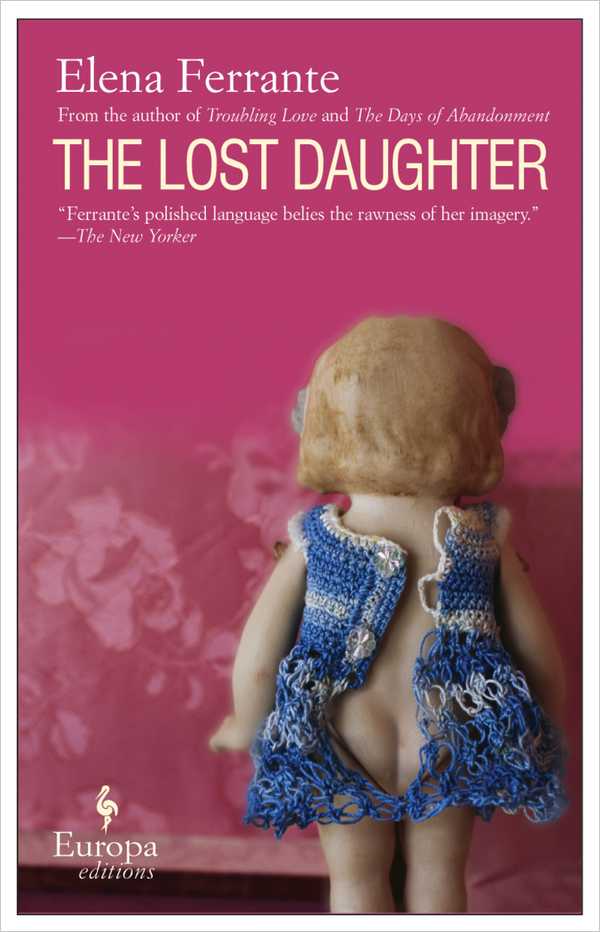
I found The Lost Daughter, by Elena Ferrante, to be an uncomfortable little book. Like The Days of Abandonment, it is an emotionally raw book with a narrator that says things that nice women, good mothers, aren't supposed to say.
One looks at a child and immediately the game of resemblances begins, as one hurries to enclose that child within the known perimeter of the parents. In fact it's just live matter, yet another random bit of flesh descended from long chains of organisms. Engineering — nature is engineering, so is culture, science is right behind, only chaos is not an engineer — and, along with it, the furious need to reproduce. I had wanted Bianca, one wants a child with an animal opacity reinforced by popular beliefs. She had arrived immediately, I was twenty-three, her father and I were right in the midst of a difficult struggle to keep jobs at the university. He made it, I didn't. A woman's body does a thousand different things, toils, runs, studies, fantasizes, invents, wearies, and meanwhile the breasts enlarge, the lips of the sex swell, the flesh throbs with a round life that is yours, your life, and yet pushes elsewhere, draws away from you although it inhabits your belly, joyful and weighty, felt as a greedy impulse and yet repellent, like an insect's poison injected into a vein.

Your life wants to become another's.
The novella spans the length of Leda's holiday on the coast, which she cuts short after just a couple weeks. An English professor at the university in Florence, she spends her vacation days at the beach, and she is quickly engrossed in unravelling the stories and dynamics of an extended Neapolitan family who have settled down near her. They are loud and rough — vulgar — exactly the kind of people Leda has struggled her whole life to escape.

She is particularly entranced by a 4-year-old girl, Elena, and her young mother. Their relationship is marked by intensity and tenderness; Leda obsesses over it and seemingly covets it. Then one day Elena loses her doll, and Leda is drawn into their drama more directly.
I watched the child, but, seeing her like that, alone and yet with all her ancestors compressed into her flesh, I felt something like repugnance, even though I didn't know what repelled me.
Leda's train of thought leads us back through her relatively short marriage. We learn that she has two daughters, now grown, whom she'd abandoned. We have occasional glimpses of her own mother ("How I suffered for her and for myself, how ashamed I was to have come out of the belly of such an unhappy person.") and the life she left behind in Naples.
"Now it seemed to that an encrusted sediment that had been lying for decades in the pit of my stomach was stirring."
Throughout The Lost Daughter, Leda is overwhelmed with feelings of disgust and revulsion. Beneath the surface layer, the fruit are overripe and rotten. The smell disgusts her. Insects on her pillow. A repulsion for an adult's fake-child voice and a child's fake-adult voice. The doll gurgles something bilious, stomach filth, stagnant liquid. Leda almost constantly feels irritated, exasperated, agitated, annoyed, distressed. She feels a vague irritation, an uncontainable aversion. And this attitude pervades the entire book.

So who is the eponymous lost daughter?

When Elena is briefly lost at the beach, Leda remembers herself being lost, and also when her firstborn was lost at the beach.
Bianca was crying when they found her, when they brought her back to me. I was crying, too, with happiness, with relief, but meanwhile I was also screaming with rage, like my mother, because of the crushing weight of responsibility, the bond that strangles.
Leda's daughters live in Toronto with their father; on many levels they are lost to her — they will never understand how their mother abandoned them. But the title references a singular daughter.

Perhaps Leda is the lost daughter; when she had ambitions beyond those circumscribed by Neapolitan life, she disconnected from her roots.

Perhaps Leda views Elena's mother as a lost daughter, a daughter preferable to the ones she had. She is more like her, and present.

Elena's doll is lost, and she is an imaginary daughter, and also a symbol of all the other daughters in this book. A nonexistent, ideal daughter. The doll herself, in play, mimicking Elena's aunt, is pregnant; perhaps the lost daughter is the bile inside her, expelled, aborted.
"Children are always cause for worry."
I love the intensity of Ferrante. Her writing is compelling in its honesty, but it is emotionally exhausting to read. It'll be a few months before I'm ready to face her again, but I look forward to the Neapolitan novels.

Sunday, March 06, 2016

Man does not actually accommodate science very much — he gets in the way of it

Sometimes I get strange thoughts, sometimes I think Chernobyl saved me, forced me to think. My soul expanded.
Voices from Chernobyl: The Oral History of a Nuclear Disaster, by Svetlana Alexievich, is an utterly devastating document, assembled some 10 years after the 1986 accident at the nuclear power plant in northern Ukraine.

These are the accounts of witnesses and survivors: power plant physicists, emergency workers, and local farmers; those in power and those following orders; those who left, those who stayed, those who returned.

The scope of this tragedy is so vast; it deals in ignorance, incompetence, and a sovietism that blends pig-headedness, denial, and a deliberate attempt to cover up certain facts.

I don't think anyone needs convincing that Chernobyl was a disaster, both the fact of it and how it was managed. Astoundingly, for many, although the dangers were already known, it was preferred over the alternative. Some people, mostly elderly, refused to be evacuated, or returned shortly thereafter. This was the only land, the only life, they'd known. Others, they felt safer living with the physical threat of radiation in ready-made homes than enduring struggles for independence. People from Tajikistan and from Chechnya chose to resettle in the area surrounding Chernobyl because it was better than where they came from.
I was running away from the world. At first I hung around train stations, I liked it there, so many people and you're all by yourself. Then I came here. Freedom is here.
While this book depicts real events, at times it reads like science fiction. In particular, the physical and mental preparation to journey into the zone, cleaning up upon return from the zone, and drinking vodka to protect against radiation (a fully sanctioned practice, but complete bullshit) — these read like they're straight out of Roadside Picnic. It's more than the use of the term "zone" — it's the dread that the term embodies.

Robots were initially deployed to clean up Chernobyl, but the radiation disrupted their electronics and they broke down; so human clean-up crews were used instead.

A former head of the Laboratory of the Institute of Nuclear Energy talks about growing up in the glory days of science and science fiction, dreaming of nuclear energy and space travel; nuclear physicists were the best and brightest, it was a "cult of physics."
Life is a surprising thing! A mysterious thing! Now I believe. I believe that the three-dimensional world has become crowded for mankind. Why is there such an interest in science fiction? Man is trying to tear himself away from the earth. He is trying to master different categories of time, different planets, not just this one. The apocalypse — nuclear winter — has already all been described in Western literature, as if they were rehearsing it, preparing for the future.

[...]

Life is such a surprising thing! I love physics and thought that I wouldn't ever do anything but physics. But now I want to write. I want to write, for example, about how man does not actually accommodate science very much — he gets in the way of it. Or about how a few physicists could change the world. About a new dictatorship of physics and math. A whole new life has opened up for me.
Had Alexievich not been awarded a Nobel prize, I doubt I would've picked this book up; I'm not naturally a nonfiction reader, and the subject matter is depressing. But I'm glad I read it. It is horrific, but it is also eerily compelling. Since these are credited oral accounts, it's difficult to say that Alexievich is a great writer or even a journalist. Rather her craft is more like that of an editor's, curating the testimonials, selecting them and giving them structure and context. These accounts are sad, but they are balanced with occasional bits of humour and imbued with a deep sense of humanity. Alexievich very gently guides the reader from ground zero to Moscow and back again, navigating personal remembrances, military accounts, and the official record. Truly this is a literary chronicle of the soul.

One recurring theme is that of freedom. Tragedy, it seems, brings with it the gift of perspective and liberation. You come to know what's essential, and let go of the rest.
We'd ask each other: is this what our life is like? It was the first time we saw it from the outside. The very first time. It made a real impression. Like a smack to the head... There's a good joke: the nuclear half-life of a Kiev cake is thirty-six hours. So... And for me? It took me three years. Three years later I turned in my Party card. My little Red book. I became free in the Zone. Chernobyl blew my mind. It set me free.
Excerpt.
Review.

Tuesday, February 23, 2016

The world simply did not permit plans

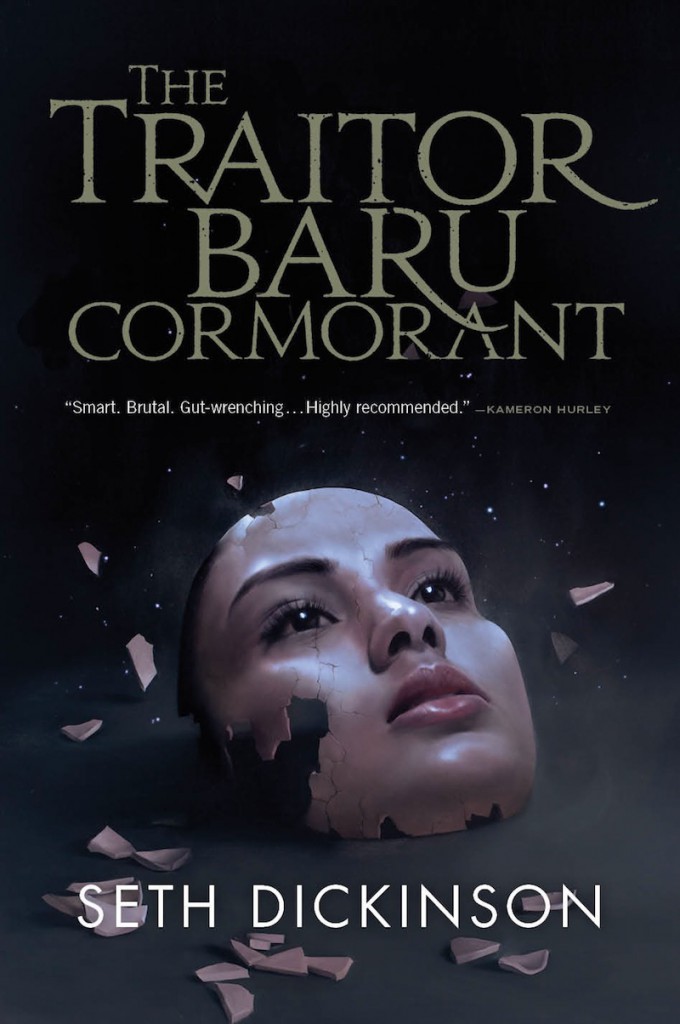
The Traitor Baru Cormorant, by Seth Dickinson, is the story of an accountant.
Baru's guard found a fulling mill by a nearby stream. They brought her there to wait.

The terror that took Baru came from the deepest part of her soul. It was terror particular to her, a fundamental concern — the apocalyptic possibility that the world simply did not permit plans, that it worked in chaotic and unmasterable ways, that one single stroke of fortune, one well-aimed bowshot by a man she had never met, could bring total disaster. The fear that the basic logic she used to negotiate the world was a lie.

Or, worse, that she herself could not plan: that she was as blind as a child, too limited and self-deceptive to integrate the necessary information, and that when the reckoning between her model and the pure asymbolic fact of the world came, the world would devour her like a cuttlefish snapping up bait.

The millwheel had been uncoupled from the machinery and it turned in useless creaking circles.
OK, so she's not an ordinary accountant. She was born in Taranoke, an island country with liberal sexual mores. When she was seven, it was conquered by the Empire of Masks, governed out of Falcrest (by committee, it turns out; the Emperor is a faceless — masked — figurehead). She goes to their schools, is indoctrinated into their Incrastic philosophy. It appears that she has a protector; she is essentially groomed for public service. She performs well on their exams and fresh out of school is awarded a post as Imperial Accountant of Aurdwynn. This conquered nation has a history of rebellion; Baru Cormorant determines that her task is to quell the insurgents, but instead she fuels a revolution.

I've described this book to some people in terms of Game of Thrones: a similar level of politics, machination, and battle planning, but minus the melodrama. A system of government that is if not exactly more modern, a little less barbaric — more complex. This book is more intimate, but somehow no less epic.

The Empire offers education and scientific advancements, medicine and sanitation. But. Incrasticism, possibly from Latin crāstinus ‎"of or belonging to tomorrow", from crās ‎"tomorrow", possibly related to Latin crassus "solid, thick". Never explicitly defined, but we have a clear sense of the dystopian evil of Incrastics.

It occurred to me early on in my reading that this could have been a work based on history. And that would've bored me to tears. Pages of balancing the books, examining the intricacies of trade agreements. Instead, it's genre fiction, so I'm all over it. But this world is ever so subtly removed from an actual one. The character's name are exotic. They practice — and enforce — social and moral hygiene, and some kind of eugenics ("hereditary regulation"). Midway through the novel we encounter the Clarified, conditioned from birth by drugs and other methods to serve.

Quite apart from that, this novel gave me the feeling that it's telling of a time in our actual history. These fantastical elements are expertly woven into the background world; the story is not about these things, but it is a story because of these things.

It was serendipitous to have read Claire North's Gameshouse novellas before embarking on the Traitor's story; it served well as a warmup game of chess, people as pawns.

There's a lot to chew on in this book: hegemony and colonialization, the logistics of rebellion, civic duty at what personal cost. I want to follow the rest of Baru Cormorant's career. I want to explore the rest of the Empire. I want to better understand the hygiene, the regulation, the Clarified, the Incrasticism.

Elsewhere
Seth Dickinson: The Secret Design of the Traitor Baru Cormorant
"In order to make Baru a useful citizen, the Masquerade hopes to create a state of learned helplessness: no matter what you do, it ends up serving our purposes. Accept your place."

Niall Alexander: Tor.com
"To tell the truth, Baru is terrifying at times; a barely-suppressed scream of a human being — yet we want what she wants."

Kameron Hurley: What Will You Sacrifice? The Traitor Baru Cormorant, Kameron Hurley
"It's set up from the beginning as a tragedy about power and commerce and sacrifice, and that's exactly what you get."

Arkady Martine: A Response (spoilers)
"From the beginning this is a book about complicity; it is a book about committing great and profound injustices for the sake of some future possibility of justice."

Excerpt

Tuesday, February 16, 2016

Short and uncertain

A note I made on my phone, February 9, 2014, 10:17 PM:

"She looked short and uncertain, like an accordion in pajamas."

It's further noted that it's on page 53, so it's not some clever observation I made, it's something I read in a book.

I have no idea which book.

I've checked page 53 of several plausibly possible books. I feel like an accordion in pajamas.

Monday, February 15, 2016

Chernobyl apples

"If you don't play, you lose. There was a Ukrainian woman at the market selling big red apples. 'Come get your apples! Chernobyl apples!' Someone told her not to advertise that, no one will buy them. 'Don't worry!' she says. 'They buy them anyway. Some need them for their mother-in-law, some for their boss.'"
— from Voices from Chernobyl: The Oral History of a Nuclear Disaster, by Svetlana Alexievich.

I'll take two, please.

Sunday, February 07, 2016

Lost property cupboard

This is my Lost Property Cupboard theory of the afterlife — when we die we are taken to a great Lost Property Cupboard where all the things we have ever lost have been kept for us — every hairgrip, every button and pencil, every tooth, every earring and key, every pin (think how many there must be!). All the library books, all the cats that never came back, all the coins, all the watches (which will still be keeping time for us). And perhaps, too, the other less tangible things — tempers and patience (perhaps Patricia's virginity will be there), religion (Kathleen has lost hers), meaning, innocence (mine) and oceans of time — Mr Belling and Bunty will find a lot of time in their cupboard. Mr Belling is always sitting at the wheel of the Rover, parked in the driveway, looking at his watch and fuming, "Do you know how much time we've lost waiting for you, Ruby? On the lower shelves will be the dreams we forgot on waking, nestling against the days lost to melancholy thoughts (if they paid dividends Patricia would be rich). And right down at the bottom of the cupboard, amongst the silt and fluff and feather, the pencil shavings and hair swept up from hairdressers' floors — that's where you find the lost memories. Deinde ipsa, virum suum complexa, in mare se deiecit. And perhaps we can sign our names and take them home with us.
Kate Atkinson's Behind the Scenes at the Museum is the story of Ruby Lennox, beginning with her conception, and of various things — a button, a rabbit's foot — commemorated in footnotes, telling of the three generations of (primarily) women before her.

Atkinson has discussed the title, but I have my own ideas. There's only one scene, in the book, in an actual museum, the Castle Museum, and it references Ruby's dream about the museum at night, the secret museum, where things came to life. The museum may as well be a symbol of marriage, what is meant to be seen, and this novel's footnotes show us the secret workings.

Like her most recent books, this novel — Atkinson's debut — also had me laughing out loud, and it made me weep; we live such stupid lives and die such stupid deaths and spend so much time misunderstanding each other. If it weren't so ridiculous and random we'd die from the tragedy of it.

Saturday, February 06, 2016

Games

All the men and women are merely players. But the world's not a stage; it's a gameboard.
At his command were seven other men, of whom two were brothers, four cousins and one they'd picked up as a child and brought along, and who suffered terribly for his lack of genetic bondage. He also had three elephants under his authority, which regarded the great turbulence of the humans about them with the patience of wily priests who have seen rebellion and heard the changing of the psalms, yet looked up and known the heavens never altered for man's delight.
Over the last few weeks I had occasion to devour Claire North's trilogy of Gameshouse novellas: The Serpent, The Thief, and The Master.

I meant to be reading other things, but I moved a few weeks ago, so books were being folded into boxes, at first in a fairly orderly fashion, almost shelf by shelf, but it quickly entropified, books were everywhere, and books were packed alongside the blankets and coffee cups they kept company with. Books I vowed not to lose track of haven't been seen in weeks, including the small book I decided to keep in my purse; at some point I must've decided that it would be safer not rubbing against the measuring tape and screwdriver that I also kept at hand in my purse — I'm confident that it will turn up eventually. Books are now spilling out of those same boxes rather randomly.

I always knew where my ebook was, however, along with my laptop and a few other "valuables." I found myself downloading books at odd hours, because, it seems, I needed them desperately. Someone told me about an article that said reading pageturners significantly reduces stress. I can't find the article, and I've puzzled over the many ways one might define "pageturner," but I've used this "research" to support my sometimes seemingly injudicious use of precious time — this was time I used not merely to read but to recalibrate my emotional and mental well-being.

I'm not sure exactly how I discovered these books. Somehow they were related to some book (which wasn't available) that I'd looked up based on some review. "In seventeenth century Venice exists a mysterious establishment known only as the Gameshouse,"and I was sold.

The Gameshouse novellas are certainly pageturners. The first book lays out the premise. What at first seems to be nothing more than a casino — a gathering place for the rich, the bored, and the desperate — is an institution that spans all of time and encircles the world, insinuating itself into the fabric of cities that hold wealth and power.

The games vary in breadth. In The Serpent, players vie to have their allotted token elected as Doge of Venice. Players are also dealt cards — representing people — which they may also bring into play.

The stakes are high. Fortunes and careers, but also memories, specialized knowledge, physical characteristics, time. The mechanism behind how these transactions are processed is never divulged, but I'd trade my funky knee for someone's facility with Sanskrit in a heartbeat. Others deal in heartbeats.

The Master is my favourite of this set of novellas. A game of hide and seek. The board is 1930s Thailand. Geographically more vast than The Serpent, the game is more intimate.
"Abhik thinks that a game can only be won with ruthlessness and calculation. Were this chess, he would be right, but you, Remy, you have the greatest gift of a higher league player — you remember that your pieces are human. At a superficial level, some might say that makes you kind, but I would suggest it makes you beautiful. To play people is a vastly more elegant skill than mere number-counting."
It also becomes clear that most games are only minor skirmishes in a much larger power struggle.

The third novella, in a modern-day setting, brought closure to the series, but I would love nothing more than an infinite series of Gameshouse game novellas, set in worldclass cities across time. It might bring a new level of paranoia to the conspiracy-minded. We are all, after all, merely pawns in the great game of chess.

Sunday, January 31, 2016

My tears were falling into the pot

I was cooking halva, the special kind that's made of flour and butter after someone dies. My tears were falling into the pot, disappearing among the little clumps of flour and sugar, and with each tear that vanished, I felt like another memory was gone. Would we run out of butane gas? Should I have put a bit more meat in the vegetable stew? Whenever people got tired of crying, they came into the kitchen and lifted the lid off a pot to stare quietly at its contents. As if crying for a long time meant you could come over and see what was cooking.
I came to the end of A Strangeness in My Mind, by Orhan Pamuk, and my initial comments stand: it's mostly boring and a little sad. The character Mevlut is somewhat unlikeable, and for all the tedious detail of his life, his motivations and actions remain opaque to me.

Maybe that's the point. That no matter our upbringing and environment, no matter our experiences and outlook on issues, we still end up doing dumb things. Well, not dumb, necessarily, but we still sometimes base our words and actions on something ineffable, that doesn't jive with what our psychological makeup would indicate, or that contradicts our views, whether stated or assumed. We just muddle through life, and it doesn't always make sense.

The latter part of the novel makes a big deal of our words versus our intent. And it's still not clear to me which is meant to be more important.

So this isn't one of my favourite Pamuk books. It's two stories really — a love story, which I found intriguing, and the ongoing tribulations of a street vendor, which failed to engage me — and in my view they don't fit very comfortably together.

Between Public and Private: Orhan Pamuk on the Intentions of Words and the Heart

Friday, January 29, 2016

The furniture-shapes

Kate Atkinson's debut novel from 1995, Behind the Scenes at the Museum, has footnotes. Not the erratic footnotes of 1996's Infinite Jest that sprawl fatly and stare you down insolently with their sometime opacity. These are British footnotes, orderly and regular, if somewhat oversized, like a handkerchief drawer, each its own story interleaved with Ruby Lennox's days. But footnotes nonetheless.

Footnotes present me with great difficulty. I read them as they are noted in the primary text, which is the only right way, although often I will actually read through to the end of the sentence in which the note is cited. I have two bookmarks — one marking my place in the main narrative, the other in the footnote. I generally read on my commute of finite length; I have not always the luxury to read to the end of the chapter. The problem is knowing which bookmark is active. I've tried to leave the bookmark noting the active spot sticking out, and making sure the other bookmark was tucked all the way in, but the book itself sometimes changes its mind about these things while riding around in my purse. Suggestions?

There is also the problem of remembering to flip back, instead of reading on.
I have been here nearly a week. I don't think the twins sleep at night. I think they just lie very, very still. I can't sleep if I think they're awake and if I do drop into sleep it's always to wake in a state of terror. I clutch Teddy tightly under the covers. His hot little body is a great source of comfort to me. I can feel his furry little chest rising and falling with his breathing. The eiderdown that covers Daisy and Rose does not move at all, however, confirming that they do not have normal, human lungs. I have seen the way they look at Teddy and do not think their intentions are good.

In the dark, the furniture takes on a new malevolence — the bedroom is crowded out with furniture — big, heavy pieces that don't belong in a child's bedroom at all, not just the arctic waste of their double bed, but the huge, double-fronted wardrobe and matching dressing-table that's big enough to stow a corpse in. In the blackness of night, the furniture-shapes possess a profound ultra-blackness that hints at anti-matter.

Over in the other corner is their doll's house, a big four-storey Victorian one. It has pictures the size of postage stamps and postage stamps the size of dots; it has gilded chairs fit for a fairy-queen and chandeliers like crystal earrings and kitchen table groaning under the weight of plaster hams and plaster moulded blancmanges.

This doll's house is much coveted by Gillian who has frequently tried to persuade the twins to make a will and leave it to her. I doubt very much that they have. If it were willed me (which is even more unlikely) I would refuse to accept it. There's something eerie about it, with its microscopic plumbing (tiny copper taps!) and little, little leather-bound books (Great Expectations!). I would be frightened — I am frightened — of getting trapped in there and becoming one of the tiny ringletted and pinafored little girls up in the nursery who have to play with teeny-weeny dolls all day long. Or worse — the poor scullery maid, for ever consigned to blacking the kitchen range.

Perhaps the twins, with their galactic powers, will miniaturize me in the night and Auntie Babs will come in this room one morning and find the guest bed empty and the guest bed in the doll's house (much nicer than the camp bed) full of a doll-like Ruby Lennox clutching a teddy bear the size of an amoeba.
Of course Teddy breathes.

Thursday, January 28, 2016

In which my daughter is traumatized by a classic

My daughter came home ranting about her English exam earlier this week. Grade 7. Given that she's in the French system, even though she's been placed in an "advanced" English class, I still don't expect it to be too terribly challenging for her. But it wasn't that. It wasn't hard. It was traumatizing. I know, because she called me as soon as she got home to tell me all about it.

She'd known it would be a comprehension-type test, and the text was about cats. Well, there were three texts, and they were about cats all right. The first two were just normal texts, but the third one! OMG (yes, she said O-M-G). It was horrible! It made her want to cry! How could anyone write something so disgusting?! She's traumatized (I know, because she said so). How could the teacher give them something so disgusting? Of course, I want to hear more.

So she starts telling me about the story. It's about a man who has a cat, only the cat loves him too much and it gets on his nerves and he starts to hate the cat and he becomes an alcoholic and now he's trying to hurt the cat. How could a cat love anyone too much, how is that even possible? Who would ever want to hurt a cat? She's choking back tears at this point, telling me how the cat loses an eye, and I'm thinking this text is a little severe, her English teacher sounded pretty cool, but assigning this text may have been a lapse in judgement. Then the man hangs the cat, kills it dead, and Helena is sobbing, how could anyone write something so horrible, why would the teacher make them read this, he doesn't like cats, does he?

And Helena goes on, in excruciating detail, not only about the story, but about her emotions, and, really, her entire value system. Now there's another cat, why would the man bring home another cat, and he tries to kill this cat too, only he kills his wife by accident. Wait a minute, I know this story. I've been listening to Helena cry into the phone for about 10 minutes now, but I'm at work and my attention is divided. But suddenly, now that we're at the end, I know this story. That's Edgar Allan Poe, The Black Cat, it's a classic. Yes, she confirms, that's it. It's disgusting.

Worst. Story. Ever.


Teacher says they'll be doing more stories by this writer this year. I can't wait.

Monday, January 04, 2016

Il descend, réveillé, l'autre côté du rêve

It's a short flight, but I'm hoping to finish reading my book. Helena asks me about the flying turtles on the cover. My edition of The Lathe of Heaven, by Ursula K. Le Guin, has flying turtles on the cover. I can't say I even noticed them.

Oh, right, I say. They're not actually turtles, they're aliens. But they're a bit odd, as aliens go, cuz this guy just dreamed them up. He has these dreams that come true, only they don't exactly "come true," just he wakes up and everything in his dream has always been true, so nobody notices when things change. So he dreamt there were aliens on the Moon, but then it was suggested to him to dream that they weren't on the Moon anymore, so suddenly they're invading the Earth, but then he dreams that it was all a big misunderstanding. They're not really turtles, it's more like an armour, or a spacesuit so they can deal with the atmosphere. And they communicate through their left elbow. At which point I'm flapping my own left elbow up near my ear to demonstrate. And Helena says, "And you think I'm weird."

It's a terrific idea book, and I was guessing that it was from earlier in Le Guin's career, but that turns out to be not true. (It was published in 1971.) I was assuming earlier because it totally feels like it's from an earlier era — it's like Philip K. Dick and Robert Sheckley with a Twilight-Zone vibe. There's a naïve idealism at work, and an underlying Cold War threat of nuclear war. On further reflection though, I realize that The Lathe is a mature and even subtle novel (despite my clumsy rehash of it here) about the nature of (our) reality(s).

So George Orr is having these dreams, and he wants to stop having these dreams, so he's taking illegally obtained drugs to suppress his dream state and when he ODs, the police refer him to compulsory psychological treatment. But Dr Haber's more interested in controlling the dreams than in curing George of them, and George is pretty much at his mercy.
"You can't go on changing things, trying to run things."

"You speak as if that were some kind of general moral imperative." He looked at Orr with his genial, reflective smile, stroking his beard. "But in fact, isn't that man's very purpose on earth — to do things, change things, run things, make a better world?"

"No!"

"What is his purpose, then?"

"I don't know. Things don't have purposes, as if the universe were a machine, where every part has a useful function. What's the function of a galaxy? I don't know if our life has a purpose and I don't see that it matters. What does matter is that we're a part. Like a thread in a cloth of a grass-bade in a field. It is and we are. What we do is like wind blowing on the grass."

There was a slight pause, and when Haber answered his tone was no longer genial, reassuring, or encouraging. It was quite neutral and verged, just detectably, on contempt.

"You're of a peculiarly passive outlook for a man brought up in the Judeo-Christian-Rationalist West. A sort of natural Buddhist. Have you ever studied the Eastern mysticisms, George?" The last question, with its obvious answer, was an open sneer.

"No. I don't know anything about them. I do know that it's wrong to force the pattern of things. It won't do. It's been our mistake for a hundred years."
Le Guin has drawn some great characters that are in sharp contrast to one another — George the dreamer, Haber the rationalist, and Heather, lawyer and George's love interest in some realities, is mostly just human, to bear the consequences and bring the others into relief. George has terrific strength of character; he carries an immense weight and tremendous sadness.

Early on George wonders if there might be other dreamers out there who can effect realities as he does, but no one cares to entertain this question too seriously. Apart from this ability, George is a very average guy. Allegorically this novel's message, trite but true, might be that anybody can change reality if they dream it so, and that even the smallest change can have a large impact. The simplest suggestions may have complex interpretations. And you can never go back.

Beyond this, the novel propounds a Buddhist mentality, embracing stillness over change, and being a part rather than apart. The Lathe doesn't exactly end well, but it ends mostly right; that is, it ends.

Read this excellent excerpt.

Thursday, December 31, 2015

Defending poetry

Reading Eternal Enemies, a collection of poems by Adam Zagajewski.


Monday, December 21, 2015

A quivering at the corners of her mouth

In all domestic arguments — as in all fistfights and armed conflicts, for that matter — there comes a moment when both, or one, of the parties can step back and prevent the situation from deteriorating any further. This was that moment. I wondered briefly what it was I was hoping for. As family and table companions, it was our role to intervene, to speak words that would put things into perspective and so allow the parties to be reconciled.

But did I feel like doing that, to be frank? Did we feel like doing that? I looked at Claire, and at the same moment Claire looked at me. Playing around her lips was something outsiders would not have recognized as a smile, but which was in fact a smile. It was to be found in a quivering at the corners of her mouth, invisible to the naked eye. I knew that invisible quiver well. And I knew what it meant: Claire, too, felt absolutely no urge to referee. No more than I did. We were not going to do anything to intervene. On the contrary, we would do everything in our power to enable things to escalate even further. Because that suited us best at this moment.
— from The Dinner, by Herman Koch.

May all your holiday dinners be free of such domestic disputes, and all your knowing glances be loving ones.

Wednesday, December 16, 2015

"Generally swims against the orthodox flow"

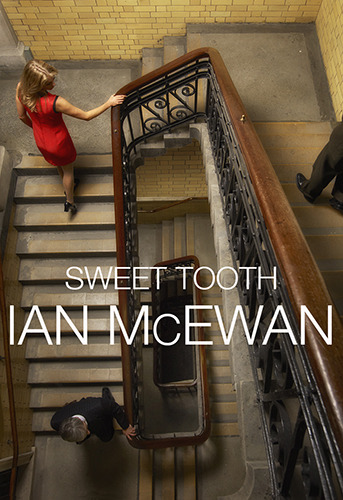
Sweet Tooth is my favourite of Ian McEwan's novels that I've read to date. (For the record, I hated Solar, loved Saturday, thought Atonement pretentious and contrived and I still don't understand the acclaim for it, and have gotten on well with most others.) Two aspects in particular stand out for me.

Literature as propaganda.
Serena has been recruited by MI5. In her spare time, she devours paperback novels. The project to which she's been assigned, codename Sweet Tooth, is to handpick some writers, academics, and journalists, finance them, and nurture their craft. There are political motivations for sidestepping the usual national arts funding mechanism. Recipients should be talented enough to become popular and thus hold some sway over public opinion, unknowingly helping to shape MI5-preferred sentiments regarding communism, freedom, and other matters of national interest.
"We're not interested in the decline of the West, or down with progress or any other modish pessimism. [...] We're looking for the sort who might spare a moment for his hard-pressed fellows in the Eastern bloc, travels out there perhaps to lend support or sends books, signs petitions for persecuted writers, engages his mendacious Marxist colleagues here, isn't afraid to talk publicly about writers in prison in Castro's Cuba. Generally swims against the orthodox flow."
This wasn't the first Western strike in the culture war; the CIA had previously none-too-subtly backed a highbrow culture magazine, so obvious it backfired. And as propaganda, without the broad appeal to the masses, it failed.

All this takes place in 1972 England (the Cold War is still going strong, but a new threat has developed: the IRA). Sweet Tooth's chosen writer turns in a prize-winning novel, but it didn't take the Booker.

A cross-check with reality shows that the 1972 Booker Prize was awarded to John Berger for G. Berger donated half his cash prize to the Black Panther Party in Britain and retained half to support his work on the study of migrant workers, both being necessary parts of his political struggle. I'd never heard of him.

Art has always been political. It got me thinking: Could propaganda of this nature actually be alive and well in the West? Are there intelligence-agency puppet masters pulling the strings of pop culture?

A man writing a feminist novel.
Perhaps Sweet Tooth is not so strikingly feminist, only my sensibilities in the last few weeks have primed me to see it so. I read most of Orhan Pamuk's A Strangeness in My Mind, which he calls a feminist novel, but the first two-thirds of which is not really. I read Monica Ali's In the Kitchen, featuring a very dislikeable man with very little regard for women, and tangentially addressing the issue societal expectations of women (oh, and, human trafficking and prostitution). Last but not least, I saw Gloria Steinem speak, and she drove home the point that of course we should all be feminists.

McEwan has an uncanny way of getting inside a woman's head. (My head at least.)
I was beginning to feel a distinctive and unusual kind of pleasure, a sense of being set free. In a portion of mental space, perhaps quite a large portion, I was actually cleverer than Tom. How strange that seemed. What was so very simple for me, for him was apparently beyond comprehension.
No man would ever feel this.

[It's not that the realization of one's cleverness is striking in itself. It's that it's worth noting at all, even by oneself, to oneself. Mid-80s, high-school calculus; I was cleverer than all the boys in the room, and it was mostly boys in the room. And teacher made a point of saying so. If it was a compliment, why did I feel condescended to? Why did he say it if not to shame them and embarrass me?]

The novelist character at one point talks about the need to be a transvestite, figuratively I assume, to fully inhabit his women characters. I wonder what McEwan's method of study is. Did he shag a spy? (I bet he's good in bed.)
I couldn't bear to look at him. I was irritated by the way he conflated his own shifting needs with an impersonal destiny. I want it, therefore... it's in the stars! What was it with men, that they found elementary logic so difficult? I looked along the line of my shoulder towards the hissing gas rings. The kitchen was warming up at last and I loosened my dressing gown at the neck. I pushed my dishevelled hair clear of my face to hep me think clearly. He was waiting for me to make the correct confession, to align my desires with his, to confirm him in his solipsism and join him in it. But perhaps I was being too hard on him. This was a simple misunderstanding. At least, that was how I intended to treat it.
In all McEwan's Serena feels like an accurate rendition of the female psyche. And the novel's portrayal of life for a working woman in 1972 feels pretty authentic too. I bought into it; the novel works for me.

On the other hand, Maureen Corrigan hated Sweet Tooth (warning: her review is ambiguously spoiler-y): "Oh, what fun McEwan has squirting acid over everything simple Serena — clearly, the Common (Female) Reader — enjoys in a novel." Your mileage may vary.

Thursday, December 10, 2015

London was all belly

In the Kitchen by Monica Ali was not what I expected. I expected something about a kitchen that confirmed everything I'd ever learned about kitchens from watching Chef! and Gordon Ramsay, and, oh yeah, the time I worked in a kitchen where the chef had a temper and ego to vie with that of any televised personality. In the Kitchen was not that book.

In the Kitchen starts with a dead body in the basement, but the book's not about that either.

While I started off rather enjoying it, quite suddenly the protagonist became very unlikeable. I couldn't understand why Ali would do that to her main character, and I spent the rest of the book being befuddled and a little angry about it. I now realize how much of a slow burn this novel is; it's taken a couple weeks for it to properly set in my head.
"My father say, in old days, Soviet days, is easy to tell what is lie. Everything is lie. Now, he says, is more hard. What is truth and what is lie? How we can know?" She pulled her shoulders up by her ears and let them drop. "But he is wrong. There is no truth. Is only a new kind of lie."
Very little of this novel actually takes place in the kitchen. But the kitchen — the idea of "kitchen" — is strongly associated with two things (things Ali has written about before): women and immigrants. Women, of course, belong in the kitchen, but only when that kitchen is a domestic one. It takes a man to run a kitchen like a business, like a well-oiled machine. But it takes the right kind of man, one who stands above the others — the others who work long hours in difficult conditions for slave wages. This kitchen runs thanks to Africans and Eastern Europeans.

It took me a while to see how all the flavours blend together, because I was so caught up in Chef Gabe being a jerk. Maybe I'm overreacting, but no: rescuing the damsel in distress but then allowing yourself to believe that her having sex with you has nothing to do with the power dynamic you've established is a pretty jerk thing to do. And lying to his girlfriend about it. Jerk.

But it's little things too, like in the way he regards his sister:
Gabe held the phone away from his ear. Two years ago — was it three? — he had been affronted when Jenny walked into the kitchen in Plodder Lane and he saw how old she had become, how middle age had enveloped her like the layers of fat on her arms, her legs, her neck. Jenny, who used to wear torn denim miniskirts and a fuck-off glare. Who use to drop one laconic word in the pub and send everyone scurrying to pick it up, frame it, and hand it around. She used so many words now and all of them passed you by.
I wondered how Ali could be so mean to women, letting Gabe get away with crap like that. Shouldn't she be championing the feminist cause? Gabe's girlfriend was made out to have a strong character in life, but be a mere background character in the novel.
Charlie, standing with her back to the kitchen counter, dug her hands into her jeans pockets. Her sweater, samphire green, showcased her curves. Once he had said to her she should be on a tailfin, a mascot for our brave boys as they went to "liberate" whichever godforsaken country they were sent to next. "You mean I've got World War Two hips," she said. He knew by then that she said these things as a parody of female insecurity and also because she was insecure. He said nothing because, confirm or deny, either way it would be taken as attempt to patronize.
But I realized how astute, how true. This is the way the world is. We parody our insecurity while still insecure. Feminism lurks here. Ali's women characters are not the centre of this story — they are side dishes, dessert, a bit of home cooking — they have an awareness of themselves and their fate that Gabe does not have of himself.

So this novel turns out to be much vaster than the midlife drama of a petty and pathetic character. I really don't care how Gabe's little life turns out, and he really unravels at the end, but I am a little more concerned for the world: How real is human trafficking? How does Great Britain really treat its immigrants? How representative is Gabe's father when he bemoans that Great Britain has lost its Britishness.
London wasn't the brains of the country, as people said; it certainly wasn't the heart. London was all belly, its looping intestinal streets constantly at work, digesting, absorbing, excreting, fueling and refueling, shaping the contours of the land.
Ali is a keen observer of human nature. I think Gabe's nature is very true, but sadly it makes him so unlikeable that it gets in the way of a good story.
"But every refugee knows how to tell his story. For him, you understand, his story is a treasured possession. For true, it is the most important thing he owns."
Possibly Ali is making the point that Gabe bears the privilege of not having to treasure his own story (but then why should I?).