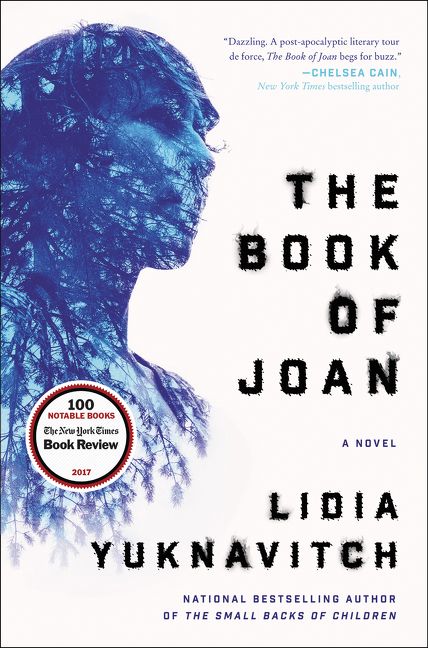
To be human the film suggested, was to step into the full flurry and motion of all humanity: to bear the weight of circumstances without flinching, to surrender to the crucible — to admit that history was not something in the past but something you consciously step into. Living a life meant knowing you might be killed instantly, like one who wanders into the path of a runaway train. It was the first time I felt a sense of messianic time, of life that was not limited to the story of a lone human being detached from the cosmos.
When I came out of the theater, I said to my mother, "It's like we're stars in space. It's like space is the theater and we are the bits of stardust and everything everywhere is the story."
The film is not named, but surely it is Doctor Zhivago that is described. I can't say I feel the same way about this film as Yuknavitch's narrator does, but I remember having a similar epiphany (for me the film was Wings of Desire).
This book is not even a little bit what I expected it to be.
Today I read the saddest poem, flipping through journals at the magazine shop. It brought tears to my eyes. I stopped breathing, and my heart stopped for an instant too.
It was so sad, I had to buy this summer reading issue of Tin House. You can't read something that sad and just put it back on the rack. Plus, there's an octopus on the cover.
The poem is "Dusk" by Tracy K Smith, just recently named US Poet Laureate. Justly so.
What woke to war in me those years
When my daughter had first grown into
A solid self-centered self? I'd watch her
Sit at the table — well, not quite sit,
More like stand on one leg while
The other knee hovered just over the chair.
She wouldn't lower herself, as if
There might be a fire, or a great black
Blizzard of waves let loose in the kitchen,
And she'd need to make her escape.
I came home and told my daughter I'd read the saddest poem, about having a teenage daughter, and she asked me if I needed a hug and I said yes.
I thought I’d have more time! I thought
My body would have taken longer going
About the inevitable feat of repelling her,
My vacation reading went off the rails pretty early on. The book I was reading in Edinburgh was set in Edinburgh, but as soon as we settled into the train ride south, a restlessness overcame me. The books I'd brought with me were laid aside, and I picked up other reading material along the way. My London stay was defined by Tim Parks's Calm. On the last day in London I came across Tove Jansson's Letters from Klara, which seemed would make for perfect seaside reading.
(The cover image and the French flaps made this book irresistible to me.)
Letters from Klara is a volume of short stories originally published in 1991, appearing now in English translation for the first time.
Jansson is probably best known for the Moomin books (did you know there's a Moomin Shop at Covent Garden?), but NYRB has been steadily reissuing her adult fiction over the last several years.
The thirteen stories in this volume transcend time; one barely notices the absence of modern technology and the reliance on post or telegram. But they feel shrouded in nostalgia. I read these stories between naps, on the beach and on a plane, allowing each story to breathe, but one could easily devour this volume in one sitting.
These stories are mostly character portraits. They might be interpreted as reflections on a life lived; more than one story alludes to switching careers, how difficult it would be to start over. I feel scolded for both taking matters too seriously and not seriously enough.
On several occasions I found myself talking back at the book and exclaiming in disbelief ("What a bitch!"). People do some nasty things in these stories.
Other people are not we expect or remember them to be.
Above all these stories demonstrate how impossible it is to understand each other and how inscrutable our motivations are. Everyone operates by their own unique internal logic.
But they are sweet and bittersweet.
I think when I have a daughter, I'll teach her to whistle. It could be useful to whistle to each other in case we lost track of each other in the woods. If she doesn't answer, then I'll know she wants to be left alone. If she goes out in The Dinghy, I won't row after her and bring her home if it starts to blow. I won't make her pick blueberries, but she can pick mushrooms because that's fun. My daughter can wear any old trousers she wants to, and she can talk back to me, though not too much. She will look like me but prettier. Autumn is coming, so I won't write any more today.
Electronic music had just begun to appear at that time — Pierre Schaeffer, Klaus Schulze — an abstract music of galactic desolation that enraptured me. I wanted Karin to hear it too, but I should never have played that record. I explained that this was a new thing they were experimenting with. "Now just listen to this," I said. "It's like the pulsing of the spheres in space. Don't you think?"
"Quiet," said Karin. "I'm listening."
We listened together. The room seemed to throb electronically. Karin had gone pale and sat utterly motionless.
I jumped up to turn off the music but Karin yelled, "Don't! This is important to me!"
I should have remembered this was the moment when Dante descended into the Underworld and was met by the cries of the lost souls.
"I know," Karin said. "This is it. Now comes the voice of God."
And it came. How could she have known!? A deep, sorrowful bass that cut through the music with incomprehensible words and vanished into the galaxy amidst vibrations that finally lost themselves in silence.
"Forgive me..." I said. "You understand, this is a new kind of music they've just invented."
"No," said Karin calmly, "it has always existed. The lost souls are with us always, I know them. It's like a grey wave — any time, any place, on the street, on the train — obliterating everything. They cry for help and we sink in sin, theirs and our own. Can you play it again?"
Sometime in the 80s, my brother discovered Klaus Schulze, and it was much like the times he discovered Kraftwerk and Beethoven. He rushed into the house, headed straight for the stereo, repositioned the speakers so the sound would roll over the dining table. Late for supper, again.
This was before trance music, before rave culture. This is how he would share with us his newest, his latest, religion. "Listen to this. Can you hear that? You can hear... Don't you get it?!"
One aspect of Vipassana still bothered him, indeed had come to bother him more and more, to the point where he was now ready to stop meditating. "What does it mean, " he asked, "when they say the thoughts are not my thoughts? What can that mean? How can the thoughts not be my thoughts?"
I don't like Tim Parks.
I attended an event several years ago where he was reading, and I overheard him saying things — not publicly, but to an individual — that rubbed me the wrong way. He struck me as a man of tremendous ego. On this basis, I have refused to read his novels, and I read his columns in the New York Review of Books aggressively and antagonistically — I love to hate them and find fault with them wherever I can.
All of which makes it particularly puzzling that I should be drawn to pick up Calm, and that I should find it so satisfying.
There I was, restless and wandering the gift shops of the Tate Modern, and there were lined up all the pretty Vintage Minis, and I suddenly had to have one, I had to have a pretty little book as a souvenir, a book that was Art, and Modern, and Summer, and Britain.
And I picked them up, one by one, to see what they were about. These are slim volumes that excerpt previously published work.
But this vacation was not about love, desire, or drinking, not even motherhood or summer. I almost left with that itch to buy a book unscratched, when Calm caught my eye. Striped shades of purple. Calm. An antidote to my restlessness. By an author I dislike. A paradox like a zen koan. My own little book of calm.
Calm is an extract from Teach Us to Sit Still, in which the sceptical Parks attends a Buddhist meditation retreat.
Why did I think I could learn something about calm, achieve some kind of calm, via the reflections of an aging white male academic? His pains are not my pains, physical or emotional. His teachings cannot be my lessons.
Attachment with aversion was a new idea to me. But I sensed at once what he meant. It was like when I read an author I despised because I despised him, because I enjoyed thinking what a scandal it was that this man was a celebrity. Or when I kept complaining about a colleague at the university because my identity was intensified by my opposition to him. Or when I listened to the radio outside Ruggero's study in order to loathe it. Did I attach to pain in the same way? Scratching sores. Was it possible that this grand showdown with myself that I had planned and been denied actually had to do with the pain I was now experiencing? The showdown was taking place without my realising it was the showdown.
I may not have learned anything, but I found a calm satisfaction in this book. Something about the relationship between the ineffable and the tangible, inner and outer, stillness and life. Thematically in keeping with what had brought me to this book, the Giacometti exhibition I'd viewed at the Tate Modern — the problem of achieving maximal expression through a minimum of means.
Calm lends itself well to introspection, examining how we think about thought and how we transform wordlessness into words. Parks's reflections only confirm how vast his ego is, but I admire his honesty. And as much as I enjoyed this read, I confess I don't intend to read any more Parks ever.
I suppose storage services have been around for some time, but this ad brings a fresh perspective. My daughter is convinced I am in need of such services.
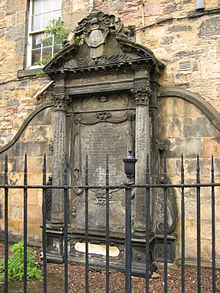
Skulk turned right onto the Mile, up for a couple of hundred metres and then left, onto the George IV Bridge above the dark chasm of the Cowgate. At this time tomorrow it would be crowded, rain or no rain, but tonight it was almost empty, Thursday's revellers mostly behind the doors of the clubs. The machine stalked between the two big libraries to the top of Candlemaker Row, into the alley of Greyfriars and up and over the gate into Greyfriars Kirkyard. It paced past the church towards the Flodden Wall, and paused at the corner where the path turned towards the Covenanters' Prison.
Somewhere at the back of the roofless mausoleum of Thomas Potter (Nuper Mercator Edinburgis) a pebble shifted. A long shape lifted itself from the ground.
This may not strike you as a particularly powerful passage, but it chilled me to the bone.
Not hours beforehand I'd walked the same route, stopped for some takeaway, then turned down Candlemaker Row to loop round to my hotel on Cowgate. I lay there in that chasm, recalling the stories our ghoulish tour guide told us of the ghosts in the graveyard.
I am grateful, too, for the history lesson, as Covenanters are deeply relevant to MacLeod's novel.
This turned out to be a most fortuitous choice of reading material while visiting Edinburgh.
From the entry concerning the secrets of St. Bartholomew's the Greater, featuring bad puns and briny floods and heralded as a rare survivor:
Very little of early medieval London remains intact today, because Londoners, like the unwise Little Pig, built houses of wood, and the city burned down in 1077, 1087, 1132, 1136, 1203, 1212, 1220 and 1227. Almost anything left intact from these was destroyed in the Great Fire of 1666.
Maybe you don't think that's very funny; then, to hell with you.
I'll be in London in about two weeks' time, and I know I won't be visiting very many of these "unusual" places (maybe a couple: the traffic light tree? the Monument?), but just knowing they exist — both the secrets and the guidebooks — brings me irrational joy.
Juhan was wearing skinny black jeans, a black T-shirt, and a massive black leather jacket with jangly silver zippers, which hung from his shoulders like the wings of a pterodactyl. In appearance, it was as if Somerset Maugham had, in the final years of his life, decided to take up death metal.
Edinburgh rain was like a judgement. It soaked into the bones, into the structures of the buildings, into the memories of the tourists. It lingered for days, splashing up from puddles by the roadside, breaking up marriages, chilling, killing, omnipresent. The typical postcard home from an Edinburgh boarding-house: "Edinburgh is lovely. The people rather reserved. Saw the Castle yesterday, and the Scott Monument. It's a very small city, almost a town really. You could fit it inside New York and never notice it. Weather could be better."
I wasn't really interested in reading a series starring yet another clichéd troubled-yet-sensitive, hard-drinking detective. But I'm vacationing in Edinburgh in a few weeks' time, and I was told the city features strongly in Rankin's Inspector Rebus novels, like a character in its own right, so it seemed appropriate to read one, to set the mood for my holiday.
There's a lightness to the writing, great humour and wit, that makes it very engaging, despite the grimness of the plot. I was halfway through when I realized the novel hadn't devoted much time at all to the actual mystery of the serial killer. And that's fine — the story certainly didn't bog down in the details of police procedure. I'm curious to see how subsequent Rebus novels play out, now that the groundwork for his character has been established.
Edinburgh slept on, as it had slept for hundreds of years. There were ghosts in the cobble alleys and on the twisting stairways of the Old Town tenements, but they were Enlightenment ghosts, articulate and deferential.
I'm sold on Edinburgh — its Jekyll-and-Hyde nature and rain like judgement.
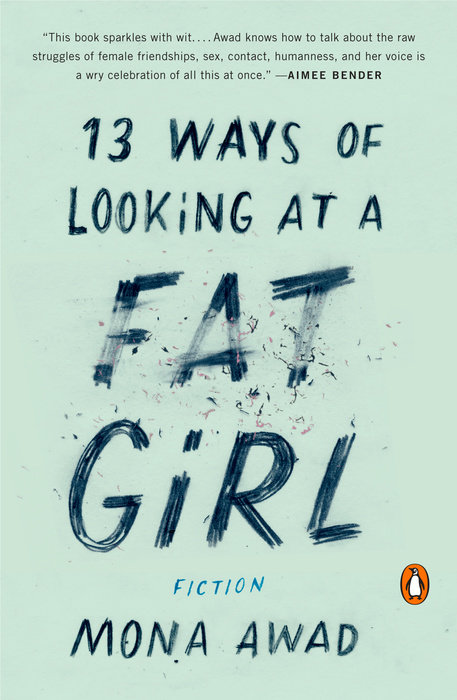
The novel consists of 13 stories, each of which could stand independently, chronicling Elizabeth's life, from fat teen to gym-going, food-weighing, unhappy obsessive. She sheds a lot of weight, but loses friends, her mother, and her marriage along the way. She tries on new names along with new bodies, each new identity a new relationship with her body: Lizzie, Elizabeth, Beth, Liz. (And it's her husband's fault when he can't keep up with her preference.)
Many reviews stress how much more this book is about than body image: friendship, loneliness, a girl's relationship with her mother, blah, blah, blah, what it means to be human. Well, no. Everyone of those facets is firmly based in Lizzie's relationship to her body.
Awad doesn't make any overt social commentary; all the criticisms of Lizzie come from within herself, with the occasional boost from her mother. I hate to think that there are women out there who live like she does, but I don't doubt it's true. Also, I couldn't help but feel a twinge of guilt for not addressing weight loss more concertedly, and for being relatively happy.
These are tight, well-written stories. Go ahead, read them. No, I don't mean anything by that; you look great.
Near his flat, he passed a little grocery shop outside which were stacked crates of milk and morning rolls. The owner had complained in private to Rebus about petty and occasional thefts, but would not submit a complaint proper. The shop was as dead as the street, the solitude of the moment disturbed only by the distant rumble of a taxi on cobblestones and the persistence of the dawn chorus. Rebus looked around him, examining the many curtained windows. Then, swiftly, he tore six rolls from a layer and stuffed them into his pockets, walking away a little too briskly. A moment later he hesitated, then walked on tiptoe back to the shop, the criminal returning to the scene of the crime, the dog to its vomit. Rebus had never actually seen dogs doing that, but he had it on the authority of Saint Peter.
Locking round again, he lifted a pint of milk out of its crate and made his getaway, whistling silently to himself.
Nothing in the world tasted as good for breakfast as stolen rolls with some butter and jam and a mug of milky coffee. Nothing tasted better than a venial sin.
This was the year Beyoncé wore a dress made entirely from the sounds of thunder and lightning. The Painter watched from the couch with his daughter and his wife as the three of them stared at the beautiful woman on the television screen accept a Grammy award.
"I want to be her," said his daughter.
"You want to be a singer?" asked his wife.
"No," she said, "I want to cease to exist. I wish that my life had never begun and my soul could occupy that body instead of my own. I wish this," she pinched the skin of her tiny arm, "wasn't even real. And I lived in there." She pointed towards the television: all of the beautiful, shiny people.
She was only twelve, but times had been tough.
Montreal can boast of being home to countless writers, whether it's writers who were born here and moved on or writers from elsewhere that chose to settle here. Historical giants include the likes of Mavis Gallant and Mordecai Richler, but you may be more familiar with contemporary names: Heather O'Neill, Steven Pinker, Louise Penny, Jo Walton.
(I don't think these writers share any Montreal-specific quality in their styles per se, but I do love when Montreal itself features as a character in the writing.)
While the "big" city may attract talent, Montreal is not much of a publishing centre, at least not for anglophones since separatism became a thing (see The plight of the angry anglo writer in Montreal). So young aspiring writers face many of the same challenges as those from nowhere towns. Slowly, the anglo marginalization may be changing (see Young writers drive Montreal's literary scene).
Browsing a local bookstore, I realized that Montreal is these days producing some great literature, and I should explore it and give it whatever small platform I can.
An Indoor Kind of Girl
Enter An Indoor Kind of Girl, by Frankie Barnet. It's a slim volume of five stories, packaged with a gorgeous 30s aesthetic, bold white type on forest green. It's a very holdable book with nice wide margins, produced by small press Metatron.
These stories are a slice of life, if your life is twenty-something and has a drifter hipster vibe, viewed through a surreal, but still relateable, lens. I mean, who hasn't worked in an office where the policy was to say you were operating out of New York City, sat by the ocean and caught up with the baby that was the fetus you long ago aborted, or lived in a an apartment that was victim to a turtle (or butterfly) infestation?
An Indoor Kind of Girl is packed with imaginative scenarios tightly woven around characters that are slightly detached, as if they were alien trying to pass for human. There's also a strong feminist undercurrent running through these stories, with some serious subjects, like abuse, abortion, and sexual agency, but they are saved from tragedy through the whimsy of the storytelling (poor capybara!).
Montreal-specific quality? One character nips down to the dep for a bottle of wine. (That's dépanneur to the uninitiated.)
So, where did all this start? Well, it all started when Tikhonov nailed his fourteen propositions to the door of the Yeliseiko village soviet. Or rather, he didn't nail them to the door, he chalked them up on the fence, and they were words, really, not propositions, very clear and succinct, and there weren't fourteen of them, just two. Well, anyway, that's where it all started.
You can see how we might be dealing with an unreliable narrator here. But sincere. He exaggerates, to be sure, but it doesn't matter much in the end, does it? The spirit is true.
I was tempted to dismiss Moscow Stations, by Venedikt Yerofeev, as drunken, if poetic, ramblings, lovely ramblings — one man's journey by train to a Moscow suburb. But amid searching for a drink, tales of past drunken escapades, and cocktail recipes (including the likes of White Lilac toilet water and brake fluid), there's a very sober grappling with Kant, free will vs predetermination, the meaning of life, and the angelic orders. And love and death.
And it's quite funny. (In a Bulgakov kind of way.)
Also, it includes graphs, detailing the productivity of his coworkers as plotted against their alcohol consumption.
"What's that got to do with the Social Democrats and Khovanshchina?"
"Plenty! That's where the whole thing started, when they switched from Veuve Cliquot to rotgut. Middle-class intellectuals, rowdyism, Khovanshchina! All these Uspenskys, all these Pomyalovskys — they couldn't write a line without a drink. I've read them, I know! All Russia's honest men drank like fish, yes. And why did they drink? They drank out of sheer desperation. They drank because they were honest! Because they weren't able to relieve the people's suffering. The people were suffocating in poverty and ignorance, you just read Pisarev! This is what Pisarev says: 'The people can't afford beef, but vodka's cheaper than beef, so the Russian peasant drinks, he drinks out of poverty! And he can't buy books, because there's no Gogol or Belinsky in the market, only vodka — yes, there's plenty of vodka, any sort you like, draught or bottled. And that's why he drinks, he drinks out of ignorance!'
"You see? No wonder they were miserable, no wonder they wrote about the peasants, and tried to save them, and no wonder they started drinking out of sheer desperation. The Social Democrats wrote and drank, they drank while they wrote. But the peasants couldn't read and drink both, they just drank! So Uspensky ups and hangs himself, Pomyalovsky lies down under a bar counter and snuffs it, and Garshin flings himself off a bridge, pig-drunk!"
So it's a book about drinking, but it's also about drinking, in all its political, religious, metaphysical glory.
Clearly this book describes much more than a trip to the suburbs. It's a Dante-esque exploration. The ending devastated me. I'm still reeling.
Truly this is a lost classic.
Yerofeev, or Erofeev or Yerofeyev, wrote this prose poem — variously titled Moscow Stations, Moscow-Petushki, Moscow to the End of the Line, and Moscow Circles — in 1969, but it was not published in the USSR till 20 years later. Yerofeev cut a tragic figure, and little of his work was ever published.
The Hand, by Georges Simenon, is true to form. Ah, the mind games old married couples play.
"You're going through a crisis typical of almost all men your age..."
If she thinks that, she's mistaken. I know myself. It isn't the infatuation of a man growing old. Besides, I am not in love. Neither am I plunging into some kind of pathological sexuality.
I remain composed, attentive to what is happening inside me and around me and am alone, no doubt, in knowing that there is nothing new in my innermost thoughts, except that I have finally dared to look at them in the light of day.
So, what is it those eyes want to say?
"I pity you..."
This novel might have been as effectively called The Eyes. The eyes are his wife's, the hand his mistress's. Her eyes are a mystery to him — what do they see? — full of curiosity and judgment.
The hand, however, is a compulsion, entirely passive but under his male gaze beckoning. The novel is barely about that hand, but trust the male to choose to make it about that hand.
The Hand starts with a snowstorm. One of their party is lost to the elements. Donald Dodd meanwhile loses his bearings.
"The important thing," my father used to say, "is to make the right choice to begin with..."
He was talking about choosing not only a wife but a profession, a way of life, a way of thinking.
I thought I had chosen. I have done my best. I have worn myself out doing my best.
And, little by little, I have wound up hoping to see approval in Isabel's eyes.
What I had chosen, in the end, was a witness, a benevolent witness, someone who, with a glance, would let me understand that I was keeping myself on the right path.
This is quite a good novel. At under 200 pages, it's an easy diversion but still thought-provoking. I've read enough Simenon to know when to read him; one must take care, as it can send one's soul flying into dangerous territory.
I am at times tired of hearing how the poor hero has been emasculated and has no control over his life, a victim of the various women in his life, fighting societal convention to prove himself to be more than an empty shell. Sometimes I want to read those women's stories.
I marvel that, for all the hundreds of books Simenon wrote, any novel of his could hope to feel original. The Hand is a slow burn with a great pay-off. I should've seen it coming, but I didn't see it coming.
She heaved a sigh, as on every evening, to mark the end of her day and the beginning of a night's rest.
I found a book at the bookstore, and I wanted it, I wanted it badly. But the more I turned it over, the more I realized I didn't want it so much as I wanted to have written it.
Dinner over, he took the empty plastic tray from his hotpot back into the kitchen and dumped it in the bin. He was supposed to separate out recyclable and unrecyclable plastics, but nobody seemed to notice and he was starting to view it as his own little rebellion against the forces of authority, a mask for the real rebellion, the one which could conceivably get him killed. Look at me, I don't recycle, I'm an anarchist.
Of course, to commence our investigation of hiccups, we must first call them forth: either an sich, in the terminology of Immanuel Kant, which means from ourselves, or else from some other person, but for our own purposes, which is für sich, as Kant terms it. Of course, the best of the lot is both an sich and für sich, and here's what you do: drink some sort of strong spirit, say Starka, or Trapper's or Hunter's vodka, for two hours non-stop. Drink it in tumblerfuls, one every half-hour, if possible without any snacks. If you find that difficult, you can allow yourself a bite to eat, but something really unpretentious: bread that's seen better days, sprats, spiced or plain, or sprats in tomato sauce.
Then break off for an hour, don't eat or drink anything, just let your muscles go limp, and don't strain. And before that hour's up, you'll see for yourself: with the very first hiccup, you'll be amazed at the suddenness of the onslaught; then you'll be amazed at the uniqueness of the second hiccup, and the third hiccup, likewise. But if you're not a complete idiot, you'd better stop being amazed and get down to business: write down at what intervals your hiccup deigns to visit you — in seconds, of course:
8 - 13 - 7 - 3 - 18 ...
Naturally you'll try to establish some sort of periodicity here, even very roughly; idiot or not, you'll have a stab at working out some ridiculous formula or other, to predict the length of the next interval. Try, by all means. Feel free. But life will topple all your half-arsed constructions.
You know, the leaders of the world proletariat, Karl Marx and Friedrich Engels, are supposed to have made an in-depth study of changes in social structures, and on that basis they were able to predict a whole heap of stuff. But they'd have been completely foxed by this one. Yes, you have entered, in pursuit of a personal whim, the realm of Fate — so bow the knee and be patient. Life will put all your mathematics to shame, both elementary and higher:
13 - 15 - 4 - 12 - 4 - 5 - 28 ...
Now, isn't this the way in which rise and fall, ecstasy and agony, alternate in each individual life — without the merest hint of regularity? Isn't this how catastrophes line up for the human race — in random order? Yes, the law is above us all, and hiccups are above any kind of law. And just as their commencement takes you by surprise, so also will their ending, and ending which, like death, we can neither foretell nor prevent:
22 - 14 stop. And silence.
And in that silence your heart will say to you: they are unfathomable, and we are powerless. We are bereft of free will, at the disposal of a fate which is nameless, and from which there is no salvation.
We are trembling wretches, and they are omnipotent. They are the right hand of God, which is poised above us all, and before which only cretins and scoundrels will not bow their heads. He is inscrutable, and in consequence — He is.
Therefore be perfect, as your Father in Heaven is perfect.
— "Kilometre 33 to Elektrougli," in Moscow Stations, by Venedikt Yerofeev.
(With a nod to Danny Yee, whose post saved me from retyping this entire excerpt.)
This novel, which often reads more like a series of prose poems, is very meditative, and in describing each leg of our intrepid hero's journey, it is highly conducive to reading during one's daily commute.
I'm not quite halfway. I lingered over this chapter, realizing how beautifully it encapsulates the feel of this novel to this point: the drinking and Kant and the crazy. The narrator is just within reach of the sublime, and just misses, both inspired and hindered by drink.
Also, wtf? Hiccups are the embodiment of free will?
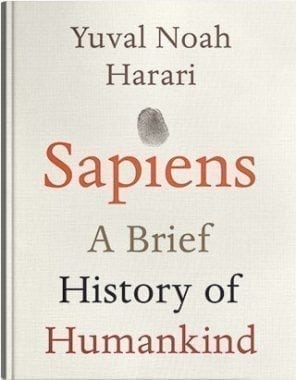
I have been reading Sapiens: A Brief History of Humankind, by Yuval Noah Harari. I blame my mother. In fact, I hold her single-handedly responsible for the popularity of this book. (OK, it was probably Obama's recommendation.)
It was back in the fall that I went to the bookstore with a couple of coworkers at lunch, and we came across a display of Sapiens. I recognized the author's name as that behind Homo Deus, which my mother had been telling me about because she thought it would interest me (and she was right), having heard Harari in interview on one of her many news channels. So I pointed the book out to my coworkers, and before I new it they were both buying a copy. (At this point, I was still hoping that someone would get me the future-looking Homo Deus, rather than the history-based Sapiens, for my birthday.) Then started the raves, and the campaigning to "do" Sapiens for book club.
Fast-forward six months. We did indeed last week discuss parts 1 and 2 (of 4) of Sapiens at book club. We went more than three hours and spent most of it at each other's throats. Fighting mostly about feminism, I think, while mostly sober.
This book is provocative. It's not that Harari puts forth any contentious arguments — I'm hard-pressed to pinpoint anything I may actually have learned — it's merely the fact that these subjects were gathered and presented together. Things we take for granted but that we need to talk about. Capitalism. Racism. Sexism. Humankind's violent nature(?).
Some sections seem a little simplistic; that can't be avoided in a book with such ambitious scope.
I'm finding the book to be weirdly judgmental; Harari explains history on this grand scale and that it couldn't've unfolded any other way, but then blames us for it. I can't decide whether this is careless or deliberately manipulative in order to spur action to quell our darker nature, but if the latter is the case, it risks antagonizing the audience it needs to reach and preaching to the choir. Ultimately, where we've been, were we are, and where we're going — it's all inevitable.
I'm not very good at reading nonfiction, so I appreciated having book club as an incentive. I do plan on reading the second half of the book, but I may take a little break before getting back to it.
To the best of our scientific knowledge, human life has no meaning. The meaning of life is always a fictional story created by us humans.
It sounds like Harari is saying in this essay that in the future, we will all play video games all day long. But I will give Harari the benefit of the doubt that his writing is sloppy, that he does not intend to insult humanity and be so casually dismissive of our choices, that he is trying to express the more meaningful fact that humans are adept at constructing realities to occupy and amuse themselves.
Life is busy of late. My reading is very piecemeal. Somehow I've managed to get myself to this point where, unnaturally for me, I'm reading four books or more at the same time. I'm highly distractible these days, and the lack of reading focus exacerbates the feeling of being unmoored. This blog in fact brings some kind of structure and routine to my life, and I miss it when I ignore it. That ends today.
Here's some of what's been going on.
Watching
My mother is a feminist, but she doesn't know it. And she's far more open-minded than she believes herself to be.
Thank gawd for television. If it weren't for television, my mother might not recognize Margaret Atwood for the Canadian icon she is. Somehow, Peter Mansbridge and I convinced my mom to give the television adaptation of The Handmaid's Tale a try, arguing that it's deeply relevant commentary on our Trumpian times.
It's dark and riveting, and my mother agrees.
My mom asked me in our first telephone debriefing, "It's almost like... is this science fiction?" I said the only thing I could say. "Ummm, nnnoooo."
Waking
Impulse purchase at a checkout counter: We Should All Be Feminists, by Chimamanda Ngozi Adichie. I was suddenly overcome with the feeling that I should own a copy of this, leave it lying around the house for visitors to pick up. But I don't have many visitors. I thought about wrapping it up for my teenage daughter, but then thought better of it. She'll find her own brand of feminism without my pressing manifestoes on her. So I sent it to my mother.
Leaking
As part of this year's Blue Metropolis literary festival, Barbara Gowdy was interviewed by Kathleen Winter, substituting for Heather O'Neill at the last minute. I've read only one of Gowdy's books, The White Bone, and it devastated me to the point that I deliberately stayed away from everything else she published for fear of further devastation or, worse, disappointment. But O'Neill was in fact the main draw for me to attend this event; had I known she was absent, I might not have made the effort, but I'm glad I did.
Gowdy's latest is Little Sister, about a woman who through paranormal means ends up inhabiting another's body, but, if I understood correctly, that body is not a mere vehicle (à la Being John Malkovich) — it's a catalyst for a much deeper experience.
The conversation was fantastic, weaving around this idea of fluidity, that so many boundaries have lost their rigidity, particularly in terms of identity, and everything is leaking into everything else. They also discussed, admiringly, George Saunders' Lincoln at the Bardo, which covers some similar territory (as well as the phenomenon of how similar, or even the same ideas, can crop up independently of one another). I'm very much looking forward to reading both the Gowdy and the Saunders (eventually).
Planning
The flights are booked: the kid and I are planning a holiday, splitting our time between Edinburgh, London, and Brighton (with daytrips to the likes of Stonehenge and Oxford).
I'm full up on English literature, but I'd like to read some novels set in Edinburgh. Any recommendations?