Saturday, April 23, 2022

I am become the howling is become me

gerald
I know I've been using a lot of WFH time but I checked with our ops team — technically there isn't a set limit on how much you can take

doug smorin
"within reason" is the limit

gerald
look, I know you don't believe me when I say I'm imprisoned in our slack workspace

doug smorin
because it's literally unbelievable

gerald
and the firm doesn't have a disembodied consciousness sabbatical policy  

doug smorin
you're doing great 

isabella, emily

emily
Is this real?

I kind of hope so. Thought you might know + wanted an excuse to say hi :wave:

isabella
haha wow it's real -- had to look it up. It's even Paris, not Bucharest (which was my first guess)

started reading Several People Are Typing this morning -- makes me kinda miss the office, and how slack was a complement to actual physical office space, not this separate thing that we're all swallowed up in

emily
OMG that sounds amazing. I have a real soft spot for work/office culture novels.

isabella
I've been literally lol-ing all morning. Good things it's short though -- the slack-style will surely become tiresome after 100 pages

emily
I miss slacking somebody while staring directly at them :lizard_stare:

isabella
/giphy stare

tripp
what is a workplace but a cult where everyone gets paid, really?

[...]

Beverley
I meant to ask if a Managing Principal was higher or lower ranking than a Director.

tripp
see, that exactly my point. we have a byzantine hierarchical structure
we have a SPECIAL PURPOSE, which we call our MISSION STATEMENT and slap it right on the website
Even the language of employment is cult-y! We're not employees, we're a "team." That's only two notches away from just calling us "acolytes" or something. And the stuff we supposedly devote ourselves to, like "innovation" or "influence" of "engagement"
how is that any different from telling everyone you're a Prophet of the Coming Storm?

Beverley
That would look great on a business card.
#talk-books

isabella
hey has anyone read Calvin Kasulke's Several People Are Typing?
(oh, look! several people are actually typing!)

first
Hi! I'd ask for advice about e-reader? Does anyone here use such as Kobo or Kindle. I have question like can use external pdf. What should I get as a first e reader :shrug:

marc
emergency, drop everything https://youtu.be/6a-k6eaT-jQ :heart:

isabella
ok so this guy gerald was trying to share a spreadsheet and he accidentally uploaded himself into slack, like his physical body is comatose in his apartment, but his mind is melding with slackbot and his productivity goes through the roof, but all his coworkers think it's just a bit while they're all wfh 

:eyeroll: sanderson :vomiting_cowboy:

pavel
Boox products are good.

isabella
And then there's lydia, who may or may not exist, but I immediately pictured her as our lydia, with the attitude and the smarts, but maybe it's slackbot impersonating lydia

lydia
it's like it's coming from inside of me!!
like the echo from the constant howling is reverberating inside my rib cage??
but instead of getting softer and more distant it just grows louder and more, present??
you know that feeling??
like my skeletal structure is just an instrument for the howling to blast through and soon it'll burst through sinew and bone and rupture by flesh beyond recognition??

Beverley
So I am also WFH except when I'm offline from 2-4:30!

lydia
so I don't think I can make it in today!!

rob
wow
I mean, dang
@lydia do you need to go to urgent care or something

kerolyn
???

rob
sounds serious

tripp
lol

lydia
it's like
I am become the howling is become me!!
you know!!

It's weirdly philosophical (and hilarious), there's this discussion between gerald and slackbot about sunsets, which evokes the concept of the "stuplime." so slackbot shows gerald where they keep the sunsets and he "sees" -- as a disembodied consciousness -- ALL the sunsets, and then he becomes sunset :whoa_keanu:
"psychic splintering"

/giphy sunset

first
cool

isabella
highly recommend (but maybe not to people who don't use slack. or work in an office. also highly relatable re marketing department day-to-day)
stuplime

Excerpt.

Saturday, April 02, 2022

Nothing goes anywhere

"You're trying to get away? It's no use! I too was trying to get away, to ride away, to move to Lviv, or to Kyiv, to anywhere else. But you can't get away. There's a moment when cars stop driving out of town, and later you find out that commuter buses and jitney vans haven't been running for a long time, and then it dawns on you that you have remained forever where, in fact, you had been lingering merely in order to leave that place at some decisive moment. You are now stuck, you've become a hostage, a prisoner of people and circumstances, just like in the movies you used to watch, except that now you've become an unwilling actor in that movie, only to discover, to your astonishment, that there isn't and never was an art more petty, more heartless than contemporary cinema, all contemporary cinema without exception, including of course documentaries. Because when you wake up inside a work of whatever genre — comedic, heroic, documentary, military — the movie, to your astonishment, turns out to be unmoving, an infinitely protracted, monotonous, corrosive nightmare. And I would have really liked, with utmost sincerity, I would have liked to believe, as with any normal film, that this nightmare followed a plot development with a climax, an ending, and even an epilogue, but, from my observations, nothing of the sort takes place. Nothing goes anywhere. Nothing ever come close to this supposedly ancient, time-tested formulaic plotting."

— from Lucky Breaks, by Yevgenia Belorusets.

Written in Russian, but with a Ukrainian title, by a Ukrainian in Ukraine, and released by a Ukrainian publisher in 2018. 

Excerpt.

Translator Eugene Ostashevsky writes:

My first paper copies of Lucky Breaks came in the mail last night. I sent a photo of them to Yevgenia in Kyiv, with the words "The book is out!" She wrote back an hour later: "We are under fire!" I am writing these sentences on the morning of February 24th, 2022, the day that Russia — the country I was born in — has perfidiously invaded Ukraine, the country of my ancestors. 

Artforum: Letters from Kyiv: A wartime diary by Yevgenia Belorusets 
The Atlantic: Her World Began to Collapse, So She Started Keeping a Diary

Wednesday, March 30, 2022

A gallery of monsters

If each of us drew our own body as if by dictation from our own internal perspective, we would produce a gallery of monsters!

— from The Sexual Life of Catherine M., by Catherine Millet. 

I'd been planning the third major sculpture for months. (Peter was my first; the second was my tree lady.) I wanted to develop technique. I wanted to stretch beyond what I'd been taught about form. I wanted to create art.

This project had purpose. A self-portrait. I established some objectives.

1. It had to look like me. At least in its early stages. I would allow for it to morph into something more symbolic, expressive, a distortion of me. But its basis had to have sufficient me-ness that I could not deny to myself that it was me.

2. It had to express joy. Pain is easy. It's unique, powerful, exquisite. But Tolstoy was wrong about happiness. Happiness is also nuanced. And it's difficult to express artistically without being saccharine or facile. I needed to preserve something joyous, but I needed to find it first. This was a pandemic project, after all. (I considered some secret joy, some orgasmic expression.)

3. It had to represent me symbolically. It was at this level I thought art manifested. I wanted it to be a self-portrait from the inside out. Maybe my brain spilling out. (What do my migraines look like?) Maybe my head split open and my brain obviously set wrong. Maybe in place of my brain, my heart.

This is what I thought about throughout the summer of 2020. I procured materials, I waited for winter. I broke open the package of clay in early November. It was US election night, I had the tv on, I needed art to counterbalance reality, I wondered if that made my art a political act.

For a few weeks I obsessed over cheekbones, the angle of my nose, the whorls of my ears. And then, quite unexpectedly, I fell in love, or something. I felt both seen and not yet fully seen, and that it didn't matter whether I was seen or not. Suddenly seeing didn't matter, feeling mattered. I thought more about seeing, without actually seeing.

Very coincidentally, I'd started reading John Berger's Ways of Seeing at about that time:

A woman must continually watch herself. She is almost continually accompanied by her own image of herself. [...] 

One might simplify this by saying: men act and women appear. Men look at women. Women watch themselves being looked at. This determines not only most relations between men and women but also the relation of women to themselves. The surveyor of woman in herself is male: the surveyed female. Thus she turns herself into an object — and most particularly an object of vision: a sight.

Love didn't last, but I had projects to keep me busy. I kept thinking about how I was seen, how I saw myself. I started seeing outside myself, in a way that I hadn't in a very long time. Among all the ways of seeing, I started seeing my way.

I learned how to handle clay, maintain its wetness. I learned how to work it when it is hard (the work of carving). I learned how to perform a lobotomy. I learned about shapeshifting. I can point to this sculpted portrait's objective faults: the face too flat, the ears too big, the mouth too thin. Too unfocused. Too ambitious. Too inauthentic, even if conceived in an authentic kind of way. 

I studied my perception of myself. I created a very long neck, not because it was realistic or particularly aesthetic. Likely this was a subconscious expression of the distance between my brain and my body.

I failed on all three objectives. (Except maybe the first. And the second and third.) I lacked patience, persistence, and discipline. (But this project served its purpose.)

I am listening to a podcast in which is discussed the drive to create beauty out of pain (and I think: beauty in ugliness and imperfection — wabi-sabi); how Leonard Cohen makes you want to die and spread your legs at the same time; how obsession with a thing is often an obsession with what the thing represents.

I am learning to refocus on form. Art will manifest itself somehow through clarity of thought. I am learning to be naked.

To be naked is to be oneself. [...]

Nakedness reveals itself. Nudity is placed on display.

To be naked is to be without disguise. 

This morning, I woke up and looked at it anew, and I smashed it.

Time to start again.

Saturday, March 26, 2022

The swelling of proportions

I'd gone to France for work, to a party, in a castle decked out in a way I'd never seen. I'd had a fair amount to drink, and I latched onto someone who worked for an important newspaper, unlike me in those days, when I slaved away a a meager publication. The guy was my age, I'd known him for a long time. He made me laugh all night, I drank and laughed, and for the first time, I cheated on my husband. And it was amazing, really amazing, but not the sex, I care next to nothing about sex. I remember, instead, the swelling of proportions that followed. I walked down tree-lined avenues at seven in the morning, the air was lovely, and I felt I'd grown as tall as a giant. But then the sense of swelling proportions dissolved, and I started to feel terrible. Not about my husband, honestly, I didn't feel the least but guilty. In any case, I believed I had the right to enjoy life.

I think about the care some people take, or not, with my secrets. Those intimate divulgences. Do they mull them over, mystified? How does it change their view of me? Do my secrets shock them, or do they puzzle over why I bother to keep them close? Do they hold them for me, or spill them out? I have so very few.

I think about the secrets I know about others.

I stumbled across Trust, by Domenico Starnone, on just such a day when I was wandering down old familiar streets, with a swelling of proportions, a swelling of memories, thinking about someone's secrets, and realizing I couldn't tell anybody about them. That someone would never know if I did. Nobody would care, about the secret, or about its telling; nothing would change. But it's a bond, my honour.

(His dark secret only made me love him more. It was the small secrets, the insignificant omissions, that drove a wedge between us. But I wonder if he thinks about it sometimes, the fact that I know.)

The tension of Trust depends on this pact between lovers: they confide in each other their most shameful secret, "something that would destroy your life if anyone came to know it," to bond them forever. Yet, a few days later, Pietro and Teresa break up.

We never know what they told each other. We know Pietro thought Teresa's secret awful. And Pietro lived in fear that Teresa might reveal his own shame. It's something she holds over him, even after his death.

The book unfolds in three parts, spanning decades and shifting perspectives, from Pietro, to his grown daughter, to old woman Teresa. Pietro's life is mostly unremarkable, a mostly undistinguished career, some minor celebrity, a typical family life with an ambitious but disappointed wife. 

His failings are also mostly unremarkable, and perhaps typical of his generation. Teresa was his student, and he felt threatened by her, diminished by her. In turn he diminished his wife, who was surely capable of great successes but was burdened by the traditional demands of marriage and motherhood. 

At this point I must pause for a moment to draw attention to the fact that, in that moment, I totally gave in to the truth of a cliché. I thought: we fall in love with people who seem real, but don't really exist. We invent them. I don't know this self-assured woman, who speaks to me in such clipped sentences, this fearless, scathing woman. She's not Nadia. There's the person we love and there's the real person, but as long as we love the person, we never see the real person underneath. We inevitably waste so much time, I said to myself, loving people. These past few years, I happily invented a person. I've taken great pleasure entering into the body of a pale watercolor of my own making.

Pietro did not think well of himself, and he shouldn't, though he didn't give these matters much thought. With an incomplete understanding of his inadequacies, but his sense of entitlement thoroughly offended, he rather blamed the unjustness of his lot in life on the socioeconomics of his upbringing.

A psychological descendant of Alberto Moravia's Contempt, Trust starts like this, stylistically modern, breathless. 

Love, well, what to say? We talk about it a lot, but I don't think I've used the word much, on the contrary, I doubt it's ever been of any use me, though I've loved, of course, I've loved, I've loved until I've lost my mind and my wits. Love as I've known it, in fact, is a lava of crude life that burns the refined one, an eruption that obliterates understanding and piety, reason and rights, geography and history, sickness and health, richer and poorer, exceptions and the rules. All that's left is a yearning that twists and distorts, an obsession without a cure: where is she, where isn't she, what's she thinking, doing, what did she say, what did she really mean when she said that, what isn't she telling me, was she as happy to see me as I was to see her, and feeling better now that I've left, or has my absence debilitated her instead, as hers debilitates me, annihilating me, stripping me of all the energy that her presence, on the other hand, generates, and what am I without her, a stopped clock on the corner of a busy street, oh her voice on the the other hand, oh to stand next to her, to diminish the distance between us, reduce it to nothing, erase kilometers, meters, centimeters, millimeters, and melt, lose myself, stop being myself, in fact, it already feels like I was never myself other than within her, in the pleasure of her, and this makes me proud, it cheers me up, and it depressed me, it saddens me, and then it jolts me again, it electrifies me, I care so much for her, yes, all I want is the best for her, always, whatever happens, even if she turns cold, even if she loves other people, even if she humiliates me, even if she strips me of everything, even of the very capacity to care for her. 

Reviews 
Shiny New Books 
LARB: The Terrible Powers of Self-Deception: On Domenico Starnone's "Trust"
Cleveland Review of Books: In Search of Self through the Other: On Domenico Starnone's "Trust" 

Sunday, March 20, 2022

A convulsive act

My adolescence as a reader became, without a break, a long and unhappy apprenticeship as an author.

The geese have returned. They've brought the rains. 

I am living amid a labyrinth of boxes. All my possessions, I am turning them over in my hands, weighing their worth. I like my things.

I am finishing repairs to the unit I will soon vacate while shopping for furniture to fill my new space. I am sick to death of my financial advisor and the notary and the customer service people of half a dozen different services. 

I spend my workday considering how we should talk about the industrial metaverse. I think: this is not reality, this is not my reality. I think: I haven't yet made peace with my profession, because writing isn't a real profession. I think: I resent my mother, my upbringing, for convincing me that pursuing artistic endeavours was nice, but not a way to make a living.

I escape into art. I am in workshop only one evening a week. But I research wire types and gauges for armatures; I make prototypes at home, testing poses, trying techniques; I amass boards and cloths; I buy litres of silicone, preparing to cast molds.

I'm not entirely pleased with my latest sculpture, working from a live female model this time. I don't think I've ever looked at a female body this intently before. The model's function is as an anatomical reference. But she has surgical scars, and acne, and razor burn. We're not supposed to notice these cosmetic details, we're encouraged to whitewash them. But I want to capture the scars, at least. They are vulnerability and strength. This is beauty. A friend tells me about wabi-sabi. (We are all broken.)

I try very hard to see what is, to not let my mind fill in the blanks. (Years of jigsaw puzzling has trained me for this.) I understand something, finally: I will show you what there is before I show you what I see. I must be able to show you what there is, so that you are ready to see when I show you what I see.

I am surprised to find that I am not enjoying books I was certain to like; clever and experimental suddenly don't seem to have sufficient substance to carry the weight of their presumptions. I am returning to modern classics to find depth of character, psychological underpinnings, plot, place in the world.

I have completed 743 days of daily German lessons, yet I find myself drawn to things Italian.

I watch The Great Beauty and The Hand of God, and I marvel at how Sorrentino frames his world, comingling the vulgar and the sublime, all of it beautiful.  

In In the Margins: On the Pleasures of Reading and Writing, Elena Ferrante offers a window onto the reading that formed her, as she believes strongly in "the importance of the writing we've inherited."

These essays were conceived as a series of lectures, which were then curtailed by the pandemic. Despite the insights, they are dry. She is a brilliant novelist, and no doubt an accomplished academic, but while her fictions keep me up past my bedtime, these learnings lulled me to sleep. 

Anyone who has literary ambitions knows that the motivations, both great and small, that impel the hand to write come from "real life": the yearning to describe the pain of love, the pain of living, the anguish of death; the need to straighten the world that is all crooked; the search for a new morality that will reshape us; the urgency to give voice to the humble, to strip away power and its atrocities; the need to prophesy disasters but also to design happy worlds.

But importantly, I learn: "Every good character needs an other." I think about that. It helps to take me outside of myself.

I watch The Lost Daughter, Gyllenhaal's adaptation of Ferrante's novel. It's anxious. The camera so very female, the way it lingers on beautiful men (women too), lusts for their youth. I understand now that there is such a thing as the female gaze, and it's a thing I have, I turn it on others.

So I got in the habit of using traditionally rigid structures and working on them carefully, while I waited patiently to start writing with all the truth I'm capable of, destabilizing, deforming, to make space for myself with my whole body. For me true writing is that: not an elegant, studied gesture but a convulsive act.

Sunday, March 13, 2022

Pain is the awareness of being alive

It was her Father who told her that highly educated people did nothing but complain, and that those in poverty, on the other hand, could stand more, much more, or maybe they felt less. He also said that distraction could be the best medicine, but that some medicine could be lethal if one denied all symptoms. Because pain is the awareness of being alive. One had to a little dead or a little deaf in order for the body to rest.

I'm not enjoying books I thought I would enjoy. Reading them is a slog. Writing about them is a penance. 

Maybe I've grown too discerning. Maybe I'm bored.

There were no candles in the country of the present, where the electricity never went out. Never, until it did.

Nervous System, by Lina Meruane, starts off beautifully, in a cold and clinical way. Pages like poetry. But the electricity went out for me early. It soon becomes needlessly cryptic.

Ella is self-absorbed, at the centre of a constellation of people, none of whom have names. I don't care about any of them. The Father (domineering, until he is sick, possibly dying), the Firstborn (mostly absent), the Friend, the Cousin. The Mother (biological) and the other Mother (the second wife, who birthed the Twins). Ella is working on her doctoral dissertation in astrophysics, but she's blocked, so instead she turns hypochondriac or possibly genuinely mysteriously ill. Possibly she quits.

The book is suddenly about Ella's boyfriend El (not really a name, just he to her she), who works in a  psychologically and politically traumatic environment and is severely injured on the job. But he doesn't seem to figure significantly in Ella's life, so I don't care about him. Possibly they split up.

Then it is about other people's traumas and illnesses.

Possibly someone (a Mother) had breast cancer in the past. The family is noncommunicative and dysfunctional in a fairly normal way.

Possibly there was a rape. I wish I knew so I could feel outraged rather than detached. I wish I could feel something.

Ella smiles sadly, reminding herself that those young people still live in the hopeful order of consecutive time, which had never been hers.

Thursday, March 03, 2022

Not to fulfill your desires

Sprawled across Jackson Avenue is a larger-than-life lady, screaming her "I don't give a fuck" in chemical pink. We come up on her from behind; a slight torque in her repose, I can't see her hand, between her legs I think, and I feel embarrassed to catch her masturbating in the midday sun. She's monstrous and gorgeous, she looks like an armature barely wrapped in plasticine, but she's all bronze, baby. So this is Queens.

We have a few minutes to pop into the bookstore. It's a comforting place, I want to touch all the books, my hand caresses the shelf, my fingertips drag across the tabletops. I want to read all the books I haven't read, but there isn't time, so I reach for a blind date. "Read me if you like... - intense, complicated sibling rivalries/ - carnivals/ - David Lynch films/ - unreliable narrators."

It's only later that I realize I know what the book is, of course I've read it. (And the receipt confirms my suspicion.) I shouldn't play this game. I've read too many books, I read too much about books, to be blind to them. But in that moment I was happy, I must've already known what it was and I reached for it anyway, this mysterious book made me happy.

I watch The Green Knight again, because it is beautiful and dark and mysterious, and it reminds me that an instant can be a lifetime, and I can wonder for all eternity where it all went wrong, and I can't tell if it actually went wrong at all. This is what I do now, I watch this movie at every opportunity, which seems to be when I fly. Who the hell is this green knight anyway? And this time the image of him picking up his head reminds me of Medusa carrying Perseus's head, but not the bronze, rather the recreation by a live model, the photograph we drew from in art class the other week, that haughty smirk. Now I want to sculpt the green knight, but I can't yet, because I don't understand him. I wonder if cutting off my own head would bring clarity, it is my oppressor after all. (And St Winnifred too, everyone losing their head.)

A friend and I are texting about Ukraine, and she sends me a poem by Bertolt Brecht, because we live in dark times. I read it and I am gutted. (Headless and gutted, empty.)

Not to fulfill your desires but to forget them
Is accounted wise.

I can't tell if Brecht is saying it is wise to forget one's desires, or if it is thought wise but isn't. I spend a weekend in New York fulfilling some desires, yearning after others, and all in all not knowing what to do with them any of them anymore.

I have been reading Ferrante and Starnone, and I will write about them someday. I have been reading other things, and enjoying not writing about them. I am working far too much.

A drunk angry Ukrainian spews profanities on the subway platform and a rat makes for the exit. The poster in the elevator in the hotel reminds me that all my desires are worth fulfilling, even as the world burns. 


Wednesday, February 09, 2022

Event-tempered against narrative repolarizations

Clara's body heaved a little, assuming the shape of a soundless sigh. Currents of emotion moved through the room.

My mother moved us to a subdivision when I was 11, a year or two before Rush immortalized the dreariness of conformant living. "Nowhere is the dreamer/ Or the misfit so alone." In my subdivision, everybody listened to Rush.

I hated it.

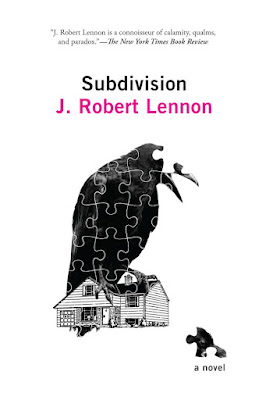
Subdivision, by J Robert Lennon, is weird and brilliant. Part videogame, part fairy tale. It's psychotherapy as written by Douglas Adams. It's Alice in Wonderland if it were an allegory about a grisly car accident. It's The Hearing Trumpet if it were about a young, professional modern woman.

It starts with a jigsaw puzzle. It fully occupies the massive table in the subdivision's guesthouse (why is she here?), and our protagonist is invited, even expected, to work on it. It's maybe three feet by five, but no box, no picture. Its pieces change shape, and the image appears to shift. As progress is made in some areas, other sections are undone. She must not allow things to delay her progress.

(I just bought an 8,000 piece jigsaw puzzle on eBay. Three feet by nine. The Sistine Chapel ceiling. Maybe it is a metaphor for my life. Maybe I will see the hand of god in it. I am saving it for the new house, a new project among others. I am preparing for a major puzzling accomplishment. Maybe I will paint my ceilings. I must make progress.)

"The problem ... with an itch," the man said, grunting and wheezing, "is that it isn't ... in one ... place." His voice, smoke-roughened, stirred a memory just out of reach.

"I'm sorry," I said, "I don't understand."

"An itch ... is a creation ... of the body ... and the mind." His face contorted with the efforts of his hand; the expression, again, struck me as familiar. "The mind ... expresses its need ... for simulation ... through the body. The ... body ... ugh ... tries to ... satisfy itself ... by scratching. But the itch ... is a phantom ... of thought. It moves ... to trick the body ... into gratification."

There's a shapeshifting bakemono, and a house built in a probability well, with windows that aren't event-tempered against narrative repolarizations. "Sometimes you'll see the future through them, or the past, or some alternate version of the present. But they really let the light in on sunny days."

Under the bed, our protagonist finds a marvelous pair of colour-changing shoes — a perfect fit, making her feel light, and strong. She lands a a job as a Phenomenon Analyst, which requires experience in the area of quantum tunneling, about which she knows nothing.

There's a child, who may or may not be hers. There's a solar-powered personal digital assistant, that appears to be evolving, throbbing.

It's completely surreal, and completely logical, a slow release of clues pointing the way to the obvious end, a journey through the subconscious for a reconciliation with tragedy.

The box, eventually found, reveals it to be an "8,000-piece deluxe mutable situation-specific matte-finish bilateral theta cardboard puzzle."

Subdivision will be facing off against Lauren Groff's Matrix in the opening round of the 2022 Tournament of Books in about a month's time.

His words incensed me, and it was time to give him a piece of my mind. I turned to him and said, "I don't know — maybe?"

Tuesday, January 25, 2022

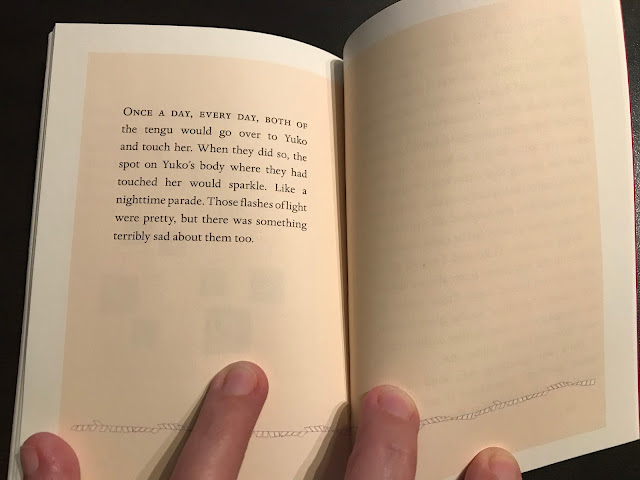
Sparkle like a nighttime parade

Sensei continued to stare at my arm, all the way down to my palm. His eyes on my palm, he murmured something about me not having any wit lines, even though I had several affair lines. The vertical lines that stick out above your heart line are your wit lines, and your affair lines are the ones that run parallel to your life line, along the base of your thumb. Look, I have many wit lines, he said.

Parade, by Hiromi Kawakami, is a delicate little thing.

Some mischievous sprite nudged this book just so on its shelf at the shop, that I had to investigate it. It's a beautifully designed volume, charmingly illustrated by Takako Yoshitomi. 

The wordcount of the reviews is higher than that of the tale itself. I've never read Hiromi Kawakami, but this is billed as a companion piece to her Strange Weather in Tokyo, which I'll be exploring soon. 

A folktale of tengu and childhood. Hazy memories. A lazy afternoon just after the rainy season.

Subtle, elegant, whimsical, intimate. Light. I feel touched by sparkles.

Reviews
Open Letters Review: November 2019
Open Letters Review: October 2020
Tony's Reading List

Monday, January 24, 2022

A condition that causes a dimensional shift

Our love was so strong that it felt like a presence in the communal apartment, as if it were another tenant. It had an amorphous shape and weird density; it was less dense than an actual object, but denser than the air in the room. It felt as if I could touch it. I could move my hand through the air and feel resistance in places were love was.

I thought that the lack of love wasn't only empty space. It had a physical presence too. Negative presence. And like negative numbers, it had the ability to multiply and grow. You couldn't stop it.

Something's happening to me. I have trouble sleeping. I have no time for reading or blogging, but there's the same amount of time there's always been. I am almost proud of not reading and not blogging, like I've stuck to a New Year's Resolution to cut down on bad habits.

But I'm not filling my time with anything new. Maybe I take more baths, listen to more podcasts, do more puzzles. I have maintained a 687-day streak of German lessons.

Nothing feels restful. I feel like I'm moving through negative space.

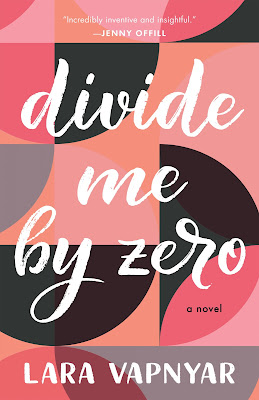
It took me a very long time to read Divide Me by Zero, by Lara Vapnyar. I don't understand why. It's charming, funny, dark. I can relate to the love and loss and death. I can relate to its Slavic outlook, its immigrant status. 

"I'd love to write the novel about Love and Death," I typed. "How both of those words lost their majestic old meanings. People don't really 'love' each other anymore, they either 'worked on a relationship' or 'succumbed to sexual desire.' People don't 'die' either, they 'lost their battles' with various diseases or they simply 'expired' like old products on a shelf. Neither love nor death is considered the most important passage in the life of a person anymore. In my new novel, I would try to restore their proper meanings."

Perhaps, I realize, I've been reading too much of the wrong kind of book. I've been reading to help myself know my heart, I've been going deeper and deeper inside it, probing. But I already know my heart. Perhaps it's time to let it rest quietly, monitor it for anomalies but trust it to function as it's meant to.

I thought that if I could study love the way I used to study math, the knowledge would arm me with some power against the colossal incomprehension and fear I was experiencing.

Divide My by Zero starts and ends with death. In the beginning, as a reflection upon the past, Katya's mother has a gentle death, couched in tenderness and nostalgia. It reaches out beyond the individual; it moves Katya to connect with a stranger, connect with her childhood and her heritage. But in Katya's retelling when we approach her mother's death at the end of the book, it feels abrupt and violent and tragic, isolated in her Escher house, somehow severed from the rest of the world.

One of the results of the compartmentalization was my grossly mistaken belief that what I did in one of my lives couldn't possibly affect people in the others.

I feel like in the six weeks it took me to read this book, my mind was preparing me to read the ending, and stick the landing, to learn this: that despite the playfulness, the wit, the compassion, there is still devastation, and in a very Slavic way life goes on, sometimes better, sometimes worse, often not the way you expected it to.

Sometimes I think that I turned to math the way B. turned to Orthodox Christianity, to fill a spiritual void that became acutely unbearable after my mother died.

If you think about it, math is as good a religion as any. It's both endlessly abstract and irresistibly precise. You can grasp the entire world with the help of math and make it seem less chaotic, unpredictable, and scary. Isn't this why my mother started to work on her last book to begin with? She must have felt that something was wrong; she must have glimpsed into the chaos of death, and she turned to math -- her safe, perfectly structured space.

One way to describe love according to the gospel of math is as a condition that causes a dimensional shift. The emerging new world that contains love becomes so vast that it opens into an entire new dimension, dwarfing all the worlds that existed in your life before you fell in love.

Excerpt.

Sunday, January 09, 2022

We can't feel two things at once

The other night I dream I am in Mexico again, but on the mainland, gently drifting, grazing the treetops. I think I am holding something over my head, maybe a sheet, acting like a glider. I watch the jaguar slink across the open field and think, I shouldn't set down in this tree, let me go a bit further, but I'm not afraid, I am just being sensible. I finally alight outside a hotel that is not a hotel. Someone invites me inside, and I stand on the terrace, watching an older couple lounging in the infinity pool, the milky water spilling seemingly onto these plains of Mexico where somewhere my jaguar is watching out for me, is that me in the pool in the milky future with my longtime lover? I can feel the jaguar prowling (for what?), but I know it will not hurt me.

What would my psychotherapist say?

I need to exercise my patience, I'm out of practice. Steady as she goes.

The sickness is sweeping the city. Friends are sick. Colleagues are sick. We are living in lockdown again, under curfew. There are lineups for liquor and groceries again. There appears to be a shortage of catfood, or maybe I live in a neighbourhood with a high-density cat population that is suddenly demanding more substantial sustenance. 

Practice gratitude. "Research has shown that gratitude displaces anxiety: We can't feel two things at once."

I can't read. I can't sculpt. Television bores me. I don't want to work. I tire easily. I play video games for hours on end. My eyes are tired. It's been 673 straight days of German lessons. Isabella, deine Arbeit ist zu stressig, mach Urlaub. My skin is peeling, I'm shedding the sun of Mexico, but I keep silver coral wrapped around my fingers, a new talisman. I go for short walks and smoke illegal menthol cigarettes.

I do research for work. The future is not only useless, it's expensive, I learn. 

And this is why the future, be it NFTs or Memoji or the howling existential horror of the Metaverse, looks so ugly and boring: it reflects the stunted inner lives of the finance and technology professionals who produced it.

The problem then, apart from the howling existential horror of the Metaverse: how to not be stunted, how to unstunt oneself, how to imagine something beautiful and interesting.

I am trying to understand, and embrace, Massive Change. In how I work and in how I live. In how I interact with people and with the world. Everything is a design problem. Design thinking leads by inspiration. It demands the clarity and courage of its convictions. Design is driven by purpose.

Thursday, December 30, 2021

Like most humans, she had a single heart

The sense of space as a controlled substance is overpowering, except you don't know where it's going to take you.

The Silk Road is magic. I don't understand how any of it works, and I'm sure there are more elements in play than I suspect, but it fills me with awe and joy.

Next she took someone's head and lifted it like it wasn't part of a human body, a cabbage or a planet or the repository of all good thoughts and evil, which, when you think about it, is exactly what a human head is.

The book opens in the labyrinth, one woman guiding bodies on yoga mats in Savasana (corpse pose).

This was the most challenging of the poses if you took into account the fact that the room was filled with people who knew the world was coming to an end and that if we worked at it hard enough we would never die.

One of them dies (murder?). Is it a tenth body, or one of the nine "named" persons (the Astronomer, the Archivist, the Botanist, the Keeper, the Topologist, the Geographer, the Iceman, and the Cook, and Jee Moon)? Is it someone from their past — Mother, Father, or are they already dead long ago? Is it someone they even know at all? 

It's a labyrinth of memory and shared consciousness. While the environs seem to shift from a settlement in the icy lands of caribou to Le Puy-en-Velay and Aubrac, the journey is primarily interior, some spiritual plane on which they remember and commune, though some things they decided to forget. All the paths are marked by cairns.

How is it possible for the solid objects around us to melt away into the past, and for a new order of objects to emerge mysteriously from the future?

I would make the case that the entire novel takes place on their yoga mats, always in the labyrinth, a spiritual investigation, processing life and birth and death and tragedy and love and desire and heartbreak, the mystery of being, and being one with it all.

The journey along the Silk Road is not one from their memory; it is a metaphor of the human condition, travelled "for everything strange or unknown, a variety of alien gods and ideas, and unbounded universe with nothing outside it, the dung-covered eggs of the silkworm." "Everyone was using it, for commerce or as a means of escape." "What everyone had in common was lack of destination."

They had been children together — siblings, it seems. (And Jee Moon, an outsider but always present.) They squabble like children. But they are like some cosmic beings, inhabiting tubes of skin and learning to tell one another apart. One of them has two hearts. One of them may not have a heart. One of them (the Archivist?) will have the black spot on the skin, a sign of the sickness.

The Topologist visits a shrine to Saint Roch. Saint Roch was also their elementary school. There are many dogs (and fleas), and the Plague (are all plagues so much the same?).

Everyone was heading north, the sickness not having arrived there yet. Everyone knew it was a physical condition — they were that knowledgeable — but the extent of what they knew was compromised by exposure to a glut of information and rumor, making it difficult to predict anything.

The Geographer has a husband, and a child. The Cook is a widower. The Topologist met the Swede. The Astronomer fell for Jee Moon. A long time ago, the Archivist fell in love with a poet.

We all had our love stories. This was true even for the Archivist, whose misfortune it had been to fall in love as a child with a girl who grew up to be a famous poet. Like most humans, she had a single heart, and that heart had room in it for only one person — that person being herself. The spirit of the age was compounded of arrogance and inattention, the predominant humor begotten of the chylus, cold and moist.

A game of Hangman: Eight letters, two Es and an X at the end. Sardines. Tarot cards.

While she walked, the Topologist felt herself becoming aroused. It was as if whatever lay beneath her had its attention fixed amorously on the cleft between her legs. She felt like she was naked from the waist down, hungrily observed and getting wet, her breath coming faster and faster. 

Walking can do that, said the Keeper. It's perfectly normal. She was trying to be reassuring, like a mother.

Sphagnum subnitens, said the Iceman. Glittering sphagnum. All it thinks about is sex.

This novel is a puzzle I can't solve, and it's surprising and gorgeous. Expansive, boundless.

Excerpts
Fairy Tale Review
Granta 

Reviews
LARB: Journey to Death: On Kathryn Davis’s "The Silk Road"
Slate: My Soul Is Going on a Trip

Monday, December 27, 2021

They had a passion for oysters

"People want conjugal love, Rachel, because it brings them well-being, a certain peace. It's a predictable love since they expect it, and they expect it for precise reasons. A bit boring, like everything predictable. Passionate love, on the other had, is linked to a sudden emergence. It disturbs order, it surprises. There is a third category. Less well known, I'll call it the inevitable encounter. It reaches an extreme intensity, and it very well might not happen. It doesn't occur in most lives. People don't seek it, it doesn't suddenly emerge either. It appears. When it's present, one is struck by its self-evidence. Its particular characteristic is that it is experienced with people whose existence one hasn't imagined or that one thought never to know. The inevitable encounter is unpredictable, incongruous, it doesn't blend with a reasonable life. But its nature is so entirely other that it does not perturb social order, since it escapes from it."

An Impossible Love, by Christine Angot, is strange and annoying.

The title is confusing. Which love are we talking about, and what about it is so impossible? The novel starts off telling the love story of the narrator's parents, which is doomed early on. But the impossibility may lie between Christine (the narrator) and her mother Rachel. Or in the difficult relationship with her mostly absent father.

His family had lived in Paris for generations, in the seventeenth arrondissement, near Parc Monceau; they came from Normandy. In Paris, many had been doctors. They were curious about the world, they had a passion for oysters.

Classism abounds, with Rachel and later Christine aspiring to the kind of life Pierre represented. Everyone is rather selfish and unworthy. Christine was born out of wedlock; while Rachel's outlook seemed rather modern, Pierre's refusal to officially recognize his daughter felt outdated (though likely in keeping with the French laws of the time). This is a suspected work of autofiction; Angot was born in 1959. 

I was surprised to learn that Angot is a Prix Médicis laureate. I'm typically very tolerant of unlikeable narrators and other characters, but in this case it greatly diminished the sympathy Christine deserves, ruining the intended effect of the direction the plot takes. The author is clearly familiar with psychoanalytic techniques, and the narrator as a grown woman has a lot of baggage to unpack. An Impossible Love was unsubtle in reminding this reader, repeatedly and from early on, that this is a book about Christine, not her parents.  

She didn't have the banal feeling of being filled, but of being annihilated, emptied of her personality, reduced to dust.

Thursday, December 16, 2021

When you and your life's happiness part ways

"I will never do that again," she said. "Be the one who loves less."

26 Knots, by Bindu Suresh, is a love story, is several love stories, several different kinds of love, wrenched by obsession and heartache.

People walk into and out of our lives all the time. Sometimes they stay awhile. Sometimes this time you spend together is the last time. Sometimes people come back after long absences, if only fleetingly.

I was happy to discover a new English-language bookstore in the neighbourhood. It felt of warmth and kindness and love for books. I scanned every fiction shelf, smiling with approval as I recognized most titles, some favourites, some classics. I imagine, "Can I help you find something?" "Yes, I've read all of these." 

A young man comes in, a screenwriter, settles by the counter to chat with the shop assistant, about the metaverse and The Green Knight, while I land on a slim volume, an iconic Montreal view on its cover.

In English, Araceli was vibrant and cheerful; in Spanish, she was soft, maternal, with a voice from the undulating Córdoban hills; in French, she was endearingly wide-eyed and lost, tripping over her words as if they were large obstacles. Adrien liked her most, but knew her least, in his mother tongue.

The knots are drama and tragedy: language, love, longing, infidelity, pregnancy, childbirth, loneliness, your mother, your father, your past, your expectations. 

I read 26 Knots, this quintessentially Montreal story, on an island thousands of kilometres away from the island I call home. I watched The Green Knight on the flight here. I think about duty and love and tests of valour. What is it I quest for. What is foretold and what is mutable. Am I moving away from something, or moving toward something else. What sticks heavy on my heart. How easily I am led astray from what matters. When is the quest over. When is it over.

I stayed with a man for too many years, for most of which he told me he loved me more. More than yesterday? More than chocolate? More than I love you? As much as I wanted to challenge his statement, I knew that doing so might prove a point better left ambiguous. Whether or not he did, he believed he did. As I believed I loved him better. But love is not a contest. And finally I know my own mind, and I accept that it is better to love than to be loved, and I love how I can.

I think there are more than knots in the muscle of my heart that I have yet to resolve.

And then, the biggest question of all: when you and your life's happiness part ways at a forked path, when do you admit the mistake and turn back, and when do you set yourself belligerently forward?

Wednesday, December 01, 2021

The vastness of confinement

I remember what's not here. An island of men who are searching for beauty and find it only in the vastness of confinement. I admit I'm sadistic. I'm always saying that nothing is possible without the soul, just as no image is possible without its other. But I have no other. I have no soul. A young lover once promised to write the fatal sign on my womb and take me away with him to fertile lands. What became of him? That night is a hundred thousand nights ago and that lover is lost. I'm still waiting for him to appear among the smoky spirals that emerge from my mouth. I've had a series of smells burnt into me: a pair of hands in the twilight, the soft skin of somebody's back, a bewitched throat. Then it was over, and they were all gone. I'm still a witch who's waiting to cast spells. Our neighbour died of a heroin overdose with his baby in his arms. The woman in the house with the boarded-up windows suffocated on the smoke of her own fire. The animals die out before reproducing. That's what death looks like in these parts. Whereas my sun-soaked nights on the island were filled with stimulating chats, daydreams, furious kisses. Whereas in those golden years of my life, everything was an ecstasy of sexual reawakening. A wave of antipathy to the world wells up from deep within me. I don't know what these animals are up to. They're forming a circle around me and watching me, dumbfounded, their jaws practically unhinged from their bodies. I fall to my knees before them. If a local were to pass by now, basket in hand, gathering mushrooms and berries, they'd think this was some kind of pagan ritual.

I ordered this book for myself in the early pandemic days, I'd read a review, maybe this one, and I thought, perfect, a book about a woman who's dying inside, a victim(?) of all-consuming lust, that's relatable, I wonder how she takes it out on her world, does she interact with her world?, but by the time the book arrived it seemed like too heavy a read, maybe I'd found a way to cope with objectless lust by then, and later I was too happy, then too fragile, but lately was just right for it.

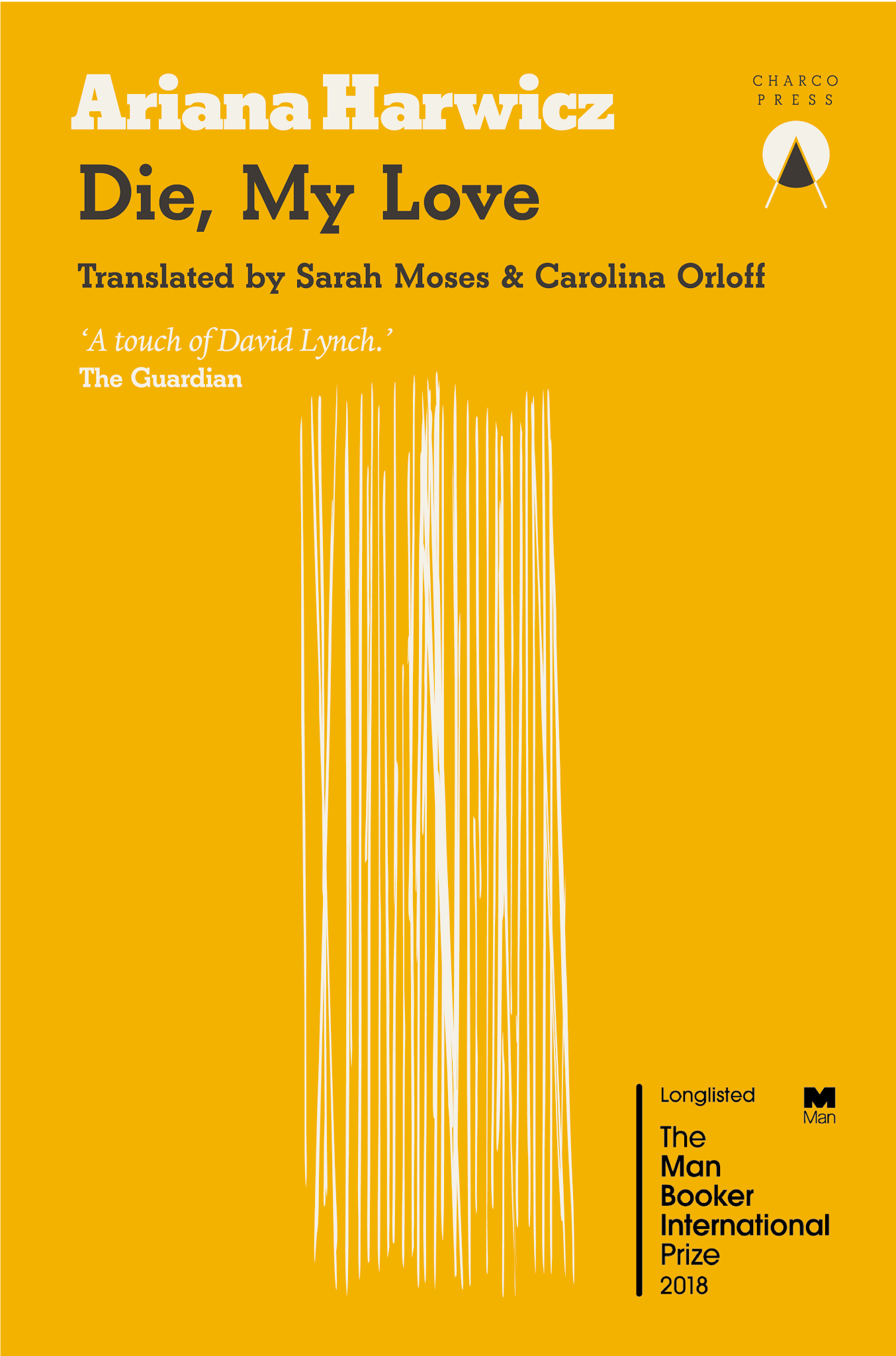
Reading Die, My Love, by Ariana Harwicz, is a descent into the maelstrom.

Not even digging a hole, a pit, would be enough. It needs to be thrown into the desert and devoured by wild beasts. Desire, that is.

The jacket copy goes like this:

In a forgotten patch of French countryside, a woman is battling her demons – embracing exclusion yet wanting to belong, craving freedom whilst feeling trapped, yearning for family life but at the same time wanting to burn the entire house down. 

That seemed to encapsulate lockdown and all the contradictory impulses it elicited, I would battle demons, I didn't need to be trapped in a marriage or by responsibility to small child (again!). Trapped at home, home was the entire world, and I would tear it down around me. 

These people are going to make me lose it. I wish I had Egon Schiele, Lucian Freud and Francis Bacon for neighbours; then my son could grow up and develop intellectually by learning that there's more to the world I brought him into than opening old skylights you can't see out of anyway. As soon as all the others had escaped to their rooms to digest their meals, I heard my father-in-law cutting the grass beneath the snow with his new green tractor and thought that if I could lynch my whole family to be alone for one minute with Glenn Gould, I'd do it.

(All figurative artists, I note. Why? Because the body, I guess. And the physicality of Glenn's art too.)

I have to say, though, that there's nothing to ground this story in the countryside of France. I believe there may have been a vineyard, possibly a road to Switzerland (my memory is hazy). Someone smokes a Gauloise. A reference to the punishment for adultery in medieval France. By this evidence, the novel could be set in my hometown. So it irks me that this "forgotten patch of French countryside" is mentioned in every review, adding colour where none is needed. We know she is a foreigner (I forget how we know, but we know, and we sense it firmly).

I woke up when she crashed through the glass, a scene worth the price of admission, I picture ribbons of blood. I need to start paying attention. "Everything is one big distortion." The fights and the jealousy, the pretense and resentments.

This is a madwoman's story (that's what it was like to be a new mother). A few times it shifts perspective to that of her lover, only now I wonder if it might be his perspective as imagined by her. By the end, I felt like things were told in the wrong order. No one dies, not really. Well, a little. Crazy, desperate, sad.

Saturday, November 27, 2021

All clean lines and precise movement

I was tipsy, yes, but also I was grace itself. There is, below the surface of every conversation in which intimacies are shared, an erotic current. Sometime this current is so hot it all but boils and other times it's barely lukewarm, hardly noticeable, but always the current is present, if only you plunge your hands just an inch or two farther down in the water. This is regardless of the gender of the people involved, of their sexual orientations. This is the natural outcome of disclosure, for to disclose is to reveal, to bring out into the open what was previously hidden. And that unwrapping, that denuding, is always, inevitably sensual. Nothing binds two people like sharing a secret.

I perch on a stool at the counter this morning, large cappuccino at hand, I'll have to go out this afternoon to get milk, there's none left for tomorrow, determined to blog about the book I finished reading earlier this week, not the the one I finished in bed this morning though it's clearer in my head, a few German lessons first (a 631-day streak), I'll revisit the library book, after all I have a time constraint, it'll vanish into the ether within a few days.

My sister meanwhile messages to say Public Health just called her, she has to get tested. It's been less than two weeks since she returned from South Africa. Did she bring omicron with her, could there be a more ominous, more threatening name for a variant, chronic, chronos, it's only a matter of time, it's a time disease, one day stretches beyond capacity, one year mutates into the next. Did she bring omicron into my home, is it on my clothes or on my cat, has it found its way into my suitcase, can I still leave for Mexico in a couple of weeks?

It's not over, I knew it wasn't over, we're all pretending life is fine, it's almost normal again, it's not. I went into the office for a day this week, my first in-office workday since March 2020, with people I remember once having had lunch with, but this day the lineup for lunch was crushing. Protocols have eased. A quick flash of a completed registration, on my honour I have no symptoms, once seated at their desk people remove their masks and neglect to put them on again. I enter a meeting room and can feel the body heat of the people who left moments beforehand. By 4 o'clock the beer taps are open, there are no open plates of snacks but there are individual serving-size chip packets, the cafeteria could be the hottest nightclub in town, I literally squeeze through bodies to get to my desk and I momentarily consider staying longer, working at my desk to wait for the crowd to thin out before I have to make my way through the drunken bodies again to exit the building.

Things are not fine.

I feel overstimulated. On the commute home, I am unable to read. Someone else is reading You Are Not Your Brain. I mull over how ridiculous this statement is. Of course I am my brain, and many other things too.

Being in the company of an exceptionally beautiful woman, all clean lines and precise movement, when I'm sober it makes me feel huge and grubby and spherical, but when I'm drunk, proximity to beauty, it's like being, myself, chosen.

I google some reviews, look at the passages I highlighted, I like to compare my thoughts to those of the published critics, did I get it right, did I read this correctly, do I understand the world the way I'm supposed to. 

Topics of Conversation, by Marina Popkey, reads more like a series of linked short stories than a novel. It took a few chapters for me to understand they were threaded together. There are no passages in the first half of the book for me to refer to. I remember highlighting plenty (well, some), but when the library loan was initially set to expire, I renewed it, without having tracked my notes.

There's a lot of aimlessness and dissatisfaction, and aimless dissatisfaction, I wonder what's the thing that made me what I am, the defining moment, the event that set the trajectory to this place. It could be many events. I connect the dots of my memories.

I love that Popkey includes a list of “Works (Not) Cited,” I keep my own list of works not cited for the book not written that I'm working on. It thrills me to find so much overlap, I guess I shouldn't be surprised, after all I'm a woman, mother, daughter, feminist, single, grappling with love and desire and guilt and other people's ideas of success and how angry I am about what it means to be a woman here and now, despite how much I love being me, and I still don't know what I want from life or men, I don't know how I got here. I'm disappointed to learn that the idea for such a list of works was borrowed from Azareen Van der Vliet Oloomi, whose novel Savage Tongues I did not enjoy.

My sister calls to tell me Health Canada called, and they told her to tell me to get tested. They don't understand omicron. Can I still go to Mexico?

I pull up one of the reviews, I'm confused, it's about two books, this one (Topics of Conversation, by Marina Popkey) and the one I finished reading in bed this morning (Die, My Love, by Ariana Harwicz). How could they know?

"And Jeff told me, kept telling me, that he was going to leave his wife." Another shrug. "And I believed him. Though maybe also I knew he wouldn't because around this time I started riding subways out to the end of the line, subways and also escalators, riding them up and down and then up again. I liked being in motion."

Reviews

The White Review

The New York Review of Books: Wanting Wrong, by Anne Enright
On Miranda Popkey's "Topics of Conversation" and Ariana Harwicz's "Die, My Love"

The New Yorker: Can a novel capture the contradictions of female desire?

Excerpt

Monday, November 22, 2021

The experience of beauty

On the platform of a train station, late morning, early June: two women embracing after a separation of several months. Behind them, a tall fair-haired man alighting from the train carrying two suitcases. The women unspeaking, their eyes closed tight, their arms wrapped around one another, for a second, two seconds, three. Were they aware, in the intensity of their embrace, of something slightly ridiculous about this tableau, something almost comical, as someone nearby sneezed violently into a crumpled tissue; as a dirty discarded plastic bottle scuttled along the platform under a breath of wind; as a mechanised billboard on the station wall rotated from an advertisement for hair product to an advertisement for car insurance; as life in its ordinariness and even ugly vulgarity imposed itself everywhere all around them? Or were they in this moment unaware, or something more than unaware — were they somehow invulnerable to, untouched by, vulgarity and ugliness, glancing for a moment into something deeper, something concealed beneath the surface of life, not unreality but a hidden reality: the presence at all times, in all places, of a beautiful world?

Sally Rooney's books are growing up. Beautiful World, Where Are You, is peopled by adults, still relatable, their college years well behind them, even it they're floundering, struggling to understand what their paths are and appreciate all they've achieved. They seem surprised that it's taken so long to settle into themselves (though it took me many years longer) and embrace the ordinary. 

It's a study in contrasts, and contrasting perspectives. The starkest opposition comes from the outsider, an uneducated warehouse worker. His presence causes the trio of old friends from Dublin to open their eyes to all their differences — on what is significant, what constitutes failure or success, how what we need and want is different from what others need and want, how none of us is speaking the same language, is seeing what another sees. How can we reach each other across these chasms? 

It feels less J.D. Salinger (striking tableau), more Rachel Cusk (philosophical conversation), in some hybrid epistolary format. Where Rooney's previous novels featured text exchanges (and this one does also), here we settle into long-form email, better suited to reflection, hypothesis, confession. Alice and Eileen expound at length about capitalism, art, memory, and the collapse of civilization as we know it. 

I still think of myself as someone who is interested in the experience of beauty, but I would never describe myself (except to you, in this email) as 'interested in beauty,' because people would assume that I meant I was interested in cosmetics. [...] I think the beauty industry is responsible for some of the worst ugliness we see around us in our visual environment, and the worst, most false aesthetic ideal, which is the ideal of consumerism. [...] To be open to aesthetic experience in a serious way probably requires as a first step the complete rejection of this ideal, and even a wholesale reaction against it, which if it seems to require at first a kind of superficial ugliness is still better by far and more substantively 'beautiful' than purchasing increased personal attractiveness at a price. Of course I wish that I personally were better-looking, and of course I enjoy the validation of feeling that I do look good, but to confuse these basically auto-erotic and status-driven impulses with real aesthetic experience seems to me an extremely serious mistake for anyone who cares about culture. 

The emails tend to go on a bit; if they were in-person monodialogues, they would be cut short. This discussion of beauty struck a chord with me, for it mirrors my own obsession, to find beauty in ugliness, to find poetry in the banal, it's always there, we just have to see it, except when it's not there, and you have to see it anyway.

I guess this idea of beauty is central to the themes of the book, or so the title would have me believe. That despite the shittiness of the world around us, it is full of hope and love. You just have to see it, open yourself to it.

It seems vulgar, decadent, even epistemically violent, to invest energy in the trivialities of sex and friendship when human civilisation is facing collapse. But [...], when people are lying on their deathbeds, don't they always start talking about their spouses and children? And isn't death just the apocalypse in the fist person. So in that sense, there is nothing bigger than what you so derisively call 'breaking up or staying together' (!), because at the end of our lives, when there's nothing left in front of us, it's still the only thing we want to talk about. Maybe we're just born to love and worry about the people we know, and to go on loving and worrying even when there are more important things we should be doing. And if that means the human species is going to die out, isn't it in a way a nice reason to die out, the nicest reason you can imagine? Because when we should be reorganising the distribution of the world's resources and transitioning collectively to a sustainable economic model, we were worrying about sex and friendship instead. Because we loved each other too much and found each too interesting. And I love that about humanity, and in fact it's the very reason I root for us to survive — because we are so stupid about each other.

Tuesday, November 09, 2021

A placeholder for something more valuable

Who even gets married? said Bobbi. It's sinister. Who wants state apparatuses sustaining their relationship?

I don't know. What is ours sustained by?

That's it! That's exactly what I mean. Nothing. Do I call myself your girlfriend? No. Calling myself your girlfriend would be imposing some prefabricated cultural dynamic on us that's outside our control. You know?

You know? Conversations with Friends, by Sally Rooney, is just what I needed. It's effortless, casual and fresh. I like reading Rooney.

There's something very Salinger about Rooney's tone, something astute and authentic, featuring characters of culture and privilege, with an educated right to be subversive, who all the while excel at the art of conversation and knowing which fork to use.

This is how privilege gets perpetuated, Philip told me in the office one day. Rich assholes like us taking unpaid internships and getting jobs off the back of them.

Frances, a 21-year-old college student playing grown-up, embarks on an adventure in relationship anarchy with a married man some dozen years older than her. This challenges her relationship with best friend Bobbi, former lover and spoken-word performance partner. 

Of course, Nick and Melissa are the type who a have a house in France available to them for the summer, so they invite Frances and Bobbi, along with another couple of friends.

Drama ensues, for all parties, and continues after France. Nick tells his wife about the affair, and when  he and his wife resume a physical relationship, Frances doesn't know what to feel.

The sex itself was similar, but afterward was different. Instead of feeling tranquil, I felt oddly defenseless, like an animal playing dead. It was as though Nick could reach through the soft cloud of my skin and take whatever was inside me, like my lungs or other internal organs, and I wouldn't try to stop him. When I described this to him he said he felt the same, but he was sleepy and he might not really have been listening.

A New Yorker profile notes, "one wonderful aspect of Rooney's consistently wonderful novel is the fierce clarity with which she examines the self-delusion that so often festers alongside presumed self-knowledge." (This is a revelation to me; I have great admiration for people with self-awareness, I wish I had more of that. But now it dawns on me: the more self-aware a person becomes, the more complex the delusions the subconscious must fabricate to keep the self placated. I wonder what my therapist would say about that. I wonder what the self-aware people in my life would say about that.)

It was hard not to notice the many references to "normal people," as if these characters weren't them but aspired to be them, or at least live among them without drawing too much of the wrong sort of attention.

My body felt completely disposable, like a placeholder for something more valuable. I fantasized about taking it apart and lining my limbs up side by side to compare them.

See also
Chapter one 
The Hysterical Hamster: Clips and astute observations
The New Yorker: A New Kind of Adultery Novel

Friday, November 05, 2021

Falling out of love is a sort of illness

We always realize things afterwards. Loneliness, for example. It's not when we think we're alone, or when we feel abandoned. That's something different. Loneliness is invisible, we go through it unconsciously, without knowing. At least that's true of the sort I'm talking about. It's a kind of empty set that installs itself in the body, in language, and makes us unintelligible. It appears unexpectedly when we look back, there in a moment we hadn't noticed before.

Empty Set, by Verónica Gerber Bicecci, is an attempt to quantify and order interpersonal associations. A cluster of relationship maps, none of them showing the most effective way through or efficient way around them. They plot out the narrator in relation to men and to her mother — psychoanalysis by way of Venn diagram.

When I first picked up this book, I was at the beginning of something. I am a different person than I was a year ago. I have come into myself, to where I need to be. But I struggle to transform all those experiences into a cohesive narrative. I continue to look for signs, everywhere. I want signposts, directions. 

The last thing he said to me was:

Something broke, I don't know exactly what, but we can't go on together any longer.

He didn't know what had broken?

But (I) needed to find out.

So (I) went back over the sequence of events again and again, cut minutes here and there, and ended up realizing what was obvious: we're constantly drawing something we can never manage to see completely. We only have one side, an edge of our own history, and the rest is hidden.

It turns out we're always at the beginning of things, we just don't know what they're the beginning of. Today is the fist day of the rest of your life. I am at the beginning of my last days in this home. I am at the beginning of another new career phase. I am at the beginning of a difficult stage in my relationship with my mother. I am at the beginning of art. We are also always in the middle of things, and at the end of them too.

Gerber Bicecci narrates a breakup and the start of what might be a new romance against the backdrop of her work. She is painting plywood boards, drawing out their grain, dabbling in dendrochronology. To pay her bills, she is archiving the belongings of a dead woman. 

Tordo(T) is a visual artist, but he would have preferred to be a writer. He used to invent a new name for me every day, as if trying out characters on me. Sometimes he'd also attempt to find some likeness between me and the actresses in the movies we watched together; he always discovered something, some detail. I, on the other hand, wanted to be a visual artist, but visualized almost everything in words. My fellow students at art school used to tell me that was really weird.

(I think of myself as a writer, yet I find myself hopelessly inarticulate and am considering the possibility that I express myself better through sculpture. I am considering the possibility that I've spent most of my life thinking I was one kind of artist, while in fact I am another kind entirely. Someone suggested to me I could be both. I'm not sure I agree. Sure, I can do both, but I can be only the one thing that I truly am. These days I am writing about sculpture. I am writing a series of artist statements for sculptures I may never create.)

Her absent mother is ever-present as she traces time.

To forget someone, you have to be extremely methodical. Falling out of love is a sort of illness that can only be fought off with routine. This hadn't occurred to me before — it was my survival instinct that discovered it. So I started searching for activities and time-tabling them. Spend the whole morning lying facedown on the huge plywood board, following the line of a grain with a brush dipped in black, white, or gray. Two or three grain lines a day, no more. A fourth, and my hand would begin to tremble and overstep the mark. Sometimes had to use an ultrafine brush, sometimes a thicker one. It was, above all, an exercise in patience.

Patience. We are always at the beginning of something. 

I quite love this novel. I don't really know what it is, and that's part of the joy I take in it. It is not merely a novel about art; it's in conversation with art. It's a non-empty set — the intersection of novel and painting.

In fact I did feel something, something strange. Not jealousy, just a sensation of disappearing; my body was becoming transparent. I didn't exist there, because in that place, I definitively did not exist. And in fact that wasn't a problem, because I didn't want to exist there, what bothered me was not being able to exist anywhere.

See also|
Verónica Gerber Bicecci and the language to come
The rabbit hole that is Verónica Gerber Bicecci's website