As much as I love my new job, there are days... There are days I'd rather stay in bed. When it's cold, when the world outside is blanketed in snow, just a day, to rest and replenish myself.
"Momma," she exhorts, "go back to bed. Just look at it outside. You're in no condition for that. You're tired. You deserve to rest. You don't need to worry about me. I can take care of myself. I can go to school by myself. You should stay home today. In bed."
I smile. That kid can be really sweet.
"You deserve a day off, Momma. Really, go back to bed. Don't worry about a thing." She drives her argument home: "I've already arranged everything with your boss."
And for a moment, just a moment, my hopes are raised. For a moment I let myself think, Really?
Friday, January 21, 2011

Thursday, January 20, 2011
About enough
"An attentive reader will always learn more, and more quickly, from good authors than from life. "
I thought I should say a few things about Enough about Love, by Hervé Le Tellier, set for publication in February. My review copy (in e-book format!) has already long since vanished into the ether. I read this back in October, and enjoyed it immensely.
Do I have anything more to say about it? It's proven to be mostly forgettable, but that shouldn't diminish the enjoyability factor. Reminds me a lot of Kundera — kind of philosophy lite, in a relationship-y context. The many reference to weightier works (including none other than Madame Bovary, which I was reading at the time).
[Of her husband, "Anna wants him to be more outgoing, more dazzling. She is actually less eager for him to be successful than for him to want to be successful." It's Emma and Charles all over again!]
That's a lot of name-dropping. I won't pretend to know the first thing about half the figures Le Tellier mentions. He seems to do so with purpose, and the references do seem to bear some relationship on the plot and character issues at work, whether the nature of love, power politics, creativity, identity, destiny, whatever.
See the review at The Complete Review for a fuller notion of what's going on in this book, and this passionate endorsement.
Excerpt.
It's a romance novel, but with a very mature approach to love as it is among very real, and very smart, grown-ups. I can see myself picking up this novel again.
I thought I should say a few things about Enough about Love, by Hervé Le Tellier, set for publication in February. My review copy (in e-book format!) has already long since vanished into the ether. I read this back in October, and enjoyed it immensely.
Do I have anything more to say about it? It's proven to be mostly forgettable, but that shouldn't diminish the enjoyability factor. Reminds me a lot of Kundera — kind of philosophy lite, in a relationship-y context. The many reference to weightier works (including none other than Madame Bovary, which I was reading at the time).
[Of her husband, "Anna wants him to be more outgoing, more dazzling. She is actually less eager for him to be successful than for him to want to be successful." It's Emma and Charles all over again!]
On the extensive bookshelves against the far wall, literature rubs shoulders with psychoanalysis in peaceful conflict. Joyce mingles with Pierre Kahn, Leiris is shoehorned against Lacan, a book by Queaneau which has been put back in the wrong place — a good sign for a book — leans up against a Deleuze.
That's a lot of name-dropping. I won't pretend to know the first thing about half the figures Le Tellier mentions. He seems to do so with purpose, and the references do seem to bear some relationship on the plot and character issues at work, whether the nature of love, power politics, creativity, identity, destiny, whatever.
Thomas shakes his head. In these few minutes of his life, he can see a fork in his own destiny. That was the word Anna used in her last session, when she said, "I don't know whether Yves is my destiny." Coming from Anna, the word is ambiguous, somewhere between freedom of choice and the inevitability of fate.
Thomas does not believe in fate. He would have the power of speech and actions shape our lives. To him, that is the point of psychoanalysis, giving the analysand the strength to become the driving force in his or her own life. If the accident just now had actually happened, he likes to think that, against all the odds, he would have known how to play it right, to become one of the people Louise would lean on.
As a teenager, he had endless discussions about the elasticity of individual fates and History (with a capital H, as Perec used to say). The budding Marxist confronted trainee Hegelians. If Hitler had died in a car crash in 1931, would some inertia in the powers that be have doggedly set the war and the Holocaust back on track? Was Stalinism conceivable with a different Stalin? Who could have replaced Trotsky?
Other questions hover. Where did he stand in Louise's story? Did a lover have to turn up at this particular point in her life? Was he interchangeable? Thomas has no idea.

See the review at The Complete Review for a fuller notion of what's going on in this book, and this passionate endorsement.
Excerpt.
It's a romance novel, but with a very mature approach to love as it is among very real, and very smart, grown-ups. I can see myself picking up this novel again.
Monday, January 17, 2011
Simenon's bedrooms
So here finally is a Simenon novel I found less than enthralling. Three Bedrooms in Manhattan doesn't have any criminal elements to speak of — it's more of a romance — and I suspect this has a great deal to do with the fact that this novel on the whole just didn't work for me.
All this in considering the unseen woman who visits his neighbour. There are some lovely, moody, poignant bits (I mean, "the desert of his bed"!), and that spare, clipped language drew me forward, but I found Franҫois Combe to be completely abstruse. I don't understand him at all, and I can't believe the character was designed in this way to be so deliberately opaque. And I can't imagine any woman falling in love with him.
It's said that this novel is quite autobiographical; maybe my distaste for Simenon the man is colouring my reading. Perhaps Combe is not so different from Simenon's other (anti)heroes, but without the focus (or perhaps distraction) of some criminal or seedy element, some genuine evil or real meaninglessness (none of this lovelorn bullshit), he is less easy to bear. Less culpable, but less sympathetic. I just didn't get Combe.
Why did he keep thinking about her? Why had he gone out? He had promised himself that one morning he'd be there in the hallway or on the stairs when she left. But every time, she managed to get up at seven sharp. She didn't need an alarm clock. She didn't bother to wake her friend. Combe never heard them talking in the morning.
Stray sounds from the bathroom, perhaps a kiss on the forehead for the man lying asleep, then she opened the door and slipped out. He imagined her searching briskly for a taxi to take her back to the station.
What did she look like in the morning? Could you make out the night's traces on her face, in her sagging shoulders, her hoarse voice?
That was the woman he wanted to see — not the one who got off the train, brimming with self-confidence, who then showed up at the studio as if she was just dropping in on some friends.
He wanted to see the woman at daybreak, when she went off alone, leaving the man asleep, selfish, stupefied, his damp forehead grazed by her lips.
He came to a corner that seemed vaguely familiar. A club was closing. The last customers were out on the sidewalk, waiting in vain for a taxi. On the corner two men who'd been drinking were finding it hard to say good-bye. They shook hands, pulled apart, then immediately turned back for a final confidence or renewed protestations of friendship.
Combe, too, looked like he'd been in a bar, not like someone who'd just gotten up.
But he hadn't been drinking. He was sober. He hadn't been out listening to jazz. He'd spent the night in the desert of his bed.

All this in considering the unseen woman who visits his neighbour. There are some lovely, moody, poignant bits (I mean, "the desert of his bed"!), and that spare, clipped language drew me forward, but I found Franҫois Combe to be completely abstruse. I don't understand him at all, and I can't believe the character was designed in this way to be so deliberately opaque. And I can't imagine any woman falling in love with him.
It's said that this novel is quite autobiographical; maybe my distaste for Simenon the man is colouring my reading. Perhaps Combe is not so different from Simenon's other (anti)heroes, but without the focus (or perhaps distraction) of some criminal or seedy element, some genuine evil or real meaninglessness (none of this lovelorn bullshit), he is less easy to bear. Less culpable, but less sympathetic. I just didn't get Combe.
Wednesday, January 12, 2011
An almost cosmic sadness
Despite the mildness of the air, he felt cold inside, and he searched fruitlessly for his tweed jacket or his raincoat. He had another lighter jacket in his suitcase. Going around to the back of the car, he opened the trunk, and his expression became one of stupefaction and dismay.
He was filled with a vast sadness that morning, an almost cosmic sadness. The suitcase was gone, but before its removal Nancy's things had been taken out of it — underclothing, sandals, and a swim suit lay scattered among the tools. The toilet kit, which contained among other things his comb, toothbrush, and razor, was also gone.
He did not attempt to think. He was just sad, and would have given a great deal to have things turn out less squalidly.
— from Red Lights, by Georges Simenon.
It's impossible for me to rank these books. Just when I think I've read the best Simenon ever, I read another one that's just as good.
So this one's a little different because of the American setting. There's an undeniable American feel to it: quintessential late-summer American suburban domestic. And Steve's a bit more of a jerk than the characters populating the other novels. Maybe this makes him more tragic too?

Steve makes yet another stop, but when he comes back out from this roadside bar, Nancy's not in the car. And now things spiral totally out of control. Really. There's an escaped convict, and also a nosy telephone operator. Gripping stuff.
It's less a mystery than a psychological study of this couple with their petty squabbling. But Steve has issues too. For example, that his wife works and is relatively successful. (It's worth noting also that she would be less valuable as a wife if she were less good-looking.) He's emasculated, and drinking is one way to assert his manliness. But it all goes so horribly wrong.
But then there's redemption! (Of a sort, for Steve.)
We experience the goings on from Steve's (in my opinion warped and unhealthy) perspective, but I would love to read Nancy's side of the story! I can't decide if she's mature and realistic and at terms with her life, or pitiful. Someone should write that novel for me please!
Monday, January 10, 2011
On the shore
"What is it?"
"It's not something you can get across in words. The real response is something words can't express."
"There you go," Sada replies. "Exactly. If you can't get it across in words then it's better not to try."
"Even to yourself?" I ask.
"Yeah, even to yourself," Sada says. "Better not to try to explain it, even to yourself."

I won't try (too hard) to explain it (much). I read Haruki Murakami's Kafka on the Shore over the holiday season, finally and having made some false starts on it over the last few months. I find reading Murakami demands a certain state of mind — sometimes the willed reading of him might bring this state into being, but sometimes it doesn't come so easy. That said, once I was in it, I loved it.
Murakami's not exactly a prose stylist, at least not in translation, but he does have the occasional way with words ("Her smile steps offstage for a moment, then does an encore"). He's more an idea guy. Thing is, I'm not really sure what the idea is.
Now, The Wind-up Bird Chronicles was pretty mind-blowing. Dream-like and trippy. But now that I "know" Murakami, his style of slipstream is a literary normal that I'm perfectly accustomed to. I mean, this being the fourth Murakami I've read, the edge is gone; it's no longer weird.
It's a lovely feeling, to be swept up in this surreality, the strange interconnections. I kind of wish I'd discovered Murakami decades ago — as a university student I'd have peed my pants with excitement to get my hands on his latest. But now, as much as I enjoy getting lost in Murakami's world (and make no mistake: I will read plenty more, and I'm plenty excited about 1Q84), I feel like I've been tricked — it just doesn't strike me as all that deep.
I'm not entirely sure what makes me say that, and I'm not all that sure what "deep" is. But take for example this idea: "People are drawn deeper into tragedy not by their defects but by their virtues." It's just thrown out there in a casual conversation. Sure, the character doesn't say this in a vacuum; there's context, there are references to Aristotle, to Oedipus. But the idea itself is the sort of thing you could write volumes about; yet there it is, for the reader to latch onto, or not, for a paragraph or two, and that's pretty much the end of the idea. It doesn't exactly weave itself throughout the novel as a grand theme (unless you work really hard at analyzing the novel that way).
I suppose this makes it deeper than the books that don't even bother throwing that kind of idea to the reader, but it makes me feel teased and short-changed. Maybe, even, there are too many ideas, and they're all over the place, touched on lightly, and this upsets some literary order I keep in my head. Not that I'm averse to doing any thinking for myself, but Murakami lulls me into believing that I'm thinking when I'm not. I finish Murakami novels with a "What just happened?" feeling, not with regard to the plot, but with a question mark hovering over the (pleasurable) immersive experience of reading a Murakami novel: Why did I love it so much? Neat trick. I don't know how he pulls it off.
Do you love Murakami? Do you think he's "deep"? Or just beautiful?
Apart from the talking cats, and that a guy carried on conversations with the cats, my favourite part of Kafka on the Shore is the digressions on music. The book should come with a built-in soundtrack. Schubert. Beethoven's Archduke Trio. Haydn. (I had to make due with other Beethoven trios.)
They say writing about music is like dancing about architecture, which is hard to do well. I love that Murakami has characters talking about music, with interesting things to say about it, and naturally.
"That's why I like to listen to Schubert while I'm driving. Like I said, it's because all the performances are imperfect. A dense, artistic kind of imperfection stimulates your consciousness, keeps you alert. If I listen to some utterly perfect performance of an utterly perfect piece while I'm driving, I might want to close my eyes and die right then and there. But listening to the D major, I can feel the limits of what humans are capable of — that certain types of perfection can only be realized through a limitless accumulation of the imperfect. And personally, I find that encouraging. Do you know what I'm getting at?"
Saturday, January 08, 2011
The catastrophe of my personality
Now I am quietly waiting for
the catastrophe of my personality
to seem beautiful again,
and interesting, and modern.
The country is grey and
brown and white in trees,
snows and skies of laughter
always diminishing, less funny
not just darker, not just grey.
It may be the coldest day of
the year, what does he think of
that? I mean, what do I? And if I do,
perhaps I am myself again.
— from "Mayakovsky," by Frank O'Hara, in Meditations in an Emergency.
I first heard this bit of poetry quite recently, and it's probably the first I'd ever heard of Frank O'Hara, and I'm sure it's true for many people, when Don Draper recited it at the close of an episode of Mad Men.
It's not the first time Mad Men has inspired my literary pickings, and I'm sure it won't be the last, but something about this recitation made me gasp, and cry a little, and want to know everything about Frank O'Hara and the bar he sat in while writing it.
I think this stanza did all it could do for me, and then some — one beautiful television minute, lingering and working through my bloodstream. Weeks since I first saw it, I think about it every day.
But I ordered this collection for my sister straightaway (happy birthday Ivonna!), because, well, I don't know why. There is no emergency, no urgent need for meditation, not beyond the daily emergency of life. Not for her, I don't think, and not for me. It may be the coldest day of the year, that's all, and we should meditate some.
I think about becoming myself again.
Friday, January 07, 2011
New year, new books
Working my way through Simenon's romans durs, one by tragic one. Ordering them one by one, on an as-needed basis; otherwise, I fear I would glut on them, not sleep at all, perhaps drink myself to death, or just leave. Greatly relieved to discover that NYRB is issuing another one this year, so I don't yet have to fear running out.
 Treated myself to Aurorarama, by Jean-Christophe Valtat, because it sounds breathtakingly lovely and weird, and I'm particularly enamored of the possibility to confront for myself the copyeditor's dilemmas therein. Seems I'm not yet in the mood for it, though.
After talking up the brilliance of China Miéville and of The City & the City in particular to various coworkers, I'm all in a lather over when there might be something more for me to read, and lo! Embassytown! Sounds like a sequel! But no! it's something entirely new!
Resolving also to finish The Magic Mountain (Thomas Mann) before the winter is through.
That is all.
 Treated myself to Aurorarama, by Jean-Christophe Valtat, because it sounds breathtakingly lovely and weird, and I'm particularly enamored of the possibility to confront for myself the copyeditor's dilemmas therein. Seems I'm not yet in the mood for it, though.
Resolving also to finish The Magic Mountain (Thomas Mann) before the winter is through.
That is all.
Monday, December 20, 2010
"Because you didn't have any"
My first Icelandic thriller turned out to be fairly thrilling. Tainted Blood, by Arnaldur Indriðason, was also published as Jar City. It's well-paced and has some thought-provoking aspects, not least being Iceland's nature as a closed community and how invaluable it therefore is in terms of things like genetic research, when traits and diseases can be readily mapped to geneological trees.
Detective Erlunder, the main investigator, is a fairly well-drawn character, with a complicated personal side, blah, blah, blah. His coworkers are more enigmatic, or more thin (at least in this first of the detective series).
— from Tainted Blood, by Arnaldur Indriðason.
This passage is nothing much special — it's certainly not representative, nor is it particularly witty. I think it's quite weird, actually; it sticks out of this book like a sore thumb. And it is about all the insight we're going to get into the private life of Sigurdur Óli, Erlunder's partner.
But it made me kind of sad. And it made me think a little harder about what I would do for J-F for his birthday this year. Happy birthday, J-F!
Detective Erlunder, the main investigator, is a fairly well-drawn character, with a complicated personal side, blah, blah, blah. His coworkers are more enigmatic, or more thin (at least in this first of the detective series).
It turned out that they were well suited, had similar interests and both wanted to make a beautiful home for themselves with exclusive furniture and objets d'art, yuppies at heart. They always kissed when they met after a long day at work. Gave each other little presents. Even opened a bottle of wine. Sometimes they went straight to bed when they got home from work, but there's been considerably less of that recently.
That was after she had given him a pair of very ordinary Finnish Wellington boots for his birthday. He tried to beam with delight but the expression of disbelief stayed on his face for too long and she saw there was something wrong. When he finally smiled it was false.
"Because you didn't have any," she said.
"I haven't had a pair of Wellington boots since I was . . . 10," he said.
"Aren't you pleased?"
"I think they're great," Sigurdur Óli said, knowing that he hadn't answered the question. She knew it too. "No, seriously," he added and could tell he was digging himself a cold grave. "It's fantastic."
"You're not pleased with them," she said morosely.
"Sure I am," he said, still at a total loss because he couldn't stop thinking about the 30,000-króna wristwatch he'd given her for her birthday, bought after a week of explorations all over town and discussions with watchmakers abut brand, gold plating, mechanisms, straps, water-tightness, Switzerland and cuckoo clocks. He'd applied all his detective skills to find the right watch, found it in the end and she was ecstatic, her joy and delight were genuine.
There he was sitting in front of her with his smile frozen on his face and tried to pretend to be overjoyed, but he simply couldn't do it for all his life was worth.
— from Tainted Blood, by Arnaldur Indriðason.
This passage is nothing much special — it's certainly not representative, nor is it particularly witty. I think it's quite weird, actually; it sticks out of this book like a sore thumb. And it is about all the insight we're going to get into the private life of Sigurdur Óli, Erlunder's partner.
But it made me kind of sad. And it made me think a little harder about what I would do for J-F for his birthday this year. Happy birthday, J-F!
Thursday, December 16, 2010
The miraculous Matilda

The only other Dahl that I've read is The Wonderful Story of Henry Sugar. And the title story in that collection — what a wonderful story it was! I know squat about its narrative structure, blah, blah, blah, but what a great frickin' story! And when I read it, when I was 11, or maybe 15, it blew my mind.
So here's this Matilda, which I read earlier this week, charming for all sorts of reasons, the well-read eponymous heroine, her criminally thoughtless parents, the weirdly nasty headmistress, et cetera — it's all so sweet (I mean that in a Dickensian way) and funny. But then! [Spoiler alert!] Matilda develops paranormal telekinetic powers! Which is what put me in mind of Henry Sugar.
I know Dahl by reputation (oh, and that terrific Mr Fox movie). Henry Sugar was special, special to me, and I assumed it was unique among his writing. But this paranormal angle fascinates me. Henry Sugar had it, and so does Matilda. Is there more? Do the other books also feature similar uncanny abilities? Are they all this good?
Sunday, December 12, 2010
Burnt-out
Has anyone ever seen a man smile at a woman as a woman smiles at the man she loves, fortuitously, at a bus-stop, in a railway carriage, at some chain-store in the middle of buying groceries, a smile so naturally joyful, without premeditation and without caution? The converse, of course, is probably true also. A man can never smile quite so falsely as the girl in a brothel parlour. But the girl in the brothel, Querry thought, is imitating something true. The man has nothing to imitate.
Not sure what possessed me to read Graham Greene’s A Burnt-out Case at this time. An examination of one man’s faith — in a leper colony — didn’t strike me as the cheeriest of reads. But perhaps I’m a bit like our hero Querry in this respect, fingering a sore.
Definitely in the mode of the Catholic novels, though not considered a major one, it’s somewhat lacking in subtlety. It’s a little too intensely moral (and in sharp contrast to Simenon’s indifferent amorality, which I’ve been gobbling up these last weeks) for my taste. However, it’s still quite worthwhile — it’s relatively short (also, available as an ebook), events take a very surprising turn toward the end, and Greene demonstrates some wonderful turns of phrase.
***********
(The Superior)
...suffering is something which will always be provided when it is required.
(Querry)
Sometime he read, sometimes he simply watched the steady khaki flow of the stream, which carried little islands of grass and water jacinth endlessly down at the pace of crawling taxis, out of the heart of Africa, towards the far-off sea.
...and a girl with a baby on her lap smiled and smiled like an open piano.
The Governor was a very small man with a short-sight which gave him an appearance of moral intensity.
(Rycker)
...he had passed from excessive amiability to dissatisfaction, the kind of cosmic dissatisfaction which, after probing faults in others’ characters, went on to the examination of his own.
(Father Thomas)
...fetching up a smile like a liquorice-stick, dark ands sweet and prehensile.
(Querry)
Boredom is worse in comfort.
(Doctor Colin)
“You’re too troubled by your lack of faith, Querry. You keep fingering it like a sore you want to get rid of. I am content with the myth; you are not — you have to believe or disbelieve.”
Tuesday, December 07, 2010
The snow was dirty

Can't put my finger on what it is that makes this book, and all of Simenon's romans durs, so ngaah (that's the sound I make when I'm punched in the gut).
The prose is spare — all the fat is trimmed. But it's not just the tap-tap rhythm, like heels clicking on the crusted snow, that's so evocative. It's all so empty feeling. Not exactly emotionless, there's plenty of hate and fear and wistfulness and sometimes love, even if Simenon doesn't tell you about it. How do I explain this? It's the emptiness of the abyss staring back at you.
I'm still reeling. I still have no idea what happened. Frank kills this man, a noncommissioned officer of the Occupation forces, pretty much on page 1, and you see him getting reckless and then it just gets worse and worse, and poor Sissy! It's unforgivable what Frank does to her. And then Frank's arrested and the book takes a weird turn.
Was he arrested for this murder? Or the other one? Or his crime against Sissy? Or the thing with the stolen watches? To do with his mother's business (she runs a brothel)? For consorting with the wrong people? Someone getting back at him? Who? Sissy's father? One of his mother's girls? One of Kromer's men? Kromer himself? The violinist on the second floor? Where does Monsieur Hamling, the inspector, fit into all this?
We spend the second half of the book detained, inside Frank's head, undergoing months of interrogation (by the Occupation forces), without getting anything straight. There's this faint glimmer of insight, maybe signifying love and redemption, but no, it's gone.
Dirty Snow championed by James Hynes as a better book The Stranger (Camus), with excerpt.
Afterword, by William T Vollmann, in which comparisons are drawn with Middlemarch.
This is my fourth roman dur by Simenon in just over 2 months. I'm bloody addicted. They are very frustrating — if you're the type of reader who likes everything tied up, if you need closure, then Simenon is probably not for you. The appeal for me, I think, lies in how lifelike it all is — not that life is so harrowing and bleak, but in the sense that we can't ever really know anyone, their motivations, what makes them tick. There is no omniscient third-person narrator to explain life to us.
I regret, a little bit, that I'm starting to learn a little bit about Simenon. Art and artist should remain separate, and I feel most strongly about this when I disapprove of the artist. While I'm about to order another batch of romans durs to feed my addiction, it turns out that I don't much like Simenon the man.
Simenon was accused of being a Nazi collaborator, presumably on the grounds of several of his works having been produced as films under the Nazi administration, and this is the reason for which he fled France in 1945, for America. (His younger brother was also accused of being a collaborator; he joined the Foreign Legion and was killed in Indochina.) Though he claims to have no ideology whatsoever, this casts a dark light on how he unfavorably portrayed Jews in his novels.
In the 1982 Radio Canada interview (link below), Simenon comes off as someone quite full of himself — he doth protest too much against the riches and the glory to be taken at his sincere word. Also, his account of his relationship with is daughter, not to mention with his wives and women in general, is somewhat disturbed. He claims to have slept with far more women than Casanova; that most of them were quite probably whores is a trivial point in his view. He's a bit of a jerk, really; and also creepy. Like M Hire, only more sexed.
Interviews
Radio Canada, Gérard Pelletier, 1960.
Radio Canada, Denise Bombardier, 1982.
The Paris Review: Georges Simenon, The Art of Fiction No. 9.
Simenon in Canada
La bonne quebecoise.
Simenon's cottage at Lac Masson.
Thursday, December 02, 2010
You would never forgive yourself
It was lucky he hadn't finished his sentence. He had to get out of the habit of speaking pointless words.
He didn't know yet that everything he saw had its importance, and became a little more important with each day. You think "school." And you have a ready-made image of it in your mind. But in some cases, the tiniest detail might one day become so precious that you would never forgive yourself for not having looked at it more carefully.
— from Dirty Snow, by Georges Simenon.
Sunday, November 28, 2010
"Books protect me from aimless wandering, from hasty conclusions."
I give up.
I haven't been able to connect with Vilnius Poker, by Ričardas Gavelis. Despite really wanting to. This failure, on the book's part, to click with me, is making me angry. I'm trying to understand my reaction to this book; it's like I'm determined not to like it now.
"Books protect me from aimless wandering, from hasty conclusions (p145)."
As of this writing, I'm on page 191 of 485. I feel like I need to write about this book, but how can I, fairly, if I haven't read the whole thing? I thought, I'll finish part 1 at least, that'd be a fair sample. But I can't do it. It's a tough slog. And it's colouring my life. It's making me cranky. I owe it to myself to read something I enjoy, don't I?
 I have no idea what Vilnius Poker is about.
In most descriptions of the book, much seems to be made of the fact that Vytautas Vargalis, the narrator of the first section, works in a library, cataloguing stuff to which no one will have ever access. It adds a level of absurdity to his circumstances, to life under Soviet rule, to his worldview, but only a few paragraphs here and there deal with the library. As far as I can make out, it's a nonessential layer.
Just a little bit of research makes some of the symbolism in the book quite obvious.
Gediminas (Gedis for short) Riauba, friend of Vytautas, and murder victim (I think), I sometimes confused with a location, a street. Gediminas Avenue is named for the 14th century Grand Duke, a pagan who resisted Christianization and cultural assimilation. Quite clearly he is brought back to life by Gavelis as Gedis, symbol of all that is true and right. ("They even call our Gedis 'The Grand Duke of Lithuania' (p150).")
The Martynas Mažvydas National Library of Lithuania (situated on Gediminas Avenue) is named for the author and the editor of the first printed book in the Lithuanian language (16th century). It can't be a coincidence that the keeper of this library's secrets (I mean, the one in Vilnius Poker — is it ever clearly identified by name or by geography as being the national library? No, I think it's the city library.) is named Martynas (also a writer).
As for the Matrix-like workings of reality, all under the tight control of Them, well, that's just the great Soviet metaphor.
There are some interesting aspects. There is beautiful conspiracy-minded paranoia. There are surreal dream sequences. There are some lovely, crazy passages, regarding the meaning of life, as well as both sense of self and sense of national identity. But I read Vilnius Poker as an immature mess, and I don't understand all the praise it has garnered.
Some readability problems. For example, the use of "pathologic" as a noun. It took me 100 pages of repeated stumbling to realize this was meant as a play, on a type of logic. As much as I disdain the senseless use of hyphens after prefixes, and in my work I attempt to eradicate them everywhere, here's a case where a hyphen might've proved useful. I get a lot more sense out of "patho-logic." Or how about a translator's note? The one note so far, regarding Stalin/Sralin, seems like a translator's cop-out, and a missed opportunity to create something clever. Typos also, like "a release value" (for "a release valve"). And why not translate "Tuteiša" (the title of part 3)? (If that's the same as what it sounds like in Polish, it's local, or native, or one from around these parts (feminine).)
So, I'm hating this book. For trying to be enigmatic without being subtle. For the angry-young-man posturing. For the disturbing sexual images, to which I hesitate to ascribe any misogyny per se — for me the tone is merely juvenile, it has the tone of a 14-year-old boy's masturbatory fantasy, like the cover art of genre paperbacks — although, it seems the treatment of women is much more offensive later in the book.
For using the excuse of a Lithuanian soul to pass off unformed ideas as high poetry, as grand literature.
To me it has all the immaturity of the newly realized Slavic and Baltic states. The sense of entitlement, of being overlooked, of demanding some acknowledgement, of demanding to be treated like a grown-up while needing your hand held. This feels like literature that has yet to grow up, though it does seem to capture rather neatly a certain zeitgeist throughout an affected area at the tail end of the Soviet era.
Vilnius Poker reminds me of something Polish I read in the last decade (oh, what was it?), something overflowing with anger and directionlessness, almost like it's outside of the author's control, like it really is a symptom of diseased times.
It reminds me also a little of Victor Pelevin, the chaotic mood of Homo Zapiens, completely out of control. But, while I appreciated the frenzy of that book, I think (if I may say so, based on my having read a grand total of two of his books) Pelevin evolved, matured, to show a more measured control (in Helmet of Horror, anyway).
There's a hint of China Miéville here too, although in The City & the City Miéville puts the paranoia and the politics and the philosophizing to the service of great storytelling. Gavelis meanwhile piles it all up with shit and just dumps it on you.
Perhaps it is because I have a faint family connection to Polish Lithuania, to Wilno, that I am unable to see the real Lithuania. I connect to Vilnius only through the eyes of its oppressors.
"Vilnius, the city of Polish poets: the city of both Mickiewicz and Miłosz (p28)." I suppose these names are called up rather disparagingly, but they are strong names, claimed by Poland, and somewhat ironic emblems of (Polish) national identity. "Now Gedis is playing solitude, a sodden, slow Vilnius solitude, he plays so sadly, softly, sadly, almost Chopin, but the others don't want to allow it (p154)." Chopin, Polish. A couple references also to Roman Polanski, Polish, as creative genius. Granted, genius transcends the boundaries of nationality, but why then does it matter at all that this is Lithuania, that this is Vilnius?
Excerpt.
I give up.
I haven't been able to connect with Vilnius Poker, by Ričardas Gavelis. Despite really wanting to. This failure, on the book's part, to click with me, is making me angry. I'm trying to understand my reaction to this book; it's like I'm determined not to like it now.
"Books protect me from aimless wandering, from hasty conclusions (p145)."
As of this writing, I'm on page 191 of 485. I feel like I need to write about this book, but how can I, fairly, if I haven't read the whole thing? I thought, I'll finish part 1 at least, that'd be a fair sample. But I can't do it. It's a tough slog. And it's colouring my life. It's making me cranky. I owe it to myself to read something I enjoy, don't I?
In most descriptions of the book, much seems to be made of the fact that Vytautas Vargalis, the narrator of the first section, works in a library, cataloguing stuff to which no one will have ever access. It adds a level of absurdity to his circumstances, to life under Soviet rule, to his worldview, but only a few paragraphs here and there deal with the library. As far as I can make out, it's a nonessential layer.
Just a little bit of research makes some of the symbolism in the book quite obvious.
Gediminas (Gedis for short) Riauba, friend of Vytautas, and murder victim (I think), I sometimes confused with a location, a street. Gediminas Avenue is named for the 14th century Grand Duke, a pagan who resisted Christianization and cultural assimilation. Quite clearly he is brought back to life by Gavelis as Gedis, symbol of all that is true and right. ("They even call our Gedis 'The Grand Duke of Lithuania' (p150).")
The Martynas Mažvydas National Library of Lithuania (situated on Gediminas Avenue) is named for the author and the editor of the first printed book in the Lithuanian language (16th century). It can't be a coincidence that the keeper of this library's secrets (I mean, the one in Vilnius Poker — is it ever clearly identified by name or by geography as being the national library? No, I think it's the city library.) is named Martynas (also a writer).
As for the Matrix-like workings of reality, all under the tight control of Them, well, that's just the great Soviet metaphor.
I came here looking for something: a thing, and animal, or a person. A thing, an animal, or a person? It's trivial, it's all nothing. A mysterious object that means something to me couldn't turn up here. The only life her is the cockroaches, dazed by the light, crawling out of the cracks. The gray ruler of Old Town's streets, the short, neckless spiderman, will surely not show up her. So why should I find an answer in this universe of boiled cabbage, vodka, and deformed faces? However, something tells me to wait just precisely here. The memory of the neckless spiderman won't give me peace. I sit and look at everyone in turn, not putting my hopes on anything until my glance stumbles upon an unusual, unexpected figure of a man who doesn't fit in here. I could swear he wasn't here a second ago. He sprang from the earth every wrinkle in his face every fold in his clothes, screams and shouts that he didn't get here the way everyone else did. He has some sort of secret purpose. And his purpose can only be me. I feel a sharp pang in my chest; my hand pours the rest of the tumbler into my mouth of its own accord. The man looks straight at me. His eyes are brimming with quiet and . . . wait, wait . . . yes, a sweetish smell of rot. I have already seen his beautiful, elegant hands, so out of place next to the dirty shirt and frayed remains of a jacket. I already know he's come for me, but I have no idea what he could want from me (I don't want anything from him).
Don't tell me he'll simply take me out to the street and push me under a passing truck? I'm not Gedis, after all. Gedis knew something, and I'm just barely beginning to speculate. Perhaps he came to intimidate me, to break me, to take away my will? The man stands up, rises to his full, gigantic height, and approaches. I look only at him, at his glassy eyes with narrow pupils, and I know him, I know him well.
"Hello, Vytie."
It seems a hundred thunderclaps should roar; it seems the entire Narutis should sink straight into the ground. The man pats my hand. I don't pull it away because across from me sits my father.
There are some interesting aspects. There is beautiful conspiracy-minded paranoia. There are surreal dream sequences. There are some lovely, crazy passages, regarding the meaning of life, as well as both sense of self and sense of national identity. But I read Vilnius Poker as an immature mess, and I don't understand all the praise it has garnered.
Some readability problems. For example, the use of "pathologic" as a noun. It took me 100 pages of repeated stumbling to realize this was meant as a play, on a type of logic. As much as I disdain the senseless use of hyphens after prefixes, and in my work I attempt to eradicate them everywhere, here's a case where a hyphen might've proved useful. I get a lot more sense out of "patho-logic." Or how about a translator's note? The one note so far, regarding Stalin/Sralin, seems like a translator's cop-out, and a missed opportunity to create something clever. Typos also, like "a release value" (for "a release valve"). And why not translate "Tuteiša" (the title of part 3)? (If that's the same as what it sounds like in Polish, it's local, or native, or one from around these parts (feminine).)
So, I'm hating this book. For trying to be enigmatic without being subtle. For the angry-young-man posturing. For the disturbing sexual images, to which I hesitate to ascribe any misogyny per se — for me the tone is merely juvenile, it has the tone of a 14-year-old boy's masturbatory fantasy, like the cover art of genre paperbacks — although, it seems the treatment of women is much more offensive later in the book.
For using the excuse of a Lithuanian soul to pass off unformed ideas as high poetry, as grand literature.
To me it has all the immaturity of the newly realized Slavic and Baltic states. The sense of entitlement, of being overlooked, of demanding some acknowledgement, of demanding to be treated like a grown-up while needing your hand held. This feels like literature that has yet to grow up, though it does seem to capture rather neatly a certain zeitgeist throughout an affected area at the tail end of the Soviet era.
Vilnius Poker reminds me of something Polish I read in the last decade (oh, what was it?), something overflowing with anger and directionlessness, almost like it's outside of the author's control, like it really is a symptom of diseased times.
It reminds me also a little of Victor Pelevin, the chaotic mood of Homo Zapiens, completely out of control. But, while I appreciated the frenzy of that book, I think (if I may say so, based on my having read a grand total of two of his books) Pelevin evolved, matured, to show a more measured control (in Helmet of Horror, anyway).
There's a hint of China Miéville here too, although in The City & the City Miéville puts the paranoia and the politics and the philosophizing to the service of great storytelling. Gavelis meanwhile piles it all up with shit and just dumps it on you.
Perhaps it is because I have a faint family connection to Polish Lithuania, to Wilno, that I am unable to see the real Lithuania. I connect to Vilnius only through the eyes of its oppressors.
"Vilnius, the city of Polish poets: the city of both Mickiewicz and Miłosz (p28)." I suppose these names are called up rather disparagingly, but they are strong names, claimed by Poland, and somewhat ironic emblems of (Polish) national identity. "Now Gedis is playing solitude, a sodden, slow Vilnius solitude, he plays so sadly, softly, sadly, almost Chopin, but the others don't want to allow it (p154)." Chopin, Polish. A couple references also to Roman Polanski, Polish, as creative genius. Granted, genius transcends the boundaries of nationality, but why then does it matter at all that this is Lithuania, that this is Vilnius?
Excerpt.
I give up.
Saturday, November 20, 2010
Today she is 8
and sweet and smart and funny and thoughtful and sensitive and daring and clever and kind.
 We had pizza and cake and fun and games and a restful bit of movie-watching. Some running around, indoors and out, plenty of singing, and lots of giggling.
(I like your friends, Helena — they're about as sweet and lovely as your are.)
Happy birthday, Kid!
 We had pizza and cake and fun and games and a restful bit of movie-watching. Some running around, indoors and out, plenty of singing, and lots of giggling.
(I like your friends, Helena — they're about as sweet and lovely as your are.)
Happy birthday, Kid!
Wednesday, November 17, 2010
Inertia and continued employment cease to be mutually tenable
Arthur's cubicle used to be near the watercooler, but the bosses tired of having to chat with him each time they got thirsty. So the watercooler stayed and he was moved. Now his desk is in a distant corner, as far from the locus of power as possible but nearer the cupboard of pens, which is a consolation.
He arrives at work, flops into his rolling chair, and remains still. This persists until inertia and continued employment cease to be mutually tenable, at which point he wriggles off his overcoat, flicks on the computer, and checks the news reports.
No one has died. Or, rather, 107 people have in the previous minute, 154,000 in the past day, and 1,078,000 in the past week. But no one who matters. That's good — it has been nine days since his last obit, and he hopes to extend the streak. His overarching goal at the paper is indolence, to publish as infrequently as possible, and to sneak away when no one is looking. He is realizing these professional ambitions spectacularly.
— from The Imperfectionists, by Tom Rachman.
I'm barely a quarter of the way into this book, but I'm loving it. It's funny and poignant, and a whole lot of other things besides.
At this point it seems more like a series of connected stories than a novel per se, but we'll see how it unfolds. The stories, the people, all circle round an English-language newspaper in Rome.
It feels right to be reading this just as I'm starting a new job in an editorial environment completely different from what I'm used to. It's not a newspaper, but the publication cycle for a good deal of the work is close to every-other-day-ly, so there's a buzz and a busy-ness that make going to work kind of exciting.
Editorial is just a small part of this business in a sector that I know rather little about. I am relying on osmosis to get up to speed, but that shouldn't be such a feat when the people around me spend their days talking, hashing out ideas and problems and other ways of thinking about things in a fairly passionate way. They are not imperfectionists. We have several watercoolers.
Overheard the other day: "The granularity of the content is one." I don't know what that means, but I can't wait to find out.
Saturday, November 13, 2010
Friday, November 12, 2010
Bergkristall

Simple, right? Well, it's Christmas Eve, and combined with the whiteness of the snow and the blueness of the ice and the innocence of the children, the story takes a near mystical turn.
The fairy tale setup had me in a state of high suspense for the appearance of some great lurking evil. But I won't tell you what happens.
Eventually, the sun comes up:
A gigantic blood-red disc climbed the heavens above the sky-line and at the same instant the snow all around flushed as though bestrewn with thousands of roses.
There's so much more to Rock Crystal than beautiful landscapes. There's more to the quaint histories of the picturesque villages — so near each other yet worlds apart — that nestle there. Nature is both enemy and saviour. The children are victims and also agents.
I look forward to that part of Thomas Mann's Magic Mountain (an ongoing read) — Hans lost in a snowstorm — which pays homage to this work.
Review: New York Sun.
This book has secured a place on my (very short) list of fine Christmas stories without sentimental treacle.
I almost wish I'd saved this slim novella for one of those snow-blanketed evenings I'm sure aren't too far off. I suspect I'll be reading it again when those still days are upon us.
NYRB Reading Week continues at Coffeespoons and The Literary Stew.

Thursday, November 11, 2010
Un roman dur
The Engagement, by Georges Simenon, is a compelling, obliquely told story about a creepy little man.
Mr Hire lives on the outskirts of Paris in an apartment complex currently under watch by detectives. Just a couple weeks previously a prostitute had been found murdered in a nearby vacant lot.

He's not very likable. He's pasty and flabby. He's a creature of habit. He earns his living running a barely legal mail-order scam. His daily routine finishes with him sitting in his chair in his room in the dark, watching a girl undress in the apartment across the courtyard.
None of the other characters — the girl, the concierge, the detectives — are much likable either, so it's curious that everyone should have it in for Mr Hire. There's just something about him...
We do learn a very little bit about Mr Hire's past, but he remains more pathetic than sympathetic. His only success is at the local bowling club, but even there, the respect he's given is devoid of any real human connection.
It's a deeply psychological novella, but as John Gray points out in the afterword, there's very little psychology in it. It's all action, or inaction; Simenon never lets us into Mr Hire's mind. He sits still for hours, but we never know what he's thinking, if he's thinking anything at all. He's a blank for the reader to fill in.
When the blood finally stopped flowing, Mr Hire had no choice but to move around carefully, holding his head very still so as not to reopen the cut. One side of his mustache was drooping, and the mixture of blood and water had stained his face pink, like a watercolor.
There's a lot of rain in this book, you see everything like through a curtain of rain, giving the whole novel the feel of a watercolour, the outlines running into and over each other, dingy and smeared. For all Mr Hire's volume, he has no solidity. He's no innocent, he's passive and impassive, but neither is he what others make him out to be.
This is the third Simenon novel I've read recently, and I want more!
NYRB Reading Week continues at Coffeespoons and The Literary Stew.
(I saw Monsieur Hire years ago, not realizing it was based on this novel. That haunting music is Brahms' Piano Quartet, Opus 25.)
Wednesday, November 10, 2010
My reading is in a way pointless
I must confess that in all the times I read Madame Bovary, I never noticed the heroine's rainbow eyes. Should I have? Would you? Was I perhaps too busy noticing things that Dr Starkie was missing (though what they might have been I can't for the moment think)? Put it another way: is there a perfect reader somewhere, a total reader? Does Dr Starkies's reading of Madame Bovary contain all the responses which I have when I read the book, and then add a whole lot more, so that my reading is in a way pointless? Well, I hope not. My reading might be pointless in terms of the history of literary criticism; but it's not pointless in terms of pleasure. I can't prove that lay readers enjoy books more than professional critics; but I can tell you one advantage we have over them. We can forget. Dr Starkie and her kind are cursed with memory: the books they teach and write about can never fade from their brains. They become family. Perhaps this is why some critics develop a faintly patronising tone towards their subjects. They act as if Flaubert, or Milton, or Wordsworth were some tedious old aunt in a rocking chair, who smelt of stale powder, was only interested in the past, and hadn't said anything new for years. Of course, it's her house, and everybody's living in it rent free; but even so, surely it is, well, you know... time?
— from Flaubert's Parrot, by Julian Barnes.
I'd wanted to read this novel for ages, but part of me held back, thinking I should properly acquaint myself with Flaubert first. Fresh off Madame Bovary's heels seemed like the perfect time.
Well, the first 50 pages or so I found dreadfully boring, and it took longer still to fully realize this opening passage was meant as a kind of satire of academic literary criticism. The narrator's an amateur critic, a doctor. I haven't yet decided whether his being a doctor is at all relevant.
I'm in the final stretch of the book and am glad to have stuck with it, even if only to discover this fabulous — my new all-time favourite — quotation, from Flaubert: "Whatever else happens, we shall remain stupid."
There are some insightful and funny passages about the art of criticism (the above passage hit me just as I was getting angry with Terry Castle's introduction to Maude Hutchins' Victorine), with examples of how a biography might be reconstructed from mere snippets of fact.
But I can't imagine anyone not interested in or familiar with Flaubert and his work enjoying this book at all.
Tuesday, November 09, 2010
Rozsądną trzeba być
And now, a musical interlude, brought to you by the fact that I don't have to go to work today and in the spirit of my night last night, drinking and smoking and footprints on the ceiling.
Sunday, November 07, 2010
For one line that scanned
I didn't think I'd have much to say about Victorine, by Maude Hutchins. I picked it up months ago, remaindered, because I loved the cover and figured, on the basis of it being published by New York Review Books Classics, that it must be fine literature of some worth, but quite honestly, it sounded like some run-of-the-mill coming-of-age story, exactly the type of thing I don't generally go in for, and a quick scan of the opening pages didn't disconfirm that opinion, but I bought it anyway.
So I finished reading Victorine days ago, and I decided I would say a few things about it after all, (and happily I realized that by the time I would have time to get around it, it would coincide with the start of NYRB reading week,) for two reasons: 1. It turns out that I loved this book — it just goes to show that books have their own time, they must be read at the right time. Well, I guess it doesn't show any such thing, but I do firmly believe that if you read a book at the wrong time, you're bound to miss out on a lot, and if you read a book at the right time, you're very lucky indeed, but really, there's no way of knowing often until it's too late. The early November chill was exactly the right time for me for this book. And 2. When I finally read the introduction, it made me angry, and I thought Terry Castle (whoever she is) really didn't get this book at all, and I need somehow to rectify this.
This book makes me want to be 14 again, which given any objective thought isn't a very reasonable wish. Hutchins knows this, Victorine knows this. "Had she been aware of her childish happiness when it was present, or only now, when it was gone, did it look pretty? [...] Childhood was a myth!" I think Hutchins gives a similar tint to adolescence. The novel is pleasantly erotically charged with anticipation, but that works for me, as an adult, only because I know what potential delights it's in anticipation of.
There's not much plot to speak of: Victorine has a few odd encounters (the priest or maybe even Jesus depending how you look at it, her childhood imaginary friend, a hobo riding the rails, the village idiot, the lady who isn't really a lady — she married beyond her station — all of which sounds much odder when listed out this way than it really is), and her older brother, Costello, has some too (with his father's mistress, and the glamorous divorcée who flies through town one summer). It's a kind of sexual awakening, for more than just Victorine, and what actually happens is less important than how it's told, how it's remembered, how it makes you feel.
No one knows why Victorine's father's mother, not talkative or given to reminiscing in her old age as some old people are, named him Homer, but she did and it stayed with him and he rather liked it, and it did somehow become him. She, bookish and shy as some remembered her when she was a young woman, may have hoped to produce a poet, who might just possibly say the thing that, tongue-tied and frightened, she dared not pronounce. Her almost total silence as an old lady, lately passed on, may or may not have been the result of her disappointment. In any even and be that as it may, Flora, or Victorine's paternal grandma, had given birth and surprisingly easily to five successful businessmen one after the other, the youngest of whom is that Homer who is Victorine's father, whose adventures and illicit meanderings he never put paper or set to music. As if she recognized in his crib, in spite of his ambitious nom de plume, just one more average man, Flora had given up, and on the advice of her doctor, some years later, submitted to the removal of those battered and bruised internal organs which were of no more use to her. All, it seemed, that the five boys inherited from their mother was speechlessness, hers. But not for the same reason. Flora had not spoken because the overwhelming beauty of her visions frightened her. The boys were fearless, uninhibited and ambitious and would have certainly learned to talk if it had been to their advantage. But even as little boys they found that at dead pan and silence gave them a prestige among the barbarous little chatterers who often found themselves in trouble because they were just that, and later, strong silent men, they were an asset in Wall Street and highly respected along Beacon Street and Worth and found themselves listed in Dun and Bradstreet without having opened their mouths. Women, too, with the exception of their wives, hung on their lips, as it were, and imagined how sweet it must be — what they didn't say — to be unutterable; and they were handsome and tolerable lovers, devoted husbands. It follows that not one of them was ever sued for breach of promise, no vulgar publicity ever followed a change of heart. No love letters would ever be found in any trunk in any attic. In truth, the only literate papers left behind by the five L'Hommedieu brothers would be, we figure, stock transfers and contracts, leases and seven years of cheque stubs in neat brown envelops, and even on these the signatures indecipherable. A hundred years from now the five will appear never to have existed, possibly because, unlike Caesar, they scorned the use of code as well, and no no oak and no tortoise will be found even the initials of the L'Hommedieu boys. No one ever guessed that they did not speak because they might have had nothing to say.
There's something pretty breathless about the prose (maybe not so much in the excerpt above, but that still gives you an idea of the convoluted syntax), which makes me want to put it in a class with Roberto Bolaño (but not so wild or savage) and Patrick Hamilton (at a different level of wit and without the cynicism).
 What Victorine reminds me of most of all, weirdly, is Franny and Zooey, I think because of the sibling relationships.
Castle seems to be calling Victorine's mother oblivious, to her marital catastrophe as well as her children. I think that goes too far. Allison is a bottomless well. I think she takes in more than she lets on; simply it fails to make an impression on her. Allison just wants to feel.
The novel's as simple as adolescence itself: a yearning for an ideal love, a deep-seated need in the soul for poetry.
But how few people achieve what they anticipate so strongly. Victorine's grandmother had "longed for just one poet and would have gladly castrated the lot of them for one line that scanned." Costello too: "It wasn't a letter he wanted to write, it was just some words — a line that scanned? [...] did Flora sigh in her grave?" Hutchins is kind enough to throw away a line to let us know that Victorine's younger brother would become a famous poet.
Here's one of my favourite sentences, for how it blends the wonder of childhood with some other surreptitiously burgeoning awareness: "The cadmium-yellow forsythia branched out in every front yard like fireworks, and the lawns, protected by snow all winter, were covered with succulent tender tiny leaves of grass, the kind that is slippery and makes a vivid stain on your sneakers."
NYRB Reading Week is on at Coffeespoons and The Literary Stew.
Monday, November 01, 2010
Il faut corriger la dictée

Vampire child went to school on Friday in place of my usual blood-sucking daughter. (Really, they don't look a bit alike.)
First snow yesterday. Patches of it still with us, hiding in dark corners.
Faintly relieved that child decided not to go trick-or-treating, that candy at school and at home was sufficient. Massively guilt-ridden that we have not ever yet been trick-or-treating, except for that time when she was 2, and we were at my mom's, and toddled over to the neighbours' houses, but I don't think that counts.
Helena's dictée this week had 4 fautes. It brought her to tears. An occasional faute will slip through, but she usually aces it. Four slips was devastating. I showed her the PDF I was marking up for work, riddled with simple spelling errors, and bigger problems besides, created by a grown-up, for work she's paid well enough for. This actually made Helena feel a great deal better (I caught her sneaking peaks at my laptop, showing an interest in my work she hadn't before). It made me feel somewhat worse.
I leave my crazy job in a week's time, soon to start on a new adventure. The new job is maybe not so different from the old job (though my concience may sleep a little better now that I'll be marketing business software rather than pharmaceuticals), but it speaks volumes to me that among the questions asked of me at my job interview was, "What are you reading?": it thrills my soul that there are editorial environments in which that question is still asked and the answer valued.

Saturday, October 30, 2010
Life in Yonville: small-minded hypocrisy
For this third and final part of Madame Bovary, I'm liking Emma significantly less.
Her expenditures really are over the top. But she is being blackmailed. He's seen them together and "she was afraid, imagining that he would talk. He was not so stupid" (p 241). It's hard to tell how much control she has. I mean, she's never been one to exert much self-control, but now her weaknesses are clearly being played to Monsieur Lheureux's financial advantage.
Favourite sentence: "The most halfhearted libertine has dreamed of sultans' wives; every notary carries within him the remains of a poet." (p 257)
Here it is again in French: Le plus médiocre libertin a rêvé des sultanes; chaque notaire porte en soi les débris d'un poête. Beautiful, no?
[I have it on good authority, based on thousands of transactions with hundreds of notaries, that this is bullshit. Not a shred of poetry in (most of) them. Yet somehow I suspect many of us wish it were true. A romantic notion to believe romantic souls are buried in clerks, yes? Flaubert certainly wished it of the notary he never was.]
I am disappointed in Emma. Happy for her in one way, but also wanting to slap her — she needs to get a grip on reality. She's pulled off her affair with Léon for almost a year! I almost wish she could pull it off for a lifetime, though it seems Léon would have none of that.
Léon is weak. He is just like Emma. This love has begun to bore him, tire him; he'll move on.
This business with the notary is fairly unpleasant (not the notary to whom Léon compares himself in my favourite sentence, above). Maître Guillaumin. Or maybe this is how his poetic debris materializes? It's just so infuriating a that a woman should fall from lover to slut as soon as another man lays eyes on her. Whatever choices she's made, Emma doesn't deserve this.
Monsieur Homais (he has his own website!) finally shows himself to be thoroughly despicable. (In my head I call him M Homard, and I picture him red and blustery and lobster-like.) It's Homais who set the whole ugly Hyppolyte incident in motion. But it's his treatment of the blind man where he is most cruel, in that moment where he makes him dance. For Homais he is a scientific curiosity, and a potential means of renown; for Homais the blind man has ceased to be a human being. For all his forward-thinking, as much as I admired his spirit and wit, he is a hypocrite, and perhaps the biggest villain of them all.
Emma goes to see Rodolphe. Is she prostituting herself? Objective description, moral ambiguity, difficult choices, blah, blah, blah; with this choice of words, Flaubert clearly condemns her.
I'm surprised the novel goes on so long after Emma's death. Poor Charles! He really did love her. And Berthe, the innocent, has a humble start in life. By addressing her as Mademoiselle Bovary, I think Flaubert intends us to glimpse what she might become.
**********
Thanks, Frances, for hosting this readalong. I'm glad to have read Madame Bovary this second time and as a woman of a certain age. I think I got it this time.
Her expenditures really are over the top. But she is being blackmailed. He's seen them together and "she was afraid, imagining that he would talk. He was not so stupid" (p 241). It's hard to tell how much control she has. I mean, she's never been one to exert much self-control, but now her weaknesses are clearly being played to Monsieur Lheureux's financial advantage.
Favourite sentence: "The most halfhearted libertine has dreamed of sultans' wives; every notary carries within him the remains of a poet." (p 257)
Here it is again in French: Le plus médiocre libertin a rêvé des sultanes; chaque notaire porte en soi les débris d'un poête. Beautiful, no?
[I have it on good authority, based on thousands of transactions with hundreds of notaries, that this is bullshit. Not a shred of poetry in (most of) them. Yet somehow I suspect many of us wish it were true. A romantic notion to believe romantic souls are buried in clerks, yes? Flaubert certainly wished it of the notary he never was.]
I am disappointed in Emma. Happy for her in one way, but also wanting to slap her — she needs to get a grip on reality. She's pulled off her affair with Léon for almost a year! I almost wish she could pull it off for a lifetime, though it seems Léon would have none of that.
Léon is weak. He is just like Emma. This love has begun to bore him, tire him; he'll move on.
This business with the notary is fairly unpleasant (not the notary to whom Léon compares himself in my favourite sentence, above). Maître Guillaumin. Or maybe this is how his poetic debris materializes? It's just so infuriating a that a woman should fall from lover to slut as soon as another man lays eyes on her. Whatever choices she's made, Emma doesn't deserve this.
Monsieur Homais (he has his own website!) finally shows himself to be thoroughly despicable. (In my head I call him M Homard, and I picture him red and blustery and lobster-like.) It's Homais who set the whole ugly Hyppolyte incident in motion. But it's his treatment of the blind man where he is most cruel, in that moment where he makes him dance. For Homais he is a scientific curiosity, and a potential means of renown; for Homais the blind man has ceased to be a human being. For all his forward-thinking, as much as I admired his spirit and wit, he is a hypocrite, and perhaps the biggest villain of them all.
Emma goes to see Rodolphe. Is she prostituting herself? Objective description, moral ambiguity, difficult choices, blah, blah, blah; with this choice of words, Flaubert clearly condemns her.
I'm surprised the novel goes on so long after Emma's death. Poor Charles! He really did love her. And Berthe, the innocent, has a humble start in life. By addressing her as Mademoiselle Bovary, I think Flaubert intends us to glimpse what she might become.
**********
Thanks, Frances, for hosting this readalong. I'm glad to have read Madame Bovary this second time and as a woman of a certain age. I think I got it this time.
Monday, October 25, 2010
Tokyo, in summer
Engulfed in the hot stench of the city, he found that the boundary between his inner and outer selves seemed to dissolve. The fetid air seeped in through his pores and soiled what was inside, while his simmering emotions leaked out of his body into the streets. In Tokyo, in summer, he felt threatened by the city, so it had always seemed better to avoid the whole season as much as possible, avoid the waves of withering heat that swept through the streets.
— from Out, by Natsuo Kirino.
About a hundred pages left to go. It's gritty and funny, peopled by a fascinating crew of (mostly) strong women who shoulder vast burdens.
No matter how it ends, I highly recommend it.
Thursday, October 21, 2010
Emma and Léon and Rodolphe
Part 2 of Madame Bovary elicited the following reactions.
The subtitle of Madame Bovary is "Provincial Ways," and after this was discussed last week, I was reminded that Middlemarch is subtitled "A Study of Provincial Life." Madame Bovary was published in 1856 and Middlemarch in 1871-72 (both first in serial form). I wonder how familiar George Eliot was with the former. They bear some striking similarities of theme. I'd say Madame Bovary is more a psychological novel and Middlemarch a sociological one, but each of them provides commentary on both levels. Dr Lydgate's wife, like Charles's, has social aspirations and contributes to their financial difficulties (although, Lydgate is a fully competent doctor). Mr Brooke is blustery like our pharmacist Homais is, but with a more political bent to his philosophizing. Then there's Dorothea's "scandalous" behaviour. (This off the top of my head; but I wonder if their similarities have been more fully assessed.) I'd love to know if Eliot ever wrote about Madame Bovary or acknowledged it as an influence.
**********
 This description (p 63) strikes me as very odd: "a small statue of the Virgin wearing a satin gown, coiffed in a tulle veil spangled with silver stars, and colored crimson on the cheeks like an idol from the Sandwich Islands." Not only is it, in my view, an odd way to dress the Virgin, it made me turn to look at the cover. Can I say? I really hate the cover of this book. The photo is creepy. (I like the font, though.)
So, Charles and Emma move to Yonville, and they bring a wet nurse, but there's no mention of a baby. Did she have the baby already? How much time has passed? Is she still pregnant? How pregnant? There's no mention of it, for pages and pages and pages, like it's a fairly insignificant event.
I'm still finding Emma sympathetic. Not very motherly, but I don't think it's unusual for that time period to be dismissive of children.
(The Homais children are rather out of the ordinary, always in the thick of things and under foot, but I do think it's the pharmacist who's the Enlightened, forward thinker; his children are being raised in an unconventional manner for the times.)
Léon. How bored he is! He and Emma are so much alike. Difference being, of course, that he's male, he can go off to Rouen any time he likes. He can call his mother for money, and leave for Paris. Emma can't. I wonder if we'll see him again.
Poor Emma. She did try to seek out spiritual guidance, but she wasn't taken very seriously, as if a woman of her position couldn't have any troubles.
Not sure what to make of her calling her child ugly (p 101). A bit harsh, but perhaps this is just a detached objective assessment of her child. Or else the comment comes as a reflection of her marriage or husband. I anticipate Emma being criticized for this statement, that she doesn't love her child, but I think it has nothing to do with that. (Besides, she doesn't even say it, she just thinks it.)
Uh-oh! Page 114. Rodolphe has designs on Emma. He'll ruin her. What a jerk!
The whole Hippolyte fiasco! I recall blaming Emma for this previously (and I think Isabelle Huppert's performance reinforced that reading). The potential increase in income from performing a noteworthy operation is a factor, but Emma is motivated also to do something for Charles, to nudge him toward being a being a man she could be proud of, and I see these as practical considerations, godd for the household, I don't think it's all about money.
Aurgh! Damn you, Lydia Davis! Huge spoiler in the note to page 175.
Regarding the narration: I think we've moved very much inside Emma's head now. An omniscient narrator, sure, but not an all-telling one. Is Emma self-absorbed? Well, that's what makes the story. We're not privy to the daily banalities, her managing the household (with the exception of a few key events), just like we don't know about Charles's comings and going, or the small talk over supper — any good writer skips over this stuff. The details Flaubert offers give a sense of realism that contributes to deluding the reader into a sense of completeness, when really the narration is very selective.
I feel Emma is a very much a victim as regards Rodolphe. His intentions are clear from the start, and he knows what buttons to push. I'm not saying Emma's not a willing participant, but it takes a character like Rodolphe to have made her willing.
Is Emma responsible for their financial problems? I want to defend her here, too. (Why am I taking sides like this?) She likes pretty things, Charles has never restrained her. (Most of America lives beyond its means; will you judge her for this?) When she's ill, he neglects his practice — arguably that's her fault, too, but it shows that money and sensible financial management aren't his first priority (he loves her!). Come to think of it, he's pretty passionless himself, doesn't feel strongly about much, he just doesn't see this as problematic, he'd be bored too if he just stopped to think about it.
Loving the pharmacist and the priest! Hilarious!
Ah, so here's Léon again, in Rouen. And Charles practically pushing Emma into Léon's arms. This won't end well.
Here ends Madame Bovary, Part 2.
The subtitle of Madame Bovary is "Provincial Ways," and after this was discussed last week, I was reminded that Middlemarch is subtitled "A Study of Provincial Life." Madame Bovary was published in 1856 and Middlemarch in 1871-72 (both first in serial form). I wonder how familiar George Eliot was with the former. They bear some striking similarities of theme. I'd say Madame Bovary is more a psychological novel and Middlemarch a sociological one, but each of them provides commentary on both levels. Dr Lydgate's wife, like Charles's, has social aspirations and contributes to their financial difficulties (although, Lydgate is a fully competent doctor). Mr Brooke is blustery like our pharmacist Homais is, but with a more political bent to his philosophizing. Then there's Dorothea's "scandalous" behaviour. (This off the top of my head; but I wonder if their similarities have been more fully assessed.) I'd love to know if Eliot ever wrote about Madame Bovary or acknowledged it as an influence.
**********

So, Charles and Emma move to Yonville, and they bring a wet nurse, but there's no mention of a baby. Did she have the baby already? How much time has passed? Is she still pregnant? How pregnant? There's no mention of it, for pages and pages and pages, like it's a fairly insignificant event.
She wanted a son; he would be strong and dark, she would call him Georges; and this idea of having a male child was a sort of hoped-for compensation for all her past helplessness. A man, at least, is free; he can explore every passion, every land, overcome obstacles, taste the most distant pleasures. But a woman is continually thwarted. Inert and pliant at the same time, she must struggle against both the softness of her flesh and subjection to the law. Her will, like the veil tied to her hat by a string, flutters with every breeze; there is always some desire luring her on, some convention holding her back.
I'm still finding Emma sympathetic. Not very motherly, but I don't think it's unusual for that time period to be dismissive of children.
(The Homais children are rather out of the ordinary, always in the thick of things and under foot, but I do think it's the pharmacist who's the Enlightened, forward thinker; his children are being raised in an unconventional manner for the times.)
Léon. How bored he is! He and Emma are so much alike. Difference being, of course, that he's male, he can go off to Rouen any time he likes. He can call his mother for money, and leave for Paris. Emma can't. I wonder if we'll see him again.
Poor Emma. She did try to seek out spiritual guidance, but she wasn't taken very seriously, as if a woman of her position couldn't have any troubles.
Not sure what to make of her calling her child ugly (p 101). A bit harsh, but perhaps this is just a detached objective assessment of her child. Or else the comment comes as a reflection of her marriage or husband. I anticipate Emma being criticized for this statement, that she doesn't love her child, but I think it has nothing to do with that. (Besides, she doesn't even say it, she just thinks it.)
Uh-oh! Page 114. Rodolphe has designs on Emma. He'll ruin her. What a jerk!
The whole Hippolyte fiasco! I recall blaming Emma for this previously (and I think Isabelle Huppert's performance reinforced that reading). The potential increase in income from performing a noteworthy operation is a factor, but Emma is motivated also to do something for Charles, to nudge him toward being a being a man she could be proud of, and I see these as practical considerations, godd for the household, I don't think it's all about money.
Aurgh! Damn you, Lydia Davis! Huge spoiler in the note to page 175.
Regarding the narration: I think we've moved very much inside Emma's head now. An omniscient narrator, sure, but not an all-telling one. Is Emma self-absorbed? Well, that's what makes the story. We're not privy to the daily banalities, her managing the household (with the exception of a few key events), just like we don't know about Charles's comings and going, or the small talk over supper — any good writer skips over this stuff. The details Flaubert offers give a sense of realism that contributes to deluding the reader into a sense of completeness, when really the narration is very selective.
I feel Emma is a very much a victim as regards Rodolphe. His intentions are clear from the start, and he knows what buttons to push. I'm not saying Emma's not a willing participant, but it takes a character like Rodolphe to have made her willing.
Is Emma responsible for their financial problems? I want to defend her here, too. (Why am I taking sides like this?) She likes pretty things, Charles has never restrained her. (Most of America lives beyond its means; will you judge her for this?) When she's ill, he neglects his practice — arguably that's her fault, too, but it shows that money and sensible financial management aren't his first priority (he loves her!). Come to think of it, he's pretty passionless himself, doesn't feel strongly about much, he just doesn't see this as problematic, he'd be bored too if he just stopped to think about it.
Loving the pharmacist and the priest! Hilarious!
Ah, so here's Léon again, in Rouen. And Charles practically pushing Emma into Léon's arms. This won't end well.
Here ends Madame Bovary, Part 2.
Tuesday, October 19, 2010
"There are things that very few portraits of women allow the viewer to discern"
The Wrong Blood, by Manuel de Lope, is set in Basque country during the Spanish Civil War and is ostensibly the tale of two women...
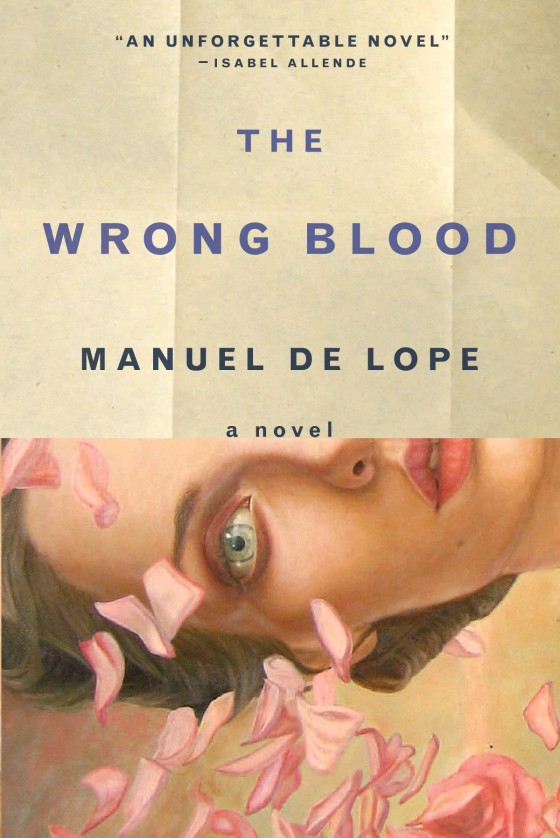 A rape victim:
And a bride:
I had a hard time settling into this book. The story jumps from one perspective to another, back in time, then forward to our present, and sometimes, as in María Antonia's burning the house down, into a what if. (Not that I have trouble with that sort of thing usually.) But I am glad I stuck with it.
I can't claim to have ever experienced anything near what these women went through, but something about the telling simply didn't ring true — too writerly, too male.
The novel for me is more effective with the stories of the men — the officer, the grandson, the neighbouring doctor — even while telling us so much less about them. These characters are told, without being explained, and I think they are richer for it.
For all this, the novel is lyrical and romantic and engrossing. Though I very early on had guessed what would be "the big reveal," I was compelled to see how it would be unveiled.
Favourite sentence: "There are men who subvert order because they carry a deep-seated, centrifugal inertia that destroys the space as well as the feelings around them." (Although, I'm not sure I agree.)
See this review.
In church, the priests taught the children such behavior, telling them that they had to be obedient, even in time of war, even though they could escape and disappear on the mountain with the cows after setting fire to the hayloft, and then, for decades to come, the house that had sheltered Etxarris's Bar would be nothing but a burnt patch, a few charred beams on ash-covered ground, and nobody except a very few people would know that María Antonia Etxarri had set the house on fire to save herself from being raped, but instead of doing that, remembering other reasons and other rains, María Antonia obediently mounted the stairs to the room, doing as she had been told, fearing only the barrage of blows she would get from her stepfather should peace ever come.
And a bride:
The bride smiled in a lost paradise of tulle and lace and orange blossoms. The photograph showed neither how much weeping she was to do nor how little she had wept until then, nor was there any visible sign of the two tears of emotion she had shed during the ceremony or of the sighs she would utter that same night, but there are things that very few portraits of women allow the viewer to discern.
I had a hard time settling into this book. The story jumps from one perspective to another, back in time, then forward to our present, and sometimes, as in María Antonia's burning the house down, into a what if. (Not that I have trouble with that sort of thing usually.) But I am glad I stuck with it.
I can't claim to have ever experienced anything near what these women went through, but something about the telling simply didn't ring true — too writerly, too male.
The novel for me is more effective with the stories of the men — the officer, the grandson, the neighbouring doctor — even while telling us so much less about them. These characters are told, without being explained, and I think they are richer for it.
For all this, the novel is lyrical and romantic and engrossing. Though I very early on had guessed what would be "the big reveal," I was compelled to see how it would be unveiled.
Favourite sentence: "There are men who subvert order because they carry a deep-seated, centrifugal inertia that destroys the space as well as the feelings around them." (Although, I'm not sure I agree.)
See this review.
Thursday, October 14, 2010
Charles and Emma
Really, I don't remember a thing about Madame Bovary. Something about adultery. I remember being bored by it when I read it 22 years ago. I don't remember whether I admired Emma, despised or pitied her. I don't know which of those I'm supposed to do.
Well, it's very readable. (Except for the seemingly random italics — very distracting.) I don't know if that's a function of Lydia Davis's translation, or maybe just because over the years I've learned to read better (or I'm more tolerant, or more discerning). At any rate, it's not boring. I was really afraid it would be very boring. It's not.
[What's the deal with first communion? Was it different back in the day, or in France? Charles is 12 when he begins his studies, and his parents are waiting till after his first communion before sending him off. Later at the wedding, a girl of 14 or 16 is wearing her communion dress, lengthened for the occasion. I wouldn't've given it much thought but for that Davis includes a note about children usually aged about 7 being prepared for this sacrament. The French text is clearly "première communion" but it sounds like confirmation might be what's meant. Either way I think Davis's note is lacking.]
Charles seems like a nice enough fellow. A bit, mmm, unambitious, maybe, but harmless, nice. Oh, but Charles totally loves her!
Emma seems hard to reach, hard to know, through her placid exterior.
Aïe! The first wife's wedding bouquet still in the bedroom! How thoughtless! This must be a sign.
Emma was ruined by romances, and the idea of grand gestures. (That's a weird passage, the shift to second person, "And you were there, too, you sultans...")
I love this sentence: "Charles's conversation was as flat as a sidewalk, and everyone's ideas walked along it in their ordinary clothes, without inspiring emotion, or laughter, or reverie." (Mind, sidewalks can be most interesting.)
Oh, she's not happy, is she? Bored, and attracted to shiny things. But I think there's a bit more to it than that, some kind of void she needs to fill. I do like her, and condemn her, and pity her.
Here ends Madame Bovary, Part 1.
Well, it's very readable. (Except for the seemingly random italics — very distracting.) I don't know if that's a function of Lydia Davis's translation, or maybe just because over the years I've learned to read better (or I'm more tolerant, or more discerning). At any rate, it's not boring. I was really afraid it would be very boring. It's not.
[What's the deal with first communion? Was it different back in the day, or in France? Charles is 12 when he begins his studies, and his parents are waiting till after his first communion before sending him off. Later at the wedding, a girl of 14 or 16 is wearing her communion dress, lengthened for the occasion. I wouldn't've given it much thought but for that Davis includes a note about children usually aged about 7 being prepared for this sacrament. The French text is clearly "première communion" but it sounds like confirmation might be what's meant. Either way I think Davis's note is lacking.]
Charles seems like a nice enough fellow. A bit, mmm, unambitious, maybe, but harmless, nice. Oh, but Charles totally loves her!
Emma seems hard to reach, hard to know, through her placid exterior.
Aïe! The first wife's wedding bouquet still in the bedroom! How thoughtless! This must be a sign.
Before her marriage, she had believed that what she was experiencing was love; but since the happiness that should have resulted from that love had not come, she thought she must have been mistaken. And Emma tried to find out just what was meant, in life, by the words "bliss," "passion," and "intoxication," which had seemed so beautiful to her in books.
Emma was ruined by romances, and the idea of grand gestures. (That's a weird passage, the shift to second person, "And you were there, too, you sultans...")
I love this sentence: "Charles's conversation was as flat as a sidewalk, and everyone's ideas walked along it in their ordinary clothes, without inspiring emotion, or laughter, or reverie." (Mind, sidewalks can be most interesting.)
Oh, she's not happy, is she? Bored, and attracted to shiny things. But I think there's a bit more to it than that, some kind of void she needs to fill. I do like her, and condemn her, and pity her.
Here ends Madame Bovary, Part 1.
A long journey through time and space
Monsieur Monde sighed, gazing at his glass of beer. He noticed that his companion's fingers were clenched on her handbag. And he seemed to have to make a long journey through time and space to find the simple, commonplace words that he uttered at last, which blended with the banality of the setting:
"Shall we take the nine o'clock train?"
She said nothing, but sat still; the fingers clutching the crocodile-skin bag relaxed. She lit a fresh cigarette, and it was later on, about seven o'clock, when the brasseries were full of customers drinking their apéritifs, that they went out, as grave and glum as a real married couple.

— from Monsieur Monde Vanishes, by Georges Simenon.
Wednesday, October 06, 2010
Octobre reading
(Or, French books by guys mostly named Georges.)
Madame Bovary, Gustave Flaubert
A readalong brought to you by Frances (Nonsuch Book), with posting on Parts 1, 2, and 3 on October 14, 21, and 28.
The delectable new translation by Lydia Davis everyone's talking about makes it hard to resist. I first read Madame Bovary some 20+ years ago. I didn't care much for it. I'm counting on my being a much wiser woman now to get something more out of it. (I'll be travelling this weekend and leaving the hardcover behind, but I have the original French loaded up on my ereader, in case I'm feeling ambitiously French.)
A Void, Georges Perec
Richard (Caravan de recuerdos) hosts this shared read, discussions taking place between October 29 and November 7.
I've read this one previously as well, back when it was first made available in English, at a time when I was fascinated with things Oulipo and also toying with the idea of pursuing further studies, and some kind of career, in problems with translation (which I never did). The book's conceit is that it is written without the letter "e," the most frequently occurring letter in French and also English). Now how do you translate that? (The Spanish translation has no "a.") I read it then as a puzzle; I'll read it now with, hopefully, appreciation for plot and character, which I've since learned that Perec can in fact do rather well.
Monsieur Monde Vanishes, Georges Simenon
I've been saving this. Having loved Simenon's Strangers in the House recently, I thought another roman dur would be perfect for my coming weekend getaway. The kid and I are flying to DC to visit with my sister for a Canadian Thanksgiving away. Even though it's a short flight, I've given excessively careful consideration to which book it is I want to have on hand when we're told to turn off all electronic devices. This is it.
(For Helena I picked out something called Lunch Lady and the Cyborg Substitute, cuz, well, cyborgs! and lunch! Note: this book is not French. It's by a guy called Jarret J Krosoczka.)
So. Monsieur Monde walks out on his life, according to the back cover, and apart from the fact that I have a fascination with people who do this (I mean, real people actually do this!; it's not just in stories, you know, where he says he's going out to get a pack of smokes and that's the last you hear of him!), the why and how of their doing it, I've spent every day of October, and most of September, thinking about running away (mostly because of my stupid job). Plus it's cold and raining a lot, so it feels right.
Yet another couple of French books
I finished The Story of the Eye, by Georges Bataille, and I'm within a few pages of the end of Roberte Ce Soir and The Revocation of the Edict of Nantes, by Pierre Klossowski (acquired during a thankfully short-lived phase of exploring obscure writers whose surnames begin with the letter "k," in some misguided desire to one day be considered one of them).
I can't say I actually recommend either of them — they're not exactly entertaining in any conventional sense. But. The Story of the Eye is an interesting complement to Tom McCarthy's C, the whole sex-death-grieving-dissociation thing. And there's a lot to dissect in Klossowki with regard to sex and gender politics; it's quite philosophical and written in a somewhat dry and academic, but playful, tone, and it could be worth careful study if you have the time or inclination, of which for the time being I have neither.
Madame Bovary, Gustave Flaubert
A readalong brought to you by Frances (Nonsuch Book), with posting on Parts 1, 2, and 3 on October 14, 21, and 28.
The delectable new translation by Lydia Davis everyone's talking about makes it hard to resist. I first read Madame Bovary some 20+ years ago. I didn't care much for it. I'm counting on my being a much wiser woman now to get something more out of it. (I'll be travelling this weekend and leaving the hardcover behind, but I have the original French loaded up on my ereader, in case I'm feeling ambitiously French.)
A Void, Georges Perec
Richard (Caravan de recuerdos) hosts this shared read, discussions taking place between October 29 and November 7.
I've read this one previously as well, back when it was first made available in English, at a time when I was fascinated with things Oulipo and also toying with the idea of pursuing further studies, and some kind of career, in problems with translation (which I never did). The book's conceit is that it is written without the letter "e," the most frequently occurring letter in French and also English). Now how do you translate that? (The Spanish translation has no "a.") I read it then as a puzzle; I'll read it now with, hopefully, appreciation for plot and character, which I've since learned that Perec can in fact do rather well.
Monsieur Monde Vanishes, Georges Simenon
I've been saving this. Having loved Simenon's Strangers in the House recently, I thought another roman dur would be perfect for my coming weekend getaway. The kid and I are flying to DC to visit with my sister for a Canadian Thanksgiving away. Even though it's a short flight, I've given excessively careful consideration to which book it is I want to have on hand when we're told to turn off all electronic devices. This is it.
(For Helena I picked out something called Lunch Lady and the Cyborg Substitute, cuz, well, cyborgs! and lunch! Note: this book is not French. It's by a guy called Jarret J Krosoczka.)
So. Monsieur Monde walks out on his life, according to the back cover, and apart from the fact that I have a fascination with people who do this (I mean, real people actually do this!; it's not just in stories, you know, where he says he's going out to get a pack of smokes and that's the last you hear of him!), the why and how of their doing it, I've spent every day of October, and most of September, thinking about running away (mostly because of my stupid job). Plus it's cold and raining a lot, so it feels right.
Yet another couple of French books
I finished The Story of the Eye, by Georges Bataille, and I'm within a few pages of the end of Roberte Ce Soir and The Revocation of the Edict of Nantes, by Pierre Klossowski (acquired during a thankfully short-lived phase of exploring obscure writers whose surnames begin with the letter "k," in some misguided desire to one day be considered one of them).
I can't say I actually recommend either of them — they're not exactly entertaining in any conventional sense. But. The Story of the Eye is an interesting complement to Tom McCarthy's C, the whole sex-death-grieving-dissociation thing. And there's a lot to dissect in Klossowki with regard to sex and gender politics; it's quite philosophical and written in a somewhat dry and academic, but playful, tone, and it could be worth careful study if you have the time or inclination, of which for the time being I have neither.
Sunday, October 03, 2010
Remaindered thoughts
Why is it that some of the best books are often the hardest to write about? It must be that flush of first love with a book, the recognition of myself in the other (or is it the other way round?). I'm giddy with emotion, can't articulate much beyond, "I just so LLOOOVVE this book!" — certainly nothing meaningful.
 So, it's all about this guy who suffered an accident, the details of which are never made clear, and basically he's left with gaps in his memory, but worse, this leaves him a shell of his former self. Something essential, something you can't quite put your finger on, is out of whack. But, also! He comes into a pile of money because of this accident, and he uses it to recreate (or create, really) scenarios from possibly his past, or maybe his imagination, but the thing is, the scenarios aren't important in themselves (well, they are, but), it's more the feeling they instill, the sense of authenticity, so the details of scenarios are important only insofar as they help further that.
Anyway, it's brilliant! (There's that flush flooding back. Really, what else is there to say about this book.)
You can read about this book all over the place, so I won't bore you with particulars. I first heard of this book through the 2008 Tournament of Books. (Careful what you read there! Some commentary has spoilers.) Interesting also is the publication history of this book, the fact that it was first published by an "art publisher" (so Remainder was recognized as "art" before it was seen as a marketable commodity by "regular" publishers?).
What gets me about this book is not just the obsession of his little hobby, it's the sense of addiction. They go hand in hand, of course; the pursuit of the addiction becomes obsessive, and then the pursuit itself becomes an object of addiction. But I think they're separate things, and McCarthy knows that. Obsessive behaviour is something you do because you have to, you feel you need to, you don't necessarily derive any pleasure from it, quite the opposite often, but addiction is after a particular high. Remainder's main character is in search of authenticity, that feeling of being real, and if you're of the sort of disposition wherein you think about those sorts of things (and I think I am) then you realize that feeling is really pretty rare. It's not about about power and control, strictly speaking; it's what those things can bring you. This became pretty clear to me in the characterization of the manager he hires to direct his affairs. This guy felt a thrill in managing these complex logistics and pulling them off successfully. I mean, I can almost relate to that, when things are crazy at work and you can actually make all the pieces fit together, there's the rush of the busy-ness of it all and immense satisfaction when it all comes together. It's not about being a workaholic, or being obsessive about the details per se; it's not lovng your work, or whatever, exactly; it's knowing you're good at what you do, doing it, and getting off on it. (Umm, I'm probably projecting here; I don't know that any of that's actully in the novel exactly.)
Maybe because I don't have obsessive behaviours, clinically speaking, or addictions of the intrusive-to-one's-daily-functioning variety, much as I enjoy food and alcohol and sex and chocolate, because I'm not consumed by my career and I don't live for the adrenaline rush of a regular physical workout (hah!), maybe because none of those things do it for me, maybe I'm realistic about the thrill of my first love and jumping out of an airplane and as much as I'd like to relive those things, I know I can't, I can't go back, it wouldn't be the same, I'm not compelled to try, maybe because there's nothing else to occupy the position of that which must be pursued at all costs, this idea of going after authenticity, all that is real and true, actually seems pretty reasonable to me. I mean, if you're going to be addicted to something, that's the thing. And that's where it gets pretty fucked up, because the more you pursue it, the more removed from it you actually become.
Anyway, pretty weird, troublesome book. Very, very good.
Excerpt.
So here I am, a couple months after having read Tom McCarthy's Remainder (of which I'd acquired a remaindered copy); the first flush has subsided, but I still want to say something about it. (Part of me wants to rush downstairs and pull the book off the shelf in my bedroom — it's unusual that I write about a book without having it by my side — but that would feel less authentic. I want this to be true to my recollection of it, not dried up by objective evidence.)
 So, it's all about this guy who suffered an accident, the details of which are never made clear, and basically he's left with gaps in his memory, but worse, this leaves him a shell of his former self. Something essential, something you can't quite put your finger on, is out of whack. But, also! He comes into a pile of money because of this accident, and he uses it to recreate (or create, really) scenarios from possibly his past, or maybe his imagination, but the thing is, the scenarios aren't important in themselves (well, they are, but), it's more the feeling they instill, the sense of authenticity, so the details of scenarios are important only insofar as they help further that.
Anyway, it's brilliant! (There's that flush flooding back. Really, what else is there to say about this book.)
You can read about this book all over the place, so I won't bore you with particulars. I first heard of this book through the 2008 Tournament of Books. (Careful what you read there! Some commentary has spoilers.) Interesting also is the publication history of this book, the fact that it was first published by an "art publisher" (so Remainder was recognized as "art" before it was seen as a marketable commodity by "regular" publishers?).
What gets me about this book is not just the obsession of his little hobby, it's the sense of addiction. They go hand in hand, of course; the pursuit of the addiction becomes obsessive, and then the pursuit itself becomes an object of addiction. But I think they're separate things, and McCarthy knows that. Obsessive behaviour is something you do because you have to, you feel you need to, you don't necessarily derive any pleasure from it, quite the opposite often, but addiction is after a particular high. Remainder's main character is in search of authenticity, that feeling of being real, and if you're of the sort of disposition wherein you think about those sorts of things (and I think I am) then you realize that feeling is really pretty rare. It's not about about power and control, strictly speaking; it's what those things can bring you. This became pretty clear to me in the characterization of the manager he hires to direct his affairs. This guy felt a thrill in managing these complex logistics and pulling them off successfully. I mean, I can almost relate to that, when things are crazy at work and you can actually make all the pieces fit together, there's the rush of the busy-ness of it all and immense satisfaction when it all comes together. It's not about being a workaholic, or being obsessive about the details per se; it's not lovng your work, or whatever, exactly; it's knowing you're good at what you do, doing it, and getting off on it. (Umm, I'm probably projecting here; I don't know that any of that's actully in the novel exactly.)
Maybe because I don't have obsessive behaviours, clinically speaking, or addictions of the intrusive-to-one's-daily-functioning variety, much as I enjoy food and alcohol and sex and chocolate, because I'm not consumed by my career and I don't live for the adrenaline rush of a regular physical workout (hah!), maybe because none of those things do it for me, maybe I'm realistic about the thrill of my first love and jumping out of an airplane and as much as I'd like to relive those things, I know I can't, I can't go back, it wouldn't be the same, I'm not compelled to try, maybe because there's nothing else to occupy the position of that which must be pursued at all costs, this idea of going after authenticity, all that is real and true, actually seems pretty reasonable to me. I mean, if you're going to be addicted to something, that's the thing. And that's where it gets pretty fucked up, because the more you pursue it, the more removed from it you actually become.
Anyway, pretty weird, troublesome book. Very, very good.
Excerpt.
Subscribe to:
Posts (Atom)

