Sunday, July 28, 2013

Only really remarkable people see the good in others

Clara saw what others couldn't. Like that little boy in The Sixth Sense, only instead of seeing ghosts, Clara saw good. Which was itself pretty scary. So much more comforting to see bad in others; gives us all sorts of excuses for our own bad behavior. But good? No, only really remarkable people see the good in others.

— from Dead Cold, by Louise Penny.

(I'm glad to say I know some truly remarkable people.)

Thursday, July 25, 2013

My whole body impaled itself on a peculiar realization

Imagine a cheerful crowd of Leib Guard officers invading the imperial kitchens, holding the staff almost at gunpoint. Led, as ever, by Svetogorov, we descended into the basement, unlocked a door to a room, and flipped the lid of a chest to reveal layers of straw that covered perfectly preserved, huge slabs of ice. We whipped out our swords and attempted to hack at it, but the highest-grade imperial ice resisted splendidly. Then Svetogorov found an ice pic, and the next moment, shards of ice flew in all directions as if they were alive and trying to escape. My fellows frolicked after them, but I — I froze. One shard had lodged itself at my feet and lay there waiting. It glittered in the candlelight and it seemed to radiate confidence — a groomed, smooth, mature ice. It could have been old. As old as I. It could been the vary same ice from which Empress Anna's Ice Palace had been built. The ice my parents had lain on. Do they not say that ice has memory? Suddenly, it seemed as if my mind — no, my whole body impaled itself on a peculiar realization: if I picked it up, it would become one with me.

— from The Colors of Cold: A New Story from The Age of Ice, by J.M Sidorova.

Friday, July 19, 2013

Summer, sloth, snow

"Summer is no fun without sloth," writes Charles Simic on The New York Review of Books blog. "Indolence requires patience — to lie in the sun, for instance, day after day — and I have none left."

While I have not been very present on this blog of late, it is not due to sloth. Sloth will have to wait a couple more days. I have patience left, just enough.

**********************

One of the hot books to watch for this month, according to io9 (although the commenters are a bit harsher in their assessment), is The Age of Ice, by J.M. Sidorova.

This bizarre historical novel involves a Russian empress who builds a palace out of ice blocks and forces a disgraced nobleman and a deformed female jester to "marry" there, giving birth to two princes — one of whom discovers later that he's immune to cold. The story of Prince Alexander spans two centuries and three continents, and includes a ton of famous historical figures.

So it's historical fiction, but with a fantasy twist.

There's Russia and there's snow, and these two things in combination call to me.

The Colors of Cold: A New Story from The Age of Ice is available as a free e-book. I snapped it up straight away and I enjoyed it (though I'm not entirely sold on reading a full-length novel in this vein). It definitely reads more like historical fiction than fantasy, but that's not a bad thing.

St. Petersburg in the 1760s was much different than it is now. It was a city cut out generously, for growth, and it had not yet filled its own interstitial spaces. It lay like a fanciful appliqué on the burlap of my country's reality.

The author, a biomedical research scientist, blogs about writing and science at Narratology.

Excerpt.

**********************

I'm still reading Vladimir Sorokin's Ice Trilogy. That is, I'd taken a break from it, but on vacation next week I mean to make headway through the second book.

I also picked up some lighter fare, perhaps more appropriate for poolside reading, Louise Penny's Dead Cold.

Ice, ice, cold. Do you see a trend? It's one way to escape the heat.

Thursday, July 18, 2013

What is my life for

Crazy. This summer is crazy. Crazy heat, crazy rain. Crazy schedule. Crazy mother-in-law, ensuring our well-laid plans turn to dust.

One evening Helena hands me a sheet of paper. A drawing of a little girl, tears flying in all directions. The caption: I feel lonely and sad.

I flip the page over. It's just a sheet from the stack of paper, old printouts, set aside for recycling. But this is different. It's an excerpt from Sylvia Plath (her journals, material I'd collected for a literary salon). And Helena has crossed out almost all of the words.

...What is my life for and what am I going to do with it? I don't know and I'm afraid. I can never read all the books I want; I can never be all the people I want and live all the lives I want. I can never train myself in all the skills I want. And why do I want? I want to live and feel all the shades, tones, and variations of mental and physical experience possible in my life. And I am horribly limited. Yet I am not a cretin: Lame, blind and stupid. I am not a veteran, passing my legless, armless days in a wheelchair. I am not that mongoloidish old man shuffling out of the gates of the mental hospital. I have much to live for, yet unaccountably I am sick and sad. Perhaps you could trace my feeling back to my distant at having to choose between alternative. Perhaps that's why I want to be everyone – so no one can blame me for being I. So I won't have to take the responsibility for my own character development and philosophy. People are happy - - - if that means being content with your lot: feeling comfortable as the complacent round peg struggling in a round hole, with not awkward or painful edges – no spaces to wonder or question in. I am not content, because my lot is limiting, as are all others. People specialize; people become devoted to an idea; people "find themselves." But the very content that comes from finding yourself is overshadowed by the knowledge that by doing so you are admitting you are not only a grotesques, but a special kind of grotesque.

— from The Unabridged Journals of Sylvia Plath. Entry #46, Smith College, Northampton, Massachusetts (first year);
Journal July 1950 – July 1953.

I am momentarily freaked out, in a desperate, hysterical kind of way (on the inside).

But I choose now to see this exercise as evidence that my daughter knows the power of words, and knows also the power they have over me. Words as a means of expression. Words for effect.

And it's a lesson to remember that my daughter — smart and easy-going, a tough cookie and a good egg — is always a sensitive soul.

Sunday, July 14, 2013

Tulips

"The vivid tulips eat my oxygen."

Sylvia Plath reads "Tulips." Recorded in 1961.


(Text and background at Brain Pickings.)

Peonies

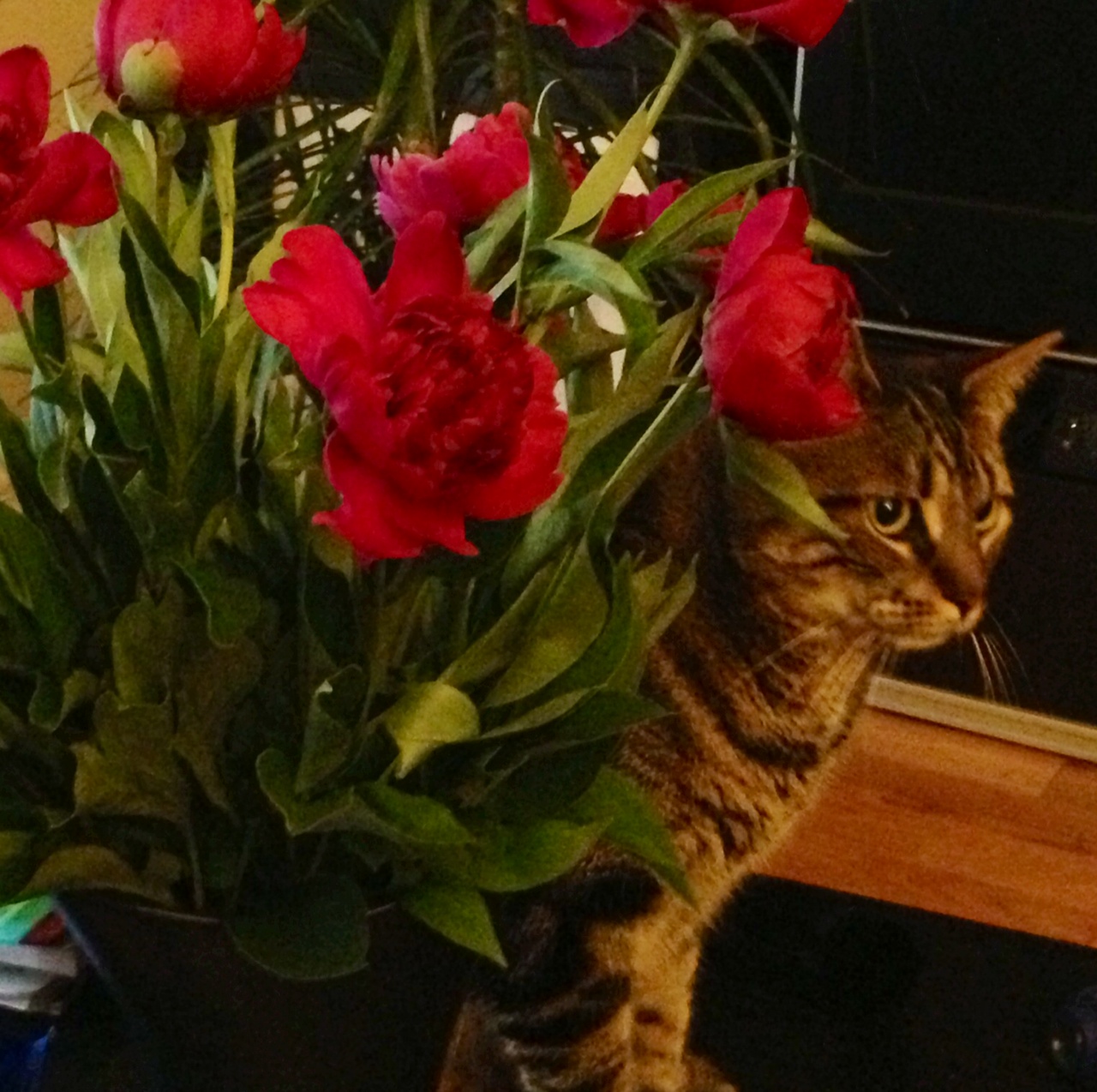
I brought home a bouquet of peonies last week,
deep raspberry pink, and I arranged them
in the living room, near the entranceway.
They are bombs exploding with perfume,
positively soporific.

Crossing the room or leaving the house
I feel like Dorothy in her opium field,
I just need to rest awhile.
(Though for some reason the cat is immune.)
Sweet relief, their exotic powers
are drying up now,
so I can wake up.

Friday, July 12, 2013

Summer reading

A round-up of summer reading lists and some thoughts about them:
What Does Your Summer Reading Say About You?
We can't say for sure that personality caused people's preferences for some kinds of recreational reading over others. In fact, the causal arrow may sometimes go the other way. Reading might not just reflect who you are, but also influence who you become.

Brooklyn beach reads:
10 Best Summer Books by Brooklyn Authors
at least partly related to or evocative of either the summer or heat or love or laughter or death or sex or the sort of false fecundity that this season offers.

This latter list makes mention of Woody Allen's "The Whore of Mensa" — which title reminds me of some women I used to know. I looked it up immediately.
A wall of books opened, and I walked like a lamb into that bustling pleasure palace known as Flossie's. Red flocked wallpaper and a Victorian decor set the tone. Pale, nervous girls with black-rimmed glasses and blunt-cut hair lolled around on sofas, riffling Penguin Classics provocatively. A blonde with a big smile winked at me, nodded toward a room upstairs, and said, "Wallace Stevens, eh?" But it wasn't just intellectual experiences. They were peddling emotional ones, too. For fifty bucks, I learned, you could "relate without getting close." For a hundred, a girl would lend you her Bartok records, have dinner, and then let you watch while she had an anxiety attack. For one-fifty, you could listen to FM radio with twins. For three bills, you got the works: A thin Jewish brunette would pretend to pick you up at the Museum of Modern Art, let you read her master's, get you involved in a screaming quarrel at Elaine's over Freud's conception of women, and then fake a suicide of your choosing — the perfect evening, for some guys. Nice racket. Great town, New York.

**********

It would seem summer caught me offguard. I'm caught up in a couple long and demanding books that I don't seem to have time for.

I am still working through Vladimir Sorokin's Ice Trilogy, and I devote some occasional minutes to Jean-Marie Blas de Robles's Where Tigers Are at Home.

Books all around me, yet not one of them yet has declared itself the book of my summer. I leave on vacation in a week's time and am starting to panic about what reading material to bring.

What are you reading this summer?

Sunday, July 07, 2013

Smashed

Yesterday, I saw the Gandini Juggling show Smashed.


It's not acrobatic or clowning-around juggling so much as it is a dance performance and artistic statement. (In fact, my favourite segment had the players working only one apple (is it still juggling if you're juggling only one thing?).) It is breathtaking, even jaw-dropping, nonetheless.

The show starts off so civilized, elegant, a little coy, witty; with humour, it pokes at male-female relations and power and control (isn't that what apples are all about?); then the tea party veers off into chaos.

Choreography is inspired by Pina Bausch (see Wim Wenders' spellbinding treatment of her work), and the music for the show is superbly chosen.

I won't reinvent the wheel: McAughtry has an enthusiastic write-up of the show (performed in an outdoor setting), with a breakdown of some of the segments, with video clips.

The Montreal show plays till Monday; if you're in town, check it out. If you're elsewhere, keep your eyes and ears open for a chance to see it.

Saturday, July 06, 2013

How busy I was in my mind

Settled in with my grilled cheese sandwich and beer, I'd watch Lex gamble away the morning, study the faces of the other players, and flirt innocently with the older man who ran the room. He liked me and gave me menthol cigarettes when I ran out of my regular ones, and then took me aside to a table next to the big one in order to share his stash of hard candy. He pulled my chair out and asked me to tell him all about myself, but then didn't pause for me to speak and began telling me all about myself instead: I was a nice girl, he said, and I shouldn't be hanging around all night with a bum like Lex in a place like this.

"She likes it," Lex yelled over, without looking up from his cards.

I smiled and shrugged and chose a pink candy from the dish.

After a while I'd return to Lex's side where I'd dream about the wonderful novel that might contain us, the sordid romance of Lex and me in the underworld. Wasn't I bored just to sit there? the others asked, not understanding how busy I was in my mind, polishing the night until it gleamed like a rare fiction. Bored? How could I be? I was the heroine of a great book.

— from Iris Has Free Time, by Iris Smyles.

Wednesday, July 03, 2013

Prague, Poland, Odessa, Russia

Prague
Kafka gets a Google doodle on his 130th birthday.

Poland
Wisława Szymborska got a Google doodle on her 90th birthday yesterday.

The Polish Cultural Institute recommends Polish books available in English translation in 2013 (including Krajewski, one of my recent obsessions).

Odessa
Tales from Odessa, a Yiddish musical by Socalled inspired by the stories of Isaak Babel, plays at the Segal Centre through Sunday.


Russia
What Russians read, an infographic.

Monday, July 01, 2013

Deconstructing music, literature, and semantics: from Schoenberg to Oulipo in 12 easy steps

It's a kind of Gödel, Escher, Bach 2.0. Watch this and you will become smarter (whether or not you understand it):

Thursday, June 27, 2013

More literary Mad Men

Another season of Mad Men has come and gone, and I thought it time to update the list of books (and poems, and other reading material) sighted or discussed in seasons 5 and 6.

(The list of books that had screen time in seasons 1 thru 4 is here.)

  • Trumbo, Dalton: Johnny Got His Gun (S05E01)
  • Leary, Timothy: The Psychedelic Experience (S05E06)
  • Malamud, Bernard: The Fixer (S05E07)
  • Plath, Sylvia: Lady Lazarus (S05E08)
  • Pynchon, Thomas: The Crying of Lot 49 (S05E08)
  • Shelley, Percy Byshe: Ozymandias (S05E09)
  • Alexander, Lloyd: The Black Cauldron (S05E09)
  • Francis, Dick: Odds Against (S05E09)
  • Brown, Margaret Wise: Goodnight Moon (S05E11)
  • Dante: The Inferno (S06E01)
  • McMurtry, Larry: The Last Picture Show (S06E07)
  • Levin, Ira: Rosemary's Baby (S06E08)
  • Massie, Robert K.: Nicholas and Alexandra (S06E11)
  • Mad Magazine: Sept 1968, no. 121 (S06E11)

A shoutout also to Hitler — "That's what they said about Mein Kampf, kid's got talent." (S05E03)

Ralph Waldo Emerson belongs on the list, but not a specific title, just the general idea of him (S06E07).

Season 6 also saw references to Edgar Allan Poe and William Wordsworth, and Don's kids watching The Prisoner (not a book, I know, but it has literary qualities and I'll take this reference as an excuse to rewatch it).

(I'd had the feeling that scenes of people reading has slowed down, but listing them out here, that appears not to be the case at all.)

One episode of season 5 featured original fiction by account exec Kenny Cosgrove (S05E05). He refers to his short story, "The Woman Who Laid an Egg and Then Gave It Away," and we're treated to an excerpt of "The Man with the Miniature Orchestra." He describes "The Punishment of X4":

"There's this bridge between these two planets and thousands of humans travel on it every day, and there's this robot who does maintenance on the bridge. One day he removes a bolt, the bridge collapses, and everyone dies."

"There's more to it than that," a nervous Cosgrove tells the hushed room. Don pushes for further details: Why does the robot destroy the bridge? "Because he's a robot," Ken answers, clearly encouraged by Don's interest. "Those people tell him what to do and he doesn't have the power to make any decisions, except he can decide whether that bolt's on or off."

What have I missed? (This more complete list includes books seen of shelves, but we all know that just because a book is sitting there doesn't mean it's been cracked.)

I have a passing acquaintance with many of Mad Men's books, but I haven't read many. I've read Plath and Shelley, and Johnny Got His Gun seriously affected me as a teenager. I don't think I'll be reading Dante's Inferno on the beach this summer, but The Crying of Lot 49 and Rosemary's Baby are more intriguing than ever. Are you still reading along with Mad Men?

Wednesday, June 26, 2013

She eats only grass, but she has a meat eater's heart

Outside on the summer veranda was a large snowdrift that the northwest wind had swept up in a bold curve, both playful and austere. A light, transparent fan of snow whirled above the knife edge at the ridge. This drift described the same line every winter, and it was always equally beautiful. But the drift was too big and too simple for Anna to have noticed it.

The True Deceiver, by Tove Jansson, is a weird little novel. Katri is good with numbers and of a logical bent, and in this calculating way, insinuates herself, with her simple-minded brother and nameless dog, into the life — and house — of Anna, a wealthy and slightly dotty illustrator of children's books.

Anna is if not exactly absent-minded somehow absent from the world, disconnected, child-like. She has no business sense, and little people sense, and it's a wonder how she muddled along before Katri came along. Anna does, however, have an exquisite talent for painting the forest floor in true and living detail (although she adds flowery rabbits at her publisher's insistence); she's spent her life trying to ground herself in this way.

Not much happens really. The prose is as chilly as the wintry Nordic landscape. Anna awaits the spring so she can paint, and the effect is that the reader is similarly in a state of suspended animation, anticipating the thaw, knowing that some semblance of life lurks just below the surface. But what kind of life? Can it be true that "She eats only grass, but she has a meat eater's heart"?

The villagers too, as in any village, I guess, keep up appearances that cover streaks of malicious ill will.

Katri's intentions are never entirely clear, whether she is running away from something or actively pursuing a higher plan, whether her scheming is noble or selfish. How much emotion lies beneath her cool façade? Only her brother can be taken at face value. "Mats has no secrets. That's why he's so mysterious."

It's ambiguous also whether her dog is wild or tame, and when is he acting true to his nature.

"And don't go telling yourself that dog is happy. He just obeys..."

Katri turned around. "Obey?" she said. "You don't know the meaning of the word. I means believing in a person and following orders that are consistent, and it's a relief, it means freedom from responsibility. It's a simplification. You know what you have to do. It's safe and reassuring to believe in just one thing."

"Just one thing!" Anna burst out. "What a lecture. And why in the world should I obey you?"

Katri's reply was chilly. "I though we were talking about the dog."

It's an unsettling novel, with the quality of a dark fairy tale, because of the ambiguity of Katri's intentions, because of the slipperiness of Anna's perception of reality, because the dog is ominously frightening. Katri is cynical, Anna is naïve; they are both deceivers, on different orders. A short, subtle, tightly controlled journey through a wilderness of human behaviour.

Review
Ursula K Le Guin, The Guardian:
Her spare exactness can express not only tension and stress but deeply felt emotion, expansion, relaxation and peace. Her description is unhurried, accurate and vivid, an artist's vision. Her style is not at all "poetic" — quite the contrary. It is prose of the very highest order; it is pure prose. Through its quiet clarity we see unreachable depths, threatening darkness, promised treasures. The sentences are beautiful in structure, movement and cadence. They have inevitable rightness.

The True Deceiver is Argo Bookshop's book club choice for June 26. See you there.

Saturday, June 22, 2013

They believed in this paper with all their might

I fell into a vivid and deep sleep: I dreamed I was in literature class at my gymnasium; I was sitting, as usual, at the desk with Shtiurmer; the classroom was flooded with rays of sunlight; outside the clean windows it was the beginning of summer; utter silence reigned in the classroom; the only thing audible was the scratching of pens and the measured steps of our literature teacher Vikenty Semyonovich, walking slowly between the rows as we wrote a final composition. I understood that this dream was from my old life long forgotten by me; for that reason it seemed funny and pitiful, but I was watching it because I was very tired; everyone is sitting, leaning over their desks; before me is a sheet of lined paper with the blue insignia of our school in the corner; my hand writes the title of the composition on it, "Fyodor Mikhailovich Dostoevsky"; I dip the pen into the inkwell, hold it over the paper, and suddenly realize that I have completely forgotten who Dostoevsky is; I raise my head and see the large portrait of Dostoevsky leaning against the classroom blackboard; I look at it intently; but the more intently I look, the more clearly I realize — before me is the depiction of a bearded, gloomy man with a massive forehead, who is entirely unknown to me; he gazes at me seriously. I look around: everyone is writing compositions about Dostoevsky; I try to remember and understand: What did this gloomy gentlemen do? Why are we writing an essay about him? Who is he? But my memory is silent; not knowing what to do, I glance at my classmates: they are wasting time, I nudge Shtiurmer with my elbow; he turns unwillingly: "Who is that?" I ask, pointing at the portrait with my eyes; he retrieves a thick book from his desk — the collected works of Dostoevsky — and hands it to me; I take it, open it, and suddenly realize clearly that this book, the sum of life of the bearded man with the serious gaze, is only paper covered with combinations of letters: it is about this book, this paper covered with letters, that we are writing our final exam essay. Only about paper — and nothing else! Everything becomes incredibly funny to me, now that I have to describe this paper in an essay; I start laughing and interrupt the dream.

Lifting my head, I opened my eyes: I was in the reading room. But in actuality, I was sleeping. And was already in another dream. All around sat the same people and the quiet rustle of paper. I raised my eyes. Four large portraits hung in their places. But instead of the writers in frames, there were strange machines. They were created for writing books, that is, for covering thousands of pages of paper with combinations of letters. I realized that this was the dream that I wanted to see. The machines in the frames produced paper covered with letters, that was their work. The people sitting at these tables were engaged in another kind of work: they believed in this paper with all their might, they measured their life and learned how to live from this paper — learned how to feel, love, worry, calculate, create, solve problems, and build, in order to teach others later how to live according to this paper.

— from Bro, first book of Ice Trilogy, by Vladimir Sorokin.

Sometimes I wonder if I'm ever going to finish this book. For something that reads so seemingly swiftly, it is incredibly dense and slow going.

The book begins June 30, 1908. The Tunguska Event awakened the primordial light that existed before time. It fell to Earth and evolved and seeped into life. It could now be found in the form of 23,000 human beings scattered across the Earth. Alexander, born the day of the Event, was part of Kulik's expedition to search for the meteorite, and he was awakened and became Bro. He spends the bulk of the first book of the trilogy searching for and awakening his brothers and sisters in light. Many of their activities are possible only because they have the cover of official Party business.

The above excerpt is interesting as it represents a new kind of awareness. Bro has been able to recognize light and non-light, but now he is suddenly able to see into things and into people to see their true nature. Plus it's a direct attack on Russian Literature. The whole of this chapter is pretty awesome actually. Bro discovers that man is a meat machine.

I can't say I'm not curious to see how the trilogy plays out, but it's going to take me a while.

Review: Lizok's Bookshelf

Related: Big Bang in Tunguska (documentary)

Thursday, June 20, 2013

A word is a recipe

"You went to school," Lee said. "I mean, at some point. And it didn't suit you very well. They wanted too teach you things you didn't care about. Dates and math and trivia about dead presidents. They didn't teach persuasion. Your ability to persuade is the single most important determinant of your quality of life, and they didn't cover that at all. Well, we do. And we're looking for students with natural aptitude."

Lexicon, by Max Barry, was a helluva read, and bears several noteworthy distinctions:
  • Starts with a needle stuck in an eyeball.
  • Made me twice almost miss my metro stop (as in, reading, reading, and as the warning chime sounds realizing, holy shit, this is my stop, and dashing through the closing doors in the nick of time).
  • Includes as characters T.S. Eliot, Sylvia Plath, Emily Dickinson, Kathleen Raine, Isaac Rosenberg, Goethe, etc. (Well, they're code names, but still.)
  • Secret society.
  • Neurolinguistics! (Which rocks my world, but maybe that's just me.)
  • Babel myths and brain hacking.
  • Made me cry.
  • Comes with personality quiz.
It's a thriller with a driving pace. The joy of reading it comes also with the dismay that you will eventually run out of book to read.

The story cuts between two main narrative threads, essentially running in opposite directions. (It's a little bit Time Traveller's Wife meets Snow Crash.) We follow Wil back across the chain of events that led to his eyeball being threatened in an airport bathroom. And there's Emily, whose story is told chronologically forward — she's a hustler who runs a three-card Monte scam who is recruited by a secret society to train as a "poet."

"What's a word?"

"Huh?

"You're feeling clever — tell me what a word is."

"It's a unit of meaning."

"What's meaning?"

"Uh... meaning is an abstraction of characteristics common to the class of objects to which it applies. The meaning of ball is the set of characteristics common to balls, i.e. round and bouncy and often see around guys in shorts."

Jeremy returned to the free throw line, saying nothing. She figured she must have that wrong, or at least not right enough.

"You mean from a neurological perspective? Okay. A word is a recipe. A recipe for a particular neurochemical reaction. When I say ball, your brain converts the word into meaning, and that's a physical action. You can see it happening on an EEG. What we're doing, or, I should say, what you're doing, since no one has taught me any good words, is dropping recipes into people's brains to cause a neurochemical reaction to knock out the filters. Tie them up just long enough to slip an instruction past. And you do that by speaking a string of words crafted for the person's psychographic segment. Probably words that were crafted decades ago and have been strengthened ever since. And it's a string of words because the brain has layers of defenses, and for the instruction to get through, they all have to be disabled at once."

So that's the neurolinguistic principle behind the brain hacking, essentially exerting a kind of mind control via a hypnotic-like suggestion. Once you've identified the segment to which a person belongs, the right string of words is easy. The ultimate purpose, of course, being something like world domination by this society, although this was never entirely clear to me, or to serve the aims of one individual corrupted by absolute power, something like that.

Lexicon is an idea book — in my view, a highly original one. I love the linguistic angle, but there's plenty of action and conspiracy to satisfy readers who aren't gaga for language processing theory.

There are some interesting discussions also about digital media and social media, how user data is gathered, and how that data can be used to generate content, so that every user has a customized user experience. A website can achieve the same end (from the point of view of a site owner) but through different, highly individualized means. (See this video about capturing data: "The global Internet becomes the personal Internet.")

At heart though, Lexicon is a love story and about the search for meaning, digging around in the thin space — the disconnect — between words, or whatever other symbols we choose to use, and the meaning they're meant to convey.

Sunday, June 16, 2013

Higgledy piggledy, lexicographical

Here's a neat way to think about it: The online dictionary is steampunk... Victorian design merged with modern propulsion...

>

One of my most memorable courses at university back in the day was on lexicography. (Although, come to think of it, it was likely more for the prof's anecdotes, of his days studying Maori tribes, and his days as a book-binder, and less to do with actual lexicography. Still.) The course was a somewhat more technical dissection than this video offers, but, ah, it takes me back.

"The Internet is actually made up of words and enthusiasm. And, words and enthusiasm actually happen to be the recipe for lexicography!"

Friday, June 14, 2013

As fine and intricate as thought

Amo Ergo Sum

Because I love
    The sun pours out its rays of living gold
    Pours out its gold and silver on the sea.

Because I love
    The earth upon her astral spindle winds
    Her ecstasy-producing dance.

Because I love
    Clouds travel on the winds through wide skies,
    Skies wide and beautiful, blue and deep.

Because I love
    Wind blows white sails,
    The wind blows over flowers, the sweet wind blows.

Because I love
    The ferns grow green, and green the grass, and green
    The transparent sunlit trees.

Because I love
    Larks rise up from the grass
    And all the leaves are full of singing birds.

Because I love
    The summer air quivers with a thousand wings,
    Myriads of jewelled eyes burn in the light.

Because I love
    The iridescent shells upon the sand
    Takes forms as fine and intricate as thought.

Because I love
    There is an invisible way across the sky,
    Birds travel by that way, the sun and moon
    And all the stars travel that path by night.

Because I love
    There is a river flowing all night long.

Because I love
    All night the river flows into my sleep,
    Ten thousand living things are sleeping in my arms,
    And sleeping wake, and flowing are at rest.

— Kathleen Raine

(Born this day in 1908.)

Thursday, June 13, 2013

How to persuade them

"The most fundamental thing about a person is desire. It defines them. Tell me what a person wants, truly wants, and I'll tell you who they are, and how to persuade them."

— from Lexicon, by Max Barry.

Wednesday, June 12, 2013

Something deep and dreadful and full of sorrow

If Teddy ever cried when he was younger, Ursula could never bear it. It seemed to open up a chasm inside, something deep and dreadful and full of sorrow. All she ever wanted was to make sure he never felt like crying again. The man in Dr Kellet's waiting room had the same effect on her. ("That's how motherhood feels every day," Sylvie said.)

— from Life after Life, by Kate Atkinson.

Tuesday, June 11, 2013

If words were weapons

Here's one of the most interesting personality quizzes that I've ever seen: If words were weapons, which poet would you be?

I don't know if there's any valid data being tapped to align your personality with that of great poets, or if the results are randomly generated. In any case, the questions, framed as part of the application process to some organization, are a little out of the ordinary, both amusing and thought-provoking.

Also, I love the use of spider graphs to illustrate the composition of the psyche (and I say this as someone who uses a lot of spider graphs in her workaday life).

I'm Kathleen Raine, "a promising new poet with enormous assertiveness and a willingness to take calculated risks" — a poet I'd never heard of before today. A selection of her poems is available online. Other poet types include Emily Dickinson, Virginia Woolf, and T.S. Eliot ("one of the organization's most admired and feared poets."). Who are you?

It turns out that this quiz is part of the marketing campaign for a novel, Lexicon, by Max Barry. It's classified as science fiction:

Students harness the hidden power of language to manipulate the mind and learn to break down individuals by psychographic markers in order to take control of their thoughts. The very best will graduate as poets: adept wielders of language who belong to a nameless organization that is as influential as it is secretive.

Read the full description on the publisher's website. Consider me intrigued.