Showing posts with label Jim Holt. Show all posts

Tuesday, October 07, 2014

Who doesn't love the universe?

Why Does the World Exist? asks Jim Holt. John Updike responds, "Beats me, actually, but who doesn't love the universe?"

And Jim Holt most certainly does love it:
  • "I found this idea of a hidden cosmic algebra — an algebra of being! — irresistible."
  • "If you turn on your television and tune it between stations, about 10 percent of that black-and-white speckles static you see is caused by photons left over from the birth of the universe. What greater proof of the reality of the Big Bang — you can watch it on TV."
  • "As the German diplomat and philosopher Max Scheler wrote, 'He who has not, as it were, looked into the abyss of the absolute Nothing will completely overlook the eminently positive content of the realization that there is something rather than nothing.'"

When I was about 12, my best friend and I collaborated on a poem. We called it "Everything is Nothing," or maybe it was "Nothing Is Everything." Mostly, it was an extensive word game, bending semantics to our will, but there was a burgeoning metaphysics — just a hint — about it, too. It made us hypothesizers. I grew up being that kind of person, who now likes this kind of book.

Jim Holt's question to many is naïve. It seems a lot of philosopher simply don't take the problem of nothing seriously anymore.
"I could understand why someone might think the mystery of existence was, by its very nature, insoluble. But to laugh it off as a pseudo-problem seemed a bit too cavalier. Still, if Grunbaum turned out to be right. the whole quest to explain the existence of the world would be a colossal waste of effort, a fool's errand. Why bother trying to solve a mystery when you can simply dissolve it?"

This book then is a survey of 20th-century philosophy. Holt looks to philosophers, scientists, mathematicians, economists, novelists, his mother, and Woody Allen. As Parfit "hated the 'naturalizing' of epistemology — the idea that the project of justifying our knowledge should be taken away from philosophers and given to cognitive scientists," Holt's book attempts to straddle the rift.

I learn that the now obsolete steady-state theory of the universe was allegedly inspired by a 1945 British horror film, Dead of Night. This awes me. This is the coolest movie I ever saw, or so I thought when I saw it when I was 11. I'm pretty sure this was a year before the Nothing poem. We had to write a radioplay, and I based mine on the coolest movie I'd ever seen, and then my script was one of the plays chosen to be produced. I'd asked my teacher to supply some text — something highfalutin and jargon for the psychiatrist to spout out. So the movie — there's a psychiatrist, goes to work, hears some pretty wacky, creepy supernatural stories in group therapy and at a climactic point wakes up to discover, relieved, that it was all a dream. And his day starts over exactly as it had already unfolded in his dream. It's a loop. So the thing is, 30+ years and I never knew the name of this movie, and Jim Holt brought it to me again and explained how truly significant it was.

Quite apart from steady-state theories, Holt raises lots of arguments that beg to have their assumptions examined:
  • It is more perfect to exist than not to exist.
  • The reason there is Something rather than Nothing is, as they fancifully put it, that nothingness is unstable.
  • A self-subsuming principle is certainly preferable to a brute fact.
  • Are the laws of physics somehow to inform the Abyss that it is pregnant with Being?
  • No explanation of reality is capable of explaining itself.
  • A cosmic possibility chosen at random is overwhelmingly likely to be thoroughly mediocre.
  • The existence of this cosmos can be fully explained only on the assumption that it is middling in every way — a vast Walpurgisnacht of mediocrity.

Holt, with the help of Alex Vilenkin, finally achieves a precise definition of nothingness: "a closed spacetime of zero radius."

Surprise, Holt doesn't actually find an answer to his question. Also not surprisingly, there are several hints along the way that while it's important to ask the question, the answer doesn't really matter.

I had a passing familiarity with several of the concepts discussed in this book. While I've picked up a few new facts and technical details, this book has not swayed me in my beliefs. However.
However — and now we move on to the third part of the axiarchic case — is it really plausible that the explaining reason should be that this world is better than an ontological blank? Actually, the axiarchist is committed to a much stronger thesis. He must believe that the world is not merely better than nothing. but that it is maximally good, infinitely good, the nicest reality that money can buy.

There's this theory that the universe exists because it ought to exist (I think it's John Mackie; I remember using a text of his in Moral Philosophy). And even while I think the theory's kind of stupid, it put a smile on my face, and I consider the possibilities of there being something to that. Holt's book has helped me rediscover my awe.

Everything is as it should be.

The Basic Question — Sarah Bakewell in The New York Times
He is an urbane guide, involving us in his personal adventures. We join him for a weekend sipping claret and reading Parfit in a bathtub at the Athenaeum Club in London. He takes us to Paris for no good reason except to sit in the Café de Flore with a volume of Hegel. We stay with him through the death of his dog, and — movingly — even attend his mother’s deathbed, where she undergoes "the infinitesimal transition from being to nothingness."

What Can You Really Know? — Freeman Dyson in the New York Review of Books
When and why did philosophy lose its bite? How did it become a toothless relic of past glories? These are the ugly questions that Jim Holt’s book compels us to ask. Philosophers became insignificant when philosophy became a separate academic discipline, distinct from science and history and literature and religion. The great philosophers of the past covered all these disciplines.

Has the Meaning of Nothing Changed? — Ron Rosenbaum in Slate
Why should you care about nothing? Well, I know what I care most about is the purity of the nothing invoked in this maddening question. Pure nothingness: It’s the last unspoiled, uncluttered concept in the cosmos. I don't believe in God, but I do believe in Nothing, in the sense I want to believe in mysteries beyond the reach of the mind. It makes life more interesting if existence can't yet be reduced to a series of equations.
Excerpt.

Jim Holt's TED Talk: Why Does the Universe Exist?

Thursday, September 25, 2014

Caffeine or alcohol?

Why, I briefly wondered as I took a seat on the sofa, did everyone but me seem to find caffeinated beverages more conducive than alcohol to pondering the mystery of existence?

I'm with Jim Holt on this one. His book Why Does the World Exist? An Existential Detective Story is under discussion tonight at Argo Bookshop. I'm hoping the bookclub also favours alcohol over caffeine.

Although in essence it's a retrospective of modern philosophy and the major theories that might shed light on why there is something instead of nothing, but I love how it's framed as a personal journey, how sitting with one philosopher led Holt to call up the next.

I haven't actually finished reading the book — I just ran out of time — but I can't wait to see how it ends.

Check out Jim Holt's TED Talk for a summary of the issues.

Friday, September 05, 2014

All kinds of thinking

I recently completed a MOOC on neuroeconomics. Basically, the study of decision-making. It's a little more exacting than other courses I've taken, but sometimes I think if I just let things play in the background I'll become smarter through osmosis.

The course actually covered some fairly familiar concepts regarding intuitive thinking versus rational thinking, how responses are affected by whether a situation is framed positively or negatively, how those responses can be primed by unrelated factors in our environment, etc. And the material referenced the work of scientists with which I'm actually conversant, like Antonio Damasio and Steven Pinker.

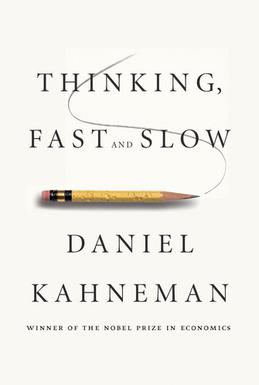
And then: Nobel laureate Daniel Kahneman. And I realized I have a book of his lying around somewhere unread that I received for Christmas a few years ago. Well, Thinking, Fast and Slow: no longer unread.

Kahneman summarizes the book in his conclusion:
I began this book by introducing two fictitious characters, spent some time discussing two species, and ended with two selves. The two characters were the intuitive System 1, which does the fast thinking, and the effortful and slower System 2, which does the slow thinking, monitors System 1, and maintains control as best it can within its limited resources. The two species were the fictitious Econs, who live in the land of theory, and the Humans, who act in the real world. The two selves are the experiencing self, which does the living, and the remembering self, which keeps score and make the choices. In this final chapter I consider some applications of the three distinctions.

I read the whole book word for word, cover to cover (is that how people read nonfiction?). The writing's a bit tedious at times; basically it's a retrospective of Kahneman's career, touching on all his research and the discoveries he made along the way. Anyone with an interest in cognitive processes will find examples and case studies to entertain or to puzzle over, some resonating more than others.

What Kahneman saves for the conclusion, though, caused a lightbulb moment. Individuals make intuitive but irrational decisions, and contradictory judgments, and "objective" assessments imbued with external influences — and these issues hold at the societal level of decision making as well. Kahneman makes a soft appeal for libertarian paternalism, where, given the known workings and weaknesses of systems of reasoning, policymakers should judiciously guide individuals using the principles of behavioral science (with experts to advise the policymakers, of course). Examples of applications of these principles include opt-out enrolment in social plans (like health care) and regulations regarding the labeling on food packaging and the framing of disclosures regarding fuel consumption. So, not just brain theory stuff.

Reviews and Insight
Two Brains Running — Jim Holt in the New York Times
And frowning — as one learns on Page 152 of this book — activates the skeptic within us: what Kahneman calls "System 2." Just putting on a frown, experiments show, works to reduce overconfidence; it causes us to be more analytical, more vigilant in our thinking; to question stories that we would otherwise unreflectively accept as true because they are facile and coherent. And that is why I frowningly gave this extraordinarily interesting book the most skeptical reading I could.

How to Dispel Your Illusions — Freeman Dyson in the New York Review of Books
There are huge differences between Freud and Kahneman, as one would expect for thinkers separated by a century. The deepest difference is that Freud is literary while Kahneman is scientific. The great contribution of Kahneman was to make psychology an experimental science, with experimental results that could be repeated and verified. Freud, in my view, made psychology a branch of literature, with stories and myths that appeal to the heart rather than to the mind. The central dogma of Freudian psychology was the Oedipus complex, a story borrowed from Greek mythology and enacted in the tragedies of Sophocles. Freud claimed that he had identified from his clinical practice the emotions children feel toward their parents that he called the Oedipus complex. His critics have rejected that claim. So Freud became to his admirers a prophet of spiritual and psychological wisdom, and to his detractors a quack doctor pretending to cure imaginary diseases. Kahneman took psychology in a diametrically opposite direction, not pretending to cure ailments but only trying to dispel illusions.

The King of Human Error — Michael Lewis in Vanity Fair
There's a quality both impish and joyous to Kahneman's work, and it is most on display in his collaboration with Amos Tversky. They had a rule of thumb, he explains: they would study no specific example of human idiocy or irrationality unless they first detected it in themselves. "People thought we were studying stupidity," says Kahneman. "But we were not. We were studying ourselves." Kahneman has a phrase to describe what they did: "Ironic research."

Tuesday, September 02, 2014

Why is there something instead of nothing?

Why is there something instead of nothing? That's the question — along with some variations ("What banged? Why did it bang? And what was going on before it banged?") — Jim Holt asks, and sets out to answer (but, unsurprisingly, doesn't, entirely), in Why Does the World Exist: An Existential Detective Story.


Coincidentally I was about 20% of the way through this book (so maybe Holt does answer it, I dunno) when this TED Talk turned up. Why Does the World Exist? is Argo Bookshop's next book club title, set for discussion on September 25.