Showing posts with label fantasy. Show all posts

Saturday, June 25, 2022

The resourcefulness of rot, the wholeness of fungi

A forest floor, the Woodland villagers knew, is a living thing. Vast civilizations lay within the mosaic of dirt: hymenopteran labyrinths, rodential panic rooms, life-giving airways sculpted by the traffic of worms, hopeful spiders' hunting cabins, crash pads for nomadic beetles, trees shyly locking toes with one another. It was here that you'd find the resourcefulness of rot, the wholeness of fungi.

A Psalm for the Wild-Built, by Becky Chambers, is about the unlikely encounter of a tea monk and a robot, centuries after the Awakening, when robots left the factories to venture into the wilderness.

Needless to say, Dex learns more about their own humanity from the wild-built Mosscap (assembled from old parts), who has undertaken an anthropological investigation into the needs of humans. In Mosscap's wisdom, they distinguish what they are doing from their reason for being.

Nothing has a purpose. The world simply is. [...] It is enough to exist in the world and marvel at it. You don't need to justify that, or earn it. You are allowed to just live.

Dex has a restless soul. They were tired of city-living when they sought a change of vocation. I'm just tired. Tired of feeling I have to justify myself. There are lessons here for me too.

[Even when I enjoy lazy days, I have to convince myself that I have earned them. Even when I have earned them, I often reframe my laziness in terms of accomplishment. Simple rest becomes an exercise in wellness, meditation, communion with nature — as if one must be active in one's passivity. Productivity is overrated. We should stop valuing it.]

As an example of solarpunk, this novella has a relatively positive outlook on our future, with humans coming to terms with their place in the world.

It is difficult for anyone born and raised in human infrastructure to truly internalize the fact that your view of the world is backward. Even if you fully know that you live in a natural world that existed before you and will continue long after, even if you know that the wilderness is the default state of things, and that nature is not something that only happens in carefully curated enclaves between towns, something that pops up in empty spaces if you ignore them for a while, even if you spend your whole life believing yourself to be deeply in touch with the ebb and flow, the cycle, the ecosystem as it actually is, you will still have trouble picturing an untouched world. You will still struggle to understand that human constructs are carved out and overlaid, that these are the places that are the in-between, not the other way around.

Excerpt. 

Wednesday, June 16, 2021

Raw earth and full bellies

Priestesses smelled like forbearance and cheap incense, not raw earth and full bellies.

When the Tiger Came Down the Mountain is an exquisite thing, the second book in the Singing Hills Cycle by Nghi Vo. This time the cleric Chih is accompanying Si-Yu and her mammoth when they are waylaid by hungry shapeshifting tigers. To stave off sleep, and to stay alive, Chih tells the tale of the love affair between legendary tiger Ho Thi Thao and human scholar Dieu.

She had turned out to be a better traveler than she had thought, or at least, she had not been eaten by hungry ghosts or had her skull stolen by fox spirits yet. She had mostly stopped panting whenever she needed to climb a rise, and she had learned early on that you never passed a priestess and her road shrine without offering something, even if it was only a tiny coin, a bun, or a prayer.

[I read the first book with a heart full of sadness, while staycationing in my own city. I read the second book with a heart full of hope while vacationing just outside the city. I wonder how much my state of mind contributes to my overall impression of these books. How much of the serendipity is actual, how much have I constructed?

I read the above before venturing out to the monastery. The lady at the cheese shop confirms they take cash, credit, even prayers (but if that's the preferred payment, she may have to charge extra — prayers aren't worth what they used to be). I seriously consider buying a zither at the antique shop down the road from the inn where I'm staying; then I read about the tiger queen correcting Chih's facts, "her voice as taut as a zither string." The countryside shapeshifts around me.]

The royal felines interrupt Chih regularly, so Chih can annotate the story with the cultural context they provide. The versions of the legend differ depending on who is telling it and whom they are telling it to. Even a love story is propaganda embodying guiding principles.

"When she shared the food that Scholar Dieu offered her rather than eating it all, she was expressing... fond feeling and fascination. When she offered her name without asking for Scholar Dieu's, she was opening the door."

"Opening the door for what?" asked Chih, fascinated in spite of themself.

Sinh Loan waved a thick hand. "To any number of things. To a courtship. To a single night of love. To something that would last far longer. To an opportunity to know her more and better. For more."

The fascination and infatuation flourishes, in spite of or inspired by their species and cultural differences.

As the sun grew ripe and started to drop towards the horizon, Scholar Dieu read the poem, and as she did, it came to Ho Thi Thao how very beautiful she was. She had been beautiful in bed for three nights, which was important, and she was beautiful now, when she was angry at having her way blocked. It came to Ho Thi Thao that perhaps she wanted to learn how else the scholar was beautiful, and even in what ways the scholar might be ugly, which could also be fascinating and beloved.

I feel overcome by love and beauty (even the ugly is beloved). These books are mythic: weightless and transportive. 

Review.
Excerpt.

Saturday, May 01, 2021

Better for it to exist than for it to be perfect and only in your mind

Accuracy above all things. You will never remember the great if you do not remember the small.

The Empress of Salt and Fortune, by Nghi Vo, is a beautiful piece of storytelling as old woman Rabbit reveals incidents from her lived past as companion to the empress. Her fairytale-like anecdotes fall on the ears of Chih, a cleric, who is traveling to the Dragon Court of the new Empress of Wheat and Flood, but she stops at the site of the former empress's exile to catalogue whatever knowledge lingers there.

Chih, whose abbey is an archive, has with her Almost Brilliant, a neixin, a talking bird-like creature who commits to memory what she cannot manage to document on paper.

"The abbey at Singing Hills would say that if a record cannot be perfect, it should at least be present. Better for it to exist than for it to be perfect and only in your mind."  

It's a deceptively gentle and intimate story even while set against a backdrop of warring factions and empirical goings-on, depicting a world where women are property, vessels, with daily struggles as epic in scope as any insurrection. "Angry mothers raise daughters fierce enough to fight wolves."

"Do you understand?" grandmother asks Chih after every tale, as there is secret knowledge, lessons to be learned.

*****

I write this as I'm reeling from a gutted heart. It's not broken, but it's been ripped open, rubbed raw, laid bare. I know now more clearly than ever the importance of present over perfect. Finally, I begin to understand some things. I have so much more still to learn. I must remember the small to remember the great. 

Tuesday, April 04, 2017

"Boredom is the mind's scar tissue."

"I don't actually think that ethics are derived from principles. At all." Patricia scooted a little closer again and touched his arm with a few cool fingertips. "I think that the most basic thing of ethics is being aware of how your actions affect others, and having an awareness of what they want and how they feel. And that's always going to depend on who you're dealing with."

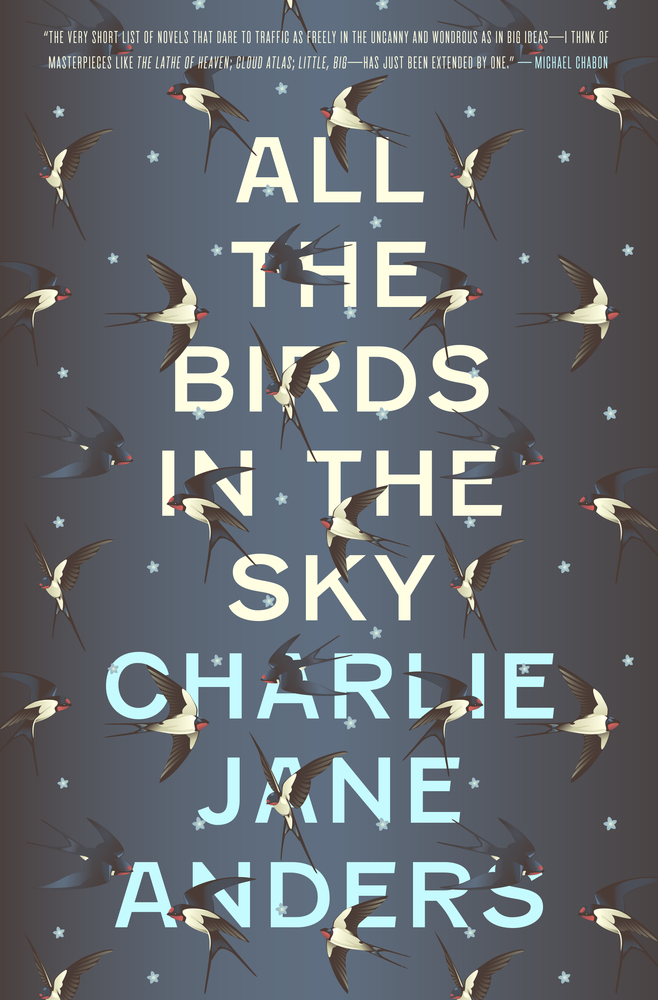
All the Birds in the Sky, by Charlie Jane Anders, is delightful. I can easily see it being quite a few people's favourite new book, and I've recommended it to some friends as such.

I was a little wary because I'm wary of magic. I just am. Don't mess with magic. Maybe because I don't believe in magic (apart from the magic principles my microwave, for example, and airplanes and the internet operate on), I think it's very difficult to write well — that is, believably.

And the ultimate showdown between magic and science, as this novel was being made out to be, just sounds simplistically grandiose.

But then the Tournament of Books happened, and there was so much love for this book, and dismay when it was knocked out of the running, and hope when it looked it might return as a crowd favourite. So I rushed to my library, and yay.

It turns out it's not really about magic or science. It's a love story. It's about misfit schoolmates Patricia and Laurence and the bonds that develop between them. Patricia is eventually whisked off to magic school, and Laurence becomes the genius scientist we always knew he would be. As adults, their lives collide. A scientist would control nature, but a witch must serve it.

It's light — that is, there's a lightness to it, lightness of touch, lightness of heart. It made me feel happy — but not because of the story, almost in spite of the story. Happy to be immersed in this kind of book. This is a book I wanted to stay up all night with. I loved the experience of this book more than the book itself.

I read it over a cold and still snowy weekend just over a week ago, and I've mostly forgotten the story. I do, however, remember the feeling of reading this story, which is sometimes more important.
Patricia had to crouch down to talk to a confused marmalade cat, who needed help finding his way home. (He remembered what his house looked like on the inside, but not on the outside.)
While it's a lovely book, I don't understand what's so original or genre-bending about this book. It seems to have cast its own spell on its readership. It's sweet and funny, with some great turns of phrase (though, I'm still puzzling over what exactly "Boredom is the mind's scar tissue." actually means).

As for the Tournament, All the Birds in the Sky won over Han Kang's The Vegetarian:
Perhaps because, political situations being what they are, I wanted to know that I was in the hands of a writer who wouldn't be falsely optimistic, but could still bring me joy.
But then it lost to Colson Whitehead's The Underground Railroad:
Anders’s prose — pretty, joyous, and inventive — felt a little too light next to Whitehead’s. Perhaps that feeling came from my own headspace, which is currently dark and stormy. But The Underground Railroad called to me more urgently than All the Birds in the Sky. I suspect in any other year, alongside any other book, the latter would win, in a landslide. But here we are. Happy 2017.
One judge liked its hope, the other opted for a strong dose of reality (despite the liberties taken in expressing that reality).

Had it been up to me to choose between All the Birds in the Sky and The Vegetarian (the only two books of the tournament I've read), I would have talked about trees. Treeness figures in both stories: In The Vegetarian Yeong-hye wants to become a tree — plant matter is persistent, if mute. In All the Birds in the Sky, the Tree is all-knowing; nature ultimately merges with science. The oneness the tree represents is in one case internal, in the other external. Though I read it months ago, The Vegetarian took root in me, and I vastly prefer the feeling of being deeply unsettled over the fleeting flush of All the Birds.
After Laurence and Serafina drifted away, Patricia told Kevin, "I didn't really save his life. He was exaggerating."

Kevin shrugged, causing his watch chain to jangle. "It's his life. One tends to privilege personal insights in such matters."

Saturday, January 28, 2017

Dreams are built on dull facts

It has been many an age more since the crowds called for a liar. Mine is a lost art, and I shall be grateful to share it with thee." He turns aside, and lets me pass. We stand back out in the busy street.

"You're a liar?"

"The last liar," he says, slowly, sadly, observing the tower. In the light of day Thyme looks like an artefact recovered from some lost tomb. "Once, dreams were built of my tales. Quests formed by the skill of my words. But now there are only the whispers and rumours, and little room for a liar. Dreams are built on dull facts. Mine," he repeats, "is a lost art. Follow me, Manderlay, and we shall locate thy Sleepwalker." Reluctantly I do as I am told, wondering whether I have made a grave mistake.
Metronome, by Oliver Langmead, is a strange but beautiful dream of a book.

The story opens by introducing the reader to Manderlay. He's aged and living in a retirement home, but with his buddy Valentine, they still get up to some antics. Manderlay was once a violinist, and receives the occasional cheque for 40 pence in royalties whenever someone buys his album. Manderlay is lately troubled by his dreams, and the reader soon leaves the gently nostalgic blanket of the home to inhabit his dreamworld entirely.

The dreaminess is both a strength and a weakness. It allows for some very creative images, actions, and relationships, but it also falls back on dream logic to justify its course.

Manderlay's musical skills are called upon to help navigate the skyship Metronome, with a small group of righteous warriors engaged in an ultimate battle between good and evil.

I don't fully understand how all our dreamworlds intersect with each other. Each dream opens onto a collective unconscious, an evidently vast but common world, night after night.

I just couldn't buy into the workings of the dream logic. There are detailed battle scenes — something I'm simply not a fan of. I would've been happy to follow Manderlay's demise from the comfort of the retirement home, but that it not the book Langmead chose to write. The story also takes a religious turn; while not exactly didactic, I'm not entirely comfortable with the implications. I'm not one to turn away from stories just because they espouse a worldview different from mine, but in this case it posed an obstacle to my buying into the premise of the book.

Still, the scenery is steampunkishly breathtaking.
There are shapes hanging from the tower ahead of us: a tapestry of wooden walkways and scaffolding which make for a kind of peculiar set of docks. I can see the distant silhouettes of dock workers, high in the air, as if we are standing beneath crystal-clear depths of water and looking up at them. And moored at those docks is a singular ship, or mechanism, that defies easy understanding.

It looks as if someone has attempted to build a clock but did not know when to stop. It is a cataclysm of clockwork parts in synchronised motion arranged in the shape of a frigate. The ship has no sails, barely any hull beyond a few lengths of wood along its flanks, and between brass and copper lengths of girders, I can see endless cogs and cables, whirring and winding and ticking in gentle motion. The whole thing just hangs there, impossibly, in the sky.

I realise that I have forgotten to breathe.
Reviews
Andromeda Spaceways
Shoreline of Infinity

Sunday, November 27, 2016

A library between worlds

For a book purportedly about a library, The Invisible Library, by Genevieve Cogman, has very little librarying going on here.
"I and Mr. Strongrock are agents of a library which exists between the alternate worlds. Our task is to collect books for the Library from all those worlds, to preserve them."
That's the premise. While the laws of physics are upheld throughout the worlds, they allow for magical elements and creatures like fairies and dragons, vampires and werewolves. Each world is governed by forces of order and of chaos, in varying degrees. I don't really see how all this jives with the claim that science remains true, but blah, blah, blah, suspension of disbelief, it's just a lame excuse to tell stories about different realities.

This story covers one particular mission in one particular alternate. This world is very Victorian-era steampunk, with a murdered vampire, zeppelins, and mechanical alligators. Our librarians seem to have stepped into a conspiracy, though whether it's masterminded by the Fae folk, the Iron Brotherhood, or Luxembourg is not clear. There's a bit of penny dreadful about it, as our chief protagonist, Librarian Irene, herself notes.

The book she's after is a version of Grimm's Fairy Tales. We're treated to a small sample of it, but my sense is that the object of the chase could have just as easily been another type of artefact.

Librarians also have access to the Language, a type of magic that seems to depend on naming things very precisely, but it's mostly just mysterious and convenient.

So what is the point of the Library? Although it opens onto all the alternate worlds, librarians are careful not to interfere in the workings of those worlds. They collect knowledge, but squirrel it away without ever really using it or even understanding it.
The conversation shifted, much to Irene's relief, into a debate on poetry that lasted for most of the journey. She herself was mostly silent, being more used to acquiring it than reading it.
Which doesn't seem very librarian-like to me.

It's a fun book, but mostly forgettable. I've had trouble focusing the last couple weeks, so this book was easy, not too demanding, and provided some distraction. There were some funny bits, and it reminds me a little of the Thursday Next books, but without the clever literary references. I won't be searching out the subsequent volumes of Cogman's series.

Thursday, July 21, 2016

Lost threads

The trumpet announced that life was beautiful, while the violin, barely keeping up, wept drunkenly that it was too fleeting.
In Red, by Magdalena Tulli, is one of the most difficult and peculiar books I've read in recent memory. I recall hearing about it upon the publication of the English translation — it's been on my list for a few years — I was sold on the promise of its poetic and fabular qualities. And this short book has plenty of that.

But I read it without really understanding it; I enjoyed parts of it thoroughly, but other parts simply mystified me. For a synopsis of the story, such as it is, you would be best served by reading the review at KGB Bar Lit Magazine.

In Stitchings it is always winter. It is a town with a port (and therefore northern). But it has salt mines (of which southern Poland has a few).

The jacket copy says it's set in an imaginary fourth partition of Poland, that it "retraces the turbulent history of the twentieth century." The third partition of Poland had divided its land among the Austrian, Prussian, and Russian empires, effectively wiping Poland off the map for 123 years, until the Treaty of Versailles restored Poland. This is the nonexistent Poland my grandparents grew up in.

In Red begins just before Archduke Ferdinand is assassinated in 1914, and war sets the town into motion, if you can call it motion. It's perpetual motion, without direction. The town's affairs, we're told, are interwoven with those of the Swedish garrison,
Its very existence should be regarded as an especially favorable sign, bearing in the mind that a Swedish garrison is better than any Russian, Prussian, or Austrian one, just as a Swedish partition is better than any other possible partition.
It's to Stockholm that the necessary documents are sent. So this then is an imaginary third partition, one that unfolded differently than the history books would have it. The third partition dissolved Poland, there was no territory left to partition; presumably the fourth partition happens after the country is re-established: But there is no Second Republic of Poland in this fiction. The hussars were dealt with by the Germans, and then the Austrian military police. The proclamation announcing the creation of the Kingdom of Poland was read by a German lieutenant.

This "new" country is not partitioned (it is not shared) so much as occupied, overrun, subsumed.
No one noticed exactly when the snowflake that appeared on Strobbel & Slotzki's products changed its shape. From that time on, each of its four arms was bent at a right angle, like the wooden rulers with which Slotzki was so prodigal.
In Red is not tracing the history of the twentieth century so much as recounting the Weimar years and the Holocaust.

According to the preview of an academic article in Translation Review
The story told here is the history of the imaginary town of Stitchings. The town's name in Polish, "Ściegi," meaning, literally, "stitches," is implausible as a place name and thus begs to be translated. While "Ściegi" has no particular cultural resonance, it is unfortunate that for the Anglophone reader "Stitchings" conjures up images of an English country town. Stitchings/Ściegi, chimerical though it is, experiences historical events that place it squarely in northern Poland, albeit in an imaginary fourth, Swedish, partition. This is clear in the Polish edition; the translation omits a specific reference to the historical partitioning powers...
All this to say: I have trouble piecing together the fictional history and fail to understand why Tulli felt it necessary to shift the historical context to include Swedish governance at all. (Can anyone offer me any insight?)

That said, In Red has several charmingly fantastical — and symbolic — elements.

The young lady whose heart stops beating but who refuses to die. The end of her hereditary line, does she represent Poland? Jeszcze Polska nie zginęła... Poland will not die.

The forgotten intended who unpicks her embroidery, the red silk threads scattered by the wind to mark those who would die. Are these the stitches that held the town together, the stitches that were pulled apart, partition after partition? The reality of the Polish spirit was strong enough for the country to regenerate after three partitions, but the fiction shows us that the failure to preserve the essence of Poland at this crucial time would be its downfall.

The magical reality slides into darkness. The tale of the diva who disappears. The typhoid, the starvation, the death, the living dead for whom there is no salvation. Denying the existence of the sea, of a port, of any exit.

Elsewhere
KGB Bar Lit Magazine:
The book is divided into three sections, each delving into the psyche of Stitchings and its attempts to deal with the chaos that befalls it. It reads like some sort of perverse fairytale, and whether through war and confrontation, through greed, or through drunkenness and debauchery, the citizens of Stitchings ultimately cannot stave off the literal and figurative winter that enshrouds them.
LA Review of Books, Politics and the Postmodern in Magdalena Tulli:
For all its immense charm, In Red is embedded in a vicious slice of Polish history, the period between World War I and World War II. The novel's political and social resonances should be abundantly clear. For whoever would visit Magdalena Tulli's shimmering cities must visit as well those forlorn cities of the dead, where strange traces — shoes, hair — are preserved in eerie effusion.
NPR (Jessa Crispin):
Magdalena Tulli is one of Poland's most celebrated writers, and with In Red there is much to treasure. She plays with the line between unexpected and quirky very well. Despite the more fantastical elements, there is nothing twee about Tulli. A gritty darkness shadows Stitchings, as the occupying German army marches in, or as the Hussars disappear in the night, or as drunken soldiers freeze to death in the snow banks on the way home from the brothel. There is desperation and poverty and starvation. She creates an atmosphere reminiscent of the dark Polish forests of older fairy tales, the ones with the high body counts.
The Quarterly Conversation
In Red is Tulli’s most conventional novel — which is not to say it could finally be described as a conventional work of fiction.
Excerpt.

Sunday, July 10, 2016

An unspace

This Census-Taker, by China Miéville, is short and creepy, and hints at a much larger narrative. Something small and intense that makes you ache for childhood and innocence. And truth.

I found no truth. Only vague impressions, vague questions.

Who is this census-taker? Is it the census-taker who comes asking questions? Or is the narrator referring to himself, the way this reader might speculate about the possible interpretations?

The epigraph, from Jane Gaskell. Houses built not for something, but against — the sea, the elements, the world, etc. Built with hatred. I think it makes this story one of social commentary. It's the father against the community, the community against him. Us and them. To which side does the census-taker belong? He is from the father's city, but maybe he kills him. He is bureaucrat, claiming authority, but one senses that the community would be against him. Where does the hatred come from?

I believe the father killed the mother. But I cannot know this.

What are his father's keys? His customers asked for "love, money, to open things, to know the future, to fix animals, to fix things, to be stronger, to hurt someone or save someone, to fly." He would sketch the keys, correcting the lines as his customers spoke. Is this magic or metaphor? A key that changes the weather.

What is the nature of the hole? This is where they tip their rubbish, but no one else disposes of their garbage this way. Is their rubbish different? Does this serve a sacrificial purpose?

As an adult, as he writes, now, he is an honoured guest. But I believe he's in prison. It must be prison. Why is he in prison? Could it be a hospital ward? There is a chandelier and a wasp and a typewriter. Could he truly be a visiting dignitary afforded the usual honours?
The manager of my line told me, You never put anything down except to be read. Every word ever written is written to be read and if some go unread that's only chance, failure, they're like grubs that die without changing. He said, you'll keep three books.
Is that an order for the boy, now a grown-up? Do others also keep three books? Is this a rule for census-takers? The first book is numbers, for everyone; this one sounds official. The third book is for its writer alone, the book of secrets. The second book is for readers; it is performance. Although it too may tell secrets cryptically. The second book is chronologically the third that he writes. Why is it called the second book? This story is that book. What secrets does it tell? It is a conversation with a previous book, that of his predecessor. Where is the place with the raised neglected rails where outcasts live? The hope became the hate.

His second book begins:
In
Keying, No Obstacle Withstands.
What does he know? In keying the keys of the typewriter. The magic of writing? The magic of his father's keys?

Just what is his mother's business in town? Is it really just trade? I believe it to be something more nefarious. Why does she trust the boy to the derelict children?
The bridge had been inhabited once but some ordinance had forbidden that practice, broken though it was by the parentless children who squatted collapsing derelicts between the shops.

Houses built on bridges are scandals. A bridge wants to not be. If it could choose its shape, a bridge would be no shape, an unspace to link One-place-town to Another-place-town over a river or a road or a tangle of railway tracks or a quarry, or to attach an island to another island or to the continent from which it strains. The dream of a bridge is of a woman standing at one side of a gorge and stepping out as if her job is to die, but when her foot falls it meets the ground right on the other side. A bridge is just better than no bridge but its horizon is gaplessness, and the fact of itself should still shame it. But someone had built on this bridge, drawn attention to its matter and failure. An arrogance that thrilled me. Where else could those children live?
What was it the mother used to do? In an office, they were training her, she was doing papers for them.

Where is the father from? The visitor wanting a key calls him councilman. Why does the father want a silver flower, "something you give someone for running away"? For helping them run away, or as a reward for the thing accomplished?

The traveller who stays at the picture-house. Things went wrong with her boss, when finally she could read all the paperwork and realized things were off. What repeal is she asking after?

What are the mother's papers? "A description of a carved box that was supposed to contain a person's soul."

What happened to the orphan boy Drobe? Did he really leave? Or did the father kill him too? Was he victim of some authority?

What does the census-taker see at the bottom of the hole? I believe he kills the father. Who used to work for him? She took off with the records. The traveller? Could it be the mother? Who is the agent following him? Is that the traveller? Issuing forgeries of what? What is this census-taker's authority?

This second book is only a prologue. This census-taker is rogue.

Some Theories

The Critical Flame: The Mastery of Absences: China Miéville’s This Census-Taker
The missing pieces in his story are organically missing and are of are two basic types. The first is what adults refuse to tell children and they cannot find out for themselves. The second is what children do not think to ask, because they don’t have an adult’s understanding of people and the world. From the perspective of adulthood, the book’s chain of logic is painfully deformed; yet from the perspective of the boy narrator, the gaps seem rather infrequent. His world is full of effects for which he does not instinctively seek causes. Effects without causes are called miracles. The book shimmers with miracles, as childhood does.
Strange Horizons: This Census-Taker by China Miéville
Filled with mystery, suspense, and magic—and, above all, secrets—This Census-Taker is a lot more than you'd think at first glance. It contains many stories, and storyworlds, nestled inside each other. A lizard that spends its whole life imprisoned in a bottle is not just a powerful symbol, but also echoes a recurring motive from China Miéville's novel Kraken (2010). There are descriptions of trains and of people who have never seen the sea that remind us of Railsea (2012), and a derelict cinema much like the one inspired by London's Gaumont State building in "Looking for Jake." There are children's games like the one at the beginning of Embassytown, and there are many other recurring motives and personal favourites of the author's: Gaskell, banyan trees, sending lamps down sinkholes, angry birds, bats, trains, the sea.
Out There Books: Is This Census-Taker Set in Bas-Lag?
The city where the narrator’s father is from is a mystery in itself. [...] The next stage of the mysterious city’s history is the great census-taking, which we only hear about in very vague terms in this book. For some reason the city decides that it needs to send agents out into the world to find out where all of its citizens are. Sounds like the kind of paranoid reaction New Crobuzon’s government might have.
Seven Circumstance: Imprecision with purpose — This Census-Taker, by China Miéville
The book has a sub-theme of hatred which runs end to end — the boy for his father, his mother for his father, his father for his clients and for the foreign census-taker, the townspeople for his parents and for the wild beggar children. What the census does is to neutralize hatred-filled situations in the town, and in the country, and even in the neighbouring countries, by being a record of the situation stated as neutral, objective numbers and facts. By simply interrogating and documenting the world, the foreign census-taker allays the boy’s fear, and is himself immune to the town’s hatred and quite powerful. Of all the characters, he is the calm, considered, fearless one.

Wednesday, May 18, 2016

An innate bitterness at the heart of education

They said I was clever.

I see now they meant that I was bookish, and suited to becoming a learned woman. A learned woman is a very different object from a wise man. I have had no experience of life; how could I see all the traps, particularly the ones that looked most like my own choices, my own happiness? Keats did not warn me, and neither did Dickens. I did not find myself within their writings.
This is The Arrival of Missives, by Aliya Whiteley.

This is a very weird story. In a good way. You know I like weird.

Whiteley's 2014 novella, The Beauty, is one of the most original and unsettling things I'd ever read. So I was ready for this.

Whiteley's recently released novella, The Arrival of Missives, starts off making you believe it's something else. A coming-of-age story, set in the past. I couldn't be sure at first if it was the real past or an imagined past. There was war. It becomes clear that this was the Great War, but war is done now. The setting is gently bucolic. Only it's not. You can feel some darkness lurking there. The story unfolds in "the place where the plans of the old and young do not quite meet."

Shirley is expected to marry someone capable, who can run the farm as her father ages. But Shirley believes herself to be part of the new era, in which women will be recognized as having something to contribute to "the upward path of humanity." Shirley dreams of escaping the farm and going to college. She wants to be a teacher. She has cultivated an attraction to her own teacher.
Look how love coats me in a shiny slick that no grim thought can penetrate. It lights the dark, and distinguishes my being. I am set alight by it.
Teacher has a secret he brought home from the war.

It reminds me very much of Bro, the first part of Vladimir Sorokin's Ice Trilogy. (Which I very much admired, though I have not yet read the rest of the trilogy. Missives is shorter by far and a swifter read.) Only instead of the Tunguska event, here the catalyst is the shrapnel of war. But in both cases something alien takes hold and demands action.

There are multiple sets of missives in this story. One is Mr Tiller's letters to Shirley, from teacher to student, a madman grasping for a shred of humanity and kindness. Another is correspondence from the college — an invitation to an interview, and then a decision letter. Another is from the future. In many ways they are the same.

Everywhere there is nature; on the farm it is made orderly and profitable, but elsewhere it is a wild tangle. And everywhere there are boys and men, and I feel Shirley's trepidation and diffidence. This is still a world ruled by men.

This is a story of how the old ways of thinking embed themselves and harden. But Shirley "will not be a foot soldier for pale old men, no matter where they live or what pretty patterns they weave." Perhaps it also a story of how women are patient like water, wearing away at stone.
For love is not the high ideal of beauty, of sacrifice, of noble deeds and chaste embraces that I had imagined when once I dreamed of Mr Tiller. It is a dirty business, of wanting and struggling and making do, and being each other's comfort because the world is cruel and there are few who want to do right by you with no thought of their own needs.
With all the intensity of a schoolgirl's heart and mind.
Once I thought that a bitter teacher spoils a pupil; I wonder now if there is not an innate bitterness at the heart of education, which always comes with hidden meanings and a high cost.
I highly recommend The Arrival of Missives. Poetic and engrossing. Quietly weird and patiently feminist.

Interview with Whiteley at The Thinker's Garden.
Excerpt.

Tuesday, February 23, 2016

The world simply did not permit plans

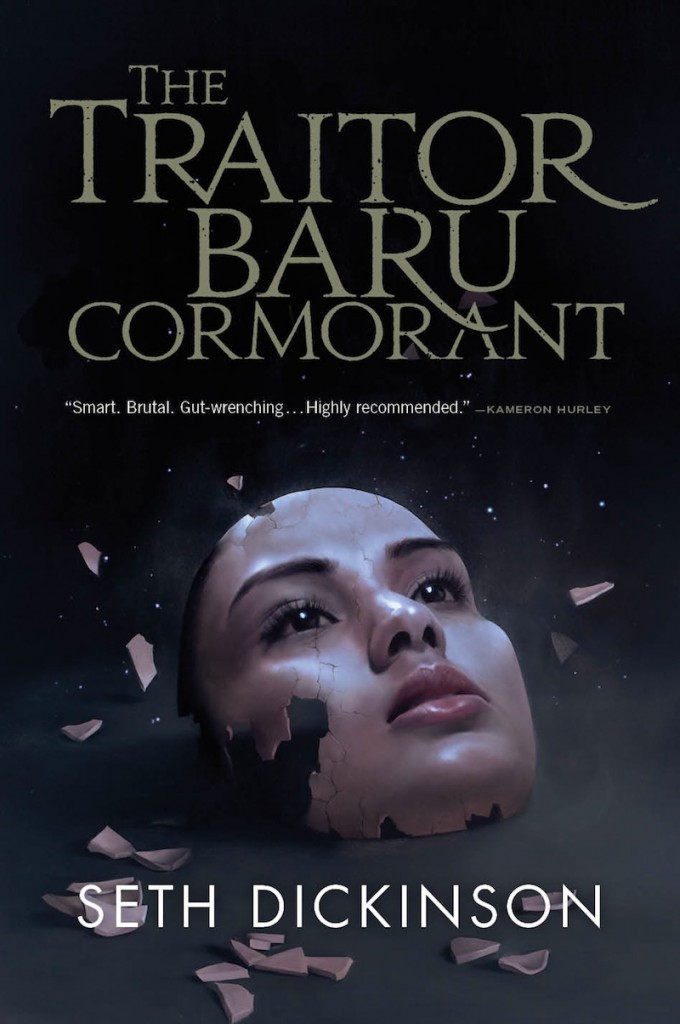
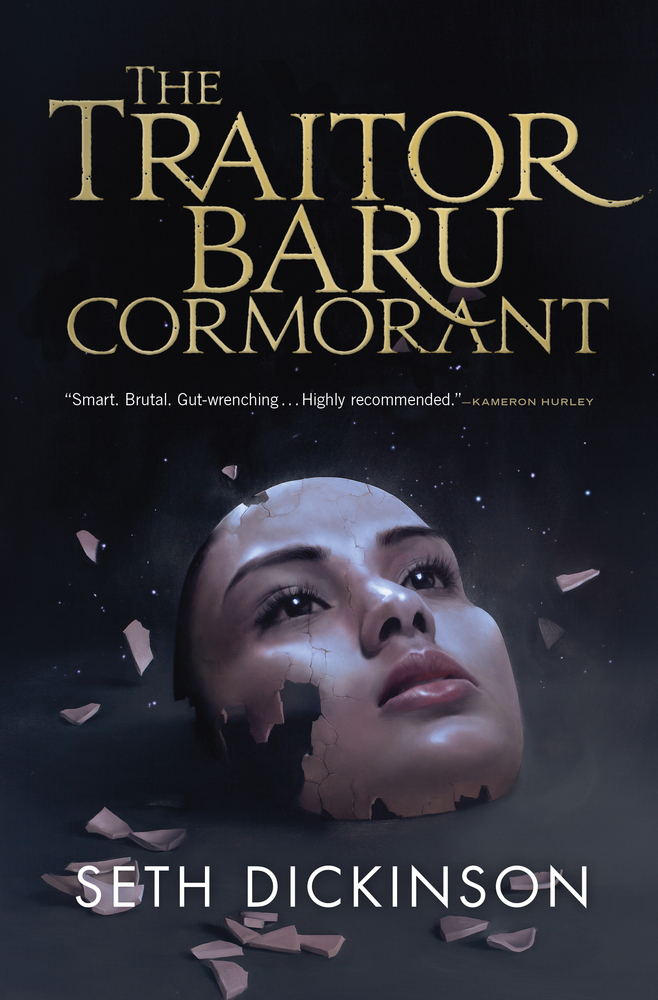
The Traitor Baru Cormorant, by Seth Dickinson, is the story of an accountant.
Baru's guard found a fulling mill by a nearby stream. They brought her there to wait.

The terror that took Baru came from the deepest part of her soul. It was terror particular to her, a fundamental concern — the apocalyptic possibility that the world simply did not permit plans, that it worked in chaotic and unmasterable ways, that one single stroke of fortune, one well-aimed bowshot by a man she had never met, could bring total disaster. The fear that the basic logic she used to negotiate the world was a lie.

Or, worse, that she herself could not plan: that she was as blind as a child, too limited and self-deceptive to integrate the necessary information, and that when the reckoning between her model and the pure asymbolic fact of the world came, the world would devour her like a cuttlefish snapping up bait.

The millwheel had been uncoupled from the machinery and it turned in useless creaking circles.
OK, so she's not an ordinary accountant. She was born in Taranoke, an island country with liberal sexual mores. When she was seven, it was conquered by the Empire of Masks, governed out of Falcrest (by committee, it turns out; the Emperor is a faceless — masked — figurehead). She goes to their schools, is indoctrinated into their Incrastic philosophy. It appears that she has a protector; she is essentially groomed for public service. She performs well on their exams and fresh out of school is awarded a post as Imperial Accountant of Aurdwynn. This conquered nation has a history of rebellion; Baru Cormorant determines that her task is to quell the insurgents, but instead she fuels a revolution.

I've described this book to some people in terms of Game of Thrones: a similar level of politics, machination, and battle planning, but minus the melodrama. A system of government that is if not exactly more modern, a little less barbaric — more complex. This book is more intimate, but somehow no less epic.

The Empire offers education and scientific advancements, medicine and sanitation. But. Incrasticism, possibly from Latin crāstinus ‎"of or belonging to tomorrow", from crās ‎"tomorrow", possibly related to Latin crassus "solid, thick". Never explicitly defined, but we have a clear sense of the dystopian evil of Incrastics.

It occurred to me early on in my reading that this could have been a work based on history. And that would've bored me to tears. Pages of balancing the books, examining the intricacies of trade agreements. Instead, it's genre fiction, so I'm all over it. But this world is ever so subtly removed from an actual one. The character's name are exotic. They practice — and enforce — social and moral hygiene, and some kind of eugenics ("hereditary regulation"). Midway through the novel we encounter the Clarified, conditioned from birth by drugs and other methods to serve.

Quite apart from that, this novel gave me the feeling that it's telling of a time in our actual history. These fantastical elements are expertly woven into the background world; the story is not about these things, but it is a story because of these things.

It was serendipitous to have read Claire North's Gameshouse novellas before embarking on the Traitor's story; it served well as a warmup game of chess, people as pawns.

There's a lot to chew on in this book: hegemony and colonialization, the logistics of rebellion, civic duty at what personal cost. I want to follow the rest of Baru Cormorant's career. I want to explore the rest of the Empire. I want to better understand the hygiene, the regulation, the Clarified, the Incrasticism.

Elsewhere
Seth Dickinson: The Secret Design of the Traitor Baru Cormorant
"In order to make Baru a useful citizen, the Masquerade hopes to create a state of learned helplessness: no matter what you do, it ends up serving our purposes. Accept your place."

Niall Alexander: Tor.com
"To tell the truth, Baru is terrifying at times; a barely-suppressed scream of a human being — yet we want what she wants."

Kameron Hurley: What Will You Sacrifice? The Traitor Baru Cormorant, Kameron Hurley
"It's set up from the beginning as a tragedy about power and commerce and sacrifice, and that's exactly what you get."

Arkady Martine: A Response (spoilers)
"From the beginning this is a book about complicity; it is a book about committing great and profound injustices for the sake of some future possibility of justice."

Excerpt

Saturday, February 06, 2016

Games

All the men and women are merely players. But the world's not a stage; it's a gameboard.
At his command were seven other men, of whom two were brothers, four cousins and one they'd picked up as a child and brought along, and who suffered terribly for his lack of genetic bondage. He also had three elephants under his authority, which regarded the great turbulence of the humans about them with the patience of wily priests who have seen rebellion and heard the changing of the psalms, yet looked up and known the heavens never altered for man's delight.
Over the last few weeks I had occasion to devour Claire North's trilogy of Gameshouse novellas: The Serpent, The Thief, and The Master.

I meant to be reading other things, but I moved a few weeks ago, so books were being folded into boxes, at first in a fairly orderly fashion, almost shelf by shelf, but it quickly entropified, books were everywhere, and books were packed alongside the blankets and coffee cups they kept company with. Books I vowed not to lose track of haven't been seen in weeks, including the small book I decided to keep in my purse; at some point I must've decided that it would be safer not rubbing against the measuring tape and screwdriver that I also kept at hand in my purse — I'm confident that it will turn up eventually. Books are now spilling out of those same boxes rather randomly.

I always knew where my ebook was, however, along with my laptop and a few other "valuables." I found myself downloading books at odd hours, because, it seems, I needed them desperately. Someone told me about an article that said reading pageturners significantly reduces stress. I can't find the article, and I've puzzled over the many ways one might define "pageturner," but I've used this "research" to support my sometimes seemingly injudicious use of precious time — this was time I used not merely to read but to recalibrate my emotional and mental well-being.

I'm not sure exactly how I discovered these books. Somehow they were related to some book (which wasn't available) that I'd looked up based on some review. "In seventeenth century Venice exists a mysterious establishment known only as the Gameshouse,"and I was sold.

The Gameshouse novellas are certainly pageturners. The first book lays out the premise. What at first seems to be nothing more than a casino — a gathering place for the rich, the bored, and the desperate — is an institution that spans all of time and encircles the world, insinuating itself into the fabric of cities that hold wealth and power.

The games vary in breadth. In The Serpent, players vie to have their allotted token elected as Doge of Venice. Players are also dealt cards — representing people — which they may also bring into play.

The stakes are high. Fortunes and careers, but also memories, specialized knowledge, physical characteristics, time. The mechanism behind how these transactions are processed is never divulged, but I'd trade my funky knee for someone's facility with Sanskrit in a heartbeat. Others deal in heartbeats.

The Master is my favourite of this set of novellas. A game of hide and seek. The board is 1930s Thailand. Geographically more vast than The Serpent, the game is more intimate.
"Abhik thinks that a game can only be won with ruthlessness and calculation. Were this chess, he would be right, but you, Remy, you have the greatest gift of a higher league player — you remember that your pieces are human. At a superficial level, some might say that makes you kind, but I would suggest it makes you beautiful. To play people is a vastly more elegant skill than mere number-counting."
It also becomes clear that most games are only minor skirmishes in a much larger power struggle.

The third novella, in a modern-day setting, brought closure to the series, but I would love nothing more than an infinite series of Gameshouse game novellas, set in worldclass cities across time. It might bring a new level of paranoia to the conspiracy-minded. We are all, after all, merely pawns in the great game of chess.

Tuesday, December 08, 2015

All I want for Christmas

So I have a little free time* these days, as I'm basically on stress leave** from work, and I'm indulging in a little armchair shopping***.

*If you can call "Christmas is coming and we will be travelling, and oh, we're moving in less than 6 weeks so I should get organized and pack up the household," free time.

**Let's see, in the past year, my husband left me, I've been adjusting to single motherhood and struggling to mitigate the pressure of feeling that I have to be always on, underwent a bathroom renovation, had a vacation which however fantastic it was came with its own set of logistical complications, shopped for a new home and made an offer, endured no end of bureaucratic obstacles in settling the current property with my ex, my brother had brain surgery and died of lung cancer within 2 months of his diagnosis****, my daughter became a teenager, I can't fathom that my ex believes his sum total responsibility toward his daughter is to take her to brunch for an hour on Sunday, I bought some new furniture, and now I'm preparing to move. Plus regular work crap. Last week I went to the hospital, convinced I was having a heart attack. Turns out, it's stress. Basically, you know that checklist of stressful life events, when you go for a massage or whatever? Just check all. 2015, you suck.

***Armchair shopping in this instance should be taken figuratively to mean shopping from the comfort of my home, as opposed to shopping for armchairs, which is something I'm also doing these days, sometimes also from the comfort of my home, albeit without an actual armchair, hence my being in the market for one. I hesitate as to whether I require it to have arms, but, leaving aside the semantic conundrum that poses, what then would I fling my legs over?

****If that sounds flippant — one more item in my litany of otherwise quotidian complaints — it's not meant to. It's heartbreaking. I just don't have the strength to address it any meaningful way.

So I'm checking some of the year-end book lists to see what I could get for others, what I should reserve for myself, and one title jumps out as one I'd registered previously. I don't generally read customer reviews for books on Amazon, but I thought it might jog my memory of what I knew of this novel.

This review (by "James") made my day:
I bought this book because the cover was cool and I was a little drunk. I didn't read it for a few days because someone else called it "a geopolitical fantasy" and that combination of words alone almost put me to sleep. Luckily for me fate intervened and I got stuck on a plane with only this and sky-mall for entertainment and subsequently dug into it. My god it was good. I finished it in under 24 hours and am eagerly awaiting whatever the author puts out next.
The book is The Traitor Baru Cormorant, by Seth Dickinson. This is the book I want***** for Christmas, please. (And also maybe some time to read it.)

*****To be clear, my want is not based solely upon this review, but rather on the general critical and popular reception of this novel. Also, I love the title.

Monday, August 25, 2014

Vampires!

Importance of names —
Most appellations appear to displease them; they would prefer not to be discussed at all, I believe. The expression "un-dead" is often considered distasteful. (I use it privately here, but would never utter it aloud in the club.) "Revenant" will do at a pinch, though the connotations of burial and return are a little indelicate. I asked Verner what name he preferred. He said that I was considering the question from the wrong angle. "We don't need words for ourselves," he said. "It's the living we're always watching out for."

"What do you call us, then?" I asked.

He said that there were few names he would care to repeat — the kindest being "bleaters." "Blood bag" is another. A buxom human female, in low circles, might be termed a "claret jug." He added that amongst those with better manners, the most widespread term for us is "the Quick."

Then he smiled — an effort made solely to discompose me. "Not always quick enough, of course."

Lauren Owen's The Quick is a vampire novel. Why this should be a secret is beyond me. But I'm betting that:
1. If you've heard at all about The Quick through the usual internetted ways, then you already know there are vampires.
2. Readers of this blog would be more inclined to pick up this novel knowing it's actually a vampire novel, not just a romance steeped in Victorian gothic atmosphere.

(Quite frankly, while the jacket copy about secret societies intrigued me, it wasn't enough to get me to read this book. It's the vampires that grabbed me; I agreed to a review copy only after I'd heard about this twist.)

It's a hefty book, but action-packed and with interesting characters, so it's quick to read.

It's positively dripping with Victorian gothic atmosphere. It reminds me of Susanna Clarke's Jonathan Strange (though I can't recall the details of that book, the mood stays with me) and Diane Setterfield's Bellman & Black (which I loved for how it let the reader hover in uncertainty). The most obvious reference would of course be Bram Stoker's Dracula, but at the time of the events told in The Quick it was not yet written.

Owen's creatures fit nicely into the vampire tradition, building on fundamental notions we have, primarily via Dracula, but with a few qualities invented or borrowed from elsewhere. These vampires have not been reinvented into something unrecognizable; they are updated classic, and they are scary.

And as in Dracula, those affected by the creatures take up a scientific exploration of their nature, so fact and myths are affirmed and dispelled for the reader as they are learned by the characters. In both books we see the investigators turning to medical and technological innovations (even if to establish a scientific basis in folkloric remedies) to aid them in defeating, or curing, the monster. Certainly typewriters will record their accumulated knowledge for posterity.

Owen discussed some the themes in her novel in an interview with The Bookseller:
"In modern representations of the vampire, the vampire is a metaphor for sex and romantic relationships, but in earlier depictions of the vampire there is more leeway into folklore," Owen says. "There's the idea of the vampire coming back to his family and sickening them and the rest of the village with his attacks, so that was part of the choice.

"I think family relationships are very interesting; the idea of what you tell the people who are closest to you and what you don't tell them — or what you're able to tell them, and whether or not being able to tell them everything about yourself means that your love for your family is not complete."

The vampire as metaphor for sex is already firmly established in Dracula, and it's nice to see this fiction stretch a little further back into the lore. Owen explores a lot of different family relationships in this novel, which puts some store in the saying that blood is thicker than water. Vampires would live by that too.

Saturday, July 05, 2014

A vitamin in society's organism

"Does a god have the right to feel anything but pity?"
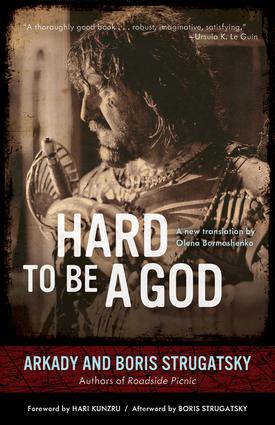
Hard to Be a God, by Arkady and Boris Strugatsky is in some ways more traditional genre fiction, at least in a North American sense, than the other two novels I've read by the brothers. Definitely, Maybe is very philosophical, static (in the sense that nothing much happens), internal (a lot of the little that happens is inside the characters' heads). Roadside Picnic, although kind of post-apocalyptic and with a noir edge, also had a deeply philosophical bent.

Hard to Be a God, on the other hand, at first glance appears to be pure genre fantasy. Or science fiction. I couldn't tell which at first.

[I asked a Russian coworker about this, and he replied, as he does regarding just about anything Russian I've mentioned in the past few years, "No, eez not science feection [or domestik drama or comedy or...]. Ees allegory ov Sovyet Rasha."]

The early chapters are all about world-building and have a medieval stench to them. The science is subtle, certainly too innocuous to be noticed by most of the resident "barbarians." But it turns out that 250 citizens of an advanced Earth have been placed on this planet to monitor and guide this "civilization" into a more enlightened era. Without "interfering." Much harder than it sounds. Don Rumata certainly has a very hard time of it indeed, and much of the book is concerned with his internal reflections.
Two hundred thousand men and women. Two hundred thousand blacksmiths, gunsmiths, butchers, haberdashers, jewelers, housewives, prostitutes, monks, money changers, soldiers, tramps, and surviving bookworms were currently tossing in bedbug-ridden, stuffy beds; sleeping, making love, recalculating profits in their heads, crying, grinding their teeth in anger or resentment. Two hundred thousand people! To a visitor from Earth, they all had something common. It was probably the fact that almost without exceptions, they were not yet humans in the modern sense of the world [sic], but blank, unfinished pieces, which only the bloody centuries of history could one day fashion into true men, proud and free. They were passive, greedy, and incredibly, fantastically selfish. Almost all of them had the psychology of slaves — slaves of religions, slaves of their own kind, slaves of their pathetic passions, slaves of avarice. And if the fates decreed for one of them to be born or become a master, he didn't know what to do with his freedom. He would again hurry to become a slave — a slave of wealth, a slave of outlandish excesses, a slave of his slaves. The vast majority of them weren't guilty of anything. They were too passive and too ignorant. Their slavery was the result of passivity and ignorance, and passivity and ignorance again and again breeds slavery.

If they were all identical, there would be reason to throw up your hands and lose hope. But they were still people, the bearers of the spark of reason. And here and there in their midst, the fires of the incredibly distant and inevitable future would kindle and blaze up. They would kindle despite it all. Despite all their seeming unworthiness. Despite the oppression. Despite the fact that they were being trampled with boots. Despite the fact that no one in the world needed them, and the everyone in the world was against them. Despite the fact that at best, they could expect contemptuous, puzzled pity.

The didn't know that the future was on their side, that the future was impossible without them. They didn't know that in a world belonging to the terrible ghosts of the past, they were the only manifestation of the future — that they were an enzyme, a vitamin in society's organism. If you destroy this vitamin, society will rot, and social scurvy will begin: the muscles will go weak, the eyes will lose their sharpness, the teeth will fall out. No country can develop without science — it will be destroyed by its neighbors. Without arts and general culture, the country loses its capacity for self-criticism, begins to encourage faulty tendencies, starts to constantly spawn hypocrites and scum, develops consumerism and conceit in its citizens, and eventually again becomes a victim of its more sensible neighbors. Persecute bookworms all you like, prohibit science, and destroy art, but sooner or later you'll be forced to think better of it, and with much gnashing of teeth open the way for everything that is so hated by the power-hungry dullards and blockheads.
And that's really the heart of the concept behind this novel.

The Strugatsky brothers had originally conceived this novel as a kind of Three Musketeers, just on another planet. Indeed there is swashbuckling and intrigue and dank taverns, but its tone took a much darker, more serious turn. The only real point in common with Dumas's creation is the sense of honour and justice.

Arkady outlined some of the initial plans for this novel in a letter: "And there would be the implicit idea that a communist who found himself in such an environment would slowly but surely become a petty bourgeois [...]." So it seems my coworker was right. Although the book is also terrific science fiction.

Here's hoping that more English translations of the Strugatsky's corpus get published, but in the meantime it's my mission to track down out-of-print editions.

Sunday, June 29, 2014

When I'm not here

I MOOC too much.

I'm currently enrolled in only one online class, but the coursework is a little heavy. I'm not even convinced that I'm enjoying Fantasy and Science Fiction: The Human Mind, Our Modern World, but I feel pressured to do the readings and to do the assignments. I tell myself I don't have to do anything I don't want to do — I'm a grownup, the course is free, I can read what I damn well please — and that the grades aren't important, and they aren't, yet they are. But having made the initial commitment, how can I not even try?

So I find myself reading for reasons other than pleasure. I'm not sure I like it.

I enrolled because I wanted to read Ursula K LeGuin's Left Hand of Darkness. Which is a dumb reason, because I have a copy; look, it's sitting right there, I could read it whenever I want.

Fortunately, I have in fact read a good deal of the material previously. To this point, I can say that Dracula and Frankenstein are justifiably classics and worth (re)reading.

But I'm not sure I've learned anything. The professor has been a little too focused on sexual symbolism (in fairy tales, Alice in Wonderland, and Dracula) — he discovers much in what, I believe, isn't there. Some of the lectures have been positively eye-rolling. Also, in his view, all fiction is fantasy, so I'm failing to discover anything I didn't already know about "science fiction" or the "the human mind" (or "our modern world" for that matter).

I'm thinking maybe I was never meant to study literature. I should simply enjoy it.

What I am establishing in taking these courses is some kind of discipline: setting a goal, sticking to schedule, completing the task. The trick now is to carry this ability over to the rest of my life, remove the MOOCs from the equation (wean myself away), but transfer the energy and focus to something else. (But what?)

Part of me really does enjoy the feeling of being in school again and stressing over assignments. And in this course more than the others I've taken, I'm thrilling from writing edgy essays just to see if can get away with it. I feel like I'm pulling one over on my peer reviewers, which from time to time causes me a twinge of shame, but mostly it gives me a high.

I may post some of my assignments here for a laugh. Or some from a previous course that I in fact found valuable.

So if I'm not blogging much this summer, it's because I'm still MOOCing, or gone fishing, or out at jazz festival, or having a nap.

Wednesday, June 25, 2014

Guilty of corrupting minds

It wasn't long ago that the Arkanarian court was one of the most educated in the empire. There had been scientists at court, most of whom were, of course, charlatans, but there had also been some like Bagheer of Kissen, who had discovered the sphericity of the planet; the healer Tata, who had made the brilliant conjecture that epidemics come from tiny invisible worms, spread by wind and water; and the alchemist Sinda, who like all alchemists had been in search of a way to transform clay into gold but instead had discovered the law conservation of matter. The Arkanarian court had also had poets, mostly foot lickers and sycophants, but some like Pepin the Glorious, the author of the historical tragedy The March to the North; Zuren the Truthful, who had composed more than five hundred ballads and sonnets that had been set to music by the people; and also Gur the Storyteller, who had written the first secular novel in the history of the empire — the sad story of a prince who had fallen in love with a beautiful barbarian. The court also used to have marvelous actors, dancers, and singes. Wonderful artists had covered the wall with unfading frescoes; fabulous sculptors had decorated the palace parks with their creations. You couldn't say that the Arkanarian kings had been enthusiastic supporters of education or connoisseurs of the arts. It had simply been considered the decent thing to do, like the ceremony of dressing in the morning or the presence of splendid guards by the main entrance.

Aristocratic tolerance would occasionally go so far as to allow scientists and poets to become visible cogs in the state apparatus. Thus, only half a century ago, the highly learned alchemist Botsa had occupied the now-abolished-as-unneeded position of Minister of Mineral Resources, founded a number of mine, and made Arkanar famous for its amazing alloys, the secret of which had been lost after his death. And Pepin the Glorious had been in charge of public education until very recently, when the Ministry of History and Literature, which he had headed, had been discovered to be harmful and guilty of corrupting minds.

— from Hard to Be a God, by Arkady and Boris Strugatsky.

Saturday, June 14, 2014

Everything is magic

And it was the landscape that formed us, that made us who we were as we grew in it, that affected everything. We thought we were living in a fantasy landscape when actually we were living in a science fictional one. In ignorance, we played our way through what the elves and giants had left us, taking the fairies' possession for ownership. I named the dramroads after places in The Lord of the Rings when I should have recognised that they were from The Chrysalids.
Among Others, by Jo Walton, was not what I expected it to be. And it's completely wonderful.

It's described as a story of a young woman struggling to escape a troubled childhood. Well, yes, but that makes it sound like the kind of book I'm not at all interested in reading. Mori is a messed-up teenager, in a mostly normal and self-aware kind of way. We don't relive her childhood with her — we see only fragments, are told a few memories — but it's mostly basic stuff: single mom with control issues, twin sister with whom Mori created or discovered a secret world. Yes, there's a tragic accident, but "troubled childhood" sounds like abuses and traumas that it's not. So, teenage girl, can't stand her mom, bad leg after the accident, sent to a boarding school, depressed maybe, lonely, a bit of a nerd, trying to make friends.

The book description also says she's sent to "a place all but devoid of true magic," which made me think the novel was set in some alternate fantasy land. But no, it's very firmly set in our actual world, 1980.

Mori is an utterly charming bookworm. She loves science fiction, but she reads mysteries and Thomas Hardy and Plato too. This is what makes the book for me, how she talks about the books she's excited to read, what she ordered at the library, what she unearthed at the bookstore, there's so much joy in it; but she really talks about the books, the ideas, she's developing tastes and reading attentively, and synthesizing what she's read, connecting the books, and considering alternate worlds, gender politics, social structures. She's totally growing up through these books. And then she joins the book club at the library and it's marvelous.
It doesn't matter. I have books, new books, and I can bear anything as long as there are books.
Here's a list of all the books Mori references. I've read barely a handful of them — makes me wonder what the heck I was reading at that age. (Douglas Adams, Thomas Hardy, Michael Moorcock, Ayn Rand, Joephine Tey, Dalton Trumbo, Margaret Atwood, Orwell, Huxley, Calvino, Somerset Maugham, Heinlein; Piers Anthony and Katherine Kurtz came later; Asimov and Lem and Doris Lessing much later still.)

(I must read Alan Garner's Red Shift.)

One thing that puzzles me is that Mori reads sci-fi, but the world she lives in has fairies, magic, witches. And that seems even odder to me if you consider the possibility that this world may be a psychological construct.

Check out the Q&A on Jo Walton's website, where there are links aplenty to great reviews.

See also the review at Tor.com: Is it magic or is it mimetic?
I thought, sitting there, that everything is magic. Using things connects them to you, being in the world connects you to the world, the sun streams down magic and people and animals and plants grow from sunlight and the world turns and everything is magic.

Sunday, June 08, 2014

Hard to be a god, on film

I just started reading Hard to Be a God, by Arkady and Boris Strugatsky, freshly available in a new English translation.

Written in 1964, it's considered a science fiction novel. But the opening pages have the feel of medieval feudalism about them, a scenario more typical of the fantasy genre. I'm not big on labels, but let's just say I find the problem of the distinction between science fiction and fantasy interesting, and it's on my mind because I just finished reading Among Others, by Jo Walton, which blends those two genres in an entirely different way (and more on this later) and fitting that I should be considering the issue now as I've just embarked on another MOOC, Fantasy and Science Fiction: The Human Mind, Our Modern World.

Poking around the internet this morning, I was delighted to discover that this "classic" (which no one has ever heard of) has been adapted for film, twice. (This information would have been known to me earlier had I actually read the back cover of my edition.)

Aleksey German's version premiered just half a year ago and its North American release is highly anticipated. Trailer:


And here's another atmospheric look.

The 1989 film, Es ist nicht leicht ein Gott zu sein, a German-Soviet coproduction, can be viewed in its entirety on YouTube, although I'm somewhat turned off by the cheesiness of the title song, as well as by the fact that the Strugatsky brothers abandoned working on the project and criticized the final result.

If anyone has read the novel or seen either movie, I'd love to hear from you about it.

Saturday, June 07, 2014

Bibliotropic

We went down the hill to the bookshop, sort of automatically, as if that's the way all our feet wanted to turn. I said that to them.

"Bibliotropic," Hugh said. "Like sunflowers are heliotropic, they naturally turn towards the sun. We naturally turn towards the bookshop."
— from Among Others, by Jo Walton.

Thursday, July 25, 2013

My whole body impaled itself on a peculiar realization

Imagine a cheerful crowd of Leib Guard officers invading the imperial kitchens, holding the staff almost at gunpoint. Led, as ever, by Svetogorov, we descended into the basement, unlocked a door to a room, and flipped the lid of a chest to reveal layers of straw that covered perfectly preserved, huge slabs of ice. We whipped out our swords and attempted to hack at it, but the highest-grade imperial ice resisted splendidly. Then Svetogorov found an ice pic, and the next moment, shards of ice flew in all directions as if they were alive and trying to escape. My fellows frolicked after them, but I — I froze. One shard had lodged itself at my feet and lay there waiting. It glittered in the candlelight and it seemed to radiate confidence — a groomed, smooth, mature ice. It could have been old. As old as I. It could been the vary same ice from which Empress Anna's Ice Palace had been built. The ice my parents had lain on. Do they not say that ice has memory? Suddenly, it seemed as if my mind — no, my whole body impaled itself on a peculiar realization: if I picked it up, it would become one with me.

— from The Colors of Cold: A New Story from The Age of Ice, by J.M Sidorova.