I've been a bit irritable this week. There was a bit of stress in getting the kid back to school — her supplies, our routine — but not enough, I don't think, to account for my crankiness. I think it's because I'm not reading enough fiction.
Working from home a couple days and getting a lift a couple other days meant not reading on my commute. My days are regularly grounded, or framed, or inspired, or escaped, by those twice-daily quarter-hour immersions in an imaginary world. Their absence is felt.
I'm still reading, though, but nonfiction. I'm actively reading two nonfiction books, one because it's related to a MOOC I've been following, another is for book club; there's a third languishing on my nightstand — I read a page now and then. They're all very interesting. But they're not exactly entertaining.
I deliberately decided that I needed to supplement my current nonfiction reading with some fiction. Short pieces by Robert Walser (which I've been meaning to get to for a couple years) seemed to fit the bill. But I was wrong. These Berlin "stories" are lovely prose poems, meditative essays, descriptive vignettes; but they're not stories.
[I've even found myself craving (gasp!) television this week.]
But I feel compelled to finish all these books before starting something new. So, here's to a couple more days of restlessness, here on a fact-based Earth, before escaping to a fictional universe.
Saturday, August 30, 2014

Monday, August 25, 2014
Vampires!

Importance of names —
Most appellations appear to displease them; they would prefer not to be discussed at all, I believe. The expression "un-dead" is often considered distasteful. (I use it privately here, but would never utter it aloud in the club.) "Revenant" will do at a pinch, though the connotations of burial and return are a little indelicate. I asked Verner what name he preferred. He said that I was considering the question from the wrong angle. "We don't need words for ourselves," he said. "It's the living we're always watching out for."
"What do you call us, then?" I asked.
He said that there were few names he would care to repeat — the kindest being "bleaters." "Blood bag" is another. A buxom human female, in low circles, might be termed a "claret jug." He added that amongst those with better manners, the most widespread term for us is "the Quick."
Then he smiled — an effort made solely to discompose me. "Not always quick enough, of course."
Lauren Owen's The Quick is a vampire novel. Why this should be a secret is beyond me. But I'm betting that:
1. If you've heard at all about The Quick through the usual internetted ways, then you already know there are vampires.
2. Readers of this blog would be more inclined to pick up this novel knowing it's actually a vampire novel, not just a romance steeped in Victorian gothic atmosphere.
(Quite frankly, while the jacket copy about secret societies intrigued me, it wasn't enough to get me to read this book. It's the vampires that grabbed me; I agreed to a review copy only after I'd heard about this twist.)
It's a hefty book, but action-packed and with interesting characters, so it's quick to read.
It's positively dripping with Victorian gothic atmosphere. It reminds me of Susanna Clarke's Jonathan Strange (though I can't recall the details of that book, the mood stays with me) and Diane Setterfield's Bellman & Black (which I loved for how it let the reader hover in uncertainty). The most obvious reference would of course be Bram Stoker's Dracula, but at the time of the events told in The Quick it was not yet written.
Owen's creatures fit nicely into the vampire tradition, building on fundamental notions we have, primarily via Dracula, but with a few qualities invented or borrowed from elsewhere. These vampires have not been reinvented into something unrecognizable; they are updated classic, and they are scary.
And as in Dracula, those affected by the creatures take up a scientific exploration of their nature, so fact and myths are affirmed and dispelled for the reader as they are learned by the characters. In both books we see the investigators turning to medical and technological innovations (even if to establish a scientific basis in folkloric remedies) to aid them in defeating, or curing, the monster. Certainly typewriters will record their accumulated knowledge for posterity.
Owen discussed some the themes in her novel in an interview with The Bookseller:
"In modern representations of the vampire, the vampire is a metaphor for sex and romantic relationships, but in earlier depictions of the vampire there is more leeway into folklore," Owen says. "There's the idea of the vampire coming back to his family and sickening them and the rest of the village with his attacks, so that was part of the choice.
"I think family relationships are very interesting; the idea of what you tell the people who are closest to you and what you don't tell them — or what you're able to tell them, and whether or not being able to tell them everything about yourself means that your love for your family is not complete."
The vampire as metaphor for sex is already firmly established in Dracula, and it's nice to see this fiction stretch a little further back into the lore. Owen explores a lot of different family relationships in this novel, which puts some store in the saying that blood is thicker than water. Vampires would live by that too.
Sunday, August 24, 2014
Sunday only ever existed at home

Park air welcomes me; the many thousand green leaves of the lofty trees are lips that wish me good morning: So you're up already too? Indeed, yes, I'm surprised myself. A park like this resembles a large, silent, isolated room. In fact it's always Sunday in a park, by the way, for it's always a bit melancholy, and the melancholy stirs up vivid memories of home, and Sunday is something that only ever existed at home, where you were a child. Sundays have something parental and childish about them.— from "The Park" in Berlin Stories, by Robert Walser.
It's Sunday, and I find something heart-wrenchingly true in these words. Later, "Sundays only exist around the family table and on family walks." I can't reproduce my childhood Sundays. My parental Sundays waver; they are less grounded, still (still!) finding their way.
Wednesday, August 20, 2014
Never underestimate the determination of a kid who is time-rich and cash-poor
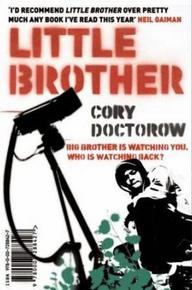
If you love freedom, if you think the human condition is dignified by privacy, by the right to be left alone, by the right to explore your weird ideas provided you don't hurt others, then you have common cause with the kids whose web-browsers and cell phones are being used to lock them up and follow them around.This is an excerpt from the introduction to Little Brother, by Cory Doctorow.
If you believe that the answer to bad speech is more speech — not censorship — then you have a dog in the fight.
If you believe in a society of laws, a land where our rulers have to tell us the rules, and have to follow them too, then you're part of the same struggle that kids fight when they argue for the right to live under the same Bill of Rights that adults have.
This book is meant to be part of the conversation about what an information society means: does it mean total control, or unheard-of liberty? It's not just a noun, it's a verb, it's something you do.
This is a very puzzling novel. Doctorow has a message he wants to spread, and he's not very subtle about it.
A terrorist attack in San Francisco gives rise to a state run by the Department of Homeland Security, by which 17-year-old Marcus is tortured, his right to privacy confiscated, his entire way of life threatened.
This novel was on the reading list for the MOOC Fantasy and Science Fiction: the Human Mind, Our Modern World. One of the issues to arise in the discussion forums was whether this novel should be considered science fiction. The professor posits that it's a thought experiment, a what-if novel. But some students observe that there's no what-if about it.
This is not a novel for readers. This is a novel for schoolchildren. It includes a history of civil rights movements and discussion of civil liberties, as well as a history of underground communications and Internet computing. I believe the tiresome explication is a desperate plea to be taken seriously.
Little Brother is a contradiction. It is free for download while being a marketing brochure for the bookstores of corporate America (every chapter is dedicated to a bookstore deemed significant by Doctorow, including Amazon and several large chainstore). It is didactic enough for inclusion on school curricula, while purporting to be a defense of autodidacticism. Its intent can only be to subvert from within. It is a how-to guide to hacking. It is a call to revolution.
This is not a novel. This is a manifesto. It is not about the future; it is about the now.
In many ways, I think this is not a very good novel. But I think it's a necessary book. It lacks subtlety, because the world of today lacks subtlety. It is attempting to equip the youth of today, who through our overprotection are sadly ill-prepared to face some social and political realities. What Doctorow has to say is more important than how he says it.
"Never underestimate the determination of a kid who is time-rich and cash-poor."
Tuesday, August 19, 2014
Some books might be better off as movies
There are some notable exceptions to the generally accepted truth that a book is better than its movie adaptation. Jaws comes to mind. Children of Men. Bladerunner. And there are other titles that stand as art in both mediums; arguably they are not adaptations, but interpretations. I'm thinking of films like Kubrick's 2001 and The Shining and Tarkovsky's Solaris and Stalker, that are equal to but different from the books they were inspired by (with credit to Clarke, King, Lem, Strugatsky).
But every know and then I encounter a book that should've bypassed its print incarnation entirely. Archetype and its sequel Prototype, by M.D. Waters, fall into this category. I enjoyed Archetype when I read it last winter. I started Prototype earlier this summer and was interrupted by life, but I've spent the last couple days complaining about this book that I couldn't stop reading.
The dialogue lacks prompts, which helps with immediacy, but for extended conversations leads to confusion. The action sequences are full of vivid description, but are somehow overly visual; the angle of the kick, the position of the gun, the bodies in motion — too many details and I lose my spatial orientation.
I'm not sure who the intended audience is. There's steamy romance (with cheesy, soap opera-like "lines") and there's a militia resistance enacting covert operations and raids. One chapter to the next didn't quite feel like the same book.
However, I would've gladly given over two hours of my life to watch this onscreen. A futuristic dystopian sci-fi action adventure romance. Something for everyone. A real blockbuster.
There are some great themes of identity and memory in these novels related to cloning, with an undercurrent of feminism. But to my liking, these are underdeveloped. And in fact, Prototype never delivers on one subplot that it is hinted at throughout (whether one of the main characters is himself a clone).
The books were really unputdownable, but with the sequel clocking in at 384 pages, I resented it.
Have you read any books that should've gone straight to film?
Monday, August 18, 2014
Jetsetting, Helena-style
She's gone now, for a week. But she left me this picture on the whiteboard.

Saturday, August 16, 2014
Still life
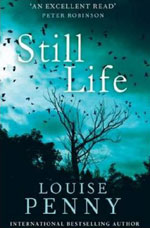
It happened far too often. Normally death came at night, taking a person in their sleep, stopping their heart or tickling them awake, leading them to the bathroom with a splitting headache before pouncing and flooding their brain with blood. It waits in alleys and metro stops. After the sun goes down plugs are pulled by white-clad guardians and death is invited into an antiseptic room.Still Life, by Louise Penny, is a wonderful palate cleanser of a book (a little too much SF for me lately). We've had cool, rainy days lately, and the leaves are starting to think about turning. The perfect backdrop for a perfect cosy mystery.
But in the country death comes, uninvited, during the day. It takes fishermen in the their longboats. It gabs children by the ankles as they swim. In winter it calls them down a slope too steep for their budding skills, and crosses their skis at the tips. It waits along the shore where snow met ice not long ago but now, unseen by sparkling eyes, a little water touched the shore, and the skater makes a circle slightly larger than intended. Death stands in the woods with a bow and arrow at dawn and dusk. And it tugs cars off the road in broad daylight, the tires spinning furiously on ice or snow, or bright autumn leaves.
Louis Penny brings death in the morning to Jane Neal, lovely, likeable old woman who'd just had a piece accepted to the community art show. And, like most of the villagers, there's a secret hidden in it.
I've read a few of Penny's novels before, but Still Life is the book that started the series of mysteries featuring Chief Inspector Gamache of the Sûreté du Québec. Her first book is every bit as assured in tone, plotting, character, and wit as the others I've read. There's only less Montreal (where Gamache's home and office are) and less departmental politics.
Excerpt.
"Life is change. If you aren't growing and evolving you're standing still, and the rest of the world is surging ahead. Most of these people are very immature. They lead 'still' lives, waiting."Perhaps the sentiment is a little anti-zen. More like stagnant stillness as opposed to being in stillness. But worth thinking about, no?
Tuesday, August 12, 2014
Things my daughter texts me

I burst out laughing, because: who talks about plane brands? But she's right. It is funnier, while also true.
Monday, August 11, 2014
Shifgrethor
Ursula K. Le Guin in The Left Hand of Darkness invents an alien world that has its own cultures, religions, mythologies, and languages. Her invented language includes some fairly nuanced concepts. The Karhidian language, for example, has several dozen terms for various type of snow. This may be out of a necessary response to the extreme environment, but this same environment, the flora and fauna, and how the land can be used, also shapes the culture philosophically.
Estraven is repeatedly described as a shadow when he comes to Genly's aid, serving as Genly's shadow (and therefore also his shifgrethor), as Genly has none of his own.
shif•gre•thor noun \ˈshif-grə-thȯr\
1: prestige, face, place, pride-relationship; all-important principle of social authority in Karhide and among other civilizations of Gethen, of which native Karhidians have an innate sense but outsiders lack
2: code of social decorum
3: standard of individual behavior
4: recognition of the level of the manifestation of this quality and the status accorded it
Usage Notes 1. One may discard, forego, waive shifgrethor. 2. One may risk, stake shifgrethor; highly valued and must be given due regard. 3. One's shifgrethor may be degraded, diminished, impugned, insulted. 4. To play shifgrethor is to engage in political games, usually at an individual level, often petty and malicious, always intricate, but sometimes also internationally; can be played on the level of ethics.
Usage Examples
1. I waive shifgrethor; I discard it.
2. We must forego shifgrethor, forbid all acts of vengeance, and unite together.
3. He could lower all his standards of shifgrethor.
4. The shifgrethor of Karhide will be diminished.
Etymology Karhidish, from Old Gethenian "shadow"; possible derivation by analogy "shift" + "grey thore", which is widespread and fastidiously husbanded for maximal usage, minimal erosion, and full integration and balance, therefore "a shift in the balance". Discussion When Getheren of Shath, in the hearth-tale of The Place Inside the Blizzard, takes back his name and his shadow, he is owning his actions, making peace with both his internal conscience and the external society. In so doing he re-establishes the responsibility and dignity of which shifgrethor is borne. As every Karhidian casts his own shadow, shifgrethor is an internal shadow, functioning as a conscience, moral compass, social guide. Karhidian shifgrethor stems from Getheren's original sin and exile and bears the rightness of acknowledgement, necessity, atonement. Honorable men come to be outlawed, yet their shadow does not shrink. They live without shadows (shifgrethor) in Orgoreyn.
Related Words conscience, dignity, etiquette, high-mindedness, honour, integrity, irreproachability, manners, nobility, protocol, respectability, righteousness, right-mindedness, scrupulousness, self-sufficiency, tactfulness, virtuousness
Near Antonyms debasement, disgrace, disreputableness, looseness, pervertedness, reprehensibleness, shamelessness, unscrupulousness, weakness, wretchedness
(This is a revised version of the "essay" I submitted for the relevant unit in the MOOC Fantasy and Science Fiction: The Human Mind, Our Modern World. As the assignment limited me to 320 words, I have here added an introductory statement and expanded slightly on some points for the sake of clarity.)
Saturday, August 09, 2014
Beethoven!

There's a new book out, Beethoven: Anguish and Triumph, by Jan Swafford, which seems to be striking a chord with the public. I may need to check it out.
NPR's interview with the author covers how the Eroica symphony revealed his personality.
The New York Times also covers the book:
Swafford's voice is genial and conversational, that of a friend who loves to tell you about his fascinations: the foibles of court life, logistical problems of the musician. He supplies a generous chapter on the German Enlightenment, connecting threads of the 1770s and '80s, opposing currents of rationalism and expressive release: Schiller, Kant, Goethe, the American Revolution. He nods toward Beethoven's unhappy childhood, but emphasizes "the golden age of old Bonn's intellectual and artistic life" and "the town's endless talk of philosophy, science, music, politics, literature."An excerpt is available online.
Music is hard to write about, and the Times includes an example of "silly": a sonata "begins with a couple of can't-get-started stutters followed by sort of a sneeze." But I think that sentence is rather evocative. And if the MOOC I took earlier this year (Exploring Beethoven's Piano Sonatas) is anything to go by, musicians actually talk that way. We can't all be poets. How else can you describe music if not by the noise it makes?
I include here for your entertainment the essay I wrote for that MOOC. Students ranged from serious experts in music theory and performance to music fans who wanted simply to explore a different genre (I fall somewhere in between). Truly, one got from the course what one put into it, and it's one of my favourite MOOCs to date.
The assignment was to choose one of nine stated sonatas, "imagine that you are hearing this sonata as a contemporary work or that you lived when it was a new work," and write a review, and to: 1. Refer to concepts covered in the lecture, including at least five historical and stylistic questions, and 2. Describe what you heard and how it made you feel, with two specific examples.
Without further ado...
Six Keys in Search of a Composer (with apologies to Pirandello)
A review of the Fantasia for piano in G minor, Op. 77, by Ludwig van Beethoven. Written 1809, published 1810. (Performed by Dino Ciano.)
Ah, phantasie. Some kind of cruel joke. A full ten minutes of unmusical noise mixed with show-offy flourishes.
"Fantasy" is the only appropriate categorization for something so unreal wrought of an unholy imagination. It is carnivalesque, bordering on grotesque.
It is a curious phenomenon that Beethoven should produce a fantasy at all. As of the publication of this phantasie, Beethoven has only once before dabbled with this "form" [issue 1], and given his propensity for structure it seems out of character to eschew it altogether.
It is striking in that it is a single-movement piece [issue 2], and it is the first time Beethoven embarks upon such a proposition [his only other single-movement composition, a polonaise, will be published in 1815].
It does not resemble, in its form or its content, anything else [issue 3] this reviewer has ever heard, in Beethoven's repertoire or that of anyone else. In its singularity, one may surmise that it was conceived as a companion piece for something that is yet to come, though what oddity that may be is difficult to imagine. The bulk of the piece is in B major (but more on this later) — so uncommon a choice my ears are barely attuned to it.
The whole of the approximately nine minutes it takes to perform this piece gives the impression of improvisation [issue 4]. It is highly involved, but with an adventurous spontaneity – Beethoven is intent on keeping us in the moment, with no glimpse of the future.
It seems not composed for human fingers, as if anticipating its performance on some autopiano. This phantasie must require inhuman preternatural skill to play, of which Beethoven has a full store, perhaps harboring in his soul a multiarmed creature both fanciful and monstrous. Beethoven's musical vision must be distorted by a blight he carries within. He must be seeing things, or hearing things. Or not hearing things.
There is an absurdity in naming this work as one in G minor – it starts in this key and stays there for all of twenty seconds. It wanders through several keys [issue 5] before settling on an organizing principle, strange though Beethoven's choice of B major may be.
Yet the atmosphere carries with it some ironic knowledge. Just past the two-minute mark, Beethoven plays allegro con brio [example 1], for almost a minute. I imagine this music accompanying some dastardly rogue villain as he ties a despairing damsel to the railroad tracks, her fate to be consummated by an oncoming steam locomotive, a hostage in his scheme; he twirls his moustaches and winks with a glint as if at an audience.
It is without a doubt a new kind of metamusical narrative. It conveys an awareness of itself, with self-deprecating wit, and an awareness that everyone (that is, everyone who matters) is aware of, and in on, the joke.
This has become music about music, lightly mocking musical tropes. The music is self-referential not just within a piece (as Bach so mathematically exemplified), but between works. Beethoven may be the father of metamusic.
The passages of villainy are followed by harp-like runs. They are disconnected form what comes before and what follows. At about three minutes, where again Beethoven slips into adagio, there is such a run in the fifth bar [example 2] that marks our entry into a different landscape – we have crossed the threshold from chaos to calm. And yet another series of runs in the opposite direction lead us back into presto.
The up and down, back and forth, disorients but also unifies: the runs are the connectors between the disparate, contrasting parts.
Although musically jarring, these runs serve a narrative function, to draw a curtain between the frenzy and calm, dream and nightmare – between fantasy and reality. But which is which? Despite the disorientation, they are in perfect balance, the yin and yang, wholly necessary to each other [issue 6].
With this phantasie, Beethoven has ventured into absurdity. It is illogical, yet logically so. Its search for structure has become its own structure. In a Hegelian manner, Beethoven’s musical dialectic becomes fundamental to its nature. It is in its becoming.
He anticipates an existentialist stance, while maintaining authenticity. One feels in his music the existential despair of the human condition, brought to the brink of the yawning void of meaninglessness. Beethoven heralds modernity, in an already postmodern way.
Certainly Beethoven has taken Kant's words into his head and his heart:
Two things fill the mind with ever new and increasing admiration and awe, the more often and steadily reflection is occupied with them: the starry heaven above me and the moral law within me. Neither of them need I seek and merely suspect as if shrouded in obscurity or rapture beyond my own horizon; I see them before me and connect them immediately with my existence.Beethoven continues to connect our finite existence to the infinite.
The fantasia is a bizarre composition, disturbing upon first hearing, but surefooted in the path it forges. Intended for ears strong enough to bear music's schizoid future.
Thursday, August 07, 2014
The fitness of that city

Following the east bank of the great Rive Kunderer I came on my third morning in Orgoreyn to Mishnory, the largest city on that world.Big aimless bookshelves! The Left Hand of Darkness, by Ursula K. Le Guin, is a remarkable novel and already I look forward to rereading it someday.
In the weak sunlight between autumn showers it was a queer-looking city, all blank stonewalls with a few narrow windows set too high, wide streets that dwarfed the crowds, street-lamps perched on ridiculous tall posts, roofs pitched steep as praying hands, shed-roofs sticking out of housewalls eighteen feet above ground like big aimless bookshelves — an ill-proportioned, grotesque city, in the sunlight. It was not built for sunlight. It was built for winter. In winter, with those streets filled ten feet up with packed, hard-rolled snow, the steep roofs icicle-fringed, sleds parked under the shed-roofs, narrow window-slits shining yellow through driving sleet, you would see the fitness of that city, its economy, its beauty.
It is a beautifully written love story set amid a harsh environment against a backdrop of political intrigue. Which has to do with interplanetary contact. Also, there's a strong feminist message in the portrayal of a genderless society.
Aside: I think The Left Hand of Darkness bears a remarkable similarity to China Miéville's Embassytown, which is one of my favourite books, across all genres. The novels bring a studied anthropological perspective to alien contact, and the problem of communication across languages and cultures, which greatly appeals to my inner linguist. Both novels play with words, and the relationship between language and concepts.
Le Guin's Weaver — who weaves together the psychic energy of the foretellers — also reminded me of Miéville's Weaver in Perdido Street Station, though his is absolutely weirder and more poetical. It would not surprise me to learn that The Left Hand of Darkness was a tremendous influence on Miéville.
Le Guin builds her world on the Sapir-Whorf hypothesis, showing how language determines its speakers' worldview. This is particularly evident in the concept of shifgrethor, an untranslatable term for a kind of honour code or code of conduct, which governs the behaviour of the Karhidians and their resultant estimation of each other, while the Terran visitor fails to fully understand its mechanisms and implications. She also demonstrates how the Karhidian language reflects the environment on this planet the Terrans call Winter; borrowing from Whorf's examples, she presents a culture that has a multitude of terms for "snow."
The same concept is evident in the excerpt above — the style of architecture has evolved under the influence of the environment — and Le Guin extends it to all facets of life. The people have not developed flight, because there are no birds.
The sexual behaviour on this other world didn't make a particularly strong impression on me — to me this is not the main focus of the novel. Perhaps because I'm naturally openminded regarding people's sexual choices. Perhaps because since the novel was written our society really has changed and established some level of gender equality (at least in theory), and is coming to realize that biological sex need not determine social roles or even sexual roles. The novel is perhaps best known for its exploration of gender, which is fine, but I just want to go on record as saying that The Left Hand of Darkness is so much more than that.
[Oh! I just read Jo Walton's take, and it seems we agree.]
And really, the whole business of crossing the glacier, the blizzard, and no shadows — spectacular!
I read this novel as part of the coursework for a MOOC (Fantasy and Science Fiction: The Human Mind, Our Modern World). I can't tell you what exactly I'm learning from this course (in the professor's view, every rocketship is a penis, and some feminists are angry) apart from some trivial facts, like that Le Guin is American (I'd always assumed she was British). But I have been enjoying the reading and the discussion.
I suppose Le Guin is significant on the SF landscape for being among the first to bring real anthropological theory into the text (which is one the things I most love about the genre), shifting the genre away from straight-up action-adventure. (Although, many writers had already done that, no? Maybe it's the feminist angle that's supposed to be so groundbreaking. Frankly, I don't understand the logic behind the curriculum and I'm disappointed that it's so American-centric. )
I'm so relieved this novel lived up to the hype, and surpassed my expectations. You can bet I'll be reading more Le Guin over the months to come.
See also:
Sarah LeFanu, The Guardian: The king is pregnant
Jo Walton: Gender and glaciers: Ursula Le Guin’s The Left Hand of Darkness
The Paris Review: Ursula K. Le Guin, The Art of Fiction No. 221
And here's a list that may be (mostly) worth working through: 21 Books That Changed Science Fiction And Fantasy Forever.
Sunday, August 03, 2014
Good for the needy
I've been off-grid for a few days, which meant missing Jack White at Osheaga.
In recompense:
Literary connections:
In recompense:
Literary connections:
- Jack White, musician, now publisher, launches Third Man Books
- In That Black Bat Licorice, "Good for the needy, like Nietzsche, Freud and Horace."
Wednesday, July 30, 2014
What did Time smell like?
There was a smell of Time in the air tonight. He smiled and turned the fancy in his mind. There was a thought. What did Time smell like? Like dust and clocks and people. And if you wondered what Time sounded like it sounded like water running in a dark cave and voices crying and dirt dropping down upon hollow box lids, and rain. And, going further, what did Time look like? Time looked like snow dropping silently into a black room or it looked like a silent film in an ancient theater, one hundred billion faces falling like those New Year balloons, down and down into nothing. That was how Time smelled and looked and sounded. And tonight — Tomás shoved a hand into the wind outside the truck mdash; tonight you could almost touch Time.In addition to rereading Ray Bradbury's The Martian Chronicles for this week's unit of the MOOC on fantasy and science fiction that I'm following, I decided to rewatch it as well.
It originally aired in January 1980, and I remember it as a big television event (this was, after all, the golden age of the miniseries). Apparently Bradbury thought it was boring. That may be true from the perspective of the mind from which the story was sprung. But it made a great impression on my 10-year-old self. Possibly more so than the book, which I didn't read till years later.
Low on special effects, and I don't particularly care for how the Martians are represented (they should be brown-skinned and small; I don't know about bald), it manages to convey the essence of Bradbury's novel, an ambiguity that hovers between poignancy and creepiness.
Scripted by Richard Matheson (no slouch as a writer of SF himself), it has an excellent new-agey soundtrack, and a vibe reminiscent of Fassbinder's World on a Wire (which is maybe just a general 1970s tv sfi-fi vibe, I dunno).But I think it's awesome.
You can watch The Martian Chronicles online (parts one, two, three).
Tuesday, July 29, 2014
Cleaning up the language
"Everything You Always Wanted to Know About: Sects, Sets, Sex, prefix, frankforts, Waldorf, idle, American, peanuts, gin, Heritage, cabbage, Dictionary, Rasputin, bassoon, cohort, rum, putty, rotor, usage, coquette, alfalfa, zipper, Mississippi,…etc.: But Were Afraid to Axe!!"
(Via.)
(Via.)
Monday, July 28, 2014
No matter how we touch Mars, we'll never touch it.

"I believe in the things that were done, and there are evidences of many things done on Mars. There are streets and houses, and there are books, I imagine, and big canals and clocks and places for stabling, if not horses, well, then some domestic animal, perhaps with twelve legs, who knows? Everywhere I look I see things that were used. They were touched and handled for centuries.— from "—And the Moon Be Still as Bright" in The Martian Chronicles, by Ray Bradbury.
"Ask me, then, if I believe in the spirit of the things as they were used, and I'll say yes. They're all here. All the things which had uses. All the mountains which had names. And we'll never be able to use them without feeling uncomfortable. And somehow the mountains will never sound right to us; we'll give them new names, but the old names are there, somewhere in time, and the mountains were shaped and seen under those names. The names we'll give to the canals and mountains and cities will fall like so much water on the back of a mallard. No matter how we touch Mars, we'll never touch it. And then we'll get mad at it, and you know what we'll do? We'll rip it up, rip the skin off, and change it to fit ourselves."
Thursday, July 24, 2014
Egg, bacon, thing

*************
Egg Man
- from aged, yellowed lava — when world created & volcanoes erupted
- yellow slime slithered, hardened with white foam covering on outside
- form of egg — were coloured white, yellow, beige, brown
- rolled about, wobbled
- few were cracked on rock — died
- most had 8-10 distinctly brow cuts used as mouths
- became very sacred — worshipped
- held ceremonies each night around fire
- first people ever created
Bacon Man
- third people to survive
- were created later than Egg Man
- live volcanic lava came together
- lava stuck and became Bacon Man
- sizzled, slithered around ground
- worshiped sun greatly — not fire, idol of Egg Man
- had not but 1 mouth
- communicate with bubbles
- were killed once all bubbles were scraped
Thing Man
- were created shortly after Egg Man far, far away — on a different planet out of our universe
- nobody knows of its background before they came to planet of Egg & Bacon
- head resembled bird, body of human, limbs & tail of pig
- worshiped dark — were blinded by any type of light except their own light
- light was of gloomy-oomy glow
- Thing Man was noisy — squawked & squealed at all times
- hated the quiet
LEGEND
Once a long time ago, Egg Man wandered the earth. He came upon Bacon Man and they travelled together. Their ways disagreed with each other — so they fought. The fighting was rough. Many peoples were killed. Strangely enough, no sound came of the fighting. Thing Man (which had come to "Planet of Bacon & Egg" by strange means) had roamed half way across the earth & dirt to the sight of the battle. The quiet of the fighting killed half of the tribe of Thing Men. The others decided to do something about this lack of noise. The Thing Men squawked & screamed and made the Egg & Bacon Men suffer, for they hated noise. But Egg & Bacon Men fought on. Thing Men decided that the only way to get rid of the quiet was to get rid of the other peoples. So the Thing Men pounced upon the others, ate them, and then there was noise. So the Thing Men travelled back to their own planet in their own universe.
This planet came to be known as "Earth." Thing Man evolved into 3 different things: the heads into chickens, the limbs & tail into pigs, and the body into a human (strange, isn't it). The humans still eat dead Bacon & Eggs. The Eggs come from the chickens. The Bacon comes from dead pigs. Few people know of Egg, Bacon & Thing Man and if you don't believe they ever lived, go ahead and think so. If you think they didn't 'live' in the sense that would most properly be understood today, you're right. Egg, Bacon & Thing Man live in imagination and mind.
Day of Egg Man
Once a year on every March 21st Egg Men would celebrate the beginning of life. That is why to this day the "egg" is thought of as the symbol of life. Well anyway, the Day of Egg Man was to them the most important day of the year. On this day they would paint each other with bright colours to show their happiness and thanks to their gods.
I.A.K.
*************
Things I love about this essay:
- It goes from the first people to the third people. But who were the second? Why not present them chronologically? Suspense!
- "had not but 1 mouth" — Who writes like that? (Yeah, I know, I do.)
- So Bacon Man dies once he loses the ability to communicate...
- "gloomy-oomy"
- The noise. Oh, the noise, noise, noise, noise. I feel somewhat Grinch-like in my aversion to noise. I'm surprised to see it manifested so early. Or maybe the legend's message is anti-quiet, I dunno.
- How the narrator is suddenly inserted into the text (strange, isn't it).
- The Twilight Zone-y ending. I can just hear Rod Serling narrating the last few sentences of the Legend over the fade-out.
Wednesday, July 23, 2014
The whole thing is nonsense
I've never read Ursula K. Le Guin. Not really. The Dispossessed was on the syllabus of a course I took in university, but we ended up skimming that unit, and the book. So: major gap in my SF education.
The Left Hand of Darkness has been on my radar for several years. I'm reading it now as part of MOOC (Fantasy and Science Fiction: The Human Mind, Our Modern World); in fact, I enrolled in the MOOC precisely because I wanted to read this novel, else it would languish in my stack of unread books for a long time to come.
Le Guin's 1976 introduction to her novel is worth reading in its own right. In it she describes science fiction as something more than extrapolation; she considers it a thought-experiment, describing reality at a quantum level.
Science fiction is not predictive; it is descriptive.The entire essay is worth reading in its entirety, if you can track it down. LeGuin's tone is very matter of fact; her style reminds me very much of Doris Lessing's (which is a good thing). It bodes well for this classic of science fiction.
Predictions are uttered by prophets (free of charge); by clairvoyants (who usually charge a fee, and are therefore more honored in their day than prophets); and by futurologists (salaried). Prediction is the business of prophets, clairvoyants, and futurologists. It is not the business of novelists. A novelist's business is lying.
[...]
Fiction writers, at least in their braver moments, do desire the truth: to know it, speak it, serve it. But they go about it in a peculiar and devious way, which consists in inventing persons, places, and events which never did and never will exist or occur, and telling about these fictions in detail and at length and with a great deal of emotion, and then when they are done writing down this pack of lies, they say, There! That's the truth.
They may use all kinds of facts to support their tissue of lies. They may describe the Marshalsea Prison, which was a real place, or the battle of Borodino, which really was fought, or the process of cloning, which really takes place in laboratories, or the deterioration of a personality, which is described in real textbooks of psychology; and so on. This weight of verifiable place-event-phenomenon-behavior makes the reader forget that he is reading a pure invention, a history that never took place anywhere but in that unlocalisable region, the author's mind. In fact, while we read a noel, we are insane — bonkers. We believe in the existence of people who aren't there, we hear their voices, we watch the battle of Borodino with them, we may even become Napoleon. Sanity returns (in most cases) when the book is closed.
Is it any wonder that no truly respectable society has ever trusted its artists?
In reading a novel, any novel, we have to know perfectly well that the whole thing is nonsense, and then, while reading, believe every word of it.
Sunday, July 20, 2014
Sardines and oranges

Why I Am Not a Painter
I am not a painter, I am a poet.
Why? I think I would rather be
a painter, but I am not. Well,
for instance, Mike Goldberg
is starting a painting. I drop in.
"Sit down and have a drink" he
says. I drink; we drink. I look
up. "You have SARDINES in it."
"Yes, it needed something there."
"Oh." I go and the days go by
and I drop in again. The painting
is going on, and I go, and the days
go by. I drop in. The painting is
finished. "Where's SARDINES?"
All that's left is just
letters, "It was too much," Mike says.
But me? One day I am thinking of
a color: orange. I write a line
about orange. Pretty soon it is a
whole page of words, not lines.
Then another page. There should be
so much more, not of orange, of
words, of how terrible orange is
and life. Days go by. It is even in
prose, I am a real poet. My poem
is finished and I haven't mentioned
orange yet. It's twelve poems, I call
it ORANGES. And one day in a gallery
I see Mike's painting, called SARDINES.
— Frank O'Hara
Perhaps the sentiment here — the present absence, or subtraction — might also explain why it is that I'm not a poet, even a writer. Or a mathematician.
Wednesday, July 16, 2014
The movements of men are not analogous to the stars

"When I break this decanter of mine," he said, "I'll replace it with one with advertising on it." He held out one of the glasses to Aimée, who reached for it with one hand as she continued towelling her hair with the other. "I am very interested in promotional items and free gifts," continued the baron. "Also in trash. I have no income, you see, and a man with no income is bound to take a great interest in free gifts and trash." He took a sip of brandy and clicked his tongue appreciatively. "Given the present state of the world, don't you know, with the increase of constant capital as compared with variable capital, a whole stratum of the poor is bound to be unemployed and live off free gifts and trash, and occasionally off various government subsidies. Do you know what I am saying?"Nor am I entirely sure what to make of Fatale, by Jean-Patrick Manchette. Every now and then it veers into something like social commentary, something like the above, which is just a little bit weird. Some passages are clearly anticapitalist, while Aimée herself operates on capitalist principals — she is the ultimate self-made woman. Is she being held up as a model or as an object of ridicule?
"I am not sure," said Aimée.
"Nor am I," said the baron.
Similarly, it's difficult to discern if Manchette is espousing feminist sympathies. There must be more to his characterization of this female James Bond–type protagonist than simple male fantasy. What message is Manchette trying to communicate when he ends the novel with the line, "SENSUAL WOMEN, PHILOSPHICALLY MINDED WOMEN, IT IS TO YOU THAT I ADDRESS MYSELF"?
These oddities, other weird narrative insertions, and occasional seeming contradictions in character made this slim book a goldmine for bookclub discussion.
A little later, a little calmer now, as the pair went back down into the hall (on a wall of which hung a Weatherby Regency under-and-over double-barrel shotgun), Baron Jules further informed Aimée that, although the movements of men are not analogous to the stars, it sometimes seemed to him that they were, this on account of the posture that he had adopted, or rather that he had been obliged to adopt. These strange remarks made Aimée a little nervous, and she wanted to get away from this place. It was not long before the baron drove her back to Bléville. Yet when he left in his banged-up old 4CV, Aimée was sorry.Fatale has a definite noir feel, but perhaps it's a little too clipped. It'd be nice to see Aimée a little closer up, insinuating herself into society, stalking her prey, to know her modus operandi better.
My sense of time and space were a little disoriented in reading Fatale. Written in the seventies, the noir tone may take you back a few decades earlier. It's set in a remote coastal village in the north of France, but "whichever way you go, there is a big hill to climb before you get out of Bléville" (I believe the hill is metaphorical).
The book reminds me of Simenon's romans durs in the moral ugliness of its characters, with a hint of existentialism underlying it all. It also brought to my mind Claude Chabrol's film La Cérémonie (based on a Ruth Rendell novel) in the violence and senselessness, the dark side of French provincial life. (Interestingly, Chabrol had adapted another Manchette work for film, so I may have sensed a common vibe.)
I really enjoyed this novella. It may ultimately prove to be forgettable, but it succeeded in lifting me out of my everyday in spectacular fashion. There are worse ways to spend a couple hours.
New York Review Books has just released Manchette's The Mad and the Bad. I need to get my hands on a copy.
See
Manchette: Into the Muck, by James Sallis, in The New York Review of Books.
Also
Analepsis
NoirWhale
Friday, July 11, 2014
On the shoulders of giants
One of the MOOCs I recently completed was On Strategy: What Managers Can Learn from Great Philosophers. While it is to date the most disorganized and worst prepared online course I've taken, the content and exercises were in fact very valuable.
One module focused on how all genius is built on the shoulders of giants. The assignment was take one or two "giants" of Luc de Brabandere's lecture (featuring Plato, Aristotle, Descartes, Leibniz, Newton, Russell) and connect them with at least two others, not included in his model. We were to include at least one philosopher and one scientist. I further challenged myself to select women.
*************************
 Hypatia of Alexandria was a fourth-century philosopher. As a Neoplatonist, she was heavily influenced by Plato and the Platonic tradition. As such, she valued and used logic and mathematical thinking. She taught the works of Plato and Aristotle in public lectures. 1
Although considered a pagan, she is significant for bridging classical antiquity to Christianity. Her murder heralded the coming dark ages. I think of her as a philosopher because she promoted a mode of logical thinking (based on Plato), but she contributed to the advancement of various geometrical concepts (also founded in Plato) and developed instruments for use in physics and astronomy. She assisted her father in the writing of his mathematical commentary, Euclid's Elements, which in turn influenced Newton.2
Descartes, Newton, and Leibniz later expanded on Hypatia's work.3
Ada Lovelace was a 19th-century computer programmer (i.e., mathematician and scientist) who worked with Charles Babbage in developing the Analytical Engine. Her study of mathematical and scientific concepts, in particular differential calculus (developed independently by Newton and Leibniz), framed by her poetical and metaphysical attitude, drove the conceptual leap to consider the possibilities of computing machines and their applications, far beyond the arithmetic of Leibniz's calculator.
"Whilst describing the revolutionary implications of Babbage's ideas, Lovelace wrote out the first computer programme […] and she made the sensational suggestion that such a device should be able to compose music if a suitable set of rules could be devised. She thus anticipated the development of both modern computing and artificial intelligence by more than a hundred years."4 Among the innovations she imagined (that would be realized only several generations later) were the subroutine (a set of reusable instructions), looping (running a useful set of instructions over and over) and the conditional jump (branching to specified instructions if a particular condition is satisfied).5 Certainly her own shoulders are broad enough for subsequent giants to stand on (such as Alan Turing). She desired also "to create a mathematical model for how the brain gives rise to thoughts and nerves to feelings ("a calculus of the nervous system"),"6 foreshadowing the entire field of cognitive neuroscience. [See also.]
*************************
I repost this assignment because Ada Lovelace seems to be in the air these days: she's been referenced on Halt and Catch Fire, which I've been watching; Melville House is publishing a book; and I get email from the Be Like Ada program the publisher mentions.
Someone outside of the course asked me, not why did I choose these women, but how I do even know about these women to be able to connect them with the other giants of history. The answer is, they're in the fiction I read. (I'll name, for example, All Men of Genius, by Lev AC Rosen, and Azazeel, by Youssef Ziedan, as obvious references, but there are others.)
Because everything is connected.
One module focused on how all genius is built on the shoulders of giants. The assignment was take one or two "giants" of Luc de Brabandere's lecture (featuring Plato, Aristotle, Descartes, Leibniz, Newton, Russell) and connect them with at least two others, not included in his model. We were to include at least one philosopher and one scientist. I further challenged myself to select women.
*************************
Although considered a pagan, she is significant for bridging classical antiquity to Christianity. Her murder heralded the coming dark ages. I think of her as a philosopher because she promoted a mode of logical thinking (based on Plato), but she contributed to the advancement of various geometrical concepts (also founded in Plato) and developed instruments for use in physics and astronomy. She assisted her father in the writing of his mathematical commentary, Euclid's Elements, which in turn influenced Newton.2
Descartes, Newton, and Leibniz later expanded on Hypatia's work.3
Ada Lovelace was a 19th-century computer programmer (i.e., mathematician and scientist) who worked with Charles Babbage in developing the Analytical Engine. Her study of mathematical and scientific concepts, in particular differential calculus (developed independently by Newton and Leibniz), framed by her poetical and metaphysical attitude, drove the conceptual leap to consider the possibilities of computing machines and their applications, far beyond the arithmetic of Leibniz's calculator.
"Whilst describing the revolutionary implications of Babbage's ideas, Lovelace wrote out the first computer programme […] and she made the sensational suggestion that such a device should be able to compose music if a suitable set of rules could be devised. She thus anticipated the development of both modern computing and artificial intelligence by more than a hundred years."4 Among the innovations she imagined (that would be realized only several generations later) were the subroutine (a set of reusable instructions), looping (running a useful set of instructions over and over) and the conditional jump (branching to specified instructions if a particular condition is satisfied).5 Certainly her own shoulders are broad enough for subsequent giants to stand on (such as Alan Turing). She desired also "to create a mathematical model for how the brain gives rise to thoughts and nerves to feelings ("a calculus of the nervous system"),"6 foreshadowing the entire field of cognitive neuroscience. [See also.]
*************************
I repost this assignment because Ada Lovelace seems to be in the air these days: she's been referenced on Halt and Catch Fire, which I've been watching; Melville House is publishing a book; and I get email from the Be Like Ada program the publisher mentions.
Someone outside of the course asked me, not why did I choose these women, but how I do even know about these women to be able to connect them with the other giants of history. The answer is, they're in the fiction I read. (I'll name, for example, All Men of Genius, by Lev AC Rosen, and Azazeel, by Youssef Ziedan, as obvious references, but there are others.)
Because everything is connected.
Subscribe to:
Posts (Atom)
