Wednesday, January 28, 2015

Neither present nor past

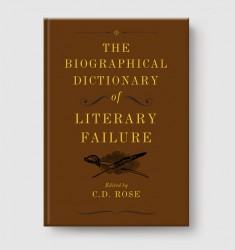
From the entry for Otha Orkkut (1890-1943), poet, translator, and historian, in The Biographical Dictionary of Literary Failure, edited by C.D. Rose:
Cimbrian, it is said, was a unique language in that it contained a tense which was used to describe a person or object which had gone missing or been lost: neither present nor past, still existing in a space or time which no non-Cimbrian can ever properly comprehend.

A number of critics and translators are currently at work on Orkkut's books, her manuscripts now inhabiting the realm of that unique Cimbrian tense.
Identified as a Bothno-Ugaric language, "Cimbrian" may be referencing the same language known in Italo Calvino's quarters as "Cimmerian," described by Professor Uzzi-Tuzzi as "a modern language and a dead language at the same time."

I treated myself to this lovely volume at Christmas, to add to my shelf of weird dictionaries. This collection of 52 lives, by turns tragic and comic, easily lends itself to browsing; I reach for it for inspiration, for reminders, for warnings.

The introduction alone is worth the price of admission, exploring the concepts of erasure, "faith in the ineffable," linguistic negation, "literature of the unword," "stories that would prefer not to."

Reviews
Biographile: "The simple fact is this: books are real; writers aren't."
PopMatters: "It's questionable whether insanity is a prerequisite for the arts."

Excerpt.

Saturday, January 24, 2015

Reading can transport you

Montreal metro stations this week have been filled with bookshelves, stocked with virtual books.

In a campaign cosponsored by various transit commissions and library associations, the commuting public is being encouraged to read.

First chapters of 60 books that span genres are available for free for instant download, just by scanning a smart code or entering a URL (or they can be accessed from the campaign website). The books are available in French only (I believe Louise Penny bears the distinction of being the only English-language author on the list, in French translation).

So far it's inspired fun waiting times when I'm with my daughter (and therefore not actually reading): "Oh, I read that," "That book looks interesting," and infinite I Spy possibilities. But I may yet download a chapter of two to practice my French.

Transit-goers may or may not be getting the point — it's really heard to tell what they're doing on their phones. I'd love to see the download and usage stats at campaign's end.

Lire vous transporte. (Video.)

Wednesday, January 21, 2015

Unperturbed by that appalling fact

Zebra, by Victor Vasarely
The following days were strange. It was as is until then we had all been dreaming and had suddenly woken to real life, although occasionally it seemed to be the other way round, as if we had all been plunged into a dream. And we went on living day by day in accordance with the abnormal conventions of the dream-world: anything can happen and whatever happens the dreamer accepts it. Movement works differently. We move like gazelles or the way gazelles move in a tiger's dream. We move like a painting by Vassarely. We move as if we had no shadows and were unperturbed by that appalling fact. We speak. We eat. But underneath we are trying not to realize that we are speaking and eating.
— from By Night in Chile, by Roberto Bolaño.

[Who'd've thought that Bolaño's description upon the toppling of Allende's government would be so apt in conveying how it feels for an 18-year relationship to end.]

I reread this book for book club; in fact, I'd suggested it. What strikes me now is that for a book whose jacket copy touts the "clandestine view of the strange bedfellows of Church and State in Chile," there's remarkably little church in this novel, and not very much politics either. The politics that are there are presented nonjudgmentally; it'd be impossible to peg the narrator, or the author, as a leftist or otherwise on the basis of this text.

It strikes me also that this novella is in many way 2666 in miniature, with its lit critics and German writers, spaceships (yes) and labyrinthine torture basements. "An assortment of fruits and vegetables worthy of Archimboldo." The cultivation of art alongside some horror.

What the narrator expresses in the excerpt above, as well as in some of the anecdotes throughout the book — in particular, that of the Guatemalan painter in Paris, and the shoemaker whose dream of Heroes' Hill became his own crypt — where lassitude meets boredom, and a glimpse of immortality catalyzes it into some form of existential ennui, is some infernal detachment haunted by a secret knowledge. "That's how literature is made."

"It's good to love. It's bad to be impressionable."

Wednesday, January 14, 2015

He is a bridge

Man is a rope stretched between the animal and the Superman — a rope over an abyss.

A dangerous crossing, a dangerous wayfaring, a dangerous looking-back, a dangerous trembling and halting.

What is great in man is that he is a bridge and not a goal.
— from Thus Spake Zarathustra, by Friedrich Nietzsche.

Thursday, January 08, 2015

Speculation

The Buddhists say there are 121 states of consciousness. Of these, only three involve misery or suffering. Most of us spend our time moving back and forth between these three.
I've had trouble reading lately. Doing much of anything really. I can't focus, yet I need to distract myself.

Enter Jenny Offill's Dept. of Speculation. It's damn near the most perfect book I could've hope for, for my here and now. "The wife is praying a little. To Rilke, she thinks."

It mirrors my reality, so that I may reflect upon it. I want to read it again immediately.

It's the story of love and marriage and a lovely daughter, and betrayal.
Taller?
Thinner?
Quieter?
Easier, he says.
I also was not a good wife. I also go to yoga to cry.
The wife has never not wanted to be married to him. This sounds false but it is true.

She has wanted to sleep with other people, of course. One or two in particular. But the truth is she has good impulse control. That is why she isn't dead. Also why she became a writer instead of a heroin addict. She thinks before she acts. Or more properly, she thinks instead of acts. A character flaw, not a virtue.
It's so hard to be kind.

Reviews
"The Smallest Possible Disaster," by Elaine Blair in The New York Review of Books:
In the history of the novel, female adulterous desire has been a major force, female jealousy a minor one.

"Bridled Vows" by Roxane Gay in The New York Times:
The wife's pain and sorrow are rendered through a wryer brand of observation as she becomes the betrayed. It is easy to feel for her because she is a desperately interesting character. Each newly disclosed flaw only makes her more compelling. In fact, we know everything about the wife and how she thinks and feels and moves through the world. It is much more difficult to feel anything about the marriage because the husband is so secondary a character. He is an accessory and a bit player in the wife's meditations.
(My husband was always a secondary character.)

"Mother Courage," by James Woods, in The New Yorker:
If it is a distressed account of a marriage in distress, it is also a poem in praise of the married state. If it brutally tears apart the boredom and frustrations of parenthood, it also solidly inhabits the joys and consolations of having a child. If it laments the work not done, the books not written, the aspirations unfulfilled, it also represents work well done, a book written, the fruit of aspiration. [...] It is often extremely funny, and often painful; earnestly direct but glancingly ironic, even whimsical.

The anatomy of jealousy

Jealousy everywhere. I'm living and breathing it.

I read Alain Robbe-Grillet's Jealousy several years ago. I never got around to reviewing it here, but I recall noting that I might've interpreted it rather differently if it weren't for its title, if I hadn't known what it was supposed to be about. It couldn't be read cold. A weirdly dispassionate telling was suddenly imbued with a passionate external interpretation.

In The New York Review of Books, Diane Johnson considers the theme of jealousy in the light of a couple of books that I'm not sure I would ever have thought to group together, including Jealousy, by Peter Toohey:
One of Toohey's more interesting findings is that a morbidly jealous person (as opposed to "normally" jealous) is especially zealous in seeking "visual evidence to confirm the truth of the way they are feeling"; Othello must see Desdemona's handkerchief. This visual element makes film a particularly suitable medium for expressing jealousy. He suggests that stalking also arises from the visual need.
Toohey uses Robbe-Grillet's novel to illustrate a couple other points. I'm a little hung up on this novel at the moment and want to revisit it, having just watched Last Year at Marienbad (for which Robbe-Grillet wrote the screenplay) the other week.

Johnson also references Happy Are the Happy, a book of short stories by Yasmina Reza, which has just sky-rocketed to the top of my wishlist.

See also An Ode to Envy, a TED Talk by Parul Sehgal, an editor for The New York Times Book Review:
Jealousy is exhausting. It's a hungry emotion. It must be fed. [...] Jealousy is a hungry emotion. Jealousy like information. Jealousy likes detail. That's why Instagram is such a hit. Proust actually links the language of scholarship and jealousy. When Swann is in his jealous throes, and suddenly he's listening at doorways and bribing his mistress' servants, he defends these behaviors. He says, "You know, look, I know you think this is repugnant, but it is no different from interpreting an ancient text or looking at a monument." He says, "They are scientific investigations with real intellectual value." Proust is trying to show us that jealousy feels intolerable and makes us look absurd, but it is, at its crux, a quest for knowledge, a quest for truth, painful truth, and actually, where Proust is concerned, the more painful the truth, the better. Grief, humiliation, loss: These were the avenues to wisdom for Proust. He says, "A woman whom we need, who makes us suffer, elicits from us a gamut of feelings far more profound and vital than a man of genius who interests us." Is he telling us to just go and find cruel women? No. I think he's trying to say that jealousy reveals us to ourselves. And does any other emotion crack us open in this particular way? Does any other emotion reveal to us our aggression and our hideous ambition and our entitlement? Does any other emotion teach us to look with such peculiar intensity?

Tuesday, January 06, 2015

If you had a crooked heart

It is important if someone asks you to remember one of your happiest times to consider not only the question but also the questioner. If the question is asked by someone you love, it is fair to assume that this person hopes to feature in this recollection he has called forth. But you could, if you were wrong and if you had a crooked heart, forget this most obvious and endearing thing and instead speak of a time you were all alone, in the country, with no one wanting a thing from you, not even love. You could say that was your happiest time. And if you did this then telling about this happiest of times would cause the person you want to be happy to be unhappy.
— from Dept. of Speculation, by Jenny Offill.

I sometimes think I have a crooked heart.

Friday, January 02, 2015

She cried that night

Stanisław Barańczak — poet, dissident, and translator — died last week. Here's a poem I found, translated by the poet himself with Clare Cavanagh.
She Cried That Night, but Not for Him to Hear

She cried that night, but not for him to hear.
In fact her crying wasn't why he woke.
It was some other sound; that much was clear.

And this half-waking shame. No trace of tears
all day, and still at night she works to choke
the sobs; she cries, but not for him to hear.

And all those other nights: she lay so near
but he had only caught the breeze's joke,
the branch that tapped the roof. That much was clear.

The outside dark revolved in its own sphere:
no wind, no window pane, no creaking oak
had said: "She's crying, not for you to hear."

Untouchable are those tangibly dear,
so close, they're closed, too far to reach and stroke
a quaking shoulder-blade. This much is clear.

And he did not reach out — for shame, for fear
of spoiling the tears' tenderness that spoke:
"Go back to sleep. What woke you isn't here.
It was the wind outside, indifferent, clear."
I quite love this poem already. It resonates with me because... it resonates.

But here's the poem in Polish.
Płakała w nocy, ale nie jej płacz go zbudził

Płakała w nocy, ale nie jej płacz go zbudził.
Nie był płaczem dla niego, chociaż mógł być o nim.
To był wiatr, dygot szyby, obce sprawom ludzi.

I półprzytomny wstyd: że ona tak się trudzi,
to, co tłumione, czyniąc podwójnie tłumionym
przez to, że w nocy płacze. Nie jej płacz go zbudził:

ile więc było wcześniej nocy, gdy nie zwrócił
uwagi — gdy skrzyp drewna, trzepiąca o komin
gałąź, wiatr, dygot szyby związek z prawdą ludzi

negowały staranniej: ich szmer gasł, nim wrzucił
do skrzynki bezsenności rzeczowy anonim:
"Płakała w nocy, chociaż nie jej płacz cię zbudził"?

Na wyciągnięcie ręki — ci dotkliwie drudzy,
niedotykalnie drodzy ze swoim "Śpij, pomiń
snem tę wilgoć poduszki, nocne prawo ludzi".

I nie wyciągnął ręki. Zakłóciłby, zbrudził
toporniejszą tkliwością jej tkliwość: "Zapomnij.
Płakałam w nocy, ale nie mój płacz cię zbudził.
To był wiatr, dygot szyby, obce sprawom ludzi".
The first stanza of the translation is, to me, strikingly different from the original. While everything else essentially matches up, the opening sets a very different tone.

More literally, it'd be something like this...
She cried that night, but it's not her crying that woke him.
She wasn't crying for him, but it might've been about him.
It was the wind, a rattling window pane, other people's odd business.
So while the official translation maintains the rhyme, rhythm, matter-of-factness of the original, it turns on generality. There is something altogether more pointed and tragic about the original. She might be crying about him.

I've always enjoyed comparing poems in translation, and I marvel at the translators' feat. It demands emotional precision more than technical exactitude.

But to my ear, this English translation is a very different poem.

Where is the damp pillow? A person's right to sleep at night?

Thursday, January 01, 2015

Full of things that have never been

And now let us believe in a long year that is given to us, new, untouched, full of things that have never been, full of work that has never been done, full of tasks, claims, and demands; and let us see that we learn to take it without letting fall too much of what it has to bestow upon those who demand of it necessary, serious and great things.
— from Rainer Maria Rilke, in a letter to Clara Rilke, January 1, 1907.

Hear me, world. I demand necessary, serious, and great things.

Tuesday, December 30, 2014

Holding the universe together

The most beautiful sentences...
She wasn't doing a thing that I could see, except standing there leaning on the balcony railing, holding the universe together.
— from "A Girl I Knew," by J.D. Salinger.

That used to be me, I was that girl. But my universe has crumbled apart. Someone else holds his universe together now.

Monday, December 29, 2014

That showy dark crack running down the middle of a life

I spent some hours at the bookstore this afternoon, wanting something but not finding anything that satisfied. I picked up Donna Tartt's The Secret History, but then I put I put it back down again. It starts this way:
Does such a thing as "the fatal flaw," that showy dark crack running down the middle of a life, exist outside literature? I used to think it didn't. Now I think it does.
Me too. I didn't think it existed. But now I do.

The narrator believes his flaw to be "a morbid longing for the picturesque." I think that's fairly benign.

I'm not convinced how showy the crack is, but sadly, I have little trouble identifying flaws — gaping voids — in others. I have much less insight into my own shortcomings.

Monday, December 22, 2014

Stillness

Much-needed stillness these days...
The amount of data humanity will collect while you're reading this book is five times greater than the amount that exists in the Library of Congress. Anyone reading this book will take in as much information today as Shakespeare took in over a lifetime. Researchers in the new field of interruption science have found that it takes an average of twenty-five minutes to recover from a phone call. Yet such interruptions come every eleven minutes — which means we're never caught up with our lives.
— from The Art of Stillness: Adventures in Going Nowhere, by Pico Iyer.


"Finding what feels like real life, that changeless and inarguable something behind all our shifting thoughts, is less a discovery than a recollection."

Friday, December 19, 2014

Where are they going?

Back in November I read Satantango, by László Krasznahorkai, and I'll even write about it someday. My challenge these days is to find an 8-hour block of time so that I can watch Bela Tarr's film adaptation of it, uninterrupted.

While trying to find my way into novel, I found some clips of the film. Nothing much happens, in any of them. Yet the clips are oddly compelling. I need to see how the nothingness resolves. I need to watch the full movie.


Where are they going? They look like they're going somewhere. That's quite the wind. Do they have far to go? They look like they're in a hurry. They must be in a hurry to get to wherever they're going. But the street's not passing fast enough beneath their feet. Where is everybody anyway? Maybe they're just leaving this place. But, no, they're going somewhere. Will they get there? Is that where everybody is?


So where is she going? And why is she carrying a dead cat? (Is it a real dead cat?) Will the rain ever let up? Oh, thank gawd, the rain is letting up. And it's daylight too. That's a lot of walking. The landscape has changed; she's making progress. But what's wrong with her? Why is the cat dead? Does she even know where she's going? Will she ever get there? She must be tired. Doesn't anybody care that she's been out all night? Where is everybody? Is she going someplace, or just leaving someplace behind? Where?

It's so much nothing. But something's going to happen, isn't it?

Where are they going?

Tuesday, December 16, 2014

A presentiment of indistinct terrors

"Yesterday their childhood came to an end." Yesterday, their mother dismissed their governess, pregnant with their cousin's child. The governess was so happy in love, but lately she's been sad. The girls overheard that there was a baby; they think that's why she's sad — the governess in another life somewhere had to leave behind her baby to come work for them. Well, not quite. And then the governess is gone, and the circumstances of her departure are a little ambiguous even, but this is not her story.
That afternoon they grow many years older. And only when they are alone in the darkness of their room in the evening do childish fears surface in them, the fear of loneliness, of images of dead people, as well as a presentiment of indistinct terrors. [...] They still dare not talk feely. But now the younger girl at last burst into tears, and her elder sister joins her, sobbing wildly. They weep, closely entwined, warm tears rolling down their faces hesitantly at first, then falling faster, hugging one another breast to breast, shaking as they share their sobs. They are united in pain, a single weeping body in the darkness. They are not crying for the governess now, or for the parents who are lost to them; they are shaken by a sudden horror and fear of the unknown world lying ahead of them, after the first terrifying glimpse that they had of it today. They are afraid of the life ahead of them into which they will now pass, dark and menacing like a gloomy forest though which they must go. Their confused fears become dimmer, almost dreamlike, their sobbing is softer and softer. Their breath mingles gently now, as their tears mingled before. And so at last they fall asleep.
— from "The Governess," in The Collected Stories of Stefan Zweig, by Stefan Zweig.

Do you remember crying yourself to sleep? Was it like that, puberty? Some inkling of the mysteries of love, a sexual awakening of a sort. The dark and menacing forest of fairy tales.

I rather think it must be like that. In a phenomenon like childbirth, the memory of the pain of it disintegrates over time as it yields to a greater thing. But Zweig and the intensity of my daughter's emotions these days (she is 12; the girls in the story, 12 and 13) convince me of its reality.

Zweig writes love well — the blooming of it, the tragedy of it, the awareness and secrecy of it. In one story ("A Summer Novella"), one character suggests to another that he is telling "a story like your German novelists, that's to say with lyrical fancies, broad, sentimental, tedious," and it is taken as a criticism. Indeed, I am seeing Zweig falter when he paints broader landscapes, whole villages in historical context. But when Zweig writes of the personal and intimate, I think he is "German" (without the tedium), and he is magnificent.

About the stories.
Wednesday, December 10, 2014

Colouring mandalas

Here's an unusual book I received for review: Coloring Animal Mandalas, by Wendy Piersall. Yes, it's a colouring book. How does one review a colouring book?

Colouring is one of my favourite things these days. Sit down at the kitchen table, throw some Netflix up on the laptop, lay out my materials in front of me, empty my mind.

I use felt tips and pencils, sometimes both within the same picture. I think I prefer pencils; I like the idea of felt tips, but I'm better with pencils. The fish at left, that's pencils.

This book smartly presents images on one side of the page as ink can and will leak through. I tend to insert a loose leaf behind whatever I'm working on as a safeguard anyway (plus, scrap paper for testing colours). If your ink is wet enough, or your pencil aggressive enough, the ink from the printed lines may smudge into your colour a bit (get to know your materials to avoid messes).

Mandalas are fantastic for colouring, it turns out; the repetition makes for a very calming experience. The animal theme keeps it interesting. Check out this time-lapse promo for the book.


Colouring as a pastime for adults is gaining respect. Now we call it anti-stress art therapy. I'm here to tell you it works. And a nice book with a set of fancy pens or pencils makes an excellent Christmas gift!

Consider:

Monday, December 08, 2014

The book bears witness

"The book has survived the same human disaster over and over again. Think about it. You've got a society where people tolerate difference, like Spain in the Convivencia, and everything's humming along: creative, prosperous. Then somehow this fear, this hate, this need to demonize 'the other' — it just sort of rears up and smashes the whole society. Inquisition, Nazis, extremist Serb nationalists . . . same old, same old. It seems to me the book, at this point, bears witness to all that."
People of the Book, by Geraldine Brooks, was a terrific palate cleanser of a book. A book lover's book. About book lovers. And one book in particular.
Why had an illuminator working in Spain, for a Jewish client, in the manner of a European Christian, have used an Iranian paintbrush?
The story concerns a book conservationist who's called in to work on a famous manuscript, the Sarajeveo Haggadah — an actual artifact, the history surrounding which inspired Brooks' novelization. It gets a bit meta, with the rare book expert explaining in an article about the conservation project:
I wanted to give a sense of the people of the book, the different hands that had made it, used it, protected it. I wanted it to be a gripping narrative, even suspenseful. So I wrote and rewrote certain sections of historical background to use as seasoning between the discussion of technical issues.
Because of course, that's exactly how the novel is structured. We follow a trail of forensic clues into the imagined past lives of the book.

This short PBS video summarizes the haggadah's history, including the forensic evidence that helps decipher its past, showcases the gorgeous illuminations, and features commentary from Geraldine Brooks.

The novel offers up a few other interesting things:
  • A line from a poem — "As Kingfishers Catch Fire," by Gerard Manley Hopkins: "Whát I dó is me: for that I came." I'll be mulling over this poem for days to come.
  • Some discussion of the nature of art, and the sinfulness of figurative depictions.
  • The coexistence of Judaism, Christianity, and Islam, though sadly usually fraught with tensions, and worse.
This to say it was a gently thought-provoking read, not too mentally taxing, thoroughly entertaining.

Sunday, November 30, 2014

A brief history of melancholy


[via]

I apologize (to the cosmos) for my recent lack of presence. I have things to write about, but no time for writing. Melancholy has little to do with it, though there's some of that today. Sigh.

Wednesday, November 26, 2014

Novembernebel

"The season in which we were born is peculiarly akin to us, and we to it. [...] For really, in my experience, there is a sympathetic relation between ourselves and the season that produced us. Its return brings something that confirms and strengthens, that renews our lives."
— from The Black Swan, by Thomas Mann.

That's how I feel about November.

I have been taking German classes now for eight weeks. I have learned how to count, how to conjugate, and how to conduct a stilted and limited conversation in a very specific, unrealistic scenario.

I have learned also that German is much stranger than I'd ever imagined. For example, the verb takes second position in a sentence. Weiso? So the addition of a sentence adverb therefore changes everything.

I still cannot read Rilke.

The compounding of nouns, however, has its own kind of poetry. Like "der Kugelschreiber" — the pen, a bullet for writing. And "der Fernseher" — the television, for watching at a distance.

I love the fact of Novembernebel, that November has its own kind of fog.

The assignment in lesson 4 was to describe a scenario in a train using the vocabulary learned to date. Here is the story I wrote:
Der Zug
Robert Walser, Stefan Zweig, und Thomas Mann fahren nach Berlin. Sie spielen Karten für kurze Zeit. Robert schläft. Stefan schreibt eine Fabel. Thomas weint. Sie arbeiten zu viel.

Monday, November 24, 2014

Strange things did happen here

We took the girl out this weekend to celebrate her 12th birthday with a few friends: a movie matinee and then wood-fired pizza. Hunger games, indeed.


Yes, we saw Mockingjay, and we loved it. Only we saw it in French, so really we saw La Révolte. (I admit I dozed off a couple times, but that was just the French short-circuiting my brain.) Because: Revolution!

One of the best things about the movie is the song, the anthem for the revolution.
Are you, are you
Coming to the tree
Where I told you to run, so we'd both be free.
Strange things did happen here
No stranger would it be
If we met up at midnight in the hanging tree.
It sounds like an old folk song, but it's not. Turns out, Suzanne Collins wrote the lyrics, and it was set to music specifically for the film.

Not having read the books, I was particularly interested to learn how the song was woven into the story for deeper significances. (See What Is the Origin of Mockingjay’s Haunting Song, "The Hanging Tree"? for more background.)

Tuesday, November 18, 2014

Variations on themes

I've always liked the short poem "This is Just to Say" by Williams Carlos Williams. Kenneth Koch parodied the poem in "Variations on a Theme by William Carlos Williams."

The Art of Poetry MOOC led by Robert Pinsky this week looked at Kidding and Tribute, and it inspired me to write a variation of my own...
Variation on a Theme by Kenneth Koch

I found the poem you wrote
and left on the table
which you probably meant to send to your publisher

I put my own name on it
and mailed it out
So much better than anything I could ever write