Showing posts with label Italo Calvino. Show all posts

Monday, September 05, 2016

No one transcends

Her parents were too middle-aged and dull to suffer accidents or die before their time, like mountaineers or poets.
For some reason I was under the impression that this book was a comedy. It is not a comedy. It is excruciatingly beautiful and filled with great sadness.

I read Jim Crace's Being Dead in one sitting. It starts with two middle-aged zoologists, husband and wife, Joseph and Celice, on a beach, undressed and very dead.

When their daughter, Syl, arrives at their house days later, she learns that Celice has been reading Calvino's Antonyms. (I can't find any trace of such a book. Anyone?) One strand of the novella details the process of death and the decay of the bodies, over the 6 days till they were found, and this strikes me as a very Calvino-esque element, in a t-zero kind of way, so minutely microcosmically physical as to become cosmically metaphysical, the flesh of a life lived falling away.

So this decomposition is interwoven with the story of their meeting; it's quite musical really, the backwards telling and the forward, their coming together and the falling apart, and then you start to hear the hum, the drone of their current life. The murder itself is percussive, and so is the daughter's anger and resentment.

It's sad how much the daughter is like the mother, but doesn't know it, and will never know it.
How should the dying spend their time when life's short portion shrinks with every waking day? She'd walked to see mortality that Sunday afternoon and found her parents irredeemable. Her gene suppliers had closed shop. Their daughter was the next in line. She could not duck out of the queue. So she should not waste her time in this black universe. The world's small, breathing denizens, its quaking congregations and its stargazers, were fools to sacrifice the flaring briefness of their lives in hopes of paradise or fears of hell. No one transcends. There is no future and no past. There is no remedy for death — or birth — except to hug the spaces in between. Live loud. Live wide. Live tall.
It's sad that Joseph and Celice spent their lives together, but not really together, and that they don't love each other the way they should. It's kind of sad that they ended up together, they were good for each other for a while, for that summer, but a forever should not have grown out of it. It's so sad they should die like this.
They say that hearing is the last of our proficiencies to die, that corpses hear the rustling of bed sheets being pulled across their faces, the early weeping and the window being closed, the footsteps on the wooden stairs, the ruffian departing, the doctor's scratchy pen. This is why our generation talks so quietly in the dying room. And that is why the quiverings of old were not a waste. The body hears the widow and the child, the rattle of the chimney-pot, the quiver sticks, the life unravelled backwards through the night.
Interview: The Paris Review
Review: New York Times

(For the record, I loved Crace's The Pesthouse. On the basis of that book, I have a couple other of his works lined up on my shelf. On the basis of Being Dead, I'll be getting to them sooner rather than later.)

Wednesday, January 28, 2015

Neither present nor past

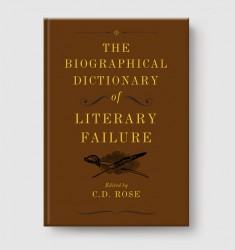
From the entry for Otha Orkkut (1890-1943), poet, translator, and historian, in The Biographical Dictionary of Literary Failure, edited by C.D. Rose:
Cimbrian, it is said, was a unique language in that it contained a tense which was used to describe a person or object which had gone missing or been lost: neither present nor past, still existing in a space or time which no non-Cimbrian can ever properly comprehend.

A number of critics and translators are currently at work on Orkkut's books, her manuscripts now inhabiting the realm of that unique Cimbrian tense.
Identified as a Bothno-Ugaric language, "Cimbrian" may be referencing the same language known in Italo Calvino's quarters as "Cimmerian," described by Professor Uzzi-Tuzzi as "a modern language and a dead language at the same time."

I treated myself to this lovely volume at Christmas, to add to my shelf of weird dictionaries. This collection of 52 lives, by turns tragic and comic, easily lends itself to browsing; I reach for it for inspiration, for reminders, for warnings.

The introduction alone is worth the price of admission, exploring the concepts of erasure, "faith in the ineffable," linguistic negation, "literature of the unword," "stories that would prefer not to."

Reviews
Biographile: "The simple fact is this: books are real; writers aren't."
PopMatters: "It's questionable whether insanity is a prerequisite for the arts."

Excerpt.

Wednesday, April 03, 2013

Is it art?

Dada, or something like it, is alive and kicking in Montreal.

Earlier this week I attended a cabaret hommage to Codex Seraphinianus and its creator, Luigi Serafini. The show was sponsored by the Université de Foulosophie.

According to Douglas Hofstadter, the Codex to many people seems "to glorify entropy, chaos, and incomprehensibility," and this was clearly the spirit that embodied the Rialto theatre Monday night.

Some of it was music. Some of it was comedy. A lot of it was weird. Some of it may have been poetry or philosophy, or parody and social commentary. I'm not too sure. There was nudity. There were aliens. And it got political ("Tuons Harper!" they chanted).

By chance I was seated just across the aisle from Luigi. He was inscrutable. Amused, honoured, insulted, bored? No idea.

About the show
My favourite bit involved the two men in black with the shiny, featureless face masks, who used a child's doll dressed in white frills to demonstrate the phases of the sun. Or something like that. It was mostly nonverbal, and those bits that were spoken were distorted, with just enough real words seeping through to hint at a meaning.

Some highlights:

Chorale Bruitist Joker, a noise music choir. The piece was alien and cacophonous, but clearly also "composed" and musical. Audio samples on the website.

Natalie Cora, who plays a kora, an instrument that looks straight out of Serafini's world.

Soizick Hébert, whose hair looks to have been constructed using the Codex's geometry, was absolutely hilarious.


Daniel Heikalo, bearded and capped, performed a piece for recorder and voice, coming off as a kind of medieval Jethro Tull. The video here includes percussion, and relative to what I witnessed it's rather low key, but this clip hints at some of the weird and wild.


About the Codex
The Codex Seraphinianus: How Mysterious Is a Mysterious Text If the Author Is Still Alive (and Emailing)? — Justin Taylor tells you why the Codex so captivating.

Another Green World: The Codex Seraphinianus — John Coulthart tells you what Douglas Hofstadter and Alberto Manguel make of the Codex.

The Worlds of Luigi Serafini — Jordan Hurder explains the differences between editions.

Orbis Pictus — Italo Calvino's introduction to the Codex in its Italian and French editions.

Clearly, I'll be needing to acquire my own copy.

Wednesday, October 24, 2012

Grandmother had never had a tail

John Turturro reads Italo Calvino's short fairy tale, "The False Grandmother."

Saturday, October 20, 2012

The distance of the moon

A month of days and lunar nights stretched uninterrupted before us... An animated adaptation of Italo Calvino's "The Distance of the Moon," found in Cosmicomics.


(via io9)

I thought only of the Earth. It was the Earth that caused each of us to be that someone he was rather than someone else; up there, wrested from the Earth, it was as if I were no longer that I, nor she that She, for me. I was eager to return to the Earth, and I trembled at the fear of having lost it. The fulfillment of my dream of love had lasted only that instant when we had been united, spinning between Earth and Moon; torn from its earthly soil, my love now knew only the heart-rending nostalgia for what it lacked: a where, a surrounding, a before, an after.

Sunday, March 06, 2011

Matrix literature

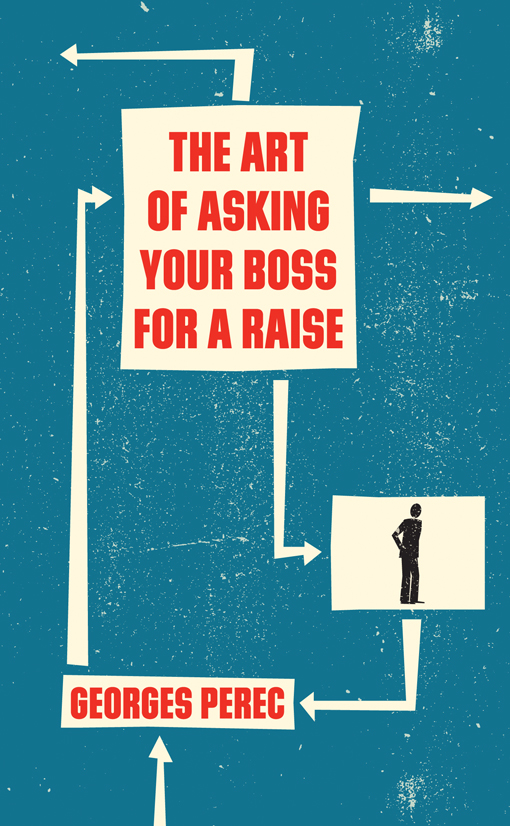
My copy of The Art of Asking Your Boss for a Raise, by Georges Perec, finally arrived! This slim little volume is exquisite!

The title has been pared down a little from the original (l'art et la maniѐre d'aborder son chef de service pour lui demander une augmentation): the art and craft of approaching your head of department to submit a request for a raise.

(Some of the background I set forth here is covered in greater detail by translator David Bellos in his introduction to the book.)

In 1968, a computer company set the challenge for writers to use a computer's basic mode of operation as a writing device. The outline: a flow-chart, a simple algorithm, a decision matrix.

The flow-chart is reproduced on this volume's endpapers.

By its nature, the algorithm is well-suited to being experienced electronically.

Of course, it has Oulipoian roots, as an exploration of how mathematics can be used to generate literature. In fact, I'm sure we're all quite familiar with another, very popular style of "matrix literature," an experiment in which (A Story As You Like It), by Raymond Queneau, is available online. (Hypertext literature has come a long way since the 1960s. I'm currently working through one such "traditional print" example with Helena.)

Perec reused the material from the art and craft in chapter 98 (Réol) of Life A User's Manual, which upon the learning of said fact I immediately reread.

I don't recall it having such a potent effect on me the first go around, but this time it brought tears to my eyes. Remember the Réols? — the young couple with the extravagant, expensive bed purchased on credit. And it puts me in mind of, no doubt because I've been reading so many articles related to the release of The Pale King, David Foster Wallace and his maximalist approach to literature (did he ever read Perec's Life, I wonder), in which he does not excise the excruciating minutiae of our lives and minds. I see now that Perec does something similar in Life. The chapter concerning Réol — and it can be read as a wholly self-contained narrative — tells a story through a perspective entirely restricted to the management of Réol's finances. There's the logistical problem of fixing an appointment with his boss (which day of the week his boss is likely to be in a good mood, not distracted, and so on), but mostly it's utilities payments due, rent in arrears, groceries on credit, loans, percentages, meeting the requirements for the assistance plan, etc. There is nothing about the Réols' life — no chance encounters or romantic situations, no grand parties or disastrous meals, no anecdotes about their son. And yet, financial management is life, one version of their life, and it's a full story. With a beautifully poignant (and happy) ending.

The Art of Asking Your Boss for a Raise is told in the second person. Story is secondary to the experiment.

either he thinks your idea is positive rich in possibilities worthwhile or he thinks it is stupid and will let you know in no uncertain terms that your logic is addled that's to say cock-eyed that's to say so devoid of understanding as to be close to either early-onset alzheimer's or congenital idiocy remember however that whether or not he calls you a nincompoop dimwit cretin nutcase crackpot woodenhead bananabrain dolt idiot or fool it comes to the same thing namely your plan will land in the wpb and you will return empty-handed to your desk while awaiting happier days it goes without saying that learning from experience you will improve your basic idea so when the day comes once again to talk with whole and open heart to your head of department he will be unable to dismiss you straight off as a nitwit so you allow yourself some months because one must always try to stack the odds in one's favour you swot up on the issue then when your plan seems perfect you go back to see mr x let's assume he's in

The text is, as is to expected given the structural constraint, repetitive and recursive, and the real-time computer-logic mood is enhanced by the lack of punctuation. (Also, it's set entirely in lowercase, but thankfully, and surprisingly, not in courier.)

I found it easiest to follow by reading it out loud. (In fact, I readily imagine the whole text being narrated and scored by Philip Glass à la Einstein on the Beach. Hey, Phil, give me a call, let's talk Perec!)

But there is a story! It's a little bit tragic even, but told with a light touch and great deal of humour.

The iterations come to be modified, and it's these variations in the phrasing that make for the funniest moments, unexpected as they are. Either they change as you reconsider them in light of all that has already occurred (the computer algorithm weights the possible outcomes and their likelihood of occurring as it acquires and learns to process the qualitative input from inside your head), or they change over time (the computer adds to the equation the actual fact of certain outcomes already having occurred).

It could be that all these thoughts pass through your neurotic head over a span of mere seconds when first you consider the possibility of asking for a raise. Or, this is a distillation of your entire career.

Either the employee is paralyzed by overthinking the situation and "we shall suppose to keep things simple — for we must do our best to keep things simple" never approaches the boss to ask for a raise; or the employees does in fact take action as governed by the logic of the algorithm, in which case years pass and the employee approaches retirement, without ever having asked for a raise. (The story does cover an approach and a request and a raise, but let's not complicate the point.)

I recommend The Art of Asking Your Boss for a Raise to those readers interested in experimental literature, but I suspect most readers will not find enough narrative thread to hold their attention for long. (On the other hand, it's short, and as an introduction to how a nontraditional approach to narrative can produce story it might serve you well alongside something like Calvino's t-zero stories, with which I see some similiarities in terms of the breakdown of processes into its smallest constituents, in a Zeno's paradox kind of way.)

If you have not read Perec's Life A User's Manual, I encourage you to read along at Conversational Reading.

Tomorrow marks what would've been Perec's 75th birthday.

To do
Approach the head of my department to submit a request for the transitioning of my role, and title, into Editor of Matrix-generated Literature and for the use of our proprietary decision support system to generate a novel in which the possible decision outcomes are not binary, but multiple and weighted and combined, where one can respond both a and b, or all of the above, to allow for the overlaying of choices and the "automatic" snipping and juxtaposition of appropriate segments of text, to tell a story about, say, a family's quest to acquire the perfect sofa, and while the daughter's preferences are considered they are of a different value than those of her parents, and the cat is also given due thought, all of which necessitates a careful study of how the sofa is used (playing video games, reading, napping, etc — each activity commanding different optimal bodily postures), how many people use the sofa over a given period of time to engage in those activities, and how many are likely to want to do so at the same time, budget of course being a key factor, but also available room, with an eye for spatial configuration of the entire room and allowing for the possibility of auxiliary seating (also to be determined through a similar decision matrix), no, no, it had better be more work-related, say, the design by committee and subsequent implementation of said design of the employee kitchen space, its general arrangement and furnishings, something like that.

Monday, February 07, 2011

Dervishes and elephants

A prophecy. Hoopoes, harem gardens, and spies, oh my! The Oracle of Stamboul, by Michael David Lukas. I llllooovved this book! I ate it up in a day, and that's even after I slowed down at about the halfway mark trying to make it last.

This was an electronic review copy (and one of the cleanest — read: typo-free — proofs I've seen in a long time), but I'm set on acquiring a hard copy to place on the shelf so that my daughter might someday stumble upon it.

It's simply magical! The kind of book that wraps you up and keeps you warm and sends your soul aflutter. Maybe I'm predisposed to liking it. It's set in Stamboul, after all, to my mind one of the most romantic settings on Earth (I must go there one day!), and I seem to be surrounded by talk of Turkey these days. Also, it's about a very charming and clever 8-year-old girl, and as I have one of my own, I happen to think they make for fascinating subjects. It reads like a fairy tale.

The author in his essay "Oskar and Eleonora" explains how this novel is a meditation on the nature of history:

I was most taken, however, by those writers whose work falls into the subgenre I like to call historical fabulism — José Saramago, Günter Grass, Salman Rushdie, and Italo Calvino — storytellers of the old school who add a pinch of magic to the stew of history. I was particularly moved by Saramago's novel The History of the Siege of Lisbon, in which a bored proofreader literally rewrites the history of Lisbon, and by Grass's The Tin Drum, in which a clairvoyant young German boy named Oskar Matzerath disrupts the traditional narrative of World War II by beating on a tin drum. How wonderful, I thought, this idea that a single act, a single person, might change the course of history.

Eleonora is born in inauspicious circumstances. Her mother dies in childbirth while her village is ravaged by the 3rd Division of Tsar Alexander II's Royal Cavalry. Her childhood is mostly a decent one, even though her stepmother doesn't believe in educating her too much (Ruxandra's no ogress, but she has her ideas about how things ought to work). Elenora's good-natured about it though, and sticks to her monthly reading allotment of only one novel (gasp!). At the age of 8, she makes her way to Istanbul (I won't tell you how), where she has a taste of a more privileged lifestyle. But tragedy — and adventure — befalls her again.

It's not exactly a coming-of-age story, although Eleonora does have some growing up to do. The book's a little bit Dickens, a little bit Roald Dahl, every bit enchanting. And the ending is, in my view, perfect.

Late in the novel we meet Fredrick, a journalist, who latches on to Eleonora's story: "This is exactly what the readers want. They want dervishes and elephants. Just look at Kinglake. Look at the Arabian Nights. People want Oriental color."

I suppose that's not true for all people. But it works for me.

I'm curious to see to whom this book is going to be marketed, and what audience for it will finally emerge. It has about it everything of a children's classic: orphaned child confronted with adversity, a special gift, and a prophecy to fulfill. (And the magical tone reminds me specifically of one of my favourites: Frances Hodgson Burnett's A Little Princess.)

I found the prose to be fresh and lively:
  • "Hoopoes coated the town like frosting, piped in along the rain gutters of the governor’s mansion and slathered on the gilt dome of the Orthodox church."
  • "drinks in every hand and in every drink a piece of ice reflecting the sun."
  • "a small flight of cormorants swept over the water like marionettes"
  • "As the morning insinuated itself into her room, Eleonora lay curled around herself like a dried tea leaf..."
  • "...he had the aspect of a well-fed rodent and eyes the color of unripe grapes."

A number of reviews are critical of the book's slow pace, that nothing happens, but I don't understand them. I was completely entranced.

Excerpt.

Sunday, May 02, 2010

La Vie est belle

Non frustra vixi.

Life A User's Manual (Georges Perec) is so, so much the book I wish I would write.

I love how difficult it was to find the space to read the final 30 pages this weekend, between kicking the ball around the schoolyard, buying fresh-cut tulips, getting caught in the rain, waiting for news of the hospitalized 90-year-old grandfather-in-law, walking some more for the hell of it with nowhere to go, laundering, cooking some surprisingly delicious lemon-dill chicken, playing a videogame, planting up some pots on the balcony, going for ice cream, and drinking chardonnay; reading fills some odd spaces.

I love how summer is so quickly upon us and how our courtyard is brimming with fresh but familiar noises: the couple with the new, strangely quiet baby; the couple who have been using their air conditioner all week long, even the day it snowed; the girl hoisting her bicycle up the fire escape to the third floor; the pigeons roosting; the man smoking on his balcony describing what it's like to watch the hockey game with his father, who's visiting from France and has never seen a game in his life, and the Habs won; the woman shaking out a tablecloth; the couple having a romantic candlelight dinner on their balcony; the drunkards spilling out from the bar on the corner; the trio for flute, violin, and cello; the couple who never speak to each other except to give each other orders, which they duly follow.

And for me, this book is now very much connected with this sense of interconnectedness, this melding of all our lives, and there's joy in it.

I love how it makes me miss my cat, the one I named Calvino. I see his younger self on Perec's shoulder, and his namesake is frequently mentioned alongside Perec in various commentaries.

I love the sense of eternal return. Everything is undone: the puzzles, but also indexing systems, construction plans, careers, families, kitchens, and good deeds (for example, the tale of the green beans). Apartments filled and emptied. All the stuff that comes and goes. Really, a beautiful, life-affirming thing. Out of chaos, order, and back again.

(Was Valène's painting undone? Or was it stalled in a state of potential?)

I love the allusions to the game of go. On the third-floor landing are seven marble lozenges laid out in the ko position (page 530), a kind of infinite deadlock. It's a game of territory, defined by what surrounds it. Positions are best shown in relief. Kind of like jigsaw puzzle pieces.

(The Gold Bug Variations: she watches the two men puzzle together at the cabin, one of them searching the board to find a fit for the piece in his hand, the other searching the table to find the piece that fits a chosen spot. Which puzzler are you?)

My favourite story within this novel is the tale of the woman who made the devil appear eighty-two times (chapter 65). Because it features the devil, but also because of the sleight of hand involved, within the story itself as well as for its place within the novel. These characters are conspicuously absent from the map of the building (previous residents of Madame Moreau's apartment). This is also the chapter ending with the tin with the picture of the girl eating the petit-beurre (as she eats a "missing" chapter for the skipped chess move, disappearing one of the building's cellars ).

Frankly, the whole book puts me in mind of the vanishing leprauchaun problem: where's the missing chapter? the missing puzzle piece? how did the puzzle piece change shape?

Annotation
I'm itching to annotate this book, but it's a daunting task. (I'll be considering this in the coming weeks; let's see how the book sits with me over more time. I'm toying with the idea of picking up a copy in French; my French is pretty crap, but maybe I'll learn something along the way.)

If you look hard enough, you'll find other people have done some of the legwork. . .

Compare Life A User's Manual (p 423):

. . . and Moriane with its alabaster gates transparent in the sunlight, its coral columns supporting pediments encrusted with serpentine, its villas all of glass, like aquariums where the shadows of dancing girls with silvery scales swim beneath medusa-shaped chandeliers.

with Italo Calvino's Invisible Cities:

When you have forded the river, when you have crossed the mountain pass, you suddenly find before you the city of Moriana, its alabaster gates transparent in the sunlight, its coral columns supporting pediments encrusted with serpentine, its villas all of glass like aquariums where the shadows of dancing girls with silvery scales swim beneath the medusa-shaped chandeliers.

(Which passage actually jumped out at me in all its exquisite beautifulness.)

As for the amazing couple Cyrille Altamont meets in a pub (page 504), the "thirty-year-old woman with a look that was both Slav and Asiatic at the same time — broad cheekbones, narrow eyes, reddish fair hair plaited and wound around her head" — this is clearly Clawdia Chauchat, and the gentleman is Mynheer Peeperkorn (although I've not yet met him for myself), known to me from Thomas Mann's Magic Mountain (which book I left off at page 425, so I cannot tell if any passage in particular is being more closely referenced).

Recommendation
If you enjoyed reading Georges Perec's Life A User's Manual, I vehemently urge you to check out The Dodecahedron: Or A Frame for Frames, by Paul Glennon. I recently listed it as a book I feel deserves a wider audience, and previously excerpted a bit here.