Showing posts with label Salman Rushdie. Show all posts

Sunday, September 24, 2017

The knowledge of the impossibility of the attempt

The Goldens all told stories about themselves, stories in which essential information about origins was either omitted or falsified. I listened to them not as "true" but as indications of character. The stories a man told about himself revealed him in ways that the record could not.
The Golden House, by Salman Rushdie, is about Nero Golden and his three grown sons, living the life in New York City. It begins the day Barack Obama is inaugurated as president and ends some eight years later.
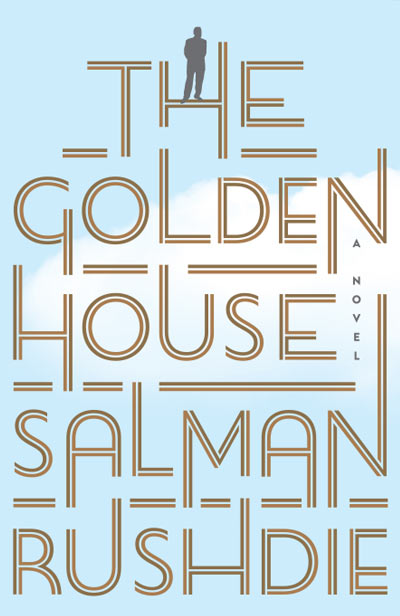
It is not the book I thought it would be.

While it mocks The Joker who eventually won the country, it takes a few jabs at Obama along the way. Nero Golden, meanwhile, is himself a kind of golden-boy caricature, one young wife after another, his spoiled progeny, so much gold it's garish.
I assumed he had brought serious funds with him when he came west, but there were persistent rumors that all his enterprises were highly leveraged, that the whole mega-business of his name was a flimflam game and bankruptcy was the shadow that went with his name whenever he took it for a stroll. I thought of him as a citizen not of New York but of the invisible city of Octavia which Marco Polo described to Kublai Khan in Calvino's book, a spider-web city hanging in a great net over an abyss between two mountains. "The life of Octavia's inhabitants is less uncertain than in other cities," Calvino wrote. "They now the net will last only so long." I thought of him too as one of those characters in animated cartoons, Wile E. Coyote perhaps, who are constantly running off the edges of canyons, but who keep going, defying gravity, until they look down, and then they fall. The knowledge of the impossibility of the attempt brings about its calamitous ending. Nero Golden kept going, perhaps, because he never looked down.
I had thought Golden was meant to serve as a commentary on, or parody of, Trump. It feels like the whole novel is supposed to be doing that, yet failing to do that. It's not really about the Obama years, or about the America that allowed Trump to happen. But I can't shake the feeling that it should be.

This novel (much like our times?) is chaotic. It's told by a storyteller (I mean Rushdie, not his weak narrator), but there's not much story to it. While it's easy to get swept up in Rushdie's prose, it wears thin after a couple hundred ADHD pages.

There are some compelling narrative threads but they don't come together satisfactorily. Big themes include identity and re-invention of self.

About two-thirds of the way through,
Then a friend of mine, a writer, a good writer, said something that scared the pants off me. He said, think of life as a novel, let's say a novel of four hundred pages, and the imagine how many pages in the book your story has already covered. And remember that after a certain point, it's not a good idea to introduce a new major character. After a certain point you are stuck with the characters you have. So maybe you need to think of a way of introducing that new character before it's too late, because everyone gets older, even you.
I thought, maybe this is it, maybe this is where it gets interesting, someone new to shine a light, but no. There was no one. I had stopped caring.

The Golden House novel left me feeling bored and disappointed.

The reviews in the New York Times really nailed it.

Reviews
Monica Ali in the New York Times: In Salman Rushdie's New Novel, the Backdrop Is the Obama Years
Collectively, their story lines are high-octane vehicles for observations on everything from art to gun violence, told with Rushdie's customary brio and narrative panache, and the reader is happy to go along for the ride.
[...]
Despite (or because of) all the apostrophizing, René fails to demonstrate any insight into why "60-million-plus" brought the Joker to power.
Dwight Garner in the New York Times: Salman Rushdie's Prose Joins the Circus in 'The Golden House'
All gestures here are grand gestures; all soirées are glittering soirées; all mirrors are magic mirrors; every ferocity is a genuine ferocity; every grill is a brazier; every regret a bitter one.

The effect is exhausting — and deadening. Anything can happen, so nothing matters. Rushdie is obsessed with "characters," as Alfred Kazin once said of John Irving, yet somehow does not evoke the more difficult thing: character.
LA Review of Books: Rushdie's Domus Aurea: "The Golden House" by Salman Rushdie
The point is apparent: the times have produced an arbitrary, indiscriminate form of violence, whether by an organization or a lone nut that can catch any of us anywhere. But the book sheds little light on the America that produces that violence or how it shapes human action and interaction.
New Statesman: The Golden House is Salman Rushdie's not-so-great American novel
What is The Golden House actually about? The models invoked – Nero as Captain Ahab, as Jay Gatsby, as Lucius in Apuleius’s The Golden Ass – suggest a study of hubris, with America as an all-too-willing home, but the relationship between subject and backdrop is lost amid so much verbal noise.

Interview with Salman Rushdie
NPR: Leaving The Past Behind — Or Trying To — In Rushdie's Latest
America clearly has some very heavy, and even dark aspects to its history. But it's not like having a couple of thousand years, or three thousand years of history. The burden of history is greater. And so one of the things that happens in this book is that people from an old country, an Indian family, a wealthy Indian family — in a way, trying to shed the burden of their own history — comes to a country in which the subject of reinvention of the self is completely central. Everybody does it. People come through Ellis Island and change their names, people move from the Midwest to the big city and try and be new people, and it seemed appropriate for people from an old country trying to get rid of the shadow of the past, to come to somewhere where it's possible to be new.

Monday, September 04, 2017

Uneasy about the easy

Theodor W. Adorno
I am reminded of Theodor W. Adorno: "The highest form of morality is not to feel at home in your own home." Yes, to be uncomfortable with comfort, uneasy about the easy, to question the assumptions of what is usually, and happily, taken for granted, to make of oneself a challenge to what for most people is the space in which they feel free from challenges; yes! That is morality raised to a pitch at which it could almost be called heroism.
— from The Golden House, by Salman Rushdie.

I've spent years learning to be comfortable in my own home, to be in own skin. Reading this, then, was a bit of a slap in the face, not only that my behaviour is not moral, but that I have still further to go.

I'm not entirely sure what it means yet, but I'm thinking about it.

Do you feel at home in your own home? (What is your home?)

Tuesday, August 29, 2017

Prufrocked

She... and here I rear back and halt myself, ashamed, prufrocked into a sudden pudeur, for, after all, how should I presume? Shall I say, I have known them all, I have seen her like a yellow fog rubbing her back against, rubbing her muzzle upon, shall I say, licking her tongue into the corners of this evening? Do I dare, and do I dare? And who am I, after all? I am not the prince. An attendant lord, deferential, glad to be of use. Almost, at times, the Fool... But, setting aside poetry, I'm too deeply in to stop now.
— from The Golden House, by Salman Rushdie.

Source
I'd forgotten that I'd read Rushdie before and I liked it. I'm liking the current novel, too: There's a charm and wit and intelligence that I find disarming. Although, at another time, in another place, I might find this same text pretentious and tiresome.

However, I'm only a quarter of the way in, and I'm worried about where Rushdie might be going with this tale with the makings of a presidential parable. We'll see where we end up.

But. Prufrocked! I sat up and paid attention!

I wrote a response to Alfred J. when I was 17.

[I can't find the damn poem. I can't find in anywhere. It's in a puke-beige duotang (not the boring-beige one), along with a weird essay I wrote on Pythagorean dualism. This is a thing I kept for 30 years. Or thought I kept. Did I lose it in the divorce? I mean, physically. Not like that story I lost on a bet. Did I throw it away in anger, or sheer drunken stupidity? Could I have been so careless? Maybe the poem's no good. Maybe I threw it out because it was no good, and I was so horrified by the poem's horribleness, I blocked the whole episode from my memory. Have I merely misplaced it? I grow old.)

Last week I met a boy who writes poetry. He devotes himself to it. He will be a writer. A poet.

It takes guts, being a poet.

Maybe I should've been a poet.

Monday, February 07, 2011

Dervishes and elephants

A prophecy. Hoopoes, harem gardens, and spies, oh my! The Oracle of Stamboul, by Michael David Lukas. I llllooovved this book! I ate it up in a day, and that's even after I slowed down at about the halfway mark trying to make it last.

This was an electronic review copy (and one of the cleanest — read: typo-free — proofs I've seen in a long time), but I'm set on acquiring a hard copy to place on the shelf so that my daughter might someday stumble upon it.

It's simply magical! The kind of book that wraps you up and keeps you warm and sends your soul aflutter. Maybe I'm predisposed to liking it. It's set in Stamboul, after all, to my mind one of the most romantic settings on Earth (I must go there one day!), and I seem to be surrounded by talk of Turkey these days. Also, it's about a very charming and clever 8-year-old girl, and as I have one of my own, I happen to think they make for fascinating subjects. It reads like a fairy tale.

The author in his essay "Oskar and Eleonora" explains how this novel is a meditation on the nature of history:

I was most taken, however, by those writers whose work falls into the subgenre I like to call historical fabulism — José Saramago, Günter Grass, Salman Rushdie, and Italo Calvino — storytellers of the old school who add a pinch of magic to the stew of history. I was particularly moved by Saramago's novel The History of the Siege of Lisbon, in which a bored proofreader literally rewrites the history of Lisbon, and by Grass's The Tin Drum, in which a clairvoyant young German boy named Oskar Matzerath disrupts the traditional narrative of World War II by beating on a tin drum. How wonderful, I thought, this idea that a single act, a single person, might change the course of history.

Eleonora is born in inauspicious circumstances. Her mother dies in childbirth while her village is ravaged by the 3rd Division of Tsar Alexander II's Royal Cavalry. Her childhood is mostly a decent one, even though her stepmother doesn't believe in educating her too much (Ruxandra's no ogress, but she has her ideas about how things ought to work). Elenora's good-natured about it though, and sticks to her monthly reading allotment of only one novel (gasp!). At the age of 8, she makes her way to Istanbul (I won't tell you how), where she has a taste of a more privileged lifestyle. But tragedy — and adventure — befalls her again.

It's not exactly a coming-of-age story, although Eleonora does have some growing up to do. The book's a little bit Dickens, a little bit Roald Dahl, every bit enchanting. And the ending is, in my view, perfect.

Late in the novel we meet Fredrick, a journalist, who latches on to Eleonora's story: "This is exactly what the readers want. They want dervishes and elephants. Just look at Kinglake. Look at the Arabian Nights. People want Oriental color."

I suppose that's not true for all people. But it works for me.

I'm curious to see to whom this book is going to be marketed, and what audience for it will finally emerge. It has about it everything of a children's classic: orphaned child confronted with adversity, a special gift, and a prophecy to fulfill. (And the magical tone reminds me specifically of one of my favourites: Frances Hodgson Burnett's A Little Princess.)

I found the prose to be fresh and lively:
  • "Hoopoes coated the town like frosting, piped in along the rain gutters of the governor’s mansion and slathered on the gilt dome of the Orthodox church."
  • "drinks in every hand and in every drink a piece of ice reflecting the sun."
  • "a small flight of cormorants swept over the water like marionettes"
  • "As the morning insinuated itself into her room, Eleonora lay curled around herself like a dried tea leaf..."
  • "...he had the aspect of a well-fed rodent and eyes the color of unripe grapes."

A number of reviews are critical of the book's slow pace, that nothing happens, but I don't understand them. I was completely entranced.

Excerpt.

Friday, April 11, 2008

Enchanted

This book is gorgeous. The Enchantress of Florence, by Salman Rushdie, casts quite a spell.

I've never read a novel of Rushdie's before (though his editorials are of great interest and I greatly admired his performance in Bridget Jones' Diary), nor have I ever felt particularly inclined to. Something about this book, though, drew me to it.

It's been a long time since I was excited about a book's glorious physicality. It's a completely subjective experience, and my impression is one I'm entirely unable to explain, but I think this book as physical object is beautiful, and I want to fondle it, turn it over and over and over.

The dust jacket is yellow and orange-red, the colour of spice, and it makes me hungry. Its design is a weird mix of Florentine flourish and orientalist illumination.

The most striking element, to me, is the endsheets — a minor detail, but one that has me exclaiming, "Look at this! Isn't this book beautiful?!" Beautiful!

As for the story, it's magical and riveting. I've had a hard time putting it aside. It's been the perfect complement to my reading of Amir Hamza, similar in flavour, but more modern (read: accessible) in its language and pacing — and I was thrilled to see the great hero referenced herein — and to the family's recent viewing of Sinbad movies. There's nothing I love so much as a vaguely middle-eastern mystical mythical adventure romance.

Pirates! A mysterious ambassador! Brothels! Secrets! An imaginary queen made real! Revenge! A forgotten princess! A painting the painter hides himself in! Vampires (and none other than Vlad Dracula himself)! Tulip superstitions! The four Swiss albino giants (Otho, Botho, Clotho, and D'Artagnan)! Macchiavelli! A magic mirror! Screaming mandrake roots!

Behind the fabulous stories is a philosophical exploration of being in the world.

The emperor Abul-Fath Jalaluddin Muhammad, king of kings, known since his childhood as Akbar, meaning "the great," and latterly, in spite of the tautology of it, as Akbar the Great, the great great one, great in his greatness, doubly great, so great that the repetition in his title was not only appropriate but necessary in order to express the gloriousness of his glory — the Grand Mughal, the dusty, battle-weary, victorious, pensive, incipiently overweight, disenchanted, mustachioed, poetic, over-sexed, and absolute emperor, who seemed altogether too magnificent, too world-encompassing, and, in sum, too much to be a single human personage — this all-engulfing flood of a ruler, this swallower of worlds, this many-headed monster who referred to himself in the first person plural — had begun to meditate, during his long, tedious journey home, on which he was accompanied by the heads of his defeated enemies bobbing in their sealed earthen pickle-jars, about the disturbing possibilities of the first person singular — the "I."

The interminable days of slow equestrian progress encouraged many languid wonderings in a man of speculative temperament, and the emperor pondered, as he rode, such matters as the mutability of the universe, the size of the stars, the breasts of this wives, and the nature of God. Also, today, this grammatical question of the self and its Three Persons, the first, the second and the third, the singulars and plurals of the soul. He, Akbar, had never referred to himself as "I," not even in private, not even in anger or dreams. He was — what else could he be? — "we." He was the definition, the incarnation of the We. He had been born into plurality. When he said "we," he naturally and truly meant himself as an incarnation of all his subjects, of all his cities and lands and rivers and mountains and lakes, as well as all the animals and plants and trees within his frontiers, and also the birds that flew overhead and the mordant twilight mosquitoes and the nameless monsters in their underworld lairs, gnawing slowly at the roots of things; he meant himself as the sum total of all this victories, himself as containing the characters, the abilities, the histories, perhaps even the souls of his decapitated or merely pacified opponents; and, in addition, he meant himself as the apogee of his people's past and present, and the engine of their future.


There are human mirrors. Doubles. Reflections. East and west. Counterparts comprising a whole. Dream, reality. God, man. Plot parallels and situational analogues.

There is great awe of women and the mysterious power of the feminine that holds sway over even emperors.

Sometimes in the woods near the farm in Percussina he lay on the leaf-soft ground and listened to the two-tone song of the birds, high low high, high low high low, high low high low high. Sometimes by a woodland stream he watched the water rush over the pebbled bed, its tiny modulations of bounce and flow. A woman's body was like that. If you watched it carefully enough you could see how it moved to the rhythm of the world, the deep rhythm, the music below the music, the truth below the truth. He believed in this hidden truth the way other men believed in God or love, believed that truth was in fact always hidden, that the apparent, the overt, was invariably a kind of lie. Because he was a man fond of precision he wanted to capture the hidden truth precisely, to see it clearly and set it down, the truth beyond ideas of right and wrong, ideas of good and evil, ideas of ugliness and beauty, all of which were aspects of the surface deceptions of the world, having little to do with how things really worked, disconnected from the whatness, the secret codes, the hidden forms, the mystery.

Here in this woman's body the mystery could be seen.


There are pages of bibliographic references at the novel's close, among which is listed Calvino's Italian Folktales. A good reason to pull that one down off the shelf for a revisit.

And it's funny.

"The Hindustani storyteller always knows when he loses his audience," he said. "Because the audience simply gets up and leaves, or else it throws vegetables, or, if the audience is the king, it occasionally throws the storyteller head-first off the city ramparts. And in this case, my dear Mogor-Uncle, the audience is indeed the king."

Friday, April 04, 2008

There is water at the bottom of the ocean.

And sometimes I need to be reminded of it.


"There is water at the bottom of the ocean."

This is one of the very first songs I loaded onto my recently acquired MP3 player. If there's a song I should have at the disposal of my auditory apparatus, yielding to the control exerted by my little finger, available to me at all times and forever, this is it.

Having come to the end Chapter 11 of Great Expectations, being all that I'd foreseen to load, I find myself waiting for a train and having to listen to — gasp! — music. (The audiobook listening on my daily commute is immensely enjoyable, by the way. I will continue with this book, and I will find others. But this is "reading" to be entertained and distracted. I will not expect an audiobook to change my life, nor that I remember it for very long.) Music!

I stand there, toe tapping, body swaying. I feel conspicuous. I restrain myself from humming, but it takes a great deal of effort. I smile. I feel like I have a secret.

(I have a few secrets.

'What am I?' he said, as if speaking to himself, but using the driver's own language. 'I'm a man with a secret, that's what — a secret which only the emperor's ears may hear.' The driver felt reassured: the fellow was a fool after all. There was no need to treat him with respect. 'Keep your secret,' he said. 'Secrets are for children, and spies.' The stranger got down from the cart outside the caravanserai, where all journeys ended and began. He was surprisingly tall and carried a carpetbag. 'And for sorcerers,' he told the driver of the bullock-cart. 'And for lovers too. And kings.'


I have a review copy of Salman Rushdies's The Enchantress of Florence — I'm loving it.)

I am mystified that for all the wired heads I see riding the metro, more people aren't tapping their toes, swaying their bodies, restraining their hums. Have we lost (are we being trained to lose) the capacity to feel the music?

Perhaps this is why I listen to music so relatively little: it carries me away too easily.

There is water at the bottom of the ocean!