Showing posts with label work. Show all posts

Saturday, April 23, 2022

I am become the howling is become me

gerald
I know I've been using a lot of WFH time but I checked with our ops team — technically there isn't a set limit on how much you can take

doug smorin
"within reason" is the limit

gerald
look, I know you don't believe me when I say I'm imprisoned in our slack workspace

doug smorin
because it's literally unbelievable

gerald
and the firm doesn't have a disembodied consciousness sabbatical policy  

doug smorin
you're doing great 

isabella, emily

emily
Is this real?

I kind of hope so. Thought you might know + wanted an excuse to say hi :wave:

isabella
haha wow it's real -- had to look it up. It's even Paris, not Bucharest (which was my first guess)

started reading Several People Are Typing this morning -- makes me kinda miss the office, and how slack was a complement to actual physical office space, not this separate thing that we're all swallowed up in

emily
OMG that sounds amazing. I have a real soft spot for work/office culture novels.

isabella
I've been literally lol-ing all morning. Good things it's short though -- the slack-style will surely become tiresome after 100 pages

emily
I miss slacking somebody while staring directly at them :lizard_stare:

isabella
/giphy stare

tripp
what is a workplace but a cult where everyone gets paid, really?

[...]

Beverley
I meant to ask if a Managing Principal was higher or lower ranking than a Director.

tripp
see, that exactly my point. we have a byzantine hierarchical structure
we have a SPECIAL PURPOSE, which we call our MISSION STATEMENT and slap it right on the website
Even the language of employment is cult-y! We're not employees, we're a "team." That's only two notches away from just calling us "acolytes" or something. And the stuff we supposedly devote ourselves to, like "innovation" or "influence" of "engagement"
how is that any different from telling everyone you're a Prophet of the Coming Storm?

Beverley
That would look great on a business card.

#talk-books

isabella
hey has anyone read Calvin Kasulke's Several People Are Typing?
(oh, look! several people are actually typing!)

first
Hi! I'd ask for advice about e-reader? Does anyone here use such as Kobo or Kindle. I have question like can use external pdf. What should I get as a first e reader :shrug:

marc
emergency, drop everything https://youtu.be/6a-k6eaT-jQ :heart:

isabella
ok so this guy gerald was trying to share a spreadsheet and he accidentally uploaded himself into slack, like his physical body is comatose in his apartment, but his mind is melding with slackbot and his productivity goes through the roof, but all his coworkers think it's just a bit while they're all wfh 

:eyeroll: sanderson :vomiting_cowboy:

pavel
Boox products are good.

isabella
And then there's lydia, who may or may not exist, but I immediately pictured her as our lydia, with the attitude and the smarts, but maybe it's slackbot impersonating lydia

lydia
it's like it's coming from inside of me!!
like the echo from the constant howling is reverberating inside my rib cage??
but instead of getting softer and more distant it just grows louder and more, present??
you know that feeling??
like my skeletal structure is just an instrument for the howling to blast through and soon it'll burst through sinew and bone and rupture by flesh beyond recognition??

Beverley
So I am also WFH except when I'm offline from 2-4:30!

lydia
so I don't think I can make it in today!!

rob
wow
I mean, dang
@lydia do you need to go to urgent care or something

kerolyn
???

rob
sounds serious

tripp
lol

lydia
it's like
I am become the howling is become me!!
you know!!

It's weirdly philosophical (and hilarious), there's this discussion between gerald and slackbot about sunsets, which evokes the concept of the "stuplime." so slackbot shows gerald where they keep the sunsets and he "sees" -- as a disembodied consciousness -- ALL the sunsets, and then he becomes sunset :whoa_keanu:
"psychic splintering"

/giphy sunset

first
cool

isabella
highly recommend (but maybe not to people who don't use slack. or work in an office. also highly relatable re marketing department day-to-day)
stuplime

Excerpt.

Tuesday, April 13, 2021

Before you became who you are

Here’s the thing: Words arrive rowdily, with all their luggage and definitions. Words that are both what they say they are, and how they say it. Words always arrive a little too late, off to the side, but they hope that what they contain will eventually show up. That it is buried somewhere in the jumble of their word-suitcases. 

— from I Say 'Stone' or 'Flower' – Reflections on a Practice, by Morten Søndergaard.

About a year and half ago, someone came into the office to talk about a game they were developing. While most of the talk covered the technical aspects of photogrammetry, I couldn't help but be charmed by the stop-motion animation, the care with which every element was hand-crafted. What clinched my interest was that the concept development included the collaboration of a poet. At heart, Vokabulantis is about words — their necessity and inadequacy. I'm so happy to see this project moving forward (support the Kickstarter campaign).

The poet involved in the project is Morten Søndergaard, and that one lunchtime session had sent me down a rabbit hole of word games and philosophical inquiry and self-reflection. I asked a colleague to pick up a copy of his A Step in the Right Direction for me when in Copenhagen. It wasn't available it turned out, but it strengthened my resolve to undertake my own walking project, or rather refine a concept that was already in the making.

Rediscovering this game this week has meant turning over all these stones to see what I'd crushed beneath them, or what hid there when I wasn't looking. 

I've started walking again, in earnest. But it's miles before I sleep, and time isn't bending the right way.

One evening I picnicked with a friend and we speculated about the time capsule buried on top of the mountain. Later that night I watched a movie about a woman who gets phonecalls from twenty years ago, but the conversation informs the past, thereby changing the woman’s present. The next day I walked up the mountain, and for a good portion of the way, I inadvertently shadowed a woman who looked like a younger me; we would pass each other, and our paths would diverge, only to cross again ten minutes later. I passed her last at the edge of the cemetery, engaged in conversation — she appeared to be on a date. The time capsule is slotted for opening in 2142.

The destructive force of anti-curfew protests saddens me. 

I can't stop crying today. Hormones, I think. Tired, too. I thought once that I might walk through this pandemic.

It's been 405 days of German lessons, and I still can't say anything meaningful. It's been 50 odd years of English, and same.

I am just a couple hundred pieces away from completing the 4000-piece puzzle I ordered a year ago, a and it feels urgent now, like it's up to me: when I finish, it will all be over.

I am flitting through many books, restlessly. I am reading Red Pill, by Hari Kunzru, and enjoying it. 

You tell yourself you're getting on fine without them, these men who used to be your friends, and you are — until you need someone to talk to, someone who knows you, who knows who you used to be before you became who you are.

Tuesday, May 26, 2020

They got on with it

Well, here was my first lesson: it had almost nothing to do with computers, the modernity I was trying to understand. Computers were the bones, but imagination, ambitions and possibility were the blood. These kids, they simply did not accept that the world as it is has any special gravity, any hold upon us. If something was wrong, if it was bad, then that something was to be fixed, not endured. Where my generation reached for philosophy and the virtue of suffering, they reached instead for science and technology and they actually did something about the beggar in the street, the woman in the wheelchair. They got on with it. It wasn't that they had no sense of spirit of depth. Rather they reserved it for the truly wondrous, and for everything else they made tools.
— from Gnomon, by Nick Harkaway.

What is it I'm trying to understand? What modernity am I too old to grasp? It's true, they get on with things. Some things. But in other regards they're clueless, not even aware that there are things to be got on with.

Time moves differently when you're swimming in it.

I think twice before popping into a shop just to pick up the cocktail tomatoes that will satisfy a craving (and then I don't do it, because I shouldn't do groceries for another week, I'll manage without). Elsewhere, I line up and wait and sanitize before I'm allowed to ask for batteries. Yet I can have exotic mango salads delivered in time for lunch. How is it that I can refurnish by balcony on a whim, but I cannot stock up on household paper products? A strange blend of excess and shortage. How difficult it is to understand what it is I need, and what I want.

My government has exceeded the pace of bureaucracy to effect change, hopefully lasting change. Something approaching a universal basic income. Recognition of the the fact that no one should ever go without food or shelter. Sick leave.

But the mood outside is chaotic. Everybody is living in their own world, some oblivious, some nothing-left-to-lose reckless, some simply testing the theory of their immortality. (The fearful are staying home.)

I am loving Gnomon. It's big and surprising, rich with allusion, playful. I imagine it as a video game through which I'm leveling up. (I'm more than 200 pages in, almost a third of the way through.) I needed this book, I needed it now.

It's awakening a sense of creativity within me, how I use words, how I look at art, how I relate to technology, where I fit in society, how I want to shape my life.

Very unexpectedly, this book is strengthening my relationship to my work and my workplace, at times echoing the mission statement and values of the company I work for. When it talks about reshaping the world and taking on hard problems — not only technical ones but challenges with a moral component — it clarifies for me what a very cool company I work for, with an admirable ethos, valuing what everyone has to contribute — everyone's perspective informs the whole. We just do things.

It makes me want to do things again.

Monday, May 01, 2017

Interesting

When I was seventeen, I had a very good year. In fact, it may even have started when I was sixteen. I developed a crush on an older man. Even if it started with a crush on his cat.

Clive (the cat) would sit in the middle of the sidewalk outside his shop, beside the bakery I frequented. Soon enough, I was frequenting his shop, pretending to be in the market for retro clothing. Pretending to have the guts to be in the market for retro clothing. Pretending to be the kind of cool I hoped to one day actually be. You know, university student cool.

He gave me a poem he'd written about his cat.

Some friends and I took to cutting class, the period after lunch, to hang out at the shop, drinking tea and smoking cigarettes.

We talked about what I was reading (he asked; I guess even then I always carried a book with me). That was my Somerset Maugham phase. He knew them all. My crush deepened. He told me to read Butler's The Way of All Flesh; I did.

He asked what I thought about one book or other, I honestly forget which, and I said it was interesting, and he berated me for lazy thinking. And I've never used the word since, unless I was prepared to expand on an argument.

(He also taught me that when someone is lighting your cigarette, you must look him in the eye.)

As an editor, I've been telling this story to my writers for years. You write "interesting," and I will delete it. Tell me why it's interesting, or if you need to build up to a full explanation, at least give me a flavour: unexpected, playful, nostalgic, frightening.

So when I came across the following passage in Dexter Palmer's Version Control, I had some rethinking to do.
If the worst thing a physicist could say about a statement is that it was "false," the best thing he could say is that it was "interesting." This was different from saying it was true: most true things were, in fact, uninteresting. Interesting statements lived on the twilit boundary between fact and question; they held the promise of revealing something unexpected and new about the world, and thus were to be treated with respect. The physicists Rebecca met always seemed to be on the lookout for something interesting, a claim or proposition that seemed to possess some kind of rare interior light.

Rebecca came to understand that Philip's constant repetition of the word "interesting" meant that he was offering what he saw as the most precious of compliments.
Most of my writers are engineers. I am trying to understand "interesting" from their perspective.

But my crush was not a physicist. And I've been hardwired over thirty years to think "interesting" was boring.

See also
The word "interesting"
"Interesting" is a Boring, Overused, and Lifeless Word

Sunday, January 12, 2014

The MOOC experience, continued

I recently completed my second massive open online course (MOOC). This time the course was User Experience for the Web offered by Open2Study. The course was self-paced.

It was completely different from my first MOOC.

The differences are attributable to three main things:
Details and observations
While the recent course was self-paced, mostly what this means is the material is already canned. You don't have to wait until the following week for the next block of videos and quizzes to be released.

This course does actually have some structure, 4 modules that could be consumed over 4 weeks. (Quite likely this course may actually have been first introduced with weekly releases.)

The course information for User Experience indicated that the material would require 2-4 hours a week. I'd say it's significantly less. (For Kierkegaard, I'd put in more time than indicated.)

(One could at this point access the Kierkegaard material and consume it at one's own pace, condensing it all into a week or so. But I doubt many people would want to do so, given the intensity of the subject and the time commitment for an 8-week course.)

Each module consisted of 8-10 topics presented in videos ranging in length from about 2 to 7 minutes. There is a 1-question quiz at the end of each video segment that reinforces a key point.

I did most of the coursework (that is, watched the videos) over my morning coffee. With the videos at about 4 minutes a pop, they're bite-sized and it's really easy to say, just one more. I did about 2 modules a week (with a break for Christmas between weeks). I can easily imagine that one might complete the entire course in 1 day.

This setup really did motivate me to keep going.

The videos show the instructor talking, and writing key points on a clear-glass whiteboard. It's all shot against a black background; he uses pink, yellow, green, and blue pens. The presentation is very clean and minimal. While it doesn't compare to the production of the Kierkegaard course videos, it is well suited to the course material.

No required reading. No essay.

Because the course is self-paced, the forum has the feel of a static archive more than of an ongoing and dynamic discussion. The discussion is filtered by module, but this wasn't obvious to me. The setup does not encourage participation.

Class stats indicate that 8,386 students have taken this course and that there are 1,316 classroom posts. (Less discussion and fewer students than Kierkegaard, but no organization. Invisible yet chaotic.)

Open2Study gives you badges for "accomplishments" (like linking a social media account). I hate this kind of thing (I wonder who likes this kind of thing). The alerts are distracting, not motivating. (The alerts are probably configurable, but I'm lazy.) (My skepty-sense is tingling: badges are less to do with motivating a user than generating soundbites that are sharable on social media for the purpose of product promotion disguised as individual accomplishment.)

The final grade is based on the module "assessments" — multiple-choice tests consisting of 5 or 10 questions. (I suspect the format may have been changed from 5 to 10 questions sometime during my enrollment, as for the first three modules, 10 questions now appear, 5 of which I have not answered.)

This course was not affiliated with any university or other learning institution (other than Open2Study itself). The instructor was a professional consultant.

Intangibles
For Kiekegaard, the course page felt like its own place, with discussions, assignments, resources all handy and centralized. I felt engaged and immersed in the course material. I felt like a student.

For User Experience (ironically) I felt very much like a consumer; the classroom is just a slight corner of the Open2Study brand.

I felt less invested in the User Experience course, partly because of the subject, but the whole of the presentation of the course contributed to my not taking it too seriously.

This was reflected in my grade, an easy 88%. A perfect score would be in easy grasp for anyone, but because of both online and real-life distractions, I didn't care enough to make it happen. Contrast this to the 92% I scored for Kierkegaard, of which I am immensely proud and I feel I worked hard for.

I don't feel that I learned anything; rather it served to consolidate what I already know from business experience, editorial instinct, and common sense. (This is still worth something.)

The User Experience course felt very lightweight. That's definitely due to a combination of factors: the subject and my attitude towards it, as well as the course design.

Summary
It's probably fair to say that you get from MOOCs what you put in to them.

I took the User Experience course because I have a mild interest in the subject as it relates to my work; it's not a deep personal interest or an academic curiosity as I felt with Kierkegaard. And I was curious to see how other types of courses in different MOOC environments operated.

Also, I think I may be somewhat addicted to MOOCs, the rush of the combination of learning, discipline, and achievement.

This week I start 2 more courses: Content Strategy for Professionals: Engaging Audiences for Your Organization and Writing for the Web. They are a little more closely related to each other in terms of subject matter (and I'm taking both because of how they're related to my work, rather than purely for personal interest), but they are on different platforms, so they should be easier to compare.

See you on the other side.

Saturday, August 24, 2013

Working, seeing, being

Some of the things I've been reading and thinking about this week...

On the Phenomenon of Bullshit Jobs, by David Graeber, Strike! Magazine:
While corporations may engage in ruthless downsizing, the layoffs and speed-ups invariably fall on that class of people who are actually making, moving, fixing and maintaining things; through some strange alchemy no one can quite explain, the number of salaried paper-pushers ultimately seems to expand, and more and more employees find themselves, not unlike Soviet workers actually, working 40 or even 50 hour weeks on paper, but effectively working 15 hours just as Keynes predicted, since the rest of their time is spent organizing or attending motivational seminars, updating their facebook profiles or downloading TV box-sets.

The answer clearly isn't economic: it's moral and political. The ruling class has figured out that a happy and productive population with free time on their hands is a mortal danger (think of what started to happen when this even began to be approximated in the '60s). And, on the other hand, the feeling that work is a moral value in itself, and that anyone not willing to submit themselves to some kind of intense work discipline for most of their waking hours deserves nothing, is extraordinarily convenient for them.

Learning How to Live, Jenny Diski, New Statesman:
An unquenchable passion for work might be a panic-stricken way of concealing the fear of a lack of passion for life itself.

[...]

Children are always being told to stop doing "nothing" when they're reading or daydreaming. It is lifelong training for the idea that activity is considered essential to mental health, whether it is meaningful or not. Behind the "nothing" is in part a terror of boredom, as if most of the work most people do for most of their lives isn't boring.

Teach Your Kids That What's Good For Them Is Bad, by Sophia Dembling, Psychology Today:
I have heard frequently from parents whose children's teachers have expressed concern about a child's tendency to play alone or lack of a large social circle. Learning to play together nicely is part of the lesson plan, learning to happily play alone is not. Daydreamers are chastised. School campuses have few spaces that facilitate solitude; school schedules rarely accommodate quiet time.

The Art of Looking: What 11 Experts Teach Us about Seeing Our Familiar City Block with New Eyes, by Maria Popova, Brain Pickings [a review of On Looking: Eleven Walks with Expert Eyes, by Alexandra Horowitz]:
Her approach is based on two osmotic human tendencies: our shared capacity to truly see what is in front of us, despite our conditioned concentration that obscures it, and the power of individual bias in perception — or what we call "expertise," acquired by passion or training or both — in bringing attention to elements that elude the rest of us.

[...]

And so we return to the straitjackets of our perception, that disconnect between seeing and knowing what to look for, filtered through the uncompromising sieve of our attention.

Thursday, June 16, 2011

And then there was one

One of the perks of my no-longer-new job is that when the kid comes with me (hey, I guess that's a perk right there), there are some fixtures in this office space that serve as marvelous distractions.

There's the freshwater aquarium. There's the saltwater aquarium. (Although, I don't know which is which. They both have, in addition to fish, similar (but different!) anemone-like creatures and cucumber-like creatures, star-like creatures and shrimp-type creatures.) And there's the aquarium with the leopard eel.

There's the goldfish and turtle pond with the cascading water at the entranceway.

And there's the CEO, who loves to watch the fish, tend to the fish, talk about the fish. He also gets on well with kids. Thanks to him, Helena already knows more about these fish than I ever will. Also, he's good at task-setting — like, "You need to catch 10 goldfish with this small net by x o'clock. I'll get you a bucket to put them in" — thanks to the accomplishment of which challenge Helena was able to witness the feeding of said goldfish to the leopard eel and a few other choice carnivorous creatures.

The first time she came with me to this office (during her Christmas break), there were 8 mini turtles and 1 much larger one, commonly referred to (by the kids who frequent the office) as the mommy turtle, although apparently none of them were actually related.

While I worked(!), Helena set about documenting their characteristics.

It was just a few short weeks later that I heard about the first demise. "Oh, no, which one was it?," I ask a coworker. "I don't know. Do they have names? The one with spots all over." Gasp. Spotty!

The last mini turtle vanished last week. That leaves just mommy turtle, and she doesn't look too happy these days.

I found the cataloguing project Helena had started on (in scintillatingly legible gold-coloured pencil), and I transcribe its text below, to commemorate, in this small way, the contribution these turtles have made to my work life.

**********
Document sur les tortus du travaille

tortu préféré brownie
1. Brownie aime être calme et atantife.
**********
[sic]

Darwin would be proud.

Tuesday, April 12, 2011

A quick note

Not my usual fare, but I accepted a copy of Attachments, by Rainbow Rowell, because I am fascinated by email relationships.

I don't feel particularly good about admitting that I've read a book written by someone named Rainbow. But everything about this book will be sold to people who wouldn't mind that fact. Ironically, it's exactly this sort of thing that it'd be likely the two female leads would kvetch over.

So the plot: the new IT security guy is charged with monitoring company email (it's a newspaper office), and surprise, he gets caught up in their story.

Being that I work in an office where it's widely known that the email is monitored, and it's surmised that the CEO spends his day doing little else but reading it, I was interested to see how this might play out in fiction.

While people who work together do share news and laughs via email, they still talk. My experience is that when there's real news to dish, we go for coffee. So while Rowell's email exchanges are necessary (this is the whole premise, after all), liberty is taken with them to the point where they no longer ring true — they're too long, too conveniently structured, and not all of them meet the criteria for being flagged by Web security.

I love the copy-desk setting. When Lincoln starts befriending his coworkers, he realizes that the copy-desk crowd is much like his D&D gang, only without the D&D. Weirdly, it's only Lincoln who knows all the words to Auld Lang Syne, which is exactly the sort of thing a bunch of copyeditors would know.

There's nothing very original about this novel — it's fairly predictable, with very ordinary characters — but it does have a modern moral bent in terms of email privacy. It was a nice way to spend a Saturday morning blanketed in bed, and I admit, I raced toward the end to see how things panned out for everybody. I'm not much for romantic comedies when it comes to movies either, but every now and then it makes for a nice change of pace.

Sunday, March 06, 2011

Matrix literature

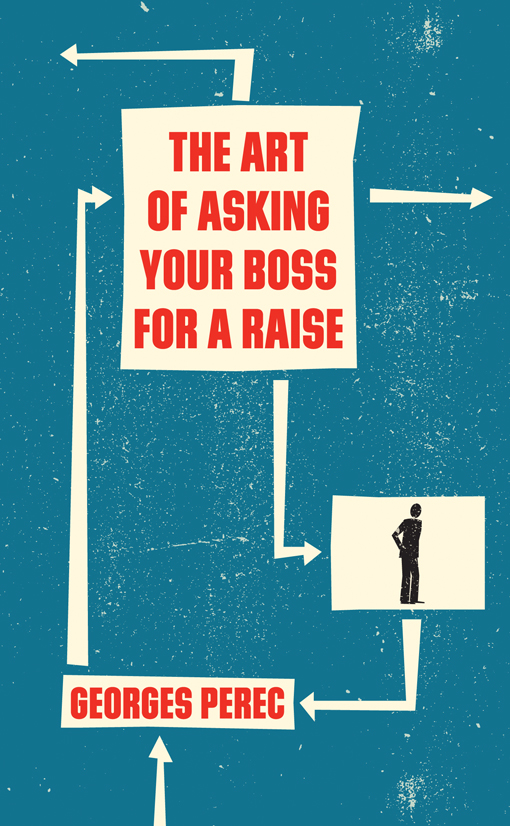
My copy of The Art of Asking Your Boss for a Raise, by Georges Perec, finally arrived! This slim little volume is exquisite!

The title has been pared down a little from the original (l'art et la maniѐre d'aborder son chef de service pour lui demander une augmentation): the art and craft of approaching your head of department to submit a request for a raise.

(Some of the background I set forth here is covered in greater detail by translator David Bellos in his introduction to the book.)

In 1968, a computer company set the challenge for writers to use a computer's basic mode of operation as a writing device. The outline: a flow-chart, a simple algorithm, a decision matrix.

The flow-chart is reproduced on this volume's endpapers.

By its nature, the algorithm is well-suited to being experienced electronically.

Of course, it has Oulipoian roots, as an exploration of how mathematics can be used to generate literature. In fact, I'm sure we're all quite familiar with another, very popular style of "matrix literature," an experiment in which (A Story As You Like It), by Raymond Queneau, is available online. (Hypertext literature has come a long way since the 1960s. I'm currently working through one such "traditional print" example with Helena.)

Perec reused the material from the art and craft in chapter 98 (Réol) of Life A User's Manual, which upon the learning of said fact I immediately reread.

I don't recall it having such a potent effect on me the first go around, but this time it brought tears to my eyes. Remember the Réols? — the young couple with the extravagant, expensive bed purchased on credit. And it puts me in mind of, no doubt because I've been reading so many articles related to the release of The Pale King, David Foster Wallace and his maximalist approach to literature (did he ever read Perec's Life, I wonder), in which he does not excise the excruciating minutiae of our lives and minds. I see now that Perec does something similar in Life. The chapter concerning Réol — and it can be read as a wholly self-contained narrative — tells a story through a perspective entirely restricted to the management of Réol's finances. There's the logistical problem of fixing an appointment with his boss (which day of the week his boss is likely to be in a good mood, not distracted, and so on), but mostly it's utilities payments due, rent in arrears, groceries on credit, loans, percentages, meeting the requirements for the assistance plan, etc. There is nothing about the Réols' life — no chance encounters or romantic situations, no grand parties or disastrous meals, no anecdotes about their son. And yet, financial management is life, one version of their life, and it's a full story. With a beautifully poignant (and happy) ending.

The Art of Asking Your Boss for a Raise is told in the second person. Story is secondary to the experiment.

either he thinks your idea is positive rich in possibilities worthwhile or he thinks it is stupid and will let you know in no uncertain terms that your logic is addled that's to say cock-eyed that's to say so devoid of understanding as to be close to either early-onset alzheimer's or congenital idiocy remember however that whether or not he calls you a nincompoop dimwit cretin nutcase crackpot woodenhead bananabrain dolt idiot or fool it comes to the same thing namely your plan will land in the wpb and you will return empty-handed to your desk while awaiting happier days it goes without saying that learning from experience you will improve your basic idea so when the day comes once again to talk with whole and open heart to your head of department he will be unable to dismiss you straight off as a nitwit so you allow yourself some months because one must always try to stack the odds in one's favour you swot up on the issue then when your plan seems perfect you go back to see mr x let's assume he's in

The text is, as is to expected given the structural constraint, repetitive and recursive, and the real-time computer-logic mood is enhanced by the lack of punctuation. (Also, it's set entirely in lowercase, but thankfully, and surprisingly, not in courier.)

I found it easiest to follow by reading it out loud. (In fact, I readily imagine the whole text being narrated and scored by Philip Glass à la Einstein on the Beach. Hey, Phil, give me a call, let's talk Perec!)

But there is a story! It's a little bit tragic even, but told with a light touch and great deal of humour.

The iterations come to be modified, and it's these variations in the phrasing that make for the funniest moments, unexpected as they are. Either they change as you reconsider them in light of all that has already occurred (the computer algorithm weights the possible outcomes and their likelihood of occurring as it acquires and learns to process the qualitative input from inside your head), or they change over time (the computer adds to the equation the actual fact of certain outcomes already having occurred).

It could be that all these thoughts pass through your neurotic head over a span of mere seconds when first you consider the possibility of asking for a raise. Or, this is a distillation of your entire career.

Either the employee is paralyzed by overthinking the situation and "we shall suppose to keep things simple — for we must do our best to keep things simple" never approaches the boss to ask for a raise; or the employees does in fact take action as governed by the logic of the algorithm, in which case years pass and the employee approaches retirement, without ever having asked for a raise. (The story does cover an approach and a request and a raise, but let's not complicate the point.)

I recommend The Art of Asking Your Boss for a Raise to those readers interested in experimental literature, but I suspect most readers will not find enough narrative thread to hold their attention for long. (On the other hand, it's short, and as an introduction to how a nontraditional approach to narrative can produce story it might serve you well alongside something like Calvino's t-zero stories, with which I see some similiarities in terms of the breakdown of processes into its smallest constituents, in a Zeno's paradox kind of way.)

If you have not read Perec's Life A User's Manual, I encourage you to read along at Conversational Reading.

Tomorrow marks what would've been Perec's 75th birthday.

To do
Approach the head of my department to submit a request for the transitioning of my role, and title, into Editor of Matrix-generated Literature and for the use of our proprietary decision support system to generate a novel in which the possible decision outcomes are not binary, but multiple and weighted and combined, where one can respond both a and b, or all of the above, to allow for the overlaying of choices and the "automatic" snipping and juxtaposition of appropriate segments of text, to tell a story about, say, a family's quest to acquire the perfect sofa, and while the daughter's preferences are considered they are of a different value than those of her parents, and the cat is also given due thought, all of which necessitates a careful study of how the sofa is used (playing video games, reading, napping, etc — each activity commanding different optimal bodily postures), how many people use the sofa over a given period of time to engage in those activities, and how many are likely to want to do so at the same time, budget of course being a key factor, but also available room, with an eye for spatial configuration of the entire room and allowing for the possibility of auxiliary seating (also to be determined through a similar decision matrix), no, no, it had better be more work-related, say, the design by committee and subsequent implementation of said design of the employee kitchen space, its general arrangement and furnishings, something like that.

Thursday, March 03, 2011

Evil weeds

The subject of Egyptian literature came up at work today, because someone's reading something Egyptian, and he mentioned it to our Egyptian-Palestinian coworker when she stopped by my desk, thinking she might be familar with the author, but he couldn't remember the author's name, and she suggested Nahguib Mahfouz, cuz really that's the first (or only) name that usually comes to mind, but no it's someone else, and she went on a bit about having read Palace Walk, and not liking it, and how it quite surprised her, whereas I had read Miramar eons ago and the only thing I can remember about it is that it bored me, and she expressed some, hmm, let's say regret, about how she's not as culturally well-versed as she'd like to be wrt her heritage, and then we chatted kind of generically, about audiobooks, and locking yourself in the bathroom — away from family distractions — to read, and a bit about work.

And I remembered I had a book: Three Egyptian Short Stories, by Youssef Idris — a bilingual edition (published 1991 by York Press, and not readily available these days it seems). The Arabic language fascinates me, and I'd taken a couple courses, and somewhere along the way I'd plucked this slim little volume out of some bargain bin or other, my aspiration being to read it in the original language. (Hah!)

So I came home from work and went straight to my shelf. Maybe my coworkers will be interested in this book. But I should read it first (had I ever actually read it?). So I read it.

Three short, very powerful stories. Poignant. Just plain sad.

The walls were half-covered in blackness in the form of paint, while the other half was stained with gloom.

Reading these stories I'm reminded a little bit of Simenon, bleak and seamy. Not so sordid as Simenon; these characters are just miserable, and poor.

Henceforth, the square witnessed an eccentric and gloomy man, whose dry and dark face was ever frowning, who broke his silence occasionally with a stray and fleeting word, only to be dominated again by dead silence, whose trembling moustache had grown wild like a bunch of evil weeds.

The stories are "Farahat's Republic," "The Wallet," and "Abu Sayyid." I trust they are available in other collections of Idris's work. While the latter two stories are sad in a pull-at-your-heartstrings kind of way, the first story packs an existential punch.

[Perhaps I feel this way because I made the mistake of checking the news online this evening. While I try to keep abreast of world events, in a shamefacedly superficial way, smaller-scale stories, if I can call them that, to differentiate them from the big picture, make me want to cry and scream, and I avoid them. Kids stuffed in luggage, dead. Some guy on speed driving around with his wife on the hood. I like to think you can change the World. But you can't do a damn thing about the sick fuck who lives down the street.]

"Farahat's Republic" is about a police officer. Even while he betrays a rich inner life, the real crime, he states, is that the rabble at the station won't give him a minute's peace, bothering him with their "petty" squabbles.

And so I feel morally defunct and guilty this evening.

Idris was nominated several times for the Nobel prize for literature.

Tuesday, March 01, 2011

Sandwich guy

Every day (well, most days), sometime between 11:45 and about 12:30 (although on at least two occasions as late as 1:20), there's a guy in a ski jacket and tuque who walks briskly down the main aisle (on which I'm situated) between the desks at my office, with a big blue cooler slung across his back. He calls out, "Sandwiches," brusquely; sometimes as he's approaching, but sometimes you just hear the echo of it — you look up and realize he's already turned the corner.

It took me a couple of weeks to figure it out: the man actually sells sandwiches. And a little while longer before I actually witnessed a transaction.

What era are we in? I see them sell sandwiches from the cart on Mad Men, but I never thought I'd see anything like it in my working career.

After monitoring his comings and goings for a few weeks, I finally asked some coworkers about him. They rewarded me with a spreadsheet recording the times of his appearance over the space of a few months, about a year ago. It seems my predecessor gave him the moniker I was already using in my head, and my time-tracking observations were confirmed.

Sandwich Guy does indeed sells sandwiches; and they're pretty good, they say.

He's associated with Les Sandwichs Volants, but nobody knows definitively his relationship with that organization, or how he comes to traverse our office space on a quasi-regular basis.

There's on ongoing debate as to whether his service commands tipping, and it seems my predecessor believed firmly that it did not — which, it's alleged, may have a little something to do with his unreliability. Past a certain hour, you just can't be sure that he'll have anything left to satisfy your particular lunchtime needs, or that he'll show up at all. (Although, it's hard to know if they ever really attended to Sandwich Guy's behaviour before my predecessor drew attention to it.)

Today, was my first first-hand experience with Sandwich Guy. I tagged behind a few coworkers who were hoping to head him off before he sold out of goods at the other end of the office. Alas, no carrot cake for the translator, but the vegetarian was in luck, and so was I.

Only two meat sandwiches left. I considered roast lamb, but opted otherwise.

Rôti de porc tranché, mayonnaise, piments marinés, sauce piquants, tomates, concombres, laitue. On a foot of baguette. Delicious. For $5.50.

And he called me mademoiselle.

I'm sorry I waited till winter is almost over. I could grow to really like Sandwich Guy.

Saturday, February 19, 2011

All in a week's work

Shop talk
I know the readership here to be smart and varied, so on the off chance some of you may actually be interested in this sort of thing, I'll mention this really interesting blog post the company I work for is promoting.

"This sort of thing" is business software, and the article addresses why so many enterprise resource planning systems fail; the researcher posits that it may be related to the professional allegiances and practices of the employees who use those systems.

If you have ever experienced (or indeed, been the victim of) the disruption of a company-wide implementation of the sort of system that's supposed to make you more productive, I encourage you also to participate in the survey that's discussed in the article.

Cat chat
I'm not a fan of Justin Bieber, but my daughter is, and I've come to terms with this — she will develop her own tastes; hopefully she will grow out of it (and someday soon!).

Now Justin Bieber reads The Cat in the Hat (via Dewey Divas). But not very well. He sounds dumb and bored.

While I can appreciate the attempt to promote literacy, or reading as cool, or the glory of pizza, I think this may backfire. This puzzling PR attempt brings him down another notch in my estimation. If the point is to sound like a (below?) average student being forced to read a text, well,... Is the point for millions of young girls to realize they read better than him? To realize that reading, for some people, is really pretty lame after all? He certainly doesn't bring a performer's verve to his reading. Does he even know what this story is about?

(Note: I couldn't actually watch it to the end. Maybe I'm missing Justin's spectacular finale?)

Life redux
For those who missed out on last year's group read of Life A User's Manual, by Georges Perec, and those of you eager to relive Life, a read-along is being hosted at Conversational Reading, starting mid-March and throughout April.

I'll follow the discussion, and as much as I still think about what an awesome wiki project it would be to annotate Life (and I do hope to dostart it someday), I expect I'll be occupied at about that time reading a Perec work never before translated, the soon-to-be-released The Art of Asking Your Boss for a Raise.

Wednesday, January 26, 2011

The mountain and the shortcut

The path was clear. From the metro station exit, around the corner, down the street, across the parking lot, through the alley, and it's the next building down, across the street. Then it snowed.

Since the first big snow back in December, I've had to cross a mountain to get to work. When they cleared the parking lot, they piled the snow in the back corner, blocking access to the alleyway.

That first day, I wasn't sure it was passable. But I found a path that had been trodden before me. Up and over.

The second day, I met someone coming the other way. Giggling and carrying a plate of cookies. High, I thought. I backed up a couple paces to let her pass and we exchanged some pleasantry. At last I came down on the other side, full with the uncertainty of fresh snow and giggling myself. Silly, slippery snow mountain.

The mountain has changed. The path is now a deep furrow, so narrow that, ironically, it's much harder to get a solid foothold. There is no longer a steady incline. A parking space has been reclaimed by carving into the slope. The way across is a plateau, but the step up to (or down from) it is treacherous.

This week in some stupid -30° weather, a colleague on the way out of the building asked if I knew about the "shortcut." Somehow, after 2 months of employ, I was finally deemed worthy of this secret knowledge, or maybe she just took pity on me in the cold.

Quick across the street and in through an unmarked industrial door beside a loading dock. Two levels of parking, eerily quiet given that most of the city is knocking off work at this hour. A stairwell and a narrow hallway wending back and forth. We exit beside a bank of elevators at the main front entranceway to the building. It's only appropriate that the occupant of the building be a major producer of video games.

Outside across a different parking lot, and now into the stock exchange building. More stairways before hitting the tunnels that join up to the metro.

I don't think it was shorter, but it was warmer for the length of two short city blocks (broken up by a block of the brisk outdoors).

No matter which path I choose on my way to and from work, it seems I choose my own adventure.

Friday, January 21, 2011

There are days

As much as I love my new job, there are days... There are days I'd rather stay in bed. When it's cold, when the world outside is blanketed in snow, just a day, to rest and replenish myself.

"Momma," she exhorts, "go back to bed. Just look at it outside. You're in no condition for that. You're tired. You deserve to rest. You don't need to worry about me. I can take care of myself. I can go to school by myself. You should stay home today. In bed."

I smile. That kid can be really sweet.

"You deserve a day off, Momma. Really, go back to bed. Don't worry about a thing." She drives her argument home: "I've already arranged everything with your boss."

And for a moment, just a moment, my hopes are raised. For a moment I let myself think, Really?

Wednesday, November 17, 2010

Inertia and continued employment cease to be mutually tenable

Arthur's cubicle used to be near the watercooler, but the bosses tired of having to chat with him each time they got thirsty. So the watercooler stayed and he was moved. Now his desk is in a distant corner, as far from the locus of power as possible but nearer the cupboard of pens, which is a consolation.

He arrives at work, flops into his rolling chair, and remains still. This persists until inertia and continued employment cease to be mutually tenable, at which point he wriggles off his overcoat, flicks on the computer, and checks the news reports.

No one has died. Or, rather, 107 people have in the previous minute, 154,000 in the past day, and 1,078,000 in the past week. But no one who matters. That's good — it has been nine days since his last obit, and he hopes to extend the streak. His overarching goal at the paper is indolence, to publish as infrequently as possible, and to sneak away when no one is looking. He is realizing these professional ambitions spectacularly.

— from The Imperfectionists, by Tom Rachman.

I'm barely a quarter of the way into this book, but I'm loving it. It's funny and poignant, and a whole lot of other things besides.

At this point it seems more like a series of connected stories than a novel per se, but we'll see how it unfolds. The stories, the people, all circle round an English-language newspaper in Rome.

It feels right to be reading this just as I'm starting a new job in an editorial environment completely different from what I'm used to. It's not a newspaper, but the publication cycle for a good deal of the work is close to every-other-day-ly, so there's a buzz and a busy-ness that make going to work kind of exciting.

Editorial is just a small part of this business in a sector that I know rather little about. I am relying on osmosis to get up to speed, but that shouldn't be such a feat when the people around me spend their days talking, hashing out ideas and problems and other ways of thinking about things in a fairly passionate way. They are not imperfectionists. We have several watercoolers.

Overheard the other day: "The granularity of the content is one." I don't know what that means, but I can't wait to find out.

Monday, November 01, 2010

Il faut corriger la dictée

Vampire child went to school on Friday in place of my usual blood-sucking daughter. (Really, they don't look a bit alike.)

First snow yesterday. Patches of it still with us, hiding in dark corners.

Faintly relieved that child decided not to go trick-or-treating, that candy at school and at home was sufficient. Massively guilt-ridden that we have not ever yet been trick-or-treating, except for that time when she was 2, and we were at my mom's, and toddled over to the neighbours' houses, but I don't think that counts.

Helena's dictée this week had 4 fautes. It brought her to tears. An occasional faute will slip through, but she usually aces it. Four slips was devastating. I showed her the PDF I was marking up for work, riddled with simple spelling errors, and bigger problems besides, created by a grown-up, for work she's paid well enough for. This actually made Helena feel a great deal better (I caught her sneaking peaks at my laptop, showing an interest in my work she hadn't before). It made me feel somewhat worse.

I leave my crazy job in a week's time, soon to start on a new adventure. The new job is maybe not so different from the old job (though my concience may sleep a little better now that I'll be marketing business software rather than pharmaceuticals), but it speaks volumes to me that among the questions asked of me at my job interview was, "What are you reading?": it thrills my soul that there are editorial environments in which that question is still asked and the answer valued.

I'll have a few days off between jobs. How serendipitous that I should have time off during NYRB Reading Week!

Tuesday, April 20, 2010

Today was a good day

I walked to work this morning, and it was a glorious morning. One hour from my front door to my desk, including dropping off the girl, picking up some cash, and thoroughly washing my hands of all the city grime that had settled on me in that time. One hour watching The Main wake up.

At lunch I went to see a chamber orchestra perform Vivaldi's Four Seasons at the church down the street. And it was glorious.

Walking to work would be a good habit to cultivate, I've been thinking, for the exercise and the air — a good way to start the day, in an otherwise underused timeslot, provided I'm sufficiently organized in the morning. However, it does mean losing about 15 minutes of reading time on the metro.

I managed to make up the time today; I left work early (shhh! don't tell my boss), to pick up the girl early ("that way we can spend more time together", she'd suggested). I caught up with her after-school group at the park. She played a bit longer, I read on a swing, and we had a wonderful time.

Spring may finally be here. This may merit a new pair of walking shoes.

Friday, August 28, 2009

Peaches

So yesterday, yesterday an urge came over me, an urge to buy a record album (do people buy those anymore? a CD? what if you download it, what do you call it?) that I've been thinking about for some time, and it's ridiculous how much I've had to think through this purchase — a $20 purchase! — I mean, I'm a grown-up with a decent income etc, I spend more than that on coffee in any given week — thinking about how I could get it cheaper if I ordered it online, except I'd have to wait days for it to be delivered, which is extra dumb, cuz I've been contemplating this whole thing for weeks already, or how about I just download it and have it instantaneously?, but though I buy some songs that way it's just so ephemeral and what if some faceless corporate power decides I'm listening to the wrong sort of music and having remote access to my music library decides to modify my behaviour by removing some potentially subversive influences?, and besides, I need a CD for the car, right?, cuz this is a great roadtrip type of CD, so even though we have one of those iPod adapter thingies to play it in the car, the couple times we used it for some reason it wasn't so easy because like you can't charge it up and play it at the same time or something like that, so I decided finally: CD it would have to be, and yesterday, well, yesterday afternoon I decided I wanted it now — I'd been sitting there all day, at my desk, and all through lunch, I ate my sandwich at my desk, powering through this project, and so I needed a break and I wanted this CD now, now was the time, so I stepped out over to the record store (do we call them that anymore? music store? entertainment needs centre? you know, the HMV) and I headed downstairs and there I saw the most amazingly beautiful and truly weird thing: there's this guy at a listening station, which is more like a semicircular customer-service counter with like maybe 5 plug-in set-ups, and he's a fairly small man but taking a lot of space; he's like 50-ish, wearing a faded red t-shirt, ballcap, and salt-and-pepper beard, and he's totally rocking out to whatever it is he's sampling at the listening station, playing the most vigorous air guitar I can ever recall witnessing, and you got the feeling he wasn't sampling a new release out of curiosity, he was in for the duration, with some classic album by his favourite band, he couldn't possibly be here on his coffee break, he was so fully in the music, it was a sight to behold, and so I picked up this album I'd so been wanting, being, by the way, Peaches: The Very Best of the Stranglers, which truly does represent their very lovely best, and I browsed a bit, and tried to find out what song was playing overhead, but I can't remember the snippet of lyrics now that had me in thrall, and I daydreamed a bit, or loitered really, just figuring out which route I should take back to the office so I could pick up a good, not average, cup of coffee on the way, and I paid for my CD, and on my way out Mr Air Guitar was still going strong and completely oblivious to the fact that he was at a listening station on the lower level of a chainstore, and this is a beautiful thing.

There was a chill wind, but on my return walk, the sun was at my back boring a hole through my shoulder, it felt like, even while my arms were bathed in cool.

The workday finished, toute la gang headed across the street for the annual company-wide summer 5 à 7. A cocktail this and a caesar that, it was well after sept that The Project took hold, to amass (from, eg, early leavers, pregnant women) sufficient drink tickets (44) in order to be able to order a bottle of champagne, but so we (well, mostly I — I admit, The Project was totally of my conception) negotiated this to a lesser number (23) for a bottle of French vin mousseux but not of the Champagne region, with even enough tickets (2) left over to get someone else a martini, and I had an interesting chat with a heretofore unknown coworker about Infinite Jest.

And I've been listening to my new record album CD all day.

What ever happened to Leon Trotsky?