Would you like a gmail account? Available here, if you say "pretty please." First come, first served.
I haven't actually decided if I like it yet, but I figure I'll never know if I don't try...
Tuesday, August 31, 2004

Monday, August 30, 2004
Le centre de blah blah blah
Daycare centre #2, which we'd considered to be Plan A all along, which plan seemed to have been cruelly thwarted last week by daycare centre Hip & Groovy across the park actually calling us and in turn threw its wrench into my commitment to Plan B, is an incredible place.
For starters, by comparison, it seems incredibly clean, which rather makes me worry about what kind of mother I am that I would've willingly sent my child to some place less clean than this.
I worry also that I'm the kind of mother who would've sent my daughter to the first centre that called, and now I'm gratefully relieved to be able to say I comparison shopped, even if accidentally.
The only thing daycare centre Hip & Groovy across the park had going for it was the park, as a regular playground excursion for Helena and as a thing for me to enjoy walking through daily as part of a forced routine.
But hey, we live here, so we still have the park.
Le centre de blah blah blah strikes me as being pretty institutional, but in a good way, like this is regulated put-your-baby-on-the-fast-track-to-communism stuff. In retrospect, Groovy centre seems a little too free-spirited (I didn't know that was possible).
J-F thinks the exact opposite.
But we both agree it's the right decision.
Helena reacted favourably.
Poor thing has diarrhea the likes of which I've never smelled before, and still I drag her downtown. Her appetite has slowed, but I can think of no anomalies that might've brought this on. Maybe something in the wading pool...
At the dollar store I bought her a child-size broom. Helena couldn't be happier, and our apartment could stand to be a tad cleaner.
Helena is currently enjoying the words towel, truck, and sometimes tractor.
For starters, by comparison, it seems incredibly clean, which rather makes me worry about what kind of mother I am that I would've willingly sent my child to some place less clean than this.
I worry also that I'm the kind of mother who would've sent my daughter to the first centre that called, and now I'm gratefully relieved to be able to say I comparison shopped, even if accidentally.
The only thing daycare centre Hip & Groovy across the park had going for it was the park, as a regular playground excursion for Helena and as a thing for me to enjoy walking through daily as part of a forced routine.
But hey, we live here, so we still have the park.
Le centre de blah blah blah strikes me as being pretty institutional, but in a good way, like this is regulated put-your-baby-on-the-fast-track-to-communism stuff. In retrospect, Groovy centre seems a little too free-spirited (I didn't know that was possible).
J-F thinks the exact opposite.
But we both agree it's the right decision.
Helena reacted favourably.
Poor thing has diarrhea the likes of which I've never smelled before, and still I drag her downtown. Her appetite has slowed, but I can think of no anomalies that might've brought this on. Maybe something in the wading pool...
At the dollar store I bought her a child-size broom. Helena couldn't be happier, and our apartment could stand to be a tad cleaner.
Helena is currently enjoying the words towel, truck, and sometimes tractor.
A most august monkey
On Blork's command:
There's so much normal weird stuff. My first concert (at which I did not lose my virginity; nor was it misplaced at subsequent concerts) was Platinum Blonde, for whom Honeymoon Suite were opening. Age 12. Weird? No. Not even particularly embarrassing — simply a question of (relatively) small-town circumstance.
Oh wait, there was Beatlemania before that, when I was 11; my best friend invited me along — she was a huge Beatles fan (I didn't really see what the big deal was). My mother was somewhat shocked by the proposition, as it took place on Holy Thursday before Easter. The only weird thing is that my mother could feel such outrage, and then relent. The show was OK.
Fast forward 2 years. Anthem: "If only Beatlemania had bitten the dust..."
Coincidentally, J-F this weekend stumbled (?!) across some Asia fan sites. Embarassingly, that was the first album I ever bought. Weird? Not particularly, though J-F points out that it was really a guy album, that Heat of the Moment was the ultimate air guitar song.
Fast-forward to university. Psychic TV.
Psychic TV was to play in Ottawa, so I rushed out for a ticket. The show was cancelled for lack of sales. All 11 of us had our money refunded.
Was it a year later? Another show was announced. A friend of mine had just seen them in Kingston, and he followed them up to Ottawa to try to get an interview for his radio show.
Genesis P. Orridge agreed to an interview, if and only if we could find him some cheese sandwiches. Not at the bar downstairs. Not at the pub across the street. Not the bistro on the corner. Not the diner. So we went to the grocery store. A variety of breads, a selection of cheeses. And lettuce.
Genesis P. Orridge concurred that the lettuce was a really nice touch. Interview granted. We slapped together some sandwiches, Genesis lit up a joint, and I don't remember much past that.
Weird? Maybe a little out of the ordinary. Weird about myself? Questionably. Motive? The guy, the music, or simply caught up in the heat of the moment.
I see that the proprietor of The Shatnerian posts nothing weird, but does note that his favourite song is That's Entertainment, by The Jam. At which point I must confess I think I might have a little bit of a crush. (Actually, I think it's cuz when I was 13, I had a crush on a guy who liked The Jam.)
I wouldn't be so bold as to say it's my favourite song, but it's definitely some of my favourite lyrics. Among several choice couplets:
Though not in the least weird, it undoubdtedly speaks volumes about me.
A musical moment of which I am most proud: going out to see The Supreme Beings of Leisure just a week before my due date. Helena kicked a lot that night, but stayed put another couple weeks. She continues to exhibit an affinity for that kind of groove.
(But if you want to get Helena to sleep, forget lullabies — White Stripes' Seven Nation Army is magic, and it... centres me somehow, even though I haven't figured out what it means.)
The soundtrack to life.
Weird? Not really.
Except for that compulsion to dramatically announce "Such and Such: The Musical," (especially after having seen Bat Boy: The Musical in New York) and list the soundtrack possibilities. And even that's rather commonplace.
Tell us something weird about yourself that involves music. I don't just mean the normal weird things, like that you're a closet Barry Manilow fan or you lost your virginity at an Alice Cooper concert. Tell us the really bizarre stuff.
There's so much normal weird stuff. My first concert (at which I did not lose my virginity; nor was it misplaced at subsequent concerts) was Platinum Blonde, for whom Honeymoon Suite were opening. Age 12. Weird? No. Not even particularly embarrassing — simply a question of (relatively) small-town circumstance.
Oh wait, there was Beatlemania before that, when I was 11; my best friend invited me along — she was a huge Beatles fan (I didn't really see what the big deal was). My mother was somewhat shocked by the proposition, as it took place on Holy Thursday before Easter. The only weird thing is that my mother could feel such outrage, and then relent. The show was OK.
Fast forward 2 years. Anthem: "If only Beatlemania had bitten the dust..."
Coincidentally, J-F this weekend stumbled (?!) across some Asia fan sites. Embarassingly, that was the first album I ever bought. Weird? Not particularly, though J-F points out that it was really a guy album, that Heat of the Moment was the ultimate air guitar song.
Fast-forward to university. Psychic TV.
Psychic TV was to play in Ottawa, so I rushed out for a ticket. The show was cancelled for lack of sales. All 11 of us had our money refunded.
Was it a year later? Another show was announced. A friend of mine had just seen them in Kingston, and he followed them up to Ottawa to try to get an interview for his radio show.
Genesis P. Orridge agreed to an interview, if and only if we could find him some cheese sandwiches. Not at the bar downstairs. Not at the pub across the street. Not the bistro on the corner. Not the diner. So we went to the grocery store. A variety of breads, a selection of cheeses. And lettuce.
Genesis P. Orridge concurred that the lettuce was a really nice touch. Interview granted. We slapped together some sandwiches, Genesis lit up a joint, and I don't remember much past that.
Weird? Maybe a little out of the ordinary. Weird about myself? Questionably. Motive? The guy, the music, or simply caught up in the heat of the moment.
I see that the proprietor of The Shatnerian posts nothing weird, but does note that his favourite song is That's Entertainment, by The Jam. At which point I must confess I think I might have a little bit of a crush. (Actually, I think it's cuz when I was 13, I had a crush on a guy who liked The Jam.)
I wouldn't be so bold as to say it's my favourite song, but it's definitely some of my favourite lyrics. Among several choice couplets:
Two lovers kissing at the scream of midnight;
Two lovers missing the tranquility of solitude.
Though not in the least weird, it undoubdtedly speaks volumes about me.
A musical moment of which I am most proud: going out to see The Supreme Beings of Leisure just a week before my due date. Helena kicked a lot that night, but stayed put another couple weeks. She continues to exhibit an affinity for that kind of groove.
(But if you want to get Helena to sleep, forget lullabies — White Stripes' Seven Nation Army is magic, and it... centres me somehow, even though I haven't figured out what it means.)
The soundtrack to life.
Weird? Not really.
Except for that compulsion to dramatically announce "Such and Such: The Musical," (especially after having seen Bat Boy: The Musical in New York) and list the soundtrack possibilities. And even that's rather commonplace.
At rest
The ever-complex and contradictory Polish sentiment toward the similarly characterized Czeslaw Milosz gave rise to protests regarding his funeral.
Elsewhere:
Ceremonies were conducted without disruption.
Earlier this week, a handful of right-wingers demonstrated against plans to bury Milosz, who died on Aug. 14 aged 93, in the Crypt of Honour at a monastery in Krakow, saying he had betrayed Poland with his liberal views and a brief flirtation with communism.
The protests, supported by fringe nationalist media, had embarrassed Polish authorities and delayed the decision on where the poet would be buried.
The protests were muzzled hours before the ceremony, when newspapers published a letter from Polish-born Pope John Paul II saying he shared the same spiritual goals as the poet.
Elsewhere:
His opponents criticise him for having served as a diplomat for communist Poland between 1946 and 1950, for having described himself as Lithuanian — he was born in what is now Lithuania in 1911 — and for criticising some aspects of Polish Catholicism.
According to the newspaper Milosz had said that the Bible was a "cruel and depressing book".
Ceremonies were conducted without disruption.
Saturday, August 28, 2004
Iconography
John Paul II handed over the icon of the Mother of God of Kazan to a Vatican delegation that returns it to Moscow today. He had hoped to return the icon himself.
The icon returns amid tensions between the Catholic and Orthodox Churches.
Like most icons, this one has an intriguing history imbuing it with miraculous powers.
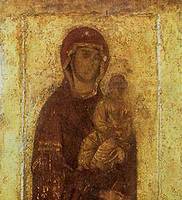
Maximovsk icon.
Icons of the Mother of God.
Historical Accounts of Miracle-working Icons.
Everything you ever wanted to know about the Orthodox Church and its icons — links aplenty regarding history, theology, and artistry.
The Pope composed a prayer to the Mother of God of Kazan, read in Russian, in which he implored the Virgin to "return in the midst of brothers and sisters of holy Russia as a messenger of communion and peace."
The icon returns amid tensions between the Catholic and Orthodox Churches.
Like most icons, this one has an intriguing history imbuing it with miraculous powers.
The first time the miraculous icon displayed its power was in 1612 in the struggle with Poles who, taking advantage of the Time of Troubles, tried not only to seize Moscow but also to install Catholicism. In a word, the Kazan icon is not simply an icon but a great symbol of Russian history and the Russian state.
It was after the attempt by the Turk Ali Agca upon the life of John Paul II that the Kazan icon was transferred to Rome and, according to the pontiff, helped him recover from his wounds.
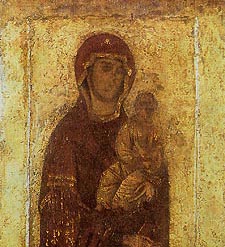
Maximovsk icon.
Icons of the Mother of God.
Historical Accounts of Miracle-working Icons.
Everything you ever wanted to know about the Orthodox Church and its icons — links aplenty regarding history, theology, and artistry.
Friday, August 27, 2004
Manifesto
By George Saunders. At Stephany Aulenback's suggestion, "Every post on every blog should contain at least one link to it today," here you go.
Since the world began, we have gone about our work quietly, resisting the urge to generalize, valuing the individual over the group, the actual over the conceptual, the inherent sweetness of the present moment over the theoretically peaceful future to be obtained via murder. Many of us have trouble sleeping and lie awake at night, worrying about something catastrophic befalling someone we love. We rise in the morning with no plans to convert anyone via beating, humiliation, or invasion. To tell the truth, we are tired. We work. We would just like some peace and quiet.
Thursday, August 26, 2004
A very uncertain octopus
I should've known it this morning, when things were just slightly off — annoying, really.
When we lost the shovel at the playground (by which I mean some little toddler hoodlum absconded with it): I hate losing things; I always keep an eye on our stuff; I lapsed.
When Helena realized she could load up her pockets with handfuls of sand. Ah, joy.
Despite the signs, I was feeling all lighthearted and relieved, reveling in that sense that everything's going to work out just fine, when reality slapped me in the face and slipped me into extreme panic mode this afternoon.
Another phonecall. Another daycare. Only this time the call was placed to J-F, and he couldn't reach me, and he had to take a decision.
And I'm desperately afraid it might be the wrong decision.
In that very same moment of J-F's decision-making, yet another hoodlum toddler decided it would be funny if he poured a bucket of water in my lap.
Seconds later, Helena loses her pool footing for the first time ever, at the very deepest part of the wading pool, falling face first. I lift her blubbering and sputtering and coughing and trying to cry. My poor frightened, soggy baby.
The entire wading pool experience was tinged with my anger toward a woman prancing about in what was obviously her underwear. It provided a lot more coverage than many of the bikinis often sported, and the woman was hardly an eyesore, the opposite in fact. It's just the idea of it — underwear, in the wading pool — is incredibly repugnant to me.
So it's going to be the other daycare, the one beside J-F's office, which will always be his office, whereas our home is likely to shift locales (we're hoping soon). We have a meeting on Monday.
I admit, the very first time I walked past the Uncertain Octopus, I thought it weird. It has storefront windows, onto the kids' playrooms. Kind of creepy.
Then there's the name, something about the name niggling at me. What kind of institutional philosophy is behind the uncertainty. I imagine it's something about the state of the toddler being uncertain, being pure potential, but I was having trouble making it sit right.
But I quashed all that.
I'd already been imagining our morning strolls through the park, how it would provide a much-needed structure to my day. Being able to drop by the playground during one of their scheduled sessions. Pick her up early if I felt like it.
Of course, with the new arrangement, J-F gets to spend more one-on-one time with Helena, and this is fantabulous.
Somehow or other, my days will assume structure. Dammit, I can still go for walks in the park.
Today's words: "people," "I finit" (I'm finished), "a-to" (which, heard amid various cries, shrieks, and head-shaking, while trying to rinse away chlorine and other residue, I finally determined means "I'm tired.")
When we lost the shovel at the playground (by which I mean some little toddler hoodlum absconded with it): I hate losing things; I always keep an eye on our stuff; I lapsed.
When Helena realized she could load up her pockets with handfuls of sand. Ah, joy.
Despite the signs, I was feeling all lighthearted and relieved, reveling in that sense that everything's going to work out just fine, when reality slapped me in the face and slipped me into extreme panic mode this afternoon.
Another phonecall. Another daycare. Only this time the call was placed to J-F, and he couldn't reach me, and he had to take a decision.
And I'm desperately afraid it might be the wrong decision.
In that very same moment of J-F's decision-making, yet another hoodlum toddler decided it would be funny if he poured a bucket of water in my lap.
Seconds later, Helena loses her pool footing for the first time ever, at the very deepest part of the wading pool, falling face first. I lift her blubbering and sputtering and coughing and trying to cry. My poor frightened, soggy baby.
The entire wading pool experience was tinged with my anger toward a woman prancing about in what was obviously her underwear. It provided a lot more coverage than many of the bikinis often sported, and the woman was hardly an eyesore, the opposite in fact. It's just the idea of it — underwear, in the wading pool — is incredibly repugnant to me.
So it's going to be the other daycare, the one beside J-F's office, which will always be his office, whereas our home is likely to shift locales (we're hoping soon). We have a meeting on Monday.
I admit, the very first time I walked past the Uncertain Octopus, I thought it weird. It has storefront windows, onto the kids' playrooms. Kind of creepy.
Then there's the name, something about the name niggling at me. What kind of institutional philosophy is behind the uncertainty. I imagine it's something about the state of the toddler being uncertain, being pure potential, but I was having trouble making it sit right.
But I quashed all that.
I'd already been imagining our morning strolls through the park, how it would provide a much-needed structure to my day. Being able to drop by the playground during one of their scheduled sessions. Pick her up early if I felt like it.
Of course, with the new arrangement, J-F gets to spend more one-on-one time with Helena, and this is fantabulous.
Somehow or other, my days will assume structure. Dammit, I can still go for walks in the park.
Today's words: "people," "I finit" (I'm finished), "a-to" (which, heard amid various cries, shrieks, and head-shaking, while trying to rinse away chlorine and other residue, I finally determined means "I'm tired.")
Some science with your fiction
It's the Guardian's science fiction issue!
"The best reason to read about science is not to check facts, but to revel in wonder."
Philip Pullman writes about science and fiction, and the relationship between the two (but don't mistake it for a discussion of science fiction):
Doing science is not the same as doing fiction. But science as a background to fiction is different. It has to do what all backgrounds do — stand firm and solid. It must not sway alarmingly when someone walks into it or sound hollow when struck, it must conform to the rules of perspective and be vivid enough to convince but not so hectic as to distract.
Is there a responsibility for science fiction to be scientifically accurate? The consensus is "No." For SF to work dramatically, it often confronts "controversial science" — where the scientific rights and wrongs (let alone the ethical) are hardly delineated.
Another blah, blah, blah article validates the blah, blah genre.
Blah, blah, blah.
A bunch of scientists compile a list of their favourite authors.
Nothing particularly striking about the choices, but this jumped out at me:
Imagine that. Philip K Dick, a stylish writer. Michel Basilières must really hate Asimov.
There's also an excerpt from Iain Banks' latest space opera, The Algebraist, but on first scan it doesn't appear to be quite my cup of tea.
"The best reason to read about science is not to check facts, but to revel in wonder."
Philip Pullman writes about science and fiction, and the relationship between the two (but don't mistake it for a discussion of science fiction):
Doing science is not the same as doing fiction. But science as a background to fiction is different. It has to do what all backgrounds do — stand firm and solid. It must not sway alarmingly when someone walks into it or sound hollow when struck, it must conform to the rules of perspective and be vivid enough to convince but not so hectic as to distract.
Is there a responsibility for science fiction to be scientifically accurate? The consensus is "No." For SF to work dramatically, it often confronts "controversial science" — where the scientific rights and wrongs (let alone the ethical) are hardly delineated.
Another blah, blah, blah article validates the blah, blah genre.
But science fiction is more than just pulp fiction; at its core is the desire to understand humanity's place in the universe.
Science fiction not only reflects science but is also an inspiration for it.
Fiction has certainly pushed the envelope for scientists. "It helps you to think the impossible and see if it is possible."
Blah, blah, blah.
A bunch of scientists compile a list of their favourite authors.
Nothing particularly striking about the choices, but this jumped out at me:
"Asimov was not a stylish writer in the way that say, Philip K Dick was, but he was very rigorous scientifically, and thoughtful about how he projects scientific ideas into the future," says Philip Ball, a writer of popular science books.
Imagine that. Philip K Dick, a stylish writer. Michel Basilières must really hate Asimov.
There's also an excerpt from Iain Banks' latest space opera, The Algebraist, but on first scan it doesn't appear to be quite my cup of tea.
Wednesday, August 25, 2004
We have lift-off
We got the phonecall!
Daycare!
Just when I'd lost all hope, losing sleep over everything and on the brink of losing my mind.
There's an opening! And it's close to home, just the other side of the park — Helena already interacts with this bunch of smock-labelled kids at the playground on a regular basis. And it's got a cool Latin name by which it will never be known, because it's just too easy to call it Uncertain Octopus.
It's what they call semi-private. That is, it is government subsidized, leaving us to pay $7 a day for standard care (I heart Quebec!), but we can pay extra for silly conveniences like diapers, extra meals, and stroller storage or for nifty special programming like music classes, zoo visits, and theatre excursions.
Once again, life is about to change drastically, and it's sure to spawn a new generation of motherhood-type crises, yet I feel somewhat relieved about sharing the matter of Helena's upbringing (or more accurately, the filling of her time with sensible toddler activities, about which I know nothing) with professionals.
Yay!
Daycare!
Just when I'd lost all hope, losing sleep over everything and on the brink of losing my mind.
There's an opening! And it's close to home, just the other side of the park — Helena already interacts with this bunch of smock-labelled kids at the playground on a regular basis. And it's got a cool Latin name by which it will never be known, because it's just too easy to call it Uncertain Octopus.
It's what they call semi-private. That is, it is government subsidized, leaving us to pay $7 a day for standard care (I heart Quebec!), but we can pay extra for silly conveniences like diapers, extra meals, and stroller storage or for nifty special programming like music classes, zoo visits, and theatre excursions.
Once again, life is about to change drastically, and it's sure to spawn a new generation of motherhood-type crises, yet I feel somewhat relieved about sharing the matter of Helena's upbringing (or more accurately, the filling of her time with sensible toddler activities, about which I know nothing) with professionals.
Yay!
Tuesday, August 24, 2004
Prolongation
In anticipation of the mini heatwave forecast for this week, the wading pool has been reopened for a few days. Yay!
We spent a couple hours at the park this morning, and I was woefully underdressed, misled by the direct beams of sunlight and momentary stillness when I'd stepped out onto the balcony to check the weather before heading out. Don't worry — Helena was suitably jacketed (just in case), and we tried out her new covered shoes. But I'm all sniffly now, and I rather expect I'll fall deathly ill by week's end. I sure could use a couple more days of wallowing in self-pity.
Helena had a swell time doing all the usual playground stuff but most particularly, along with a handful of daycare toddlers also seated in the playhouse, in repeatedly piling sand onto the table and then vigorously brushing it off. Ah, the simple things...
Scribbling Woman has in one short post of interesting links managed to revive my work-at-home–mom crisis, putting an end to the comfortable denial I was just barely starting to settle into.
"Mothering in the Ivory Tower" (author's blog here) at Literary Mama:
I used to think all those people who said they slept about 5 hours a night were weird, if admirable. I remember hearing coworkers talk about getting up at 5 in the morning. Of course, it was always women saying these things, but maybe men just don't like to talk about their sleep habits.
I imagined these creatures staying up till midnight, chatting with their lover over a bottle of wine, getting up before dawn in a zen-like frame of mind, to enjoy coffee, read the newspaper, breathe the air. They're crazy, I thought. Who could like that stuff better than 9 hours of glorious rejuvenating sleep? Lovers and lazy coffees are well and good, but at what price?
It never once crossed my mind that these women might sleep a mere 5 hours out of necessity — that they were up late finishing a report and doing laundry, that the baby demanded feeding in the morning and it was the only way to get older kids to school on time.
Five hours of sleep. They said it with a secret smile. Proud? Stoic. Why didn't they tell me?
We spent a couple hours at the park this morning, and I was woefully underdressed, misled by the direct beams of sunlight and momentary stillness when I'd stepped out onto the balcony to check the weather before heading out. Don't worry — Helena was suitably jacketed (just in case), and we tried out her new covered shoes. But I'm all sniffly now, and I rather expect I'll fall deathly ill by week's end. I sure could use a couple more days of wallowing in self-pity.
Helena had a swell time doing all the usual playground stuff but most particularly, along with a handful of daycare toddlers also seated in the playhouse, in repeatedly piling sand onto the table and then vigorously brushing it off. Ah, the simple things...
Scribbling Woman has in one short post of interesting links managed to revive my work-at-home–mom crisis, putting an end to the comfortable denial I was just barely starting to settle into.
"Mothering in the Ivory Tower" (author's blog here) at Literary Mama:
I am at work on my computer, typing, typing, typing on an academic article that is due at the end of this month, but I am only partly here. I try to focus, to concentrate, to get this done so I can go back to my daughter. I keep being drawn back to her image, her smell, her touch, as I imagine she does with me.
I must do this work, but I have to call it as I see it in my own life. I won't pretend that Sarah is not suffering. I won't pretend that her pain doesn't matter. I won't try to justify it in terms of her well being, as in claiming that "she is learning to be more independent" or "a happy mother makes a happy home." I won't be pacified by the nanny's comment that "she stops crying the minute you are out of sight." Does my pain at a loss hurt any less because I can reconcile myself to it? No, of course not. Then, should I disregard her pain because she is learning to deal with it? Because it is short-lived? Is my child's pain less important than mine? Even though she won't consciously remember this later, if therapy has taught me anything, it's that the unconscious forgets nothing.
I won't deny the obvious truth: I am rebuilding my career on the back of her grief.
I used to think all those people who said they slept about 5 hours a night were weird, if admirable. I remember hearing coworkers talk about getting up at 5 in the morning. Of course, it was always women saying these things, but maybe men just don't like to talk about their sleep habits.
I imagined these creatures staying up till midnight, chatting with their lover over a bottle of wine, getting up before dawn in a zen-like frame of mind, to enjoy coffee, read the newspaper, breathe the air. They're crazy, I thought. Who could like that stuff better than 9 hours of glorious rejuvenating sleep? Lovers and lazy coffees are well and good, but at what price?
It never once crossed my mind that these women might sleep a mere 5 hours out of necessity — that they were up late finishing a report and doing laundry, that the baby demanded feeding in the morning and it was the only way to get older kids to school on time.
Five hours of sleep. They said it with a secret smile. Proud? Stoic. Why didn't they tell me?
Monday, August 23, 2004
Quirks
[Edited, kind of, cuz I posted the wrong draft.]
I asked Helena if she wanted some mango — we'd just returned from the park and some shops, and dinner was still an hour away. She stood still for a few seconds before replying "Mmm-mmmmmm-mmmm-mango!" in full smile, deciding that it was in fact a delightful idea.
Yesterday I left her at the kitchen table with her lunch and I went off to the bathroom. It had crossed my mind to warn J-F to keep his eyes and ears open for juice spills, now that Helena insists on drinking from a regular glass with a straw, ever since we lost the spillproof sippy cup (I don't understand the concept of the non-spillproof sippy cup — the spout is so conducive to pouring, dribble by deliberate dribble...), but I didn't. J-F hears her push her chair away from the table and watches her climb down and march determinedly to her room, emerging a moment later with one of her washcloths (stored conveniently at toddler height on the shelf of her change table). She returns to the kitchen and stands there. You can see the wheels turning. Helena heads to the cats' water bowls, dunks the washcloth, wrings it out, and turns back to kitchen table to wipe up the juice spill. Remarkable.
She hates getting sand in her sandals. Some days she insists on being carried from slide to swing so as to avoid walking across the sand herself. I admit it's not a pleasant sensation, but Helena's tolerance for it has reached breaking point. She sits at the entrance to the playground, instead of areas more conducive to sand play, filling her pail while blocking traffic. At times, the grit is unbearable, and everything must come to a stop while we remove her shoes to shake them out and brush off her feet now, whether we're sitting at the top of the slide, a line forming behind us, or walking across the middle of sand with no where to sit but in the sand.
My daughter is a tree hugger. Literally. But she hugs metal lampposts too.
Today she discovered the joy of puddles. That is, she's stumbled across them in the past and thought the splash factor amusing, but after this morning's rain there's puddles aplenty — in mid-splash she's already scoping the next site and plotting a path of puddle destruction.
This evening we were listening to some Nick Cave, and Helena enjoyed it immensely, doing her little boppy dance. Maybe it has something to do with the concert I attended when I was 3 months' pregnant with her.
Helena is home with me all week this week, because her grandmother's gone to the cottage; but I still have work to do. I'm sleeping little. As difficult as our arrangement is, I was quick in coming to rely on it.
I asked Helena if she wanted some mango — we'd just returned from the park and some shops, and dinner was still an hour away. She stood still for a few seconds before replying "Mmm-mmmmmm-mmmm-mango!" in full smile, deciding that it was in fact a delightful idea.
Yesterday I left her at the kitchen table with her lunch and I went off to the bathroom. It had crossed my mind to warn J-F to keep his eyes and ears open for juice spills, now that Helena insists on drinking from a regular glass with a straw, ever since we lost the spillproof sippy cup (I don't understand the concept of the non-spillproof sippy cup — the spout is so conducive to pouring, dribble by deliberate dribble...), but I didn't. J-F hears her push her chair away from the table and watches her climb down and march determinedly to her room, emerging a moment later with one of her washcloths (stored conveniently at toddler height on the shelf of her change table). She returns to the kitchen and stands there. You can see the wheels turning. Helena heads to the cats' water bowls, dunks the washcloth, wrings it out, and turns back to kitchen table to wipe up the juice spill. Remarkable.
She hates getting sand in her sandals. Some days she insists on being carried from slide to swing so as to avoid walking across the sand herself. I admit it's not a pleasant sensation, but Helena's tolerance for it has reached breaking point. She sits at the entrance to the playground, instead of areas more conducive to sand play, filling her pail while blocking traffic. At times, the grit is unbearable, and everything must come to a stop while we remove her shoes to shake them out and brush off her feet now, whether we're sitting at the top of the slide, a line forming behind us, or walking across the middle of sand with no where to sit but in the sand.
My daughter is a tree hugger. Literally. But she hugs metal lampposts too.
Today she discovered the joy of puddles. That is, she's stumbled across them in the past and thought the splash factor amusing, but after this morning's rain there's puddles aplenty — in mid-splash she's already scoping the next site and plotting a path of puddle destruction.
This evening we were listening to some Nick Cave, and Helena enjoyed it immensely, doing her little boppy dance. Maybe it has something to do with the concert I attended when I was 3 months' pregnant with her.
Helena is home with me all week this week, because her grandmother's gone to the cottage; but I still have work to do. I'm sleeping little. As difficult as our arrangement is, I was quick in coming to rely on it.
Saturday, August 21, 2004
Which literature classic are you?

Umberto Eco: The Name of the Rose. You are a
mystery novel dealing with theology, especially
with catholic vs liberal issues. You search
wisdom and knowledge endlessly, feeling that
learning is essential in life.
Which literature classic are you?
brought to you by Quizilla
Via Catalogue Blog.
Park stuff
I've been meaning to take Helena to the library. Somehow we never make it through the park.
Yesterday, the library came to us, in the park.
Helena was filling her pail with sand as a young woman came by to explain the library's initiative, pointing out the blanket off to the side. The blanket was piled with books and a handful of toddlers, with one dutiful library employee reading to them animatedly. Mommies looked on, corralling the odd youngster trying to make a break for it.
Nobody needs to convince me kids ought to be exposed to books from an early age. Leaving Miss Recruiter Lady in mid sentence, I was already redirecting Helena's attention to the now book-laden corner of the playground.
Helena stood on the fringes, as is her wont, and watched. She was not enthralled, but stood somehow approving that these young wild things should be held quiet. A Caillou book made its way to her hands. Now Helena loves to watch Caillou at 5:30 in the morning — heck, maybe she even forces herself to get up at that ungodly hour at least once a week just so she can watch it. But she tossed the book aside, sat a few feet apart from the crowd, at the edge of the sand, and proceeded to fill her pail.
And that was that. It's a nice program the library has, full of good intentions, and I'm sure for some kids this exposure to books will have an impact.
But Helena lives surrounded by books. We play with them all day. We even read them sometimes. We come to the playground to run around, and fill our pail with sand.
(I have nothing against her growing up to come to the park wearing her pretty peasant blouse to sit under a tree and read her poetry. I am constantly amazed, and comforted, to see people sitting on benches reading. It makes me smile to see the odd kid — and they usually are rather odd — stretched out on a towel by the wading pool and reading. For the time being, Helena and I come to the park to play. And feed the ducks.)
Yesterday, cool as it was, only one of the wading pools was filled. Two lifeguards in attendance, three kids floundering about. Today, the "main" building is locked up, the sign posting the wading regulations removed. Today, by this measure of our life, summer is over. (And an effing cold, bloody useless summer it's been.)
Helena and I have a game. Mostly it's a lunchtime game, but it can be other times that we're sitting at the kitchen table. It's private — J-F can't play. Helena, usually between mouthfuls, will suddenly look all serious, often stern, pinching her mouth and furrowing her brow. I try to suppress my laughter, and return the look, cocking an eyebrow. And we do this, each trying to make the other crack up while maintaining a "straight" face, and always ending up laughing hysterically. She's a very funny little girl.
Yesterday for the first time, she transported this game away from the kitchen table, first to the park as a matter of fact — the swing and the top of the slide — and suddenly it's everywhere, when we're just hanging out. Our little in-joke.
This public expression feels like an affirmation — beyond merely tolerating my chaperoning presence, Helena may actually believe I'm cool to hang out with.
Yesterday, the library came to us, in the park.
Helena was filling her pail with sand as a young woman came by to explain the library's initiative, pointing out the blanket off to the side. The blanket was piled with books and a handful of toddlers, with one dutiful library employee reading to them animatedly. Mommies looked on, corralling the odd youngster trying to make a break for it.
Nobody needs to convince me kids ought to be exposed to books from an early age. Leaving Miss Recruiter Lady in mid sentence, I was already redirecting Helena's attention to the now book-laden corner of the playground.
Helena stood on the fringes, as is her wont, and watched. She was not enthralled, but stood somehow approving that these young wild things should be held quiet. A Caillou book made its way to her hands. Now Helena loves to watch Caillou at 5:30 in the morning — heck, maybe she even forces herself to get up at that ungodly hour at least once a week just so she can watch it. But she tossed the book aside, sat a few feet apart from the crowd, at the edge of the sand, and proceeded to fill her pail.
And that was that. It's a nice program the library has, full of good intentions, and I'm sure for some kids this exposure to books will have an impact.
But Helena lives surrounded by books. We play with them all day. We even read them sometimes. We come to the playground to run around, and fill our pail with sand.
(I have nothing against her growing up to come to the park wearing her pretty peasant blouse to sit under a tree and read her poetry. I am constantly amazed, and comforted, to see people sitting on benches reading. It makes me smile to see the odd kid — and they usually are rather odd — stretched out on a towel by the wading pool and reading. For the time being, Helena and I come to the park to play. And feed the ducks.)
Yesterday, cool as it was, only one of the wading pools was filled. Two lifeguards in attendance, three kids floundering about. Today, the "main" building is locked up, the sign posting the wading regulations removed. Today, by this measure of our life, summer is over. (And an effing cold, bloody useless summer it's been.)
Helena and I have a game. Mostly it's a lunchtime game, but it can be other times that we're sitting at the kitchen table. It's private — J-F can't play. Helena, usually between mouthfuls, will suddenly look all serious, often stern, pinching her mouth and furrowing her brow. I try to suppress my laughter, and return the look, cocking an eyebrow. And we do this, each trying to make the other crack up while maintaining a "straight" face, and always ending up laughing hysterically. She's a very funny little girl.
Yesterday for the first time, she transported this game away from the kitchen table, first to the park as a matter of fact — the swing and the top of the slide — and suddenly it's everywhere, when we're just hanging out. Our little in-joke.
This public expression feels like an affirmation — beyond merely tolerating my chaperoning presence, Helena may actually believe I'm cool to hang out with.
Friday, August 20, 2004
Cows and baths
"Cow." Cow, cow, cow, all through breakfast, all through lunch. For days. No beef on the menu.
Finally, I draw the line from Helena's haphazard pointing finger to the case of Moosehead at the side of the kitchen. I guess the moose kind of looks like a cow, in the same metaphysical way a horse kind of looks like a cow when you're not yet 2 years old.
I've explained the difference, but still she persists. Only now it's because she thinks instead of saying "moose," I'm saying "moo."
Do I have to explain everything around here?
Actually, no, I don't. The kid's a whiz at puzzles — fitting shapes into their moulds (animals, geometric figures) as well as interlocking pieces (decidedly abstract in shape when seen as parts apart from their whole).
I'm going to have to step up the challenge — the challenge for me being to find something that inspires without bringing on tantrums of frustration. I think a trip to the dollar store is in order.
I love that place: cleaning supplies, my favourite biscuits (Italian!), and more toys than Helena should be able to hope for. I derive immense satisfaction after having formed that initial impulse — that my baby deserves a new toy today — from pulling some coins out of the sofa and trekking down to the dollar store, being able to bestow on her the gift that is plywood puzzle made in China, or generic brand plastic slinky.
This week's new word: "foufounes."
Helena is so extraordinarily happy and cuddly and giggly on coming home form her grandmother's place. Except she seems to want more baths. At least that's what I gather from the excited squeals of "bat, bat" every time I remove an article of her clothing or change her diaper, and from her walking in on me in the bathroom while she struggles to remove her own clothing, pointing "bat, bat." I guess that's a good thing. We're just too lazy to comply.
I miss baths. I had a bubble bath recently, my first since the two awkward ones I'd had in late pregnancy, and found it terribly unsatisfying. When I was single, I indulged about once a week. Now, it's a question of time — not in preparing the tub or even taking half an hour out to clean oneself. It's a mindset problem. It takes substantially more than half an hour to be able to let go of the day to be able to truly enjoy the bath. And I really don't like our bathroom.
Finally, I draw the line from Helena's haphazard pointing finger to the case of Moosehead at the side of the kitchen. I guess the moose kind of looks like a cow, in the same metaphysical way a horse kind of looks like a cow when you're not yet 2 years old.
I've explained the difference, but still she persists. Only now it's because she thinks instead of saying "moose," I'm saying "moo."
Do I have to explain everything around here?
Actually, no, I don't. The kid's a whiz at puzzles — fitting shapes into their moulds (animals, geometric figures) as well as interlocking pieces (decidedly abstract in shape when seen as parts apart from their whole).
I'm going to have to step up the challenge — the challenge for me being to find something that inspires without bringing on tantrums of frustration. I think a trip to the dollar store is in order.
I love that place: cleaning supplies, my favourite biscuits (Italian!), and more toys than Helena should be able to hope for. I derive immense satisfaction after having formed that initial impulse — that my baby deserves a new toy today — from pulling some coins out of the sofa and trekking down to the dollar store, being able to bestow on her the gift that is plywood puzzle made in China, or generic brand plastic slinky.
This week's new word: "foufounes."
Helena is so extraordinarily happy and cuddly and giggly on coming home form her grandmother's place. Except she seems to want more baths. At least that's what I gather from the excited squeals of "bat, bat" every time I remove an article of her clothing or change her diaper, and from her walking in on me in the bathroom while she struggles to remove her own clothing, pointing "bat, bat." I guess that's a good thing. We're just too lazy to comply.
I miss baths. I had a bubble bath recently, my first since the two awkward ones I'd had in late pregnancy, and found it terribly unsatisfying. When I was single, I indulged about once a week. Now, it's a question of time — not in preparing the tub or even taking half an hour out to clean oneself. It's a mindset problem. It takes substantially more than half an hour to be able to let go of the day to be able to truly enjoy the bath. And I really don't like our bathroom.
Olympic games, herculean boredom
I've been so busy with work, I didn't have time until today to realize just how boring these Games of the XXVIIIth Olympiad are.
I've had the television on in the background for the last few days and not once was I distracted.
Is it me? Seems I'm not alone in this feeling. Is it the commentators? Is it cuz we're not winning anything? But the ennui seems to cross national borders. There's no enthusiasm. Is it the oppressive Greek heat that's sapping the energy of our people on the scene and seeping through our television screens?
It wasn't always this way.
Via So Many Books, The Literary Olympics:
More links via The Literary Saloon:
Artists and the Olympic Games:
Art competitions at the Olympic Games.
Olympic medallists in art competitions. In the modern games. Really.
Scrabble anyone?
I've had the television on in the background for the last few days and not once was I distracted.
Is it me? Seems I'm not alone in this feeling. Is it the commentators? Is it cuz we're not winning anything? But the ennui seems to cross national borders. There's no enthusiasm. Is it the oppressive Greek heat that's sapping the energy of our people on the scene and seeping through our television screens?
It wasn't always this way.
Via So Many Books, The Literary Olympics:
With the Olympics kicking off in Athens, the connection to the ancient Greeks has made every Bud-swilling couch potato feel somehow related to the Apollonian ideal. But we pallid, bespectacled book lovers shouldn't miss out on all the nostalgia. The world has forgotten that literary "happenings" were once an essential ingredient of all ancient athletic festivals; for those well-rounded Greek crowds, the 90-pound-weakling writers could be as compelling an attraction as the beefcake that paraded stark naked around the stadium. In fact, we should thank the first Olympics for several crucial breakthroughs in the Western literary tradition — including the pioneering act of self-promotion by a celebrity-hungry author.
Debuting at the Olympics, it turned out, was antiquity's equivalent of appearing on Oprah.
More links via The Literary Saloon:
Artists and the Olympic Games:
For the ancient Greeks, there was no separation between the idea of culture and the Olympic Games. The Games were the manifestation of a full civilization, and all aspects of culture were honored. Fine arts were elements of the ideal of the ‘all around man’ as citizen, soldier, and athlete. This concept of the ‘ideal’ was celebrated in various ways, including sculptural representations of winning athletes, often with idealization of the proportions of their physical form.
Art competitions at the Olympic Games.
From 1912 to 1948, rules of the art competition have varied, but the core of the rules remained the same. All of the entered works had to be inspired by sport, and had to be original (that is, not be published before the competition).
Art competitions have been held in the five areas of architecture, literature, music, painting and sculpture. At one time or another, there were suggestions to also include dancing, film, photography or theatre, but neither of these art forms was ever included in the Olympic Games as a medal event.
Olympic medallists in art competitions. In the modern games. Really.
Scrabble anyone?
Wednesday, August 18, 2004
What do you see?
Bill Martin Jr, author of Brown Bear, Brown Bear, What Do You See?, one of Helena's favourites, died August 11.
He loved language, as a thing in itself, and had a great ear for its rhythm.
A blessed thing happened to me as a child. I had a teacher who read to me. Of course, she was reading to all other children in the classroom, but I believed she was reading just to me because I was a nonreader.
It's his nonreader mindset that enabled him to tap into a language that children respond to.
Thanks, Bill, for helping me draw Helena into the world of books.
He loved language, as a thing in itself, and had a great ear for its rhythm.
A blessed thing happened to me as a child. I had a teacher who read to me. Of course, she was reading to all other children in the classroom, but I believed she was reading just to me because I was a nonreader.
It's his nonreader mindset that enabled him to tap into a language that children respond to.
Thanks, Bill, for helping me draw Helena into the world of books.
Difficult loves
Italo Calvino. Love letters. Copyright ownership? Publication injunction.
Illicit affair. Movie star. The disappearance of a cuckold.
The literary sensation of the year in Italy has turned the spotlight on a relationship paid scant attention by Calvino's biographers, and revealed a new side of an author otherwise renowned for his measured literary style.
Why was it paid scant attention? The torridness too cool to qualify as scandal among Italians? The preservation of their left-wing revolutionary idol?
No surprise. Beautiful stories. Romantic soul. Labyrinthine passions, precise and measured.
Illicit affair. Movie star. The disappearance of a cuckold.
The literary sensation of the year in Italy has turned the spotlight on a relationship paid scant attention by Calvino's biographers, and revealed a new side of an author otherwise renowned for his measured literary style.
Why was it paid scant attention? The torridness too cool to qualify as scandal among Italians? The preservation of their left-wing revolutionary idol?
No surprise. Beautiful stories. Romantic soul. Labyrinthine passions, precise and measured.
Tuesday, August 17, 2004
The naming of things
I've been nibbling away at Jhumpa Lahiris's The Namesake over the last week, finally finishing it up a couple nights ago.
Coincidentally, I stumbled across this recent commentary on the novel at Cup of Chicha, echoing some of my own sentiments.
Lahiri's style, though without flourish, I found to be almost graceless, droningly repetitive.
The story was nice enough, but there were no eureka moments.
I have not read the much-acclaimed Interpreter of Maladies, and I'm in no hurry to. I'm mildly curious as to what else Lahiri is capable of, but I won't be rushing out to buy her next book.
Why are all the reviews of The Namesake so glowing?
This review points out some of the differences between the advance reading copy and the published novel as evidence of the fine-tuning Lahiri engages in for just the right effect (even if it was lost on me).
See also the review in The New York Times.
The Washington Post review in writing generally about Lahiri, her success, and her real-life immigrant experience starts to get to the nitty-gritty of things.
"Naming is everything, a way to claim identity, to pass on notions of love, tradition and hope."
What's in a name? A hell of a lot. I agonized over naming Helena. Naming is an responsibility not to be taken lightly. Much as Adam named God's creatures. It's in the naming that we give something life, set it on its course. Impart meaning.
Like the novel's hero, I also grew up in an immigrant family, against whose culture and tradition I did my best to rebel. Most of that rebellion took place in my head, so it wasn't very successful, and that's all probably for the best.
I also had a "family" name, or pet name, that marked me as different. It caused confusion and grief in having to explain myself as a kid at school. That name was my childhood and is not much used outside my family anymore. But I'm oddly satisfied and reassured in knowing that my life can be distinguished into phases according to the name by which people knew me.
Although the story Lahiri tells isn't particularly insightful, I did feel connected to it through the coincidence of my own experience.
These words near the book's beginning delve into states of being that are states of mind, and are the most striking of the entire novel:
The Namesake doesn't live up to its promise. But it's made me rediscover the obligation of living up to one's name.
Coincidentally, I stumbled across this recent commentary on the novel at Cup of Chicha, echoing some of my own sentiments.
From the first page, her use of the present tense bugged me. . . I get that she might have been trying to make some interesting comment on how the past stays with us by writing a lengthy family saga over a long period of years in the present tense, but while that’s an interesting intellectual exercise, it didn’t work for me as a reader.
Lahiri's style, though without flourish, I found to be almost graceless, droningly repetitive.
The story was nice enough, but there were no eureka moments.
I have not read the much-acclaimed Interpreter of Maladies, and I'm in no hurry to. I'm mildly curious as to what else Lahiri is capable of, but I won't be rushing out to buy her next book.
Why are all the reviews of The Namesake so glowing?
This review points out some of the differences between the advance reading copy and the published novel as evidence of the fine-tuning Lahiri engages in for just the right effect (even if it was lost on me).
See also the review in The New York Times.
The Washington Post review in writing generally about Lahiri, her success, and her real-life immigrant experience starts to get to the nitty-gritty of things.
"Naming is everything, a way to claim identity, to pass on notions of love, tradition and hope."
What's in a name? A hell of a lot. I agonized over naming Helena. Naming is an responsibility not to be taken lightly. Much as Adam named God's creatures. It's in the naming that we give something life, set it on its course. Impart meaning.
Like the novel's hero, I also grew up in an immigrant family, against whose culture and tradition I did my best to rebel. Most of that rebellion took place in my head, so it wasn't very successful, and that's all probably for the best.
I also had a "family" name, or pet name, that marked me as different. It caused confusion and grief in having to explain myself as a kid at school. That name was my childhood and is not much used outside my family anymore. But I'm oddly satisfied and reassured in knowing that my life can be distinguished into phases according to the name by which people knew me.
Although the story Lahiri tells isn't particularly insightful, I did feel connected to it through the coincidence of my own experience.
These words near the book's beginning delve into states of being that are states of mind, and are the most striking of the entire novel:
For being a foreigner, Ashima is beginning to realize, is a sort of lifelong pregnancy — a perpetual wait, a constant burden, a continuous feeling out of sorts. It is an ongoing responsibility, a parenthesis in what had once been ordinary life, only to discover that that previous life has vanished, replaced by something more complicated and demanding. Like pregnancy, being a foreigner, Ashima believes, is something that elicits the same curiosity from strangers, the same combination of pity and respect.
The Namesake doesn't live up to its promise. But it's made me rediscover the obligation of living up to one's name.
More on Miłosz
The tributes and remembrances are piling up. No one has anything but nice things to say. That's part of the ritual.
I wondered if the Polish press might be a little more critical in their special editions. Not really.
Among some of the insights:
Jerzy Jarzębski, professor of literature, Jagillonian University, defines him as the antithesis of Gombrowicz:
On his return to Poland for the first time in more than 30 years in the 1980s after having received the Nobel Prize, he was heralded as a national symbol. Wojtyła, Wałęsa, and Miłosz — the trinity that would inspire Poland to restore itself.
There are many interesting personal remembrances. For those of you who don't read Polish, this photo essay retrospective is worth looking at. Another photo series shows Miłosz, man about his adopted town Kraków.
The New York Times:
Mr. Milosz chose throughout his life to compose his poetry in the complex but rich Polish language, even after he mastered French and English. Poetry can be true, he said, only if created in one's mother tongue.
When he consulted on his plan to break with Communism, it was with no less a figure than Albert Einstein, who advised him during a talk at Princeton University that he should go home to Poland, not defect to the West to join the sad fate of exiles.
Los Angeles Times:
Fame interfered with his work and threatened to turn him into a pompous fool, he said, but it also set off a burst of productivity.
"Loving me, Janka would have preferred me to be the most ordinary of men; a baker, for example," he wrote. "The Nobel Prize, when it came, was, for her, a tragedy."
It's the piece in The Guardian that comes closest to really examining the contradiction that was the "petulant" Czesław Miłosz, "the luckiest Polish writer of the last century":
Now that's the stuff that makes me think Milosz is worth reading.
I wondered if the Polish press might be a little more critical in their special editions. Not really.
Among some of the insights:
Jerzy Jarzębski, professor of literature, Jagillonian University, defines him as the antithesis of Gombrowicz:
Dla mnie był antytezą Gombrowicza, najważniejszą w polskiej literaturze. O ile Gombrowiczowi zależało na obronie indywidualności, to Miłosz, który był człowiekiem o silnym "ja", bardziej niż Gombrowicz miał poczucie misji i powinności, która czasami prowadziła do sytuacji niewygodnych, zmuszających do dramatycznych posunięć — takich jak wyjazd z Polski w 1951 r. i zmierzenie się z polską nieprzychylną emigracją. Miłosza stosunek do wartości był inny: był czymś, co wymaga nieustannej ochrony, dyskutowania na nowo, bo poeta, pisarz to ktoś, kto nieustannie musi się nad tymi wartościami zastanawiać. Przede wszystkim Miłosz był kimś, kto próbował nawiązywać dialog między kulturami, budować kulturę uniwersalną, która łączy wyznania i narody, co dla Gombrowicza walczącego o indywiduum było mniej ważne. Trudno zajmować się Gombrowiczem nie pamiętając o Miłoszu, a Miłoszem — o Gombrowiczu; to dwa filary, na których stoi kultura polska.
On his return to Poland for the first time in more than 30 years in the 1980s after having received the Nobel Prize, he was heralded as a national symbol. Wojtyła, Wałęsa, and Miłosz — the trinity that would inspire Poland to restore itself.
There are many interesting personal remembrances. For those of you who don't read Polish, this photo essay retrospective is worth looking at. Another photo series shows Miłosz, man about his adopted town Kraków.
The New York Times:
Mr. Milosz chose throughout his life to compose his poetry in the complex but rich Polish language, even after he mastered French and English. Poetry can be true, he said, only if created in one's mother tongue.
When he consulted on his plan to break with Communism, it was with no less a figure than Albert Einstein, who advised him during a talk at Princeton University that he should go home to Poland, not defect to the West to join the sad fate of exiles.
Los Angeles Times:
Fame interfered with his work and threatened to turn him into a pompous fool, he said, but it also set off a burst of productivity.
"Loving me, Janka would have preferred me to be the most ordinary of men; a baker, for example," he wrote. "The Nobel Prize, when it came, was, for her, a tragedy."
It's the piece in The Guardian that comes closest to really examining the contradiction that was the "petulant" Czesław Miłosz, "the luckiest Polish writer of the last century":
He provoked vilification from the Polish authorities and Polish intellectuals, as well as from the Stalin-infatuated French left.
Throughout those years Milosz remained bitter and unrelenting, convinced that his life was riddled with misfortunes brought about by the malice of his countrymen. He could never understand that by choosing a life of high exposure and ideological manoeuvring, he was bound to provoke hostile reactions, as well as fierce loyalties.
Lithuania, united with Poland in 1386, is viewed by Poles with affection as an enigmatic, romantic borderland which produced Mickiewicz and Pilsudski; it therefore obviously suited Milosz to stress his ties with that region to the point of denying any links with Poland.
Neither then nor subsequently did Milosz attempt to push his poetry beyond 18th-century decorum. He cherished a profound distaste for what he termed the 20th-century avant-garde, and his poetry therefore lacks flexibility and adaptability. On the other hand, his refusal ever to abandon his lonely tower enabled him in later years to create magisterial poetic meditations out of a rich and varied mixture of philosophical, quasi philosophical and religious material, and from sharply focused descriptions of historical events and the natural world.
Now that's the stuff that makes me think Milosz is worth reading.
Monday, August 16, 2004
Swing
Today Helena refused to let me remove her pyjamas.
She was a little dopey this morning, though clued in to the preparations we were making to leave the house. An easy-going, ya-whatever mood. Except for the pyjamas.
So off we went to the park in sleepwear and sandals.
I felt a little silly, mildly embarassed about it. There were all the neighbourhood girls in their summer dresses, much nicer today than their usual grubby shorts and T-shirts. Helena didn't mind one bit.
Of course, there are days I wish I could stay in my pyjamas, and there are the times when I have worn them to the corner store, ducking out for a litre of milk, always in winter, when I can throw a long coat over top, and I feel a thrill.
Ah, to be a toddler, free of the social conventions of appropriate clothing. I, as her mother, on the other hand, expect raised eyebrows and stern looks, directed at me on her behalf. Mothers should know better.
On arrival at the playground, Helena looks at me and says, "Pail." It takes me a minute to understand that she's saying "pail." "Pail. Pail. Pail." I forgot the pail, the shovel and sieve. She closely examines the basket beneath the seat of the stroller, just in case. How could I forget the pail?
Fortunately, Helena had, unbeknownst to me, tucked a plastic cup into my bag earlier in the morning. That'll do.
Today's word of the day: swing. And we swinged and we swinged and we swinged and we swinged. Swang. Until Helena fell asleep.
(Yesterday's word: pickle. Which is a very funny word. Particularly if you say it repeatedly for any length of time. Is that how it's going to be — a new word every day? How big should my vocabulary be by now?)
She was a little dopey this morning, though clued in to the preparations we were making to leave the house. An easy-going, ya-whatever mood. Except for the pyjamas.
So off we went to the park in sleepwear and sandals.
I felt a little silly, mildly embarassed about it. There were all the neighbourhood girls in their summer dresses, much nicer today than their usual grubby shorts and T-shirts. Helena didn't mind one bit.
Of course, there are days I wish I could stay in my pyjamas, and there are the times when I have worn them to the corner store, ducking out for a litre of milk, always in winter, when I can throw a long coat over top, and I feel a thrill.
Ah, to be a toddler, free of the social conventions of appropriate clothing. I, as her mother, on the other hand, expect raised eyebrows and stern looks, directed at me on her behalf. Mothers should know better.
On arrival at the playground, Helena looks at me and says, "Pail." It takes me a minute to understand that she's saying "pail." "Pail. Pail. Pail." I forgot the pail, the shovel and sieve. She closely examines the basket beneath the seat of the stroller, just in case. How could I forget the pail?
Fortunately, Helena had, unbeknownst to me, tucked a plastic cup into my bag earlier in the morning. That'll do.
Today's word of the day: swing. And we swinged and we swinged and we swinged and we swinged. Swang. Until Helena fell asleep.
(Yesterday's word: pickle. Which is a very funny word. Particularly if you say it repeatedly for any length of time. Is that how it's going to be — a new word every day? How big should my vocabulary be by now?)
Sunday, August 15, 2004
Parents strongly cautioned
We watched Hellboy this weekend, and I was struck by the film rating advisory:
"Rated PG-13 for sci-fi action violence and frightening images."
I'm pleased to see they're distinguishing "sci-fi action violence" from your run-of-the-mill slash-'em-up violence.
"Accompanying ratings are reasons for the ratings." Thanks for that.
Reasons like, "Occasional language," which I recall seeing on a movie rental that I recall not at all.
Personally, I prefer my movies to have lots of language. It makes them so much more interesting.
"Rated PG-13 for sci-fi action violence and frightening images."
I'm pleased to see they're distinguishing "sci-fi action violence" from your run-of-the-mill slash-'em-up violence.
"Accompanying ratings are reasons for the ratings." Thanks for that.
Reasons like, "Occasional language," which I recall seeing on a movie rental that I recall not at all.
Personally, I prefer my movies to have lots of language. It makes them so much more interesting.
Atwood on Snow
Margaret Atwood reviews Orhan Pamuk's Snow in The New York Times.
"Snow is the latest entry in Pamuk's longtime project: narrating his country into being. It's also the closest to realism."
This time Pamuk explores modern-day Turkey's schizophrenic east–west personality (as opposed to the historical perspective in My Name is Red, which I really enjoyed).
Atwood seems to like it, and I trust her opinion. Smart cookie, she is.
Atwood also calls for the labelling of a new genre under which we could catalogue Pamuk's work:
This, of course, leaves me a little confused: does Atwood generally admire this type of book, this kind of man? She doesn't think much of women, does she? She wouldn't end up dead. Am I allowed to like those books? — I love them actually. What does that say about me as a woman? Damn her and her clever words.
An excerpt from Snow is available online.
Also reviewed here.
And Pamuk in interview.
"Snow is the latest entry in Pamuk's longtime project: narrating his country into being. It's also the closest to realism."
This time Pamuk explores modern-day Turkey's schizophrenic east–west personality (as opposed to the historical perspective in My Name is Red, which I really enjoyed).
Atwood seems to like it, and I trust her opinion. Smart cookie, she is.
Atwood also calls for the labelling of a new genre under which we could catalogue Pamuk's work:
The twists of fate, the plots that double back on themselves, the trickiness, the mysteries that recede as they're approached, the bleak cities, the night prowling, the sense of identity loss, the protagonist in exile — these are vintage Pamuk, but they're also part of the modern literary landscape. A case could be made for a genre called the Male Labyrinth Novel, which would trace its ancestry through De Quincey and Dostoyevsky and Conrad, and would include Kafka, Borges, Garcia Marquez, DeLillo and Auster, with the Hammett-and-Chandler noir thriller thrown in for good measure. It's mostly men who write such novels and feature as their rootless heroes, and there's probably a simple reason for this: send a woman out alone on a rambling nocturnal quest and she's likely to end up a lot deader a lot sooner than a man would.
This, of course, leaves me a little confused: does Atwood generally admire this type of book, this kind of man? She doesn't think much of women, does she? She wouldn't end up dead. Am I allowed to like those books? — I love them actually. What does that say about me as a woman? Damn her and her clever words.
An excerpt from Snow is available online.
Also reviewed here.
And Pamuk in interview.

Saturday, August 14, 2004
Veni creator
Czesław Miłosz died today.
Miłosz, "who with uncompromising clear-sightedness voices man's exposed condition in a world of severe conflicts," received the Nobel Prize in Literature in 1980. It was arguably a decision based on politics rather than literary merits; nonetheless, his work and this recognition for it wielded a great deal of influence on the creative expression of artists as well on the political expression of the people of his homeland.
He struggled in his early career. "His works, written in Polish, did not reach his native country because of communist censorship, and he was unknown to foreign readers."
In the summer of 1994, Miłosz was a guest speaker and lecturer at Jagiellonian University in Krakow. That was my summer of Poland, and I was fortunate enough to attend his sessions.
The professors and academics either revered him unquestioningly or gave him the cold shoulder, wouldn't give his work the time of day.
It took me a while to figure it out, but it was a question of politics. In Poland, everything's a question of politics.
After World War II, Miłosz served in communist Poland's diplomatic service as a cultural attache in New York and Paris. In 1951, he broke with the government and sought political asylum in France, entering into cooperation with a Paris-based institute that specialized in Polish emigre literature.
Both the diplomatic service and the defection were seen by many as a betrayal.
After one generic talk on some of the difficulties of translation, I asked him how it was that he felt comfortable in breaking one of the primary tenets of translation, translating his own poetry into a language other than his mother tongue.
Miłosz's English was far from perfect, even difficult to decipher, much worse than, say, my mother's. I'll grant that this isn't evidence of his proficiency with the written English word, but it hints at some truth behind allegations of him being an egomaniacal control freak regarding the translation of his own work.
I never got an answer to my question; the session was brought short because Pan Miłosz had another engagement. But in the asking, my reputation was made among the professors as being either bright and brave or a troublemaker.
I enjoyed drinks with his granddaughter in the days surrounding that session. She speaks not a word of Polish. A sad irony, considering her grandfather's reputation is based on having a strong national identity and pride in one's cultural heritage.
In Poland's love–hate relationship with America, Miłosz chose love, and in the choosing, a bit of his Polishness was lost.
"I've always regretted that I'm made of contradictions. But, if contradiction is impossible to overcome, we have to accept both its ends."
I never particularly liked his poetry. Idyllic (yet, in English translation, stilted), it doesn't speak to me. Perhaps because it never even tries to reconcile those contradictions, barely acknowleges them.
Miłosz, "who with uncompromising clear-sightedness voices man's exposed condition in a world of severe conflicts," received the Nobel Prize in Literature in 1980. It was arguably a decision based on politics rather than literary merits; nonetheless, his work and this recognition for it wielded a great deal of influence on the creative expression of artists as well on the political expression of the people of his homeland.
He struggled in his early career. "His works, written in Polish, did not reach his native country because of communist censorship, and he was unknown to foreign readers."
In the summer of 1994, Miłosz was a guest speaker and lecturer at Jagiellonian University in Krakow. That was my summer of Poland, and I was fortunate enough to attend his sessions.
The professors and academics either revered him unquestioningly or gave him the cold shoulder, wouldn't give his work the time of day.
It took me a while to figure it out, but it was a question of politics. In Poland, everything's a question of politics.
After World War II, Miłosz served in communist Poland's diplomatic service as a cultural attache in New York and Paris. In 1951, he broke with the government and sought political asylum in France, entering into cooperation with a Paris-based institute that specialized in Polish emigre literature.
Both the diplomatic service and the defection were seen by many as a betrayal.
After one generic talk on some of the difficulties of translation, I asked him how it was that he felt comfortable in breaking one of the primary tenets of translation, translating his own poetry into a language other than his mother tongue.
Miłosz's English was far from perfect, even difficult to decipher, much worse than, say, my mother's. I'll grant that this isn't evidence of his proficiency with the written English word, but it hints at some truth behind allegations of him being an egomaniacal control freak regarding the translation of his own work.
I never got an answer to my question; the session was brought short because Pan Miłosz had another engagement. But in the asking, my reputation was made among the professors as being either bright and brave or a troublemaker.
I enjoyed drinks with his granddaughter in the days surrounding that session. She speaks not a word of Polish. A sad irony, considering her grandfather's reputation is based on having a strong national identity and pride in one's cultural heritage.
In Poland's love–hate relationship with America, Miłosz chose love, and in the choosing, a bit of his Polishness was lost.
"I've always regretted that I'm made of contradictions. But, if contradiction is impossible to overcome, we have to accept both its ends."
I never particularly liked his poetry. Idyllic (yet, in English translation, stilted), it doesn't speak to me. Perhaps because it never even tries to reconcile those contradictions, barely acknowleges them.
Friday, August 13, 2004
About my baby and other people's blogs
The silence. It's as if I have nothing to say.
All I have to say is that my baby has the most kissable cheeks ever.
Plenty of other people have stuff to say, though.
The guys at SFSignal are working on compiling a list of 10 essential sci-fi reads to lay the foundation for newbies to the genre. I'm taking notes.
Central European & Slavic Literature in Translation (a new blog right up my alley) led me to a piece in the Michigan Quarterly Review, "The Strange Afterlife of Bruno Schulz."
I'm torn between "wow!" and "huh?" Maybe I should read some Schulz.
Helena and I are having a lovely rainy day. She invites me for "tea" using the plastic dishes on the floor of her room. (Where did she learn to keep her pinky up?) We reconstruct the hanging gardens of Babylon in Lego. We brush our teeth. We read the book about the kitten. We nap.
I'm still feeling a little sorry for myself. I'm wrapping my head around coming to terms with reconciling myself to working a mere 30 billable hours a week. I'm building the steam to yell at J-F, for a bunch of reasons relating to pitching in around the house, but, to tell the truth, mostly cuz I feel like it. I'm trying to remember what exactly it is I hope to get out of life and searching for a source of strength to strive for it.
Helena's sleep-breath is a boundless stream of wisdom and peace.
All I have to say is that my baby has the most kissable cheeks ever.
Plenty of other people have stuff to say, though.
The guys at SFSignal are working on compiling a list of 10 essential sci-fi reads to lay the foundation for newbies to the genre. I'm taking notes.
Central European & Slavic Literature in Translation (a new blog right up my alley) led me to a piece in the Michigan Quarterly Review, "The Strange Afterlife of Bruno Schulz."
Forgotten rooms full of fecund weedy rot, culs-de-sac choked with rampant weeds and trash, "astral dough," unmade beds that are a kind of dough, bedclothes in which a character swells like dough or that suck him in as if he had fallen in dough — images like these, of a clandestine yet boundless (and finally uncontrollable and menacing) fertility, are everywhere in Schulz. Unseen space mushrooms, empty drawers pulled open one last time now have objects in them. It's in these freak limbs of time and space, in these forgotten but never finally vacant drawers, where Bruno Schulz operates, where his sly fantasy and profuse idiosyncrasy are at home. A small and hunched, guarded, depressive (he had reason to be depressed), solitary man, obedient to his small-town family duties and to the exigencies of making a living, eventually bearing the whole load of support of his sickly family, anxiously polite and much given to apologies in the letters through which he carried on his brief career, he nevertheless had to find space and time for the force and strange fertility of his imagination, and this he did, being the least confrontational of men, by interpolating liberties of space and time into unused, unseen angles of the conventional order of things. He filled invisible rifts in space and time with a richness — cheap and doughy, perhaps, frankly false, if you insist, but still, a richness — at once novel and somehow native to the real world that so lately had looked complete without it.
I'm torn between "wow!" and "huh?" Maybe I should read some Schulz.
Helena and I are having a lovely rainy day. She invites me for "tea" using the plastic dishes on the floor of her room. (Where did she learn to keep her pinky up?) We reconstruct the hanging gardens of Babylon in Lego. We brush our teeth. We read the book about the kitten. We nap.
I'm still feeling a little sorry for myself. I'm wrapping my head around coming to terms with reconciling myself to working a mere 30 billable hours a week. I'm building the steam to yell at J-F, for a bunch of reasons relating to pitching in around the house, but, to tell the truth, mostly cuz I feel like it. I'm trying to remember what exactly it is I hope to get out of life and searching for a source of strength to strive for it.
Helena's sleep-breath is a boundless stream of wisdom and peace.
Wednesday, August 11, 2004
Voilà
J-F was telling me about dropping Helena off at her grandmother's house yesterday and her interminable cuteness. While he was still pulling her bag out of the car, Helena marched up the walkway, the purse she loves slung over her shoulder, and knocked on the door.
I could picture it so vividly, I was in tears.
I resist phoning her because it makes me miss her more.
I even resist writing about the experience of missing her here because it just makes me cry.
Sob. Gulp. See what you made me do?!
There are moments throughout the day where I forget about her, almost as if she doesn't exist, when life is "normal" again, quiet in my no-baby household space, busy in a working-adult kind of way.
Then there are the moments where I realize I've had such moments, and the guilt of them haunts the rest of my day. I think I hear her playing in the next room, and seconds later I wonder why she's so quiet.
I phoned her today. She's revelling in a new word: "Voilà." I'm heartbroken that for a couple days each week we don't even speak the same language.
She sounds so happy without me and I'm miserable without her.
As much as I fought the traditional role of stay-at-home mom, even denouncing and renouncing it, proclaiming myself a modern woman with a strong and completely individual identity, for the last 2 years, even before she was born, Helena well and truly defined me.
I'm feeling a little lost. Voilà.
I could picture it so vividly, I was in tears.
I resist phoning her because it makes me miss her more.
I even resist writing about the experience of missing her here because it just makes me cry.
Sob. Gulp. See what you made me do?!
There are moments throughout the day where I forget about her, almost as if she doesn't exist, when life is "normal" again, quiet in my no-baby household space, busy in a working-adult kind of way.
Then there are the moments where I realize I've had such moments, and the guilt of them haunts the rest of my day. I think I hear her playing in the next room, and seconds later I wonder why she's so quiet.
I phoned her today. She's revelling in a new word: "Voilà." I'm heartbroken that for a couple days each week we don't even speak the same language.
She sounds so happy without me and I'm miserable without her.
As much as I fought the traditional role of stay-at-home mom, even denouncing and renouncing it, proclaiming myself a modern woman with a strong and completely individual identity, for the last 2 years, even before she was born, Helena well and truly defined me.
I'm feeling a little lost. Voilà.
A weird trip
In this year of Gombrowicz, to honor his centennial, another story, "Adventures," is made available online.
The eighth day of Marek Hlasko
James Sallis in an article in The Boston Globe urges to you to read Marek Hlasko.
Of his oeuvre I've read only The Eighth Day of the Week, and in English translation at that, but I've known people who revered him like a rebel rockstar poet. (I've not seen the movie based on that work, but the book certainly reads like a European film, love and hopelessness heavy in the air, the dialogue pregnant with accusations.)
These days, it's as hard to find information about the author as it is to find English copies of his books.
See also "In God's Playground" (The New York Review of Books, subscription required).
Test your knowledge of Polish literature.
Marek Hlasko burst on the scene in 1954 at age 20 and, by way of a stream of miraculous short stories and his work as reviewer of both books and film, soon came to dominate Polish literary life. He was a superstar, an idol, an image. Not only does he look like the newly created film star James Dean in the most prevalent photo we have of him, but he also, like Dean's character, was a born rebel. Forced to work at menial labor from early childhood, lacking formal education, he knew intimately that shadowy, violent world close to society's ground. "The road that led me to literature," he noted, "was very different from the one followed by my fellow writers in Poland. . . . I came to it from below. And when I began to write, I'd already seen so much that it was absolutely impossible for me to believe in official truth."
Of all Europe's war-torn countries, Poland had it perhaps the worst, surviving Hitler's war only to be set upon by Stalin's brigades. "My generation time and again had to face the possibility of their lives being threatened," novelist Tadeusz Konwicki states. "Traditional narrative structure could not express the psychological insight of the situations we found ourselves in."
Born to that aftermath, Hlasko possessed as well, at least initially, a hard strain of postwar hopefulness. Bleak and sere as might be the lives of his characters, all of them outsiders, the disavowed, the deracinated, those lives were invested also with rebelliousness, with a struggle for authentic feeling and for love that would not be put down.
Of his oeuvre I've read only The Eighth Day of the Week, and in English translation at that, but I've known people who revered him like a rebel rockstar poet. (I've not seen the movie based on that work, but the book certainly reads like a European film, love and hopelessness heavy in the air, the dialogue pregnant with accusations.)
These days, it's as hard to find information about the author as it is to find English copies of his books.
See also "In God's Playground" (The New York Review of Books, subscription required).
Test your knowledge of Polish literature.
Tuesday, August 10, 2004
Matters and manners of style
A beautiful article on style by Ben Yagoda appears in The Chronicle Review. He journeys through its definition and history, its applications and the teaching of it.
While examining whether style guides or manuals have any style themselves, Yagoda grapples with the differences between "style" and "voice":
Language: a means of expression or of communicating truth? Ideally, both.
Yagoda's essay springs out of some common characterizations, which bear further scrutiny (by all readers of books):
Coincidentally, this brushes up along conversations I've been having with J-F over the last few days.
Why do we have such a hard time explaining why Philip K Dick is a "great" writer (who has no style) or why The Da Vinci Code is a "great" book (though poorly written)? Is it only in the English literary tradition that "style" is the final arbiter of a writer's greatness? (Or do other cultures esteem only those literary works that expertly meld idea and execution, the foreign-language trickle-down to English translation being the cream of the crop?) Is North American culture so superficial?
What's the last good book of ideas you read?
While examining whether style guides or manuals have any style themselves, Yagoda grapples with the differences between "style" and "voice":
The Strunk-and-White people privilege readers, viewing them as delicate invalids, likely to scurry off to their bedchambers when faced with any sentence diverging in the slightest from the plain style. . . At the other extreme, the Goldberg group coddles the writer the way an overindulgent parent would a sensitive child: Are you sure you've shared everything that's on your mind or in your heart?
Language: a means of expression or of communicating truth? Ideally, both.
Style is not the man, nor the woman. It is, rather, the manifestation or symptom of core trends or truths, next to which the personal projects of individual authors are puny and irrelevant.
Yagoda's essay springs out of some common characterizations, which bear further scrutiny (by all readers of books):
The premise that in many cases writers entertain, move, and inspire us less by what they say (their matter) than by how they say it (their manner) would seem irrefutable. To name some obvious examples, Charles Dickens, Ernest Hemingway, Tom Wolfe, Joan Didion, and Dave Barry are read and honored hardly at all for their profound insights about the human condition, much more for their intoxicating and immediately identifiable ways of expressing themselves — their styles.
Everyone understands that the content is constant, frequently ordinary, and sometimes banal; that the (wide) variation, the arena for expression and excellence, the fun, the art — are all in the individual style.
Coincidentally, this brushes up along conversations I've been having with J-F over the last few days.
Why do we have such a hard time explaining why Philip K Dick is a "great" writer (who has no style) or why The Da Vinci Code is a "great" book (though poorly written)? Is it only in the English literary tradition that "style" is the final arbiter of a writer's greatness? (Or do other cultures esteem only those literary works that expertly meld idea and execution, the foreign-language trickle-down to English translation being the cream of the crop?) Is North American culture so superficial?
What's the last good book of ideas you read?
Strolling along
Wow!
The Stokke Xplory.
It's beautiful. It never ceases to amaze me how ugly strollers are. Bulky and nondescript. But this is art.
My sister is so lucky Helena was born in 2002, or I'd be begging her to buy this one for us. But we love our Maclaren.
I've only seen a handful of Maclarens about town. They're easy to spot amid a sea of navy-drab Gracos. At 11 lbs, ours is the only model I would ever consider dragging up to our third-floor apartment.
But this is something else. The Stokke Xplory is the newest luxury buggy to invade city sidewalks:
The tailpipe factor is a big one. Huge. Urban living. Something that people who do not use their feet as a primary mode of transportation could never understand. Something suburbanites who drive to the "corner" store could never understand. I've stood on many blocked sidewalks, waiting and swearing as drivers insisted there was enough room for me and my stroller to squeeze through. Yes, but not without asphyxiating my cargo.
There's making life easy, and there's making life easy. The Xplory is streamlined design, improved and sensible function. Efficiency.
I'd argue that in fact it is the lower-end strollers that cater to a particular brand of late-20th-century "comfort." Snack trays. Toy gizmo attachment-readiness. Drinkholders for the parents (!?). Laziness.
As far as the stroller-as-status-symbol hierarchy goes, it's not about money; it's about a way of life.
And there's simply no reason for common and essential objects to be so consistently ugly.
Stokke's designs are amazing. I can't say enough good things about Helena's chair. She climbs in of her own accord, often to signal that she's a bit peckish. It pulls up to the kitchen table nicely, where we spend hours colouring or just shooting the breeze. It's (relatively) compact (again, a European perspective on better living). And it's really nice to look at.
Helena is back to her old self again. The weekend was low-key, with more napping than usual. We must've watched The Aristocats about 5 times.
(Yes, I know. Disney. But The Aristocats is an exception. Disney's still a dirty word around here.)
So while Helena's not much of a TV watcher, and I certainly don't encourage the behaviour, I can see the worth of having a couple DVDs on hand for those rainy afternoons when you feel like crap. Who knew Sesame Street wasn't on at 3 in the afternoon?
The only thing new to come out of Helena's mysterious illness is her little tantrums. At first I thought they might even be illness-related — stomach cramps? — but only insofar as being sick may have pushed her to a whole new level of discomfort and frustration, most particularly at her inability to express herself through means other than screaming with clenched fists and throwing herself to the floor to flail about in her mire of philosophical angst.
Maybe I should get her a self-help book.
What is the world coming to that we inflict our neuroses on our children, and we market it as if it's a good thing?
One of the British books in a new series is quoted as:
Children who "suffer from panic attacks and have problems with school phobia" need a little more attention from their parent and of a different quality than a quick-fix pamphlet.
A good children's story will do all those wonderful things without smelling like bullshit.
The Stokke Xplory.
It's beautiful. It never ceases to amaze me how ugly strollers are. Bulky and nondescript. But this is art.
My sister is so lucky Helena was born in 2002, or I'd be begging her to buy this one for us. But we love our Maclaren.
I've only seen a handful of Maclarens about town. They're easy to spot amid a sea of navy-drab Gracos. At 11 lbs, ours is the only model I would ever consider dragging up to our third-floor apartment.
But this is something else. The Stokke Xplory is the newest luxury buggy to invade city sidewalks:
The radical notion behind the newer stroller is that its munchkin passenger seats are elevated several feet above the ground, at least 30 percent higher than any other stroller on the market. Kids perch above the tailpipe-level exhaust fumes of city streets, away from canine butts and face-whapping tails, not to mention the dust-kicking shoes of pedestrian traffic.
The tailpipe factor is a big one. Huge. Urban living. Something that people who do not use their feet as a primary mode of transportation could never understand. Something suburbanites who drive to the "corner" store could never understand. I've stood on many blocked sidewalks, waiting and swearing as drivers insisted there was enough room for me and my stroller to squeeze through. Yes, but not without asphyxiating my cargo.
It's not a Lexus, it's a stroller. The suspension and shock-absorption is lovely, but are we at risk of raising a bunch of overprotected wusses who wince when their dirt bikes hit gravel and don't like to be touched? Or kids who think that nothing has to be uncomfortable or distasteful if you throw enough money at it? The Bugaboo and Xplory fall into the category of products that make life so easy for newborns that it seems downright wrong.
There's making life easy, and there's making life easy. The Xplory is streamlined design, improved and sensible function. Efficiency.
I'd argue that in fact it is the lower-end strollers that cater to a particular brand of late-20th-century "comfort." Snack trays. Toy gizmo attachment-readiness. Drinkholders for the parents (!?). Laziness.
As far as the stroller-as-status-symbol hierarchy goes, it's not about money; it's about a way of life.
And there's simply no reason for common and essential objects to be so consistently ugly.
Stokke's designs are amazing. I can't say enough good things about Helena's chair. She climbs in of her own accord, often to signal that she's a bit peckish. It pulls up to the kitchen table nicely, where we spend hours colouring or just shooting the breeze. It's (relatively) compact (again, a European perspective on better living). And it's really nice to look at.
Helena is back to her old self again. The weekend was low-key, with more napping than usual. We must've watched The Aristocats about 5 times.
(Yes, I know. Disney. But The Aristocats is an exception. Disney's still a dirty word around here.)
So while Helena's not much of a TV watcher, and I certainly don't encourage the behaviour, I can see the worth of having a couple DVDs on hand for those rainy afternoons when you feel like crap. Who knew Sesame Street wasn't on at 3 in the afternoon?
The only thing new to come out of Helena's mysterious illness is her little tantrums. At first I thought they might even be illness-related — stomach cramps? — but only insofar as being sick may have pushed her to a whole new level of discomfort and frustration, most particularly at her inability to express herself through means other than screaming with clenched fists and throwing herself to the floor to flail about in her mire of philosophical angst.
Maybe I should get her a self-help book.
What is the world coming to that we inflict our neuroses on our children, and we market it as if it's a good thing?
One of the British books in a new series is quoted as:
the most typical of the genre in that it overtly uses the language of self-help. Each story ends with a list of 'affirmations, to help draw out the story's deeper meaning, address issues such as shyness, separation, loneliness, gently help to instil qualities such as confidence, love, sharing, courage and patience'. Designed to be read by parents, children are supposed to close their eyes and concentrate on visualisation techniques.
Children who "suffer from panic attacks and have problems with school phobia" need a little more attention from their parent and of a different quality than a quick-fix pamphlet.
A good children's story will do all those wonderful things without smelling like bullshit.
Sunday, August 08, 2004
Dicked
Michel Basilières paints a harsh (perhaps undeservedly so) portrait of Philip K Dick.
I really enjoyed Basilières' previous articles in Maisonneuve, and I've been looking forward to this one, but it leaves me feeeling confused.
After decribing the job of science fiction to see the future and citing examples of how "Toronto is beginning to look like the science fiction landscapes of the eighties"; after contending that Michel Houllebecq's Elementary Particles is science fiction; after admitting he could never muster the enthusiasm for "the Golden Age masters — Heinlein, Asimov, Clarke," while extolling the virtues of a genre hack whose novels opened a window onto the multidimensional world of books to teenage boys . . .
Why read a column — "alternative literature explored" — written by someone who degrades the genre and increasingly shows little understanding of it?
(Feedback on this instalment to date has been resoundingly negative.)
I don't know much about science fiction. I consider myself a student of the genre. There must be something to it when the most colourful and interesting books I've read in recent years fall under this category (Neal Stephenson, Richard K Morgan, China Miéville); it demands further investigation.
I've always been a fan of dystopian novels, and more often than not it's the questionable employment of scientific advancements that generates these worlds gone awry (Margaret Atwood's Oryx and Crake).
I admit, I've not read much Dick (but some).
According to Basilières:
Philip K. Dick rarely made sense. His paranoid delusions about his own life transposed easily into his baroque space operas. He’s becoming a hero in hindsight only because his work coincidentally seems to presage the creepiest developments of our contemporary culture. On the evidence of what’s on his pages, people are beginning to think he knew what he was talking about.
Basilières' main argument is that Dick wrote really fast, and "real writing takes real time"; therefore his writing can't be any good. He even compares Dick's drug-induced outpouring to the automatic writing experiments of the Surrealists — but an examination of intent shows how inappropriate the analogy is.
Basilières derides the creative inspiration driven by a "drugged-out mental state" or "the stress of poverty-induced deadlines."
What about those great serial writers: Dickens and opium, Dostoevsky and vodka?
Dick is not a great writer in any technical sense. He's not a master wielder of words. He's an idea man. His "science" is often illogical and never fully explained. What's at issue are the ethical implications: it's an analysis of human behaviour in weird circumstances. The science doesn't matter.
"Philip K. Dick: A Visionary Among the Charlatans," by Stanislaw Lem:
The Second Coming of Philip K Dick (Wired, Dec 2003) quotes a 1978 essay by Dick:
The World According to Dick, according to The Economist (Aug 8, 2004).
Philip K Dick: The Official Site.
Study Guide for Philip K. Dick: Blade Runner (1968).
Filmography.
The Religious Experience of Philip K Dick, by R Crumb.
I really enjoyed Basilières' previous articles in Maisonneuve, and I've been looking forward to this one, but it leaves me feeeling confused.
After decribing the job of science fiction to see the future and citing examples of how "Toronto is beginning to look like the science fiction landscapes of the eighties"; after contending that Michel Houllebecq's Elementary Particles is science fiction; after admitting he could never muster the enthusiasm for "the Golden Age masters — Heinlein, Asimov, Clarke," while extolling the virtues of a genre hack whose novels opened a window onto the multidimensional world of books to teenage boys . . .
Why read a column — "alternative literature explored" — written by someone who degrades the genre and increasingly shows little understanding of it?
(Feedback on this instalment to date has been resoundingly negative.)
I don't know much about science fiction. I consider myself a student of the genre. There must be something to it when the most colourful and interesting books I've read in recent years fall under this category (Neal Stephenson, Richard K Morgan, China Miéville); it demands further investigation.
I've always been a fan of dystopian novels, and more often than not it's the questionable employment of scientific advancements that generates these worlds gone awry (Margaret Atwood's Oryx and Crake).
I admit, I've not read much Dick (but some).
According to Basilières:
Philip K. Dick rarely made sense. His paranoid delusions about his own life transposed easily into his baroque space operas. He’s becoming a hero in hindsight only because his work coincidentally seems to presage the creepiest developments of our contemporary culture. On the evidence of what’s on his pages, people are beginning to think he knew what he was talking about.
Basilières' main argument is that Dick wrote really fast, and "real writing takes real time"; therefore his writing can't be any good. He even compares Dick's drug-induced outpouring to the automatic writing experiments of the Surrealists — but an examination of intent shows how inappropriate the analogy is.
Basilières derides the creative inspiration driven by a "drugged-out mental state" or "the stress of poverty-induced deadlines."
What about those great serial writers: Dickens and opium, Dostoevsky and vodka?
Dick is not a great writer in any technical sense. He's not a master wielder of words. He's an idea man. His "science" is often illogical and never fully explained. What's at issue are the ethical implications: it's an analysis of human behaviour in weird circumstances. The science doesn't matter.
"Philip K. Dick: A Visionary Among the Charlatans," by Stanislaw Lem:
There is some inscrutable factor at work which is visible in its manifestations but not at its source, and the world behaves as if it has fallen prey to a malignant cancer which through metastases attacks one area of life after another.
The Second Coming of Philip K Dick (Wired, Dec 2003) quotes a 1978 essay by Dick:
"We live in a society in which spurious realities are manufactured by the media, by governments, by big corporations, by religious groups, political groups. I ask, in my writing, What is real? Because unceasingly we are bombarded with pseudorealities manufactured by very sophisticated people using very sophisticated electronic mechanisms. I do not distrust their motives. I distrust their power. It is an astonishing power: that of creating whole universes, universes of the mind. I ought to know. I do the same thing."
The World According to Dick, according to The Economist (Aug 8, 2004).
Philip K Dick: The Official Site.
Study Guide for Philip K. Dick: Blade Runner (1968).
Filmography.
The Religious Experience of Philip K Dick, by R Crumb.
Friday, August 06, 2004
The pleasure of her company
When we picked up Helena last night, she ran to greet us at the door. Maybe she likes us after all.
Helena is obviously not herself — I concede, she's a little sick. However, though she's warm to the touch, the thermometer reading is normal. So reports of "great fever" I continue to believe were exaggerated.
I tend not to believe people about being sick. When they crawl into bed for the day, or run to the clinic, I think they're whiners. I like to believe I'm a tough cookie with a high pain threshold. But then it occurs to me that maybe they're really ill; maybe if I had what they had I'd crumble too. Of course, they simply think I'm cold-hearted and unempathetic and never fall prey to their strains of flu. I think they're weak.
How can pain be made objective?
I fear this attitude may quite literally prove to be the death of me. That ache or itch will go unheeded and days hence will wake me in the night and I'll find myself in my final throes.
I imagine wild scenarios: if Helena's not back to her old self soon I'll get to a clinic, where the doctor will scold me for not having brought her yesterday. Yet this fear isn't strong enough to trump my certainty that it's nothing serious and she just needs a little rest and TLC. Is it commonsense or denial?
My mother-in-law is convinced that it's tonsils that ails Helena. I'm skeptical. Paticularly when by her own admission Helena won't let her look in her mouth. I'm convinced her excitability and over-concern lead Helena to act more sick in her presence.
She may be right about the tonsils, but for the time being I have an overpowering urge to be contrary. I suppose this is typical competition-for-territory behaviour we all engage in with our mother-in-laws, but I really am going to have to get over it.
I'm afraid that she's not just spoiling Helena, but ruining her. Giving her full-strength juice, and lots of it. Spoon-feeding her. Picking her up every time she cries. Heavens! What if Helena grows to like her more than me?
J-F and I ordered pizza last night. Helena was still up when we placed the call, and as we flipped the glossy, 4-colour pamphlet around, Helena distinctly said, "Pizza!" and then again when the box showed up at our door. We're baffled at this outburst. Of course, we like to indulge in the occasional take-out pie (though we have yet to find one we really like in this town), but always after she's gone to bed. And the frozen pizzas she glimpses at the store (or in our grocery bags) don't even remotely resemble the grey cardboard box that was delivered last night. I'm surprised at Helena's being able to articulate not the word itself, but the concept. There is no pizza pictured in her baby vocabulary books.
Our fingers point to J-F's mother.
Helena and I went for a walk this morning. A little fresh air never hurt anyone, and it could only do her some good. Besides, it's not like she'd be over-exerting herself sitting in her stroller. A quick stop at the bank machine...
(You know how when you're standing in line, and the person in front of you steps forward, then the person behind you automatically steps forward, severely encroaching on your pesonal space, even though you yourself haven't budged an inch? I hate that. I'm all for the efficient use of space, but pay attention. There's plenty of room for everybody and you're still going to have to wait the same amount of time.)
...before picking up some cheese and tomatoes, and we wandered home via the park.
At Helena's insistence she was unbuckled and let free, free to chase a pigeon for 10 minutes (the very same bird — pigeons are so stupid) and practice negotiating the steps. Ducks and dogs both elicited giggles. How sick can she be?
Helena is obviously not herself — I concede, she's a little sick. However, though she's warm to the touch, the thermometer reading is normal. So reports of "great fever" I continue to believe were exaggerated.
I tend not to believe people about being sick. When they crawl into bed for the day, or run to the clinic, I think they're whiners. I like to believe I'm a tough cookie with a high pain threshold. But then it occurs to me that maybe they're really ill; maybe if I had what they had I'd crumble too. Of course, they simply think I'm cold-hearted and unempathetic and never fall prey to their strains of flu. I think they're weak.
How can pain be made objective?
I fear this attitude may quite literally prove to be the death of me. That ache or itch will go unheeded and days hence will wake me in the night and I'll find myself in my final throes.
I imagine wild scenarios: if Helena's not back to her old self soon I'll get to a clinic, where the doctor will scold me for not having brought her yesterday. Yet this fear isn't strong enough to trump my certainty that it's nothing serious and she just needs a little rest and TLC. Is it commonsense or denial?
My mother-in-law is convinced that it's tonsils that ails Helena. I'm skeptical. Paticularly when by her own admission Helena won't let her look in her mouth. I'm convinced her excitability and over-concern lead Helena to act more sick in her presence.
She may be right about the tonsils, but for the time being I have an overpowering urge to be contrary. I suppose this is typical competition-for-territory behaviour we all engage in with our mother-in-laws, but I really am going to have to get over it.
I'm afraid that she's not just spoiling Helena, but ruining her. Giving her full-strength juice, and lots of it. Spoon-feeding her. Picking her up every time she cries. Heavens! What if Helena grows to like her more than me?
J-F and I ordered pizza last night. Helena was still up when we placed the call, and as we flipped the glossy, 4-colour pamphlet around, Helena distinctly said, "Pizza!" and then again when the box showed up at our door. We're baffled at this outburst. Of course, we like to indulge in the occasional take-out pie (though we have yet to find one we really like in this town), but always after she's gone to bed. And the frozen pizzas she glimpses at the store (or in our grocery bags) don't even remotely resemble the grey cardboard box that was delivered last night. I'm surprised at Helena's being able to articulate not the word itself, but the concept. There is no pizza pictured in her baby vocabulary books.
Our fingers point to J-F's mother.
Helena and I went for a walk this morning. A little fresh air never hurt anyone, and it could only do her some good. Besides, it's not like she'd be over-exerting herself sitting in her stroller. A quick stop at the bank machine...
(You know how when you're standing in line, and the person in front of you steps forward, then the person behind you automatically steps forward, severely encroaching on your pesonal space, even though you yourself haven't budged an inch? I hate that. I'm all for the efficient use of space, but pay attention. There's plenty of room for everybody and you're still going to have to wait the same amount of time.)
...before picking up some cheese and tomatoes, and we wandered home via the park.
At Helena's insistence she was unbuckled and let free, free to chase a pigeon for 10 minutes (the very same bird — pigeons are so stupid) and practice negotiating the steps. Ducks and dogs both elicited giggles. How sick can she be?
The pleasure of his company
I've been denying myself the pleasure of reading lately, because time is limited and responsibilities are many.
For more than a week, the only books on my nightstand were the ones I've had trouble cracking for years: Ulysses, Dianetics, A History of Islam — slim chance of a breakthrough. I deliberately put off the periodic "clearing and reshuffling," wherein I invariably rediscover that fabulous novel I picked up last year and never got 'round to.
How hard it was to resist temptation when a shipment of books I'd ordered arrived on Monday. Fortunately among that treasure was one slim volume I justified in setting apart from the heap, setting it up as my reward after a hard day's work.
The Pleasure of My Company, by Steve Martin (reviewed here).
Slim, but so satisfying. Smart and funny.
Comparisons to Mark Haddon's The Curious Incident of the Dog in the Night-time are inevitable, and in my view, Martin's is the superior book. It's . . . lighter — in the sense that it lifts you up, fills you with joy and light.
While Haddon's narrator is autistic, Martin's is obsessive–compulsive — a shade closer to this side of normal. For this reason, and because he's an adult, with a grasp on human relationships (though tenuous at times), Martin's character is the more sympathetic.
The novella has an uncomplicated plot; mostly we rattle about inside Daniel's head, inside his apartment, while he examines his love-life, complicated by his neuroses.
The only valid negative criticism of this book is that my hardcover has a misprint on page 96: the "new" magic square is in fact a copy of the previous one, with an alleged new component obviously missing.
Elinor Lipman summarizes the high points well.
Best of all, The Pleasure of My Company made me laugh out loud, when I really needed it. Laughter! Lesson learned: denying myself the pleasure of reading isn't good for anybody.
For more than a week, the only books on my nightstand were the ones I've had trouble cracking for years: Ulysses, Dianetics, A History of Islam — slim chance of a breakthrough. I deliberately put off the periodic "clearing and reshuffling," wherein I invariably rediscover that fabulous novel I picked up last year and never got 'round to.
How hard it was to resist temptation when a shipment of books I'd ordered arrived on Monday. Fortunately among that treasure was one slim volume I justified in setting apart from the heap, setting it up as my reward after a hard day's work.
The Pleasure of My Company, by Steve Martin (reviewed here).
Slim, but so satisfying. Smart and funny.
Comparisons to Mark Haddon's The Curious Incident of the Dog in the Night-time are inevitable, and in my view, Martin's is the superior book. It's . . . lighter — in the sense that it lifts you up, fills you with joy and light.
While Haddon's narrator is autistic, Martin's is obsessive–compulsive — a shade closer to this side of normal. For this reason, and because he's an adult, with a grasp on human relationships (though tenuous at times), Martin's character is the more sympathetic.
The novella has an uncomplicated plot; mostly we rattle about inside Daniel's head, inside his apartment, while he examines his love-life, complicated by his neuroses.
His need for love, for any sort of human connection, is at war with his desire for stasis, for an "utter motionless life" that will keep the clamouring world well beyond arm's length.
The only valid negative criticism of this book is that my hardcover has a misprint on page 96: the "new" magic square is in fact a copy of the previous one, with an alleged new component obviously missing.
Elinor Lipman summarizes the high points well.
Martin's tone never falters. When he describes Daniel it is through the fun-house lens of his character's weird and wonderful eye: "I can be physically appealing," Daniel tells us. "Plus I'm clean. Clean like I've just been car-washed and then scrubbed with a scouring pad and then wrapped in palm fronds infused with ginger."
His love for Elizabeth Warner, a rental agent who works Daniel's Santa Monica turf, gives new meaning to "unrequited." He is patient and hopeful, reminding us that "there was a time when Liz Taylor and Richard Burton had never met, yet it doesn't mean they weren't, in some metaphysical place, already in love."
Best of all, The Pleasure of My Company made me laugh out loud, when I really needed it. Laughter! Lesson learned: denying myself the pleasure of reading isn't good for anybody.
Thursday, August 05, 2004
I miss my baby
Helena again is with her grandmother, the baroness Munchausen, for a few days so I can get some work done.
Cramming a full week's worth of work into three days ain't easy, and I'm not there yet, but I'm getting the hang of it.
Apparently, Helena has been feverish. I prefer to think that the cool weather has slowed her down, the rain has plunged her into introspection; she's catching up on some much-needed sleep and maybe she misses me a little.
Her appetite is always healthy, and her play regularly varies from rambunctious to quiet.
Helena's absence is still a bit of a shock to my system, but I've stopped crying about it. It's necessary and temporary I remind myself. And good for everybody in the long-run.
Cramming a full week's worth of work into three days ain't easy, and I'm not there yet, but I'm getting the hang of it.
Apparently, Helena has been feverish. I prefer to think that the cool weather has slowed her down, the rain has plunged her into introspection; she's catching up on some much-needed sleep and maybe she misses me a little.
Her appetite is always healthy, and her play regularly varies from rambunctious to quiet.
Helena's absence is still a bit of a shock to my system, but I've stopped crying about it. It's necessary and temporary I remind myself. And good for everybody in the long-run.
Wednesday, August 04, 2004
Sto lat!
It's the 100th anniversary of the birth of Witold Gombrowicz, "the most important twentieth-century novelist most Western readers have never heard of." Poland is celebrating all week long by playing chess and staging readings.
Even children are in on the act — the festivities join forces with a national campaign known as "Cala Polska czyta dzieciom" ("All of Poland is Reading to Its Children").
The Literary Saloon has marked the occasion with kind words.
Biography and links (including to online texts).
Read "The Rat."
See Witold Gombrowicz, and to Hell with Culture:
Reviews of Trans-Atlantyk at The Literary Saloon and Bookslut:
His (hard-to-find) Diaries absolutely wowed me.
Even children are in on the act — the festivities join forces with a national campaign known as "Cala Polska czyta dzieciom" ("All of Poland is Reading to Its Children").
The Literary Saloon has marked the occasion with kind words.
Biography and links (including to online texts).
Read "The Rat."
See Witold Gombrowicz, and to Hell with Culture:
Gombrowicz raged against what he saw as the aristocratic conservatism of Polish culture, the formality of men bowing and kissing ladies’ hands in greeting, the general insistence on how Poland’s grand destiny had been sidetracked by a century of partition and occupation, and perhaps most of all the uncritical reverence for such cultural heroes as Copernicus (of questionable nationality), Mickiewicz (the national poet, actually born in Lithuania), and Chopin (half-Polish, who spent most of his life in France).
Reviews of Trans-Atlantyk at The Literary Saloon and Bookslut:
As Gombrowicz sees it, man is torn between submitting to the will of society, which robs him of all freedom, and following his own will, which entails breaking with society altogether. Neither extreme is attainable, so we are stuck murkily in between.
His (hard-to-find) Diaries absolutely wowed me.
Tuesday, August 03, 2004
A well of lost plots
The Library of Unwritten Books travels the U.K.
The original concept comes from the library of unpublished books in Richard Brautigan's novel The Abortion — and it was the desire to bring unpublished ideas into the open that brought the library into reality.
Read an excerpt of the inspiration (published 1971).
It may well have inspired Jasper Fforde (published 2004):
Borges once imagined the universe as a library. Fforde adapts this idea but brings to it his own grace and antic disposition. All books, it turns out, are essentially copies of living Platonic originals that are kept in the Library, an otherworldly building consisting of 26 floors, one for each letter of the alphabet. In the basement of this vast but orderly structure lies the Well of Lost Plots, the realm where unpublished manuscripts are polished and readied for publication. Nearby looms a vast word sea, the final resting place for discarded books once they are broken down into their component elements.
"The Well of Lost Plots is a veritable linguistic free-for-all where grammasites run rampant, plot devices are hawked on the black market, and lousy books . . . are scrapped for salvage."
In 1979, Italo Calvino catalogued the books that had been written, elegizing the act of reading in so doing.
If on a Winter's Night a Traveller enchants us with unfinished stories, awes us with the potential.
I'm producing too many stories at once because what I want is for you to feel, around the story, a saturation of other stories that I could tell and maybe will tell or who knows may already have told on some other occasion, a space full of stories that is simply my lifetime, where you can move in all directions, as in space, always finding stories that cannot be told until other stories are told first, and so, setting out from any moment or place, you encounter always the same density of material to be told. In fact, looking in perspective at everything I am leaving out of the main narration, I see something like a forest that extends in all directions and is so thick that it doesn't allow light to pass: a material, in other words, much richer than what I have chosen to put in the foreground this time, so it is not impossible that the person who follows my story may feel himself a bit cheated, seeing that the stream is dispersed into so many trickles, and that of the essential events only the last echoes and reverberations arrive at him. . .
A book not written, a tale not told. A good writer opens our eyes to what's not been written and opens our minds to be able to read it.
The original concept comes from the library of unpublished books in Richard Brautigan's novel The Abortion — and it was the desire to bring unpublished ideas into the open that brought the library into reality.
Read an excerpt of the inspiration (published 1971).
It may well have inspired Jasper Fforde (published 2004):
Borges once imagined the universe as a library. Fforde adapts this idea but brings to it his own grace and antic disposition. All books, it turns out, are essentially copies of living Platonic originals that are kept in the Library, an otherworldly building consisting of 26 floors, one for each letter of the alphabet. In the basement of this vast but orderly structure lies the Well of Lost Plots, the realm where unpublished manuscripts are polished and readied for publication. Nearby looms a vast word sea, the final resting place for discarded books once they are broken down into their component elements.
"The Well of Lost Plots is a veritable linguistic free-for-all where grammasites run rampant, plot devices are hawked on the black market, and lousy books . . . are scrapped for salvage."
In 1979, Italo Calvino catalogued the books that had been written, elegizing the act of reading in so doing.
If on a Winter's Night a Traveller enchants us with unfinished stories, awes us with the potential.
I'm producing too many stories at once because what I want is for you to feel, around the story, a saturation of other stories that I could tell and maybe will tell or who knows may already have told on some other occasion, a space full of stories that is simply my lifetime, where you can move in all directions, as in space, always finding stories that cannot be told until other stories are told first, and so, setting out from any moment or place, you encounter always the same density of material to be told. In fact, looking in perspective at everything I am leaving out of the main narration, I see something like a forest that extends in all directions and is so thick that it doesn't allow light to pass: a material, in other words, much richer than what I have chosen to put in the foreground this time, so it is not impossible that the person who follows my story may feel himself a bit cheated, seeing that the stream is dispersed into so many trickles, and that of the essential events only the last echoes and reverberations arrive at him. . .
A book not written, a tale not told. A good writer opens our eyes to what's not been written and opens our minds to be able to read it.
Monday, August 02, 2004
Things nobody tells you
Vanessa Thorpe in The Observer comments on Anne Enright's Making Babies: Stumbling into Motherhood.
If I were ever to read a serious book about motherhood, this might be the one.
Enright has excellent phrases for some of the states of mind and body involved. Pregnancy, she says, is a 'limbo state', 'a non place.'
Pregnancy is a very complicated emotional and physical experience. Nothing I read prepared me for its strangeness. My pregnancy was almost completely wonderful (once I figured out that I was indeed pregnant and not merely crying and gaining weight in succumbing to the stress of moving to a new city where I had no friends and having no success in the job-hunt). I felt supremely healthy. I glowed.
But everything I ate or craved to eat, every nap I took, and maybe every emotion I felt too, was orchestrated to serve that larger biological purpose. My body was a vessel. I was host to a parasite.
The books prepare you for the physical eventualities, including the hormonal aspects. But nothing readied me to answer that philosophical crisis. "Limbo state" starts you on the right track.
But it is the author's traumatic memories of labour itself that will send a chill through any mother who picks up Making Babies. Her struggle with a never-ending blur of pain in unfamiliar surroundings is closer to most women's experience of childbirth than is usually acknowledged.
Nobody really talks about labour or delivery. Even among my friends the experience is summed up in a sentence of two, about how it hurts like hell but it's all worth it. Perhaps it's simply too difficult to convey the pain and confusion of something so intimate.
My entire delivery experience was hellish. I'm still angry that I didn't fight harder with hospital personnel against the use of labour-inducing drugs (my water broke before I had any contractions), which I'm sure set the stage for all that followed.
If I could do it over again, I'd make sure my mother stayed home. In fact, though I was desperate for her nurturing and supportive presence in those last days of pregnancy, I hadn't wanted her with me at the hospital. Maybe in the waiting room, popping by occasionally, but not beside me.
As for J-F, I'll leave that between me and J-F.
But people stop listening when they're so busy trying to take care of you.
After 23 hours of excruciating (yet drug-hazed )labour, I had a cesarean section.
(The hospital experience, as distinct from all that surrounded bringing a baby into the world, was equally terrible. Six rooms in five days, and the nurses were bitches.)
But it's all worth it.
The pure pleasures of parenthood are in this book too, but Enright is frank about the real significance of introducing her child to new sensations: she admits it is more about her emotions than her daughter's. On standing her baby barefoot on a lawn, she writes: 'She loved this, but maybe not so much as I did — her first experience of grass. For her, this green stuff was just as different and delicious as everything else — the "first" was all mine. Sometimes, I feel as though I am introducing her to my own nostalgia for the world.'
I suspect Helena's firsts — penguins, duck-feeding, flower-watering — are something completely beyond what her mother told her it would be. We know the romance of it is somewhere, but we can never quite put our finger on it.
If I were ever to read a serious book about motherhood, this might be the one.
Enright has excellent phrases for some of the states of mind and body involved. Pregnancy, she says, is a 'limbo state', 'a non place.'
Pregnancy is a very complicated emotional and physical experience. Nothing I read prepared me for its strangeness. My pregnancy was almost completely wonderful (once I figured out that I was indeed pregnant and not merely crying and gaining weight in succumbing to the stress of moving to a new city where I had no friends and having no success in the job-hunt). I felt supremely healthy. I glowed.
But everything I ate or craved to eat, every nap I took, and maybe every emotion I felt too, was orchestrated to serve that larger biological purpose. My body was a vessel. I was host to a parasite.
The books prepare you for the physical eventualities, including the hormonal aspects. But nothing readied me to answer that philosophical crisis. "Limbo state" starts you on the right track.
But it is the author's traumatic memories of labour itself that will send a chill through any mother who picks up Making Babies. Her struggle with a never-ending blur of pain in unfamiliar surroundings is closer to most women's experience of childbirth than is usually acknowledged.
Nobody really talks about labour or delivery. Even among my friends the experience is summed up in a sentence of two, about how it hurts like hell but it's all worth it. Perhaps it's simply too difficult to convey the pain and confusion of something so intimate.
My entire delivery experience was hellish. I'm still angry that I didn't fight harder with hospital personnel against the use of labour-inducing drugs (my water broke before I had any contractions), which I'm sure set the stage for all that followed.
If I could do it over again, I'd make sure my mother stayed home. In fact, though I was desperate for her nurturing and supportive presence in those last days of pregnancy, I hadn't wanted her with me at the hospital. Maybe in the waiting room, popping by occasionally, but not beside me.
As for J-F, I'll leave that between me and J-F.
But people stop listening when they're so busy trying to take care of you.
After 23 hours of excruciating (yet drug-hazed )labour, I had a cesarean section.
(The hospital experience, as distinct from all that surrounded bringing a baby into the world, was equally terrible. Six rooms in five days, and the nurses were bitches.)
But it's all worth it.
The pure pleasures of parenthood are in this book too, but Enright is frank about the real significance of introducing her child to new sensations: she admits it is more about her emotions than her daughter's. On standing her baby barefoot on a lawn, she writes: 'She loved this, but maybe not so much as I did — her first experience of grass. For her, this green stuff was just as different and delicious as everything else — the "first" was all mine. Sometimes, I feel as though I am introducing her to my own nostalgia for the world.'
I suspect Helena's firsts — penguins, duck-feeding, flower-watering — are something completely beyond what her mother told her it would be. We know the romance of it is somewhere, but we can never quite put our finger on it.
Sunday, August 01, 2004
Cesspool or whirlpool?
This last week has been one of the most difficult of my life. It's been one vicious sleepless, emotional rollerball. Whack.
Helena was left in the care of my mother-in-law for three days, and two nights, so I could get some work done.
And work I did. Not the 10-hour workdays I'd set as a goal, but a solid two-thirds of that, for which I'm proud. Frankly, I'm out of practice. Realistically, it's going to take a few weeks for me to get up to speed, adjust to this routine — my new life.
I procrastinated much. But it seems I procrastinate less with age, as if I'm growing up.
I even reveled in the silence. No TV, no toys clinking or clanging or otherwise electronically announcing their presence. No cats yelping in distress. For some reason, I didn't even turn on the radio. But most jarring, no constant chatter. I sat at this desk, window open beside me, listening to traffic and sirens and nearby construction. Something wafted up of the sax that guy in the park plays. It was beautiful.
I wallowed in guilt for abandoning my daughter, insecurity, jealousy, jealousy on behalf of my own mother, resentment, furious anger, separation anxiety, denial, guilt for not feeling nearly as guilty as I think I should, confusion, and fear of the future. It was awful.
Sometimes I think: My blog, my forum, my whines against the world. But my inner censor held me back. Not my whines against my loved ones.
One week down. A happy baby. A happy grandmother. A mother awash in emotional development. One more textbook on digestive disorders made readable. One step closer to a home mortgage.
Even more monkeys!
Well, just one. That we could see, anyway. And not including the ones I live with.
Friends came to visit for the day, with their 4½-year-old girl and 18-month-old boy. To our modest 2-bedroom apartment. In the pouring rain.
To the Biodôme.
In pre-Helena world, J-F and I would go there on dates. My favourite? Penguins! flipper-wings down. It was a real kick introducing Helena to live penguins — "Pang!" — though she's enthralled by birds in general.
Toy penguins for everybody! OK, just the kids.
Meals for the day included Chez Cora and Ben's Delicatessen. How Montreal can you get?
Today at the park
I couldn't muster the energy for the playground, and the wind on our balcony deceived me into believing it too cool for the wading pool.
So we took a different route through the park . I thought we might find a patch of grass to kick the ball around.
Let me tell you, the cult of Django is alive and well in this neighbourhood.
Helena was distracted by one band of guitar players. It seems she's drawn to young, long-haired, bare-chested, pot-smoking musicians. Uh-oh.
We watched a puppet show. No plot, but much dancing — a wide-eyed, rosy-cheeked, beret-sporting accordéoniste taking up with, successively, a toucan, a sheep, little red riding hook, and a freakishly large rabbit. Helena was less interested in the performance than in the other babies in attendance.
We steered clear of the junior world petanque championship tournament.
We passed a photo shoot that required a large pile of equipment. The "models" were a bunch of bananas, reclining on a dark, shaggy pelt under a tree.
And we fed the ducks. A young boy (10 years old?), having seen us approach and witnessing Helena's delight, offered her a chunk of the bread he was tearing up for the little quacks. I assumed he was with the other mother and toddler, but when his bread was gone he hopped on his bike and rode away. Nice kid. Whoever you are, Thanks! you made Helena's day. I tore up the bread, handing her the crumbs to dispense; she flung her arm forward, letting the bread drop straight down, often landing at her feet, not even making it over the concrete lip of the lake. Eventually we got it all into the water. The ducks didn't want to come that close to the edge, certainly not while we were there, but the bread was drifting. The ducks would be fed. Helena was happy.
Helena was left in the care of my mother-in-law for three days, and two nights, so I could get some work done.
And work I did. Not the 10-hour workdays I'd set as a goal, but a solid two-thirds of that, for which I'm proud. Frankly, I'm out of practice. Realistically, it's going to take a few weeks for me to get up to speed, adjust to this routine — my new life.
I procrastinated much. But it seems I procrastinate less with age, as if I'm growing up.
I even reveled in the silence. No TV, no toys clinking or clanging or otherwise electronically announcing their presence. No cats yelping in distress. For some reason, I didn't even turn on the radio. But most jarring, no constant chatter. I sat at this desk, window open beside me, listening to traffic and sirens and nearby construction. Something wafted up of the sax that guy in the park plays. It was beautiful.
I wallowed in guilt for abandoning my daughter, insecurity, jealousy, jealousy on behalf of my own mother, resentment, furious anger, separation anxiety, denial, guilt for not feeling nearly as guilty as I think I should, confusion, and fear of the future. It was awful.
Sometimes I think: My blog, my forum, my whines against the world. But my inner censor held me back. Not my whines against my loved ones.
One week down. A happy baby. A happy grandmother. A mother awash in emotional development. One more textbook on digestive disorders made readable. One step closer to a home mortgage.
Even more monkeys!
Well, just one. That we could see, anyway. And not including the ones I live with.
Friends came to visit for the day, with their 4½-year-old girl and 18-month-old boy. To our modest 2-bedroom apartment. In the pouring rain.
To the Biodôme.
In pre-Helena world, J-F and I would go there on dates. My favourite? Penguins! flipper-wings down. It was a real kick introducing Helena to live penguins — "Pang!" — though she's enthralled by birds in general.
Toy penguins for everybody! OK, just the kids.
Meals for the day included Chez Cora and Ben's Delicatessen. How Montreal can you get?
Today at the park
I couldn't muster the energy for the playground, and the wind on our balcony deceived me into believing it too cool for the wading pool.
So we took a different route through the park . I thought we might find a patch of grass to kick the ball around.
Let me tell you, the cult of Django is alive and well in this neighbourhood.
Helena was distracted by one band of guitar players. It seems she's drawn to young, long-haired, bare-chested, pot-smoking musicians. Uh-oh.
We watched a puppet show. No plot, but much dancing — a wide-eyed, rosy-cheeked, beret-sporting accordéoniste taking up with, successively, a toucan, a sheep, little red riding hook, and a freakishly large rabbit. Helena was less interested in the performance than in the other babies in attendance.
We steered clear of the junior world petanque championship tournament.
We passed a photo shoot that required a large pile of equipment. The "models" were a bunch of bananas, reclining on a dark, shaggy pelt under a tree.
And we fed the ducks. A young boy (10 years old?), having seen us approach and witnessing Helena's delight, offered her a chunk of the bread he was tearing up for the little quacks. I assumed he was with the other mother and toddler, but when his bread was gone he hopped on his bike and rode away. Nice kid. Whoever you are, Thanks! you made Helena's day. I tore up the bread, handing her the crumbs to dispense; she flung her arm forward, letting the bread drop straight down, often landing at her feet, not even making it over the concrete lip of the lake. Eventually we got it all into the water. The ducks didn't want to come that close to the edge, certainly not while we were there, but the bread was drifting. The ducks would be fed. Helena was happy.
Subscribe to:
Posts (Atom)

