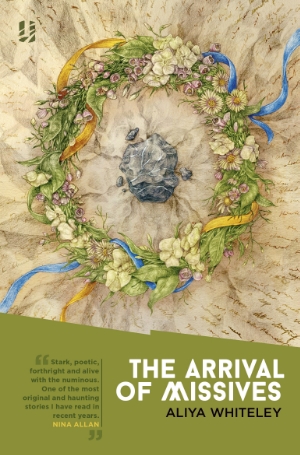
They said I was clever.This is The Arrival of Missives, by Aliya Whiteley.
I see now they meant that I was bookish, and suited to becoming a learned woman. A learned woman is a very different object from a wise man. I have had no experience of life; how could I see all the traps, particularly the ones that looked most like my own choices, my own happiness? Keats did not warn me, and neither did Dickens. I did not find myself within their writings.
This is a very weird story. In a good way. You know I like weird.
Whiteley's 2014 novella, The Beauty, is one of the most original and unsettling things I'd ever read. So I was ready for this.
Whiteley's recently released novella, The Arrival of Missives, starts off making you believe it's something else. A coming-of-age story, set in the past. I couldn't be sure at first if it was the real past or an imagined past. There was war. It becomes clear that this was the Great War, but war is done now. The setting is gently bucolic. Only it's not. You can feel some darkness lurking there. The story unfolds in "the place where the plans of the old and young do not quite meet."
Shirley is expected to marry someone capable, who can run the farm as her father ages. But Shirley believes herself to be part of the new era, in which women will be recognized as having something to contribute to "the upward path of humanity." Shirley dreams of escaping the farm and going to college. She wants to be a teacher. She has cultivated an attraction to her own teacher.
Look how love coats me in a shiny slick that no grim thought can penetrate. It lights the dark, and distinguishes my being. I am set alight by it.Teacher has a secret he brought home from the war.
It reminds me very much of Bro, the first part of Vladimir Sorokin's Ice Trilogy. (Which I very much admired, though I have not yet read the rest of the trilogy. Missives is shorter by far and a swifter read.) Only instead of the Tunguska event, here the catalyst is the shrapnel of war. But in both cases something alien takes hold and demands action.
There are multiple sets of missives in this story. One is Mr Tiller's letters to Shirley, from teacher to student, a madman grasping for a shred of humanity and kindness. Another is correspondence from the college — an invitation to an interview, and then a decision letter. Another is from the future. In many ways they are the same.
Everywhere there is nature; on the farm it is made orderly and profitable, but elsewhere it is a wild tangle. And everywhere there are boys and men, and I feel Shirley's trepidation and diffidence. This is still a world ruled by men.
This is a story of how the old ways of thinking embed themselves and harden. But Shirley "will not be a foot soldier for pale old men, no matter where they live or what pretty patterns they weave." Perhaps it also a story of how women are patient like water, wearing away at stone.
For love is not the high ideal of beauty, of sacrifice, of noble deeds and chaste embraces that I had imagined when once I dreamed of Mr Tiller. It is a dirty business, of wanting and struggling and making do, and being each other's comfort because the world is cruel and there are few who want to do right by you with no thought of their own needs.With all the intensity of a schoolgirl's heart and mind.
Once I thought that a bitter teacher spoils a pupil; I wonder now if there is not an innate bitterness at the heart of education, which always comes with hidden meanings and a high cost.I highly recommend The Arrival of Missives. Poetic and engrossing. Quietly weird and patiently feminist.
Interview with Whiteley at The Thinker's Garden.
Excerpt.


