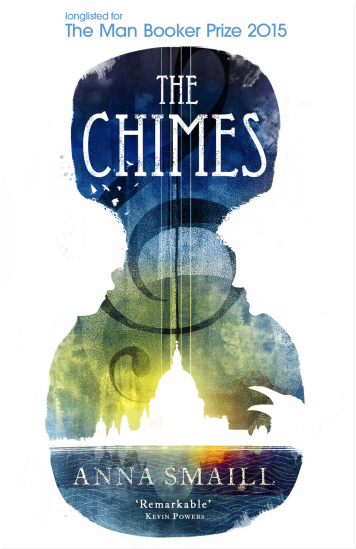
The Chimes, by Anna Smaill, is about memory and about music."Do you know what steals your memories?"
I look at him. Because it is a strange question, one that has no answer and many answers. The river of sleep take memories down in the murk and silt. Night and the darkness take them. Waking takes them. Or our own sadness. Or maybe it's the forgetting is like a spore of blight inside each memory itself, and the two cannot ever be separated.

It's poetic and mysterious from the outset. A little Dickensian, but it's not bustling with life so much as buzzing in your head.
The jacket description explains some of the Chimes world, but it's not till I was well past a third of the way through that the world became clear.
Simon keeps his memories close. It seems people have a hard time keeping memories in their heads; they transfer them to objects. Simon can access a memory by examining an object. If you lose your objects, you're in trouble.
When Simon comes to London, the gang he runs with uses music to navigate the city, the tunes describing the paths they take, helping them to find the objects of their hunt as well as helping them find their way home.
He sings and time stands still, as if he is walking on water. His voice is stark and true, and in it there are stretches of empty skies and a bright rime of salt.It's common wisdom that with the right music, you either forget everything or remember everything. The Chimes takes this aphorism to its dystopic extreme. Personal music links closely to memory, but the public music of the Chimes issued by the Order has a dulling effect, to keep the masses in line.
The language of The Chimes is punctuated with musical terminology; movements are subito, lento, presto. The poetry of "the sunlight's pale violence" drips off every page.
On my palm is a nugget of Pale. About three ounces, and shined with soapy, idle gleam in the thin light, as beautiful as anything I've ever seen. It pulses with silence.At times I wished it were a little less beautiful. The evil at the heart of this dystopia is clouded by the beautiful language. But maybe that's the point: the musicality can obfuscate the reality.
See last year's review in the Guardian.