Showing posts with label Jeanette Winterson. Show all posts

Sunday, August 20, 2017

Apocalyptic body song

"There is no self and other," she said, laughing into the mouth of death, the blue light at her temple gleaming laser-like into the sky and surrounding air, the song in her head crescendoing in tidal waves and reverberating in the bones of every man, woman, and child around her, her armies plunging and rising as if carried by apocalyptic body song.

And when she rested her body down upon the dirt, arms spread, legs spread, face down, there was a breach to history as well as evolution.

And the sky lit with fire, half from the weapons of his attack, half from her summoning of the earth and all its calderas — war and decreation all at once, a seeming impossibility.
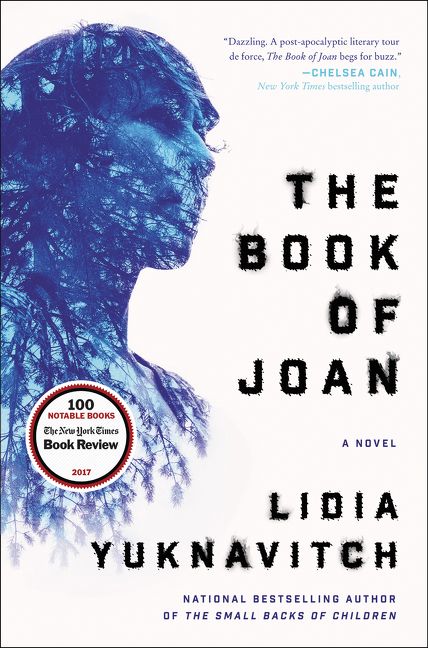
It's been a while since I read The Book of Joan, but I think I still have things to say about it.

It was not an easy read for me. Overly literary, almost poetic. That's not always a bad thing. Usually I would blame myself for not connecting with a book. For some reason, this time, I am perfectly comfortable in not taking the blame. Another time, another place, I imagine I would feel similarly, just that I might explain it away differently.

I mean, "apocalyptic body song." Come on.

While the turns of phrase are sometimes beautiful, they took me out of the story rather than propel me along by fleshing it out.

That said, there's an awful lot to think about here. The trajectory on which our planet is headed, ecologically, politically, maybe morally. "We are what happens when the seemingly unthinkable celebrity rises to power." Resources. "Reproduction wasn't what we mourned. We mourned the carnal." The nature of love, gender, energy, power, narrative. "I wonder sometimes if that's why grafting was born. It restores us to the evidence of a body." Physicality and magicality. "The physical world seemed only a membrane between humans and the speed and hum of information." Rebellion.

In 2049 there is a space station colony where live — if you can call it that — Earth's last survivors, among whom 49-year-old Christine, soon to be "aged out" and thus having nothing to lose, grafts the story of Joan onto her body. "What is the word for her body?"

[It's hard not to think that I would be aged out soon, too.]

[It's hard not to think of Jeanette Winterson's Written on the Body. It's been eons since I read it, I don't remember it, but I'm going to go out on a limb and say these novels share some themes and theory.]
Two things have always ruptured up and through hegemony: art and bodies. That is how art has preserved its toehold in our universe. Where there was poverty, there was also a painting someone stared at until it filled them with grateful treas. Where there was genocide, there was a song that refused to quiet. Where a planet was forsaken, there was someone telling a story with their last breath, and someone else carrying it like DNA, or star junk. Hidden matter.
Reviews
Shirin Neshat. Divine Rebellion, 2012.
Los Angeles Review of Books: Retrofuturist Feminism
Now is a fine time for tales of women's resistance, which, above all else, is what The Book of Joan has on offer. Lidia Yuknavitch mines literary and political history for impressive, timely heroines based on the iconic Joan of Arc and her contemporary Christine de Pizan, the only chronicler to write during Joan’s lifetime. Yuknavitch grafts these findings onto layers of material drawn equally from contemporary critical theory, our dire political and ecological realities, and an array of speculative fiction ranging from Shakespeare's The Tempest to Philip K. Dick's Do Androids Dream of Electric Sheep? In the convoluted folds and counterfolds of her narrative, Yuknavitch binds these various strains together with the fates of an Earth that has not quite survived eco-catastrophe and a parasitic sky realm, CIEL, ruled over by Jean de Men, a sadistic and egotistical television-billionaire-become-dictator: "His is a journey from opportunistic showman, to worshipped celebrity, to billionaire, to fascistic power monger," a rise made possible by the "acquiescence" of the powerful and wealthy.
The Rumpus: "A Full-Throated Cry from a Clarion"
In The Book of Joan, the last members of the human race, having "ascended" to a colony in space after a violent event, have lost their sexual organs in a devolutionary process. Insects and reptiles populate the station where these semi-humans orbit a dead Earth; the bugs and lizards are neither animal nor synthetic, but something between. The relationship of Joan, around whom the book revolves, to her companion Leone, is not sexual or platonic but something else. Everything in the novel is both-and, not either-or.
Tor.com: "Bodies in Space"
When you center a story in the body, particularly the female body, you're going to have to grapple with ideas of autonomy, consent, life and death. We like the female body when it is wet, unless that wet is urine or period blood. We like the female body when it is DTF, not as much when it is Down To Eat or Down To Fight or, Ishtar save us, Down To Think. As the book twists and turns and changes shape it becomes far less the familiar story of a young girl leading a war, or becoming a nation's sacrificial lamb, and becomes much more about women having control over what is done to their bodies. It also mediates long and hard on those people who want to assert their desire on other people, animals, or the Earth itself.
********** 
I can't imagine whom I would recommend this book to.
The beauty is all gone now — but the vastness remains, and I can almost feel beauty just under the surface of things. It hurts to look at it.

Thursday, February 16, 2017

The spiral of us

I don't know how I came to have this book. I've had it for some time, and I know I didn't buy it or steal it. Friends deny giving it to me. Having established that it evidently dropped from nowhere onto my stack, I took it for a sign.

My reading in January had been not exactly depressing, and not heavy, yet it weighed. It felt decidedly male. No, I don't quite know what I mean by this. Coupland, Gaiman, Pynchon, and more, all writing boys' stories. I wanted something... not gentler exactly... More measured?
The lost and found/found and lost is like a section of our DNA. In the spiral of us is the story we can't tell — the story we tell in single lines, separated from one another not by neat spaces but by torn-out years.

Emerson said that the rarest thing on the planet is a truly individual action — but I'd set the bar at a story told. It's why the nineteenth century writers favoured such long and satisfyingly plotted novels. Some of them — like George Eliot — really believed there was something to tell and that we could tell it. Dickens knew very well that we could not, but he told it anyway, glittering and bravura. It's one way of defying chaos — the kind of Chaos, with a capital C, that can't be avoided; the exuberant, unfolding, unpredictable universe, expanding when it should be contracting, made largely of something that is not something but nothing — dark energy, anti-matter. A thing unconfined. What to say when the certainties fail?

Words are the part of silence that can be spoken.
I think I found... that something in The Stone Gods, by Jeanette Winterson, though it didn't entirely work for me.

It's too compressed a book to satisfactorily be all the things it thought about being. It's a sci-fi parable that blends philosophy, anthropology and humour, but it's suddenly a travelogue from the 1700s, deciphering the warring cultures of Easter Island, and then an urban thriller, on the run through society's fringes. Futuristic yet ancient. Space pirates. A resistance movement. A cautionary environmentalist tale. And a love story. Stories within stories. In about 200 pages.

I don't mind that the connections are somewhat opaque, and I generally love Winterson's rhythm, her way with words (sparse but pregnant). But here the change in tone from one narrative to the next, as well as from character to character, felt like a self-indulgent exercise. It's all too deliberate, built for show. Winterson's poetry did not flow naturally out of it; or the characters did not fit comfortably under the umbrella of her poetry. This book demands a lot of the reader, and I'm not sure it's rewarded.

But as one character reminds us: "Stories are always true. It's the facts that mislead."

While I didn't love The Stone Gods as a novel, it provides an endless source of food for thought and conversation. Among its topics for consideration: We have destroyed our planet, depleted its resources, and therefore must colonize a new one (first priority: build a mall). A future with predictably customized advertising and customer service. Genetic manipulation. No one ages anymore. No one gets pregnant anymore (that's what test tubes are for). What is natural? The kernel of our consciousness and "humanity." Machine learning and the inevitability of a singularity. Robo sapiens. Cultural bias, but also species bias. The eery feeling that our future may be a past that we've already experienced — this may not be the first planet we have inhabited and destroyed. The paradox that technology makes us stupid. "Love is an experiment." Is that enough?
Everything is imprinted for ever with what it once was.

Is that true?
Ursula K Le Guin in the Guardian.

Tuesday, January 27, 2009

The story so far

I've been reading. I've been lost in my reading — in good ways and in bad.

It started with The Savage Detectives. I started it over the Christmas break, and it was my little oasis of poetry, to shut the world off — the family, the noise — for a few minutes a day and immerse myself in a book.

So I loved the start of it, wanted to know more of the visceral realist movement in Mexico. Then it got weird. The second section of the book, called "The Savage Detectives," consists of the journal entries of a varied cross-section of people, recalling certain events, or nonevents, in which the new visceral realists we'd come to know in the first section played peripheral roles. Then I felt lost. I was somewhat startled to find myself dislocated in space and time, over and over again. (Who are the detectives here anyway? And what's so savage about them?) Then I gave myself over to it.

But the whole time I'm thinking: How did someone manage to craft a novel out of all this? Is it really a novel? And do I really like it?

These tiny windows onto these poets who passed through random people's lives. This interests me, as a technique, as well as in life, because, well, how much do we know anyone really? The size of the window varies, but even to live with someone for years, sharing nights and days, whole and endless, is there ever complete entry into their inner life?

This, then, is how one writes? Find a window, open it wider, wider. And when it doesn't open any further, find another window?

"One day I drank five Coca-Colas and suddenly I felt sick, as if the sun had filtered down into my Cokes and I'd drunk it without realizing." This is a magical sentence. I've read it over countless times. I still don't get it. Sick — like the sun would poison your drink; drinking the sun would poison you. And that doesn't seem quite right, it's not the glass of Florida sunshine we down at breakfast. But then it's not the Florida sun, is it? And I remember seeing the desert shimmer in the south of Tunisia, the sad little zoo with the trick camel that drank water from a Coke bottle; I remember The Sheltering Sky and I remember Under the Volcano, and pretty much the only thing I remember about the both of them is the feeling of heat, the exhaustion of it, like drinking a poison sun. It's a plain little sentence, but I love it.

Excerpts:
Stars like holographic projections
Two islands

Then I started the seahorse book (so called by Helena for the illustration on its cover): Lighthousekeeping, by Jeanette Winterson. I started by loving it. So much the opposite of Bolaño, so spare; poetic with a delicate poignancy of observation. Not Bolaño's rapturous flood of images and emotions.

Bolaño is the poetry of excess. Winterson is a negative; it's what's left after all excess is removed. I don't know how to substantiate this. It's a feeling. Visceral. There is a time for Winterson's stillness. And I needed to be stilled, a little, in my reading. But I get a rush from the bombardment Bolaño levels at me. Makes me feel alive. Winterson leaves me feeling longing, empty. Bolaño may tear out my innards, but at least I see the innards, know what and where they are, as I gather it all up into myself again. It's something visceral.

Lighthousekeeping starts in a fairytale haze, through which eternal truths seem to shine. How does she write this thing? Few words, but all, I'm sure, carefully chosen.

Darkness was a presence. I learned to see in it, I learned to see through it, and I learned to see the darkness of my own.

Pew did not speak. I didn't know if he was kind or unkind, or what he intended to do with me. He had lived alone all his life.

That first night, Pew cooked the sausage in darkness. No, Pew cooked the sausage with darkness. It was the kind of dark you can taste. That's what we ate: sausages and darkness.


And there was talk of story, without all that much story actually being divulged. Wherever a story starts, one could always go back a little further, to an earlier beginning, just as stories always go on well after the ending. How can you tell a story these days without acknowledging this? And it all made a calm and rational sense to me.

Then it got weird. Suddenly the fairy tale was gone and we were in modern times trying to make it sound like a fairy tale, all cryptic proclamations of love, all airy-fairy. And she lost me.

But all the same, I wonder. How did she write this, these disparate tableaux laid on top of each other to make something called a novel?

I noted an obvious debt to Doris Lessing:

The doctor leaned back in his chair. "Do you keep a diary?"

"I have a collection of silver notebooks."

"Are they consistent?"

"Yes. I buy them from the same department store."

"I mean, do you keep on record or your life, or several? Do you feel you have more than one life perhaps?"

"Of course I do. It would be impossible to tell one single story."

"Perhaps you should try."

"A beginning, a middle, and an end?"

"Something like that — yes."


Then something more visceral (though, somehow, fairly emotionlessly told):

My heart is a muscle with four valves. It beats 101,000 times a day, it pumps eight pints of blood around my body. Science can bypass it, but I can't. I say I give it to you, but I never do.


...reminding me of "How I Finally Lost My Heart."

Then I read more Doris Lessing: On Cats. It's light, and deft, and it's about cats, wonderful cats! This is not a fluffy, sentimental book. This is about weird creatures with secret lives. And I wonder how she does it, there's no particular way about her, or her words; it's all done without pretension, straight up. She just has the most interesting things to say.

Now, at the end of January, in the deep of winter, I am reading The Thirteenth Tale, by Diane Setterfield, and I wish I could stay in bed all day reading. I've been suspicious of this book; overhyped, I thought. But on impulse I dragged it out of the bargain bin the other day, and I haven't been able to put it down since. It feels old-fashioned (and I don't know what that means); traditional: extolling the beginning-middle-end that Winterson denies. It is comfortable, if slightly (deliciously) eery, and makes me want to stay still and lost and blanketed till it's done.

And this is how I'm learning to write. Reading has always been a window onto another world, but now I'm seeing that writing is too. I see so many windows these days — in the metro, in my coworkers' phone conversations, in other internet lives. Some days there is even time enough to peer through them. It's not a matter of escape, but simply of seeing something else, something outside myself. (If I've learned anything this last year it's to allow myself to be lifted out of myself, to be lifted, to lift myself.) To shape a novel is to find where the views through various windows intersect.