The 2016 Nobel prize in literature will be announced Thursday, October 13.
New Republic gives a rundown of who's in the running, in full awareness that there are more factors at play than merely the quality of the work.
I've been rooting for Adam Zagajewski for several years. Because Polish poets rock. But his rank has been slipping, and another Eastern European after Alexievich is unlikely.
Adonis has been favoured by the odds for about a decade now. This choice would not surprise me. I'm not very familiar with his work; it doesn't really speak to me. Poetry's like that.
Haruki Murakami would be disappointing. Entertaining as his books can be, I think he lacks depth.
Margaret Atwood is deserving. I'm surprised she didn't win years ago, but as a Canadian she may have several more years to wait.
Ursula K. Le Guin would be awesome. It may be America's turn, but perhaps she's too genre.
Elena Ferrante would be an inspired choice, an opportunity for the committee to send a message about privacy rights, women's rights, or the intersection of truth and fiction. No odds listed just a few days ago, but now she does.
Currently leading Ladbrokes at 4/1: Kenyan writer Ngugi wa Thiong’o — completely unknown to me, but he has the right geography to be a winner this year.
But the odds are changing daily. The Guardian covers some of the movement.
Showing posts with label Svetlana Alexievich. Show all posts
Showing posts with label Svetlana Alexievich. Show all posts
Tuesday, October 11, 2016

Sunday, March 06, 2016
Man does not actually accommodate science very much — he gets in the way of it
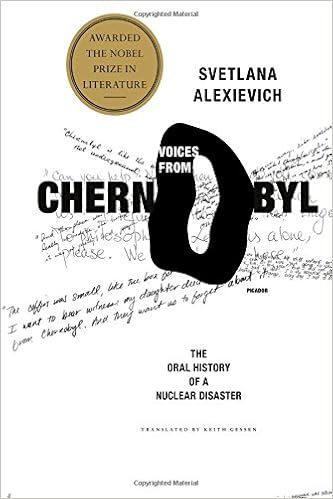
Sometimes I get strange thoughts, sometimes I think Chernobyl saved me, forced me to think. My soul expanded.Voices from Chernobyl: The Oral History of a Nuclear Disaster, by Svetlana Alexievich, is an utterly devastating document, assembled some 10 years after the 1986 accident at the nuclear power plant in northern Ukraine.
These are the accounts of witnesses and survivors: power plant physicists, emergency workers, and local farmers; those in power and those following orders; those who left, those who stayed, those who returned.
The scope of this tragedy is so vast; it deals in ignorance, incompetence, and a sovietism that blends pig-headedness, denial, and a deliberate attempt to cover up certain facts.
I don't think anyone needs convincing that Chernobyl was a disaster, both the fact of it and how it was managed. Astoundingly, for many, although the dangers were already known, it was preferred over the alternative. Some people, mostly elderly, refused to be evacuated, or returned shortly thereafter. This was the only land, the only life, they'd known. Others, they felt safer living with the physical threat of radiation in ready-made homes than enduring struggles for independence. People from Tajikistan and from Chechnya chose to resettle in the area surrounding Chernobyl because it was better than where they came from.
I was running away from the world. At first I hung around train stations, I liked it there, so many people and you're all by yourself. Then I came here. Freedom is here.While this book depicts real events, at times it reads like science fiction. In particular, the physical and mental preparation to journey into the zone, cleaning up upon return from the zone, and drinking vodka to protect against radiation (a fully sanctioned practice, but complete bullshit) — these read like they're straight out of Roadside Picnic. It's more than the use of the term "zone" — it's the dread that the term embodies.
Robots were initially deployed to clean up Chernobyl, but the radiation disrupted their electronics and they broke down; so human clean-up crews were used instead.
A former head of the Laboratory of the Institute of Nuclear Energy talks about growing up in the glory days of science and science fiction, dreaming of nuclear energy and space travel; nuclear physicists were the best and brightest, it was a "cult of physics."
Life is a surprising thing! A mysterious thing! Now I believe. I believe that the three-dimensional world has become crowded for mankind. Why is there such an interest in science fiction? Man is trying to tear himself away from the earth. He is trying to master different categories of time, different planets, not just this one. The apocalypse — nuclear winter — has already all been described in Western literature, as if they were rehearsing it, preparing for the future.Had Alexievich not been awarded a Nobel prize, I doubt I would've picked this book up; I'm not naturally a nonfiction reader, and the subject matter is depressing. But I'm glad I read it. It is horrific, but it is also eerily compelling. Since these are credited oral accounts, it's difficult to say that Alexievich is a great writer or even a journalist. Rather her craft is more like that of an editor's, curating the testimonials, selecting them and giving them structure and context. These accounts are sad, but they are balanced with occasional bits of humour and imbued with a deep sense of humanity. Alexievich very gently guides the reader from ground zero to Moscow and back again, navigating personal remembrances, military accounts, and the official record. Truly this is a literary chronicle of the soul.
[...]
Life is such a surprising thing! I love physics and thought that I wouldn't ever do anything but physics. But now I want to write. I want to write, for example, about how man does not actually accommodate science very much — he gets in the way of it. Or about how a few physicists could change the world. About a new dictatorship of physics and math. A whole new life has opened up for me.
One recurring theme is that of freedom. Tragedy, it seems, brings with it the gift of perspective and liberation. You come to know what's essential, and let go of the rest.
We'd ask each other: is this what our life is like? It was the first time we saw it from the outside. The very first time. It made a real impression. Like a smack to the head... There's a good joke: the nuclear half-life of a Kiev cake is thirty-six hours. So... And for me? It took me three years. Three years later I turned in my Party card. My little Red book. I became free in the Zone. Chernobyl blew my mind. It set me free.Excerpt.
Review.
Monday, February 15, 2016
Chernobyl apples

"If you don't play, you lose. There was a Ukrainian woman at the market selling big red apples. 'Come get your apples! Chernobyl apples!' Someone told her not to advertise that, no one will buy them. 'Don't worry!' she says. 'They buy them anyway. Some need them for their mother-in-law, some for their boss.'"— from Voices from Chernobyl: The Oral History of a Nuclear Disaster, by Svetlana Alexievich.
I'll take two, please.
Subscribe to:
Posts (Atom)

