Showing posts with label mathematics. Show all posts

Tuesday, June 29, 2021

Kill the King and fuck the Queen

Caissa, the muse of chess, was no less ruthless than the muse of poetry. Muses had a way of killing those whom they inspired.

The Eight, by Katherine Neville, originally published in 1988, is a rollicking thriller full of puzzles and esoteric plot points that starts with a chess match — one minor faceoff in a tournament for the ages. With symbols enough to make Robert Langdon's head swim, Neville takes us on a tour of the corridors of power connecting Napoleon and Catherine the Great with ancient Masonic orders as well as America's founding fathers. 

One must never lose sight of the big picture. And remember: a pawn that reaches the eighth rank can be promoted to Queen. (I mean, Caïssa wasn't one of the original Nine.)

"Chess, my dear, is such an Oedipal game. Kill the King and fuck the Queen, that's what it's all about. Psychologists love to follow chess players about to see if they wash their hands too much, sniff at old sneakers, or masturbate between sessions. Then they write it all up in the Journal of the AMA."

From 1970s Manhattan, our (female!) computer wiz protagonist sets off for Algeria on a work contract. The story slips through time, spanning cultures and continents — from Phoenician mythology and the French Revolution to the Colonies and the looming OPEC crisis. 

Basically, The Eight has a serious Assassin's Creed vibe, only the Pieces of Eden are pieces of a legendary chess set (fictitious), gifted to Charlemagne by the Moors, scattered across the globe. There's no overt alien angle, but it brushes up against arcane formulas like the Music of the Spheres that unlock secret knowledge like the elixir of life.

Neville imagines an encounter between Leonhard Euler and Johann Sebastien Bach in which the composer has translated the mathematician's knight's tour to music, producing philosophical alchemies where physical transmutations are wanting for proof.

Cameo appearances feature William Blake, Benedict Arnold, Jean-Jacques Rousseau, painter Jacques-Louis David, and William Wordsworth, among others.

"This one — the man with the head of a bird — is the great god Thoth. He was a doctor who could heal any illness. He invented writing, too. It was his job to write the name of everyone in the Book of the Dead. Shahin says each person has a secret name given him at birth, written on a stone, and handed to him when he dies. And each god had a number instead of a secret name...  [...] We believe the universe is comprised of number, and it is only a question of vibrating to the correct resonance of these numbers to become one with God."

Caïssa, by Domenico Maria Fratta
[When I was in grade 8, in the early 80s, my teacher was something of a computer enthusiast. We were the only grade-school classroom in the region with a computer "lab" — three monster machines we took turns on. I wrote a program in Basic to complete the calculations for an income tax return. Our teacher was an immovable force, physically resembling a very tall, thick brick wall. He had a bushy black moustache and a Ukrainian name, and he spoke softly but forcefully, like he might be holding you at gunpoint. Because he maintained our student records on computer, he argued that it was easier to call us by number than to remember our names. I was number 8. I've held an affinity for this number ever since.]

The novel is about chess the same way Alice Through the Looking Glass is, with no great insight into the game or its players, but it pauses to ponder whether to play the man or play the board, and speculates that chess's popularity in America is not evidence of intellect so much as of morality.

Neville quotes Polish Grand Master Savielly Tartakower: "Tactics is knowing what to do when there something to do. Strategy is knowing what to do when there is nothing to do." I realize I am becoming a master strategist of life.

The secret was not hidden beneath a rock in the desert. Nor was it tucked inside a musty library. It lay hidden within the softly whispered tales of these nomadic men. Moving across the sands by night, passing from mouth to mouth, the secret had moved as the sparks of a dying bonfire are scattered across the silent sands and buried in darkness. The secret was hidden in the very sounds of the desert, in the tales of her people — in the mysterious whispers of the rocks and stones themselves.

Saturday, November 08, 2014

"Matter is made up of a whole lot of nothing"

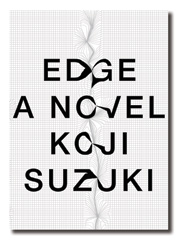
Edge, by Koji Suzuki, is billed as quantum horror. That is, it's horror derived from quantum physics. Or maybe it's that you don't know if it's really horror till you open the book and look inside.

The story is set in our now. It has some science-y stuff going on, but also a hint of supernatural. I don't think it quite qualifies as science fiction. Also, it's not post-apocalyptic dystopia; nothing post about it — this is how the apocalypse unfolds.

It starts with people disappearing, suddenly and inexplicably, there one minute gone the next. And math starts going wrong; pi and other "constants" and equations just aren't stable anymore.

Saeko starts investigating a set of disappearances. Ever since her own father disappeared 18 years previously, she's been rather obsessed with these types of occurrences. Not to mention having all kinds of daddy issues.

Saeko's father imparted to her all sorts of knowledge, along with a general wonder about the universe. Sadly, Suzuki flashes back on their time together, and the father's speeches are used as massive info dumps. How dreadfully boring, I thought; so glad he disappeared, I wouldn't be able to stand him another day. Maybe I was a little jaded after having just read an elegant and eloquent nonfiction treatment of similar issues, but I think Suzuki could give his readers a little more credit — no need for him to talk down to his readers the way Saeko's father evidently did to her.

But there's some food for deep thought buried in there: "The odds for the string of coincidences necessary to create our universe were basically nil." And, "matter is made up of a whole lot of nothing." "The real mystery is, why does the universe have any structure at all?"

So math and physics suddenly going all wonky is, I think, a fantastic concept. And a journalistic investigation into the strange disappearances could make for a good story too. But mash them together? And throw in a handful of coincidences, some supernatural-type visions, two-dimensional characters, and an appearance by the devil? I'm kind of glad that [spoiler alert] the world ends — having it go on just wouldn't make sense. Taken on their own, there are a couple deliciously creepy scenes and other interesting setups, but the book doesn't hang together for me.

Reviews

Friday, July 11, 2014

On the shoulders of giants

One of the MOOCs I recently completed was On Strategy: What Managers Can Learn from Great Philosophers. While it is to date the most disorganized and worst prepared online course I've taken, the content and exercises were in fact very valuable.

One module focused on how all genius is built on the shoulders of giants. The assignment was take one or two "giants" of Luc de Brabandere's lecture (featuring Plato, Aristotle, Descartes, Leibniz, Newton, Russell) and connect them with at least two others, not included in his model. We were to include at least one philosopher and one scientist. I further challenged myself to select women.

*************************

Hypatia of Alexandria was a fourth-century philosopher. As a Neoplatonist, she was heavily influenced by Plato and the Platonic tradition. As such, she valued and used logic and mathematical thinking. She taught the works of Plato and Aristotle in public lectures. 1

Although considered a pagan, she is significant for bridging classical antiquity to Christianity. Her murder heralded the coming dark ages. I think of her as a philosopher because she promoted a mode of logical thinking (based on Plato), but she contributed to the advancement of various geometrical concepts (also founded in Plato) and developed instruments for use in physics and astronomy. She assisted her father in the writing of his mathematical commentary, Euclid's Elements, which in turn influenced Newton.2

Descartes, Newton, and Leibniz later expanded on Hypatia's work.3

Ada Lovelace was a 19th-century computer programmer (i.e., mathematician and scientist) who worked with Charles Babbage in developing the Analytical Engine. Her study of mathematical and scientific concepts, in particular differential calculus (developed independently by Newton and Leibniz), framed by her poetical and metaphysical attitude, drove the conceptual leap to consider the possibilities of computing machines and their applications, far beyond the arithmetic of Leibniz's calculator.

"Whilst describing the revolutionary implications of Babbage's ideas, Lovelace wrote out the first computer programme […] and she made the sensational suggestion that such a device should be able to compose music if a suitable set of rules could be devised. She thus anticipated the development of both modern computing and artificial intelligence by more than a hundred years."4 Among the innovations she imagined (that would be realized only several generations later) were the subroutine (a set of reusable instructions), looping (running a useful set of instructions over and over) and the conditional jump (branching to specified instructions if a particular condition is satisfied).5 Certainly her own shoulders are broad enough for subsequent giants to stand on (such as Alan Turing). She desired also "to create a mathematical model for how the brain gives rise to thoughts and nerves to feelings ("a calculus of the nervous system"),"6 foreshadowing the entire field of cognitive neuroscience. [See also.]


*************************

I repost this assignment because Ada Lovelace seems to be in the air these days: she's been referenced on Halt and Catch Fire, which I've been watching; Melville House is publishing a book; and I get email from the Be Like Ada program the publisher mentions.

Someone outside of the course asked me, not why did I choose these women, but how I do even know about these women to be able to connect them with the other giants of history. The answer is, they're in the fiction I read. (I'll name, for example, All Men of Genius, by Lev AC Rosen, and Azazeel, by Youssef Ziedan, as obvious references, but there are others.)

Because everything is connected.

Sunday, February 16, 2014

A romance in lower mathematics

The Dot and the Line: A Romance in Lower Mathematics — book by Norton Juster, adapted into animated short by Chuck Jones.


(Via Brain Pickings.)

Moral of the story: "To the vector belong the spoils."

Thursday, October 17, 2013

We think, therefore we are


Cool math aside, in this TED talk Adam Spencer talks up the power of collaborative mindset and distributed computing projects (such as SETI and GIMPS), that this is the greatness of the human race.

Monday, July 01, 2013

Deconstructing music, literature, and semantics: from Schoenberg to Oulipo in 12 easy steps

It's a kind of Gödel, Escher, Bach 2.0. Watch this and you will become smarter (whether or not you understand it):