Sunday, February 26, 2017

"Elections are sugar-coated oppression."

"You can't exist today, much less be a dodgy, widely hated world leader, and not assume that your every action is being documented."
Infomocracy, by Malka Older, describes a future world operating on the principles of microdemocracy. Every 10 years, everyone worldwide votes for a government in their centenal, a kind of riding or district of 100,000 people, a representative democracy, where the party that wins the majority of centenals, wins the Supermajority — basically, runs the world. But crossing from one centenal to the next, an individual may be subject to a vastly different set of rules.

There's a push from some factions for electoral reform for nanodemocracy, to bring global government closer to one person, one vote. The technology of the future makes this perfectly feasible.

There's a passage from David Graeber's The Utopia of Rules: On Technology, Stupidity, and the Secret Joys of Bureaucracy that has always stuck with me:
Consider the ATM machine. In the last thirty years, I can't remember a single occasion in which I have asked an ATM machine for money and gotten an incorrect amount. Nor have I been able to find anyone I know who can. This is so true that in the wake of the 2000 U.S. presidential elections, when the public was being regaled with statistics on the 2.8 percent degree of error expected from this type of voting machine, or the 1.5 percent expected from that, some had the temerity to point out that in a country that defines itself as the world's greatest democracy, where elections are our very sacrament, we seem to just accept that voting machines will regularly miscount the vote, while every day hundreds of millions of ATM transactions take place with an overall zero percent rate of error. What does this say about what really matters to Americans as a nation?
According to Graeber, it would seem, America values money over democracy. The future of Infomocracy indicates a mature global economy; money and voting as values may be seen as equivalent. Electoral technology is accurate. But it is still susceptible to tampering.

Elections are administered and monitored by an organization, a great bureaucracy, called Information. The future is chockfull of big data, and Information watches it and processes it. It's an always-on Googly-glassbook, instastats, mega-infobubble world.

Given all the election difficulties plaguing our current world, Infomocracy's future system — where nationhood cedes to community-based voting blocks — makes sense on many levels. Until you remember two things: 1. Technology can be hacked. 2. Information is power.
"Information is a public good," one of the older men says with finality. "It may fail for technical reasons, and we may strategize about the best technical approach to get it back up. but we will not withhold Information once it is in our power to make it available. We cannot give ourselves the power to see and leave everyone else blind."
So, all is good, so long as we aspire to be our better selves. But it wouldn't be much of a thriller if that were all there were to it. Remind me someday to tell you about the busride last fall when I realized that maybe people aren't basically good.
"Surely you would prefer for the election system not to exist? We are working to eliminate it, or at the very least make it more realistic..."

The open question breaks the tension, and the sheikh laughs. "Why would we want to change it? There is nothing that suits us more than most of the world believing that their will is being carried out by governments that do exactly as they please."
Infomocracy is definitely a thriller, but who wins the election is not nearly so interesting a problem as the electoral process itself and the mystery of how information is wielded. I'll definitely be looking up the next books in this planned trilogy.

Living in an infomocracy.
Excerpt. (Chapters 1-5 are available online.)

This book is like any other book

I was feeling torn about what to read next, so I let the cat decide.

Rosie says, quite emphatically, paws down: The Passion According to G.H., by Clarice Lispector.

It opens with a note "To Possible Readers":
This book is like any other book. But I would be happy if it were only read by people whose souls are already formed.
This concerns me a little. I hope I'll be OK.

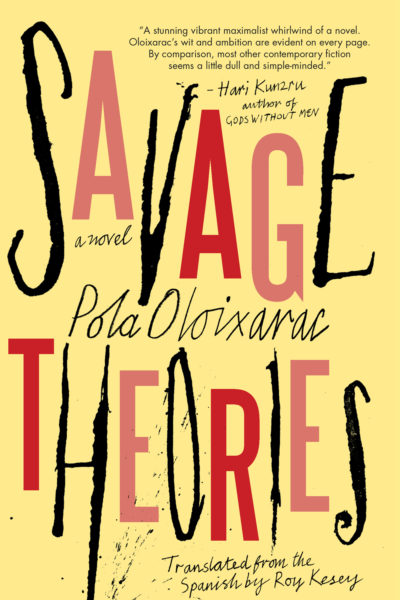
Lispector again blipped across my radar this week in a bookclub discussion of Pola Oloixarac's Savage Theories, when someone speculated whether there might be an intentional reference to The Passion in this passage:
A cockroach scuttled along the edge of the room. [...] I gave the order for Montaigne Michelle to set her ambush . . . Now! She purred toothily. The individual in question (a Blatella germanica) came forward a meter or so: Montaigne put it down with a single swipe of her paw. Flat on its back, its abdomen contracted in pain, the cockroach bent its antennae toward us. I believe that it sensed the formidable presence of its motionless adversary — perhaps, too, that of the impromptu Thucydides who sat nearby taking notes. Finally it managed to get back on its feet. And here is where this domestic tableau takes on transcendental dimensions: it was at this moment that, overawed by such brutality, irresistibly attracted to a power far superior to her own, the scene's victim advanced voluntarily toward the Predator, and bowed down to her, in a sign of Reverence.
Fittingly, it seems Lispector's novel offered itself up to the beast to be devoured in a similar way.

Thursday, February 23, 2017

She wasn't sure how to live

She used to think falling in love was alchemy, that animals had weddings, that coal was a gemstone, that mountains were hollow, that trees had hidden eyes!
The Portable Veblen, by Elizabeth McKenzie, was something of a disappointment.

I kept bumping up against this novel at the end of the year, and there's a squirrel on the cover, which I took for a sign. Why a squirrel would be a sign I won't explain here, but I bought a copy for my sister, and I read a library copy, hoping the squirrel had some secret wisdom to impart, to me, to us. Alas not.

The Portable Veblen is, in fact, a rom-com — not really my thing.

The New York Times sums up the novel as follows:
At 30, Veblen still surfs from one unchallenging administrative job to the next, conserving her real energy for her translation work for something called the Norwegian Diaspora Project in Oslo. She takes antidepressants every morning (Vivactil, citalopram). She never finished college. She prefers to read, bike and compile trivia about squirrels and become a secret expert on the life and ideas of the Norwegian-American economist Thorstein Veblen, for whom she was named.

For all its charm, bounce, radiant eccentrics and diverting episodes involving drug companies and squirrels, that is what "The Portable Veblen" is about: shaking the demented ghosts of our youth so that we can bind with clean spirits to someone in our adulthood.

Or, as Veblen puts it: "A wedding is the time and place to recognize the full clutch of the past in the negotiation of a shared future. Try devoting a few pages to that, Brides magazine!"

I won't give away how the book ends. But "The Portable Veblen" is a novel of such festive originality that it would be a shame to miss.
The Guardian called it "raw, weird and hilarious." According to the LA Times, it's "deep, wise and eccentric."

I don't see it — the originality, the weirdness. Because she talks to squirrels? I've read much stranger, more original things than this.
She relaxed and watched a family at a table nearby, the parents feeding the children, wiping their mouths, cleaning their hands, a father and mother and two children, the unit of them unsettling to her, though she couldn't say why. She looked away, at an older man eating by himself, and that unsettled her too. She wasn't sure how to live.
It feels like a missed opportunity to talk about the other Veblen's Theory of the Leisure Class and conspicuous consumption. This book is blah, blah, shitty childhood, blah, blah, first-world problems, blah, do I really love him, blah, do the right thing. It's all very sweet and light and nice.

Tuesday, February 21, 2017

Why we stand in line at nightclubs

— So, the human brain is designed to establish relationships only within small groups, and seeks constantly to reproduce the feeling of being "just amongst us." All attempts at socialization are intended to recreate within us a series of previously successful patterns of empathy, because . . . Aha! Because the only real human instinct is to flee into the forest depths. If this weren't the case, why would the State expend so much effort teaching us to love that which is social, and why such frantic insistence on the amorous-gregarious nature of the glorious Fatherland? Social training is an operating system composed of customs designed to minimize the pain one feels at finding oneself completely surrounded. Social aristocracies are brought into existence as a form of technology that enables the elite to tolerate the proximity of others, as another way to address the need for human contact felt by the I while simultaneously protecting it from the unwashed hordes via membership cards and club protocols. The presence of the bouncer ensures that the favored group will stay small. The charm exuded by the elite is the Ersatz of an evolutionary defect related to our genetic inability to be alone, which is to say, to rid ourselves of our fear of the forest — and to do so with sufficient speed.

The later is got, the more intense grew the couple's desire not to be turned away at the door.
— from Savage Theories, by Pola Oloixarac.

I haven't yet decided how I feel about this book. I'm only just past halfway.

At first it was quirky and clever, and I liked it.

Then it was all about sex, and it became tiresome. I questioned whether I was being a prude. (I'm not a prude.)

There are bursts that are funny and insightful, but then it gets pretentiously academic, and I feel stupid (I'm not stupid), and I wonder if the pretentiousness is tongue-in-cheek.

"Philosophy is Satan's playground."

It's not yet clear to me what Savage Theories is about. The theorizing seemed to be about sex, and the laws of attraction, and young people claiming and wielding their sexual awareness while also dissociating from it.

Then I think, it is about sex as a political act. Revolutionary. Subversive. "There couldn't be anything in this world more beautiful than working for justice and fucking in the name of the Fatherland." And then it is about power; of course it's about power. Predatory behaviour. Everyone's a predator.

Then there is the Theory of Egoic Transmissions. (I don't know.)

Also, I need a crash course in Argentine history. Montoneros and Trotskyites. The Dirty War.

So. I will educate myself on some of the issues in Savage Theories, but I'm not sure it will make me like it any better. Right now it feels a little too opaque for me to be able to connect with it.

One hundred pages to go before bedtime, and tomorrow will be bookclub, where I hope all will be explained.

Thursday, February 16, 2017

The spiral of us

I don't know how I came to have this book. I've had it for some time, and I know I didn't buy it or steal it. Friends deny giving it to me. Having established that it evidently dropped from nowhere onto my stack, I took it for a sign.

My reading in January had been not exactly depressing, and not heavy, yet it weighed. It felt decidedly male. No, I don't quite know what I mean by this. Coupland, Gaiman, Pynchon, and more, all writing boys' stories. I wanted something... not gentler exactly... More measured?
The lost and found/found and lost is like a section of our DNA. In the spiral of us is the story we can't tell — the story we tell in single lines, separated from one another not by neat spaces but by torn-out years.

Emerson said that the rarest thing on the planet is a truly individual action — but I'd set the bar at a story told. It's why the nineteenth century writers favoured such long and satisfyingly plotted novels. Some of them — like George Eliot — really believed there was something to tell and that we could tell it. Dickens knew very well that we could not, but he told it anyway, glittering and bravura. It's one way of defying chaos — the kind of Chaos, with a capital C, that can't be avoided; the exuberant, unfolding, unpredictable universe, expanding when it should be contracting, made largely of something that is not something but nothing — dark energy, anti-matter. A thing unconfined. What to say when the certainties fail?

Words are the part of silence that can be spoken.
I think I found... that something in The Stone Gods, by Jeanette Winterson, though it didn't entirely work for me.

It's too compressed a book to satisfactorily be all the things it thought about being. It's a sci-fi parable that blends philosophy, anthropology and humour, but it's suddenly a travelogue from the 1700s, deciphering the warring cultures of Easter Island, and then an urban thriller, on the run through society's fringes. Futuristic yet ancient. Space pirates. A resistance movement. A cautionary environmentalist tale. And a love story. Stories within stories. In about 200 pages.

I don't mind that the connections are somewhat opaque, and I generally love Winterson's rhythm, her way with words (sparse but pregnant). But here the change in tone from one narrative to the next, as well as from character to character, felt like a self-indulgent exercise. It's all too deliberate, built for show. Winterson's poetry did not flow naturally out of it; or the characters did not fit comfortably under the umbrella of her poetry. This book demands a lot of the reader, and I'm not sure it's rewarded.

But as one character reminds us: "Stories are always true. It's the facts that mislead."

While I didn't love The Stone Gods as a novel, it provides an endless source of food for thought and conversation. Among its topics for consideration: We have destroyed our planet, depleted its resources, and therefore must colonize a new one (first priority: build a mall). A future with predictably customized advertising and customer service. Genetic manipulation. No one ages anymore. No one gets pregnant anymore (that's what test tubes are for). What is natural? The kernel of our consciousness and "humanity." Machine learning and the inevitability of a singularity. Robo sapiens. Cultural bias, but also species bias. The eery feeling that our future may be a past that we've already experienced — this may not be the first planet we have inhabited and destroyed. The paradox that technology makes us stupid. "Love is an experiment." Is that enough?
Everything is imprinted for ever with what it once was.

Is that true?
Ursula K Le Guin in the Guardian.

Monday, February 13, 2017

The problem with doublethink

I came across an article this morning, posted to Facebook by a Trump supporter, that troubles me for reasons quite beyond the partisan rhetoric. To me it exhibits a warped way of thinking, but most troublesome is that I'm unable to pinpoint why.

Written by John Nolte, a former Breibart editor, BE AFRAID: The Left's Resistance Movement Is EXACTLY as Orwell Depicted It (click at your own risk) proclaims "how truly Orwellian it is for the Left to pretend they are on the side of 1984's angels."

There has been renewed interest of late in George Orwell's Nineteen Eighty-Four.

What is increasingly troubling to me is how the same "evidence" can be held by both sides to argue opposite things. I acknowledge that I live in a bubble of my own devising; my personal bias is to dismiss the other side as dimwitted. But I'm certain that from their own bubble they share the same view of me.

So, how to objectively identify the the parts of and the problems with the arguments?

Quite serendipitously, this past weekend I was sorting through the last 3 boxes — milk crates, actually — of random stuff I need to contend with after having moved a year ago, among which I found a beige exercise book filled with notes made by my eighth-grade self (who even was I back then?) on CoRT III. This unit of CoRT Thinking covers debate and conflict and employs various strategies to examine both sides (EBS) by assessing the structure and value of the arguments.

My eighth-grade self was aware of 1984. The actual year was just around the corner, and soon, my very own big brother would take me to see the film adaptation.

My critical-thinking skills aren't what they used to be, so let me channel my eighth-grade self.

Nolte writes, "Orwell's seminal work is a cautionary tale aimed directly at the king of all Leftists, Josef Stalin."

Problem 1. Equating Stalinism with today's leftists. True that Orwell took aim at Stalin, but he is not the king of all Leftists.

I don't know a single left-leaning individual (and being a reasonably average university-educated, gainfully employed Canadian, I know a few) who condones Stalin. People who vote left of centre are not Orwell's target. Orwell stated that this and other works were "written, directly or indirectly, against totalitarianism and for democratic socialism." Stalin was a totalitarian; I am, more or less, a democratic socialist. Very few left-leaning people would even self-identify as communists.

Problem 2. Interpreting the aims of the left as including:
  • "the horrors of an all-powerful central government (that knows what's best for us)" — Might that not describe a president who signs executive orders for the good of us all, because he knows things we don't, and he understands the law better than the lawyers do?
  • "speech and thought policing" — Like discrediting all media as fake news.
  • "endless wars" — Who wants that?
  • "the elimination of the family and gender differences" — Nobody wants to eliminate family! As for the elimination of gender differences, if there's one thing the USSR deserves credit for it's for having produced so many women doctors, engineers, scientists.
Nolte's article then summarizes (his view of) the state of today:
We conservatives are not without our flaws, but we most certainly are not the ones running around portraying a centralized federal government as the solution to every problem, policing language, brutalizing thought-apostates, seeking the destruction of religious faith, spewing anti-science nonsense about gender-fluidity, or doing everything possible to eliminate the nuclear family — including the replacement of the father with a government check. We are also not the ones ginning up endless race and gender wars based on viralized lies and hoaxed hate crimes
Problem 3. I don't even know where to start in picking apart that paragraph. It doesn't remotely resemble the world I live in or reflect the aims of people I know. Who wants the destruction of religious faith? (Perhaps those who fear Islam?) Who is spewing anti-science nonsense? (Maybe the climate change deniers?) I might concede the need to draw attention to race and gender wars, but based on the fact that gross inequalities exist. I'm guessing that John Nolte is neither black nor a woman.

Problem 4. Calling the media Big Brother is a false equivalence. Is that just misunderstanding the source material? Big Brother is the surveillance state. It's the NSA. It's CCTV cameras. It's big data without regulation. The media does not see all.
"Here we were in the middle of Reagan's golden-era. It is Morning in America and I'm supposed to worry about words being placed off limits, guys in dresses peeing next to my daughter, and the Christian Gospels being portrayed on 24/7 cable news as bigotry?"
Problem 5. Reagan's era was not all golden. I was just a teenager, but I recall it as a time of Cold War terror, living under the constant threat of nuclear war. Or meltdown. Doesn't he remember The Day After? Or Ultravox? Or Chernobyl?

Problem 6. I can no longer tell which side Nolte is on. I thought he was worried about guys in dresses peeing next to his daughter. So, he's not? Or is it just that it's thirty years too early for that worry? Is this a time-travel problem?
Now take a good long look around and what you'll see is the deeply-disturbing spectacle of the American Left using their own Resistance movement in the exact same way Big Brother did — to out dissenters, to crush the souls of dissenters, to make violence against dissent, to make an example of those who think in ways unapproved by the Party, to silence, humiliate and punish Thought Criminals.
Problem 7. My head now hurts from trying to unravel this. The Left is Big Brother, the Party, and the Resistance. But the Resistance are the Thought Criminals. So the Left is everyone.

This is the point at which I throw my hands up in the air. It's illogical. Does not compute.

Without engaging in politics, without name calling or condescension, is it possible to define the flaws in this article and argue against it?

This is doublethink: "We have a president capable of standing in the rain and saying it was a sunny day."

Wednesday, February 08, 2017

Remainder


A feature film based on Tom McCarthy's mindfuckingly awesome novel. A couple showings this week at Phi Centre. I think I need to see this.
All great enterprises are about logistics. Not genius or inspiration or flights of imagination, skill or cunning, but logistics.
― from Remainder, by Tom McCarthy.

Thursday, February 02, 2017

A salad of despair

Yet at least he had believed in the cars, maybe to excess: how could he not, seeing people poorer than him come in, Negro, Mexican, cracker, a parade seven days a week, bring with them the most godawful of trade-ins: motorized, metal extensions of themselves, of their families and what their whole lives must be like, out there so naked for anybody, a stranger like himself, to look at, frame cockeyed, rusty underneath, fender repainted in a shade just off enough to depress the value, if not Mucho himself, inside smelling hopelessly of children, of supermarket booze, two, sometimes three generations of cigarette smokers, or only of dust — and when the cars were swept out you had to look at the actual residue of these lives, and there was no way of telling what things had been truly refused (when so little he supposed came by that out of fear most of it had to be taken and kept) and what had simply (perhaps tragically) been lost: clipped coupons promising savings of 5 or 10c, trading stamps, pink flyers advertising specials at the market, butts, tooth-shy combs, help-wanted ads, Yellow Pages torn from the phone book, rags of old underwear or dresses that already were period costumes, for wiping your own breath off the inside of a windshield with so you could see whatever it was, a movie, a woman or car you coveted, a cop who might pull you over just for drill, all the bits and pieces coated uniformly, like a salad of despair, in a grey dressing of ash, condensed exhaust, dust, body wastes — it made him sick to look, but he had to look. If it had been an outright junkyard, probably he could have stuck things out, made a career: the violence that had caused each wreck being infrequent enough, far enough away from him, to be miraculous, as each death, up till the moment of our own, is miraculous. But the endless rituals of trade-in, week after week, never got as far as violence or blood, and so were too plausible for the impressionable Mucho to take for long. Even if enough exposure to the unvarying grey sickness had somehow managed to immunize him, he could still never accept the way each owner, each shadow, filed in only to exchange a dented, malfunctioning version of himself for another, just as futureless, automotive projection of somebody else's life. As if it were the most natural thing. To Mucho it was horrible. Endless, convoluted incest.
— from The Crying of Lot 49, by Thomas Pynchon.

The life of a used car salesman sounds terrible.

Wednesday, February 01, 2017

Time didn't leak away as it should

A sudden mist, a mumble of thunder over the sea, the wind scurrying along the beach with its crop of old bones and litter, was sometimes all it took to make you feel as though something was about to happen. Though quite what, I didn't know.

I often thought there was too much time there. That the place was sick with it. Haunted by it. Time didn't leak away as it should. There was nowhere for it to go and no modernity to hurry it along. It collected as the black water did on the marshes and remained and stagnated in the same way.
The Loney, by Andrew Michael Hurley, was a real treat.

The Loney is creepy, in layered way. There's the suspicious religious community that's making a pilgrimage to this corner of England — something seems off about their dynamic, maybe they're too religious, and they definitely appear to be harbouring some secrets from the new priest. There's something the boy's not telling us about the old priest either.

Then there's the creepiness of Catholicism itself: the somber rites of Holy Week, every action steeped in prayer and tragedy. (Having grown up Catholic, this element holds a great deal of interest for me in trying to gauge what is a normal level of religiosity.)

The setting is utterly windswept and gothic, a bleak house by the sea. And the tower across the way, where hanged the witch who lived there. Secret rooms. An underground shrine. Pagan charms and strange goings on in the woods at night.
The Church of the Sacred Heart was an ancient place — dark and squat and glistening amphibiously in the rain.
The locals are mostly unwelcoming, thoroughly unpleasant.
Like most drunks, Billy bypassed the small talk and slapped his bleeding, broken heart into my palm like a lump of raw beef.
Creepy also is the disconnect between now and then. The Loney is a coming-of-age story in a way — of two teenage brothers growing up in the 1970s. Back then, Hanny was mute, and everyone prayed for a miracle. The story is told by the other brother. Something happened that drastically changed how they are today.

I don't recall how I came to learn of this book, but I'm glad I did. A perfect read for a damp blustery day.

Reviews
The Guardian: The Loney by Andrew Michael Hurley review — horror days by the sea:
This is a novel of the unsaid, the implied, the barely grasped or understood, crammed with dark holes and blurry spaces that your imagination feels compelled to fill.
The Telegraph: The Loney by Andrew Michael Hurley, review: 'haunted and haunting':
The Loney is certainly a book about bloody rituals and ancient survivals, but it pays considerably more attention to the mechanisms of Christian faith, and to the strange arcana of esoteric Catholicism, than it does to the half-glimpsed paganism of this timeless corner of England.

Sunday, January 29, 2017

Another world's intrusion into this one

Bulgarian edition, 1990
This book is funny and messed with my mind in a most wonderful way. I have no idea what to make of it, and I loved it. The Crying of Lot 49, by Thomas Pynchon. This is my first Pynchon.

It preys on a paranoid sense of conspiracy, both in the protagonist, Oedipa Maas, and the reader.

How strange it is to be reading the words "REPORT ALL OBSCENE MAIL TO YOUR POTSMASTER" while standing in the metro waiting for the doors to close, and at the last moment a young man who bears a striking resemblance to Putin should jump in, squeezing in behind my shoulder. He's wearing a standard-issue Canada Post jacket. I read about the Scope bar, and upon arriving at work I'm asked to proofread an ad for a conference called SCOPE. There's bourbon everywhere. Several(!) articles I read during the week reference Stockhausen, and Bakunin.

Oedipa Maas has been named executor of the estate of an old boyfriend. As she reviews his assets, she stumbles onto a massive conspiracy regarding the American postal system extending prior to the Civil War (an alternate history of which is also presented). She finds secret signs everywhere, but she herself is not comfortable with all the coincidence, and considers that it may all be in her head.

We are treated to a Jacobean revenge play, its variant editions, and an investigation into its origins that takes Oedipa to a used bookstore, a publisher, and a university professor. There's a scheme to recover bones for the purpose of making cigarette filters. The Yoyodyne corporation. A perpetual motion machine.
"You know what a miracle is. Not what Bakunin said. But another world's intrusion into this one. Most of the time we coexist peacefully, but when we do touch there's cataclysm. Like the church we hate, anarchists also believe in another world. Where revolutions break out spontaneous and leaderless, and the soul's talent for consensus allows the masses to work together without effort, automatic as the body itself. And yet, señá, if any of it should ever really happen that perfectly, I would also have to cry miracle. An anarchist miracle. Like your friend. He is too exactly and without flaw the thing we fight. In Mexico the privilegiado is always, to a finite percentage, redeemed — one of the people. Unmiraculous. But your friend, unless he's joking, is as terrifying to me as a Virgin appearing to an Indian."
There's a whole wiki devoted to this novel, and I read alongside it for a while. It was the note regarding Oedipa's shrink, Dr Hilarius, that caused me to trust in my own reading. The annotation gives a summary of Pope Saint Hilarius. But I truly don't see a need to look beyond the obvious: as a name, Hilarius is plain hilarious, only slightly more latinate and therefore doctory.

At some point I had to consciously decide not even to try to make sense of it all, let it wash over me, enjoy the ride. "Like all their inabilities to communicate, this too had a virtuous motive."

It reminds me of the best of Auster and the best of Murakami, but more self-assured, smarter. Wackier, yet in a seeming contradiction giving the impression of being more grounded in the real world. It feels loaded with possibility, and with possible interpretation.

Polish edition, 1990
There are a couple odd references to cancer. "The rest of the bones were used in the R&D phase of the filter programme, back around the early fifties, way before cancer." Did cancer not exist in the early fifties? Is it a symbol for communism? Some other sickness afflicting America? (Norman Mailer said, "Cancer is the growth of madness denied.") At another point, Oedipa lumps cancer together with things she doesn't want to think about. Is she turning a blind eye to some social responsibility? Or is she in denial about a personal, physical cancer? Is that what Maas is? Maybe it's merely her marriage that is the cancerous mass.
"There's a certain harassed style," she said, "you get to recognize. I thought only kids caused it. I guess not."
One reading of the book posits that it's one long acid trip. Dr Hilarius had wanted her to take part in a study, but she didn't trust him, and didn't take any of the pills her prescribed her (but perhaps this is a wish manifest through LSD, not reflecting reality).

The titular crying is that of an auctioneer. When lot 49, the dead man's collection of forged stamps, is put on the block, Oedipa hopes it will draw out a representative of Trystero, proving its existence once and for all. But the book ends as the auctioneer is clearing his throat. So the reader will never know. I feel Oedipa crying at this moment too, the way only a painting can make her cry.

Have you read The Crying of Lot 49? Do you have a theory?

Review in The New York Times (1966).
Review in The Quarterly Conversation.
Gallery of cover art.

Saturday, January 28, 2017

Dreams are built on dull facts

It has been many an age more since the crowds called for a liar. Mine is a lost art, and I shall be grateful to share it with thee." He turns aside, and lets me pass. We stand back out in the busy street.

"You're a liar?"

"The last liar," he says, slowly, sadly, observing the tower. In the light of day Thyme looks like an artefact recovered from some lost tomb. "Once, dreams were built of my tales. Quests formed by the skill of my words. But now there are only the whispers and rumours, and little room for a liar. Dreams are built on dull facts. Mine," he repeats, "is a lost art. Follow me, Manderlay, and we shall locate thy Sleepwalker." Reluctantly I do as I am told, wondering whether I have made a grave mistake.
Metronome, by Oliver Langmead, is a strange but beautiful dream of a book.

The story opens by introducing the reader to Manderlay. He's aged and living in a retirement home, but with his buddy Valentine, they still get up to some antics. Manderlay was once a violinist, and receives the occasional cheque for 40 pence in royalties whenever someone buys his album. Manderlay is lately troubled by his dreams, and the reader soon leaves the gently nostalgic blanket of the home to inhabit his dreamworld entirely.

The dreaminess is both a strength and a weakness. It allows for some very creative images, actions, and relationships, but it also falls back on dream logic to justify its course.

Manderlay's musical skills are called upon to help navigate the skyship Metronome, with a small group of righteous warriors engaged in an ultimate battle between good and evil.

I don't fully understand how all our dreamworlds intersect with each other. Each dream opens onto a collective unconscious, an evidently vast but common world, night after night.

I just couldn't buy into the workings of the dream logic. There are detailed battle scenes — something I'm simply not a fan of. I would've been happy to follow Manderlay's demise from the comfort of the retirement home, but that it not the book Langmead chose to write. The story also takes a religious turn; while not exactly didactic, I'm not entirely comfortable with the implications. I'm not one to turn away from stories just because they espouse a worldview different from mine, but in this case it posed an obstacle to my buying into the premise of the book.

Still, the scenery is steampunkishly breathtaking.
There are shapes hanging from the tower ahead of us: a tapestry of wooden walkways and scaffolding which make for a kind of peculiar set of docks. I can see the distant silhouettes of dock workers, high in the air, as if we are standing beneath crystal-clear depths of water and looking up at them. And moored at those docks is a singular ship, or mechanism, that defies easy understanding.

It looks as if someone has attempted to build a clock but did not know when to stop. It is a cataclysm of clockwork parts in synchronised motion arranged in the shape of a frigate. The ship has no sails, barely any hull beyond a few lengths of wood along its flanks, and between brass and copper lengths of girders, I can see endless cogs and cables, whirring and winding and ticking in gentle motion. The whole thing just hangs there, impossibly, in the sky.

I realise that I have forgotten to breathe.
Reviews
Andromeda Spaceways
Shoreline of Infinity

Sunday, January 22, 2017

No apparatus except gut fear and female cunning to examine this formless magic

Mujer Saljendo del Psicoanalista, Remedios Varo
In Mexico City they somehow wandered into an exhibition of paintings by the beautiful Spanish exile Remedios Varo: in the central paintings of a triptych, title 'Bordando el Manto Terrestre', were a number of frail girls with heart-shaped faces, huge eyes, spun-gold hair, prisoners in the top room of a circular tower, embroidering a kind of tapestry which spilled out the slit windows and into a void, seeking hopelessly to fill the void: for all the other buildings and creatures, all the waves, ships and forests of the earth were contained in this tapestry, and the tapestry was the world. Oedipa, perverse, had stood in front of the painting and cried. No one had noticed; she wore dark green bubble shades. For a moment she'd wondered if the seal around her sockets were tight enough to allow the tears simply to go on and fill up the entire lens space and never dry. She could carry the sadness of the moment with her that way forever, see the world refracted through those tears, those specific tears, as if indices as yet unfound varied in important ways from cry to cry. She had looked down at her feet and known, then, because of a painting, that what she stood on had only been woven together a couple thousand miles away in her own tower, was only by accident known as Mexico, and so Pierce had taken her away from nothing, there'd been no escape. What did she so desire to escape from? Such a captive maiden, having plenty of time to think, soon realizes that her tower, its height and architecture, are like her ego only incidental: and what really keeps here where she is is magic, anonymous and malignant, visited on her from outside and for no reason at all. Having no apparatus except gut fear and female cunning to examine this formless magic, to understand how it works, how to measure its field strength, count its lines of force, she may fall back on superstitions, or take up a useful hobby like embroidery, or go mad, or marry a disc jockey. If the tower is everywhere and the knight of deliverance no proof against its magic, what else?
— from The Crying of Lot 49, by Thomas Pynchon.

As with many references in The crying of Lot 49, I didn't know if Remedios Varo was real or fictitious. Real, it turns out. Her paintings are real.

I don't recognize her work as anything I've come across in the past; how can I have lived my life without knowing her? Whimsical yet dark. Feminist. Several of her works would feel at home within the world of The Crying of Lot 49.

I have a particular fondness for Woman Leaving the Psychoanalyst (above), as if she's pulled the cobwebs from her mind, and they are the psychoanalyst.

Oedipa Maas's shrink, Dr. Hilarius, has been trying to recruit her for an LSD study, but she has resisted. She doesn't trust him. I haven't entirely figured out Pynchon's attitude to women, or at least to this woman protagonist. It may not be important. But I have the feeling it is.

Bordando el Manto Terrestre, Remedios Varo

Has a painting ever made you cry?

Friday, January 20, 2017

What are we reading for?

I think we ought to read only the kind of books that wound or stab us. If the book we're reading doesn't wake us up with a blow to the head, what are we reading for? So that it will make us happy, as you write? Good Lord, we would be happy precisely if we had no books, and the kind of books that make us happy are the kind we could write ourselves if we had to. But we need books that affect us like a disaster, that grieve us deeply, like the death of someone we loved more than ourselves, like being banished into forests far from everyone, like a suicide. A book must be the axe for the frozen sea within us. That is my belief.
— from a letter to Oskar Pollak from Franz Kafka, 1904.

Here's another thoughtful work from La Biennale de Montréal 2016 at the Musée d’art contemporain de Montréal, themed Le Grand Balcon. In Zac Langdon-Pole's My Body, poetic extracts are spelled out with enlarged ornamental letters (such as drop caps are often styled) in various typographies and with different artistic sensibilities (some are stark and modern, others cherub-laden). The different verses are introduced with epigraphic photographs; these are subdued in colour and highly reflective. Upon this visual is etched some textual excerpt, like textured text (my photo atempts can't capture it). The first framed photo here cited Kafka.

This section spells out "by the light of the axe / in my secret life / I am with him."

I really appreciated how difficult it was to decipher the text, both the photos and the initials, and their juxtaposition creates a puzzling but engaging tension. More than anything, though, I'm inspired to read Kafka's letter.

Wednesday, January 18, 2017

History will ignore you

But I get this feeling —

It is a feeling that our emotions, while wonderful, are transpiring in a vacuum, and I think it boils down to the fact that we're middle class.

You see, when you're middle class, you have to live with the fact that history will ignore you. You have to live with the fact that history can never champion your causes and that history will never feel sorry for you. It is the price that is paid for day-to-day comfort and since. And because of this price, all happinesses are sterile; all sadnesses go unpitied.

And any small moments of intense, flaring beauty such as this morning's will be utterly forgotten, dissolved by time like a super-8 film left out in the rain, without sound, and quickly replaced by thousands of silently growing trees.
Generation X: Tales for an Accelerated Culture, by Douglas Coupland — I've been meaning to read this book since 1991, and then again in 2010 when it was a Canada Reads selection and I came into possession of a copy exactly as pictured here.

More recently, we were severally drunk, in my kitchen, and someone was bemoaning the fate of the Gen-X-er, and I wondered how this could be, said bemoaner being a full decade younger than myself. And it was decided to read the book so as to know once and for all who was truly of generation X.

What came as a surprise is that the novel's narrator is almost a decade older than me.

Still, the angsty apathy, the pessimism I vehemently declare to be realism, is something I very must relate to. Or related to. As a gen-x-er of a certain age, I feel like I've grown out of it. Or rather, having acknowledged the hopelessness of where I sit, socioeconomically, historically — that hasn't changed, but I am no longer mired in the problem of it. Millennials, on the other hand, have not "grown out of it" yet, and I get the feeling that they are unlikely to.

[Whatever happened to Generation Y?]

There's not much of a plot to Generation X. I'm tempted to call it a collection of loosely connected short stories. The novel, such as it is, pivots around Andy, Dag, and Clare, who tell each other stories, primarily (solely?) for entertainment, AA-style, without judgment.
"I firmly believe," Dag once said at the beginning, months ago, "that everybody on earth has a deep, dark secret that they'll never tell another soul as long as they live. Their wife, their husband, their lover, or their priest. Never.

"I have my secret. You have yours. Yes, you do — I can see you smiling. You're thinking about your secret right now. [...] Just tell me. You may be able to help me and not even know it."
[What's your secret?]

Stories get told, and then several times we see glimmers of the "real life" that inspired those stories. Or maybe the stories inspired reality. Or maybe it's all just stories. It's easy to call the earth-colony space-poisoning incident a story, but Irene and Phil, neighbours who live permanently in the 1950s, are presumably real, even though both environments share details like a brandy snifter filled with matchbooks and a freak jaws-of-life event.

Some bits struck eerily close to home, in an entirely insignificant way.
I'd sooner have died than admit that the most valuable thing I owned was s fairly expensive collection of German industrial music dance mix EP records stored, for even further embarrassment, under a box of crumbling Christmas tree ornaments in a Portland, Oregon basement.
This on the tail end of a visit to my mom, wherein I found a crate of vinyl — including German industrial music dance mix EP records — that I'd long ago assumed my brother had pawned off. But there they were in the basement crawlspace (Sandinista! mislabeled), behind (not under) a crumbling box of Christmas tree ornaments (who knows what shape the ornaments were actually in) once temporarily stored there by a now deceased friend of the family. I mean, who even has records anymore? Except of course that suddenly, people do.

[What's the most valuable thing you own?]

Apart from the aimlessness of the characters (and of the novel), this novel leaves me with an overwhelming sense of Cold-War nuclear-arms-race paranoia. Remember The Day After? How scared we were? This book like a madeleine recalls the dis-ease that hovered over the land.
Although their background orbits are somewhat incongruous, Claire and Elvissa share a common denominator — both are headstrong, both have a healthy curiosity, but most important, both left their old live behind them and set forth to make new lives for themselves in the name of adventure. In their similar quest to find a personal truth, they willingly put themselves on the margins of society, and this, I think, took some guts. It's harder for women to do this than men.
[Is that true, that it's harder for women? Is it still true?]

One chapter is titled December 31, 1999 (I remember that day), and another, much later is January 1, 2000 (that day is hazy). Taken at face value, the intervening text may be understood to have happened overnight. And all that came before... Has it been years of roaming through dead-end jobs and meaningless parties? A lost decade? [I had a lost decade.]
"What one moment for you defines what it's like to be alive on this planet? What's your takeaway?"

[...] "Fake yuppie experiences that you had to spend money on, like white water rafting or elephant rides in Thailand don't count. I want to hear some small moment from your life that proves you're really alive."
[What's your takeaway?]

I will spend time puzzling over some of the questions the novel incidentally raises and never really addresses, more so than I will considering the actual novel.

[What's my takeaway? How many of those first thoughts that come to mind were bought experiences?]

I loved the sidebars: slogans, definitions, and cartoon panels, all complementing the themes of the main text. I wish there were more of this kind of thing in book publishing. However, I hated the squareness of the volume, which made it tough to read while commuting; the text doesn't have the gravity to demand that kind of space. And the paper quality is shit for flipping — I had to rub pages to separate them at every turn. It's not a lay-flat beautiful book, and it's not a "disposable" newsprinty comic book, which is too bad, because either form could complement this content really well.

Conclusion: This is a generation-defining novel only in the most literal way. It no longer feels fresh, but maybe as a generation we're just tired. The voice is unique only insofar as it sounds just like every other self-aware and ironic writer since the late 80s. But Coupland does have a knack for tapping into a particular slice of the gen-x zeitgeist. "I was feeling homesick for the event while it was happening."

I'm looking forward to discussing the book with my fellow gen-x-ers, debating whether we are or are not, and I have the perfect cocktail for it: it'll be "washed down with Polish cherry brandy, the taste for which he acquired during a long, sleepy earnest summer job spent behind the glum, patronless counter of the local Enver Hoxha Communist bookstore." Ahh.

Article: Generation X: The young and restless work force following the baby boom
Review: I read the book and wondered where I was
Bonus: Ready, Steady, Go!

Sunday, January 15, 2017

You must first deny, then admit and repent.

Today I caught La Biennale de Montréal 2016 on its last day at the Musée d’art contemporain de Montréal, themed Le Grand Balcon, inspired by Genet. Our flirtation with hedonism.

My favourite piece by far was Luzie Meyer's video, The Balcony, featuring the Bishop, the Judge, the General, and the camerawoman.


This trailer doesn't do it justice — it's playful but very thought-provoking, especially when the camerawoman begins following herself. The narration/dialogue is delightful. I would readily sit through a feature-length version of this riff off Genet's Balcony, and I urge anyone who has opportunity to see the video in full (just under 20 minutes) to do so.

I'm not much for reading plays, but I have a copy of the Genet. My cousin gave it to me. He's dead now. He was a hedonist, of a very cerebral variety.

Remind me someday to tell you about the night I spent in a brothel.

Tuesday, January 10, 2017

A simple lack of temporal focus

Most psychic abilities are caused by a simple lack of temporal focus, and the mind of Agnes Nutter was so far adrift in Time that she was considered pretty mad even by the standards of seventeenth-century Lancashire, where mad prophetesses were a growth industry.

But she was a treat to listen to, everyone agreed.

She used to go on about curing illnesses by using a sort of mold, and the importance of washing your hands so that the tiny little animals who caused diseases would be washed away, when every sensible person knew that a good stink was the only defense against the demons of ill health. She advocated running at a sort of gentle bouncing trot as an aid to living longer, which was extremely suspicious and first put the Witchfinders onto her, and stressed the importance of fiber in diet, although here she was clearly ahead of her time since most people were less bothered about the fiber in their diet than the gravel. And she wouldn't cure warts.

"Itt is alle in youre Minde," she'd say, "forgett about Itte, and it wille goe Away."

It was obvious that Agnes had a line to the Future, but it was an unusually narrow and specific line, In other words, almost totally useless.
The books I'd come equipped with simply wouldn't do. I just didn't have the head for them — I lacked focus, temporal or otherwise.

While rummaging in my mother's basement through boxes of books that belonged variously to myself, my siblings, and friends of the family who lacked closets and crawlspaces, I came across a copy of Good Omens, by Neil Gaiman and Terry Pratchett, which may in itself have been considered a good omen. With Clive Barker proclaiming that "the Apocalypse has never been funnier," it seemed appropriate reading material with which to start the new year.

On the outside it looked brand new (I myself cracked the spine of this mass market paperback [do they even print those anymore?]), but the pages were yellowed and it smelled old. Pricemarked $6.99. This edition bears no sign of a subtitle, neither on its cover or in the copyright page, although the covers of most other editions seem to include one ("The Nice and Accurate Prophecies of Agnes Nutter, Witch").

It served very well for the hours-long train journey, and a couple late nights requiring the mind to be emptied, stilled, entertained.

So, the Apocalypse. The Antichrist, switched at birth, raised in the British countryside. An angel who runs a used bookshop where customers occasionally inconvenience him. A witch's descendant and a collection of mostly useless prophecies. Four Horsemen. Mayhem ensues.

Good Omens is quite hilarious in parts.
The only things in the flat Crowley devoted any personal attention to were the houseplants. They were huge and green and glorious, with shiny, healthy, lustrous leaves.

This was because, once a week, Crowley went around the flat with a green plastic mister, spraying the leaves and talking to the plants.

He had heard about talking to plants in the early seventies, on Radio Four, and thought it an excellent idea. Although talking is perhaps the wrong word for what Crowley did.

What he did was put the fear of God into them.

More precisely, the fear of Crowley.

In addition to which, every couple of months Crowley would pick out a plant that was growing too slowly, or succumbing to leaf-wilt or browning, or just didn't look quite as good as the others, and he would carry it around to all the other plants. "Say goodbye to your friend," he'd say to them. "He just couldn't cut it..."

Then he would leave the flat with the offending plant, and return an hour of so later with a large, empty flower pot, which he would leave somewhere conspicuously around the flat.

The plants were the most luxurious, verdant, and beautiful in London. Also the most terrified.
(Crowley is of course a demon, and it's hinted that the mister may contain holy water.)

But it's hard to sustain the hilarity. Maybe it's me? (Full disclosure: I think Neil Gaiman is overrated, and I've never read Terry Pratchett.)

Frankly, this apocalypse bored me after a couple days. It took longer to read than for the apocalypse to actually happen.

Little things irked, like how the teenage Antichrist's dialect is represented. I mean, what really is served by writing analoggy or rappore or could of (while other characters correctly "could have")?

And like how some descriptions are very faintly (so faint that I can't even pinpoint why they offend me) sexist. "Sgt. Deisenburger had never seen a female general like her before, but she was certainly an improvement." There's nothing wrong with that sentence, but there's something nudge-winky about it. There are only a handful of examples throughout the book, but... but really? Is it necessary? Is it funny? Are we not past this yet?

And while I'm usually a proponent of the "show, don't tell" philosophy, I couldn't help but feel I was reading a very precise description of a comedy-action movie, rather than reading an actual comedy-action novel. A good novel lets you picture it in your head. This novel ensures there is no mistaking what you picture, it is so carefully stage-directed for you. That's not exactly bad, but it feels intrusive — get out of my head. This may be the wrong medium for this particular story.

By novel's close, I couldn't even stand that old-book smell anymore.

Wow, am I ever critical! At this point you must be wondering what crawled up my butt to die. Maybe it's the back-pain-related crankiness, or the back-to-work crankiness. Maybe it's the looming gloom of the Trumpocracy. Just not feeling the funny. I'm switching back to short and angsty novels for the foreseeable future.

Friday, January 06, 2017

You may withdraw and proceed with your walk

An excerpt from All This Can Happen produced by Siobhan Davies Dance, based on Robert Walser's 1917 novella The Walk. (Discovered via the New York Review Books newsletter.)

All This Can Happen

[I am rediscovering walking this week. Montreal is a good city for walking, made all the more beautiful when it's under fresh snow.]
An Inexpressible Feeling for the World

I stood and listened, and suddenly there came upon me an inexpressible feeling for the world, and, together with it, a feeling of gratitude, which broke powerfully out of my soul.
Excerpts from The Walk, by Robert Walser.

See also Maria Popova's reflections: Robert Walser, the Art of Walking, and Our Daily Dance of Posturing and Sincerity.

Sunday, January 01, 2017

Because of all the fog

The sensation of being homesick
for a place that is not my home
while being right in the middle of it

[...]

which reminds me
of another Japanese poet

who wrote how much he enjoyed
not being able to see
his favorite mountain because of all the fog.
— from "Bashō in Ireland" in The Rain in Portugal, by Billy Collins.

I'm going home tomorrow, and looking forward to a year with more poetry in it.

Billy Collins' latest volume was under the tree for me. He never fails to put a smile on my face. Reading "Dream Life," I delude myself for a moment thinking I actually could've written it.
Poetry works long hours
and rarely speaks to the tailor
as she bends to repair the fancy costumes
of various allegorical figures
who were told by Thrift how little she charges.

Friday, December 30, 2016

The swamp gas of European anxiety

Mystery lingered in the air like the scent of a scorched book.
As a teenager I tried reading H.P. Lovecraft — my big brother wouldn't shut up about him. But I didn't get very far; it just wasn't for me. I tried again in my twenties. This time, with a decent liberal arts education behind me, while the concepts intrigued, I just couldn't get past the poor quality of the writing. Today, I have a passing familiarity the Cthulhu mythos, despite never having read the source material.

The Ballad of Black Tom, by Victor Lavalle, is a retelling of Lovecraft's 1925 story The Horror at Red Hook, generally acknowledged to be not particularly good. The original story is also widely considered to be offensive in its bigoted, xenophobic attitude. (After finishing Lavalle's Ballad, I decided to skim through the source. I am ashamed to admit that the racism wasn't entirely obvious to me; if I weren't looking for it, I might miss it, not because it's not there, but because it is so much a part of my cultural context. Is the story exceptionally offensive for its time or merely a mirror of society? Am I that oblivious? I don't know.)
"Your people," Robert Suydam began. "Your people are forced to live in mazes of hybrid squalor. It's all sound and filth and spiritual putrescence."
Lavalle manages to spin the negativity and bring it front and centre, making it essential to this story of otherness, of anger, corruption, power, entitlement.

The Ballad is told in two parts, the first from the perspective of minor hustler Charles Thomas Tester, the second from police detective Malone. Malone has for some time been watching the activities of Robert Suydam, a rich old eccentric, who is apparently connected to various nefarious goings-on relating to the immigrant community of Red Hook.
Locals attributed the rumors of abduction to the swamp gas of European anxiety known to flare up with a neighborhood's proximity to Red Hook.
Tommy Tester finds his marks, picks up jobs, while playing his guitar on sidewalks. He's not very good, so why would Suydam hire him to play for a party he's giving?
The idea troubled him like a pinched nerve.
Of course it's part of Suydam's bid for world domination, and his plan to summon Cthulhu. But, surprise: things go terribly wrong.

There's a fantastic review at Fantasy Fiction that explains the story better than I ever could (but be warned, it's rife with spoilers).
I thoroughly enjoyed reading The Ballad of Black Tom, and the experience has been truly enriched by reading commentary about it.

One interview with Lavalle in particular in The Lovecraft eZine gave me a great deal of perspective:
I switched to Malone for a few reasons, but one of the biggest was that I wanted to spend time with Malone and show the journey of a white character who is a passive racist. There's a private detective in the book, Mr. Howard, who is the more virulent — and easily dismissed — kind of racist. He says terrible things about black people, he’s physically abusive to black people, he kills them without any guilt. Of course he's terrible. Malone, on the other hand, seems to have a greater respect for Tommy. He doesn't say racist things and he doesn't seem to relish being brutal to black people. And yet he never stands up against the system in which he works. He sits at the same table as police who have very recently murdered an innocent black man and he doesn't object, or try to bring criminal charges against them. He's good in the sense that he isn't overtly evil but if that's the best he can do then what the hell good is he? I wanted to write that guy because I find that kind of perspective interesting. "Well I've never called anyone a nigger." Or, "But my family never owned slaves." It's that kind of person, the one who simply stays silent in the face of oppression, who in fact looks away from it when he sees it, that is as much to blame for the situation as the more overt Mr. Howard. I didn't worry about making him too sympathetic, instead I simply tried to show him as someone who was blind but didn’t know he was blind. I've known lots of people like that. I've liked many of them but that didn't make them blameless.
Lavalle's novella ends with "Zig zag zig." It kind of made sense, in a passively random this-is-the-way-the-world-ends way, but it didn't make any sense at all, so I looked it up. The last letter of the Supreme Alphabet, signifying "from knowledge to wisdom to understanding." This be the last page of the book Tommy Tester is delivering when the novella opens, a page he withheld.

This makes me want to read the novella all over again, realizing that there are other mythologies woven into this story, that there a different levels of knowledge, types of arcana — the Ballad is rich with it. The writing is compelling, the plot and characters are well crafted, and there's a wonderful sense of unease throughout, making this my kind of horror story. Plus, a new kind of swamp gas of anxiety hangs is the air, which makes it relevant.
This is how you hustle the arcane. Skirt the rules but don't break them.

Thursday, December 22, 2016

Even my morality is just discipline

Once, after she'd been introduced to the tape recorder in our apartment and told that you could play back a text or a piece of music, she talked about what it would be like if someone's life were recorded and put on tape, to be rewound, stopped and replayed at will. She said she'd accept her own life the way it was; or rather, as is would be up to her death, but with the proviso that she might rewind it to any point she chose. I didn't dare ask where she would stop the machine, and still less, why there. I didn't think she's tell me anyway.
In The Door, by Magda Szabó, a writer describes her tumultuous relationship with her housekeeper Emerence. Emerence is difficult.

The title no doubt refers to the door of Emerence's apartment. No one is allowed inside, ostensibly because of the cat, or nine cats, except for the dog, because the dog is privileged. But perhaps she hides other secrets inside. Late in the novel, there's another door, inside the apartment; it's a door to a past, but it's a mausoleum really, everything turned to dust.

I recently read an interview with Elena Ferrante conducted by Sheila Heti, which helped me put into perspective the writer's relationship with her housekeeper:
In Magda Szabó's The Door, Emerence — the intelligent cleaning-woman with a strong inner code of behaviour, who keeps house for the intellectual woman-writer protagonist—reminds me a bit of Lila, and Szabó's protagonist is reminiscent of your Elena. Yet Emerence is somehow the superior of the pair, as is Lila. Is there something in the figure of the intellectual woman writer that pales in comparison (from the perspective of the woman writing) to the (comparatively) uneducated woman who yet knows and understands the world? Why do so many female writers demean the "intellectual" female figures we create? Do we still not truly value female literary work, women who work with their minds? Is it a kind of self-loathing? Why do we often portray intellectual women as having lost more than they have gained?

You pose a very interesting question; I have to think about it. Why do we invent cultivated, intelligent women and then lower their level or even their pleasure in life? Who knows. Maybe because we're still incapable of a convincing portrayal of female intelligence. We haven't completely set aside the literary model that represented us at the side of a superior man who would take care of us and our children. Thus, though we have now acquired the sense of our inner richness and our intellectual autonomy, we portray them in a minor key, as if our capacity to produce ideas and culture were a presumptuous exaggeration, as if, even having something extra, we ourselves didn't really believe in it. From here, probably, comes the literary invention of secondary female figures who possess that something extra in themselves, remind us of it, assure us that it's there and should be appreciated. We are still in the middle of the crossing, and literature makes do however it can.

Reading The Door has provoked a lot of reflection, about honour and pride and betrayal, discipline, friendship, love, about how we can never get inside somebody else's head, how other people must in some ways forever remain mysterious to us.
She's making these underhand remarks to settle the score, I told myself, but I quickly dropped the thought because I knew this wasn't true. Emerence wasn't getting even. The matter was more complicated than that, and rather more interesting. Emerence was a generous person, open-handed and essentially good. She refused to believe in God, but she honoured him with her actions. She was capable of sacrifice. Things I had to attend to consciously she did instinctively. It made no difference that shewasn't aware of it — her goodness was innate, mine was the result of upbringing. It was only later that I developed my own clear moral standards. One day Emerence would be able to show me, without uttering a word, that what I consider religion is a sort of Buddhism, a mere respect for tradition, and even my morality is just discipline, the result of training at home, in school and my family, or self-imposed.
This is a very beautiful novel, and it did put me in mind of Ferrante's Neapolitan quartet, only it's funnier, while somehow at the same time more serious. Less Latin, more Eastern European (I couldn't help but be reminded of other Hungarian works). Less telenovela, more absurdist crazy cat lady. I will definitely be reading more Szabó.