Friday, September 07, 2018

Too clever by seven eighths

Skagra adjusted the controls again. "When I was born, this is what Drornid had become," he said gravely.

Romana turned her eyes back to the screen, expecting to see some hellish, blasted wilderness. Instead she saw lush, tropical beaches, and wide tree-lined boulevard though which people in shorts and sandals walked happily.

"It looks quite nice," said Romana.

"Nice?" said Skagra. "This is the sick, degenerate, purposeless world I was born into. Drornid, the so-called top holiday destination of Galactic Quadrant 5. Primary export, beachwear. Primary import, ice cream. The Planet of Fun."

"It must have been awful for you," said Romans.

Skagra searched her face. "Do you mock me?"

"Of course not," said Romana.

"Nobody was interested in the past," Skagra went on. "Nobody was interested in anything but their mindless, futile diversions. It was I who unlocked the secrets of the planet's history. I who excavated the site of the great Statue of Thorac. I who discovered the abandoned papyri in the ruins and restored them."
Shada: The Lost Adventure by Douglas Adams, is a Tom Baker-era Doctor Who script resurrected by Gareth Roberts. It's a smart story that could be easily appreciated both by Douglas Adams fans who are not aware of his Doctor Who involvement and Whovians who could care less who scripted the story (though the existence of such a person strikes me as having a high improbability factor).

It's funny. It sounds like Douglas Adams. Roberts respects Adams's voice, and there are several nods to Hitchhiker along the way. And Roberts obviously respects books, as his Who credits clearly attest (he scripted the episodes in which we encounter literary icons Shakespeare and Agatha Christie, among others).

Indeed, the plot centres on a book, The Worshipful and Ancient Law of Gallifrey, one of the Artefacts of the Rassilon Era, hidden and misplaced.
The book was impressive. Much more impressive than the books he'd actually meant to borrow from old Chronotis, which now sat abandoned on a table top, in their disappointingly papery ordinariness.
The book is found and stolen and key to all sorts of nefarious dealings.
Skagra entered the room, and winced. He was seeking one book. Here there were many, but they had all been scattered carelessly around in no particular order, with creased and cracked spines, dog ears and — most horrifically of all — many, if not most, of them were adorned with dark brown ring-shaped stains, as if some beverage vessel ad been placed on top of them. I was a place of vile untidiness and confusion.
You can read up on the plot details elsewhere. This read was all about voice for me. And pure joy! Oh, and there's K-9!

Reviews
AV Club
Games Radar

Excerpt.

Wednesday, September 05, 2018

Misrepresenting the world

But Özgür never hangs up on Elaine because Elaine never lies like that. If she lies at all. Özgür's never caught her. Sometimes he wonders if what keeps him interested isn't the sex but the dumb suspicion that how Elaine misrepresents the world is far beyond his abilities to detect, which considering his profession both galls and entices him, especially since the implication then is that the only one misrepresenting the world is Özgür himself.

Elaine had even written on the very possibility once:

Where identity's at stake, the unconscious keeps attempting to create a blind until it succeeds in fortifying one beyond the abilities of the intellect to parse. We cannot mentally accommodate the vastness of the variables we daily inhabit. So we invent a self we believe can.

"Though none can. Not even you, Oz." Her margin note.

Which more crucially posits: it is not belief that necessitates the self, but rather the other way around. It is the creation of the self that necessitates belief.

But when Özgür asked what she meant by belief, Elaine had just smiled and before going down on him, whispered: "Let me show you."
— from The Familiar, Volume 2: Into the Forest, by Mark Z Danielewski.

Thursday, August 30, 2018

It would break our hearts

When, in our second year, we discussed the function of defence mechanisms and found that we were humbled by the power of that portion of our psyche, we began to understand that if it weren't for rationalization, sublimation, denial — all the little tricks we let ourselves perform — if instead we simply saw the world as it was with nothing to protect us, honestly and courageously, it would break our hearts.
— from Flights, by Olga Tokarczuk.

Braced to have my heart broken.

Monday, August 20, 2018

Benign idiopathic perambulation

Book acquired: The Unnamed, by Joshua Ferris.
"There is no laboratory examination to confirm the presence or absence of the condition," he was told by a doctor named Regis, "so there is no reason to believe the disease has a defined physical cause or, I suppose, even exists at all."

Janowitz of Johns Hopkins had concluded that some compulsion was driving him to walk and suggested group therapy.

Klum dubbed it "benign idiopathic perambulation." He'd had to look up idiopathic in the dictionary. "Adj. — of unknown causes, as a disease." He thought the word, divorced of meaning, would have nicely suited Klum and her associates. Idiopaths. He also took exception to the word benign. Strictly medically speaking perhaps, but if his perambulation kept up, his life was ruined. How benign was that?

The internists made referrals. The specialists ordered scans. The clinics assembled teams.

He saw his first psychiatrist reluctantly, convinced as he was that his problem was not a mental one.
It started for me in the winter, around the time I'd decided to start dating. I don't think it's a physical problem or a mental one. It's a restless sexual energy, and it's spiritually driven. Certainly I'm not running, not running away from anything. I'm walking toward something, I don't know what. Like a quest I don't know the nature of. Like a curse. Ten kilometres a day is ideal. Most days I average 7 or 8. I'd do 15 to 20 if I could find the time.

I have a feeling this isn't the book I want it to be. It has generally neutral reviews, but I'd never heard of this novel till the other week. When I stumbled upon it, I took it for a sign. It must offer some clue, to my affliction or to its cure. It might show me some way to cope.

I have to walk, but I'm tired of walking. I want to stop, but I don't want to stop.
He released the bin at the end of the drive and continued walking. He walked past neighbours' houses, he walked barefoot down Route 22. He walked past the supermarket empty parking lot and an eerie glow. He walked pas the Korean Baptist church and the Saks-anchored mall into the dreams of late-night drivers who took home the image of some addled derelict in a cotton robe menacing the soft shoulder. He looked down at his legs. It was like watching footage of legs walking from the point of view of the walker. That was the helplessness, this was the terror: the brakes are gone, the steering wheel has locked, I am at the mercy of this wayward machine. It circled him around to the south entrance of the forest preserve. Five, six miles on foot after a fourteen-hour day, he came to a clearing and crashed. The sleep went as quickly as a cut in a film. Now he was standing again, in the cricket racket, forehead moist with sweat, knees rickety, feet cramped, legs aching with lactic acid. And how you walk home in a robe with any dignity?
I met a man on the internet who said he could help, by roping me, tying me down. Enforced stillness. But I find a kind of stillness in the compulsive motion.

Friday, August 17, 2018

A certain cheap value

Did you ever notice that women can seem common while men never do? You won't ever hear anyone describe a man's appearance as common. The common man means the average man, a typical man, a decent hardworking person of modest dreams and resources. A common woman is a woman who looks cheap. A woman who looks cheap doesn't have to be respected, and so she has a certain value, a certain cheap value.
The Mars Room, by Rachel Kushner, is devastating. The writing is also clever and laugh-out-loud funny.

("'The thing about cows is they're dressed all in leather,' he said. 'Head to toe, nothing but leather. It's badass. I mean when you really think about it.'" And there I was on my morning commute, thinking about it.)

It's about Romy Hall, in prison for murder. It tells of her life on the inside and of her previous life as a stripper. (Romy may not have been educated, but she reads a lot. She's savvy in her way, and perceptive.) It's brutal and sad.
There was a club on Columbus where feminist strippers made eleven feminist dollars an hour. It was very little for what they gave out, and took in, watching men masturbate in the little booths around the stage. Regal Show World was a regular peep show without the feminism.
She spends much of her time tying to track down her son, who seems to have been swallowed by the system after Romy's mother died.

Romy's story is punctuated with a glimpse into the lives of a couple men: a teacher at the prison (with a profound familiarity with both Thoreau and Ted Kaczynski) as well as Romy's victim, serving — as with all the men in her life — to put her life in negative relief.
A man could say every day that he wanted to change his life, was going to change it, and every day the lament became merely a part of the life he was already living, so that the desire for change was in fact a kind of stasis that allowed the unchanged life to continue, because at least the man knew to disapprove of it, which reassured him not all was lost.
It's hard to call it an enjoyable read — it's like watching a train wreck — but it's propulsive
He needed certain things to feel okay. Vanessa was among those things. He needed dark and heavy curtains, because he had a sleeping problem. He needed Klonopin, because he had a nerve problem. He needed Oxycontin because he had a pain problem. He needed liquor because he had a drinking problem. Money because he had a living problem, and show him someone who doesn't need money. He needed this girl because he had a girl problem. Problem was maybe the wrong word. He had a focus. Her name was Vanessa.
Reviews
New York Review of Books: Notes from the inside
Guardian: What it means to be poor and female in America
Washington Post: If you like despair — and 'Orange Is the New Black'* — you'll love The Mars Room

*I once tried to watch Orange is the New Black. I think I made it through the whole first episode, but I didn't care. This to say: liking the show is not a prerequisite for appreciating this novel.
By their own social code, you were not supposed to ask what people had been convicted of. It was common sense not to ask. But the opprobrium on asking was so deep it seemed to also bare speculating, even privately. You weren't supposed to wonder about the facts that had determined people's lives. He had in his mind something Nietzsche said about truth. That each man is entitled to as much of it as he can bear. Maybe Gordon was not seeking truth, but seeking to learn his own limits for tolerating it.
Excerpt.

Wednesday, August 08, 2018

There's a situation vacant

Book acquired: Shada (Doctor Who: The Lost Adventure by Douglas Adams), by Gareth Roberts.

It starts this way:
At the age of five, Skagra decided emphatically that God did not exist. This revelation tends to make most people in the universe who have it react in one of two ways — with relief or with despair. Only Skagra responded to it by thinking, Wait a second. That means there's a situation vacant.
I had this revelation at the age of four. I was sitting in church, humming. I definitely felt relief, mostly because this meant it was merely parental authority compelling me to attend mass on a weekly basis, not anything higher. This was something I could work with.

Thursday, August 02, 2018

Exactly what a young girl dreams love can be

The years I spent getting high and reading library books I do not regret. It wasn't a bad life, even if I would probably never go back. I had an income from stripping and could afford to buy what I wanted, which was drugs, and if you have never tried heroin I have news for you: It makes you feel good about yourself, especially in the beginning. It makes you feel good about other people. You want to give the whole world a break, a time-out, a tender regard. There is nothing so soothing. My first dabble in it was morphine, a pill that someone else melted in a spoon and helped me inject, a guy named Bill and I hadn't thought much about him or what the drug would be like but the careful way he tied off my arm and found my vein, the way the needle went in, so thin and delicate, the whole experience of this random guy I never saw again shooting me up in an abandoned house was exactly what a young girl dreams love can be.

"This is a pins and needles high," he'd said. "It'll grab you by the back of the neck." It grabbed me by the back of the head with its firm clench, rubber tongs, then warmth spread down through me. I broke into the most relaxing sweat of my life. I fell in love. I don't miss those years. I'm just telling you.
— from The Mars Room, by Rachel Kushner.

Here we go with the heroin, again.

Monday, July 30, 2018

World cannot be grasped

World was in the face of the beloved—,
but suddenly was all poured out.
World is outside. World cannot be grasped.

Why, when I raised to my lips the full,
beloved face, did I not drink in world,
which was so near I tasted its bouquet?

Ah, I drank. Insatiably I drank.
But already I was overbrimming
with too much world, and as I drank I spilled.

— Rainer Maria Rilke (tr. Edward Snow)
[Another translation here.]

I'm putting this volume of poetry to bed.

It's a beautiful edition. I love having the German side by side with the English. I love pretending I can read it aloud competently. If nothing else, it gives a good sense of the rhyme and rhythm of the original.

I don't like all of Rilke's work — much of it even bores me — but that which resonates with me utterly transports me.

I much prefer his later uncollected poems, which I would characterize as more spiritual and more sensual both, less identifiably about anything.

I've been dipping into this volume for years, but gave vast sections of it a more concentrated look this summer and now I feel glutted.

Too much world.

Sunday, July 29, 2018

The goby and the shrimp

"The pistol shrimp digs out a little hole to live in. But every once in a while, something else comes and sets up camp in the shrimp's hole — a little fish, called a goby. The goby isn't a freeloader, however. In exchange for a place to live, he hangs out at the entrance to the hole and wags his tail whenever enemies approach, letting the shrimp know what's coming. It's what biologists call a symbiotic relationship."
In Under the Midnight Sun, by Keigo Higashino, Detective Sasagaki has been watching the shrimp for twenty years, hoping to catch out the goby.

It starts with the murder of a pawnbroker. The shrimp is a little girl at the time, whose mother has an undefined relationship with the victim. And grim events seem to follow the girl throughout her life. She grows into an enterprising woman whose calm demands respect, or fear.
"You know how the sun rises and sets at a certain time each day? In the same way, all of our lives have a day and night. But it's not set like it is with the sun. Some people walk forever in the sunlight, and some people have to walk through the darkest night their whole lives. When people talk about being afraid, what they're afraid of is that their sun will set. That the light they love will fade. That's why you're frightened, isn't it?"
It's a mostly enjoyable read that covers a lot of aspects of a changing society, from dance clubs, tea ceremonies, and matchmaking services to booming financial markets, pirated video games, and fringe sex trade operations.

This book sprawls more than the other Higashino books I've read, and has a large cast of characters. Apparently, the novel was originally published in a serialized fashion, which goes a long way toward explaining the pacing. Every chapter switches to a new scene, and for the first part of the book to a new set of players. To my mind the chapters were overly long and bogged down in stage-setting unnecessary to the main story. It makes sense for serialization but as a novel it could be tighter — it shouldn't take 200 pages to get one's bearings and feel invested in the outcome.

Still, the characters are mostly well drawn, and the at-times heavy subject matter is balanced with moral insight and good humour ("It was Akemi's stated belief that a life lived in fear of stinking like garlic wasn't worth living."). The title remains enigmatic to me.

Reviews
An interesting perspective in the South China Morning Post:
Journey Under the Midnight Sun isn't a whodunnit or even a whydunnit but a what-exactly-is-being-dunnit. It is also an extraordinary work of popular fiction. You could read it as a potted history of modern Japan, an exploration of a crumbling social order (gender, class, money, obedience), a ludic literary puzzle that plays with genre expectations: Higashino's many allusions veer from mysteries to "classic girl's school story". But at no point does he forget his fundamental raison d'ecrire: to provide a tantalising mystery that keeps the pages turning.
See Contemporary Japanese Literature for a fantastic review that covers the problematic elements of this novel — notably the author's treatment of women and the detective's less-than-credible obsession with the case. While I definitely noticed these flaws, I chose to overlook them in my pursuit of entertainment.

Monday, July 23, 2018

The air itself is one vast library

What a strange chaos is this wide atmosphere we breathe! Every atom, impressed with good and with ill, retains at once the motion which philosophers and sages have imparted to it, mixed and combined in ten thousand ways with all that is worthless and base. The air itself is one vast library, on whose pages are for ever written all that man has ever said or woman whispered. There, in their mutable but unerring characters, mixed with the earliest, as well as with the latest sighs of mortality, stand for ever recorded, vows unredeemed, promises unfulfilled, perpetuating in the united movements of each particle, the testimony of man’s changeful will.
— from The Ninth Bridgewater Treatise, by Charles Babbage.

This quotation serves as a springboard for appreciating the work of Rafael Lozano-Hemmer. The exhibit Unstable Presence is showing at the Musée d’art contemporain de Montréal (MAC) until September 9.

In Vicious Circular Breathing, for example, the participant steps into a glass box and breathes, breathing in the air breathed by previous participants. The breath is represented by bellows which, via respiration tubes, inflate and deflate a number of brown paper bags.

Other works are more purely sound-based. You can step inside a sphere and here all of Bach's works at the same time. In another room voices are "translated" into light and layered on top of each other.

I am reminded of a couple of Wim Wenders' films — the angels that perceive everything at once (Wings of Desire); sound that is removed from its context, distilled (Lisbon Story).

All of which stands to complement my reading of Rilke...
Wer, wenn ich schriee, hörte mich denn aus der Engel
Ordnungen? und gesetzt selbst, es nähme
einer mich plötzlich ans Herz: ich verginge von seinem
stärkeren Dasein. Denn das Schöne ist nichts
als des Schrecklichen Anfang, den wir noch grade ertragen,
und wir bewundern es so, weil es gelassen verschmäht,
uns zu zerstören. Ein jeder Engel ist schrecklich.

Tuesday, July 17, 2018

The mezzanine of parentheses

Rilke to Tsvetayeva, May 10, 1926:
You, poet, do you sense how you have overwhelmed me, you and your magnificent fellow reader; I'm writing like you and I descend like you the few steps down from the sentence into the mezzanine of parentheses, where the ceilings are so low and where it smells of roses past that never cease.
— from Letters: Summer 1926, by Boris Pasternak, Marina Tsvetayeva, and Rainer Maria Rilke.

I am finding Rilke's correspondence more interesting than his poetry.

Most of his poetry no longer resonates with me the way it once did. Perhaps I feel the glut of it; I feel the pull of only rare scraps. Most of it feels too much like a riddle to be solved.

How my mindset has changed over the years. Today I seek clarity (even if it is parenthetical).

Wednesday, July 11, 2018

What I fall in love with when I read dating profiles

[Actual lines from various profiles across several dating apps. A found poem of sorts.]

Dear future girlfriend,

Fantastically flawed human being looking for same.

Two-time winner of Monopoly beauty contest.

Spicier than vanilla. Often accused of being addictive, even in small doses.

Mostly happy with occasional spurts of go-lucky.

Passable credit.

I want a princess by day and complete submissive whore behind closed doors. Ultimately looking for long term.

Research shows the best way to know if you'll want a second date is to go on a first date.

I live on my own, and I smell nice.

Epic poet.

You agree with Socrates that the unexamined life isn't worth living, but also value life enough not to share the hemlock with him.

Life without music is pointless.

You: [this space intentionally left blank]

Please don't message me if you're a scammer who expects me to send you money. Had 2 of those already in my first 3 days here, and I wasn't born yesterday. It won't work.

Looking for friends on this planet.

Reassure me that you do, in fact, exist.

Monday, July 09, 2018

Redolent of coffee

When he got home he found in the mailbox a postcard from Claire that had been sent from Bonifacio the preceding week. The news was out of date but the thoughtfulness pleased him. In fact it was this time lag that made the card valuable, as if the words had mellowed in the space of a few days. The e-mails were precious because they provided almost instantaneous reports, but they would never have that slightly aged flavor. On a postcard, the words had been weighed while staring into space and chewing on the pen. They were laid down with care and measure, since there was limited room. The cards were redolent of coffee and fruit juice drunk on a terrace, the perfume of flowers in the shade of a public park. The e-mails smelled of a dirty keyboard and a poorly ventilated office.
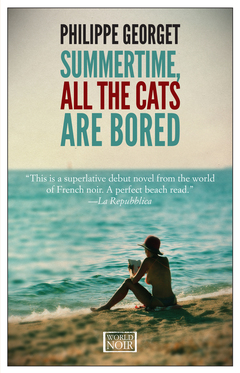
Summertime, All the Cats Are Bored. This has got to be one of my favourite titles ever. Because cats! In summertime!

The story itself, a mystery set in Southern France, is somewhat quiet. Methodical, both in laying out the crime and investigating it. It's credible, not gratuitous in the slightest. Which makes it nice and easy. This novel succeeded in gently easing me back into reading fiction.

Inspector Gilles Sebag is a very ordinary cop who enjoys spending time with his family, lounging by the pool, eating, making love, sleeping. He is a coffee connoisseur. He finds time for work, but has the best work-life balance of any investigator I can recollect. He doubts his abilities.

And he is drawn into a game of cat and mouse. Somebody's life is at stake, and this finds the right priority amid office politics and potential marital troubles.

I am these days somewhat preoccupied with the phenomenon of the midlife crisis. "Where did adultery begin?"
When you know each other by heart, you can read your partner's body language, smiles and grimaces. You start by no longer needing to look at each other and end up not seeing each other at all. You no longer even bother to look up.
The subject is treated here in a mature and altogether French way.

There is only one actual cat in this book, belonging to Gilles' neighbour, whom he lures over to his side with bowls of milk. The other cats must be metaphorical. I guess they're bored.

I am pleased to note that Philippe Georget has written more novels, and some are available in English. I'll be watching out for them.

Tuesday, July 03, 2018

Something long and difficult to fathom

Navoi lived for four years in Samarkand: a city so deeply imbued with poetry that even the doctors wrote their medical treatises in verse. But before Navoi himself transformed the Old Uzbek vernacular into a literary language, all of this poetry was written in Persian. In his Muhakamat al-lughatayn, or Judgement of Two Languages (1499), Navoi mathematically proved the superiority to Persian of Old Uzbek, a language so rich that it had words for seventy different species of duck. Persian just had duck. Impoverished Persian writers had no words with which to differentiate between a burr and a thorn; older and younger sisters; male, female, and infant boars; hunting and fowling; a beauty mark on a woman's face and a beauty mark somewhere else; deer and elands; being adorned and being really adorned; drinking something down all at once in a refined way, and drinking slowly while savouring each drop.

Persian, Dilorom told me, had only one word for crying, whereas Old Uzbek had one hundred. Old Uzbek had words for wanting to cry and not being able to, for being caused to sob by something, for loudly crying like thunder in the clouds, for crying in gasps, for weeping inwardly or secretly, for crying ceaselessly in a high voice, for crying in hiccups, and for crying while uttering the sound hay hay. Old Uzbek had special verbs for being unable to sleep, for speaking while feeding animals, for being a hypocrite, for gazing imploringly into a lover's face, for dispersing a crowd.

It was all just like a Borges story — except that Borges stories are always so short, whereas life in Samarkand kept dragging obscurely on and on. In Borges, the different peculiar languages yield up, in a matter of pages, some kind of interesting philosophical import: the languages of the northern hemisphere of Tlon have no nouns, a circumstance that immediately turns out to represent an extreme of Berkeleyan idealism whereby the world is perceived as a sequence of shifting shapes; the Chinese encyclopedia has different words for animals drawn with a fine camel's-hair brush and animals who have just broken a flower vase, which dramatizes the impossibility of devising any objective system of classifying knowledge.

By contrast, whatever it was that you learned about Uzbeks when you studied their language, it was something long and difficult to fathom. What did you know about Uzbekistan once you learned that Old Uzbek has a hundred different words for crying? I wasn't sure, but it didn't seem to bode well for my summer vacation.
— from The Possessed: Adventures with Russian Books and the People Who Read Them, by Elif Batuman.

Friday, June 29, 2018

How shall I keep my soul from touching yours?

Love Song

How shall I keep my soul
from touching yours? How shall I
lift it up beyond you to other things?
Ah, I would gladly hide it
in darkness with something lost
in some silent foreign place
that doesn't tremble when your deeps stir.
Yet whatever touches you and me
blends us together the way a bow's stroke
draws one voice from two strings.
Across what instrument are we stretched taut?
And what player holds us in his hand?
O sweet song.

— Rainer Maria Rilke (tr. Edward Snow)
I'm reading Rilke again. Never a good sign.

Three books have come together:
So it'll be another summer of Rilke. I hope this ends better than the last one. What is wrong with me?

Writes Tsvetayeva to Rilke, inexplicably:
I know what time is and what a poem is. I also know what a letter is. So there.

Wednesday, June 27, 2018

The feeling of only half understanding

While it's true that, as Tolstoy observed, every unhappy family is unhappy in its own way, and everyone on planet Earth, vale of tears that it is, is certainly entitled to the specificity of his or her suffering, one nonetheless likes to think that literature has the power to render comprehensible different kinds of unhappiness. If it can't do that, what's it good for?
Batuman is a joy to read. She's funny, smart, and sincere. The Possessed: Adventures with Russian Books and the People Who Read Them, by Elif Batuman, takes the reader from Stanford to Samarkand by way of Russia.

A familiarity with Russian literature is not required to appreciate this memoir, though if you understand the mindset of what it is to revel in these thick and intricate Russian worlds, so much the better.

However, for example, I've never read Babel, to whom the whole of chapter one is devoted; but I think I might want to read Babel now ("Whenever Babel meets anyone, he has to fathom what he is. Always "what," not "who."). I have no knowledge of the Uzbek language or its literature, and I'm quite convinced that it's not necessary for me to pursue the topic further. So I guess what you need to bring to this book is an openness to hearing the stories of people who pursue literature, and its more obscure aspects, as a field of study.

(The scholars seem to agree that Babel lived life as a source of material. I suppose a lot or writers are "guilty" of this.)
I became aware of a deep flaw in my understanding of the world and human knowledge. I had previously thought of knowledge as a network of connections that somehow preserved and safeguarded the memory of what they were connecting. But of course it was only people who remembered things; words and ideas themselves had no memory. The Uzbek language truly was related to both Turkish and Russian, by either genetic origin or secondary contact... but that didn't make it a reconciliation between the two. When you studied Uzbek, you weren't learning a history or a story; all you were learning was a collection of words. And the larger implication was that no geographic location, no foreign language, no pre-existing entity at all would ever reconcile "who" you were with "what" you were, or where you came from with what you liked.
What may not be obvious about The Possessed, even though Batuman states it clearly, more than once, is that it's about love. The state of being possessed has love at its core. "What is it you love, when you're in love?" This is difficult enough to answer when the object of love is a person — their body, their soul, their attributes, their worldly goods. But when love's target is more abstract, so too are its defining characteristics. What do you love when you love a language or a literature or a body of work?

Batuman exposes some of the tedium and absurdity of academia. But through it all there is love and joy!
When I came back from Samarkand, I almost entirely lost the ability to read poetry. It was like a language I didn't speak anymore. What I used to enjoy in poetry was precisely the feeling of only half understanding — a feeling that is intensified, as Tolstoy once observed, when the poetry is written in a foreign language:

Without entering into the meaning of each phrase you continue to read and, from the few words that are comprehensible to you, a completely different meaning arises in your mind — unclear, cloudy, and not in accord with the original phrasing, but all the more beautiful and poetic. For a long time, the Caucasus was for me this poem in a foreign language; once I deciphered its true meaning, there were many cases in which I missed the poem I had invented, and many cases in which I believed the real poem was better than the imaginary one.

After Samarkand, the beauty of cloudy, poetical meanings conjured out of associations and half-grasped words — the beauty of things that don't appear on the page — somehow lost its charm for me. From that point on I was interested only in huge novels. I started researching a dissertation on the hugeness of novels, the way they devour time and material. And although I suppose it's just coincidence that Tolstoy compared the subjective charms of half-understood poetry to the Caucasus in particular, nonetheless, I was finished with them, too — with the Caucasus, the Russian East, and the literatures of the peripheries.
Meanwhile, I have lost the ability to read fiction, I hope only temporarily. Between salving my heart, confessing my soul to paper, and walking — the endless walking — fiction has become an interference, reading an irritation. Sigh.

Excerpt.

Review: Salon
The fact that I could never quite understand what was going on put me off of Russian novels; for Batuman, it's a prime attraction.

Monday, June 25, 2018

Inviolate to the ravages of time

Is it because of some billowing whiteness within us, unsullied, inviolate, that our encounters with objects so pristine never fail to leave us moved?
The White Book, by Han Kang, is a difficult book to talk about. It's billed as fiction, but it reads like something between memoir and poetry. It's less book than art. Being so experimental in form, it is difficult to synthesize.

I read it about a month ago, in one sitting. I promptly forgot its details, but the mood of it washed over me and lingered. I revisited portions of it last week in preparation for book club discussion, but again the substance of it has washed away.

It's a beautiful book as object. It's crisp, stark. French flaps. White space. Blank pages. Black and white photos (greyscale, really).

On the whole it leaves me cold (like frost). It's sterile and antiseptic (like salt).

It starts off as a formal exercise, a list of white things. I expect a meditation on whiteness and its associations (a philosophical inquiry à la William H Gass). I am relieved that there is no discussion of race, but other bookclub participants are outraged that there is no discussion of race; how could anyone call their book "The White Book" and not at least acknowledge the issue of race?

The narrator walks through a foreign city. The city is never named. The very first review of this book that I read identified the city; in fact this knowledge piqued my interest in the book. It's a city that I know, and that I don't particularly like. I wonder if I would've been able to identify the city without having been told. I think so. It's a city that was destroyed and rebuilt. It looks old, but it's brand new. It feels... disconnected.

The story, such as it is, is about the narrator's older sister, whom she never met. (Or it is about her relationship with her older sister.) The baby had lived only an hour or so. The heart and soul of the book is the narrator's imagining of her non-sister's non-life. It is a life reconstructed, resurrected; but it's not the real thing. Her sister is a kind of ghost, realized in this city of ghosts.

Whiteness tends toward innocence, purity, peace, and hope. Also blankness, a kind of neutrality. White is all colour.

The narrator has migraines. So do I. I was the only one in our discussion group who has migraines. Statistically, I thought there'd be one more. "I concentrate on simply enduring the pain, sensing time's discrete drops as razor-sharp gemstones, grazing my fingertips." White pain, like white noise.
Clean, cold light that had bathed her eyes, scouring her mind of all memory.
The book's whiteness is punctuated with colour: a bead of blood, red brick wall, black earth's reflection, the blue tinge of a sluggish dawn, a gunmetal sea.

Fog: "can we really call it white? That vast soundless ululation between this world and the next, each cold water molecule formed of drenched black darkness." Is translucence white?
Blizzard: "This vanishing fragility, this oppressive weight of beauty."
Bed linen: "Your sleep is clean, and the fact of your living is nothing to be ashamed of."
Laughing whitely: "Laughter that is faint, cheerless, its cleanness easily shattered. And the face that forms it."
Bones: "That human beings are also constructed of something other than flesh and muscle seemed to her like a strange stroke of luck."

This book will not advance your understanding of whiteness. It may or may not have achieved any resolution of memory, or guilt, or writer's block.

The end inspires some hopefulness, that all will be whiteness (all will be all colours?), that the narrator will see clearly with her non-sister's eyes. It confirms connection through detachment.

This book is not a story, it's an experience.

Reviews
Asian Review of Books
The Irish Times
There are certain memories which remain inviolate to the ravages of time. And to those of suffering. It is not true that everything is coloured by time and suffering. It is not true that they bring everything to ruin.

Wednesday, June 13, 2018

The impossibility of forever

Incandescent bulb

Her desk had been swept bare. There is only the incandescent bulb above it, giving off light and heat.
All is still.
The blind has not been lowered, and headlights can be seen moving along the main road at sporadic intervals now that midnight has passed.

She is sitting at the desk, like someone who has never known suffering.
Not like someone who has just been crying, or is about to.
Like someone who has never shattered.
As though there has never been a time when the only comfort lay in the impossibility of forever.
— from The White Book, by Han Kang.

Sunday, June 10, 2018

Emptiness is a type of existence

The Three-Body Problem, by Cixin Liu, takes its name from the problem of physics to do with gravitational systems and the predictability of the movement of those bodies. Finally I'm motivated to read this book, as it's up for discussion at bookclub.

What I did not expect was the background of the Cultural Revolution, a physics professor persecuted for teaching the (reactionary!) theory of relativity (developed under "the black banner of capitalism"), and a woman traumatized by the experience of seeing this man, her father, die.

(The author claims he's not interested in social commentary; the stories of science are far more profound. Maybe it's true, or maybe it's just something he says.)

I did not expect to be confronted with Rachel Carson's Silent Spring:
It was impossible to expect a moral awakening from humankind itself, just like it was impossible to expect humans to lift off the earth by pulling up on their own hair. To achieve moral awakening required a force outside the human race.
Nor did I expect to be fully immersed in a virtual reality game, encountering historical personages and simulating famous mathematical conundrums (and with an homage to Flatland).

Also this sentence, which I keep rolling over, trying to make sense of it: "A woman should be like water, able to flow over and around anything."

And Buddhist teachings: "Emptiness is not nothingness. Emptiness is a type of existence. You must use this existential emptiness to fill yourself."

And bits of poetry: "This kind of experiment is akin to looking for a raindrop of a slightly different color in a summer thunderstorm."

This is a massive story, and it feels like it's barely just begun (this is, after all, just the first part of a trilogy of books). The plot proper ostensibly opens when Wang Miao, a nanotech researcher, is called in to assist in the investigation into a rash of mysterious deaths of several prominent scientists.

He has occasion to meet Ye Wenjie, astrophysicist and mother of the latest victim. Much of the novel is devoted to Wang learning about Ye's past, including how she had watched her father be executed and herself was imprisoned during the Cultural Revolution.

And then, wow, contact. And that first message is a warning, or maybe a threat, or maybe a cleverly laid ruse.

Much of the rest of the novel is consumed with Wang playing the VR game, trying to solve the three-body problem, which turns out be a very real problem for a very real planet with three suns. The Trisolarans have adapted to their extreme environment — their bodies can dehydrate and be stored during chaotic periods — but the end is imminent and they must find a new home.

I finished the book despairing over humanity, not so much concerned over its ultimate fate as disappointed in our actions along the way — how many betrayals against our species along the way, whether at an individual or community level or on a planetary scale.

I am torn between resistance and welcoming our alien overlords.

It was quite the humbling realization to realize we are but bugs before them, but...
Look at them, the bugs. Humans have used everything in their power to extinguish them: every kind of poison, aerial sprays, introducing and cultivating their natural predators, searching for and destroying their eggs, using genetic modification to sterilize them, burning with fire, drowning with water. Every family has bug spray, every desk has a flyswatter under it . . . this long war has been going on for the entire history of human civilization. But the outcome is still in doubt. The bugs have not been eliminated. They still proudly live between the heavens and the earth, and their numbers have not diminished from the time before the appearance of the humans.
Excerpt.