Tuesday, November 15, 2005

Arbitrary book marks

José Saramago in interview (via comments left at Bookpuddle) on his new novel, Las intermitencias de la muerte (no publication date available for an English translation), the premise of which is "what would happen if we were eternal beings."
The truth is that I didn't intend to be humorous, it just came out like that. I have to confess that I enjoyed writing about a subject as serious as death, although we all know that we can't laugh much about death because it is death that ends up by laughing at us. We shouldn't think of death as an entity, a 'grim reaper' waiting outside for us, but something that is inside ourselves, that each one of us carries within, and that when our body comes to an agreement with it, then our lives end.

So not dying is a failure to recognize something essential within ourselves? My grandmother died at age 99, I think only because she'd finally decided to.

The Guardian on Paul Auster.
One view, especially common on this side of the Atlantic, is that he is an American writer of European descent ... "The book that convinced me I wanted to be a writer was Crime and Punishment. I put the thing down after reading it in a fever over two or three days ... I said if this is what a book can be, then that is what I want to do." He laments the declining interest in foreign fiction in America. "Are young people still reading Gide?" He calls this neglect "the great tragedy of American publishing. It's the way American culture has evolved. We've become very hermetic. We're not interested in others any more. It's hurt us politically and it's hurt us culturally. We've lost our taste for what I would call 'the exotic'."

That first sentence puzzles me — is that view wrong? What makes an "American writer"? I don't think Paul Auster will ever write "the great American novel." They mean, perhaps, he's descended from the European literary tradition, he's a European writer, but happens to be American.

From A Whistling Woman, by A.S. Byatt:
But always remember that one map of another man's thought always runs the risk of becoming a string of shortcuts between arbitrary landmarks.


A propos of nothing, authors I wish would write something else for me to read:
Mark Z Danielewski, who wrote House of Leaves (audio excerpts)
Glen David Gold, who wrote Carter Beats the Devil (excerpt)

It's snowing!

And it takes my breath away! I can't stop smiling!

Monday, November 14, 2005

Showing how easy it is to drop a habit

even when it's a good one. And how easy it is to pick it up again. I hope.

I've been thinking about writing — generally, here, something, I know not what — for days, but the inclination has not been strong enough to find the opportunity to do so.

I've just returned from a wonderful yet totally unproductive shopping excursion. I bought nothing, except a porkchop, which I don't think should count. I'm mildly disappointed that I did not find any fluffy animal slippers, which I'm hoping to buy for Helena on the occasion of her birthday this weekend. And that I couldn't decide which jigsaw puzzle she'd like best. No, that's not true — she'd like a Dora puzzle, but a bigger one than she's already mastered, and I did spot one, but I couldn't bring myself to actually buy it cuz, frankly, I'm kind of sick of Dora — we have a puzzle, a bag, a DVD, some figurines, as well as the somewhat more practical pillowcase, shirts, socks, and underwear. However, I expect as Helena's special day nears, I will succumb to that great marketing machine. But not today.

But it's a lovely fall day, and I've been crunching through leaves, and the air is crisp (almost too cold to go a-wandering without a beret, but that replacement purchase will have to wait for another day), and the moon is huge as I was heading home, and I feel almost like I'm in love.

Also, I'm very excited that my sister is coming for a visit next week, and she tells me she's bringing Helena a trainset. I can't wait! And she's bringing me a signed copy of Margaret Atwood's The Penelopiad, because it's soon to be my birthday too, even though this makes me feel slightly pressured to actually read the Odyssey now.

The weekend was full of sleeping and reading and walking and taking the girl for a haircut and also watching Charlotte's Web, more than twice, which I haven't watched in its entirety for many years, though I have tried to introduce it to Helena a few times. I guess it's finally taking. And this in part is contributing to my overall cheeriness, because running through my head all day is that silly little song "Chin Up," and while getting tunes stuck in one's head is generally pretty annoying, it's hard to go wrong with a sentiment like that. The movie is also pretty jarring cuz there's all that reality of farmlife and death, which is a good thing, the reality, but I'm quite suprised at the strength of my instinct to protect the kid from all that.

Last week I drafted thoughts aplenty on the Peter Carey book I'd finished reading. I will likely post said thoughts here shortly, possibly without even reviewing them. I'm slightly weirded out by the dialogue the books I've been reading of late are having with me and amongst themselves — they seem all to be referring to each other, and I don't know if it's coincidence, or the magical cast of Don Quixote on my reading life, or if maybe I'm a little bit smarter and better able to see connections than I used to be.

And now I will go cook a porkchop.

Thursday, November 10, 2005

My ray of sunshine in an otherwise dark week

Helena has insisted on waking at 5 am every day this week. Though I find myself indulging in little post-lunch siestas, I'm feeling a little deprived on the sleep front, particularly as I'm struggling to keep on top of work deadlines.

This morning I woke with her little face staring at mine, mere centimetres away, again at 5 am. I was hopeful when she crawled into bed with us that I might enjoy another hour of slumber before she pulled me by the hand to come play with her. Only 10 minutes later she was squirming.

Her pillow, which she carries with her in the early morning, was neatly centred between the adult heads. Her teddy bear, in repose on said pillow, between our warm bodies. Helena tucks him in carefully with her own blanket and a kiss before pulling the duvet back up over our shoulders and wriggling out down the middle to the foot of the bed.

Minutes later she's at my side again. "Fix it," as she struggles to replace the dust jacket on her book. My sleepy fingers fumble a little but she's pleased to finally see the book intact. She looks at me, waiting. "J[e n]'ai pas capable read it toute seule."

So she leads me by the hand to the spot she cleared on the floor outside her room. A blanket to sit on, a pile of books to the side. And we read about Kitten, and Green Sheep, and Bootsie Barker, and others before she helps me make coffee an hour later.

Tuesday, November 08, 2005

A neoplastic lightbulb

A.S. Byatt, A Whistling Woman:

Mondrian, too, had been in Hampstead in 1938 and 1939, painting severe black and white grids with discrete peripheral rectangles of red, yellow and blue. Mondrian believed that everything — the sum of things — could be represented by these three colours, with black, white and grey, within the intersections of verticals and horizontals. The colours were signs, denoting all the colour in the world, symbolising everything, purple, gold, indigo, flame, blood, earth, ultramarine, even green, which Mondrian could not bear to look at. The straight lines represented the refinement of spiritual vision. They were the intersection of the infinite flat horizon, and the infinite vertical, travelling away from earth into the source of light. They avoided the tragic capriciousness of the dreadfully particular curves of flesh, or even of the changing moon. The vertical line was taut, and was the tension of all things. The horizontal line was weight and gravity. The figure of the Cross was the meeting of vertical and horizontal, and intrinsic form of the spirit. The movement of waves on the sea, the form of the starry sky, could be represented with patterns of little crossings. Diagonals, according to Mondrian, were not essentially abstract, and should be eschewed. Wijnnobel thought this system was mad in its man-made purity, and yet found it endlessly beautiful in its own implacable terms. There were many triads of "primary" colours, of which, for historical reasons, Mondrian had picked one. It was one vision of necessity, of the building blocks of the universe. A theory of everything.

Reading to my kid

From The Globe and Mail:
Parents take note: Reading to your preschoolers before bedtime doesn't mean they are likely to learn much about letters, or even how to read words.

A new study shows that while storybook time has developmental benefits, preschool children pay very little attention to the printed words on a page.

"There are all kinds of parents who are reading to their children believing that it's going to help their children to learn how to read," said Mary Ann Evans, a psychology professor at the University of Guelph and co-author of the study.

"That's true to an extent in that reading to your children will help them develop an understanding of storyline. But it's not necessarily helping them to learn how to decode the words on the page."


(Read the study abstract.)

This doesn't surprise me.

I never thought the point of reading to kids was to teach them to read. The most one can hope to do is foster a life-long love of reading and books.

I do not read to Helena every day. When we do read together, it's usually not at bedtime. That's not something I ever anticipated saying in regards to a child of mine.

When she was crib-bound and a captive audience, I read her a short book every night, one of a handful of her obvious favourites. Now that she's a little older, more verbal, I've let her exercise choice. We have a bedtime story every night for about a week, then maybe two weeks off before she decides to again include a book in her nightly preparations. Still, every night as I tuck her in I ask her if she'd like a story. "Non, mama. Pas un histoire. Bonne nuit."

We do, however, read books together in the morning, or more usually after supper. She arranges cushions and blankets, on the floor in the hallway or on the sofa, and gathers her friends about her. (Elmo usually sits in my lap.) Then she ceremoniously hands me her book of choice. It's nursery rhymes and sing-along books as often as it is my old paperbacks of Winnie-the-Pooh (with black-and-white illustrations so faded and tiny as to be nonexistent).

"Read," she commands.

Of course, there's not much reading going on. She counts the ducks in the picture's wallpaper background. She names objects, hypothesizing about their relationships to one another. A picture of a squirrel in a park leads to some anecdote or other, and we talk about our days. But if there's ever a lull in our converstation, she taps her finger on the text and tells me, "Read."

I've relinquished the romantic image I've always held of mother and child reading together. I've also realized that my own reading experience has always been a solitary one. I ensure she has every opportunity to develop a relationship with books. If nothing else, I lead by example, with my nose in a book of my own any spare minute she grants me.

Lately, Helena has been noticing labels, from Halloween candy wrappers to the tags on her clothing. "C'est ecrit He-le-na," she suggests hopefully, and I rejoice. She knows! She knows that those regular scratchings encode some mystery for her to crack.

If you want to teach your kid to read, point at the letters, the study suggests.

Helena is very good at jigsaw puzzles, at spatial problems, pattern recognition. To my mind, written text falls into the same category of analysis. And the more data available, the clearer the pattern that emerges. Written words are part of our backdrop. Whether Helena grows up to love reading remains a question mark, but there's no doubt that she will learn to read, and, I suspect, soon.

The point of storytime, on the other hand, is not the words on the page — it's a huge exercise in communication and comprehension. It's forging a bond, if not between a girl and books, between mother and daughter.

Listening to scientific reason

The Vatican reaffirms John Paul II's 1996 statement that evolution is "more than just a hypothesis."

Cardinal Paul Poupard:
"The faithful have the obligation to listen to that which secular modern science has to offer, just as we ask that knowledge of the faith be taken in consideration as an expert voice in humanity."

Monday, November 07, 2005

When pretend eerily echoes reality

Yesterday, Helena, while working at a jigsaw puzzle, sighs a sigh of complete and utter exasperation at (no longer dancing because if Helena accidentally sets him off she knocks him over hard, clunk, to make him stop so now battery-less) Elmo, sitting quietly (I thought) in the corner, who wants her to pick him up again.

Saturday, November 05, 2005

Things I haven't done today

but had planned on doing, and probably should've done.

Get dressed (which process includes showering).

Go to the library. Not that I'm a regular library-goer (the shame!), but having finally finished Don Quixote, I'm inspired to see this exhibit. Maybe tomorrow.

Buy a replacement black beret. Every year I buy one, and every year I lose it. Last year, I didn't lose it till the very tale end of the beret-wearing season, which was rather convenient, except for that now beret season is upon me and I'm unprepared.

Modify the kid's hat such that the ties are regulation length and not a potential tool of strangulation — they shall fasten by velcro instead, which I imagine is equally potentially lethal. No fastening at all and the hat would just fall off and be rendered useless.

Finish reading Peter Carey's My Life as a Fake, of which I'd managed to read only the opening pages a couple weeks ago on the métro, and the setting aside of which, in a concerted effort to finish DQ, genuinely disappointed me, and which has thoroughly engrossed me all day long. I'm loving it. What the heck am I doing sitting at the computer?

That's it. I've decided not to count making the bed, doing laundry, and all those other mundane household tasks. Also, I'm not counting rearranging even more furniture and sorting through boxes of crap, cuz that's an ongoing project.

Good thing I didn't set my ambitions too high this weekend. I have drunk 3 bottles of beer and the better half of a bottle of crappy red wine. And I'm eating salted peanuts.

It's NaDruWriNi!

And I'm so drunk already I almost forgot!

I haven't officially signed on to participate in National Drunken Writing Night (and I'm not sure I'm even eligible, being Canadian — what is the internet nation?), but consider this my show of solidarity.

Conveniently, we dropped the kid with her grandmother last night! And I slept in! And I'm still in my pyjamas! And I've been drinking since 3! And J-F will be watching the hockey game tonight! And I won't!

Last night, we dined at Momesso's. Best subs ever!

The first time I went to Momesso's was April 2002, days after moving to Montreal and having spent almost all of those first few days sick and exhausted in bed. (I didn't yet know that I was pregnant, but I was, though I'd attributed the sickness and fatigue — and, yes, missed periods — to the stress of packing and moving, leaving a job I'd loved and a city I'd known for some 15 years. And also to the paint fumes).

Painters painted around boxes and unassembled furniture. I languished on a futon in a corner of the corner room. Appliances had not yet been purchased, so we were living off dry goods (read: crackers) and take-out.

And there was J-F taking a day off work to meet up with old buddies at Momesso's before the Expos home-opener, and I'd already finished reading the only book I'd kept out of the boxes (Rose Tremain's Music and Silence — I wept), and as much as I don't get baseball, I wanted to go to. And I had the best sub ever!

Momesso's is something of a local legend, owned by a washed-up NHLer and boasting photos and other memorabilia of moments in Canadiens history. But really, it's all about the subs.

Many years ago, before I met J-F, I attended a costume party (I'm betting it was Halloween, although perhaps I'm conflating my memory of it with another party at the same venue — maybe it was just a regular party, and we weren't costumed) with a friend (hi, Bethann!). This guy threw awesome parties.

We ensconced ourselves in the kitchen ("you will always find me in the kitchen at parties"), seated ourselves on the countertop. No need to mingle. The party would come to us. Everyone goes through the kitchen.

And it seems one other fellow had a similar idea. I don't think he knew anybody, don't know why he was there, but he had a story. He stood by the fridge, waiting for an unsuspecting audience to whom he could tell his story.

He told his story easily a dozen times that night, to a dozen different audiences. Oddly, he never the felt the need to tell it to us directly, but after a few retellings, we knew his story verbatim, and Bethann and I for weeks afterwards delighted in retelling it ourselves, in his words, at the pub (damn, I miss the Manx).

Sadly, but for one particularly evocative phrase, I no longer remember his words. I do remember that he was freshly arrived from Vancouver. Somehow, he would steer conversation with his victims to the topic of food, providing the opportunity to tell them about the best burger he'd ever had, in Vancouver.

An unassuming storefront, a hippie-ish, vaguely vegan feel. Hungry, and not expecting to be sated in a place like this. But the burger! Garnished with sprouts. He had doubts. But so thick and meaty, the juices dripping over his hands, down his arms, (here, he tugged at his elbow) "into the nipple of my sweater."

And that's what the subs at Momesso's are like.

Friday, November 04, 2005

The impossible dream

I finished it. All 940 pages. The 52 chapters of part 1, the 74 chapters of part 2. A little behind schedule, but here we are. Don Quixote rocks!

I read Don Quixote for fun, to see what the big deal was. And it was fun.

I love the chapter descriptions (these are a sampling from Part Two):
Chapter IX Which recounts what will soon be seen
Chapter XXIV In which a thousand trifles are recounted, as irrelevant as they are necessary to a true understanding of this great history
Chapter XXXI Which deals with many great things
Chapter LIV Which deals with matters related to this history and to no other
Chapter LXVI Which recounts what will be seen by whoever reads it, or heard by whoever listens to it being read

Hah!

I have no intention of writing a thesis, but I do have some thoughts. Ahem.

The 2 parts, published 10 years apart, have very different feels. I much prefer the second. While the first boasts many more adventures (or so it seems — the pace is frenetic) with characters of all walks, each with colourful histories of their own, the second is a little more static in its setting and players, slower, richer in its characterizations, with a more philosophical outlook on the events that unfold. (Or maybe this opinion simply reflects the time it took me to properly settle into the book.)

If you've read only the first portion, you're missing out.

As metanovel
Not only is Don Quixote commonly cited as the first novel, it is sometimes called the first postmodern novel, or metanovel. How can that be?

(I've noted before that Don Quixote is Paul Auster's favourite book. "The Auster connection" is dicussed elsewhere. I can see already that my firsthand experience with Don Quixote will enhance my overall appreciation of all sorts of literature.)

Is Don Quixote postmodern? It is self-referential. There is a kind of metanarrative. What the fuck is "postmodern" anyway? Don Quixote reads as if it's of the great oral story-telling tradition. Stories within stories. A la 1001 Arabian (K)Nights. How we still tell stories today — "you'll never believe what happened to a friend of mine..." How we assimilate other people's stories as our own.

While authorship is called into question by postmodernists and the line between reality and fiction is blurred, all the time sporting an attitude of irony and self-consciousness, the real mystery is how our minds evolved to embrace the "modern" novel, where the only interface was a book's physical cover, beyond which we are completely immersed in a virtual reality. So the postmodern novel is a return to the premodern, stripping the illusion, pulling back the wizard's curtain, to show us the program architecture we always knew was there.

But what do I know?

The sidekick
Dare I say it? Sancho Panza is a much more interesting and complex character than Don Quixote.

And I still don't get him. Why does he stick with the mad man? Why doesn't he just turn around and go home? He knows Quixote is insane, he acknowledges that he himself is crazy to stand by him, he realizes they're being played for fools.

Why does he not come clean on the trick he played on Quixote, in which he presents a homely peasant girl as the beauteous Dulcinea under enchantment. Certainly he has his own best interests in mind at first, but later? Surely the Don's wrath would be easier to bear than the task Sancho is called upon to perform to break the enchantment. Can it be he simply does not want to break the illusion? He wants to believe. His unyielding loyalty to Don Quixote, or at least to the best interests of Don Quixote, is more steadfast, and more reasonable, than the proclamations of devotion of any knight. Or is he really all about the money?

Simple-minded?

Two cliches make us laugh but a hundred cliches moves us because we sense dimly that the cliches are talking among themselves, celebrating a reunion . . . Just as the extreme of pain meets sensual pleasure, and the extreme of perversion borders on mystical energy, so too the extreme of banality allows us to catch a glimpse of the Sublime.


Umberto Eco said this in regards to Casablanca, but it applies equally well to Sancho Panza, the spouter of proverbs who won't shut up.

Sancho is governor of an "insula" for a few days; he rules well and wisely.

I like to think that it is Sancho who is the author of these tales; although he's illiterate, I imagine him recounting them to the Arab scribe, who takes some liberties in detailing Sancho's simple character.

Other stuff
What's with the duke and duchess? How cruel. "Cide Hamete goes on to say that in his opinion the deceivers are as mad as the deceived, and that the duke and duchess came very close to seeming like fools since they went to such lengths to deceive two fools." Don't they have anything better to do?

I was somewhat surprised not so much by the characterization of the Moors, either as individuals or as a people, given the time and place of writing, but by a few specific references to the Islamic faith as being inferior and destructive. Will read more on this.

"Tilting at windmills." While the windmill scene, very early among the adventures, presents a strong visual image, I'm not convinced it's the greatest, or most representative, in the book. I'm really surprised that the phrase took hold in so many languages. Possibly used be people who never got past the first 100 pages.

Loudest laugh-out-loud moment:
And turning to Sancho, he asked for his sallet helmet; Sancho did not have time to take out the curds and was obliged to hand him the helmet just as it was. Don Quixote took it, and without even glancing at what might be inside, he quickly placed it on his head; since the curds were pressed and squeezed together, the whey began to run down Don Quixote's face and beard, which startled him so much that he said to Sancho:

"What can this be, Sancho? It seems as if my head is softening, or my brains are melting..."


Short answers
The very best novel ever? Maybe. It's a better candidate than most.

My favourite novel? No. Not yet.

I will probably read it again before I die — parts of it, anyway.

Food for thought
I read an interview with Umberto Eco the other week, in which he dismisses the impossibility of translation. He later elaborates:

I believe that mine is the right philosophical attitude. The kind of reflections in analytical philosophy, in order to be supposedly scientific, don't analyse the real common language but only laboratory situations. For instance, the philosopher [Saul] Kripke illustrates an entire discussion on translation of proper names with the case of a certain Pierre who, being French, knew London as Londra. He was convinced that Londra was a beautiful city. He visited London without realising that it was Londra and wrote that London is an ugly city. Pierre is an idiot or a laboratory fiction. Human beings are not like that. You cannot create a philosophical discourse on the behaviour of a mad person.


With this quotation, as with most everything else I come across these days, I can't help but think of Don Quixote. Of course we do have philosophical discourse on the behaviour of Don Quixote. His imagination — and his library — was more vivid than his waking life as a gentleman in a nameless town. He's a laboratory fiction, but he's more real than real.

All good books have one thing in common — they are truer than if they had really happened, and after you have read one of them you will feel that all that happened, happened to you and then it belongs to you forever.
— Ernest Hemingway


Summary of my DQ reading experience.
Also, some background.

Finding Copernicus

For I am not so enamored of my own opinions that I disregard what others may think of them. I am aware that a philosopher's ideas are not subject to the judgement of ordinary persons, because it is his endeavor to seek the truth in all things, to the extent permitted to human reason by God. Yet I hold that completely erroneous views should be shunned.
— Copernicus


It's known that Copernicus was buried in the cathedral at Frombork, Poland, but his remains were never located.

The gothic cathedral, completed in 1388, has survived, with some additions and reconstructions, the devastation of the Thirteen Years' War, the Swedish Wars, and the Napoleonic Wars, as well as that of World War II.

Copernicus himself organized defences in the war against the Teutonic Order (1519—1524).

This week:
Jerzy Gassowski, head of an archaeology and anthropology institute in Pultusk, central Poland, said his four-member team found what appears to be the skull of the Polish astronomer and clergyman in August, after a one-year search of tombs under the church floor.

"We can be almost 100 percent sure this is Copernicus," Gassowski told The Associated Press by phone after making the announcement during a meeting of scientists.

Gassowski said police forensic experts used the skull to reconstruct a face that closely resembled the features—including a broken nose and scar above the left eye—on a Copernicus self-portrait. The experts also determined the skull belonged to a man who died at about age 70.

The grave was in bad condition and not all remains were found, Gassowski said, adding that his team will try to find relatives of Copernicus to do more accurate DNA identification.


See the forensic facial recontruction.

Thursday, November 03, 2005

The scary week behind us

The preface
Am I too late? All in all, it's been a rough week, but there's pictures to share and stories to tell. The stories have lost their luster — some bits were drafted before our cat difficulties, other bits are abbreviated. Forgive the incoherence. I'm tired.

The carving
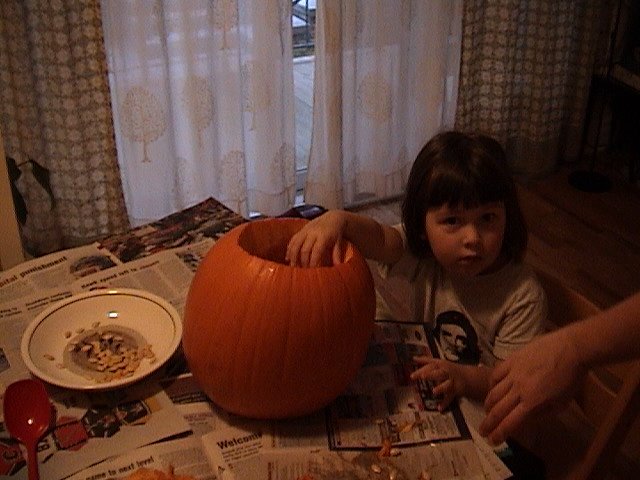
Carving a pumpkin sounds like a lot of fun. The reality of it is a lot of work and a big mess. Helena chooses the design from a few I'd sketched — happy and starry-eyed over fierce and scary. Her enthusiasm wanes after one handful of goopy innards. Mommy is left to clean and carve the husk on her own.

Still, Helena beams at the finished product, and delights in placing her painted baby pumpkin inside the hollowed gourd.

(Photo of lit jack'o'lantern not taken. And now it's mouldy — no way I'm sticking my hand in there.)

A party
Saturday afternoon is the 3rd birthday party of one of Helena's classmates. Fun is had by all, including me. I entertain several catty thoughts about other parents, their parenting philosophies, and their children, but they have since all dissipated.

But I'm still in shock over how many toys and movies Rose has. No musical instruments though, which may explain why the keyboard we gave her was such a hit.

In the end, I was truly warmed by the birthday girl's delight in it all. And Helena's.

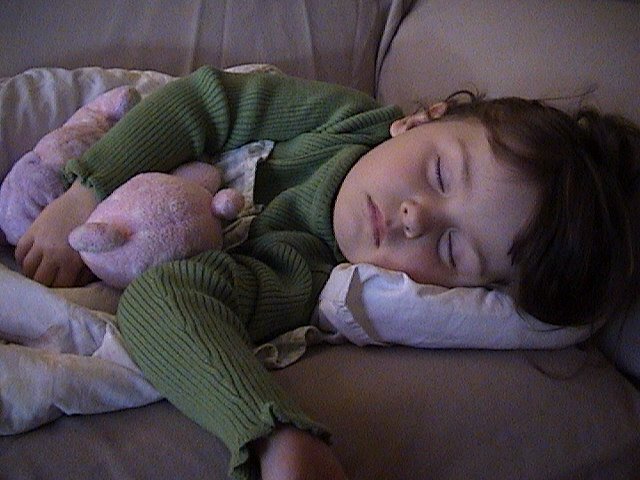
A nap


The sickness
J-F's mom and her de facto come for supper that evening. She insists on bringing the meal. I'm not quite sure what to make of this habit of hers, but I've come to accept it, so I'm slightly disappointed when she brings ingredients for me to assemble.

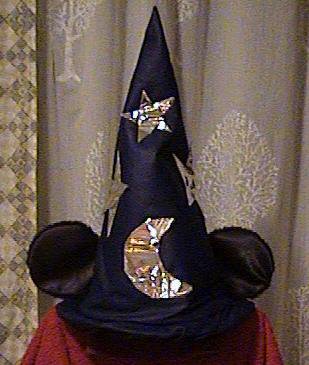
I awake Sunday to a screaming pain in my head, as if some clawed creature has hatched behind my eyes and is trying to scratch its way out. I throw up a few times and sleep. (In retrospect, I think I vomited from migraine-pain nausea, rather than anything gostrointestinally induced, though my body continues to complain of flu-like ache.) I drag myself out of bed to make Helena's hat a little more blue, and ensure her "robe" is cut and stitched to bear some semblance of sleeves.

The hat
Of which I am proud.

Tricks
I give Helena the choice of donning her costume at home or putting it on at the daycare centre. She opts for the latter, but when the time comes, she is having none of it. She even tears off her turtleneck. I leave her whipping around in a spare t-shirt. I can only hope her mood improves in time for the kids' Halloween morning parade through the local shops and offices.

I have time for a coffee and a good long cry. I'd always thought the fun in dressing up came from the pride of conceptualizing something unique, being able to execute it oneself. But I may be wrong about this. I felt such embarassment trying to costume Helena that morning — her outfit looked so shabby beside the store-bought disguises of her classmates.

On top of which, it would seem that no one is familiar with Mickey Mouse's Sorceror's Apprentice. Lesson learned: never dress a child of limited communication skills in a costume that needs explaining. Even when it's of her own devising.

Treats

J-F and I rendezvous to see our daughter costumed — sans red cowl and white gloves, and hat backwards, but smiling and calm.

Worse tricks
When we get home, the cat, not well for a few days already, seems rather worse. A trip to the vet. We leave the cat there for x-rays. Pick up Helena. J-F will go to the follow-up appointment by himself.

Unless Helena absolutely insists, there will be no trick-or-treating. Fortunately, she had her fill that morning, and her pumpkin is already full.

On the phone with my mother, I start crying over the cat's likely fate. Helena notices. "Tue es sad?" She gives me a hug and makes faces.

J-F returns, without the cat, as we're preparing for bed. Helena asks where the cat is, and my instinct, before I know, but I already know, is to tell her the cat's staying with the doctor, because we can't take care of her properly at home. We save that conversation for the next day.

Additional treats
Although there is an elementary school at the end of our block, our stretch of street features mostly the backs of houses, so we had no ghoulish visitors. More candy for us.

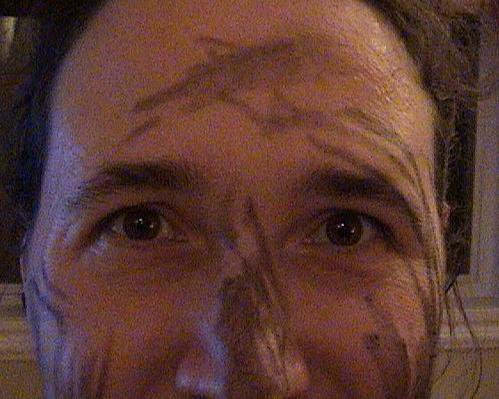
Helena and I had spent our evening playing with face makeup crayons. That morning I had painted her a smile, a nose, some whiskers, to enhance the illusion (even though Mickey Mouse has no whiskers), but they were long gone.

Helena puts a spider on my left cheek. On the right, she paints a portrait of Blue's Clues' Joe (?!). For the record, in this photo, I am ghastly tired and not wearing my glasses, but I am sticking out my tongue (not shown).


For "dessert" this week, every day I let Helena choose two things from her basket. She tastes them and almost always sets them aside. We have learned that Helena does not like KitKat or Coffee Crisp (yay for me! except when she licks the chocolate off first). Nor does she like peanut butter. We knew this, but thought the candy bar factor might sway her. It has not (yay for J-F!). She likes only the outside of Tootsie Roll Pops. She does not like anything sour. She likes wine-gum-type candies, but, inexplicably, not red ones.

We all love Smarties, and we're learning to share.

Wednesday, November 02, 2005

Writing movies

The CBC recaps movie treatments of the writing life, noting in particular the dramatic depictions of creative inspiration and of writer's block. The list includes The Shining, Barton Fink, and Adaptation.

Missing from the list:
Gothic
Henry and June
Naked Lunch
Mrs Parker and the Vicious Circle
Fear and Loathing in Las Vegas

all of which I love, and which feature as a source of inspiration — a cure but also occasional cause of block — to some degree or other, alcohol, sex, and drugs. Ah, the writer's life.

What movies would you add to the list?

Tuesday, November 01, 2005

Rolly Cat

Yesterday we became a one-cat household, down from two.

Rolly wasn't particularly clever, but she was the sweetest, most good-natured, easy-going, eager-to-please cat we've ever known. Almost dog-like. In a good way.

She came to us as a foster pet about 7 years ago. She'd been dropped at the Humane Society pregnant too young and not expected to survive her condition, but survive she did. A scrawny thing, before she grew into her name.

We hadn't chosen her, but she made it clear she'd come to stay.

I hope we made a little difference in her little life.

She used to wrap herself around my head at night.

Nap buddy.


Partner in crime.


Bane of her shadow's existence.


Object of much affection.

Monday, October 31, 2005

Friday, October 28, 2005

Barnes's parrot

A Spanish gentleman walks into a shop of exotic birds. He notices a parrot with an exorbitant pricetag, 50,000 escudos. He asks the shopkeeper about the bird, "He must be very special. What can he say?"
The shopkeeper replies, "This parrot can recite the whole of the Bible in Spanish."
"Astonishing! What about this one, for 100,000 escudos."
"Ah, he can recite the Bible in three different languages."
There's yet another beautiful parrot on the counter — 200,000 escudos.
"What can he say?"
"Nothing, but the other two call him 'Maestro'."

I arrive 40 minutes early, in time to snag one of the last available seats, for this the inaugural event of Blue Metropolis Literary Series 2005-2006, in collaboration with Writers Read at Concordia. A good 100 people are there already, and as many more file in to line the walls before Julian Barnes takes to the podium.

Julian Barnes is introduced by a former student of his, now professor at Concordia University. They called him Maestro, she can't remember why (Barnes later recounts how he often used the parrot joke as an example of narrative, as well as to loosen up the class). One day she heard whispered in her ear, "I will be called Maestro only if it is used ironically." She still calls him Maestro, now maybe "with more affection than deference, but there has never been any irony about it."

In person, he's charming and funny. (Years ago he impressed me with his bearing in conversation with Bernard Pivot and others, on TV). He has an interesting face — deeply lined. He's tired, no doubt, from recent travel and appearances, but those are laugh lines. He lives well.

I've read a few of Barnes's books. I like them well enough. There was a time it was hip to say you were reading him, and I did. I grabbed one of his books off my shelf before going, Something to Declare — I must have something at the ready for him to sign.

Of his novels that I've read, I'd borrowed (and returned) one, one is in a box, another I'd passed on to a friend. I've seen Metroland. I have not read Flaubert's Parrot (recently the subject of the Guardian's book club).

I stop by the bookshop on my way to the event. To be honest, none of titles, none of the openings, grab me. His latest book, Arthur & George, opens well: "A child wants to see. It always begins like this, and it began like this then. A child wanted to see." I'll read it someday.

Arthur & George is a fictionalized account of Arthur Conan Doyle, with especial focus on his involvement in the trial of George Edalji for a sensational string of animal mutilations, as well as Conan Doyle's developing passion for spiritualism.

The novel is a split narrative, as the title implies, one regarding Arthur, the other George. Barnes reads 3 or 4 selections from the first third or so of his book that tell Arthur's story.

He tells us Arthur's character is established by about page 60 or 70; at this point the reader knows he is none other than the famous Sir. (Will any reader of this book on turning to the first page not already know who he is? I wonder if the reviews, even the bookjacket, have in some way spoiled this revelation.)

Clearly Barnes has thoroughly researched the historical Conan Doyle, but he has also imagined Arthur well. He speaks of him as if he is his own creation, which I suppose he is. Barnes in the same sentence adjusts his tone and phrasing when discussing one or the other, historical or quasi-fictional, Arthur. Later with a wry smile he refers to Arthur as "a character in one of my books."

The floor is opened up for questions. No takers at first. Barnes obligingly supplies a few answers to questions someone might've asked. A long-abiding fascination with Conan Doyle? No, actually. He read the Sherlock Holmes stories as a kid.

It was an account Barnes had read of the parallels between Edalji's trial and the Dreyfus affair that sparked his imagination. Both scandals were high-profile and of the same time period, both involving a question of racism, and both having famous writers (in the French case, Zola) come to the defense of the accused. It's a curiosity that the English case is largely forgotten, even though likely most Brits are more scandalized by animal mutilation than by the idea of treason.

Barnes dislikes using the term "historical novel" to describe Arthur & George — it's a contemporary novel that happens to be set 100 years ago. The themes — our basic attitudes, racism; also the power of officials to bury news, the power of the media in shaping public opinion — are relevant today.

I buy a copy of Arthur & George on the spot (book promotion tours work!), which Julian Barnes inscribes for me. He is genuinely delighted to know that José Saramago this past summer was rereading Flaubert's Parrot.

What Julian Barnes is reading:
The "wonderfully moving" account by Joan Didion of the period following the death of her husband, The Year of Magical Thinking.

The official website of Julian Barnes.
Read an excerpt of Arthur & George.

Report on his recent appearance at the Toronto International Festival of Authors:
He also maintains he doesn't mind if people still identify him primarily as the author of Flaubert's Parrot. He mentions a story of someone asking the late Kingsley Amis if Lucky Jim, Amis's most famous novel, was an "albatross" around his neck. It's better than having no albatross, Amis replied. "I thought that was a very good reply," Barnes says. "So I have a parrot around my neck."

Thursday, October 27, 2005

Etc

Go away, I'm working.

I've just sent off a bundle of work actually, so my usual time-wasting activities should resume shortly.

I have spent all my procrastination efforts in diligently reading about other people's joys and woes rather than recording my own. I've left numerous comments in an effort to have my presence felt but on subsequent examination found many of them didn't take, leading me to think I'm more preoccupied and less computer-savvy than I previously believed — I'm considerably multitasking-challenged. Just know that I've been thinking of you.

Both Helena and my so-called husband have been pretty cranky this week, mostly, I assume, in response to my own aura of stress. My presence has been felt by them.

Also, all our lightbulbs are burning out at the same time. I mean that literally, around the house, not as some enigmatic metaphor.

Here's a boring anecdote, but with a horrific image: This morning Helena was retelling one of her famous boo-boo stories, when in early September she tripped on her way to the car, scraping both knees and hands, and she learned the lesson that it's dangerous to run in the street. This time she adds, "et les voitures vont marcher sur moi."

Stay tuned for notes on the reading by Julian Barnes that I'll be attending this evening (and the related likely misadventures of Papa entertaining and bathing the toddler alone). Also, on Don Quixote, which I plan to finish before I sleep tonight. And adventures in Helena's book nook.

That is all. For now.

Monday, October 24, 2005

Witching hours

Friday, I run some errands. Acquire one witch's hat, white gloves, and mouse ears (part of a whoreslut "costume" package, which includes also a bowtie and a poofy black furball of a tail — for all those who can't tell their rodents from their rabbits — but for a dollar!). Also, some felt, just in case. The afternoon was a success, even if I feel nauseated and exhausted for it.

Helena is delighted, alternates donning the hat — une sorcière! — and the mouse ears — Meeckey Mous-eh! (she exclaims with a thick French accent). She wants noses to match. I debate: makeup or attachment.

Saturday, I begin modifying the witch's hat, by making the brim much smaller. A red towel from the linen closet with a few cuts is fashioned into a sorceror's robe. I rummage about for a length of rope that will serve to tie it shut. Helena struts in front of the mirror, draped in her towel. She carries the video box for Fantasia with her, making a show of repeatedly comparing her ears, robe, gloves against the Platonic ideal to her audience (me, Papa, the cats).

We stop by a mall. Helena, inspired by the Halloween extravaganza that is the mall, decides she wants to be a pumpkin.

Sunday, we head to the market to buy a pumpkin, which does nothing to discourage Helena's concept for a pumpkin disguise. At home, Helena expresses displeasure at the modified witch's hat, it being no longer particularly witch-like.

Monday, I confirm that I have an old can of blue spray paint (why?), and proceed, by an as yet untried force of mama-magic, to transform the now unwitchlike witch's hat into a blue sorceror's hat. It's a dark, dusty, grayish blue, which doesn't seem quite right. Perhaps I will buy paint the right colour. Or I may decide that the hat looks blue enough by light of day and hints of blue enough by cloak of night after all. We will afix a silver moon and stars, then somehow weld the hat and ears together.

Helena returns home from daycare. "Je veux déguiser comme un squelette."

All evening long, her imaginary skeleton friend is following us around. It even follows us into the bathroom. She leads it by the hand, opens doors for it. I hope it's not a mouse skeleton.

I want to believe

Don Quixote went up to Sancho, and in his ear he whispered:
"Sancho, just as you want people to believe what you have seen the sky, I want you to believe what I saw in the Cave of Montesinos. And that is all I have to say."

Friday, October 21, 2005

Bleak reading

On Dickens and sanitation reform.
One finds the obsession with cleanliness everywhere in Bleak House. Dickens's filthmeter is always turned on. It goes into whirring overdrive in such scenes as that of the first visit to the brickmakers' hovel in St Alban's. "Is my daughter awashin?" asks the drunken brute of a brickmaker, in response to Mrs Pardiggle's condescending inquiries as to the state of his soul and whether he has read the uplifting tracts she has kindly left him: "Yes, she is awashin. Look at the water. Smell it! That's wot we drinks. How do you like it, and what do you think of gin, instead? An't my place dirty? Yes, it is dirty - it's nat'rally dirty, and it's nat'rally unwholesome; and we've had five dirty and onwholesom children, as is all dead infants, and so much the better for them, and for us besides. Have I read the little book wot you left? No, I an't read the little book wot you left."


A "Condition of England" novel — "Help me to be clean": that is what the unfortunates who crowd the pages of Bleak House are saying.

Having read Tale of Two Cities in grade 9 (and having loved it), I proceeded to pick up Bleak House — this one rather than other Dickens novels because I liked the title. I remember little of the story; I remember feeling bogged down and lost about halfway through. I know I turned all the pages to get to the end, but nothing of it stuck with me.

It's almost a year since I vowed to properly acquaint myself with Dickens (What makes him so great?). There's a fresh copy of David Copperfield beside my bed. My paperback of Bleak House has long since been discarded, but I'm thinking it may be worth an adult look.

Secret adventures

Thursday, October 20, 2005

What's going on

Me
I've been mildly flu-ish the last couple days — sniffly, achey, occasionally fevered, and confused. Not so sick that I can't do things — like feed and dress the kid, or myself, clean the cat litter, or hop over to the grocery store for milk. Not so sick that coffee tastes disgusting.

But sick enough that I can't really focus on anything much for too long at a stretch (like work), I don't feel guilty for whining to J-F to make me some tea, I'm sleeping a lot, and I feel generally shitty.

The kid
Since the daycare trip to Le Jardin botanique a couple weeks ago and the encounter with Esméralda, Helena has been looking forward to Halloween. The festive spirit of the season is not lost on her (as it was last year). For about 48 hours after meeting Esméralda, Helena wanted to dress up as a witch for Halloween. She has changed her mind.

I don't know if someone or something at daycare inspired her decision or whether she came up with it on her own. Certainly, it is not the sort of idea J-F or I would've casually suggested. Helena wants to be Mickey Mouse, and the idea persists.

The only Mickey Mouse exposure the girl has ever had, to my knowledge, is the occasional viewing of the Sorceror's Apprentice, in Fantasia. Whatever the origin of her fixation, we think it's weird.

I'm somewhat charmed by the idea's simplicity. All we need to do is find some ears and fashion a tail. The basics of the "costume" are already in her wardrobe. (Or will be, once we go shopping for winter clothes that fit.) Black turtleneck, leggings, red shorts — we're done, yes? Where can I get ears?

J-F thinks Helena's choice is "of another era" and would rather encourage some other costume that will have more recognition and approval from her peers (and their parents). I hesitate to point Helena in a specific disguise direction unless I am certain we can pull it off. I refuse to spend real money on a pre-packaged costume, but trust that the local dollar store will have everything we may need.

We are considering "astronaut." No, I have no idea how to do that.

Whatever we choose, I suspect Helena won't go for it. Either we wholeheartedly embrace the Mickey Mouse concept now, or we ensure the materials are at the ready as a backup when Helena starts to cry. Whatever we choose, you can bet that I'll put off getting organized about it till it's too late and it'll be half-assed.

The blog
This place is a mess. I need to get organized.

If you notice me spending an inordinate amount of time on your own blogs, I'm likely mining your link lists for inspiration and good reading, or I'm stalking you, or I've fallen asleep in front of the computer (Because I'm sick-ish, not because you're boring. You most decidedly are not.). Recommend me a blog, please.

I still intend to write about Doris Lessing's The Golden Notebook. Something about doing so scares me. It took me years to ready myself for reading it; it may take me a while longer to develop some coherent thoughts out of the mist of emotion it left me in. But it's something I need to do. Someday.

The rest
We're still fine-tuning our home, repositioning pictures and shelves, and preparing for the acquisition of new furniture. I have a pile of work to do, which I'm actually making progress on. I'm still reading Don Quixote, which at this point I'm loving.

Mostly, this week, I just feel really, really bored.

Tuesday, October 18, 2005

CanLit awards

Having surveyed the past winners of the Governor General's Literary Awards and Giller Prize, Rachel Giese has determined
how to write a Canadian award-winner:
Be Alice Munro.

Oh, wretched misfortunes

Today sees the long-awaited (by me!) release of the last book before the last book in a series of unfortunate events, The Penultimate Peril: Book the Twelfth, in which the further travails of the Baudelaire orphans are documented by Lemony Snicket.

From Chapter One:
"La forza del destino" is an Italian phrase meaning "the force of destiny," and "destiny" is a word that tends to cause arguments among the people who use it. Some people think destiny is something you cannot escape, such as death, or a cheesecake that has curdled, both of which always turn up sooner or later. Other people think destiny is a time in one's life, such as the moment one becomes an adult, or the instant it becomes necessary to construct a hiding place out of sofa cushions. And still other people think that destiny is an invisible force, like gravity, or a fear of paper cuts, that guides everyone throughout their lives, whether they are embarking on a mysterious errand, doing a treacherous deed, or deciding that a book they have begun reading is too dreadful to finish. In the opera La Forza del Destino, various characters argue, fall in love, get married in secret, run away to monasteries, go to war, announce that they will get revenge, engage in duels, and drop a gun on the floor, where it goes off accidentally and kills someone in an incident eerily similar to one that happens in chapter nine of this very book, and all the while they are trying to figure out if any of these troubles are the result of destiny. They wonder and wonder at all the perils in their lives, and when the final curtain is brought down even the audience cannot be sure what all these unfortunate events may mean.

Monday, October 17, 2005

Regarding part the first, which both entertains and provides a moral education

Having now read the First Part of the tales of the Ingeniuous Gentleman Don Quixote of La Mancha, I am eager to read further of this knight's adventures, in hopes that, while I have been thoroughly entertained by these romances, even if over the obstacles life has presented me for these 10 long months, I might glean some insight into the workings of the mind of the Knight of the Sorrowful Face and the nature of his enchantment, as well as a proper resolution to the dark machinations of the barber and the priest. I would be mildy disappointed to have to consider part I in its entirety apart from subsequent goings-on and outcomes. Thank God Cervantes wrote a sequel! (How could anyone call this book boring?!)

The canon agreed, and going on ahead with his servants, listened with attention to the account of the character, life, madness, and ways of Don Quixote, given him by the curate, who described to him briefly the beginning and origin of his craze, and told him the whole story of his adventures up to his being confined in the cage, together with the plan they had of taking him home to try if by any means they could discover a cure for his madness. The canon and his servants were surprised anew when they heard Don Quixote's strange story, and when it was finished he said,

"To tell the truth, senor curate, I for my part consider what they call books of chivalry to be mischievous to the State; and though, led by idle and false taste, I have read the beginnings of almost all that have been printed, I never could manage to read any one of them from beginning to end; for it seems to me they are all more or less the same thing; and one has nothing more in it than another; this no more than that. And in my opinion this sort of writing and composition is of the same species as the fables they call the Milesian, nonsensical tales that aim solely at giving amusement and not instruction, exactly the opposite of the apologue fables which amuse and instruct at the same time. And though it may be the chief object of such books to amuse, I do not know how they can succeed, when they are so full of such monstrous nonsense. For the enjoyment the mind feels must come from the beauty and harmony which it perceives or contemplates in the things that the eye or the imagination brings before it; and nothing that has any ugliness or disproportion about it can give any pleasure. What beauty, then, or what proportion of the parts to the whole, or of the whole to the parts, can there be in a book or fable where a lad of sixteen cuts down a giant as tall as a tower and makes two halves of him as if he was an almond cake? And when they want to give us a picture of a battle, after having told us that there are a million of combatants on the side of the enemy, let the hero of the book be opposed to them, and we have perforce to believe, whether we like it or not, that the said knight wins the victory by the single might of his strong arm. And then, what shall we say of the facility with which a born queen or empress will give herself over into the arms of some unknown wandering knight? What mind, that is not wholly barbarous and uncultured, can find pleasure in reading of how a great tower full of knights sails away across the sea like a ship with a fair wind, and will be to-night in Lombardy and to-morrow morning in the land of Prester John of the Indies, or some other that Ptolemy never described nor Marco Polo saw? And if, in answer to this, I am told that the authors of books of the kind write them as fiction, and therefore are not bound to regard niceties of truth, I would reply that fiction is all the better the more it looks like truth, and gives the more pleasure the more probability and possibility there is about it. Plots in fiction should be wedded to the understanding of the reader, and be constructed in such a way that, reconciling impossibilities, smoothing over difficulties, keeping the mind on the alert, they may surprise, interest, divert, and entertain, so that wonder and delight joined may keep pace one with the other; all which he will fail to effect who shuns verisimilitude and truth to nature, wherein lies the perfection of writing. I have never yet seen any book of chivalry that puts together a connected plot complete in all its numbers, so that the middle agrees with the beginning, and the end with the beginning and middle; on the contrary, they construct them with such a multitude of members that it seems as though they meant to produce a chimera or monster rather than a well-proportioned figure. And besides all this they are harsh in their style, incredible in their achievements, licentious in their amours, uncouth in their courtly speeches, prolix in their battles, silly in their arguments, absurd in their travels, and, in short, wanting in everything like intelligent art; for which reason they deserve to be banished from the Christian commonwealth as a worthless breed."

The curate listened to him attentively and felt that he was a man of sound understanding, and that there was good reason in what he said; so he told him that, being of the same opinion himself, and bearing a grudge to books of chivalry, he had burned all Don Quixote's, which were many; and gave him an account of the scrutiny he had made of them, and of those he had condemned to the flames and those he had spared, with which the canon was not a little amused, adding that though he had said so much in condemnation of these books, still he found one good thing in them, and that was the opportunity they afforded to a gifted intellect for displaying itself; for they presented a wide and spacious field over which the pen might range freely, describing shipwrecks, tempests, combats, battles, portraying a valiant captain with all the qualifications requisite to make one, showing him sagacious in foreseeing the wiles of the enemy, eloquent in speech to encourage or restrain his soldiers, ripe in counsel, rapid in resolve, as bold in biding his time as in pressing the attack; now picturing some sad tragic incident, now some joyful and unexpected event; here a beauteous lady, virtuous, wise, and modest; there a Christian knight, brave and gentle; here a lawless, barbarous braggart; there a courteous prince, gallant and gracious; setting forth the devotion and loyalty of vassals, the greatness and generosity of nobles. "Or again," said he, "the author may show himself to be an astronomer, or a skilled cosmographer, or musician, or one versed in affairs of state, and sometimes he will have a chance of coming forward as a magician if he likes. He can set forth the craftiness of Ulysses, the piety of AEneas, the valour of Achilles, the misfortunes of Hector, the treachery of Sinon, the friendship of Euryalus, the generosity of Alexander, the boldness of Caesar, the clemency and truth of Trajan, the fidelity of Zopyrus, the wisdom of Cato, and in short all the faculties that serve to make an illustrious man perfect, now uniting them in one individual, again distributing them among many; and if this be done with charm of style and ingenious invention, aiming at the truth as much as possible, he will assuredly weave a web of bright and varied threads that, when finished, will display such perfection and beauty that it will attain the worthiest object any writing can seek, which, as I said before, is to give instruction and pleasure combined; for the unrestricted range of these books enables the author to show his powers, epic, lyric, tragic, or comic, and all the moods the sweet and winning arts of poesy and oratory are capable of; for the epic may be written in prose just as well as in verse."

(The above is from the translation by John Ormsby. Edith Grossman's working is smoother, more natural, to the modern ear — and the one that I'm reading — but not available online.)

Friday, October 14, 2005

5 cents a ride

When we visited my hometown this summer, we had occasion to ride the Looff Carousel at Lakeside Park, "one of the oldest hand crafted wooden merry-go-rounds in North America."

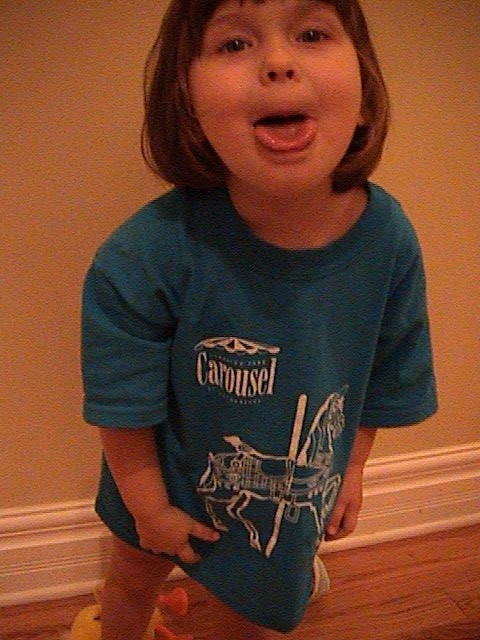
This past weekend was its final run of the season. Both the summer and our carousel ride were commmemorated in a small way this week by Helena digging out her souvenir T-shirt. It's too big for normal wear, but I struck a deal with her — if she dressed in sensible clothes for daycare, she could wear the carousel shirt to sleep in.

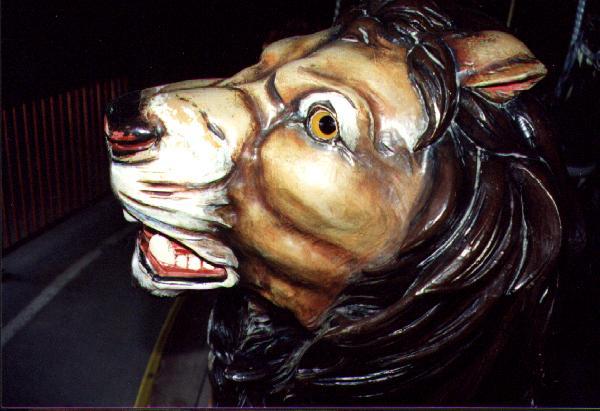
In the evening and again in the morning she recounted her memories of that day at the park. She'd wanted to sit on the lion, but once we climbed aboard the platform, she was scared. Then she chose a horse, but even that was daunting. Finally, Helena and I settled into a bench in one of the "chariots" while my sister perched on a nearby giraffe. Babcia was there too, watching. Dizzying at first, but then smiles and giggles.

This historic masterpiece was hand-carved by the Charles I.D. Looff Company between 1898 and 1905. The carousel came to St. Catharines in 1921 when it was purchased to become a part of the Port Dalhousie amusement park. It is a Coney Island–style carousel with 68 carved animals in 4 rows (making it relatively large), 4 chariots, and a functioning band organ. Each animal has been hand-carved, and most still sport real horse-hair tails.

According to the U.S. National Carousel Association, between 3,000 and 4,000 wooden carousels were carved across North America between the years 1885 and 1930. Today, less than 150 of these original carousels are left, and only 9 historic carousels reside in Canada.


The carousel has a new lion, Paws, hand-carved and painted by the Friends of the Carousel. Paws is allegedly a replacement for a lion that went missing some 30 years ago, though some sources maintain only Leo, carved by Looff himself, was on the original roster.


History of the carousel's ownership.

In 1974, the carousel suffered a storage fire and 20 animals were damaged. It was restored and reopened 1981.

This tidbit explains to me why memories of the carousel are absent from my own childhood. It was as adolescents that we flocked to the park and thought it was cool to spend our days and our nickels there. I should note that much of the popularity of Lakeside Park, our teenage "nostalgia" for it, was owing to the fact that it had been immortalized by Rush, which one had to admit was kind of cool even if one didn't much like their music.

Midway hawkers calling
'Try your luck with me'
Merry-go-round wheezing
The same old melody
A thousand ten cent wonders
Who could ask for more
A pocketful of silver
The key to heaven's door


Since the reopening in 1981, a carousel ride costs 5 cents, same as it did in 1921. (I don't know if it ever cost more than that.)

Niagara Woodcarvers are helping the Friends of the Carousel (a not-for-profit organization) with the ongoing restoration project. There's also a gift shop now, with all proceeds helping to fund the work. In addition to the T-shirt, we bought a sticker book for Helena.

I was always in awe of these prancing beasts, but the organ is also a wonder.

Sources show it currently has a Frati band organ which plays Wurlitzer 150 rolls, and that this organ was refurbished in 1985. The Artizan organ resides in The St. Catharines Historical Museum, having been moved there in 1976.


In one of his books, Neil Peart writes:
Another important setting in my childhood and early teens was Lakeside Park, in Port Dalhousie...When I was fourteen and fifteen, I worked summers at Lakeside Park as a barker ('Catch a bubble, prize every time,' all day and night)... And there was music: some of the kids brought transistor radios to work, and the music of that summer of 1966 played up and down the midway... At night, when the midway closed, we gathered around a fire on the beach, singing... Lakeside Park resonated in my life in so many deep ways, especially those fundamental exposures to music that would be forever important... It's all gone now. All that's left, apart from memories, is the old merry-go-round...


There are current plans to relocate the carousel within the park and house it in a glass-walled structure.

He makes a fine laureate

Harold Pinter, in his own words:
Some journalists have behaved appallingly. They've been ringing on the door insisting on entrance. They don't like it if you don't respond like a chimpanzee. But I'm not a chimpanzee and I don't intend ever to be a fucking chimpanzee. Not that I've anything against chimpanzees.

Thursday, October 13, 2005

A Nobel choice

The Swedish Academy:
The Nobel Prize in Literature for 2005 is awarded to the English writer Harold Pinter "who in his plays uncovers the precipice under everyday prattle and forces entry into oppression's closed rooms".

I have only a passing familiarity with Pinter. In high-school drama club we performed some pieces they called Pinteresque: "in which sense of menace emerges from a second or third layer of unspoken meaning." I wondered about the references to him in the lyrics of Anne Clark. I've seen a number of films for which Pinter wrote the screenplay.

Harold Pinter's website:
In 1958 I wrote the following:

"There are no hard distinctions between what is real and what is unreal, nor between what is true and what is false. A thing is not necessarily either true or false; it can be both true and false."

I believe that these assertions still make sense and do still apply to the exploration of reality through art. So as a writer I stand by them but as a citizen I cannot. As a citizen I must ask: What is true? What is false?


CBC:
Considered Britain's greatest living playwright for plays like The Birthday Party, The Caretaker and The Homecoming, "Pinter restored theatre to its basic elements: an enclosed space and unpredictable dialogue, where people are at the mercy of each other and pretence crumbles," the academy said.

Though a human rights activist since the early 1970s, Pinter has recently become more outspoken about politics, specifically criticizing U.S. President George W. Bush, British Prime Minister Tony Blair and the war in Iraq.


Pinter's name was not among those bandied about in recent weeks as a potential prize winner.

The choice undeniably has political overtones.

Earlier this year Pinter announced he was turning his focus to politics and poetry.

. . . all the dead air is alive
With the smell of America's God.


News coverage (at this still early hour, other than what's on the wires):
The Guardian.

Wednesday, October 12, 2005

Blogstipation, in 9 parts, more or less

Harken, thou discourager of the brethren, for you will see your pomegranates wither!

A.
In recent weeks we've taken to keeping a box of Smarties on standby for Helena. Smarties (note: the Canadian link is even more boring than this one) were a childhood fetish of mine. (Remember when the boxes were real boxes, not glued and perforated? When empty, they made excellent kazoos. Remember when they introduced blue? It seemed so unnatural.) Helena and I were at the grocery store and she was itching for a treat, and deserving one, and thus a new generation of Smarties fetish was born. It's a reasonably smart treat too, as far as sugar-and-chemical-based treats go, because you don't have to eat the whole thing and it's made for sharing. And colour-sorting, and counting. I made the mistake once of singing the jingle — it's now a frequent request.

Last night, for I don't know what reason, I sniffed out Helena's stash and ate them all. I feel a little guilty. (Not for gobbling down Smarties, but because they were hers. Silly guilt, really. It's not like her name was actually on them.)

B.
Thanksgiving came and went. J-F and his family have no tradition of celebrating Thanksgiving — just another long weekend. As my own family has dispersed and the logistics for gathering have become more complicated, and Thanksgiving being a "lesser" holiday, this weekend for me has also become just like any other. Sometimes that makes me a bit sad.

No turkey. No festive meals. But I still give thanks.

C.
Helena had a pretty bad cold over the weekend, with a pretty rough cough and a pretty high fever. It seemed like a good weekend to curl up and watch movies.

Helena has a current fixation with The Secret Garden — it'd been sitting in a drawer for a very long time, till one day not so long ago she thought it looked interesting. I'm curious to reread the book now, tho' I never loved it the way I loved A Little Princess. I'll have to dig it out of my mother's basement when next I visit.

Last week when renting a movie not worth mentioning, Helena expressed interest in Shrek. She's smitten by the creature — at least the appearance of him. So Sunday, in search of Shrek we went. For some reason, it seemed like a good idea for all of us to bundle up and go, but of course it wasn't, cuz Helena threw up.

We did find a copy of Shrek 2. And I'd previously seen most of Shrek (1) on TV. I just don't see what the big deal is about it being clever and working on so many levels. Kind of cute, but leaves me cold.

D.
Bath night. I always remind Helena in the morning, to warm her up to the idea. She protests, I insist, she asks whether we have to wash her hair, she makes me promise not to get water in her eyes, we get on with our day, periodically reminding each other of our evening bath commitment. Monday, she decides she wants a shower. While during the summer we would on occasion hose her down in the shower stall (by no means a thorough cleansing) and she's been rinsed off under the nozzles at the wading pool (more like running through a sprinkler), she's never had a shower per se. But Monday morning she got the idea in her head to take a shower and reminded me about it all day. OK.

We won't be doing that again any time soon.

E.
I had to take the métro yesterday. I momentarily toyed with the idea of lugging Don Quixote with me for 7 minutes of quality reading time, but the prospect of having to carry both it and a toddler was too real and daunting, so I slipped a slim paperback in my bag instead and started reading it on my commute, and it's very good, and it'd almost be a shame not to continue reading it now. I've never been good at reading more than one book at a time.

Don Quixote is in fact a very entertaining and readable book. Gripping, even. I'm amazed more people don't rave about it. But I just can't get physically comfortable with this edition. At this point, my resolve and interest outweigh(!) the drawbacks, but I fear for all the lesser people who started the Grossman translation on the recommendation of pretty much everybody only to feel literally bogged down. Paperbacks! Cheap stock! Multiple-volume box sets! Do you hear me publishers?!

F.
Last night was the annual general meeting of the daycare. Mostly very boring. And also French. And very poorly attended. But I feel involved. I almost want to join a committee. Except for that the feeling that I am constantly being scrutinized by other parents as well as staff holds me back a little, as if my parenting abilities, let alone any committee contributions, are only as competent as my French.

The highlight came in the report from the health and safety committee, regarding fire drills and evacuations — now completed in under 2 minutes! I know adults less competent than this. The report was punctuated with amusing anecdotes of children reacting to alarms during snacktime, and failing to react during naptime.

G.
Helena and I were playing in her room, with the dollhouse I think. She asks me if I want to play naptime, something we do often, plotting out our spots on the floor, finding pillows, blankets, and teddybears for ourselves and whichever dolls are playing with us, tucking each other in, fake snoring. I say OK. She very seriously tells me I have to tidy up first. This stops me like a slap. Is this playing, or manipulating? We strike a deal to clean up together. The scamp isn't keeping up her end and has the audacity to order me to finish the job. (At which point I managed to turn the tables.)

H.
FlyLady is starting to piss me off. While her tagline speaks to me — "You are not behind! I don't want you to try to catch up; I just want you to jump in where we are." — I could also use some serious catching up.

On the whole, the FlyLady concept is empowering (for me, for now, for maybe a little while longer), but then there are email messages I shake my head at:
Dirty dishes are a blessing, because when they are put away I am blessing my family. Laundry is the same way. I am no longer chained to a chore but I have been given a chance to show my sweet darling that I care for him. After all, nothing says I love you, like clean underwear. So when we have a change in our attitude from feeling martyred to finding joy in blessing our family, we will have time to do just a little.


For a sink-cleaning assignment: "use an OLD toothbrush not your husband's!"

What the fuck century is this?

I.
Need a slogan?
(Thanks to Scribbling Woman for reminding me of all the linky goodness in the world.)

Moving at the Speed of Magnificent Octopus.
The Magnificent Octopus Is Mightier Than The Sword.
I Wish They All Could Be Magnificent Octopus Girls.
Does She or Doesn't She? Only Her Magnificent Octopus Knows for Sure.
8 out of 10 Owners who Expressed a Preference said Their Cats Preferred Magnificent Octopus.
There's More Than One Way To Eat A Magnificent Octopus.
Now with 50% more Magnificent Octopus!

Friday, October 07, 2005

My week so far

(What? It's almost over?)

As luck would have it, I've been dropping off and picking up Helena at daycare quite a bit over the last week and some, just because that's the way it's worked out. As such, I've been reading quite a bit, on those métro journeys I make alone. This was all very fine, until I'd decided a few nights ago to throw myself back into Don Quixote, which is big and heavy and is not easily accommodated for transitory reading. And so it was that I found myself staring into space for an entire 7 minutes of subway riding between here and there, and some more minutes of entirely unproductive waiting, which were not even restful, so distraught I was at having nothing to read. Of course, I could've carried a little volume of something else, or a magazine, but I'm worried about disrupting the rhythm I'm currently hell-bent on establishing with Don Quixote.

As it was, when a few days ago I opened Don Quixote to the place I'd marked, the page number was much lower than I'd remembered achieving and the text was familiar, but I'm unable to ascertain whether the bookmark was (re)placed inaccurately or if my doubt stems from the combination of wishful thinking as to my previous progress and simply being attuned since the start of the calendar year to all things DQ, leading to a sense of familiarity with the text equalling that as if I'd actually read it.

The day-to-day stuff
We attended a parent–educator meeting at the daycare this week, a general presentation to the group of us about their rules and routines. Very boring. (Excruciating for J-F, as we were pressed to make it home in time to watch the first NHL game in 524 days. Yes, he counted the days.)

We heard in great detail about the menu. And how the kids have tasks (like distributing milk glasses), and take turns, and make decisions about activities as a group. We met Brindami, the paper mouse on a stick (shades of Mr. Hat) — I couldn't help but notice that his head has been ripped off a number of times, as evidence by the cast of tape he wore around his neck.

The biggest surprise is how busy their schedule is; I knew they had regular activities, but it's much more impressive on paper than when it simply buzzes around in my head. Every Monday: music lesson. Every other Tuesday: the gym. Every other Thursday: the library. Every Friday: dance class. (Not to mention the daily washing up for snacktime, snacking, washing up after snacktime; washing up for lunch, lunching, washing up after lunch; preparing for naps, napping; washing up for another snacktime, snacking, and cleaning up.) They're busy! And on top of this, special excursions — this Wednesday it was the botanical gardens; a couple weeks back, they went to see dinosaurs; today was supposed to be apple-picking, but cancelled due to rain. So, while I sometimes feel guilty for not keeping Helena home with me (particularly when work is slow), sometimes I don't.

The only mystery to me is where Helena's learning her letters and numbers, seeing as they have no "academic" program as such. I guess she's just piecing it all together for herself from various unstructured input.

Next week is the daycare's annual general meeting, which we've already committed to attending, and J-F, it turns out, is unable to attend, and I'm dreading facing it alone, not least because of my inadequate French, not to mention poor general social skills. Ugh.

Assorted cute things
Helena is being generally adorable and lovely, with me anyway.

In the bath, with her squirty frog toy: "La grenouille fait pipi a la bouche!"

At the grocery store, which is crawling with (decorative) huge black hairy spiders — as big as Helena: she tries to hide from them and plays scared.

She met une sorcière at la garderie this week, with a very big nose and a black hat, but it's ok because she was very nice. There was much spinning.

Helena's received her first invitation, to a real birthday party, of a classmate, to take place at the end of the month. (How much money are we supposed to spend on a present? Do I have to run it by the parents first?)

I had to stop at the pharmacy on the way home last night, and Helena was very excited about accompanying me. Then she started asking where the pigs and cows are. (If it's taking you as long as it took me to figure out: she expected farm, was rather disappointed by pharmacy.)

Not so cute
Last night, J-F gave Helena her bath (even though there was a hockey game on), for the first time in a very long time. We've gone through phases of bathing her together or regularly taking turns, but the routine somehow always falls apart, and the task inevitably falls to me alone. While I generally don't mind — we enjoy water play and I (usually) want to spend as much waking time with the girl as possible (given that she goes daily to daycare) — it still breeds resentment.

Last night's bath was one long continuous scream. (The kind that's an actual scream, not in the sense of "it was great, what a scream.") The sort of scream that makes me want to jump in and say, oh here, just let me do it, it'll be easier, no big deal. Which I've done way too often in the past.

Ditto regarding the "task" of bedtime (the pj's, the story, the tucking in). My job. And waking up. And going to the park. And after-supper walks. And pretty much everything. My job.

The two of them have got to figure something out. And I think not just for the sake of my sanity, me wanting a break.

This is related to the fact that J-F sees our parenting roles as good cop/bad cop, and he's resigned himself to being bad cop, cuz you can't be both. (By corollary, I'm not "bad" enough often enough.) I'm not convinced it has to be that way.

Meanwhile
I've discovered FlyLady. Some of you have mentioned her before, to me even. But why didn't you make sure I was paying attention?! I'm so full of hope, now, for an organized and orderly home!

Modern love
One book I zipped through at the beginning of the week: The.Powerbook, by Jeanette Winterson. (Extract.)

(One reason I'd avoided it while simultaneously being drawn to it is that upon reading the description it sounded much like an idea I've had buzzing 'round my head for years already, thinking that were I ever to write a novel it would be something like this. Of course, having read it now, I know my idea, and whatever novel might result, is nothing like this. Phew.)

I was confused at first, but soon enough I was mesmerized by the prose, and the story unfurled itself to me.

I went through a phase of reading, and loving, Winterson in my early college years, probably as much for the illicit thrill of her stories as for the beautiful prose. But after a while, I no longer felt compelled to read her latest, as if by settling into my own sexuality I no longer had need for her explorations.

There's something very unsettling about this book, even as I melt into her words. It's almost as if maybe, just maybe, I've never actually been in love after all.

Thursday, October 06, 2005

Who shall be the master?

Today I suffered a great injury by Don Quixote. While easing him into my lap for an afternoon escape, I was caught off guard — having forgotten — so long it's been since last I sampled the pleasure he has to give — by his massive girth. And so it came to pass that my own left forearm has been horribly twisted. I let him drop to the ground — doubtless he was as aghast as I at this unsuspected turn in our long overdue rendezvous. I am tender at the thought of him.

As is so often the case with great books and slightly lesser men, while I love the idea of him, I'm coming to loathe his physical presence.

Tuesday, October 04, 2005

Death and glory!

Finally I finished Alexandre Dumas's The Man in the Iron Mask. It's very funny, except for that almost everybody dies.

For example, as far as funny goes, when a messenger arrives for the governor of the Bastille at some ungodly hour and he is finally granted entrance,
addressing Aramis, [the governor] added in a lower tone of voice, 'Do you know what it is? I warrant it is something about as interesting as this: "Keep fire away from you powder magazine," or, "Keep an eye on so-and-so; he is an expert gaol-breaker."'


And on it goes sarcastically about, essentially, the stupidity of office memos.

Dumas also imagines some witty exchanges among poets and artists — friends of the court — including Molière and La Fontaine.

I was inspired to spend time with Dumas after reading Arturo Perez-Reverte's The Queen of the South, which refers quite a bit to The Count of Monte Cristo, which I haven't read and which would've been a more appropriate follow-up reading candidate, but somehow I found myself face to face with The Man instead (I'd read The Three Musketeers year ago). So here we are.

My reading of the book got off to a difficult start, if not exactly a slow one. The political and romantic machinations amid which I found myself were so fast and furious that I was wishing for diagrams to plot out the characters' relationships to one another. I was plagued with questions such as, "Who's this Raoul fellow?"

The introduction alerted me to the proper sequence of Musketeer stories: The Man in the Iron Mask is but one section, with a disputed starting point, of The Vicomte de Bragelonne — none other than the aforementioned Raoul, son(!?) of Athos — which was the serialized follow-up to The Three Musketeers and its sequel, Twenty Years After, the latter of which I've not read and familiarity with which might've eased my entrance into the intrigue.

One of Dumas's biographers, André Maurois, is quoted as saying:
"Does Dumas make us think? Not very often. Dream? Never. Go on turning the pages? Always."

And so I turned some 600 pages.

I can't believe everyone dies. Everyone except Aramis. And Aramis should've died. It was his doing that caused so much misfortune to befall so many around him. And him a man of God! It's distasteful to watch a musketeer become this. Does Aramis have more adventures, I wonder. I hope he dies a miserable death. I'd like to read about it.

And d'Artagnan! Was it worth it? How did your ambition come to be stripped of your honour and integrity, to be so naked. Oh, d'Artagnan, you disappoint me. (I used to have such a crush on you.) You had the death you deserve.

Their glory days are so far behind them.

Did you see the movie? With those gloriously cast aging musketeers? The book is nothing like that. The movie picks up a plot point that in my edition begins on page 178 (of 616) and carries on for maybe two hundred pages, but it's difficult to measure precisely because the movie goes off to resolve that plot in a wildly different (if still thrillingly entertaining) manner. (That bit where the 4 of them charge the line of musketeers at the Bastille and they're shocked when the smoke clears to find themselves still standing — I love that scene. But this scene is not to be found in the book; I don't think the 4 of them are ever even together on the same page in the book.)

The story is so much more than who is on the throne of France, or to whom it rightly belongs. If anything it lends import to the the tiniest gestures, merest glances, careless words, and romantic whims that affect matters of state.

To this end I find the title odd and misleading, as the title character is on stage for merely a few scenes, his only purpose to reassert the question of the kingliness of the king. Which is a great question. While the theory regarding the identity of the mysterious prisoner in the Bastille is dramatic, Dumas could've effected the plot bits of treason and exile with equally conspiratorial and less far-fetched devices to ensure the coming of age — solidification — of the king. Whatever.

I just hope they keep discovering more Dumas manuscripts. I eat this stuff up.

Monday, October 03, 2005

Out the door

This morning as J-F and Helena were on their way out the door to daycare, she turns to him in all seriousness and tells him,

(I paraphrase her French toddler speak here — how natural it's become to smooth out the grammar, fill in the blanks, know exactly what she's trying to say, and how difficult to recreate her actual utterances and to explain how I know the sense of it, the sum of it being so much more than its little garbled parts...)

"Papa, I'm not going to cry. At la garderie. I won't cry. Un bisou, calin, and that'll be that. And I won't kick the back of your seat in the car."

And that's exactly how it was.

Weekend pleasures

Helena spent the weekend with her grandmother — I feel greatly refreshed, and not certain why I can't achieve or maintain this feeling of equlibrium when she's here. As if every word or glance from her is momentous enough a force to hurtle me along some new emotional spiral, whether up or down — I'm physically dizzy with her. Off balance. But I have realignment now.

I slept! Twelve hours a night, for two nights! I love sleep! God, how I miss it sometimes! (Of course, I could be napping now...)

I shopped for books! It's buy-a-friend-a-book week after all. The experience was remarkably peaceful and restorative, the way I remember it being long ago, when unhampered by toddler in tow.

I browsed magazines! While chatting with J-F about current events and deciding where to lunch, I read all of Doris Lessing's "Death of a Chair" in this month's Harper's (without buying it).

This, and all sorts of mundane things like hanging pictures and mopping floors! Such happiness!

But all this — restoration of order at home, the procurement of books, and Lessing's story — leaves me wanting a proper reading chair. I want to sit sideways in it, dangle my legs over its arm, rest my head on its back. I've been searching for the perfect chair for about 5 years now. Where are you? I need you!

Saturday, October 01, 2005

The mystery of heat

Mystery the first:
How is it that, although all known thermostats are still set to zero, the two baseboard electric heaters in the dining room radiate warmth?

Mystery the second:
How is that there is a thermostat in the main bathroom, but no heat source is in evidence?