Wednesday, November 26, 2014

Novembernebel

"The season in which we were born is peculiarly akin to us, and we to it. [...] For really, in my experience, there is a sympathetic relation between ourselves and the season that produced us. Its return brings something that confirms and strengthens, that renews our lives."
— from The Black Swan, by Thomas Mann.

That's how I feel about November.

I have been taking German classes now for eight weeks. I have learned how to count, how to conjugate, and how to conduct a stilted and limited conversation in a very specific, unrealistic scenario.

I have learned also that German is much stranger than I'd ever imagined. For example, the verb takes second position in a sentence. Weiso? So the addition of a sentence adverb therefore changes everything.

I still cannot read Rilke.

The compounding of nouns, however, has its own kind of poetry. Like "der Kugelschreiber" — the pen, a bullet for writing. And "der Fernseher" — the television, for watching at a distance.

I love the fact of Novembernebel, that November has its own kind of fog.

The assignment in lesson 4 was to describe a scenario in a train using the vocabulary learned to date. Here is the story I wrote:
Der Zug
Robert Walser, Stefan Zweig, und Thomas Mann fahren nach Berlin. Sie spielen Karten für kurze Zeit. Robert schläft. Stefan schreibt eine Fabel. Thomas weint. Sie arbeiten zu viel.

Monday, November 24, 2014

Strange things did happen here

We took the girl out this weekend to celebrate her 12th birthday with a few friends: a movie matinee and then wood-fired pizza. Hunger games, indeed.


Yes, we saw Mockingjay, and we loved it. Only we saw it in French, so really we saw La Révolte. (I admit I dozed off a couple times, but that was just the French short-circuiting my brain.) Because: Revolution!

One of the best things about the movie is the song, the anthem for the revolution.
Are you, are you
Coming to the tree
Where I told you to run, so we'd both be free.
Strange things did happen here
No stranger would it be
If we met up at midnight in the hanging tree.
It sounds like an old folk song, but it's not. Turns out, Suzanne Collins wrote the lyrics, and it was set to music specifically for the film.

Not having read the books, I was particularly interested to learn how the song was woven into the story for deeper significances. (See What Is the Origin of Mockingjay’s Haunting Song, "The Hanging Tree"? for more background.)

Tuesday, November 18, 2014

Variations on themes

I've always liked the short poem "This is Just to Say" by Williams Carlos Williams. Kenneth Koch parodied the poem in "Variations on a Theme by William Carlos Williams."

The Art of Poetry MOOC led by Robert Pinsky this week looked at Kidding and Tribute, and it inspired me to write a variation of my own...
Variation on a Theme by Kenneth Koch

I found the poem you wrote
and left on the table
which you probably meant to send to your publisher

I put my own name on it
and mailed it out
So much better than anything I could ever write

Sunday, November 16, 2014

A series of seemingly meaningless human movements

He understood, just in time, that the best he could do was to use his memory to fend off the sinister, underhanded process of decay, trusting in the fact that since all that mason might build, carpenter might construct, woman might stitch, indeed all that men and women had brought forth with bitter tears was bound to turn to an undifferentiated, runny, underground, mysteriously ordained mush, his memory would remain lively and clear, right until his organs surrendered and "conformed to the contract whereby their business affairs were wound up," that is to say until his bones and flesh fell prey to the vultures hovering over death and decay. He decided to watch everything very carefully and to record it constantly, all with the aim of not missing the smallest detail, because he realized with a shock that to ignore the apparently insignificant was to admit that one was condemned to sit defenceless on the parapet connecting the rising and falling members of the bridge between chaos event and comprehensible order. However apparently insignificant the event, whether it be the ring of tobacco ash surrounding the table, the direction from which the wild geese first appeared, or a series of seemingly meaningless human movements, he couldn't afford to take his eyes off it and must note it all down, since only by doing so could he hope not to vanish one day and fall a silent captive to the infernal arrangement whereby the world decomposes but is at the same time constantly in the process of self-construction. It was not, however, enough to remember things conscientiously: that "was insufficient in itself," not up to the task: one had to compile and comprehend such signs as still remained in order to discover the means whereby the perfectly maintained memory's sphere of influence might be extended and sustained over a period. The best course then, thought the doctor during his visit to the mill, would be "to reduce to a minimum such events as would tend to increase the number of things I have to keep an eye on," and that very night, having told the useless Horgos girl to clear off home, informing her he longer required her services, he set up his observation post by the window and began planning the elements of a system that some people might consider insane.
— from Satantango, by László Krasznahorkai.

I'm having a difficult time with this book, not least because it doesn't have paragraph breaks and so does not lend itself to being read on one's daily commute, and I find I read the same page several times over, which contributes to the overall effect, I suppose, quite possibly just as intended. I don't entirely dislike the experience. And there are bits of this book that are strangely compelling.

Like this doctor character here. I assume these are quotes from his notebook. Very formal. He's pretty insane, just sitting there amid decay (the old estate), taking notes, indirectly recording the decay.

Thursday, November 13, 2014

All edges erased

Stories are as slippery as seasons; it's beyond my power to make either stand still. I try to tell them the same way, but each telling leads to small changes; something added to the structure, a change of pace, a tweak of testimonies, all of them make circles in our minds.
This is kind of wow. Creepy, elegant, thoughtful, feminist, weird. Unsettling.

The Beauty. Think collective noun, hive mind, like The Silence, or Borg.

The Beauty, by Aliya Whiteley, is the book I want to give all my friends for Christmas. (Except it may put a slight damper on the holiday spirit.) (But isn't that cover gorgeous?)

It starts off with a postapocalyptic scenario — a bunch of people have fled the city to return to Nature. They live communally, live off the land. Only, all the women are dying off. They are dying of the yellow fungus that grows out of them. And when they die, the same fungus grows out of their graves. Things get a bit weird from there. The Beauty arrive.
When he told me about his journey, that was how he finished it — he fitted there. I find this to be the strangest of expressions — how does one fit in to other people, all edges erased, making a seamless life from the sharp corners of discontent I don't find anything that fits in such a way. Certainly not in nature. Nothing real is meant to tessellate like a triangle, top-bottom bottom-top. The sheep will never munch the grass in straight lines.
This book is short and compelling. The sound of it is mythic and important. And it sounds gorgeous.

It's about beauty, to an extent, and what we find beautiful. And how that changes according to experience. And what we do to what we find beautiful, how we take it for our own. It's about gender roles, and how we fall into them. Also, an individual's place and role within a society. Nevermind the function that society serves. And also it's about the nature and power of storytelling.
Did my mother hum to me when I was little? Did she touch me, hold me, fill me with her noise and her thoughts? This loneliness I feel is of the womb, born by women. I was sixteen when they all died and I thought I understood this loss, but it comes to me that I didn't know what women gave to the world. It wasn't about their lips, their eyes or the gentle quality of their voices. It was about the way that all men are a part of them. And now we are part of nothing.
The Beauty do all the hard work for the men, so the men become reliant and weak. Who controls whom?

Does it depict change, or is it the same old? Is it bleak or hopeful? Feminist? Cynical? Yes, yes, yes, yes.

Reviews
BookCunt
By Lulu with Love

See also
The Story Behind The Beauty
For the first few thousand words I worried that I couldn’t write persuasively in a male voice, but then the story kicked in and I realised that Nathan isn’t exactly a man.

Tuesday, November 11, 2014

Harmony between one's life and one's innate moral convictions

Harmony between body and soul is certainly a good and necessary thing, and you are proud and happy because Nature, your beloved Nature, has granted it to you in a way that is almost miraculous. But harmony between one's life and one's innate moral convictions is, in the end, even more necessary, and where it is disrupted the only result can be emotional disruption, and that means unhappiness. Don't you feel that this is true?

— from The Black Swan, by Thomas Mann.

Saturday, November 08, 2014

"Matter is made up of a whole lot of nothing"

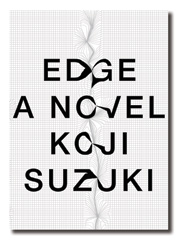
Edge, by Koji Suzuki, is billed as quantum horror. That is, it's horror derived from quantum physics. Or maybe it's that you don't know if it's really horror till you open the book and look inside.

The story is set in our now. It has some science-y stuff going on, but also a hint of supernatural. I don't think it quite qualifies as science fiction. Also, it's not post-apocalyptic dystopia; nothing post about it — this is how the apocalypse unfolds.

It starts with people disappearing, suddenly and inexplicably, there one minute gone the next. And math starts going wrong; pi and other "constants" and equations just aren't stable anymore.

Saeko starts investigating a set of disappearances. Ever since her own father disappeared 18 years previously, she's been rather obsessed with these types of occurrences. Not to mention having all kinds of daddy issues.

Saeko's father imparted to her all sorts of knowledge, along with a general wonder about the universe. Sadly, Suzuki flashes back on their time together, and the father's speeches are used as massive info dumps. How dreadfully boring, I thought; so glad he disappeared, I wouldn't be able to stand him another day. Maybe I was a little jaded after having just read an elegant and eloquent nonfiction treatment of similar issues, but I think Suzuki could give his readers a little more credit — no need for him to talk down to his readers the way Saeko's father evidently did to her.

But there's some food for deep thought buried in there: "The odds for the string of coincidences necessary to create our universe were basically nil." And, "matter is made up of a whole lot of nothing." "The real mystery is, why does the universe have any structure at all?"

So math and physics suddenly going all wonky is, I think, a fantastic concept. And a journalistic investigation into the strange disappearances could make for a good story too. But mash them together? And throw in a handful of coincidences, some supernatural-type visions, two-dimensional characters, and an appearance by the devil? I'm kind of glad that [spoiler alert] the world ends — having it go on just wouldn't make sense. Taken on their own, there are a couple deliciously creepy scenes and other interesting setups, but the book doesn't hang together for me.

Reviews

Thursday, November 06, 2014

The art of poetry

The eight-week Art of Poetry massive open online course (MOOC) conducted by former United States Poet Laureate Robert Pinsky is headed into the final phases. The course is terrific. It draws on the Favorite Poem Project, a program Pinsky founded to celebrate, document, and encourage the role of poetry in people's lives.

The course material explores the difficulty, freedom, and form of poetry while considering its relationship to music, courtship, and humour, among other themes. Most of the material is presented via videos, either of Pinsky on his own or leading a discussion group. There are some supplementary readings, and discussion forums in which to continue the exploration of these and related subjects.

(This is first course I participate in that is on the edx platform. The navigation took a little getting used, and I still feel that it's easy to miss certain sections of the course material. The forums are active, but not particularly well-organized or easy to find your way around; Coursera really sets the standard for this.)

But the heart of the course is the personal anthology that each student is required to compile. By the end of the course, I will have annotated twelve poems with reflections and analysis, notes on why they speak to me.

The task was rather daunting — where do I even find poems? But it turns out I've been collecting poetry all along on this very blog.

Now I have a notebook for the poems I find. I write the poems into it by hand. This is an insanely pleasant experience. Like saying a poem out loud and letting it roll around your mouth, writing it out, guiding the pen to make the marks that mean those words, makes it something tangible, something you can feel.

I think it forces a more intense reflection on the poem, the sound and shape of it, how the pieces fit together. I will absolutely be maintaining my poetry journal beyond this course.

To date this is one of the most rewarding MOOCs I've participated in.

Monday, November 03, 2014

One of the most amazing people on Earth

I have a slight obsession with reviews of an unreliable biography about an obscure (at least to most Westerners) Russian countercultural dissident antihero with unpalatable politics written by a man who, if the other works of his I've read are any indication, examines the external world primarily as a means of examining himself.

According to Matt Taibi, "Edward Limonov is one of the most amazing people on Earth, the author of a few truly great books, a man who has lived a fuller life than any 10 of your most interesting friends combined."

Limonov: The Outrageous Adventures of the Radical Soviet Poet Who Became a Bum in New York, a Sensation in France, and a Political Antihero in Russia, a fictional biography by Emmanuel Carrère.

Matt Taibi, NPR:
Carrere wonders: What could Limonov be thinking? "Does it amuse him," he writes, "the outlaw, the mad dog, to play the virtuous Democrat?" He spends the rest of the book trying to answer the question: Is this last part the act? Or was it the earlier part?

Carrere struggles with that theme throughout, and in the end toys with a horrifying surprise conclusion: Limonov is above all else a failure.
Julian Barnes, The Guardian:
The conformist loves the transgressor, the bourgeois loves the punk, the careful man the adventurer; while the Parisian intellectual (see Sartre and "Saint Genet") typically loves the intransigent despiser of all that Parisian intellectuals stand for. Some, if not all of these themes play out in Limonov. [...]

Why, then, is he interesting? Flaubert, asked to justify his interest in Nero and the Marquis de Sade, replied, "These monsters explain history to us." Limonov is not a monster, though would perhaps like to think himself one; he is a philosophical punk, a chancer, a blood-and-soil patriot who imagined himself a cleansing political force. Carrère, reflecting on his subject's escapades, decides that:

He sees himself as a hero; you might call him a scumbag; I suspend my judgment on the matter. But ... I thought to myself, his romantic, dangerous life says something. Not just about him, Limonov, not just about Russia, but about everything that's happened since the end of the second world war.
José Teodoro, National Post:
Of course a writer wants to write about a writer who, to such an extraordinary degree, writes his life into being, writing always with audacity, always for maximum drama and dynamism, always working to ensure that he’s at the nucleus of the narrative.
M.A. Orthofer, The Complete Review:
Carrère doesn't see himself in Limonov, but he sees them as kindred writing spirits, obsessed with themselves and presenting themselves in their writing. Significantly, Limonov has also lived the life that was closed to Carrère, because of his ultra-bourgeois background and limited experience. Carrère has a writer-crush on this buffoon who has 'lived' so much.
Rachel Donadio in The New York Times:
Some critics have found Limonov too flattering a portrait, though Mr. Carrère says he finds Mr. Limonov's politics unpalatable. "We are not on the same side of the barricades," he said, adding that Mr. Limonov told him, "If I were in power, I would send you to the gulag."
Michael Dirda, The Washington Post:
The book interweaves a social and political history of post-Stalinist Russia, chunks of Carrère's autobiography and a hodgepodge of reflections on art, sex, ambition, the punk aesthetic, fascism, mysticism and old age.
Interview.
Excerpt.

Sunday, November 02, 2014

Sunday reading: Ursula K. Le Guin

Two terrific pieces in Brain Pickings, originating with Ursula K. LeGuin's The Wave in the Mind: Talks and Essays on the Writer, the Reader, and the Imagination:
Maria Popova has selected some brilliant passages, many of which are laugh-out-loud funny. (I read a passage to my other half, and not ten seconds later I'm nudging him again, Listen to this.)

"On Being a Man" actually addresses a few topics — gender and sex, aging and spectator sports:
And another thing. Ernest Hemingway would have died rather than get old. And he did. He shot himself. A short sentence. Anything rather than a long sentence, a life sentence. Death sentences are short and very, very manly. Life sentences aren't. They go on and on, all full of syntax and qualifying clauses and confusing references and getting old.
"On Aging and What Beauty Really Means" also covers cats and dogs, dance and space-time.
Cats know exactly where they begin and end. When they walk slowly out the door that you are holding open for them, and pause, leaving their tail just an inch or two inside the door, they know it. They know you have to keep holding the door open. That is why their tail is there. It is a cat's way of maintaining a relationship.
I expect I'll have downloaded Le Guin's book of essays before the hour is out... (not to mention digging out those as yet unread novels of hers).

Tuesday, October 28, 2014

The eternal reality of the exploited

The taller of the two men assures his companion, saying, "The two clocks say different times, but it could be that neither of them is right. Our clock here," he continues, pointing to the one above them with his long, slender and refined index finger, "is very late, while that one there measures not so much time as, well, the eternal reality of the exploited, and we to it are as the bough of a tree to the rain that falls upon it: in other words we are helpless."
— from Satantango, by László Krasznahorkai.

Sunday, October 26, 2014

Mad, bad

Jean-Patrick Manchette's The Mad and the Bad is a heart-pumping novel. Extremely violent. Damaged people.

Hartog — architect, businessman, philanthropist — plucks Julie out of an insane asylum to care for his ward, his 12-year-old orphaned nephew, spoiled brat (or worse — things don't seem quite right with the boy) and heir to the family fortune. On her first day of work, Julie and the boy are kidnapped. Once tranquilizers and alcohol aren't available, Julie's forced to rely on her wits to survive, and she has plenty. She escapes death and her captors, with the boy in tow, only to face more dangers.

Here's a passage I quite liked from late in the novel:
Julie poured herself a bowl of coffee, touched it to her lips and burnt herself. She put the vessel down and left the kitchen. She almost lost her way in the web of corridors and rooms. Then she stepped into Fuentes's room. The failed architect was lying on his back in bed, wearing khaki shorts. Empty beer bottles were strewn across a good half of the room. He had dried beer on his chest. His thoracic hair was sticky with it. He was snoring. Julie contemplated him with commiseration and chagrin. She regretted the fact that he was not a handsome young man and that he had not tried to possess her. She would have struggled, scratched his face no doubt, and in any case men did nothing for her, but, all the same, she regretted it.

This is the second Manchette novel I've read (after Fatale). Both have a female protagonist. There are shades of feminist thinking to their motivations and their competence and self-reliance, but some gratuitous objectification as well. I wish I could find a feminist critique so that I'd know what to think. I know one woman who read Fatale, and she was a bit put off by the violence. A scan of the internet suggests that not many women are interested in Manchette.

Check out His Futile Preoccupations for a closer look at Julie's character.

James Sallis writes in the introduction to this editions
There's much that's quintessentially French about Manchette: his political stance, the stylish hard surface of his prose, his adoption of a "low" or demotic art form to embody abstract ideas. Like any great illusionist, he directs our attention one way as the miraculous happens in another. He tells us a simple story. This occurred. That. But there's bone, there's gristle. Floors give way, and wind heaves its shoulder against the door. His stories of cornered individuals become an indictment of capitalism's excesses, its unchallenged power, its reliance on distraction and spectacle.
All true.

Everything happens so fast it's hard to read any of it as social commentary. But it's not much of a stretch to see how Manchette might be considered as a successor to Simenon. In their world, darkness lives in everyone's heart, and everyone is capable of anything. Manchette is credited with launching the neo-polar wave. For me Manchette's style calls to mind Delacorta, who was writing just a few years later (among other things he wrote Diva, which is perhaps better known as a film adaptation).

I am furious with NYRB Classics for divulging a major plot point in the description on the back cover. It's just barely hinted at in the early pages, and not fully confirmed until page 140. I made the mistake of rereading the description a few chapters in — someone had asked me about what I was reading — at which point, all the steam was taken out of the ride, the drive to find out who was behind it all deflated. The novel lost its purpose for me.

Still, something very compelling about Manchette's writing, the feeling that there's more to it than meets the eye. His novels are fully loaded. I'm packing this one away for a reread some day.

Friday, October 24, 2014

The fire of life

How is it that I can claim a familiarity with Stefan Zweig's oeuvre when I've read merely two of his novellas? (And I've seen Wes Anderson's Zweig-inspired Grand Budapest Hotel, but that hardly counts.) I'll try not to make sweeping generalizations about his work, but the temptation is great, owing to the shroud of intimacy with which he encircles the reader. I feel like I have secret knowledge of the workings of Zweig's heart and mind, but I know it is a trick.

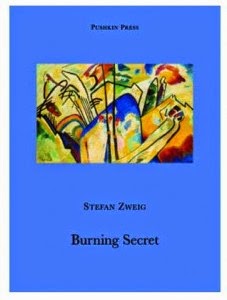
Burning Secret, by Stefan Zweig, is a terrific story — intensely, relentlessly, heart-poundingly emotional.

It's established in the opening pages that the Baron is a ladykiller. It's no secret how this will play out...
It was very likely that he wold not pursue his quarry in vain. She was at that crucial age when a woman begins to regret having stayed faithful to a husband she never really loved, when the glowing sunset colours of her beauty offer her one last, urgent choice between maternal and feminine love. At such a moment a life that seemed to have chosen its course long ago is questioned once again, for the last time the magic compass needle of the will hovers between final resignation and the hope of erotic experience. Then a woman is confronted with a dangerous decision: does she live her own life or live for her children? And the Baron, who had a keen eye for these things, thought he saw in her just that dangerous hesitation between the fire of life and self-sacrifice.
There are a few secrets in play that aren't much of a secret to anyone: that the Baron is using 12-year-old Edgar to make a play for his mother; that the Baron and the mother may be about to embark on something illicit (she is quite married, after all); that both of them want Edgar to keep out of the way. But Edgar, "he had a secret of his own now. Its name was hatred, boundless hatred for both of them."

The burning secret is the one kept from Edgar: the mystery of love.

What's most remarkable about this short work is how much psychology is packed into it. The events take place over just a couple days, and Zweig essentially gives a play-by-play of the characters' actions and intentions: why they say and do what they say and do, what they hope to gain, what they stand to lose, what they're hiding from others.

Nicholas Lezard sums this up nicely in "Zweig's Perfect Triangle" (The Guardian):
One wonders what they were putting into the water in Vienna a century or so ago to produce people with such a capacity to enter into the human soul, and then render it into art or analysis. Around the time Zweig published this, Freud was writing On Narcissism, and there are moments here when you marvel at the psychological accuracy and plausibility of Zweig's characters.
Related

Tuesday, October 21, 2014

A suggestion, and lots of beer

Funny how it takes reading a stylized French crime thriller of another era to learn a little about local history.

The Mad and the Bad, by Jean-Patrick Manchette, was first published in 1972. The protagonist, recently released from an insane asylum and now implicated in a kidnapping and worse, is on the run, literally, across the countryside of France, and in one small village she ducks into a conference hall where some kind of evangelical rally is underway:
"Would you like to know what happens in a big city when there are no more police? That is what occurred in Montreal on October 7, 1969. The police were on strike. Did citizens respect the law once they knew the police were no longer there to make arrests? Not at all! Right away Montreal became the scene of rioting, arson, looting, and fighting among taxi drivers. The rioters armed themselves with clubs and rocks and engaged in an orgy of senseless destruction. They smashed the windows of the Queen Elizabeth Hotel and stole merchandise. They vandalized the fine IBM Building. They plundered the Windsor and Mount Royal hotels. Without police, respect for law and order completely vanished. According to government spokesmen, the city was 'on the verge of anarchy'!"
While the preacher's rhetoric is intended to argue that only God can bring order, the author is no doubt making some kind of commentary on power, authority, and freedom. Meanwhile, I'd never heard of Montreal's night of terror.

Indeed, a taxi driver's union staged a protest regarding unfair competition (a legitimate issue that wasn't resolved till years later). And the police, who were on strike (regarding pay negotiations), weren't around to prevent it from getting out of hand.

(If video does not appear, try Google Chrome.) More facts related to the incident are available in the CBC Digital Archives.
In 1987 Montreal journalist and city councillor Nick Auf der Maur recalled the riot in Saturday Night magazine: "The bunch of us had thrown in our lot with something called the Mouvement de libération de taxi, a group dedicated to ridding the airport of its Murray Hill limousine monopoly... It seems that all it took back then to organize a full-scale riot in Montreal was a suggestion, and lots of beer."

Tuesday, October 14, 2014

More Foundation concepts: the Division of Logic and the Church of Science

So I finished reading Asimov's Foundation, and the details have already faded since I closed it about two weeks ago.

I think I kind of get why it's an important book, taking world-building to a new level and elevating the genre of science fiction by a few degrees of respectability. For its relatively low page count, Foundation is big in scope and ideas. But I didn't quite love it.

If you know it only by its reputation, as I did, then you probably don't know much about it at all. Foundation began life as a series of interconnected short stories. The basic premise: it's been foreseen that the Empire is in demise, and a foundation is established to preserve its knowledge. I stand by my initial impressions.

Asimov introduces some terrific concepts: psychohistory and the Encyclopedia Galactica chief among them.

And I love the application of symbolic logic, using it "to prune away all sorts of clogging deadwood that clutters up human language." Upon submitting to symbolic analysis the transcripts of Lord Dorwin's discussions during his diplomatic mission, the Division of Logic
"after two days of steady work, succeeded in eliminating meaningless statements, vague gibberish, useless qualifications — in short, all the goo and dribble — he found he had nothing left. Everything cancelled out."

"Lord Dorwin, gentlemen, in five days of discussion didn't say one damn thing, and said it so you never noticed."
(I wish we could run those analyses on the some of the meetings I'm forced to attend at work.)

And the Church of Science, established by the Foundation in order for the barbarians to more readily accept the science of the Foundation. Hah! Its high priests are in charge of the power plants. This is a wickedly satirical story.

The book reads to me as a cross between The Hitchhiker's Guide to the Galaxy, for its general tone, humor, and spaciness, and Game of Thrones, for its backroom dealings and back-stabby politics. All of Foundation was narrated to me in my head by the voice of the Guide, giving characters here and there a whiff of Zaphod or Slartibartfast, and adding greatly to my enjoyment.

I should note that the book contains one female character. I was reading some forum or other recently, and someone was criticizing an author for not writing women well and it led to accusations that the author was misogynistic. And so I happened to notice that to that point, I hadn't encountered a woman in Foundation. I don't think Asimov has been accused of these things. However, clearly he is a product of his times. (Possibly there are actually two female characters in Foundation — I can't be sure because my attention foundered toward the end.)

Is my life changed for having read Foundation? No. Am I dying to read the rest of the series? Not particularly. Am I glad to have read Foundation? Sure, but more for its historical significance than for the actual story. I wasn't quite in the perfect headspace for it, but I'll give the rest of the series a chance someday.

Have you read Foundation? How does it rank in your personal sci-fi pantheon?

Check out io9's chapter-by-chapter discussion of Foundation, its strengths and weaknesses and its big ideas.

Monday, October 13, 2014

How literature helps us live


[via]

As much as I dislike Alain de Botton, every now and then his projects demonstrate a glimmer of right and good.

Saturday, October 11, 2014

Why is this a book?

I'm mildly obsessed with Consumed, a new novel by David Cronenberg. I haven't actually read it yet — I'm still hoping someone will think to buy it for me for my birthday next month — but I'm reading every review I can find.

I'm not even that big of a Cronenberg fan (excepting Naked Lunch, which is one of my favourite films ever). I just feel compelled to watch his films, and now read his novel, even though I fully expect it to be an unpleasant experience.

According to Jason Sheehan on NPR (In Cronenberg's 'Consumed,' An Appetite For Sex, Death And The Latest Gear):
Here's everything you need to know about Consumed in one sentence: This is a book that is unmistakably written by David Cronenberg.

Not so much the newer, grayer Cronenberg either. Not Eastern Promises Cronenberg or A History Of Violence Cronenberg. No, this is something that feels more like the young, perverse, freakishly laser-beam-obsessive and deeply, deeply strange Cronenberg.
But what I desperately want to know, and which no reviews that I've found address, is, why is this book? Did this need to be a book? Is it better as a book than it would be as a movie? What is it about the narrative that makes it better suited to this medium?

David Cronenberg’s consuming obsession, by Geoff Pevere in Quill & Quire:
"I really wanted to become an obscure novelist."

And I come to understand that Cronenberg's influences are more literary than filmic, which may explain my interest in him.

What Cronenberg says
Virtual Reality, Corporeality Collide In Cronenberg's First Novel, NPR:
"I always thought I'd be a novelist. I never thought I'd be a filmmaker."

Flavorwire Interview: David Cronenberg on Body Horror, Dick Pics, and His First Novel, Consumed:
"Movies, in some way, are very restrictive — compared to what you can do in a novel."

It came from within, The National Post:
"Seduction of the reader is definitely where it’s at. In a novel it’s much more intimate, because you can be in the interior of these characters."

About the book
David Cronenberg’s debut novel, Consumed, is one of the strangest books you’ll encounter all year, by Pasha Malla in the Globe and Mail:
It’s really, really weird.

All Atwitter, by Jonathan Lethem in The New York Times:
The book presents a locked-room mystery of sorts: Can it be possible that a woman said to be dying of cancer, and whose philosopher-cannibal-husband left a record of her ­dismemberment, is still alive? Or was she a consensual accomplice to her own murder? This core plot is elaborated in a highly traditional (and satisfying) way: twin investigations, apparently unrelated, which gradually entwine. Amateur detectives who become complicit — and, of course, involved sexually — with their suspects.
and
These passages are typical of the book's descriptive exactitude and flatness, its use of banal signifiers like "GarageBand," and the constant germane ­citations of psychoanalytic or philosophical brands. The book seems to desublimate itself for you: No sooner does the reader think, "This is like the case of Louis Althusser's murder of his wife," than some character makes the comparison for you. The result is provocatively comic, and surreal in the manner of a Max Ernst collage.

The Strange and the Familiar: David Cronenberg's Consumed, by Karin L Kross at Tor.com:
So much of it exactly what you would expect from him — especially if your ideas of his films are shaped largely by his earlier work; pre-M. Butterfly, to put an arbitrary stake in the ground — that you occasionally wonder if he's not deliberately sending himself up.

[...] In its energy and content, Consumed feels like a younger man's work — specifically, a younger David Cronenberg's, though with the confidence of someone who has been telling stories for decades.

Body horror and techno lust in director's debut novel, by Steven Poole in The Guardian:
The 21st century's version of the hall of mirrors is the infinite regress of embedded recording devices. Naomi and Nathan are always stealthily recording their conversations with other characters by means of some hidden app on a MacBook Air or iPhone, when they are not overtly putting obscenely expensive Swiss voice recorders on glass coffee tables. Cronenberg's fiction is one of omnipresent multimedia surveillance and retention, though we never witness the heroes performing the subsquent grunt work of transcription and editing. Perhaps deliberately, because a major plot question becomes what one can trust of electronic recording, and what was only cleverly fabricated using Photoshop or its video equivalents.

Other
Excerpt.

David Cronenberg becomes novelist; other directors decide to pull a Cronenberg, by Mark Krotov at MobyLives:
A connoisseur of violence, brutality, and grotesquerie — all of which are banned in Canada, where he was born — David Cronenberg has been making dark and weird masterpieces since the late 1960s. And while he has directed films based on novels — including such conventional, mainstream, user-friendly books as William Burroughs's Naked Lunch, J.G. Ballard's Crash, and Don DeLillo's Cosmopolis — he had never actually written one himself until Consumed.

Wednesday, October 08, 2014

Three hearts!

Happy World Octopus Day!
The Octopus

Tell me, O Octopus, I begs,
Is those things arms, or is they legs?
I marvel at thee, Octopus
If I were thou, I'd call me Us.

— Ogden Nash


[via]

See also:

[via]

Tuesday, October 07, 2014

Who doesn't love the universe?

Why Does the World Exist? asks Jim Holt. John Updike responds, "Beats me, actually, but who doesn't love the universe?"

And Jim Holt most certainly does love it:
  • "I found this idea of a hidden cosmic algebra — an algebra of being! — irresistible."
  • "If you turn on your television and tune it between stations, about 10 percent of that black-and-white speckles static you see is caused by photons left over from the birth of the universe. What greater proof of the reality of the Big Bang — you can watch it on TV."
  • "As the German diplomat and philosopher Max Scheler wrote, 'He who has not, as it were, looked into the abyss of the absolute Nothing will completely overlook the eminently positive content of the realization that there is something rather than nothing.'"

When I was about 12, my best friend and I collaborated on a poem. We called it "Everything is Nothing," or maybe it was "Nothing Is Everything." Mostly, it was an extensive word game, bending semantics to our will, but there was a burgeoning metaphysics — just a hint — about it, too. It made us hypothesizers. I grew up being that kind of person, who now likes this kind of book.

Jim Holt's question to many is naïve. It seems a lot of philosopher simply don't take the problem of nothing seriously anymore.
"I could understand why someone might think the mystery of existence was, by its very nature, insoluble. But to laugh it off as a pseudo-problem seemed a bit too cavalier. Still, if Grunbaum turned out to be right. the whole quest to explain the existence of the world would be a colossal waste of effort, a fool's errand. Why bother trying to solve a mystery when you can simply dissolve it?"

This book then is a survey of 20th-century philosophy. Holt looks to philosophers, scientists, mathematicians, economists, novelists, his mother, and Woody Allen. As Parfit "hated the 'naturalizing' of epistemology — the idea that the project of justifying our knowledge should be taken away from philosophers and given to cognitive scientists," Holt's book attempts to straddle the rift.

I learn that the now obsolete steady-state theory of the universe was allegedly inspired by a 1945 British horror film, Dead of Night. This awes me. This is the coolest movie I ever saw, or so I thought when I saw it when I was 11. I'm pretty sure this was a year before the Nothing poem. We had to write a radioplay, and I based mine on the coolest movie I'd ever seen, and then my script was one of the plays chosen to be produced. I'd asked my teacher to supply some text — something highfalutin and jargon for the psychiatrist to spout out. So the movie — there's a psychiatrist, goes to work, hears some pretty wacky, creepy supernatural stories in group therapy and at a climactic point wakes up to discover, relieved, that it was all a dream. And his day starts over exactly as it had already unfolded in his dream. It's a loop. So the thing is, 30+ years and I never knew the name of this movie, and Jim Holt brought it to me again and explained how truly significant it was.

Quite apart from steady-state theories, Holt raises lots of arguments that beg to have their assumptions examined:
  • It is more perfect to exist than not to exist.
  • The reason there is Something rather than Nothing is, as they fancifully put it, that nothingness is unstable.
  • A self-subsuming principle is certainly preferable to a brute fact.
  • Are the laws of physics somehow to inform the Abyss that it is pregnant with Being?
  • No explanation of reality is capable of explaining itself.
  • A cosmic possibility chosen at random is overwhelmingly likely to be thoroughly mediocre.
  • The existence of this cosmos can be fully explained only on the assumption that it is middling in every way — a vast Walpurgisnacht of mediocrity.

Holt, with the help of Alex Vilenkin, finally achieves a precise definition of nothingness: "a closed spacetime of zero radius."

Surprise, Holt doesn't actually find an answer to his question. Also not surprisingly, there are several hints along the way that while it's important to ask the question, the answer doesn't really matter.

I had a passing familiarity with several of the concepts discussed in this book. While I've picked up a few new facts and technical details, this book has not swayed me in my beliefs. However.
However — and now we move on to the third part of the axiarchic case — is it really plausible that the explaining reason should be that this world is better than an ontological blank? Actually, the axiarchist is committed to a much stronger thesis. He must believe that the world is not merely better than nothing. but that it is maximally good, infinitely good, the nicest reality that money can buy.

There's this theory that the universe exists because it ought to exist (I think it's John Mackie; I remember using a text of his in Moral Philosophy). And even while I think the theory's kind of stupid, it put a smile on my face, and I consider the possibilities of there being something to that. Holt's book has helped me rediscover my awe.

Everything is as it should be.

The Basic Question — Sarah Bakewell in The New York Times
He is an urbane guide, involving us in his personal adventures. We join him for a weekend sipping claret and reading Parfit in a bathtub at the Athenaeum Club in London. He takes us to Paris for no good reason except to sit in the Café de Flore with a volume of Hegel. We stay with him through the death of his dog, and — movingly — even attend his mother’s deathbed, where she undergoes "the infinitesimal transition from being to nothingness."

What Can You Really Know? — Freeman Dyson in the New York Review of Books
When and why did philosophy lose its bite? How did it become a toothless relic of past glories? These are the ugly questions that Jim Holt’s book compels us to ask. Philosophers became insignificant when philosophy became a separate academic discipline, distinct from science and history and literature and religion. The great philosophers of the past covered all these disciplines.

Has the Meaning of Nothing Changed? — Ron Rosenbaum in Slate
Why should you care about nothing? Well, I know what I care most about is the purity of the nothing invoked in this maddening question. Pure nothingness: It’s the last unspoiled, uncluttered concept in the cosmos. I don't believe in God, but I do believe in Nothing, in the sense I want to believe in mysteries beyond the reach of the mind. It makes life more interesting if existence can't yet be reduced to a series of equations.
Excerpt.

Jim Holt's TED Talk: Why Does the Universe Exist?

Wednesday, October 01, 2014

Lady-killers

He was the kind of young man whose handsome face has brought him plenty of success in the past and is now ever-ready for a new encounter, a fresh experience, always eager to set off into the unknown territory of a little adventure, never taken by surprise because he has worked out everything in advance and is waiting to see what happens, a man who will never overlook any erotic opportunity, whose first glance probes every woman's sensuality and explores it, without discriminating between his friend's wife and the parlour-maid who open the door to him. Such men are described with a certain facile contempt as lady-killers, but the term has a nugget of truthful observation in it, for in fact all the passionate instincts of the chase are present in their ceaseless vigilance: the stalking of the prey, the excitement and mental cruelty of the kill. They are constantly on the alert, always ready and willing to follow the trail of an adventure to the very edge of the abyss. They are full of passion all the time, but it is the passion of a gambler rather than a lover, cold, calculating and dangerous. Some are so persistent that their whole lives, long after their youth is spent, are made an eternal adventure by this expectation. Each of their days is resolved into hundreds of small sensual experiences — a look exchanged in passing, a fleeting smile, knees brushing together as a couple sit opposite each other — and the year, in its own turn, dissolves into hundreds of such days in which sensuous experience is the constantly flowing, nourishing, inspiring source of life.
— from Burning Secret, by Stefan Zweig.