Showing posts with label philosophy. Show all posts

Saturday, June 25, 2022

The resourcefulness of rot, the wholeness of fungi

A forest floor, the Woodland villagers knew, is a living thing. Vast civilizations lay within the mosaic of dirt: hymenopteran labyrinths, rodential panic rooms, life-giving airways sculpted by the traffic of worms, hopeful spiders' hunting cabins, crash pads for nomadic beetles, trees shyly locking toes with one another. It was here that you'd find the resourcefulness of rot, the wholeness of fungi.

A Psalm for the Wild-Built, by Becky Chambers, is about the unlikely encounter of a tea monk and a robot, centuries after the Awakening, when robots left the factories to venture into the wilderness.

Needless to say, Dex learns more about their own humanity from the wild-built Mosscap (assembled from old parts), who has undertaken an anthropological investigation into the needs of humans. In Mosscap's wisdom, they distinguish what they are doing from their reason for being.

Nothing has a purpose. The world simply is. [...] It is enough to exist in the world and marvel at it. You don't need to justify that, or earn it. You are allowed to just live.

Dex has a restless soul. They were tired of city-living when they sought a change of vocation. I'm just tired. Tired of feeling I have to justify myself. There are lessons here for me too.

[Even when I enjoy lazy days, I have to convince myself that I have earned them. Even when I have earned them, I often reframe my laziness in terms of accomplishment. Simple rest becomes an exercise in wellness, meditation, communion with nature — as if one must be active in one's passivity. Productivity is overrated. We should stop valuing it.]

As an example of solarpunk, this novella has a relatively positive outlook on our future, with humans coming to terms with their place in the world.

It is difficult for anyone born and raised in human infrastructure to truly internalize the fact that your view of the world is backward. Even if you fully know that you live in a natural world that existed before you and will continue long after, even if you know that the wilderness is the default state of things, and that nature is not something that only happens in carefully curated enclaves between towns, something that pops up in empty spaces if you ignore them for a while, even if you spend your whole life believing yourself to be deeply in touch with the ebb and flow, the cycle, the ecosystem as it actually is, you will still have trouble picturing an untouched world. You will still struggle to understand that human constructs are carved out and overlaid, that these are the places that are the in-between, not the other way around.

Excerpt

Wednesday, November 11, 2020

The abstract splendor of the whole

Buying things requires at least a rudimentary level of optimism — indeed, why buy the most recent critical edition of Henry James's complete works in a linen slipcase if you're not assuming that life will go on, one way or another?

It didn't exactly make me feel stupid, but it did make me wish I were smarter. Kraft, by Jonas Lüscher, is one man's struggle to defend theodicy

(One chapter epigraph quotes Schelling: "Doubt the brightness of the sun, doubt the light of the stars, just do not doubt my truth and your stupidity." I do not doubt my stupidity.)

Richard Kraft, German professor of rhetoric, has been invited to participate in an essay competition with the possibility of winning a million dollars. All he need do is present an 18-minute lecture on: what is, is right.

Theodicy, according to my eight minutes of intensive Google research, is the idea that suffering and evil in the world, as a product of God, must not be so bad as we think and, while not exactly good, are a necessary and just component of the divine plan.

Kraft, both the man and the book, is funny. But also unlikeable. While the intellectual challenge of this book didn't put me off, the mood of it it did. He's a smug academic and though he pays lipservice to bucking convention, he is overly concerned with appearances. He is quintessentially male and oozes entitlement. He clearly believes he deserves to win this prize, deserves to live a carefree life with no responsibility toward his children or to the women in his life. He lies to his wife, to his best friend, to strangers. He looks down on... everybody. 

Herb, that emaciated insect, that physicist with his tide models, his flow velocities, distances to maintain, and time window; for him all these were nothing but variables in an equation from which all superfluity had been subtracted. What does a guy like Herb know about an individual's entanglements with the world, about the necessity for chance, about the beauty of the superfluous, about suffering, about humiliation? For a guy like Herb it can all be tallied, every evil offset by a good. Who the victim is plays no role, the important thing is for the equation to balance in the end. They call it elegance, those number jugglers. What does a guy like Herb know about elegance? The abstract splendor of the whole, perhaps. 

Funny and clever, but something grated. It was the throwaway comments about "Nicki Minaj's monumental rear end" and a similar appreciation he expressed, at every opportunity, for the maternal figure of his first love. Deliberate characterization or not, I stopped rooting for Kraft — he's a bit of a dick really.

Still. Favourite sentence:

István appeared intoxicated by the high mass of parliamentarian democracy and lapped up Barzel's every word as if it were sacramental wine transubstantiated to liberty.

Kraft travels to California (it's no accident that he must leave the traditional structure of Europe) and stays with István in the leadup to the competition. Flashbacks give us glimpses into his friendship with István, his politics, his past liaisons and his family life. By my reckoning, he's a lot more shallow than you'd expect a philosophy prof to be. 

That's about it. He just can't find a way into his essay. He picks the brains of his colleagues for inspiration.

What he plans to do, Ducavalier tells Kraft, is to take on the task of explaining why almost everything that is, is bad. A rather easy task, he adds, and gives a brief overview of the coming apocalypse: the impending collapse of the European Union; the return of nationalism; the new acceptability of open racism and bigotry; the democratically elected despots who turn their countries into dictatorships with their people's consent — a process that makes one doubt the usefulness of democracy itself; the rising tide of anti-intellectualism, for which the intellectuals themselves are responsible, and the accompanying legitimation of ignorance; the openly expressed longing for strongmen; the moral bankruptcy of the economic elite who behave like unrepentant secondhand-car dealers; the threat of a new economic crisis against which the central banks will be left with no possible recourse, since they can't devalue money any more than they already have, as a consequence of which they've already shot the last arrow in their quiver; a free trade policy combined with a protectionist system of subsidies that drives millions of poor people from the south to the north; the stagnation of economic growth despite the digital revolution; the lack of alternatives to capitalism even though capitalism leads inevitable to an ever greater disparity in wealth that will in turn cut the system's legs out from under it in the near future; the millions of surplus young men in China and India who are badly educated, sexually frustrated, and without hope of a future, a problem that will be most elegantly solved with a war of aggression . . . And although he is of course aware that it is an unacceptable if terribly effective simplification, he will give his explanation theoretical and narrative weight by using a cyclical philosophy of history that will allow him to evoke in his conclusion a return of the conditions that existed during the Weimar Republic, thus conjuring a third world war that will hover implacably over the assembly. Et voilà, Bertrand sat . . . all that is, is bad.

Kraft pulls a lettuce leaf from his ham sandwich. You forgot climate change, he says to Ducavalier.

Eighteen minutes, my dear Kraft, you've got to set some limits. Eighteen minutes is not enough to describe the world's depravity in full.

Already Kraft is setting on his ultimate path. Instead of committing himself to the PowerPoint presentation, he begins to stage his final act, a performance piece that embodies theodicy more than any bullet points.

This book put me in quite a funk, relieved only by the realization that the Trump era is over. A weight is lifted off our shoulders, a veil cleared from our eyes.

I keep wanting to quip, "We have normality. Anything you still can't cope with is therefore your own problem." I mean, apart from there being a pandemic on and living in lockdown. And don't forget climate change (23 degrees in Montreal today, far from normal).

Excerpt.

Monday, July 23, 2018

The air itself is one vast library

What a strange chaos is this wide atmosphere we breathe! Every atom, impressed with good and with ill, retains at once the motion which philosophers and sages have imparted to it, mixed and combined in ten thousand ways with all that is worthless and base. The air itself is one vast library, on whose pages are for ever written all that man has ever said or woman whispered. There, in their mutable but unerring characters, mixed with the earliest, as well as with the latest sighs of mortality, stand for ever recorded, vows unredeemed, promises unfulfilled, perpetuating in the united movements of each particle, the testimony of man’s changeful will.
— from The Ninth Bridgewater Treatise, by Charles Babbage.

This quotation serves as a springboard for appreciating the work of Rafael Lozano-Hemmer. The exhibit Unstable Presence is showing at the Musée d’art contemporain de Montréal (MAC) until September 9.

In Vicious Circular Breathing, for example, the participant steps into a glass box and breathes, breathing in the air breathed by previous participants. The breath is represented by bellows which, via respiration tubes, inflate and deflate a number of brown paper bags.

Other works are more purely sound-based. You can step inside a sphere and here all of Bach's works at the same time. In another room voices are "translated" into light and layered on top of each other.

I am reminded of a couple of Wim Wenders' films — the angels that perceive everything at once (Wings of Desire); sound that is removed from its context, distilled (Lisbon Story).

All of which stands to complement my reading of Rilke...
Wer, wenn ich schriee, hörte mich denn aus der Engel
Ordnungen? und gesetzt selbst, es nähme
einer mich plötzlich ans Herz: ich verginge von seinem
stärkeren Dasein. Denn das Schöne ist nichts
als des Schrecklichen Anfang, den wir noch grade ertragen,
und wir bewundern es so, weil es gelassen verschmäht,
uns zu zerstören. Ein jeder Engel ist schrecklich.

Sunday, April 01, 2018

Triumphs of artifice

The Zero and the One, by Ryan Ruby, is imperfect, but I loved it. It's a college novel, and a pursuit of a rare book, with a heavy dose of philosophizing. The novel starts with a suicide and the rest of the book uncovers how we got to this point, through flashbacks on the school year at Oxford and muddling through the funeral aftermath in New York City.

Obvious comparisons for The Zero and the One are Donna Tartt's The Secret History and Patricia Highsmith's Talented Mr Ripley. I'd add a dose of Patrick Hamilton's Rope. It doesn't have the emotional or moral heft of these, but I was perfectly satisfied to be immersed for a couple days in student life in Oxford and NYC, with a side trip to Berlin.

Owen (like "one") is on scholarship and is consumed by his studies, until Zach (like "zero") zooms in from America and enlists Owen's help in getting a girl. Zach gets the girl, Owen gets her friend. Zach develops an obsession with philosopher Hans Abendroth. Everyone revels in academia. Until they don't. Then Owen meets Zach's twin sister.

My favourite sentence:
A typical late winter sky, dull and grey as an oyster shell, hung like a Rothko in the window frame.
Structurally, each chapter is headed with a passage from Abendroth, who turns out to be entirely fictional. His rare collection of aphorisms, Null und Eins, is at the centre of this novel, which could be described as an investigation into the ethics of suicide. The sensibilities expressed in The Zero and the One borrow heavily from Dostoevsky.
Stupidity is not just the result of false consciousness and organized oppression. It's the natural condition of the vast majority of mankind. It's the one thing that is equally distributed among the rich and the poor. Solving our political and economic problems will do nothing to answer the question, Why bother? In fact, all evidence suggests that it will only make that question more difficult to answer.
The Paris Review gives us a biography of Hans Abendroth with an extensive extract of his work.

Some aphorisms from Abendroth:
  • Never and nowhere is man truly at home. In order to experience this all he needs to do is to return, after even a short absence, to the city of his birth.
  • Happiness, when ill timed, can maim a life just as thoroughly as sorrow.
  • The difference between being in the world and reading the world breaks down and woe to the man who does not recognise which story he is living in!
  • The use people make of their freedom is the best argument against allowing them to have any.
I'd be quite happy to spend many more meditative hours with this book within a book.

Review at The Rumpus: The Story Is the Concepts: Philosophizing with Ryan Ruby.

Excerpt.
Abendroth thought parks and gardens belonged in the same conversation as novels and paintings. They are all, he writes, triumphs of artifice.

Sunday, October 29, 2017

Addicted to the condiment of the word

Ah, speaking to me and to you is being mute. Speaking to the God is the mutest that exists. Speaking to things, is mute. I know this sounds sad to you, and to me too, since I am still addicted to the condiment of the word. And that is why muteness hurts me like a dismissal.
I adore this book. I want to read it again. The Passion According to G.H., by Clarice Lispector, is a mystical, and sometimes mystifying, marvel.

But this book is not for everybody.

This is the story of woman who finds a cockroach. They stare into each other's being. This novel is about those minutes that turn into hours.

My love for this book is more about the reading experience it gave me than about the book itself. I can imagine failing miserably with this book at another time in my life.

While it is short enough to read in a weekend, it plunges to existential depths in liquid time. It did me good to read it over months, chapter by chapter, often rereading pages. It took me deep into myself, but also brought me out of myself. This book was a tool for introspection.

After a couple days of (mostly) sober reflection, I realize that the ending is a little disappointing, as a novel. What's astounding is that this should be considered a novel at all; it's a philosophical treatise, more Kierkegaard than Kafka. But amazingly, for most of the book, I turned pages based on that novelistic framework: what's going to happen next? how will it end?

As the novel closes there are some loose threads: Does the cockroach die*? (Can we consider G.H. to be a death-eater, a sin-eater?)

*[A few reviews summarize the ending — SPOILER ALERT — thusly: G.H. eats the dead cockroach. My reading tells me this: she eats the white matter that spurted from its body (this is a sexual passion before it is a religious one). She eats "of the roach," the paste of the roach, the roach's matter. G.H.'s initial slam did not kill the roach instantaneously; all G.H. learns she learns from the living roach, she describes the roach as dying (are we not all dying?), but there is no dead body. Fellow readers, what say you? And does it matter in terms of G.H.'s experience (I think it might)?]

How did G.H. get from yesterday to today? How did she leave the room? Presumably she is at a desk, writing about her experience. And now that's done, will she go dancing?
(I know one thing: if I reach the end of this story, I shall go, not tomorrow, but this very day, out to eat and dance at the "Top-Bambino," I furiously need to have some fun and diverge myself. Yes, I'll definitely war my new blue dress that flatters me and gives me color, I'll call Carlos, Josefina, Antonio, I don' really remember which of the two of them I notices wanted me or if both of them wanted me, I'll eat crevettes à la whatever, and I know because I'll eat crevettes, tonight, tonight will be my normal life resumed, the life of my common joy, for the rest of my days I'll need my light, sweet and good-humoured vulgarity, I need to forget, like everyone.)
This paragraph is so out of step with the rest of the book. (Later she decides against the blue dress in favour of the black and white one [p183].) Is this the old G.H.? Or the new G.H.? Do we all so desperately need to forget? (Yes!)

The first sentence of each chapter repeats the last sentence of the preceding chapter, which effectively pulls the reader along. While there's no secret message here, this list of first sentences provides an interesting summation of the novel's contents.
— — — — — — I'm searching, I'm searching.
Because a world fully alive has the power of a Hell.
Only I will know if that was the failure I needed.
Then I headed into the dark hallway behind the service area.
Then, before understanding, my heart went gray as hair goes gray.
That was when the cockroach began to emerge.
Each eye reproduced the entire cockroach.
I had reached the nothing, and the nothing was living and moist.
Forgiveness is an attribute of living matter.
I had committed the forbidden act of touching the unclean.
Then, once again, another thick millimeter of white matter spurted out.
Finally, my love, I gave in, and it became a now.
Since what I was seeing predated humanity.
Neutral crafting of life.
No longer even fear, no longer even fright.
Give me your hand:
Prehuman divine life is of a presentness that burns.
I was seeking an expanse.
I suddenly turned to the interior of this room which, in its burning, at least was not populated.
But there is something that must be said, it must be said.
Because inside myself I saw what hell is like.
Hell is my maximum.
I was eating myself, I am who am also living matter of the Sabbath.
She would feel like the lack of something that should have been hers.
Because the naked thing is so tedious.
I must not fear seeing humanization from the inside.
Infinitely increasing the plea that is born of neediness.
The taste of the living.
Our hands that are coarse and full of words.
Because I haven't told everything.
The divine for me is whatever is real.
All that is missing is the coup de grâce — which is called passion.
Giving up is a revelation.
The last sentence is:
And so I adore it. — — — — — —
The dashes bring us full circle to the start of the novel, suggesting there might be something cyclical thematically as well.

G.H. starts the book claiming to have lost something. Her humanity? Her inhumanity? What has she become?

The convoluted sentence structure (not to be mistaken for convoluted thought; in fact, Lispector (and her translator, Idra Novey) wields a precision of language in verbing and positioning subject and object in relation to each other) brings to mind Kierkegaard or Kant. Some of the concepts Lispector dances with: transcendence, consubstantiation, immanence. Being and nothingness. Divinity and humanness.

In addition: notions of time and history, and indirectly the cultural trappings of art and sexuality. Beauty.

It made me lose my bearings and helped me find them again.

Previous Passion posts
This book is like any other book
I lost my human form for several hours
Everything there was sliced-up nerves
I, whatever that was
A belly entirely new and made for the ground
The simple moistness of the thing
Feeling with hellish voracity

Monday, September 04, 2017

Uneasy about the easy

Theodor W. Adorno
I am reminded of Theodor W. Adorno: "The highest form of morality is not to feel at home in your own home." Yes, to be uncomfortable with comfort, uneasy about the easy, to question the assumptions of what is usually, and happily, taken for granted, to make of oneself a challenge to what for most people is the space in which they feel free from challenges; yes! That is morality raised to a pitch at which it could almost be called heroism.
— from The Golden House, by Salman Rushdie.

I've spent years learning to be comfortable in my own home, to be in own skin. Reading this, then, was a bit of a slap in the face, not only that my behaviour is not moral, but that I have still further to go.

I'm not entirely sure what it means yet, but I'm thinking about it.

Do you feel at home in your own home? (What is your home?)

Saturday, August 26, 2017

The ultimate shiver running up the ultimate spine

Propagating at a significant fraction of the speed of light, a frisson of alarm travelled the length of the Atlantic Space Elevator, like the ultimate shiver running up the ultimate spine.
There's a lot going on in The Night Sessions, by Ken MacLeod. It's a police procedural. It's science fiction. It's an ecologically challenged future where religion has been eradicated from public discourse, the Faith Wars having culminated in the discharge of nuclear arms. There's a Third Covenant on the rise in Edinburgh.

And robots are attaining consciousness.
Detecting Hardcastle might or might not be difficult, but preventing that entity from accomplishing whatever it had planned was likely to be violent and, as far as Skulk2 was concerned, terminal. It had been thrown into this unenviable position by its original self, from which its sense of identity was diverging by the millisecond. Skulk2 was still Skulk, with all the original machine's emotions and loyalties, memories and reflections, but it found itself both baffled and despondent about the decision its past self had taken — that blithe disregard for a separate being that was, after all, as close to itself as it was possible to be. Some of that resentment begin to jaundice its feelings about Adam Ferguson. The man had been as casual as Skulk had been in sending his old friend on this probably suicidal mission.

Remembering their conversation just before the copying, Skulk2 made a cold assessment of how much separate existence it could experience before it drifted so far from its original that would find the switch to self-sacrifice mode painful. This projection of a future potential state of mind was an absorbing exercise, and in itself intensified its self-awareness. The time, it discovered could be reckoned in minutes.
I read this book earlier this summer while in Edinburgh. That made for spectacular reading: wandering the wynds of the Old Town by day, and settling into our hotel to read about those same paths by night. Plus I learned a little about the Covenanters along the way, which definitely added to my understanding of the issues in the novel.

About two-thirds of the way through my interest waned a bit, partly because of the distractions of vacation, but also the story gets a little chaotic — there are just so many weighty issues in this 260-page novel that they start to suffocate a little. That said, I'd like to come back to this book someday.

Reviews
Los Angeles Review of Books: Taking the Future on Faith
It's here that the capabilities of the robots and their superiority to mere humans becomes clear. It isn't just their speed and versatility, or their ability to toggle their minds from one state to another, from self-preservation to self-sacrifice. Two different characters ask two different robots whether they are saved ­— whether they have backed up their memories and mental states. On one level, it's a trite pun; on another, it's the kind of science-fictional sentence that creates a new reality by collapsing the gap between metaphor and literal act. Robots can save themselves, and can be resurrected by downloading a copy into a new body. They are, essentially, physically immortal. And it's here, too, that we begin to realize that the conspiracy Ferguson has been so doggedly unraveling cloaks the true meaning of the Third Covenant, that the real story has been happening elsewhere, and that MacLeod has ruthlessly followed the logic of his intelligent, ambitious novel to a conclusion that’s truly world-changing.
io9: Do Protestant Terrorist Robots Have Souls?
There is something brilliant in MacLeod's idea that when robots achieve human-style intelligence that they'll become as irrational as humans too.
Strange Horizons: The Night Sessions by Ken MacLeod

See also the Complete Review for its comprehensive review round-up.

Saturday, July 08, 2017

Still life

One aspect of Vipassana still bothered him, indeed had come to bother him more and more, to the point where he was now ready to stop meditating. "What does it mean, " he asked, "when they say the thoughts are not my thoughts? What can that mean? How can the thoughts not be my thoughts?"
I don't like Tim Parks.

I attended an event several years ago where he was reading, and I overheard him saying things — not publicly, but to an individual — that rubbed me the wrong way. He struck me as a man of tremendous ego. On this basis, I have refused to read his novels, and I read his columns in the New York Review of Books aggressively and antagonistically — I love to hate them and find fault with them wherever I can.

All of which makes it particularly puzzling that I should be drawn to pick up Calm, and that I should find it so satisfying.

There I was, restless and wandering the gift shops of the Tate Modern, and there were lined up all the pretty Vintage Minis, and I suddenly had to have one, I had to have a pretty little book as a souvenir, a book that was Art, and Modern, and Summer, and Britain.

And I picked them up, one by one, to see what they were about. These are slim volumes that excerpt previously published work.

But this vacation was not about love, desire, or drinking, not even motherhood or summer. I almost left with that itch to buy a book unscratched, when Calm caught my eye. Striped shades of purple. Calm. An antidote to my restlessness. By an author I dislike. A paradox like a zen koan. My own little book of calm.

(Weirdly, Calm is the book repeatedly recommended to me by the "which Vintage Mini do you need in your life?" quiz, even when I switch up my responses.)

Calm is an extract from Teach Us to Sit Still, in which the sceptical Parks attends a Buddhist meditation retreat.

Why did I think I could learn something about calm, achieve some kind of calm, via the reflections of an aging white male academic? His pains are not my pains, physical or emotional. His teachings cannot be my lessons.
Attachment with aversion was a new idea to me. But I sensed at once what he meant. It was like when I read an author I despised because I despised him, because I enjoyed thinking what a scandal it was that this man was a celebrity. Or when I kept complaining about a colleague at the university because my identity was intensified by my opposition to him. Or when I listened to the radio outside Ruggero's study in order to loathe it. Did I attach to pain in the same way? Scratching sores. Was it possible that this grand showdown with myself that I had planned and been denied actually had to do with the pain I was now experiencing? The showdown was taking place without my realising it was the showdown.
I may not have learned anything, but I found a calm satisfaction in this book. Something about the relationship between the ineffable and the tangible, inner and outer, stillness and life. Thematically in keeping with what had brought me to this book, the Giacometti exhibition I'd viewed at the Tate Modern — the problem of achieving maximal expression through a minimum of means.

Calm lends itself well to introspection, examining how we think about thought and how we transform wordlessness into words. Parks's reflections only confirm how vast his ego is, but I admire his honesty. And as much as I enjoyed this read, I confess I don't intend to read any more Parks ever.

Monday, December 12, 2016

Library packed, unpacked

About a year ago now I was packing up house. I whittled down my possessions to those I truly wanted to possess, those that I would freely invite into my new home. That included books.

I gave away about half of my books. That still leaves me with too many books.

It's also about a year ago that a friend sent me a "postcard book," something she'd recently picked up in Atlantis Books on Santorini. It's a 2013 publication from Paravion Press of Walter Benjamin's essay, Unpacking My Library.

It seemed a small gem, and I kept it in my purse for a few weeks for fear of losing it in the shuffle of boxes. But then I decided I should put it in a safe place, where it would be protected from my daily rummaging. But then I couldn't remember where I'd put it, so it was effectively lost for a few months, till I found it and moved it to a more logical, more sensible, safer place. And so it was lost for another couple months. Till I slipped it back in my purse, and finally read it.

Illustration (detail) by Marie Basten
It's not really about books; it's about collecting books. It's not even really about libraries, except insofar as libraries house collections. The books here are incidental. It's about books as objects.

This shouldn't surprise me. I encountered Benjamin previously in a class on Dada and Surrealism; he had some thoughts on thingness. In this essay books are physical things with physical histories, never mind their contents.
[For the collector] it is not so much books as copies of books that have their fates. I am not saying too much: for the true collector, the acquisition of an old book is its rebirth. [...] To make the old world new again — that is the deepest drive in the collector's wish to acquire new things, and that is why the collector holds older books to be closer to the essence of collecting than reprints, which are interesting for bibliophiles.
Clearly, although I have collected many books, I am not a collector.

Benjamin offers some thoughts on the book collector hovering between the poles of order and disorder "If there is a counterpart to the lawlessness of a library, it is the strict adherence to rules in its indexing." Benjamin seems to claim that this is the only respect in which a collector of books is distinguished from a collector of fine china or come other collectible. But I dispute it, having viewed finely catalogued collections of stamps, baseball cards, and geological samples.

My library of books, much reduced over the years, is in my head more than it can be defined in spatial terms. But much like a collector, the value of the books I have read is inextricably linked to the circumstances that brought me to them, the network of people, places, subjects in which they are entrenched.

I am more enamored of the idea of them than the physical evidence of them. But this is not a natural position of mine; it had to be learned. Maybe there's something to Benjamin's position that childishness permeates the collector. Simply I've outgrown it.

Benjamin's essay is a phenomenological digression, and not the paean to books that sings in my soul.

I wonder what Benjamin would make of ebooks.

Read Benjamin's essay online.

Monday, December 22, 2014

Stillness

Much-needed stillness these days...
The amount of data humanity will collect while you're reading this book is five times greater than the amount that exists in the Library of Congress. Anyone reading this book will take in as much information today as Shakespeare took in over a lifetime. Researchers in the new field of interruption science have found that it takes an average of twenty-five minutes to recover from a phone call. Yet such interruptions come every eleven minutes — which means we're never caught up with our lives.
— from The Art of Stillness: Adventures in Going Nowhere, by Pico Iyer.


"Finding what feels like real life, that changeless and inarguable something behind all our shifting thoughts, is less a discovery than a recollection."

Saturday, November 08, 2014

"Matter is made up of a whole lot of nothing"

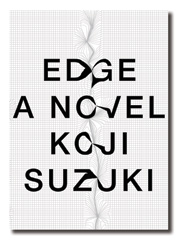
Edge, by Koji Suzuki, is billed as quantum horror. That is, it's horror derived from quantum physics. Or maybe it's that you don't know if it's really horror till you open the book and look inside.

The story is set in our now. It has some science-y stuff going on, but also a hint of supernatural. I don't think it quite qualifies as science fiction. Also, it's not post-apocalyptic dystopia; nothing post about it — this is how the apocalypse unfolds.

It starts with people disappearing, suddenly and inexplicably, there one minute gone the next. And math starts going wrong; pi and other "constants" and equations just aren't stable anymore.

Saeko starts investigating a set of disappearances. Ever since her own father disappeared 18 years previously, she's been rather obsessed with these types of occurrences. Not to mention having all kinds of daddy issues.

Saeko's father imparted to her all sorts of knowledge, along with a general wonder about the universe. Sadly, Suzuki flashes back on their time together, and the father's speeches are used as massive info dumps. How dreadfully boring, I thought; so glad he disappeared, I wouldn't be able to stand him another day. Maybe I was a little jaded after having just read an elegant and eloquent nonfiction treatment of similar issues, but I think Suzuki could give his readers a little more credit — no need for him to talk down to his readers the way Saeko's father evidently did to her.

But there's some food for deep thought buried in there: "The odds for the string of coincidences necessary to create our universe were basically nil." And, "matter is made up of a whole lot of nothing." "The real mystery is, why does the universe have any structure at all?"

So math and physics suddenly going all wonky is, I think, a fantastic concept. And a journalistic investigation into the strange disappearances could make for a good story too. But mash them together? And throw in a handful of coincidences, some supernatural-type visions, two-dimensional characters, and an appearance by the devil? I'm kind of glad that [spoiler alert] the world ends — having it go on just wouldn't make sense. Taken on their own, there are a couple deliciously creepy scenes and other interesting setups, but the book doesn't hang together for me.

Reviews

Tuesday, October 07, 2014

Who doesn't love the universe?

Why Does the World Exist? asks Jim Holt. John Updike responds, "Beats me, actually, but who doesn't love the universe?"

And Jim Holt most certainly does love it:
  • "I found this idea of a hidden cosmic algebra — an algebra of being! — irresistible."
  • "If you turn on your television and tune it between stations, about 10 percent of that black-and-white speckles static you see is caused by photons left over from the birth of the universe. What greater proof of the reality of the Big Bang — you can watch it on TV."
  • "As the German diplomat and philosopher Max Scheler wrote, 'He who has not, as it were, looked into the abyss of the absolute Nothing will completely overlook the eminently positive content of the realization that there is something rather than nothing.'"

When I was about 12, my best friend and I collaborated on a poem. We called it "Everything is Nothing," or maybe it was "Nothing Is Everything." Mostly, it was an extensive word game, bending semantics to our will, but there was a burgeoning metaphysics — just a hint — about it, too. It made us hypothesizers. I grew up being that kind of person, who now likes this kind of book.

Jim Holt's question to many is naïve. It seems a lot of philosopher simply don't take the problem of nothing seriously anymore.
"I could understand why someone might think the mystery of existence was, by its very nature, insoluble. But to laugh it off as a pseudo-problem seemed a bit too cavalier. Still, if Grunbaum turned out to be right. the whole quest to explain the existence of the world would be a colossal waste of effort, a fool's errand. Why bother trying to solve a mystery when you can simply dissolve it?"

This book then is a survey of 20th-century philosophy. Holt looks to philosophers, scientists, mathematicians, economists, novelists, his mother, and Woody Allen. As Parfit "hated the 'naturalizing' of epistemology — the idea that the project of justifying our knowledge should be taken away from philosophers and given to cognitive scientists," Holt's book attempts to straddle the rift.

I learn that the now obsolete steady-state theory of the universe was allegedly inspired by a 1945 British horror film, Dead of Night. This awes me. This is the coolest movie I ever saw, or so I thought when I saw it when I was 11. I'm pretty sure this was a year before the Nothing poem. We had to write a radioplay, and I based mine on the coolest movie I'd ever seen, and then my script was one of the plays chosen to be produced. I'd asked my teacher to supply some text — something highfalutin and jargon for the psychiatrist to spout out. So the movie — there's a psychiatrist, goes to work, hears some pretty wacky, creepy supernatural stories in group therapy and at a climactic point wakes up to discover, relieved, that it was all a dream. And his day starts over exactly as it had already unfolded in his dream. It's a loop. So the thing is, 30+ years and I never knew the name of this movie, and Jim Holt brought it to me again and explained how truly significant it was.

Quite apart from steady-state theories, Holt raises lots of arguments that beg to have their assumptions examined:
  • It is more perfect to exist than not to exist.
  • The reason there is Something rather than Nothing is, as they fancifully put it, that nothingness is unstable.
  • A self-subsuming principle is certainly preferable to a brute fact.
  • Are the laws of physics somehow to inform the Abyss that it is pregnant with Being?
  • No explanation of reality is capable of explaining itself.
  • A cosmic possibility chosen at random is overwhelmingly likely to be thoroughly mediocre.
  • The existence of this cosmos can be fully explained only on the assumption that it is middling in every way — a vast Walpurgisnacht of mediocrity.

Holt, with the help of Alex Vilenkin, finally achieves a precise definition of nothingness: "a closed spacetime of zero radius."

Surprise, Holt doesn't actually find an answer to his question. Also not surprisingly, there are several hints along the way that while it's important to ask the question, the answer doesn't really matter.

I had a passing familiarity with several of the concepts discussed in this book. While I've picked up a few new facts and technical details, this book has not swayed me in my beliefs. However.
However — and now we move on to the third part of the axiarchic case — is it really plausible that the explaining reason should be that this world is better than an ontological blank? Actually, the axiarchist is committed to a much stronger thesis. He must believe that the world is not merely better than nothing. but that it is maximally good, infinitely good, the nicest reality that money can buy.

There's this theory that the universe exists because it ought to exist (I think it's John Mackie; I remember using a text of his in Moral Philosophy). And even while I think the theory's kind of stupid, it put a smile on my face, and I consider the possibilities of there being something to that. Holt's book has helped me rediscover my awe.

Everything is as it should be.

The Basic Question — Sarah Bakewell in The New York Times
He is an urbane guide, involving us in his personal adventures. We join him for a weekend sipping claret and reading Parfit in a bathtub at the Athenaeum Club in London. He takes us to Paris for no good reason except to sit in the Café de Flore with a volume of Hegel. We stay with him through the death of his dog, and — movingly — even attend his mother’s deathbed, where she undergoes "the infinitesimal transition from being to nothingness."

What Can You Really Know? — Freeman Dyson in the New York Review of Books
When and why did philosophy lose its bite? How did it become a toothless relic of past glories? These are the ugly questions that Jim Holt’s book compels us to ask. Philosophers became insignificant when philosophy became a separate academic discipline, distinct from science and history and literature and religion. The great philosophers of the past covered all these disciplines.

Has the Meaning of Nothing Changed? — Ron Rosenbaum in Slate
Why should you care about nothing? Well, I know what I care most about is the purity of the nothing invoked in this maddening question. Pure nothingness: It’s the last unspoiled, uncluttered concept in the cosmos. I don't believe in God, but I do believe in Nothing, in the sense I want to believe in mysteries beyond the reach of the mind. It makes life more interesting if existence can't yet be reduced to a series of equations.
Excerpt.

Jim Holt's TED Talk: Why Does the Universe Exist?

Monday, September 29, 2014

We must obey the forces we want to command

For a recent MOOC, On Strategy: What Managers Can Learn from Great Philosophers, the final exam asked us to respond to Francis Bacon's assertion that "we must obey the forces we want to command," presenting two arguments, with a quotation and an example for each.

*************************

Francis Bacon famously wrote that we must obey the forces we want to command in reference to the laws of nature. One can readily transpose this dictum to other domains: market forces, military forces, cultural forces, psychological forces, etc. — each being subject to the same rigor and scrutiny we demand when performing natural science.

Literature is one such domain. Although it is steeped in tradition – the rules of language (from grammar to semantics), conventions of genre, formal narrative structures, as well as cultural expectations – truly original work emerges only once these elements are firmly understood [Argument 1]. The rules are acknowledged and assimilated, and subverted to new ends. This is especially true in the example of Oulipo – a formally defined literary movement. Cofounder Raymond Queneau described Oulipians as "rats who construct the labyrinth from which they plan to escape"[1].

Consider for a moment, though, how it (or any other constraint, for that matter) works. It places a restriction on the expressions and phrases that can be used in a poem, and it determines to some extent what the poet is able to say. It makes the process of writing both more difficult — by short-circuiting habitual modes of self expression — and, paradoxical as it may seem, easier: certain decisions have already been made for the writer. A constraint confronts the writer with a puzzle to solve, not a blank page, and this can be strangely comforting. Finally, a constraint will almost always force a writer to be creative, to seek out new means of self expression.[2]

Clearly the forces of language are fully obeyed by Oulipians in order that their practitioners can bend them to their will.

Science has evolved since Bacon’s time, and its ambitions have become more complex and its progress more nebulous. The pursuit of artificial intelligence is limited in exactly the way Bacon’s dictum would suggest [Argument 2]: "How do you make a search engine that understands if you don't know how you understand?"[3].

Douglas Hofstadter is a cognitive scientist who has become disillusioned with the common approach: "Sometimes it seems as though each new step towards AI, rather than producing something which everyone agrees is real intelligence, merely reveals what real intelligence is not"[4].

While advances have been made in data processing, and a form of "intelligence" has grown out of this capability, we have not yet achieved a truly artificial intelligence. We cannot master this domain until we have fully understood the workings of the mind and can obey the algorithms that are in play.

Bacon's assertion is thus borne out in both successes and failures across domains.

1. Raymond Queneau. Definition provided at Oulipo meeting. Apr 5, 1961.
2. Paul Kane. Review of Oulipo Compendium. Oct 2006.
3. James Sommers. "The Man Who Would Teach Machines to Think." Atlantic Monthly. Oct 23, 2013.
4. Douglas Hofstader. Gödel, Escher, Bach: An Eternal Golden Braid. 1979.

Thursday, September 25, 2014

Caffeine or alcohol?

Why, I briefly wondered as I took a seat on the sofa, did everyone but me seem to find caffeinated beverages more conducive than alcohol to pondering the mystery of existence?

I'm with Jim Holt on this one. His book Why Does the World Exist? An Existential Detective Story is under discussion tonight at Argo Bookshop. I'm hoping the bookclub also favours alcohol over caffeine.

Although in essence it's a retrospective of modern philosophy and the major theories that might shed light on why there is something instead of nothing, but I love how it's framed as a personal journey, how sitting with one philosopher led Holt to call up the next.

I haven't actually finished reading the book — I just ran out of time — but I can't wait to see how it ends.

Check out Jim Holt's TED Talk for a summary of the issues.

Tuesday, September 02, 2014

Why is there something instead of nothing?

Why is there something instead of nothing? That's the question — along with some variations ("What banged? Why did it bang? And what was going on before it banged?") — Jim Holt asks, and sets out to answer (but, unsurprisingly, doesn't, entirely), in Why Does the World Exist: An Existential Detective Story.


Coincidentally I was about 20% of the way through this book (so maybe Holt does answer it, I dunno) when this TED Talk turned up. Why Does the World Exist? is Argo Bookshop's next book club title, set for discussion on September 25.

Friday, July 11, 2014

On the shoulders of giants

One of the MOOCs I recently completed was On Strategy: What Managers Can Learn from Great Philosophers. While it is to date the most disorganized and worst prepared online course I've taken, the content and exercises were in fact very valuable.

One module focused on how all genius is built on the shoulders of giants. The assignment was take one or two "giants" of Luc de Brabandere's lecture (featuring Plato, Aristotle, Descartes, Leibniz, Newton, Russell) and connect them with at least two others, not included in his model. We were to include at least one philosopher and one scientist. I further challenged myself to select women.

*************************

Hypatia of Alexandria was a fourth-century philosopher. As a Neoplatonist, she was heavily influenced by Plato and the Platonic tradition. As such, she valued and used logic and mathematical thinking. She taught the works of Plato and Aristotle in public lectures. 1

Although considered a pagan, she is significant for bridging classical antiquity to Christianity. Her murder heralded the coming dark ages. I think of her as a philosopher because she promoted a mode of logical thinking (based on Plato), but she contributed to the advancement of various geometrical concepts (also founded in Plato) and developed instruments for use in physics and astronomy. She assisted her father in the writing of his mathematical commentary, Euclid's Elements, which in turn influenced Newton.2

Descartes, Newton, and Leibniz later expanded on Hypatia's work.3

Ada Lovelace was a 19th-century computer programmer (i.e., mathematician and scientist) who worked with Charles Babbage in developing the Analytical Engine. Her study of mathematical and scientific concepts, in particular differential calculus (developed independently by Newton and Leibniz), framed by her poetical and metaphysical attitude, drove the conceptual leap to consider the possibilities of computing machines and their applications, far beyond the arithmetic of Leibniz's calculator.

"Whilst describing the revolutionary implications of Babbage's ideas, Lovelace wrote out the first computer programme […] and she made the sensational suggestion that such a device should be able to compose music if a suitable set of rules could be devised. She thus anticipated the development of both modern computing and artificial intelligence by more than a hundred years."4 Among the innovations she imagined (that would be realized only several generations later) were the subroutine (a set of reusable instructions), looping (running a useful set of instructions over and over) and the conditional jump (branching to specified instructions if a particular condition is satisfied).5 Certainly her own shoulders are broad enough for subsequent giants to stand on (such as Alan Turing). She desired also "to create a mathematical model for how the brain gives rise to thoughts and nerves to feelings ("a calculus of the nervous system"),"6 foreshadowing the entire field of cognitive neuroscience. [See also.]


*************************

I repost this assignment because Ada Lovelace seems to be in the air these days: she's been referenced on Halt and Catch Fire, which I've been watching; Melville House is publishing a book; and I get email from the Be Like Ada program the publisher mentions.

Someone outside of the course asked me, not why did I choose these women, but how I do even know about these women to be able to connect them with the other giants of history. The answer is, they're in the fiction I read. (I'll name, for example, All Men of Genius, by Lev AC Rosen, and Azazeel, by Youssef Ziedan, as obvious references, but there are others.)

Because everything is connected.

Monday, June 02, 2014

Blue

This has been a most puzzling book. Sentence by sentence it's absolutely gorgeous, but I have trouble making sense of it.

On Being Blue: A Philosophical Inquiry, by William H. Gass, is about the colour blue, and about blueness, but mostly it's about sex. Kind of.

The thing is: it's breathtakingly beautiful. Just loll-your-tongue-around-it gorgeous. But it didn't make any sense. I get how blue refers to sex, but really? Random sex passages throughout all literature are blue? Random passages throughout all literature are really about sex? Everything is blue? Really?
So a random set of meanings has softly gathered around the word the way lint collects. The mind does that.
Then I read a couple of reviews, was reassured that I wasn't alone in being somewhat mystified, and gave myself over to it.
Then there are the blues we'd love to have loom large and linger long around us like deep sofas, accommodating women, and rich friends.
It's a great book for skimming, and there are sentences and long breathless passages that beg to be read aloud.
"For our blues," Hoogstraten says, "we have English, German, and Haarlem ashes, smalts, blue lakes, indigo, and the invaluable ultramarine." It is of course the skiy. It is the sky's pale deep endlessness, sometimes so intense at noon the brightness flakes like a fresco. Then at dusk, it is the way the color sinks among us, not like dew but settling dust or poisonous exhaust from all the life burned up while we were busy being other than ourselves. For our blues we have those named for nations, cities, regions: French blue, which is an artificial ultramarine, Italian, Prussian, Swiss and Brunswick blues, Chinese blue, a pigment which has a peculiar reddish-bronze cast when in lump-form and dry, in contrast to China blue which is a simple soluble dye; we have Indian blue, an indigo, Hungarian, a cobalt, the blues of Parma and Saxony, Paris, Berlin, and Dresden, those of Bremen and Antwerp, the ancient blues of Armenia and Alexandria, the latter made of copper and lime and sometimes called Egyptian, the blue of the Nile, the blue of the blue sand potters use. Are there so many states of mind and shades of feeling?
Reviews
The Guardian:
One difference is that much, or most, of Gass's self-conscious experiment is going on at the level of the sentence, its style and especially its sound, rather than look-at-me games with plot or character. This is partly a matter of poetic influence – Stevens and Rilke have been constant references – but the presiding example is probably Gertrude Stein, about whom he has written several essays. Stein is nowhere to be seen in On Being Blue, but the book is surely in thrall to her Tender Buttons and its incantatory way with the rhythms and phonics of everyday American speech.
Although, I wonder if that review merely skimmed the book, as Gass does directly reference Stein, including specifically Tender Buttons. And the review contains other factual errors.

NPR:
In many ways, On Being Blue is less a book to read than an experience to be had. It's essentially a rant, a riff, poetry, music, art, all of that. But it isn't apologetics. There's no scientific argument, no clear-cut hypothesis to be found. It's not a treatise on the nature of man and his place in the universe. Gass is more interested in getting across a passion for language, and the way the words look and sound on the page.
*************

On Being Blue was the subject of a book club I attended last week, and it turned out to be less inspiring of discussion than had been hoped. Without a clear thesis, it's difficult to argue against anything Gass brings to the table. While it's mostly internal to Gass — the connections he makes between colour, science, philosophy, sex, language — it's also weirdly impersonal. The thing to do is just read it, let it wash over you, accept it, and think about blue.
(curses without a curse, they contain only archery and cleverness like a purse full of chocolates and needles)
Excerpt.

Monday, April 21, 2014

If we were his sentences

If any of us were as well taken care of as the sentences of Henry James, we'd never long for another, never wander away: where else would we receive such constant attention, our thoughts anticipated, our feelings understood? Who else would robe us so richly, take us to the best places, or guard our virtue as his own and defend our character in every situation? If we were his sentences, we'd sing ourselves though we were dying and about to be extinguished, since the silence which would follow our passing would not be like the pause left behind by a noisy train. It would be a memorial, well-remarked, grave, just as the Master has assured us death itself is: the distinguished thing.
— from On Being Blue: A Philosophical Inquiry, William H. Gass.

Gass writes a mean sentence himself.

[On Being Blue is the Argo Bookshop bookclub selection to be discussed at the end of May.]

Tuesday, April 15, 2014

Transcendence of form

Beethoven's music is Hegelian philosophy: it is at the same time truer than this; i.e., it contains the conviction that the self replication of society as something identical is not enough, indeed, that it is false. Logical identity as the esthetic and produced domination of forms is at once practiced and criticized by Beethoven. The seal of its truth in Beethoven's music is its suspension: the transcendence of form, through with form for the first time achieves its inner meaning. The transcendence of form is for Beethoven the portrayal — not the expression — of hope.
— T.W. Adorno, as quoted in Hegel — Purpose, Results and the Philosophical Essence, by Scott Hornton, in Harper's Magazine.

I've just finished another online course, this one exploring Beethoven's piano sonatas. I've learned quite a bit about the structure of Beethoven's music, and about the historical context for all the rules he was stretching to breaking point. And I've come to some understanding about some of the elements that attract me, about why I love Beethoven so much (even though I wasn't especially familiar with his sonatas before taking up this course).

I got to realizing just how modern Beethoven is, and it got me thinking about Kierkegaard and the crisis of modernity, and I started drawing connections, and recognized an ironic stance in Beethoven's work, how self-reference can only come from self-awareness, how he could be said to be composing metamusic. Beethoven of course precedes Kierkegaard, but Hegel would've been all the rage, and Kant: "The moral law within us and the starry heaven above us!" — which Beethoven had scrawled in a notebook. The music is becoming. And Beethoven is infinite.

And in writing my final assignment, I found scattered across the internet evidence that others have thought as I have. A reassuring thing.

And I am reminded to pick up Thomas Mann again. I must read Doctor Faustus.

Wednesday, November 13, 2013

What is a poet?

What is a poet? An unhappy person who conceals profound anguish in his heart but whose lips are so formed that as sighs and cries pass over them they sound like beautiful music. It is with him as with the poor wretches in Phalaris's bronze bull, who were slowly tortured over a slow fire; their screams could not reach the tyrant's ears to terrify him; to him they sounded like sweet music. And people crowd around the poet and say to him, "Sing again soon" — in other words, may new sufferings torture your soul, and may your lips continue to be formed as before, because your screams would only alarm us, but the music is charming. And the reviewers step up and say, "That is right; so it must be according to the rules of esthetics." Now of course a reviewer resembles a poet to a hair, except that he does not have the anguish in his heart, or the music on his lips. Therefore, I would rather be a swineherd out on Amager and be understood by swine than be a poet and be misunderstood by people.
— from "Diapsalmata," in Either/Or, by Søren Kierkegaard.

This is a very strange and disjointed text, mostly dwelling on Kierkegaard's (self-termed) "depression." He sounds overly dramatic, and very much like those German Romantics he rails against.
I have, I believe, the courage to doubt everything; I have, I believe, the courage to fight against everything; but I do not have the courage to acknowledge anything, the courage to possess, to own, anything. Most people complain that the world is so prosaic that things do not go in life as in the novel, where opportunity is always so favorable. I complain that in life it is not as in the novel, where one has hardhearted fathers and nisses and trolls to battle, and enchanted princesses to free. What are all such adversaries together compared with the pale, bloodless, tenacious-of-life nocturnal forms with which I battle and to which I myself give life and existence.

How self-indulgent.

I was completely unprepared for this. It seems that after having defended his thesis (The Concept of Irony), Kierkegaard threw all notions of structure and form to the wind, one big middle finger to the Man, his traditions and institutions. This strikes me as a little at odds with his being a Christian theologian, but what do I know. (Maybe we'll cover this issue later in the course.) To Kierkegaard's credit, he practiced what he preached, practiced irony and found his own subjective truth.

It's pages upon pages of aphorisms concerning death, cereal, erotic love, Mozart, boredom, salmon, Sunday afternoons. It begs to be parodied. And it's wildly beautiful.
This is the way, I suppose, that the world will be destroyed — amid the universal hilarity of wits and wags who think it is all a joke.