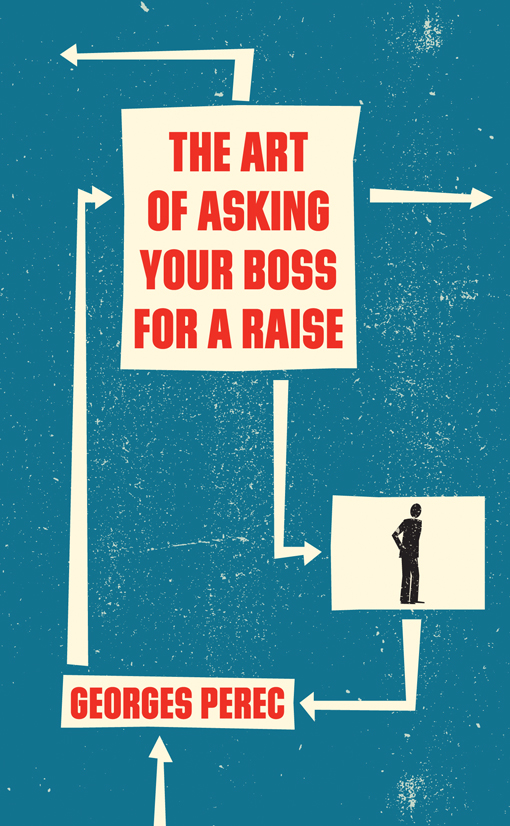
My copy of
The Art of Asking Your Boss for a Raise, by Georges Perec, finally arrived! This slim little volume is exquisite!
The title has been pared down a little from the original (
l'art et la maniѐre d'aborder son chef de service pour lui demander une augmentation):
the art and craft of approaching your head of department to submit a request for a raise.
(Some of the background I set forth here is covered in greater detail by translator David Bellos in his introduction to the book.)
In 1968, a computer company set the challenge for writers to use a computer's basic mode of operation as a writing device. The outline: a flow-chart, a simple algorithm, a decision matrix.

The flow-chart is reproduced on this volume's endpapers.
By its nature,
the algorithm is well-suited to being experienced electronically.
Of course, it has
Oulipoian roots, as an exploration of how mathematics can be used to generate literature. In fact, I'm sure we're all quite familiar with another, very popular style of "matrix literature," an experiment in which (
A Story As You Like It), by Raymond Queneau, is available online. (
Hypertext literature has come a long way since the 1960s. I'm currently working through
one such "traditional print" example with Helena.)
Perec reused the material from the art and craft in chapter 98 (Réol) of
Life A User's Manual, which upon the learning of said fact I immediately reread.
I don't recall it having such a potent effect on me the first go around, but this time it brought tears to my eyes. Remember the Réols? — the young couple with the extravagant, expensive bed purchased on credit. And it puts me in mind of, no doubt because I've been reading so many articles related to the release of
The Pale King, David Foster Wallace and his maximalist approach to literature (did he ever read Perec's
Life, I wonder), in which he does not excise the excruciating minutiae of our lives and minds. I see now that Perec does something similar in
Life. The chapter concerning Réol — and it can be read as a wholly self-contained narrative — tells a story through a perspective entirely restricted to the management of Réol's finances. There's the logistical problem of fixing an appointment with his boss (which day of the week his boss is likely to be in a good mood, not distracted, and so on), but mostly it's utilities payments due, rent in arrears, groceries on credit, loans, percentages, meeting the requirements for the assistance plan, etc. There is nothing about the Réols'
life — no chance encounters or romantic situations, no grand parties or disastrous meals, no anecdotes about their son. And yet, financial management
is life, one version of their life, and it's a full story. With a beautifully poignant (and happy) ending.
The Art of Asking Your Boss for a Raise is told in the second person. Story is secondary to the experiment.
either he thinks your idea is positive rich in possibilities worthwhile or he thinks it is stupid and will let you know in no uncertain terms that your logic is addled that's to say cock-eyed that's to say so devoid of understanding as to be close to either early-onset alzheimer's or congenital idiocy remember however that whether or not he calls you a nincompoop dimwit cretin nutcase crackpot woodenhead bananabrain dolt idiot or fool it comes to the same thing namely your plan will land in the wpb and you will return empty-handed to your desk while awaiting happier days it goes without saying that learning from experience you will improve your basic idea so when the day comes once again to talk with whole and open heart to your head of department he will be unable to dismiss you straight off as a nitwit so you allow yourself some months because one must always try to stack the odds in one's favour you swot up on the issue then when your plan seems perfect you go back to see mr x let's assume he's in
The text is, as is to expected given the structural constraint, repetitive and recursive, and the real-time computer-logic mood is enhanced by the lack of punctuation. (Also, it's set entirely in lowercase, but thankfully, and surprisingly, not in courier.)
I found it easiest to follow by reading it out loud. (In fact, I readily imagine the whole text being narrated and scored by Philip Glass
à la Einstein on the Beach. Hey, Phil, give me a call, let's talk Perec!)
But there is a story! It's a little bit tragic even, but told with a light touch and great deal of humour.
The iterations come to be modified, and it's these variations in the phrasing that make for the funniest moments, unexpected as they are. Either they change as you reconsider them in light of all that has already occurred (the computer algorithm weights the possible outcomes and their likelihood of occurring as it acquires and learns to process the qualitative input from inside your head), or they change over time (the computer adds to the equation the actual fact of certain outcomes already having occurred).
It could be that all these thoughts pass through your neurotic head over a span of mere seconds when first you consider the possibility of asking for a raise. Or, this is a distillation of your entire career.
Either the employee is paralyzed by overthinking the situation and "we shall suppose to keep things simple — for we must do our best to keep things simple" never approaches the boss to ask for a raise; or the employees does in fact take action as governed by the logic of the algorithm, in which case years pass and the employee approaches retirement, without ever having asked for a raise. (The story
does cover an approach and a request and a raise, but let's not complicate the point.)
I recommend
The Art of Asking Your Boss for a Raise to those readers interested in experimental literature, but I suspect most readers will not find enough narrative thread to hold their attention for long. (On the other hand, it's short, and as an introduction to how a nontraditional approach to narrative can produce story it might serve you well alongside something like Calvino's
t-zero stories, with which I see some similiarities in terms of the breakdown of processes into its smallest constituents, in a Zeno's paradox kind of way.)
If you have not read Perec's
Life A User's Manual, I encourage you to
read along at Conversational Reading.
Tomorrow marks what would've been
Perec's 75th birthday.
To do
Approach the head of my department to submit a request for the transitioning of my role, and title, into Editor of Matrix-generated Literature and for the use of our proprietary decision support system to generate a novel in which the possible decision outcomes are not binary, but multiple and weighted and combined, where one can respond both a and b, or all of the above, to allow for the overlaying of choices and the "automatic" snipping and juxtaposition of appropriate segments of text, to tell a story about, say, a family's quest to acquire the perfect sofa, and while the daughter's preferences are considered they are of a different value than those of her parents, and the cat is also given due thought, all of which necessitates a careful study of how the sofa is used (playing video games, reading, napping, etc — each activity commanding different optimal bodily postures), how many people use the sofa over a given period of time to engage in those activities, and how many are likely to want to do so at the same time, budget of course being a key factor, but also available room, with an eye for spatial configuration of the entire room and allowing for the possibility of auxiliary seating (also to be determined through a similar decision matrix), no, no, it had better be more work-related, say, the design by committee and subsequent implementation of said design of the employee kitchen space, its general arrangement and furnishings, something like that.