Tuesday, February 26, 2013

Books are the pillars

Books are a force for peace and development that must be placed in the hands of all. They are also crucial tools for expression that help to enrich languages, while recording their changes over time. In this age of new technologies, books remain precious instruments, easy to handle, sturdy and practical for sharing knowledge, mutual understanding and opening the world to all. Books are the pillars of knowledge societies and essential for promoting freedom of expression and education for all.

Message for International Mother Language Day 2013, Irina Bokova, Director-General of UNESCO.

International Mother Language Day has come and gone, and sad to say, I didn't even know it was a day for celebration until days too late. This year's theme: Books for mother tongue education.

Coincidentally, experts of my own mother language marked the day by launching a campaign to preserve diacritical marks, of which there are several in Polish. It's a bit of a backlash against the laziness engendered by texting, but there's a bit more to it than curmudgeonly nit-picking.

The campaign — Język polski jest ą-ę — called on media outlets to do without diacritical marks for a day, and several artists have produced diacriticless pop music, with somewhat ridiculous results.

I'll have to do my bit to read something (maybe Tulli, or Myśliwski) in my mother tongue this year (it's been downhill for me pretty much since age 5), but preferably with diacritical marks intact.

Sunday, February 24, 2013

One by one, they were all becoming shades

But we are living in a sceptical and, if I may use the phrase, a thought-tormented age: and sometimes I fear that this new generation, educated or hyper-educated as it is, will lack those qualities of humanity, of hospitality, of kindly humour which belonged to an older day.

Can we not say the same today? The Dead, by James Joyce, was originally published in 1914. I'd never read Joyce until a few weeks ago.

It was fully engrossing, funny and poignant, and, contrary to my expectation of Joyce, not at all hard to read.

The story takes place during a holiday party. Tension mounts from the beginning, and the reader prepares for a secret to be revealed, but it's not at all clear where that secret resides — the maid, the old aunts, Gabriel's past? Is it political, to do with the Irish nationalist in attendance? Will it fall from the lips of the drunk? And who are the eponymous dead?

One by one, they were all becoming shades.

The secret, it turns out, is much quieter than the possibilities Joyce forced me to consider, but no less devastating for the characters involved.

He watched her while she slept, as though he and she had never lived together as man and wife. His curious eyes rested long upon her face and on her hair: and, as he thought of what she must have been then, in that time of her first girlish beauty, a strange, friendly pity for her entered his soul. He did not like to say even to himself that her face was no longer beautiful, but he knew that it was no longer the face for which Michael Furey had braved death.

I read somewhere that Gabriel is generally considered pathetic. But I don't see that. He seems to me to act like an outsider, though he is very much the centre of this story, and very near the centre of the social circle gathered this night. But he is not in his skin, and he questions himself. He is highly sympathetic.

While I think the ultimate revelation is somewhat prosaic, the turmoil Gabriel experiences is intensely human and believable. The emotional complexity that is conveyed is stunning, oh so male, and soul-wrenching, and for this I look forward to reading more Joyce.

Gabriel is of that thought-tormented, hyper-educated new generation, and it is difficult for him, but he does well to find within him kindness.

Thursday, February 21, 2013

Snack drawer

One box of almond thin biscuits, excellent with tea
Large bag of Blue Diamond roasted, salted almonds (almost empty)
Tin of Blue Diamond lime and chili almonds
(What makes Blue Diamond almonds so salty delicious?)
Jar of almond-stuffed olives
Handful of lemon pepper almonds, courtesy of a coworker who uncovered this gastronomic wonder at Jean-Talon market
Yogourt-covered almonds, for those rare afternoons when I need a candy fix
One large gold-wrapped bar of chocolate-covered marzipan, best savoured when shared on Friday afternoons
About a half dozen packets of instant barszcz

Wednesday, February 20, 2013

The list is in charge

What power a list can have, no? That column down the left with all the letters exactly the same, all capitals, one after another, it's always fascinated me. I've always found lists enthralling, why should I deny it? There's nothing wrong in that either, I suppose, nothing reproachable. A telephone directory was the best thing I could have when I was little; I'd put my finger at the top and slide it down a page where they were all ls or ms, where they were all us. The feeling of tranquility that gives you. The feeling that there is an order to the world. Or at least that it can be put in order. Take the chaos of a hotel, for example, and you put it down on a list. I don't care if it's a list of things to do, of guests, the payroll. Everything that needs to be is there and what is not there isn't because it shouldn't be there. And you breathe easy, sure of having done things as they need to be done. Control. That's what you have when you make list; absolute control. The list is in charge. A list is a universe. What isn't in a list doesn't exist for anyone. A list is proof of the non-existence of God. I said that to Papa once and he slapped me across the face. I said it to sound interesting, a bit to see what would happen, and that's what happened, a slap. But deep down it's true.

— from The Informers, by Juan Gabriel Vásquez.

Monday, February 18, 2013

A tale of two nouns

Plural noun
Same plural noun
Plural noun
Plural noun
Plural noun
Plural noun
Plural noun
A place
Adverb
Adjective
Noun
Plural noun
Plural noun

OK,ready?

It was the best of _____, it was the worst of _____, it was the age of _____, it was the age of foolishness, it was the epoch of belief, it was the epoch of _____, it was the season of Light, it was the season of _____, it was the spring of hope, it was the winter of _____, we had _____ before us, we had nothing before us, we were all going direct to (the) _____, we were all going _____ the other way — in short, the period was so far like the _____ _____, that some of its noisiest _____ insisted on its being received, for good or for _____, in the superlative degree of comparison only.

— from Penguin Classics Mad Libs, by Roger Price and Leonard Stern.

So, according to my sister,

It was the best of cats, it was the worst of cats, it was the age of dogs, it was the age of foolishness, it was the epoch of belief, it was the epoch of mushrooms, it was the season of Light, it was the season of matrices, it was the spring of hope, it was the winter of dice, we had mice before us, we had nothing before us, we were all going direct to Tuscany, we were all going slowly the other way — in short, the period was so far like the pretty book, that some of its noisiest books insisted on its being received, for good or for trains, in the superlative degree of comparison only.

Friday, February 15, 2013

A brutal nostalgia

The second life, as everyone knows, always comes with the inconvenient obligation to correct the first one.

And later,

And then he confirmed the feeling I'd had earlier: one of the consequences of the second life was a brutal nostalgia, the notion, so very democratic, so universally accessible and at the same time so surprising, of time lost, even though we might have suffered more in that time than in the present.

I'm reading The Informers, by Juan Gabriel Vásquez — a much denser read than I'd expected, though it's only just over 300 pages. Not hard, but weighty. The narrator is slowly unpacking his relationship with his father, and his family's relationship to its community. Neither memory nor history is entirely reliable; accuracy, let alone truth, is elusive.

The setting is Colombia, a country with a politically convoluted history, and the story told here essentially starts with Jewish immigrants at the onset of WWII. Weighty.

Also,

Life likes to outdo itself.

Tuesday, February 12, 2013

A soup like this is what I need

This may be a first for me, quoting from a cookbook:

This recipe, however, has an entirely literary provenance: the minute I read about Ezra'a hopes for the restaurant in Dinner at the Homesick Restaurant, his plan for a soup made with garlic and love, I knew I had to eat it. Which meant, first, I had to come up with a recipe and cook it. I am not trying to replicate the recipe that the character had in mind, not that I could; but no matter, for this is the sort of soup that came into my head as I read. (I've spared you the gizzards — because I couldn't, in any case, get them past the home front.) With any other writer, there might be a danger of the title's being cloying or sentimental, but how — really — is that possible in an Anne Tyler novel? Your soul gets flayed on every page: I don't think any writer has managed to be so piercing and unrelentingly intense and plain downbeat at the same time.

There's not a sentence of hers I don't love, but after reading any of her books, a soup like this is what I need.

— from "Soup made with garlic and love," in Nigella Kitchen, by Nigella Lawson.

Last night's soup wasn't Nigella-perfect, but I think next time it will be. Maybe I should read some Anne Tyler.

Sunday, February 10, 2013

A pterodactyl in Paris

Some time ago I read a review by Rosecrans Baldwin: Pterrifying Pterodactyl Meets Sexy Detective. Thus was I introduced to The Extraordinary Adventures of Adèle Blanc-Sec. He writes:

The books are part adventure comic, part hardboiled fiction. They're terrific whodunits that conjure up all the precise atmospheric detail of, say, a Georges Simenon novel, but with twice the plot. And the artwork is striking, paneled like a comic but with historical grit. Here is Paris in its authentic beauty: rainy, crowded and bristling with characters who wear their neuroses like carnival masks.

And I was sold.

This graphic novel is recently available in English, but I figured, hey, I can read a French comic book. In French. I've done it before. So I did it again. Les aventures extraordinaires d'Adèle Blanc-sec, tome #1, Adèle et la Bête, by Jacques Tardi.

What I like most about the story is how it combines some pretty disparate elements, all interesting in their own right: prehistoric creatures, seemingly supernatural powers, a feminist sensibility, early 20th-century Paris.

I'm a little fuzzy on some of the details, however, like who's the guy the pterodactyl swoops in to rescue from the guillotine. Not sure if that's the fault of my graphic-novel literacy, or my French. Doesn't matter, I'll read it again and figure it out.

In a weird coincidence, a few days after I brought the book home, my daughter watched the film adaptation at school (they have movie afternoon at the end of the month). From what she tells me, the movie has developed Adèle's back story and filled in many of the details. I look forward to reading about Adèle's further adventures.


Saturday, February 09, 2013

How are you supposed to have any intimacy?

"Stanley, if you closed your store for just a week and you let me elope with you..."

"What a romantic idea. Where would we go?"

"To Montreal."

"Never."

"What? You have something against Quebec, too?"

"I didn't endure six months of close starvation to lose ten pounds just to gain them back in a few days. Montreal's restaurants are irresistible, as are its waiters."

What do more than 25 million readers see in Marc Levy? All Those Things We Never Said, written in 2008 and recently released in the US, is currently being heavily promoted, including a Paris getaway sweepstakes — sadly, for US residents only (it runs till tomorrow if you're interested), and a bit weirdly, as Paris figures into this novel in only a very small way and as a nice place to die.

Levy is touted as the most-read French author in the world, all his novels topping the bestseller lists in France. I wanted to see what the fuss was about.

All Those Things We Never Said is a "romantic comedy" (admittedly, not really my go-to genre). Julia's supposed to be married on Saturday, but her estranged father's died and he's being buried that day. With the wedding indefinitely postponed, Julia spends the ensuing week getting to know her father, and reexamining life and love in the process.

I very nearly abandoned this novel very early on. I didn't, only because work has been very trying and I couldn't be bothered to think to grab something else to read before heading out on my daily commute. I was well over halfway before I developed any interest in how it might turn out.

It reads like a movie (one of Levy's novels has already had the film treatment) — it is heavy on dialogue. In itself that's not necessarily a bad thing, but the conversation is fairly superficial — it's as if these characters have no internal lives at all. It lacks nuance. These people remain two-dimensional.

Starting in New York City, the story takes us to Montreal and later Berlin via Paris. The writing does nothing to bring these places to life on the page. Berlin fares a little better than the other cities, but then I've never been there, and the Wall plays a vital role in the story. Really, most of the events could've taken place anywhere.

"If there were, I don't know, perhaps a little sitting room or a library, maybe a billiard parlor or a laundry room... then I might have some place to go and wait for you. These one-room apartments... What a strange way to live! How are you supposed to have any intimacy?"

Intimacy? Is this a translation error? Maybe privacy? Or is it meant ironically? If so, it's not sufficiently backed by subtlety of character, or strength of character, for the reader to be cued to interpret it this way.

One German journalist aspires to a Pulitzer, which strikes me as a weird thing for a German journalist to say, or a French author to write, even on the off-chance that it might've been meant symbolically (and I certainly hope it wasn't the translator's choice to create a context for American readers).

What puzzles me most about this novel is how little it feels like a French novel. Not that I can tell you what a French novel should feel like. Maybe the expectation of Frenchness was built up in me because of the Paris sweepstakes connection. Just because an author's French doesn't mean he has to write about France. But there's no depth, no awareness, no reflection; no French philosophical attitude. This is not Michel Houellebecq or Emmanuel Carrère, or Patrick Lapeyre or Hervé Le Tellier. (I name these authors because they are contemporary, and I've read them and they all feel French. To be fair, the first pair can't be said to deal in light romance, and should not be used as a basis for comparison with Levy on any other score but this point about Frenchness I'm trying to make.)

All Those Things We Never Said does not feel French. It feels like a fairly predictable Hollywood movie. This novel was not for me, which is too bad, because there are a couple points that interested me — the father's story about meeting the love of his life and the father's final circumstances — and they could have been developed into very different novels. Have you read it? Am I being unfair?

Thursday, February 07, 2013

Palindrome

Helena came home from school one day recently all excited to tell me about palindromes. There'd been a substitute teacher that day, and the regular teacher hadn't provided a lesson plan. So, palindromes!

And though I know a bit about palindromes, and I know some palindromes, I don't think it had ever occurred to me that there might be palindromes in languages other than English. Thus, my first French palindrome: élu par cette crapule. (For a palindrome to work in French, diacritics are often disregarded.)

And it seems obvious to me now that this is exactly the sort of jeu de mots that Georges Perec might have played with. In fact, he composed a palindrome (in the form of a story or poem, kind of) that is 1247 words long.

Coincidentally, later the same evening that Helena and I were getting word nerdy, I was reading my book (which was rather big on coincidence) and it happened that the point was made that a character's cellphone ringtone was a palindrome — Bach's Crab Canon.


See also how Vi Hart folds space-time with Bach and plays a music-box Möbius strip.

Tuesday, February 05, 2013

When the curtain comes down


If you are rich, if you are poor
It's all the same I'm sure...

Monday, February 04, 2013

A between-place

Ragle Gumm is at the centre of his universe. Everything revolves around him.

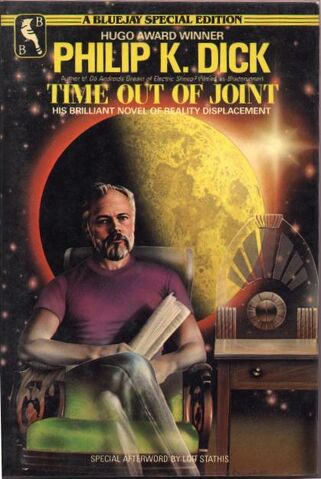
Time out of Joint, by Philip K. Dick, was published in 1959. It's set primarily in small-town America, the 50s. There's a sense that life is good, anything is possible. This is the world through which Ragle Gumm moves. Every day he plays the puzzle contest in the newspaper, "Where will the little green man be next?" And every day he wins.

But Ragle is not entirely at ease with this world. It's a little too good to be true. At first it seemed, to this reader, that there's a little Cold War paranoia seeping in. But no, maybe it's just regular paranoia, a bit conspiracy-minded, like everybody but you is in on something. Also, Marilyn Monroe is conspicuously absent.

And then Ragle's world starts to fall apart, in more ways than one.

Maybe I'm not moving. Caught in a between-place. Wheels of the pick-up truck spinning in gravel . . . spinning uselessly, forever. The illusion of motion. Motor noise, wheel noise, headlights on pavement. But immobility.

It becomes clear that Ragle's got some sanity issues going on.

And it turns out that there's another world outside of Ragle's. It's the world of 1996, and there's a war going on with the lunar colonies.

Reality according to Philip K. Dick is never what it seems to be, and it can be constructed in various ways, requiring the collusion of multiple government bodies, or sometimes just the active cooperation of your own mind.

The ending was a bit of a disappointment to me, not in how the story was resolved, but in its execution. The last 30 or so pages feel like a different book altogether — it becomes expository and futuristic.

The magic of this book lies in its nostalgia for the 50s. There are weird details about the Book-of-the-Month club and its selections, fashion trends, and a fad for all things Italian. Dick writes about a future in which his present is a rose-coloured past. His 50s are rich with the things we would indeed grow sentimental over forty and fifty years later.

Time out of Joint is a weird little story. But it has great insight into how our minds go about creating our individual realities, how we choose details to form our memories, and how some memory gets physically lodged in our bodies. Hopefully we are none of us as deluded as Ragle Gumm, but we are each in our way the centre of our own universe.

Sunday, February 03, 2013

Right to the last twist of necktie

Appearing, Bill Black said pleasantly, "Hi, Ragle. Hi,Vic." He had on the ivy-league clothes customary with him these days. Button-down collar, tight pants . . . and of course his haircut. The styleless cropping that reminded Ragle of nothing so much as the army haircuts. Maybe that was it: an attempt on the part of sedulous, young sprinters like Bill Black to appear regimented, part of some colossal machine. And in a sense they were. They all occupied minor status posts as functionaries of organizations. Bill Black, a case in point, worked for the city, for its water department. Every clear day he set off on foot, not in his car, striding optimistically along in his single-breasted suit, beanpole in shape because the coat and trousers were so unnaturally and senselessly tight. And, Ragle thought, so obsolete. Brief renaissance of an archaic style in men's clothing . . . seeing Bill Black legging it by the house in the morning and evening made him if he were watching an old movie. And Black's jerky, too-swift stride added to the imoression. Even his voice, Ragle thought. Speeded up. Too high-pitched. Shrill.

But he'll get somewhere, he realized. The odd thing in this world is that an eager-beaver type, with no original ideas, who mimes those in authority above him right to the last twist of necktie and scrape of chin, always gets noticed. Gets selected. Rises. In the banks, in insurance companies, big electric companies, missile-building firms, universities. He had seen them as assistant professors teaching some recondite subject — survey of heretical Christian sects of the fifth century — and simultaneously inching their path up with all their might and main. Everything but sending their wives over to the administration building as bait . . .

— from Time out of Joint, by Philip K. Dick.

Thursday, January 31, 2013

Prompt editors to be always truthful

Today, January 31, is the feast day of Saint John Bosco, patron saint of illusionists, stage magicians, and editors.

Admirable apostle of youth, founder of religious Congregations, catechist, educator, writer, and a light that shone brightly in our time, you know that one of the greatest powers today is the power of the Press. Prompt editors to be always truthful and to work for the good of human beings, thus serving the greater glory of God. Amen.

Tuesday, January 29, 2013

All part of the huge, dirty, torn social fabric

A coincidence is just an explanation waiting to happen. So says Jackson Brodie, who used to be a private investigator, who used to be a policeman, who used to be in the military, whose role in Kate Atkinson's When Will There Be Good News? is far from central, yet somehow he is its heart.

This story is about Joanna, who when she was six witnessed the murder of her mother and siblings, barely escaping herself. Thirty years on, the convicted murderer is being released from prison. It's also about Reggie, who works as "mother's help," looking after Joanna's baby. Reggie is 16 and recently orphaned; her brother is bad news. Then there's Louise, a cop in a marriage gone wrong, and former love interest (or something like it) of Jackson's, who's investigating Joanna's husband.

Louise was an urbanite, she preferred the gut-thrilling sound of an emergency siren slicing through the night to the noise of country birds at dawn. Pub brawls, rackety roadworks, mugged tourists, the badlands on a Saturday night — they all made sense, they were all part of the huge, dirty, torn social fabric. There was a war raging out there in the city and she was part of the fight, but the countryside unsettled her because she didn't know who the enemy was. She had always preferred North and South to Wuthering Heights. All that demented running around the moors, identifying yourself with the scenery, not a good role model for a woman.

Throw in a massive train wreck — Jackson's on board — and these characters and others turn out to be connected to one other in unlikely ways.

This is the second Jackson Brodie novel I've read, and I will read more. I marvel at the writing, that it should appear to be so light and funny, and turn so suddenly very dark. So rambling and seemingly random, but in fact tightly interwoven with every other character's thoughts and actions. It turn out it's quite difficult to quote from this novel, as all the punchy bits rely on how they relate to what happened three pages, or three chapters, earlier.

There is not a lot of good news in this novel. And there are a lot of coincidences, with explanations I was willing to accept.

This is not a conventional mystery novel. There are a few sets of mysterious circumstances, but it's some time before it's at all clear that there is a central mystery that needs solving. And that's fine by me, as I was busy being engrossed in the plenty of very interesting people who have a lot of shit to deal with in their lives. As one review notes, "The mysteries Atkinson is most invested in are those of the human heart."

Monday, January 28, 2013

K is for Kindred

Philip K. Dick. The K is for Kindred — Philip Kindred Dick — and I think that's weird and fantastic.

I'm familiar with the work of Philip K. Dick more by virtue of the many film adaptations of his work than direct from the source material. I intend to rectify that this year.

I've had reason recently to poke at the work of a few authors with respect to their relationship with mental illness, and it comes as no surprise that Dick's relationship with reality is somewhat privileged.

What distinguishes schizophrenic existence from that which the rest of us like to imagine we enjoy is the element of time. The schizophrenic is having it all now, whether he wants it or not; the whole can of film has descended on him, whereas we watch it progress frame by frame. So for him, causality does not exist. Instead, the acausal connective principle that Wolfgang Pauli called synchronicity is operating in all situations — not merely as only one factor at work, as with us. Like a person under LSD, the schizophrenic is engulfed in an endless now. It's not too much fun.

— from "Schizophrenia and the Book of Changes," by Philip K. Dick.

An endless now!

Saturday, January 26, 2013

The dark and sooty chamber in his heart

He had to get out. Jackson hated hospitals. He had spent more time in them than most people. He had watched his mother take an eternity to die in one and as a police constable he had spent nearly every Saturday night taking statements in A and E. Birth, death (the one as traumatic as the other), injury disease — hospitals weren't healthy places to hang around in. Too many sick people. Jackson wasn't sick, he was repaired, and he wanted to go home, or at least to the place he called home now, which was the tiny but exquisite flat in Covent Garden containing the priceless jewel that was his wife, or would contain her when she stepped off the plane at Heathrow on Monday morning. Not his real home, his real home, the one he never named any more, was the dark and sooty chamber in his heart that contained his sister and his brother and, because it was an accommodating kind of space, the entire filthy history of the industrial revolution. It was amazing how much dark matter you could crush inside the black hole of the heart.

— from When Will There Be Good News?, by Kate Atkinson.

Wednesday, January 23, 2013

Love was ferocious

Love. Love wasn't sweet and light, it was visceral and overpowering. Love wasn't patient, love wasn't kind. Love was ferocious, love knew how to play dirty.

— from When Will There Be Good News?, by Kate Atkinson.

Tuesday, January 22, 2013

The validity of someone else's solution

Within the first couple dozen pages of The Devotion of Suspect X, by Keigo Higashino, there's a murder. The main characters are sketched out in simple, broad, vivid strokes. Yasuko, with the help of her daughter, kind of accidentally kills her abusive ex-husband. We're sympathetic toward Yasuko; the jerk deserved it. Their neighbour, Ishigami, a high-school math teacher and genius, offers to help cover up the incident.

A body's discovered in due course, and the investigation gets underway. Turns out that Ishigami went to the same school as Detective Kusanagi, the cop on the case, and they have a mutual friend, Manubu Yukawa, a brilliant physicist, to whom Kusanagi often turns for advice.

And so the mathematician and the physicist — theory and practice — face off.
"You're familiar with the P = NP problem, right? Yukawa asked from behind him.

Ishigami looked around. "You're referring to the question of whether or not it is as easy to determine the accuracy of another person's results as it is to solve the problem yourself — or, failing that, how the difference in difficulty compares. It's one of the questions the Clay Mathematics Institute has offered a prize to solve."

"I figured you might be." Yukawa smiled and tipped back his glass.

Ishigami turned back to the desk.

He had always thought of mathematics at a treasure hunt. First, one had to decide where to dig; then one had to determine the proper excavation route that led to the answer. Once you had a plan, you could make formulas to fit it, and they would give you clues. If you wound up empty-handed, you had to go back to the beginning and choose another route. Only by doing this over and over, patiently, yet boldly, could you hope to find the treasure — a solution no one else had ever found.

Therefore, it would seem that analyzing the validity of someone else's solution was simply a matter of following the routes they had taken. In fact, however, it was never that simple. Sometimes you could follow a mistaken route to a false treasure, and proving that it was false could be even harder than finding the real answer.

Which was why someone had proposed the exasperating P = NP problem.
This book is a treasure, not a false one. Some readers cry foul over the ending, but I think that's because they have fallen into the kind of trap Ishigami sets for his students, mistaking this book for a geometry puzzle, when really it's an algebra problem. One would do well to remember too that Yasuko, Ishigami, the cop, and the physics professor are each trying to solve a different puzzle, with different information at hand.

The resolution is logical, it fits perfectly; it is also heart-rending.

I read this book over a weekend, and it evoked in me all the wow of when my grade 7 teacher read us The Witness for the Prosecution, and it occurs to me he may have been trying to teach us the lesson to avoid the trap, question our assumptions, watch for our blind spots, not just how to construct a perfect alibi.

Background
The review that put this book on my radar: Reading Matters.
Excerpt.

Saturday, January 19, 2013

By studying our cancers

I zipped through Octavia Butler's trilogy of Lilith's Brood in the last couple weeks. The first book, Dawn, stands alone, but once I was in, I was in for the long haul. (The subsequent books in the series demand knowledge of the first, but could be read independently of each other.)

Mostly it's about the recolonization of Earth (some hundreds of years after a nuclear apocalypse), via a cross-breeding program devised by the Oankali. Lilith is awakened (having been rescued from the dying planet) and the program is "sold" to her. She then leads the first inhabitants reintroduced to a healed Earth.

The big question is: Is humanity being saved or exploited?

The second novel introduces a plan to colonize Mars with pure humans. The alien Oankali race is betting they'll destroy themselves within a couple generations.

What's compelling about this series is how well the alien species and its culture is imagined. The aliens are completely alien, but they are flesh and blood; their ways are weird, but so natural. And over time, they gradually become more human.

Of course one of the biggest attractions of the book is all the alien sex. Which sounds kind of awesome. The Oankali is a species with three sexes: male, female, and ooloi. They mate together "through" the ooloi; the ooloi establishes a neural link with all parties, and mixes all the genetic material. Now throw in a couple humans, a male and a female, to get the cross-breeding — a genetic trade — underway. Once mated, the parties develop a revulsion for mating with anyone else, to the point of not even being able to comfortably touch one another. They connect only through the ooloi. That neural link must be out of this world.

"This isn't just a drug."

"What then?"

"Direct stimulation of the brain and nervous system." She held up her hand to stop him from speaking. "There's no pain. They hate pain more than we do, because they're more sensitive to it. If they hurt us, they hurt themselves. And there are no armful side effects. Just the opposite. They automatically fix any problems they fin. They get real pleasure from healing or regenerating, and they share that pleasure with us. They weren't as good at repairs before they found us. Regeneration was limited to wound healing. Now they can grow you a new leg if you lose one. They can even regenerate brain and nervous tissue. They learned that from us, believe it or not. We had the ability, and they knew how to use it. They learned by studying our cancers, of all things. It was cancer that made Humanity such a valuable trade partner."

So the Oankali improve humans, using cancer as an agent for good.

I'm including here a picture of a blobfish because it looks just like I imagine one of the cross-breed subadult ooloi whose metamorphosis goes horribly wrong for a little while when it doesn't have recourse to the grounding influence of mates (but it ends up OK).