Sunday, November 29, 2015

Strangeness

A novel, for me, is an excuse to pin down, collect, and put together all the little things about daily life that I like writing about. A novel is an excuse to, just like a museum, preserve the details, colors, tastes, social relationships, rituals, advertisements, smells, the chaotic richness and the sentiments that that richness lends us in the city.
— Orhan Pamuk, "I Walk in the City All the Time": An Interview with Orhan Pamuk by Tobias Carroll, Hazlitt Magazine.

It's a new year, baby! Starting now.

It seems I've allowed my time to be swallowed by life, death, and facebook these last few months instead of blogging. I have, however, continued to read, though at a slower rate than in past years. I hate the feeling of not being able to organize my thoughts and set them down in this little piece of internet I call home (you know, at the house icon); I hate the feeling of not having the time to do so.

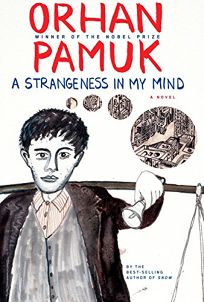
I have a few comments about A Strangeness in My Mind, the latest novel from Orhan Pamuk. I have not finished reading this book, but I want to. I had a digital review copy, which I let languish a little because life, but then I found myself taking train rides and having the luxury of long, uninterrupted blocks of time to read, and in this way I managed to read about two-thirds of this not so slender novel.

One morning I was happily reading along. My layover gave me time to grab a coffee. Cozily settled into the connecting train, I opened up my e-reader to be greeted by an error — the rights had expired.

So I want to know what happens next, but not because I'm invested in these characters' fates, but because I need to know if
there's a payoff. Frankly, most of what I'd read verged on boring; that is, it wasn't the novel I was expecting to read after the opening chapters describing an elopement. The next 400 pages cover the plight of the peasant coming to the big city to find his fortune, details regarding street vendors and the yogurt-selling trade, against a diachronic view of Istanbul.

I was cut off in my reading just as the narrative was returning to that promised in the beginning, and Mevlut was, it seems to me, discovering religion. That is, just as it was getting interesting.

I need to know if the last third of the novel, makes the first two-thirds relevant. How Istanbul has changed over the last several decades — culturally, socioeconomically, and politically — is actually interesting to me. But to my mind that story would've been better served in a separate collection of stories. I wanted to know more about how it was that, and what came to transpire when, Mevlut married the "wrong" girl.

I'd read some blurbs to the effect that this was a feminist novel. After 400+ pages, I wouldn't say so, but I need to know if the remaining 200 pages make it so.

The novel also makes use of a narrator-switching gimmick. That totally worked in My Name Is Red, but in Strangeness it's a distracting element. There's no regularity to it, or much reason for it beyond laziness to tell of events that couldn't otherwise be easily incorporated into a singular perspective; none of those secondary voices are much developed. Perhaps it works better in print where voices can be distinguished typographically.

Also, what exactly is the strangeness in Mevlut's mind? Is it something to do with religion?

I deliberately stayed away from reviews of this novel, so I could form an unbiased opinion. Let me pause a moment to check out some of those reviews now.

The Guardian, Alberto Manguel:
Though at times it reads as a cross between a history manual and private memoir, A Strangeness in My Mind is above all a love letter to the city in all its faded, messy, dusty glory.
The Independent, Boyd Tonkin:
Across the 600-odd pages of this epic fusion of soap opera, family saga and state-of-the-nation novel, Pamuk's beloved Istanbul mutates into that kind of skyscraping agglomeration: no longer a "familiar home" but "dreadful and dazzling at once".
The New York Times, Martin Riker:
A Strangeness in My Mind becomes a tremendous concatenation of voices and places and politics and culture, gathered around a melancholy hero and a winding psychological plot.
The Scotsman, Stuart Kelly:
Mevlut, of course, is a model not of prevarication, but the awful capability of seeing the virtues in both sides. He likes the Communists because they care about the poor, and he likes the conservatives because a good man needs a break. He even likes the Islamists because their heritage should not be disparaged, and God, is after all, Great. He is not a weathercock, but an amalgam: it is possible to have all these beliefs at once, Pamuk suggests, and that complexity is in itself a good thing.
I was unable to get my review copy extended, and when I first checked, by library didn't yet have it. I won't buy it, because I'm doubtful that the ending is worth it. My library has since acquired it, and I'm second in line for it now. So maybe my disappointment with A Strangeness in My Mind will coalesce into something more positive in a few months' time.

Has anyone read A Strangeness in My Mind? Is it worth seeing through to the end?

These are the other books I've finished reading since August, and I have every intention of writing more about them here.
  • Zofloya; or, The Moor: A Romance of the fifteenth century, by Charlotte Dacre — which was not at all what I'd expected, omitting as it does "gothic" from its subtitle, which might have better prepared me for its hysterical revenge, bloodlust, and satanic qualities.
  • Via Roma, by Mary Melfi — which was mostly forgettable, but portrayed both Montreal and Italian culture and so made for a nice comfort read after my Italian vacation this summer.
  • A God in Ruins, by Kate Atkinson — which made me sob, several times, but the part about one minor character dying from brain cancer helped me deal with the fact of my brother's brain tumour.
  • Slade House, by David Mitchell — which was creepy and intense and perfect for when I was alone at night
  • The Windup Girl, by Paolo Bacigalupi — which was difficult, but represents the kind of book I wish I were more fluent in reading.
  • The Utopia of Rules, by David Graeber — which was somewhat cathartic amid the paperwork and complications I encountered in buying a condo and negotiating a mortgage.
  • In the Kitchen, by Monica Ali — which made me hate dumb men for doing dumb things.
So now the only things between me and my blog over the next six or seven weeks are travelling for the holidays, some shopping for furniture and appliances, packing up house, and navigating the other logistical nightmares of moving. Nothing I can't get through.

Wednesday, November 25, 2015

It was all a dream

Mrs. Todds my English teacher gives an automatic "F" if anyone ever writes "I woke up and it was all a dream" at the end of a story. She says it violates the deal between reader and writer; that it's a cop-out, it's the Boy Who Cried Wolf. But every single morning we really do wake up and it really was all a dream.
— from Slade House, by David Mitchell.

Friday, November 20, 2015

Three library things

The Library at Night
A virtual exploration of the great libraries of the world, inspired by Alberto Manguel's essay.

Step into a recreation of Manguel's own library. "The library in the morning suggests an echo of the severe and reasonably wishful order of the world, the library at night seems to rejoice in the world's essential, joyful muddle."

Exhibition at the Grande Bibliothèque (Bibliothèque et archives nationales du Québec) until August 28, 2016. (I'll review it when I see it, but sadly that may not be for a while.)

Fallout 4
Disclaimer: I've never played Fallout, but I've logged several hours watching other people play Fallout.

In the latest installment, players can return overdue library books, strewn about the wasteland, for valuable tokens.

"There's certainly no harm in including a library in an imagined dystopian future — if anything, it's a great reminder that overwhelming violence can destroy valuable culture and knowledge."

The Library
A short film about the romance of books.

"It still carries a magical feeling for me, this special kind of sanctuary full of knowledge, full of stories, all covered in a sense of quiet respect and revery." (via)

Monday, October 26, 2015

Science in the service of Fiction

La Science au service de la Fiction:

Premier prototype d'écriture automatique avec images, typographies et pourcentages. Carte postale extraite du livre «Lapsus Mordicus», 2013.

A friend of mine recently sent me this fabulous postcard from France. It oozes cool, but I can't be entirely certain how the machine works.

The retro-futuristic computer appears to be designed to generate fiction according to the input configuration of narrative elements.

I'm not convinced that this machine covers all the components required for a satisfying read: violence, suspense, emotion, and femme fatale. I might add the elements of comedy, character, and cats.

Wednesday, October 21, 2015

Cat, book

Local street art, on the wall of a used book shop.

Wednesday, October 07, 2015

Notebooks, neckties, and homework

For one and half school years, between sixth and seventh grade, Mevlut worried constantly about where to sit in the classroom. The inner turmoil he endured while grappling with this question was as intense as the ancient philosophers' worries over how to live a moral life. Within a month of starting school, Mevlut already knew that if wanted to become "a scientist Atatürk would be proud of," as the principal liked to say, he would have to befriend the boys from good families and nice neighbourhoods, whose notebooks, neckties, and homework were always in good order. Out of the two-thirds of the student body who, like Mevlut, lived in a poor neighbourhood, he had yet to meet anyone who did well in school. Once or twice in the school yard, he'd bumped into boys from other classes who took school seriously because they, too, had heard it said, "This one's really clever, he should be sent to school," but in the apocalyptically overcrowded school, he had never managed to communicate with these lost and lonely souls who, like the quiz team, were belittled by the rest as nerds. This was partly because the nerds themselves regarded Mevlut with some suspicion, as he, too, was from a poor neighborhood. He rightly suspected that their rosy worldview was fatally flawed: deep down, he felt that these "clever" boys, who thought they would become rich one day if only they could learn the sixth-grade geography textbook by heart, were, in fact, fools, and the last thing he wanted was to be anything like them.
— from A Strangeness in My Mind, by Orhan Pamuk.

Wednesday, September 23, 2015

There was no prize

When she sat back down at her table she found that a group of men dresses as condoms were staggering across St Helen's Square. They were in one of the best-preserved medieval cities in Europe and they were dressed as condoms. What was wrong with Benidorm? Or Magaluf? ("You want everyone to behave better, but you don't behave better yourself," Bertie said.)

One of the condom men squashed himself like an insect against the large plate-glass of Bettys and leered at the diners. The pianist glanced up from his keyboard and then continued serenely with Debussy. A van drew up in the centre of St Helen's Square and disgorged several people dressed as zombies. The zombies proceeded to chase the men who were dressed as condoms. The condom men didn't seem very surprised, as if they were expecting to be chased by zombies. ("They pay for it," Bertie said.) Was this fun? Viola despaired. It was possible, she thought, that she had won the race to reach the end of civilization. There was no prize. Obviously.
— from A God in Ruins, by Kate Atkinson.

It's a devastatingly lovely book. The above excerpt should not considered representative, but it did make me laugh amid the general bleakness of war, and of life in general.

Thursday, September 17, 2015

All alike, perhaps just because they all wanted to be different

Here the pavements were swarming with feet wearing shoes, boots, high boots, shoes with heels and shoes without, and some in sandals, which, to look at them, make one's head go round; here the people were strolling up and down in couples, or in groups of men, women and children, or alone: some slow, some in a hurry, all alike, perhaps just because they all wanted to be different, with the same clothes, the same hair, the same faces, eyes, and mouths. Here were the furriers, bootmakers, stationers, jewelers, watchmakers, booksellers, florists, drapers, toyshops, hardware stores, milliners, hosiers, glove shops, cafés, theaters, banks; here were the lighted windows of the buildings with people walking up and down or working at desks; the electric signs, always the same; on the street corners stood the newspaper kiosks, the chestnut sellers, the unemployed selling ruban de Bruges and rubber fins for umbrellas. Here were the beggars, a blind man with black spectacles, cap in hand at the top of the street, his head thrown back against the wall, lower down an elderly woman suckling a child at her shrunken breast, and lower still an idiot with a shiny yellow stump like a knee-joint where his hand should have been. As I ground myself once more in that street, among such familiar things, I had a funereal impression of immobility, which made me shudder profoundly and feel momentarily naked, as if the icy breath of fear had passed between my body and my clothes.
— from The Woman of Rome, by Alberto Moravia.

Wednesday, September 16, 2015

Library for the soul


Libraries sometimes happen in unexpected places, right when you need them.

Last week I spent a night with my mother and my sister at Mark Preece Family House while my brother had brain surgery at the hospital next door. The idea for the House is to function as a home away from home for families whose loved ones are critical care patients in nearby facilities. So families can spend time being families instead of worrying about the price and logistics of travel and accommodations.

Part of the comfort of the House comes from its library. (Other House comforts: the kitchen, the bountiful complimentary baked goods, the fact that everyone there is going through something like what you are.) For me, a library signals both normalcy and escape.

These books were all donated or left behind. The library is genre-spanning, from Tana French, to James Patterson, to Douglas Adams.

I picked out Ian McEwan's Sweet Tooth — something I'd been meaning to get to someday. I made it tens of pages in, but decided to leave it for someone else to discover. (I already know I want to read it.)

Staying at the House was a really positive experience, and I encourage you to support ventures like this one. Sadly, a lot of people don't recognize the value of this sort of organization until they need one.

Tuesday, September 08, 2015

A factory to manufacture sorrow

You may well doubt words themselves, but there is often no mistaking the tone of voice in which they are uttered.
I had occasion recently to read Alberto Moravia's The Woman of Rome, in Rome. This was a marvelous reading experience, for several reasons, and I am definitely motivated to read more Moravia on its basis, quite apart from the enticement of the several of his novels issued by NYRB Classics.

I anticipate a surge in this novel's popularity due to its being featured in a near-final episode of Mad Men. That was certainly a factor in my choice to read it at this time. It is currently hard to come by in print, but it's readily available electronically. I hope for an NYRB edition, but at 336 pages, it's a little longer than their average publication.

The Woman of Rome shows up poolside in 1970; one fully expects Don Draper to make a play for its reader. So I was a little surprised to discover that the novel dates back to 1949, appearing in English the same year (if my copyright page is to be trusted, but the date of Italian publication varies around the web — either 1947 or 1949). The story centers around a prostitute, so it's easy to interpret the bathing beauty as a simple symbol of Don's temptation.

But really, The Woman of Rome is about Don Draper. Don is Adriana, both of them saddled with expectations, both realists in their way even if they are mostly deluded. They are fully in themselves but not of themselves.
I can remember that when I found myself in the street, among the crowds, on a fine and cloudy day of that mild winter, I felt with better certainty that my life, like a river that has been artificially turned from its course for a brief period, had begun once more to flow in its usual direction, without change or novelty, after an interruption caused by my hopes and the preparations for my marriage. Perhaps this sensation was due in part to the fact that in my bewilderment I was looking around me with a gaze shorn of its original bright hopefulness. The crowd, the shops, the streets, appeared to me, for the first time in many months, in a pitilessly objective light, neither beautiful nor ugly, neither interesting nor dull, but just as they were — as they must appear to a drunkard when his state of intoxication is past. But more probably it derived from my realization that the normal things of life were not, as I had supposed, my plans for happiness, but the exact opposite — I mean, all those things that are inimical to planning and programs are casual, faulty, and unforeseen agents of disillusionment and sorrow. If this were true, as I thought it must be, I had undoubtedly begun that morning to live again, after a state of intoxication lasting several months.
Adriana is desperately trying to rise above her circumstances, to break out of a cycle but condemned to it.
I climbed the steps, pushed aside the heavy covering over the door, and entered, putting a handkerchief on my head. While I dipped my fingers in the holy water stoup, I was struck by a scene carved around the edge of the stoup — it showed a naked woman, her hair streaming in the wind, her arms raised as she fled, pursued by a foul dragon, with a parrots' beak, that was standing upright on its hind legs like a man. I seemed to recognize myself in that woman and thought how I, too, was fleeing just such a dragon, that the course of my flight was circular, like hers, but that as I ran around in circles, I sometimes found I was not fleeing but was following a desire and gaily pursuing the ugly beast.
Adriana works as a nude model when she falls in love with Gino. They are engaged to be married but it turns out that Gino is a good-for-nothing liar and a cheat, so that's the end of that. Adriana is very realistic about her assets and her prospects. Before you know it she's a prostitute; she likes the money, and her mother likes the money too, although they never really speak of it.
I was not at all ashamed; I only felt an occasional sense of servitude and betrayal of my own nature.
Adriana's relationship with her mother is central to this novel, and that complex relationship appears to have been Moravia's starting point. Mother is always there, complaining about eyestrain and a shortage of sewing work, she's always there in the background, in the next room, or waiting for Adriana to return home, or trying to keep out of the way. Adriana's character is formed by this and the expectations set on her. (Note, the Wikipedia entry on this novel gets a key point wrong: Adriana's mother is not herself a prostitute, although she certainly encourages Adriana to cash in on her looks.)
I had always loved the Madonna because she carried a baby in her arms and because her baby, who became a man, was killed; and she who bore him and loved him as any mother loves her son and suffered so when she saw him hanging on the cross. I often thought to myself that the Madonna, who had so many sorrows, was the only one who could understand my own sorrows, was the only one who could understand my own sorrows, and as a child I used to pray to her alone, as the only one who could understand me. Besides, I liked the Madonna because she was so different from Mother, so serene and tranquil, richly clothed, with her eyes that looked on me so lovingly; it was as if she were my real mother instead of the mother who spent her time scolding me and was always worn out and badly dressed.
Then there's the police chief who offers to keep her. Adriana doesn't like him much, but she comes to rely on him for advice and favours. Meanwhile she falls in love with a politically active student. She's still working and encounters some unsavoury characters. There is theft and murder, thuggishness and underground pamphleteering. All the characters and storylines are threaded together quite nicely.

If it's not clear, I loved this book. Adriana is a wonderfully drawn, complex character. According to the promo copy:
One of the very few novels of the twentieth century which can be ranked with the work of Dostoevsky, The Woman of Rome also tells the stories of the tortured university student Giacomo, a failed revolutionary who refuses to admit his love for Adriana; of the sinister figure of Astarita, the Secret Police officer obsessed with Adriana; and of the coarse and brutal criminal Sonzogno, who treats Adriana as his private property. Within this story of passion and betrayal, Moravia calmly strips away the pride and arrogance hiding the corrupt heart of Italian Fascism.
The story is not, to me, obviously political. I needed to be reminded about Italian Fascism. The novel reads very smoothly and could easily be set anytime over the last century. Reading the story in Rome leant it an extra golden hue, and brought to life the streets, the bars, the shops. Ultimately I found it to be a very introspective novel, about what we demand of life and how unfairly it can treat us.
My room, which was always full of cigarette smoke, seemed to me like a factory working day and night to manufacture sorrow, without a moment's break; and the very air I breathed had by now become a thick gelatinous mass of sad, obsessive thoughts.

The Paris Review
Alberto Moravia, The Art of Fiction No. 6
On the writing process:
I had intended it to run to no more than three or four typescript pages, treating the relations between a woman and her daughter. But I simply went on writing. [...] It was a case, simply, of my thinking initially that I had a short story and finding four months later that it was a novel instead.
On the psychology of his characters:
For the psychology of my characters, and for every other aspect of my work, I draw solely upon my experience; but understand, never in a documentary, a textbook, sense. No, I met a Roman woman called Adriana. Ten years afterward I wrote the novel for which she provided the first impulse. She has probably never read the book. I only saw her that once; I imagined everything, I invented everything.
On writing novels, generally:
I do not foresee a time when I shall feel that I have nothing to say.

Monday, September 07, 2015

A lifelong state of expectancy

Remember your first kiss?
Since then I have given and received many kisses, and God knows I have given and received them without participating in them, either emotionally or physically, as you give and receive an old coin that has been handled by many people; but I shall always remember that first kiss because of its almost painful intensity, in which I seemed to be expressing not only my love for Gino but a lifelong state of expectancy. I remember that I felt as if the whole world were revolving around me and the sky lay beneath me, the Earth above. In fact, I was leaning back slightly, his mouth on mine, so that the embrace would last longer. Something cool and living pressed against my teeth and when I unclenched them I felt his tongue, that had caressed my ears so long with the sweetness of his words, now penetrating wordlessly into my mouth to reveal to me another sweetness I had never suspected. I did not know people could kiss in that way for so long, and I was soon breathless and half intoxicated. In the end, when we broke away from one another I was obliged to lean back against the seat with my eyes closed and my mind hazy, as if I were going to faint. And so I discovered there were other joys in the world than merely living peacefully in the bosom of one's family.
— from The Woman of Rome, by Alberto Moravia.

I was seventeen, the back seat of a cab.

Tuesday, September 01, 2015

Happiness is a new IKEA catalogue

It was with unreasonable joy that I discovered the latest IKEA catalogue in my mailbox the other week. My daughter and I made an event of it.

But what keeps us coming back to this long-standing series, year after year, awaiting each new edition? Is it the characters? The narrative structure?

A German literary critic reviews the publication:
"Happiness is a super-comfy sofabed, a few side tables and a strong wifi connection." But happiness, according to Freud, was never intended in creation's plan as a permanent state.

(via CBC)

Thursday, August 27, 2015

O virtuous Atwood! Virtuous beer!

Great Canadian novelist, environmental activist, inventor, poet. Margaret Atwood is also a brewmaster.

A colleague stumbled across some NooBroo at a local dépanneur, and picked up a bottle for me. I couldn't be more chuffed (any chuffier?)!

Beau's All Natural teamed up with Margaret Atwood and Graeme Gibson to create MaddAddamites NooBroo, inspired by Atwood's novel MaddAddam and including many of the botanicals noted therein. Proceeds support the Pelee Island Bird Observatory.

According to the brewery website, "Atwood personally tasted and selected the bouquet of botanicals included in this delicate, delicious gruit." She describes it as, "Fresh and spring-like, confident and down-to-earth yet inspirational, rooted in the wild world of foraging and gathering."

Also: most excellent label. I especially love the bee. (Why yes, that is a wind-up frog sitting in the background on my desk at work.)

However, my daughter has raised a concern: she thought K~ was simply showing me the bottle, hadn't realized K~ gave it to me. And now I can't sleep because it seems to me I must've got it wrong. Just last week K~ was offering a taste of the honey her father had made, er, harvested, to the bossman at work, and he mistakenly claimed the whole jar. And so with NooBroo, I couldn't just admire the concept and the packaging; I had to take it, I have to drink it.

I have not yet sampled the brew. Quite in addition to clarifying the issue of ownership, I believe the gruit requires a leisurely weekend to serve as an excellent accompaniment to some fine literature. Perhaps it shall wait even, for The Heart Goes Last. (No, I don't think it can wait that long. Atwood's new novel comes out at the end of September.)

Wednesday, August 12, 2015

This most improbable of cities

I read Thomas Mann's Death in Venice in Venice recently, and it was a remarkably intense experience.

I began reading en route from Florence, in the train.
He saw it once more, that landing-place that takes the breath away, that amazing group of incredible structures the Republic set up to meet the awe-struck eye of the approaching seafarer: the airy splendour of the palace and Bridge of Sighs, the columns of lion and saint on the shore, the glory of the projecting flank of the fairy temple, the vista of the gateway and clock. Looking, he thought that to come to Venice by the station is like entering a palace by the back door. No one should approach, save by the high seas as he was doing now, this most improbable of cities.
I immediately regretted our approach. Although by our original plan we were to fly to Venice, and travel from the airport to the city by boat, we had been forced to revise several arrangements. Here we were on the railroad tracks stretching out from the mainland onto the sea with no inkling of what we were approaching — a train station like any other, the back door.

It would be days later that I fully understood, when we returned over water from neighbouring islands. Fairy-tale splendour, unreal city.

But at last we would leave with dignity and pride, not slinking through the servants' entrance.

Then I read about the gondolas.
Is there anyone but must repress a secret thrill, on arriving in Venice for the first time — or returning thither after long absence — and stepping into a Venetian gondola? That singular conveyance, come down unchanged from ballad times, black as nothing else on earth except a coffin-what pictures it calls up of lawless, silent adventures in the plashing night; or even more, what visions of death itself, the bier and solemn rites and last soundless voyage! And has anyone remarked that the seat in such a bark, the arm-chair lacquered in coffin-black and dully black-upholstered, is the softest, most luxurious, most relaxing seat in the world?
I was amused by Mann's description, but then shocked to discover its accuracy. They are blacker than black. Mann spoiled it for me. Why would I climb into that foreboding conveyance, glide to my afterlife? It took me some days to come to my senses: hundreds of people travel by gondola daily, my stepping into a gondola would not herald my death. Yes, it is the softest, most luxurious, most relaxing seat in the world. Maybe this is my afterlife.
Leaning back among soft, black cushions he swayed gently in the wake of the other black-snouted bark, to which the strength of his passion chained him. Sometimes it passed from his view, and then he was assailed by an anguish of unrest. But his guide appeared to have long practice in affairs like these; always, by dint of short cuts or deft maneuvers, he contrived to overtake the coveted sight. The air was heavy and foul, the sun burnt down through a slate-coloured haze. Water slapped gurgling against wood and stone. The gondolier's cry, half warning, half salute, was answered with singular accord from far within the silence of the labyrinth. They passed little gardens, high up the crumbling wall, hung with clustering white and purple flowers that sent down an odour of almonds. Moorish lattices showed shadowy in the gloom. The marble steps of a church descended into the canal, and on them a beggar squatted, displaying his misery to view, showing the whites of his eyes, holding out his hat for alms. Farther on a dealer in antiquities cringed before his lair, inviting the passer-by to enter and be duped. Yes, this was Venice, this the fair frailty that fawned and that betrayed, half fairy-tale, half snare; the city in whose stagnating air the art of painting once put forth so lusty a growth, and where musicians were moved to accords so weirdly lulling and lascivious.
Antonio drove us past the homes of Marco Polo and Casanova. He cries out before the bend. Kids in the upper story of some palazzo call out to him by name. This was Antonio's route. They all know him.

The gondolas have names. Some of them are engraved on a silver plaque affixed at the front: Cristina, Laura, Elena. Antonio's boat is called Pruna, after his mother.
Solitude gives birth to the original in us, to beauty unfamiliar and perilous — to poetry. But also, it gives birth to the opposite: the perverse, the illicit, the absurd.
Today the gondoliers all steer while texting.
Passion paralyses good taste and makes its victim accept with rapture what a man in his senses would either laugh at or turn from with disgust.
Venice is absurd in its luxury, it drips with overindulgence, the lushness of its interiors, the richness of its food, the mystery of its labyrinths, the magic of its squares.

Death in Venice I knew by reputation to be a tragic love story of sorts. I was prepared for this, the perverse ramblings of an ailing old man. He obsesses over youth and beauty. I sat on Lido beach and watched, as Mann did, young bodies. I was prepared for despair.

I had expected something nostalgic and mournful. What I found was something altogether sinister. Not only is a plague of lusts, desires, and disappointments visited upon the central character, a literal plague descends upon Venice, not for the first time. A conspiracy of silence supports the bubble of the Venetian fairy tale. I regret that we were not present for the festa del redentore, which celebrates the end of the plague of 1576; perhaps the plague has not really ended.

Thomas Mann wrote Death in Venice in 1911. In 1954 he published The Black Swan, which I read last winter, which revisits many of the same themes, but this time from a female perspective. I'm astounded by Mann's ability to convey human experience in all its complexity, its joy and shame.

The contrast between youth and age is aligned with that of passion and knowledge. The passion of youth, the wisdom of age. With age, one should know better. The heart and the head. Forget the head.
Knowledge is all-knowing, understanding, forgiving; it takes up no position, sets no store by form. It has compassion with the abyss — it is the abyss. So we reject it, firmly, and henceforward our concern shall be with beauty only. And by beauty we mean simplicity, largeness, and renewed severity of discipline; we mean a return to detachment and to form.
Today marks the 60th anniversary of Thomas Mann's death, not in Venice.

Thursday, August 06, 2015

Art heightens life

Art heightens life. She gives deeper joy, she consumes more swiftly. She engraves adventures of the spirit and the mind in the faces of her votaries; let them lead outwardly a life of the most cloistered calm, she will in the end produce in them a fastidiousness, and over-refinement, a nervous fever and exhaustion, such as a career of extravagant passions and pleasures can hardly show.
— from Death in Venice, by Thomas Mann.

Friday, July 17, 2015

Venetian comfort

The Comfort of Strangers, by Ian McEwan, is a strange little novel, set in Venice. One of his early works. It's short, and nothing much happens.

I'm not sure how he achieves it, but the novel has a very sinister tone — the sense that something's lurking in an alleyway or canal. Venice is labyrinthine and mysterious.

McEwan in my view excels at depicting relationships in all their nuance; what little is spoken between characters speaks volumes. Although the details of the story may seems far-fetched, the characters are very real.

And the title tantalizes. I'm still wondering who is seeking comfort from whom, who are the real strangers in this story?
She appeared greedy for the fact of conversation rather than its content; she inclined her head towards him, as though bathing her face in the flow of his speech.
I like this review in New York Times that manages to tell you everything about the novel without actually spoiling any of it, and still make you want to read it. "No reader will begin The Comfort of Strangers and fail to finish it; a black magician is at work."

The movie also is worth watching. It has a terrific cast. And scripted by Harold Pinter, it's mostly true to the novel.

Tuesday, July 07, 2015

Reading Italian style

I leave for Italy next week, and as such I've been reading all things Italian.

Here are two guidebooks I recommend:

Italy, Insight Guides is a little short on logistical details but big on flavour. This is the book I turned to to help me decide what regions I wanted to visit, but I'll probably leave the book at home.

Secret Venice is a treasure trove of weird and wonderful stories concerning the nooks and crannies of Venice, of which there appear to be plenty. Like the graffiti image of a human heart, scratched by a stonecutter who slept in the doorway upon witnessing a Levantine Venetian stab his mother and tear out her heart.

So yes, Venice is on the itinerary, followed by Florence, then Rome, with day trips here and there. (And as part of our preparation, we've been replaying Assassin's Creed II, to familiarize ourselves with the lay of the land.)

Quite apart from practical research, I've also been stocking up on novels set in those places. My reading material for the journey includes:

I've already started the McEwan, and it's short and very compelling and it'll be done before I leave. And I'm excited about the Moravia because it was referenced in Mad Men. But it strikes me that these novels are all a little dark. Perhaps something a little lighter, more gelato-inspired, is in order.

Do you have any Venice-to-Rome reading recommendations for me?

Wednesday, June 24, 2015

Only poetry could win the vote

We were packing our bags. There was nothing that they could say now. Now they were trying anything to make us stay. Like a lover who was trying to talk reason into you as you were throwing your clothes into a suitcase, they went from saying soothing, reconciliatory, sweet things to calling you a complete idiot and telling you that you'd regret it for a sure. Well it was too late for all that.

We would go off on our own. We just wanted to speak French in peace. We wanted to whisper dirty things to our loved ones in French. There was a certain kind of love that could only be expressed in this way.

There was no difference between the expressions I like you and I love you in French. You could never declare love like that in English.

We loved in a self-destructive, over-the-top way. A way that was popular in sixties experimental theatre and certain Shakespeare plays. We loved like Napoleonic soldiers in Russia, penning beautiful letters while seated on the corpses of our dead horses. We were like drunk detectives who carried around tiny notebooks full of clues and fell for our suspects. We were crazy about the objects of our affection the way that ex-criminals in Pentecostal churches were crazy about Jesus. We went after people who didn't know we existed, like Captain Ahab did. We loved awkwardly and hopelessly, like a wolf ringing a doorbell while wearing a sheepskin coat that is way too small for him.

How could you explain that in a political platform? I wondered. I began to write a speech for Etienne. The only way that we would win the referendum would be if the speech-makes came out. Only poetry could win the vote.
— from The Girl Who Was Saturday Night, by Heather O'Neill.

Harkening back to the pre-referendum days of 1995.

Happy St. Jean-Baptiste Day, Quebec!

Monday, June 22, 2015

The joules of men

I started reading The Windup Girl some time ago, by Paolo Bacigalupi. It's slow going and fairly demanding reading, but in a rewarding way. There are no infodumps here; the reader has to figure out the terminology and the society and the politics as they go. It's rich world-building. (In this way this book is reminiscent of the work of China Miéville. These authors give their readers a lot of credit.)
Hock Seng's treadle loses its rhythm. "This is a difficult thing, I think. Even the Dung Lord must bow before the Megodont Union. Without the labor of the megodonts, one must resort to the joules of men. Not a powerful bargaining position."
I love this passage from early on in the book, because it makes no sense (what's a megodont? what's a dung lord?), but of course it makes all kinds of sense.

I imagine breaking the lines, for it to take the form of a poem.
Hock Seng's treadle
loses its rhythm.
"This is a difficult thing,
I think. Even the Dung Lord must
bow before the Megodont Union.
Without the labor of the megodonts,
one must resort
to the joules of men.
Not a powerful
bargaining position."
The language of science fiction is poetry.

So I'm plodding along and figuring things out, but also reminded of the value of taking things slow, the richness of slow reading.

Here we have calorie companies and generipping and seedbanks.
Best to trust no one, even if they seem friendly. A smiling girl one day is a girl with a stone bashing in the brains of a baby the next. This is the only truth. One can think there are such things as loyalty and trust and kindness but they are devil cats.

Sunday, June 21, 2015

Grade 6 is so over

Two more days of school (sigh), but prom was Friday night.