There's a place that as kid you called the farthestmost point — the most distant you could get, the place that when you stood there you could pretend you were the only person in the world. Being there made you wary, but it also put a kind of peace into you, a sense of security. Beyond that point, in either direction, you were always returning, and are returning still. But for that moment, even now with Whitby by your side, you're so remote that there's nothing for miles — and you feel that. You feel it strongly. You've gone from being a little on edge to being a little tired, and you've come out on this perfectly still scene where the scrublands turn to wetlands, with a freshwater canal serving as a buffer to the salt marsh and, ultimately, the sea. Where once you saw otters, heard the call of curlews. You take a deep breath and relax into the landscape, walk along the shore of this lower heaven rejuvenated by its perfect stillness. Our legs are for a time no longer tired and you are afraid of nothing, not even Area X, and you have no room for memory or thought or anything except this moment, and this one, and the next.
Imagine, she had told Control next, that language is only part of a method of communication. Imagine that it isn't even the important part but more like the pipeline, the highway. A conduit only. Infrastructure was the word Control would use with the Voice later.
The real core of the message, the meaning, would be conveyed by the combinations of living matter that composed the words, as if the "ink" itself was the message.
"And if a message is half-physical, if a kind of coding is half-physical, then words on a wall don't mean that much at all, really, in my opinion. I could analyze those words for years — which is, incidentally, what I understand the director may have done — and it wouldn't help me to understand anything. The type of conduit helps decide how fast the message arrives, and perhaps some context, but that's all. Further" — and here Control recognized that Hsyu had slipped into the rote routine of a lecture given many times before, possibly accompanied by a PowerPoint presentation — "if someone or something is trying to jam information insider your head using words you understand but a meaning you don't, it's not even that it's not on a bandwidth you can receive, it's much worse. Like, if the message were a knife and it created its meaning by cutting into meat and your head is the receiver and the tip of that knife is being shoved into your ear over and over again..."
This is from the second instalment of the Southern Reach trilogy, about Area X.
Annihilation was creepy, thrumming our unease with the unknown in our external world. In Authority, the creep factor stems from the unknown in our intimate world — an invasion into the places we live, the work we do, the people we know.
Nothing special has happened today; no one can say she was more provoked than usual. It is only that every day one grows a little, every day something is different, so that in the heaping up of days suddenly a thing that was impossible has become possible. This is how a girl become a grown woman. Step by step until it is done.
Award-winning, genre-bending feminist dystopia. Praised by Margaret Atwood. The Power, by Naomi Alderman. A huge disappointment.
A fascinating premise, and a book for our times, the execution was weak and formulaic, with characters I didn't care about.
What The Power does do quite cleverly is flip gender expectations upside-down.
Boys dressing as girls to seem more powerful. Girls dressing as boys to shake off the meaning of the power, or to leap on the unsuspecting, wolf in sheep's clothing.
I'm surprised this book wasn't written before now; it's as if it were waiting for its time.
Girls have evolved to have an organ of electricity; they can channel this "power" through their fingertips like lightning. It can kill.
This sets the world on fire, with women wresting control from abusers, criminal, harassers, despots. Women take back the night, and then some.
As provocative as the ideas are in this novel, it feels like it was trying to do too many things. The cross-cutting of several perspectives, the overall pacing, the graphic nature of some scenes, the "real-life" politics (mentions of military training, UN sanctions, a play for oil) — these elements give the novel the feel of a thriller, of a genre novel. I'm not proud of myself for using that word ("genre") disparagingly here (I trust most readers recognize that I read broadly and I have nothing against genre-bending), but the novel packs all this in and more to the detriment of more meaningful plot and better realized characters. I suspect the work of a marketing-savvy editor with an eye on film rights.
That being said, The Power is a worthwhile thought experiment. Beyond the role switching, the novel questions power dynamics, the nature of power itself, and the corruption of individuals who hold it and wield it.
It also questions how we come by our basic assumptions of history, biology, and our place in the world. (This is particularly evident in the novel's frame; the story is established as a work of historical fiction speculating on the events that led to the global Cataclysm — it posits a kind of pre-history. I found the framing device really jarring, but I appreciate what it's trying to accomplish.)
Do you think that you are so exceptional that if you had been born a German in the 1930s, you would have understood immediately that Lebensraum was a lie? That you would have tried to assassinate Hitler? Do you believe that your ethics are so exceptional that you would immediately have rebelled?
If you and I lived in a world where women were dominant, would you be telling yourself: This is very unjust; I will fight for the rights of men?
If we lived in the world of the power, I don't think I would be magically excluded from the way the world operates. I don't think I can say I would have been the enlightened person. With or without the power, I behave the way the system teaches me to behave.
Early chapters reminded me strongly of SNL's Welcome to Hell skit, from late 2017 (viewable in Canada here).
The things you don't want to know, Roxy, those are the things that'll get you in the end.
"I am not a writer, I am an atmosphere," Lúcio Cardoso quipped. Brazilian, gay, and by all accounts larger than life.
And this book is some kind of atmosphere.
Chronicle of the Murdered House, by Lúcio Cardoso, did not at first appear to be the kind of book I would enjoy. But what is bookclub for if not to push me to appreciate books I might not otherwise pick up?
The first strike against it: it's long, almost 600 pages, which I think is a little much for bookclub to demand of me.
Second, a quick scan showed it to be epistolary in nature: a collection of letters, diary entries, confessions, et cetera. Not really my thing. I find it hard to keep track sometimes of who's writing and when; I expect the author/narrator to ensure the entries are suitably "curated" — such a novel demands a strong framework (I hold it to higher standard than a "traditional" novel, and so it more likely to fare poorly).
Third, there's something florid about it. The framework contributes to the sense that this book is much older than its 60-odd years. The language is dense and musty. It feels altogether of another era.
But bookclub. What else did I have to do in the deep cold of winter?
And wow. A mere five pages in, there's a spectacular reveal. André in his diary is questioning the meaning of it all — love, life, death — and mourning his lover, Nina, a paragon of beauty and life struck down too young (although in these early pages it's not clear whether by illness or something more nefarious). It's overly sentimental. André is highly dramatic (it's not till much later that we learn he is only 16 years old).
SPOILER:
On the fifth page, he clearly identifies Nina as his mother.
I was hooked.
Oh, the melodrama, the scandal, the sin. Chronicle of the Murdered House is a love story, a tragedy, a family drama, a morality tale, a mystery, and a horror story.
This is the story of Nina and her effect on the Meneses family (I started pronouncing them the "menaces"). When Valdo, the youngest of three brothers, brings home a young wife (well, she arrives separately), the reader anticipates a breath of fresh air, to stir up some dust in this proud family. But I was not prepared for this.
The title is inspired and it serves the story well.
Curiosity #1: The house of the title.
The title highlights a gothic element — indeed, the Chácara, the historic family home, is a strong character. The house is dim and stuffy, preserving bygone traditions. It has an army of servants. It has its own generator, with flickering yellow lights. It overlooks what was once an impressive garden, with a pavilion. The house is gradually falling into disrepair. By novel's end it is crumbling, "an abandoned skeleton." The house of course represents the family name.
"What do you think a house ruled by the power of evil is like?" (I skated clumsily over those words — the power of evil — ignoring their poverty and vulgarity.) "It is constructed very much like this one, firm in its foundations, secure in its traditions, conscious of the heavy responsibility of its name. It isn't tradition that takes root in it, it is tradition as the sole defense of truth." [...]
"It is what we could call a solidly built home." (I could not help noticing that my voice had become singularly calm.) "There is not a single crack through which heaven can enter." [...]
"Often, in times gone by," — it was my turn now to confess — "I wondered what made this house so cold, so soulless. And it was then that I discovered the formidable immutability of its walls, the frozen tranquility of its inhabitants. Ah, my friend, trust me when I tell you there is nothing more diabolical than certainty. In certainty there is no place for love. Everything that is solid and firm is a denial of love." (p 334)
With Nina's death, the windows are finally flung open.
Curiosity #2: The murder of the title.
I won't tell you who dies. Well, yes, the house — both that which physically stands and the family that presided over the land — dies. But the title supports the framework, establishing the novel as a mystery. The book is a compilation of accounts, of witness testimony, regarding certain events. (It is not revealed till the end who has gathered these documents together.) While the accounts are not obviously contradictory, they occur in different personal contexts, they focus on different aspects, they are imbued with different emotions. All of this raises the question of absolute truth. While there is no clear murder mystery as the book progresses, the structure sets up the reader to believe there is one.
Curiosity #3: The epigraph. John 11:39-40. It links the smell of disease and decay to resurrection, or the absence thereof. Toward Nina's end, the stink is unbearable. I read with wrinkled nose. So there is no salvation in this house. "Christ is nothing but a lie" (p 573).
Curiosity #4: The summoning of the monster.
There's a scene I found utterly monstrous, horrific, Lovecraftian. Nina's lover recounts how "down my fists and my fingers ran a liquid which was neither blood nor pus, but a thick, hot substance that dripped down as far as my elbows and gave off a foul unbearable smell," (p 468) like her rotting lifeforce. It's really weird and unpleasant, but not entirely out of place. Nina is a catalyst for something, allowing the true horror (of the house?!) to manifest itself.
When she first comes the Chácara, Nina is a breath of fresh air, but she's also trouble. (I picture Nina as Rita Hayworth's Gilda.) She's also very much a victim. As monstrous as her behaviour is, I can't help but feel sorry for her. She is a creature of her body, of sensuous pleasures — as she has no moral code, it's hard to condemn her for breaking one.
What is goodness? How could one judge or evaluate it when in the presence of a blind, impulsive being like her? [...]
She was not a simple human being, but a construct, a work of art. (p 366-7)
Curiosity #5: Nina/Ana.
They are positive/negative. Nina is colour and life, Ana is dour and gray. Nina is spontaneity and impulse and laughter, Ana is deeply unhappy and deeply repressed. Ana feels the burden of sin deep in her soul. Nina drinks champagne.
Ana is married to the eldest Meneses brother, and she is one with the house. Her confessions (to an actual priest) constitute a significant portion of the testimony in this chronicle. She figures prominently enough that one may say the novel is the story of two women, a study in contrasts.
Curiosity #6: The buried family secrets. Senhor Timóteo is the Meneses brother nobody speaks of. An obese, cross-dressing embarrassment, he is quite literally buried alive, condemned to his room to watch life pass him by from his window over the garden.
Then there's the great aunt, whose portrait was removed from the drawing room.
It was the face of a woman, there was not doubt about that, but so stern, so unemotional, so detached from any mean, everyday thoughts, that it was more like the face of a man — a man, moreover, utterly disillusioned with the vanities of this world. There was no promise of serenity, none of the greens and pinks that conceal barely suppressed laughter or the twinkle of a sudden burst of youthful spirit — no. Everything about that face was dense and mature. The colors were the grays of tamed passions and the ochers of contained violence. It wasn't the face of an old woman, but of a woman at the outer limits of herself, with nothing to cover herself but the truth itself, whose caustic effects might or might not be dangerous.
In 1959, Cardoso was giving gay culture a place in Brazilian literature.
Curiosity #7: The snake, the wolf, the revolver.
The snake completes the Biblical allegory of the garden. The wolf is an external unseen predator, possibly imagined, a false pretext for a revolver. I'm not sure what to make of the revolver.
It's hard to explain, especially since, in the Meneses family, Timóteo was far from being its dullest or its least unusual member, on the contrary, but to describe his personality, I would have speak not so much about what he did or felt and more about the dense, unstable, electrically charged atmosphere that surrounded him — like the atmosphere you might find in certain smoky bars. Were I to describe his actions and feelings, they would be like mere supports propping up the foggy world he inhabited. He navigated his room like some splendid, deep-sea fish in the small maritime stronghold of his aquarium. What he said could seem abrupt and disconnected to those who merely heard him speak, but for anyone who understood him, there was a complete coherence between the things he said and the turmoil of his thoughts.
I found myself thinking about a girl from school, Meredtih Wittman who had lived on the same floor as me and Hannah and Angela, though the few times I said hi to her, she murmured something without looking at me or moving her mouth. A graduate of Andover, she carried her books in a Christian Dior bag and had once written a feature for the student newspaper's weekly magazine about Boston's salsa and merengue scene. I happened to know, because I had overheard her telling her friend Bridey, that Meredith Wittman was doing a summer internship at New York magazine, and for a moment now I reflected on the fact that, although Meredith Wittman and I both wanted to be writers, she was going about it by interning at a magazine, whereas I was sitting at this table in a Hungarian village trying to formulate the phrase "musically talented" in Russian, so I could say something encouraging by proxy to an off-putting child whose father had just punched him in the stomach. I couldn't help thinking that Meredith Wittman's approach seemed more direct.
I love this book so much. Much more than I expected to. Much more than I recall loving any other book in recent memory. I love it in a deeply personal way. It is urging me to closely consider how I judge books.
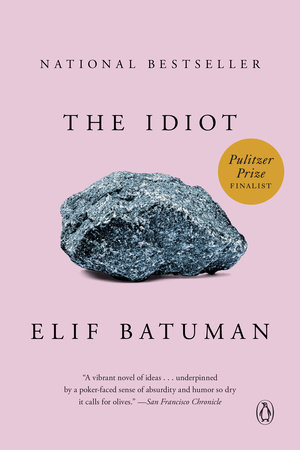
Not by the cover. It's pink, a horrific millennial shade of it. There's a picture of a rock. Too literal a representation of the title. The cover is so awful, I'm starting to like it. ("You can't just tell an ache: 'Go back into the rock.'" Neruda's atom to return to blind stone.)
Not by the title. The title is not original. The author blatantly stole it from another book, a book with its own reputation that I've never read.
By the plot? Very little happens. There is no situation requiring resolution. Except maybe the element that may be called a love story, but that element fades in and out — it's barely there.
Characters. Are not fully formed. Rather, they are fully formed representations of not yet fully formed people. People come and go. We only know them as much as the narrator gives them the time of day, considers how they impact her own life. She doesn't know how most of them fit into her own narrative yet.
So here I am thinking it can't be a very great book. It is not Dostoyevskian, I don't think. But how is it that I love it so? Why do I think of it as a guilty pleasure, that it is somehow not worthy of all my love. Is it not enough that this book brings me great joy? Why would I hesitate to give it 5 stars? Can the experience of reading the book be so much greater than the book itself? Does not the book itself earn the credit for giving me this experience?
The Idiot, by Elif Batuman, captures something delicate. I don't know if it is a universal experience, or a female experience, but it was my experience.
It takes me back to my first year at university, and dorm living, and the cafeteria, and poring over the course catalogue, trying to figure out more that what I wanted to study: what kind of person I wanted to be. Did I want to be the kind of person who read about the history of magic and witchcraft, surveyed obscure fine arts movements, or enrolled in 19th-century literature?
What even is love, and do I want to be in it? How do people even talk to one another?
Selin's summer teaching English in Hungary is some ways also reflects a summer I spent in Poland — my roommate there was there teaching English (she didn't know any Polish, and she was ill-equipped to teach language; she was in an accounting program, I was the linguistics major), phones were complicated, boys were complicated, communism hadn't entirely worn off yet. It was exciting, and sometimes very strange.
I've read a lot of negative comments about this book, about its pointlessness. People who dislike Selin, so self-absorbed, why doesn't she just say something?
When Vivie apologized for eating slowly, Béla said that eating slowly was good: "If you eat slowly, you can feel the food."
"You don't feel food," Owen said, "you taste it."
"Yes," Béla said. "But I also mean more than to taste it."
"You enjoy it," suggested Daniel. "If you eat slowly, you enjoy the food."
"You enjoy," repeated Béla.
"You relish it," said Owen. "You savor it."
"Savior?"
"Not savior — savor. It's like enjoying something, but more slowly."
"I don't know this word," Béla said, his eyes shining.
I realized that I would never have corrected somebody who said "you can feel the food." That was how Owen would end up with students who said "savor," while I wold end up with students who said "papel iss blonk."
I wouldn't correct it either. Of course you can feel the food, why would anyone correct that?
I can't help but feel that The Idiot's naysayers are people who talk too much without saying anything substantial, who don't think before they speak; they either live in hypocrisy or their existence is charmed by self-assurance and obliviousness.
I've been thinking a lot about the kind of person I was when I was 18. I don't think I've changed much. Sure I've "evolved" — I know more stuff, I've had more experience. I form (and state) opinions more readily, because I have accumulated more arguments to back them up. I still obsess about language and figuring out what people are trying to say when they choose to say things (I do this professionally). The naysayers — I am certain I would not have liked their insufferable 18-year-old selves. I would not have liked Meredith Wittman.
The Guardian describes how The Idiot is a historical novel, set at the advent of the internet but before smartphones, so this story could not have happened at any other time. At any other time, the plot would have to be different. But I think the story would be the same, youth is the same. (My university experience was pre-email. But it was the same.)
Teenage pretention, unlike its later incarnations, has always seemed to me to be a kind of thrilling, experimental optimism: Is this who I could be? The Idiot is full of that wonderful, embarrassing kind of early pretention that consists of trying on roles like coats. (Selin buys a coat because it reminds her of Gogol).
[...] The Idiot encapsulates those years of humiliating, but vibrant, confusion that come in your late teens, a confusion that's not even sexual, but existential and practical: Where do people get their opinions from? "How did you separate where someone was from, from who they were?" How do I "dispose of my body in space and time, every minute of every day, for the rest of my life?"
In secondhand bookshops, he's sell the books he'd lovingly collected over the years in exchange for a pittance, and then he drank his own books, each day he drank one, some days as many as two, I'm drinking The Odyssey, the small change they gave me for it is disappearing down my throat, he'd tell himself, look how little I got for the paperback edition of Martin Amis's Money, he exchanged literature for alcohol, Robinson Crusoe became a bottle of Baileys, The Brothers Karamazov a bottle of Smirnoff vodka, the three gin and tonics he'd just ingested were The Life and Adventures of Lazarillo de Tormes. He got his hands on an expensive bottle of Laguvulin whisky in exchange for the leather-bound copy of James Joyce's Ulysses that Ana had given him as a gift; if, on a given day, he sold Montaigne's essays for next to nothing, he would buy himself a Bordeaux red, trying to be coherent with what he drank; if he got rid of Madame Bovary, he had to try to find a potion similar to something Flaubert might have ingested, to be able to emulate him; in exchange for Italo Calvino's Our Ancestors he'd get a Chainti or a bottle of pelaverga from Saluzzo, maybe. Whoever said that literature doesn't feed us, that it doesn't comfort our spirit or our soul?
The trees whipped past, the same trees that I had observed from a middle-aged woman's car. Now I was that woman, but I was speeding wildly and the trees flashed by so fast I felt nauseated. No limpid daughter slept in the backseat; no strange teenage girl sat next to me, stewing in her own nightmarish consciousness. (And isn't that how you become tender, vulnerable? The tissue-softening marination of your own mind, the quicksand of mental indulgence?)
Her Body and Other Parties, by Carmen Maria Machado, stormed onto the literary scene last year and was unanimously highly lauded, ending up on many best-of-2017 lists. (Just look at that praise.) It's a collection of eight short stories, which, drawing on science fiction, horror, and feminist theory, I ought to love, but all of them were a little too long (and boring) for my liking.
One story, "The Resident," describes the narrator's experience at an artists' residence (or colony) (taking up residence in the artist mind, or colonizing it? she wonders). She winds up on the floor, thinking about Shklovsky's idea of defamiliarization.
Toward the end of the stay, the artists share their work with each other, and one of them accuses the narrator of indulging in "that old trope" — the madwoman-in-the-attic story, the angry lesbian. It was nice to hear a character expressing my own feeling about the narrator's work, though I would level that criticism at Machado regarding this entire collection.
I didn't know anything about defamiliarization till I looked it up on Wikipedia — "a technique of presenting to audiences common things in an unfamiliar or strange way in order to enhance perception of the familiar." It occurs to me that maybe Machado intended all these stories to demonstrate this technique, to enhance my perception of the ordinary. But it's mostly lost on me; I wish someone could explain it to me; I just see ordinary.
These stories have some nicely constructed images, original turns of phrase, a lot of gauzy fabric, nuggets of deep thought, but I found myself plodding through these stories, not enjoying them. They were fairly predictable. These stories just weren't for me, at least not the me in my current headspace.
"One day, in the garden, he told me that a sin is almost always something very tiny, a grain of sand, a nothing—but that it can destroy an entire soul. Ah, Betty, the soul is a strong thing, an invisible, indestructible force. If a tiny pinch of sin—a nothing, a dream, a nasty thought—can destroy it, what will a large dose of poison do, a sin instilled drop by drop into the heart you want to destroy?"
I didn't really understand what he meant, but I stared at him in alarm.
"The Bath" is a substantial short story that starts off Where Europe Begins, a collection of Yoko Tawada's work.
Have you ever tried to tell someone what you dreamt? And you stumble for words to convey the dream logic and transitions.
"The Bath" reads like a dream, only the telling of it is sublimely fluid.
It's kind of a fairy tale, about a fish-woman, or maybe a bird with scales, who may or may not be (as things are in dreams) a simultaneous interpreter who loses her tongue, both the physical muscle and her language, and joins a freak show.
I heard the click of a cigarette lighter. Evidently someone had begun to smoke. The faces around me were flushed from the wine. When jaw muscles relax, the atmosphere becomes relaxed as well. People's mouths fell open like trash bags, and garbage spilled out. I had to chew the garbage, swallow it, and spit it back out in different words. Some of the words stank of nicotine. Some smelled like hair tonic. The conversation became animated. Everyone began to talk, using my mouth. Their words bolted into my stomach and back out again, footsteps resounding up to my brain.
A lot happens in this story, and a lot of it is dreamt. It quite possibly merits Jungian analysis, but it moves so swiftly, slippery life a fish, it's hard to know where to start.
There's the issue of the mother, and the mother's refusal/failure to (physically) recognize her daughter (or emotionally acknowledge her). There's the mystery of the dead woman, whom she begins to confuse herself with, suicide from loneliness — is this what happens to Japanese women of a certain age who choose career over marriage? ("I have no time to go out because I sleep so much.") There's the problem of the tongue, forsaking one language for another, only to have no identity at all.
She is swallowed by her own vagina.
All at once I realize that the scale-covered bird called Sarcophagus is, in fact, the woman. I push open the lid and climb out.
Sky and earth have come to an end, and before me lie desolate grasslands full of slender blades swaying in the air. I remember having felt this way when I firs left my mother's womb.
With all my strength, I embrace the cold body of the scaly bird. In my arms, each of its scales becomes a wind chime that rings. Sharp, gently, bitter, soft notes penetrated my bones, and now my bones, too, begin to ring. This ringing gradually give rise to a strength which belongs to no one.
Twist, by Harkaitz Cano, is billed as a crime novel cum political thriller. In my view, it's more subtle than that: it's a meditation on memory and guilt.
It's about being in one's skin and feeling it in one's bones.
If you were in their skin, you would be the same, the same as them and their circumstance. "I am I and my circumstance; if I do not save it, I do not save myself." The second part of that sentence by the famous philosopher is often forgotten, who knows why. But no one inhabits anyone else's skin anymore, do they? It's hard enough to withstand our own skin, why would we think of inhabiting another's. The difference is that now you're in your own bones, and not in your skin.
This novel also has a lot of ghosts. These are predominantly political and historical ghosts, but they are also personal — the ghosts of the actual dead along with the spectres of family and past relationships invading one's current course of action.
It occurs to him that the water that comes out of the taps in our houses is filled with spectra: he remembers his mother's lock of white hair, how she deliberately blocked the sink once, just so she could ask for Diego's help. Our ghosts and the ghosts we must inherit. Those who make us guilty and those who make us be born guilty.
The water that comes out of the taps in our houses is filled with spectra and we drink those spectra and introduce them inside ourselves. How many like this one. Impossible to know. Spectra that we swallow and that turns us into spectra in turn. Transparent souls. Intermittent beings.
It's also about art and literature as a means of exorcising some of our ghosts. The main protagonist is a novelist; other characters are writer, journalist, publisher, actor, theatre director, visual artist. Some plot points move through a publishing house and a theatre. Cano it clearly a booklover. There are literary digressions on Shakespeare and Chekhov and Faulkner, typography and rare editions.
Twist sprawls. It's about Basque separatism and Franco fascism and coming to terms with the past, though justice may be beyond anyone's reach. The setting is contemporary to the time of writing (2006), but reaches back to the early 1980s and the first political stirrings felt by Diego Lazkano.
In embodying Diego's mindset, the novel essentially describes his midlife crisis. ("It was all there, [...] his middle-age crisis, the evidence that such crises offer no other consolation but the option to become contemplative beings.") We wax nostalgic about Joy Division and Echo & the Bunnymen.
Apparently the novel was inspired by the real-life murders of Lasa and Zabala, ETA activists who were kidnapped and tortured.
In Twist, they are represented by Soto and Zeberio. It could've been Diego who was sacrificed to the cause (not having a driver's licence saved him from going out on one fateful mission; he has since refused to learn to drive); he harbours immense guilt about Soto and Zeberio's deaths. They play, in a way, in his memory, like Rosencrantz and Guildenstern to Diego's Hamlet (Diego has father issues, too). Diego tries, in his way, to live out their lives that were cut short, perhaps to the detriment of living his own.
Nothing is more pathetic than realizing a friend you admire looks down on you with feigned deference. Actually, something is: not noticing that your friend looks down on you while your wife does.
Part of me thinks this novel is too big (528 pages), but I can't imagine cutting anything out. I loved inhabiting the many love affairs (not just Diego's) and dissecting relationships, where things are thought but not said. I loved learning to cope as the publisher went blind. I was horrified to meet up-close a collector of Nazi memorabilia. I loved the detail of the art installations. These were not about Diego per se, nor Soto and Zeberio; the plot could be made to work without these elements, but they are the life of the novel. This is what life is made of. (But read over the busy weeks preceding Christmas, I feel I still didn't give this novel the focus it deserves.)
I may have rushed past a crucial point: I don't know why this novel is called Twist.
Twist was originally written in Basque, and was translated by Amaia Gabantxo. It's set to publish in March 2018. It's the only Basque novel I've ever read — not many are available in English. I first encountered the Basque culture when I read Trevanian's Shibumi in 1985. It's been a source of intrigue — cultural, political, linguistic — for me ever since. However, an understanding of Basque issues in not required to appreciate Twist.
Far worse, though, was a low, powerful moaning at dusk. The wind off the sea and the odd interior stillness dulled our ability to gauge direction, so that the sound seemed to infiltrate the black water that soaked the cypress trees. This water was so dark we could see our faces in it, and it never stirred, set like glass, reflecting the beards of gray moss that smothered the cypress trees. If you looked out through these areas, toward the ocean, all you saw was the black water, the gray of the cypress trunks, and the constant, motionless rain of moss flowing down. All you heard was the low moaning. The effect of this cannot be understood without being there. The beauty of it cannot be understood, either, and when you see beauty in desolation it changes something inside you. Desolation tries to colonize you.
This passage should give you an idea of why it's being called eco-horror. Annihilation is creepy, but also surprisingly beautiful.
This reminded me of a conversation in Ali Smith's Winter (the books are talking to each other again!), though it stands in stark contrast to it:
Beauty is the true way to change things for the better. To make things better. There should be a lot more beauty in all our live. Beauty is truth, truth beauty. There no such ting as fake beauty. Which is why beauty is so powerful. Beauty assuages.
...for which comments Sophia is roundly ridiculed, but she suggests they tell each other the most beautiful thing they've ever seen.
This got me to thinking. I see beautiful things often enough. But the most beautiful? Today I'm thinking it's the parking lot forest of dead Christmas trees. An act of art. Beauty in desolation.
What's the most beautiful thing you've ever seen? (Was it in desolation?)
By easy I do not mean simple. Winter has a lot of depth, but the writing is so effortless, so at ease.
It's Christmastime. Art is committed to visiting his mother, Sophia, for the holiday. He's expected to bring his girlfriend, but they've broken up (she's holding his Twitter account hostage for control of his blog, "Art in Nature" — blogging is dead, don't they know?), so he hires someone (an immigrant) to act her part. When they arrive, they find Sophia not quite herself, so they invite her estranged sister Iris (they're polar opposites) to help.
Sophia has had a disembodied child's head following her around. She's not telling anybody about it, but she doesn't know what to make of it. It's not haunting her, but she seems haunted by it; she's shutting down.
What ensues is late-night conversations at the kitchen table: some Brexit talk, old resentments, family secrets, past love, all the related wounds, a sculpture by Barbara Hepworth ("It would be good to be full of holes, she says. Then all the things you can't express would maybe just flow out."), and a great love of Shakespeare. In other words, a perfect family Christmas.
All the deadness that so hooked me at the novel's opening turned out to be quite a clever trick. What "is dead" is Google autocomplete.
Thinking about Charlotte is also a waste of valuable energy and to free himself from it and from her he is now going to go out into the streets of this city and find, wherever he can, a handful of earth
(is dying
is divided into twenty four
is doomed
is destroyed
is dead)
so as ceremonially to hold in his hand nothing but soil, a handful of it breathing at its own rate, slow and meditative and completely itself through all the anger and the rot, earth itself, to remind him of it stilling to hard and frozen when the temperatures fall and thawing back to pliant again when they rise. That's what winter is: an exercise in remembering how to still yourself then how to come pliantly back to life again. An exercise in adapting yourself to whatever frozen or molten stat it brings you. So gentle Art will look for literal earth. City earth. He'll look in the places where the city trees meet the pavement; sometimes there are patches of earth round them if they haven't been rubbered in under that bouncy plastic stuff. Nature is adaptable. Nature changes all the time.
This is the first book of Smith's that I've read, and I hadn't even finished it before I placed a hold on her other novels my library carries. You don't have to read Autumn to appreciate Winter.
Reading Winter was like reading Doris Lessing at her finest — just the right blend of political activism and domesticity. And art and love and feminism, a fantastical element or two, and, you know, life.
Yet Smith, for all her characters' dismay at "post-truth" culture ("like walking in a blizzard all the time"), never becomes a slave to topicality. Her many-layered artistry softens rage or sorrow. These novels seek to bring our time and deep time together. "That's one of the things stories and books can do," says the sort-of-hero as, flashing forward, we glimpse him reading Dickens's A Christmas Carol to his child: "they can make more than one time possible at once".
Winter is a novel in which the cold also reveals clarity. Things crystallise. They become piercing and numbing at the same time. It is a book about being wintry in the sense of supercilious and hibernal, in its sense of wanting to shut the world out. The characters have to deal with both impulses, and deal with them in different ways. But the end result is a book that makes one think, and thinky books are rare as hen’s teeth these days.
She reflects on aging, leisure, anger, writing, genre, feminism, social media, opera. She has interesting opinions to share. She tells tales of her cat.
Sometimes I notice that a teenager in the family group is present in body — smiling, polite, apparently attentive — but absent. I think, I hope she has found an interstice, made herself some spare time, wriggled into it, and is alone there, deep down there, thinking, feeling.
I recently ordered this book for someone as a gift; it was only afterwards that I was lucky enough to see a review copy. Because of the nature of the collection, I think it is much more conducive to print than to e-publication (somewhat ironically, given its blogly origins). It's the sort of book you flip through, let something catch your eye, settle in to mull over an essay or two. As something to read cover to cover, it's a little disjointed.
What most impresses me is the spirit of the book, which the title captures well. Don't waste time, be mindful, think things through, do something.
Some quotable highlights
"Lying It All Away" (October 2012):
I have watched my country accept, mostly quite complacently, along with a lower living standard for more and more people, a lower moral standard. A moral standard based on advertising. That hard-minded man Saul Bellow wrote that democracy is propaganda. It get harder to deny that when, for instance, during a campaign, not only aspirants to the presidency but the president himself hides or misrepresents known facts, lies deliberately and repeatedly. And only the opposition objects.
"The Inner Child and the Nude Politician" (October 2014):
Children are by nature, by necessity, irresponsible, and irresponsibility in them, as in puppies or kittens, is part of their charm. Carried into adulthood it becomes a dire practical and ethical failing. Uncontrolled spontaneity wastes itself. Ignorance isn't wisdom. Innocence is wisdom only of the spirit. We can and do all learn from children, all through our life; but "become as little children" is a spiritual counsel, not an intellectual, practical, or ethical one.
"Belief in Belief" (February 2014):
I don't believe in Darwin's theory of evolution. I accept it. It isn't a matter of faith, but of evidence.
The whole undertaking of science is to deal, as well as it can, with reality. The reality of actual things and events in time is subject to doubt, to hypothesis, to proof and disproof, to acceptance and rejection — not to belief or disbelief.
Belief has its proper and powerful existence in the domains of magic, religion, fear, and hope.
This morning it was -34°C with the windchill. Harsh, blowing snow. Tomorrow will be no better.
It's winter.
I'll be spending the weekend indoors reading, I think. What could be more appropriate than Winter, by Ali Smith.
It starts like this:
God was dead: to begin with.
And romance was dead. Chivalry was dead. Poetry, the novel, painting, they were all dead, and art was dead. Theatre and cinema were both dead. Literature was dead. The book was dead. Modernism, postmodernism, realism and surrealism were all dead. Jazz was dead, pop music, disco, rap, classical music, dead. Culture was dead. Decency, society, family values were dead. The past was dead. History was dead. The welfare state was dead. Politics was dead. Democracy was dead. Communism, fascism, neoliberalism, capitalism, all dead, and marxism, dead, feminism, also dead. Political correctness, dead. Racism was dead. Religion was dead. Thought was dead. Hope was dead. Truth and fiction were both dead. The media was dead. The internet was dead. Twitter, instagram, facebook, google, dead.
Love was dead.
Death was dead.
A great many things were dead. Some, though, weren't, or weren't dead yet.
But the computer? Dead. TV? Dead. Radio? Dead. Mobiles were dead. Batteries were dead. Marriages were dead, sex lives were dead, conversation was dead. Leaves were dead. Flowers were dead, dead in their water.
Imagine being haunted by the ghosts of all these dead things. Imagine being haunted by the ghost of a flower. No, imagine being haunted (if there were such a thing as being haunted, rather than just neurosis or psychosis) by the ghost (if there were such a thing as ghosts, rather than just imagination) of a flower.
Ghosts themselves weren't dead, not exactly. Instead the following questions came up: are ghosts dead
are ghosts dead or alive
are ghosts deadly
but in any case forget ghosts, put them out of your mind because this isn't a ghost story, though it's the dead of winter when it happens, a bright sunny post-millennial global-warming Christmas (Christmas, too, dead) and it's about real things really happening in the real world involving real people in real time on the real earth (uh huh, earth, also dead).
I'm not entirely sure what to make of this opening.
Of all the things listed as dead, I'd argue that twitter, instagram, and mobiles (at least in their smart incarnations) are not, though they are losing relevance quickly. And racism, not dead. (The rest I won't take issue with.) I assumed a current-day setting, but perhaps this list intends to nudge the timeframe slightly ahead.
I don't often post year-end stats or best-of-the-year lists, mostly because they don't really mean anything to me.
I read, on average, a book a week, and that's held steady since about the time I became the sort of person who reads a book a week, about the time I started blogging. It's just not a very large sample to draw from for a top-ten list.
But I can't help but call out some standouts from 2017. (They may be the standouts of my century so far.)
The Blizzard, by Vladimir Sorokin.
Not a nineteenth-century Russian novel. Although it is, only with some surprising elements, like zombie plague, Mongolian pharmaceutical kingpins, and small pyramids made of some unknown substance.
Fever Dream, by Samanta Schweblin.
Short and thrilling. Highly original in its form as well as in its story elements. Transmigration of souls. I loved puzzling over what the hell happened. (I am wondering, though, if my enthusiasm for this short novel might wane over time.)
My Heart Hemmed In, by Marie Ndiaye.
This is one of the most intense reading experiences I can recall. I didn't really notice the writing on the sentence level, but proof of its effectiveness lies in how this book seeped into my consciousness. I spent the week feeling anxious, paranoid, suspicious, confused, hemmed in.
The Passion According to G.H., by Clarice Lispector.
I'd been meaning to read this one for a while. Every book has its time and its place, and this one finally had its day. Absolutely a modern classic. I tried to read this one slowly, carefully. G.H.'s confrontation with a cockroach is rich with meditation on the meaning of life, the history of humanity, her place in the world. I can see myself returning to this book in a few years.
Short-term goals
Annihilation, by Jeff Vandermeer.
Read it before the movie hits theatres. Progress on this front: I used a Christmas gift card to finally acquire a copy.
The Idiot, by Elif Batuman.
By January 31, for New Reads book club.
Chronicle of the Murdered House, by Lúcio Cardoso.
By February 7, for Reading Across Borders book club.
Catch up on The Familiar, by Mark Z Danielewski.
I have time for bingeing on Netflix serials, I should make time this literary equivalent. I started volume 2, but volume 5 has already been released.
Read more Clarice Lispector.
I have the Complete Stories at my bedside.
That's enough.
[Maybe this is the year for The Book of Disquiet.]
Lucio finds Fede bent over an Albrecht Dürer catalog. It looks like he's inhaling, sniffing it, even, bringing the image of the painting closer to his eyes with a gigantic magnifying glass.
"Look at this, it's astonishing..."
Fede shows him an etching from the book Melencolia I, from 1514, which some experts say marks the start of the Renaissance. Melancholy is represented by a sitting angel who looks tormented. Behind them, an unfinished house; in front of them, a multitude of objects: an hourglass, a feather, an empty scale, an inkwell, a ladder... objects that speak of a half finished job. He says:
"Back then melancholia was not what we understand it to be today: it was the least appreciated of the four temperaments... "
"Indeed. It was related to madness, to the color of the earth, to the fall, to the north wind, to cold weather and drought, to Saturn, which seems to influence creative types so much... it was also related with the time in life when men turn sixty years old..."
"With our time in life, therefore."
"Melancholia was always associated with laziness... but that's not the case in Dürer's etching. Look: it's true that melancholy has abandoned its work, but it's not doing it because of laziness, but because it's realized that it makes no sense to continue."
"The strangest thing is that we don't have a Melencolia II or Melencolia III..."
"Lost works of art..."
"I am not so sure... I have always believed that the I not a number, but an invocation."
"An invocation?"
"Yes: Go away, Melancholia! in Latin... Out of here! It's the desire to say goodbye to the dark Middle Ages and embrace the light of the Renaissance..."
"It was around that time that our beloved Aldus Manutius showed the world his first book using the Bembo font..."
"Garamond also emerged around the same time. Do you know what, Lucio, I've just realized why I prefer the Bembo font to Garamond: The Garamond font has smaller eyes, as if the eyes of the letters a and e were half closed..."
"As if they'd just woken up from a long sleep..."
"The Bembo font, however, has wide open eyes... The Bembo font is the first font that remains alert, attentive and vigilant. The Garamond font suits the sleepy, those who haven't quite woken up yet, who are still dormant... It's a bleary-eyed font... After looking at this painting by Dürer, I believe my conscience is clear and I am ready to go blind."
Reading it doesn't feel like reading nonfiction at all, and I mean that in the best possible way.
Did I learn anything? Not much. I find octopuses fascinating; I've probably picked up a thing or two about them over the years, but I'm not an expert. This is not book to learn facts about octopuses. For that, see Wikipedia.
This book is for those people, like myself, who think octopuses are amazing but completely alien creatures.
Nagel concluded, like Wittgenstein before him, that it is impossible to know what it is like to be a bat. After all, a bat sees much of its world using echolocation, a sense we do not possess and can hardly imagine. How much further from our reach is the mind of an octopus?
Yet still I wondered: What is it like to be an octopus?
Isn't this what we want to know about those whom we care about? What is it like, we wonder at each meeting, in shared meals and secrets and silences, with each touch and glance, to be you?
Does this book answer those questions? No. But I think it knows at the outset that these are unanswerable things. It's not about consciousness per se. It's more about, as the subtitle suggests, glorying in the wonder of it all.
Octopuses are weird.
They taste with their skin. Can they taste our sadness, our pain?
Most of their neurons aren't in their brains, but in their arms. Is that what it takes for effective multitasking? Arms that can think independently?
Technically colorblind, how do they achieve camouflage? It's been suggested they see with their skin.
Assessing the mind of a creature this alien demands that we be extraordinary flexible in our own thinking. Marine biologist James Wood suggests our hubris gets in our way.
The book tours Jules Verne, Descartes, Antonio Damasio, Jane Goodall, Jacques Cousteau. Theory of mind and scuba diving lessons. It touches on the behaviour of animals of all kinds.
I may not have learned anything material, but I spent a few days in the excellent company of this naturalist and her engrossing stories of her several vertebrate and invertebrate friends.
She gave the boy across the street a haircut. All the tufts of hair fell down around him, like some birds had been shot out of the sky and now were falling and falling. It looked terrible. And later in life, when women were yelling at him that he was a loser, that he wasn't any good, that he didn't do anything for anyone on earth and that he had never come close to making anyone happy, he would close his eyes and remember this haircut.
Because it was when he was having this haircut that he had been able to know for absolute certain what it was like to feel free of doubt.
Twice I've had the pleasure of seeing Heather O'Neill in conversation, and twice, despite copious note-taking and some photos, I've failed to write about it. I don't know why that is.
I got my copy of Daydreams of Angels about two and a half years ago, when Heather O'Neill launched the book to a packed house at local bookstore. (So packed I missed the first 10 minutes or so of the convo because I had to wait for some people to decide to leave before I could squeeze in through the door.) My book is personally, friendlily (is that a legit adverb?) inscribed.
Daydreams of Angels are short stories. Fairy tales for grown-ups. There's a childlike wonder in her characters and the narration, but also a worldliness that often spins that naïveté into tragedy. O'Neill herself is disarming, and while she may draw on her own upbringing for material, she can talk academic circles around any male gaze or literary theory.
[That childlike wonder — that ability children have to imbue their world with magical creatures and comforts and treasures — that's a rare thing for adults to hold on to without any artificial aids (kids don't need Disney the way their parents do). The best poets have it. O'Neill has it.]
I recall her speaking about angels as aristocrats. A little like the angels in Wings of Desire, walking among us, hanging out, only British. "The shadows became as long as pulled taffy."
One theme throughout O'neill's work might be a leveling of class structures, the way only children can break those walls down.
"I'm interested in the layers of storytelling that happen in a family. You know, it's kind of a shame — the golden age of lying is dead thanks to the Internet. Our grandparents were able to basically BS us. They could weave anything they wanted. There was this wonderful sense of a family mythology being created. You'd love it until a certain age and then you'd just be like, "Yeah, right. Shut up,'" she laughed.
There are stories about the war, stories about gypsies and dolls and heroin addicts and clones of Rudolf Nureyev. Stories about Jesus and welfare families and about where babies come from.
There's some Escheresque recursiveness going on. And I get from these stories also a sense of fatalism, that things are as they need to be, they couldn't be otherwise. I can't say I subscribe to that worldview, but I don't dispute that these stories are exactly as they should be.
Listen: The Wolf-Boy of Northern Quebec appears in this collection. I adore this story, and in fact it was my introduction to Heather O'Neill when I first heard it on Wiretap.