Sunday, May 29, 2011

The game

What is honor compared to a woman's love? What is duty against the feel of a newborn son in your arms . . . or the memory of a brother's smile? Wind and words. Wind and words. We are only human, and the gods have fashioned us for love. That is our great glory, and our great tragedy.

Well, I'm hooked. A Game of Thrones (George R.R. Martin) was completely compelling, I'd read it while cooking, while walking, it had me cursing J-F for (unusually) taking the metro with me in the morning and cutting into my reading time.

It's a soap opera of epic proportions. The story lines are somewhat predictable, never straying far from those trusted themes, typical of fantasy novels, of love, duty, honor, and I can't say they're treated with any peculiar nuance, but the characters are interesting and complicated, and sometimes they have wise things to say.

Mostly, though, I just want to know what happens next! I'm mildly pissed off that so many threads are left unresolved at the end of this first book of a five-part trilogy — in particular, a potentially paranormal, zombie-like plot line! — as this means I'll probably be reading another 2000 pages of stuff. Which isn't a bad thing exactly; I just hadn't planned on it, and it's getting in the way of other reading plans.

I have seen an episode and a half of the television series. It's well cast and seems to be true to the book, but doesn't have the same escapist thrill as reading does. I'll watch a bit more, for J-F's sake. I'm kind of hoping it picks up and saves me from reading the rest of the series.

Monday, May 23, 2011

A mind needs books

"Why do you read so much?"

Tyrion looked up at the sound of the voice. Jon Snow was standing a few feet away, regarding him curiously. He closed the book on a finger and said, "Look at me and tell me what you see."

The boy looked at him suspiciously. "Is this some kind of trick? I see you. Tyrion Lannister."

Tyrion sighted. "You rare remarkably polite for a bastard, Snow. What you see is a dwarf. You are what, twelve?"

"Fourteen," the boy said.

"Fourteen, and you're taller than I will ever be. My legs are short and twisted, and I walk with difficulty. I require a special saddle to keep from falling off my horse. A saddle of my own design, you may be interested to know. It was either that or ride a pony. My arms are strong enough, but again, too short. I will never make a swordsman. Had I been born a peasant, they might have left me out to die, or sold me to some slaver's grotesquerie. Alas, I was born a Lannister of Casterly Rock, and the grotesqueries are all the poorer. Things are expected of me. My father was the Hand of the King for twenty years. My brother later killed that very same king, as it turns out, but life is full of these little ironies. My sister married the new king and my repulsive nephew will be king after him. I must do my part for the honor of my House, wouldn't you agree? Yet how? Well, my legs may be too small for my body, but my head is too large, although I prefer to think it is just large enough for my mind. I have a realistic grasp of my own strengths and weaknesses. My mind is my weapon. My brother has his sword, King Robert has his warhammer, and I have my mind . . . and a mind needs books as a sword needs a whetstone, if it is to keep its edge." Tyrion tapped the leather cover of the book. "That's why I read so much, Jon Snow."

— from A Game of Thrones, by George R.R. Martin.

I'd never heard of this book till a few weeks ago, when the televisionization of the novel premiered. I never did get around to watching it, but I noticed that a coworker was reading it, and she was kind enough to lend me her copy when she was done with it, recommending it as fast and light.

I had some trouble finding my way into the novel — it felt like too many characters to keep track of and I worried over how I could manage 800 pages (but I'm chalking up this hesitation to the anxiety, the general distractedness I've been feeling all week long — I've been unable to make even simple hairstyling decisions, and I managed to get off at the wrong metro stop the other day).

But it's all intrigue, mostly political but some sexual in nature. And at this point (about a third through), I can't stop reading. It is indeed a lovely, light break from Martin Chuzzlewitt, and completely undemanding of me in the way that a couple other books I've been grappling with exactly aren't.

Saturday, May 21, 2011

Dybbuk

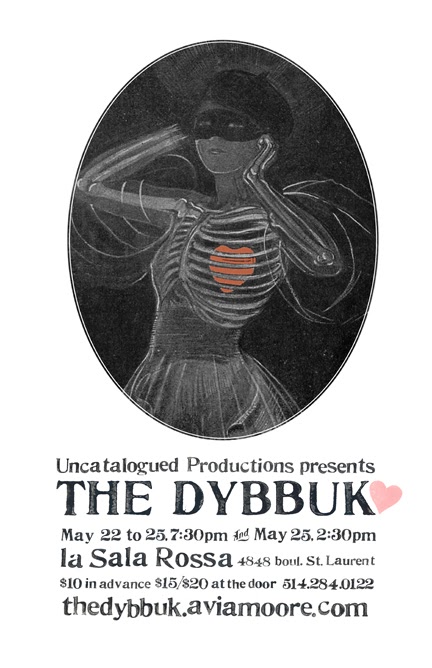
I have tickets to see a play this week! A friend of mine is acting in it, so I thought I'd find out a little bit more about it, and it turns out to be a very compelling story.

The Dybbuk was written by S. Ansky in 1914, in Yiddish. And the story's a bit creepy.

It's about a pair of lovers, Leah and Hannan. Leah's father opposes their marriage and when he calls it off, Hannan drops dead. Leah is resigned to marrying a man of her father's choosing, but on the way to the wedding, she is possessed by Hannan's spirit. The rest of the story deals with the challenge of exorcising the spirit, which can only be achieved finally through the trial and judgment of Leah's father.

In an interesting twist, the production I'm to see is performed by a small, all-women cast. I'm told the roles were cast without regard for gender, on the basis of talent alone, but I suspect it'll be difficult to view this show without a feminist lens.

(I would be remiss not to mention that The Dybbuk was famously brought to the screen in 1937 by Michał Waszyński.)

The Dybbuk plays at La Salla Rossa (Montreal), May 22 – 25.

Monday, May 16, 2011

The girl who ate what was given her

"A simile," he said, "is true because you say so. It's a persuasion: this is like that. That's not enough for it anymore. Similes aren't enough." He stared. "It wants to make you a kind of lie. To change everything.

"Simile spells an argument out: it's ongoing, explicit, truth-making. You don't need . . . logos, they used to call it. Judgement. You don't need to . . . to link incommensurables. Unlike if you claim: 'This is that.' When it patently is not. That's what we do. That's what we call 'reason,' that exchange, metaphor. That lying. The world becomes a lie. That's what Surl Tesh-echer wants. To bring in a lie." He spoke very calmly. "It wants to usher in evil."

As of this writing, Embassytown is my favourite China Miéville novel, but then, I once studied linguistics and philosophy, and being that I work as an editor, it should go without saying that I'm a bit of a language geek, and I would happily discuss with you why a given metaphor is more effective and/or appropriate than a simple simile, or vice versa, so, these factors taken together, it's no wonder Embassytown rocks my world.

Embassytown is about Avice Benner Cho, who returns to her hometown, on a planet that humans (which she is one) colonized. The humans coexist with the Ariekei, though communication is difficult given the complex Ariekei language (more on this later) (and it seems that the humans benefit more from their trade relationship than vice versa).

Avice grew up wanting to leave, and then she did. She trained as an immernaut and travelled subspace as crew on ships delivering passengers (usually in sopor) and cargo.

The steersperson took us close to Wreck. It was hard to see. It looked at first like lines drawn across space, then was briefly, shabbily corporeal. It ebbed and flowed in solidity. It was many hundreds of metres across. It rotated, all its extrusions moving, each on its own schedule, its coagulated-teardrops-and-girder-filigree shape spinning complexly.

Wreck's architecture was roughly similar to Wasp's, but it was antiquated, and it seemed many times our dimensions. It was like an original of which we were a scale model, until abruptly it altered its planes and became small or far off. Occasionally it wasn't there, and sometimes only just.

All this backstory to demonstrate that Embassytown is far, far away, the last outpost, a final frontier. As a colony under Bremen's control in geopolitical terms, it functioned according to its own rules, much like the New World operated a little differently than its European masters might've known or liked.

So Avice goes back to Embassytown, with her husband, a linguist who is fascinated by the Language of the Ariekei. The Ariekei are insect-like, winged and hoofed, with eyestalks. They speak with two simultaneous voices.

Their language is organised noise, like all of ours are, but for them each word is a funnel. Where to us each word means something, to the Hosts, each is an opening. A door, through which the thought of that referent, the thought itself that reached for the word, can be seen.

In this linguistic system, thoughts cannot precede words, indeed they cannot be thought without having the words for them. The Ariekei need similes to express their reality. They need to be able to say what something is like. If they can express it, it is a truth. They are unable to lie.

And then the new Ambassador shows up, and says something in Language, causing what can only be called a diplomatic incident. But, oh, just wait and see.

(I've read several reviews of Embassytown that are critical of it taking so long before the story gets started. For me, these first 100+ pages of world-building are the richest, and would be worth reading even if nothing followed. But maybe you have to have sat, and appreciated, a class on the philosophy of language to totally get that.)

I like to think of this novel as being all about linguistics.

"Words don't signify: they are their referents. How can they be sentient and not have symbolic language?"

It takes the Sapir-Whorf Hypothesis to the extreme. It's about linguistic relativity and Wittgenstein. And about Lakoff:

Metaphor has been seen within the Western scientific tradition as purely a linguistic construction. The essential thrust of Lakoff's work has been the argument that metaphors are primarily a conceptual construction, and indeed are central to the development of thought.

So, if an alien (Arieke) speaks a language (Language) and there's no one there to hear it, does it still think? What if the alien can't hear itself speak, can't hear itself think? Then there are no words, no thoughts, and reality collapses.

Avice when she was young herself was made a simile and incorporated into the language. Her assimileation (ooh, I just made that up!) was scripted or planned or faintly conceived, and then recounted. There was a human girl who in pain ate what was given her in an old room built for eating in which eating had not happened for a time. Avice was the girl who ate what was given her. It's never entirely clear what the Ariekei meant by her, by the simile of her, and Avice comes to wonder: if she changes her experiential truth, can she change the Ariekei's reality?

There's this wonderful Doctor Who–type moment toward the end that's a life-affirming vindication of what it is to be alien (cognitively, politically) and joy that, yes, good sense has prevailed, see, if only people would (could) just talk to each other, communication is brilliant, words are more powerful than any weapons, and more menacing: You get to live. It's a reward, but also a sentence.


Ten things about China. (Are you paying attention, Steven Moffat? Really, Neil Gaiman's Doctor Who episode was almost as disappointing as Gaiman himself is overrated. But China Miéville, his monsters — big scary, political monsters — would make the Doctor run.)

Sunday, May 15, 2011

Atomic secrets

The Atomic Weight of Secrets, or The Arrival of the Mysterious Men in Black, by Eden Unger Bowditch, is the first book in The Young Inventors Guild trilogy.

Jasper and Lucy ran up to their rooms and dropped off their bags. Looking around for a place to put their satchels, they opted to shove the lot under their beds.

"That's as good a place as any," said Jasper, pulling the edge of his quilt down so the satchel was completely hidden.

"I really think it's just awful keeping all these things from Rosie," said Lucy, "and from Miss Brett and. . . It make me feel like a naughty girl."

"Well, you're not a naughty girl. None of us is naughty. And we're not telling lies either. Not really," he said. He stopped rushing for a moment and looked Lucy in the eyes. A sneaky smile spreading across his face, he said, "It is terribly exciting, isn't it, Lucy? I mean, it's exciting as well as dangerous, amazing, historic, and brilliant, and, of course, terrifying, and horridly worrying. Still, all said, it is frightfully thrilling, isn't it?"

Lucy smiled. "Yes," she said in earnest. "Frightfully."

It's a mysterious and charming story. Helena is a little young yet for the attention a book like this requires, but I will encourage her to read it someday. Reminds me a little of Lemony Snicket, but without so much snark, and maybe not quite so nefarious.

A group of kids — 2 girls, 3 boys — ranging in age from 6 to 13, specializing in different kinds of science and themselves the children of the world's most important scientists, are taken from their parents and thrown together into a private boarding school, for them alone.

There's not much the teacher can teach such clever children, but she does find a gap in their education that she is able to fill: nursery rhymes and other children's literature.

On weekends the children are taken to their respective parentless homes, where the nannies attend to their needs. The homes abut a shared meadow.

The children come from unique backgrounds but find they have quite a bit in common when they start to discuss the circumstances by which they came together, so they put their inventive, scientific minds to work toward a common goal. The mysterious men in black factor into their separation from their parents, but it's never clear whether they are their jailers or their protectors.

The review at Young Adult Books Central sums it all up more succinctly than I can.

Tuesday, May 10, 2011

Unholy verbs

ACL — Accelerated Contact Linguistics — was, Scile told me, a speciality crossbred from pedagogics, receptivity, programming, and cryptography. It was used by the scholar-explorers of Bremen's pioneer ships to effect very fast communication with indigenes they encountered or which encountered them.

In the logs of those early journeys, the excitement of the ACLers is moving. On continents, on worlds vivid and drab, they record first moments of understanding with menageries of exots. Tactile language, bioluminescent words, all varieties of sounds that organisms can make. Dialects comprehensible only as palimpsests of references to everything already said, or in which adjectives are rude and verbs unholy. I've seen the trid diary of an ACLer barricaded in his cabin, whose vessel has been boarded by what we didn't then know as Corscans — it was first contact. He's afraid, as he should be, of the huge things battering at his door, but he's recording his excitement at having just understood the tonal structures of their speech.

— from Embassytown, by China Miéville.

I'm not very far along yet, but this seems to be a novel about linguistics, and the linguistics major in me is somersaulting. A novel about an alien race with a language, Language, where thoughts cannot precede words, indeed they cannot be thought without having the words for them, where Language and Reality are one.

And some of the sentences are gorgeous.

Excerpt. (On sale May 17.)

Tuesday, May 03, 2011

Housecleaning

I love that when I perched on Helena's bed this morning and she opened her eyes, the first thing she thought to say was, "Who won last night?"

************

I love democracy. Despite the overall result, I love that we did this, that for the first time since moving here, my vote in my riding really counts. It feels like the Quebec I fell in love with, my adopted home, a country within a country, may be returning to itself.

************

I'm still reading Martin Chuzzlewit. It's rather long. And enjoyable enough, if not deep. A third of the way through and I'm still wondering whether the title means to refer to Martin Jr or Sr. I'm just at the bit where Jr's recently arrived in America. Frankly, I'm more interested to see what comes of the Pecksniffs and Tom Pinch.

************

Has anybody been watching Doctor Who? That timey-wimey stuff is hurting my brain. And I've spent far too many hours lately searching the forums and trying to figure out what the hell is going on. [SPOILERS] Especially wrt Rory. I mean, when Rory came back as the android Roman centurion toward the end of last season, and then the Doctor reset the universe, I thought Rory'd be restored, or undone, or set right. But even when the Doctor first comes back he's all "How could we forget the Doctor?" — how could he even forget to remember? It's not quite like being at the eye of the storm — the whole universe poured out of Amy's head. So who did she remember — who's the Rory she brought back? Real Rory of flesh and blood, or Roman Rory who believed he was real, who stood guard over her for 2,000 years? Who would you bring back?

And I think, when Rory says he was there, when Rome fell, I think the Doctor's thinking, whoa, how could he remember being not real?, which is why he starts to probe with "personal" questions. So this is the problem behind Amy's quantum pregnancy. It's not a mystical timehead or genetic transfer pregnancy — it's quantum because Rory's not resolved. Poor Rory.

************

Every now and then, I realize that someone's missing from my blogroll. I follow most blogs through Google Reader, and with an adjustment here, an update there, sometimes my lists don't match up. Sorry. If you're missing from my sidebar, let me know.

************

I love that there's a flower stall outside the metro station near my work so I can buy flowers on my way home.

Friday, April 29, 2011

Old heads upon young shoulders

An ancient proverb warns us that we should not expect to find old heads upon young shoulders; to which it may be added that we seldom meet with that unnatural combination, but we feel a strong desire to knock them off; merely from an inherent love we have of seeing things in their right places. It is not improbable that many men, in no wise choleric by nature, felt this impulse rising up within them, when they first made the acquaintance of Mr Jonas; but if they had known him more intimately in his own house, and had sat with him at his own board, it would assuredly have been paramount to all other considerations.

— from Martin Chuzzlewit, by Charles Dickens.

Mr Jonas, you may gather, is not very likable.

I love how Chuck delivers an insult.

Monday, April 18, 2011

Very swaggering and very slinking

It happened on the fourth evening, that Mr. Pecksniff walking, as usual, into the bar of the Dragon and finding no Mrs. Lupin there, went straight up-stairs; purposing, in the fervour of his affectionate zeal, to apply his ear once more to the keyhole, and quiet his mind by assuring himself that the hard-hearted patient was going on well. It happened that Mr. Pecksniff, coming softly upon the dark passage into which a spiral ray of light usually darted through the same keyhole, was astonished to find no such ray visible; and it happened that Mr. Pecksniff, when he had felt his way to the chamber-door, stooping hurriedly down to ascertain by personal inspection whether the jealousy of the old man had caused this keyhole to be stopped on the inside, brought his head into such violent contact with another head that he could not help uttering in an audible voice the monosyllable "oh!" which was, as it were, sharply unscrewed and jerked out of him by very anguish. It happened then, and lastly, that Mr. Pecksniff found himself immediately collared by something which smelt like several damp umbrellas, a barrel of beer, a cask of warm brandy-and-water, and a small parlour-full of stale tobacco smoke, mixed; and was straightway led down-stairs into the bar from which he had lately come, where he found himself standing opposite to, and in the grasp of, a perfectly strange gentleman of still stranger appearance who, with his disengaged hand, rubbed his own head very hard, and looked at him, Pecksniff, with an evil countenance.

The gentleman was of that order of appearance which is currently termed shabby-genteel, though in respect of his dress he can hardly be said to have been in any extremities, as his fingers were a long way out of his gloves, and the soles of his feet were at an inconvenient distance from the upper leather of his boots. His nether garments were of a bluish grey — violent in its colours once, but sobered now by age and dinginess — and were so stretched and strained in a tough conflict between his braces and his straps, that they appeared every moment in danger of flying asunder at the knees. His coat, in colour blue and of a military cut, was buttoned and frogged up to his chin. His cravat was, in hue and pattern, like one of those mantles which hairdressers are accustomed to wrap about their clients, during the progress of the professional mysteries. His hat had arrived at such a pass that it would have been hard to determine whether it was originally white or black. But he wore a moustache — a shaggy moustache too: nothing in the meek and merciful way, but quite in the fierce and scornful style: the regular Satanic sort of thing — and he wore, besides, a vast quantity of unbrushed hair. He was very dirty and very jaunty; very bold and very mean; very swaggering and very slinking; very much like a man who might have been something better, and unspeakably like a man who deserved to be something worse.

— from Martin Chuzzlewit, by Charles Dickens.

Once upon a time I vowed to read a Dickens a year. Seeing as they're so long, I think one every two years or so should suffice.

Several commenters on this blog have in the past mentioned Martin Chuzzlewit, for its humor, for its women characters, and for some of the more memorably Dickensian characters going. Not being the least bit familiar with it, and it bearing the distinction of not having been recommended by Oprah, I decided to take it up.

Not much has happened yet. I'm a little daunted that my e-reader calculates this novel at 3167 page turns — I've barely made a dent.

But it is funny, although mostly in attitude, in an almost self-parodying tone. This effect is somewhat exaggerated by the fact that I can't help but hear the text in my head as narrated by Simon Callow, and am reminded of the Doctor's judgment that the American bit (which I've got a way to go before I get to it) is rubbish.

One may read a defense of the American bit — indeed, the novel as a whole — by GK Chesterton, from which I learned that this is a novel about a selfishness, and, despite its humour, this novel is sad.

I have just recently encountered Mark, the barman, who is a jolly fellow, who is looking to find a new situation in the city, a gloomy and difficult one, one in which his jollity might be seen as a credit, for there is no trial of character in being jolly as a barman, surely it be a virtue only when overcoming some adversity, working as a grave-digger or taxman perhaps.

Thursday, April 14, 2011

Literary Mad Men

It's taken a while, but finally I've watched all Mad Men episodes to date. From the start of the series, it's been impossible not to notice what these wonderfully culturally literate (it is advertising, after all) characters were reading.

I've tried to keep a list of those books that were directly discussed or in the hands of readers. In chronological occurrence of their mention:

  • Lawrence, DH: Lady Chatterley's Lover (S01e03)
  • Jaffe, Rona: The Best of Everything (S01e06)
  • Uris, Leon: Exodus (S01e06)
  • Rand, Ayn: Atlas Shrugged (S01e08, but with several mentions)
  • O'Hara, Frank: Meditations in an Emergency (S02e01)
  • Fitzgerald, F Scott: Babylon Revisited and Other Stories (S02e04)
  • Forester, CS: Horatio Hornblower (S02e08)
  • Porter, Katherine Anne: Ship of Fools (S02e09)
  • Faulkner, William: The Sound and the Fury (S02e11)
  • Gibbon, Edward: Decline and Fall of the Roman Empire (S03e03)
  • Ogilvy, David: Confessions of an Advertising Man (S03e06)
  • Twain, Mark: Tom Sawyer (S03e06)
  • Hilton, Conrad: Be My Guest, Autobiography of Conrad Hilton (S03e07)
  • McCarthy, Mary: The Group (S03e10)
  • Benedict, Ruth: The Chrysanthemum and the Sword: Patterns of Japanese Culture (S04e05)
  • Keene, Carolyn: The Clue of the Black Keys (S04e09)
  • Berne, Eric: Games People Play: The Psychology of Human Relationships (S04e10)
  • Le Carré, John: The Spy Who Came in from the Cold (S04e13)

Of course, there have been countless literary allusions throughout the series. TS Eliot's The Hollow Men was recited. A reference to The Man in the Gray Flannel Suit (Sloan Wilson) is as much a cultural touchstone as it has to do with any novel. Moby Dick. I can't help but think of The Bell Jar when you mention the summer the Rosenbergs were executed, but very likely that's the sort of reference that wasn't necessarily intended.

I've read only a few of those listed, some of them many years ago, but on watching some episodes, I have been inspired to directly seek out some titles, particularly since they are not merely props but have direct bearing on the plot or characters at issue. I know I'm not the only one to be reading up. Frank O'Hara's rediscovery has been widely noted.

Similarly, according to NPR, "Interest in Rand and her philosophy is on the upswing. Since the 2008 presidential election, according to Brook, the novel Atlas Shrugged has sold more than 1 million copies, far more than in any similar period in the book's 54-year history." While this is linked to the rising popularity of the Tea Party, no doubt sales for this particular novel were boosted by its exposure on Mad Men.

But I think my favourite book sighting, late in season 4, is the Nancy Drew mystery in Sally Draper's hands. We've seen the books in the house she grew up in; it should come as no surprise that Sally too should find escape in a good book. Reminds me a little of my own young self, visiting my dad's office and being told to sit quietly — I'd read. Though I can't recall it specifically, I'm sure I read The Clue of the Black Keys — I read them all. I'll be sure to dig this one out of the box in my mom's basement as soon as the opportunity presents itself.

Have you been reading along with the Mad Men?

Tuesday, April 12, 2011

A quick note

Not my usual fare, but I accepted a copy of Attachments, by Rainbow Rowell, because I am fascinated by email relationships.

I don't feel particularly good about admitting that I've read a book written by someone named Rainbow. But everything about this book will be sold to people who wouldn't mind that fact. Ironically, it's exactly this sort of thing that it'd be likely the two female leads would kvetch over.

So the plot: the new IT security guy is charged with monitoring company email (it's a newspaper office), and surprise, he gets caught up in their story.

Being that I work in an office where it's widely known that the email is monitored, and it's surmised that the CEO spends his day doing little else but reading it, I was interested to see how this might play out in fiction.

While people who work together do share news and laughs via email, they still talk. My experience is that when there's real news to dish, we go for coffee. So while Rowell's email exchanges are necessary (this is the whole premise, after all), liberty is taken with them to the point where they no longer ring true — they're too long, too conveniently structured, and not all of them meet the criteria for being flagged by Web security.

I love the copy-desk setting. When Lincoln starts befriending his coworkers, he realizes that the copy-desk crowd is much like his D&D gang, only without the D&D. Weirdly, it's only Lincoln who knows all the words to Auld Lang Syne, which is exactly the sort of thing a bunch of copyeditors would know.

There's nothing very original about this novel — it's fairly predictable, with very ordinary characters — but it does have a modern moral bent in terms of email privacy. It was a nice way to spend a Saturday morning blanketed in bed, and I admit, I raced toward the end to see how things panned out for everybody. I'm not much for romantic comedies when it comes to movies either, but every now and then it makes for a nice change of pace.

Tuesday, April 05, 2011

L'Amour

With no trace of irony, she clinks her glass against his. He would rather not know what they are drinking to. To his leaving? To the peacefulness of their breakup? To Scotland's mild summer? Silently, he drinks to l'Amour, and everything he knows about it. Its 2,700 miles, from its source in the Argun region to its mouth on the Tatar Strait, opposite Sakhalin. He keeps his bad joke about the River Amour to himself. A pity he doesn't realize that the river's English name, Armur, is closer to the word "armor" than to "love," and — worse — that armur means "muddy" in Buriat.

Our hero takes a sip from this dark, bitter beer that he does not like, which is precisely why he chose it. He had to give the whole debacle a degree of harmony.

— from The Intervention of a Good Man, by Hervé Le Tellier.

Slight, but a mostly pleasant read. It continues to astound me that 20- and 30-year-old women would want to associate with or attach themselves to 50-year-old men, but that's not a problem of the novella, that's life. The story gives a nice play-by-play of the thought processes of one party to a such relationship as it disintegrates.

I hate the title. En français, c'est Je m'attache très facilement — much better. I suppose it's an intervention of sorts, but I think "intervention" is semantically loaded with things not present here. And I don't think he's a particularly good man. We have only his word for it, and his carrying on an affair with an as-good-as-married younger woman in a very insecure and needy way doesn't exactly speak to his goodness. The Slight Disturbance of Some Pathetic Chump, more like.

And there's that thing with the Polish girl who works at the hotel. Do you really have to bring up Nazi concentration camps just because she's Polish? That was weird and out of place.

Although Le Tellier is an Oulipo member, I didn't recognize any of the qualities related to that group in this novella. However, I did very much enjoy his Enough about Love, and I see the Oulipo in it in retrospect, and I look forward to reading more by him.

Read Le Tellier on what exactly is French love...

Saturday, April 02, 2011

Suspended in a mystic delirium

Here are some of the questions I have. How content should I aim to be? How discontent? What is the proper balance and how is it to be managed?

How aggressive should I be in seeking out new experiences? In challenging myself? How much should I hope to accomplish?

How fragile should I strive to be? How efficient, how dreamy, how routine? What depth of engagement with others should I hope to achieve? Why have friendships become so difficult?

What is life's richest possible template, and how bad should I feel if it doesn't suit me? Assuming that everyone has their own richest possible template, how do I go about finding my own?

If you could only get to the center of all questions, then the questions themselves would vanish and you'd be left hanging there, suspended in a mystic delirium.

The Saint: The True Story of How One Man's Search for Virtue Led to the Brink of Madness, by Oliver Broudy, raises these questions and many, many more. And it's as much the author's meditation on these issues, his dissatisfaction with the statusphere of New York City, as it is the story of a crazy man, a rich man with good intentions, who collects Gandhi memorabilia. With a bit about Gandhi thrown in for good measure.

I connected with this memoir right from the epigraph, which comes from one of my very favourite books (The Razor's Edge, W Somerset Maugham), a passage beginning thusly: "You're not altogether stupid. As a matter of fact, you sound like a very religious man who doesn't believe in God."

Lots of questions. Really good questions.

Friday, April 01, 2011

Polish noir

Marek Krajewski was a wonderful discovery and Death in Breslau is full of, in my opinion, fantastic story elements. I won't repeat myself on those points, but I can add now to that list: a lost manuscript, a Kurdish sect, a centuries-old prophecy, and a retelling of an Oedipal tragedy. One would expect no less from an author who's a Classics scholar.

Oh, and! Our detective! Eberhard Mock likes to combine his enthusiasms for chess and brothels. He gets away with as much shit as he does only because he has dirt on everyone.

Also, I would clarify that this novel definitely falls on the side of entertainment(!) — not that there's anything wrong with that — and doesn't have the philosophical depth of Simenon's romans durs. Nor does it have the kind of reflection and wit I so like in Fred Vargas's novels — not that there should be any similarity between these authors beyond that of broad crime genre label. I bring these names up only because I know and like their work, so they're a kind of benchmark against which I can position new discoveries.

Krajewski is straight up: sex and violence and Nazis, and never knowing for sure who's on whose side.

I'm looking forward to reading the rest of Krajewski's Breslau novels.

Reviews
The Independent
Where the Long Tail Ends

Thursday, March 31, 2011

This too shall pass

I don't sleep well of late.

I spent the start of my week in the arms of Morpheus, in hospital bed with a kidney stone. I don't recommend the experience. There are easier ways to get a day off work. Although, morphine is pretty spectacular, rolling through your body in waves, rendering each segment heavy, limp, unencumbered. Weighty and weightless at the same time.

By chance, I am fortunate to be back in touch with a dear, dear friend of my adolescence. We were going to write poetry, change the world, dance however we damn well pleased. I've missed her.

I received a complimentary copy of The Saint, by Oliver Broudy, the recounting of days he spent travelling with a very charismatic man who happened to be very rich and a collector of Gandhi memorabilia, only he's not just a collector, he's a spiritual disciple, and this leads to all kinds of moral paradox: cuz there's this tension between means and ends, he's a rich man helping the poor; and it makes for a fascinating study of where ego fits in the world, and the tremendous ego required to achieve complete self-erasure; and it brings to the forefront the audacity, the crazy logic, of forsaking the value of actual individuals for some principle of greater good.

It's quite a compelling tale, and very thoughtful, and thought-provoking, and I expect I'll have a bit more to say about it yet. Among other nuggets: "age is the bitter process by which we gradually learn to aim low."

I'm suspended in this mood where I have to believe that this confluence of events holds some significance. That this stone in me is the detritus of gritty reality, that I will filter a new reality from my experience.

Thursday, March 24, 2011

Planet Earth


Not sure anything can top the understated weirdness of the original video, but now it's Lynchian.

Tuesday, March 22, 2011

Imagination was a filter for wondrous transformations

The patient Herbert Anwaldt had survived "the house of torture", as he called the psychiatric clinic on Marien-Allee in Dresden, for already five years, thanks to his imagination. Imagination was a filter for wondrous transformations; the nurses' jabs and punches became gentle caresses, the stench of faeces became the scent of a spring garden, the cries of the sick became baroque cantatas and the shabby panelling frescoes by Giotto. Imagination obeyed him. After years of practice, he had managed to tame it to such an extent that he had entirely extinguished in himself something, for example, which would otherwise not have allowed him to survive incarceration: desire for a woman's body. He did not have to "extinguish the fire in his loins" like a sage from the Old Testament — that flame had long ago gone out.

Imagination did, however, betray him when he saw small, busy insects scuttling across the room. Their yellowish-brown abdomens flitting in and out of the gaps between the floorboards, their flickering antennae sticking out form behind the washbasin, the individual specimen crawling on to his eiderdown: a pregnant female dragging a pale cocoon, or a handsome male holding its body high on quick limbs, or the helpless young tracing circles with thin feelers — all this would lead to Anwaldt's brain being shaken by an electrical charge of neurons. The whole of him would curl up painfully, flickering feelers would burrow into his skin and he would be tickled, in his imagination, by thousands of limbs. He would then fall into a fury and was a potential danger to other patients, especially since the occasion on which he had discovered that some of them were catching insects, putting them into matchboxes and hiding them in his bed. Only the smell of insecticide would calm his jittering nerves. The matter could have been dealt with by transferring the sick man to another hospital — one less infested by cockroaches — in another town, but here unanticipated, bureaucratic obstacles wold present themselves and successive heads of clinic would forsake the idea. Doctor Bennert had restricted himself to transferring Anwaldt to a private room disinfected somewhat more frequently. In periods preceding the swarming cockroaches, the patient Anwaldt would be calm and occupied himself for the most part by studying Semitic languages.

— from Death in Breslau, by Marek Krajewski.

I'm not sure how this book first came to my attention, but it's been on my list of books-I-really-should-look-up-someday for years. And something made me think to look it up this weekend, so now I have a copy (electronic), and I'm reading and loving it.

Polish noir, they say. Morally ambiguous characters and sordid settings. Reminiscent of Simenon, only there's a little more going on in the plot department and the evidence of living in a Nazi state is a little more in your face.

Plus (as if that's not enough going for it!), it's set in Wrocław (or Breslau, as it was known prior to the end of WWII) — a town I have some familiarity with.

Double plus, I think the cover design for this series of Krajewski's novels (all set in interwar Breslau), from Quercus Publishing, is spectacular (to the point that I'm coveting actual print copies).

I'm only about 40 pages in. The murder case — involving hints of sexual perversion, scorpions, and ancient Syrian script, on a train car — has just been closed to everyone's satisfaction — everyone being the police department (chief of which is a prominent Freemason), the recently installed Nazi officials, and the victim's father (a connoisseur of esoterica) — except maybe that of the convicted Jew. I suspect we're not quite done yet.

Sunday, March 20, 2011

Lately

I found myself recently reading Caspian Rain, by Gina B Nahai, because somehow or other, the subject of Jewish Iranians came up at work. It happens that I work with a number of Iranians, and for some reason or other someone non-Iranian was saying something like, "But you don't have Jews in Iran, do you," and I thought, "How ignorant," and one of the Iranians proceeded to set this fellow straight on the matter. But it made me think, how did I know this, and is this a common piece of knowledge or is it privileged, and how did I come by this knowledge?

And I remembered having read Moonlight on the Avenue of Faith, by Gina B Nahai, the story of a Jewish family living in the ghetto of Tehran, with a twist of magic realism about it. That's about all I remember about the book. That and the fact that I loved it, and oh, how it made me cry and cry and cry. I wept oceans reading that book, that summer. That was just about the time I figured out I was pregnant.

So I wondered what else she may have written, and thus I embarked upon Caspian Rain. I enjoyed it, but I can't really recommend it.

I love it for the glimpse it gives of Iranian Jewish life at a certain time and place, that place otherwise being a relatively inaccessible and mysterious one. I have a thing for the Middle East, which isn't entirely logical or explicable. I have little to no interest in the politics and history of the region. It's not exactly the "culture" that I'm drawn to, though it's to do with a poetic and storytelling tradition. A thousand and one nights, and all that. A sense of exoticism that may not be founded in anything real.

Anyway, Caspian Rain starts off as a kind of love story, and it's lovely, pushing all the right buttons with me. The narrator relates the story of her parents. About halfway through, the novel turns to centre around the narrator herself, the hardships she's suffered as a result of her parents' relationship being so strained but also because of her medical difficulty (well, let's just call it that for the sake of expediency). And then it felt like the novel was trying to be two different stories, and they just didn't work that well together. And it felt like the author was trying too hard to be poetic and vague and deep, and it stopped working for me, and the last page was terrible.

I'm currently reading A Polish Book of Monsters. I have mixed feelings about it so far, and I suspect I'll have a lot to say about it when I'm done, not least being regarding the problem of how one defines "monster."

Also, I've spent far too much time this weekend considering what ebook I should use my coupon to acquire. Should I actually get the book my boss recommended to me? I finally decided yes, because so many other people had esteemed it, and because it's set in an ad agency, which fact I hadn't recalled from the original commotion surrounding this novel but is a selling point with me. But then no, because the coupon couldn't be used for books from this publisher, so I could buy this book at any time, I wouldn't be saving any money by doing it today. (But I did buy some Polish noir.)

I'm missing loving a book right now. I need a book to really love.

But I found a plant for my office. And mostly I'm happy I spent most of my weekend hanging out with the kid, shopping for rainboots and almonds.

Wednesday, March 16, 2011

Solid or hollow

It's strange, how a person carries around the shadow of those that matter most to her. You can always see it — that presence, or its absence — in the eyes, in the movements of the hands, in a person's laugh. You can see it — if an old woman had a father who loved her when she was a child; if a teenage girl has a best friend she knows she can run to. You see it in the way people move and speak, in the subjects they choose and the things they avoid, in the way they appear solid or hollow, certain or plagued with doubt.

— from Caspian Rain, by Gina B Nahai.

Tuesday, March 15, 2011

New machine jihad

"You'll have nothing to rule."

"The New Machine Jihad does not need to rule. It needs only itself."

A thwarted kidnapping, a Japanese businessman who apparently runs his affairs yakuza-style, a Russian organitskaya boss. So far, so thriller.

Equations of Life, by Simon Morden, is set in the 2020s, some time post Armageddon. We don't know much about what happened. Nuclear strikes? Japan sank into the sea. There's a Cold War reference, which may or may not have anything to do with Armageddon times. So, vaguely futuristic, but still more thriller than sci-fi.

In fact, for the first half of the novel, there's very little of anything hinting of sci-fi going on. It's suggested when we learn Petrovitch is working on this little quantum gravity thing, and again when Oshicora-san reveals his pet project: VirtualJapan.

Our protagonist, Samuil Petrovitch, is 22 and has serious heart trouble. For a few pages I suspected this book might head in the direction of organ development and/or trade, organic or otherwise.

But no. Just the faintest whiff of science.

The cop on the case is old-school — rough around the edges, but effective when it suits his purposes to be. Then there's the amazonian nun who keeps turning up to save Petrovitch's ass.

The cast and their context, while not as fully realized as I felt they could be, were certainly compelling enough to draw me forward. It seems, however, that some of the history was previously developed in Morden's short stories, so when I say I feel like I was dropped in the middle of something, it's because I kind of am. This novel does stand up entirely on its own, though.

There's an awful lot going on here, and I had to flip back on a few occasions to keep things straight (but I'm not the most practiced at reading — or watching, for that matter — "action"; characters and events start to blur for me if the pace is too frenetic and the language is combat).

Also, I did roll my eyes a couple times in the early stages, when, for example, (I think it was) the ventilator fans "were ancient with age." As the story progressed, however, such linguistic rough spots pretty much vanished.

As far as I'm concerned, things start to get sci-fi at about halfway, when the new machine jihad begins to assert itself. And that's very cool. And then it gets really sci-fi in the final pages. And that's totally cool. And now I'm dying to read the next book in the Petrovitch trilogy (the books are being released the end of March, April, and May, respectively).

I can't stress how unsettling it was to be finishing up this novel last Friday, after having heard the news of the disaster in Japan. This is a novel in which Japan had sunk into the sea(!); the world is reeling from nuclear fallout, and London is overflowing with immigrant ghettoes. So. Yeah. Unsettling. Still. The whole VirtualJapan idea was really cool, and it's almost reassuring to believe that should any parts of our world be lost, they could be revirtualized.

This is a novel where actions speak louder than words, and that's fun, but I liked those bits best that slowed down and considered themselves.

"Is this what it's like, then?" she said, eyes closed, dreaming. "People like us, we think differently, don't we? We are different. We do all the things that others do. We go out to parties and concerts, we go to conferences and drink and talk, we play music and games and we laugh and cry. But when it comes down to it, we don't actually need anyone else. We're happy doing what we do and having obligations interferes with that. Does that make us selfish, or something else?"

"I don't know. To them, I guess it is selfish. Me? I just have such a monstrous sense of self, I don't need to feel love. I don't even feel lonely." He watched Pif's hair beads swinging slightly in time with her breathing. "Sometimes I wonder what it might be like. To be with someone, well, who isn't me. And sometimes I think we don't even need ourselves. What's most important is to find out whether we're right or not."