Why would you want to be with someone if they didn't change your life? She said that, and Julio was there when she said it: that life only made sense if you found someone who would change it, who would destroy your life as you knew it.
[I want someone to change my life. Again. Turn my life upside down. Make me question every moment I've lived until now. I think of all the times my life has been destroyed.]
Bonsai, by Alejandro Zambra, is a quick and beautiful read, a lazy morning in bed, inspiring a hazy recollection of past lovers.
We start at the end. We know that it ends, and that Emilia dies. In a study group for Spanish Grammar, they ended up sleeping together. Emilia and Julio have never read Proust, but they lie about it to each other. Perhaps the deception binds them.
They read to each other in bed, and enact the texts, interpreting them erotically. And then they read Macedonio Fernández's "Tantalia," and it breaks them. It's about a couple who buy a plant together as a symbol of their love, but rather than risk it dying, they decide to lose it in a crowd of plants (starting on page 111, "the suffocated scream of a suffering root in the earth"). So now Emilia and Julio have the awareness of the inevitability of their relationship's end, each of them individually and alone sensing it. To preserve the power of their love, they are impelled to abandon it.
Emilia goes to Spain, becomes more completely like how she is. An old friend think she looks bad, depressed, like a junkie.
Zambra keeps insisting that this is Emilia's story, but it's not. We know how her story ends, that's all.
Julio fails to land a transcription job with a bigshot novelist. He lies about it to a woman he's sleeping with it. He makes up the story of the novel to tell her, a variation of his and Emilia's love story. His life begins to take the shape of the story he's created.
Bonsai. Delicate in appearance, but strong. Small, but carefully cultivated. A world in miniature. Old. Maybe these are the best relationships. A beautiful, impossible artifice.
Emilia and Julio's was a relationship riddled with truths, with personal disclosures that quickly built up a complicity they strove to see as unassailable. This is, then, a light tale that becomes heavy. This is the story of two student enthusiasts of the truth, aficionados of deploying words what seem like truth, of smoking endless cigarettes, and of enclosing themselves within the violent complacency of those who believe themselves better and purer than others, than that immense and detestable group called everyone else.
They quickly learned to read the same way, to think similarly, and to hide their differences. Very soon they comprised a vain private world. For a time, at least, Julio and Emilia managed to meld into a single entity. They were, in short, happy.
Whenever dawn caught him in motion, Gonzalo tended to feel like there was some kind of link between the birth of the light and the very fact of moving forward, as if the walker were somehow responsible for the dawn, or the other way around: as if the dawn generated the movement of feet over sidewalk. He was about to say this to Carla, but he wasn't sure he could explain it, he was afraid of getting tangled up, and he felt like anything he said could spoil that beautiful senseless morning.
We start the book believing the eponymous Chilean poet is Gonzalo, but later realize it could instead be Carla's son, Vicente. Or perhaps it is neither of them specifically, but rather a breed of poet, like the domestic shorthair, and the novel a study of the creature's history and environment, influences and influence.
(Why is there a cat on the cover anyway? Pru wants to write about the stray dogs Chile is overrun by, like the poets are dogs, and she is led by them, or maybe in fact poets are the opposite of dogs — tolerated, cared for, nurtured, loved. The cover illustration is credited to Laura Wächter and titled "Darkness," so it is clearly a portrait of the family pet, who did play a pivotal but not central role in the novel, so unless he's a poet, it's a surprising choice to feature him on the cover.)
I was prepared to dislike Chilean Poet, by Alejandro Zambra, because it might not live up to Multiple Choice, or it would show it up for the gimmick it was and prove Zambra incapable of depth beyond gimmickry. Also, the opening pages felt very male, as if they could not have been written by anyone who hadn't been a teenage boy, and I thought, this may not be something I want to read right now.
But it's charming, that boy somehow charmed me, maybe the fact that he wanted to be a poet gave his character a layer of complexity, took the edge off the masculinity.
Usually Carla wanted to be where she was and who she was.
People say that's what happiness is — when you don't feel like you should be somewhere else, or someone else. A different person. Someone younger, older. Someone better.
It's a perfect and impossible idea, but still, during all those years, Carla generally wanted to be exactly were she was.
Chilean Poet is a love story, or two, or more. As an intergenerational drama, everyone's driven by different values, but they all simply want to get the most out of life. This novel is also a crash course in the country's literary tradition and the politics that accompany it.
"It's better to write than not to write. Poetry is subversive because it exposes you, tears you apart. You dare to distrust yourself. You dare to disobey. That's the idea, to disobey everyone. Disobey yourself, that's the most important thing. That's crucial. I don't know if I like my poems, but I know that if I hadn't written them I'd be dumber, more useless, more individualistic. I publish them because they're alive. I don't know if they're good, but they deserve to live."
"A lot of people say that poetry is useless."
"They're afraid of useless things. Everything has to have purpose. They hate pure creation, they're in love with corporations. They're afraid of solitude. They don't know how to be alone."
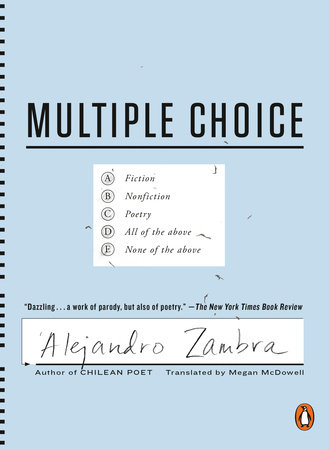
Multiple Choice, by Alejandro Zambra, is fiction, nonfiction, poetry, something more, and something else entirely. It consists of 90 thought experiments, creating one big meta thought experiment about narrative. It is structured in the form of a standardized test (complete with a sheet on which you can mark your responses), 5 sections that cover skills like word choice, sentence order, and reading comprehension.
For example, for the following exercise, mark the answer that puts the sentences in the best possible order to form a coherent text.
31. Relatives
1. You group them into two lists: the ones you love and the ones you don't.
2. You group them into two lists: the ones who shouldn't be alive and the ones who shouldn't be dead.
3. You group them according to the degree of trust they inspired in you as a child.
4. For a moment you think you discover something important, something that has been hanging over you for years.
5. You group them into two lists: the living and the dead.
A) 1-3-4-5-2
B) 5-2-1-3-4
C) 1-3-5-2-4
D) 3-4-5-2-1
E) 1-2-3-4-5
(I answered B. Or maybe A.) Wouldn't you love to discuss this question with your family? The conversational tangents it inspires!
I'd like to present some of these exercises to my team of editors, so we could debate the subtleties in meaning between, for example, "but," "yet," and "notwithstanding," what order of facts and opinions conveys the most effective emphasis, which sentences aren't essential to moving the narrative forward.
It was a perfect read for me, the perfect time and place, serving to slow me down. In this way the book was much like poetry. Read a page, think about it, let it sink in, reconsider it. It's a short book, but it demands a lot of breathing space. It has served to make me feel really smart, and also really stupid. That's a good thing.
I rather wish that more books would not merely invite but forcibly ask me to pause and reflect on what I read.
Multiple Choice failed completely to make an impression upon people I know, some off whom are actual readers. It's as if by physically pressing the book upon them, forcing them to cast their eyes across a sample "question," was like making them sit an actual exam. One person was outraged that there was no answer key. What do you mean there are no answers!
I think that this story and the book as a whole argue against the illusion of a single right answer. But it’s also a book about the wish for that answer, the naïve or visceral desire for there to be a truth. In “Multiple Choice,” I was interested in the question of how those structures mark you: the rhetoric of options, distractor questions, the true and the false—that whole complex and crude game, deeply ideological, of exclusions and inclusions.
All highlighted the significance of context: how context predominantly figures in shaping an experience for a "reader." For example:
Experiencing the last 4 minutes of JFK's life through sound and smell ("Famous Deaths") only becomes art because we know how it ends, and we're aware of its historical significance. I mean, on its own, in isolation of context, it stands as an aesthetic juxtaposition of audio and olfactory cues — but I could guess at the smells only because I could line up the accompanying sounds with footage I've previously seen. What a person brings to the experience in terms of their knowledge and expectations is what makes it a meaningful narrative. The mortuary fridge you're rolled into enhances the anticipation of death.
A video game that consists of a police database which the user can query ("Her Story") has no structure; it's driven entirely by the user's interests. When I first sat down at the terminal, I was at a loss; it felt a little bit like work. If this is a police database, I've been cast in the role of investigating officer. Where to start? I reasoned, a police database must have something about murder in it, so that was my first keyword search, which delivered some video footage, which soon had me asking, who's Hannah? and, what baby? Every session will yield a different story.
Blindness experienced through a VR headset ("Notes on Blindness") might seem like a contradiction in terms, but the flashes of light begin to take shape according to sound prompts. The experience is inspired by and complemented with the audio recordings of John Hull, a theologian who with a scientist's precision documented his experience of going blind. (The associated film, by contrast, I have no interest in seeing — the trailer leads me to expect an overly sentimental drama that emotionally manipulates its audience, playing on themes of loneliness vs connection rather than on the cognitive aspects of blindness that are so much more interesting to me.) The most poetic of the chapters in this VR experience dealt with rain and with wind. He describes the rain as a blanket that gives things shape and dimension (think: the sound of rain on metal vs glass, on the roof vs the window, in tight alleys vs open fields). Wind is the equivalent of a sighted person's clear and sunny day, bringing one's surroundings to life.
A short film unfolds according to decisions the audience makes via mobile devices ("Late Shift"). A choose-your-own-adventure movie, only you're not watching alone; the direction of the narrative is based on majority votes. Some of the decisions are straightforward yes-no scenarios, but others ask you to take a more philosophical perspective (selfish or selfless?), thereby defining character and moral context. And some questions frustratingly don't offer as an option your preferred course of action. One unsettling aspect is that the story doesn't always go the way you want it to go. You wonder who your neighbour is, do they believe what you believe, what is their motivation.
Of these examples, I feel that Death and Blindness don't entirely fit the storytelling mould — they don't tell a story so much as share an experience. Zambra's book would be a perfect conceptual fit for this exhibition, but perhaps, being print-based, it would be considered too traditional.