Showing posts with label Louise Penny. Show all posts

Wednesday, October 02, 2019

Singing myself into stupidity

"Scientists have even begun studying the chants," said Frère Sébastien, "trying to explain the popularity of the recording these monks made. People went nuts for it."

"And have they any explanation?"

"Well, when they hooked up probes to volunteers and played Gregorian chants it was quite startling."

"How so?"

"It showed that after a while their brain waves changed. They started producing alpha waves. Do you know what those are?"

"They're the most calm state," said the Chief. "When people are still alert, but at peace."

"Exactly. Their blood pressure dropped, their breathing became deeper. And yet, they also became, as you said, more alert. It was as though they became 'more so,' you know?"

"Themselves, but their best selves."

"That's it. Doesn't work on everyone, of course. But I think it works on you."

Gamache considered that and nodded. "It does. Perhaps not as profoundly as the Gilbertines, but I've felt it."

"While the scientists say it's alpha waves, the Church calls it 'the beautiful mystery.'"

"The mystery being?"

"Why these chants, more than any other church music, are so powerful. Since I'm a monk I think I'll go with the theory they're the voice of God. Though there's a third possibility," the Dominican admitted. "I was at dinner a few weeks ago with a colleague and he has a theory that all tenors are idiots. Something to do with their brain pans and vibration of the sound waves."

Gamache laughed. "Does he know you're a tenor?"

"He's my boss, and he sure suspects I'm an idiot. And he might be right. But what a glorious way to go. Singing myself into stupidity. Maybe Gregorian chants have the same effect. Make us all into happy morons. Scrambling our brains as we sing the chants. Forgetting our cares and worries. Letting the world slip away." The younger man closed his eyes and seemed to go somewhere else. And the, just as quickly, he came back. Opening his eyes he looked at Gamache, and smiled. "Bliss."

"Ecstasy," said Gamache.

"Exactly."

"But for monks it's not just music," said Gamache. "There's also prayer. The chants and prayers. It's a potent combination. Both mind altering, in their way."

When the monk didn't say anything, Gamache continued.

"I've sat here for a number of services now and watched the monks. To a man they go into a sort of reverie when singing the chants. Or even just listening to them. You did it just now, just thinking about the chants."

"Meaning?"

"I've seen that before, you know. On the faces of drug addicts."
— from The Beautiful Mystery, by Louise Penny.

It's one of few memories I have of my father. I was 4, and he took me to church. My mother must have been not feeling well, it was just him and me. I'm sure I fidgeted; I was a good kid, but even then I remember not believing in God. A stern look from my father was enough to still me. But what I remember is him, afterward, amused, telling my mother that I hum along with the priest's chanting. The chanting – that was the only reason I tolerated mass.

I've been self-conscious about my humming ever since. It's stronger than me, the instinctive urge to hum along with almost any type of music. Humming, chanting, is weirdly both physical and spiritual, whether I'm practicing yoga or blissed out on sex, drugs, and rock 'n' roll.

Home sick in bed for a couple days last week, I glutted on Louise Penny, downloading whatever my library had readily available. In brief:

The Beautiful Mystery is set in a monastery in Northern Quebec, completely removed from the village of Three Pines and its inhabitants. Featuring a small, reclusive order of monks once thought vanished, the rule of silence is lifted so that the brothers can help the investigation into the murder of the choirmaster, who was responsible for the recording of chants that brought the order out of obscurity. Although they indulge in chocolate-covered blueberries, Chief Inspector Gamache and Inspector Beauvoir wrestle with powerful personal demons in this one. Monks, music, and manuscripts — this book was heaven for me.

The Long Way Home, on the other hand, is dependent on some familiarity with the cast of regulars in Three Pines. Gamache's wife plays a larger role than I remember in other books, but this is only natural as she is now a resident of the community, the couple having decided to retire there. While the cast travels first to Toronto and then across Quebec to the stony mouth of the Saint Lawrence, the story journeys into the heart of Quebecois art, with a layover at the Garden of Cosmic Speculation.

The Hangman is disappointing. You need to know that this story was written as part of a series designed to encourage adult literacy. It's simplistic, not nuanced at all. It has the kernel of a good story, but the plotting and characterization are thin. Chronologically the events of this book fall between numbers 6 and 7 in the Inspector Gamache series, but it hardly matters, as there are no developments in the greater character or story arcs. It's short, easy to read, and still compelling, and therefore suitable for its target audience, but you won't miss anything if you skip this one.

If I had a cottage, I'd be sure to stock its shelves with a complete set of Penny's books.

Monday, September 16, 2019

At the intersection of truth and wishful thinking

Then he'd gotten back up, and walked some more. For hours.

[...]

He only stopped when he'd met himself again. The Armand who'd been standing on the side of the quiet road, in the middle of nowhere, waiting. At the intersection of truth and wishful thinking.
I showed up at bookclub a couple years ago, for a book I hadn't entirely enjoyed. The usual bookclub host was out sick and couldn't make it — she'd asked one of the other bookstore employees to fill in, someone who hadn't read the book. One other reader showed up. It was a quiet evening at the shop, so the bookstore clerk on duty sat down and had a beer with us.

That other reader though. I want to say her name was Marion, it was — she was — of another era. She must've been seventy-something, elegantly grey, incongruously carrying a plastic shopping bag to haul some notes, a shawl. She couldn't possibly have ever worked, apart from arranging tea or some fundraising down at the club. She was visiting from Texas, and had a night in Montreal before embarking on her adventure. What better activity than attending a book club about a book she happened to have recently read. The book in question was short stories by Teffi, but that doesn't matter.

She drawled loud and slow, her head bobbing gently. And she told us she'd stopped in Montreal on her way to Three Pines. Of course she knew it was a fictional place; but she needed to see the village that inspired it. Marion was on her way to the Eastern Townships to meet Louise Penny, and to celebrate the launch of the latest instalment of the Inspector Gamache books. That would've been Glass Houses.

This is only the fifth book I've read of the series, now fifteen strong. But it's peopled by characters so familiar, in a place just down the road. They don't call these cozy mysteries for nothing.

Louise Penny is a frightfully astute observer of the human condition.
Men and women going about their lives. Apparently quite normal. On the outside. Their skin stretched across the void inside.
Glass Houses has two main narrative threads. The "present day" courtroom drama in a sweltering July, and the events of the previous November, including the murder for which someone is now standing trial. We don't know the nature of the crime, who the victim is or who the perpetrator, until we are quite a way into the book (some readers may find this frustrating).

As is typical of Penny, there's a healthy dose of real-life Quebec politics thrown in, this time a drug crisis, the organization of the drug's trafficking within Quebec and across international borders, and the failure of authorities to clamp down — all issues in the news in recent years.

At the core of the book is the concept of the cobrador, a debt collector who dresses like Darth Vader (or Death, or a plague doctor). Penny's version is a collector of moral debts. It turns out almost everyone believes the cobrador could be there for them.

Gamache and others have to decide if their job is to uphold the law or to do what's right. Gamache is Churchill allowing Coventry to be bombed, for the greater good.
And Lacoste remembered the advice given to Mossad agents. Advice Lacoste had found abhorrent, wrong on every level. Until it had been explained.

The instruction given the Israeli agents, if they met resistance during an assault, was kill the women first.

Because if a woman was ever driven so far as to pick up a weapon she would be the most committed, the least likely to ever give up.

Kill the women first.

Lacoste still hated the advice. The simplicity of it. The baldness. But she also hated that the philosophy behind it was almost certainly true.
To be honest, I thought Marion at bookclub was crazy. Maybe because I'm afraid of becoming her. But I haven't forgotten about her. In fact, I rather admire her. Why shouldn't I be like her, following the paths of my favourite imaginary people?

And let me admit now how much I loved to be enveloped in the world of Three Pines. I could stand to spend a little more time there. I'm going back to read the ones I've missed.
It wasn't really, he knew, about less fear. It was about more courage.

Saturday, August 16, 2014

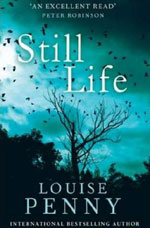
Still life

It happened far too often. Normally death came at night, taking a person in their sleep, stopping their heart or tickling them awake, leading them to the bathroom with a splitting headache before pouncing and flooding their brain with blood. It waits in alleys and metro stops. After the sun goes down plugs are pulled by white-clad guardians and death is invited into an antiseptic room.

But in the country death comes, uninvited, during the day. It takes fishermen in the their longboats. It gabs children by the ankles as they swim. In winter it calls them down a slope too steep for their budding skills, and crosses their skis at the tips. It waits along the shore where snow met ice not long ago but now, unseen by sparkling eyes, a little water touched the shore, and the skater makes a circle slightly larger than intended. Death stands in the woods with a bow and arrow at dawn and dusk. And it tugs cars off the road in broad daylight, the tires spinning furiously on ice or snow, or bright autumn leaves.
Still Life, by Louise Penny, is a wonderful palate cleanser of a book (a little too much SF for me lately). We've had cool, rainy days lately, and the leaves are starting to think about turning. The perfect backdrop for a perfect cosy mystery.

Louis Penny brings death in the morning to Jane Neal, lovely, likeable old woman who'd just had a piece accepted to the community art show. And, like most of the villagers, there's a secret hidden in it.

I've read a few of Penny's novels before, but Still Life is the book that started the series of mysteries featuring Chief Inspector Gamache of the Sûreté du Québec. Her first book is every bit as assured in tone, plotting, character, and wit as the others I've read. There's only less Montreal (where Gamache's home and office are) and less departmental politics.

Excerpt.
"Life is change. If you aren't growing and evolving you're standing still, and the rest of the world is surging ahead. Most of these people are very immature. They lead 'still' lives, waiting."
Perhaps the sentiment is a little anti-zen. More like stagnant stillness as opposed to being in stillness. But worth thinking about, no?

Sunday, September 08, 2013

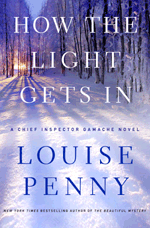
How the light gets in

I spent the better part of the weekend in bed reading Louise Penny's How the Light Gets In. Most of the other part of the weekend I spent curled up on the sofa or at the kitchen table reading Louise Penny's How the Light Gets In.

I have been reading this series of Chief Inspector Gamache novels out of order. So while some readers gush about the overarching story development, I'm not qualified to comment — I've been exposed to several pieces, but I'm still not seeing the full picture.

However, I'm here to tell you that this novel stands perfectly well on its own. An appreciation of the magical village of Three Pines and its eccentric inhabitants would no doubt be enhanced by having read one or two other novels set here, but I think that would be true no matter what order you read them in.

The case Gamache is on in How the Lights Gets In is related to the death of a quintuplet and delves into a fictionalized historical past inspired by the real-life Dionne Quintuplets. It raises some interesting questions about living life under public scrutiny, the life of celebrity, public versus private, the fabrication of reality for public consumption, the branding and commodification of people.

What non-Quebec readers may not be aware of (and certainly there's been no mention of it in the reviews I've read) is how much the rest of the novel, those supplementary plots that belong to the series-spanning story arc of corruption at high levels, is also based in fact.

This novel starts in the Ville-Marie Tunnel of Montreal. As Audrey drives through, she fears that it, and the city above, may crash down on top of her.

Anyone who lives in Montreal could not but recall the collapse of said tunnel two summers ago. Miraculously no one was hurt, but everyone was afraid.

It is one of the events that led to the establishment of the Charbonneau Commission, an ongoing inquiry into corruption with regard to public construction contracts, implicating organized crime and the mayoralty of Montreal (and other players).

I'd love to know from other readers to what extent you find this aspect of the story — regarding collusion among the powers that be in the Ministry of Transportation and other government departments — believable.

The story of the quintuplet is certainly interesting enough, but it's not as compelling as some of Penny's earlier mysteries. It's thoroughly overshadowed by the other events of the book. The corruption on the force and the mystery as to how far it spreads is by far the stronger storyline in this novel, and I say this without complete knowledge of all that's come before. That is, the novice Penny reader should start with a different book.

Now that Penny is garnering an international reputation, I wish she'd have a little more local recognition for her insightful depiction of life in Montreal and environs.

There's something so perfectly cozy about these cozy mysteries, especially at this time of year. I can see myself reading through the rest of Penny's back catalogue before Christmas. And I'm inspired to get out to the Eastern Townships for a little visit...

(Check out what peril other readers are imbibing this season.)

Thursday, September 05, 2013

How a sigh might look

Had the Chief Inspector been blindfolded he could have described the familiar shop. The walls were lined with bookcases filled with hardcovers and paperbacks. With fiction and biography, science and science fiction. Mysteries and religion. Poetry and cookbooks. It was a room filled with thoughts and feeling and creation and desires. New and used.

Threadbare Oriental rugs were scattered on the wood floor, giving it the feel of a well-used library in an old country home.

A cheerful wreath was tacked on the door into Myrna's New and Used Bookstore, and a Christmas tree stood in a corner. Gifts were piled underneath and there was the slight sweet scent of balsam.

A black cast-iron woodstove sat in the center of the room, with a kettle simmering on top of it and an armchair on either side.

It hadn't changed since the day Gamache had first entered Myrna's bookstore years before. Right down to the unfashionable floral slipcovers on the sofa and easy chairs in the bay window. Books were piled next to one of the sagging seats and back copies of The New Yorker and National Geographic were scattered on the coffee table.

It was, Gamache felt, how a sigh might look.

— from How the Light Gets In, by Louise Penny.

Monday, August 05, 2013

I'm FINE

"I read your book," said Gamache to Ruth as the two of them sat in front of the cheery fire while Peter puttered in the kitchen and Clara browsed her bookshelves for something to read.

Ruth looked as though she'd rather be sitting in scalding oil than next to a compliment. She decided to ignore him and took a long gulp of her Scotch.

"But my wife has a question."

"You have a wife? Someone agreed to marry you?"

"She did and she was only a little drunk. She wants to know what FINE means in your title."

"I'm not surprised your wife has no idea what fine means. Probably doesn't know what happy or sane means either."

"She's a librarian and she was saying in her experience when people use capital letters it's because the letters stand for something. Your title is I'm FINE with the FINE in capitals."

"She has brains, your wife. She's the first to notice that, or at least to ask. FINE stands for Fucked up, Insecure, Neurotic and Egotistical. I'm FINE."

"You certainly are," agreed Gamache.

Dead Cold (alternately known as A Fatal Grace), by Louise Penny, was a terrific vacation read — swift-moving, not very demanding, but also charming and thoughtful. (The vacation was drizzly, foggy, and at sea, calling for just this sort of thing.)

This is the second in the series of novels featuring Chief Inspector Armand Gamache, and the second that I've read (though I'm reading them out of order).

Penny's latest novel, to be released later this month, is How the Light Gets In, which title comes from a line in a Leonard Cohen song: "There is a crack in everything. That's how the light gets in."

This line crops up in Dead Cold also, and it's clearly a recurring theme of Penny's — the flaws, often fatal (given that these are mystery novels), in characters and in their constructs — the ideas they hold and the lives they build. But the flaws are not wholly negative; they make space for all sorts of wonderful things like love, for illumination and insight, only tragically sometimes (but not always) too late.

Two dead women start off the story, one rich bitch whom nobody liked, the other homeless. Of course they're connected, and more death follows in their wake. Part police procedural, part "cozy," with philosophizing, humour, and lightness.

Set in the fictional village of Three Pines (somewhere in the Eastern Townships), it's populated by artists and poets and book lovers who quote Atwood and Yeats. The sense of place is marvelous; Penny treats Montreal and its environs lovingly. She gets the Ogilvy Christmas window just right. And the cold — as you might guess from the title, there's a lot of cold in this novel; winter in these parts is just like that. Also she deftly incorporates some of the peculiarities of French-English coexistence.

These books satisfy my definition of a comfort read. I'll be reading more from Louise Penny as the nights get chillier.

Excerpt.

Sunday, July 28, 2013

Only really remarkable people see the good in others

Clara saw what others couldn't. Like that little boy in The Sixth Sense, only instead of seeing ghosts, Clara saw good. Which was itself pretty scary. So much more comforting to see bad in others; gives us all sorts of excuses for our own bad behavior. But good? No, only really remarkable people see the good in others.

— from Dead Cold, by Louise Penny.

(I'm glad to say I know some truly remarkable people.)

Friday, July 19, 2013

Summer, sloth, snow

"Summer is no fun without sloth," writes Charles Simic on The New York Review of Books blog. "Indolence requires patience — to lie in the sun, for instance, day after day — and I have none left."

While I have not been very present on this blog of late, it is not due to sloth. Sloth will have to wait a couple more days. I have patience left, just enough.

**********************

One of the hot books to watch for this month, according to io9 (although the commenters are a bit harsher in their assessment), is The Age of Ice, by J.M. Sidorova.

This bizarre historical novel involves a Russian empress who builds a palace out of ice blocks and forces a disgraced nobleman and a deformed female jester to "marry" there, giving birth to two princes — one of whom discovers later that he's immune to cold. The story of Prince Alexander spans two centuries and three continents, and includes a ton of famous historical figures.

So it's historical fiction, but with a fantasy twist.

There's Russia and there's snow, and these two things in combination call to me.

The Colors of Cold: A New Story from The Age of Ice is available as a free e-book. I snapped it up straight away and I enjoyed it (though I'm not entirely sold on reading a full-length novel in this vein). It definitely reads more like historical fiction than fantasy, but that's not a bad thing.

St. Petersburg in the 1760s was much different than it is now. It was a city cut out generously, for growth, and it had not yet filled its own interstitial spaces. It lay like a fanciful appliqué on the burlap of my country's reality.

The author, a biomedical research scientist, blogs about writing and science at Narratology.

Excerpt.

**********************

I'm still reading Vladimir Sorokin's Ice Trilogy. That is, I'd taken a break from it, but on vacation next week I mean to make headway through the second book.

I also picked up some lighter fare, perhaps more appropriate for poolside reading, Louise Penny's Dead Cold.

Ice, ice, cold. Do you see a trend? It's one way to escape the heat.

Thursday, January 19, 2012

What you know, you know

"Why did you strike his so soundly?"

"He needs that scholarly pride clouted out of him."

"Like the man you spoke of who angered you?"

There's a short silence. His shoulders rise and fall. "There are those who think that all of life's lessons can be reaped from reading. I despise them."

"Despise them?"

"What a man does with his brain is his concern, not mine. Just do not let him think he's a better man for it. [...]"

Although many professional reviewers are quibbling over the liberties David Snodin has taken with Shakespeare's Othello, I rather enjoyed his Iago, and I'm guessing my general ignorance of Shakespeare went a long way in this regard. I didn't notice what plot points were changed, nor did I have a strong sense of Iago's character before jumping in.

Of course, I knew the basics of Shakespeare's story, and read up on it a little after Snodin's novel had hooked me.

Snodin has written about his fascination with the character of Iago, and the more I know, the more entranced I become myself — enough so that I'll be checking out Othello on film soon.

Snodin's story picks up where Shakespeare's left off. Iago is imprisoned for murder in a remote corner of Cyprus, and by page 11 we learn he's escaped. Back in Venice, we learn of the domestic tragedy of Othello and experience its aftermath through Gentile Stornello, cousin of Shakespeare's ill-fated Desdemona. Gentile's a nerd and a weakling — a poet! — and he gets mixed up with — that is, beaten up by — one of the Malipiero bad boys. And he falls for his servant girl.

One of the Malipiero uncles is Chief Inquisitor of the Serene Republic of Venice. He has Gentile brought in, because he can. And he throws Gentile — who reminds him of his own deceased son — in with Iago — for whom there is still an official hunt going on. That is, he's got Iago, but he's not telling anyone yet, cuz that's not enough for him; he wants to know what makes Iago tick. So he lets him go. Malipiero uses Gentile to gleen what he can about Iago.

So the plot has some Shakespearean-like complexities at its core.

It's a cat-and-mouse story — the cat know exactly where the mouse is, and the mouse knows the cat is on its tail, but the cat waits for exactly the right moment to pounce, and the mouse plays to survive, and you're never really sure what the cat gets out of it. Is there really such a thrill in the hunt or is it simply playing, to the death — does it enjoy the game or is it merely acting according to its nature?

There are a lot of reasons I enjoyed Iago.

One. I'm loving historical Venice, its sounds and colours. This is directly related to my ongoing relationship with the Assassin's Creed video games, and reading this book was a reasonable substitute for the games, allowing me to immerse myself in that world through a different channel.

Two. It seems I may have my own personal Iago these days, whispering groundless suppositions in my Othello's ear. But by what motivation? Jealousy, cruelty, kindness, justice, amusement?

Three. I read this novel while watching people grieve. It served as a much-needed escape from funereal circumstances and as a reminder of some basic truths.

The loyalty and protection of those closest to you, I think, is what makes for true succor — a shield against the fears of the night and the perils of the world outside.

Mostly it made me wonder about our true natures. Do we always act as our selves, or can we be driven to deeds that are out of character? How? Which is our true self — the one in cool-headed repose or the one inflamed by passion? Do we betray our true selves under torture? People around me are saying things in their grief — I can't tell if it has muddied their contact with the world or if it has stripped bare something that is in their essence.

(With these questions I'm reminded of Louise Penny's A Trick of the Light, a completely different novel from this one, and a remarkably strong one in how it's holding up in my memory, but with a similar motivation — to dig at the roots of human nature.)

Reviews
Milwaukee Journal Sentinel
The New Republic
Washington Post
Winnipeg Free Press

I tend to agree with the reviewer of the Winnipeg Free Press piece:

It is a journey that ends, as it seems all post-Freudian accounts of evil must, with sexual trauma suffered in childhood.

This is perhaps the most disappointing aspect of the novel, betraying as it does the most unsettling aspect of Shakespeare's play. Whereas Shakespeare's Othello reveals to us monstrosity disguised as mundanity, Snodin's Iago only manages to make the monstrous mundane.

From what I gather, if you know your Shakespeare, this book may disappoint you, but if you're like me, Iago may inspire you to approach its source.

Friday, September 09, 2011

A trick of the light

A Trick of the Light, by Louise Penny, was a wonderful discovery for me, and the perfect first read for me of RIP VI. It's a detective novel with lots of traditional elements: a sleepy village, eccentric characters, a troubled police inspector (well, they're all troubled, aren't they? — and this one may be less tortured than many). It's not exactly a locked room, but the list of possible suspects is limited to a fairly small group. And there's a big reveal at the end, on a stormy night.

The story: A body's found in Clara's garden, the morning after the big party celebrating Clara's art show. That's pretty much it, but you don't need anything more.

Clara's an artist, so it's natural that she should be surrounded by other artists. And critics and art dealers and a poet. It makes for some wonderful digressions on the nature of art, how much of it inspiration versus hard work, the subjectivity of its value.

One clue leads to an AA meeting, and the cast is then filled out with alcoholics. That leads to some interesting discussions about finding your happy place, whether it's possible for a person to change, and when are people really themselves. And forgiveness, and doing things for the right reasons.

While most of the story takes place in the fictional village of Three Pines (it almost makes me want to take a drive through the Eastern Townships to pinpoint it), Chief Inspector Gamache does have to come into the big city, Montréal (avec un accent), to take care of some business. I do get a kick out of encountering familiar stomping grounds in fiction. (I figure I live about halfway between the Inspector's place edging Outremont and the victim's apartment in the Plateau.)

The thing about this book: it made me feel very smart. Not in a look-at-me-I'm-reading-War-and-Peace kind of way. And not in a I-figured-out-whodunnit-by-page-23 way either. (I've always been really crap at figuring out whodunnit.) But in the way I recognized clues, the way my mind wandered down certain paths. The thing is: I know I was led down these paths, in the way clues and characters were smoothly, elegantly revealed.

The reader may guess, but the reader won't figure it out, as some vital information is withheld. But this does not detract from the pleasure of reading this novel.

I don't have many benchmarks when it comes to mysteries. This book feels a little like Agatha Christie, but not so dated. It doesn't have the verbal flair of Fred Vargas — the conversations and observations here are just as philosophical, but toned down, more natural — but then it doesn't get carried away either with the unbelievable, sensationalistic, or just plain weird plot stuff that Vargas gets away with. It is exactly what it sets out to be, and that's more than can be said for some other mystery books (for example, Erasing Memory, by Scott Thornley, which I read earlier this summer) that veer off into thriller territory or gawd knows what.

A Trick of the Light proved to be very comfortable and very comforting.

Agent Lacoste was exhausted. She wished she could take her bowl of café au lait and a croissant, and curl up on the large sofa by the fireplace. And read one of the well-worn paperbacks from Myrna's shop. An old Maigret. Read and nap. Read and nap. In front of the fireplace. While the outside world and worries receded into the mist.

A Trick of the Light is Penny's seventh book in a series of mystery novels featuring Chief Inspector Gamache. Let me assure you that it stands perfectly well on its own, but it does refer to previous cases and it's evident the characters are evolving. I'll be looking up her previous books. If A Trick of the Light is any indication, they're the perfect thing to have on hand for a rainy day.

Monday, September 05, 2011

RIP VI

It's been a few years since I followed along with Carl's annual autumnal Halloween-mood-based challenge, Readers Imbibing Peril (RIP). The goal is to celebrate books that might be classified in the following genres: Mystery. Suspense. Thriller. Dark fantasy. Gothic. Horror. Supernatural.

I'm pretty noncommittal with respect to reading goals, but sometimes it just feels right.

Having just come off 5000 pages of political romance, I'm looking to switch gears and clear my way through some of the books that inadvertently got set aside. As it happens, a number of them fit the above-mentioned categories.

A Trick of the Light, Louise Penny. Mystery (of the cozy variety). I was drawn to this book by the Montreal backdrop.

The Train, Simenon. Psychological suspense. Because I think Simenon's amazing.

The End of the World in Breslau, Marek Krajewski. Noir mystery thriller. I read the first of this series a few months ago and was struck by the unique setting — 1930s Nazi-run Wrocław.

Eyes to See. Joseph Nassise. Creepy supernatural suspense horror thriller. This one's a review copy. Heck, I'll give anything a try. And the cover looks pretty demonic.

And this might be the year I pick up Shirley Jackson's classic, The Haunting of Hill House.