Showing posts with label Strugatsky. Show all posts

Friday, November 25, 2016

On not buying books

Yesterday for lunch I went to the bookstore. Food for thought, food for the soul. Usually I just like to browse, just being in a bookstore brings me comfort (and I'm lucky to have recently found a non-big-box-chain store near my office — I blame the shifting streets of Old Montreal, like mischievous Hogwarts staircases, for keeping it hidden from me for so long), but yesterday, uncharacteristically, I splurged on impulse.

I have tried to keep in check the acquisition of books, but when displaying my spoils back at the office (just three books), a coworker, having witnessed me purchase books on two occasions and at other times open packages of books, called me on this delusion of mine.

Since September,
  • The Ballad of Black Tom, Victor LaValle — because a review made me want it, it's Lovecraftian
  • Le Chat, Georges Simenon — to practice my French
  • The Crying of Lot 49, Thomas Pynchon — because I've been planning to read it for years, so finally now
  • The Door, Magda Szabó — because I wanted Iza's Ballad (because the name) but it wasn't available, and NYRB Classics books are beautiful
  • Exercises in Style, Raymond Queneau — because it's exercises in style, so I can argue that it's related to my work
  • The Familiar, Volume 2, Mark Z Danielewski — because volume 1 was exhilarating, and it's fascinating as an object
  • The Hand, Georges Simenon — because I'd never heard of it, and since it's not available in Canada it's that much more precious
  • The Invisible Library, Genevieve Cogman — because it was on all sorts of books-to-watch-for lists and it cost less than 2 dollars, and it might be about a library
  • The Last Days of New Paris, China Miéville — because Miéville is one of the few authors about whom I feel I must own his entire oeuvre
  • The Loney, Andrew Michael Hurley — because I had it on a list somewhere, I don't know why
  • Monday Starts on Saturday, Arkady and Boris Strugatsky — because now available in English, plus it's an excellent title
  • So You Don't Get Lost in the Neighbourhood, Patrick Modiano — because I'd never heard of it, and I felt a connection to Modiano this summer, and it was shelved in the thriller section
  • The Vegetarian, Han Kang — because I've been wanting to see what the fuss is about, but it wasn't available at my library, and I know I can hand it off to someone afterward
And before September, the last time I purchased a book was August, and before that was June. If you don't count the travel guide I picked up in July, along with some other vacation-reading material.

That's not counting the books I've purchased as gifts for other people, which typically occasion an oh-I'll-just-pick-up-a-little-something-for-myself-then-too moment, which helped contribute to the above.

Some of the above books were rationalized in a my-birthday-is-coming-soon way, and then an it-was-just-my-birthday-so-of-course-I-should-treat-myself way.

I'm proud to be using the library more regularly this year (quite suddenly they have a decent selection of ebooks), and when I'm hankering for something new I'm likely to browse NetGalley review copy offerings. At least some of the books listed above are ebooks (for which I'll rarely allow myself to spend more $5). I have not listed here the free ebooks I've acquired.

But believe me when I say it's not a spending problem so much as a space problem. I've become adept at slipping books in and overlooking them mentally; physically, it's a bit more challenging. Surely I'm a victim of book creep — the steady but so-slow-as-to-be-almost-imperceptible advance of books from designated shelves and corners onto most surfaces of my living space.

Me not buying books? Not very good at it.

Saturday, September 17, 2016

Cursing my stupid fate

"Haven't you ever noticed, Mr. Glebsky, how much more interesting the unknown is than the known? The unknown makes us think — it makes our blood run a little quicker and gives rise to various delightful trains of thought. It beckons, it promises. It's like a fire flickering in the depths of the night. But as soon as the unknown becomes known, it's just as flat, gray and uninteresting as everything else."
Another strange little book from the Strugatsky brothers: The Dead Mountaineer's Inn. All the books of theirs I've read so far are completely different from one another. You never know what you're going to get.

For the most part, this is a detective novel. Unexplained goings-on in an isolated setting, hints of a ghost, a petty theft, and a police detective on holiday casually investigating these things. Then there's a dead body.

But I thought Boris and Arkady Strugatsky wrote sci-fi. Maybe there's a sci-fi element that picks up on the unidentified flying objects alluded to in the opening pages.

And there's the fact that this book is pretty funny. In a Shot-in-the-Dark ridiculous kind of way, only our investigator is more of a Columbo than a Clouseau.
I looked and I snooped. I clambered around in the basement, peeked into the shower, examined the garage, the boiler room, the generator room — I even took a look at the underground oil tank. Nothing. Naturally, I hadn't expected to discover anything, that would have been too simple, but my damned bureaucratic integrity wouldn't let me leave any stone unturned. Twenty years of impeccable service are twenty years of impeccable service; anyway, it's always better to look like a scrupulous blockhead rather the the slapdash man of talent in the eyes of one's superiors, not to mention subordinates. So I groped, crawled, wallowed, breathing in dust and trash, pitying myself and cursing my stupid fate.

When I made my way out of the underground tanks, upset and filthy, it was already dawn. The pale moon was leaning to the west. The huge grey cliffs were covered in a purple mist. And what fresh, sweet, frosty air had filled the valley! Damn it all!...
I would read whole series featuring Inspector Peter Glebsky.

His stay at the inn is peopled by a bunch of weirdos, and I'd happily read the novels (that don't exist) that tell their back stories, in particular that of the famous physicist, who's unbeatable at pool and literally climbs the walls.

(One "comedic" element gave me pause. It seems nobody can tell whether one particular teenage character is a boy or girl, and it's played for laughs ad nauseam, our intrepid detective performing awkward linguistic gymnastics to avoid wrongly gendering the youth. And that's just, I dunno — is that funny? This novel was published in 1970; a product of its times, maybe its humour doesn't play as well today. Or maybe it's just me. But I recall reading that the Strugatsky brothers don't write women well, if they bother at all; that they are misogynistic, both in real life and in their fiction. Which colours the humour somewhat; I can't help but feel mean-spiritedness in this circumstance more than comedic ambiguity. But what do I know? Maybe it's funny.)

Everything is mostly resolved in the end. It's not exactly straightforward, though; in fact, it's outrageously over the top, in the best possible way.

And yes, this novel really is science fiction.

Saturday, July 05, 2014

A vitamin in society's organism

"Does a god have the right to feel anything but pity?"
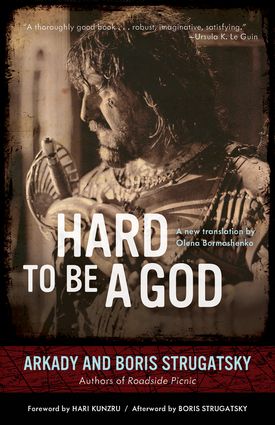
Hard to Be a God, by Arkady and Boris Strugatsky is in some ways more traditional genre fiction, at least in a North American sense, than the other two novels I've read by the brothers. Definitely, Maybe is very philosophical, static (in the sense that nothing much happens), internal (a lot of the little that happens is inside the characters' heads). Roadside Picnic, although kind of post-apocalyptic and with a noir edge, also had a deeply philosophical bent.

Hard to Be a God, on the other hand, at first glance appears to be pure genre fantasy. Or science fiction. I couldn't tell which at first.

[I asked a Russian coworker about this, and he replied, as he does regarding just about anything Russian I've mentioned in the past few years, "No, eez not science feection [or domestik drama or comedy or...]. Ees allegory ov Sovyet Rasha."]

The early chapters are all about world-building and have a medieval stench to them. The science is subtle, certainly too innocuous to be noticed by most of the resident "barbarians." But it turns out that 250 citizens of an advanced Earth have been placed on this planet to monitor and guide this "civilization" into a more enlightened era. Without "interfering." Much harder than it sounds. Don Rumata certainly has a very hard time of it indeed, and much of the book is concerned with his internal reflections.
Two hundred thousand men and women. Two hundred thousand blacksmiths, gunsmiths, butchers, haberdashers, jewelers, housewives, prostitutes, monks, money changers, soldiers, tramps, and surviving bookworms were currently tossing in bedbug-ridden, stuffy beds; sleeping, making love, recalculating profits in their heads, crying, grinding their teeth in anger or resentment. Two hundred thousand people! To a visitor from Earth, they all had something common. It was probably the fact that almost without exceptions, they were not yet humans in the modern sense of the world [sic], but blank, unfinished pieces, which only the bloody centuries of history could one day fashion into true men, proud and free. They were passive, greedy, and incredibly, fantastically selfish. Almost all of them had the psychology of slaves — slaves of religions, slaves of their own kind, slaves of their pathetic passions, slaves of avarice. And if the fates decreed for one of them to be born or become a master, he didn't know what to do with his freedom. He would again hurry to become a slave — a slave of wealth, a slave of outlandish excesses, a slave of his slaves. The vast majority of them weren't guilty of anything. They were too passive and too ignorant. Their slavery was the result of passivity and ignorance, and passivity and ignorance again and again breeds slavery.

If they were all identical, there would be reason to throw up your hands and lose hope. But they were still people, the bearers of the spark of reason. And here and there in their midst, the fires of the incredibly distant and inevitable future would kindle and blaze up. They would kindle despite it all. Despite all their seeming unworthiness. Despite the oppression. Despite the fact that they were being trampled with boots. Despite the fact that no one in the world needed them, and the everyone in the world was against them. Despite the fact that at best, they could expect contemptuous, puzzled pity.

The didn't know that the future was on their side, that the future was impossible without them. They didn't know that in a world belonging to the terrible ghosts of the past, they were the only manifestation of the future — that they were an enzyme, a vitamin in society's organism. If you destroy this vitamin, society will rot, and social scurvy will begin: the muscles will go weak, the eyes will lose their sharpness, the teeth will fall out. No country can develop without science — it will be destroyed by its neighbors. Without arts and general culture, the country loses its capacity for self-criticism, begins to encourage faulty tendencies, starts to constantly spawn hypocrites and scum, develops consumerism and conceit in its citizens, and eventually again becomes a victim of its more sensible neighbors. Persecute bookworms all you like, prohibit science, and destroy art, but sooner or later you'll be forced to think better of it, and with much gnashing of teeth open the way for everything that is so hated by the power-hungry dullards and blockheads.
And that's really the heart of the concept behind this novel.

The Strugatsky brothers had originally conceived this novel as a kind of Three Musketeers, just on another planet. Indeed there is swashbuckling and intrigue and dank taverns, but its tone took a much darker, more serious turn. The only real point in common with Dumas's creation is the sense of honour and justice.

Arkady outlined some of the initial plans for this novel in a letter: "And there would be the implicit idea that a communist who found himself in such an environment would slowly but surely become a petty bourgeois [...]." So it seems my coworker was right. Although the book is also terrific science fiction.

Here's hoping that more English translations of the Strugatsky's corpus get published, but in the meantime it's my mission to track down out-of-print editions.

Wednesday, June 25, 2014

Guilty of corrupting minds

It wasn't long ago that the Arkanarian court was one of the most educated in the empire. There had been scientists at court, most of whom were, of course, charlatans, but there had also been some like Bagheer of Kissen, who had discovered the sphericity of the planet; the healer Tata, who had made the brilliant conjecture that epidemics come from tiny invisible worms, spread by wind and water; and the alchemist Sinda, who like all alchemists had been in search of a way to transform clay into gold but instead had discovered the law conservation of matter. The Arkanarian court had also had poets, mostly foot lickers and sycophants, but some like Pepin the Glorious, the author of the historical tragedy The March to the North; Zuren the Truthful, who had composed more than five hundred ballads and sonnets that had been set to music by the people; and also Gur the Storyteller, who had written the first secular novel in the history of the empire — the sad story of a prince who had fallen in love with a beautiful barbarian. The court also used to have marvelous actors, dancers, and singes. Wonderful artists had covered the wall with unfading frescoes; fabulous sculptors had decorated the palace parks with their creations. You couldn't say that the Arkanarian kings had been enthusiastic supporters of education or connoisseurs of the arts. It had simply been considered the decent thing to do, like the ceremony of dressing in the morning or the presence of splendid guards by the main entrance.

Aristocratic tolerance would occasionally go so far as to allow scientists and poets to become visible cogs in the state apparatus. Thus, only half a century ago, the highly learned alchemist Botsa had occupied the now-abolished-as-unneeded position of Minister of Mineral Resources, founded a number of mine, and made Arkanar famous for its amazing alloys, the secret of which had been lost after his death. And Pepin the Glorious had been in charge of public education until very recently, when the Ministry of History and Literature, which he had headed, had been discovered to be harmful and guilty of corrupting minds.

— from Hard to Be a God, by Arkady and Boris Strugatsky.

Sunday, June 08, 2014

Hard to be a god, on film

I just started reading Hard to Be a God, by Arkady and Boris Strugatsky, freshly available in a new English translation.

Written in 1964, it's considered a science fiction novel. But the opening pages have the feel of medieval feudalism about them, a scenario more typical of the fantasy genre. I'm not big on labels, but let's just say I find the problem of the distinction between science fiction and fantasy interesting, and it's on my mind because I just finished reading Among Others, by Jo Walton, which blends those two genres in an entirely different way (and more on this later) and fitting that I should be considering the issue now as I've just embarked on another MOOC, Fantasy and Science Fiction: The Human Mind, Our Modern World.

Poking around the internet this morning, I was delighted to discover that this "classic" (which no one has ever heard of) has been adapted for film, twice. (This information would have been known to me earlier had I actually read the back cover of my edition.)

Aleksey German's version premiered just half a year ago and its North American release is highly anticipated. Trailer:


And here's another atmospheric look.

The 1989 film, Es ist nicht leicht ein Gott zu sein, a German-Soviet coproduction, can be viewed in its entirety on YouTube, although I'm somewhat turned off by the cheesiness of the title song, as well as by the fact that the Strugatsky brothers abandoned working on the project and criticized the final result.

If anyone has read the novel or seen either movie, I'd love to hear from you about it.

Wednesday, March 12, 2014

Homeostatic universe

A riddle, wrapped in a mystery, inside an enigma. I've heard this phrase thousands of times, often with a hint of humour, referring to various things. I didn't know that it was Winston Churchill who said it, and I didn't know that the statement was in reference to Russia.

In a radio broadcast in October 1939, Churchill said:
I cannot forecast to you the action of Russia. It is a riddle, wrapped in a mystery, inside an enigma; but perhaps there is a key. That key is Russian national interest.
Definitely Maybe, by Arkady and Boris Strugatsky, is a riddle wrapped in a mystery inside an enigma.

I hesitate to call it science fiction, although that's the label commonly applied to the work of the Strugatsky brothers. It's deeply psychological, with several ambiguities and loose ends. It could also be read as a political satire or social commentary.
I was realizing that just yesterday I was man, a member of society. I had my own concerns and worries, yes, but as long as I obeyed the laws created by the system — and that had become a habit — as long as I obeyed those laws, I was protected from all imaginable dangers by the police, the army, the unions, public opinion, and my friends and family. Now, something in the world around me had gone haywire. Suddenly I became a catfish holed up in a crack, surrounded by monstrous vague shadows that didn't even need huge looming jaws — a slight movement of their fins would grind me into a powder, squash me, turn me into zilch. And it was made clear to me that as long a I hid in that crack I would not be touched. Yet it was even more terrifying than that. I was separated from humanity the way a lamb is cut off from the herd and dragged off somewhere for some unknown reason, while the herd, unsuspecting, goes on about its business, moving farther away into the distance. I would have felt much better if only they had been warlike aliens, some bloodthirsty, destructive aggressors from outer space, from the ocean depths, from the fourth dimension. I would have been one among many; there would have been a place for me, work for me; I would be in the ranks! But I was doomed to perish in front of everyone's eyes. No one would see a thing, and when I was destroyed, ground to dust, everyone would be surprised and then shrug it off.
Does that sound more like the threat of an alien intelligence or of government?

Dmitri Alekseevich Malianov, astrophysicist, is on the brink of a great discovery.
In the yellow, slightly curved space, the axially symmetric cavities turned slowly like gigantic bubbles. Matter flowed around them, trying to seep through, but it couldn't. The compressed itself on the boundaries to such incredible densities that the bubbles began to glow.
His wife and son have gone to Odessa, leaving him alone with the cat to work. But one interruption (a beautiful woman) follows another (a delivery of vodka and caviar), and soon a full cast is parading through the apartment: Arnold Pavlovich Snegovoi, highly mysterious neighbour, colonel, supposed by Malianov to be a physicist, in rocketry. Valentin Andreevich Weingarten, biologist and womanizer. Zakhar Gubar, master craftsman techie, patent holder of several inventions, lady-killer of the highest degree. Vladlen Semenovich Glukhov, orientalist.

And Philip Pavlovich Vecherovsky, state prize laureate.
Vecherovsky lapsed into muffled guffaws that passed for satisfied laughter. That's probably the sound H.G. Wells's Martians made when they drank human blood; Vecherovsky guffawed like that because he liked the poem he had just read. One would think that the pleasure he derived from poetry was purely physical.
All these men are connected, their life's work has been waylaid, the universe is conspiring against them. I find it curious, and commendable, that while the supposed cosmic intelligence is unknowable, there is no hypothesizing about anything like God; for these are men of science (or at least, academic rigour), living under a godless Soviet regime.

When they are forced to consider that the orientalist is among their ranks, they realize that it is not merely scientific advances and technological innovation that are being stifled but rather the whole of knowledge of humankind.

Continued reference to Vecherovsky's Martian guffaws lends to the impression that there is something alien among them, even while Vecherovsky is firmest his conviction that he knows what's going on and how best to combat it.

The story is presented in the form of excerpts, all starting with ellipses, sometimes midsentence, but they are presented in order, with no obvious gaps between them. Excerpts of what?

There are so many unresolved situations in this book. It's impossible to state with any certainty which occurrences are purely coincidental or imagined or planned as a joke or part of a grand conspiracy, whether governmental or cosmic in nature.

Roadside Picnic by the Strugatsky brothers, which I read a couple years ago, conveys suspense and horror so palpably; I count it as one of my favourite books ever. Definitely Maybe takes place in a more familiar environment, yet is more mysterious — the enigma it is wrapped in is subtler. It is less about an obvious external threat than a creeping paranoia that's generated from within.

I finished reading Definitely Maybe a couple weeks ago, but I find myself thinking of it often. It is in fact more potent now than when I turned the final page. I continue to consider, with a shudder:

Work toward what end? What price my family, my peace of mind? At what cost knowledge?

See also Kaggsy's Bookish Ramblings.

Thursday, February 20, 2014

An octopus that doesn't even exist

"Or take our situation, for instance, why do you say it isn't a manifestation of a supercivilization?"

"Hmm, too human. They've discovered that earthlings are on the threshold of the universe. Afraid of the competition, they decide to stop it. Is that it?"

"Why not?"

"Because that's fiction. Dime-store fiction in bright, cheap covers. It's like trying to fit an octopus into a pair of tuxedo pants. And not a plain octopus at that, but an octopus that doesn't even exist."

— from Definitely Maybe, by Arkady and Boris Strugatsky.

Despite the awesomeness of the interwebs, there is an appalling dearth of images of octopuses in tuxedo pants, let alone any that approach what this passage conjures in my head. The occasional jacket-wearing octopus, yes. Also, people wearing tuxedoes while eating octopus. But no pants-wearing octopus.

There you have it. Proof that such an octopus doesn't even exist.

Note: It should not be construed that this novel is in any way about octopus — tuxedo pants-wearing octopus, space alien octopus, or octopus of any kind. There is some caviar, though. And to this point, there is some conjecture as to the existence of (non-octopus-like) space aliens. The quoted passage is a simple — and delightful — metaphor.

Friday, February 14, 2014

Yes, no, maybe, perhaps

Malianov's wife is away, and a friend of hers comes to stay:
...then he poured her another glass of wine. The decision to toast the use of the informal Russian personal pronoun for "you" came up. Without the kissing. Why should there be kissing between two intelligent people? The important thing was spiritual rapport. They drank to using the informal "you" and spoke of spiritual closeness, new methods of birth deliveries, and about the differences among courage, bravery, and valor. The Riesling was finished, and Malianov put the empty bottle out on the balcony and went over the bar for some cabernet. They decided to drink the cabernet out of Irina's favorite smoked crystal glasses, which they chilled first. The conversation on femininity, which came up after the one on manliness and bravery, went very well with the icy red wine. They wondered what asses had decreed that red wine should never be chilled. They discussed the question. Isn't it true that iced red win is particularly good? Yes, absolutely. By the way, women who drink icy red wine become particularly beautiful. They resemble witches somewhere. Where precisely? Somewhere. A marvelous word — somewhere. "You are a pig somewhere." I love that expression. By the way, speaking of witches — what do you think marriage is? A real marriage. An intelligent marriage. Marriage is a contract. Malianov refilled the glasses and developed the thought. In the aspect that a man and wife are first of all friends, for whom friendship is the most important think. Honesty and friendship. Marriage is a friendship. A contract on friendship, understand? He had his hand on Lidochka's bare knee and was shaking it for emphasis.

I am thus far loving Definitely Maybe, by Arkady and Boris Strugatsky. I love the drunken trajectory of this particular passage.

(I'm slightly puzzled by the pig expression, though, and the use of "somewhere." Perhaps the translation is too literal here. I'll have to ask around. In Polish you can use "somewhere" as an exclamatory expression signifying something between indifference and disbelief. Perhaps something similar is going on here.)

It was originally published in English under the title A Billion Years Before the End of the World. I don't know the rationale for the title change to Definitely Maybe, but I can't help but be reminded of Kraftwerk's 1986 classic, Sex Objekt. (That album is now my reading soundtrack.)

NPR review.
Excerpt.

Friday, January 17, 2014

Novels not included

Having read, and absolutely loved, Roadside Picnic some time ago, I'm really excited about the upcoming release of Definitely Maybe, by Arkady and Boris Strugatsky, from Melville House.

So I was inspired, as I am from time to time, to poke around the Internet to see what else by the Strugatsky brothers is available in English these days. And I found the little gem known as Novels by Arkady and Boris Strugatsky (Book Guide):


The book description begins thusly:
Please note that the content of this book primarily consists of articles available from Wikipedia or other free sources online. Commentary (novels not included). Pages: 24.

A list of chapters and an excerpt follow. And the excerpt is very boring.

The excerpt alone must account for nearly 5% of the whole of the book's contents. And for just $17.21 you can have several more pages just like it of material you can access online for free.

The spirit of capitalism never ceases to amaze me.

Tuesday, January 01, 2013

Lazy days

I feel like I've been holed away for weeks rather than mere days, although maybe it really has been much longer in terms of my headspace.

My hometown at Christmas was (unusually for its microclimate) blanketed with snow, and I returned to Montreal to record-breaking piles of the white stuff. Perfect for taking cover and staring into other worlds.

Three movies I've seen...

Moonrise Kingdom. So charmingly naive while being the exact opposite of naive. Visually it reminds me a little of Greenaway, only it's sweet and funny and ironic. The soundtrack (a lot of Britten) goes some way to promoting this comparison too. Thematically, I'm not sure — the strength of true love, the innocence of childhood, they fuck you up your mum and dad? But lovely. (Bill Murray: "I had to work with a bunch of scouts and kids. No money can make that right, can it?")

Stalker. Not what I expected, based on having read the source material (Roadside Picnic, by the Strugatsky brothers). No alien gadgetry, no reanimated corpses, no backroom thuggery, no black market economy, not much obvious unpleasantness at all. Tarkovsky stripped away all the details of the novel to focus on one trip into the Zone, one philosophical issue: the nature of the true unconscious wish that might be granted upon reaching The Room. The film is gorgeous, everything looks organic, walls and faces are mossy, mouldy. The Zone itself is lush, quite the opposite of the barren desolation the novel invoked, in fact more like Chernobyl is now; it's the town skirting the Zone that's colourless, dead.


This is art. But I'd still love to see a true adaptation of the Strugatskys' novel.

The Other. Based on Thomas Tryon's novel, which I read a couple months ago, I think the trailer with its voiceover and screams may be more chilling than the movie as a whole. The book is one of the scariest I've ever had the pleasure to read. The movie missed the mark on the characterization of the supporting characters, but it has all the classic elements of an evil-child horror movie, perfect for a dark and stormy night.

Three serials I recommend...
These are weirdly interconnected. Race, class, money, love. And a lot of desperation. (I watched these on Netflix.)

Daniel Deronda. Wow. I have got to read more George Eliot. I was fascinated by the Victorian-era look at Zionism. (Part 1 on Youtube.)

The Way We Live Now. An adaptation of Anthony Trollope's novel, inspired by financial scandals of the 1870s. (Part 1 on Youtube.)

Hell on Wheels. I wouldn't say I'm a fan of westerns, and nothing about post-Civil War frontier expansion holds much appeal for me, but this show is strangely compelling. The same time period as the Eliot and Trollope stories, it also features some railroad-related financial and sociopolitical shenanigans, but with a harsher breed of day-to-day difficulties. And several scenes flashed through my mind on my way home when my train was blockaded by First Nations protesters and delayed for several hours. Only the first season is currently available on Netflix, but I look forward to seeing more when I can. (Trailer.)

In queue
Prometheus today, and the continuation of John Galsworthy's The Forsyte Saga.

What are you watching these cold snowy days?

Sunday, December 09, 2012

We don't notice things change

OK, wow. This is some of the most interesting sci-fi I've ever read.

I first heard about Roadside Picnic, by Arkady and Boris Strugatsky, a handful of years ago, in the context of it having served as the basis for Andrei Tarkovsky's film Stalker (which I hope to see someday soon). It came up again last spring, as a new translation was being published in English.

The few reviews I saw haled it as a classic, and while it was generally revered as such by sci-fi fans (on various blogs and forums, as well by fans among my personal acquaintance), that seemed to be the result of the book resting on its reputation, not because many people had actually read it.

I picked up a copy this summer, but it's not till a few weeks ago when I heard the news that Boris had died that I was inspired to read it.

I was not prepared for this.

The problem is we don't notice the years pass, he thought. Screw the years — we don't notice things change. We know that things change, we've witnessed things change ourselves many a time, and yet we're still utterly incapable of noticing the moment that change comes — or we search for change in all the wrong places. A new breed of stalker has appeared — armed with technology. The old stalker was a sullen, dirty man, stubborn as a mule, crawling through the Zone inch by inch on his stomach, earning his keep. The new stalker is a tie-wearing dandy, an engineer, somewhere a mile away from the Zone, a cigarette in his teeth, a cocktail by his elbow — sitting and watching the monitors. A salaried gentleman. A very logical picture. So logical that other possibilities don't even occur.

In many ways, this is not a science fiction book at all. It's not exactly a crime novel either, but it circles round a group of scavengers and thugs and the black market economy they've helped build up around alien artefacts.

The Earth has been visited by aliens. The several landing areas are zones of total devastation, now with weird gravitational properties and other physical abnormalities, and littered with alien crap. Stalkers risk their lives to venture out into the zones, to retrieve this junk. Much of it is destined for genuine, institutionalized scientific research, but not without it first passing through the hands of several interested parties and generating some profit along the way. But pretty much nobody has any idea what all this crap is for or what purpose it can be set to.

Oh, right. And reanimated corpses. Corpses buried near the Zone just get up and go home. They move pretty slowly and the stench is overwhelming at first, but you get used to it. Also, a ban on emigrations from the Zone, as weird and unlikely mass disasters seem to follow those people who were inhabitants at the time of the visitation.

Our protagonist, Red Schuhart, is a stalker with a heart of gold. Sure, he wants to promote science, but at the end of the day, he just wants to make an "honest" buck.

Certainly, this is one of the most tension-packed novels I've ever read. The job of stalker is tougher than driving truckloads of nitroglycerin. I'm pretty sure there's an actual reference to nitroglycerin in the text, though of course I'm unable to track it down now. Have you seen that great Yves Montand film, Le Salaire de la peur (The Wages of Fear), where they drive the nitroglycerin along extremely rough roads, and they might blow up at every bump, every turn? This novel is like that, with the stalkers inching along on their bellies, only they don't know if they'll explode or implode, disintegrate or melt. This edge-of-your-seat tension is what made that movie and this book excellent thrillers, aside from whatever political or social commentary they want to make. I mean, take the aliens out of this book, cast Humphrey Bogart as Red, and you'd still have an excellent story.

The scenes where Red goes into the Zone are unforgettable.

Highly recommended.

Reviews
io9
Shelf Love
Wuthering Expectations

Friday, November 30, 2012

It came and went

"Go back?" he whispers.

I desperateley shake my head and wave my fist right in his visor — Cut that out. For God's sake! You never know which way to look with these novices — at the Zone or at them... And here my mind goes blank. Over the pile of ancient trash, over the colorful rags and broken glass, drifts a tremor, a vibration, just like the hot air above a tin roof at noon; it floats over the mound and continues, cuts across our path right beside a marker, lingers over the road, waits for half a second — or am I just imagining that? — and slithers into the field, over the bushes, over the rotten fences, toward the old car graveyard.

Damn these eggeheads, a great job they did: ran their road down here amid the junk! And I'm a smart one myself — what on Earth was I thinking while mooning over their stupid map?

"Go on at low speed," I tell Kirill.

"What was that?"

"God knows! It came and went, thank God. And shut up, please. Right now, you aren't a person, got it? Right now, you are a machine, my steering wheel, a lever..."

— from Roadside Picnic, by Arkady and Boris Strugatsky.

Monday, August 20, 2012

Picnic

Recently acquired: Roadside Picnic, by Arkady and Boris Strugatsky.

Because:
  1. Alleged by many to be the best Russian sci-fi ever.
  2. The basis of Tarkovsky's Stalker, by which swear several film enthusiasts I know.
  3. Two words: The. Zone.
  4. Abounding with alien artefacts.
  5. New translation.
  6. Foreword by Ursula K Leguin.
Have you read it? Or seen Stalker? Maybe you've played the video game? Is it everything they say it is?