"To arrive at a bar where the principal spectacle is the clientele..."
Reading The Angst-Ridden Executive, by Manuel Vázquez Montalbán, and getting in the mood for an upcoming trip to Barcelona...
Showing posts with label Melville House. Show all posts
Thursday, March 15, 2018
Saturday, July 30, 2016
A gap in the book's mask

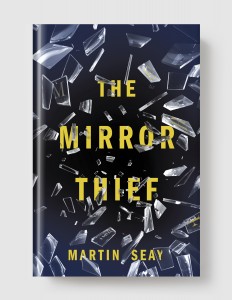
As he reads, his eyes graze each poem's lines like a needle over an LP's grooves, atomizing them into letters, reassembling them into uniform arcades. What he's looking for is a key: a gap in the book's mask, a loose thread to unravel its veil. He tries tricks to find new openings — reading sideways, reading upsidedown, reading whitespace instead of text — but the works always close ranks like tiles in a mosaic, like crooks in a lineup, and mock him with their blithe expressions. The usual suspects.I've begun reading The Mirror Thief, by Martin Seay. The first page didn't feel right, maybe not my cup of tea after all. The first major section is set in Vegas. But before I knew it, I couldn't stop reading. The focus is on Stanley, everybody's looking for him, trying to discover his whereabouts. The second major section takes us to California, back in time to Stanley's youth. This didn't feel right either, the change in locale and tone, another cup of tea that isn't mine. But I am learning that all Stanley's movements centre around a book.
The Mirror Thief is a book about a book called The Mirror Thief. It is starting to feel like a booklover's book.
(This book feels overly masuline. I don't know what I mean by that. I think that's why it doesn't feel right. Maybe it's just the wrong time and place for me to be reading this book. I'm enjoying it, but something just doesn't feel right.)
It is difficult, but probably necessary, to remember that books always know more then their authors do. They are always wiser. This is strange to say, but it's true. Once they are in the world, they develop their own peculiar ideas.
Labels:
Martin Seay,
Melville House
Saturday, March 07, 2015
Words will change nothing
Those who claim to know her, or know of her, have talked of poems whose syntax and diction twist language into new shapes, forming tiny bright daggers sharp enough to pierce the heart. Others have spoken of a novel so compendious and yet so precise it would change our thinking about the form, the last true revolutionary work, a thing that would turn lives inside out after only its first page. Some have claimed she wrote short stories, brief tales that twist and turn, things that would checkmate Chekhov, carve Carver into pieces. Stories that need but a few brief pages to reconfigure our soul.— from "Sara Zeelen-Levallois" in The Biographical Dictionary of Literary Failure, edited by C.D. Rose.
The ephemeral, evanescent, scarcely believable career of Sara Zeelen-Levallois shows us, if nothing else, one important, terrible thing: words will change nothing. Write how we may, the arrogant and corrupt will still run the world, people will starve needlessly, your lover will still leave you.
And yet.
The power of writing is one of the greatest things we have, whether it is read or not.

Labels:
C.D. Rose,
dictionary,
Melville House
Wednesday, January 28, 2015
Neither present nor past
From the entry for Otha Orkkut (1890-1943), poet, translator, and historian, in The Biographical Dictionary of Literary Failure, edited by C.D. Rose:
I treated myself to this lovely volume at Christmas, to add to my shelf of weird dictionaries. This collection of 52 lives, by turns tragic and comic, easily lends itself to browsing; I reach for it for inspiration, for reminders, for warnings.
The introduction alone is worth the price of admission, exploring the concepts of erasure, "faith in the ineffable," linguistic negation, "literature of the unword," "stories that would prefer not to."
Reviews
Biographile: "The simple fact is this: books are real; writers aren't."
PopMatters: "It's questionable whether insanity is a prerequisite for the arts."
Excerpt.
Cimbrian, it is said, was a unique language in that it contained a tense which was used to describe a person or object which had gone missing or been lost: neither present nor past, still existing in a space or time which no non-Cimbrian can ever properly comprehend.Identified as a Bothno-Ugaric language, "Cimbrian" may be referencing the same language known in Italo Calvino's quarters as "Cimmerian," described by Professor Uzzi-Tuzzi as "a modern language and a dead language at the same time."
A number of critics and translators are currently at work on Orkkut's books, her manuscripts now inhabiting the realm of that unique Cimbrian tense.

I treated myself to this lovely volume at Christmas, to add to my shelf of weird dictionaries. This collection of 52 lives, by turns tragic and comic, easily lends itself to browsing; I reach for it for inspiration, for reminders, for warnings.
The introduction alone is worth the price of admission, exploring the concepts of erasure, "faith in the ineffable," linguistic negation, "literature of the unword," "stories that would prefer not to."
Reviews
Biographile: "The simple fact is this: books are real; writers aren't."
PopMatters: "It's questionable whether insanity is a prerequisite for the arts."
Excerpt.
Labels:
C.D. Rose,
dictionary,
Italo Calvino,
language,
Melville House
Sunday, May 25, 2014
"Even the murders move more slowly down here."
Resurrection, by Wolf Haas, is a charming little crime novel. That is, there's very little crime in it, it just zips along from taxicab to curling strip to castle to restaurant, and before you know it, you're halfway through when you realize, oh, right, it started with a couple of dead bodies, presumably foul play, now what's that all about?
The setting is Zell, an Austrian ski resort, but with very much a small town vibe. Inspector Simon Brenner, recently resigned from the police force, is now "investigating" (that is, writing occasional reports), this time on behalf of an insurance company.
It's been three-quarters of a year since the bodies on the ski lift, so it's not exactly an "active" investigation. Brenner's just muddling into situations.
And there's more by Wolf Haas — Come, Sweet Death — coming from Melville House soon.
(See also my recap of Wolf Haas at the Blue Met a few weeks ago.)
The setting is Zell, an Austrian ski resort, but with very much a small town vibe. Inspector Simon Brenner, recently resigned from the police force, is now "investigating" (that is, writing occasional reports), this time on behalf of an insurance company.
It's been three-quarters of a year since the bodies on the ski lift, so it's not exactly an "active" investigation. Brenner's just muddling into situations.
The German had this bad habit. Purely insofar as, let's say, cars and drivers go. She always looked you right in the eye when she was talking to you. Now, normally, that's not necessarily uncomfortable. But in this case. She was hissing down the Autobahn at 130. And on top of that, well, no hands after all, even if she was a good driver, unbelievable, but still, just her two arm-stumps on the steering wheel. And when she was talking, she always took her eyes off the road and looked right at Brenner with those enormous eyes of hers. Because they were magnified so big by her farsighted glasses.This is the very first Inspector Brenner novel, but the third to be available in English. I really enjoyed Brenner and God for its wit and philosophical musing; The Bone Man was a bit madcap, and the crime seemed to bog down the story. But Resurrection is simply delightful. What little story there is moves with more agility than Brenner's migraine-addled thought processes. That may sound like a back-handed compliment, but without all those pesky crime details getting in the way, it's simple, swift, and funny.
"It's quite lovely here," she says.
"Here in the tunnel?" Brenner says.
He was thinking, I'll make a joke, and if I make a joke, maybe I'll get her to look back at the road again, at least in the tunnel, because this here's a place with oncoming traffic. But, nothing doing, she didn't understand it was joke, and Brenner, of course, ready with a stereotype: Germans, no sense of humor. She looked at him with her polyp eyes and said:
"No, here in Zell."
"You don't like it in Hamburg?"
"I do. Quite lovely. Quite lovely indeed. But everything moves very fast there. Whereas here, everything's allowed to move a tiny bit — just a bisserl — more slowly."
Needless to say, we're all the same down here. We don't like it when a German imitates our dialect. And it wasn't any different for Brenner, a bisserl. And then that bit about the "slowly," practically — well, it's true, of course, but we don't like hearing it. But Handless didn't mean it quite so generally, because now she says:
"Even the murders move more slowly down here. In Hamburg, shot on the spot. And here, deep frozen."
And then, she even laughed. Brenner thought: This I don't understand, either, what's so funny about that.
And there's more by Wolf Haas — Come, Sweet Death — coming from Melville House soon.
(See also my recap of Wolf Haas at the Blue Met a few weeks ago.)
Labels:
Melville House,
mystery,
Wolf Haas
Friday, May 02, 2014
"It's not real German, it's more like the nightmare of German."
Wolf Haas is the author of a series of comic crime novels featuring private investigator Simon Brenner, a former cop. Three of them are now available in English, and a fourth is on its way. (The English publications are not in the order of their original release.) I saw Haas yesterday evening at the Blue Metropolis Literary Festival.
Haas is Austrian, and so is his German. "If it sounds weird, sounds wrong, it's a good translation." He apologizes for his English, but explains that when he reads in German, he also has to apologize for his German: "It's not real German, it's more like the nightmare of German." There is not only one kind of German.
His writing style is unique. It's very much like spoken language, lively, verbal tics and all. He writes the way he does because he likes the sound of it. (And it makes for very compelling reading.)
He likes reading in English because it's as if he's reading a book someone else wrote. He is distanced from the words; the words come as a surprise and he's not as judgemental of them as if he were reading them in his own language.
On top of which, in English they sound more like a real whodunit. He seems to romanticize the American crime thriller. As I riffle through scads of Scandinavian bestsellers in my head, I realize he means the hard-boiled, noir tradition.
In his view (and mine) it's the narrator of these books who's the main character, not the detective.
There's an attempt to explain the detective Simon Brenner to those who have not read any of the books. The interviewer likes the Columbo analogy; I don't. Brenner may have a common-man appeal about him, but he's not that clever. A bit oafish; not exactly clumsy, but intellectually sloppy. He never controls a situation; things happen to him.
Haas describes Brenner as a dinosaur of a man, an old-fashioned stereotype, only he tried to make him more likeable. Like his uncles. The kind of man who has to appear strong, tough; says little, but drinks a lot. Remember, Brenner's an ex-cop, and all-round fuck-up. "He tries to think, but he's too tired."
So how does he solve anything then (or does he)? "I don't want to be rude in a foreign language, but that's when the narrator kicks his ass."
While some of his writing has a basis in reality, Haas admits that much of it is pure fantasy; for example, Brenner's hometown is a real village, but Haas has never been there. Haas travels to promote his books, of course, and he discusses how those experiences are creeping into his books. But he's wary of opening his mind too far; his books are, after all, about small villages with narrow-minded people.
When did Wolf Haas realize he needed to write? He sets the interviewer straight: "I do not need to write. I want to write." Being a writer was a more attractive alternative to having a proper job, though not so viable in the beginning. What he learned from his days writing advertising copy: when you have an idea, you have to stick with it, run with it past the point of no return. He confesses that it's somewhat embarrassing to write crime stories — it's ridiculous.
I picked up a copy of Resurrection and he signed it for me. We even managed some (very) small talk. I asked him whether he reads a lot of crime novels, does he have a favourite crime writer, but it turns out, no, he reads maybe 2 or 3 a year, he likes reading all kind of things, "even poetry" (and it sounded to me a little like a line). Lovely man, shy, a bit nervous and awkward — real, with things to say.
Read Wolf Haas.
Haas is Austrian, and so is his German. "If it sounds weird, sounds wrong, it's a good translation." He apologizes for his English, but explains that when he reads in German, he also has to apologize for his German: "It's not real German, it's more like the nightmare of German." There is not only one kind of German.
His writing style is unique. It's very much like spoken language, lively, verbal tics and all. He writes the way he does because he likes the sound of it. (And it makes for very compelling reading.)
He likes reading in English because it's as if he's reading a book someone else wrote. He is distanced from the words; the words come as a surprise and he's not as judgemental of them as if he were reading them in his own language.
On top of which, in English they sound more like a real whodunit. He seems to romanticize the American crime thriller. As I riffle through scads of Scandinavian bestsellers in my head, I realize he means the hard-boiled, noir tradition.
In his view (and mine) it's the narrator of these books who's the main character, not the detective.
There's an attempt to explain the detective Simon Brenner to those who have not read any of the books. The interviewer likes the Columbo analogy; I don't. Brenner may have a common-man appeal about him, but he's not that clever. A bit oafish; not exactly clumsy, but intellectually sloppy. He never controls a situation; things happen to him.
Haas describes Brenner as a dinosaur of a man, an old-fashioned stereotype, only he tried to make him more likeable. Like his uncles. The kind of man who has to appear strong, tough; says little, but drinks a lot. Remember, Brenner's an ex-cop, and all-round fuck-up. "He tries to think, but he's too tired."
So how does he solve anything then (or does he)? "I don't want to be rude in a foreign language, but that's when the narrator kicks his ass."
While some of his writing has a basis in reality, Haas admits that much of it is pure fantasy; for example, Brenner's hometown is a real village, but Haas has never been there. Haas travels to promote his books, of course, and he discusses how those experiences are creeping into his books. But he's wary of opening his mind too far; his books are, after all, about small villages with narrow-minded people.
When did Wolf Haas realize he needed to write? He sets the interviewer straight: "I do not need to write. I want to write." Being a writer was a more attractive alternative to having a proper job, though not so viable in the beginning. What he learned from his days writing advertising copy: when you have an idea, you have to stick with it, run with it past the point of no return. He confesses that it's somewhat embarrassing to write crime stories — it's ridiculous.
I picked up a copy of Resurrection and he signed it for me. We even managed some (very) small talk. I asked him whether he reads a lot of crime novels, does he have a favourite crime writer, but it turns out, no, he reads maybe 2 or 3 a year, he likes reading all kind of things, "even poetry" (and it sounded to me a little like a line). Lovely man, shy, a bit nervous and awkward — real, with things to say.
Read Wolf Haas.
Labels:
Blue Metropolis,
Melville House,
translation,
Wolf Haas
Wednesday, March 12, 2014
Homeostatic universe
A riddle, wrapped in a mystery, inside an enigma. I've heard this phrase thousands of times, often with a hint of humour, referring to various things. I didn't know that it was Winston Churchill who said it, and I didn't know that the statement was in reference to Russia.
In a radio broadcast in October 1939, Churchill said:
I hesitate to call it science fiction, although that's the label commonly applied to the work of the Strugatsky brothers. It's deeply psychological, with several ambiguities and loose ends. It could also be read as a political satire or social commentary.
Dmitri Alekseevich Malianov, astrophysicist, is on the brink of a great discovery.
And Philip Pavlovich Vecherovsky, state prize laureate.
When they are forced to consider that the orientalist is among their ranks, they realize that it is not merely scientific advances and technological innovation that are being stifled but rather the whole of knowledge of humankind.
Continued reference to Vecherovsky's Martian guffaws lends to the impression that there is something alien among them, even while Vecherovsky is firmest his conviction that he knows what's going on and how best to combat it.
The story is presented in the form of excerpts, all starting with ellipses, sometimes midsentence, but they are presented in order, with no obvious gaps between them. Excerpts of what?
There are so many unresolved situations in this book. It's impossible to state with any certainty which occurrences are purely coincidental or imagined or planned as a joke or part of a grand conspiracy, whether governmental or cosmic in nature.
Roadside Picnic by the Strugatsky brothers, which I read a couple years ago, conveys suspense and horror so palpably; I count it as one of my favourite books ever. Definitely Maybe takes place in a more familiar environment, yet is more mysterious — the enigma it is wrapped in is subtler. It is less about an obvious external threat than a creeping paranoia that's generated from within.
I finished reading Definitely Maybe a couple weeks ago, but I find myself thinking of it often. It is in fact more potent now than when I turned the final page. I continue to consider, with a shudder:
Work toward what end? What price my family, my peace of mind? At what cost knowledge?
See also Kaggsy's Bookish Ramblings.
In a radio broadcast in October 1939, Churchill said:
I cannot forecast to you the action of Russia. It is a riddle, wrapped in a mystery, inside an enigma; but perhaps there is a key. That key is Russian national interest.Definitely Maybe, by Arkady and Boris Strugatsky, is a riddle wrapped in a mystery inside an enigma.
I hesitate to call it science fiction, although that's the label commonly applied to the work of the Strugatsky brothers. It's deeply psychological, with several ambiguities and loose ends. It could also be read as a political satire or social commentary.
I was realizing that just yesterday I was man, a member of society. I had my own concerns and worries, yes, but as long as I obeyed the laws created by the system — and that had become a habit — as long as I obeyed those laws, I was protected from all imaginable dangers by the police, the army, the unions, public opinion, and my friends and family. Now, something in the world around me had gone haywire. Suddenly I became a catfish holed up in a crack, surrounded by monstrous vague shadows that didn't even need huge looming jaws — a slight movement of their fins would grind me into a powder, squash me, turn me into zilch. And it was made clear to me that as long a I hid in that crack I would not be touched. Yet it was even more terrifying than that. I was separated from humanity the way a lamb is cut off from the herd and dragged off somewhere for some unknown reason, while the herd, unsuspecting, goes on about its business, moving farther away into the distance. I would have felt much better if only they had been warlike aliens, some bloodthirsty, destructive aggressors from outer space, from the ocean depths, from the fourth dimension. I would have been one among many; there would have been a place for me, work for me; I would be in the ranks! But I was doomed to perish in front of everyone's eyes. No one would see a thing, and when I was destroyed, ground to dust, everyone would be surprised and then shrug it off.Does that sound more like the threat of an alien intelligence or of government?
Dmitri Alekseevich Malianov, astrophysicist, is on the brink of a great discovery.
In the yellow, slightly curved space, the axially symmetric cavities turned slowly like gigantic bubbles. Matter flowed around them, trying to seep through, but it couldn't. The compressed itself on the boundaries to such incredible densities that the bubbles began to glow.His wife and son have gone to Odessa, leaving him alone with the cat to work. But one interruption (a beautiful woman) follows another (a delivery of vodka and caviar), and soon a full cast is parading through the apartment: Arnold Pavlovich Snegovoi, highly mysterious neighbour, colonel, supposed by Malianov to be a physicist, in rocketry. Valentin Andreevich Weingarten, biologist and womanizer. Zakhar Gubar, master craftsman techie, patent holder of several inventions, lady-killer of the highest degree. Vladlen Semenovich Glukhov, orientalist.
And Philip Pavlovich Vecherovsky, state prize laureate.
Vecherovsky lapsed into muffled guffaws that passed for satisfied laughter. That's probably the sound H.G. Wells's Martians made when they drank human blood; Vecherovsky guffawed like that because he liked the poem he had just read. One would think that the pleasure he derived from poetry was purely physical.All these men are connected, their life's work has been waylaid, the universe is conspiring against them. I find it curious, and commendable, that while the supposed cosmic intelligence is unknowable, there is no hypothesizing about anything like God; for these are men of science (or at least, academic rigour), living under a godless Soviet regime.
When they are forced to consider that the orientalist is among their ranks, they realize that it is not merely scientific advances and technological innovation that are being stifled but rather the whole of knowledge of humankind.
Continued reference to Vecherovsky's Martian guffaws lends to the impression that there is something alien among them, even while Vecherovsky is firmest his conviction that he knows what's going on and how best to combat it.
The story is presented in the form of excerpts, all starting with ellipses, sometimes midsentence, but they are presented in order, with no obvious gaps between them. Excerpts of what?
There are so many unresolved situations in this book. It's impossible to state with any certainty which occurrences are purely coincidental or imagined or planned as a joke or part of a grand conspiracy, whether governmental or cosmic in nature.
Roadside Picnic by the Strugatsky brothers, which I read a couple years ago, conveys suspense and horror so palpably; I count it as one of my favourite books ever. Definitely Maybe takes place in a more familiar environment, yet is more mysterious — the enigma it is wrapped in is subtler. It is less about an obvious external threat than a creeping paranoia that's generated from within.
I finished reading Definitely Maybe a couple weeks ago, but I find myself thinking of it often. It is in fact more potent now than when I turned the final page. I continue to consider, with a shudder:
Work toward what end? What price my family, my peace of mind? At what cost knowledge?
See also Kaggsy's Bookish Ramblings.
Labels:
Melville House,
science fiction,
Strugatsky
Friday, February 14, 2014
Yes, no, maybe, perhaps
Malianov's wife is away, and a friend of hers comes to stay:
I am thus far loving Definitely Maybe, by Arkady and Boris Strugatsky. I love the drunken trajectory of this particular passage.
(I'm slightly puzzled by the pig expression, though, and the use of "somewhere." Perhaps the translation is too literal here. I'll have to ask around. In Polish you can use "somewhere" as an exclamatory expression signifying something between indifference and disbelief. Perhaps something similar is going on here.)
It was originally published in English under the title A Billion Years Before the End of the World. I don't know the rationale for the title change to Definitely Maybe, but I can't help but be reminded of Kraftwerk's 1986 classic, Sex Objekt. (That album is now my reading soundtrack.)
NPR review.
Excerpt.
...then he poured her another glass of wine. The decision to toast the use of the informal Russian personal pronoun for "you" came up. Without the kissing. Why should there be kissing between two intelligent people? The important thing was spiritual rapport. They drank to using the informal "you" and spoke of spiritual closeness, new methods of birth deliveries, and about the differences among courage, bravery, and valor. The Riesling was finished, and Malianov put the empty bottle out on the balcony and went over the bar for some cabernet. They decided to drink the cabernet out of Irina's favorite smoked crystal glasses, which they chilled first. The conversation on femininity, which came up after the one on manliness and bravery, went very well with the icy red wine. They wondered what asses had decreed that red wine should never be chilled. They discussed the question. Isn't it true that iced red win is particularly good? Yes, absolutely. By the way, women who drink icy red wine become particularly beautiful. They resemble witches somewhere. Where precisely? Somewhere. A marvelous word — somewhere. "You are a pig somewhere." I love that expression. By the way, speaking of witches — what do you think marriage is? A real marriage. An intelligent marriage. Marriage is a contract. Malianov refilled the glasses and developed the thought. In the aspect that a man and wife are first of all friends, for whom friendship is the most important think. Honesty and friendship. Marriage is a friendship. A contract on friendship, understand? He had his hand on Lidochka's bare knee and was shaking it for emphasis.
I am thus far loving Definitely Maybe, by Arkady and Boris Strugatsky. I love the drunken trajectory of this particular passage.
(I'm slightly puzzled by the pig expression, though, and the use of "somewhere." Perhaps the translation is too literal here. I'll have to ask around. In Polish you can use "somewhere" as an exclamatory expression signifying something between indifference and disbelief. Perhaps something similar is going on here.)
It was originally published in English under the title A Billion Years Before the End of the World. I don't know the rationale for the title change to Definitely Maybe, but I can't help but be reminded of Kraftwerk's 1986 classic, Sex Objekt. (That album is now my reading soundtrack.)
NPR review.
Excerpt.
Labels:
Melville House,
science fiction,
Strugatsky
Sunday, January 26, 2014
Waiting for socialism
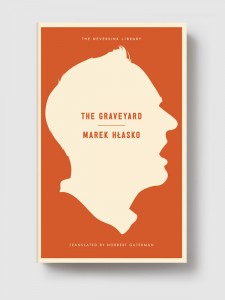
It took me a long time to read The Graveyard, by Marek Hłasko, despite its being merely 140 pages long. It's dense with politics and a whole country's emotional baggage.
I first read Hłasko about 20 years ago — The Eight Day of the Week was just about the only book of his readily available in English. The Polish crowd I ran with couldn't sing his praises strongly enough. Hłasko is Poland's James Dean, its Angry Young Man. It's 1950s angst, but on another planet; Holden Caulfield's life of privilege shrinks to nothing when compared with growing up in the shadow of Communism. You want phoney, try on some party propaganda.
It's the story of Franciszek Kowalski, a factory worker and party man. He meets up with an old friend and they go for a few drinks. On his way home, drunk, he manages to insult a couple police officers. Very soon, the exact nature of his innocent drunken outburst is called into question. A night in the drunk tank pales against the ensuing difficulties at work, with the party, and at home.
What begins with bureaucratic absurdities moves into surreal, nightmarish wartime flashbacks. And then. One by one, Kowalski hunts down his old comrades in the underground, looking to restore his faith but instead finding deeper truths.
There's joke early on that sums up the moral-political confusion of the times:
Reviews
Cleaver Magazine
Numéro Cinq
The School of Washington
I first read Hłasko about 20 years ago — The Eight Day of the Week was just about the only book of his readily available in English. The Polish crowd I ran with couldn't sing his praises strongly enough. Hłasko is Poland's James Dean, its Angry Young Man. It's 1950s angst, but on another planet; Holden Caulfield's life of privilege shrinks to nothing when compared with growing up in the shadow of Communism. You want phoney, try on some party propaganda.
"It's funny," Franciszek said. "Man always dreamed of one thing — knowledge. That was the meaning of his eternal struggle. He dreamed of only one thing — to understand his times, his purpose, his place, his meaning, and his moment in eternity. And now that he has come closest to this understanding, knowledge is his main enemy. It's better not to understand — knowledge is a disease."The Graveyard was firmly rejected for publication in Poland. It appeared first in France in 1956.
"No," the painter said. "it's death. It's worse than death. It's an encore piece, and encore to something that didn't exist, that couldn't be taken seriously." He waved the bottle joyfully. "How about a drink?"
It's the story of Franciszek Kowalski, a factory worker and party man. He meets up with an old friend and they go for a few drinks. On his way home, drunk, he manages to insult a couple police officers. Very soon, the exact nature of his innocent drunken outburst is called into question. A night in the drunk tank pales against the ensuing difficulties at work, with the party, and at home.
What begins with bureaucratic absurdities moves into surreal, nightmarish wartime flashbacks. And then. One by one, Kowalski hunts down his old comrades in the underground, looking to restore his faith but instead finding deeper truths.
He rose suddenly and began to pace the room. His neck grew purple, and his upper lip quivered. "Goddam it to hell!" he said. "To hell with this goddam chatter! What matters are the consequences, the final consequences. Once you've started a revolution, you have to realize that it can't be stopped, or moderated, or turned off, or delayed. A revolution can be only won or lost, and that's all. What horrifies you? The dimensions? The methods?"Franciszek wants only to know what kind of man he really is, what he really is, but what a quagmire of mistruths he stirs up. That should teach him drink vodka on a weeknight.
"The consequences," Franciszek said. "What you said a moment ago. Is the revolution a blind, brutal force?"
Birch gripped Franciszek by the arm and led him to the window. Before them lay the wet city, bristling with scaffoldings. "Here, to this place," Birch said, "in I don't know how many years, a man will come who hasn't yet been born. He will come and he'll want to live, to have food, an apartment, children, a family; he will want to live in security and he will expect the time he lives in to provide everything a man is entitled to. I assure you that he won't be concerned with your sufferings and doubts, or mine. He will evaluate the world he finds by the yardstick of his reason. And that's all."
There's joke early on that sums up the moral-political confusion of the times:
Once again he ran in his unbuttoned overcoat through the wet, muddy streets. He stopped suddenly. [...] He heard the furious screech of brakes behind him, and jumped aside.
"What are you waiting for?" the driver screamed, "For applause?"
"For socialism," someone said on the sidewalk.
Reviews
Cleaver Magazine
Numéro Cinq
The School of Washington
Labels:
Marek Hłasko,
Melville House,
Polish literature
Friday, January 10, 2014
Such faces
A corpulent man with a friendly face rose from his seat behind the desk. He had the clay-colored complexion of those who never get enough to eat, live in stuffy rooms, and breathe large amounts of stale smoke. His cheeks were pendulous and his eyes red from constant lack of sleep; most of the people entrusted with looking after the souls of others have such faces.— from The Graveyard, by Marek Hłasko.

That's how I feel this week. And it shows. All those souls to look after.
Labels:
Marek Hłasko,
Melville House,
Polish literature
Friday, September 06, 2013
Bulgakov and the case of the missing galoshes
"Yes, a rack of galoshes. I have been living in this house since 1903. And from then until March 1917 there was not one case — let me underline in red pencil not one case — of a single pair of galoshes disappearing from that rack even when the front door was open. There are, kindly note, twelve flats in this house and a constant stream of people coming to my consulting rooms. One fine day in March 1917 all the galoshes disappeared including two pairs of mine, three walking sticks, an overcoat and the porter's samovar. And since then the rack had ceased to exist. And I won't mention the boiler. The rule apparently is — once a social revolution takes place there's no need to stoke the boiler. But I ask you: why, when the whole business started, should everybody suddenly start clumping up and down the marble staircase in dirty galoshes and felt boots? Why must we now keep our galoshes under lock and key? And put a soldier on guard over them to prevent them from being stolen? Why has the carpet been removed from the front staircase? Did Karl Marx say anywhere that the front door of No. 2 Kalabukhov House in Prechistenka Street must be boarded up so that people have to go round and come in by the back door? What good does it do anybody? Why can't the proletarians leave their galoshes downstairs instead of dirtying the staircase?"
"But the proletarians don't have any galoshes, Philip Philipovich," stammered the doctor.
"Nothing of the sort!" replied Philip Philipovich in a voice of thunder, and poured himself a glass of wine. "[...] Nothing of the sort! The proletarians do have galoshes now and those galoshes are — mine! The very ones that vanished in the spring of 1917. Who removed them, you may ask? Did I remove them? Impossible. The bourgeois Sablin?" (Philip Philipovich pointed upwards to the ceiling.) "The very idea's laughable. Polozov, the sugar manufacturer?" (Philip Philipovich started to turn purple.) "Why on earth do they have to remove the flowers from the landing? Why does the electricity, which to the best of my recollection has only failed twice in the past twenty years, now go out regularly once a month? Statistics, Doctor Bormenthal, are terrible things."
The Heart of a Dog, by Mikhail Bulgakov, is a little weird and hilarious. Philip Philipovich has brought home a stray on which to conduct a medical experiment. The doctor transplants the testes and pituitary gland of a dead man into the dog. He and his associate observe and document the dog's progress, his gradual transformation into a human.
While medically speaking the experiment might be said to be a success, it doesn't go so well at all on a social level. The humanized dog is a lazy but subtly scheming drunken lecher (much as we assume the donor of his human parts must've been). Attempts to educate and cultivate him become hopeless. When the doctor risks losing more of his rooms to the proletarians invading his house, he decides there's nothing do but to turn the dog back.
Translator Michael Glenny in his foreword (reprinted in the new Melville House edition with the fabulous cover art) argues that it can be read as a parable, that the doctor represents the Communist party and his operation is the revolution. "The bitter message is that the Russian intelligentsia, which made the Revolution is henceforth doomed to live with — and eventually be ruled by — the crude, unstable and potentially brutal race of hominids — homo sovieticus — which it has called into being."
I rather see Philip Philipovich as wholly unsympathetic to the cause and wanting to inject a counterrevolutionary element, a better human. But Sharikov (he needs papers, after all) eschews betterment in favour of "behaving naturally," proving a kind of fatalism — that people, or dogs, are what they are, despite the accoutrements of class or, on the contrary, the attempts to annihilate it.
Labels:
Melville House,
Mikhail Bulgakov
Monday, September 02, 2013
You hate the proletariat

"I want to ask you" — here the woman pulled a number of coloured magazines wet with snow, from out of the front of her tunic — "to buy a few of these magazines in aid of the children of Germany. Fifty kopecks a copy."
"No, I will not," said Philip Philipovich curtly after a glance at the magazines.
Total amazement showed on the faces, and the girl turned cranberry-colour.
"Why not?"
"I don't want to."
"Don't you feel sorry for the children of Germany?"
"Yes, I do."
"Can't you spare fifty kopecks?"
"Yes, I can."
"Well, why won't you, then?"
"I don't want to."
Silence.
"You know, professor," said the girl with a deep sigh, "if you weren't world-famous and if you weren't being protected by certain people in the most disgusting way" (the fair youth tugged at the hem of her jerkin, but she brushed him away), "which we propose to investigate, you should be arrested."
"What for?" asked Philip Philipovich with curiosity.
"Because you hate the proletariat!" said the woman proudly.
"You're right, I don't like the proletariat," agreed Philip Philipovich sadly [...]."

— from The Heart of a Dog, by Mikhail Bulgakov.
Labels:
Melville House,
Mikhail Bulgakov
Friday, May 10, 2013
A crocheted toilet-paper-cover doll
I finished Wolf Haas's The Bone Man the other night, and I enjoyed it, but I also have some mixed feelings about it that I'll try to talk out here.
The narration is pretty wonderful, most of the time, except when it isn't. And that's not because the narration changes, no, not at all, it's because, you know, life. You as a reader change chapter to chapter, from your morning commute to waiting for the timer to go off indicating supper's ready. Mostly there's something really compulsive about it, it's lively, it chatters, it hooks you, but occasionally it grates, because, I dunno, just shut up already, like when you're cornered into a conversation with someone who is in fact charming and interesting, but at some point it's just too much, I have other people to talk to, things to do, books to read, but the other party fails to acknowledge this. It can be pretty exhausting. I'm not saying the novel trapped me in any real way, except maybe it did with its wily wiles. It's not like I felt I had to be polite about it and read through to the end. But it addicted me and sometimes I resented that. It's complicated.
So sometimes the chattiness grates, or starts to, anyway. I apologize for subjecting you to it here, but it seems I'm unable to help myself in this matter, I'm hopelessly stuck in the groove of mimicry.
This is the second novel featuring Austrian private eye Simon Brenner to be made available in English, thanks to Melville House Publishing, but the events of The Bone Man are much earlier in Brenner's timeline than what transpires in Brenner and God.
The narrator has all these verbal tics, needless to say, part of his charm. And we don't know who this narrator is, although what he relates is pretty much from Brenner's perspective, with a running commentary, so we associate the narrator very closely with Brenner, and then suddenly we recognize those verbal tics, trademark phrasings, coming out of another character's mouth. And that's a bit, you know, jarring.
And at this point I should probably insert a spoiler warning, because I want to quote a passage, and it was really difficult to choose a passage because the thing about this book — the style, the story, the humour — is that everything builds on everything else, and it won't do to tell you the punchline, it needs, I mean really needs, the long, drawn-out set-up. So to quote a passage, I have to give you context, and really, it shouldn't spoil the book for you (and don't you let it), by the time you get round to reading it you will have forgotten the details of what I write here.
But you need to know that an artist has gone missing, only he hasn't really gone missing at all, he simply decided to live as a woman, so that's what he's been doing, quite openly, working as a waitress (a really ugly waitress we're often reminded) and enjoying (if what's heard through the paper-thin walls is to be believed) a very exuberant sex life.
I'm not even sure that's funny anymore. But somewhat interesting, no? A crocheted toilet-paper-cover doll!
Oh, right, the story, there's an actual story. Story feels pretty secondary to style here, but it still does pretty well. I got confused a few times about who was who, but ultimately it all hung together.
Yes, I'll read more Haas.
The narration is pretty wonderful, most of the time, except when it isn't. And that's not because the narration changes, no, not at all, it's because, you know, life. You as a reader change chapter to chapter, from your morning commute to waiting for the timer to go off indicating supper's ready. Mostly there's something really compulsive about it, it's lively, it chatters, it hooks you, but occasionally it grates, because, I dunno, just shut up already, like when you're cornered into a conversation with someone who is in fact charming and interesting, but at some point it's just too much, I have other people to talk to, things to do, books to read, but the other party fails to acknowledge this. It can be pretty exhausting. I'm not saying the novel trapped me in any real way, except maybe it did with its wily wiles. It's not like I felt I had to be polite about it and read through to the end. But it addicted me and sometimes I resented that. It's complicated.
So sometimes the chattiness grates, or starts to, anyway. I apologize for subjecting you to it here, but it seems I'm unable to help myself in this matter, I'm hopelessly stuck in the groove of mimicry.
This is the second novel featuring Austrian private eye Simon Brenner to be made available in English, thanks to Melville House Publishing, but the events of The Bone Man are much earlier in Brenner's timeline than what transpires in Brenner and God.
The narrator has all these verbal tics, needless to say, part of his charm. And we don't know who this narrator is, although what he relates is pretty much from Brenner's perspective, with a running commentary, so we associate the narrator very closely with Brenner, and then suddenly we recognize those verbal tics, trademark phrasings, coming out of another character's mouth. And that's a bit, you know, jarring.
And at this point I should probably insert a spoiler warning, because I want to quote a passage, and it was really difficult to choose a passage because the thing about this book — the style, the story, the humour — is that everything builds on everything else, and it won't do to tell you the punchline, it needs, I mean really needs, the long, drawn-out set-up. So to quote a passage, I have to give you context, and really, it shouldn't spoil the book for you (and don't you let it), by the time you get round to reading it you will have forgotten the details of what I write here.
But you need to know that an artist has gone missing, only he hasn't really gone missing at all, he simply decided to live as a woman, so that's what he's been doing, quite openly, working as a waitress (a really ugly waitress we're often reminded) and enjoying (if what's heard through the paper-thin walls is to be believed) a very exuberant sex life.
The Ford was full of the kind of crap that certain people have in their cars, a CD was dangling from the rearview mirror, a crocheted toilet-paper-cover doll was standing on the rear shelf, and a "Get Home Safe" picture frame was glued next to the glove box. But the yellowing photo of the man in the frame must have been circa Elvis Presley, because the kiss curl — a catastrophe.
It didn't come as a particular surprise to Brenner that today's man can decide: I'd rather be a woman. And there are even operations, and he understood all that. And that an artist might think, I'd like to be an ordinary person again, he understood, too. But that someone would go so far in his transformation as to have a crocheted toilet-paper-cover doll in his car — that was something Brenner couldn't comprehend. And was thinking to himself now, maybe that's the reason why the waitress made such a racket every night. Maybe it wasn't purely lust. Maybe there was also some twinge of a desire to be caught, i.e. "liberate me from my toilet-paper doll."
I'm not even sure that's funny anymore. But somewhat interesting, no? A crocheted toilet-paper-cover doll!
Oh, right, the story, there's an actual story. Story feels pretty secondary to style here, but it still does pretty well. I got confused a few times about who was who, but ultimately it all hung together.
Yes, I'll read more Haas.
Labels:
Melville House,
mystery,
Wolf Haas
Tuesday, May 07, 2013
Why I don't like dogs
The two Rottweilers, very well behaved now — they obey that wisp of a woman, heel, incredible. And you see, that's why I don't like dogs, one minute they're practically tearing your head off, and the next they're pandering to you — if that's what you're looking for, you might as well just stick with people.
— from The Bone Man, by Wolf Haas.
I really enjoyed the narrator first time out in Brenner and God. But this time, you know, starting to grate. So I gave it a rest for a couple days, let the stress dissipate — not the stress of the book, I was more or less enjoying that, but the stresses of life and such I mean — drank it away, really. And now I'm in love with the narrator all over again. Also, craving fried chicken and a beer.
Labels:
Melville House,
mystery,
Wolf Haas
Sunday, February 24, 2013
One by one, they were all becoming shades
But we are living in a sceptical and, if I may use the phrase, a thought-tormented age: and sometimes I fear that this new generation, educated or hyper-educated as it is, will lack those qualities of humanity, of hospitality, of kindly humour which belonged to an older day.
Can we not say the same today? The Dead, by James Joyce, was originally published in 1914. I'd never read Joyce until a few weeks ago.
It was fully engrossing, funny and poignant, and, contrary to my expectation of Joyce, not at all hard to read.
The story takes place during a holiday party. Tension mounts from the beginning, and the reader prepares for a secret to be revealed, but it's not at all clear where that secret resides — the maid, the old aunts, Gabriel's past? Is it political, to do with the Irish nationalist in attendance? Will it fall from the lips of the drunk? And who are the eponymous dead?
One by one, they were all becoming shades.
The secret, it turns out, is much quieter than the possibilities Joyce forced me to consider, but no less devastating for the characters involved.
He watched her while she slept, as though he and she had never lived together as man and wife. His curious eyes rested long upon her face and on her hair: and, as he thought of what she must have been then, in that time of her first girlish beauty, a strange, friendly pity for her entered his soul. He did not like to say even to himself that her face was no longer beautiful, but he knew that it was no longer the face for which Michael Furey had braved death.
I read somewhere that Gabriel is generally considered pathetic. But I don't see that. He seems to me to act like an outsider, though he is very much the centre of this story, and very near the centre of the social circle gathered this night. But he is not in his skin, and he questions himself. He is highly sympathetic.
While I think the ultimate revelation is somewhat prosaic, the turmoil Gabriel experiences is intensely human and believable. The emotional complexity that is conveyed is stunning, oh so male, and soul-wrenching, and for this I look forward to reading more Joyce.
Gabriel is of that thought-tormented, hyper-educated new generation, and it is difficult for him, but he does well to find within him kindness.
Labels:
James Joyce,
Melville House,
novella,
short stories
Wednesday, January 16, 2013
Logic, that angular old maid with flat hips
The Madonna of the Sleeeping Cars, by Maurice Dekobra, is a very charming novel written in 1925 and recently reissued by Melville House.
The story is told by Prince Gerard Séliman, who works as private secretary to the widowed Lady Diana Wyndham, who set out the terms quite clearly:
Séliman carries out his duties with grace and humour, very William Powell, but they become more complicated when Lady Diana realizes that her funds are dwindling and that she may have to remarry. An interesting offer from a Soviet delegation leads to travelling across Europe, encountering secret agents, and enduring harsh times in a Soviet prison.
The charm of the narrative voice outweighs, for me, the adventurous spy-novel elements, although there are some unexpected and astute observations, often downplayed as mere witticisms, regarding politics, and in particular the Russian, or Soviet, character.
While much is made of the fact that his style earned its own adjective, dekrobisme, I can't say I've ever seen the word used outside of in reference to Dekobra'a own work, and frankly, not too many people these days talk about Dekobra at all.
All in all, the story feels kind of formulaic, with its femmes fatales and its Soviet thugs, its showdowns and twisty resolutions, its romances and alliances, its Orient Express and its Scottish castle, but it's a perfectly good formula, one that Dekobra may well have developed.
This novel has been filmed twice, and I'd love to see either version, but it seems to have missed out on the kind of Golden Age treatment I picture in my head.
Reviews
Head Butler
The Millions
Washington Post
A Work in Progress
The story is told by Prince Gerard Séliman, who works as private secretary to the widowed Lady Diana Wyndham, who set out the terms quite clearly:
"I am a woman to whom you'll be rather more a companion than a secretary, or, I might say, you'll have to play the part of a husband — up to the point of coming into my bedroom. You understand that! You're going to take care of my interests. You're going to give me a lot useful advice. You're going to prevent me from doing stupid things whenever possible, because they tell me that that is the favorite pastime of women of my class. Lastly, I hope you won't hesitate to throw out any questionable admirers, who may try to profit by my feminine caprices."
Séliman carries out his duties with grace and humour, very William Powell, but they become more complicated when Lady Diana realizes that her funds are dwindling and that she may have to remarry. An interesting offer from a Soviet delegation leads to travelling across Europe, encountering secret agents, and enduring harsh times in a Soviet prison.
"Without any doubt, you are the strangest individual I have ever met. You are a combination of the sublime and the ridiculous, if you will forgive me for saying so. A distinguished gentleman at noon — a clown at midnight — you excel in every capacity! Here you are moving heaven and earth for the sake of a woman who is not even yours. To my mind, that isn't logic."
"Sometimes, Griselda, it is dangerous to challenge logic, that angular old maid with flat hips."
The charm of the narrative voice outweighs, for me, the adventurous spy-novel elements, although there are some unexpected and astute observations, often downplayed as mere witticisms, regarding politics, and in particular the Russian, or Soviet, character.
I offered him a gold-tipped cigarette. He accepted it without question. His companion, who possessed a polyhedric figure and broken nose, along with bloody cheekbones, extended his flabby hand toward my case, removed the eleven remaining cigarettes and slipped them into a pocket of his leather coat without saying a word.
I remarked facetiously, "I perceive that your friend practices self-preservation."
The mole-like gentleman made an evasive gesture and replied, "Well, that's Communism, isn't it?"
While much is made of the fact that his style earned its own adjective, dekrobisme, I can't say I've ever seen the word used outside of in reference to Dekobra'a own work, and frankly, not too many people these days talk about Dekobra at all.
All in all, the story feels kind of formulaic, with its femmes fatales and its Soviet thugs, its showdowns and twisty resolutions, its romances and alliances, its Orient Express and its Scottish castle, but it's a perfectly good formula, one that Dekobra may well have developed.
This novel has been filmed twice, and I'd love to see either version, but it seems to have missed out on the kind of Golden Age treatment I picture in my head.
Reviews
Head Butler
The Millions
Washington Post
A Work in Progress
Labels:
French literature,
Maurice Dekobra,
Melville House
Sunday, January 13, 2013
These were the happy people of the world
These were the happy people of the world. They were amusing themselves. They had done nothing to deserve happiness, but they were happy. Or, what is the same thing, they thought they were. And is not the formula of oriental happiness to do nothing?
— from The Madonna of the Sleeping Cars, by Maurice Dekobra.
Labels:
happiness,
Maurice Dekobra,
Melville House
Thursday, August 09, 2012
God, death, and atheism
Brenner and God
I read Brenner and God, by Wolf Haas, earlier this summer and thoroughly enjoyed the story and the fresh manner of its telling (see my review).
A Q&A with the book's translator on the publisher's website offers some insight into the author's style:
********************
Death in Breslau
I don't recall how I first came across the series of Eberhard Mock investigations by Marek Krajewski, but they're among the most curious mysteries I've ever read.
Melville House Publishing is set to release the first novel, Death in Breslau, in September.
The first three books in this series were previously released by Quercus Publishing — and I've written a bit about them here (Death in Breslau, The End of the World in Breslau, Phantoms in Breslau) — but I'm pleased that Melville House will be making (at least) the first book available to a whole new audience, even while I'm trying to get my hands on the fourth: The Minotaur's Head.
Set in interwar Breslau (now Wrocław), these books offer a weird view on a society that is a historical and cultural mix of German, Polish, and Jewish. Nostalgic for the past, that society is shown to be perverted and corrupted and completely hypocritical in its drive to be modern and free-thinking. I enjoyed the first book particularly for how the police investigation was shown to be conducted amid inquiries regarding internal affairs and with a hovering Gestapo presence. Dark and original.
********************
Shoes for atheists
At long last, atheists have their own shoes — atheists have soles too!
These shoes started off as a Kickstarter project. They look well-crafted and divinely comfortable. And they have a sense of humour — a black hole for a logo and a sole stamped with a message.
I haven't decided which colour I want, but I love the write-up for the literarily inspired "Nabokov cream":
The website as a whole is a cheeky bit of atheism-awareness, which maybe the world could use a little bit more of. And I could use some new shoes.
I read Brenner and God, by Wolf Haas, earlier this summer and thoroughly enjoyed the story and the fresh manner of its telling (see my review).
A Q&A with the book's translator on the publisher's website offers some insight into the author's style:
What constitutes good style has been drummed into us to such an extent that, as good readers, we still bristle when a writer upsets those ingrained ideas. And what I see Wolf Haas doing is prying open this chasm between, on the one hand, how language behaves, and on the other, how language is enforced — and then letting his reader fall right in.
********************
Death in Breslau
I don't recall how I first came across the series of Eberhard Mock investigations by Marek Krajewski, but they're among the most curious mysteries I've ever read.
Melville House Publishing is set to release the first novel, Death in Breslau, in September.
The first three books in this series were previously released by Quercus Publishing — and I've written a bit about them here (Death in Breslau, The End of the World in Breslau, Phantoms in Breslau) — but I'm pleased that Melville House will be making (at least) the first book available to a whole new audience, even while I'm trying to get my hands on the fourth: The Minotaur's Head.
Set in interwar Breslau (now Wrocław), these books offer a weird view on a society that is a historical and cultural mix of German, Polish, and Jewish. Nostalgic for the past, that society is shown to be perverted and corrupted and completely hypocritical in its drive to be modern and free-thinking. I enjoyed the first book particularly for how the police investigation was shown to be conducted amid inquiries regarding internal affairs and with a hovering Gestapo presence. Dark and original.
********************
Shoes for atheists
At long last, atheists have their own shoes — atheists have soles too!
These shoes started off as a Kickstarter project. They look well-crafted and divinely comfortable. And they have a sense of humour — a black hole for a logo and a sole stamped with a message.
I haven't decided which colour I want, but I love the write-up for the literarily inspired "Nabokov cream":
Is there anything more beautiful in life than the pure, sweet, wondrous innocence of an unblemished, open and untainted soul?
Yes... the delightful process of getting that sole so fucking filthily dirty, and soiling its purity with so much titiliating sin and hedonistic whoredom that it can scarcely remember what colour it was to begin with.
This creamy, ivory, blank canvas of a shoeling is resplendent in her off-white milky maidenhood... but not for long, the little nymph, for you will introduce her to the real world... blemishing and sullying her with every step you take.
You're about to make a grown-up of this shoe.
The website as a whole is a cheeky bit of atheism-awareness, which maybe the world could use a little bit more of. And I could use some new shoes.
Labels:
Marek Krajewski,
Melville House,
mystery,
Polish literature,
religion,
shoes,
translation,
Wolf Haas
Sunday, June 24, 2012
Interesting, though: Brenner and God
There was never a riotous crowd in front of the abortion clinic, but somehow that silent threat from the church-types was even more menacing, because there's nothing worse than a sighing aggressor. A well-known fact: behind every mass murderer there's a mass sigher.
Simon Brenner is an ex-cop. Now he works as chauffeur for the 2-year-old daughter of an abortion doctor and a construction magnate, shuttling her between them. One day while he's at a gas station counter, little Helena is stolen out the car.
His sense of duty (not so much to his employers but to the job he was hired to do) as chauffeur and guardian, his feeling of guilt, and his old police instinct conspire to overrule any compunction he has about leaving this matter to the proper authorities. Really, even while he's following up leads, he wants to know, and he wants the job done right, but you sense that he'd rather not be involved at all.
Brenner and God, by Wolf Haas, is newly translated and issued by Melville House (available June 26). It turns out that this story is several books along in a series starring Brenner (and a few of them have been made into movies). There are hints of back-story, but certainly this novel reads well as a standalone. Definitely I would love for more of this Austrian series to be available in English, please.
The real cops are essentially absent from the story, and since we follow the plot from Brenner's point of view, when they do appear they come off, unsurprisingly, as somewhat incompetent. There are lots of leads (and nonleads) on this case, and it's not immediately clear which ones to follow. On the mother's side, there are antiabortionists and politics, and on the father's side there's a lot of money and politics, and on both sides there are people with their hands in other people's pockets.
But here again is the advantage of being the murderer. You don't have to go around agonizing about the little moral prescriptions.
The undisputed star of this novel is its narrator, exhorting us to "pay attention, because this is important" (which makes you pay attention) and making witty observations — "interesting, though:..." — about the characters, or life, and interpreting situations for us, occasionally skipping ahead a bit of the story and prefacing the retelling with "believe it or not" (which makes it more believable). Also, there's a constant reminder that the immediate events are unfolding 35 hours after Helena disappeared, or 53 hours, etc, which makes for excellent pacing.
There are some graphic bits, but the overall tone thanks to the narration is light, and even when the narration casts doubt on Brenner's sanity and motivation, we root for him the whole way.
What does God have to do with all this? Well, Brenner meets him, and the experience is pivotal in spurring Brenner on to follow through.
The good lord just gazed upon all this with a smile because — free will.
Labels:
Melville House,
Wolf Haas
Sunday, June 10, 2012
The detective counterquestion
You should know, there's a right moment for everything. For plants, when to plant them, when to water them, when to harvest them; for animals, when to feed them, when to milk them, when to slaughter them; for children, when to make them, when to nurse them, when to kick them out on their own; for fingernails, when to cut them, when to file them, when to polish them; and hair, too, very important. But only a very few know how important the right moment is for the detective counterquestion.
— from Brenner and God, by Wolf Haas.
Labels:
Melville House,
Wolf Haas
Subscribe to:
Posts (Atom)