Showing posts with label Yoko Tawada. Show all posts

Thursday, June 06, 2024

Activity as volumetric thinker

Looking up at the heavens she howled and cried until she grew hoarse, but even after her voice had given out, her whole body continued to shake. If only she could become a sculpture. Though she had produced many drawings and prints, she had know that she was meant to be a sculptor since her youth. And now, the only way to escape this pain was to become a sculpture herself.

— from 3 Streets, by Yoko Tawada

1. Can I call myself an artist? Yes. Apparently I am emerging. Some of my sculptures are on display at the Montreal Art Center and Museum, June 8-22.

Women sculptors have often been single figures, whose very activity as volumetric thinkers caused consternation. (Penelope Curtis)

2. What am I trying to prove? And I am certain I am trying to prove something. I am, however, not sure if it is to the world or to myself, or to someone else. This is a partial proof that anyone can be an artist. If I can do it, surely anyone can. Or at least anyone who takes the time to respond to a call for submissions, prepare a portfolio and a statement. Anyone who can manage the logistics of exhibiting one's work. Alternatively it is proof that I have some artistic talent. Can both hypotheses be true?

3. Having the goal of exhibition has shaped my time. There are deadlines. Paint must dry. These past months have been exceptionally stress-laden, for life reasons, yet I made a commitment to participate in a group exhibit — an added pressure, but also a distraction from life, even a handy excuse.

4. Would these sculptures have turned out differently without a looming end date? Minimally. In some cases, a decision was forced. I no longer had the luxury of procrastination. But the right decisions were made, of this I am confident. 

5. Some finishing detail was rushed. As I browse work in galleries, I notice the precision I didn't make time for — a sanded contour, a crisper edge, a neater mounting. Such detail can be a differentiator between competent work and confident work. While parts of the process are meditative and slow down time, I need to relearn patience, I need to take more time.

6. How do I title a sculpture? A title can change everything. It gives the viewer a framework, it sets a tone. An artwork must announce itself to the world. It takes a stance. It makes a statement. It tells a story. Sometimes it's an untitled story about nothing in particular.

7. I play a game with myself when I visit galleries and museums: I look at an artwork cold, understand something about it, identify how it makes me feel; then I read the little white label at its side, for its title, year, materials, maybe some other context. And then I look again. This game makes me feel like both a winner and a loser simultaneously, that I am some clever purist exercising her cumulative knowledge and insight but also never fully appreciating what an artist might be trying to say. Is the failing mine or the artist's, I wonder.

8. They say a picture's worth a thousand words. What is a sculpture worth then? Why do we title artworks with words? An artwork can generate a feeling; but a title can help the artwork tell a story. Sometimes I think the title should be able to stand on its own, without the artwork.

9. I read artist statements and laugh at their empty wordiness. I have collected many sample over the years. Enough to fill a book.

10. How do I price a sculpture? Unlike a canvas, I cannot charge by square inch. I can calculate time and materials, but what of found materials? Do I count the time involved for mould-making on top of the time to make the clay original? If I reuse the mould, should I adjust the price? 

11. What is my artwork worth to me? What do I want for it? At this point, mostly I want someone to take it off my hands. I'm not in this for the money. I like the idea of barter pricing, because some things are more useful to me than money. One sculpture is priced at "Removal and disposal of two old hot water tanks from the artist's cellar basement, accessed via trap door and steep step ladder." Another costs "Air duct and dryer vent cleaning in the artist's condo, which may include the removal of animal remains and other debris." But it's only because I'm financially comfortable that I can entertain alternative economic structures.

12. Curatorial philosophies and logistics are confounding me. How do I choose what to display? How many pieces? How do I display them? Painters must choose how to frame their paintings; sculptors must stage their work, in three dimensions. I put my work on a pedestal. Should these platforms conform to each other to forge (a perhaps artificial) cohesiveness of the sculptures, or should they play to each piece's distinctiveness?

13. Where do I find such pedestals? Do I make them, modify them? How do I transport them? How much time have I devoted to the material that supports the art, beyond making the art itself?

Object-sculpture is by it nature materially and spatially assertive, so a sculptor needs logistical and material support as well as the endorsement of others who believe in the undertaking. (Clare Lilley)

14. Here's a smattering of books I've read in recent months (rather, almost years), either directly or tangentially about art and artists, that have shaped some of my art thinking, bringing me to where I am now.

  • Breaking the Mould: Sculpture by Women Since 1945, published on the occasion of the Arts Council Collection Exhibition
  • Old in Art School, A Memoir of Starting Over, by Nell Painter
  • Like a Sky Inside, by Jakuta Alikavazovic
  • Biography of X, by Catherine Lacey
  • The Art Thief: A True Story of Love, Crime, and a Dangerous Obsession, by Michael Finkel
  • The Deceptions, by Jill Bialosky
  • Tell Me I'm an Artist, by Chelsea Martin
  • Sirens and Muses, by Antonia Angress
  • The Art of Vanishing, by Lynne Kutsukake
  • The Exhibitionist, by Charlotte Mendelson
  • 3 Streets, by Yoko Tawada

15. Why do writers have so much to say about art?

16. There is so much more I want to say about these books, but I'm not sure I remember what. I read differently now. I regret not blogging, not documenting my response, not writing my way through my opinions. 

17. I've been messing around, playing with art, toying with the idea of art school; if not a degreed program, then workshops in exotic places. What do I hope to accomplish with school? More proof, validation? (Of what?) More importantly, what do I hope to learn?

18. I don't even know how to properly clean a paint brush.

19. I have been making things out of clay and, for the most part, casting them. I want to learn about different casting materials. How do I even begin to go about casting bronze? Where do I get some bronze? Can the things I do with clay be adapted for ceramics? How do different types of clay feel, or behave differently? I have trouble finding answers in books or on the internet. I suspect the answers may come from people, possibly school. I want to experiment with materials, to find the material best suited to the story I want to tell.

20. Perhaps I want to prove that art is easier than literature. The price of admission is lower. It's easy to show my work at the little gallery down the street. People actually stop and look. It's less simple to publish a book. There is no little publisher around the corner. There aren't many people who will casually spend 20 minutes with my writing and spend a few hundred or thousand dollars on it.

21. Perhaps this exercise in art was a warm-up. Or merely a procrastination tactic.

Exhibitions are not the end point of a process. Exhibitions start things, and they begin processes of change and reassessment. They don't close a chapter but open it. (Joy Sleeman)

Gaping holes in the body of her argument, 2024; clay, acrylic. On the beach at Benitses, she came apart at the seams, 2022; plaster, acrylic. 
The body is a construct, the body is a triangle, 2023; hydrostone. Jeremy is a delicate flower, 2024; clay, plaster, acrylic.


Monday, May 20, 2019

Changing the consistency of the air around her

Another woman was already standing in my favorite spot by the rusty tracks. Her long coat had a high collar that resembled the gills of a tropical fish. On her head she wore ornaments that looked somehow extraterrestrial. Perhaps she was a singer who'd fled from the stage of an opera with futuristic sets. What could be the reason for her having hurried here without removing her makeup and changing clothes? She was older than I was, and had something extraordinary about her. Her presence even seemed to be changing the consistency of the air around her. The clear form of her lips held her flesh together like overripe fruit, and the two ends sometimes dipped down slightly, as if they were remembering a bitter taste. The woman's spine described a straight line of justice not dependent on any existing law. Each time I blinked, her body dissolved for two seconds into colorful micro-grains.

The darkness around us thickened. The woman gave me a dutiful nod, as if the two of us had an understanding. My heart began to pound violently. It was up to me to take action. Today was the chosen day. I had a vague memory of our having arrived at our agreement in a dream, though the specific terms of the the agreement were unknown to me. Suddenly the woman lay down on the tracks and pressed her face to one of the ties. I ran to her, took her by the shoulder and tried to roll her over, but she was as immovable as the spire of a temple whose root is buried in the earth. I thought I heard the sound of a train approaching from a distance — this was impossible though. There tracks had known nothing but rust and weeds for years, certainly no wheels. Then I heard it once more, the sound of an approaching train. Or was it just a streetcar heading into the city center? Or was it the drone of a refrigerator that had been implanted in the depths of my eardrums during my days of loneliness? I wanted to tell the woman to get up, but I couldn't think of any words. The old words had left my skull, I needed new words to be able to speak to her. But what were new words?
— from The Naked Eye, by Yoko Tawada.

The old words are inadequate. The new words are inaccessible.

Tuesday, April 16, 2019

Women whose real-life roles I was unable to determine

Between emerging from the métro and disappearing again into the darkness of a movie theater, I would see women whose real-life roles I was unable to determine. They made a point of giving off an air of eroticism, for the very possibility of appearing prudish would have been enough to render them suspect, even antisocial. The length of their skirts was chosen with diplomatic precision: two centimeters longer than might count as indecent, and two centimeters too short to risk the stigma of prudishness. When the evening sun chanced to shined down on a round white table in a café, turning it into a dazzling mirror, even one of these upstanding bourgeois ladies might get swallowed up by the mirror, never to return. In this looking-glass world, such a lady might eat pears with legs and hairy skin, gigantic Adam's apples and calluses on their heels. In return, she would receive payment from her customers in a currency that no longer existed. While the bill was being settled, her labia would flush as red as the flag that used to stand on the podium during Party meetings. Neither her husband nor her lover would have the slightest idea.
— from The Naked Eye, by Yoko Tawada.

I want to watch all of Catherine Deneuve's movies. I've see only very few of them. Repulsion. Belle de Jour. 8 Women. So many others I think I've seen, but I may not have seen. (Did I or did I not see Indochine?)

[Look at that. That's Catherine Deneuve in the pupil of the eye!]

The book is often noted for being something of a linguistic curiosity, having been written in two languages — German and Japanese — and translated back and forth between each other to develop a full text in each language (it's not clear to me how faithful they are to each other, or whether they are in any way distinct). The English version was translated from German.

There's something beautifully naïve about Tawada's writing; that is, the naïveté of her characters (she's pulled this off before). It takes a sophisticated mastery of language to convey this simplicity so effortlessly.

We see everything through the eyes of a young communist-raised Vietnamese woman, whose name may or may not be Anh. When she arrives at a youth conference in East Berlin, understandably everything feels foreign — German and at least Occidental — but slightly familiar — Russian and communist.
I always got good grades in Russian, but there was one grammatical rule to which I had a physical aversion: the genitive of negation. A person who was absent was no longer allowed to exist in the nominative case, as though he were no longer a subject.
As she moves west, and forward in time (the Wall falls), the sense of alienation increases and she belongs nowhere.

The language, the politics, the economic system, womanhood, a western way of thinking, basic human codes of conduct are all foreign to her.
This is a study in identity, of infiltrating humanity, to try to pass as human.

It's funny and tragic when Anh is trying to figure out how to get herself a room for the night. She observes someone conduct such a transaction, she thinks, but we know it's a john negotiating with a prostitute.

Then there's this description of an interview in a magazine:
Between the pages of photographs there were other pages with a text in two voices. The voice printed in boldface said little, and almost always ended with a question mark, so this person must have been filled with despair during the conversations. The other voice never asked a a question and spoke in larger blocks of text.
Not much has been written about this slim novel, but this review in Transit sums up the themes:
"The gaze of the nameless lens licks the floor like a detective without grammar." The first paragraph of Yōko Tawada's The Naked Eye is a blueprint for the novel's itinerancy, mapping out the difficulties of constructing a story that is caught in flux, between countries, between media, between languages, between political systems, between adolescence and adulthood, and between sexualities.
Anh is mesemerized by Catherine Deneuve. She's seen all her movies. She lives to see her movies. They are the highlight of her life. Much of the novel is addressed directly to Catherine, as Anh feels she knows her, despite them speaking different languages. The chapters are named for key works, progressing chronologically, and reference many of the films. Anh views Deneuve's filmography as a continuous story, populated by disparate ensembles of bit players in the story of her life, with Deneueve deftly changing names and identities. (Such is Anh's disjointed life!) Anh wonders, for example, how the Deneuve of Les Voleurs doesn't recognize the bathtub where the Deneuve of Repulsion lay the corpse of the man she murdered.
Every time we went to a movie together, he would take me out for coffee afterward and would tirelessly ask me questions that I didn't understand right away. He wouldn't give up until I'd answered them. Sometimes he was completely satisfied with my reply even though I hadn't understood his question and had just blurted something out. Perhaps not understanding or misunderstanding a question is something that often happens to other people. No one notices, though, since the answers one gives generally happen to fit the questions anyhow.

Wednesday, April 25, 2018

A stone like a misplaced comma

I had always found it unpleasant to have guests in my apartment. They filled up my rooms with strange sentences I would never have formulated in such a way. Today I found the sound of these sentences particularly unbearable. Sometimes I tried to follow only the sense of the conversation so as not to hear the sounds of the language. But they penetrated my body as though they were inseparable from the sense.

[...]

At midnight the guests began to dance to disco music. I couldn't hear the music, but saw the wine glasses vibrating. Apparently it was very loud. No one was allowed to miss a beat. The guests weren't dancing at all, they were speaking to one another. When someone stuttered, the other spoke more quickly so the interruption wouldn't be noticed. The rhythm was set by a computerized drum set, just like in disco music. The people breathed, as it were, mechanically, rather than taking irregular breaths whenever they felt like it. My heartbeat and my sighs were ridiculously soft, no match for the powerful speakers. In these black refrigerators, the mass of sounds is frozen. There weren't any speakers in my apartment, and there wasn't any music playing. People were talking. I wanted to transform myself into a stone. Wanted to become a stone like a misplaced comma, to interrupt the clatter of conversation.
— from "A Guest," in Where Europe Begins, by Yoko Tawada.

Where Europe Begins, by Yoko Tawada, is short enough that one could ride along the dream narrative to the end in just a few hours. I feel rather lucky that I rather accidentally chose to read this over a couple months, extending the experience, embodying it.

It's a meditative, highly surreal text that grapples with the intersection of language and reality.

Language as a physical thing, our tongue in our mouth, sound waves.

Language with a physical representation, scratches on paper.
I asked the man who was standing there hawking his wares in what language the book was written, since I don't know of any language whose letters are arranged in a circle. He shrugged his shoulders and said it wasn't a book, it was a mirror. I refused to look at the thing he was calling a mirror.

Maybe it isn't a book, I conceded, but I would still like to know what's going on with this writing.

The man grinned and replied: To our eyes, you look exactly like this writing. That's why I said it was a mirror.

I rubbed my forehead from left to right, as if rewriting my face.

Everything is translation, and all translation is interpretation.

I previously responded to a couple of the pieces in this book:
The Bath
Canned Foreign [text]

To date, this is my favourite of Tawada's books and I see myself returning to it.

Saturday, April 21, 2018

A new species of human being

On tree day maybe the cherry tree in the schoolyard will fall on top of me and crush me. Almost all trees are sick these days, even if they look healthy their trunks are hollow, so all it takes to make them fall over is a sight from someone standing next to them. That's why all those signs say "Do not sigh near this tree." I can see it now — a whole row of cherry tree falling like dominoes, starting with the one farthest away. I run away.
The Emissary, by Yoko Tawada, is a slight novella that poetically hovers over many interesting themes without ever touching down.

I'm hard-pressed to explain what The Emissary is about. It takes place in a future, post-disaster Japan, where children are helpless and frail and wheelchair-bound and elders are robust. (Is this not the way the world is? Or is it upside down? Is it the elders or the children who have wisdom?)
Assuming he had knowledge and wealth to leave to his descendants was mere arrogance, Yoshiro now thought. This life with his great-grandson was all he could manage. For that he needed to be flexible, in mind and body, with the courage to doubt what he had believed for over a century. He'd have to slough off his pride like an old jacket and go around in his shirt sleeves. If he was cold, rather than buying a new jacket it would be better to think of ways to change his body so that it would grow a thick coat of fur like a bear's. He was not really an "old man," but a man who, after living for a century had become a new species of human being, he thought, clenching his fists again and again.
Japan has quarantined itself from the rest of the world.
Having been among the first countries to withdraw from the global rat-race in which huge corporations turned underground resources into anything they could sell at inhuman speeds while ruthlessly competing to keep production costs lower than anyone else's, South Africa and India now kept to a policy of supporting their economies by exporting language alone, discontinuing all other imports and exports. The two nations had formed what they called "The Gandhi Alliance," which was gaining world-wide popularity. They got along so well that other countries were beginning to envy them. South Africa and India fought about soccer and nothing else, their positions on humanity, the sun, and language being perfectly matched. Contrary to the predictions of foreign experts, the economies of both were growing steadily. Like these two nations, the Japanese government had also stopped importing underground resources and exporting manufactured goods, but with no language it could export, Japan had come to an impasse. The government hired a linguist to write a paper proving that the language Okinawans spoke was linguistically unrelated to Japanese, to promote its plan to sell the Okinawan language to China for a good price, but Okinawa refused to let this underhanded scheme go through. They came back with an ultimatum: If Japan insisted on selling their language to China, then Okinawa would stop all shipment of fruit to the main island of Japan.
Old man Yoshiro had once written a novel, Ken-to-shi, Emissary to China, which manuscript he'd buried because there were too many foreign place names.

Meanwhile, Yonatani, the teacher, is tasked with selecting the child most suitable to be an emissary. (Emissary to where?) "All he could teach them was how to cultivate language. He was hoping they themselves would plant, harvest, consume, and grow fat on words." He has his eye on Yoshiro's great-grandson, Mumei.

The Emissary imagines a future where the past (our now) doesn't make any sense. Tawada is as playful and surreal as ever. The story, such as it is, is grounded in the intergenerational interplay, but I lost my bearings when trying to understand the big picture, Japan's place in the world, or the new human's role.
"So in another hundred thousand years we'll all be octopi?"

"Maybe so. A long time ago people would have thought of that as devolution, but it might just be evolution after all."

"In high school I used to envy people with bodies like Greek statues. I was trying to get into art school, you see. Don't know when I developed a liking for entirely different bodies — birds, say or octopi. I'd like to see everything from an optical point of view."

"Optical?"

"No, I meant octopus. I want see through the eyes of an octopus."
Reviews
Hyperallergic: A Dystopian Fairy Tale Reflects Challenges of the Present
New York Times: After Disaster, Japan Seals Itself Off From the World in "The Emissary"
Words without Borders: Yoko Tawada’s Dystopian Novel "The Emissary" Delivers a Bitingly Smart Satire of Present-Day Japan

Excerpt.

Monday, March 05, 2018

I might have read this foreign city like a text

Often it sickened me to hear people speak their native tongues fluently. It was as if they were unable to think and feel anything but what their language so readily served up to them.
— from "Canned Foreign," in Where Europe Begins, by Yoko Tawada.

"Canned Foreign" is a brilliant little story (well, it's not really a story; vignette?). I love this idea, that too-easy language is simple, inadequate, wrong. It reaffirms me in my shortcomings, my own inadequately communicative behaviour, grounding me in a comprehensive philosophy of language and theory of communication.

Clearly my reading this year is proving the inadequacy of language:
Clearly we need to read to learn to read the world. But then what? My reading is also leading me to attempt to articulate . . . something inexpressible.
Once, in the supermarket, I bought a little can that had a Japanese woman painted on the side. Later, at home, I opened the can and saw inside it a piece of tuna fish. The woman seemed to have changed into a piece of fish during her long voyage. This surprise came on a Sunday: I had decided not to read any writing on Sundays. Instead I observed the people I saw on the street as though they were isolated letters. Sometimes two people sat down next to each other in a café, and thus, briefly, formed a word. Then they separated, in order to go off and form other words. There must have been a moment in which the combinations of these words formed, quite by chance, several sentences in which I might have read this foreign city like a text. But I never discovered a single sentence in this city, only letters and sometimes a few words that had no direct connection to any "cultural content."

Monday, January 15, 2018

Mouths fell open like trash bags

"The Bath" is a substantial short story that starts off Where Europe Begins, a collection of Yoko Tawada's work.

Have you ever tried to tell someone what you dreamt? And you stumble for words to convey the dream logic and transitions.

"The Bath" reads like a dream, only the telling of it is sublimely fluid.

It's kind of a fairy tale, about a fish-woman, or maybe a bird with scales, who may or may not be (as things are in dreams) a simultaneous interpreter who loses her tongue, both the physical muscle and her language, and joins a freak show.
I heard the click of a cigarette lighter. Evidently someone had begun to smoke. The faces around me were flushed from the wine. When jaw muscles relax, the atmosphere becomes relaxed as well. People's mouths fell open like trash bags, and garbage spilled out. I had to chew the garbage, swallow it, and spit it back out in different words. Some of the words stank of nicotine. Some smelled like hair tonic. The conversation became animated. Everyone began to talk, using my mouth. Their words bolted into my stomach and back out again, footsteps resounding up to my brain.
A lot happens in this story, and a lot of it is dreamt. It quite possibly merits Jungian analysis, but it moves so swiftly, slippery life a fish, it's hard to know where to start.

There's the issue of the mother, and the mother's refusal/failure to (physically) recognize her daughter (or emotionally acknowledge her). There's the mystery of the dead woman, whom she begins to confuse herself with, suicide from loneliness — is this what happens to Japanese women of a certain age who choose career over marriage? ("I have no time to go out because I sleep so much.") There's the problem of the tongue, forsaking one language for another, only to have no identity at all.

She is swallowed by her own vagina.
All at once I realize that the scale-covered bird called Sarcophagus is, in fact, the woman. I push open the lid and climb out.

Sky and earth have come to an end, and before me lie desolate grasslands full of slender blades swaying in the air. I remember having felt this way when I firs left my mother's womb.

With all my strength, I embrace the cold body of the scaly bird. In my arms, each of its scales becomes a wind chime that rings. Sharp, gently, bitter, soft notes penetrated my bones, and now my bones, too, begin to ring. This ringing gradually give rise to a strength which belongs to no one.
(Inhabiting one's own skin, one's own bones, someone else's skin, someone else's bones.)

I'm delighted to learn that a new novel, The Emissary, by Yoko Tawada, is to be released this spring.

Sunday, November 20, 2016

A smell cannot lie

Wolfgang's mouth smelled of lies. There are different sorts of lies, and each one has its own smell. This particular lie smelled of suspicion: Wolfgang was probably reporting not his own thoughts but the words of his boss. Wolfgang was a liar, but fortunately he was still a young liar. His smell revealed that he was still a child, and a smell cannot lie.
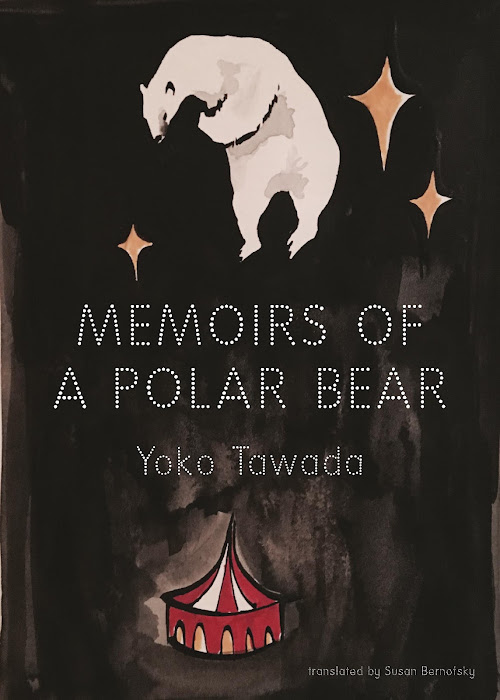
Memoirs of a Polar Bear, by Yoko Tawada, is a beautifully whimsical meditation of a novel.

Really it's the memoirs of three polar bears spanning three generations. But they are the collective unconscious of an archetypal polar bear. Each bear embodies all past bear ancestors.

The subject of that meditation is tough to pin down. It is about writing and words and politics.
"Writing isn't particularly different from hibernation."

"The smaller the newborn text, the better, because then it has a better chance at survival."

"The boss had no doubt intended to enrich this low-fat speech with a bit more semantic butterfat."

"After that I stopped writing anything political, though I'm not entirely sure what's political and what isn't."

"Rage is a sort of fuel that can't be found in the forest."
It is about nationalism and cultural identity. How language is linked to identity. It is about climate change and responsibility and responsibility for the actions of our forebears. Free will and predetermined nature. What is natural and what is learned behaviour.

The first bear, the grandmother, is a star circus performer; she rode a bicycle in the early days. When her knees gave out after training in Latin American dance, she was assigned a desk job and started participating in conferences (for example, Working Conditions Among Artists, and Working Class Pride).

So there's this polar bear just living out her life in Moscow, sweet-talking her superintendent into giving her some contraband vodka, and the super starts discussing a masterpiece of Japanese diary literature from the Middle Ages, which inspires the bear to pen her autobiography, which is well received by the public, but her celebrity leads to persecution by the state.

She defects to West Germany, where she is overwhelmed by the availability of goods and somewhat taken aback by the conspicuous and wasteful consumption of the West. The bear begins to realize that her fate is inextricably linked to that of humans and human rights.

A bookseller presses Heinrich Heine's Atta Troll on her, for which she reproaches him: "You sold me an indigestible book!" Atta Troll, A Midsummer Night's Dream, an 1841 epic poem, is about a dancing bear who makes a break for freedom, to end up as rug in Paris. (Everything I know about Atta Troll I owe to short summaries and a Google preview of Reading Heinrich Heine; it appears to be not widely known in English.) The conversation turns to censorship.

Eventually she seeks political asylum in Canada. She learns English, marries, has a daughter (Tosca); her husband wants them to flee to East Germany, to contribute to the creation of an ideal state, so they do.

And this is how this novel is. Is she really a polar bear, or is she a metaphor? She is nameless.

Her daughter, Tosca, makes her name on the stage, and eventually also works in the circus. It appears that Tosca's son, Knut, is born in captivity, in a zoo, and is also an acclaimed public figure.

Their memoirs in turn are both funny and poignant.
"Someone told me once that illness was a traditional form of theater practiced by office workers, who were allowed to put on these performances only on Mondays when they didn't want to come to work."

"It's not that I want to talk about the war, it's just that it makes me nervous to have a hole in my circus biography. A hole that big might one day become my grave."

"I wanted to wrap myself in the black woolen blanket of grief and brood over my clutch of sorrows until they hatched and flew away, but it wasn't possible."

"Knut felt powerless in the face of time. Time was a huge ice block made of loneliness. Knut gnawed and scratched at it, but without effect. When Christian complained of having no time, as he often did, Knut envied him."
Each bear gains awareness of themselves, their heritage, and the larger climate of which they're a part. Only by looking inward can one begin to see outward.

I expected gimmicky and sentimental, but this novel was unpretentious and thoughtful, thoroughly charming. It let me revel in surreal circumstances and circus stories, but gave me space to consider some very serious questions indeed. The narrations flits easily, letting my mind settle where it will.
After the death of all living creatures, all our unfulfilled wishes and unspoken words will go on drifting in the stratosphere, they will combine with one another and linger upon the earth like fog. What will this fog look like in the eyes of the living? Will they fail to remember the dead and instead indulge in banal meteorological conversations like: "It's foggy today, don't you think?"

Thursday, November 03, 2016

Shivering jouissance

"Were you ever in Canada?" I asked him.

"No."

"Do you know what sort of country it is?"

"A very cold one."

When I heard that, I wanted to move to Canada right away.

The adjective "cold" had such an appealing sound. I'd give up anything to experience such cold, for Ice Queen beauty, for shivering jouissance. The ice cold truth. Acrobatic marvels that give you cold feet. A talent that makes all your competitors blanch and tremble as if frozen. Rationality honed sharp as an icicle. Cold has a broad spectrum.

"Is it really that cold in Canada?"

"Yes, it's incredibly cold there."

I dreamed of a frozen city in which the walls of all the buildings were made of transparent ice. Instead of cars, salmon swam through the streets.
—from Memoirs of a Polar Bear, by Yoko Tawada.

No, Canada's not really like that. But one can dream.

Monday, October 24, 2016

A sentimental, decadent cult

Stop Global Warming and Save the Polar Bears!
The polar bear speaks up, and it makes me want a bicycle:
"The bicycle is beyond all doubt the most excellent invention in the history of civilization. The bicycle is the flower of the circus stage, the hero of every environmental policy. In the near future, bicycles will conquer all major cities in the world. And not just that: Every household will have its own generator attached to a bicycle. You'll be able to get fit and produce electricity at the same time. You can also get on your bicycle to pay your friends a spontaneous visit instead of first calling them on your cell phone or sending an email. When we utilize the multifunctional capacity of the bicycle, many electronic devices will eventually become superfluous."

I saw dark clouds gathering about several of the faces. Putting even more power into my voice, I continued: "We will ride to the river on our bikes to do our laundry. We'll ride our bikes to the forest to collect firewood. We don't need washing machines anymore, and we don't have to rely on electricity or gas to heat our apartments or cook our meals." Several faces were amused by these fanciful proposals, displaying unobtrusive laugh creases, while others turned gray as stone. Not a problem, I cheered myself on, don't let them intimidate you. Pay no attention to these bores. Relax! Ignore this wrong audience, imagine yourself standing before hundreds of ecstatic faces and keep talking. This is a circus. Every conference is a circus.

The chair coughed dismissively, as if to show he had no intention whatever of dancing to my tune. Then he exchanged intimate glances with a bearded official seated beside him. I remembered that the two men had entered the room side by side. The official, thin as a nail, wore a matte black suit even though he wasn't at a funeral. He began to speak without first asking permission: "Rejecting automobiles and worshipping bicycles: This is a sentimental, decadent cult already familiar to us from Western countries. The Netherlands are a good example. But supporting machine culture is a matter of the utmost urgency. We must provide logical connections between places of employment and residential areas. Bicycles create the illusion that one might ride anywhere one likes at any time. A bicycle culture could exert a problematic influence on our society." I raised my hand to contradict this line of argumentation. But the session leader ignored my hand and announced the lunch break. I left the room without a word to anyone and ran out of the building like a schoolchild running onto the playground.
—from Memoirs of a Polar Bear, by Yoko Tawada.

Imagine a bicycle-driven future! Perhaps the most problematic influence on our society is the Establishment. See through the illusions.

Memoirs of a Polar Bear will be released November 8. I was eager to read a review copy on the basis of Rivka Galchen (whom I revere on the basis of a single "essay") having referred to the author's whatness as Yoko Tawada's Magnificent Strangeness.

It's early pages still, but if the polar bear is expressing her concern about having missed the forecast for the weather change of the Prague Spring, I'm guessing climate may be a running thread, whether ecological, social, or political.

Excerpt.