Tuesday, May 29, 2012

The sight was stunning

She had to admit the sight was stunning, though. There were squat ships and circular ships, brightly coloured ships and severe black, white and grey ships, ships made to resemble birds or giant fish; there were ships which seemed spun from spiders' webs and hung with silvery droplets of dew, ships so massive they looked as if they would sink into the super-reinforced concrete of their pads. A million shades of metal flashed and clashed in the crowded port. Peoples of every race and manufacture walked between the gantries or sailed above them in open air-cars leaking colour. And when the atmosphere testers came on, the new arrivals were hit by a sea of scents out of which it was possible to detect burning metal, fuels of every kind, plants, bodies, cooking food, the life-gasses of a thousand worlds.

— from The Coming of the Terraphiles (Or, Pirates of the Second Aether!!), by Michael Moorcock.

I'm a little embarrassed to admit that I'm reading a Doctor Who novel. I've been curious for years, thinking it might be just the thing to ward off serious withdrawal symptoms (or boredom) between television seasons. But it's not just any Doctor Who novel. It's one written by Michael Moorcock, whom many consider to be an author of very respectable science fiction and fantasy — that is, if your definition of respectable includes free-wheeling attitudes toward sex and drugs and rock and roll. As a bonus, this Doctor Who adventure features a journey into the Second Aether, and an encounter with a pirate captain, who is an incarnation of none other than the infamous and too-charming-to-be-trusted time-travelling superhero Jerry Cornelius, whose chronicled adventures I read back when I was 16.

The first section of the book concerns the Terraphiles, a group of hobbyists who delight in the reenactment of all things ancient Earth, where their idea of ancient coincides with early 1900s and, not surprisingly, many of the details have been lost in translation over the centuries, and the theft of a hideous designer hat.

When opened, the box revealed the most stomach-turning confection of poisonous colours, ebony, feathers, gauze, ivory, bits of silver, gold and presumably platinum wire plus a whole shower of precious stones mined from the bowels of a hundred planets, four multifaceted gems resembling eyes, the whole more than adequately arching over its generous brim of about a meter and a half around his spouse's head and bearing an uncanny likeness to a Shummyunny, the predatory arachnid occupant of Perseus IX, which was actually the creature of nightmares. Certainly of Mr B-C's nightmares. These said creatures were inclined to fill him with a mixture of nausea, dizziness and an irresistible tendency to race into the world cawing like a rook and tearing off all his clothes until he had located a small, dark space into which he could lock himself and give vent to his inevitable diarrhoea.

For the most part is sounds rather cheerio, as if Douglas Adams had adapted an Agatha Christie novel for a movie starring Cary Grant.

The latter portion of the novel is more sci-fi-y with the dangerous gravitational pull of black holes, contact with antimatter, dark tides, and life-threatening time storms. And pirates. It looks like this group of Terraphiles is being deliberately thwarted from reaching Miggea, where they are to play a championship tournament in some weird "authentic-Earth" sporting event (the Doctor's on the team). It's suspected that the trophy may be more than it appears to be.

Or maybe the journey is being kept off course because of the hat.

There's nothing particularly deep or especial about this novel, and it does nothing to enhance the characterizations of the Doctor and companion Amy Pond or expand the Doctor Who canon, but it is a great deal of fun.

Wednesday, May 23, 2012

My mind plays tricks on me

So with morning coffee I read chapter thirteen, about Julius stopping at a bank machine and freezing on his PIN, trying and thinking and just blanking some 20-odd times. My mom meanwhile is turning the house upside down looking for the soup packets she meant to send home with me — my favourite instant soup she'd set aside so it wouldn't be forgotten. Don't worry about it, I tell her. Like the kid's school pictures I spent the last 3 weeks looking for (and finding in a place I'd already checked twice), and disc 2 of season 3 of Doctor Who, the one with the Shakespeare episode, which inexpicably isn't in its DVD case — I'm still looking for it.

Chapter fourteen, Julius goes to visit the professor. But wait! Didn't he die? Julius had called, and a strange woman answered and told him he'd died. Did I imagine this? But if I don't know for sure whether I read this, I won't know for sure how to understand the next part of the story. Was it someone else who died? (I know the patient died, but the circumstances were different; I'm not mistaking that death for this one.) Why am I so sure it was the professor? Maybe it's not in this book at all, maybe it's some other book I was reading, but I haven't been reading anything else. Maybe I dreamt it. When I woke up with someone's name on my lips, maybe it's because I dreamt I phoned and learned he died, and for some reason I associated him with the professor.

I can't read forward until I know.

J-F ask for his mouse, knows I have the mouse, accuses me of hiding his mouse. He'd handed me the mouse and asked me to tuck into one of the bags. I don't remember this. I can describe the contents of my suitcase in detail, down to the kid's spare socks, the white ones with the blue and green flower shapes, in the back bottom left corner (when the suitcase is oriented as it's lying open in front of you) and the travel size body lotion and spare plastic bag tucked in the top outside pocket. J-F never remembers anything. J-F insists. I think he must be joking, but I can't be sure.

We pack the car. I find the GPS jammed under the seat. It's been "missing" since January. I assumed it had been stolen out of the car, since J-F often forgets to lock it. I spend the next several hours checking the book up to page 168. I skim backwards and forwards. It might've served my purpose better if I actually reread the book, carefully, starting at page one, but as a rule I don't read in the car, much as I would like to, because it's rude; not reading is a gesture of solidarity with the driver. But this isn't reading, it's looking for something. I don't dare turn past page 168.

No one died like I remember it.

I finally settle into bed, leave the day behind me. The kid left her necklace on my mom's dresser. Nothing to do but read forward. Let Julius visit the professor, who in my memory is already dead.

Chapter sixteen, Julius calls up the professor, and a woman, not Mary, tells him he died, and he hangs up, just like I remember it.

Why would I have read page 183 if I hadn't naturally arrived there? When did I do this? I never skip forward. When I test drive books at the store, I start at the beginning. It's not standard to excerpt pages from the latter portions of a book. Did I flip open to page 183 by accident? The contents registered themselves on my subconscious mind, while I consciously worked to erase them? My mind plays tricks on me.

Friday, May 18, 2012

How fleeting the sense of happiness

I became aware of just how fleeting the sense of happiness was, and how flimsy its basis: a warm restaurant after having come in from the rain, the smell of food and wine, interesting conversation, daylight falling weakly on the polished cherrywood of the tables. It took so little to move the mood from one level to another, as one might push pieces on a chessboard. Even to be aware of this, in the midst of a happy moment, was to push one of those pieces, and become slightly less happy.

— from Open City, by Teju Cole.

I am finding my groove with this book finally, liking it more, and reading it much more slowly.

Thursday, May 17, 2012

The abessive

Finnish is weird. It's not related to very many other languages, and it's relatively highly inflected — 15 noun cases and moods that include optative, potential, and eventive — making it pretty interesting linguistically speaking.

New Finnish Grammar, by Diego Marani, is only indirectly about grammar. You need have no knowledge of Finnish in order to appreciate the novel. In fact, the reader makes discoveries about the Finnish language through its protagonist, an amnesiac who has lost the ability to communicate and who, when it's assumed that he's Finnish, sets about learning the language.

The thing he likes most about Finnish is the abessive, "a declension for things we haven't got: koskenkorvsatta, toivatta, no koskenkorva, no hope, both are declined in the abessive. It's beautiful, it's like poetry! And also very useful, because there are more things we haven't got than that we have."

For the man who assumes the name Sampo Karjalainen, because that's what the label in his jacket says, learning Finnish and roaming around Helsinki are the only possible way to stir up some memories, reclaim an identity. Oh, and it's 1943 — war is raging outside.

I don't know much about Finland, so it was a bit of an eye-opener to read about Finland's involvement in World War II, its warring history with Russia in particular, its relationship with Slavic peoples, and its epic tradition.

The Kalevala is Finland's national epic, with a creation myth, magic, and romance. The Sampo is a magical talisman said to bring luck to its holder and consequences on those who come into contact with it.

"When you read the Kalevala you will be a real Finn; when you can feel the rhythm of its songs, your hair will stand on end and you will truly be one of us! Look!" he added, opening the black leatherbound volume on the table. "These are not just words! This is a revealed cosmogony, the mathematics that holds the created world in place! Ours is a logarithmic grammar; the more you chase after it, the more it escapes you down endless corridors of numbers, all alike yet subtly different, like the fugues of Bach! Finnish syntax is thorny but delicate; instead of starting from the centre of things, it surrounds and envelops them from without. As a result, the Finnish sentence is like a cocoon, impenetrable, closed in upon itself; her meaning ripens slowly and then, when ripe, flies off, bright and elusive, leaving those who are not familiar with our language with the feeling that they have failed to understand what has been sad. For this reason, when foreigners listen to a Finn speaking, they always have the sense that something is flying out of his mouth the words fan out and lightly close in again; they hover in the air and then dissolve. It is pointless to try and capture them, because their meaning is in their flight: it is this that you must catch, using your eyes and ears. Hands are no help. This is one of the loveliest things about the Finnish language!"


New Finnish Grammar is a sad book, and quietly beautiful, but not the astoundingly original novel many reviews would have me believe. It's sad, but at a distance.

What Marani captures brilliantly is the experience of living in a foreign language. While my experience of choosing to move to a bilingual city in no way compares to Sampo's sense of isolation and his desperation to claim an identity, I do know what it is to be a linguistic outsider: no matter how well you conjugate your verbs, there will always be people who speak too fast or with a peculiar accent, that you will asking to repeat themselves or reconcile yourself to missing half of what they say; there will always be words whose meaning you have to piece together from context, semantic nuances you won't detect, cultural references that fly right past you. It is near impossible to be fully fluent in a language you learned the hard way.

In 1943 Finland, the present is bleak and the future uncertain; as time goes, it becomes harder to feel sympathetic toward Sampo. This book could have been about its other characters: the doctor who first found Sampo, the pastor who tutors him, the nurse who falls for him. Each of them has their own struggle with the past and their place in the world. I think it might have been a better book if these characters' stories were fuller, to balance Sampo's lack of a story.

Wednesday, May 16, 2012

This strangest of islands

This strangest of islands, I thought, as I looked out to the sea, this island that turned in on itself, and from which water had been banished. The shore was a carapace, permeable only at certain selected points. Where in this riverine city could one fully sense a riverbank? Everything was built up, in concrete and stone, and the millions who lived on the tiny interior had scant sense about what flowed around them. The water was a kind of embarrassing secret, the unloved daughter, neglected, while the parks were doted on, fussed over, overused. I stood on the promenade and looked out across the water into the unresponsive night.

— from Open City, by Teju Cole.

I am liking this book well enough, but not loving it the way I expected it to.

I am missing the feeling of being wholly captivated by the book I'm reading. Where are you, the-perfect-book-for-me-right-now?

Friday, May 11, 2012

Three French graphic novels

There's a long, strong tradition of the bande dessinéebédé or BD for short — in the French language. It's so much more than Tintin. I am awed by the range of material covered by this format — neither "graphic novel" nor "comic strip" or "cartoon" comes close to adequately describing the possibilities.

Bookshops in Montreal have big sections devoted to BDs, and my local bookstore is no exception. The floorspace devoted to BDs is larger than that for any category or genre (the non-genre of "general fiction" aside), and it's bigger than the English books section — although, to be fair, the BDs span genres and include some English editions. I always need to stop and look.

French BD readers surely are already in the know, but here are 3 fascinating-to-me bédés (and we won't even mention the Assassin's Creed series of French-language graphic novels) I recently stumbled upon in-store:

1. Les derniers jours de Stefan Zweig [The last days of Stefan Zweig], by Laurent Seksik (text) and Guillaume Sorel (illustrations).

The author adapted his own book on the subject. It covers the period of August 27, 1941 — the day Austrian writer Zweig and his wife set foot in Rio — to February 22, 1942 — the day they died (suicide by drug overdose), holding hands.

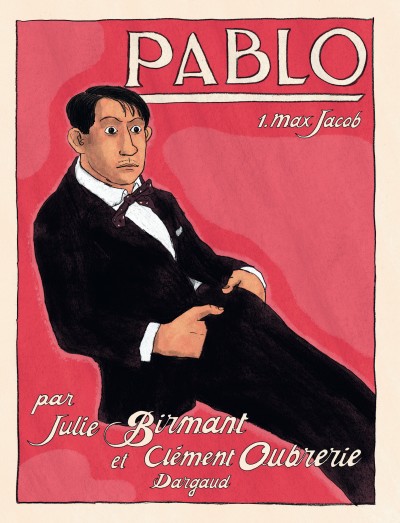
2. Pablo (tome I, Max Jacob), by Julie Birmant (text) et Clément Oubrerie (illustrations).

The first of four volumes, Pablo recounts the daily life of a young Picasso in Montmartre, 1900–1912. Max Jacob, poet and Pablo's roommate, figures prominently as an influence.

3. Nietzsche, by Michel Onfray (text) and
Maximilien Le Roy (illustrations).


This volume follows Nietzsche's quest for happiness, in an attempt to rehabilitate his reputation and position him as a hero for our times.

I hope these books find English translators/publishers some day soon. In the meantime, I suspect I'll be splurging on the above titles anyway, in the interest of practicing my French.

Wednesday, May 09, 2012

A learnt language is just a mask

A learnt language is just a mask, a form of borrowed identity; it should be approached with appropriate aloofness, and its speaker should never yield to the lure of mimicry, renouncing the sounds of his own language to imitate those of another. Anyone who gives in to this temptation is in danger of losing their memory, their past, without receiving another in exchange.

— from New Finnish Grammar, by Diego Marani.

Tuesday, May 08, 2012

Translated books

The winners of this year's Best Translated Book Award were announced last Friday, with the fiction award going to Wiesław Myśliwski's Stone Upon Stone, translated from the Polish by Bill Johnston.

Not having read any of the shortlisted titles, I was faintly rooting for New Finnish Grammar, by Diego Marani and translated from the Italian by Judith Landry, because I actually had a copy of it and was planning to read it soon (in fact, I'm reading it now). My second choice would've been In Red, by Magdalena Tulli and translated from the Polish by Bill Johnston, because I've had it on my shopping list since last September.

So now I'm looking for a copy of Stone Upon Stone, only in Polish (Kamień na kamieniu), cuz it strikes me as something my mother might be interested in reading. (Only it's not so easy to find and it will not be done in time for Mother's Day.)

Here's something to chew on: it's not a new book. The novel was published in Polish in 1984. There was a movie in 1995. The English translation was published December 2010. That's a long time for a book to find an audience beyond the speakers of its original language.

I'll add a word of general praise for Bill Johnston, translator of the winning book and one of the other finalists (see above). This winter I listened to his translation of Stanisław Lem's Solaris — "the definitive edition" — and it was unputdownable (something I never thought I'd say about an audiobook). The credit for this is in part owing to the stunning source material, as well as to the impeccable narration (Allessandro Juliani). This audio experience was vastly superior to that of reading the book (and that's another thing I never thought I'd say with regard to an audiobook) — some time ago I read an English version that was translated via French. All this to say: you're doing a great job, Mr Johnston.

Note, however, that the above-mentioned award is for the best translated book. This is not synonymous with "best translation." It might help to think of it as the best book newly brought to the attention of English readers, which is a collaboration between publisher and translator and dependant on the quality of the source material. Maybe?

I read a healthy amount of translated fiction. Over the last year or so, the predominant source languages have been French and Polish — ironically languages that I am capable of reading in the original (given time, patience, and a dictionary, and acknowledging that they will be read at the expense of any subtlety and nuance in the language).

I detect occasional hiccups in phrasing. These can generally be chalked up to the fact that the books were written in another era (for example, Simenon books of the 30s), or they are "historical fiction" and describing another era (for example, contemporary Krajewski noirs, set in the 30s and prior)— they are not of this millennium.

The very best translators are, of course, absolutely invisible. I don't notice them, and they generally go unheralded.

How about you: do you pay any heed to who translates the foreign fiction you read? (Really, barring novels by the Tolstoys of the world, how often do you get to choose whose translation you're going to read?) Are you concerned about what's lost in translation?

Friday, May 04, 2012

The laws of humanics

"Human beings have ways of thinking about human beings that we have not." Had Giskard been human, the remark might have been made with regret or envy, but, since he was a robot, it was merely factual.

He went on, "I have tried to gain the knowledge, if not the way of thinking, by reading human history in great detail. Surely somewhere in the long tale of human events, there must be buried the Laws of Humanics that are equivalent to our Three Laws of Robotics."

Daneel said, "Madam Gladia once told me that this hope was an impossible one."

"So that may be, Friend Daneel, for though it seems to me such Laws of Humanics must exist, I cannot find them. Every generalization I try to make, however broad and simple, has its numerous exceptions. Yet if such Laws existed and if I could find them, I could understand human beings better and be more confident that I am obeying the Three Laws in better fashion."

"Since Partner Elijah understood human beings, he must have had some knowledge of the Laws of Humanics."

"Presumably. But this he knew through something that human beings call intuition, a word I don't understand, signifying a concept I know nothing of. Presumably it lies beyond reason, and I have only reason at my command."

— from Robots and Empire, by Isaac Asimov.

Wednesday, May 02, 2012

Smudged girls

When I clicked on the lamp, I saw she was still in her dress and her face looked blurry like someone had tried to erase it. And her mouth was like the mouth of a little kid when they eat too much jelly.

I really enjoyed Mathilda Savitch, by Victor Lodato. The prose was so fluid and fresh and honest; every few pages I felt caught off guard, like when you suddenly come across a beautiful poem. It's funny and poignant, and it felt like the perfect book at the perfect time, just when I was bogged down in a pile of books I really wasn't enjoying.

It's about Mathilda, 12 years old, about her sister having died under a train a year previously, about their parents, about living in the grip of terrorism, about being 12. It's all very tragic, really, but it captures very well how very hard it is to be 12.

I love the line above, about her sister's face looking like someone had tried to erase it. It reminds me of a phrase I read recently, about smudged girls, but for the life of me, and I've checked through all the books I've recently read, I can't place it. It might've been, must've been, Simenon. It was just the perfect word, smudge. The girls made up and undone, smudged by excitement or sex or tears, smudged by boys, physically or morally. Mathilda's sister also was smudged. So much in that sad little smudge of a word.

Saturday, April 28, 2012

To nurture the illusion


Basically, as far as Madame Thouret was concerned it was a disgraceful thing to get oneself murdered in an alleyway off the Boulevard Saint-Martin. She had planned her life in every detail, and not only her own life but also that of her family, and murder had no place in her scheme of things, especially this murder, with the corpse wearing brown shoes and a tie that might almost be described as red!

Maigret and the Man on the Boulevard, by Simenon, was my very first Maigret, and I was surprised and pleased to find that there were many similarities thematically to Simenon's romans durs that I've come to know and admire.

It is definitely a more traditional mystery novel — crime committed, police investigate, criminal apprehended.

It happpens that this murder victim had been living a double life. Although he'd lost his job almost three years previously, every morning he dressed and caught the train as if to go to work, and his wife was never the wiser. The wife was very much about keeping up with Joneses, and the man, despite his gripes and what may or may not have been unhappiness, somewhat ironically went to great lengths to keep up appearances.

My feeling is that while in the romans durs the reader faces existential angst from the inside, here Maigret observes it in others from a more tolerable distance. It's altogether softer.

In the old days he had been particularly struck, even one might say romantically stirred, by the sight of those who, discouraged and defeated, had given up the struggle, being swept along will nilly by the great, surging tide of humanity.

Since then, he had come to know many such people, and it was no longer them whom he most admired, but rather those just one step above them on the ladder, who were clean and decent and not in the least picturesque, and who fought day in and day out to keep their heads above water, or to nurture the illusion, or perhaps the faith, that they were alive and life was worth living.

This passage in particular has had the effect of making Simenon somewhat less dark in my eyes, less obsessive, more human, and easier to stomach, as a writer and as a person.

I don't see myself working through the entire Maigret catalogue (well, you never know...), but I do see how the occasional title might serve as a welcome antidote to Simenon's grittier work.

Thursday, April 26, 2012

The woman with three names

Joyce Carol Oates was awarded this year's Blue Metropolis International Literary Grand Prix.

I read one of her novels for the first time the other week, and I didn't like it much.

This past weekend I saw her interviewed by Jack Kirchhoff, Deputy Books Editer of The Globe and Mail, on the subject of her crime novels.

I find Oates to be very creepy. Her physical persona, gaunt, pale, crazy hair that's being restrained, a bit Emily Dickinson, very gothic. Her subject matter too, uncomfortable. Even the book I didn't like, I loved hating it. Felt like rubbernecking.

Oates gave us a brief overview of crime writing as an exploration of the human dilemma, starting with Ovid, through Dickens and Dostoevsky, to the Americans Melville, Hemingway, and Faulkner, and she puts herself in the same lineage.

To write a crime novel seemed more ambitious to her than straight fiction, at which she was already practiced. When she started writing under the pen name Rosamond Smith, the idea was to produce something that was swift-moving and cinematic. She was very witty in describing the experiment of shopping the first pseudoymous novel with a new agent to a new publisher, like she was cheating on her established editorial relationships.

It was an interesting session, but I had a hard time keeping straight when she was talking about her crime novels and when she was speaking more generally about her entire body of work. Kirchhoff did little to keep her on topic, and Oates — you could tell she's done this before — just talked and talked about whatever the last sentence led her to. (The general nature of the discussion meant I decided to forego attending another interview with Oates later in the day.) So this report is a bit scattered, but such was the nature of the hour.

Her writing has a ballad-like structuring, and she refers to Dickens and Hardy quite a bit, with characters that are blind and heedless, but well intentioned.

She quips at one point that one tends to think of psychopaths as male, but then has to clarify to the nervous audience, "That was a joke actually."

She's interested in darkness. Just because you can't see it doesn't mean it doesn't exist.

One of the differences in writing crime is that the tradition demands tying things up; serious fiction allows for irresolute, mysterious endings.

Kirchhoff brought up the point that Oates has been accused of melodrama (but I'm not sure if this was leveled at the crime novels or her fiction in general). She counters that there's little difference between drama and melodrams — Shakespeare was the king of melodrama!

In her early work, Oates felt herself telling a story. Now, she mediates her voice; there's more dialogue.

She likes reading Michael Connelly, and James Ellroy.

Then there are her postmodernist gothic novels (I'm not sure which ones fall into this category). She loves gothic, surreal. She described the spectrum from domestic realism — John Updike, which is beautiful and contained — to the gothicism of Cormac McCarthy, with its rich language and story that is primitive, elemental, and deeply scary.

I think it was in discussing Blonde that Oates went off on a tangent about the United States being "such a tragic, farcical country" and the "demonic forces" among the Republican candidates with their warped nationalism and sense of American exceptionalism, that America is special, and therefore everything about it is good and right. She got pretty worked up. That was something to see.

Of her own novels, Oates' favourites are Blonde (and she spoke at great length about her fascination with Marilyn Monroe, and how public figures can have such vast loneliness), My Sister, My Love (which was suggested by a real-life unsolved case, because we all have the right to speculate, to look at the evidence), and as a straight-up crime novel Take Me, Take Me with You (written as Lauren Kelly).

Definitely I will pick up one of these and give Oates another shot.

Wednesday, April 25, 2012

Suddenly there you are naked

I want to fuck you, is one of the things in the letter.

Also, I am in love with you.

Isn't language amazing? I can't get over it. Sometimes you can just say things and it's like a bomb that blows all your clothes off and suddenly there you are naked. I don't know if it's disgusting or beautiful.

— from Mathilda Savitch, by Victor Lodato.

Monday, April 23, 2012

Simenon and the man who didn't stay to lunch

Circumstances conspired against it. The damp cold on its own might've kept me home with a book and a blanket, but Earth Day manifestations meant roads were blocked and kept other people away from the downtown core and the Blue Metropolis Literary Festival.

Despite a handful of people having expressed interest in Lunch and Literature: A Georges Simenon Salon, only one gentleman actually showed up. He was there with a genuine enthusiasm for Simenon, but he's also on the festival board of directors, and he absolved me of the responsibility of lunching with him. I admit I was a little disappointed, as he claimed to have read all 400 Simenon books, and I'm sure he could've told me a thing or two.

Evidently Joyce Carol Oates, who wrote an introduction to Three Bedrooms in Manhattan, did not feel obligated to attend.

It does make wonder who are all these people reading Simenon and responsible for the renaissance Simenon is reportedly enjoying. Is it you? (Drop me a line. I'm seriously interested in the demographics of the Simenon appeal.)

I have not yet finished all the homework I'd assigned myself. I'm still reading a biography of Simenon. There are a lot of facts in it. And I know for a fact that Simenon was a very interesting man. But ohmygawd-it-is-sssoooo-boring-shoot-me-now. I will skim through what's left of it in hopes of finding some meaningful insight, but I doubt I will find anything worth sharing with you. Simply, I would so much rather be reading a Simenon than reading about Simenon.

I have posted a version of my discussion notes, along with some supplemental material, to their own page. (These notes are subject to further editing for clarity and flow.)

These notes are deliberately very general in nature — even had the event attracted a full room, given Simenon's output there's no guarantee there'd be any overlap in the books everyone had read. The idea was to talk about Simenon in a general way and examine the attraction to his works via some common themes, with a focus on the romans durs (as opposed to the Maigret mysteries). You may find these notes useful in your own discussions on Simenon.

I will consider fleshing out this page with other Simenon resource material. For example, I'd like to add short (50-word) synopses of Simenon titles, something I'd started doing for my own easy reference.

Anyway. I'll keep reading Simenon, and maybe we can try to meet up for lunch again next year.

Sunday, April 22, 2012

On translating DFW

This afternoon at the Blue Metropolis Literary Festival, a dozen or so people (of which I was one) sat in on a discussion panel with author and translator Edoardo Nesi (winner of this year's Strega Prize, Italy's most prestigious literary award) and literary critic Scott Esposito (Conversational Reading), moderated by Juliet Waters, on the difficulties involved in translating the works of David Foster Wallace. Nothing particularly revelatory here to anyone familiar with DFW's work or who's given the problems of translation the slightest bit of thought, but interesting nonetheless.

Nesi very neatly summarized Infinite Jest as a book of weakness, where everyone is incapable of doing the right thing, everyone is recovering from something.

It's agreed that Infinite Jest is a very American novel. When Nesi first urged Italian publishers to take it on, they saw it as a too expensive proposition. It is long, its use of language is intricate, and there's a lot of tennis in it. Nesi, who played tennis as a youth, was well poised to complete the Italian translation that was started by somebody else.

A translation constraint: Since IJ already has copious footnotes, a layer of translation notes wasn't practical, so the translated text really did need to speak for itself, without further explanation.

It's a book a lot of people talk about it Italy, but not so many people have actually read it, daunted by its size (and I'd venture to say that's true among English speakers as as well).

Esposito characterized IJ as positively Dickensian, in how it plays with language (may I add — even revels in it), and the scope of the story — hundreds of pages go by before the strands come together and the connections become clear.

DFW is a unique voice; no one compares to him. Nesi gives the example of Pynchon (with whom DFW is often thrown into the group of American postmodernists), whose Vineland was translated as if it had been written by an "old master." The language of DFW, on the other hand, demands that it be treated fresh.

Waters asked if there was anyone writing in Italian today who might compare. She suggested Umberto Eco — (apart from the footnotes in Foucault's Pendulum, I don't really see it, but) she contends there's something monastic and arcane (and therefore Eco-like?) about The Pale King (which I have not yet read).

To write like DFW, with the "foolish idea" of explaining youth, says Nesi, is too high an ambition for Italians, who have lost the ability to explain their own country.

There is no French translation of Infinite Jest. The conversation touched briefly on whether and how to preserve the grammatical errors and misspellings in DFW's French (given his meticulousness, it's hard to imagine these weren't deliberate, no matter his rationale for them). Also, how it might be politically touchy.

I had assumed a French translation would be rendered in Quebec French. I think the language allows for an Americanness of spirit, and with more registers, than France French. But I didn't think to ask about this. Also, I missed the chance to ask if someone could enlighten me on Gilles Duceppe's role in endnote 304.

On a side note, I know what this summer's big read is. I'm in, and I'm psyched.

Saturday, April 21, 2012

Reeling from the rot

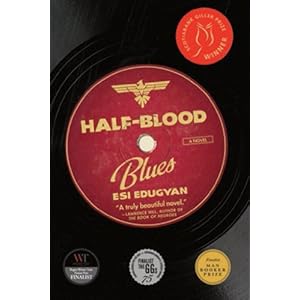
Esi Edugyan is the author of Half Blood Blues. Her second novel, it won the 2011 Giller Prize and was a finalist for several other awards, including the Governor General's Award and the Booker. I have not read this novel yet, but it's been on my list owing to the endorsement given it in Kim's review at Reading Matters.

This afternoon she was interviewed on stage by Shelagh Rogers, and Shelagh asked the question that I'm sure is on everybody's mind: "Did The Wire have anything to do with this book?" The answer is No.

Shelagh asked because some of the characters hail from Baltimore, and there's something in the clip of the language in that television program and in this novel that's similar. Esi later came back to The Wire actually, in talking about the time she lived in Baltimore, that it's a city of stories, if you get into a cab you're going to hear a story, and that it's weird, and well, very much like it's depicted in The Wire (a show I've never seen, but which comes highly recommended — maybe I'll start watching it tomorrow).

The novel is about a group of jazz musicians in Nazi Germany. Today's conversation discussed some of its themes: whether talent is "god-given" and how it differs from genius; the black experience in the Weimar Republic and the seeming randomness and sometime contradiction in its laws with regard to... what's the correct term here? non-Aryans? (for example, a Jewish teacher was fired and replaced by an African-German teacher); the nature of friendship, how people slip into patterns in any relationship, and whether friendship can withstand betrayal (of which there's some in the story); how creativity thrives (or not) under an oppressive regime; how we define and establish identity, whether by blood or geography (which reminds me of some of what Vasily Grossman had to say in Life and Fate).

It's clear that Esi did a lot of research in writing this novel, on the dialect and slang, on Berlin, on jazz, the politics and the day-to-day circumstances of the time, on Louis Armstrong. She admits that several elements (what Louis said, or some of the slang terms) may not be true to life, but she feels no qualms about this because she believes them to be true to the spirit. (When she was taking journalism classes she shied away from doing interviews for her assignments to the point of making up quotes — a sign, I think, that fiction was a better career choice.)

I picked up a copy of the book and had it signed afterward, and felt like an idiot for having nothing to say, just "I hear it's really good," which may be the dumbest thing I've ever said to an author. But truly, I'm more eager to read this now after having heard her — she's thoughtful in her responses, seems very sweet and honest if shy, and really does have a lot to say about all sorts of things.

Excerpt from Half Blood Blues:
Chip told us not to go out. Said, don’t you boys tempt the devil. But it been one brawl of a night, I tell you, all of us still reeling from the rot – rot was cheap, see, the drink of French peasants, but it stayed like nails in you gut. Didn’t even look right, all mossy and black in the bottle. Like drinking swamp water.

Friday, April 20, 2012

The sound of things

I'd planned to see Colombian writer Juan Gabriel Vásquez this evening at the Blue Metropolis Literary Festival, but the event has been cancelled.

Vásquez's 2007 novel The Secret History of Costaguana (published in English translation in 2010) riffs off of Joseph Conrad's Nostromo, a book I've been trying to read for the last 26 years, and it occurred to me that Vásquez might be my way into that story.

His first novel, The Informers, is about Colombia's Jewish and German Immigrant populations, and The Sound of Things Falling (I love this title!), due out in English later this year, tackles the subject of the drug trade.

I'm disappointed that I won't have the chance to hear Vásquez speak (but this means I can spend the evening going over my notes in preparation for talking about Simenon on Sunday).

I'll be back at Blue Met tomorrow, and I'll be checking out the onsite bookstore for Vásquez's novels too.

Further reading

Thursday, April 19, 2012

Hot art

This evening I attended Blue Metropolis Literary Festival event Crime Writing: Hot Art and Montreal.

Joshua Knelman, author of Hot Art: Chasing Thieves and Detectives through the Secret World of Stolen Art, spoke about the state of international art theft. The book came about from an award-winning article he wrote for The Walrus, of which he is a founding member.

I have not read his book, but I am fascinated by the subject. Here's what he said in a Q&A on the Indigo non-fiction blog:

The minute a Picasso is stolen from a museum there are pictures of it in every paper across the world, with the value of the painting, every auction house and art gallery knows this piece has been stolen, every collector knows its been stolen. It's a headache for the thieves because suddenly everyone is looking for this painting. It's a headache for the police because if it's a really famous painting stolen from a cultural institution the police get pressure from the political side.

Headache art cases make up about 5% of what is actually stolen every year. So you're talking about a very small piece of the art theft pie but it gets probably 95% of the media attention. So again it's the complete inverse.

He's out to dispel the glamour I (and many others) tend to associate with this type of crime.

Most stolen art is worth a fraction of a Picasso, but theft from private collections is apparently going on all the time — it adds up to ahuge black market art industry.

It's complicated by the difficulty of establishing a work of art's provenance, and the fact that the business of art is completely unregulated. Further, very few people are equipped with the knowledge of art and understanding of how the art world operates required to investigate crimes of this nature. The people who do have specialized knowledge are usually dealers and collectors, who with their interests at heart very often turn a blind eye. Art cops are few and far between.

For about an hour Knelman talked about his research, with anecdotes about the art thiefs and the detectives he's met who devote themsleves to this niche — and how remarkably similar their skillsets are.

I still think it's glamorous, and I'm thinking about a career change.

Read Joshua Knelman's article "Artful Crimes" for a taste.

Art theft fiction
Since I tend to turn to fiction, here are some titles I dug up — novels that involves art theft, though generally of the more sensational kind. I'm somewhat surprised there aren't more, but it occurs to me that art crime doesn't need fictionalizing to be a good story.

  • The Raphael Affair, by Iain Pears — Featuring detective art historian Jonathan Argyll investigating the destruction of a newly discovered painting thought to be by Raphael.
  • Doors Open, by Ian Rankin — A bored, self-made man decides to commit the perfect crime: rip off the National Gallery of Scotland.
  • Artists and Thieves, by Linda Schroeder — By day Mai Ling recoveres stolen art for Interpol. But she is also duty-bound by her family to steal a priceless object, and return it to China.
  • The Rembrandt Affair, by Daniel Silva — Retired spy Gabriel Allon is pulled into a race across the globe when an art restorer is murdered and a portrait by Rembrandt stolen.

Art appreciation?
Complex as it is to pull off a theft of this nature, and as beautiful as the objects of these crimes are, what intrigues me most is the question of who is actually in the market for stolen art. I imagine the filthy rich eccentric who goes down to his cellar occasionally to admire the genuine Mona Lisa that hangs there. (See also The Eiger Sanction, by Trevanian, whose protagonist is an assassin and an art collector.)

But the idea of such a connoisseur isn't very realistic either. Stolen art tends to move to dealer to dealer to collector to auction house to dealer, etc. It's not about the art — it's the money.

Making everything ordinary too beautiful to bear

There were phrases of Beethoven's Ninth Symphony that still made Coe cry. He always thought it had to do with the circumstances of the composition itself. He imagined Beethoven deaf and soul-sick, his heart broken, scribbling furiously while Death stood in the doorway, clipping his nails. Still, Coe thought, it might have been living in the country that was making him cry. It was killing him with its silence and loneliness, making everything ordinary too beautiful to bear.

— from "The Man with the Miniature Orchestra," by Dave Algonquin.

Wednesday, April 18, 2012

A sense of futility

Four blacks slid the coffin into the too-shallow hole. They used hoes to rake the dirt over it.

The idea that one day he might also be interred like this made Timar unbearably conscious of his life since La Rochele. This wasn't a cemetery! This wasn't a burial! He wasn't at home!

My God! How did I get here! And hours later:

At that point it wasn't just the misery of homesickness that had him in its grip: it was a sense of futility. The futility of being here! The futility of struggling against the sun that penetrated his every pore. The futility of the quinine that lifted his spirits and that he swallowed every night. The futility of living and dying, only to be buried in a fake cemetery by four half-naked blacks.

Set in and around Libreville (Gabon), the events of Simenon's Tropic Moon are presumably fairly contemporary with its 1933 publication.

I had a harder time getting into this book than I have had with any other Simenon novel. It thought it might be because it's a relatively early novel, but I checked the dates of the ones I've read, and no, that's not it.

I think it's because it's heavy on the foreignness of Africa, and I need a certain frame of mind for that sort of thing.

The story: Joseph Timar arrives in Libreville — his uncle had arranged a job for him. Within 48 hours of arriving, he's had an encounter with the hotel proprietor's wife, a black servant is murdered, and the proprietor himself dies of snail fever. There are racial tensions, the local government operates pretty loosely, and Timar finds that Adèle's been pretty, um, friendly with a lot of the white men about town.

Anyway, it's really short (133 pages), and there's a huge payoff — the final scenes are unforgettable.