"I know it's temporary." But this is her secret: she doesn't want it to end. What she can never tell Pablo, because he disdains all things corporate, is that she likes being at Neptune Logistics more than she likes being at home. Home is a small dark apartment with an ever-growing population of dust bunnies, the hallway narrowed by Pablo's canvases propped up against the walls, an easel blocking the lower half of the living room window. Her workspace at Neptune Logistics is all clean lines and recessed lighting. She works on her never-ending project for hours at a time. In art school they talked about day jobs in tones of horror. She never would have imagined the her day job would be calmest and least cluttered part of her life.
I've only ever had one workspace that was actual clean lines and recessed lighting, but several that felt at one time or another preferable to home, so I get it. But that's changed for me in recent times; most days there's no place I'd rather be than home. (Well, except maybe Venice.)
And I think I may start referring to my job as a day job, with all that implies. Life is elsewhere, but a day job finances it.
I'm not sure what made me turn to this novel this week, and I was quite prepared to hate it as an overhyped, unmeritedly trendy, pale shadow of a proper dystopia, but I'm digging it. It's got a very Atwood vibe, with the Shakespeare and the sci-fi comic, but somehow warmer, less cynical, more naive.
It's early pages yet, and this may turn out to be the great lesson of the novel, but it seems to me that the pre-apocalyptic days are in many ways sadder than what comes later. Maybe the epidemic serves as a reset. Maybe this is wishful thinking on my part.
My mother's a news junkie. It started a few years after my father died. About the time we moved into our new house; we got cable and CNN was new. It took that long, I think, for her to come to terms, identify herself as an individual, and direct her energies for once to the external world. It made her feel alive to know what was happening all around her.
I stopped watching the news when my daughter was born. It was too terrible to bear. Not like I was an addict going cold turkey or anything. But The News was suddenly unimportant yet painfully threatening. It impinged on the internal world I was trying to nurture.
[I'm cured now, more or less. The kid is older, I have other survival mechanisms in play. I follow the news at a distance, and sometimes a bit closer, out of a sense of civic duty.]
The Transcriptionist, by Amy Rowland, reminds me how fragile we are in this world where unspeakable horrors happen 24/7. Lena is the only transcriptionist, the last one, at a major New York newspaper.
The room is the color of old opossum or new pumice, the color of newspaper without ink. Gray.It is the room where the transcriptionist, or, in the perplexing vocabulary of the corporate world, Recording Room operator, sits alone all day with a headset and a Dictaphone and transcribes all the words that have been recorded for the Record.
She survived the news frenzy that was 9/11; what undid her was the story of a woman she recognized as having met in passing, a blind woman who deliberately, knowingly, swam to her death, swam the moat at the zoo to be devoured by lions.
is about one lowly worker questioning the role of the newspaper as an institution, and about how newspapers are facing the challenges and the new reality of the time we’re living in. If we tell ourselves stories about ourselves in order to know who we are, then for more than a century newspapers have been the backbone of a collective sense of community. In this new world of virtual living, what will bind us together?
There's a quirky cast of journalists and other newsroom workers. Lena also befriends a pigeon on the ledge outside her window, but even that has a seamy underbelly.
One man is devoted to preserving the files of obituaries, not mere death notices, but the paeans to the news makers, most written years in advance, in anticipation of death, as if only death gives life newsworthy meaning. Recognize it when its gone.
"Obits mark the lives that define us as a nation; they embody the moral imperative of the newspaper, one that is slipping away."
You learn things about humanity from a newspaper, but very little about individuals. Thanks to social media we now know everything about individuals but this data rarely coalesces into anything bigger than itself. The Transcriptionist gently reminds the reader to see the forest, see the trees. Seize the day, do the right thing, follow your gut, live a little.
This is a loving and tender novel, that evokes the sepia tones of a bygone era, even while it's set in this century.
Lena is always disappointed anew at the room, where instead of bald, bespectacled men typing with one heavy hand and reaching into the drawer for the bourbon bottle with the other, it is the usual corporate subdivision: well-medicated activity, soundless keypads, and clusters of low-partitioned cubicles in a rectangle that spans the entire floor.
[Where does that cliche come from, Editorial with its hands on the bourbon, surely it predates Lou Grant. I've done my best to perpetuate it in the department I work in, you never know when bourbon might come in handy. Of course, we're not dealing with the heart-crushing news of the outside world, just fighting the relatively minor but daily soul-sucking battles for editorial integrity in a company that has lost sight of its raison d'être and is quickly spiralling down the existential vortex that portends financial, not only moral, bankruptcy. Ah, bourbon.]
I was waiting at the bus stop, for the bus, when it started to rain,
not a downpour but it had more vehemence than a drizzle. It didn't last long;
in fact, by the time I looked up, trying to decide whether or not
to put away my electronic device, and saw people still rummaging
in their bags for forgotten umbrellas, it was over.
Only, I know it had actually rained. I know this because a small
but not insubstantial drop had fallen on the touchscreen of my ereader
with sufficient force to select a word and call up its definition: "right."
/rīt/ adj. 1 Morally good, justified, or acceptable: I hope we’re doing the right thing | [WITH INFINITIVE]: you were quite right to criticize him 2 true or correct as a fact
That's all I read before I closed the cover. Right as rain.
Later, in the bus, I wiped away the stains of raindrops
left on my screen. They might have been tears.
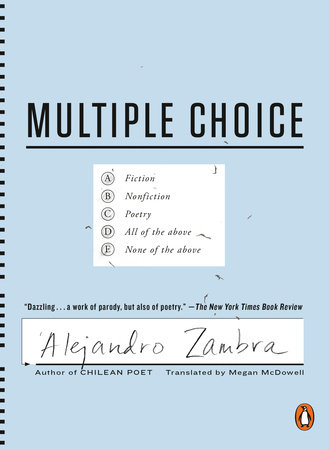
Multiple Choice, by Alejandro Zambra, is fiction, nonfiction, poetry, something more, and something else entirely. It consists of 90 thought experiments, creating one big meta thought experiment about narrative. It is structured in the form of a standardized test (complete with a sheet on which you can mark your responses), 5 sections that cover skills like word choice, sentence order, and reading comprehension.
For example, for the following exercise, mark the answer that puts the sentences in the best possible order to form a coherent text.
31. Relatives
1. You group them into two lists: the ones you love and the ones you don't.
2. You group them into two lists: the ones who shouldn't be alive and the ones who shouldn't be dead.
3. You group them according to the degree of trust they inspired in you as a child.
4. For a moment you think you discover something important, something that has been hanging over you for years.
5. You group them into two lists: the living and the dead.
A) 1-3-4-5-2
B) 5-2-1-3-4
C) 1-3-5-2-4
D) 3-4-5-2-1
E) 1-2-3-4-5
(I answered B. Or maybe A.) Wouldn't you love to discuss this question with your family? The conversational tangents it inspires!
I'd like to present some of these exercises to my team of editors, so we could debate the subtleties in meaning between, for example, "but," "yet," and "notwithstanding," what order of facts and opinions conveys the most effective emphasis, which sentences aren't essential to moving the narrative forward.
It was a perfect read for me, the perfect time and place, serving to slow me down. In this way the book was much like poetry. Read a page, think about it, let it sink in, reconsider it. It's a short book, but it demands a lot of breathing space. It has served to make me feel really smart, and also really stupid. That's a good thing.
I rather wish that more books would not merely invite but forcibly ask me to pause and reflect on what I read.
Multiple Choice failed completely to make an impression upon people I know, some off whom are actual readers. It's as if by physically pressing the book upon them, forcing them to cast their eyes across a sample "question," was like making them sit an actual exam. One person was outraged that there was no answer key. What do you mean there are no answers!
I think that this story and the book as a whole argue against the illusion of a single right answer. But it’s also a book about the wish for that answer, the naïve or visceral desire for there to be a truth. In “Multiple Choice,” I was interested in the question of how those structures mark you: the rhetoric of options, distractor questions, the true and the false—that whole complex and crude game, deeply ideological, of exclusions and inclusions.
All highlighted the significance of context: how context predominantly figures in shaping an experience for a "reader." For example:
Experiencing the last 4 minutes of JFK's life through sound and smell ("Famous Deaths") only becomes art because we know how it ends, and we're aware of its historical significance. I mean, on its own, in isolation of context, it stands as an aesthetic juxtaposition of audio and olfactory cues — but I could guess at the smells only because I could line up the accompanying sounds with footage I've previously seen. What a person brings to the experience in terms of their knowledge and expectations is what makes it a meaningful narrative. The mortuary fridge you're rolled into enhances the anticipation of death.
A video game that consists of a police database which the user can query ("Her Story") has no structure; it's driven entirely by the user's interests. When I first sat down at the terminal, I was at a loss; it felt a little bit like work. If this is a police database, I've been cast in the role of investigating officer. Where to start? I reasoned, a police database must have something about murder in it, so that was my first keyword search, which delivered some video footage, which soon had me asking, who's Hannah? and, what baby? Every session will yield a different story.
Blindness experienced through a VR headset ("Notes on Blindness") might seem like a contradiction in terms, but the flashes of light begin to take shape according to sound prompts. The experience is inspired by and complemented with the audio recordings of John Hull, a theologian who with a scientist's precision documented his experience of going blind. (The associated film, by contrast, I have no interest in seeing — the trailer leads me to expect an overly sentimental drama that emotionally manipulates its audience, playing on themes of loneliness vs connection rather than on the cognitive aspects of blindness that are so much more interesting to me.) The most poetic of the chapters in this VR experience dealt with rain and with wind. He describes the rain as a blanket that gives things shape and dimension (think: the sound of rain on metal vs glass, on the roof vs the window, in tight alleys vs open fields). Wind is the equivalent of a sighted person's clear and sunny day, bringing one's surroundings to life.
A short film unfolds according to decisions the audience makes via mobile devices ("Late Shift"). A choose-your-own-adventure movie, only you're not watching alone; the direction of the narrative is based on majority votes. Some of the decisions are straightforward yes-no scenarios, but others ask you to take a more philosophical perspective (selfish or selfless?), thereby defining character and moral context. And some questions frustratingly don't offer as an option your preferred course of action. One unsettling aspect is that the story doesn't always go the way you want it to go. You wonder who your neighbour is, do they believe what you believe, what is their motivation.
Of these examples, I feel that Death and Blindness don't entirely fit the storytelling mould — they don't tell a story so much as share an experience. Zambra's book would be a perfect conceptual fit for this exhibition, but perhaps, being print-based, it would be considered too traditional.
In Vancouver a little while ago we peeked in on the exhibit Becoming Animal/Becoming Landscape at the Morris and Helen Belkin Art Gallery at UBC, which explores works "through the lens of recent philosophical ideas, questioning and breaking down old borders between the human and the non-human."
For me it expressed some ideas about our relationship to nature, and how strong a force our environment is in shaping us and our technology, but it also coalesced some ideas that were germinating in me after having travelled from Montreal to Vancouver by train, and venturing north by car and by ferry to the gateway to the Great Bear Rainforest. (Curator's talk: "...based on mapping... travelling through the landscape, and when you do that, the landscape begins to saturate you and you become the landscape." (We are becoming landscape.))
Notably, the exhibit included works by Lawrence Paul Yuxweluptun, to whose work I'm glad to be introduced, and Emily Carr, for whom I have fresh appreciation now that I've seen the northwest landscape she strove to express.
(I must admit, I was a bit horrified to be confronting some sexual/erotic pieces in the company of both my daughter and my mother. To her credit, my mother was able to take away some insight into and appreciation of technique within the context of my brother's artwork, the whole purpose of our journey west being to scatter his ashes. (He is becoming landscape.))
One overtly bookish component of the exhibit was Marina Roy's "Thumb Sketches."
The work consists of a series of paperbacks of literary classics from the Western cannon, flayed to show Roy's ink paintings on the edges. They are scatological and lightly pornographic, but quite funny — visual responses to or subtexts of the particular novel.
In a statement on her website, Roy writes:
In the pile-up of language and spectacle which constitutes our amnesiac present, one role for art is to create a clearing within our petrified landscape, and, through a reordering all this new and obsolete stuff, through bricolage and play, construct new meanings, new conceptions of reality, shot through with historical memory, utopian aspirations, and pleasure.
Cross-disciplinary in scope, my artwork investigates the intersection between materials, history, language, and ideology. It is my hope that the work addresses the need for a post-humanist perspective, counter to the dictates of humanistic hubris and its entrapment within binary power dynamics. Art can act as a bridge between culture and nature, ethics and drive.
I'm a big fan of this intersection of language and art, and will be hunting down her book about the letter X.
I understood only later that I can be quietly unhappy, because I'm incapable of violent reactions, I fear them, I prefer to be still, cultivating resentment.
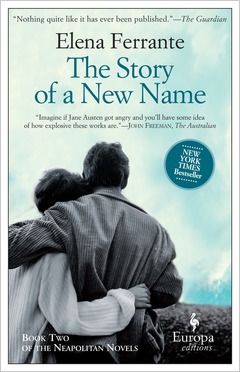
Indeed Elena (Lena) cultivates much resentment toward Lila in this second of Elena Ferrante's Neapolitan novels, The Story of a New Name.
This novel focuses on Lila, the grocer's wife. It's the story of her marriage, its dissolution, a marriage that was over before it began, as book one had ended with the realization that her husband had essentially sold her out, trading her ideals and ideas, dreams and designs, for some thug's cash and empty promises, a man who'd once wooed her and who she'd sworn would never own her. And it's all downhill from there. This is the story of her miserable married life, with her wretched husband's name.
Elena spends these years preoccupied with the idea of escaping her fate.
Did Alfonso also conceal Don Achille, his father, in his breast, despite his delicate appearance? Is it possible that our parents never die, that every child inevitably conceals them in himself? Would my mother truly emerge from me, with limping gait, as my destiny?
Elena holds on to the belief that education is her key to leaving the neighbourhood. For someone who pursues the life of the mind, she is very much trapped by her body.
Suddenly it seemed to me that I had lived with a sort of limited gaze: as if my focus had been only on us girls, Ada, Gigliola, Carmela, Marisa, Pinuccia, Lila, me, my schoolmates, and I had never really paid attention to Melina's body, Giuseppina Pelusi's, Nunzia Cerullo's, Maria Carracci's. The only woman's body I had studied, with ever-increasing apprehension, was the lame body of my mother, and I had felt pressed, threatened by that image, and still feared that it would suddenly impose itself on mine. That day, instead, I saw clearly the mothers of the old neighborhood. They were nervous, they were acquiescent. They were silent, with tight lips and stooping shoulders, or they yelled terrible insults at the children who harassed them. Extremely thin, with hollow eyes and cheeks, or with broad behinds, swollen ankles, heavy chests, they lugged shopping bags and small children who clung to their skirts and wanted to be picked up. And, good God, they were ten, at most twenty years older than me. Yet they appeared to have lost those feminine qualities that were so important to us girls and that we accentuated with clothes, with makeup. They had been consumed by the bodies of husbands, fathers, brothers, whom they ultimately came to resemble, because of their labors or the arrival of old age, of illness. When did that transformation begin? With housework? With pregnancies? With beatings? Would Lila be misshapen like Nunzia? Would Fernando leap from her delicate face, would her elegant walk become Rino's, legs wide, arms pushed out by his chest? And would my body, too, one day be ruined by the emergence of not only my other's body but my father's? And would all that I was learning at school dissolve, would the neighborhood prevail again, the cadences, the manners, everything be confounded in a black mire, Anaximander and my father, Folgóre and Don Achille, valences and the ponds, aorists, Hesiod, and the insolent vulgar language of the Solaras, as over the millenniums, had happened to the chaotic, debased city itself?
Life goes on. Lena applies herself to her studies. Lila is her opposite, in every way, in everything.
And then Lena is crushed by love.
I made the dark descent. Now the moon was visible amid scattered pale-edged clouds; the evening was very fragrant, and you could hear the hypnotic rhythm of the waves. On the beach I took off my shoes, the sand was cold, a gray-blue light extended as far as the sea and then spread over its tremulous expanse. I thought: yes, Lila is right, the beauty of things is a trick, the sky is the throne of fear; I'm alive, now, here, ten steps from the water, and it is not at all beautiful, it's terrifying; along with this beach, the sea, the swarm of animal forms, I am part of the universal terror; at this moment I'm the infinitesimal particle through which the fear of every thing becomes conscious of itself; I; I who listen to the sound of the sea, who feel the dampness and the cold sand; I who imagine all Ischia, the entwined bodies of Nino and Lila, Stefano sleeping by himself in the new house that is increasingly not so new, the furies who indulge the happiness of today to feed the violence of tomorrow. Ah, it's true, my fear is too great and so I hope that everything will end soon, that the figures of the nightmares will consume my soul. I hope that from this darkness packs of mad dogs will emerge, vipers, scorpions, enormous sea serpents. I hope that while I'm sitting here, on the edge of the sea, assassins will arrive out of the night and torture my body. Yes, yes, let me be punished for my insufficiency, let the worst happen, something so devastating that it will prevent me from facing tonight, tomorrow, the hours and days to come, reminding me with always more crushing evidence of my unsuitable constitution. Thoughts like that I had, the frenzied thoughts of girlish discouragement.
It's a heartbreaking scene; Lena is betrayed by her childhood friend and by her childhood crush. She doesn't see it that way then; she lets is wash over her, and she betrays herself that night.
But ultimately, this is the experience that leads her to write, which solidifies for her a life outside of Naples.
As emotional as the romantic revelations are, what led me to tears was the possibility that Lena's education might be over, "I cried and cried, as if I had carelessly lost somewhere the most promising part of myself," that she might resign herself to a life in the civil service, in Naples.
The title of this book also might apply to Lena as well as it does to Lila. At the end of this volume, Lena's family is examining a copy of her newly published book. Her father recognizes his own name on the cover, but Lena claims it as her own. And even while she is anticipating taking her fiance's name,she intends to keep this name on her future books.
She has found some success, but she's not done measuring it.
I understood that I had arrived there full of pride and realized that — in good faith, certainly, with affection — I had made that whole journey mainly to show her what she had lost and what I had won. But she had known from the moment I appeared, and now, risking tensions with her workmates, and fines, she was explaining to me that I had won nothing, that in the world there is nothing to win, that her life was full of varied and foolish adventures as much as mine, and that time simply slipped away without any meaning, and it was good just to see each other every so often to hear the mad sound of the brain of one echo in the mad sound of the brain of the other.
Train travel is an exercise in suspension, of both time and space; the days blur, we are carried suspended across the land, just above it. After travelling four days by train, we arrived in Vancouver.
The garden was built just a few decades ago, but in honour of ancient principles. Somewhat surprisingly, plants are not the main element of a Chinese garden; they rank lower in importance than the foundational element of architecture, and the elements of rock (textured and weathered) and water (deliberately clouded, for better reflection).
It is less controlled than a Japanese garden, but no less careful. It is walled, contained. Vancouver skyscrapers are visible above the pagodas, in perfect balance; this garden belongs here.
There are couplets on the walls.
Courtyard ever green
all four seasons with
blossoming trees
Perfect right here
one fine volume
of poetic inspiration
We said nothing concrete, I still have those letters [...]. We focused, let's say, on a book he had read, on an article of interest for our studies, on some reflection of his or mine, on unrest among certain university students, on the neo-avant-garde, which I didn't know anything about but which he was surprisingly well acquainted with, and which amused him to the point of inspiring him to write: "I would like to make a book out of crumpled-up pieces of paper: you start a sentence, it doesn't work, and throw the page away. I'm collecting a few, I would have the pages printed just as they are, crumpled, so the random pattern of the creases is interwoven with the tentative, broken-off sentences. Maybe this is, in fact, the only literature possible today."
For a cross-country train journey, people bring a lot of books. But I saw more people carrying them than actually reading them. It's too easy to be distracted by scenery, or sleep. I certainly read far less than I had hoped to.
Although it boasts an activity car, a dining car, and a panorama car, The Canadian clearly lacks a library car.
But I was heartened to see this book exchange basket at the train station in Jasper, Alberta, full of good intentions.
It was like crossing a border. I remember a dense crowd and a sort of humiliating difference. I looked not at the boys but at the girls, the women: they were absolutely different from us. They seemed to have breathed another air, to have eaten other food, to have dressed on some other planet, to have learned to walk on wisps of wind. I was astonished. All the more so that, while I would have paused to examine at leisure dresses, shoes, the style of glasses if they wore glasses, they passed by without seeming to see me. They didn't see any of the five of us. We were not perceptible. Or not interesting. And in fact if at times their gaze fell on us, they immediately turned in another direction, as if irritated. They looked only at each other.
As he reads, his eyes graze each poem's lines like a needle over an LP's grooves, atomizing them into letters, reassembling them into uniform arcades. What he's looking for is a key: a gap in the book's mask, a loose thread to unravel its veil. He tries tricks to find new openings — reading sideways, reading upsidedown, reading whitespace instead of text — but the works always close ranks like tiles in a mosaic, like crooks in a lineup, and mock him with their blithe expressions. The usual suspects.
I've begun reading The Mirror Thief, by Martin Seay. The first page didn't feel right, maybe not my cup of tea after all. The first major section is set in Vegas. But before I knew it, I couldn't stop reading. The focus is on Stanley, everybody's looking for him, trying to discover his whereabouts. The second major section takes us to California, back in time to Stanley's youth. This didn't feel right either, the change in locale and tone, another cup of tea that isn't mine. But I am learning that all Stanley's movements centre around a book.
The Mirror Thief is a book about a book called The Mirror Thief. It is starting to feel like a booklover's book.
(This book feels overly masuline. I don't know what I mean by that. I think that's why it doesn't feel right. Maybe it's just the wrong time and place for me to be reading this book. I'm enjoying it, but something just doesn't feel right.)
It is difficult, but probably necessary, to remember that books always know more then their authors do. They are always wiser. This is strange to say, but it's true. Once they are in the world, they develop their own peculiar ideas.
On December 31st of 1958 Lila had her first episode of dissolving margins. The term isn't mine, she always used it. She said that on those occasions the outlines of people and things suddenly dissolved, disappeared. That night, on the terrace where we were celebrating the arrival of 1959, when she was abruptly struck by that sensation, she was frightened and kept it to herself, unable to name it. [...] now she felt content, watching the streaks of fire in the sky. But suddenly — she told me — in spite of the cold she had begun to sweat. It seemed to her everyone was shouting too loudly and moving too quickly. This sensation was accompanied by nausea, and she had had the impression that something absolutely material, which had been present around her and around everyone and everything forever, but imperceptible, was breaking down the outlines of persons and things and revealing itself.
[...] How poorly made we are, she had thought, how insufficient.
[...]But that New Year's Eve she had perceived for the first time unknown entities that broke down the outline of the world and demonstrated its terrifying nature.
My Brilliant Friend,by Elena Ferrante, is, I believe, everything it's cracked up to be and quite possibly more.
The dissolving margins at first are like a migraine, but then grow out of control, even into mental illness. It is a fractured view of the world, filtered through the clarity of pain. How will Lila turn out? Will she be broken? Or will she transcend the material world, become one with its terrifying nature?
My Brilliant Friend is the story of two friends, documented from the time of their childhood in 1950s Naples, both of them brilliant in their own way. They are competitive with each other, particularly in terms of academics, but this spills over into what they wear, who they associate with, and boys. They admire and inspire each other, but they are still adolescent girls with confused motivations. Since it's written from a first-person perspective, I assumed the title was Lena refering to Lila. But it's late in this book that Lila calls Lena her brilliant friend. So is Lena writing Lila's story? Or is she really more interested in putting her own story forth?
But I did it without conviction: I did many things in my life without conviction; I always felt slightly detached from my own actions. Lila, on the other hand, had, from a young age — I can't say now precisely if it was so at six or seven, or when we went together up the stairs that led to Don Achille's and were eight, almost nine — the characteristic of absolute determination.
They have different temperaments, but they grow up in the same neighbourhood, in similar circumstances. However, their paths diverge when Lila is denied the opportunity to go to high school.
She also asked me about the Aeneid, she was crazy about it. She had read it all in a few days, while I, in school, was in the middle of the second book. She talked in great detail about Dido, a figure I knew nothing about, I heard that name for the first time not at school but from her. And one afternoon she made an observation that impressed me deeply. She said, "When there is no love, not only the life of the people becomes sterile but the life of cities." I don't remember exactly how she expressed it, but that was the idea and I associated it with our dirty streets, the dusty gardens, the countryside disfigured by new buildings, the violence in every house, every family. I was afraid that she would start talking about Fascism, Nazism, Communism.
Depite claiming to lack conviciton, Lena is hard-working and ambitious. Lila's "determination," on the other hand, stems from confidence (is it feigned?) and certainty — her life is not easy, but everything seems to come naturally to her. Lena's brilliance is studied; Lila's brilliance is free-spirited and creative.
She said, in dialect, "You still waste time with those things, Lenu? We are flying over a ball of fire. The part that has cooled floats on the lava. On that part we construct the buildings, the bridges, and the streets, and every so often the lava comes out of Vesuvius or causes an earthquake that destroys everything. There are microbes everywhere that make us sick and die. There are wars. There is a poverty that makes us all cruel. Every second something might happen that will cause you such suffering that you'll never have enough tears. And what are you doing? A theology course in which you struggle to understand what the Holy Spirit is? Forget it, it was the Devil who invented the world, not the Father, the Son, and the Holy Spirit. Do you want to see the string of pearls that Stefan gave me?" That was how she talked, more or less, confusing me.
This first book of the quartet ends with Lila's wedding. She's barely 16.
But it wasn't the ordinary conflict between mother-in-law, daughter-in-law, sister-in-law. I had the impression, from the way she used me, from the way she handled Stefano, that she was struggling to find, from inside the cage in which she was enclosed, a way of being, all her own, that was still obscure to her.
The trumpet announced that life was beautiful, while the violin, barely keeping up, wept drunkenly that it was too fleeting.
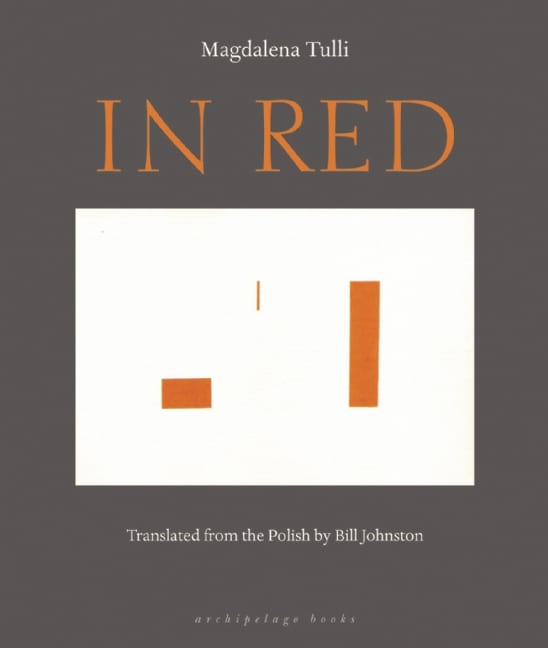
In Red, by Magdalena Tulli, is one of the most difficult and peculiar books I've read in recent memory. I recall hearing about it upon the publication of the English translation — it's been on my list for a few years — I was sold on the promise of its poetic and fabular qualities. And this short book has plenty of that.
But I read it without really understanding it; I enjoyed parts of it thoroughly, but other parts simply mystified me. For a synopsis of the story, such as it is, you would be best served by reading the review at KGB Bar Lit Magazine.
In Stitchings it is always winter. It is a town with a port (and therefore northern). But it has salt mines (of which southern Poland has a few).
The jacket copy says it's set in an imaginary fourth partition of Poland, that it "retraces the turbulent history of the twentieth century." The third partition of Poland had divided its land among the Austrian, Prussian, and Russian empires, effectively wiping Poland off the map for 123 years, until the Treaty of Versailles restored Poland. This is the nonexistent Poland my grandparents grew up in.
In Red begins just before Archduke Ferdinand is assassinated in 1914, and war sets the town into motion, if you can call it motion. It's perpetual motion, without direction. The town's affairs, we're told, are interwoven with those of the Swedish garrison,
Its very existence should be regarded as an especially favorable sign, bearing in the mind that a Swedish garrison is better than any Russian, Prussian, or Austrian one, just as a Swedish partition is better than any other possible partition.
It's to Stockholm that the necessary documents are sent. So this then is an imaginary third partition, one that unfolded differently than the history books would have it. The third partition dissolved Poland, there was no territory left to partition; presumably the fourth partition happens after the country is re-established: But there is no Second Republic of Poland in this fiction. The hussars were dealt with by the Germans, and then the Austrian military police. The proclamation announcing the creation of the Kingdom of Poland was read by a German lieutenant.
This "new" country is not partitioned (it is not shared) so much as occupied, overrun, subsumed.
No one noticed exactly when the snowflake that appeared on Strobbel & Slotzki's products changed its shape. From that time on, each of its four arms was bent at a right angle, like the wooden rulers with which Slotzki was so prodigal.
In Red is not tracing the history of the twentieth century so much as recounting the Weimar years and the Holocaust.
The story told here is the history of the imaginary town of Stitchings. The town's name in Polish, "Ściegi," meaning, literally, "stitches," is implausible as a place name and thus begs to be translated. While "Ściegi" has no particular cultural resonance, it is unfortunate that for the Anglophone reader "Stitchings" conjures up images of an English country town. Stitchings/Ściegi, chimerical though it is, experiences historical events that place it squarely in northern Poland, albeit in an imaginary fourth, Swedish, partition. This is clear in the Polish edition; the translation omits a specific reference to the historical partitioning powers...
All this to say: I have trouble piecing together the fictional history and fail to understand why Tulli felt it necessary to shift the historical context to include Swedish governance at all. (Can anyone offer me any insight?)
That said, In Red has several charmingly fantastical — and symbolic — elements.
The young lady whose heart stops beating but who refuses to die. The end of her hereditary line, does she represent Poland? Jeszcze Polska nie zginęła... Poland will not die.
The forgotten intended who unpicks her embroidery, the red silk threads scattered by the wind to mark those who would die. Are these the stitches that held the town together, the stitches that were pulled apart, partition after partition? The reality of the Polish spirit was strong enough for the country to regenerate after three partitions, but the fiction shows us that the failure to preserve the essence of Poland at this crucial time would be its downfall.
The magical reality slides into darkness. The tale of the diva who disappears. The typhoid, the starvation, the death, the living dead for whom there is no salvation. Denying the existence of the sea, of a port, of any exit.
The book is divided into three sections, each delving into the psyche of Stitchings and its attempts to deal with the chaos that befalls it. It reads like some sort of perverse fairytale, and whether through war and confrontation, through greed, or through drunkenness and debauchery, the citizens of Stitchings ultimately cannot stave off the literal and figurative winter that enshrouds them.
For all its immense charm, In Red is embedded in a vicious slice of Polish history, the period between World War I and World War II. The novel's political and social resonances should be abundantly clear. For whoever would visit Magdalena Tulli's shimmering cities must visit as well those forlorn cities of the dead, where strange traces — shoes, hair — are preserved in eerie effusion.
Magdalena Tulli is one of Poland's most celebrated writers, and with In Red there is much to treasure. She plays with the line between unexpected and quirky very well. Despite the more fantastical elements, there is nothing twee about Tulli. A gritty darkness shadows Stitchings, as the occupying German army marches in, or as the Hussars disappear in the night, or as drunken soldiers freeze to death in the snow banks on the way home from the brothel. There is desperation and poverty and starvation. She creates an atmosphere reminiscent of the dark Polish forests of older fairy tales, the ones with the high body counts.
"Consciousness is a tragedy. It leads the whole race away from perfection, causes it to fritter its efforts on individual and wasteful effort. Our lives as Consu are spent learning to free our race from the tyranny of self, to move beyond ourselves and in doing so move our race forward. It is why we help you lesser races along, so you may also free yourselves in time."
Zoe's Tale was a delightful, easy read, and it's not my intent to diminish it by calling it easy. Easy, like the living is easy. Reading with ease. A breath of fresh air after the darkness I've been lately immersed in reading.
A colleague recommended it (and loaned me her copy). I know Scalzi by reputation, and I can now say his reputation is well deserved. It's a good story with adventure and young love. I laughed and cried, and wondered how a middle-aged man can write a teenage girl so well; I barely recall being one, and times have changed, but I have a freshly teen-aged daughter who will have turned into Zoe within the year, I can tell.
Apparently this novel is part of a larger universe of stories, but it stands on its own. I would totally read more. (Did I just say "totally"?)
This Census-Taker, by China Miéville, is short and creepy, and hints at a much larger narrative. Something small and intense that makes you ache for childhood and innocence. And truth.
I found no truth. Only vague impressions, vague questions.
Who is this census-taker? Is it the census-taker who comes asking questions? Or is the narrator referring to himself, the way this reader might speculate about the possible interpretations?
The epigraph, from Jane Gaskell. Houses built not for something, but against — the sea, the elements, the world, etc. Built with hatred. I think it makes this story one of social commentary. It's the father against the community, the community against him. Us and them. To which side does the census-taker belong? He is from the father's city, but maybe he kills him. He is bureaucrat, claiming authority, but one senses that the community would be against him. Where does the hatred come from?
I believe the father killed the mother. But I cannot know this.
What are his father's keys? His customers asked for "love, money, to open things, to know the future, to fix animals, to fix things, to be stronger, to hurt someone or save someone, to fly." He would sketch the keys, correcting the lines as his customers spoke. Is this magic or metaphor? A key that changes the weather.
What is the nature of the hole? This is where they tip their rubbish, but no one else disposes of their garbage this way. Is their rubbish different? Does this serve a sacrificial purpose?
As an adult, as he writes, now, he is an honoured guest. But I believe he's in prison. It must be prison. Why is he in prison? Could it be a hospital ward? There is a chandelier and a wasp and a typewriter. Could he truly be a visiting dignitary afforded the usual honours?
The manager of my line told me, You never put anything down except to be read. Every word ever written is written to be read and if some go unread that's only chance, failure, they're like grubs that die without changing. He said, you'll keep three books.
Is that an order for the boy, now a grown-up? Do others also keep three books? Is this a rule for census-takers? The first book is numbers, for everyone; this one sounds official. The third book is for its writer alone, the book of secrets. The second book is for readers; it is performance. Although it too may tell secrets cryptically. The second book is chronologically the third that he writes. Why is it called the second book? This story is that book. What secrets does it tell? It is a conversation with a previous book, that of his predecessor. Where is the place with the raised neglected rails where outcasts live? The hope became the hate.
His second book begins:
In Keying, No Obstacle Withstands.
What does he know? In keying the keys of the typewriter. The magic of writing? The magic of his father's keys?
Just what is his mother's business in town? Is it really just trade? I believe it to be something more nefarious. Why does she trust the boy to the derelict children?
The bridge had been inhabited once but some ordinance had forbidden that practice, broken though it was by the parentless children who squatted collapsing derelicts between the shops.
Houses built on bridges are scandals. A bridge wants to not be. If it could choose its shape, a bridge would be no shape, an unspace to link One-place-town to Another-place-town over a river or a road or a tangle of railway tracks or a quarry, or to attach an island to another island or to the continent from which it strains. The dream of a bridge is of a woman standing at one side of a gorge and stepping out as if her job is to die, but when her foot falls it meets the ground right on the other side. A bridge is just better than no bridge but its horizon is gaplessness, and the fact of itself should still shame it. But someone had built on this bridge, drawn attention to its matter and failure. An arrogance that thrilled me. Where else could those children live?
What was it the mother used to do? In an office, they were training her, she was doing papers for them.
Where is the father from? The visitor wanting a key calls him councilman. Why does the father want a silver flower, "something you give someone for running away"? For helping them run away, or as a reward for the thing accomplished?
The traveller who stays at the picture-house. Things went wrong with her boss, when finally she could read all the paperwork and realized things were off. What repeal is she asking after?
What are the mother's papers? "A description of a carved box that was supposed to contain a person's soul."
What happened to the orphan boy Drobe? Did he really leave? Or did the father kill him too? Was he victim of some authority?
What does the census-taker see at the bottom of the hole? I believe he kills the father. Who used to work for him? She took off with the records. The traveller? Could it be the mother? Who is the agent following him? Is that the traveller? Issuing forgeries of what? What is this census-taker's authority?
This second book is only a prologue. This census-taker is rogue.
The missing pieces in his story are organically missing and are of are two basic types. The first is what adults refuse to tell children and they cannot find out for themselves. The second is what children do not think to ask, because they don’t have an adult’s understanding of people and the world. From the perspective of adulthood, the book’s chain of logic is painfully deformed; yet from the perspective of the boy narrator, the gaps seem rather infrequent. His world is full of effects for which he does not instinctively seek causes. Effects without causes are called miracles. The book shimmers with miracles, as childhood does.
Filled with mystery, suspense, and magic—and, above all, secrets—This Census-Taker is a lot more than you'd think at first glance. It contains many stories, and storyworlds, nestled inside each other. A lizard that spends its whole life imprisoned in a bottle is not just a powerful symbol, but also echoes a recurring motive from China Miéville's novel Kraken (2010). There are descriptions of trains and of people who have never seen the sea that remind us of Railsea (2012), and a derelict cinema much like the one inspired by London's Gaumont State building in "Looking for Jake." There are children's games like the one at the beginning of Embassytown, and there are many other recurring motives and personal favourites of the author's: Gaskell, banyan trees, sending lamps down sinkholes, angry birds, bats, trains, the sea.
The city where the narrator’s father is from is a mystery in itself. [...] The next stage of the mysterious city’s history is the great census-taking, which we only hear about in very vague terms in this book. For some reason the city decides that it needs to send agents out into the world to find out where all of its citizens are. Sounds like the kind of paranoid reaction New Crobuzon’s government might have.
The book has a sub-theme of hatred which runs end to end — the boy for his father, his mother for his father, his father for his clients and for the foreign census-taker, the townspeople for his parents and for the wild beggar children. What the census does is to neutralize hatred-filled situations in the town, and in the country, and even in the neighbouring countries, by being a record of the situation stated as neutral, objective numbers and facts. By simply interrogating and documenting the world, the foreign census-taker allays the boy’s fear, and is himself immune to the town’s hatred and quite powerful. Of all the characters, he is the calm, considered, fearless one.
It was as if dawn had been told to come quicker on that side, as if the greater emptiness of the streets sucked the light in. What watchers you noticed may as well have been dispassionate observers from some austere alternative, so opaque were their regards. Destitutes lying but not asleep under leaves in a graveyard, marking you from their locations, cosied up to the railings as if to give the dead their room. In a chair by her open doorway a woman waited for the sun and nodded as your escorts took you past. You cried out because something terrible clawed from her mouth, a dark tangle, as if something hook-footed was emerging from her and she didn't care.
"Hush," Drobe said. "We have to be quick and quiet."
To the east there are beetles the size of hands and their shells tell fortunes. If you boil them you can chew their dead legs, as did the woman, and suck out narcotic blood. But you didn't know that then.
— from This Census-Taker, by China Miéville.
It's a short book, 140 pages, I'm just past halfway. It's bloody terrifying. Not for any really tangible horror. It's slow, dense passages like the above, and suddenly their implications set in.
"When you're worried about something," said Henry abruptly, "have you ever tried thinking in a different language?"
"What?"
"It slows you down. Keeps your thoughts from running wild. A good discipline in any circumstance. Or you might try doing what the Buddhists do."
"What?"
"In the practice of Zen there is an exercise called zazen — similar, I think, to the Theravedic practice of vipassana. One sits facing a blank wall. No matter the emotion one feels, no matter how strong or violent, one remains motionless. Facing the wall. The discipline, of course, is in continuing to sit."
There was a silence, during which I struggled for language to adequately express what I thought of this goofball advice.
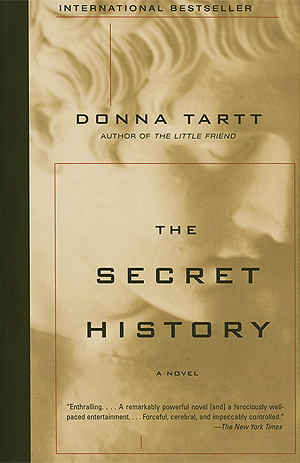
— from The Secret History, by Donna Tartt.
Anything in it?
Thinking in a different language slows you down, keeps your thoughts from running wild. I tend to think it's true; however, I tend to invoke this ability only when my mind is already in a leisurely state, not pressed.
A few months ago I rediscovered the library. I had in general thought the English-language selection of fiction pretty paltry. I mean, I'd always check if I was looking for something in particular, but it was often easier and more efficient to purchase a book online.
But then suddenly they had e-books.
Maybe they'd had them for a while. But suddenly they had selection. And I've been taking advantage regularly.
I decided I'd finally try out Elena Ferrante's Neapolitan novels, and I placed a hold, and I waited and waited and waited, and meanwhile I decided to check out another novel, and wouldn't you know, the very next day My Brilliant Friend became available and was automatically checked out to me. So two novels, neither of them exactly slight. One at a time. I finished one, so started the other, the Ferrante, but felt I was running out of time. No problem, I'll renew the loan.
Not so fast.
Renewing digital titles works a little differently than renewing physical books from the library. When you renew a digital title, it doesn't extend your lending period. Instead, it lets you borrow the title again immediately after your current checkout expires (if there are no existing holds) or it places you on the wait list to borrow the title again as soon as possible (if there are existing holds).
And I realized: back into the queue I would go. I might be granted access to book 2 in the series before I could renew, and finish, book 1.
This put me in the position of rushing home from work, racing to the final 60-70 pages in just a couple hours, instead of spending a leisurely holiday weekend with it.
I did it. I finished it, just under the wire. A short while later, wanting to review a scene, the book was locked to me. Imagine if a physical book would just, poof, disappear, when the lending time was up.
I feel a little bereft. I didn't get to finish the book in my own time, on my own terms. I don't have full and proper closure on it.
I love the instantaneity of the digital library, and I love the interface that allows to me to keep lists and ratings. I hate just a little that I can't choose to return a book a day late.
I was charmed by his conversation, and despite its illusion of being rather modern and digressive (to me, the hallmark of the modern mind is that it loves to wander from its subject) I now see that he was leading me by circumlocution to the same points again and again. For if the modern mind is whimsical and discursive, the classical mind is narrow, unhesitating, relentless. It is not a quality of intelligence that one encounters frequently these days. But though I can digress with the best of them, I am nothing in my soul if not obsessive.
The Secret History, by Donna Tartt, reminds me hugely of my dead cousin Peter. Everything about it. Well, not everything. I mean, it's not the dead body at the beginning of book that reminds me of the deadness of Peter. But Peter's world was academic — and we connected. He was my favourite cousin, my closest — we were just a year apart.
We would talk for hours in theoretical terms about politics and the law, about literature and philosophy, about music and film, about artificial intelligence and the possibility of extraterrestrial life. We talked about how theory could be implemented in practice.
I wonder if he read The Secret History before he died.
It was funny, but people never seemed to notice at first glance how big Henry was. Maybe it was because of his clothes, which were like one of those lame but curiously impenetrable disguises from a comic book (why does no one ever see that "bookish" Clark Kent, without his glasses, is Superman?). Or maybe it was a questions of his making people see. He had the far more remarkable talent of making himself invisible — in a room, in a car, a virtual ability to dematerialize at will — and perhaps this gift was only the converse of that one: the sudden concentration of his wandering molecules rendering his shadowy form solid, all at once, a metamorphosis startling to the viewer.
Peter had that gift too.
His air of being moneyed. His cultivated persona, in how he wore his clothes and his hair, whom he was seen with and where, what he was seen to be reading and studying, what he was seen to be drinking, the drugs he did. How he would deem you with a glance for inclusion or exclusion. Yet he was charming. I wanted to be in his club — when I was 9 and visiting his family's cottage, hen I was 19 and hanging out in downtown Toronto. We all wanted into his club.
Hampden College, as a body, was always strangely prone to hysteria. Whether from isolation, malice, or simple boredom, people there were far more credulous and excitable than educated people are generally believed to be, and this hermetic, overheated, atmosphere made it a thriving black petrie dish of melodrama and distortion.
Peter claimed his mother was prone to hysterics. I knew our grandmother had "episodes," but bloody hell, two world wars, a philandering husband, and exile from her homeland... hysterics seems like a perfectly reasonable response. So it seems reasonable too that one of the daughters might've learned that behaviour (my own mother tended toward melancholic). And I never figured out if any of it was true, or if his perception was the product of male entitlement, dismissal of the feminine, mommy issues, or simply drug-addled revisionist personal history. But then, I kind of think he inherited the hysteria gene himself.
I could say that the secret of Julian's charm was that he latched onto young people who wanted to feel better than everybody else; that he had a strange gift for twisting feelings of inferiority into superiority and arrogance. I could also say that he did this not through altruistic motives but selfish ones, in order to fulfill some egotistic impulse of his own. And I could elaborate on this at some length and with, I believe, a fair degree of accuracy. But still that would not explain the fundamental magic of his personality of — even in the light of subsequent events — I still have an overwhelming wish to see him the way that I first saw him: as the wise old man who appeared to me out of nowhere on a desolate strip of road, with a bewitching offer to make all my dreams come true.
Julian is a suspicious character. Well, they all are really. But him maybe more so. The professor. Because we don't know anything about him, yet he's an older authority figure — we have the sense he should know better.
This whole book is very Hitchcockian, I find. It's not about the crime; it's about the psychology of the people involved. Specifically Rope. But also Strangers on a Train and Shadow of a Doubt and others. In Hitchcock, it's about the idea of a perfect crime. In The Secret History it's that too, but it starts as something purer: simply, putting theory into practice.
The Secret History reminds me of the classes I never took, at the college I never went to, with the people I never knew.