Sunday, January 29, 2017

Another world's intrusion into this one

Bulgarian edition, 1990
This book is funny and messed with my mind in a most wonderful way. I have no idea what to make of it, and I loved it. The Crying of Lot 49, by Thomas Pynchon. This is my first Pynchon.

It preys on a paranoid sense of conspiracy, both in the protagonist, Oedipa Maas, and the reader.

How strange it is to be reading the words "REPORT ALL OBSCENE MAIL TO YOUR POTSMASTER" while standing in the metro waiting for the doors to close, and at the last moment a young man who bears a striking resemblance to Putin should jump in, squeezing in behind my shoulder. He's wearing a standard-issue Canada Post jacket. I read about the Scope bar, and upon arriving at work I'm asked to proofread an ad for a conference called SCOPE. There's bourbon everywhere. Several(!) articles I read during the week reference Stockhausen, and Bakunin.

Oedipa Maas has been named executor of the estate of an old boyfriend. As she reviews his assets, she stumbles onto a massive conspiracy regarding the American postal system extending prior to the Civil War (an alternate history of which is also presented). She finds secret signs everywhere, but she herself is not comfortable with all the coincidence, and considers that it may all be in her head.

We are treated to a Jacobean revenge play, its variant editions, and an investigation into its origins that takes Oedipa to a used bookstore, a publisher, and a university professor. There's a scheme to recover bones for the purpose of making cigarette filters. The Yoyodyne corporation. A perpetual motion machine.
"You know what a miracle is. Not what Bakunin said. But another world's intrusion into this one. Most of the time we coexist peacefully, but when we do touch there's cataclysm. Like the church we hate, anarchists also believe in another world. Where revolutions break out spontaneous and leaderless, and the soul's talent for consensus allows the masses to work together without effort, automatic as the body itself. And yet, señá, if any of it should ever really happen that perfectly, I would also have to cry miracle. An anarchist miracle. Like your friend. He is too exactly and without flaw the thing we fight. In Mexico the privilegiado is always, to a finite percentage, redeemed — one of the people. Unmiraculous. But your friend, unless he's joking, is as terrifying to me as a Virgin appearing to an Indian."
There's a whole wiki devoted to this novel, and I read alongside it for a while. It was the note regarding Oedipa's shrink, Dr Hilarius, that caused me to trust in my own reading. The annotation gives a summary of Pope Saint Hilarius. But I truly don't see a need to look beyond the obvious: as a name, Hilarius is plain hilarious, only slightly more latinate and therefore doctory.

At some point I had to consciously decide not even to try to make sense of it all, let it wash over me, enjoy the ride. "Like all their inabilities to communicate, this too had a virtuous motive."

It reminds me of the best of Auster and the best of Murakami, but more self-assured, smarter. Wackier, yet in a seeming contradiction giving the impression of being more grounded in the real world. It feels loaded with possibility, and with possible interpretation.

Polish edition, 1990
There are a couple odd references to cancer. "The rest of the bones were used in the R&D phase of the filter programme, back around the early fifties, way before cancer." Did cancer not exist in the early fifties? Is it a symbol for communism? Some other sickness afflicting America? (Norman Mailer said, "Cancer is the growth of madness denied.") At another point, Oedipa lumps cancer together with things she doesn't want to think about. Is she turning a blind eye to some social responsibility? Or is she in denial about a personal, physical cancer? Is that what Maas is? Maybe it's merely her marriage that is the cancerous mass.
"There's a certain harassed style," she said, "you get to recognize. I thought only kids caused it. I guess not."
One reading of the book posits that it's one long acid trip. Dr Hilarius had wanted her to take part in a study, but she didn't trust him, and didn't take any of the pills her prescribed her (but perhaps this is a wish manifest through LSD, not reflecting reality).

The titular crying is that of an auctioneer. When lot 49, the dead man's collection of forged stamps, is put on the block, Oedipa hopes it will draw out a representative of Trystero, proving its existence once and for all. But the book ends as the auctioneer is clearing his throat. So the reader will never know. I feel Oedipa crying at this moment too, the way only a painting can make her cry.

Have you read The Crying of Lot 49? Do you have a theory?

Review in The New York Times (1966).
Review in The Quarterly Conversation.
Gallery of cover art.

Saturday, January 28, 2017

Dreams are built on dull facts

It has been many an age more since the crowds called for a liar. Mine is a lost art, and I shall be grateful to share it with thee." He turns aside, and lets me pass. We stand back out in the busy street.

"You're a liar?"

"The last liar," he says, slowly, sadly, observing the tower. In the light of day Thyme looks like an artefact recovered from some lost tomb. "Once, dreams were built of my tales. Quests formed by the skill of my words. But now there are only the whispers and rumours, and little room for a liar. Dreams are built on dull facts. Mine," he repeats, "is a lost art. Follow me, Manderlay, and we shall locate thy Sleepwalker." Reluctantly I do as I am told, wondering whether I have made a grave mistake.
Metronome, by Oliver Langmead, is a strange but beautiful dream of a book.

The story opens by introducing the reader to Manderlay. He's aged and living in a retirement home, but with his buddy Valentine, they still get up to some antics. Manderlay was once a violinist, and receives the occasional cheque for 40 pence in royalties whenever someone buys his album. Manderlay is lately troubled by his dreams, and the reader soon leaves the gently nostalgic blanket of the home to inhabit his dreamworld entirely.

The dreaminess is both a strength and a weakness. It allows for some very creative images, actions, and relationships, but it also falls back on dream logic to justify its course.

Manderlay's musical skills are called upon to help navigate the skyship Metronome, with a small group of righteous warriors engaged in an ultimate battle between good and evil.

I don't fully understand how all our dreamworlds intersect with each other. Each dream opens onto a collective unconscious, an evidently vast but common world, night after night.

I just couldn't buy into the workings of the dream logic. There are detailed battle scenes — something I'm simply not a fan of. I would've been happy to follow Manderlay's demise from the comfort of the retirement home, but that it not the book Langmead chose to write. The story also takes a religious turn; while not exactly didactic, I'm not entirely comfortable with the implications. I'm not one to turn away from stories just because they espouse a worldview different from mine, but in this case it posed an obstacle to my buying into the premise of the book.

Still, the scenery is steampunkishly breathtaking.
There are shapes hanging from the tower ahead of us: a tapestry of wooden walkways and scaffolding which make for a kind of peculiar set of docks. I can see the distant silhouettes of dock workers, high in the air, as if we are standing beneath crystal-clear depths of water and looking up at them. And moored at those docks is a singular ship, or mechanism, that defies easy understanding.

It looks as if someone has attempted to build a clock but did not know when to stop. It is a cataclysm of clockwork parts in synchronised motion arranged in the shape of a frigate. The ship has no sails, barely any hull beyond a few lengths of wood along its flanks, and between brass and copper lengths of girders, I can see endless cogs and cables, whirring and winding and ticking in gentle motion. The whole thing just hangs there, impossibly, in the sky.

I realise that I have forgotten to breathe.
Reviews
Andromeda Spaceways
Shoreline of Infinity

Sunday, January 22, 2017

No apparatus except gut fear and female cunning to examine this formless magic

Mujer Saljendo del Psicoanalista, Remedios Varo
In Mexico City they somehow wandered into an exhibition of paintings by the beautiful Spanish exile Remedios Varo: in the central paintings of a triptych, title 'Bordando el Manto Terrestre', were a number of frail girls with heart-shaped faces, huge eyes, spun-gold hair, prisoners in the top room of a circular tower, embroidering a kind of tapestry which spilled out the slit windows and into a void, seeking hopelessly to fill the void: for all the other buildings and creatures, all the waves, ships and forests of the earth were contained in this tapestry, and the tapestry was the world. Oedipa, perverse, had stood in front of the painting and cried. No one had noticed; she wore dark green bubble shades. For a moment she'd wondered if the seal around her sockets were tight enough to allow the tears simply to go on and fill up the entire lens space and never dry. She could carry the sadness of the moment with her that way forever, see the world refracted through those tears, those specific tears, as if indices as yet unfound varied in important ways from cry to cry. She had looked down at her feet and known, then, because of a painting, that what she stood on had only been woven together a couple thousand miles away in her own tower, was only by accident known as Mexico, and so Pierce had taken her away from nothing, there'd been no escape. What did she so desire to escape from? Such a captive maiden, having plenty of time to think, soon realizes that her tower, its height and architecture, are like her ego only incidental: and what really keeps here where she is is magic, anonymous and malignant, visited on her from outside and for no reason at all. Having no apparatus except gut fear and female cunning to examine this formless magic, to understand how it works, how to measure its field strength, count its lines of force, she may fall back on superstitions, or take up a useful hobby like embroidery, or go mad, or marry a disc jockey. If the tower is everywhere and the knight of deliverance no proof against its magic, what else?
— from The Crying of Lot 49, by Thomas Pynchon.

As with many references in The crying of Lot 49, I didn't know if Remedios Varo was real or fictitious. Real, it turns out. Her paintings are real.

I don't recognize her work as anything I've come across in the past; how can I have lived my life without knowing her? Whimsical yet dark. Feminist. Several of her works would feel at home within the world of The Crying of Lot 49.

I have a particular fondness for Woman Leaving the Psychoanalyst (above), as if she's pulled the cobwebs from her mind, and they are the psychoanalyst.

Oedipa Maas's shrink, Dr. Hilarius, has been trying to recruit her for an LSD study, but she has resisted. She doesn't trust him. I haven't entirely figured out Pynchon's attitude to women, or at least to this woman protagonist. It may not be important. But I have the feeling it is.

Bordando el Manto Terrestre, Remedios Varo

Has a painting ever made you cry?

Friday, January 20, 2017

What are we reading for?

I think we ought to read only the kind of books that wound or stab us. If the book we're reading doesn't wake us up with a blow to the head, what are we reading for? So that it will make us happy, as you write? Good Lord, we would be happy precisely if we had no books, and the kind of books that make us happy are the kind we could write ourselves if we had to. But we need books that affect us like a disaster, that grieve us deeply, like the death of someone we loved more than ourselves, like being banished into forests far from everyone, like a suicide. A book must be the axe for the frozen sea within us. That is my belief.
— from a letter to Oskar Pollak from Franz Kafka, 1904.

Here's another thoughtful work from La Biennale de Montréal 2016 at the Musée d’art contemporain de Montréal, themed Le Grand Balcon. In Zac Langdon-Pole's My Body, poetic extracts are spelled out with enlarged ornamental letters (such as drop caps are often styled) in various typographies and with different artistic sensibilities (some are stark and modern, others cherub-laden). The different verses are introduced with epigraphic photographs; these are subdued in colour and highly reflective. Upon this visual is etched some textual excerpt, like textured text (my photo atempts can't capture it). The first framed photo here cited Kafka.

This section spells out "by the light of the axe / in my secret life / I am with him."

I really appreciated how difficult it was to decipher the text, both the photos and the initials, and their juxtaposition creates a puzzling but engaging tension. More than anything, though, I'm inspired to read Kafka's letter.

Wednesday, January 18, 2017

History will ignore you

But I get this feeling —

It is a feeling that our emotions, while wonderful, are transpiring in a vacuum, and I think it boils down to the fact that we're middle class.

You see, when you're middle class, you have to live with the fact that history will ignore you. You have to live with the fact that history can never champion your causes and that history will never feel sorry for you. It is the price that is paid for day-to-day comfort and since. And because of this price, all happinesses are sterile; all sadnesses go unpitied.

And any small moments of intense, flaring beauty such as this morning's will be utterly forgotten, dissolved by time like a super-8 film left out in the rain, without sound, and quickly replaced by thousands of silently growing trees.
Generation X: Tales for an Accelerated Culture, by Douglas Coupland — I've been meaning to read this book since 1991, and then again in 2010 when it was a Canada Reads selection and I came into possession of a copy exactly as pictured here.

More recently, we were severally drunk, in my kitchen, and someone was bemoaning the fate of the Gen-X-er, and I wondered how this could be, said bemoaner being a full decade younger than myself. And it was decided to read the book so as to know once and for all who was truly of generation X.

What came as a surprise is that the novel's narrator is almost a decade older than me.

Still, the angsty apathy, the pessimism I vehemently declare to be realism, is something I very must relate to. Or related to. As a gen-x-er of a certain age, I feel like I've grown out of it. Or rather, having acknowledged the hopelessness of where I sit, socioeconomically, historically — that hasn't changed, but I am no longer mired in the problem of it. Millennials, on the other hand, have not "grown out of it" yet, and I get the feeling that they are unlikely to.

[Whatever happened to Generation Y?]

There's not much of a plot to Generation X. I'm tempted to call it a collection of loosely connected short stories. The novel, such as it is, pivots around Andy, Dag, and Clare, who tell each other stories, primarily (solely?) for entertainment, AA-style, without judgment.
"I firmly believe," Dag once said at the beginning, months ago, "that everybody on earth has a deep, dark secret that they'll never tell another soul as long as they live. Their wife, their husband, their lover, or their priest. Never.

"I have my secret. You have yours. Yes, you do — I can see you smiling. You're thinking about your secret right now. [...] Just tell me. You may be able to help me and not even know it."
[What's your secret?]

Stories get told, and then several times we see glimmers of the "real life" that inspired those stories. Or maybe the stories inspired reality. Or maybe it's all just stories. It's easy to call the earth-colony space-poisoning incident a story, but Irene and Phil, neighbours who live permanently in the 1950s, are presumably real, even though both environments share details like a brandy snifter filled with matchbooks and a freak jaws-of-life event.

Some bits struck eerily close to home, in an entirely insignificant way.
I'd sooner have died than admit that the most valuable thing I owned was s fairly expensive collection of German industrial music dance mix EP records stored, for even further embarrassment, under a box of crumbling Christmas tree ornaments in a Portland, Oregon basement.
This on the tail end of a visit to my mom, wherein I found a crate of vinyl — including German industrial music dance mix EP records — that I'd long ago assumed my brother had pawned off. But there they were in the basement crawlspace (Sandinista! mislabeled), behind (not under) a crumbling box of Christmas tree ornaments (who knows what shape the ornaments were actually in) once temporarily stored there by a now deceased friend of the family. I mean, who even has records anymore? Except of course that suddenly, people do.

[What's the most valuable thing you own?]

Apart from the aimlessness of the characters (and of the novel), this novel leaves me with an overwhelming sense of Cold-War nuclear-arms-race paranoia. Remember The Day After? How scared we were? This book like a madeleine recalls the dis-ease that hovered over the land.
Although their background orbits are somewhat incongruous, Claire and Elvissa share a common denominator — both are headstrong, both have a healthy curiosity, but most important, both left their old live behind them and set forth to make new lives for themselves in the name of adventure. In their similar quest to find a personal truth, they willingly put themselves on the margins of society, and this, I think, took some guts. It's harder for women to do this than men.
[Is that true, that it's harder for women? Is it still true?]

One chapter is titled December 31, 1999 (I remember that day), and another, much later is January 1, 2000 (that day is hazy). Taken at face value, the intervening text may be understood to have happened overnight. And all that came before... Has it been years of roaming through dead-end jobs and meaningless parties? A lost decade? [I had a lost decade.]
"What one moment for you defines what it's like to be alive on this planet? What's your takeaway?"

[...] "Fake yuppie experiences that you had to spend money on, like white water rafting or elephant rides in Thailand don't count. I want to hear some small moment from your life that proves you're really alive."
[What's your takeaway?]

I will spend time puzzling over some of the questions the novel incidentally raises and never really addresses, more so than I will considering the actual novel.

[What's my takeaway? How many of those first thoughts that come to mind were bought experiences?]

I loved the sidebars: slogans, definitions, and cartoon panels, all complementing the themes of the main text. I wish there were more of this kind of thing in book publishing. However, I hated the squareness of the volume, which made it tough to read while commuting; the text doesn't have the gravity to demand that kind of space. And the paper quality is shit for flipping — I had to rub pages to separate them at every turn. It's not a lay-flat beautiful book, and it's not a "disposable" newsprinty comic book, which is too bad, because either form could complement this content really well.

Conclusion: This is a generation-defining novel only in the most literal way. It no longer feels fresh, but maybe as a generation we're just tired. The voice is unique only insofar as it sounds just like every other self-aware and ironic writer since the late 80s. But Coupland does have a knack for tapping into a particular slice of the gen-x zeitgeist. "I was feeling homesick for the event while it was happening."

I'm looking forward to discussing the book with my fellow gen-x-ers, debating whether we are or are not, and I have the perfect cocktail for it: it'll be "washed down with Polish cherry brandy, the taste for which he acquired during a long, sleepy earnest summer job spent behind the glum, patronless counter of the local Enver Hoxha Communist bookstore." Ahh.

Article: Generation X: The young and restless work force following the baby boom
Review: I read the book and wondered where I was
Bonus: Ready, Steady, Go!

Sunday, January 15, 2017

You must first deny, then admit and repent.

Today I caught La Biennale de Montréal 2016 on its last day at the Musée d’art contemporain de Montréal, themed Le Grand Balcon, inspired by Genet. Our flirtation with hedonism.

My favourite piece by far was Luzie Meyer's video, The Balcony, featuring the Bishop, the Judge, the General, and the camerawoman.


This trailer doesn't do it justice — it's playful but very thought-provoking, especially when the camerawoman begins following herself. The narration/dialogue is delightful. I would readily sit through a feature-length version of this riff off Genet's Balcony, and I urge anyone who has opportunity to see the video in full (just under 20 minutes) to do so.

I'm not much for reading plays, but I have a copy of the Genet. My cousin gave it to me. He's dead now. He was a hedonist, of a very cerebral variety.

Remind me someday to tell you about the night I spent in a brothel.

Tuesday, January 10, 2017

A simple lack of temporal focus

Most psychic abilities are caused by a simple lack of temporal focus, and the mind of Agnes Nutter was so far adrift in Time that she was considered pretty mad even by the standards of seventeenth-century Lancashire, where mad prophetesses were a growth industry.

But she was a treat to listen to, everyone agreed.

She used to go on about curing illnesses by using a sort of mold, and the importance of washing your hands so that the tiny little animals who caused diseases would be washed away, when every sensible person knew that a good stink was the only defense against the demons of ill health. She advocated running at a sort of gentle bouncing trot as an aid to living longer, which was extremely suspicious and first put the Witchfinders onto her, and stressed the importance of fiber in diet, although here she was clearly ahead of her time since most people were less bothered about the fiber in their diet than the gravel. And she wouldn't cure warts.

"Itt is alle in youre Minde," she'd say, "forgett about Itte, and it wille goe Away."

It was obvious that Agnes had a line to the Future, but it was an unusually narrow and specific line, In other words, almost totally useless.
The books I'd come equipped with simply wouldn't do. I just didn't have the head for them — I lacked focus, temporal or otherwise.

While rummaging in my mother's basement through boxes of books that belonged variously to myself, my siblings, and friends of the family who lacked closets and crawlspaces, I came across a copy of Good Omens, by Neil Gaiman and Terry Pratchett, which may in itself have been considered a good omen. With Clive Barker proclaiming that "the Apocalypse has never been funnier," it seemed appropriate reading material with which to start the new year.

On the outside it looked brand new (I myself cracked the spine of this mass market paperback [do they even print those anymore?]), but the pages were yellowed and it smelled old. Pricemarked $6.99. This edition bears no sign of a subtitle, neither on its cover or in the copyright page, although the covers of most other editions seem to include one ("The Nice and Accurate Prophecies of Agnes Nutter, Witch").

It served very well for the hours-long train journey, and a couple late nights requiring the mind to be emptied, stilled, entertained.

So, the Apocalypse. The Antichrist, switched at birth, raised in the British countryside. An angel who runs a used bookshop where customers occasionally inconvenience him. A witch's descendant and a collection of mostly useless prophecies. Four Horsemen. Mayhem ensues.

Good Omens is quite hilarious in parts.
The only things in the flat Crowley devoted any personal attention to were the houseplants. They were huge and green and glorious, with shiny, healthy, lustrous leaves.

This was because, once a week, Crowley went around the flat with a green plastic mister, spraying the leaves and talking to the plants.

He had heard about talking to plants in the early seventies, on Radio Four, and thought it an excellent idea. Although talking is perhaps the wrong word for what Crowley did.

What he did was put the fear of God into them.

More precisely, the fear of Crowley.

In addition to which, every couple of months Crowley would pick out a plant that was growing too slowly, or succumbing to leaf-wilt or browning, or just didn't look quite as good as the others, and he would carry it around to all the other plants. "Say goodbye to your friend," he'd say to them. "He just couldn't cut it..."

Then he would leave the flat with the offending plant, and return an hour of so later with a large, empty flower pot, which he would leave somewhere conspicuously around the flat.

The plants were the most luxurious, verdant, and beautiful in London. Also the most terrified.
(Crowley is of course a demon, and it's hinted that the mister may contain holy water.)

But it's hard to sustain the hilarity. Maybe it's me? (Full disclosure: I think Neil Gaiman is overrated, and I've never read Terry Pratchett.)

Frankly, this apocalypse bored me after a couple days. It took longer to read than for the apocalypse to actually happen.

Little things irked, like how the teenage Antichrist's dialect is represented. I mean, what really is served by writing analoggy or rappore or could of (while other characters correctly "could have")?

And like how some descriptions are very faintly (so faint that I can't even pinpoint why they offend me) sexist. "Sgt. Deisenburger had never seen a female general like her before, but she was certainly an improvement." There's nothing wrong with that sentence, but there's something nudge-winky about it. There are only a handful of examples throughout the book, but... but really? Is it necessary? Is it funny? Are we not past this yet?

And while I'm usually a proponent of the "show, don't tell" philosophy, I couldn't help but feel I was reading a very precise description of a comedy-action movie, rather than reading an actual comedy-action novel. A good novel lets you picture it in your head. This novel ensures there is no mistaking what you picture, it is so carefully stage-directed for you. That's not exactly bad, but it feels intrusive — get out of my head. This may be the wrong medium for this particular story.

By novel's close, I couldn't even stand that old-book smell anymore.

Wow, am I ever critical! At this point you must be wondering what crawled up my butt to die. Maybe it's the back-pain-related crankiness, or the back-to-work crankiness. Maybe it's the looming gloom of the Trumpocracy. Just not feeling the funny. I'm switching back to short and angsty novels for the foreseeable future.

Friday, January 06, 2017

You may withdraw and proceed with your walk

An excerpt from All This Can Happen produced by Siobhan Davies Dance, based on Robert Walser's 1917 novella The Walk. (Discovered via the New York Review Books newsletter.)

All This Can Happen

[I am rediscovering walking this week. Montreal is a good city for walking, made all the more beautiful when it's under fresh snow.]
An Inexpressible Feeling for the World

I stood and listened, and suddenly there came upon me an inexpressible feeling for the world, and, together with it, a feeling of gratitude, which broke powerfully out of my soul.
Excerpts from The Walk, by Robert Walser.

See also Maria Popova's reflections: Robert Walser, the Art of Walking, and Our Daily Dance of Posturing and Sincerity.

Sunday, January 01, 2017

Because of all the fog

The sensation of being homesick
for a place that is not my home
while being right in the middle of it

[...]

which reminds me
of another Japanese poet

who wrote how much he enjoyed
not being able to see
his favorite mountain because of all the fog.
— from "Bashō in Ireland" in The Rain in Portugal, by Billy Collins.

I'm going home tomorrow, and looking forward to a year with more poetry in it.

Billy Collins' latest volume was under the tree for me. He never fails to put a smile on my face. Reading "Dream Life," I delude myself for a moment thinking I actually could've written it.
Poetry works long hours
and rarely speaks to the tailor
as she bends to repair the fancy costumes
of various allegorical figures
who were told by Thrift how little she charges.

Friday, December 30, 2016

The swamp gas of European anxiety

Mystery lingered in the air like the scent of a scorched book.
As a teenager I tried reading H.P. Lovecraft — my big brother wouldn't shut up about him. But I didn't get very far; it just wasn't for me. I tried again in my twenties. This time, with a decent liberal arts education behind me, while the concepts intrigued, I just couldn't get past the poor quality of the writing. Today, I have a passing familiarity the Cthulhu mythos, despite never having read the source material.

The Ballad of Black Tom, by Victor Lavalle, is a retelling of Lovecraft's 1925 story The Horror at Red Hook, generally acknowledged to be not particularly good. The original story is also widely considered to be offensive in its bigoted, xenophobic attitude. (After finishing Lavalle's Ballad, I decided to skim through the source. I am ashamed to admit that the racism wasn't entirely obvious to me; if I weren't looking for it, I might miss it, not because it's not there, but because it is so much a part of my cultural context. Is the story exceptionally offensive for its time or merely a mirror of society? Am I that oblivious? I don't know.)
"Your people," Robert Suydam began. "Your people are forced to live in mazes of hybrid squalor. It's all sound and filth and spiritual putrescence."
Lavalle manages to spin the negativity and bring it front and centre, making it essential to this story of otherness, of anger, corruption, power, entitlement.

The Ballad is told in two parts, the first from the perspective of minor hustler Charles Thomas Tester, the second from police detective Malone. Malone has for some time been watching the activities of Robert Suydam, a rich old eccentric, who is apparently connected to various nefarious goings-on relating to the immigrant community of Red Hook.
Locals attributed the rumors of abduction to the swamp gas of European anxiety known to flare up with a neighborhood's proximity to Red Hook.
Tommy Tester finds his marks, picks up jobs, while playing his guitar on sidewalks. He's not very good, so why would Suydam hire him to play for a party he's giving?
The idea troubled him like a pinched nerve.
Of course it's part of Suydam's bid for world domination, and his plan to summon Cthulhu. But, surprise: things go terribly wrong.

There's a fantastic review at Fantasy Fiction that explains the story better than I ever could (but be warned, it's rife with spoilers).
I thoroughly enjoyed reading The Ballad of Black Tom, and the experience has been truly enriched by reading commentary about it.

One interview with Lavalle in particular in The Lovecraft eZine gave me a great deal of perspective:
I switched to Malone for a few reasons, but one of the biggest was that I wanted to spend time with Malone and show the journey of a white character who is a passive racist. There's a private detective in the book, Mr. Howard, who is the more virulent — and easily dismissed — kind of racist. He says terrible things about black people, he’s physically abusive to black people, he kills them without any guilt. Of course he's terrible. Malone, on the other hand, seems to have a greater respect for Tommy. He doesn't say racist things and he doesn't seem to relish being brutal to black people. And yet he never stands up against the system in which he works. He sits at the same table as police who have very recently murdered an innocent black man and he doesn't object, or try to bring criminal charges against them. He's good in the sense that he isn't overtly evil but if that's the best he can do then what the hell good is he? I wanted to write that guy because I find that kind of perspective interesting. "Well I've never called anyone a nigger." Or, "But my family never owned slaves." It's that kind of person, the one who simply stays silent in the face of oppression, who in fact looks away from it when he sees it, that is as much to blame for the situation as the more overt Mr. Howard. I didn't worry about making him too sympathetic, instead I simply tried to show him as someone who was blind but didn’t know he was blind. I've known lots of people like that. I've liked many of them but that didn't make them blameless.
Lavalle's novella ends with "Zig zag zig." It kind of made sense, in a passively random this-is-the-way-the-world-ends way, but it didn't make any sense at all, so I looked it up. The last letter of the Supreme Alphabet, signifying "from knowledge to wisdom to understanding." This be the last page of the book Tommy Tester is delivering when the novella opens, a page he withheld.

This makes me want to read the novella all over again, realizing that there are other mythologies woven into this story, that there a different levels of knowledge, types of arcana — the Ballad is rich with it. The writing is compelling, the plot and characters are well crafted, and there's a wonderful sense of unease throughout, making this my kind of horror story. Plus, a new kind of swamp gas of anxiety hangs is the air, which makes it relevant.
This is how you hustle the arcane. Skirt the rules but don't break them.

Thursday, December 22, 2016

Even my morality is just discipline

Once, after she'd been introduced to the tape recorder in our apartment and told that you could play back a text or a piece of music, she talked about what it would be like if someone's life were recorded and put on tape, to be rewound, stopped and replayed at will. She said she'd accept her own life the way it was; or rather, as is would be up to her death, but with the proviso that she might rewind it to any point she chose. I didn't dare ask where she would stop the machine, and still less, why there. I didn't think she's tell me anyway.
In The Door, by Magda Szabó, a writer describes her tumultuous relationship with her housekeeper Emerence. Emerence is difficult.

The title no doubt refers to the door of Emerence's apartment. No one is allowed inside, ostensibly because of the cat, or nine cats, except for the dog, because the dog is privileged. But perhaps she hides other secrets inside. Late in the novel, there's another door, inside the apartment; it's a door to a past, but it's a mausoleum really, everything turned to dust.

I recently read an interview with Elena Ferrante conducted by Sheila Heti, which helped me put into perspective the writer's relationship with her housekeeper:
In Magda Szabó's The Door, Emerence — the intelligent cleaning-woman with a strong inner code of behaviour, who keeps house for the intellectual woman-writer protagonist—reminds me a bit of Lila, and Szabó's protagonist is reminiscent of your Elena. Yet Emerence is somehow the superior of the pair, as is Lila. Is there something in the figure of the intellectual woman writer that pales in comparison (from the perspective of the woman writing) to the (comparatively) uneducated woman who yet knows and understands the world? Why do so many female writers demean the "intellectual" female figures we create? Do we still not truly value female literary work, women who work with their minds? Is it a kind of self-loathing? Why do we often portray intellectual women as having lost more than they have gained?

You pose a very interesting question; I have to think about it. Why do we invent cultivated, intelligent women and then lower their level or even their pleasure in life? Who knows. Maybe because we're still incapable of a convincing portrayal of female intelligence. We haven't completely set aside the literary model that represented us at the side of a superior man who would take care of us and our children. Thus, though we have now acquired the sense of our inner richness and our intellectual autonomy, we portray them in a minor key, as if our capacity to produce ideas and culture were a presumptuous exaggeration, as if, even having something extra, we ourselves didn't really believe in it. From here, probably, comes the literary invention of secondary female figures who possess that something extra in themselves, remind us of it, assure us that it's there and should be appreciated. We are still in the middle of the crossing, and literature makes do however it can.

Reading The Door has provoked a lot of reflection, about honour and pride and betrayal, discipline, friendship, love, about how we can never get inside somebody else's head, how other people must in some ways forever remain mysterious to us.
She's making these underhand remarks to settle the score, I told myself, but I quickly dropped the thought because I knew this wasn't true. Emerence wasn't getting even. The matter was more complicated than that, and rather more interesting. Emerence was a generous person, open-handed and essentially good. She refused to believe in God, but she honoured him with her actions. She was capable of sacrifice. Things I had to attend to consciously she did instinctively. It made no difference that shewasn't aware of it — her goodness was innate, mine was the result of upbringing. It was only later that I developed my own clear moral standards. One day Emerence would be able to show me, without uttering a word, that what I consider religion is a sort of Buddhism, a mere respect for tradition, and even my morality is just discipline, the result of training at home, in school and my family, or self-imposed.
This is a very beautiful novel, and it did put me in mind of Ferrante's Neapolitan quartet, only it's funnier, while somehow at the same time more serious. Less Latin, more Eastern European (I couldn't help but be reminded of other Hungarian works). Less telenovela, more absurdist crazy cat lady. I will definitely be reading more Szabó.

Sunday, December 18, 2016

A kind of unimportant nebula

According to the back cover copy of my trashy-looking mass market paperback (exactly as pictured here),
The Accomplices is Simenon's powerful study in guilt and obsession — the portrait of a man destroyed by the consequences of sexual bondage.
That's a simplistic reading. Joseph Lambert is not a sexual obsessive per se. He lives an ordinary life. He wants to escape his mundane life, his boring wife, his predictable routine.
He was fed up with himself, fed up with being a man.
The novel opens with Lambert driving through the rainy countryside with his mistress, his secretary Edmonde. He doesn't have both hands on the wheel, and his attention is not on the road. By page 2, he has caused a deadly crash — a schoolbus full of children goes up in flames. The story follows Lambert's trajectory through guilt and self-destruction in the immediate aftermath of the tragedy.

One intuits immediately that the occupants of the car are the accomplices of the title.
Though they were not in love and had never acted as if they were, there was nevertheless an intimacy between them, an intimacy of another kind that bordered on complicity.
Their complicity is noted a few times, but Edmonde's complete silence about the incident makes one wonder whether she's aware of what happened at all. Doesn't complicity require some form of intent? Is she so cold or so oblivious that she does not recognize it as a tragedy at all?
What did Edmonde think about what had happened, about the way he had behaved? What did she think bout him? Had it been anyone else, he would have asked. But her — he dared not.

Why?

Was it because what existed between them was on a plane different from that of ordinary life, of life as one conceives it, as one lives it, as one wants it to be?

It was somewhat as if, at a given moment, for no apparent reason, they exchanged a signal and then escaped.

He was not modest in her presence either. They entered a different realm, a realm which resembled that of childhood rather than that of evil.
There are times when it seems the whole town is complicit with Lambert. Despite the occasional marital indiscretion, he is, on the whole, an upstanding businessman, and nobody suspects him of playing a role in the disaster. Nobody wants to suspect him, nobody wants their routine disrupted, their humdrum, provincial existence upended.

Except maybe Lambert himself.
He felt within him a refusal to return to ordinary life, and he plunged almost fiercely into a universe where all that mattered was the quivering of his senses.

The universe then drifted away until it was only a kind of unimportant nebula. Objects lost their weight, human beings were merely tiny or grotesque puppets, and everything to which one usually attached value became ridiculous. All that remained in a shrunken, warm, enveloping, an kindly world was the pounding of the blood in their arteries, a symphony which at first was vague and diffuse, then gradually became sharper, and finally concentrated in their sex organs.
There's a very specific thing in The Accomplices that put me in mind of a very specific thing in Hangover Square by Patrick Hamilton. Lambert's pursuit of "the click" — that's what Edmonde enables. It's a mental switch, a cognitive break from reality.

In Hamilton that break is tied up with mental illness, and blurred by sex and alcohol; sex acts as a trigger, evidence of all the dirt and filth the character needs to break from. In Simenon the break is pursued, and the pursuit of sex is a catalyst to achieving that break, kind of like the ultimate, transcendent orgasm, only it's not sexual per se — it's sensual, fully inhabiting one's senses. It mimics a return to childhood, a detachment from reality, an absence of responsibility.

It's taken me ages to read this slim little novel. I've made several false starts on this one over the couple years since I acquired it. My copy is very used, and very pungent with old-book smell. It's also sticky. Twice in the past week I've left home without a book, without this book. One might take this for a sign of illness. Or a sign of avoidance. I find reading Simenon takes a certain strength, a willingness to abandon oneself to the questionable morality Simenon probes at, book after book after book. But it's a very rewarding interior journey.

Monday, December 12, 2016

Library packed, unpacked

About a year ago now I was packing up house. I whittled down my possessions to those I truly wanted to possess, those that I would freely invite into my new home. That included books.

I gave away about half of my books. That still leaves me with too many books.

It's also about a year ago that a friend sent me a "postcard book," something she'd recently picked up in Atlantis Books on Santorini. It's a 2013 publication from Paravion Press of Walter Benjamin's essay, Unpacking My Library.

It seemed a small gem, and I kept it in my purse for a few weeks for fear of losing it in the shuffle of boxes. But then I decided I should put it in a safe place, where it would be protected from my daily rummaging. But then I couldn't remember where I'd put it, so it was effectively lost for a few months, till I found it and moved it to a more logical, more sensible, safer place. And so it was lost for another couple months. Till I slipped it back in my purse, and finally read it.

Illustration (detail) by Marie Basten
It's not really about books; it's about collecting books. It's not even really about libraries, except insofar as libraries house collections. The books here are incidental. It's about books as objects.

This shouldn't surprise me. I encountered Benjamin previously in a class on Dada and Surrealism; he had some thoughts on thingness. In this essay books are physical things with physical histories, never mind their contents.
[For the collector] it is not so much books as copies of books that have their fates. I am not saying too much: for the true collector, the acquisition of an old book is its rebirth. [...] To make the old world new again — that is the deepest drive in the collector's wish to acquire new things, and that is why the collector holds older books to be closer to the essence of collecting than reprints, which are interesting for bibliophiles.
Clearly, although I have collected many books, I am not a collector.

Benjamin offers some thoughts on the book collector hovering between the poles of order and disorder "If there is a counterpart to the lawlessness of a library, it is the strict adherence to rules in its indexing." Benjamin seems to claim that this is the only respect in which a collector of books is distinguished from a collector of fine china or come other collectible. But I dispute it, having viewed finely catalogued collections of stamps, baseball cards, and geological samples.

My library of books, much reduced over the years, is in my head more than it can be defined in spatial terms. But much like a collector, the value of the books I have read is inextricably linked to the circumstances that brought me to them, the network of people, places, subjects in which they are entrenched.

I am more enamored of the idea of them than the physical evidence of them. But this is not a natural position of mine; it had to be learned. Maybe there's something to Benjamin's position that childishness permeates the collector. Simply I've outgrown it.

Benjamin's essay is a phenomenological digression, and not the paean to books that sings in my soul.

I wonder what Benjamin would make of ebooks.

Read Benjamin's essay online.

Friday, December 02, 2016

A border area between states of being

"The water's boiling." Her voice had no weight to it, like feathers. It was neither gloomy nor absent-minded, as might be expected of someone who was ill. But it wasn't bright or light-hearted either. It was the quiet tone of a person who didn't belong anywhere, someone who had passed into a border area between states of being.
The Vegetarian, by Han Kang, is a creepy little novel, in the most beautiful way. It's completely weird and fascinating. I love this book.

Despite having read quite a few reviews of it, none of them quite prepared me. Maybe, since I was already interested in reading it, I merely skimmed the reviews in order to avoid spoilers. Basically I had the impression that this was a book about a dinner party gone wrong. (I love dinner parties! I love when they go wrong!) There is indeed a dinner party, and it does go wrong. And then there's a family dinner that goes so much more wrong. But there's more to this story than what is served and what is eaten.

Yeong-Hye turns to vegetarianism because of a dream (a horrific dream, all the more terrifying for being only vaguely described for the reader). She will not even touch mayonnaise, and later eschews food altogether. She wants to photosynthesize; she wants to be a tree.

She posits also that it's the trees' hands digging into the earth (heads buried?), their legs flailing above, crotches flowering.

The novel is in three acts, from the perspectives of her husband, her brother-in-law, and her sister. Yeong-hye turns vegetarian, her family stages an intervention, she's hospitalized; she's released, there's an interlude of peace, but not exactly normalcy, that gives way to art, maybe some kind of understanding, sublimation, acceptance; she's institutionalized.

Yeong-hye's vegetarianism is not symptomatic of anorexia. It's not about control. Despite being shackled by domesticity and refusing (or forgetting) to wear a bra (it's just not comfortable), it's not about feminism. Her actions do not have any religious motivation.

A review in the New York Times calls out some of these readings — feminist, ethnographic, sociological — as not exactly faulty or skewed but incomplete or incapable.

I don't think any isms explain Yeong-hye's behavior. Some things defy explanation. Some things cannot be explained in words. Some things can only be expressed through art.

Yeong-hye's brother-in-law is an artist. He had a vision, an artistic vision he had trouble realizing.
His silence had the heavy mass of rock and the tenacious resistance of rubber, particularly when his art wasn't going well.
Yeong-hye's sister (the artist's wife) also has dream. She tried acting on a version of it once.

The reason for these things is beyond words. Wounded bodies, strained souls.

It is somewhat mystifying that the plantlike and the animal are sometimes confounded. Of course, what joins them is their nonhumanness. Plantlike should not be taken for passive; it is persistent.
The trees by the side of the road are blazing green fire undulating like the rippling flanks of a massive animal, wild and savage.
Genesis
A poet's proclamation, "I believe that humans should be plants," was the seed of this story, but I wonder if Kang didn't then investigate the several cult-like philosophies whereby it is believed the human body can derive all its energy and nourishment via the photosynthesis of sunlight.

In a beautiful instance of synchronicity, my cursory Wikipedia research takes me from sungazing to Joseph Plateau, whose father was a talented flower painter, an entirely random yet meaningful fact.

Related concepts
Two documentaries:
Sungazing: Eat the Sun
Breatharianism: In the Beginning There Was Light

Two books come to mind, related obliquely, but which may appeal to readers who liked The Vegetarian:
The Art of Murder, by José Carlos Somoza, insofar as it relates to the human body as a canvas.
The Beauty, by Aliya Whiteley, where fungal disease takes humanoid form, kind of.

Two sources:
Excerpt of The Vegetarian [Words without Borders].
"The Fruit of My Woman" — the short story from which this novella grew [Granta].

Sunday, November 27, 2016

A library between worlds

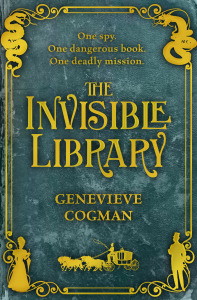
For a book purportedly about a library, The Invisible Library, by Genevieve Cogman, has very little librarying going on here.
"I and Mr. Strongrock are agents of a library which exists between the alternate worlds. Our task is to collect books for the Library from all those worlds, to preserve them."
That's the premise. While the laws of physics are upheld throughout the worlds, they allow for magical elements and creatures like fairies and dragons, vampires and werewolves. Each world is governed by forces of order and of chaos, in varying degrees. I don't really see how all this jives with the claim that science remains true, but blah, blah, blah, suspension of disbelief, it's just a lame excuse to tell stories about different realities.

This story covers one particular mission in one particular alternate. This world is very Victorian-era steampunk, with a murdered vampire, zeppelins, and mechanical alligators. Our librarians seem to have stepped into a conspiracy, though whether it's masterminded by the Fae folk, the Iron Brotherhood, or Luxembourg is not clear. There's a bit of penny dreadful about it, as our chief protagonist, Librarian Irene, herself notes.

The book she's after is a version of Grimm's Fairy Tales. We're treated to a small sample of it, but my sense is that the object of the chase could have just as easily been another type of artefact.

Librarians also have access to the Language, a type of magic that seems to depend on naming things very precisely, but it's mostly just mysterious and convenient.

So what is the point of the Library? Although it opens onto all the alternate worlds, librarians are careful not to interfere in the workings of those worlds. They collect knowledge, but squirrel it away without ever really using it or even understanding it.
The conversation shifted, much to Irene's relief, into a debate on poetry that lasted for most of the journey. She herself was mostly silent, being more used to acquiring it than reading it.
Which doesn't seem very librarian-like to me.

It's a fun book, but mostly forgettable. I've had trouble focusing the last couple weeks, so this book was easy, not too demanding, and provided some distraction. There were some funny bits, and it reminds me a little of the Thursday Next books, but without the clever literary references. I won't be searching out the subsequent volumes of Cogman's series.

Friday, November 25, 2016

On not buying books

Yesterday for lunch I went to the bookstore. Food for thought, food for the soul. Usually I just like to browse, just being in a bookstore brings me comfort (and I'm lucky to have recently found a non-big-box-chain store near my office — I blame the shifting streets of Old Montreal, like mischievous Hogwarts staircases, for keeping it hidden from me for so long), but yesterday, uncharacteristically, I splurged on impulse.

I have tried to keep in check the acquisition of books, but when displaying my spoils back at the office (just three books), a coworker, having witnessed me purchase books on two occasions and at other times open packages of books, called me on this delusion of mine.

Since September,
  • The Ballad of Black Tom, Victor LaValle — because a review made me want it, it's Lovecraftian
  • Le Chat, Georges Simenon — to practice my French
  • The Crying of Lot 49, Thomas Pynchon — because I've been planning to read it for years, so finally now
  • The Door, Magda Szabó — because I wanted Iza's Ballad (because the name) but it wasn't available, and NYRB Classics books are beautiful
  • Exercises in Style, Raymond Queneau — because it's exercises in style, so I can argue that it's related to my work
  • The Familiar, Volume 2, Mark Z Danielewski — because volume 1 was exhilarating, and it's fascinating as an object
  • The Hand, Georges Simenon — because I'd never heard of it, and since it's not available in Canada it's that much more precious
  • The Invisible Library, Genevieve Cogman — because it was on all sorts of books-to-watch-for lists and it cost less than 2 dollars, and it might be about a library
  • The Last Days of New Paris, China Miéville — because Miéville is one of the few authors about whom I feel I must own his entire oeuvre
  • The Loney, Andrew Michael Hurley — because I had it on a list somewhere, I don't know why
  • Monday Starts on Saturday, Arkady and Boris Strugatsky — because now available in English, plus it's an excellent title
  • So You Don't Get Lost in the Neighbourhood, Patrick Modiano — because I'd never heard of it, and I felt a connection to Modiano this summer, and it was shelved in the thriller section
  • The Vegetarian, Han Kang — because I've been wanting to see what the fuss is about, but it wasn't available at my library, and I know I can hand it off to someone afterward
And before September, the last time I purchased a book was August, and before that was June. If you don't count the travel guide I picked up in July, along with some other vacation-reading material.

That's not counting the books I've purchased as gifts for other people, which typically occasion an oh-I'll-just-pick-up-a-little-something-for-myself-then-too moment, which helped contribute to the above.

Some of the above books were rationalized in a my-birthday-is-coming-soon way, and then an it-was-just-my-birthday-so-of-course-I-should-treat-myself way.

I'm proud to be using the library more regularly this year (quite suddenly they have a decent selection of ebooks), and when I'm hankering for something new I'm likely to browse NetGalley review copy offerings. At least some of the books listed above are ebooks (for which I'll rarely allow myself to spend more $5). I have not listed here the free ebooks I've acquired.

But believe me when I say it's not a spending problem so much as a space problem. I've become adept at slipping books in and overlooking them mentally; physically, it's a bit more challenging. Surely I'm a victim of book creep — the steady but so-slow-as-to-be-almost-imperceptible advance of books from designated shelves and corners onto most surfaces of my living space.

Me not buying books? Not very good at it.

Monday, November 21, 2016

Prospero's library


If my library were peopled with creatures rather than books, it would house polar bear memoirists, insurgent dogs, poetry-spurting robots, grieving elephants, musical dragons, literary rats (and cockroaches), dream-weaving spiders, and pulsating intelligences. Murderers, detectives, hackers, God's gardeners, librarians, artists, occultists, mothers, medieval scholars, and bureaucrats all live here.

Sunday, November 20, 2016

A smell cannot lie

Wolfgang's mouth smelled of lies. There are different sorts of lies, and each one has its own smell. This particular lie smelled of suspicion: Wolfgang was probably reporting not his own thoughts but the words of his boss. Wolfgang was a liar, but fortunately he was still a young liar. His smell revealed that he was still a child, and a smell cannot lie.
Memoirs of a Polar Bear, by Yoko Tawada, is a beautifully whimsical meditation of a novel.

Really it's the memoirs of three polar bears spanning three generations. But they are the collective unconscious of an archetypal polar bear. Each bear embodies all past bear ancestors.

The subject of that meditation is tough to pin down. It is about writing and words and politics.
"Writing isn't particularly different from hibernation."

"The smaller the newborn text, the better, because then it has a better chance at survival."

"The boss had no doubt intended to enrich this low-fat speech with a bit more semantic butterfat."

"After that I stopped writing anything political, though I'm not entirely sure what's political and what isn't."

"Rage is a sort of fuel that can't be found in the forest."
It is about nationalism and cultural identity. How language is linked to identity. It is about climate change and responsibility and responsibility for the actions of our forebears. Free will and predetermined nature. What is natural and what is learned behaviour.

The first bear, the grandmother, is a star circus performer; she rode a bicycle in the early days. When her knees gave out after training in Latin American dance, she was assigned a desk job and started participating in conferences (for example, Working Conditions Among Artists, and Working Class Pride).

So there's this polar bear just living out her life in Moscow, sweet-talking her superintendent into giving her some contraband vodka, and the super starts discussing a masterpiece of Japanese diary literature from the Middle Ages, which inspires the bear to pen her autobiography, which is well received by the public, but her celebrity leads to persecution by the state.

She defects to West Germany, where she is overwhelmed by the availability of goods and somewhat taken aback by the conspicuous and wasteful consumption of the West. The bear begins to realize that her fate is inextricably linked to that of humans and human rights.

A bookseller presses Heinrich Heine's Atta Troll on her, for which she reproaches him: "You sold me an indigestible book!" Atta Troll, A Midsummer Night's Dream, an 1841 epic poem, is about a dancing bear who makes a break for freedom, to end up as rug in Paris. (Everything I know about Atta Troll I owe to short summaries and a Google preview of Reading Heinrich Heine; it appears to be not widely known in English.) The conversation turns to censorship.

Eventually she seeks political asylum in Canada. She learns English, marries, has a daughter (Tosca); her husband wants them to flee to East Germany, to contribute to the creation of an ideal state, so they do.

And this is how this novel is. Is she really a polar bear, or is she a metaphor? She is nameless.

Her daughter, Tosca, makes her name on the stage, and eventually also works in the circus. It appears that Tosca's son, Knut, is born in captivity, in a zoo, and is also an acclaimed public figure.

Their memoirs in turn are both funny and poignant.
"Someone told me once that illness was a traditional form of theater practiced by office workers, who were allowed to put on these performances only on Mondays when they didn't want to come to work."

"It's not that I want to talk about the war, it's just that it makes me nervous to have a hole in my circus biography. A hole that big might one day become my grave."

"I wanted to wrap myself in the black woolen blanket of grief and brood over my clutch of sorrows until they hatched and flew away, but it wasn't possible."

"Knut felt powerless in the face of time. Time was a huge ice block made of loneliness. Knut gnawed and scratched at it, but without effect. When Christian complained of having no time, as he often did, Knut envied him."
Each bear gains awareness of themselves, their heritage, and the larger climate of which they're a part. Only by looking inward can one begin to see outward.

I expected gimmicky and sentimental, but this novel was unpretentious and thoughtful, thoroughly charming. It let me revel in surreal circumstances and circus stories, but gave me space to consider some very serious questions indeed. The narrations flits easily, letting my mind settle where it will.
After the death of all living creatures, all our unfulfilled wishes and unspoken words will go on drifting in the stratosphere, they will combine with one another and linger upon the earth like fog. What will this fog look like in the eyes of the living? Will they fail to remember the dead and instead indulge in banal meteorological conversations like: "It's foggy today, don't you think?"

Sunday, November 13, 2016

All our conversations compete

I don't know how to say what I have to say to you. If I say, "I find that my choice is whether to not be or to be," it'll worry you. I could maybe say, "My choice is how to be," but that leaves so much unsaid.

When a robot vacuum cleaner hits the sofa leg, it might veer left, might go right. Is that choice? I don't know yet which way I'll veer.

The time I'm talking about is just before you got that last text from me, to which you didn't immediately reply, because it was in the middle of the night and it made no sense. I know later you came to my ruined house and couldn't get in, and no one could find me. I got your messages, but I couldn't answer. I saw how you all looked.

How do I tell this?

It's hard to think sometimes amid the clamor of argument. The politics of objects. All our conversations compete.

YouTube videos might be conversing among themselves — their lists and references and cuts parts of their dialect. When we bounce from song to nonsense to meme, we might be eavesdropping on arguments between images. It might be none of it's for us at all, any more than it's for us when we sit on a stool and intrude on the interactions of angles of furniture, or when we see a washing line bend under the weight of the wind or a big cloud of starlings and act like we get to be pleased.
— from "The Dusty Hat," in Three Moments of an Explosion, by China Miéville.

Conversations in the world that have nothing to do with you are suddenly meaningful. Everything is suddenly loaded with meaning.

I'm restless this week, and so is my reading. I can't seem to settle on anything, or see anything through.

I've been dipping into this volume of Miéville's short stories for well over a year now. I have a difficult time appreciating short stories in general. Maybe not unexpectedly, short stories feel just right at a time like now.

Some of these are brilliant, others less so. (Every reviewer has a different favourite; I'll keep you posted on mine.) But all of them are suddenly loaded with meaning.

Saturday, November 12, 2016

Cohen, elsewhere

In the summer of '94 I was passing through Wrocław. A friend of mine from Kraków was in town, and we arranged to meet one afternoon in the bar beside the experimental theatre. My friend introduced me to Igor, an actor — more of a troubadour really — from Russia, somewhere east of Moscow. Igor spoke little Polish, and even less English or French. My friend was quite drunk already, and tired of translating.

Igor looked at me and said, Kanada, as if to confirm. Yes, I nodded. Igor smiled and said, Leonard Cohen.

And so we sang.