Friday, February 15, 2013

A brutal nostalgia

The second life, as everyone knows, always comes with the inconvenient obligation to correct the first one.

And later,

And then he confirmed the feeling I'd had earlier: one of the consequences of the second life was a brutal nostalgia, the notion, so very democratic, so universally accessible and at the same time so surprising, of time lost, even though we might have suffered more in that time than in the present.

I'm reading The Informers, by Juan Gabriel Vásquez — a much denser read than I'd expected, though it's only just over 300 pages. Not hard, but weighty. The narrator is slowly unpacking his relationship with his father, and his family's relationship to its community. Neither memory nor history is entirely reliable; accuracy, let alone truth, is elusive.

The setting is Colombia, a country with a politically convoluted history, and the story told here essentially starts with Jewish immigrants at the onset of WWII. Weighty.

Also,

Life likes to outdo itself.

Tuesday, February 12, 2013

A soup like this is what I need

This may be a first for me, quoting from a cookbook:

This recipe, however, has an entirely literary provenance: the minute I read about Ezra'a hopes for the restaurant in Dinner at the Homesick Restaurant, his plan for a soup made with garlic and love, I knew I had to eat it. Which meant, first, I had to come up with a recipe and cook it. I am not trying to replicate the recipe that the character had in mind, not that I could; but no matter, for this is the sort of soup that came into my head as I read. (I've spared you the gizzards — because I couldn't, in any case, get them past the home front.) With any other writer, there might be a danger of the title's being cloying or sentimental, but how — really — is that possible in an Anne Tyler novel? Your soul gets flayed on every page: I don't think any writer has managed to be so piercing and unrelentingly intense and plain downbeat at the same time.

There's not a sentence of hers I don't love, but after reading any of her books, a soup like this is what I need.

— from "Soup made with garlic and love," in Nigella Kitchen, by Nigella Lawson.

Last night's soup wasn't Nigella-perfect, but I think next time it will be. Maybe I should read some Anne Tyler.

Sunday, February 10, 2013

A pterodactyl in Paris

Some time ago I read a review by Rosecrans Baldwin: Pterrifying Pterodactyl Meets Sexy Detective. Thus was I introduced to The Extraordinary Adventures of Adèle Blanc-Sec. He writes:

The books are part adventure comic, part hardboiled fiction. They're terrific whodunits that conjure up all the precise atmospheric detail of, say, a Georges Simenon novel, but with twice the plot. And the artwork is striking, paneled like a comic but with historical grit. Here is Paris in its authentic beauty: rainy, crowded and bristling with characters who wear their neuroses like carnival masks.

And I was sold.

This graphic novel is recently available in English, but I figured, hey, I can read a French comic book. In French. I've done it before. So I did it again. Les aventures extraordinaires d'Adèle Blanc-sec, tome #1, Adèle et la Bête, by Jacques Tardi.

What I like most about the story is how it combines some pretty disparate elements, all interesting in their own right: prehistoric creatures, seemingly supernatural powers, a feminist sensibility, early 20th-century Paris.

I'm a little fuzzy on some of the details, however, like who's the guy the pterodactyl swoops in to rescue from the guillotine. Not sure if that's the fault of my graphic-novel literacy, or my French. Doesn't matter, I'll read it again and figure it out.

In a weird coincidence, a few days after I brought the book home, my daughter watched the film adaptation at school (they have movie afternoon at the end of the month). From what she tells me, the movie has developed Adèle's back story and filled in many of the details. I look forward to reading about Adèle's further adventures.


Saturday, February 09, 2013

How are you supposed to have any intimacy?

"Stanley, if you closed your store for just a week and you let me elope with you..."

"What a romantic idea. Where would we go?"

"To Montreal."

"Never."

"What? You have something against Quebec, too?"

"I didn't endure six months of close starvation to lose ten pounds just to gain them back in a few days. Montreal's restaurants are irresistible, as are its waiters."

What do more than 25 million readers see in Marc Levy? All Those Things We Never Said, written in 2008 and recently released in the US, is currently being heavily promoted, including a Paris getaway sweepstakes — sadly, for US residents only (it runs till tomorrow if you're interested), and a bit weirdly, as Paris figures into this novel in only a very small way and as a nice place to die.

Levy is touted as the most-read French author in the world, all his novels topping the bestseller lists in France. I wanted to see what the fuss was about.

All Those Things We Never Said is a "romantic comedy" (admittedly, not really my go-to genre). Julia's supposed to be married on Saturday, but her estranged father's died and he's being buried that day. With the wedding indefinitely postponed, Julia spends the ensuing week getting to know her father, and reexamining life and love in the process.

I very nearly abandoned this novel very early on. I didn't, only because work has been very trying and I couldn't be bothered to think to grab something else to read before heading out on my daily commute. I was well over halfway before I developed any interest in how it might turn out.

It reads like a movie (one of Levy's novels has already had the film treatment) — it is heavy on dialogue. In itself that's not necessarily a bad thing, but the conversation is fairly superficial — it's as if these characters have no internal lives at all. It lacks nuance. These people remain two-dimensional.

Starting in New York City, the story takes us to Montreal and later Berlin via Paris. The writing does nothing to bring these places to life on the page. Berlin fares a little better than the other cities, but then I've never been there, and the Wall plays a vital role in the story. Really, most of the events could've taken place anywhere.

"If there were, I don't know, perhaps a little sitting room or a library, maybe a billiard parlor or a laundry room... then I might have some place to go and wait for you. These one-room apartments... What a strange way to live! How are you supposed to have any intimacy?"

Intimacy? Is this a translation error? Maybe privacy? Or is it meant ironically? If so, it's not sufficiently backed by subtlety of character, or strength of character, for the reader to be cued to interpret it this way.

One German journalist aspires to a Pulitzer, which strikes me as a weird thing for a German journalist to say, or a French author to write, even on the off-chance that it might've been meant symbolically (and I certainly hope it wasn't the translator's choice to create a context for American readers).

What puzzles me most about this novel is how little it feels like a French novel. Not that I can tell you what a French novel should feel like. Maybe the expectation of Frenchness was built up in me because of the Paris sweepstakes connection. Just because an author's French doesn't mean he has to write about France. But there's no depth, no awareness, no reflection; no French philosophical attitude. This is not Michel Houellebecq or Emmanuel Carrère, or Patrick Lapeyre or Hervé Le Tellier. (I name these authors because they are contemporary, and I've read them and they all feel French. To be fair, the first pair can't be said to deal in light romance, and should not be used as a basis for comparison with Levy on any other score but this point about Frenchness I'm trying to make.)

All Those Things We Never Said does not feel French. It feels like a fairly predictable Hollywood movie. This novel was not for me, which is too bad, because there are a couple points that interested me — the father's story about meeting the love of his life and the father's final circumstances — and they could have been developed into very different novels. Have you read it? Am I being unfair?

Thursday, February 07, 2013

Palindrome

Helena came home from school one day recently all excited to tell me about palindromes. There'd been a substitute teacher that day, and the regular teacher hadn't provided a lesson plan. So, palindromes!

And though I know a bit about palindromes, and I know some palindromes, I don't think it had ever occurred to me that there might be palindromes in languages other than English. Thus, my first French palindrome: élu par cette crapule. (For a palindrome to work in French, diacritics are often disregarded.)

And it seems obvious to me now that this is exactly the sort of jeu de mots that Georges Perec might have played with. In fact, he composed a palindrome (in the form of a story or poem, kind of) that is 1247 words long.

Coincidentally, later the same evening that Helena and I were getting word nerdy, I was reading my book (which was rather big on coincidence) and it happened that the point was made that a character's cellphone ringtone was a palindrome — Bach's Crab Canon.


See also how Vi Hart folds space-time with Bach and plays a music-box Möbius strip.

Tuesday, February 05, 2013

When the curtain comes down


If you are rich, if you are poor
It's all the same I'm sure...

Monday, February 04, 2013

A between-place

Ragle Gumm is at the centre of his universe. Everything revolves around him.

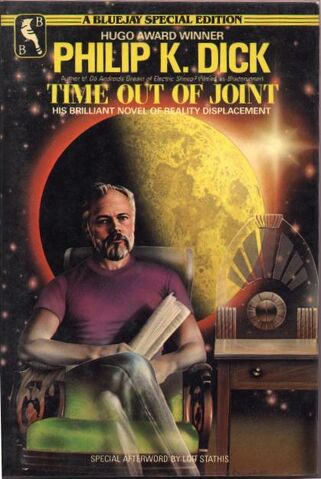
Time out of Joint, by Philip K. Dick, was published in 1959. It's set primarily in small-town America, the 50s. There's a sense that life is good, anything is possible. This is the world through which Ragle Gumm moves. Every day he plays the puzzle contest in the newspaper, "Where will the little green man be next?" And every day he wins.

But Ragle is not entirely at ease with this world. It's a little too good to be true. At first it seemed, to this reader, that there's a little Cold War paranoia seeping in. But no, maybe it's just regular paranoia, a bit conspiracy-minded, like everybody but you is in on something. Also, Marilyn Monroe is conspicuously absent.

And then Ragle's world starts to fall apart, in more ways than one.

Maybe I'm not moving. Caught in a between-place. Wheels of the pick-up truck spinning in gravel . . . spinning uselessly, forever. The illusion of motion. Motor noise, wheel noise, headlights on pavement. But immobility.

It becomes clear that Ragle's got some sanity issues going on.

And it turns out that there's another world outside of Ragle's. It's the world of 1996, and there's a war going on with the lunar colonies.

Reality according to Philip K. Dick is never what it seems to be, and it can be constructed in various ways, requiring the collusion of multiple government bodies, or sometimes just the active cooperation of your own mind.

The ending was a bit of a disappointment to me, not in how the story was resolved, but in its execution. The last 30 or so pages feel like a different book altogether — it becomes expository and futuristic.

The magic of this book lies in its nostalgia for the 50s. There are weird details about the Book-of-the-Month club and its selections, fashion trends, and a fad for all things Italian. Dick writes about a future in which his present is a rose-coloured past. His 50s are rich with the things we would indeed grow sentimental over forty and fifty years later.

Time out of Joint is a weird little story. But it has great insight into how our minds go about creating our individual realities, how we choose details to form our memories, and how some memory gets physically lodged in our bodies. Hopefully we are none of us as deluded as Ragle Gumm, but we are each in our way the centre of our own universe.

Sunday, February 03, 2013

Right to the last twist of necktie

Appearing, Bill Black said pleasantly, "Hi, Ragle. Hi,Vic." He had on the ivy-league clothes customary with him these days. Button-down collar, tight pants . . . and of course his haircut. The styleless cropping that reminded Ragle of nothing so much as the army haircuts. Maybe that was it: an attempt on the part of sedulous, young sprinters like Bill Black to appear regimented, part of some colossal machine. And in a sense they were. They all occupied minor status posts as functionaries of organizations. Bill Black, a case in point, worked for the city, for its water department. Every clear day he set off on foot, not in his car, striding optimistically along in his single-breasted suit, beanpole in shape because the coat and trousers were so unnaturally and senselessly tight. And, Ragle thought, so obsolete. Brief renaissance of an archaic style in men's clothing . . . seeing Bill Black legging it by the house in the morning and evening made him if he were watching an old movie. And Black's jerky, too-swift stride added to the imoression. Even his voice, Ragle thought. Speeded up. Too high-pitched. Shrill.

But he'll get somewhere, he realized. The odd thing in this world is that an eager-beaver type, with no original ideas, who mimes those in authority above him right to the last twist of necktie and scrape of chin, always gets noticed. Gets selected. Rises. In the banks, in insurance companies, big electric companies, missile-building firms, universities. He had seen them as assistant professors teaching some recondite subject — survey of heretical Christian sects of the fifth century — and simultaneously inching their path up with all their might and main. Everything but sending their wives over to the administration building as bait . . .

— from Time out of Joint, by Philip K. Dick.

Thursday, January 31, 2013

Prompt editors to be always truthful

Today, January 31, is the feast day of Saint John Bosco, patron saint of illusionists, stage magicians, and editors.

Admirable apostle of youth, founder of religious Congregations, catechist, educator, writer, and a light that shone brightly in our time, you know that one of the greatest powers today is the power of the Press. Prompt editors to be always truthful and to work for the good of human beings, thus serving the greater glory of God. Amen.

Tuesday, January 29, 2013

All part of the huge, dirty, torn social fabric

A coincidence is just an explanation waiting to happen. So says Jackson Brodie, who used to be a private investigator, who used to be a policeman, who used to be in the military, whose role in Kate Atkinson's When Will There Be Good News? is far from central, yet somehow he is its heart.

This story is about Joanna, who when she was six witnessed the murder of her mother and siblings, barely escaping herself. Thirty years on, the convicted murderer is being released from prison. It's also about Reggie, who works as "mother's help," looking after Joanna's baby. Reggie is 16 and recently orphaned; her brother is bad news. Then there's Louise, a cop in a marriage gone wrong, and former love interest (or something like it) of Jackson's, who's investigating Joanna's husband.

Louise was an urbanite, she preferred the gut-thrilling sound of an emergency siren slicing through the night to the noise of country birds at dawn. Pub brawls, rackety roadworks, mugged tourists, the badlands on a Saturday night — they all made sense, they were all part of the huge, dirty, torn social fabric. There was a war raging out there in the city and she was part of the fight, but the countryside unsettled her because she didn't know who the enemy was. She had always preferred North and South to Wuthering Heights. All that demented running around the moors, identifying yourself with the scenery, not a good role model for a woman.

Throw in a massive train wreck — Jackson's on board — and these characters and others turn out to be connected to one other in unlikely ways.

This is the second Jackson Brodie novel I've read, and I will read more. I marvel at the writing, that it should appear to be so light and funny, and turn so suddenly very dark. So rambling and seemingly random, but in fact tightly interwoven with every other character's thoughts and actions. It turn out it's quite difficult to quote from this novel, as all the punchy bits rely on how they relate to what happened three pages, or three chapters, earlier.

There is not a lot of good news in this novel. And there are a lot of coincidences, with explanations I was willing to accept.

This is not a conventional mystery novel. There are a few sets of mysterious circumstances, but it's some time before it's at all clear that there is a central mystery that needs solving. And that's fine by me, as I was busy being engrossed in the plenty of very interesting people who have a lot of shit to deal with in their lives. As one review notes, "The mysteries Atkinson is most invested in are those of the human heart."

Monday, January 28, 2013

K is for Kindred

Philip K. Dick. The K is for Kindred — Philip Kindred Dick — and I think that's weird and fantastic.

I'm familiar with the work of Philip K. Dick more by virtue of the many film adaptations of his work than direct from the source material. I intend to rectify that this year.

I've had reason recently to poke at the work of a few authors with respect to their relationship with mental illness, and it comes as no surprise that Dick's relationship with reality is somewhat privileged.

What distinguishes schizophrenic existence from that which the rest of us like to imagine we enjoy is the element of time. The schizophrenic is having it all now, whether he wants it or not; the whole can of film has descended on him, whereas we watch it progress frame by frame. So for him, causality does not exist. Instead, the acausal connective principle that Wolfgang Pauli called synchronicity is operating in all situations — not merely as only one factor at work, as with us. Like a person under LSD, the schizophrenic is engulfed in an endless now. It's not too much fun.

— from "Schizophrenia and the Book of Changes," by Philip K. Dick.

An endless now!

Saturday, January 26, 2013

The dark and sooty chamber in his heart

He had to get out. Jackson hated hospitals. He had spent more time in them than most people. He had watched his mother take an eternity to die in one and as a police constable he had spent nearly every Saturday night taking statements in A and E. Birth, death (the one as traumatic as the other), injury disease — hospitals weren't healthy places to hang around in. Too many sick people. Jackson wasn't sick, he was repaired, and he wanted to go home, or at least to the place he called home now, which was the tiny but exquisite flat in Covent Garden containing the priceless jewel that was his wife, or would contain her when she stepped off the plane at Heathrow on Monday morning. Not his real home, his real home, the one he never named any more, was the dark and sooty chamber in his heart that contained his sister and his brother and, because it was an accommodating kind of space, the entire filthy history of the industrial revolution. It was amazing how much dark matter you could crush inside the black hole of the heart.

— from When Will There Be Good News?, by Kate Atkinson.

Wednesday, January 23, 2013

Love was ferocious

Love. Love wasn't sweet and light, it was visceral and overpowering. Love wasn't patient, love wasn't kind. Love was ferocious, love knew how to play dirty.

— from When Will There Be Good News?, by Kate Atkinson.

Tuesday, January 22, 2013

The validity of someone else's solution

Within the first couple dozen pages of The Devotion of Suspect X, by Keigo Higashino, there's a murder. The main characters are sketched out in simple, broad, vivid strokes. Yasuko, with the help of her daughter, kind of accidentally kills her abusive ex-husband. We're sympathetic toward Yasuko; the jerk deserved it. Their neighbour, Ishigami, a high-school math teacher and genius, offers to help cover up the incident.

A body's discovered in due course, and the investigation gets underway. Turns out that Ishigami went to the same school as Detective Kusanagi, the cop on the case, and they have a mutual friend, Manubu Yukawa, a brilliant physicist, to whom Kusanagi often turns for advice.

And so the mathematician and the physicist — theory and practice — face off.
"You're familiar with the P = NP problem, right? Yukawa asked from behind him.

Ishigami looked around. "You're referring to the question of whether or not it is as easy to determine the accuracy of another person's results as it is to solve the problem yourself — or, failing that, how the difference in difficulty compares. It's one of the questions the Clay Mathematics Institute has offered a prize to solve."

"I figured you might be." Yukawa smiled and tipped back his glass.

Ishigami turned back to the desk.

He had always thought of mathematics at a treasure hunt. First, one had to decide where to dig; then one had to determine the proper excavation route that led to the answer. Once you had a plan, you could make formulas to fit it, and they would give you clues. If you wound up empty-handed, you had to go back to the beginning and choose another route. Only by doing this over and over, patiently, yet boldly, could you hope to find the treasure — a solution no one else had ever found.

Therefore, it would seem that analyzing the validity of someone else's solution was simply a matter of following the routes they had taken. In fact, however, it was never that simple. Sometimes you could follow a mistaken route to a false treasure, and proving that it was false could be even harder than finding the real answer.

Which was why someone had proposed the exasperating P = NP problem.
This book is a treasure, not a false one. Some readers cry foul over the ending, but I think that's because they have fallen into the kind of trap Ishigami sets for his students, mistaking this book for a geometry puzzle, when really it's an algebra problem. One would do well to remember too that Yasuko, Ishigami, the cop, and the physics professor are each trying to solve a different puzzle, with different information at hand.

The resolution is logical, it fits perfectly; it is also heart-rending.

I read this book over a weekend, and it evoked in me all the wow of when my grade 7 teacher read us The Witness for the Prosecution, and it occurs to me he may have been trying to teach us the lesson to avoid the trap, question our assumptions, watch for our blind spots, not just how to construct a perfect alibi.

Background
The review that put this book on my radar: Reading Matters.
Excerpt.

Saturday, January 19, 2013

By studying our cancers

I zipped through Octavia Butler's trilogy of Lilith's Brood in the last couple weeks. The first book, Dawn, stands alone, but once I was in, I was in for the long haul. (The subsequent books in the series demand knowledge of the first, but could be read independently of each other.)

Mostly it's about the recolonization of Earth (some hundreds of years after a nuclear apocalypse), via a cross-breeding program devised by the Oankali. Lilith is awakened (having been rescued from the dying planet) and the program is "sold" to her. She then leads the first inhabitants reintroduced to a healed Earth.

The big question is: Is humanity being saved or exploited?

The second novel introduces a plan to colonize Mars with pure humans. The alien Oankali race is betting they'll destroy themselves within a couple generations.

What's compelling about this series is how well the alien species and its culture is imagined. The aliens are completely alien, but they are flesh and blood; their ways are weird, but so natural. And over time, they gradually become more human.

Of course one of the biggest attractions of the book is all the alien sex. Which sounds kind of awesome. The Oankali is a species with three sexes: male, female, and ooloi. They mate together "through" the ooloi; the ooloi establishes a neural link with all parties, and mixes all the genetic material. Now throw in a couple humans, a male and a female, to get the cross-breeding — a genetic trade — underway. Once mated, the parties develop a revulsion for mating with anyone else, to the point of not even being able to comfortably touch one another. They connect only through the ooloi. That neural link must be out of this world.

"This isn't just a drug."

"What then?"

"Direct stimulation of the brain and nervous system." She held up her hand to stop him from speaking. "There's no pain. They hate pain more than we do, because they're more sensitive to it. If they hurt us, they hurt themselves. And there are no armful side effects. Just the opposite. They automatically fix any problems they fin. They get real pleasure from healing or regenerating, and they share that pleasure with us. They weren't as good at repairs before they found us. Regeneration was limited to wound healing. Now they can grow you a new leg if you lose one. They can even regenerate brain and nervous tissue. They learned that from us, believe it or not. We had the ability, and they knew how to use it. They learned by studying our cancers, of all things. It was cancer that made Humanity such a valuable trade partner."

So the Oankali improve humans, using cancer as an agent for good.

I'm including here a picture of a blobfish because it looks just like I imagine one of the cross-breed subadult ooloi whose metamorphosis goes horribly wrong for a little while when it doesn't have recourse to the grounding influence of mates (but it ends up OK).

Wednesday, January 16, 2013

Logic, that angular old maid with flat hips

The Madonna of the Sleeeping Cars, by Maurice Dekobra, is a very charming novel written in 1925 and recently reissued by Melville House.

The story is told by Prince Gerard Séliman, who works as private secretary to the widowed Lady Diana Wyndham, who set out the terms quite clearly:

"I am a woman to whom you'll be rather more a companion than a secretary, or, I might say, you'll have to play the part of a husband — up to the point of coming into my bedroom. You understand that! You're going to take care of my interests. You're going to give me a lot useful advice. You're going to prevent me from doing stupid things whenever possible, because they tell me that that is the favorite pastime of women of my class. Lastly, I hope you won't hesitate to throw out any questionable admirers, who may try to profit by my feminine caprices."

Séliman carries out his duties with grace and humour, very William Powell, but they become more complicated when Lady Diana realizes that her funds are dwindling and that she may have to remarry. An interesting offer from a Soviet delegation leads to travelling across Europe, encountering secret agents, and enduring harsh times in a Soviet prison.

"Without any doubt, you are the strangest individual I have ever met. You are a combination of the sublime and the ridiculous, if you will forgive me for saying so. A distinguished gentleman at noon — a clown at midnight — you excel in every capacity! Here you are moving heaven and earth for the sake of a woman who is not even yours. To my mind, that isn't logic."

"Sometimes, Griselda, it is dangerous to challenge logic, that angular old maid with flat hips."

The charm of the narrative voice outweighs, for me, the adventurous spy-novel elements, although there are some unexpected and astute observations, often downplayed as mere witticisms, regarding politics, and in particular the Russian, or Soviet, character.

I offered him a gold-tipped cigarette. He accepted it without question. His companion, who possessed a polyhedric figure and broken nose, along with bloody cheekbones, extended his flabby hand toward my case, removed the eleven remaining cigarettes and slipped them into a pocket of his leather coat without saying a word.

I remarked facetiously, "I perceive that your friend practices self-preservation."

The mole-like gentleman made an evasive gesture and replied, "Well, that's Communism, isn't it?"

While much is made of the fact that his style earned its own adjective, dekrobisme, I can't say I've ever seen the word used outside of in reference to Dekobra'a own work, and frankly, not too many people these days talk about Dekobra at all.

All in all, the story feels kind of formulaic, with its femmes fatales and its Soviet thugs, its showdowns and twisty resolutions, its romances and alliances, its Orient Express and its Scottish castle, but it's a perfectly good formula, one that Dekobra may well have developed.

This novel has been filmed twice, and I'd love to see either version, but it seems to have missed out on the kind of Golden Age treatment I picture in my head.

Reviews
Head Butler
The Millions
Washington Post
A Work in Progress

Monday, January 14, 2013

Indebted

I watched Payback yesterday, the documentary based on Margaret Atwood's book — Payback: Debt and the Shadow Side of Wealth — that served as the 2008 Massey Lectures (a book I believe I have a copy of, but have not read).

It covers the notion of debt, but primarily non-monetary debt: paying one's dues, paying for one's crimes — a debt to society.

This film looks at some particular cases: a code of family honour and revenge in an Albanian village, one man's time in prison for breaking and entering and his guilt for the seemingly irreparabe damage he did to an old lady's sense of security, the 2010 Gulf of Mexico oil spill, and the working conditions of Mexican migrant tomato pickers in Florida. Conrad Black and Raj Patel have supporting roles.

The pacing's a bit slow (I've seen better documentaries lately, for example, Freakonomics), and it doesn't cover the material I'd expected to (I've read better treatments of the subject, like the anthropoligical persepective in David Graeber's Debt: The First 5,000 Years, which I admit I haven't yet read the whole of).

The movie finally comes together for me when the concept of debt, or payback, is rephrased as making reparation — what sets the balance right again. Money, time, spiritual penance? And of course there will be differing views on whether a debt has been settled depending on whether you're talking to a labour lawyer, a victim of crime, a priest, etc.

What makes this movie interesting to me, though, is that I watched it against the backdrop of a weekend in which I was immersed in Lilith's Brood, a trilogy by Octavia Butler in which extraterrestrials salvage humans and other species after Earth's nuclear destruction. The Oankali restore the humans and the planet, and restore them to each other, kind of.

The book makes me think of debt insofar as it questions: what do we owe our planet, our species, other species; to what do we owe our humanity (and how much of that debt is cultural versus genetic); to what extent would we owe someone or something for saving our life (or saving our species) and at what price?

That's fairly superficial, but there's something else too. I get the feeling we wouldn't have a sense of debt if there weren't a sense of honour or pride which could be injured. And that sense can originate within an individual, a family, a community, a species — any debt we feel is based in the thing, the unit, the code to which we feel allegiance.

So suddenly, this little science fiction trilogy is about a lot more than repopulating the planet — it's become socioeconomic. The Oankali call themselves a species of traders — they trade in knowledge and genetic material. A communal species with high intelligence, they claim their primary sense of debt is to the preservation, or continuity, of life.

Sunday, January 13, 2013

These were the happy people of the world

These were the happy people of the world. They were amusing themselves. They had done nothing to deserve happiness, but they were happy. Or, what is the same thing, they thought they were. And is not the formula of oriental happiness to do nothing?

— from The Madonna of the Sleeping Cars, by Maurice Dekobra.

Friday, January 11, 2013

The parking lot forest of dead Christmas trees

Christmas trees at the side of the road this week prompted me to undress our own, which I did this morning, thinking we'd set it out on the curb this evening in time for pick up.

But when I stepped out of the house this morning, there were no Christmas trees in sight.

I soon found them, however. A couple buildings down from us is a parking lot — really two parking lots with a sloped drive between them, a slope where all the parking lot snow is mounded.

It seems someone rescued all the discarded trees of the neighbourhood in the night and planted them here.

Thursday, January 10, 2013

A mismatched pair of genetic characteristics

"You have a mismatched pair of genetic characteristics. Either alone would have been useful, would have aided the survival of your species. But the two together are lethal. It was only a matter of time before they destroyed you."

[...]

Jdahya made a rustling noise that could have been a sigh, but that did not seem to comer from his mouth or throat. "You are intelligent," he said. "That's the newer of the two characteristics, and the one you might have put to work to save yourselves. You are potentially one of the most intelligent species we've found, though your focus is different from ours. Still, you had a good start in the life sciences, and even in genetics."

"What's the second characteristic?"

"You are hierarchical. That's the older and more entrenched characteristic. We saw it in your closest animal relatives and in your most distant ones. It's a terrestrial characteristic. When human intelligence served it instead of guiding it, when human intelligence did not even acknowledge it as problem, but took pride in it or din not notice it at all..." The rattling sounded again.

— from Dawn, book one of Lilith's Brood, by Octavia Butler.

So far, so very readable. When humanity destroyed the Earth, extraterrestrials saved the survivors, Lilith among them, and salvaged what they could of the planet. Lilith has been preserved for a couple hundred years, and when she is awakened and introduced to an alien culture, naturally she has a lot of questions.

What do you think: Is having a hierarchical nature incompatible with intelligence?

Saturday, January 05, 2013

Crossword resolution

Though I work as an editor, I am at times dolefully inarticulate. I'm of the general philosophy that there's a lot of stuff I don't need to know, I just need to know where to find out that stuff when I need to. On the whole, this approach works just fine. But there are times I wish I knew stuff just a little bit faster. That includes words. I wish I knew more words, the right words, when I need them.

Just after Christmas I picked up for myself a New York Times Sunday Crossword 2013 Weekly Planner Calendar, to sit on my desk at work, the idea being that exercising the puzzle-solving neural pathways will make them, and related word-retrieval mechanisms, stronger.

I love crossword puzzles. I used to be very good at them. I used to meet my sister regularly at the pub on the weekend — we'd enjoy beer and wings and the Sunday crossword, and we wouldn't leave till it was done. But it's been years since we lived in the same city, and I'm out of practice.

So I have this weekly planner, with a crossword puzzle per week. The calendar starts at December 31, and I was worried I wouldn't finish the first puzzle by the end of the work week. So I started a few days early. And, with a little input from a couple colleagues, it was completed on schedule.

My daughter made a new year's resolution this year, and when she asked me what mine was, I told her about this puzzle project, one a week, to exercise my vocabulary and general knowledge, to exercise my brain in ways I haven't lately. "But Mommy! You're brain is perfect! Don't get too geeky." [I've been replaying that soundbite in my head for days now, every time anything starts to go horribly wrong.]

But, hey. Puzzle #1 is done, and I'm feeling a mite bit more cruciverbabendy.

Thursday, January 03, 2013

Old knowledge, new knowledge

"I told them about Manutius."

She did it.

"How it's this amazing ancient book, totally a historical treasure, totally old knowledge, OK — "

She actually did it.

" — and then I explained how there's this nonprofit that's trying to break the code — "

"Nonprofit?"

"It sounds better than, like, secret society. Anyway, I said they're trying to break the code, and of course people perked up at that, because everybody at Google likes codes —"

Books: boring. Codes: awesome. These are the people who are running the internet.

Mr. Penumbra's 24-Hour Bookstore, by Robin Sloan, was one of the best Christmas presents ever (thanks, bro!)! [Along with all the movie-watching you enabled!] [And the amazing red velvet bed cover (thanks, sis!)!]

This is not serious Literature, but there's so much love in it, for books, for codes, for secret societies, for the internet, for quests, for fonts, for obscure skillsets, for interconnectedness, for secret passageways built into bookshelves.

Mostly what I love about it this story is simply the intersection of old books with new technology. Because they don't have to be mutually exclusive.

This was the perfect holiday read — the kind of book you sneak off to read a chapter or two of for a few quiet moments away from the hecticity, the kind that helps a long journey pass easily, the kind that makes me wish I worked in a crazy weird bookstore.

Also, it turns out that Manutius is an actual historical figure, believed to have been the first typographer to use a semicolon.

Wednesday, January 02, 2013

On s'aime comme ça


The kid and I watched Un monstre à Paris (A Monster in Paris). (Watched on Netflix in English; regret that we couldn't see it in French.)

Can't stop singing. Loved it.

Tuesday, January 01, 2013

Lazy days

I feel like I've been holed away for weeks rather than mere days, although maybe it really has been much longer in terms of my headspace.

My hometown at Christmas was (unusually for its microclimate) blanketed with snow, and I returned to Montreal to record-breaking piles of the white stuff. Perfect for taking cover and staring into other worlds.

Three movies I've seen...

Moonrise Kingdom. So charmingly naive while being the exact opposite of naive. Visually it reminds me a little of Greenaway, only it's sweet and funny and ironic. The soundtrack (a lot of Britten) goes some way to promoting this comparison too. Thematically, I'm not sure — the strength of true love, the innocence of childhood, they fuck you up your mum and dad? But lovely. (Bill Murray: "I had to work with a bunch of scouts and kids. No money can make that right, can it?")

Stalker. Not what I expected, based on having read the source material (Roadside Picnic, by the Strugatsky brothers). No alien gadgetry, no reanimated corpses, no backroom thuggery, no black market economy, not much obvious unpleasantness at all. Tarkovsky stripped away all the details of the novel to focus on one trip into the Zone, one philosophical issue: the nature of the true unconscious wish that might be granted upon reaching The Room. The film is gorgeous, everything looks organic, walls and faces are mossy, mouldy. The Zone itself is lush, quite the opposite of the barren desolation the novel invoked, in fact more like Chernobyl is now; it's the town skirting the Zone that's colourless, dead.


This is art. But I'd still love to see a true adaptation of the Strugatskys' novel.

The Other. Based on Thomas Tryon's novel, which I read a couple months ago, I think the trailer with its voiceover and screams may be more chilling than the movie as a whole. The book is one of the scariest I've ever had the pleasure to read. The movie missed the mark on the characterization of the supporting characters, but it has all the classic elements of an evil-child horror movie, perfect for a dark and stormy night.

Three serials I recommend...
These are weirdly interconnected. Race, class, money, love. And a lot of desperation. (I watched these on Netflix.)

Daniel Deronda. Wow. I have got to read more George Eliot. I was fascinated by the Victorian-era look at Zionism. (Part 1 on Youtube.)

The Way We Live Now. An adaptation of Anthony Trollope's novel, inspired by financial scandals of the 1870s. (Part 1 on Youtube.)

Hell on Wheels. I wouldn't say I'm a fan of westerns, and nothing about post-Civil War frontier expansion holds much appeal for me, but this show is strangely compelling. The same time period as the Eliot and Trollope stories, it also features some railroad-related financial and sociopolitical shenanigans, but with a harsher breed of day-to-day difficulties. And several scenes flashed through my mind on my way home when my train was blockaded by First Nations protesters and delayed for several hours. Only the first season is currently available on Netflix, but I look forward to seeing more when I can. (Trailer.)

In queue
Prometheus today, and the continuation of John Galsworthy's The Forsyte Saga.

What are you watching these cold snowy days?

Monday, December 31, 2012

I have waited my whole life

Deckles stands, straightens his robe, braces himself, and gives the shelves behind the desk a sharp shove. They swivel smoothly and silently — it's as if they're weightless, drifting in space — and as they draw apart, they reveal a shadowed space beyond, where wide steps curl down into darkness. Deckles stretches an arm to invite us forward. "Festina lente," he says matter-of-factly.

Neel takes a sharp breath and I know exactly what it means. It means: I have waited my whole life to walk through a secret passage built into a bookshelf.

— from Mr. Penumbra's 24-Hour Bookstore, by Robin Sloan.

Friday, December 21, 2012

Until the end of the world

Some things we plan,
we sit and we invent and we plot and cook up;
others are works of inspiration, of poetry;
and it was this genius hand that pushed me [...]

— from "Until the End of the World," by Nick Cave.

Wednesday, December 19, 2012

I mused on my mistake

Last week I read The Murder of Halland, by Pia Juul.

I saw "lust" where the text said "last." I tried to continue reading, but couldn't. I mused on my mistake, marvelling at the ability to read in the first place. How did the eyes work? And the brain? Just as I wobbled on a bike if I allowed myself to think about balance, my reading became shaky if I wondered about the mechanism of reading. I loved reading and had always thought of it as a refuge. I even read the labels on bottles, if only to keep myself occupied on trains or in restaurants. I read in bed at night. If I lay awake for more than two minutes after switching off the light, I switched it on again to avoid lapsing into thought. To avoid thinking.

And so I read this book, on my commute, in bed at night, without ever caring what it was about. To keep myself occupied. I kept myself occupied a little longer as I walked from the metro to my office, wondering, what is this book about? it's certainly not a muder mystery, and I'm not even sure it's a mystery of any order. It's about, well, just her, maybe her writer's temperament, maybe that annoying way of focusing in or out just when it doesn't quite suit the reader. Most people say it's about grieving, but I've seen many people grieve, and if that's what this book is about, it's not entirely genuine, or at least complete.

For the longest time, and pretty much from the start, I thought it was about her relationship with her estranged daughter, the one she'd essentially abandoned when she left her husband for another man. It seems to me to be the emotional centre of this book anyway.

Mostly it was just boring.

Several of the reviews listed below found this book rich in emotion and character, and even worthy of a second reading. I don't get it. And I doubt I'll be reading it again to try to figure it out.

The review that originally turned me on to this book, which I'm sadly unable to track down now, was, ironically, a fairly negative one. I gambled my tastes against that reviewer's and lost.

I'm all for "literary" and "genre-subverting" and "ambiguity" — even in my murder mysteries — but I'm not convinced this book succeeds on any of these counts (and it's not a murder mystery).

Reviews
Andrew Blackman
Book Snob
Eurocrime
Necessary Fiction
Reading Matters
Tony's Reading List

Tuesday, December 18, 2012

Sheckley's store of worlds

"But your skin is made of metal," Melisande said. "And metal can't feel."

"Darling Melisande," the Rom said tenderly, "if flesh can stop feeling, can't metal begin to feel? If anything feels, can anything else not feel? Didn't you know that the stars love and hate, that a nova is a passion, and that a dead star is just like a dead human or a dead machine? The trees have their lusts, and I have heard the drunken laughter of buildings, the urgent demands of highways..."

— from "Can You Feel Anything When I Do This?," in Store of the Worlds, by Robert Sheckley.

(That story was originally published in Playboy, and yes, the title means what you think it does.)

I've been reading the stories of Robert Sheckley since early summer. This collection, issued by NYRB Classics, has been my go-to book when I needed something short or witty or thoughtful, as a palate cleanser between books, sometimes during other books, or just because.

As I've mentioned before, the stories have a very Twilight Zone-y feel. Some of the details are dated (for example, references to Fuller Brush salesmen), but the ideas themselves are not. Some may call the prose naive, but I find it refreshingly straightforward.

I'm sorry to have finished this collection. I wish only that there might be another to get me through next year.

Sunday, December 09, 2012

We don't notice things change

OK, wow. This is some of the most interesting sci-fi I've ever read.

I first heard about Roadside Picnic, by Arkady and Boris Strugatsky, a handful of years ago, in the context of it having served as the basis for Andrei Tarkovsky's film Stalker (which I hope to see someday soon). It came up again last spring, as a new translation was being published in English.

The few reviews I saw haled it as a classic, and while it was generally revered as such by sci-fi fans (on various blogs and forums, as well by fans among my personal acquaintance), that seemed to be the result of the book resting on its reputation, not because many people had actually read it.

I picked up a copy this summer, but it's not till a few weeks ago when I heard the news that Boris had died that I was inspired to read it.

I was not prepared for this.

The problem is we don't notice the years pass, he thought. Screw the years — we don't notice things change. We know that things change, we've witnessed things change ourselves many a time, and yet we're still utterly incapable of noticing the moment that change comes — or we search for change in all the wrong places. A new breed of stalker has appeared — armed with technology. The old stalker was a sullen, dirty man, stubborn as a mule, crawling through the Zone inch by inch on his stomach, earning his keep. The new stalker is a tie-wearing dandy, an engineer, somewhere a mile away from the Zone, a cigarette in his teeth, a cocktail by his elbow — sitting and watching the monitors. A salaried gentleman. A very logical picture. So logical that other possibilities don't even occur.

In many ways, this is not a science fiction book at all. It's not exactly a crime novel either, but it circles round a group of scavengers and thugs and the black market economy they've helped build up around alien artefacts.

The Earth has been visited by aliens. The several landing areas are zones of total devastation, now with weird gravitational properties and other physical abnormalities, and littered with alien crap. Stalkers risk their lives to venture out into the zones, to retrieve this junk. Much of it is destined for genuine, institutionalized scientific research, but not without it first passing through the hands of several interested parties and generating some profit along the way. But pretty much nobody has any idea what all this crap is for or what purpose it can be set to.

Oh, right. And reanimated corpses. Corpses buried near the Zone just get up and go home. They move pretty slowly and the stench is overwhelming at first, but you get used to it. Also, a ban on emigrations from the Zone, as weird and unlikely mass disasters seem to follow those people who were inhabitants at the time of the visitation.

Our protagonist, Red Schuhart, is a stalker with a heart of gold. Sure, he wants to promote science, but at the end of the day, he just wants to make an "honest" buck.

Certainly, this is one of the most tension-packed novels I've ever read. The job of stalker is tougher than driving truckloads of nitroglycerin. I'm pretty sure there's an actual reference to nitroglycerin in the text, though of course I'm unable to track it down now. Have you seen that great Yves Montand film, Le Salaire de la peur (The Wages of Fear), where they drive the nitroglycerin along extremely rough roads, and they might blow up at every bump, every turn? This novel is like that, with the stalkers inching along on their bellies, only they don't know if they'll explode or implode, disintegrate or melt. This edge-of-your-seat tension is what made that movie and this book excellent thrillers, aside from whatever political or social commentary they want to make. I mean, take the aliens out of this book, cast Humphrey Bogart as Red, and you'd still have an excellent story.

The scenes where Red goes into the Zone are unforgettable.

Highly recommended.

Reviews
io9
Shelf Love
Wuthering Expectations

Thursday, December 06, 2012

Punch in a bowl

Helena's been invited to a Christmas party this weekend, and I've been trying to impart to her the concept of a hostess gift — a nice thing to do despite having been told no presents are required.

Maybe a Christmas ornament, or at the grocery store this evening I suggest fancy chocolates to share with the girls. Helena's look says I'm being lame.

She tells me, "Just so you know, Mom, when I'm a teenager, I'm going to be invited to lots of cool parties. Really cool. Like where they serve punch. In a bowl." I don't see how this precludes a hostess gift, but I suppress a laugh, and for the time being I let it lie.

Wednesday, December 05, 2012

Books for play

Here are three books on my Christmas shopping list that aren't exactly books; that is, they are books, and just a little bit more — art, games, puzzles, adventures, playthings, exercises in deduction.

1. Color Your Own Graphic Novel: Sherlock Holmes The Hound of the Baskervilles, by Arthur Conan Doyle, adapted by John Green.

The classic detective story is done up comic-book style, and you get to colour it yourself. We're big fans of Sherlock in this household. I suspect Helena would find Arthur Conan Doyle's original text and little daunting at her age, and I hope this abridged text will be a little more accessible. Plus (did I mention?), it's a comic book! And you get to colour it yourself! OMG how perfect is that when you're 10!

2. The Worst-Case Scenario, An Ultimate Adventure: Amazon: You Decide How to Survive!, by Hena Kahn and David Borgenicht, with Ed Stafford, Amazon consultant, illustrated by Yancey Labat.

Helena and I worked through a previous adventure in this series, to Mars. It's a choose-your-own-adventure-type story, but your life depends on it. Not only do you have to identify which choice demonstrates bettter science, but you need to perform risk-benefit analyses and manage some complex relationships. We spent more time talking — discussing our choices and the factors that played into them — than reading. Also, we made the wrong choices, and failed several times.

It's not just about decision making, and it's not just about a fun reading experience, though it is those things. I love that the series is based on real, true-life facts.

This Amazon adventure promises piranhas, tarantulas, mosquitoes, monkeys, and jaguars..

3. Penguin Classics Mad Libs, by Roger Price and Leonard Stern.

I admit: I'm stuffing my own stocking with this one. This collection of Mad Libs borrows the openings of literary classics, and leaves you to fill in the blanks. "It was the best of times, it was the ____ of times." The kid may not appreciate the classics yet, but she enjoys Mad Libs. The rest of my family is tolerant of my enthusiasm for both these things. I'm crossing my fingers that someone will play with me.

Monday, December 03, 2012

Like a locust

Mark Helprin's Winter's Tale is big, really big, with a big heart, and a big vocabulary. It starts off as an adventure — gangs of criminals, New York's immigrants and destitute. But before you know it, it's a love story, very possibly a tragic one. Oh, and there's a magic horse. Then suddenly you're jumped forward in time to what appears to be a more contemporary setting, and you're very sad that you won't be spending more time with the characters you came to love in part one. But there's this crazy old lady who keeps a rooster like a cat and whom you need a dictionary to keep up with, and her charming daughter. Some more new characters, and it slips into slapstick. A couple chapters later you're back in New York, and then it's a newspaper novel, you can smell the ink rolling off the presses as the wit rolls off their tongues. But lo, there appears to be a rift in the space-time continuum. And it's mostly very lovely and uplifting, even when people die.

It's all a bit fantastic, in every sense. See, there's this thing with the dead, who've returned, or who just keep on, and the eternal city, and the bridge of pure light that need be built to get there. I don't think anything directly offended my atheist sensibilities, but till the very end I was afraid it might give way to something more overtly religious than the vaguely mystical. I'm pretty open-minded about what I read, I read broadly, and I'm generally happy to suspend disbelief for the sake of a good story or an interesting idea; but I was never fully comfortable with where I felt this book was trying to lead me, even though I ended up a little to the side of the destination I'd anticipated. But it is a good story, and very well told.

The love in this novel for New York and for winter, for New York in winter, for language, for life, is immense. I loved reading Winter's Tale a lot, and I feel it deserves to be loved better than I was able to. Which is a pretty powerful thing for a book to inspire. I'm curious about Helprin's other novels, and I'll be happy to read this one again in my old age.

A warning: if you can help it, don't read this as an e-book. The proofreading job on the OCR to digitize this book was atrocious, far past distracting and well into confusing; e.g., "haifa" for "half a", "mat" for "what", "silendy" for "silently", and many others, including some permutations which I abandoned as unsolvable. And the apostrophes are missing.

"A benevolent act is like a locust: it sleeps until it is called."

Friday, November 30, 2012

It came and went

"Go back?" he whispers.

I desperateley shake my head and wave my fist right in his visor — Cut that out. For God's sake! You never know which way to look with these novices — at the Zone or at them... And here my mind goes blank. Over the pile of ancient trash, over the colorful rags and broken glass, drifts a tremor, a vibration, just like the hot air above a tin roof at noon; it floats over the mound and continues, cuts across our path right beside a marker, lingers over the road, waits for half a second — or am I just imagining that? — and slithers into the field, over the bushes, over the rotten fences, toward the old car graveyard.

Damn these eggeheads, a great job they did: ran their road down here amid the junk! And I'm a smart one myself — what on Earth was I thinking while mooning over their stupid map?

"Go on at low speed," I tell Kirill.

"What was that?"

"God knows! It came and went, thank God. And shut up, please. Right now, you aren't a person, got it? Right now, you are a machine, my steering wheel, a lever..."

— from Roadside Picnic, by Arkady and Boris Strugatsky.

Sunday, November 25, 2012

A child is rather horribly perfect

Good science fiction movies for kids are hard to find, but The Last Mimzy may qualify.

Helena and I watched The Last Mimzy this weekend, finally, many, many months after the IT guy at my office (since retired) recommended it. (Actually, we'd watched the beginning on Youtube but had been unable to find all the movie's parts; conveniently, a DVD turned up to be included among Helena's birthday presents.)

You may recognize "mimzy" as "mimsy," a word occurring in Lewis Carroll's "Jaberwocky," which served as inspiration for Lewis Padgett's 1943 short story, "Mimsy Were the Borogoves":

How can an immature human understand the complicated system of social relationships? He can't. To him, an exaggeration of natural courtesy is silly. In his functional structure of life-patterns, it is rococo. He is an egotistic little animal, who cannot visualize himself in the position of another, certainly not an adult. A self-contained, almost perfect natural unit, his wants supplied by others, the child is much like a unicellular creature floating in the blood stream, nutriment carried to him, waste products carried away —

From the standpoint of logic, a child is rather horribly perfect. A baby may be even more perfect, but so alien to an adult that only superficial standards of comparison apply. The thought processes of an infant are completely unimaginable. But babies think, even before birth. In the womb they move and sleep, not entirely through instinct. We are conditioned to react rather peculiarly to the idea that a nearly-viable embryo may think. We are surprised, shocked into laughter, and repelled. Nothing human is alien.

But a baby is not human. An embryo is far less human.

The story is rather philosophical (as all the best SF is), and uses a mathematical paradigm to demonstrate its thesis. The film diverges greatly from its source material, and at times comes across as more new-age-y than scientific. But it embodies a similar, even broader, spirit to the story, and it is nonetheless thoughtful and thought-provoking.

Full text of "Mimsy Were the Borogoves."
William Shatner reads "Mimsy Were the Borogoves" (in 6 parts).

Saturday, November 24, 2012

The subjugation of apparent anarchy

New York had always been a city destined for the rule of dandies, thieves, and men who resembled hardboiled eggs. Those who made its politics were the people who poured gasoline on fires, rubbed salt into wounds, and carried coals to Newcastle. And its government was an absurdity, a concoction of lunacies, a dying man obliged to race up stairs. The reason for this condition was complex rather than accidental, for miracles are not smoothly calculated. Instead, they are the subjugation of apparent anarchy to a coherent design. Just as music must be like a hive of bees, with each note that strains to go its own way gently held to a thriving plan, a great empire depends for its driving force upon the elements that will eventually tear it apart. So with a city, which if it is to make its mark must be spirited, slippery, and ungovernable. A tranquil city of good laws, fine architecture, and clean streets is like a classroom of obedient dullards, or a field of gelded bulls — whereas a city of anarchy is a city of promise.

— from Winter's Tale, by Mark Helprin.

Wednesday, November 21, 2012

Nothing under my skin but light

It was Helena's birthday yesterday, and just like every year, my birthday came 24 hours later. The thing is, she turned 10, and that fact is hitting me much harder than my turning forty-something again. It hits me with amazement and dread and inspires a rash of pinprick emotions.

On Turning Ten

The whole idea of it makes me feel
like I'm coming down with something,
something worse than any stomach ache
or the headaches I get from reading in bad light —
a kind of measles of the spirit,
a mumps of the psyche,
a disfiguring chicken pox of the soul.

You tell me it is too early to be looking back,
but that is because you have forgotten
the perfect simplicity of being one
and the beautiful complexity introduced by two.
But I can lie on my bed and remember every digit.
At four I was an Arabian wizard.
I could make myself invisible
by drinking a glass of milk a certain way.
At seven I was a soldier, at nine a prince.

But now I am mostly at the window
watching the late afternoon light.
Back then it never fell so solemnly
against the side of my tree house,
and my bicycle never leaned against the garage
as it does today,
all the dark blue speed drained out of it.

This is the beginning of sadness, I say to myself,
as I walk through the universe in my sneakers.
It is time to say good-bye to my imaginary friends,
time to turn the first big number.

It seems only yesterday I used to believe
there was nothing under my skin but light.
If you cut me I could shine.
But now when I fall upon the sidewalks of life,
I skin my knees. I bleed.

— Billy Collins

She's not a kid anymore. She's real.

Monday, November 19, 2012

A thousand white cats

Hugh Close, The Sun's rewrite editor, had the boundless energy of a hound, and was always perched upright, like a Labrador waiting for a stick to be thrown into a cool lake. He had a red mustache, and red hair that was sculpted to his head like clay. He could see puns in everything, and one could not speak to him without suffering an embarrassing disinterment of double entendres. His suits were gray; his shirts had collars with bars; he could read a thousand words a minute upside down and backward (the words, that is, not him); he knew all the Romance languages (including Romanian), Hindi, Chuvash, Japanese, Arabic, Gullah, Turqwatle, and Dutch; he could speak any of these languages in the accent of the other; he generated new words at a mile a minute; he was the world's foremost grammarian and a maser of syntax; and he drove everyone mad. But The Sun was unmatched in style and linguistic precision. Words were all he knew; they possessed and overwhelmed him, as if they were a thousand white cats with whom he shared a one-room apartment. (In fact, he did not like cats, because they could not talk and would not listen.)

— from Winter's Tale, by Mark Helprin.

Saturday, November 17, 2012

Seven things

Claire has tagged me with seven bookish questions. (See other answers by Mee, BIP, Nicola, ds, Vasilly, and Lu.)

1. What propelled your love affair with books — any particular title or a moment?
Not a title or a particular moment, but the situation of new motherhood. I'd always been a reader, but under this challenging circumstance my mindset shifted. I read while breastfeeding, 35 hours a day it felt like. I read to stave off boredom, to escape, to step out of my self, to stay awake, to bring myself to stillness and sleep, to consider other lives, to exercise my vocabulary, to stretch my imagination, to engage with the world. I guess that was always the case, but now I gave it more focus and intensity, and a habit was formed.

2. Which fictional character would you like to be friends with and why?
Larry Darrell, from The Razor's Edge, by W Somerset Maugham. We could loaf together.

3. Do you write your name on your books or use bookplates?
No. I used to, as a child and teenager; I don't know why I stopped. These days I try to give books away; I guess I don't feel I own them enough to label them mine. I still write my name in reference books, as these get passed around the office and I want them to come back to me.

4. What was your favourite book read this year?
The Sparrow, by Mary Doria Russell. Jesuit philosophy, anthropological linguistics, first contact with alien cultures. My favourite things! I'll be revisiting this book in the years to come.

5. If you could read in another language, which language would you choose?
Arabic. I suspect there's a treasure trove of literature that's never been translated, that the West has never heard of. But more compelling than that, it's linguistically interesting. I've taken classes twice but failed to retain much.

6. Name a book that made you both laugh and cry.
The book I'm reading now — Winter's Tale, by Mark Helprin — I don't cry easily at books. And I'm laughing too, not just a chuckle at a witty turn of phrase, but heartily and out loud, and often unexpectedly at the sudden slapstick of a situation. And I'm only halfway.

7. Share with us your favourite poem?
"anyone lived in pretty how town," by e.e. cummings.

The Liebster Award, helping others discover other blogs. I'd like to ask Ana, Cipriano, Dwight, Melwyk, Mental Multivitamin, Sara, Tom, and anyone else:

1. What book (a classic?) do you hate?
2. To what extent do you judge people by what they read?
3. What television series would you recommend as the literariest?
4. Describe your ideal home library.
5. Books or sex?
6. How do you decide what to read next?
7. How much do you talk about books in real life (outside of the blogging community)?

Thursday, November 15, 2012

A kick like a mule

The shelf was filled with books that were hard to read, that could devastate and remake one's soul, and that, when they were finished, had a kick like a mule.

— from Winter's Tale, by Mark Helprin.

Tuesday, November 13, 2012

Expression itself held down and stilled

They walked along the line of machinery until they were discovered by a workman who was emerging from one of the long passages inside. He said nothing as he approached. But in his expressionless face and jewel-like eyes he was expression itself held down and stilled. Peter Lake had heard Beverly say that the greater the stillness, the farther you could travel, until, in absolute immobility, you achieved absolute speed. If you could hold your breath, batten yourself down, and stop every atom from its agitation within you, she had said, you could vault past infinity. All this was beyond his comprehension.

— from Winter's Tale, by Mark Helprin.

Sunday, November 11, 2012

The colour of infinity

— No-one's trying to kill him at all. He's just paranoid, isn't he? Nora says irritably. He's just a red herring. And the old people — I bet they're just paranoid as well.

"Ah, yes, but that doesn't mean that someone's not out to get them."

— You'll never make a crime writer.

"This isn't a crime story. This is a comic novel."

Emotionally Weird, by Kate Atkinson, is a weird novel. There's a story within a story, and it took quite some time for me to figure that was the case (and not that we were simply jumping forward or backward to another time period). And it took me a while longer to determine which story was inside which. Further, throughout the inner story — Effie's college life — we are treated to excerpts of a few more manuscripts (one of them more prominently). So structurally it's a bit weird, but fun.

It does not hold together as crime story, or mystery, but then it's not one (see above) — despite the mysterious goings on, the dog, the woman, and other red herrings. So if you're familiar only with Kate Atkinson's Jackson Brodie stories (as I was), check your expectations at the door.

The language is often breathtaking. At times it veers off toward becoming a parody of itself, but even this is somewhat fitting as the protagonist of the inner story is struggling to complete her creative writing assignment, and even though I had to look up a lot of words (a lot of them being very Scottish), the language is always light.

From the framing story, generally more serious and (intentionally, I think, maybe even mockingly) capital-L Literary in tone:
I have my mother's temperamental hair — hair that usually exists only in the imagination of artists and can be disturbing to see on the head of a real woman. On Nora it is the colour of nuclear sunsets and of over-spiced gingerbread, but on me, unfortunately, the same corkscrewing curls are more clownish and inclined to be carroty.

From the inner story — the college novel — that story intended to be "comic":
The old woman had skin that was the texture and colour of white marshmallows and in a poor light (which was always) you might have mistaken her hair for a cloud of slightly rotten candyfloss. Although fast asleep, she was still clutching a pair of knitting needles on which hung a strange shapeless thing, like a web woven by a spider on drugs.

Reviews
New York Times
Salon

These and other reviews can't fully agree on what Emotionally Weird is all about.

One of Effie's assignments is an essay on Middlemarch, and the criticism Henry James levels against it: "Middlemarch is a treasure-house of details, but it is an indifferent whole." Henry James was wrong, of course. And I get the feeling that this entire novel is intended as a response to James, an exercise in Eliot's realism, a defense of it, but in its execution at once proof that ultra-realism is no longer suited to narrating today's realities.

Emotionally Weird is very realistic: a lot of nothing happens. There are many conversations — some interesting, some boring — with too many people. A lot of what happpens, as in life, has nothing to with anything else. It shows just how difficult it is to tease the narrative thread out of real life.

Emotionally Weird also has some wonderful details, especially to do with colour, and clothing, and how academics talk, but, despite how the Doctor Who references made me smile, it — and not Middlemarch — leaves me indifferent.

I wouldn't recommend this book to most readers I know, except to some who've had a particular kind of college experience.

"Today the Tay was the colour of infinity and made me feel suddenly depressed."

Friday, November 09, 2012

Impossibly pale, lucid, and silver

His eyes were like razors and white diamonds. They were impossibly pale, lucid, and silver. People said, "When Pearly Soames opens his eyes, its electric lights." He had a scar that went from the corner of his mouth to his ear. To look at it made the beholder feel a knife on his own skin, cutting deep and sharp, because Pearly Soames' scar was like a white trough reticulated with painful filaments of cold ivory. It had been with him since the age of four, a gift from his father, who had tried and failed to cut his son's throat.

Of course, it's bad to be a criminal. Everyone knows that, and can swear that its true. Criminals mess up the world. But they are, as well, retainers of fluidity. In fact, one might make the case that New York would not have shone without its legions of contrary devils polishing the lights of goodness with their inexplicable opposition and resistance. It might even be said that criminals are a necessary component of the balanced equation which steadily and beautifully eats up all the time that is thrown upon its steely back. They are the sugar and alcohol of a city, a red flash in the mosaic, lightning on a hot night. So was Pearly.

— from Winter's Tale, by Mark Helprin.

I'm looking forward to the weekend and maybe (please?) some days off where I can immerse myself in this book. I'm finding it hard to give myself over to it when I have only 10-minute spurts of congested reading time on the metro (both it and my head being congested). But there are such flashes of gorgeous. Pearly gorgeous.

Thursday, November 08, 2012

An advertisement, an experience, a souvenir

"What the Book" is an interactive exhibit designed by Barbara deWilde. Visitors choose to agree or disagree with seven statements that relate to the function of physical books and ebooks.

A video on deWilde's blog explains how it works. Much of the text of the video is reproduced on the AIGA website.

Devising the statements was the most challenging part of the design:

The content had to touch upon physicality and its effect on functionality within James Bridle's temporal model of the book. In his model, the book is first an advertisement, next a reading experience and finally a souvenir. Printed books work well at all points along the timeline. Ebooks, however, make lousy advertisements, so-so reading experiences and terrible souvenirs.

(Actually, I'm not sure I agree.)

I believe it is no longer on display at the AIGA National Design Center, but the online version of the poll is still active.

Do you agree or disagree?:
  • I silently judge people by their bookshelves.
  • I would love to be picked up in a bookstore.
  • A book has made me so angry I've thrown it against the wall.
  • I would never give an ebook as a gift.
  • Decorating with books is perverse.
  • The Internet is as important as sex.
  • I want to own nothing.

Wednesday, November 07, 2012

Our slouch towards commitment

What if I didn't leave Bob? What if our slouch towards commitment ended at the altar? What would it be like if I occupied the wife-shaped space next to Bob? My life as a wife. In a Barratt's starter-home, with an avocado bathroom and a three-piece suite in leather. If we ever had a child (a curious idea) I thought we should call it Inertia. Although our occasional dull missionary encounters didn't seem passionate enough to produce anything as real and lasting as a child, even one called Inertia, and Bob (more likely to consult Mr Spock than Dr Spock) wasn't fit to be in charge of a push-and-pull lawnmower let alone a baby in a pram.

I did so hope that Bob was a dress rehearsal, a kind of mock-relationship, like a mock-exam, to prepare me for the real thing, because if I tried to imagine Bob in a grown-up life I could only visualize him slumped on the leather sofa, watching Jackanory with a huge joint in his hand.

— from Emotionally Weird, by Kate Atkinson.

Thursday, November 01, 2012

It turns on detail

There's an interesting piece by Mark Lawson in The Guardian about the long and popular tradition of European crime fiction and introducing his new radio series:

Retracing these journeys, I have made a 15-part series for BBC Radio 4, Foreign Bodies, which uses celebrated fictional detectives — from Christie's Poirot to Nesbø's Harry Hole — to explore the history of modern Europe. Cop novels are a useful tool for such a survey because the police procedural turns on detail. Novelists working in crime-free narratives have no need (and often no wish) to specify a character's job, clothes, income or family background. But because observation and evidence are crucial to the investigation of a crime – the motive for which will often rest on who someone was or what they possessed or desired – crime writers routinely provide a mass of social detail: menus, train timetables, fashion labels, shops, newspaper stories. As a result, good crime novels become a case-file of their times. The introduction of the welfare system and unemployment benefit, for example, can be traced through the comments of posh employers in Christie's mysteries. And reporters preparing to cover the impending referendum on Scottish independence would be well advised to read Ian Rankin's DCI Rebus books, which systematically depict the country's re-examination of its identity over the last 25 years.

I think this goes some way to explaining the mass appeal of crime novels. Some say we read in order to live other lives. Reading crime novels then, with their finer level of detail, may be a more immersive experience (whether for the purpose of education, entertainment, or escape).

(Certainly the attraction to my latest criminal addiction — Marek Krajewski — has less to do with the police case at hand than it does with the minutiae of 1930s Poland: the meals, the bars, the beer and the vodka, office life, marriage bureaus, tenements. All reliably filtered through an investigator who, though he often breaches ethics and good taste, has the mental discipline of a chess enthusiast and a Latin scholar.)

While Sherlock Holmes remains the detective archetype, Lawson identifies Georges Simenon (and his creation, Maigret) as the greatest influence on European crime fiction:

In Rome, Andrea Camilleri — creator of the Sicilian policeman Inspector Montalbano — pointed out to me the complete set of Maigret books on his shelves. In Berlin, one of the leading German crime-writers, Jakob Arjouni, also kept a complete Simenon close to his desk. PD James cites Simenon as a master as well, confirming a literary afterlife that perhaps validates the view of André Gide that the Belgian writer should have won the Nobel prize for literature.

Perhaps because Simenon expresses more temperament, and Maigret acts on instinct — the approach to crime is more believable than that taken by Doyle, more "human" than Holmes. My fascination with Simenon's books is by now well documented, and continually being validated.