Tuesday, June 28, 2011

A new era in the aesthetics of the human body

Now before we forget abut it completely or before our continuation of the story renders the fact redundant because it comes too late, we will tell you about the stealthy, almost clandestine visit the lord made to the garden of eden one hot summer night. As usual, adam and eve were sleeping, naked, beside each other, not touching, a deceptively edifying image of the most perfect innocence. They did not wake up, and the lord did not wake them either. He had gone there with the intention of correcting a slight flaw, which, as he had finally realised, seriously marred his creations, and that flaw, can you believe it, was the lack of a navel. The pale skin of his babies, untouched by the gentle sun of paradise, was too naked, too vulnerable, and in a way obscene, if that word existed then. Quickly, in case they should wake up, god reached out and very lightly pressed adams's belly with the tip of his forefinger, making a rapid circling movement, and there was a navel. The same procedure, carried out on eve, produced similar results, with the one important difference that her navel was much better as regards design, shape and the delicacy of its folds. This was the last time that the lord looked upon his work and saw that it was good.

Fifty years and one day after this fortunate surgical interventiuon, which gave rise to a new era in the aesthetics of the human body under the consensual motto that everything about it can always be improved, disaster struck.

— from Cain, by José Saramago.

Friday, June 24, 2011

Compañero

The wit in Chuzzlewit

It was one of those unaccountable little rooms which are never seen anywhere but in a tavern, and are supposed to have got into taverns by reason of the facilities afforded to the architect for getting drunk while engaged in their construction. It had more corners in it than the brain of an obstinate man...

Hurrah! I finished Martin Chuzzlewit. It's very long, and for some stretches very boring, but also very funny. The breed of humour is much more physical than I recall from other Dickens books — it's slapstick.

It was so amusing, that Tom, with Ruth upon his arm, stood looking down from the wharf, as nearly regardless as it was in the nature of flesh and blood to be, of an elderly lady behind him, who had brought a large umbrella with her, and didn't know what to do with it. This tremendous instrument had a hooked handle; and its vicinity was first made known to him by a painful pressure on the windpipe, consequent upon its having caught him round the throat. Soon after disengaging himself with perfect good humour, he had a sensation of the ferule in his back; immediately afterwards, of the hook entangling his ankles; then of the umbrella generally, wandering about his hat, and flapping at it like a great bird; and, lastly, of a poke or thrust below the ribs, which give him such exceeding anguish, that he could not refrain from turning round to offer a mild remonstrance.

The pacing really picks up in the last few hundred pages. And there's a murder! Nobody told me there was a murder in Chuzzlewit.

I'm not particularly happy with how everything turns out. A couple plot points are left unresolved. And Tom Pinch surely deserves better, and he is certainly the star of this novel.

And while I rooted for Tom, and loved to hate the despicable Jonas, none of the characters really sings, with ugly truth or deep humanity.

I might agree with Chesterton:

Dickens may or may not have loved Pecksniff comically, but he did not love him seriously; he did not respect him [...] But the fact remains. In this book Dickens has not allowed us to love the most absurd people seriously, and absurd people ought to be loved seriously. Pecksniff has to be amusing all the time; the instant he ceases to be laughable he becomes detestable.

I care not at all for Peckniff ("He was a most exemplary man; fuller of virtuous precept than a copy book."), but love this description:

His shoes looked too large; his sleeve looked too long; his hair looked too limp; his features looked too mean; his exposed throat looked as if a halter would have done it good. For a minute or two, in fact, he was hot, and pale, and mean, and shy, and slinking, and consequently not at all Pecksniffian.

Then there's the bit about America, which I neither love nor hate as most readers seem to. I am surprised that Dickens would put his characters through such hell, but I like that America turns out to be not so much the land of opportunity as the land of opportunists.

I don't recommend Chuzzlewit as an entryway to Dickens, but I found plenty in it to make it worthwhile.

I've been reading this on my ereader over several weeks. Chuzzlewit is a free download from Project Gutenberg. I'm somewhat surprised that I didn't abandon this novel when I was overcome by distractions, but I'm pleased to realize that the fact that it's free and digital in no way diminished the commitment I generally feel toward a book once started.

I was reading Chuzzlewit on the metro, and smiling at some passage or other, when a woman leaned over to ask, "What are you reading? You're enjoying it so much. Is it a romance?" I told her, no, Dickens, and she just loves Dickens, which one?, so I told her, but she hadn't read it, and we chatted for a moment about Dickens in general, doesn't matter whether he's being funny or poignant or creepy, the man has a way with words.

And this exchange made me smile all the more, because I realized: with the advent of ereaders, as much as I miss seeing people's book covers and knowing what they're reading, it's not a human connection — it's just plain voyeurism. Paper or digital, if you're really interested in what someone's reading, you should talk to them.

Wednesday, June 22, 2011

Lumpy and runneled and cracked

They say a picture's worth a thousand words. I supposed it depends on the words, depends on the picture.

The stink of the Lannister host reached Arya well before she could make out the devices on the banners that sprouted along the lakeshore, atop the pavilions of the westermen. From the smell, Arya could tell that Lord Tywin had been here some time. The latrines that ringed the encampment were overflowing and swarming with flies, and she saw faint greenish fuzz on many of the sharpened stakes that protected the perimeters.

Harrenhal's gatehouse, itself as large as Winterfell's Great Keep, was as scarred as it was massive, its stones fissured and discolored. From outside, only the tops of five immense towers could be seen beyond the walls. The shortest of them was half again as tall as the highest tower in Winterfell, but they did not soar the way a proper tower did. Arya thought they looked like some old man's gnarled, knuckly fingers groping after a passing cloud. She remembered Nan telling how the stone had melted and flowed like candlewax down the steps and in the windows, glowing a sullen searing red as it sought out Harren where he hid. Arya could believe every word, each tower was more grotesque and misshapen than the last, lumpy and runneled and cracked.

"I don't want to go there," Hot Pie squeaked as Harrenhal opened its gates to them. "There's ghosts in there."

Chiswyck heard him, but for once he only smiled. "Baker boy, here's your choice. Come join the ghosts, or be one."

— from A Clash of Kings, by George R.R. Martin.

I can't keep away from these books it seems, even though I tell myself I have other things to do, other books to read first, save these for later. But this series — A Song of Fire and Ice — is addictive.

Frankly, I'm hard-pressed to explain why. And I'm incapable of summarizing the story. Not much happens at all at a page-by-page level, yet so much happens. It's somehow magical, that there should be life on the page.

I'm halfway through book two (even while trying to finish Martin Chuzzlewit and keep up with a couple other reading "commitments") and there's but one mention so far of the walking dead that closed out book one.

Anyway, I'm solidly committed now to seeing how far this series will take me. I have given up on the televization for good. It strikes me as remarkably faithful, and on-screen that can be quite boring (the same fault the Harry Potter books suffered, in my view.) Filmically, so many things might be better cut, or altered, or resequenced. But in this case, with legions of fans, it seems more important to be faithful.

Then there are descriptions such as the above, sure to be shortcutted in a few-second glimpse of an extraordinary set — that's what pictures can do, what film is for — but lost is the... I dunno, the immersion, the feeling of scurrying away to read a wholly different world, a whole other world. Not sure how I can justify the assertion that worlds like this are meant to be read (and imagined), not seen. But there you have it.

"Lumpy and runneled and cracked" — those words so much richer than a picture.

Thursday, June 16, 2011

And then there was one

One of the perks of my no-longer-new job is that when the kid comes with me (hey, I guess that's a perk right there), there are some fixtures in this office space that serve as marvelous distractions.

There's the freshwater aquarium. There's the saltwater aquarium. (Although, I don't know which is which. They both have, in addition to fish, similar (but different!) anemone-like creatures and cucumber-like creatures, star-like creatures and shrimp-type creatures.) And there's the aquarium with the leopard eel.

There's the goldfish and turtle pond with the cascading water at the entranceway.

And there's the CEO, who loves to watch the fish, tend to the fish, talk about the fish. He also gets on well with kids. Thanks to him, Helena already knows more about these fish than I ever will. Also, he's good at task-setting — like, "You need to catch 10 goldfish with this small net by x o'clock. I'll get you a bucket to put them in" — thanks to the accomplishment of which challenge Helena was able to witness the feeding of said goldfish to the leopard eel and a few other choice carnivorous creatures.

The first time she came with me to this office (during her Christmas break), there were 8 mini turtles and 1 much larger one, commonly referred to (by the kids who frequent the office) as the mommy turtle, although apparently none of them were actually related.

While I worked(!), Helena set about documenting their characteristics.

It was just a few short weeks later that I heard about the first demise. "Oh, no, which one was it?," I ask a coworker. "I don't know. Do they have names? The one with spots all over." Gasp. Spotty!

The last mini turtle vanished last week. That leaves just mommy turtle, and she doesn't look too happy these days.

I found the cataloguing project Helena had started on (in scintillatingly legible gold-coloured pencil), and I transcribe its text below, to commemorate, in this small way, the contribution these turtles have made to my work life.

**********
Document sur les tortus du travaille

tortu préféré brownie
1. Brownie aime être calme et atantife.
**********
[sic]

Darwin would be proud.

Tuesday, June 14, 2011

The smell of secession

The Oregon Experiment, by Keith Scribner, has a couple really interesting things going for it. Namely:

1. A nose. One of the main characters works as a nose.
2. A secessionist movement.

But it turns out that this is a novel with a breast fixation. This book is all about the breasts. Large, or too small, fleshy, pillowy, ample, lactating, infected, hard, soft, sharp, droopy, pointy. We know all about the characters' breasts, and the characters' mothers' breasts, and the characters' lovers' breasts.

On the other gendered hand, we know very little about what the men look like. Apart from one male "milky torso," there is little indication whether the men are fleshy, flabby, sinewy, sculpted.

A little imbalance doesn't usually faze me. But this book is top-heavy to the point of tipping over. It's too much.

And breastfeeding. The pressure to breastfeed. The romance of breastfeeding. The bond that results from breastfeeding. And such issues. Is it OK to be breastfeeding 4-year-old girls? (Boys?) How about grown men?

Not that I'm a prude or anything. But there's a lot in this novel that made me uncomfortable. Maybe that's the point. But I don't have a good (constructive?) feeling about it.

The characters are all pretty messed up, and none of them particularly likable. They're all pretty selfish actually.

There's Scanlon, a poli sci prof specializing in mass movements and radicalism. His wife Naomi is a former professional "nose" (perfuming and such), but she posttraumatically lost her sense of smell some years ago. Baby on the way, they're moving from New York to Oregon for Scanlon's work.

Naomi's sense of smell comes back, and along with it a hormonal flood — resentments and memories and worries about (in)dependence and career fulfillment and striking a family balance and reclaiming one's body, one's self — issues not uncommon to new mothers.

They befriend a local anarchist. Angry young man. And this relationship I don't see as credible. I just don't see what Clay gets out of it, why he would stick around. Whatever. It's kind of essential to the plot that there be an anarchist, and that he be entwined within this family. So there he is.

And the leader of the secessionist movement, Sequoia, is a near-ideal, free-loving, all-giving vegan earth mother goddess. But I can't really like a character who's chosen to call herself Sequoia. Plus, in complete contrast to her usual policy of openness, she lets her past drive a wedge between her and her daughter.

Scanlon needs both these locals for his work. He tries to convince himself that he's not a bourgeois slumming it for the sake of his research, he tries to walk the talk, but really, who's he kidding?

And it all ends very badly, making me think much the worse of all the characters.

Somewhere in its heart this book is about leaving a life behind, running away from your past, it catching you up even while you yearn for it, ambling toward a life you think you're supposed to be living. Maybe outrunning your past, or just forgetting it.

Somewhere toward the end, the book purports to be about love, the bonds of family, and betrayals thereof. But there's very little real love here. Maybe that's the point. But I can't shake the feeling that this book was written by a man with a superficial grasp of what love is, who just plain doesn't understand women. It makes me angry, and sad. Maybe that's the point.

I'm reminded a little of Doris Lessing's The Good Terrorist, for the street-level view of a movement, the day-to-day practicalities that weigh the lofty ideals back down to earth. Also, Annette Gilson's New Light, for it's Americanness, for putting the commune back in community.

It's also a very olfactory book, though it's neither Proust nor Süskind; only when the smells of fear and danger crop up, I'm afraid the nose has some rehabilitation to go before her alleged genius specificity fully returns.

So, there's some pretty heady stuff in here, but it didn't come together for me. I may or may not pick up Keith Scribner's next novel, depending on its subject matter. I'm sure he'll be fine; his wife must have quite the rack.

Thursday, June 09, 2011

Physical and metaphysical at one and the same time

OK. Wow. This is an amazing little book.

Martin Chuzzlewit is finally almost leaving America. And during his very long (boring) illness in that new land I was distracted (sorry, Charlie) by, appropriately, a little Europeana.

From the first sentence I was drawn along.

When people stopped believing in God, they started to seek ways of expressing that the world is absurd, and they invented Futurism and Expressionism and Dadaism and Surrealism and Existentialism and the Theater of the Absurd. And the Dadaists wanted to do away with art and they made art out of things that were not used before, such as wires and matches and slogans and newspaper titles and the telephone directory, etc., and they said it was new and absolute art. The Futurists wrote verse with lots of interjections such as KARAZUK ZUK ZUK DUM DUM DUM, and they promoted expressive typography, and the Expressionists and the Dadaists wrote verse in new, unknown languages to show that all languages are equal, both comprehensible and incomprehensible ones, such as BAMBLA O FALI BAMBLA, and the Surrealists, on the other hand, promoted automatic writing and unusual metaphors, and they wrote for instance MY CORK BATH IS LIKE YOUR WORM EYE, and they explained that the meaning of this verse spurted out of it automatically and that was physical and metaphysical at one and the same time. The Existentialists said that metaphysics was decadent and everything was subjective, but that objectivity existed nevertheless and that we were going about it the wrong way, because the most important thing was intersubjectivity. And the main thing was for everything to be authentic and that history and the course of history were the result of the philosophical question whether people could communicate authentically and, if they could, then history could be more meaningful than previously, so long as transcendental authorities were restored. And linguists said that communication was only a question of the manner of deconstruction and that there were several ways to deconstruct. And old people said that communication was in a sorry state because people were not capable of looking each other in the eye anymore and they averted their gaze immediately they caught someone's eye and that nowadays people only looked blind people in the eye.

— from Europeana: A Brief History of the Twentieth Century, by Patrik Ouředník.

Europeana is not a novel. So far as I can tell, it's mostly fact. But not entirely. (I would love to see this book annotated. There are some wonderfully intimate, human "facts" included, which may or may not have a basis in historically verifiable anecdotes; either way, they're beautiful.)

The language is so simple, simplistic, naive, it's as if a child had written it. Or a poet.

It pretends to be objective, but it's not. The facts by themselves are cold. The book's power is in how they're juxtaposed. It made me cry.

It does, in fact, in its brief 120 pages cover many events of the 20th century, from a European perspective, and several times. It touches on the invention of tanks and dishwashers, Esperanto and the Enigma machine. Barbie, Scientology, the Y2K bug, and psychoanalyis.

It's main focus, however, is war — both the world wars — cuz let's face it, war pretty much defined the century, framed by fascism and communism and democracy.

The text is repetitive and recursive. It runs over the same territory several times, but from different angles, with different emphasis. This neatly parallels my own theory that time, history, our cultural evolution is not quite cyclical, but spiral, that each time we go over the same old ground, our experience of it is — metaphorically speaking — a little broader, a little higher.

It's the forest and the trees at once. Europeana is an exquisite thing.

Monday, June 06, 2011

Polish monsters

I so wanted to love A Polish Book of Monsters — I'd placed an order for it within minutes of having been alerted to its existence — but I found it to be a huge disappointment. Subtitled "Five Dark Tales from Contemporary Poland," it more accurately should've been labeled simply as an SF sampler.

  • Yoo Retoont, Sneogg. Ay Noo, by Marek S Huberath. This is a futuristic, postapocalyptic, dystopian tale. Nothing particularly original, but I did find it to be the most emotionally wrenching of the stories included here. As one might guess by the title, much of the story is written in "dialect" — personally I find this more distracting than clever or colourful. Part 1 is online.
  • Spellmaker, by Andrzej Sapkowski. This one's a fairly straightforward fairytale, distinguishable from standard bedtime fare only by the hero's rather boastful arsenal of augments. In addition to there being a traditional monster, however, one might view the protagonist as also being somewhat monstrous. The concept here spawned a series of stories, film and television adaptations, and a videogame. Translated variously as The Witcher and The Hexer.
  • Key of Passage, by Tomasz Kołodziejczak. This story read like typical fantasy, and it bored me. Excerpt.
  • A Cage Full of Angels, by Andrezej Zimniak. To my mind, this is the most original of the stories included in this volume. Not that I'm especially well read in SF, but I've never come across an idea anything like this one. I like this one also because it has an urban and "contemporary" feel, even though it's evident that things work not quite as they do in our known world.
  • The Iron General, by Jacek Dukaj. This story has something of an epic space opera about it. As the title might suggest, it is militaristic and political. In the context of this story, the term "monster" is used to depict (moral) character. Excerpt.

Sadly, I didn't find any of these monsters to be particularly monstrous.

Having read The Dedalus Book of Polish Fantasy, and being familiar with Stefan Grabiński, and aware of China Miéville's admiration for Eastern European imaginative fiction, I had hoped for something better. I didn't find these monsters to be anything special. I'd like to think there are better Polish monsters out there, that it will only take a better editor to collect them.

I fear I didn't give this book, these stories, a fair shake. Particularly offputting to me was the introduction, by editor and translator Michael Kandel, probably best known as the preeminent translator of Stanisław Lem. But the background material Kandel presents was poorly written (it can't have been copyedited) and simplistic, with no clear logic drawing it forward, making me question his abilities as a translator. The blurbs extolling the "virtuoso translations" etc seem to me to be somewhat excessive — after having read the book, they strike me as overly defensive. Despite the variety of the material, there is an overwhelming sameness of tone — a blandness — throughout the stories, a tone that I also associate with Lem (which books I've read were translated by Kandel). In the case of Lem, I'd accepted the detached tone as being part of Lem's philosophical style, but I'm concerned now that it might originate in, or be exaggerated in, the translation (I'm very curious now to read some non–Kandel-translated Lem for the sake of comparison).

Kandel seems to conclude that Polish monsters are generally internal ones, but the stories here do not completely bear this out; nor is that a uniquely Polish stance. I can't say what point he's trying to make, or what he means to demonstrate by setting these stories on the English-speaking world (other than that Poland produces a great deal of competent and diverse creative output).

So. I'm glad I read this sampling for a taste of what's out there in Poland. But here's hoping there are bigger, better, weirder, scarier monsters lurking in the corners of Poland's darker minds.

Sunday, June 05, 2011

"Lift me like an olive branch"

Leonard Cohen was this week conferred the 2011 Prince of Asturias Award for Letters, reminding me that I left Beautiful Losers half read on my nightstand last summer (and that I should finish it), but putting his songs in my head.

"The passing of time, sentimental relationships, the mystical traditions of the East and the West and life sung as an unending ballad make up a body of work associated with certain moments of decisive change at the end of the 20th and beginning of the 21st century."

Listen to my favourite cover version of one of my favourite Leonard Cohen songs: Dance Me to the End of Love.

Friday, June 03, 2011

The many books I thought I'd've read by now but haven't

So many I thought I'd be over and done with. So many I had planned. But there just isn't enough time.

Martin Chuzzlewit, Charles Dickens. I was distracted, first by something shiny, something new, then by something relatively short, which I needed in order to feel I'd actually accomplished something. It's so bloody long. Even though some scenes do drag on, it is really quite funny. I picked it up again today, determined to stay focused, to finish it. I'm still a bit disoriented trying to remember who's who and what last happened, but confident it'll come together.

The Doll, Bolesław Prus. Purchased directly upon its release in February. This was going to be my end-of-winter read. Something richly Slavic, to remind me where I come from. But I was daunted by its size (~700 pages).

The Pale King, David Foster Wallace. This was going to be my big spring read. In fact, my other half (himself an enforcer of the Income Tax Act) and I were going to read it together (and we almost never do anything together — sigh). I haven't even purchased this yet.

The Man Who Watched Trains Go By, Simenon. In January it was apparent I was suffering from a surfeit of Simenon, but I bought another to keep on standby. And for a couple weeks already I've been feeling ready. There's just no time. (And there's Mr Chuzzlewitt to lay to rest first.)

The End of the World in Breslau, Marek Krajewski. Because I liked the first book of his so much, I invested in more.

Europeana, Patrik Ouředník. On my wish list for several years already, I finally ordered it along with something or other.

The Book of Disquiet, Fernando Pessoa. I actually had to tear myself away from this one, because it didn't feel right — not fair to me or the book — to be embarking on a fourth or fifth concurrent read.

The Fragile Mistress, Leora Skolkin Smith. This is a review copy. Because the backdrop — 1960s Israel/Palestine — fascinates me. Plus another of hers.

X'ed Out, Charles Burns. I picked this graphic novel up for J-F at Christmas, because then I'd get to read it too. He was finished with it in 2010. I started to look at it, but didn't feel like I had the solid, uninterrupted couple hours it deserved, so I put it down.

The Elephant's Journey, José Saramago. I treated myself to this book for my birthday more than half a year ago. What am I waiting for? Almost an imperative now that I have a review copy of Cain on my e-shelf, also for which I am awaiting a perfect, quiet time.

I should've had time for all this.

This is not a catalog of the unread books lying around the house (there are so many more). These are but the ones I seriously, reasonably expected to have made my way through before summer took hold (which it hasn't quite yet).

I have not yet finished The Magic Mountain, Thomas Mann. I've forgotten which Bolaño it is I have sitting on the shelf. I want the new Fred Vargas novel. I vow still to someday finish The Adventures of Amir Hamza. A coworker brought me the 2nd and 3rd books following A Game of Thrones. I'd thought this might be the summer of Pynchon (in particular, Against the Day); now I'm thinking rather not.

This week I shall see Chuzzlewitt through. I will write about A Polish Book of Monsters. I will write about The Oregon Experiment. I will make sense of Humankind.

And then I will read some more.

Sunday, May 29, 2011

The game

What is honor compared to a woman's love? What is duty against the feel of a newborn son in your arms . . . or the memory of a brother's smile? Wind and words. Wind and words. We are only human, and the gods have fashioned us for love. That is our great glory, and our great tragedy.

Well, I'm hooked. A Game of Thrones (George R.R. Martin) was completely compelling, I'd read it while cooking, while walking, it had me cursing J-F for (unusually) taking the metro with me in the morning and cutting into my reading time.

It's a soap opera of epic proportions. The story lines are somewhat predictable, never straying far from those trusted themes, typical of fantasy novels, of love, duty, honor, and I can't say they're treated with any peculiar nuance, but the characters are interesting and complicated, and sometimes they have wise things to say.

Mostly, though, I just want to know what happens next! I'm mildly pissed off that so many threads are left unresolved at the end of this first book of a five-part trilogy — in particular, a potentially paranormal, zombie-like plot line! — as this means I'll probably be reading another 2000 pages of stuff. Which isn't a bad thing exactly; I just hadn't planned on it, and it's getting in the way of other reading plans.

I have seen an episode and a half of the television series. It's well cast and seems to be true to the book, but doesn't have the same escapist thrill as reading does. I'll watch a bit more, for J-F's sake. I'm kind of hoping it picks up and saves me from reading the rest of the series.

Monday, May 23, 2011

A mind needs books

"Why do you read so much?"

Tyrion looked up at the sound of the voice. Jon Snow was standing a few feet away, regarding him curiously. He closed the book on a finger and said, "Look at me and tell me what you see."

The boy looked at him suspiciously. "Is this some kind of trick? I see you. Tyrion Lannister."

Tyrion sighted. "You rare remarkably polite for a bastard, Snow. What you see is a dwarf. You are what, twelve?"

"Fourteen," the boy said.

"Fourteen, and you're taller than I will ever be. My legs are short and twisted, and I walk with difficulty. I require a special saddle to keep from falling off my horse. A saddle of my own design, you may be interested to know. It was either that or ride a pony. My arms are strong enough, but again, too short. I will never make a swordsman. Had I been born a peasant, they might have left me out to die, or sold me to some slaver's grotesquerie. Alas, I was born a Lannister of Casterly Rock, and the grotesqueries are all the poorer. Things are expected of me. My father was the Hand of the King for twenty years. My brother later killed that very same king, as it turns out, but life is full of these little ironies. My sister married the new king and my repulsive nephew will be king after him. I must do my part for the honor of my House, wouldn't you agree? Yet how? Well, my legs may be too small for my body, but my head is too large, although I prefer to think it is just large enough for my mind. I have a realistic grasp of my own strengths and weaknesses. My mind is my weapon. My brother has his sword, King Robert has his warhammer, and I have my mind . . . and a mind needs books as a sword needs a whetstone, if it is to keep its edge." Tyrion tapped the leather cover of the book. "That's why I read so much, Jon Snow."

— from A Game of Thrones, by George R.R. Martin.

I'd never heard of this book till a few weeks ago, when the televisionization of the novel premiered. I never did get around to watching it, but I noticed that a coworker was reading it, and she was kind enough to lend me her copy when she was done with it, recommending it as fast and light.

I had some trouble finding my way into the novel — it felt like too many characters to keep track of and I worried over how I could manage 800 pages (but I'm chalking up this hesitation to the anxiety, the general distractedness I've been feeling all week long — I've been unable to make even simple hairstyling decisions, and I managed to get off at the wrong metro stop the other day).

But it's all intrigue, mostly political but some sexual in nature. And at this point (about a third through), I can't stop reading. It is indeed a lovely, light break from Martin Chuzzlewitt, and completely undemanding of me in the way that a couple other books I've been grappling with exactly aren't.

Saturday, May 21, 2011

Dybbuk

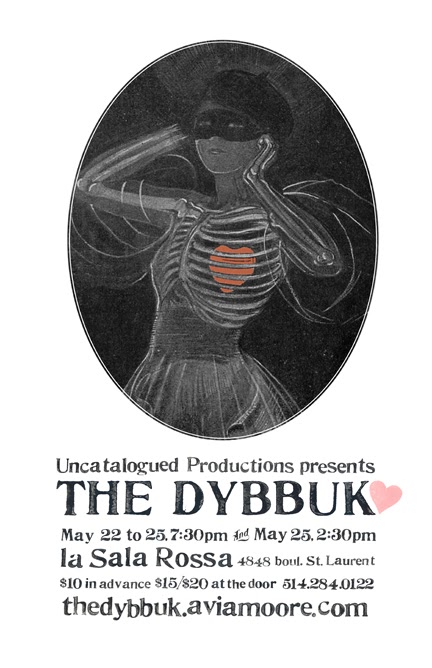
I have tickets to see a play this week! A friend of mine is acting in it, so I thought I'd find out a little bit more about it, and it turns out to be a very compelling story.

The Dybbuk was written by S. Ansky in 1914, in Yiddish. And the story's a bit creepy.

It's about a pair of lovers, Leah and Hannan. Leah's father opposes their marriage and when he calls it off, Hannan drops dead. Leah is resigned to marrying a man of her father's choosing, but on the way to the wedding, she is possessed by Hannan's spirit. The rest of the story deals with the challenge of exorcising the spirit, which can only be achieved finally through the trial and judgment of Leah's father.

In an interesting twist, the production I'm to see is performed by a small, all-women cast. I'm told the roles were cast without regard for gender, on the basis of talent alone, but I suspect it'll be difficult to view this show without a feminist lens.

(I would be remiss not to mention that The Dybbuk was famously brought to the screen in 1937 by Michał Waszyński.)

The Dybbuk plays at La Salla Rossa (Montreal), May 22 – 25.

Monday, May 16, 2011

The girl who ate what was given her

"A simile," he said, "is true because you say so. It's a persuasion: this is like that. That's not enough for it anymore. Similes aren't enough." He stared. "It wants to make you a kind of lie. To change everything.

"Simile spells an argument out: it's ongoing, explicit, truth-making. You don't need . . . logos, they used to call it. Judgement. You don't need to . . . to link incommensurables. Unlike if you claim: 'This is that.' When it patently is not. That's what we do. That's what we call 'reason,' that exchange, metaphor. That lying. The world becomes a lie. That's what Surl Tesh-echer wants. To bring in a lie." He spoke very calmly. "It wants to usher in evil."

As of this writing, Embassytown is my favourite China Miéville novel, but then, I once studied linguistics and philosophy, and being that I work as an editor, it should go without saying that I'm a bit of a language geek, and I would happily discuss with you why a given metaphor is more effective and/or appropriate than a simple simile, or vice versa, so, these factors taken together, it's no wonder Embassytown rocks my world.

Embassytown is about Avice Benner Cho, who returns to her hometown, on a planet that humans (which she is one) colonized. The humans coexist with the Ariekei, though communication is difficult given the complex Ariekei language (more on this later) (and it seems that the humans benefit more from their trade relationship than vice versa).

Avice grew up wanting to leave, and then she did. She trained as an immernaut and travelled subspace as crew on ships delivering passengers (usually in sopor) and cargo.

The steersperson took us close to Wreck. It was hard to see. It looked at first like lines drawn across space, then was briefly, shabbily corporeal. It ebbed and flowed in solidity. It was many hundreds of metres across. It rotated, all its extrusions moving, each on its own schedule, its coagulated-teardrops-and-girder-filigree shape spinning complexly.

Wreck's architecture was roughly similar to Wasp's, but it was antiquated, and it seemed many times our dimensions. It was like an original of which we were a scale model, until abruptly it altered its planes and became small or far off. Occasionally it wasn't there, and sometimes only just.

All this backstory to demonstrate that Embassytown is far, far away, the last outpost, a final frontier. As a colony under Bremen's control in geopolitical terms, it functioned according to its own rules, much like the New World operated a little differently than its European masters might've known or liked.

So Avice goes back to Embassytown, with her husband, a linguist who is fascinated by the Language of the Ariekei. The Ariekei are insect-like, winged and hoofed, with eyestalks. They speak with two simultaneous voices.

Their language is organised noise, like all of ours are, but for them each word is a funnel. Where to us each word means something, to the Hosts, each is an opening. A door, through which the thought of that referent, the thought itself that reached for the word, can be seen.

In this linguistic system, thoughts cannot precede words, indeed they cannot be thought without having the words for them. The Ariekei need similes to express their reality. They need to be able to say what something is like. If they can express it, it is a truth. They are unable to lie.

And then the new Ambassador shows up, and says something in Language, causing what can only be called a diplomatic incident. But, oh, just wait and see.

(I've read several reviews of Embassytown that are critical of it taking so long before the story gets started. For me, these first 100+ pages of world-building are the richest, and would be worth reading even if nothing followed. But maybe you have to have sat, and appreciated, a class on the philosophy of language to totally get that.)

I like to think of this novel as being all about linguistics.

"Words don't signify: they are their referents. How can they be sentient and not have symbolic language?"

It takes the Sapir-Whorf Hypothesis to the extreme. It's about linguistic relativity and Wittgenstein. And about Lakoff:

Metaphor has been seen within the Western scientific tradition as purely a linguistic construction. The essential thrust of Lakoff's work has been the argument that metaphors are primarily a conceptual construction, and indeed are central to the development of thought.

So, if an alien (Arieke) speaks a language (Language) and there's no one there to hear it, does it still think? What if the alien can't hear itself speak, can't hear itself think? Then there are no words, no thoughts, and reality collapses.

Avice when she was young herself was made a simile and incorporated into the language. Her assimileation (ooh, I just made that up!) was scripted or planned or faintly conceived, and then recounted. There was a human girl who in pain ate what was given her in an old room built for eating in which eating had not happened for a time. Avice was the girl who ate what was given her. It's never entirely clear what the Ariekei meant by her, by the simile of her, and Avice comes to wonder: if she changes her experiential truth, can she change the Ariekei's reality?

There's this wonderful Doctor Who–type moment toward the end that's a life-affirming vindication of what it is to be alien (cognitively, politically) and joy that, yes, good sense has prevailed, see, if only people would (could) just talk to each other, communication is brilliant, words are more powerful than any weapons, and more menacing: You get to live. It's a reward, but also a sentence.


Ten things about China. (Are you paying attention, Steven Moffat? Really, Neil Gaiman's Doctor Who episode was almost as disappointing as Gaiman himself is overrated. But China Miéville, his monsters — big scary, political monsters — would make the Doctor run.)

Sunday, May 15, 2011

Atomic secrets

The Atomic Weight of Secrets, or The Arrival of the Mysterious Men in Black, by Eden Unger Bowditch, is the first book in The Young Inventors Guild trilogy.

Jasper and Lucy ran up to their rooms and dropped off their bags. Looking around for a place to put their satchels, they opted to shove the lot under their beds.

"That's as good a place as any," said Jasper, pulling the edge of his quilt down so the satchel was completely hidden.

"I really think it's just awful keeping all these things from Rosie," said Lucy, "and from Miss Brett and. . . It make me feel like a naughty girl."

"Well, you're not a naughty girl. None of us is naughty. And we're not telling lies either. Not really," he said. He stopped rushing for a moment and looked Lucy in the eyes. A sneaky smile spreading across his face, he said, "It is terribly exciting, isn't it, Lucy? I mean, it's exciting as well as dangerous, amazing, historic, and brilliant, and, of course, terrifying, and horridly worrying. Still, all said, it is frightfully thrilling, isn't it?"

Lucy smiled. "Yes," she said in earnest. "Frightfully."

It's a mysterious and charming story. Helena is a little young yet for the attention a book like this requires, but I will encourage her to read it someday. Reminds me a little of Lemony Snicket, but without so much snark, and maybe not quite so nefarious.

A group of kids — 2 girls, 3 boys — ranging in age from 6 to 13, specializing in different kinds of science and themselves the children of the world's most important scientists, are taken from their parents and thrown together into a private boarding school, for them alone.

There's not much the teacher can teach such clever children, but she does find a gap in their education that she is able to fill: nursery rhymes and other children's literature.

On weekends the children are taken to their respective parentless homes, where the nannies attend to their needs. The homes abut a shared meadow.

The children come from unique backgrounds but find they have quite a bit in common when they start to discuss the circumstances by which they came together, so they put their inventive, scientific minds to work toward a common goal. The mysterious men in black factor into their separation from their parents, but it's never clear whether they are their jailers or their protectors.

The review at Young Adult Books Central sums it all up more succinctly than I can.

Tuesday, May 10, 2011

Unholy verbs

ACL — Accelerated Contact Linguistics — was, Scile told me, a speciality crossbred from pedagogics, receptivity, programming, and cryptography. It was used by the scholar-explorers of Bremen's pioneer ships to effect very fast communication with indigenes they encountered or which encountered them.

In the logs of those early journeys, the excitement of the ACLers is moving. On continents, on worlds vivid and drab, they record first moments of understanding with menageries of exots. Tactile language, bioluminescent words, all varieties of sounds that organisms can make. Dialects comprehensible only as palimpsests of references to everything already said, or in which adjectives are rude and verbs unholy. I've seen the trid diary of an ACLer barricaded in his cabin, whose vessel has been boarded by what we didn't then know as Corscans — it was first contact. He's afraid, as he should be, of the huge things battering at his door, but he's recording his excitement at having just understood the tonal structures of their speech.

— from Embassytown, by China Miéville.

I'm not very far along yet, but this seems to be a novel about linguistics, and the linguistics major in me is somersaulting. A novel about an alien race with a language, Language, where thoughts cannot precede words, indeed they cannot be thought without having the words for them, where Language and Reality are one.

And some of the sentences are gorgeous.

Excerpt. (On sale May 17.)

Tuesday, May 03, 2011

Housecleaning

I love that when I perched on Helena's bed this morning and she opened her eyes, the first thing she thought to say was, "Who won last night?"

************

I love democracy. Despite the overall result, I love that we did this, that for the first time since moving here, my vote in my riding really counts. It feels like the Quebec I fell in love with, my adopted home, a country within a country, may be returning to itself.

************

I'm still reading Martin Chuzzlewit. It's rather long. And enjoyable enough, if not deep. A third of the way through and I'm still wondering whether the title means to refer to Martin Jr or Sr. I'm just at the bit where Jr's recently arrived in America. Frankly, I'm more interested to see what comes of the Pecksniffs and Tom Pinch.

************

Has anybody been watching Doctor Who? That timey-wimey stuff is hurting my brain. And I've spent far too many hours lately searching the forums and trying to figure out what the hell is going on. [SPOILERS] Especially wrt Rory. I mean, when Rory came back as the android Roman centurion toward the end of last season, and then the Doctor reset the universe, I thought Rory'd be restored, or undone, or set right. But even when the Doctor first comes back he's all "How could we forget the Doctor?" — how could he even forget to remember? It's not quite like being at the eye of the storm — the whole universe poured out of Amy's head. So who did she remember — who's the Rory she brought back? Real Rory of flesh and blood, or Roman Rory who believed he was real, who stood guard over her for 2,000 years? Who would you bring back?

And I think, when Rory says he was there, when Rome fell, I think the Doctor's thinking, whoa, how could he remember being not real?, which is why he starts to probe with "personal" questions. So this is the problem behind Amy's quantum pregnancy. It's not a mystical timehead or genetic transfer pregnancy — it's quantum because Rory's not resolved. Poor Rory.

************

Every now and then, I realize that someone's missing from my blogroll. I follow most blogs through Google Reader, and with an adjustment here, an update there, sometimes my lists don't match up. Sorry. If you're missing from my sidebar, let me know.

************

I love that there's a flower stall outside the metro station near my work so I can buy flowers on my way home.

Friday, April 29, 2011

Old heads upon young shoulders

An ancient proverb warns us that we should not expect to find old heads upon young shoulders; to which it may be added that we seldom meet with that unnatural combination, but we feel a strong desire to knock them off; merely from an inherent love we have of seeing things in their right places. It is not improbable that many men, in no wise choleric by nature, felt this impulse rising up within them, when they first made the acquaintance of Mr Jonas; but if they had known him more intimately in his own house, and had sat with him at his own board, it would assuredly have been paramount to all other considerations.

— from Martin Chuzzlewit, by Charles Dickens.

Mr Jonas, you may gather, is not very likable.

I love how Chuck delivers an insult.

Monday, April 18, 2011

Very swaggering and very slinking

It happened on the fourth evening, that Mr. Pecksniff walking, as usual, into the bar of the Dragon and finding no Mrs. Lupin there, went straight up-stairs; purposing, in the fervour of his affectionate zeal, to apply his ear once more to the keyhole, and quiet his mind by assuring himself that the hard-hearted patient was going on well. It happened that Mr. Pecksniff, coming softly upon the dark passage into which a spiral ray of light usually darted through the same keyhole, was astonished to find no such ray visible; and it happened that Mr. Pecksniff, when he had felt his way to the chamber-door, stooping hurriedly down to ascertain by personal inspection whether the jealousy of the old man had caused this keyhole to be stopped on the inside, brought his head into such violent contact with another head that he could not help uttering in an audible voice the monosyllable "oh!" which was, as it were, sharply unscrewed and jerked out of him by very anguish. It happened then, and lastly, that Mr. Pecksniff found himself immediately collared by something which smelt like several damp umbrellas, a barrel of beer, a cask of warm brandy-and-water, and a small parlour-full of stale tobacco smoke, mixed; and was straightway led down-stairs into the bar from which he had lately come, where he found himself standing opposite to, and in the grasp of, a perfectly strange gentleman of still stranger appearance who, with his disengaged hand, rubbed his own head very hard, and looked at him, Pecksniff, with an evil countenance.

The gentleman was of that order of appearance which is currently termed shabby-genteel, though in respect of his dress he can hardly be said to have been in any extremities, as his fingers were a long way out of his gloves, and the soles of his feet were at an inconvenient distance from the upper leather of his boots. His nether garments were of a bluish grey — violent in its colours once, but sobered now by age and dinginess — and were so stretched and strained in a tough conflict between his braces and his straps, that they appeared every moment in danger of flying asunder at the knees. His coat, in colour blue and of a military cut, was buttoned and frogged up to his chin. His cravat was, in hue and pattern, like one of those mantles which hairdressers are accustomed to wrap about their clients, during the progress of the professional mysteries. His hat had arrived at such a pass that it would have been hard to determine whether it was originally white or black. But he wore a moustache — a shaggy moustache too: nothing in the meek and merciful way, but quite in the fierce and scornful style: the regular Satanic sort of thing — and he wore, besides, a vast quantity of unbrushed hair. He was very dirty and very jaunty; very bold and very mean; very swaggering and very slinking; very much like a man who might have been something better, and unspeakably like a man who deserved to be something worse.

— from Martin Chuzzlewit, by Charles Dickens.

Once upon a time I vowed to read a Dickens a year. Seeing as they're so long, I think one every two years or so should suffice.

Several commenters on this blog have in the past mentioned Martin Chuzzlewit, for its humor, for its women characters, and for some of the more memorably Dickensian characters going. Not being the least bit familiar with it, and it bearing the distinction of not having been recommended by Oprah, I decided to take it up.

Not much has happened yet. I'm a little daunted that my e-reader calculates this novel at 3167 page turns — I've barely made a dent.

But it is funny, although mostly in attitude, in an almost self-parodying tone. This effect is somewhat exaggerated by the fact that I can't help but hear the text in my head as narrated by Simon Callow, and am reminded of the Doctor's judgment that the American bit (which I've got a way to go before I get to it) is rubbish.

One may read a defense of the American bit — indeed, the novel as a whole — by GK Chesterton, from which I learned that this is a novel about a selfishness, and, despite its humour, this novel is sad.

I have just recently encountered Mark, the barman, who is a jolly fellow, who is looking to find a new situation in the city, a gloomy and difficult one, one in which his jollity might be seen as a credit, for there is no trial of character in being jolly as a barman, surely it be a virtue only when overcoming some adversity, working as a grave-digger or taxman perhaps.

Thursday, April 14, 2011

Literary Mad Men

It's taken a while, but finally I've watched all Mad Men episodes to date. From the start of the series, it's been impossible not to notice what these wonderfully culturally literate (it is advertising, after all) characters were reading.

I've tried to keep a list of those books that were directly discussed or in the hands of readers. In chronological occurrence of their mention:

  • Lawrence, DH: Lady Chatterley's Lover (S01e03)
  • Jaffe, Rona: The Best of Everything (S01e06)
  • Uris, Leon: Exodus (S01e06)
  • Rand, Ayn: Atlas Shrugged (S01e08, but with several mentions)
  • O'Hara, Frank: Meditations in an Emergency (S02e01)
  • Fitzgerald, F Scott: Babylon Revisited and Other Stories (S02e04)
  • Forester, CS: Horatio Hornblower (S02e08)
  • Porter, Katherine Anne: Ship of Fools (S02e09)
  • Faulkner, William: The Sound and the Fury (S02e11)
  • Gibbon, Edward: Decline and Fall of the Roman Empire (S03e03)
  • Ogilvy, David: Confessions of an Advertising Man (S03e06)
  • Twain, Mark: Tom Sawyer (S03e06)
  • Hilton, Conrad: Be My Guest, Autobiography of Conrad Hilton (S03e07)
  • McCarthy, Mary: The Group (S03e10)
  • Benedict, Ruth: The Chrysanthemum and the Sword: Patterns of Japanese Culture (S04e05)
  • Keene, Carolyn: The Clue of the Black Keys (S04e09)
  • Berne, Eric: Games People Play: The Psychology of Human Relationships (S04e10)
  • Le Carré, John: The Spy Who Came in from the Cold (S04e13)

Of course, there have been countless literary allusions throughout the series. TS Eliot's The Hollow Men was recited. A reference to The Man in the Gray Flannel Suit (Sloan Wilson) is as much a cultural touchstone as it has to do with any novel. Moby Dick. I can't help but think of The Bell Jar when you mention the summer the Rosenbergs were executed, but very likely that's the sort of reference that wasn't necessarily intended.

I've read only a few of those listed, some of them many years ago, but on watching some episodes, I have been inspired to directly seek out some titles, particularly since they are not merely props but have direct bearing on the plot or characters at issue. I know I'm not the only one to be reading up. Frank O'Hara's rediscovery has been widely noted.

Similarly, according to NPR, "Interest in Rand and her philosophy is on the upswing. Since the 2008 presidential election, according to Brook, the novel Atlas Shrugged has sold more than 1 million copies, far more than in any similar period in the book's 54-year history." While this is linked to the rising popularity of the Tea Party, no doubt sales for this particular novel were boosted by its exposure on Mad Men.

But I think my favourite book sighting, late in season 4, is the Nancy Drew mystery in Sally Draper's hands. We've seen the books in the house she grew up in; it should come as no surprise that Sally too should find escape in a good book. Reminds me a little of my own young self, visiting my dad's office and being told to sit quietly — I'd read. Though I can't recall it specifically, I'm sure I read The Clue of the Black Keys — I read them all. I'll be sure to dig this one out of the box in my mom's basement as soon as the opportunity presents itself.

Have you been reading along with the Mad Men?