Sunday, May 31, 2015

All the strange things that have no purpose other than making life more awesome

"In the Bible, it says that God invented the universe in seven days," I started. "But there was actually an eighth day, and on this day God created all the strange things that have no purpose other than making life more awesome."

[...]

"On the eighth day God invented the sound of rain and electricity. He invented roses and tattoos of roses. He invented city beaches and goldfish. He invented spots on cheetahs and made the legs on women longer than they needed to be. He invented trumpet players and haikus. He invented tiny old men that serve espresso, and wild flowers in abandoned lots. He invented constellations and neon lights. He invented being ticklish and exaggerating. He invented snowflakes and dinosaur bones for us to dig up. And most importantly, he invented a little boy on Boulevard Saint-Laurent who would be greatest figure skater and greatest kisser the world had ever seen, and he named him Raphaël Lemieux."
— from The Girl Who Was Saturday Night, by Heather O'Neill.

This is a fine example of how Heather O'Neill makes life a little more awesome.

Tuesday, May 26, 2015

Colourless dreams

Early this month I started a reading a novelization of the life of George Sand. How is it that such an interesting historical figure could be rendered so mind-numbingly boring? With excruciating physical detail, that's how.

They say it's the small details that bring historical fiction to life, but in such quantities they seem to deaden it.

This is The Dream Lover, by Elizabeth Berg. Is this just a matter of the wrong book at the wrong time for me? Have you read Berg?

I admit to having been charmed by one line: "I was thrilled by the way Jules made an intimate act intimate."

I have picked up and put down this novel a couple times already. Maybe I'll try one more time. Maybe I won't.

Sunday, May 24, 2015

Damp secrets

The Service of Clouds, by Delia Falconer, takes its title from the epigraph from art critic John Ruskin in "Of Modern Landscape": "if a general and characteristic name were needed for modern landscape art, none better could be invented than 'the service of clouds'." I'm not really sure what that means, nor what significance it has as this novel's title. Perhaps the novel is meant to depict an interior landscape, but it is decidedly not a modern one.

It is a huge responsibility — one I rather dislike — to read a book pressed upon you by a friend who professes it to be among their favourites. This is not a book I would've picked up of my own accord. But once started, it's not one I would abandon, either — I was wholly interested to know how it would turn out.

In fact, at its very best, it calls to mind the magic and awe I felt when reading Richard Powers' The Goldbug Variations and Mark Helprin's Winter's Tale, two books I think of fondly.

The novel is, as advertised, "sumptuously poetic" and "seductively lyrical", but for my taste, excessively so. Many of the descriptions run on, and I would skip through them. Quite possibly because of this I have missed out on beauteous and nuanced observations of the human condition.
When I recounted the terrible winter of 1918, I could not find the words to tell him how Mrs Grudge, who had been widowed two years by the war, was found in her chicken shed, her cheek flattened against the faeces and pellets on the floor. I remembered how Mr Medlicottt, just weeks before his own loss, had returned to the pharmacy to give an account of the post-mortem. He had stood behind the doctor as his government-issue scalpel made a red line from the tip of her chin down to the sparse triangle of hair below her belly. Before the muscle and the inner organs were revealed he saw pale beads of fat which spilled and gleamed. The voluptuousness, he said, had surprised him. Inside her womb the doctor had found a lump of tissue attached to a damp hand of chestnut hair, which he pulled taut with one hand while he detached the tumour with his knife. Springing from her belly, the growth bobbed from his gloved fingers like a shrunken head. When it was bisected there were two crude teeth caught like see pearls at its centre. The doctor dropped the flesh and teeth and hair into a jar of spirits and took them to a sandstone building in the university on Parramatta Road, islanded by the traffic which made its way into the city form the west. All that day I was haunted by the thought of those damp secrets unwound on the wooden table.
What exactly is going on here? Something nefarious and sexual is implied here. Is it a baby, or a tumour? This is a fairly extreme example, but it demonstrates my overall impression of the novel. The language is cryptic, and the book wants to be thought clever — it's too clever to tell anything straight. It's like a poem that's deliberately ambiguous; it probably has something concrete to relate, but the more metaphor and symbol that can be packed in, the more important it sounds.

Perhaps my judgement is so harsh because I did not like the heroine or find her romances wholly believable. Eureka Jones is a capital "R" Romantic, but ultimately I found her reserved and passionless even (especially) when she professed her heartbreak. At times there are weirdly sexual references. Is this novel a meditation on love? It is not even the story of a romance. It is the self-indulgent musings of a silly young woman, one with her head in the clouds. One who's learned everything about love from vaguely suggestive poetry.

I liked this novel's opening, when it recounted the character's family histories. But it lost me when it spoke of love. I understand love and romance completely differently, in a much fuller, more passionate, more romantic way than poor stupid Eureka. She's found nothing.

The story is set in Australia in the years leading up to and just after the First World War, when a lot of nations and individuals grew up. The main love interest photographs clouds and is based on real-life Blue Mountains photographer Harry Phillips. Clouds are a key motif throughout the text, but it could just as easily have been rock formations, botanicals, or photographic emulsions.

Reviews
Happy Antipodean
New York Times

Reading Group Guide

Monday, May 11, 2015

Warning: there are no unicorns in this book

There are no unicorns in this book, not really. The Gallery of Lost Species, by Nina Berkhout, has a picture of a unicorn on the cover. It looks like a real unicorn, too, not some childlike rainbow-prancing animation.

The flap copy also refers to the unicorn:
Just as thirteen year-old Edith Walker is about to leave childhood behind, she thinks she spots a unicorn high on a slope while hiking. Her daydreamer father Henry convinces her that what she's seen is real. Edith's sighting of the fabled creature — and her unfailing belief that the imaginary creature will eventually be found — sets in motion a series of events that impact the next decade of her life.
Symbolism, much?

So for some reason I expected this book to be a quest for that unicorn. A bit of a fantasy novel, YA maybe. I wasn't sure I wanted to read this book.

But the website copy provided a few more details:
Fulfilling her father's wish for her to work in a museum, Edith takes a job cataloguing artwork at the National Gallery of Canada, where she meets an elderly cryptozoologist named Theo. Theo is searching for "Gauguin's mystery bird" and has devoted his entire life to tracking down extinct animals. [...] Edith develops an unlikely friendship with Theo when she realizes they might have more in common than she imagined: they are both trying to retrieve something that may be impossible to bring back to life.
Aha! Cryptozoology. There's something I could sink my teeth into.

But Edith doesn't go looking for the unicorn, she just remembers it from time to time. And the cryptozoologist is a fairly minor character.

So this gallery of lost species consists of a unicorn, a bird, and Edith's sister. And maybe Edith herself, and Theo, and Edith's failed painter father, and her mother is certainly a species unto herself, who doesn't even know she's lost. Liam, who fell hard for Edith's sister, he's neither much of a species nor is he lost, though he's lost to Edith, who fell hard for him.

I feel like I was tricked into reading this book. Like when my mom is watching TV and some movie's just starting, and she tells me to come watch with her, it's such a nice movie, but I don't really feel like it. But she tells me the title and its sounds vaguely familiar, like something that may have interested me once upon a time. And I start watching it from where I stopped midtrack crossing the living room, and then I perch on the arm of the sofa, and before you know it I'm curled up beside my mom with a blanket and the tears are streaming down my face, and I'm thinking, this is not a nice movie at all, it's not what I thought it was at all.

This book is like that. I got sucked into Edith's childhood, living in the shadow of her sister, living in the whirlwind of their crazy mom, and wondering why their parents were even together, they're both of them so weak in their different ways. And then they're teenagers, and the drugs start, and the sister leaves and goes to the other side of the country, and she just can't keep it together, and the alcohol, and barely making ends meet, and people die, and life just happens, and it's so sad and depressing, she's a lost cause, and they're all doing stuff for the wrong reasons, they're so screwed up.

So it was a good book, in that it was entirely compelling, I couldn't wait to find out what happened next.

But had I known what it was all about, it's not the kind of book I would've picked up. I still kind of wish there'd been an honest-to-goodness unicorn quest in it.

Thursday, May 07, 2015

Everything beautiful makes them cry

"You're mistaking happiness for unhappiness. That's why the French are so melancholic. Everything beautiful makes them cry. They invented existentialism as an excuse not to love their wives."
— from The Girl Who Was Saturday Night, by Heather O'Neill.

Tuesday, May 05, 2015

All time is unredeemable

When I was 17, I would ride the bus up to the university. For art and culture. By myself. I'm not sure why I thought that would be a cool thing to do. Certainly I enjoyed it, but I suspect it was something I felt I ought to do, in order to become the person I thought I wanted to be.

I didn't tell any of my friends. I don't remember what I told my mother — she would've been supportive of the endeavour in theory, but horrified that I was going alone. I must've lied.

So I was 17 when I first saw Jean-Luc Godard's Prenom: Carmen. Which I'd wanted to see because I liked Carmen, the opera, the story. What did I know?

So I was 17 when I first heard Beethoven's String Quartet No. 15 in A Minor, when I first heard it in a significant way. In that movie.


I was 17 when I studied T.S. Eliot's Love Song of J. Alfred Prufrock, and wrote a response.

I was 19 when I first encountered the Four Quartets. When I met David. When he brought me Beethoven's Late Quartets.

Last weekend I saw the Emerson String Quartet perform No. 15 in A Minor at Bourgie Hall. It was perfect.

It's one of the sexiest pieces of music I know, the way it breathes with exquisite anticipation.
Time present and time past
Are both perhaps present in time future
And time future contained in time past.
If all time is eternally present
All time is unredeemable.
What might have been is an abstraction
Remaining a perpetual possibility
Only in a world of speculation.
What might have been and what has been
Point to one end, which is always present.
Footfalls echo in the memory
Down the passage which we did not take
Towards the door we never opened
Into the rose-garden.

Monday, May 04, 2015

I have nothing to hide

I've played with personas, I've tried to compartmentalize my various selves, but it's too hard. It's contrary to my experience of reality; everything bleeds into everything else. (Even this blog, Magnificent Octopus, was conceived as a magnum opus, an everything, a unifier.)

In the end, it's all me. I've always used my real name. Why wouldn't I? I have nothing to hide.

Last weekend, though, I came to the stark realization that "I have nothing to hide" is a vulnerability in the armour of freedom I wear so brazenly. It can be used to undermine my right to privacy.

Everybody has something to hide. And I'm prompted, what if you're applying for a certain job, what if there's a regime change in 5 or 10 years' time, what if.

So let me say instead: I stand by all I say and do. I have nothing I should ever have to hide.

From Anonymous to Edward Snowden: Hackers as Activists, was a fascinating discussion, part of this year's Blue Metropolis International Literary Festival, moderated by Will Straw and featuring anthropologist Gabriella Coleman (@BiellaColeman)and Ubisoft content director Thomas Geffroyd (@Orph30), who worked on Watch Dogs, a game about a hacker.


On my way out to the event, I continued reading Satin Island, by Tom McCarthy, and I was just at the part where Petr was telling about people hacking down the Berlin wall. I was jarred by the use of the word hack — here it was starkly physical, people chiseling and chipping away at this massive physical structure, which itself was a mere symbol of something much stronger and vaster, something social and political, some great divide. And this word was buried in this tiny account which was surrounded by talk of U's company's Project, his growing fantasies of vandalizing the Project and its associated structures, of sabotaging it by feeding faulty data into the Project.

That word, "hack," is a loaded word. To cut, to cough. To cope, to loaf. To work as a mercenary, to work in the service of mediocrity, to sell out. As regards the technological connotations, see Ben Yagoda's A Short History of Hack.


Hacking has a long and proud history that depends on craft and craftiness, with the intent of repurposing machines to do things they weren't designed for. It has its own tradition and folklore; this is evident in naming practices, and Coleman gave the example of UNIX, which was based on the overly complex Multics, in effect castrating it, and thus its name memorializes the condition of its birth.

Hackers tend to combine tech savviness with a touch of compulsive disorder. They have a highly developed sense of humour, hence Easter eggs. They take pleasure in breaking (into) things, just to see if they can. Which gives them the knowhow to build better things. They work as system administrators and security researchers.

Hacking embodies a counter-cultural, antiestablishment spirit. The idea of hacktivism then takes up the cause of freedom, free speech, free access, and freedom of information. And that's a good thing. How could it not be a good thing?

Geffroyd made the point that we're very quick to give up our freedoms in North America. For a continent founded on the principles of liberty, it's easy to convince us that the greater good outweighs our individual rights. This is not so true in Europe (Germany is one of the biggest defenders of personal privacy), and he surmises that this is the legacy of World War II, which Europeans still live with in a relatively immediate way. Take for example the Gestapo, who used government files to identify Jews; the Stasi, who used surveillance and other techniques to identify dissidents. Europeans know firsthand the terror and danger of the surveillance state.

Whether or not I have anything to hide, I should never have to hide.


How does a modern anthropologist go live among the natives when the natives are an underground subculture? (Tom McCarthy asks the same question in Satin Island, which is about a corporate anthropologist.)


It was a provocative hour; there was no time for an in-depth analysis of today's privacy issues, or WikiLeaks, or the infiltration of communication networks. But it definitely opened my eyes to the interconnectedness of many of these issues, and confirmed for me that I need to take responsibility for being better informed so I can be a better citizen.

Some of the subjects that were touched on...

People:
Jacob Appelbaum
Aaron Swartz
Anonymous: The Masked Avengers in The New Yorker.

Issues:
Journalists' email being vacuumed by security organizations: GCHQ captured emails of journalists from top international media
The need to ensure free speech and privacy for lawyers, activists, and journalists.
Internet crime laws
The Five Eyes, an alliance that shares intelligence, in circumvention of domestic privacy laws: About.
Televisions collecting data via camera and microphone: Your Samsung SmartTV Is Spying on You, Basically

Tools:
Copyleft, copyright that guarantees free distribution terms.
Pretty Good Privacy (PGP) data encryption: About.
Tor, for preserving anonymity online: Download.

See also
Hacking Watch Dogs – An Interview With Thomas Geffroyd
Hacker, Hoaxer, Whistleblower, Spy: The Many Faces of Anonymous by Gabriella Coleman – review

Thursday, April 30, 2015

The ridiculous squalor that was everyday life

His real talent, what people went crazy for, was his knack for writing song lyrics. There was a song about a mechanic who builds a snowbmobile that can go faster than the speed of light. There was one about a grandpapa who had gas. There was song abut a tiger that escapes from le Zoo de Granby to go eat poutine. He had a song about a man who finds a magical cigarette that doesn't end, and he never has to come back from his cigarette break. He made the ridiculous squalor that was everyday life sublime. There was no subject that was beneath Etienne Tremblay.
— from The Girl Who Was Saturday Night, by Heather O'Neill.

I've only just started reading this novel, and this is the first description of the famous Quebec folksinger character. I'm kind of wishing he were real (he's not, though "He’s in a tradition of Robert Charlebois and Paul Piché and those wonderful guys.") so I could really listen to him instead of making up songs based on the ideas of these songs in my head.

Sunday, April 19, 2015

End of story

In New York City last month, I treated myself to some shoes. We hadn't set foot in a single bookstore (gasp!), so it's the least I could come away with. But it's only this past week that the Montreal streets were finally entirely snow-free and I could wear them out. So I've been wearing them. They're my new editing shoes.

The brand is Poetic Licence, and this particular model of shoe is called "End of Story." Complete strangers have complimented me on my shoes. They're my best foot forward, my final word, my stamp of approval. My end of story.

Saturday, April 18, 2015

The future of knowledge

I'm only on page 51 of Tom McCarthy's Satin Island, and I think it's extraordinary.
5.7 His most famous riff, perhaps, was about knowledge. Not knowledge of anything in particular; just knowledge in and of itself. Who was the last person, he would ask, to enjoy a full command of the intellectual activity of their day? The last individual, I mean? It was, he'd answer, Leibniz. He was on top of it all: physics and chemistry, geology, philosophy, maths, engineering, medicine, theology, aesthetics. Politics too. I mean, the guy was on it. Like some universal joint in the giant Rubik's Cube of culture, he could bring it all together, make the arts and sciences dance to the same tune. He died three hundred years ago. Since Leibniz's time (Peyman would go on), the discipline have separated out again. They're now on totally different pages: each in its own stall, shut off from all the others. Our own era, perhaps more than any other, seems to call out for a single intellect, a universal joint to bring them all together once again — seems to demand, in other words, a Leibniz. Yet there will be no Leibniz 2.0. What there will be is an endless set of migrations: the process. No one individual will conduct this operation; it will be performed collectively, with input from practitioners of a range of crafts, possessors of a range of expertise. Migration, mutation and what I (Peyman affirmed) call "supercession": the ability of each and every practice to surpass itself, break its own boundaries, even to the point of sacrificing its own terms and tenets in the breaching; and, in the no-man's-land between its territory and the next, the blank stretches of the map, those interstitial zones where light, bending and kinking round impossible topographies, produces mirages, fata morganas, apparitions, spectres, to combine in new, fantastic and explosive ways. That, he'd say is the future of knowledge.
I'm reading slowly, fully considering every paragraph, smiling over how these ideas dance. It's meditative, but in a cerebral way, not emotionally. It makes me feel smart.

Tuesday, April 14, 2015

The devastation of abandoment

The Days of Abandonment, by Elena Ferrante, was an absolutely devastating book. It made me thoroughly miserable and I wallowed in it.

I recommend it for its honesty and its anguish. There is nothing beautiful about it, but it describes in unflinching detail the workings of the mind of an abandoned woman. I know because I am one.

The absurdity of his uttering, "Don't think it's easy for me"!

For thirty-eight-year-old Olga, her fifteen-year marriage dissolved one April afternoon, right after lunch. She spends the summer disintegrating, withering under the imagined gaze of others — the sense that everybody knows, and they judge you for it. She's turned the magnifying glass on herself, searing into her soul, as if to etch the pain there, to feel it more deeply, to make it mean something more than it is.

[On Christmas evening, our eighteenth together, I told him, "I love you," and was greeted with silence. I've spent these three months reading about all manner of marriage gone wrong. In this way I think I've stopped myself from being completely consumed by rage and from committing countless desperate and petty acts of spite.]

Olga has two small children to care for, and a dog. And she totally loses it.

It is an exhausting, unpleasant read.

I was an unpleasant person for days while reading it, full of rage and frustration and confusion and despair. Yet I needed to read it. It was wholly cathartic. I think I'm done now, reading this kind of book, at least for a little while.

Jean Hanff Korelitz in the New York Times:
"Olga's close self-scrutiny and utter lack of resulting self-awareness is particularly striking."

James Woods in The New Yorker:
"It assails bourgeois niceties and domestic proprieties; it rips the skin off the habitual."

I have more Ferrante on deck, but I need to pause first. Readers will be discussing Ferrante's work over brunch at the 17th Blue Metropolis Montreal International Literary Festival.

Monday, April 13, 2015

Photography has no language

I was chatting with some colleagues about god knows what, when one fellow said, it's like those people who shop around for a doctor to amputate a perfectly good body part — people do that, you know; it's a condition. And I said, someone should write a novel about that, that would make for some great doctor and patient characters; maybe I should write that novel. And I proceeded to look it up and find that it's called "body integrity identity disorder." Several months later I would discover that David Cronenberg had in fact written that novel; it's called Consumed.

I should've recognized the Cronenbergian appeal of this theme straight away, and he does touch on the issue in Crash and in the short film The Nest, both of which I'd seen. While Consumed is not consumed by this theme, it does flesh it out.

Just how many senses of the word does the title capture?

transitive verb
1 : to do away with completely : destroy
2 a : to spend wastefully : squander ; b : use up
3 a : to eat or drink especially in great quantity ; b : to enjoy avidly : devour
4 : to engage fully : engross
5 : to utilize as a customer

intransitive verb
1 : to waste or burn away : perish
2 : to utilize economic goods

It starts off as an investigation into a murder. Photojournalist Naomi flies off to Paris to delve into the lives of the Arosteguys, famed philosopher couple. But Aristide appears to have fled the country, while Celestine's remains are scattered around their apartment. It appears that parts of her had been prepared, cooked, and eaten.

Naomi's partner Nathan meanwhile is in Eastern Europe photographing the work of a shady doctor who performs operations for the truly desperate. Nathan's dream is to be published in The New Yorker's Annals of Medicine section.

There's a lot of technogeekery in this novel, mostly cameras and lenses, but also hearing aids, 3D printers, and some run-of-the-mill gadgetry.

There's also a peculiarly warped penis. And the sense that everybody is sleeping with everybody else, although they don't; but I guess, you know, the French and the medically perverse, they cast that aura.

Nathan contracts a rare STD and heads to Toronto to talk to the elusive has-been of a doctor after whom the disease was named. Naomi meanwhile follows Aristide's trail to Japan.
"I only smoke Japanese now. I want to become Japanese. I'll never speak French again. Never. They say that Tolstoy learned classical Greek very quickly once he put his mind to it. I'm learning Japanese very quickly. Until then, I speak English or German. For philosophy, at least, you have to speak German. Perhaps I will make Japanese essential for contemporary Western philosophy. If I live long enough."

Naomi was groping. "Photography has no language. Is that why you're so interested in it?"
Cronenberg's expression of journalism puzzles me. Here are these photojournalists following these really complex stories — stories that, in my view, demand more (much more) than pictures to tell them — but for them, the words are an afterthought, easily dashed off, filled in later. It's the picture that makes the story. I can't tell if Cronenberg is saying this is how it is, or how it ought to be. Of all the perversities in this novel, this is the one I can't get past, the one that feels wrong. I guess it's natural for a filmmaker to fetishize the view through the lens; but why then is he writing a novel?

Believe it or not, Naomi's and Nathan's stories do intersect, quite satisfactorily. These characters' narratives are wholly intertwined, even though they barely share any screen time.

Oh, and there's also a North Korean conspiracy, that's involved even in the politicking at Cannes.

I hope Cronenberg writes another book.

Sunday, April 12, 2015

Revisiting Ravenscrag

The other week I attended the launch of Alain Farah's Ravenscrag at Drawn & Quarterly (although the term "launch" seems to be used rather loosely by the store, as the book has been available since January).

The conversation with author Alain Farah (left) and his translator, Lazer Lederhendler (right), was moderated by Catherine Leclerc. Interestingly, it's Lederhendler who held the floor for most of the evening, probably because 1. his command of English is superior to that of the other parties, and 2. as translator, he's had to read and interpret the text particularly closely. He could've carried the evening on his own with his insight into the problems of translation.

Lededhendler notes that the novel may seem crazy — or better, "madcap" — but it's not insane. It holds to an internal logic.

The novel in French is titled Pourquoi Bologne, which I would think makes the thing as a whole something other than Montreal-centric, whereas the English takes for its title the name of a city landmark, grounding it very firmly. I can't help but think the title, and the impression it creates, affects the reception of the novel. Is it a different novel in English than it is in French? In fact, Farah occasionally refers to the translation as "Lazer's novel."

What I hadn't considered is how much the schizoid experience of the book is meant to reflect a francophone's experience in English Montreal — I can't tell if I didn't recognize this because I'm still so much an outsider to this city that I can't see some of its essential paradoxes, or that I'm so much of here already that the issues appear commonplace and don't strike me the way they would if I were reading about some foreign place.

The underground geography of the McTavish reservoir, its pipes and tubes, Farah says was inspired by Terry Gilliam.

This novel is not a linear narrative because that's not Farah's experience of the world.

[I had several issues with the event: it started late (about 30 minutes or so, though I'd stopped checking the time); the way chairs were set up severely restricted movement, particularly access to the author (for a subsequent event I attended, someone had the sense to stack chairs to clear floorspace once the formal portion of the event was through); in fact, the author appeared to be at a cocktail party rather than a book-signing (I had every intention of buying a copy of the book for a friend, but I didn't, because it was difficult to interrupt his small talk and more awkward to ask that he bestow the favour of his signature (at the subsequent event, the author sat at a table and there was a clear lineup for signings). Keeping it casual can be cool, but I'd bet it's detrimental to book sales.]

Things I would've liked to ask the author (but didn't, because the question period was cut short because it was weirdly silent and I'd already asked a question, and because I failed to schmooze my way into conversation with him):
  • What exactly is retro scifi? Is it a thing your marketing department came up with, just because you mention Philip K. Dick?
  • What is the relationship between insanity and time travel? You seem to be deeply influenced by Philip K. Dick; to what extent is the relationship between insanity and time travel in your novel inspired by or modeled after Dick's depictions?
  • Although he has a cult following, Dick has never really been accepted by the literary establishment (to the extent even that none of the reviews of your novel I've read appear to recognize his influence): Does that hold true among French readers? (To what extent is genre an English problem?) How do you feel about the genre-ification of literature, that Dick should be ghetto-ized? How would you feel if your book were shelved in SF?

Monday, April 06, 2015

Disillusionment

Mad Men has returned, and it got literary again.

While only one novel was clearly in view, and shown to be actively read — The 42nd Parallel, by John Dos Passos — there's another literary reference straining through Peggy Lee's rendition of "Is That All There Is?" which opens and closes last night's episode. The song's lyrics were inspired by Thomas Mann's short story "Disillusionment."
I zealously fed my magnificent expectations of life with the matter of a thousand books and the works of all the poets. Ah, how I have learned to hate them, those poets who chalked up their large words on all the walls of life — because they had no power to write them on the sky with pencils dipped in Vesuvius! I came to think of every large word as a lie or a mockery.

Ecstatic poets have said that speech is poor: "Ah, how poor are words," so they sing. But no, sir. Speech, it seems to me, is rich, is extravagantly rich compared with the poverty and limitations of life. Pain has its limits: physical pain in unconsciousness and mental in torpor; it is not different with joy. Our human need for communication has found itself a way to create sounds which lie beyond these limits.

Is the fault mine? Is it down my spine alone that certain words can run so as to awaken in me intuitions of sensations which do not exist?
You can read it in its entirety, or listen to it here.

It's not hard to imagine that the story was written with Don Draper in mind. Ennui in extremis.

Sunday, April 05, 2015

Nest

David Cronenberg's short film The Nest documents a medical consultation with a woman who wants her left breast removed because she believes it to be full of insects.


I love how it's set in a garage.

I was lucky enough to see The Nest during the Christmas holidays of 2013 at a TIFF exhibition exploring Cronenberg's work.

Cronenberg's novel, Consumed, explores the same subject matter further. It's just one of several weird and typically Cronenbegian narrative threads in the book, but having watched this film gave the novel another dimension — it's become a kind of multimedia experience.

Monday, March 30, 2015

To study myself with precision and cruelty

I spent the warm months of early autmumn sitting on a bench in the rocky garden, writing. In appearance they were notes for a possible book, at least that's what I called them. I wanted to cut myself to pieces — I said to myself — I wanted to study myself with precision and cruelty, recount the evil of these terrible months completely. In reality the thoughts revolved around the question that Carrano had suggested to me: was I like Mario? But what did that mean? That we had chose each other because of affinities and that those affinities had ramified over the years? In what ways did I feel similar to him when I was in love with him? What had I recognized of him in myself, at the beginning of our relationship? How many thoughts, gestures, tones, tastes, sexual habits had he transmitted to me over the years?

In that period I filled pages and pages with questions of this type. Now that Mario had left me, if he no longer loved me, if I in fact no longer loved him, why should I continue to carry in my flesh so many of his attributes? What I had deposited in him had surely been eliminated now by Carla in the secret years of their relationship. But as for me, if all the features that I had assimilated from him had once seemed to be lovable, how, now that they no longer seemed lovable, was I going to tear them out of me? How could I scrape them definitively off of my body, my mind, without finding that I had in the process scraped away myself?
— from The Days of Abandonment, by Elena Ferrante.

The hard part is telling us apart. And what of the ossified bits? How do I scrape him off without marring any bit of my real self? What is my real self, anyway?

Sunday, March 29, 2015

Skin deep

"You know," he said, almost dreamily, "I sometimes think that the only things really worth talking about are the things people absolutely refuse to discuss."

"Yes," snapped Isserley, "like why some people are born into a life of lazing around and philosophizing, and others are shoved into a hole and told to fucking get busy."
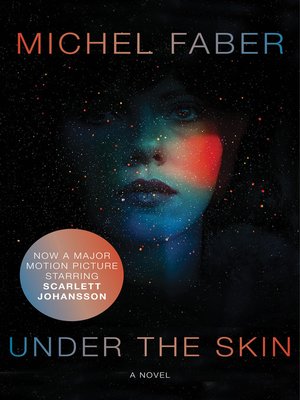
I read Michel Faber's Under the Skin over a month ago, but I put off writing about it, wanting to see the film adaptation. Now I'm at a loss — they are so completely different, yet also compelling and weird. They're both also nigh impossible to talk about without giving anything away.

The weight, weightiness, of them comes out of the title. We're immediately invited to question: What's under Isserley's skin? What's under Scarlet Johansson's skin? The character in both the novel and the film is somehow off, out of place, other.

The only thing seemingly clear from the outset is that we're dealing with a female predator. In the film this is highly sexualized, because ScarJo; in the novel, Isserley is weird-looking, but men are distracted by her massive breasts, because men. But she's a very good predator; she studies her prey, their habits, and their environment intensely.

The film does a great job of focusing on the predation. The novel goes far beyond female-male relations (not that the film does just that) to cover a lot more territory, a whole other culture, in fact.

Under the Skin is also very much about the relationship between hunter and hunted. What's under the skin of her victims, anyway? What constitutes our humanity?
The thing about vodsels was, people who knew nothing whatsoever about them were apt to misunderstand them terribly. There was always the tendency to anthropomorphize. A vodsel might do something which resembled a human action; it might make a sound analogous with human distress, or make a gesture analogous with human supplication, and that made the ignorant observer jump to conclusions.

In the end, though, vodsels couldn't do any of the things that really defined a human being. They couldn't siuwil, they couldn't mesnishtil, they had no concept of slan. In their brutishness, they'd never evolved to use hunshur; their communities were so rudimentary that hississins did not exist; nor did these creatures seem to see any need for chail, or even chailsinn.

And, when you looked into their glazed little eyes, you could understand why.

If you were looking clearly, that is.

So, that's why it was better that Amlis Vess didn't know that the vodsels had a language.
It's the sort of talk that could turn you vegetarian. The novel might also be read as a warning about the dangers of disturbing an ecosystem ("A few drops of chemical soap into such a vast reservoir of natural purity wouldn't have much effect, surely?"). The problems of overhunting. How economics factors into our moral choices.

Most reviews of the novel give away the story, and that's okay in the sense that that's not really what the book is about. However, I really loved the discovery of the story as the novel unfolded. It changed tack several times; it started off as a thriller, turned scifi, took a romantic twist, and mused on socioeconomic structures, before finally settling into an existential introspection — the problem of otherness and the impossibility of genuine communication.
That's what lying had done to the world. All the lying that people had been doing since the dawn of time, all the lying they were doing still. The price everyone paid for it was the death of trust. It meant that no two humans, however innocent they might be, could ever approach one another like two animals. Civilization!
Reviews (with spoilers)
LitMed
New York Times

Excerpt.

Thursday, March 26, 2015

Bookclub, anyone?

If you're in the Montreal area and interested in meeting downtown (in person) every 2 months or so (starting at the end of May) to discuss a book of note (probably fiction), please contact me for more details.

The bookclub I'd been attending quasiregularly for about a year and a half recently had to disband (it was associated with a bookstore, and there weren't the resources to maintain it any longer).

A couple of the readers, along with myself, are interested in continuing the club, but we're looking for fresh reader blood.

The previous club had focused on books published under the NYRB Classics imprint, but had begun to branch out. Selections spanned centuries and cultures.

Future bookclub choices will very much depend on the dynamics of the group, but if your reading tastes at all jive with mine, consider joining us. Email me at ikratynski@gmail.com.

Monday, March 23, 2015

Bug music

With dusk begins to cry
the male of the Waiting-insect; —
I, too, await my beloved,
and, hearing, my longing grows.
— from Kokinshu, by Tsurayuki (~900 AD)

Graeme Revell (once best known for fronting industrial band SPK, now probably more readily recognized for his soundtracks) produced The Insect Musicians in 1987. (I listened to a lot of experimental music in the mid 80s.)

This orchestral wall of sound consists entirely of modulated insect sounds.


I owned and loved that album, and shared it and it was lost. (All praise the Internet, restorer of lost treasures!)

The liner notes summarize Revell's concept and describe the techniques used in transforming insect "noise" into "music."

To me this album signified a world of (alien) beauty at our feet, if only we cared to look, listen.

Insects feature in Consumed, by David Cronenberg, inhabiting the left breast of the woman who as the novel opens is found apparently to have been murdered and cannibalized. The book embraces entomologists and state-of-the-art hearing technology. So this music formed the soundtrack for my weekend reading.

Wednesday, March 18, 2015

Word neutrality is destabilizing

We were enclosed in Audio Booth 4, basically an audio recording cabinet floating on foam and designed to be sound-neutral. Words spoken in Booth 4 sounded unnaturally deadened, like inanimate objects. The walls of the booth, the floor, the ceiling, none of it added any energy or shape by reflectance or geometry to the sounds that came out of our mouths, and this had a mysterious effect on the meaning and the impact of the words themselves that was hard to calculate. It made me realize that word neutrality in human communication is destabilizing; there is a paper to be written there.
— from Consumed, by David Cronenberg.