Friday, July 01, 2005

Christmas in June

(Yes, I know it's July already, but I'm talking about yesterday.)

The job that's been keeping me crazy the last few weeks is still not done.

And with commitments outstanding, it certainly wouldn't do to be seen having fun. Or blogging.

I feel like a school-girl, avoiding the teacher, ducking out of class early, because she hasn't completed the assignment. Not that I'd know too much about that, but I know a little, having always thought: better perfect and a little late than just plain substandard. (Similarly, if it's worth doing at all, it's worth doing right, which makes so many tasks so overwhelmingly ominous, it's no wonder so few things around the house ever get started.) Of course, this philosophy has not served me particularly well, and it really shouldn't be encouraged among people who work in a deadline-driven industry.

Where was I? Ah, yes. Crazy.

Yesterday, Helena's daycare headed out to Santa's summer residence for the day. J-F and I had signed on board to accompany the hordes.

(To the annoyance of many women, Svelte Mommy strips down to a bikini moments after stepping into the grounds. It is a small consolation that Svelte Mommy goes home with Problem Child.)

I find the Christmas concept a little strange, but much fun was had by all the toddlers, particularly in the bouncy tent (we have got to find ourselves one of those in town).

Helena with daycare buddy Xavier.

Helena had been talking about Père Noel all day though, and it didn't seem right to have come all that way (maybe an hour out of town) and not pay him a visit. So we joined the line that trailed up to his cabin. As we neared the door, Helena admitted she didn't like Santa Claus — he scares her. Which is not an altogether unhealthy attitude for a two-year-old to take toward a big, smelly, overly friendly old man. We did have an audience with the guy, and he did his best to assuage her fears, Helena clinging to my neck the whole time. But she graciously accepted and genuinely appreciated the notebook he gave her, was polite, even friendly, with her "merci"s and "buh-bye"s.

We rounded out the day with ice cream cones around the corner from home. Helena decided she liked my strawberry cone better than her vanilla, and so a vast world of ice cream flavours has opened up to her that she is eager to explore.

Merry Christmas to all, and to all a good night.

Wednesday, June 29, 2005

Tucking Helena in the other night, I offer her a teddybear. She pushes it away, "Non, je veux toi Mama."

Monday, June 27, 2005

A public, fictional life

Umberto Eco:

I have the virtue of not listening when people are talking to me, and to muse by myself. One day, a friend of mine — by the way, an antiquarian book dealer, which is probably why my character became a book dealer — was talking with me while we were sipping martinis. He used a word... I don’t know if it was memory, or maybe he said, "I forgot," but something clicked in my brain, and I started musing. My friend said, "You are not listening to me," and I said, "Sorry, I was writing my new novel," and he bought me a second martini.


Just imagine the martinis consumed if Eco had a blog to feed.

Yet,

People right now are encouraged to live a more public, fictional life than their own and you realize that when they are alone, they are compelled to talk on their cell phone to be in contact with somebody else, because they are unable to appreciate silence and solitude. I think it’s a dangerous risk of our time.


I see his point, but how is this worse than not listening to your drinking buddy?

Sunday, June 26, 2005

Not Constantinople

Alberto Manguel reviews Orhan Pamuk's Istanbul: Memories and the City.

All happy cities resemble one another, to paraphrase what Tolstoy famously observed of families, but each melancholy city is melancholy in its own way. The saudade of Lisbon, the tristeza of Burgos, the mufa of Buenos Aires, the mestizia of Turin, the Traurigkeit of Vienna, the ennui of Alexandria, the ghostliness of Prague, the glumness of Glasgow, the dispiritedness of Boston share only on the surface a common sense of melancholy.

Not every city has this spirit, but I've visited a few that do for long enough to recognize it. Lisbon, Prague, Krakow.

Someday, I will go to Istanbul.

[Pamuk suggests] Istanbul is haunted by another Istanbul, a shadowy presence in the shadows. He sees the city in black and white, mirrored in the ancient engravings and old photographs that illustrate the book — a city in which ruined buildings conjure up the ghosts of their former selves and stately monuments insinuate their future collapse. Through the descriptions of other writers — several Turkish masters, various traveling foreigners — Pamuk parades yet more double-images of the Istanbul he knows. As seen by the poet Yahya Kemal or the historian and encyclopedist Resat Ekrem Kocu, by Gerard de Nerval or Gustave Flaubert, Pamuk's Istanbul keeps unfolding like a series of Rorschach tests, multiplying its ink-stained ghosts and tempting the reader with potentially infinite interpretations.

Consider the paving stones beneath your feet.

This was only a test

Had I actually died, posting would have continued as usual, for a short while anyway, in accordance with instructions I'm leaving to be followed in the event of my demise. The idea's been planted that I must prepare a few drafts so that I can continue to blog from beyond. Feel free to offer your topic suggestions.

What's been going on:
Work.

A surprise (to me) fundraising barbecue at Helena's daycare Thursday.

A surprise holiday Friday. Not really a surprise — it's been going on for years. But it slipped my mind. How dare the world stop and have fun while I have so much work to do?! Of course, I couldn't do any of that work, because it being a holiday, the daycare was closed.

So, much less work than originally scheduled.

And people came to visit yesterday — real people! — not like all you imaginary folk.

Does anyone even visit my virtual space anymore? Why bother? I don't blame you.

The week ahead:
More work. All the work I should've finished by now.

On my mind:
What ever happened to laser discs? Did anyone actually own one of those players?

Why are videogames so crappy? Why isn't there a DaVinci Code videogame yet? I'd play that. What's Jane Jensen doing?

A ton of things to say about The Golden Notebook. I'm at about the quarter mark and hope to say some of these things soon, before I forget them.

The Management thanks you for your patience and continued patronage.
Stay tuned.

Wednesday, June 22, 2005

This week

Work, work, work, work, work, yuk, work. Yuk. Work.

Blog?

Sleep?

Work. Work, work, work. Die.

Monday, June 20, 2005

Summer reading

Everyone has a different idea of what makes for good summer reading. Personally, I've always believed the season to read is winter, curling up on cold days and nights with a blanket, a cat, a book. Summer is for... I don't know exactly what it's for, but reading is not the first thing that springs to my mind.

I've never cared much for other people's lists, that is, the recommended reading lists published in newspapers and magazines. Better to trust a friend.

Among my friends, then, I've come to count AS Byatt and Elinor Lipman, whose taste in books have proven a match for my own (though Antonia and I will have to agree to disagree on Harry Potter).

Of course, I read all the lists, not paying them much attention, but hoping to find new friends.

So what's Doris Lessing reading?
Patrick Hamilton's Twenty Thousand Streets Under the Sky.

Aliens and angels

Margaret Atwood on why we need science fiction:
Literature is an uttering, or outering, of the human imagination. It lets the shadowy forms of thought and feeling - heaven, hell, monsters, angels and all - out into the light, where we can take a good look at them and perhaps come to a better understanding of who we are and what we want, and what the limits to those wants may be.

Friday, June 17, 2005

Green sheep

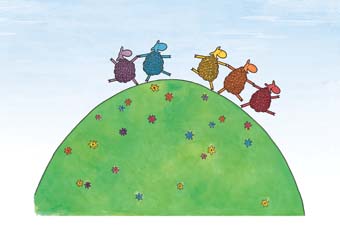
Where Is the Green Sheep?, written by Mem Fox and illustrated by Judy Horacek.

I'm not familiar with any of Mem Fox's other children's books, but her interest in teaching and promoting literacy (as expressed on her website) is in full evidence in the fine crafting of this sheepish little tale.

We love this book!


Illustrations © 2004 Judy Horacek. Posted by Hello

(Compare the covers of the US and Australian editions.)

Helena received this book as a gift about a month ago. While it would've entertained and captivated her from birth, I'm certain it will be a staple to be read in various ways and on different levels for years still to come.

[Warning: spoilers ahead.]

Helena is developing a fine sense of intertextuality. At 32 pages, the simplicity of this book, and the assumed brief time it takes to read it, is deceptive.

Blue sheep and red sheep recall both black sheep (Have you any wool?) and brown bear (What do you see?). We follow the tangents.

Just a few pages in, bed sheep provides a Borgesian touch to our reading experience. Aside from the fact that bed sheep is a sheep and Helena is a little girl, our bedroom scenes are near identical. What book is bed sheep reading?

A host of varied creatures peers from the windows of train sheep's train, not so exotic or endangered as Burningham's menagerie, but each on his own journey to an unknown destination.

Moon sheep never fails to inspire a few bars of Au clair de la lune. It is striking that moon sheep is on the moon, in contrast to the many of our other books featuring a cow over the moon. Different still from kitten's moon, which is full, whereas this is a crescent — a partial moon, but one that is "owned," not merely aspired to.

Similarly star sheep gives us pause. Helena sings a little Mozart, but is well aware that star sheep's star is not so little and with no worlds in sight of it. Could this star possibly be caught?

Eventually we find green sheep, asleep. I expect a straight reading of this book has a deliberately sleep-inducing lilt; it asks us to turn the page quietly, intoning the subliminal suggestion, "Sleeeep, little one. Sleep." We should find both green sheep and tot asleep at the end.

Not so in this household. Helena is invigorated, and with a resounding blast of a pop-cultural reference invokes Joe, singing "Wake up, Green Sheep, wake up!"

Now that we know how the book ends, Helena insists we begin each reading in hushed tones, so as not to disturb Green Sheep until it's time.

Helena "reads" the book back to me, in French, a remarkably fluid and accurate translation. (Perhaps we could get a contract for publication?)

Each reading provides fresh insight into the backstory of the minor characters such as train escargot and hillside-picknicker sheep.

Review.

The book has already been successfully adapted for the stage.

Where Is the Green Sheep? is getting constant play these days, resting only for very short bits of time on the shelf. "Ssshhhh! Green Sheep fait do-do..."

Wednesday, June 15, 2005

Over the past few days, and in the future

In my sci-fi future, you will walk into the office and plug yourself — your brain — into a control panel. A technician will quickly survey your neural circuitry and temporarily deactivate the pain receptors associated with today's dental procedure. With a flick of a switch.

No needles, no time wasted waiting for the freezing to take hold, no realizing it didn't take.

In my sci-fi future, the technician will also adjust your speakers, so to speak — you can listen internally to, say, Erik Satie, instead of the grind of metal on tooth that no external input can drown out.

I assume though that if we were capable of this technology, we would also have nanotechnology keeping one's teeth forever healthy and white.

(J-F is extremely bothered by sci-fi movies that feature people wearing glasses. Laser surgery, anyone? Never mind that he would fight to the death anyone attempting to laser, let alone clamp, pierce, poke, or discuss in any detail, his own eyeball. Me, I like wearing glasses: I think they're cool, and I like having the option to remove them, to move through life as if in a haze.)

Today's extraction was unpleasant. Had the procedure lasted 23 hours, I might put it on par with childbirth. I tried distracting myself, thinking about the novel I've been reading, considering how to manage my workload. Not really strong enough ideas to hold my attention for long. I tried visualization, imagining I was being probed by aliens, but only until I realized this perceptual shift was in fact making my experience all the more horrific.

Walking to the dentist, I hadn't though much about pain or discomfort — it was nothing compared with the extraction of my life savings to pay for the procedure. Hah! The physical extraction was hell.

On the up side, walking to the dentist, on the other side of street than last time, I discovered a chocolatière. I will have to investigate further.

I'm so glad to have run away this weekend, if only for 12 hours. The sense of freedom achieved was just large enough to outweigh the enormous guilt. But I'm still paying for it.

I'm deeply resentful of the fact that just after J-F and Helena dropped me off at the bus station before 3pm, Helena fell asleep, and stayed asleep, till about 10 minutes before I returned home. That it was my job to stay with her, soothe her. That the guilt for having left them was telling me I had to make up for it now.

(By the way, photos are available of Saramago and others in Ottawa. Now you have something by which to judge my sketching abilities.)

For reading material for the bus ride, I left behind the hardcover novel I'd started and chose instead the relatively lightweight The Golden Notebook. It's not what I'd expected. The dialogue, and tone overall, is almost gossipy. I'd expected to be intimidated, to have to weigh every sentence carefully to glean its Importance. But it's enjoyable in a very easy way. I'd had it in my head that I would be diligent in providing a running commentary with profound insight here, but it doesn't feel conducive to that sort of reflection. Not yet.

Work this week is not progressing as I'd hoped.

Tuesday, June 14, 2005

She flits


Cookie in hand, Helena makes a break for it. Posted by Hello

(Yesterday, when it was still sunny and hot.)

Monday, June 13, 2005

Saramago speaks, part 3 of 3

The interview
Saramago describes himself as a child as melancholic, and further explains that this is not a bad thing. Where is the virtue in being happy? "C'est bien la tristesse." For the soul. A typically Portuguese sentiment (to which I relate).

You are sad, you are happy, you write, you don't write.

Adrienne Clarkson suggests he was a late-bloomer, to which he agrees maybe he bloomed differently. You bloom in one way when the time is right, and then again. He seems to be saying that in order to write, one must live first and bear witness.

He fears the specialist, the "What do you do for a living?" askers.

"One writes well under liberty. But under a dictatorhip, the writer is more intelligent." One learns to overcome, to fool, to be vigilant. One masters language as a cryptic device.

(Saramago assures the Governor General, and the audience, that he is not suggesting she instate a dictatorship — Canadians are already sufficiently intelligent.)

Clarkson raises the theme of bureaucratic walls his protagonists keep running up against. Saramago, to my surprise, segués to the subject of women. Are the women also walls?

[His female characters are weakly drawn, but they are often catalysts, driving forces (for better or worse) and inspiration. I don't think he actively dismisses them so much as he doesn't consider them at all. There's something of a saint–whore complex to them. Saramago is an old man, from the Old Country, so for this I forgive him.]

"For men, women are opaque. Men for women are transparent."

He admits women are a mystery, with a "force intérieure." It is evident he loves women. He gazes lovingly and respectfully at his current wife, seated in the audience. There is tenderness and awe.

Clarkson turns to The Cave, a vision of the near future, and in this context asks Saramago for his impression of West Edmonton Mall (which he recently visited).

Saramago has much to say about the shopping centre. (I'm reminded of my visit to Portugal — a man I'd met wanted to show me around the city, so we took the subway out to one the city's more recently contructed landmarks and a point of pride. A suburban mall.)

Shopping centres are clean, well-lit, calm, secure. There is never a lack of people offering to help you. There are women whose happiest moments in life have been realized in a mall.

The mall is not much different from the traditional market or main street in concept, but there is a difference of spirit.

The conversation turns a little political. A citizen's duties. The duty to vote. We must choose; also we must have choice.

Saramago is tearful "What's happened to the human species?" "Is God an assassin?" Why do we accept to live in a world like this?

Each of us in in our own hearts knows that we have responsibility for the future, and knows what that responsibility is.

Disclaimer
I have a hard time believing I understood all that was said (in French!), even if I feel as if I did. Perhaps my comprehension was better than usual because of the "level" playing field — all participants were not native speakers of French. More likely, I've made a lot of this up. Recognized a few words and filled in the blanks to match the expressions and gesticulations. Still, that's not to say I didn't gain anything from the evening — I engaged with my own self for some fresh insight into Saramago's character and work, whether or not he actually said any of these things.

What Saramago is currently reading:
Flaubert's Parrot, Julian Barnes.
(Actually, rereading, if I understood correctly.)

His favourites and influences:
Gogol, Kafka, Montaigne, Cervantes.
He comments also on the impact on him personally of the lesser known (internationally, relatively) Portueguese canon, highlighting Anton Vieira, a 17th century Jesuit, as having great personal significance in addition to his importance in forming the literary tradition in which Saramago was raised.

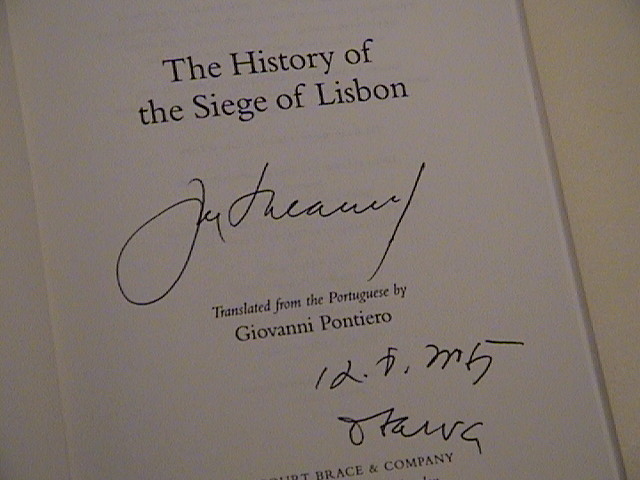
A signature
Gracing the book of his that has the most personal significance to me.


Illegibly signed. Posted by Hello

Blindness on screen
Jonathan Safran Foer gets his wish.

The mood in reference to the planned movie adapation of Blindness was celebratory, it being a point of pride that the much-sought after rights (more than 30 serious requests, Saramago says) were granted to a Canadian.

In March 1999, Saramago
explained that in his own novel, Ensaio sobre a Cegueira (Blindness), he had striven to express his own perception of that dehumanised modern reality which Kafka's work foreshadows: his main purpose in this novel was 'to denounce the perversion of human relations'. He had been asked by numerous film directors for permission to film this novel, but the answer was no: he felt that a film of his book would reduce it to a mere spectacle of sex and violence and — as had happened with Umberto Eco's The Name of the Rose — deprive it of its entire intellectual content.


Verdict
Saramago: man of greatness. Unquestionably Nobel-worthy. Clever, down to earth, funny, sincere. He gives a lot of thought to what he says; he's not afraid to say what he thinks. He's shy, but poised, exuding some vast inner reserve of calm and wisdom. He stands in awe of the world, and shouts about it from the rooftops of his novels.

From Saramago's Nobel lecture:
The apprentice thought, "we are blind", and he sat down and wrote Blindness to remind those who might read it that we pervert reason when we humiliate life, that human dignity is insulted every day by the powerful of our world, that the universal lie has replaced the plural truths, that man stopped respecting himself when he lost the respect due to his fellow-creatures.

Saramago speaks, part 2 of 3

The stage set is flanked by two identical signs, startling red on the earthy palette. Lettered in white:
KNOWLEDGE IS HERE
ICI LE SAVOIR

The event is sold out. (I'd purchased a ticket by phone a day beforehand.) They are prepared to accommodate a limited overflow crowd, with video and audio available in an adjoining room.

(For all the years I lived in Ottawa, I recognize no one, except for that guy who used to ride my bus when I had that one contract, and a woman I think I was introduced to at a bar as a friend of a friend of a friend.)

More than 30 minutes late to get started, the emcee dives into a long and boring list of obligatory acknowledgements of volunteers and sponsors.

The format of the evening is revealed. Also, Saramago will speak in French. (I should've guessed. A test of my linguistic abilities now too.) There's been much confusion regarding the language and nature of the events in the local press. (Saramago is due to speak also at the University of Ottawa later today.)

Some welcoming comments by Ian Wilson (Librarian and Archivist of Canada). Something vaguely elitist in him recognizing that this is an audience who appreciates the power of language, literature, and the written word. As if not enough people do.

Also a word from Governor General Adrienne Clarkson — who will as the highlight of the evening be interviewing Saramago on stage — and then some other guy. Support for the arts, blah, blah, blah.

I didn't bring the cumbersome, less-than-handy Handycam with me, but I did snap a couple analog photos. It'll be months, I'm sure, before I get them developed. But here's a rendering of the man to lend some immediacy to my retelling of the event.


José Saramago. Posted by Hello

Saramago takes the stage. Standing ovation. He looks genuinely humbled.

He speaks (in French) for maybe 10 minutes: For all our advanced studies — discussion, analysis, expostion — he says what is missing from universities today, what is missing from the study of literature is communication, between the reader and writer. Saramago speaks also of "la reception" — by which I understand a kind of opening up of the reader to receive and welcome, and engage in, the literature at hand.

Saramago has recieved thousands of letters from readers around the world. He wonders why — they are not seriously intended to engage with the author, they are a one-way communication. But he understands that in the letter-writing the reader engages with his own self, and perhaps this is what literature is meant to do after all.

Saramago reads the opening pages of Blindness in Portuguese. It's beautiful.

Don McKellar reads the same segment, and then some, in English. Decidedly less beautiful. He stumbles a lot, but his theatricality manages to charm us.

(He'd "joked" about forgetting his own copy of the book at home and having to borrow Her Excellency's, afraid to mark its unscored pages. His reading sounded unpracticed. While the tone of the evening was casual, this struck me as less than professional and sadly disrespectful.)

Saramago speaks, part 1 of 3

In a long, drawn-out fit of spontaneity, I hopped on a bus for Ottawa yesterday to hear for myself what Nobel laureate José Saramago had to say.

His publisher's publicity department did in fact respond to my email last week, informing me that at this time Saramago has no plans to appear in Montreal.

Though the news disappointed me, I was relieved that I could blame time and distance for missing him, missing him because he was hundreds of kilometres away. I'd dreaded that I might hear from the publisher that Saramago had lectured in Montreal just around the corner from here last week: to miss him because of negligence — ignorance of local literary events on my part or delay in the publisher responding — would've been unbearable.

I couldn't get it off my mind though. Ottawa isn't that far away. How much work would I really get done at home this weekend? The real test (of anything): if I didn't do this, how much would I regret it later?

I figured that hearing, in person, José Saramago was worth at least the price of a bus ticket, worth foisting all toddler-minding duties on J-F, worth cramming in extra work hours elsewhere to make up for lost time. How often does one have the opportunity to bask in the presence of genius (a Nobel Prize winner at least)?

(I have met a Nobel winner before, and he failed to impress me. Czeslaw Milosz emanated no aura of greatness.)

Literature of course is not a science. A Nobel prize in the field then cannot be a quantitative indicator of genius. In judging writers, their writing and its impact, the Nobel committee is often as flawed as the rest of us.

It's clear that over the years, some of the awards have been political, if not necessarily politically correct.

How does Saramago measure up?

Remarkably, I'd heard of Saramago before he scored the big prize. I work as a copyeditor. It was in some industry publication or other that a review of The History of the Siege of Lisbon caught my eye. I hunted it down immediately, and fell in love with the rhythm of his words, flattered by his reverence for my profession. (I think it was the following year that the international Nobel spotlight fell on him.) Years later the book again was highlighted to my colleagues.

The proof-reader say, Yes, this symbol is called deleatur, we use it when we need to suppress and erase, the word speaks for itself, and serves both for separate letters and complete words, it reminds me of a snake that changes its mind just as it is about to bite its tail, . . . I must remind you that proof-readers are serious people, much experienced in literature and life, My book, don't forget, deals with history. However, since I have no intention of pointing out other contradictions, in my modest opinion, Sir, everything that is not literature is life, History as well, Especially history, without wishing to give offence, And painting and music, Music has resisted since birth, it comes and goes, tries to free itself from the word, I suppose out of envy, only to submit in the end, And painting, Well now, painting is nothing more than literature achieved with paintbrushes, I trust you haven't forgotten that mankind began to paint long before it knew how to write, Are you familiar with the proverb, If you don't have a dog, go hunting with a cat, in other words, the man who cannot write, paints or draws, as if he were a child, What you are trying to say, in other words, is that literature already existed before it was born, Yes, Sir, just like man who, in a manner of speaking, existed before he came into being, It strikes me that you have missed your vocation, you should have become a philosopher, or historian, you have the flair and temperament needed for these disciplines, I lack the necessary training, Sir, and what can a simple man achieve without training, I was more than fortunate to come into the world with my genes in order, but in a raw state as it were, and then no education beyond primary school, You could have presented yourself as being self-taught, the product of your own worthy efforts, there's nothing to be ashamed of, society in the past took pride in its autodidacts, No longer, progress has come along and put an end to all of that, now the self-taught are frowned upon, only those who write entertaining verses and stories are entitled to be and go on being autodidacts, lucky for them, but as for me, I must confess that I never had any talent for literary creation, Become a philosopher, man, You have a keen sense of humour, Sir, with a distinct flair for irony, and I ask myself how you ever came to devote yourself to history, serious and profound science as it is, I'm only ironic in real life, It has always struck me that history is not real life, literature, yes, and nothing else, But history was real life at the time when it could not yet be called history, So you believe, Sir, that history is real life, Of course, I do, I meant to say that history was real life, No doubt at all, What would become of us if the deleatur did not exist, sighed the proof-reader.


Saramago's biography has also comforted me. He worked as a clerk, a civil servant, before getting into the publishing business. Though he'd published some poems in his 20s, decades passed before he would become a novelist. He's a late bloomer.

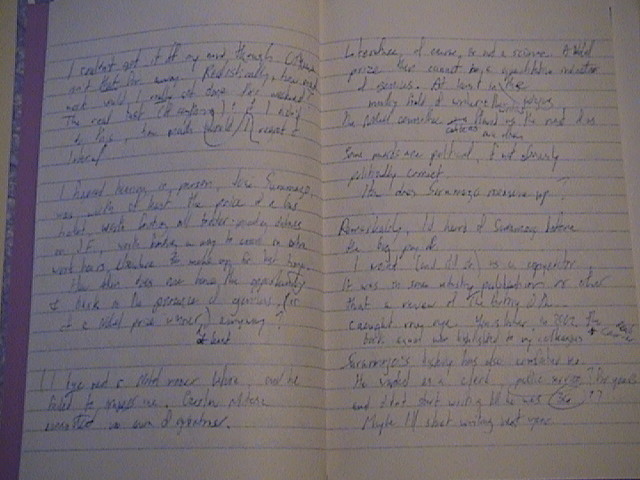
Notes. Posted by Hello

Thursday, June 09, 2005

Confronting oneself

I commented on a review of José Saramago's The Double shortly after its release in the UK.

Now that I've read the novel for myself, my comments stand.

The reviewer found that:
The difference between the spareness of the idea and the bulk of the finished book is made up by the contributions of an intrusive narrator. There are elusive truths which must be approached round three corners, but there is also such a thing as going all round the houses for no good reason.


Saramago goes "round the houses" because they are there. It's as good a reason as any. This is not a plot-driven book — deal with it.

The New York Times:
To judge "The Double" by the tenor of plot and theme would be to miss it. The countertenors are at least as important and, if there were such a thing, the countersopranos and -altos as well. Also the counterdog. (When Tertuliano stays overnight at his mother's, her Tomarctus comes sniffing at his bedroom door. "For what dogs most want in life is for no one to go away.") What Tertuliano and Antonio make and mangle of their situation would provide a one-dimensional fable, stunningly conceived and played out. Greek tragedy without the chorus would be a thin thing; the chastening humanity in "The Double" comes from those who witness and warn.


The Washington Post:
Throughout The Double there is an obvious archness, an authorial sneer at the fantastical subject matter that quickly distances the reader from any emotional involvement with either the character or his situation. As a result, we don't care what happens to Afonso or how he ends up.

What's more, if the subject of a novel is a dull man, there must be something at least a little interesting in his everyday existence to keep us interested. Unfortunately, in The Double it takes close to half of the novel's 300 pages for the protagonist to even get up the nerve to send a letter to the film company asking about this mysterious actor. Until then, we hear only about Afonso's dry-as-a-bone daily inner and outer life, his tepid love affair with a woman, and repeatedly about the inner conflict he has trying to decide whether to eat out or stay home and rummage in the refrigerator for a meal.


Not all reviews of The Double were favourable, as you can see.

Why not write about boring people? Tedium is a powerful tool, and in the hands of a skilled writer, can lure a voyeur into the intricacies of a mundane life just as well as the usual stock of character quirks and plot twists.

Is the narrator intrusive? He is as much a character with reflections and opinions as those people named in his story. The voice of Common Sense converses with Tertuliano; perhaps he is the narrator, inserting himself directly into our hero's life.

Some reviews hint that the novel should be read as a commentary on the implications of cloning. The "twins" do briefly entertain the notion of DNA testing to determine the extent of similarity between them, but the book is about neither science nor society (much). It's a novel about interior spaces — obviously, the sense of identity and where it comes from.

I admit I was slow to like this novel. I didn't care about the protagonist and didn't understand what motivated him to act as he did. I realize now that it is on the suggestion of his colleague, a math teacher, that the entire plot is set in motion. The plot is almost a mathematical exercise, following each action to its logical conclusion. It is not what he wants to do, but what he must. Tertuliano is purposely dull, without the strength of character to resist the course laid out before him.

They say you can hate someone only if you hate yourself, but the worst of all hatreds must be the hatred that cannot bear another person to be the same, worse still if that sameness should ever become total.


Had this sentence begun the novel, a proclamation in the style of an older literary tradition, rather than appearing near the end, I suspect the work would be better received.

It's a truth, in my experience, that we criticize in others those flaws we recognize (and fear, and deny) in ourselves. Saramago explores this phenomenon in the extreme.

Reviews.
Reading group guide.
Excerpt, but not a very good one. (It's from the opening pages, which failed to make an impression on me. In fact, the first 100 pages left me indifferent. In truth, I'd be hard pressed to find an enticing excerpt — there's little but to swallow the book whole for the desired effect.)

José Saramago appears this Sunday evening in Ottawa courtesy of The Ottawa International Writers Festival. (I'm still waiting for the publisher's publicity department to tell me whether an appearance is scheduled for Montreal.) To all of you in Ottawa: can I crash on your couch? If I can't make it: can you go in my stead? (You'd have to take careful notes — heck, videotape the proceedings — and get one of my books signed for me though. I'll pay for your ticket.)

It's said everyone has a double somewhere in the world. One assumes that double in on the other side of the world, not next door. When I first moved to Ottawa, I was several times stopped in the street by people expecting me to acknowledge them. "Mary?" No. (Maybe Mary will show up at Writersfest Sunday night.)

J-F encountered his double many years ago, before we'd met, when he was working in retail. An uncanny resemblance, he says. Though he reports feeling unsettled by the experience, it was business as usual.

Most people take it as obvious that our sense of self is derived from environmental factors and experience more so than genetics.

I'm reminded of an idea articulated by David Byrne that has obsessed me since I first brought Music for the Knee Plays home with me in the late 1980s (vinyl!).

Social Studies [Knee Play 4]

I thought that if I ate the food of the area I was visiting.
That I might assimilate the point of view of the people there.
As if the point of view was somehow in the food.
So I would make no choices myself regarding what food I ate.
I would simply follow the examples of those around me.
I would study menus very carefully,
Making note of important differences and similarities.
When shopping at the supermarket
I felt a great desire to walk off with someone else's groceries
So that I could study them at length
And study their effects on me.
As though if I ate their groceries I would become that person; until I finished their groceries.
And we might find ourselves going to the same places.
Running into one another at the movies
Or in a shopping mall.
Reading the same books.
Watching the same TV programmes.
Wearing the same clothes.
Travelling to the same places.
And taking the same pictures.
Getting sick at the same time.
And getting well again simultaneously.
Finding ourselves attracted to the same people.
Working at the same job.
And making the same amount of money.
Living identical lives — as long as the groceries lasted.


I play this game every time I do groceries (every time!): I form a character profile of the person in front of me at the checkout, based on the items they lay out on the conveyor belt. The time of day and the manner in which they arrange their purchases are also factors I consider. Whether they have families or live alone, are health-obsessed and indulge in guilty pleasures; what they do for a living, the hours they keep, the extent and quality of their social life.

I fear, too, what others might make of my basket.

Where's the harm?

Eye Weekly produces its own list of harmful books, and actually defines "harm," in response to a recent list compiled by conservative scholars.

One dangerous book that might not occur to many people:
The Pet Goat, Siegfried Engelmann and Elaine Bruner: This heartwarming story of a boy and his goat is so insidiously mesmerizing that it kept George W. Bush transfixed for a full seven minutes after learning that the first plane had hit the twin towers on Sept. 11, 2001.


(Link via Bookninja.)

Wednesday, June 08, 2005

Misbehavin' Elmo

You wouldn't know it to look at him, but Dancing Elmo has a mean streak. (Maybe as a result of my wanting him not to dance quite so much, preferring him to sit quietly?)

No less than twice this week, Helena has had to console one of her dolls, telling me the doll was mad because Elmo hit her. Helena scolded Elmo, "Non, c'est non," and carried him (kicking and screaming?) under her arm out of her bedroom to sit in the hall.

She checks on him a few minutes later, asks if he's better, and then invites him back into her room.

(We've never formalized a "time-out" method in this household — certainly there's no "Go stand in the corner" or "I want you to sit here and think about what you've done." If Helena's being particularly ornery, we may walk away for a minute till she calms down. I can only imagine she's mimicking a rare disciplinary measure in force at her daycare.)

Elmo may be annoying, but toddlers are weird.

Tuesday, June 07, 2005

A meme, by which I procrastinate

The lovely Kimberly recently tagged me with a book meme. I'm terrible at getting around to doing these things, and I doubt anyone (except maybe Kimberly) really wants to know my answers to these questions, but hey, it's more fun (for me) than working.

Actually, I answered some of these questions in brief elsewhere, but in the interest of wasting time I will refine my responses here.

Total number of books I've owned
My rough estimate of books currently occupying shelves and waiting patiently in unpacked boxes is about 2000. (So I exaggerated a little previously.) The number of books I've ever owned would be easily double that number, having seriously culled my shelves in a move about 8 years ago (finally liberating myself from required university reading as well as the literary trash that had helped pass the time) and including boxes that remain in my mother's basement (favourites from my childhood and teenage years).

The last book I bought
I imposed a moratorium on book-buying a few months ago. Knowing that we'd be moving soon it didn't make sense to me to add to the piles needing packing, particularly when there is sufficient as yet unread material on hand to get me through this stressful period. Even though I've been frequenting bookstores lately, it's more in a pursuit of calm and centredeness than to satisfy any urge for acquisitions. Likely the last book I bought was Walter Mosley's The Man in My Basement (in April), discounted, and no, I haven't read it yet. Too, I rather like deluding myself that I don't have a book-buying compulsion, so I may have conveniently forgotten one or two purchases since.

The last book I read
I am 28 pages from the end (does that count?) of José Saramago's The Double, and I'm dying to know how it turns out. (I must set my priorities straight.) Although the opening chapters didn't impress me, the meat of it is more than satisfactory. Before this book was Iain Pears' The Dream of Scipio.

I recommend both of these to people whose taste in books is highly similar to my own (practically no one). I would recommend neither to casual acquaintances looking to me for a suggestion for light summer reading.

[In a twist of fate, my computer froze while composing this post. The clock on the computer also froze, and so I gained, or lost, half an hour. Amid waiting and rebooting and waiting and scrambling to recover files, I managed to finish reading The Double, on which I will have something to say later.]

Five books that mean a lot to me
These change over time. Few books are truly life-changing. Some books I'm sentimental about because of the time in my life when I read them or because they were gifts from lovers. Today I choose the following, some of which I've written about previously:

1. A Little Princess, Frances Hodgson Burnett.
"Not because it introduced me to the world of books — I was already immersed in it. I read it when I was 8 or 9 — it couldn't've been long after my father died. I felt something like empathy with poor orphaned Sara (our princess), and so a whole new level of reading was opened up to me, some place Nancy Drew could not take me. I learned something about mastery of one's inner life even when completely at odds with one's surroundings."

2. The Razor's Edge, W Somerset Maugham.

3. The Unbearable Lightness of Being, Milan Kundera.

4. The New York Trilogy, Paul Auster.
"Changed my life. There. I knew I would find one. Thing is, I can't quite pinpoint how. Something to do with that time in my life, fumbling about at university, identity, my obsession with the myth of the Tower of Babel, why I finally chose to study linguistics, and my generally roundabout approach to life."

5. The First Century after Beatrice, Amin Maalouf.
Apart from the fact that it has a great premise and is told by a master storyteller, I don't know why I rave about this book, to everyone. Honestly I don't know what it means to me, but it feels Important.

Tag 5 people
This is where it all falls apart. Memes tend to stop with me. I don't think I even know 5 people, let alone 5 who would be happy to take up the challenge and post responses on their own blogs. So with absolutely no expectations, I tag:
1. Liam (Silly Daddy), because I want to encourage his blogging efforts by obligating him to comply.
2. Suzanne (Miscellanea & Ephemera), because she also needs to blog more, and I think she likes being tagged.
3. Russell (All My Shoes and Glasses), even though he's on a blog vacation, because he's taken an interest in memes lately, going so far as to create his own (though I've not felt adequate to undertake it).
4. Diana (Seeking Clarity), because she reads a lot, and this may provide some clarity.
5. Anonymous, even though you don't visit much anymore, because I want to know more about you.

Sunday, June 05, 2005

Bookstore observations

Mass market paperback editions of The DaVinci Code are recently available everywhere in French, but there is no scheduled date for such an English edition. Meanwhile, Umberto Eco's latest is marked down 30% in French, not so in English. What does this say about the difference between French and English consumer markets? (Note that first issues in French are usually a kind of trade paperback, and relatively expensive — as much as or more than an English hardcover.)

(Yes, I'm spending more time in bookstores these days than I ought. With all the other things needing doing, they're so conveniently on the way.)

I'm setting off alarms in stores. The culprit is finally identified as the book I've been lugging around for dentist chairs and metro rides. Of course, it's in the bookstores that security guards question me about the contents of my bag. One uniform turns the book over, checking the spine and corners. He thumbs through it, presumably looking for smudged fingerprints, coffee spills, chocolate smears, other signs of wear.

The thing is: I tend to take care of my books. While this one is not pristine, it isn't any worse off than many that are regularly handled and perused in the bookstore stacks. The only evidence in my favour is the tattered bookmark about halfway through. I brace myself for a pop quiz on the book's contents, but it does not come to pass. He hands the novel back to me, resignedly.

Surely they realize that people who carry books around with them are likely to frequent bookshops, that they who linger there might be the type to have reading material at the ready.

I wonder do they ever confiscate such books, do they have training to recognize that a book has had travels and experiences beyond the store, or are they specialized in reading people.

Do people steal books? What kind of people? Do security guards hand the goods over to the criminals and let them walk away?

Friday, June 03, 2005

The notebook

Confession: As much I profess an admiration of Doris Lessing, and I've read handfuls of her books, I have not read what many consider to be her most important work, The Golden Notebook.

I bought a copy for myself ages ago. I often weigh it in my hands, with a sense that it has a secret to tell me which I'm not yet equipped to handle. It will reveal mysteries to me. I've never glanced inside. I didn't feel ready.

It's been increasingly on my mind in recent months. My eyes rest on it more frequently. Now — soon, this summer — is the time.


The Golden Notebook, by Doris Lessing. Posted by Hello

There's a couple books I'd like to get through before I tackle this one, but I sat down to read the Doris Lessing's 1971 preface to this 1962 novel the other night.

"This novel was not a trumpet for Women's Liberation." Its theme, breakdown as a means of self-healing, was, she claims, barely noticed.

To be honest, I know nothing about this book, its plot or themes. I thought it was a kind of feminist manifesto. Hmmm.

Lessing addresses some of the decisions that went into creating The Golden Notebook: the ideological "feel" of the midcentury, why her main character must be an artist, the shape of the book.

The problem of subjectivity:
At last I understood that the way over, or through this dilemma, the unease at writing about 'petty personal problems' was to recognize that nothing is personal, in the sense that it is uniquely one's own. [The tiny individual is a microcosm.] Growing up is after all only the understanding that one's unique and incredible experience is what everyone shares.


Perhaps, then, I am a grown-up.

Lessing lambastes literary critics, but also the education system; more broadly, she explores the problem of parochialism in our culture, institutionalization and indoctrination. Just as a preface.

The other thing taught from the start is to distrust one's own judgement. Children are taught submission to authority, how to search for other people's opinions and decisions, and how to quote and comply.


(This is what I hated about university. I was not being encouraged to think; it was important only that I knew what other people had thought.)

Lessing writes also of the multiplicity, and validity, of perceptions and interpretations:
It is not only childish of a writer to want readers to see what he sees, to understand the shape and aim of a novel as he sees it — his wanting this means that he has not understood a most fundamental point. Which is that the book is alive and potent and fructifying and able to promote thought and discussion only when its plan and shape and intention are not understood, because that moment of seeing the shape and plan and intention is also the moment when there isn't anything more to be got out of it.


There is much more that is quotable, but you'd do better to go find a copy of the preface and read it for yourself. I agree with most of what Lessing has to say; she is sensible; her writing on these subjects engages me.

The preface bodes well for the book.

There is only one way to read, which is to browse in libraries and bookshops, picking up books that attract you, reading only those, dropping them when they bore you, skipping the parts that drag — and never, never reading anything because you feel you ought, or because it is part of a trend or a movement. Remember that the book that bores you when you are twenty or thirty will open doors for you when you are forty or fifty — and vice-versa. Don't read a book out its right time for you. . . . Everywhere, if you keep your mind open, you will find the truth in words not written down. So never let the printed page be your master. . . . [Y]ou should have been taught to read your way from one sympathy to another, you should be learning to follow your intuitive feeling about what you need: that is what you should have been developing, not the way to quote from other people.


I am ready.

Thursday, June 02, 2005

Behind the fairy tales

Directing you to your Mental Multivitamin of Hans Christian Andersen:

Harold Bloom sees Andersen's project as "how to remain a child in an ostensibly adult world."

Simon Tait investigates the relationship between Andersen and Dickens.

(For the record, we love the movie, too.)

Leaps and bounds

J-F is away for a few days for work. That leaves me and Helena with intense quality time together, not the least being the metro ride for drop-off and pick-up at daycare.

Leave house this morning at 8.25. Arrive at daycare shortly thereafter as building is being evacuated — fire drill? bomb threat? Regardless, once I'm in the daycare courtyard with Helena, I'm not allowed to leave, as the only legitimate way of doing so is through the building, which we're not allowed to re-enter (apparently hopping the fence sets a bad example for the children). So I stick around with half a dozen other parents, their own children clinging to them. I help out with impromptu snacks (someone did sneak back inside for cheerios and juice [why doesn't Helena eat cheerios at home?]), wiping up other people's children. I watch grown men, suited up and tied, sing about the wheels of the bus.

Helena's group is going for a walk; the key for the gate in the fence makes a rare appearance. Neither their day nor mine is going according to plan, but they seem grateful for my help. I bring up the rear of the rope, corraling the herd, while one of the educatrices communicates with the other groups for updates. They will serve an early lunch, outdoors, and phone parents to pick up their children by 1:00.

Helena and I leave the pack at about 11:00; we have to go the long way 'round to get to the metro. She falls asleep on my lap before our stop.

It seems I won't be getting any work done today (you know, work, the kind they pay me for).

We finally made it to the new neighbourhood park, featuring a half-million dollar playground, a sign proudly proclaims.

While the old neighbourhood park was across the street, its vastness ensured a healthy trek before reaching the playground. Though the new park is down the street, it's about the same distance to what matters — the slide.


New slide. Posted by Hello

In fact, the new park is superior on this count: 2 pieces of equipment that feature 5 slides in total.

Helena likes swings too. At her size, the baby swings are a bit awkward, and I feel some trepidation about regular swings. But Helena insists. She holds on tight. I sit on the swing next to her and demonstrate how to pump one's legs to make the swing move. Helena is thrilled. She slips off her swing because she wants to help push me.


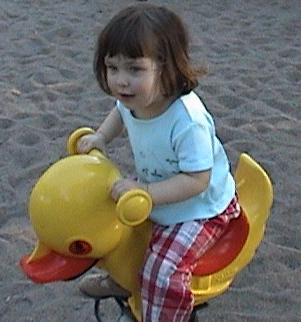
New duck. Posted by Hello

Other cool stuff about the kid:

An obsession with microbes — as in wash your hands, wipe the table, and don't eat that, parce qu'il y a des microbes.

Helena has entered the pourquoi, ad infinitum, phase. It seems "il y a des microbes" is the only answer able to cut the chain.

I hold the door open for Helena to pass through. She sings out, "Merci Madame Mama."

The big bed. She fell out once, her second night. She has not exploited the freedom the bed allows. I'd left to retrieve something or other and returned to find her scurrying back into bed — she knows she's not to leave its confines. She doesn't get of bed herself in the morning, but rather waits for someone to come get her.

Bedtime is tedious. Everything about it drags on forever. (I have yet to see an episode of Doctor Who in its entirety.) I'm hoping the ritual will normalize over the next couple weeks as we impose more order on our space and our time.

When she tells me about her day, I understand her. For example, she told me that she and J-F the other day had stopped for coffee on the way to daycare, Papa had coffee but she didn't have any coffee, she ate a blueberry muffin, and J-F rested her backpack and her hat on the chair beside her. And it was all intelligible and true.

She can count to 11 in both official languages.

Is that enough?

Toothless

I've lost a tooth.

I'm embarrassed to tell the world of this. It implies self-neglect in one so young (?!); alternatively, it speaks of age, of physical decay. It stuns me actually, because I've always had pretty nice teeth.

While having a perfectly ordinary lunch yesterday, I felt something hard and unusual rolling about in my mouth and extracted a large piece of tooth.

Fortune would have it that this is the same tooth for which I had a root canal last year, so at least it doesn't hurt. Am a little pissed off about all the time and money spent on the root canal.

I blame Helena. I'm certain it was her swift kick to my face that precipitated the root canal. I'm equally certain it was her sudden standing up as I leaned over her, the slamming into my chin that clanked my jaw together and threw my head back, that cracked the already weakened tooth. Accidents, of course.

Up: Had a lovely walk to the dentist this morning. For the first time walked more or less in a straight line from current address to immediate vicinity of old address.

Down: Dentist previously 3 blocks away, now a 20- to 25-minute walk away.

Up: Discovered that there's a patisserie around the corner from here, not yet having walked around that particular corner.

Up: Found a fantastic second-hand bookshop featuring in its window the likes of Calvino, Gombrowicz (!), Kundera, Pirandello — for all your used 20th century European (and other) literature needs.

Down: All the books were in French translation.

Up: Two and a half hours with my feet up, sinking into a very comfortable chair, and because of the circumstances not feeling a shred of guilt for not working.

Down: Actually not getting any work done.

Up: Most of the two and a half hours was spent waiting. I read. Am about halfway through Saramago's The Double.

Down: It's not one of his stronger works.

Up: Have been meaning to get 'round to scheduling a cleaning. Done.

Down: The noise! Oh, the unbearable noise noise noise noise of dental instruments! It's never really bothered me before today.

Down: There's a cut at the corner of my mouth, courtesy of noisy dental instruments.

Down: The tooth in question is not salvageable.

Down: Dental work is expensive.

Up: On my way home purchased a small jasmine tree to lift my spirits. I've wanted one for years. I'd let all houseplants die a miserable death this winter, and this tree with its evocative scent feels appropriately inaugural in our new home.

Wednesday, June 01, 2005

Mara and Dann again

I've been meaning to say some things about Doris Lessing, but they will have to wait — they're still brewing, or steeping, or simmering, not ready yet. Just this morning I was wondering to myself: "It's been ages since I had news from the Doris Lessing mailing list. I hope she doesn't die this summer, it's too soon." (Morbid, I know. And selfish. That's me, morbid and selfish.)

By a startling coincidence I received word via the mailing list today that:
"Doris Lessing's new book The Story of General Dann, Mara's Daughter, Griot and the snow dog has just been published in the U.K. It is the sequel to Mara and Dann and is one of her most emotional and moving books."

(Mara and Dann was one of the most powerful books I've read in recent years.)

Tuesday, May 31, 2005

Rear window

Life is hectic. My surroundings continue to look like the aftermath of some terrible disaster. There is little evidence of my physical busy-ness, and were you to peer inside my head you would wonder also about the success of my grinding mental efforts in the chaos that is currently my brain. I feel lost without my daily blogging fix.

With both J-F and I busy with work and toddler-minding, after meals and laundry — the regular crap of daily life — there's little time or energy to contend with the "extra" work of unpacking and settling in. We, each of us on our own schedules, have occasional bursts of fed-up-edness — in this manner the kitchen has been made functional (though some drawers with less organization than I hope to someday achieve), the storage area and hall closet are orderly such that one can maneouvre and access stuff, boxes have been emptied, and additional shelving has been assembled. (Yes, the dishwasher was installed successfully, by J-F himself.)

My sister flew through town this weekend. A couple hours here, a few there — we spent what time we could together. Her efforts to buy me an extravagant housewarming present were unsuccessful, though the fruitless shopping did result in fresh air — a success in itself — and an envisioning of the day our space could stylishly accommodate expensive furniture.

We are experiencing our first homeownership setback. The shower and toilet are not draining, for no discernible reason. We know nothing of plumbing. Perhaps it has something to do with the ongoing exterior work, or the recent rain. The contractor will be investigating later today, but we can't help but feel a little discouraged.

I've been feeling a bit bummed — a little blue, unsettled, disappointed, confused — ever since reading Petite Anglaise's news last week. I've been reading her blog for a about half a year and came to think of her a little as a kindred spirit — both of us shacked up with Frenchmen in a "foreign" city, toddler in tow, with similiar outlooks on child-rearing and career, love and life.

I'm unsettled now much like I was when watching the final episode of Mad About You. And unsettled more by the fact that I feel unsettled at all.

When you see yourselves in other people, and they don't turn out well, or as well as you'd hoped, or anything like what you hope for yourselves... It scares me a little. Not in any real way, but it reminds me that love isn't easy, that even after almost nine years this relationship isn't easy.

Strangers — virtual and fictional and the ones next door — are windows into ourselves. But we are not them.

So here we are.

The courtyard of this condoplex is nearing completion. Through sliding doors we watch our neighbours' lives, assembling patio sets, planting geraniums, installing curtains, working, studying, sharing meals. We are the last to move in, and as such I feel we are on display in the full glory of our disorganization and frustration — they're window onto us is fuller.

Our neighbours are mostly couples, on average a few years younger than us. One couple has a baby, another I think is expecting, another is gay. There's a cat across the way, and a couple dogs upstairs (two cats beside me).

As we exit the other morning, we surprise an older, distinguished-looking gentleman in his bathrobe scooting down to the main entrance to get his newspaper. We've seen him on television, representing the police or fire department. (No more pot-smoking on the balcony.)

I'm struck by what attractive people live here, how good-looking everyone is. I wonder if this plex is a beacon for a certain "type." I hope it's something in the water.

Thursday, May 26, 2005

Remembrance of books past

Chabon
I've never read anything by Michael Chabon, except for this essay, just now, which not only makes me want to read his books, it makes me want to write a novel. (Oh, wait — I did glance at his website once.)

Chabon also experienced a Calvino effect, citing him and a few others as authors "who wrote at the critical point of language, where vapor turns to starry plasma." He writes about embarking on the writing of his first novel with the realization that it was not according to "the plan to do for romantic relationships what Calvino had done for the urbis in Invisible Cities."

Chabon's essay is in fact not at all about Calvino. It's about writing, the reading that informs writing, the desire to write.
...when I read a page of Remembrance of Things Past (as it was then known), the book that was my project for the year, I felt all those interests mesh with the teeth of Grammar and Style, and I would imagine myself, spasmodically, a writer.


It's also about summer and place.
I started to write my first novel, The Mysteries of Pittsburgh, in April of 1985, in Ralph's room. Ralph was the Christian name of a man I never met, the previous owner of my mother's house on Colton Boulevard, in the Montclair District of Oakland, California. His so-called room was in fact a crawl space, twice as long as it was wide, and it was not very wide. It had a cement floor and a naked light bulb. It smelled like dirt, though not in a bad way—like soil, and cold dust, and bicycle grease. Most people would have used it for suitcases and tire chains and the lawn darts set, but at some point this Ralph had built himself a big, high, bulky workbench in there. He built it of plywood and four-by-fours, with a surface that came level to the waist of a tall man standing. It might have been a fine workbench, but it made a lousy desk, which is how I used it.


Eco
Umberto Eco talks about everything (including The DaVinci Code), and a little bit about The Mysterious Flame of Queen Loana. (I must make haste to a bookstore!)
"I had to fight against Proust in this book. If you write a novel about memory, you have to. So I did the contrary of the great Proust. He went inside himself to retrieve senses, smells and memories. My hero does the opposite because he is only confronted with the external memories, public memories which a whole generation shared."


The importance of Proust
Author Lauren Baratz-Logsted talks about her impulse to read,
It amazes me how often, when I ask a would-be published author what they're reading at the time, the response comes back: "Nothing. I don't have much time for reading." To me, this is like saying, "I want to be a brain surgeon, but I really don't have time for med school." A.O. Scott, reviewing Joyce Carol Oates' Uncensored: Views and (Re)views in the NYTBR on April 17, wrote, "Of course, every serious writer of fiction must also be a serious reader; the only way the art can really be mastered is through a compulsive, self-administered pedagogy of worship, derision, imitation and intimidation."


(Among her standout reads this year: Arturo Perez-Reverte's Queen of the South.)

The dream

Iain Pears' The Dream of Scipio will stay with me a very long time.

I started reading this book months ago. Previously, I quoted this bit:

Was Julien a mere bookworm? Or was he sensitive to the outside world, could he absorb time and place, feel history in the stones and use this to make his work more sensitive and more subtle? Are you a mere pedant, Monsieur? Or do you have the spark of vitality inside you? Will you do something with your life? Answer my question with all the wit at your disposal and let us see.


Because I've been reading this over such a long time, it has read very much like a dream. I've lost the details, but the mood lingers. Bits of it come back to me when I'm otherwise engaged, taking me on journeys to investigate my motivation, my actions, my inaction.

The dream of the title is a reference to a classical text. From the New York Times review:
In his essay "De Republica," Cicero digressed to tell the story of the great general Scipio, and the dream he had of being taken up into the heavens to meet his ancestor Africanus, who shows him the machinery of the cosmos and teaches him a lesson about the vanity of fame and the necessity of virtue. This digression is missing from the manuscripts of Cicero's essay that have come down to us; it was preserved only in a long commentary by the Neoplatonic thinker Macrobius, which circulated in several manuscripts in the Middle Ages.


It is appropriate then that the novel is full of philosophical digressions, and that I digressed while reading it. The vanity of fame and the necessity of virtue. Pears does not deign to teach his readers a lesson, nor do his characters much learn one, but every digression leads the reader deeper into her won soul.

According to The Guardian, The Dream is "a lengthy meditation on cultural history, with characters as pegs for thoughts. The plot has more in common with an academic treatise than with a thriller." Which is just fine by me.

The characters: three men at three different critical moments of Western civilization, linked by some writings and by geography, interwoven in such a way as to invite comparison and the drawing of parallels. Each of these men's stories revolve about a woman from whom they have much to learn.

From a review in The Washington Post:
Pears does not tell these stories in sequence, but rather weaves from one to the next, a risky strategy for the storyteller and, initially, a demanding one for the reader. But both risk and effort prove worthwhile, for this structure allows the echoes and resonances of each to build into an entirely satisfying symphony of story and substance.

Although Pears' 1998 novel An Instance of the Fingerpost was a critical and popular success, to me it seemed a flabby book, bloated on its own mannered cleverness. In The Dream of Scipio, Pears has abandoned cleverness for wisdom, paring his style to a cool elegance that allows some very large ideas the room they need to breathe.


I read An Instance a couple summers ago. The idea of the structure was clever — the story retold form the perspectives of four different narrators — but after one and a half tellings, the story bored me. The murder mystery became mired in political details, and so my focus wandered and waned.

The Dream of Scipio follows the path of an intellectual's life in Vichy-run France and his investigation into a poet's writings during the time of the Black Death, framed by the writings of a bishop witness to the collapse of the Roman Empire. They consort with painters, philosophers and rabbis, government and church officials. Art, love, religion. Following are some of the passages that gave me pause.

Critique of Julia's painting (p 121–2):
"You've looked at too many pictures, you know too much. You are too aware of what you're doing and of the past. That's what's wrong with it."
"You have Matisse and Cézanne and a bit of Puvis there. A touch of Robert, perhaps, as well. I look at that picture and I can see what you've built it out of. That's what's wrong."
"It's the painting of a dutiful daughter," he said eventually, looking at her cautiously to see her reaction. "You want to please. You are always aware of what the person looking at this picture will think of it. Because of that you've missed something important."


The soul dies (p 153):
The phrase of Manlius which led Olivier to the rabbi was at least a considered one, and one of the greatest importance. Indeed, it was at the summation of nearly eight hundred years of thought on the relationship which must exist between the physical and the metaphysical. The soul dies when it falls to earth. More Christian heresies were contained in this statement than in almost anything else in the entire document. It contradicted the idea that the soul is created ex nihilo — at birth, at quickening or at conception, a question never precisely answered. It contradicted the idea that man is born and dies once only; it contradicted the idea that salvation lies through God alone; indeed it suggests that man is responsible for his own salvation, but through knowledge, not through deeds or faith. The idea that birth is death, and death is life again hardly sat easily with contemporary Christian doctrine, although it echoed all too readily with the heresies of the Cathars.


The blanket over men's minds (p 154):
It was a duty, not a labour of love, that made her teach, for she could not but be aware that each newcomer to her door, however curious, knew less than the one he replaced. The ability to argue diminished; the grasp of basic concepts weakened; and the knowledge that comes from study grew perpetually less. Christianity, which spread over men's minds like a blanket, put faith above reason; increasingly those brought up under its influence scorned knowledge and thought. Even those with a spark given to them by the gods wanted to be told, rather than wanted to think. Getting to accept that the goal was thought itself, not any conclusion at the end of thought, was hard indeed. They came to her for answers; all they got instead was questions.


In the cause of virtue (p 254–5):
And so Julien judged Olivier de Noyen harshly and without pity. He even referred back to Manlius and the example he set, using the test of The Dream of Scipio as the link; for Olivier knew Manlius's words, but had utterly failed to comprehend them, it seemed. "no one can possess wisdom if consumed by intemperance", says Manlius, quoting the Protagoras, yet Olivier's actions were surely intemperate. Another statement, this time derived from Cicero, also gave him comfort, for the wisest of all Romans stated that "you cannot act rightly by taking up arms against your father or your fatherland". Was that not what Olivier had done? For in that age without countries, Cardinal Ceccani was both father and fatherland to Olivier, and he had turned against both. Julien's own position was the more clear, surely?
It is significant, however, that Julien did not ponder the next passage from Manlius's manuscript until much later, for it might have brought with it further reflection. He had noted it years before in the Vatican library, correctly ascribed its origins to Theophrastus, then filed it away. "An amount of disgrace or infamy can be incurred", Manlius quoted, "if it is in the cause of virtue."
Had Julien been less influenced by his own predicament, then he might have looked harder and guessed the poet's motivations earlier than he did. He might also have considered the possibility that Manlius, in writing these words, was passing a verdict on his own acts, rather than providing a philosophical basis for them.


Are we fated or not? (p 267):
The question is a false one, for the concern of man is not his future but his present, not the world but his soul. We must be just, we must strive, we must engage ourselves with the business of the world for our own sake, because through that, and through contemplation in equal measure, our soul is purified and brought closer to the divine. There is no reward for good behavior, as the Christians suppose, no judge to decide. The more nearly our soul resembles the divine, the closer it is able to approach the model from which it was formed and which it ceased resembling when it became tainted by the material on falling to earth. Thought and deed conjoined are crucial. Faith means nothing, for we are too corrupted to apprehend the truth.
**********
The attempt must be made; the outcome is irrelevant. Tight action is a pale material reflection of the divine, but reflection it is, nonetheless. Define your goal and exert reason to accomplish it by virtuous action; success or failure is secondary. The good man, the philosopher — the terms to Manlius were the same — would strive to act rightly and discount the opinion of the world. Only other philosophers could judge a philosopher, for only they can grasp what lies beyond the world.


"Can there be no good man?" (p 269–70):
"Action is the activity of the rational soul, which abhors irrationality and must combat it or be corrupted by it. When it sees the irrationality of others, it must seek to correct it, and can do this either by teaching or engaging in public affairs itself, correcting through its practice. And the purpose of action is to enable philosophy to continue, for if men are reduced to the material alone they become no more than beasts." ... Only a man who realised that civilisation might not continue could have reformulated classical ideas in such a way...


In the paragraphs that follow it is made clear that "as a piece of philosophy, it was not of the highest order." Here, the thoughts become pegs for the characters.

I should mention that in each of the three eras, Jews are being persecuted. Although in some ways this is incidental, it serves to make the climactic point (p 370–1).
They may be mad, but they're not fools. What they're doing goes far beyond the war. Something unparalleled in human history. The ultimate achievement of civilisation. Just think about it. How do you annihilate so many people? You need contributions from so many quarters. Scientists to prove Jews are inferior; theologians to provide the moral tone. Industrialists to build the trains and the camps. Technicians to design the guns. Administrators to solve the vast problems of identifying and moving so many people. Writers and artists to make sure nobody notices or cares. Hundreds of years spent honing skills and developing techniques have been necessary before such a thing can even be imagined, let alone put into effect. And now is the moment. Now is the time for all the skills of civilisation to put to use.
"Can you imagine a greater, a more enduring achievement? This will last forever, and cannot be undone. Whatever benefits we bring to mankind in the future, we killed the Jews. No matter how great the advances of medicine, we killed them. However high our achievements may soar, however perfect we become, this is what is at our heart. We killed them all; not by accident, or in a fit of passion. We did it deliberately, and after centuries of preparation."


I think these passages speak for themselves. It is simplistic philosophy, critique, examination; but these digressions feed the characters with motive and rationale (right or wrong) and give the reader the example of their lives as a framework for self-reflection.

Extract.
Reading group guide.

Iain Pears' The Portrait has just been released.
The Washington Post:
We are in for much more than a mortal reckoning between artist and critic (though we get that, too). This is a novel of pitiless revenge. ("A critic is to a painter as a eunuch is to a man.")

A final word on The Dream's geography, which connects its characters, all walking the same stones of Avignon (p 261):
Even for the atheist and the rationalist, there are places in the world which are special, for no reason that can be easily explained. The footsteps slow, the voice lowers and speaks more softly, an air of peace works its way into the soul. Each individual has his own place, it is true; what is holy to one will not be so necessarily to another, although the reverberations of some are all but universal.


Outside the papal palace. Posted by Hello

I spent a week in Avignon in 1995. Reading The Dream makes me want to go back.

Wednesday, May 25, 2005

Please excuse the mess

I'm settling into our new condo (opening boxes and finding place for stuff anyway), and I was suddenly overcome by the urge to clean up and redo my blog home as well.

This may take a while.

Long live Molvania

Zlad's latest tune has been disqualified from Eurovision for Satanism.
Like a lion kills an antelope.
Like a hammer hits a canteloupe.
I am the anti-Pope.


(Remember Zlad?)

Molvania: A Land Untouched by Modern Dentistry — recommended here.

(What a great series of travel books!)

Tuesday, May 24, 2005

Invisible effects

A collection of links to works inspired by the writings of Italo Calvino, particularly Invisible Cities (via Bookninja):
What makes up a city is not so much its physical structure but the impression it imparts upon its visitors, the way its inhabitants move within, something unseen that hums between the cracks.


Contemplating these essential landscapes, Kublai reflected on the invisible order that sustains cities, on the rules that decreed how they rise, take shape and prosper, adapting themselves to the seasons, and then how they sadden and fall in ruins. At times he thought he was on the verge of discovering a coherent, harmonious system underlying the infinite deformities and discords, but no model could stand up to comparison with the game of chess. Perhaps, instead of racking one's brain to suggest with the ivory pieces' scant help visions which were anyway destined to oblivion, it would suffice to play a game according to the rules, and to consider each successive state of the board as one of the countless forms that the system of forms assembles and destroys.


"The Calvino Effect" in my life:
  • In grade 7 I produced a series of reports ("future scenarios")with conceptual cover art — a city, always the same city, but retold. I was not yet familiar with the work of Calvino, but it's evident my mind was already open to him.
  • My discovery of Calvino via a radio reading of If on a Winter's Night a Traveller (I was maybe 15) opened up for me a new path through life.
  • An attempted visit, failed, to the town of Malbork.
  • My cat, Calvino.

Around the house

Hitchhiking
I did it. I read — and finished — a book. Somehow. When nobody was looking. Not just one book, but a trilogy in five parts. The Hitchhikers Guide to the Galaxy.

I hadn't remembered much of the second half. I was reading as if for the first time —which is pleasant, but highly unsettling. As if I originally read the series while asleep, or in a parallel lifetime.

While it was an enjoyable enough diversion from the hell that is otherwise currently my life, much as I lost interest halfway through, so did Douglas Adams.

I was a bit put off, actually, by how it all ended, but I suppose Adams had to resolve some questions once and for all, and I feel thoroughly primed to see the movie now. Assuming I don't forget that I read it before the DVD is released.

Swashbuckling
Captain Alatriste, by Arturo Perez-Reverte, and freshly available in English, is reviewed:
It's all good stuff, set against a vivid and often murky Madrid that feels alive and authentic. Is it hyper-realistic, raw and/or naked? No. That's the movie. The novel is brisk and bawdy, and Pérez-Reverte writes with panache and pacing, abetted by his translator, Margaret Sayers Peden, in exactly the way a translator wants to do her abetting: by going unnoticed.

So why aren't I as enthusiastic as I thought I'd be? Is Alatriste not an absorbingly complex character? Yes. Do I not love swordplay as much as the next tío? I do. Am I not an all-around sucker for all things Spanish, especially literary and historical? Claro.

All I can tell you, then, is that the intrigue in Captain Alatriste isn't as intriguing as it could be. The whodunit and the whydunit don't, in the end, take a lot of working out.


And this is the problem, I find, with all of Perez-Reverte's books. Either there's barely a mystery to begin with, in which case much fuss is made over next to nothing (The Nautical Chart), or the endings are complicated and far-fetched (both The Flanders Panel and The Club Dumas), which is unfair to the reader and, in a word, stupid.

He doesn't know when, or how, to end things, which is a shame. He has come to be known to write "literary mysteries" or "intellectual thrillers." Since I picked up The Flanders Panel, years ago, by accident, I've been following this writer. The topics and settings intrigue me: rare manuscripts, Vatican investigations, fencing. I enjoy the read, but the end always disappoints.

His recent Queen of the South is, coincidentally, next up on my bookshelf. I'll be jumping on Captain Alatriste in short order — I'm certain I'll love the ride, even if I'm a bit wary of the destination.

Homeowning
Much as we all have different philosophies regarding packing and moving, so it is with unpacking.

Of course, the disorderly unpacking is a direct consequence of the initial packing, where boxes were filled with absolutely no regard for either theme or location, and moving, where all boxes were deposited in the middle of the main living area. Needless to say, almost no boxes were labelled.

I'd had the foresight to label cutlery, cups and glasses, dictionaries, and office supplies and pack a bag with fresh sheets and towels. Life would in fact be not that bad were it not for the gazillion open boxes in the middle of the floor with contents pouring out of them because someone was looking for something.

I am enjoying alphabetizing and shelving my books. It's meditative. Sometimes I think I should do that for a living.

Dishwashing
The dishwasher arrived Sunday. Imagine my confusion when the delivery men left and the dishwasher remained uninstalled. Imagine my dismay to learn this had been agreed to as a cost-saving measure, and J-F's mom's significant other would be around in a few days to take care of it for us. Imagine my horror when J-F announced he wanted to install it himself.

Imagine me biting my lip as we easily rack up the equivalent of half the installation fee on purchasing parts and equipment J-F thinks are required. Imagine my surprise when J-F's enthusiasm for the project takes hold with less than an hour to go to when I'd intended to start preparing dinner.

Imagine that six hours later, the dishwasher is not yet fully, but almost, installed (though we did break for dinner, which included overdone asparagus — damn that dishwasher in the middle of the floor for preventing me from getting to it in time).

I would've paid the $120 (CAD).

Helena's exploding brain
Helena has changed. Her vocabulary, English and French, has exploded, and her syntax is almost right. She has stories to tell.

She explains in great detail that we're approaching the escalator and I have to carry her, even though I'm also carrying her backpack and a shopping bag. She acknowledges this, but I must carry her anyway because she doesn't like escalators. She tried twice, but it's a weird sensation for her. I know all this, but she is suddenly overwhelmed by the need to communicate this to me.

She uses her old baby foot rattles as hand puppets. They haven't even settled over our fingers when she rips them off her hands and mine because she forgot to give them magic. She lays them on the floor, tells me they're sleeping, waves her hands over them, and recites some incantation in French before they "come to life" and we can resume play.

She has rediscovered the harmonica. Half a year ago, she didn't "get it." We were jamming the other day — all of us taking turns on piano, xylophone, saxoflute, maracas — so I thought I'd pull out the ol' dollar store harmonica. She won't let it out of her sight (she calls it a kazoo). She tells me about the old man in the metro who plays harmonica and demonstrates how he sways and taps a rhythm with his foot.

When Helena has a bath, she washes my feet.

We're in for a weird and wonderful ride.
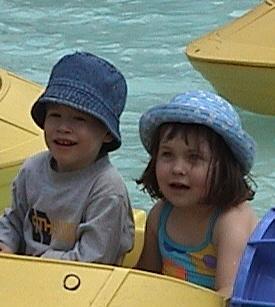
Friday, May 20, 2005

Love and hate

What I hate
Moving.

Not having a dishwasher yet. (The resident dishwasher to date is named Isabella.)

Bell Canada. Disconnected at old residence 8 am Monday. Technician arrives to install new service at new address 5 pm Tuesday. Dial tone achieved, but realize after technician has gone that the phone number associated to the line belongs to somebody else. Spend Wednesday explaining to dozens of callers (who gets that many phone calls?!?) that I know nothing about the person to whom the phone number actually belongs. Wait at home all day for technician to arrive sometime between 8 am and 6 pm. Sometime during the afternoon, the line goes dead (fortunately after I'd placed a few long-distance calls). Thursday, have furious and lengthy conversations with customer service reps and repairmen as they explain certain policies and I tell them regardless of their freaking policies my bloody phoneline still doesn't work, depleting my cell phone account in the process (which I have trouble refilling, because in obtaining a mortgage all credit cards were cancelled but one, and that one hasn't yet been modified to include my name). Was promised that a technician would arrive between 1 pm and 6 pm and told somebody must be home. Placed call to customer service at 5:55 pm, as no technician had arrived. Was assured technician would arrive first thing Friday morning, between 8 and 10 am. Still waiting. (But I feel a little better about it now.)

What I love
Coffee. As I make it, espresso with milk over ice in a tall, skinny glass. I think in some circles that's an iced latte.

How Helena hugs so tightly now, and coos, "Mon amie Mama."

How I can plop a bowl of strawberries and cream in front of her and there's such appreciation in her eyes, as if I'd spent hours slaving over a hot stove. "C'est délicieux."

How when climbing the stairs (which turn), she monitors my progress and insists I follow her lead to use the best hand grips, as if we were scaling Mount Everest.

That the terrace is nearing completion and they're planting shrubbery. Shrubbery!

Today is the first day of the rest of our life
Today, Helena is two and a half years old. A very happy unbirthday to you!

Today (assuming I don't have to wait at home for a phone technician), we finally clean the old residence and clear out the final contents from the hall closet, and say good-bye.

Today we close that chapter of our life and start building our home.