Trips to the park: Approximately 15.
Chocolate consumed: Countless.
Smingus dingus antics: None. Completely overlooked. I'm devastated by this realization.
Bottles of wine consumed: Not nearly enough.
Shopping expeditions: Mostly pointless, overly long, and unfair to small child.
Number of televisions playing at excessively loud volumes for excessively long periods of time and setting my whole body, not to mention my temper, on edge: Two.
Tempers lost: Mine, for reasons I don't yet have the perspective to wholly define. I won't count the little girl's episodes of frustration as they were hardly meltdowns, and none of them her fault but clearly attributable to boredom, glitches in routine meals and disrupted bedtime rituals, and not being paid attention (!). I have much griping to do actually, and am still waiting for my temper to fully settle before venturing an exposition of multigenerational family female dynamics.
Migraines suffered: Two, one of which is ongoing.
Despondent Leafs fan in a days-long funk: My brother.
Exuberant (perhaps overly so) Habs fan: That would be J-F.
Books acquired (at bargain prices):
Alcott, Louisa May: Little Women — to correct the oversight in my reading education.
Miéville, China: Iron Council — because I've been dying waiting for the mass market paperback, and this remaindered hardcover was super cheap.
Pinker, Steven: The Language Instinct — because my old copy was never returned to me.
Pearl, Matthew: The Dante Club — just because.
Wallace, David Foster: Infinite Jest — because some people think it's a big deal.
Walsh, Bill: The Elephants of Style — because I've been meaning to.
Books recovered from my mother's basement:
Boston, Lucy M: The River at Green Knowe
Clifton, N Roy: The City Beyond the Gates — both of which I have no recollection of, and I'm curious to rediscover why I thought them worth saving.
Collodi, Carlos: The Adventures of Pinocchio
DVDs acquired:
Watership Down
Middlemarch — Yay! With Rufus Sewell. Yum! Am deliberating how best to watch it: In one late-night 7-hour marathon? In daytime lunch-hour snippets? Daytime viewing should be postponed till after I've delivered a batch of work this week, and till after I've done my effing taxes. Consecutive evening showings would have to wait till the Habs are eliminated from the playoffs. Should I dispose of the child for a weekend? Do I make J-F watch it with me? Salty snacks or sweet? How many bottles of wine for 7 hours?
Movies watched:
The Adventures of Pinocchio
Saw II
Miami Rhapsody
History of Violence
Domino
Creep — which is excellently creepy!
Books read:
Alcott, Louisa May: Little Women
I did not read it as a young girl and thought I should. Frankly, I'm glad I didn't read it as a young girl, as I'm afraid to think what effect all the moralizing and godliness might've had on me. Ugh. The last few chapters were just awful. Still, I suppose there are some worthwhile lessons to take from these women regarding formation of character, so long as one has the ability to identify the timeless from the hopelessly dated. Weird, too, to read it on the tail of Middlemarch, to see the contrast between American and English sensibilities at a similar time period, although holding it against the mature and complex workings of Middlemarch also highlighted how juvenile Little Women is, not only in that its intended audience is young, but in how simple (and I mean that derogatorily) its construction and messaging is. I did enjoy its soapiness, however, and I suspect it's probably better read while not under the influence of PMS.
Buchanan, Andrea J, ed: It's A Girl: Women Writers on Raising Daughters
Blog book tour alights here May 5.
Glennon, Paul: The Dodecahedron
That is, I finally finished it. I have much (good) to say about it.
Walsh, Bill: The Elephants of Style
I love this guy, and trust him. He's funny; his points are well reasoned, and the reasoning is consistent and common-sensical.
The denouement
Bouts of car-sickness: Helena, just once, on the return trip, about 3 blocks from home.
First thing on arriving home: birthday party for 11-year-old cat, complete with hats and cake.
Hiding under the bed from excessive displays of toddler affection: one 11-year-old cat.
Tuesday, April 25, 2006

Thursday, April 13, 2006
Later, gators
I've actually been wanting to share quasi-interesting things with you — the reading I attended last weekend, cute weird things the kid is doing — but all week I've been plagued with work deadlines and a sick child (why must those things always coincide?). But that'll have to wait. We leave in the morning to visit with family. No Internet (gasp!). Back in 10—12 days, haven't decided yet. Miss me. (I miss you terribly already.)
Wednesday, April 12, 2006
ABCs
(Because it's a quick and pleasant diversion from all else. Well, it's something.)
Shelly's Booked by Three for April (via Pages Turned):
Name 3 books you liked, titles which start with A, B, C (one per letter).
All the Names, José Saramago
Balthasar's Odyssey, Amin Maalouf
Carter Beats the Devil, Glen David Gold (Please write another book.)
Name 3 authors you like whose names (given or surname) start with A, B, C (one per letter).
Auster, Paul
Byatt, A.S.
Calvino, Italo
Name 3 books on your To Read list with titles starting with A, B, C (one per letter).
The Art of Murder, José Carlos Somoza (from which I heard the author read this past weekend — more on this later)
Beyond Black, Hilary Mantel
Captain Alatriste, Arturo Pérez-Reverte
Monday, April 10, 2006
Brought to you by the letter "H"
Helena is home today with a nasty cough, runny nose, and slight fever, but with a mostly sweet disposition. She's home today to fulfill the law that demands she prey on my guilt and mothering instincts on the day that's the worst possible day for her to be encroaching on my time, what with my having a work project due in a couple days.
She's napping now, and I've decided to go ahead and blog cuz, hey, the day's pretty much a write-off workwise anyway.
What makes it worthwhile: she sits beside me at my desk, picks up a pen and writes "I" on the legal pad. "Mama, c'est 'I.' C'est pour toi: Isabella." Then "H," a recognizable capital "H," "pour moi, Helena." She writes a thousand "H"'s, half of them on my arm. Then "X" — I don't know why, other than that she can, but she writes "X" and calls it "X" likes she means it.
Recent lightbulbs
Noted here for posterity before I forget and because I don't think I'll ever get 'round to writing something clever and meaningful about any of these points individually:
She operates the CD player with ease, although despite my best efforts her taste in music leaves something to be desired. (I try to listen as a 3-year-old, and remind myself how normal it is for children, such naive creatures, to like children's music. Why should I hurry her to have "sophisticated" tastes?)
She is almost as proficient with the DVD player, inserting her program of choice. I used to cringe at her handling DVDs (and CDs) and did what I could to dissuade her, but we're past that now. She knows triangle is for "play," square for "stop."
Back in February she figured out the computer mouse, or her hand was finally big enough, coordinated enough, to make it do what she wanted. The lightbulb that correlated mouse movement with cursor position had already been illuminated. She favours matching and memory games.
Friday she drew a spider that looked like a spider and a mouse (of the mammalian variety) that looked like a mouse. Sadly, these pictures have not been preserved as they were drawn on the palms of my hands.
Friday, April 07, 2006
Marching on
I finished reading Middlemarch, because I hate reading more than one book at a time and also I'm not very good at it. I find myself unable to focus on anything properly, too much going on, too many loose ends, and the distraction spills into my nonreading life, on top of which there's the feeling of lack of accomplishment, leaving things unfinished, delaying that peculiar sense of satisfaction in being able to cram a read book into its alphabetized position on the shelf.
So I finished reading Middlemarch, because I could, and because I couldn't help myself, schedule be damned, it's that engrossing. And I'm brimming with things to say about it, most particularly in agreement with Virginia Woolf's comment that it "is one of the few English novels written for grown-up people," but on this point I will restrain myself, because there's a schedule after all. But I'm glad I didn't read it 15 years ago, because while I'm sure it would've made some impact, served as a warning of sorts even, I most definitely was not a grown-up.
Would it be premature for me to say this may be the best book ever?! Really, it's that good. You should read it.
I'm loving reading it this way though (aside from not being able to read much of anything else alongside it), rereading sections as they come up for discussion, and again as other people's comments point me to specific passages. I could've read it in a matter of days, enjoyed it and been done with it, but now I'm absorbing it, which leads me to realize how flawed my usual reading experience can be, how much missed potential I've let drift by, which is fine, usually, but some books are worthy of more attention than I give them — the trick is to know which ones.
So I'm already wondering, what next — I mean, aside from the stuff on my nightstand — what else would be suited to this kind of group reading? Dare I say, it's more like school than a bookclub, in a good way, as discussion happens along the way, not in one sitting at the end (though, come to think of it, even at school, books were assigned and often not discussed till they were finished). Still, there are books I did read a dozen years ago from which I might benefit rereading as a grown-up (eg, The Master and Margarita, The Sheltering Sky), and there are classics that to appreciate fully one should take time and companions. But how to know which ones? So what next?
Wednesday, April 05, 2006
Science writing
For my daily bread and butter I read, and try to fix, an awful lot of less than elegant science.
In the Guardian, Ian McEwan, in an expanded version of a talk given at the London School of Economics to mark the 30th anniversary of Richard Dawkins' The Selfish Gene, explains why the writing is as important as the science:
Ian McEwan further proposes a canon of science literature; accuracy is not the most important criterion.
In the Guardian, Ian McEwan, in an expanded version of a talk given at the London School of Economics to mark the 30th anniversary of Richard Dawkins' The Selfish Gene, explains why the writing is as important as the science:
This year marks the thirtieth anniversary of the publication of Richard Dawkins' The Selfish Gene. There has never been a science book quite like it. Drawing on the work of a handful of scientists, it bound together genetics and Darwinian natural selection in a creative synthesis that amazed even those few who were already familiar with the concepts. It hastened a sea change in evolutionary theory, it affected profoundly the teaching of biology, it enticed an enthusiastic younger generation into the subject, and spawned a huge literature, and eventually a new discipline — memetics. At the same time, and this is the measure of its achievement, it addressed itself without condescension to the layman. It did so provocatively, and with style.
"Individuals are not stable things, they are fleeting. Chromosomes too are shuffled into oblivion, like hands of cards soon after they are dealt. But the cards themselves survive the shuffling. The cards are the genes. The genes are not destroyed by crossing over, they merely change partners and march on. Of course they march on. That is their business. They are the replicators and we are their survival machines. When we have served our purpose, we are cast aside. But genes are the denizens of geological time: genes are forever."
It is a lovely phrase, "shuffled into oblivion", and the analogy with cards — the hand being the information, the cards themselves the genes — is apt, economical and informative: true eloquence. In the years since then, Dawkins' work might be seen as one extended invitation addressed to us non-scientists to enjoy science, to indulge ourselves at a feast of human ingenuity. Just as we can sit around the kitchen table and discuss operas, movies or novels without being composers, directors or novelists, so we can engage with this subject, one more sublime achievement of accumulated creativity. We can make it "ours" just as we might the music of Bach or Bill Evans.
Ian McEwan further proposes a canon of science literature; accuracy is not the most important criterion.
We need to remember the various discarded toys of science — the humours, the four elements, phlogiston, the ether and, more recently, protoplasm. Modern chemistry was born out of the futile ambitions of alchemy. Scientists who hurl themselves down blind alleys perform a service — they save everyone a great deal of trouble. They may also refine techniques along the way, and offer points of resistance, intellectual cantilevers, to their contemporaries.
I say all this somewhat dutifully, because there actually is a special pleasure to be shared, when a scientist or science writer leads us towards the light of a powerful idea which in turn opens avenues of exploration and discovery leading far into the future, binding many different phenomena in many different fields of study. Some might call this truth.
Tuesday, April 04, 2006
Immigrant stories
I've never been a big fan of short stories. Their length makes them hard to do right — develop the characters adequately, tell exactly all that's required for whatever there is of a plot to work. And when they are done right, you're left wanting more.
Natasha and Other Stories, by David Bezmozgis, is utterly right: charming, poignant, honest. All the stories share the same context.
I found myself wondering how many people would relate to, or at least enjoy, stories of the Russian-Jewish immigrant experience, circa 1980s Toronto. But obviously, this collection has already been widely acclaimed be people other than me. In these stories I recognized little bits of my own past — not strictly "immigrant" and no longer confined or defined by but still, then, firmly within that community, of another Slavic heritage, over the same time period not so far from Toronto. Silly, I know, to be grasping for similarities; but there are insights still into how my family acts and thinks:
I don't know what others will find in these characters' lives. Humour, compassion, suburban reality.
My favourite line:
Stories:
Tapka
The Russian Riviera
Excerpts:
The Second Strongest Man
A New Gravestone for an Old Grave
Dispatch:
Dubbing, Italian-Style
Reviews:
London Review of Books
The National Post
About:
Quill & Quire: profile
The Atlantic Monthly: interview
Reading group guide.
Natasha and Other Stories, by David Bezmozgis, is utterly right: charming, poignant, honest. All the stories share the same context.
I found myself wondering how many people would relate to, or at least enjoy, stories of the Russian-Jewish immigrant experience, circa 1980s Toronto. But obviously, this collection has already been widely acclaimed be people other than me. In these stories I recognized little bits of my own past — not strictly "immigrant" and no longer confined or defined by but still, then, firmly within that community, of another Slavic heritage, over the same time period not so far from Toronto. Silly, I know, to be grasping for similarities; but there are insights still into how my family acts and thinks:
My mother noted the size of the house. Maybe three thousand square feet with a big yard. Also, it was fully detached. This was two substantial steps beyond our means. Between our apartment and a fully detached house loomed the intermediate town house and the semidetached house. A fully detached house was the ultimate accomplishment.
I don't know what others will find in these characters' lives. Humour, compassion, suburban reality.
My favourite line:
The sun was neither bright nor hot and the outdoors felt conveniently like the indoors: God's thermostat set to suburban basement.
Stories:
Tapka
The Russian Riviera
Excerpts:
The Second Strongest Man
A New Gravestone for an Old Grave
Dispatch:
Dubbing, Italian-Style
Reviews:
London Review of Books
The National Post
About:
Quill & Quire: profile
The Atlantic Monthly: interview
Reading group guide.
Women, writing, etc
Highlights from an interview with Erica Jong, author of Fear of Flying, which I've never read:
- If I were running a political movement today, I would focus on children and how parents are being screwed.
- It's possible to be a writer, a mother and a wife, without necessarily killing yourself.
Monday, April 03, 2006
Anniversary
Fifty years ago today my parents were wed.
My father lived to see but 21 years of marriage. I marvel at my mother's continued devotion to him.

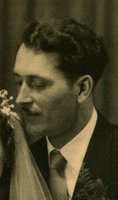
My father lived to see but 21 years of marriage. I marvel at my mother's continued devotion to him.


Friday, March 31, 2006
Creamy goodness
We came out of our metro station this afternoon and saw the cremerie across the street lit up and open for business. So after supper, we took a little walk. As did every other family with small children in the neighbourhood, not to mention young lovers and gaggles of teens. I wouldn't be surprised if the first day of ice cream season is their busiest.
I'd planned on being content with watching Helena enjoy her vanilla, maybe lap up her leftovers, but I ended up taking a strawberry cone for myself. Which is just as well, because we both like both flavours, and on a good day (like today) we're both pretty good at sharing. Tomorrow evening we'll bring J-F with us and get chocolate too.
I'd planned on being content with watching Helena enjoy her vanilla, maybe lap up her leftovers, but I ended up taking a strawberry cone for myself. Which is just as well, because we both like both flavours, and on a good day (like today) we're both pretty good at sharing. Tomorrow evening we'll bring J-F with us and get chocolate too.
Books! Flowers!
Yes! We're still reading Middlemarch! Discussion of Book III is now underway.
I have my ticket to see David Bezmozgis, Tim Parks, and José Carlos Somoza next week at the Blue Metropolis Montreal International Literary Festival. I haven't read anything by any of them but was lured on the strength of Bezmozgis' reputation alone. As it happens, I found a copy of Natasha and Other Stories in the sale bin yesterday, and figured I may as well see first-hand what I'd got myself into. I whipped through the first half of the book last night in bed. It's lovely.
By the way, if anyone's interested, Susan Glickman herself responded to my little rant regarding the lack of information regarding her just-released novel and provided a synopsis.
Also from the sale bin: Hilary Mantel's Beyond Black. I enjoyed a previous work of hers, but having heard her in interview a couple years back I was thoroughly turned off by her self-centred self-importance and thought I could never read her again. However, I've heard nothing but good things about this book, and I couldn't resist the sale price.
The sale-bin pièce de resistance: Harold and the Purple Crayon! Many thanks to Suzanne for first alerting me to existence of this little gem, lodging it so firmly in my memory banks that as I ran my finger over its spine I was able to instantly recognize it for what it was. Helena and I have so far read it twice together (and I read it twice on my own) — it's a hit. While it does have some troublesome existentialist underpinnings, for the time-being we will revel in Harold's resourcefulness and his ability to immerse himself in his art.
 There's still a tiny patch of dirty snow in our courtyard, but there's no denying that spring is in the air.
Helena crafted a play-doh flower for Papa, which I didn't have the heart to disassemble.
 Near her daycare, they're selling gerber daisies, which I can't resist, to support AIDS research. Lucky me, as they were packing up for the day, they threw in an extra handful.
Thursday, March 30, 2006
Growing pains
Oh, but there are growing pains! That is, a million little weird things about the girl, some of which greatly annoy me. Some of which are fucking annoying.
It's been (and will continue to be) a long week. J-F's away. Helena is moody, stubborn, and testing me.
These annoyances have been going on for a few weeks, directly correlating, I think, to her insistence on sleeping sans diaper (or overnight pants), which means about half of those nights she wakes up having wet her bed and the rest of the nights she wakes up because I guess it's become a habit, which means she's generally not as well rested as she ought to be. Nor am I.
Friday night she woke up screaming. She cried and I paced with her and she complained about her ear. No fever and I couldn't see anything in the dark, and god forbid I turn on a proper light and incur the wails resulting from the bright sting to her eyes. A dose of Tylenol, an hour of her crying and my pacing, and we fell back to sleep. Morning came and I gave some thought to taking her to a clinic, but nothing close by was open, and there was the pesky logistical matter of getting J-F to the airport and the more emotionally wrenching one of seeing him off. Taking Helena to a clinic was just so damn inconvenient, particularly since she claimed she felt fine, and she seemed fine, so I didn't, because that's the kind of horrible mother I am.
Tuesday Helena gives me a hard time about getting ready to go to daycare. I give us both a minute to calm down, got my own shoes and jacket on. I find her curled up fetal-like on her bed, feigning sleep. So I tuck her in and stroke her hair, call the daycare, and Helena sleeps the morning away.
Wednesday morning she tells me she wants to stay home, and I feel guilty. I have no work this week. I had plans for a little spring-cleaning is all. And my daughter wants to stay home, dare I say spend a little time with me.
Helena's back at daycare today for an excursion to the science centre, which I've been building up in preceding days so she wouldn't show too much resistance in the morning.
When it's good, it's really good. But the bad is frustrating beyond belief.
1. How none of her socks are comfortable for her. Or shoes. But it starts with the socks. And I've always given this rather serious consideration, given her history with eczema, always the worst on her feet and ankles, which look fine at the moment. But every year for the 3 years of her life so far, as winter gives way to spring her baby flesh turns scaly and she starts to scratch it raw. So. Cotton socks. Are hard to find. And I find myslef wondering if 95% cotton, 5% lycra is enough cotton. But the princess has issues with loose threads and noticeable seams. The Dora socks she screamed to own have never been worn. I've been turning most of her socks inside out so the seam across the toe isn't directly rubbing her feet. But add the pressure of shoes and she still feels the pea through the mattress.
2. How none of her underwear is comfortable for her. Most mornings she tries on all available clean underwear, usually settling on the last pair. If we're staying home, the underwear comes off within the hour. I've bought dozens of pairs of underwear, some cheap, some expensive, all 100% cotton. Some days I think we've found a comfortable fit, and I determine to buy a dozen exactly the same, but I've already cut off the tag (because tags irritate Helena, even more than the scratchy remnants often left behind), so I don't even know what size they are (they could be anything from 3 to 6, depending on brand and style). But it doesn't matter, because there's no guarantee that what she settles for one day is good enough the next.
I honestly can't gauge how reasonable or not she's being. No one should have to wear uncomfortable underwear! But don't we all put up with a little discomfort now and then? Maybe I should never have let the first pair come off.
3. Last week on entering the living room she freaked out that J-F's shoes were on the floor in front of sofa (but not even casually strewn, but placed neatly). Freaked out.
4. Hand-washing, dawdling over. This more than anything leads to tears. And I find this odd, because she used to love washing her hands. She scolds her cousin (so-called, as shorthand for a complicated not-directly-blood-sharing but in-the-family relationship), who's a year older, for not washing her hands after using the toilet, even bringing her a stepstool and leading her hands under the tap. So she knows she's supposed to, she knows how, but she defies my telling her to.
5. Bedtime used to be so easy. We left her to cry it out in her crib only a couple times when she was a baby. But sleep generally came easy. There were occasional glitches, after long days with visitors, when travelling or upon our return, for a few weeks when we moved house — all understandable. But recently, after a story or two, she looks at me sadly, "Je ne veux pas rester tout seul." I acquiesced a couple times, sat with her till her breathing changed, but I fear I've created a monster. It seems a small price to pay, 10 minutes watching your angel drift off, but...
But.
Sunday, March 26, 2006
Underwear! for everyone!
Today marks a rite of passage in our household. Helena and I were chatting this morning about getting out shopping today, and she suggested we add pull-ups to the list. I had to think about this.
Helena hasn't worn pull-ups for some time. She has, however, been wearing a diaper overnight, until a few weeks ago, when after a few evenings of unfastening and refastening diapers and Helena tugging and crying it was determined that size 6 diapers really are too small. Genius that I am, I suggested she wear a pull-up, of the half-bag still sitting in the cupboard — not the greatest in overnight protection but better than nothing. Then we ran out. So I bought some "overnight pants," although the reassurances on the package that bed-wetting is common did make me wonder what age-group these are intended for (it never struck me as a problem that my 3-year-old can't stay dry at night). But it turns out they're kind of big. Not monstrously, but enough so that Helena won't even consider trying them on. So I told Helena she was a big girl and she didn't need to a wear a diaper or a pull-up at night — she could sleep in her underwear if she wanted to. So there's been some bed-wetting recently, and some laundry, but not nearly so much as I expected there to be, and when there is, I offer up the overnight pants, but she won't hear of it. So I wondered why she thought we should buy pull-ups.
It turns out, they weren't for her, but for Teletubby Dipsy. The pull-ups-aren't-toys argument and the they-cost-money factor didn't make make much impression on Helena, maybes because Dipsy's been wearing her too-small diapers for weeks already. So I suggested maybe Dipsy didn't need diapers or pull-ups anymore.
So today, our two Tubbies, Dancing Elmo, and a baby doll are sitting around the house fully toilet-trained, wearing Helena's too-small underwear. And birthday party hats (cuz they were there).
Wednesday, March 22, 2006
Last night
When I finally went to bed last night, I just lay there, my body clenched into a tiny ball of a fist against the cold air and J-F's sleep-moans, swinging against as yet undreamed nightmares about having disturbed authorial tone and leaving some participles dangling in my wake.
I couldn't sleep. I couldn't brave leaving my coccoon to retrieve Middlemarch or The Dodecahedron. Instead I reached my hand out cautiously and settled on Stefan Grabinski's The Dark Domain, giving way to a fitfully dark place indeed.
I slept eventually. I dreamed about a dodecahedron, and about AS Byatt — her book's ribs struggling to hold their intended shape, holding boxes within boxes within boxes, contents under pressure, and Alice was inside.
I held the dodecahedron in the palm of my hand, admiring the elegance of its geometry, even if the edges are a bit rough. It could almost fold in on itself. It's made of metal scraps, hollow inside. The air whistles through it. Alice wants it.
Tuesday, March 21, 2006
Just so you know
1. Work deadlines are creeping up on me, preparing to bash me on the head from behind and leave me unconscious.
2. Sunday evening, the child threw up. Copiously. And all over me (2 different outfits), in addition to all over herself (also 2 outfits), her blanket, the sofa, the floor. She hadn't been showing any signs of illness. I think it had more to do with our afternoon snack, when I made hot chocolate and she ate half a box of cookies when I wasn't looking (even if they were those delicate almond thins). Monday morning she rushed into our room exclaiming, "I'm not sick anymore!" It seems she's drawn some correlation between feeling better and throwing up specifically all over my pants.
3. This morning, child refuses to go to daycare. This is unusual. I can't bring myself to force the issue. No fever, but general malaise and a bit of diarrhea. Mother-in-law is expected to swoop to the rescue shortly, so maybe I will meet my deadlines after all.
4. Over the last week, I've been sneaking peeks at The Dodecahedron, by Paul Glennon. So far, it's amazing. More on this later.
5. It seems I've been leaving typos in my wake, wherever my personal and professional correspondence has taken me these last couple days. This does not bode well for work at all.
Saturday, March 18, 2006
Seatbelts! So we can be safe!
Yesterday morning, while I was already at work at this very desk, J-F and Helena were driving downtown, to work and daycare. Helena taps J-F on the shoulder from the back seat. She waves, "Hallo, Papa!" all smiles. Seconds later she has clambered up into the front passenger seat, so proud that she can unfasten the buckles of her carseat (which she's just about outgrown) and exercise such mobility. J-F is, well, in traffic, busy driving, and all he can do is yell, terrify her into a state of paralysis so that she desists from climbing or squirming. Helena is in tears.
They arrive at daycare, Helena still very much distraught at the nonstop verbal lashing she endured till they reached their destination. Her educatrice inquires as to the problem and upon hearing about the misadventure proceeds also to scold Helena.
The good that comes from this: the morning's activities were scrapped in favour of watching a video on car safety. Helena was asked to do a presentation to the rest of her group, along the lines of "This morning, Papa was very angry at me..."
Friday, March 17, 2006
City of words
The 8th edition of the Blue Metropolis Montreal International Literary Festival takes place April 5–9, 2006. The programme is now available.
The website is hellish to navigate and information on the authors, their works, what they might be discussing or reading from is scant. (Case in point: the title of Susan Glickman's first novel, The Violin Lover, has a certain appeal to me, but that's simply not enough to entice me to attend its launch or a reading of it when I weigh the cost of admission and my precious time against the unknown. Is it a romance? historical? experimental? what? If you don't tell me at least some basic stuff like that, I'm not paying to find out.)
Here are some of the events that hold interest for me.
Readings, of course:
I'm planning on seeing David Bezmozgis, maybe Yann Martel, a couple others. There's a temptation to attend Leah McLaren's reading, only to heckle her, but I'm not sure I want to pay money for that privilege.
Remembering Irving Layton:
A panel discussion, including a former prof of mine.
The Good Old Bad Days:
A conversation about Montreal in the 40s, including William Weintraub, author of City Unique, which is a fascinating read.
This year's Blue Metropolis Literary Grand Prix honours Michel Tremblay.
Thursday, March 16, 2006
Wednesday, March 15, 2006
Monday, March 13, 2006
Seen this weekend
1. Friends! Even though we had to drive more than 2 hours to get there, and then back, and even though, if we're actually leaving the house and spending money, I'd rather we treat ourselves to a bistro brunch, or cocktails, than overpriced, and overrated, buffet. It's nice to be reminded that I know real people, not just virtual ones, and that I still like them.
2. Formations of Canada geese. They're coming home!
3. The Legend of Zorro. Cuz, well, it's Zorro! and there's swordplay! (And also Rufus Sewell, who appears in the BBC production of Middlemarch, which I look forward to seeing soon.) Zorro's no musketeer, but he'll do.
4. Bear, napping.

2. Formations of Canada geese. They're coming home!
3. The Legend of Zorro. Cuz, well, it's Zorro! and there's swordplay! (And also Rufus Sewell, who appears in the BBC production of Middlemarch, which I look forward to seeing soon.) Zorro's no musketeer, but he'll do.
4. Bear, napping.


Saturday, March 11, 2006
The interminable cuteness that is my daughter Helena
1. The way she says D is for Don Quixote, H is for "moi."
2. We go "see animals in the park." She ushers us into our bedroom, stopping in front of the cat at the foot of the bed, pointing out the sharp teeth on this wild tiger. Next stop, the giraffe, played by her stuffed elephant, which is sitting next to her stuffed giraffe.
This morning's safari featured snakes, grasshoppers, and spiders.
3. The way she governs her little entourage of dolls. She has taken on the role of educatrice to them, so once they're tucked in for naptime, she sits nearby and scribbles notes on their behaviour, appetite, and bowel movements.
4. She asks to watch her stupid Caillou Christmas movie en espanol, evidently tired of both the French and English versions. (I offered Spanish as an option one day and apparently it made an impression. Warning: Caillou's Spanish mommy can't sing — she makes me want to tear off my fingernails.)
(Can I get Caillou in Polish?)
5. The way she knows when I'm losing patience with her. She bats her eyelashes and makes kissy faces at me. It's my kryptonite. All stern disciplinary resolve dissolves into laughter.
6. She carries with her everywhere one of my itty-bitty book lites (though neither of the two contraptions I own actually goes by that trademarked name), with the unfortunate result that my attempts to read in bed are generally thwarted by spent batteries.
Thursday, March 09, 2006
Things that blow my mind
Life:
The universe:
You know, everything!
...within a generation, biology will face its ultimate identity crisis. Researchers in the field of nanobiotechnology are racing to achieve the complete molecular integration of living and nonliving materials. We will hack into the CPU of life in order to insert new hardware and software. The purpose is to extend the capabilities of biology far beyond the limits imposed by evolution, to integrate the incredible biochemistry of life with the equally spectacular chemistry of nonliving systems like semiconductors and fiber optics. The idea is to hard-wire biology directly into any and every part of the nonliving world where it would be to our benefit. Optoelectronic splices for the vision impaired, micromechanical valves to restore heart function.
But the moment we close that nano-switch and allow electron current to flow between living and nonliving matter, we open the nano-door to new forms of living chemistry — shattering the "carbon barrier."
The universe:
The burst, named GRB 050904, originated 12.8 billion light-years away, which means it occurred 12.8 billion years ago and the light took that long to reach us. It erupted very nearly at the beginning of time.
You know, everything!
Tuesday, March 07, 2006
Books to movies
Books into movies:
(I wonder how different Middlemarch would be were it written today.)
Increasingly I find authors are afraid to show us thoughts and feelings, thinking it more clever if we're made to infer them from the characters' actions and words, from the juxtaposition of scenes. But what's wrong with clearly writing about what's inside a person's head? This is precisely why I like authors like, for example, Auster and Saramago and others think they're overrated.
Larry McMurtry:
We won't lose it, but it will evolve, again, and again.
And a not-so-funny thing happened. The books began to change the movies. (André Bazin argued that the Italian neorealist school was really "the cinema of American literature.") And the movies began to change the books.
There was an element of mercy to this. Authors no longer had to lard their chapters with physical description in the manner of a Balzac or a Trollope; the fund of common visual reference bequeathed to us by movies (and later television) meant that we were all, writers and readers, on the same page. Except that the page itself was changing: Text was losing ground to image.
(I wonder how different Middlemarch would be were it written today.)
Bibliophiles fall back on the assurance that books alone can draw us into the human soul. Or, as theorist George Bluestone puts it, a film "can show us characters thinking, feeling, and speaking, but it cannot show us their thoughts and feelings."
Increasingly I find authors are afraid to show us thoughts and feelings, thinking it more clever if we're made to infer them from the characters' actions and words, from the juxtaposition of scenes. But what's wrong with clearly writing about what's inside a person's head? This is precisely why I like authors like, for example, Auster and Saramago and others think they're overrated.
Larry McMurtry:
And finally I'm going to thank all the booksellers of the world. Remember, "Brokeback Mountain" was a book before it was a movie. From the humblest paperback exchange to the masters of the great bookshops of the world. All are contributors to the survival of the culture of the book. A wonderful culture, which we mustn't lose.
We won't lose it, but it will evolve, again, and again.
Monday, March 06, 2006
Update on reading Middlemarch
Henceforth I will not utter a word on Middlemarch here (unless I feel like it). All discussion will be confined to Reading Middlemarch (as much as one can confine literature or keep it from spilling over into real life).
I think I've tracked down everybody who expressed interested in reading along. If I've missed you, I apologize — please contact me again. Or reconsider your anti-Middlemarch stance — there's still time to join us!
Also, I'd like to highlight Rachel's apology in advance for being a Middlemarch smartypants and a hog. For this I also apologize to the rest of you.
Thanks for everybody's kind comments and emails.
Now. Back to work.
Friday, March 03, 2006
The week in transit
I've been responsible for much of the dropping and collecting of the child at and from daycare recently. There have been developments in matters related to public transportation, general mobility of said child, and of course my reading habits.
1. Helena doesn't much like crowded subways. Who does? During rush-hour somebody usually offers us a seat, but not always. I've tried a few times to get her to stand on her own, but in the time it took to crouch to let her down easy I realized just how unpleasant the ride would be for one who's only just over 3 feet tall. So I usually balance her on my hip. Earlier this week, I warned her I'd be putting her down for a minute when we pulled into the next station, so I could readjust my stance. And very bravely, and I suspect even in sympathy for the plight of the heavy load I was carrying (being said child), she told me she wanted to try to stand. And stand she did, holding onto the pole and lurching in fun with the train's momentum, the rest of the way and every metro trip since, even when seating was available.
2. Helena walked of the train onto the platform all by herself. "J'ai pas tombé dans le trou!"
3. Helena doesn't much like escalators. (Some of her classmates are pros at escalators; Helena opts for regular stairs.) She tried once, about a year ago, to step onto one, but she turned back at me in tears. So when regular stairs are not an option, I balance her on my hip. This week, she wanted to try. She did not turn back, but after we stood there for about 5 minutes, Helena mesmerized by the patterns of moving lines, I had to lift her on. But she rode up (and later down) on her own 2 feet, hand on handrail, and stepped off without hesitation.
4. Helena on hearing the subway approach, stretches up her arms for me to lift her. After a few runs this week, she held my hand till the doors opened; we stepped on to the train together. "J'ai pas tombé dans le trou!"
5. I had a fit of panic when, returning home alone, I finished reading the book I'd been carrying around in my bag, with 3 stops (of a 5-stop trip) still to go. Once home I wasted hours (!) looking for unread books the right size for my next metro journey, tucking them into my bag to check for fit. Luckily, I found a couple Penguin 60s (Virginia Woolf, Killing the Angel in the House: Seven Essays, and Arthur Rimbaud, A Season in Hell). I finally settled on a Dover Thrift Edition (Dostoyevky, The Gambler), greatly relieved that I'll have metro reading for the next while. Sure I like hardcovers, finely textured paper, and gloriously illustrated covers as much as the next reader, but really, there's a lot to be said for pocket-sized (and cheap) paperbacks when you're just trying to make the commute go by a little faster.
Thursday, March 02, 2006
Middlemarch reading
As mentioned, I'm about to embark on George Eliot's Middlemarch. Diana has already bravely agreed to accompany me on this journey. Anyone else?
Email me, or leave a comment below, if you're interested in joining us. Because it's nice to have a group of people to turn to for encouragement, questions, comments, clarifications, insight. This is an unstructured approach to get 'round to reading a "great book," to see what all the fuss is about. Read at your own pace!
(The text is available online; I picked up a bargain copy a while ago.)
If responses warrant, I'll set up a separate blog à la last year's Don Quixote project, where readers can post their thoughts, raise questions, link to background material, etc. Or else I'll just bombard you all with my own progress here.
Heck, does anyone even read this blog anymore? Now would be a good time to leave a comment: click on "comments" at the bottom of the post (Oh wait, it says "fish" — is that what confused you?) and type. (This includes you, Iwonka.) Let me know if:
A. I bore you, utterly and completely.
B. You have no interest whatsoever in reading Middlemarch for yourself but yearn for the vicarious thrill of my interpreting every sentence.
C. You wish I'd take my attempts at critical analysis elsewhere.
D. You've read Middlemarch and can't wait to see me make a fool of myself.
E. You love me, no matter what.
While I hope to finish Middlemarch before October, I do intend to give it a considered reading, pencil in hand (that is, I won't be rushing through it this weekend; this should take me well past the middle of March).
I have thus far read the prelude and two whole pages of Chapter One. So far, so good. I'm motivated. This book is now at the right time and place for me.
That Spanish woman who lived three hundred years ago, was certainly not the last of her kind. Many Theresas have been born who found for themselves no epic life wherein there was a constant unfolding of far-resonant action; perhaps only a life of mistakes, the offspring of a certain spiritual grandeur ill-matched with the meanness of opportunity; perhaps a tragic failure which found no sacred poet and sank unwept into oblivion. With dim lights and tangled circumstance they tried to shape their thought and deed in noble agreement; but after all, to common eyes their struggles seemed mere inconsistency and formlessness; for these later-born Theresas were helped by no coherent social faith and order which could perform the function of knowledge for the ardently willing soul. Their ardor alternated between a vague ideal and the common yearning of womanhood; so that the one was disapproved as extravagance, and the other condemned as a lapse.
Wednesday, March 01, 2006
David
David was a genius.
I knew David from the university. He approached me casually one day, hoping to come up to speed on The Death of Ivan Ilyich. He'd noticed I was in many of the same classes as him. That is, he was just hanging out on campus, sitting in on what he thought was an interesting sample, but eclectic mix, of classes, in a couple cases officially auditing them. Metaphysics, 19th Century Russian Literature, Computer Logic, Modern British Poetry. And there I was, actually enrolled in them.
We went for coffee. He quizzed me a bit on my course of study, mining me for information really, how to consolidate these interests into a practicable academic path toward... something.
Of course, I didn't know the answers to his questions. We were essentially doing the same thing, trying to find ourselves, only I was paying a lot more money for the privilege.
The year passed, measured out in coffespoons after class.
Eliot's Four Quartets.
He pressed Cortazar's Hopscotch on me; I loaned him my Calvino. He stopped by my place whenever he was passing by. We had tea and listened to my Philip Glass.
We saw Man Facing Southeast, twice, and argued Bach's mathematical head versus Beethoven's wild heart.
 We stared at Francis Bacon's pope-in-a-box.
I didn't know anything about David really, beyond his ideas on art, literature, music. Maybe that's all that matters; I knew him in a "pure" way. He was very private. I think his mother was ill, very ill. Or maybe she just had the flu that week.
I, on the other hand, was an open, and, that year, very emotional, book; he heard all about my family, friends, and romances.
He took me to a Christmas party, hosted by a Polish friend of his. In the kitchen was a young Jesuit studying for the priesthood. That night David argued him out of God. Later we heard the monk had packed his bags, hadn't returned to school, hadn't been heard from since.
After much research David had found a college he wanted to attend. He spent months bouncing his essay for application off me, how our perception of art is a product of our experience.
Before he left for the States, he brought me a cassette tape of Beethoven's Late Quartets. To this day, it's the most excruciatingly beautiful music I've ever heard. (I have it on CD now, many recordings of the same pieces, in fact.)
We exchanged a letter or two, then fell out of touch.
Something happened to him. He'd seen things that terrified him, but fascinated him. Terrible beauty. I don't know if he finished his program.
I saw him once — no, twice — after he came back. We ran into each other in the street. The first time we immediately adjoined to the nearest coffeeshop.
I don't remember the details; I think now that whatever it is I heard frightened me too much at the time to seriously consider it. It seemed so unreal. I was incapable of deciphering the truth of it. He admitted his own memory of the events was sketchy. I don't know if it was part of his studies or a job he took or a cult he joined. A charismatic entrepreneur and mentor. They travelled (Africa? South America?). Something about isolation tanks, mind control experiments.
Frankly, I have no idea what he told me that day. The impressions I retain are as likely to be a feeble interpretation I pieced together from his cryptic behaviour as to bear any relation to the conversation that transpired between us, let alone to what really had happened to him. He told me because he needed to tell, but as if in confession, as if no living soul, myself included, could bear the weight of knowing what it was. I wonder that he didn't hypnotize me himself to erase all — most — traces of what he'd said.
The second time we passed each other in the street was insignificant. The connection was lost, both of us still, I think, trying to find ourselves, but too caught up in the practicalities of the day to day to devote ourselves to that task properly. Maybe I should've looked for myself more carefully; I think he could've helped.
Years later I was dating someone who, it turned out, and I don't recall how we figured it out, had been at that Christmas party and knew David. I heard he'd married, was working in IT.
I don't remember when it was, whether soon after first meeting or the last time I saw him, David told me I had to read Middlemarch. Had to. His urgency scared me. I didn't read it then, but I'm about to.
Sometimes I wonder whatever happened to David.
I knew David from the university. He approached me casually one day, hoping to come up to speed on The Death of Ivan Ilyich. He'd noticed I was in many of the same classes as him. That is, he was just hanging out on campus, sitting in on what he thought was an interesting sample, but eclectic mix, of classes, in a couple cases officially auditing them. Metaphysics, 19th Century Russian Literature, Computer Logic, Modern British Poetry. And there I was, actually enrolled in them.
We went for coffee. He quizzed me a bit on my course of study, mining me for information really, how to consolidate these interests into a practicable academic path toward... something.
Of course, I didn't know the answers to his questions. We were essentially doing the same thing, trying to find ourselves, only I was paying a lot more money for the privilege.
The year passed, measured out in coffespoons after class.
Eliot's Four Quartets.
He pressed Cortazar's Hopscotch on me; I loaned him my Calvino. He stopped by my place whenever he was passing by. We had tea and listened to my Philip Glass.
We saw Man Facing Southeast, twice, and argued Bach's mathematical head versus Beethoven's wild heart.
 We stared at Francis Bacon's pope-in-a-box.
I didn't know anything about David really, beyond his ideas on art, literature, music. Maybe that's all that matters; I knew him in a "pure" way. He was very private. I think his mother was ill, very ill. Or maybe she just had the flu that week.
I, on the other hand, was an open, and, that year, very emotional, book; he heard all about my family, friends, and romances.
He took me to a Christmas party, hosted by a Polish friend of his. In the kitchen was a young Jesuit studying for the priesthood. That night David argued him out of God. Later we heard the monk had packed his bags, hadn't returned to school, hadn't been heard from since.
After much research David had found a college he wanted to attend. He spent months bouncing his essay for application off me, how our perception of art is a product of our experience.
Before he left for the States, he brought me a cassette tape of Beethoven's Late Quartets. To this day, it's the most excruciatingly beautiful music I've ever heard. (I have it on CD now, many recordings of the same pieces, in fact.)
We exchanged a letter or two, then fell out of touch.
Something happened to him. He'd seen things that terrified him, but fascinated him. Terrible beauty. I don't know if he finished his program.
I saw him once — no, twice — after he came back. We ran into each other in the street. The first time we immediately adjoined to the nearest coffeeshop.
I don't remember the details; I think now that whatever it is I heard frightened me too much at the time to seriously consider it. It seemed so unreal. I was incapable of deciphering the truth of it. He admitted his own memory of the events was sketchy. I don't know if it was part of his studies or a job he took or a cult he joined. A charismatic entrepreneur and mentor. They travelled (Africa? South America?). Something about isolation tanks, mind control experiments.
Frankly, I have no idea what he told me that day. The impressions I retain are as likely to be a feeble interpretation I pieced together from his cryptic behaviour as to bear any relation to the conversation that transpired between us, let alone to what really had happened to him. He told me because he needed to tell, but as if in confession, as if no living soul, myself included, could bear the weight of knowing what it was. I wonder that he didn't hypnotize me himself to erase all — most — traces of what he'd said.
The second time we passed each other in the street was insignificant. The connection was lost, both of us still, I think, trying to find ourselves, but too caught up in the practicalities of the day to day to devote ourselves to that task properly. Maybe I should've looked for myself more carefully; I think he could've helped.
Years later I was dating someone who, it turned out, and I don't recall how we figured it out, had been at that Christmas party and knew David. I heard he'd married, was working in IT.
I don't remember when it was, whether soon after first meeting or the last time I saw him, David told me I had to read Middlemarch. Had to. His urgency scared me. I didn't read it then, but I'm about to.
Sometimes I wonder whatever happened to David.
Tuesday, February 28, 2006
Days gone by
Le grand spectacle
 Somehow, my weekend was perfect. (I even had time to read!)
I'd been dreading it actually, knowing that J-F was to work on Saturday and I'd have to wrangle the child on my own. But it was lovely. We had a picnic in her bedroom. We dressed all her dolls. We did puzzles and had adventures.
Helena asked me to read the Merriam Webster's Collegiate Dictionary to her, which I'd left lying on the floor. I complied, skipping over the boring bits. Her favourite entries are "Norwegian elkhound" and "lute," which inspired a song, "La guitare, ma guitare...," in the flamenco style.
 Sunday evening Helena made preparations for a "pestacle," converting our second bathroom into a performance theatre space. The crowd was assembled. We parents were also invited — standing room only. Much to my surprise, I was called on to open the show. Though unprepared, I performed an abridged version of Don Quixote, throwing in a chorus of "The Impossible Dream," which was well-received. J-F used the chalkboard to illustrate an alternate battle plan from the Lord of the Rings, or some such, involving helicopters. Helena herself finally took the podium to read a Caillou story. She then attempted to lure one of her babies on stage, but baby kept dropping her chalk, so we adjourned for supper.
It's days like these that dissolve all our petty growing pains. Of course, the weekend's joy was balanced by the migraine that developed Monday morning, the one that made me want to die, and Helena's pesky new habit of trying on all her underwear after every trip to the bathroom to find a pair sufficiently comfortable.
Some kind of burgeoning
I couldn't put down Ami McKay's The Birth House. Honestly, I wasn't expecting to like it so much. Based on my very limited experience with "Canadian" fiction, I didn't expect early 20th-century Nova Scotia — an isolated village — to hold more than over-the-top melodrama, the hardships of small lives peppered with sugar. I was very wrong. The Birth House is lovely (and a joyful complement to my other recent maternal readings).
Excerpt.
The Birth House website.
Ami McKay's blog.
CBC profile.
It's the story of a midwife's apprentice. Yes, there are hardships, and it is emotional, but it never induces eye-rolling. The writing is clear and honest, the heroine very likeable.
One blurb notes that this is "a world where tradition collides with science." I say it's where tradition and progress (scientific and other) both collide with common sense.
One of my favourite, and subtle, aspects of the novels is that our heroine Dora Rare is a reader behind her father's disapproving back, "borrowing" books — Dickens, Austen, et al — from forgotten cupboards. "Every woman needs a sanctuary." (For some of us, it is found in books.)
(It's clear, too, that the author loves books. This may seem like a no-brainer, but I find myself discouraged by all the wannabe writers with a blog presence who wouldn't know a classic if it bit them on the ass, who have no reverence for the tradition that's gone before them. McKay's sincerity when she notes "You gotta read to write," is hard to resist.)
(Thank you, Patricia! (who met The Birth House's author) for helping me get my reading groove back.)
My sense of Smilla
Not very good.
Last week I finished up Smilla's Sense of Snow, by Peter Hoeg. Part murder mystery, action thriller, forensic investigation, police procedural, social commentary, sea voyage, psychological drama, and science fiction. Ordinarily, I embrace this kind of genre-spanning refusal to be pigeon-holed; here, I couldn't find a comfortable foothold. And really, the suggestion of the possibility of an alien life form, or life force? Ridiculously out of place. (Oops. Did I just ruin it for you?)
I was never convinced that Smilla cared what had happened to Isaac up on the roof. Perhaps this is an effect of the translation. Perhaps her motivation is a kind of distinctly Danish or Groenlandian attachment emotion that I cannot hope to understand. Perhaps she really does not care what happened to Isaac; in fact, Smilla's investigation is to lay to rest the psychological demons leftover from her own childhood. Thinking of it in this last way, now, makes it a little better.
She's emotionally cold, or at least suppressed, though she evolves somewhat on this front. This makes her drive — her desperation — for truth all the more puzzling.
Smilla doesn't strike me as very smart, starting with the illogic of pursuing the question of Isaac's death. She knows mathematics; she knows ice and snow on molecular level; however, this is not a product of extraordinary intelligence, but rather an offshoot of her instinct. Neither is she street smart, walking into situations she shouldn't. Granted, she always extricates herself expertly, thanks to luck and instinct. (I suppose this raises some questions of definition. Is instinct a kind of intelligence? Are book smarts in and of itself not sufficient to prove intelligence.)
My instinct: I don't like her. But I am somewhat intrigued by her. (Strangely, I also relate to her, as far as goes her personal, banal emotional being anyway — not so much the daredevil breaking and entering or nothing-to-lose attitude regarding this still mysteriously all-important and all-consuming quest.)
Also, there are far too many people in this novel. I couldn't keep them straight. But I'm sure this is the fault of my divided attention.
I don't know any Danes personally but am a little puzzled by Smilla's assertion that Danes are essentially optimistic. 1. This runs contrary to my sense of the reputation of Danes. 2. The Danes in the novel do not strike me as optimistic. (Similar assertion, though less problematic for me, regarding their complacency.)
Mostly it was cold, just achingly cold, without inducing the wonder of snow I so wanted to experience.
In my opinion, the book's vastly overrated. (I wonder, was it so well rated to begin with? Why did the buzz of so many years ago stick with me? The promise of mathematics to be beautifully literarily rendered?)
February for me was emotionally volatile, physically less than healthy, mentally exhausting. My reading has been overall disjointed and not satisfying. Still, it can't all be me, can it?
Unfinished business
I've resolved to finish, finally, A Whistling Woman, by A.S. Byatt — I have 50 pages or so to go to be done with it.
I hate not finishing books and it's very rare that I don't. If I've brought a book into my home, it has already been very carefully considered and deemed worthy on some level. In recent months, however, it's becoming clearer that life is short; perhaps not all books are worth finishing after all. (I almost set Smilla aside.) At the very least, I ought to revise my criteria, or consider them more carefully, for bringing books into my home.
The book is full of interesting ideas, but I can't find the life in them. It's academic and cold, which to some degree is the point of her story, but the more it goes, I think Byatt writes like an academic — her books are an exercise. There's no writerly passion in her.
A Whistling Woman more than any other novel I've read in recent years has me dog-earing pages, noting paragraphs of insight, clever turns phrase. I reach for my notebook (or blog), but I'm always stopped from quoting at length like I'd like to. Stopped cold. I can't make it connect.
All of which has me thinking: what do I like to read? Books I've wanted to read for years disappoint me; books I'd be unlikely to pick up of my own accord surprise and engross me. (Nor is it lost on me that I have more to say about books that I don't like than those that I do.) Every book has its time and its place, but the spaces within me for them to fill up are shifting too rapidly for me to finger them precisely.
Thursday, February 23, 2006
Reading for the maternally inclined
 I never considered myself particularly maternally inclined, but here I am.
I've been a mother for more than 3 years now. In some ways, the last month or so has been the hardest — at 3, Helena is horrid and vile, by which I mean no longer completely pliant to my will, stubborn. She is testing her boundaries, my patience. Of course, the first months were hard too, but frankly, I barely remember them anymore, if anything at all of those sleep-deprived times even registered on my cortex.
And this is one of the great mysteries new mothers puzzle over: Why didn't anybody tell me it would be this hard? I didn't think it was supposed to be hard — it's supposed to be natural. Women have been doing it for millennia. How hard could it be? And why didn't they tell me?
Because they forget. Because they know how it is, and with the years it's easier, and they convince themselves it's not so hard after all; they assure you you will arrive at the same conclusion, that it's worth it. And really, most of the time it's not that hard at all.
Literary Mama: Reading for the Maternally Inclined, edited by Andrea J Buchanan and Amy Hudock, helps us remember.
Earlier this month, anthology editor Andi Buchanan on her own blog responded to some questions posed by Miriam Peskowitz. Parts of those answers are worth repeating:
Why should mothers read literature?...
...As an avid reader, I can't imagine a life without reading, and even though motherhood has compressed my available "free time" to an incredible degree, I find myself needing good literature now more than ever. And when I say "good," I don't mean lofty, or Important, or boring, or academic, or literary, or whatever adjectives people like to use to describe books that seem more like assignments than enjoyments; I just mean works that lift me out of my own life. As a mother, alternately plunged into the most mundane and most vital aspects of existence, reading books is a window out of and into my busy, complicated, boring (and when you think about it pretty incredible) life...
What's the literary in Literary Mama?
...The Literary in Literary Mama is about making mother-writing count as "real writing," as writing that matters. And if you care about that — and about reading that kind of writing — then you're a literary mama.
Reading Literary Mama has been an emotionally charged experience for me. Since it arrived on my doorstep just after Christmas, I've been dipping into it when I can. Of course, this is the same timeframe that included post-holiday clean-up, bedroom furniture assembly, an ever-growing work project with a cruelly unrealistic deadline, a crashing computer, a bout of something flulike, central vacuum installation, and a sick child (twice!). Too, it seems my longest sessions with this book were accompanied by PMS.
I started keeping a reading journal for this anthology, but gave up after just three entries. They all kind of went like this: "Wake up at 5:30. Helena won't go back to sleep. She drags me to the living room and turns on the TV. I try to read a couple pages but doze off. Not enough energy to make coffee." Other days are better, whether because I manage to read chapters at a time or because Helena has spontaneous bursts of affection that paint my day happy.
Some of the essays make me uncomfortable. While I don't think it's always a deliberate effect, it's still worthwhile for me to consider why. A few others — the poetry, for example — simply don't speak to me, at least not in a voice that I'm accustomed to listening to.
(I have not yet read those piece on illness and loss. That will require the emotional fortitude of another time and place.)
My favourite essay by far is The Gift, by Karen Vernon. She recognizes her daughter's creative gift and finds incentive to nurture her own. I am similarly awakening to the gifts before me and within me.
Read the introduction to Literary Mama: Reading for the Maternally Inclined:
...the vein of voyeurism that is often a part of motherhood—observing children, teachers, other mothers—leads women online, often late at night, between feedings or diaper changes, to seek out other mothers’ stories.
...we assert that motherhood as a theme is worthy of great literature — and that mothers are capable of writing it.
If you've read along this "review" thus far, you might be dismayed that I've provided very little information about the book itself, that it's all about me. As far as I'm concerned, this is the point. The essays are windows, as much into myself as to other mothers. They let me try on other styles of mother for size, recognize the common denominators while appreciating the uniqueness of my own experience.
The pieces included in the anthology will hold appeal for both women and men, regardless of parenting status, wanting insight into their mothers, sisters, wives. It's great that motherhood is considered a worthwhile topic of discussion, and that mother-writers are supported, allowed a voice and given a platform. But Literary Mama's greatest gift is to the new mother, showing her her past and her future, reassuring her that she's not alone, encouraging her to embrace her Now.
Wednesday, February 22, 2006
Tuesday, February 21, 2006
World literature tour
Just over a month ago, Culture Vulture kicked off a World Literature Tour. It's a great way to learn or share what you know about literature that isn't written in English. And you can have a say in where the tour stops next.
Recommendations for Finland, the first stop, have been neatly summarized. It seems there's way more to Finland than Aki Kaurismaki, Saku Koivu, vodka, and Moominland books (as if those aren't enough).
Poland was next up (yet to be summarized), and I'm proud to say I did contribute, if only because it makes me angry to think most people actually believe Czeslaw Milosz to be Poland's greatest literary export. (He's not.)
Now boarding for the Czech Republic... (Has anyone read anything other than Kundera?)
Monday, February 20, 2006
Can you smell the excitement?
Perfume!
Am I the last to know? Why have I not heard about this? How come nobody told me?
Perfume: The Story of a Murderer, by Patick Suskind, is being adapted to film! And with Alan Rickman! Coming to a theatre near me in September!
Trailer! (via a German fan site)
I read this book in 1995 when I was vacationing in Provence. Which was really the best place to read it. The visceral punch of it amid the lull of lavender. Absolutely horrifying! (Come to think of it, I haven't travelled alone since.)
So who borrowed it from me and failed to return it?
TV or not TV
Helena was recently introduced to my 30-odd-year-old finger puppets. Bert's lost some hair over the years. I'm pretty sure I also owned Grover (my favourite) and Cookie Monster (everybody else's favourite) — I suspect their heads were bitten off, or maybe whatever toxic material they're made of simply disintegrated with overuse. While Helena enjoys them, her enthusiasm does not rival my nostalgia for them. The reason's simple: Sesame Street ain't what it used to be.
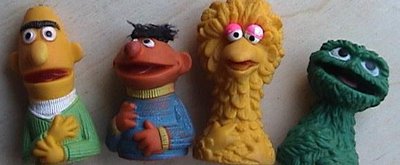
I miss Sesame Street's good ol' days. When Kermit the Frog would interrupt our regularly scheduled program with a breaking news story from the 3 little pigs' house. When the Count would spontaneously start counting things. When Cookie Monster ate everything in sight, not just a cookie imprinted with the letter of the day. When letters and numbers of the day turned up every couple minutes, and I felt a glimmer of recognition. Big Bird was less patronizing and more stupid. Snuffleupagus was invisible. Oscar the Grouch was grouchier. When muppet denizens freely commingled in the street without being compartmentalized into narrow roles so obviously designed with a different specific instructional goal in mind.
I continued to enjoy and appreciate the genius of the Children's Television Workshop well after I grew out of their target audience range. Mostly I miss Monsterpiece Theater, hosted by Alistair Cookie. I have a particular fondness for Grover's rendition of Upstairs, Downstairs.
When I was little, I watched Sesame Street every day. My mom would sit me in a playpen in front of the TV while she did housework. My dad came home for lunch and we watched the Flintstones together. I remember watching snatches of Polka-Dot Door, Romper Room, Electric Company (which holds great nostalgia for many and is being released on DVD), with less regularity and less enthusiasm, but they too filled my world.
Afternoons, my mom and I went next door. I watched my mother watch General Hospital and The Young and the Restless with our neighbour while I enjoyed milk and cookies. Somehow I amused myself with a quiet stuffed toy, or with trying to reach the pedals on the exercise bike in the neighbour's TV room. Sometimes I just watched with them.
That is to say, I watched easily 2 hours of television a day. And I turned out OK.
Nobody really knows the long-term effects of TV on kids. I'm not convinced it matters.
Saturday, February 18, 2006

Friday, February 17, 2006
Baby math
Babies may have abstract numerical sense (via Mirabilis):
It's clear to me that babies already have basic math skills. No? The trick is to teach them to express it in the formalized manner we expect.
Even before babies learn to talk they have a bit of a grasp of math, according to new research concluding that infants may have an abstract sense of numerical concepts.
. . .
"As a result of our experiments, we conclude that the babies are showing an internal representation of 'two-ness' or three-ness' that is separate from sensory modalities and thus reflects an abstract internal process," researcher Elizabeth Brannon wrote.
. . .
Understanding the research could be useful in devising methods for teaching basic math skills to the very young, Brannon said.
It's clear to me that babies already have basic math skills. No? The trick is to teach them to express it in the formalized manner we expect.
My metaphorical houses
Nothing has gone as planned.
The child was home sick a couple days, the physical house is only slightly (but somehow, magically!) more ordered, the work house entirely neglected, the house of love is cold. All my metaphorical houses are toppling. And my blog house feels so empty.
One sentence — "A small child kept me circumscribed." (Doris Lessing, in "Now You See Her, Now You Don't," Time Bites). One sentence, in an essay on Muriel Spark, not meaning anything but to explain a difference in their social circles. One sentence bursts a dam, and I dissolve in tears. I feel circumscribed.
The horrid child. (The first sick day was awful, starting in a sleep-deprived state. It got better, easier. I'd like to think it's just a matter of finding the rhythm, adjusting to it. But I spent hours feeling incompetent. How do other mothers do it? I have it relatively easy — this child spends weekdays in daycare — but this week it feels very hard.)
(Yes, having a tough time of things this week. Part domestically overwhelmed. Part parenting-skill-challenged. Part revisiting emotions, previously thought resolved, in reading Literary Mama. Part PMS. Part professionally unsatisfied. Part where am I and how did I get here.)
Serious questions
How do you keep a small child in bed who doesn't want to stay there? How many stories should I reasonably be expected to read? How many songs should I sing? How many times should I sing the same song over again? Do I really have to stay with her till she falls asleep (as she's requested a few times, and as I've acceded) (She says she's not afraid, she just wants me there. Me. Not Papa. There's a nightlight on and the door stays ajar — should I not do that?). Must I threaten her? Close the door on her? Is there a way to do it without tears (hers or mine)? Is bedtime the province of one parent or is it shared or in turns? Is this just a phase (no, I don't think it's related to her feeling under the weather this week)? How long does this phase last? Should I read parenting manuals?
Moments of joy
Seeing Elmo on television, Helena rushes to find her Elmo and sits him down to watch.
Perusing Where Is the Green Sheep? with Helena, anticipating the English text in her bilingual head she recites: "Here is la lune sheep."
The grin on the face of the T-shirted twenty-something driving a massive and noisy snowplow through narrow Plateau streets yesterday. Like Christmas! We should all love our jobs so much.
"There is water at the bottom of the ocean."
Monday, February 13, 2006
The natives are restless
 And I'm still bored, and experiencing severe cognitive difficulties.
(What does it mean when you no longer feel guilt over your guilty pleasures?)
I may or may not be here this week. Excuse me while I struggle to put my metaphorical houses in order.
(Coming February 23: Literary Mama Blog Book Tour stops here!)
Thursday, February 09, 2006
Bored and stupid
1. I'm bored.
(NPR interviews Gillian Anderson and includes a clip of her boredom.)
Is anyone else watching Bleak House who's never read the book? Or like me you tried to read it 20 years ago because it had a cool title and you can't remember a thing about it? Only you realize you did read some of it and some of it must lurk in your head in a dark room with no doors and watching it now something is starting to seep through its floorboards? And it pisses me off that I can't stop watching — I'm riveted — to break away and read it cold, or anew, that I'll never know whether the obviousness of the story is actually there in Dickens's story, or whether it's an effect of a director's interpretation and editing, or whether I've simply found access to forgotten memories. And this review, which I finally got round to reading, confuses me all the more, because I am on the edge of my seat and dizzy with it, it's the exact opposite of "languid," exactly not "a luxurious cat stretch" or "seductive languor." More a cat bristling, wriggling its little butt preparing to pounce. Is it me?
2. The public wants what the public gets.
3. Have been very, ugh, domestic this week. Not in a satisfyingly domestic-goddess kind of way, but just barely keeping it together. Taming books and toys and bills and wrapping paper. Ugh. But we're eating well, and I've determined that I'm a better cook than I, and other people, think I am — I just need to sell myself better by, for example, saying "blanched asparagus with lemon and herbs" instead of "some vegetable."
4. Other people's children are amazing.
5. Am mildly bewildered? amused? horrified? that one of Helena's baby dolls has developed an identity as her baby brother Philipe.
6. Also, I'm feeling stupid.
I've never read David Foster Wallace, but I will, having been inspired by Callie's encounter with him (parts 1, 2, 3, and especially 4).
How can I not see that as a challenge? I feel stupid just reading about it, made to feel stupid by proxy, dreading to think how I would've withered were I in his actual presence.
But I have read the commencement address he delivered. I've printed it out and reread it several times already. Somehow it makes me feel better. (Even the ouch of "Worship your intellect, being seen as smart, you will end up feeling stupid, a fraud, always on the verge of being found out." — gives me perspective.) Read it if you're having a bad time at the grocery store or just wondering what the hell you're doing with your life.
7. A package of books arrived for me yesterday! The book I ordered that I was most looking forward to was not among them, but I will console myself and rest my brain by indulging in a guilty pleasure for the rest of the week, and then probably getting all worked up over how stupid it is.
There you are. Bored and stupid.
(NPR interviews Gillian Anderson and includes a clip of her boredom.)
Is anyone else watching Bleak House who's never read the book? Or like me you tried to read it 20 years ago because it had a cool title and you can't remember a thing about it? Only you realize you did read some of it and some of it must lurk in your head in a dark room with no doors and watching it now something is starting to seep through its floorboards? And it pisses me off that I can't stop watching — I'm riveted — to break away and read it cold, or anew, that I'll never know whether the obviousness of the story is actually there in Dickens's story, or whether it's an effect of a director's interpretation and editing, or whether I've simply found access to forgotten memories. And this review, which I finally got round to reading, confuses me all the more, because I am on the edge of my seat and dizzy with it, it's the exact opposite of "languid," exactly not "a luxurious cat stretch" or "seductive languor." More a cat bristling, wriggling its little butt preparing to pounce. Is it me?
2. The public wants what the public gets.
3. Have been very, ugh, domestic this week. Not in a satisfyingly domestic-goddess kind of way, but just barely keeping it together. Taming books and toys and bills and wrapping paper. Ugh. But we're eating well, and I've determined that I'm a better cook than I, and other people, think I am — I just need to sell myself better by, for example, saying "blanched asparagus with lemon and herbs" instead of "some vegetable."
4. Other people's children are amazing.
5. Am mildly bewildered? amused? horrified? that one of Helena's baby dolls has developed an identity as her baby brother Philipe.
6. Also, I'm feeling stupid.
I've never read David Foster Wallace, but I will, having been inspired by Callie's encounter with him (parts 1, 2, 3, and especially 4).
...it smacked a bit of..."Look, at the end of the day, I'm really too smart for all of you, you will never understand my work because you are idiots, so can we just end this thing already?" But in the most charming way possible.
How can I not see that as a challenge? I feel stupid just reading about it, made to feel stupid by proxy, dreading to think how I would've withered were I in his actual presence.
But I have read the commencement address he delivered. I've printed it out and reread it several times already. Somehow it makes me feel better. (Even the ouch of "Worship your intellect, being seen as smart, you will end up feeling stupid, a fraud, always on the verge of being found out." — gives me perspective.) Read it if you're having a bad time at the grocery store or just wondering what the hell you're doing with your life.
7. A package of books arrived for me yesterday! The book I ordered that I was most looking forward to was not among them, but I will console myself and rest my brain by indulging in a guilty pleasure for the rest of the week, and then probably getting all worked up over how stupid it is.
There you are. Bored and stupid.
Days go by
Endlessly
Endlessly pulling you
Into the future...
Tuesday, February 07, 2006
Inspiration, and hard work
If I could choose any living author with whom to sit and chat over a bottle of wine, Doris Lessing would be it. Not given that opportunity, I took some time last week, finally, bundled in pyjamas and blankets, tea and cold medication at my side, to watch Doris Lessing deliver the first Monique Beudert Memorial Lecture, "a series of events that focus on literary writers and their relationship to visual culture" (recorded in December).
The lecture purports to be about images in literature from visual art. Where do writers draw their inspiration? Lessing says we make things too simple; people tend to offer banal answers — composites of acquaintances, a dream, a picture reminds one of a character.
But there must be more to it? Something deeper? That a picture, as an indirect inference, corresponds with one's view of life.
Virginia Woolf describes, she says, an old woman's mind as an opening of doors, letting in a stream of ideas and associations.
With age, space and time become extremely fluid. Every face one encounters reminds one of other faces, in other times and different places.
The webcast is over an hour long, with the first 25 minutes, and then some at the end, devoted to Proust and Vermeer's yellow patch of sunlight.
This is difficult for me to summarize. Lessing rambles and digresses through her mind's labyrinth of associations, and connections are not always evident. Is it contradictory then for me to say what I admire most about her is her straightforwardness? She says what she thinks. And she thinks a great deal.
Mara and Dann is an adventure story (possibly, she confides, soon to be an animated film) with that most classic element of stories found the world over: orphan children.
Set in the future, Europe is in an ice age. She pictures it like the mountains in the background of Brueghel's "Hunters in the Snow," a poster of which she has hanging on a door: unnatural and otherworldly, not a real part of Brueghel's countryside, improbable, mythical mountains of snow.
Now there is sequel, The Story of General Dann and Mara's Daughter, Griot and the Snow Dog.
Mara's daughter looks like this:
Because she does. This painting ("The Parasol," Goya) makes Lessing feel like she's being stroked like a cat.
What strikes me most from this lecture is what she unwittingly divulges about her writing process. She knows the end, knows her characters; she still allows for minor characters to pop up, some unexpected incidents to occur, but she knows where's she going, she knows the shape of the thing. Yet for the first time — remarkably I think, for a woman of 89 years who has published scads of novels — in Griot did a character "take on a life of his own." She always knows how things turn out, but not so with Griot.
(Remarkable, I say, because I read and hear often about writers discussing the ease of writing: characters simply come to life, stories write themselves. I wonder how many of them are lying, what is their motivation in perpetuating the myth of the inspired artist, in denying the hard work; does their reliance on that myth condemn them to lesser accomplishments, relinquish them of the responsibility to do hard work; can they be serious writers?)
So an hour after having raised the question about the source of inspiration, she answers it honestly. Sometimes things come in dreams. How can one know why something draws you, inspires you? But it does. Perhaps one shouldn't ask. "Where do all these things come from? They come from everywhere."
Through all her rambling runs a thread of... melancholy? A weight of the world, a weight of wisdom. And cynicism and even anger (at Alexander the Great, and Banda; how the media is a mechanism in keeping life tame, ordinary, boring; her lost Africa). She talks about humankind's destructive tendencies and her despair if she thinks about it too much — better to pretend it isn't there. And yet. What we destroy, we will rebuild. It won't necessarily be better, but it will persevere.
Lessing would like to be remembered as a hard worker. "Life is really very hard work."
(Why, why, why do I have such a hard time writing about Doris Lessing? It's not for lack of anything to say, it's my inability to break it down, to do so concisely. It's too big somehow. Lessing says, "The human mind, can't stand too much complexity, I've come the conclusion. We have to simplify things." I think she's right, and I think she implies that this is not necessarily the right way to grapple with life, and I agree with that, and this is very much what The Golden Notebook was about for me, insofar as compartmentalizing is an attempt to simplify. Our efforts to simplify often have the opposite effect. Maybe I should stop trying to say anything about Doris Lessing, just delight in the ideas sparked and tangents followed.)
I've not yet read The Story of General Dann and Mara's Daughter, Griot and the Snow Dog, but I plan to. In case you're wondering, there will not be another book in this story — what happens after this novel leaves off is obvious, and Lessing has nothing more to say about it.
Recent interview: San Francisco Chronicle.
The lecture purports to be about images in literature from visual art. Where do writers draw their inspiration? Lessing says we make things too simple; people tend to offer banal answers — composites of acquaintances, a dream, a picture reminds one of a character.
But there must be more to it? Something deeper? That a picture, as an indirect inference, corresponds with one's view of life.
Virginia Woolf describes, she says, an old woman's mind as an opening of doors, letting in a stream of ideas and associations.
With age, space and time become extremely fluid. Every face one encounters reminds one of other faces, in other times and different places.
The webcast is over an hour long, with the first 25 minutes, and then some at the end, devoted to Proust and Vermeer's yellow patch of sunlight.
This is difficult for me to summarize. Lessing rambles and digresses through her mind's labyrinth of associations, and connections are not always evident. Is it contradictory then for me to say what I admire most about her is her straightforwardness? She says what she thinks. And she thinks a great deal.
Mara and Dann is an adventure story (possibly, she confides, soon to be an animated film) with that most classic element of stories found the world over: orphan children.
Set in the future, Europe is in an ice age. She pictures it like the mountains in the background of Brueghel's "Hunters in the Snow," a poster of which she has hanging on a door: unnatural and otherworldly, not a real part of Brueghel's countryside, improbable, mythical mountains of snow.

Now there is sequel, The Story of General Dann and Mara's Daughter, Griot and the Snow Dog.
Mara's daughter looks like this:

Because she does. This painting ("The Parasol," Goya) makes Lessing feel like she's being stroked like a cat.
What strikes me most from this lecture is what she unwittingly divulges about her writing process. She knows the end, knows her characters; she still allows for minor characters to pop up, some unexpected incidents to occur, but she knows where's she going, she knows the shape of the thing. Yet for the first time — remarkably I think, for a woman of 89 years who has published scads of novels — in Griot did a character "take on a life of his own." She always knows how things turn out, but not so with Griot.
(Remarkable, I say, because I read and hear often about writers discussing the ease of writing: characters simply come to life, stories write themselves. I wonder how many of them are lying, what is their motivation in perpetuating the myth of the inspired artist, in denying the hard work; does their reliance on that myth condemn them to lesser accomplishments, relinquish them of the responsibility to do hard work; can they be serious writers?)
So an hour after having raised the question about the source of inspiration, she answers it honestly. Sometimes things come in dreams. How can one know why something draws you, inspires you? But it does. Perhaps one shouldn't ask. "Where do all these things come from? They come from everywhere."
Through all her rambling runs a thread of... melancholy? A weight of the world, a weight of wisdom. And cynicism and even anger (at Alexander the Great, and Banda; how the media is a mechanism in keeping life tame, ordinary, boring; her lost Africa). She talks about humankind's destructive tendencies and her despair if she thinks about it too much — better to pretend it isn't there. And yet. What we destroy, we will rebuild. It won't necessarily be better, but it will persevere.
Lessing would like to be remembered as a hard worker. "Life is really very hard work."
(Why, why, why do I have such a hard time writing about Doris Lessing? It's not for lack of anything to say, it's my inability to break it down, to do so concisely. It's too big somehow. Lessing says, "The human mind, can't stand too much complexity, I've come the conclusion. We have to simplify things." I think she's right, and I think she implies that this is not necessarily the right way to grapple with life, and I agree with that, and this is very much what The Golden Notebook was about for me, insofar as compartmentalizing is an attempt to simplify. Our efforts to simplify often have the opposite effect. Maybe I should stop trying to say anything about Doris Lessing, just delight in the ideas sparked and tangents followed.)
I've not yet read The Story of General Dann and Mara's Daughter, Griot and the Snow Dog, but I plan to. In case you're wondering, there will not be another book in this story — what happens after this novel leaves off is obvious, and Lessing has nothing more to say about it.
Recent interview: San Francisco Chronicle.
Saturday, February 04, 2006
Between sleep and wakefulness
 My days and nights lie between sleep and wakefulness.
Helena comes home all sweetness. We chat, eat, play.
She makes tea (with tiny rubber frogs), and "washes" dishes.
She delays bedtime, tucking in all her friends before she herself is ready to don pyjamas. Tubby Dipsy has trouble falling asleep, Helena tells me. She presses an imaginary magic button on the wall that plays Dipsy's music, Dipsy's favourite — and, so far as I can tell, wholly imaginary — song, "La danse du lion." Helena tells me shh, listen (!?), isn't it pretty?
Where's Helena's magic button?
She is in bed by 9, late but not terribly unreasonable.
I snack, tidy, putter. By 9:45 I decide to ready myself for bed. I'll settle in and read. Helena is sitting on the stairs, waiting for me. I re-tuck her, but she's restless; she puts socks on, plumps her pillow, takes her socks off, doublechecks that her friends are sleeping soundly, and creeps into my room.
I invite her to read with me. With a sigh I set aside Smilla's Sense of Snow, which is maybe just as well, cuz it makes me feel a cold that no number of blankets can comfort, though I expected it to be perfect February reading, and it might be, if the snow outside where fresh, crisp, white, but it's not, it's grey and damp cold not suited to gazing in wonder, and we read about Caterpillar's Dream, which takes forever because the pages are lightly textured, bumped, and Helena has to feel every square inch of them, and then we read Guji Guji, which takes forever because Helena interrupts every sentence with urgent tapping on my hand or tugging on my sleeve or even less subtle "Mama, mama," to catch my attention to tell me, "look, c'est Guji Guji" and there he is, crocodile among ducks, I think she only does it because she likes saying Guji Guji, it's hard to fault her for this, it is fun to say Guji Guji, and then we read The Happy Lion, which takes forever because Helena must say "Bonjour, Happy Lion" whenever he is pictured and roar a little, we rarely make it to the end of this story, I don't know why, she loves the first half, but then I don't know, so she hands me the Pandi books, the reading of which takes forever because they're French, and I read French slowly on the best of days, self-conscious that my pronunciation will be corrected by the child, worried too that I'm missing the whole point of the story even if I think I know the words, and it's painfully so now that I'm tired and bleary-eyed, J-F has joined us and as much as I encourage, nag, beg him to read to the kid, especially her French books, he rarely does, and now it's a vicious circle cuz when he offers, Helena wants none of it, c'est mama who's the reader, so he offers less, nobody likes rejection, and I read two Pandi books, one about the doctor, and one about the ball, and they take forever also because Helena insists that Pandi's name be changed to Helena throughout, I don't know where she got that idea, and just for this series of books, so I proceed slowly, taking care, but sometimes I forget anyway and Helena scolds me and I have to read the page over, and then we read The Cat in the Hat, and both of them are snoring, finally, is it 11:00 already? just before Things One and Two arrive, thank goodness, I do not like those Things, Mother would not like them at all, and I sneak out to lie in Helena's bed, and I toss and turn, and I wonder what Isaiah was doing up on the roof, I think I hear Helena cry out a couple times but I do my best to ignore her and remind myself that I am far far away, until she wakes before 5 am wanting me to read her the train story and then eager to play Lego.
J-F has to go in to the office today, so I let him sleep while I make juice and coffee and muffins and fruit, we turn on the tv, I think I doze off for a while. Helena is busy camping, which entails packing the car, which entails a lot of shopping bags, each with a book or a doll or some sandals, piled in a corner of the living room. She tells me to wait in the car, I think I doze off again.
Fate smiles on me in this mysterious way: that my hair in incredibly sexy today, so this makes me feel a tiny bit beautiful and we go for a walk.
We buy matching socks — which takes forever because the store has a children's play area, a few steps, a tunnel, a slide, Helena had to slide, I actually consider for a moment leaving her unattended, what's the worst that could happen?, when I hear a child crying and I think it might be Helena, even though I'm staring right at her, I tell her she can have 3 turns and then we have to leave, this is the very longest 3-foot-high slide of my life — and butter cookies and a gerber daisy.
She sleeps a little in the stroller on the way home, maybe 20 minutes, it doesn't last, it's not deep enough that I can move her without disturbing her and I can walk no longer. I need to rest.
We spend the rest of the day shuffling our feet and not understanding each other, she's highly emotional, I cannot tell her to wash her hands or not to open the umbrella in the house without inspiring a flood of tears, we find comfort in tomato soup, cheese and crackers, staring at Dora dancing like ants and spiders, we giggle, but mostly we're silent.
She's asleep now.
Thursday, February 02, 2006
Dating by the book
Literary speed-dating, ie, speed-dating with books to talk about in front of you:
I'm thinking:
1. Something by Paul Auster or Jose Saramago.
2. Perdido Street Station (China Miéville) or Snowcrash or Cryptonomicon (Neal Stephenson).
3. ?
Part of me wants to bring The Golden Notebook (Doris Lessing), but that would be a little cruel, and clearly indicates I shouldn't be speed-dating at all.
What 3 books would you bring on a literary speed date?
There's still a bit of strategy to selecting books for Literary Speed Dating.
"That's part of the interesting thing about it — how do you want to introduce yourself through your books?" Tom said. "You don’t necessarily want to bring your favorite books. You want to bring books that tell somebody something about you, but speak well of you, too."
I'm thinking:
1. Something by Paul Auster or Jose Saramago.
2. Perdido Street Station (China Miéville) or Snowcrash or Cryptonomicon (Neal Stephenson).
3. ?
Part of me wants to bring The Golden Notebook (Doris Lessing), but that would be a little cruel, and clearly indicates I shouldn't be speed-dating at all.
What 3 books would you bring on a literary speed date?
Wednesday, February 01, 2006
Unprompted
There's so much cuteness and love in this household, it's killing me, or it would if it weren't doing so much to alleviate the misery of my vicious viscous head-cold.
I've been trying to remind myself to take pictures, but Helena runs at the sight of a camera, and, frankly, the all-pervading aura of cuteness is something altogether nonvisual.
Like how I hear her at the other end of the house singing Chim-chiminee, chim-chiminee, chim-chiminee-chee. Or something about a teddybear's picnic.
Helena makes goofy faces all the time, but it's most fun when we're sitting at supper together. J-F encourages this behaviour, and I'm expecting the daycare to send home a note regarding her table manners any day now. But it's just too funny to correct. J-F did warn her not to cross her eyes cuz they'll stay that way, but that reduced us all to howling with laughter, not least because it's exactly the sort of thing one's parents might say (lies!) and we resort to saying it anyway.
She's finally absolutely clear about her yesterdays and tomorrows, and while she's always had, I'm sure, a subconscious sense of structure and her routines, it's a fresh kind of anticipation she exudes when she dresses in the morning knowing it's gym day or chooses to take a book to share with her playmates at storytime.
Till now, I've had to interrogate her about her day, and I've wondered whether I'd spend the next decade having to extract information from her tooth by baby tooth. Very suddenly she's realized that there are things happening in her life! Interesting things! With narrative value! And she wants to talk about them! All the time!
She tells me about her "theatre" course, the story they're enacting with a kind of chorus, about some pigs, three of them, tucked away in their little houses, afraid of the wolf. The wolf is mean.
She tells me how Marie-Claire took the yellow ball away from her and she started to cry cuz she wan't finished yet. But Julie got it back for her and Marie-Claire had to wait.
And she tells me she loves me, beaucoup beaucoup beaucoup. Oh, I am so lucky!
Subscribe to:
Posts (Atom)
