Wednesday, June 06, 2007

Why you should read Patrick Hamilton

The Patrick Hamilton revival, in the Boston Globe:

Hamilton's novels are filled with drinking, murder, madness, unrequited passion, loneliness, casual cruelty, the anomie of modern society, dismal, drenching weather, and humor — the words "black comedy" spring to mind. The two I've read are imbued with a decidedly noirish sensibility. Still, Hamilton has been compared with both Charles Dickens and Jane Austen — strange bedfellows, if I may put it so indelicately, and neither exactly the first name in noir. But there is truth there: Hamilton's characters, like Dickens's, are almost surreal products of the distorting forces of their society: They are the peculiar spawn of the modern age, sometimes predators, sometimes unhardy shoots of humanity deprived of sun, their promise stifled. And both writers see kindness as the highest virtue. As for his similarity to Austen: His portrayal of how manners and social relationships are integral to identity are akin to hers, as is the wickedness with which he dissects social situations. And, while we're at it, I, personally, would like to compare him with Barbara Pym in his bleak, biting wit and interest in the rotten deal given to quietly decent people of reduced means.


Katherine A Powers takes a particular look at 2 relatively recent reissues (that I myself read not so long ago): Hangover Square — "It makes personal an atmosphere of deluded, cheap relief, of irresolution; and conveys all the crumminess of the sense of escape bought by a couple of stiff ones at mid day." — and The Slaves of Solitude — "I enjoyed every page of this novel, and have never had the pleasure of seeing the panoply of loneliness and depression employed to such brilliant comic effect."

Monday, June 04, 2007

Following the road to nowhere

Before Oprah and her minions, and Cormac McCarthy himself, sway me to the contrary, I just have to say, for the record: I did not care so much for The Road. I just don't see what the big deal is.

There's nothing to this book beyond mood, of which there's plenty, all of it stark and oppressive. I've got nothing against mood, or dark moods — some books are all about mood, and I'm all for that. Just like some books are all about plot, or character, or language.

But I wouldn't say The Road is a stylistic triumph either. Mood is primary here, and often at the expense of language. McCarthy's prose is often laughable.

"The snow fell nor did it cease to fall."

"Standing with his suitcase like an orphan waiting for the bus."

More than one metaphor employed "Holocaust victim" or something similar.

I mean, really. Good grief.

The tone is biblical. The story and the scope are small, but McCarthy is tricking us into thinking that what happens here is epic. (It's not.) It’s a story of a man and his son. It’s not about their relationship (the boy is a secondary character entirely). We barely get to know either of them; I’d find it hard to believe they come to know each other. Is there something meant to be more universal here? What is it? "Love triumphs in the face of adversity" — gimme a break.

I've over the last few months read a number of dystopian or postapocalyptic novels (4 of them review copies, coincidentally from the same publisher). I can't help but compare and contrast them a little.

My favourite of the lot was A Canticle for Leibowitz. It suffers from inelegant writing, lack of characterization, less than smooth plotting; but more than any of the others, it is a novel of ideas, which to my mind is what any treatment of a postapocalypse ought to be. An extrapolation of a current crisis framed by a prominent concern. What if.

The Children of Men, similarly, lacked in literariness, but it's relevant to the state of the world now and where it's heading. For all its faults, it provides, still, endless conversation fodder.

The Pesthouse, to my mind, is the best of the lot, with all the elements of idea, language, character, plot, etc in writerly balance. While the nature of the apocalypse is never clear (it's hinted perhaps that this future results from ecological disaster), it's a decent study of survival amid chaos.

But The Road? The Road has little by way of "idea." We don’t know why the world is in the state it is, and I for one could not be made to care.

There are rare glimmers of something interesting, but they're passed by:

He tried to think of something to say but he could not. He'd had this feeling before, beyond the numbness and the dull despair. The world shrinking down about a raw core of parsible entities. The names of things slowly following those things into oblivion. Colors. The names of birds. Things to eat. Finally the name of things one believed to be true. More fragile than he would have thought. How much was gone already? The sacred idiom shorn of its referents and so of its reality. Drawing down like something trying to preserve heat. In time to wink out forever.


That's it. A small part of a paragraph that grabs me and then vanishes. (Paul Auster covered the idea cited above more fully in The Country of Last Things.)

There are some beautiful bits, cryptic, that hint at mythic, philosophical depths (but they're never realized):

They began to come upon from time to time small cairns of rock by the roadside. They were signs in gypsy language, lost patterans. The first he'd seen in some while, common in the north, leading out of the looted and exhausted cities, hopeless messages to loved ones lost and dead. By then all sorts of food had given out and murder was everywhere upon the land. The world soon to be largely populated by men who would eat your children in front of your eyes and the cities themselves held by cores of blackened looters who tunneled among the ruins and crawled from the rubble white of tooth and eye carrying charred and anonymous tins of food in nylon nets like shoppers in the commissaries of hell. The soft black talc blew through the streets like squid ink uncoiling along a sea floor and the cold crept down and dark came early and the scavengers passing down the steep canyons with their torches trod silky holes in the drifted ash that closed behind them silently as eyes. Out on the roads the pilgrims sank down and fell over and died and the bleak and shrouded earth went trundling past the sun and returned again as trackless and as unremarked as the path of any nameless sisterworld in the ancient dark beyond.


And:

They talked hardly at all. He coughed all the time and the boy watched him spitting blood, Slumping along. Filthy, ragged,hopeless. He'd stop and lean on the cart and the boy would go on and then stop and look back and he would raise his weeping eyes and see him standing there in the road looking back at him from some unimaginable future, glowing in that waste like a tabernacle.


The book is at its most interesting when the duo encounter other people. But being that the populace is greatly diminished, we spend most of our time in the grim company of father and son, and a whole lot of nothingness.

Maybe this is the point: the quest for like-minded people amid all the nothingness of our hard daily lives. It's not a postapocalyptic novel at all (and that was the only draw for me; I have no interest for the subjects of McCarthy's other works); it's a small story about a man making his way in the world, trying to make a better life for his son.

Many of the review quotes refer to the love and tenderness between father and son. I didn't see anything more than an ordinary paternal–filial bond.

I found The Road pretentious, and it bored me.

Sunday, June 03, 2007

After After Dark

I am a Murakami virgin. (Gasp!) Or, was, until a couple weeks ago. Oh — apart from a story in the New Yorker I liked (years ago), after which reading I made the mental note to pick me up some Murakami. Which I did, finally.

"Time moves in its own special way in the middle of the night."

Reading After Dark, by Haruki Marukami, time did move in its own special way in the middle of the night.

I'm at a loss, really, to tell you much of anything about this book. I loved it while I was in it, but I can't say much of any of it has stayed with me. It felt, somehow, very real, while surreal and hyperreal. The way time moves.

After a quick survey of the interior, our eyes come to rest on a girl sitting by the front window. Why her? Why not someone else? Hard to say. But, for some reason, she attracts our attention — very naturally. She sits at a four-person table, reading a book. Hooded gray parka, blue jeans, yellow sneakers faded from repeated washing. On the back of the chair next to her hangs a varsity jacket. This, too, is far from new. She is probably college freshman age, though an air of high school still clings to her. Hair black, short, and straight. Little makeup, no jewelry. Small, slender face. Black-rimmed glasses. Every now and then, an earnest wrinkle forms between her brows.

She reads with great concentration. Her eyes rarely move from the pages of her book — a thick hardback. A bookstore wrapper hides the title from us. Judging from her intent expression, the book might contain challenging subject matter. Far from skimming, she seems to be biting off and chewing it one line at a time.

On her table is a coffee cup. And an ashtray. Next to the ashtray, a navy blue baseball cap with a Boston Red Sox "B." It might be a little too large for her head. A brown leather shoulder bag rests on the seat next to her. It bulges as if its contents had been thrown in on the spur of the moment. She reaches out at regular intervals and brings the coffee cup to her mouth, but she doesn’t appear to be enjoying the flavor. She drinks because she has a cup of coffee in front of her: that is her role as a customer. At odd moments, she puts a cigarette between her lips and lights it with a plastic lighter. She narrows her eyes, releases an easy puff of smoke into the air, puts the cigarette into the ashtray, and then, as if to soothe an approaching headache, she strokes her temples with her fingertips.

The music playing at low volume is "Go Away Little Girl" by Percy Faith and His Orchestra. No one is listening, of course. Many different kinds of people are taking meals and drinking coffee in this late-night Denny’s, but she is the only female there alone. She raises her face from her book now and then to glance at her watch, but she seems dissatisfied with the slow passage of time. Not that she appears to be waiting for anyone: she doesn’t look around the restaurant or train her eyes on the front door. She just keeps reading her book, lighting an occasional cigarette, mechanically tipping back her coffee cup, and hoping for the time to pass a little faster. Needless to say, dawn will not be here for hours.

She breaks off her reading and looks outside. From this second-story window she can look down on the busy street. Even at a time like this, the street is bright enough and filled with people coming and going—people with places to go and people with no place to go; people with a purpose and people with no purpose; people trying to hold time back and people trying to urge it forward. After a long, steady look at this jumbled street scene, she holds her breath for a moment and turns her eyes once again toward her book. She reaches for her coffee cup. Puffed no more than two or three times, her cigarette turns into a perfectly formed column of ash in the ashtray.


There was nothing grand in the story, but the mood of it was exquisite — like jazz after midnight. And that, sometimes, this time, is enough.

Perhaps because weird but not weird — real — things are happening in my life.

The ending was weak, but the more it goes, the more I recognize that the resolutions to the surreal or hyperreal situations life puts before me are equally generally anticlimactic and vaguely dissatisfying. You process certain moments, certain meetings, certain conversations, within a context of intensity (for some reason; why some moments and not others?) — everything is deep and meaningful; connections and significances abound. And then they dissolve.

I'd asked around a little before embarking on this book whether it was a good starting point into Murakami's work. First thoughts were that it was as good as any, but time is dulling people's initial impressions — apparently it pales in comparison to his other books. While After Dark didn't blow my mind, it's a good enough starting point in that it I'm looking forward to exploring more Murakami.

Excerpt.

Lessing at Hay

See the Guardian and BBC:
But asked by a member of the audience if it was men who waged war, she replied: "I have not noticed that women, when they get to be prime ministers are particularly peaceful."

On the contrary she said some of the worst crimes had been committed by women.

She said: "We like to think we are motherly and kind and that we are not going to go to war, but it's not true, is it?"

Tuesday, May 29, 2007

So, umm, "hi"

Having a regular job, I find, is really cutting into my personal time.

But millions of people do this, right? Hold jobs and have families and do stuff, and still have time for housecleaning and shopping, maybe a little tv, some blogging even. I'm sure I'll get the hang of it someday. Or I'll find a way to improve the computer situation such that I don't have to wait (read: give up) my turn.

The thing I hate most about work: papercuts. I have lots, everywhere!

Helena is her usual awesome self, though a tad on the dramatic side lately, both in the exaggeratedly emotional sense and in an inventive sense too (for example, her greeting her reflection in the mirror as if it were a stranger). But I have no anecdotes.

Has anybody seen The Fountain? We watched it Sunday night, after a very sad weekend (a memorial service for my deceased cousin; we drove far and back). The tree of life, the fountain of youth, becoming one with the cosmos, eternal life in death. I haven't made sense of the movie fully rationally, but I found it strangely beautiful, poetic; it left me at peace.

I stayed up late finishing a project for Helena for daycare: a family tree. Next time she's on her own.

This weekend also marked Helena's first stay in a motel, which she has incorporated into her play-acting scenarios.

I've long finished reading Murakami's After Dark, which I thoroughly enjoyed while I was in it but seems to have left me already, and McCarthy's The Road, which I was surprised to discover I did not like much at all. I fully intended to write more about each, but I'm starting to wonder if that'll happen.

The thing I like best about work: the commute. In the mornings, it's a family affair. I ride a couple more stops on my own, reacquaint myself with the novel I fell asleep to the night before. The way home is all mine. It's not long, but just long enough to read a chapter.

I started Alexandre Dumas's Georges, but it's a little more demanding than I can give it at the moment. I'm about halfway through Peter Carey's Theft right now. What are you reading?

Wednesday, May 23, 2007

Evidence

1. That we watch far too much Doctor Who and that Helena has developed a crush:
Helena tells me her dream the other morning, that she was at a party(?!) and la madame(?) said Doctor Who was there, but Helena looked and looked and couldn't find him anywhere. But then la madame pointed down the hallway, and Helena saw him there, in the bedroom, in bed, fast asleep. So she went up to him and gave him a quick kiss on the mouth and ran away, but he didn't wake up.

2. That Helena has inherited the copyediting gene:
Since Helena's prize, season 2 of Doctor Who on DVD, arrived last week, our household is pretty much all Doctor, all the time. In trying to explain some of the plot points to her father, Helena clarifies a nuance, "No, he doesn't turn into a werewolf. He is a werewolf. He turns into a wolf."

3. That Helena is a sweetheart:
Tucking her in at night: "You smell good, Mommy. You smell like Mommy."

Tuesday, May 22, 2007

Ominously second-rate

The introduction by DJ Taylor to a single-volume reprint of Patrick Hamilton's Gorse trilogy to be published by Black Spring next month (oh! I'm so excited!) is available online:

Unquestionably, Hamilton originally conceived Gorse as a villain of the deepest dye, a walking encapsulation of the great criminal names of English folklore. This impression is reinforced by the eagerness with which Hamilton constantly mythologizes him, compares him to other criminals (he apparently has a touch of Burke and Hare, not to mention resemblances to Palmer the poisoner and Neville Heath, who mutilated a series of young women), offers scornful summaries of what journalists have said about him and, in Unknown Assailant, even manufactures a couple of biographers, "G. Hadlow Browne" and "Miss Elizabeth Boote", who have written full-length books about him.

The problem about these exalted standards is that Gorse can never live up to them. While it is perfectly possible that Hamilton intended to develop him into a figure of Heath-like depravity in later books, his early career is trivial in the extreme. Mrs Plumleigh-Bruce, with her snaffled £500, rests at the top of a very small range: Esther’s savings amount to a paltry £68.15s, while the fleecing of Ivy Barton realizes a bare £50 (although to do Gorse justice he does manage to relieve her father of an additional £200). A really competent performer, you feel, would already be helping himself to thousands, hoodwinking Lloyds syndicates with insurance scams, issuing false prospectuses and retiring to the Riviera on the proceeds. But Gorse, as confidence tricksters go, is ominously second-rate, betraying his social origins from one phrase to the next — speaking French to Mrs Plumleigh-Bruce at one point he pronounces et as "eight" — bragging about his prospects and trusting to the extreme stupidity of his victims to see him through. Such is the number of people who have their doubts about him — these range from his prep-school headmaster to a theatre director met for a few moments in the pub — that the reader wonders why the procession of female dupes can't see through him as well. But while this may undermine Gorse as a character — commonplace when he should be exceptional, conceited when he should be discreet — from the point of view of the trilogy as a whole it works to Hamilton’s advantage. What starts off as the analysis of a particular "type" ends up as a series of psychological case studies and, more important still, an exposure of the milieu that gives them life.

Sunday, May 20, 2007

The pesthouse

I thoroughly enjoyed The Pesthouse, by Jim Crace (but then, in this household any apocalypse and its aftermath is a source of fascination).

There was a review of The Pesthouse in The Globe and Mail a couple weeks back, but seeing as I'd only just started reading the novel, I barely skimmed the review. Looking to it now, I see that it's available to subscribers only (which I am not one), so I can't quote from it or say anything, really, other than that I believe it was fairly positive.

Then there's the New York Times.

Francine Prose didn't much care for it:
You can't help wanting more from art, and from Jim Crace. You can't help wanting something new, something beyond an inspired melding of science fiction and the horrors we ourselves dream up in the dead of night. It's disorienting and a little dispiriting — like some sort of odd déjà vu — to read about the hell of the future and feel that we've been there before.


Prose was stalled each time characters acted counterintuitively; I didn't find them to act so at all. They're among the most rational, commonsensical, most human (and most humanly flawed), most real creatures I've ever met in a postapocalyptic setting.

Richard Eder sees it in a much more positive light:
[Crace] brings his large, distant abstractions — prehistory, a dystopic future, religion, death — up close, segmenting them into tangible and particular fictional parcels. His universal themes are paced out in wry individual footsteps.


It is a story of redemption. With that I must agree. The redemption of 2 people in a big, ugly world.

It is grim, but not desperately so. It has political and ecological concerns. There are problems of health and of technology. It has elements that are mystical. But no one mood or angle is prevalent. And in this way, perhaps, it is a balanced extrapolation of our now — a fairly reasonable, believable depiction of the not-too-distant future.

The Pesthouse reminds me most of Doris Lessing's Mara and Dann (though Lessing's book spans a much greater time period): a migration toward a promised land, the vigour of the survival instinct in the face of illness and other means of imminent death, encounters with communities who've developed their own survival strategies, the splitting up (and later reunion) of the travel party, the disillusion of that promised land. (On the whole, I prefer Lessing's book — it has a more fabular quality, its characters relying on storytelling for the preservation of knowledge (and wisdom); but then it concerns itself with the survival of something more than the lives of main characters.)

I think postapocalyptic books are a reflection of the fears and mood of the times they are written in. There's no mistaking those that derive from the atom bomb, the arms race, the Cold War. Some books are fueled by particular political movements; some by specific medical or other scientific advancements; recent dystopias are founded in ecological crises.

There is no evidence regarding the nature of Crace's apocalypse. The people of America in Crace's future believe they will find a better life elsewhere, that the rest of the world goes on as always, civilized. Whether this is so, we never know.

Jim Crace on The Pesthouse (in a humorous essay regarding Useless America):
It's set in America's medieval future and is an inquiry into my — and the world's — love-hate relationship with the United States.


America itself is a pesthouse.

The prologue is available on the Jim Crace website:
This used to be America, this river crossing in the ten-month stretch of land, this sea-to-sea. It used to be the safest place on earth.


Read Chapter 1 on the publisher's website.

Wednesday, May 16, 2007

Start with what you know

We know Bill Clinton is good at crossword puzzles; he's pretty good at writing them too. His first set of clues appeared in the New York Times the other week.

Will Shortz notes: "The clues in this puzzle are a little more playful and involve more wordplay than in a typical crossword. You have been warned."

For example: Social events for flirts? Teas, of course.

I'm out of the habit of doing crosswords in recent years. I'm still working on this one, in little sections over coffee breaks. I'm rediscovering an old love.

Follow Bill's advice for problem-solving, be it crossword or life: Start with what you know.

Ack

Preamble: I'd written most of what follows days ago, and I'll let it stand without the further elaboration I'd intended, but it all seems pointlessly trivial now. Whatever.

1. I started a new job last week. It both fails to meet and exceeds expectations, in different ways. But on balance, the job's a good thing.

2. This new routine is both easier and harder than I'd expected, in different ways.

3. I'm tired.

4. My feet hurt. Heels are much less comfortable than the barefoot lifestyle to which I'd grown accustomed.

5. I sometimes forget that I am not the only one affected by these new routines. Of course, everyone else in the household must adjust too, including the cat, who seems a bit insulted that I'm no longer available for him to ignore at his leisure for long stretches of the day.

6. J-F, Helena, and I take the metro together in the morning. Helena loves this. She and her father get off a couple stations before I do. Her loudly waving bye-bye to me never fails to put a smile on my face, and seems to brighten up many of the other faces in my subway car too.

7. I have yet to figure out how to squeeze blogging into this new life. While it may seem that I've been posting as (ir)regularly as before, I confess most of the past weeks' entries were things I'd previously written and simply had not gotten around to tidying up and posting. The 3 of us vie for computer time in the evening, and as yet I've not had the energy to argue my case very firmly.

8. I've been invited to join the company blog. Sadly, it does not include any literary discussions.

9. I had word that Helena's Dalek was a prize-winner. The complete second season of Doctor Who on DVD arrived in today's mail. Helena's thrilled, but still asked whether she would be receiving a medal (uh, no).

10. We (the Company) had a 5 à 7 Thursday. The upstairs lounge of a prominent Crescent Street location was reserved solely for employees. Free drinks! It's kind of nice to work in an office where "fun" means something other than "pot-luck luncheon."

11. I was delighted to be hearing questions of wording being bandied about over cubicle dividers, and it was satisfying to be able to pipe up and clarify the difference between "honing" and "homing (in)"; but you cannot imagine how far my jaw dropped to discover the question had been posed by a Quality Assurance Editor. There is a place for me here, to set some editorial standards.

12. There were buskers in the tunnels from the metro station to my office building Friday. Two girls with guitars, harmonizing beautifully, singing "Message in a Bottle"; it sounded like a a special message for me. I felt guilty for not dropping any change in their cases, hoarding my few coins for a sorely needed espresso to grease up my brain before entering the machine.

13. Every coffee place has its peculiar rhythms, its own names for things. I resent being accosted with attitude for not knowing these things on a first visit. Espresso, alongé trois-quarts — that's what I want. I've since learned that while the ground floor coffee is 34% more expensive than the mezzanine coffee, it's easily 1000 times better.

14. The cat has taken to napping in Helena's room, which heralds the advent of long-sought but strangely elusive good vibes in that corner of our home. I'm not sure how they came to be finally. I don't believe the cat carried them in on his back, but I do believe him to be a fair barometer of the feel of a place.

15. I finished reading Jim Crace's The Pesthouse last week. I enjoyed it, but it wasn't nearly so compelling a read as I'd anticipated, and pales in comparison to some of the more stellar books I've had the good fortune to be exposed to in recent months. I may or may not have more to say about it in coming days.

16. I'm currently devouring, and have almost finished, Haruki Murakami's After Dark — my first Murakami (I know!) — and am love-love-loving it. I wonder if Peter ever read Murakami. I think he would've liked it.

17. I used to think my cousin Peter had a charmed life. That is, until he died this weekend, from complications following heart surgery for problems unsuspected but recently uncovered during a lingering bout of pneumonia. Age 36, recently relocated to Poland and married in December. It's the saddest thing.

Friday, May 11, 2007

On the chaise longue

The Victorian Chaise Longue, by Marghanita Laski, is a very odd little story, with more than meets the eye. It's ultimately quite terrifying; indeed, a sink of malignancy. Very little happens by way of plot, but what happens in the mind is frenetic. There is no resolution; we're left to decipher the patterns, as Melanie tries, but the only link she finds between her present and the past she wakes up in — and the body she finds herself trapped in — is the chaise longue she lies on.

We seem to be together now, she explained, you and I both hopeless. I think we did the same things, she told her, we loved a man and we flirted and we took little drinks, but when I did those things there was nothing wrong, and for you it was terrible punishable sin. It was no sin for Melanie, she explained carefully, because the customs were different; sin changes, you know, like fashion.


Both Melanie and Millie are wholly dependent on their doctors and their sisters, who (inexplicably?) wield a great deal of power. Melanie is confined by illness, a condition compounded by childbirth, but it's really the doctor and the husband (and the sister!?) who control her fate. Her sexuality is strongly hinted at — the ecstasy that brought her to this place — but shame is stronger; while she seems to appreciate her relative freedom, we know it to be more suppressed than she admits.

Whether Melanie is dreaming, having a vision of the past, or experiencing some other supernatural phenomenon is never explained.

This slim novel provides a disturbing but worthwhile glimpse inside a woman's head, an opportunity for a woman of today to temporarily experience Melanie's 50-odd-year-old desperation and Millie's 150-year-old hopeless cause.

Wednesday, May 09, 2007

About the Messiah

It's been some time since I finished reading Cynthia Ozick's The Messiah of Stockholm, and I wanted to get a couple thoughts down before they vanish from my head entirely. The novel's starting point is the historical figure of Bruno Schulz, a Polish writer shot dead by a German officer in the Jewish ghetto of his hometown, whose entire literary oeuvre consists of 2 slim volumes of stories, and the rumour that Schulz had been working on novel a entitled The Messiah, any scraps of which may ever have existed being lost.

In Ozick's story, Lars Andemening, a book reviewer, believes himself to be Schulz's son, and the manuscript of The Messiah surfaces.

I'm in awe how neatly Ozick manages to capture Schulz's voice. There are passages so surreal and frenetic; there is no question that her characters and events are modelled after those in The Cinnamon Shops. Ozick does not sustain this tone, however, which is for the best. Ozick's story is not set in Schulz's Poland. Her Stockholm is culturally empty; Lars is depressed and cynical. Lars may take flights of fancy through his father's eye but he must always return to ground.

The revealing of the manuscript is anticlimactic. The telling of its contents is a disappointment; something so mythic is better off remaining a mystery. But in this way the reader feels very like Lars must've — let down.

The Messiah of Stockholm is short and weird, a booklover's book (used bookshop, old manuscript, a book reviewer, etc — better executed by far than the overhyped Shadow of the Wind), whether or not one is familiar with Schulz's books. (I'll be checking out the rest of Schulz's work soon, and some more of Ozick's too.)

Monday, May 07, 2007

Calvin : Hobbes. Helena : Poilly.

Helena found my Calvin and Hobbes treasury. Some weekends she totes it about with her constantly. She curls up on the sofa, or amid pillows in my bed, with "her" book. "Je fais comme Mama." She studies the images carefully, page after page. She uses her magic wand as a bookmark.

She's particularly taken with those frames where the perspective is of Hobbes as just an ordinary stuffed tiger. I'm not sure what she makes of it, but the more I consider it, the more I see how her relationship with Poilly, the lion handpuppet, mirrors that of Calvin and Hobbes: the sidekick is an inseparable companion, partner in crime, conscience.

Poilly (1, 2) had a birthday last week. He took a few days off from going to daycare with Helena. It seems his next birthday is already fast approaching and Helena is concerned that he'll be bumped up to the next older daycare group before she is.

But Helena is a little more serious-minded than Calvin on the eventual prospect of school. She tells Poilly he'll have to wait outside for her, so as not to disturb her work, so that she can hear what the teacher says. Poilly reacts badly to this, so Helena modifies her stance: he can share her seat with her but he's not allowed to draw on her papers.

Poilly is currently "vacationing" in Laval with Helena's grandmother, but I rather suspect he's been sent away.

Sunday, May 06, 2007

Divided

I was disappointed, upset even, that I wouldn't be able to attend any of the Blue Met — I had particular designs on attending the launch of Michael Ondaatje's new novel, Divisadero — but would instead be sitting at my desk, working. I did allow myself some breaks and I spent time in the world he painted for me instead, arguably a better place and a better way of getting to know a writer than face to face.

When I come to lie in your arms, you sometimes ask me in which historical moment do I wish to exist. And I will say Paris, the week Colette died. . . Paris, August 3rd, 1954. In a few days, at her state funeral, a thousand lilies will be placed by her grave, and I want to be there, walking that avenue of wet lime trees until I stand beneath the second-floor apartment that belonged to her in the Palais-Royal. The history of people like her fills my heart. She was a writer who remarked that her only virtue was self-doubt. (A day or two before she died, they say Colette was visited by Jean Genet, who stole nothing. Ah, the grace of the great thief . . .)

"We have art," Nietzsche said, "so that we shall not be destroyed by the truth." The raw truth of an incident never ends, and the story of Coop and the terrain of my sister's life are endless to me. They are the sudden possibility every time I pick up the telephone when it rings some late hour after midnight, and I wait for his voice, or the deep breath before Claire will announce herself.

For I have taken myself away from who I was with them, and what I used to be. When my name was Anna.


This little prologue may seem a bit precious and is particularly jarring when the story proper opens on horseback, a story of American farmlife (the kind of story I'm not drawn to in the least), but it eventually fits. We see at first through Anna's eyes and come to trust her as an observer: sensitive, well-read, — "the one who read so constantly and carefully she always had a frown, as if gazing at a fly on the end of her nose." I came to trust her too as a storyteller, translator of and researcher into Lucien Segura, a (fictional) Frenchman of letters. But her assumed talent as a storyteller is reason also to question the veracity of all she tells; that is, the emotions are sincere, but the facts remain hazy.

It's beautifully written. Everything about my reading experience was languorous. Like a cat stretching, fur bristling with static.

The title of the novel, Divisadero, comes from the name of the street where Anna lives; that is, it is her address, but she lives, works, loves, elsewhere, in France, in the past, and in her imagination. It's a Spanish word meaning both division and an elevated place from which a broad expanse can be viewed; it's referred to only once but it is a key to seeing the patterns — the divisions and plateaus of clearsightedness, both in the plot and in the structure — to make sense of all the story threads.

And there are many stories in Divisadero. Ondaatje quotes Dickens; he does not leave room for doubt that each character is indeed the hero of his own story — Ondaatje tells them. We lose sight of their connection to other characters' stories; I'm still struggling to find parallels, but perhaps there need not be any. I found the transitions from one story to the next to be abrupt, though by page-end my discomfort was forgotten, so engrossed was I in the new voice and vantage point on the world.

I was disappointed to realize I would not hear the end of anyone's story, particularly Coop's, nor that there would be any straightforward resolution. The present day romance of Anna and Rafael is a lovely if spare interlude. Perhaps the weakest of the stories is that of Claire, but I see know that it may be deliberately so, or at least appropriately.

I have a theory: that Claire does not exist. She is Anna's other self, her fictionalized self, the self she could've been, or wishes she were. Coop mistakes one for the other. Anna herself comments on how much the same they were, until that traumatic event that changed her, divided her from the person she used to be.

Ondaatje makes references to Stendhal's The Red and the Black (among other works of literature, notably those of Dumas). Again there's a sense that this means something; Ondaatje's trying to tell us something without actually saying it. Like Julien, Anna and others grapple with life decisions, and often refuse to make them, letting life unfold as it would. There is love not quite condoned and the questions whether to embrace it, deny it, run from it, toy with it.

A review in the Toronto Star hits on some salient points:

Often, however, Ondaatje's figures of speech prompt the reader to wonder if their purpose is, in the phrase of Joseph Conrad, to help make the reader see, or whether they are there for embroidery. This is sometimes true of the metaphors in Divisadero, although there are no conspicuously over-wrought examples here, as there are in some other Ondaatje novels. Anna's lover Rafael, the son of Segura's former tenant, sits in a chair as a boy and daydreams, "as if the chair he sat in was a horse to gallop into unknown distances." This metaphor could perhaps be dispensed with.

Too many of these dispensable phrases point to Ondaatje's major weakness as a novelist, which is his tendency to construct characters out of nothing more than resonant phrases – phrases that seem to give the reader more information than they actually do. Describing Claire's feats of horsemanship, Ondaatje notes, "It was in this way that she discovered the greater distances in herself." The reader knows what Ondaatje is talking about, but there is no lively appeal to the imagination in these words.


The novel feels fragmented, but it is perhaps just enough that the broad tapestry of life is vividly suggested, though many threads are broken and left hanging. There's something beautiful in Ondaatje's way with words — romantic, poetic, dreamy, indulgent, bloated with some ineffable meaning — even though (perhaps because) I can't put my finger on it. Divisadero is a strangely satisfying read.

Saturday, May 05, 2007

The high party

So I suggest to J-F, given our newly promised financial security, that maybe we should consider indulging in the extravagance of concert tickets — as a celebration, reward, a guilt-free pleasure — like, say, for The Police. We'd toyed with the idea when they first announced their tour, not that we're great fans, but we love them well enough, icons of a generation — our generation — blah, blah, blah. So we consider, and I jump on the internet and find tickets are still available, and I hesitate. "You really think we should see The Police?"

And J-F thinks a bit, and says, "You know, if we're gonna go see a concert, I'd rather see Arcade Fire." In the spirit of getting with the times. And here we are in their hometown. Maybe they're known to jam at some little club on St Laurent.

So I jump on the internet, and lo and behold, they're on tour, with dates in Montreal very soon (not an intimate venue, but...), only they're sold out. I find tickets on eBay, about $200 a pop. But a couple days later, it's still on my mind, and I ask J-F, "So just how badly do you want to see Arcade Fire?"

And he says, "You know, Arcade Fire is well and good, but you know who I'd really like to see?" "Uh, no. Who?" "Ted Leo & the Pharmacists." "Uhh...?" "You know, the guy who does that version of Six Months in a Leaky Boat we like so much." "Oh! We should totally go see him!" So I jump on the internet, and lo and behold, they're coming to an intimate venue near us.

So Thursday night, we dump the kid and, running short on time, splurge on a $4 cab ride to Boulevard Saint-Laurent, to an annex of the very same establishment where I occasionally drop in to buy art from their funky refurbished art-dispensing cigarette machines, and plonk down $15 bucks apiece to enjoy the privilege of watching Ted Leo & the Pharmacists, and 2 other bands too.

We're a little out of practice at this sort of thing, so we arrive on time, even though an hour or two after posted starting time would've been a reasonable entrypoint. We entertain ourselves before showtime drinking quantities that mock the (relatively) cheap ticket price and making fun of people — including the guy in charge of t-shirt sales, who regularly counts out the change in the tips jar to see if he has enough for a beer (and finally he does!) and the guy manning the coatcheck, who even after midnight is diligently working away at the same sudoku puzzle — and how few people are there. Also, I marvel that among all the photocopies announcing future concerts on the wall lining the stairway there is a notice of marriage.

So the first band is Vague Angels, from Brooklyn, and they're kind of crappy, in an artsy reminds-me-of-a-lot-of-stuff-I-listened-to-in-my-college-days way, inspiring me, as I sarcastically tell J-F, to go home and "work on my music." It turns out that the man behind them (and in front of them) is Chris Leo, brother of the aforementioned Ted, and he (Chris) is also author (and this is the only book-related part of this rambling) of 57 Octaves Below the Middle C Buzzed by the Bee (or Really) How I Lost This Place, as he happens to mention amid some mostly ineffective banter with the still spare audience, at which point he comes off as something of a pretentious know-it-all (annoying, yet still interesting), claiming to have predicted in his book (a novel, it turns out) the phenomenon of colony collapse disorder, citing it as the start of the end of civilization as we know it, though he fails to address the fact that North American Indians sustained themselves just fine before Europeans introduced honeybees to this continent.

And then there's Love of Diagrams, with a girl drummer looking strangely delicate as she beats out a fusillade of rhythms.

And then Ted Leo. And the pharmacists. Who're great.


(The above clip being fairly representative of his talent, skill, and style. Although, there are no pharmacists in this clip: you'll have to fill in the blanks — the stoned drummer, the big-haired bassist, and the other guy — for the harder jumpin' show we were witness to.)

The pleasure of simultaneously feeling young and old: priceless.

Thursday, May 03, 2007

Defining the decades

The Book Marketing Society in association with The Guardian has launched a nationwide (UK) promotion to find the book that best defines the 20th century. The promotion features a review of 50 specially selected titles and editorial features on the "groundbreaking" books defining the various decades of the 20th Century.

Full list of titles.
You're welcome to vote.

Books that define their era, not describe it. (I admit I'm still stumbling over whether it defines or describes the 80s, but I think American Psycho should be on the list. I think.)

Guardian books blog discussion (in which it is noted that Patrick Hamilton's era-defining The Slaves of Solitude was overlooked).

Tuesday, May 01, 2007

Old movies, young kids

Helena's taste in films I find a bit odd. But there's no doubt that tastes and interests are guided by exposure:

When our nephew was 3, we tried to watch "Mary Poppins" — only to be met with an unexpected stumbling block: If it wasn't animated, he wasn't interested. (Really, really not interested.) As a result, after our son was born, my husband went on a musicals campaign: "Singin' in the Rain," "Swing Time," "The Wizard of Oz," even parts of the Bollywood extravaganza "Lagaan." By the time our son was 3, he demanded his own pair of tap shoes.


When Helena came along there were only 2 children's movies in my video collection: Fantasia and Charlotte's Web. Five years ago the VCR was already a bit temperamental, so they've been viewed but rarely.

Among baby preparation purchases were The Aristocats (a sentimental favourite of mine, although I try to resist the Disney machine as best I can) and Hans Christian Andersen (of which I have fond memories from my own childhood). About this time we also received a copy of The Secret Garden, "for when she's older."

Our movie viewing then, in Helena's early days, was limited to these. So maybe it comes as no surprise that she likes them, and has a fondness generally for "older" animated movies as well as live-action films.

I think kids respond to live-action more than we give them credit for. Children's television programming in my day featured real people: Romper Room, Mr Dress-up, The Friendly Giant, Mr Rogers. Even Sesame Street muppets interacted with regular folks much more frequently than they do today. It's bemoaned that it's increasingly harder to hold a child's interest, but technologically advanced animation (no matter its appeal to adults and its commercial success) may not be the answer. Maybe kids don't like animation as much as we think they do; they're simply not given many other options.

Interestingly, here in Quebec there are several non-animated French-language children's programs, which Helena enjoys well enough — adults dressed in animal costumes, or adults reading stories. They look cheesy and amateurish to my now-jaded eyes, but there's a naive innocence in them, and a sense of reality you don't get from cartoons. (I wonder if European programming has withstood the Disneyfied American influence.)

Helena loves Mary Poppins, but the animation sequence is her least favourite part. (Lately though, we've been watching it in French and in Spanish; we expect it might be useful to know how to say supercalifragilisticexpialidocious in other languages.)

Ty Burr, in The Best Old Movies for Families, a guide for parents, gives his top five choices for toddlers:
The Adventures of Robin Hood
Bringing Up Baby
Meet Me in St. Louis
Singin' in the Rain
Stagecoach

I fully endorse his choice of Singin' in the Rain.

While our first exposure to The Wizard of Oz was an overwhelming experience, our viewing this weekend was delightful.

Last year on impulse, for a buck at a checkout counter, I picked up Shirley Temple's The Little Princess. I'd heard it be a desecration of the classic novel by Frances Hodgson Burnett (my very favourite!), but had never seen it for myself. It is a travesty in relation to the book, but Helena loves it.

I'm inspired to hunt down those cheesy old Sinbad movies I used to watch on Sunday afternoons.

What old movies do you recommend for kids?

Thursday, April 26, 2007

When medicine sounds like a magical kingdom

"The stone can migrate to more unusual areas, such as the region of the iliopsoas."

From an article on postoperative abdominal complications. But I picture a smooth, round-bodied creature, an outcast of a tranquil race of people, joining an island colony in a tropical haven.

Wednesday, April 25, 2007

Too good

Over a week ago I received a surprise package in the mail. Enclosed was this card with its lovely sentiment: "Nobody minds having what is too good for them."

The tides are turning in my favour these days. I don't mind, exactly, but I do wonder sometimes when they might turn the other way, not that I think I don't deserve good things but because they seem to be governed by forces beyond my control.

In that package was a book qualifying as good for me. Whining and Dining: Mealtime Survival for Picky Eaters and the Families Who Love Them strikes me as a pretty smart and basic resource; with over 100 easy recipes (Martian soup!), it includes recipe substitutions, general tips for enticing kids to eat what's good for them, and helpful not-always-as-obvious-as-you'd-think-it-should-be advice like pour out the kid's portion before you add spoonfuls of grated ginger for the benefit of flavour-adventurous adults. I even tried a recipe for some cheese-poofy things last week and met with relative success. Ironically, the girl is pretty easy to "cook" for — she's never met a fresh vegetable she didn't like (excepting those days one just doesn't feel like having green peppers); if anyone's a picky eater here, it's J-F (but don't tell him I said so).

So, no, I don't mind having what's good for me. And books are good for me. I'm developing a taste for receiving review copies. It's a sad day when I tuck into bed sighing, "I didn't get any free books today," but I haven't had a sad day this week:


So far as I can tell, they're all excellent. Work first, reward (read: reading frenzy) soon. Already Ondaatje's Divisadero is serving as an occasional langourous respite.

Nothing's too good for me.

Monday, April 23, 2007

I feel like I'm being watched


Helena says her drawing is of a spectacle, putting herself on the stage and describing the view, reminiscent of Harold's purple-crayon audience at the circus.

Saturday, April 21, 2007

Panic

Panic, work-related, I:
One hundred thousand words, not yet fully edited, with several deadlines for various pieces of it at different stages of production over the next week. And it's about suicide, a topic of vital importance, blah, blah, blah, but one that's not exactly, umm, uplifting. For various reasons — family obligations, suboptimal planning, and events relating to the situation outlined in Panic, work-related, II (see below) — I'm behind schedule.

Panic, child-related:

Friday Helena came home with a fever and an I-don't-feel-too-good pout. I'm not exactly panicking about the state of her health, but rather my ability to get any work done under these conditions. (Actually, it's turning out to be not so bad. The neediness and whining that inevitably accompany her head- and tummyaches are somewhat offset by her simply being a little bit older this time round and that much better at entertaining, or at least occupying and consoling, herself. Also, she's old enough now to realize she's not feeling well and give in to sleeping and resting, versus the tendency of her younger self, and of babies and toddlers everywhere, to insist on carrying on as usual.)

Panic, work-related, II:
Recently, I was offered a position of full-time employment, doing something I am perfectly suited to doing for a decent salary and at a convenient downtown location. And I accepted it. I start in a couple weeks. Life as I now it is about to transform into a very different kind of beast.

1. What do you mean I can't set my own hours, get around to working when I feel like it? What do you mean I can't wear my pyjamas or pyjama-like loungewear. What do you mean this doesn't seem like a good time to up and take a walk around the neighbourhood? But I wanted this, asked for it, and got it. Now to deal with it. And purchase some respectable officewear, of the sort I've not needed or worn in 5 years.

2. I have never before had a job and a child at the same time. The logistics of it are daunting. I have to remind myself that there are millions of families with children where both parents work outside the home, that millions of people manage to have jobs, and kids, and regular lives. I have to keep reminding myself of that or I stop breathing. As difficult as it seems, millions of people actually do it — how bone-crushingly, brain-suckingly hard can it be?

3. I'm not sure what the third element of this panic is, but I'm sure there is one. Likely something to do with the precise nature of the work itself. Frankly, I've been so consumed with my current contract and with the panic concerning it, that I've had little time or energy to formulate a full response, emotional or logical, to this job offer and its implications even a week after the fact. Nor has it been properly celebrated. Yet.

Panic, blog-related:

For the time-being, blogging will be light and sporadic, or possibly voluminous and angst-ridden, serving as either procrastination or therapy or both. I remind myself that millions, no, but at least tens of people with jobs and children and regular lives manage to maintain interesting blogs. Maybe I can be one of them.

Panic, general:
Did I brush my teeth today? What are we having for dinner? I desperately need a haircut. I wonder how The Messiah of Stockholm ends.

Wednesday, April 18, 2007

Kevin goes to Virginia

Pierre Foglia notices the chains. First in the book he was reading, We Need to Talk about Kevin, by Lionel Shriver. Then in the world, on a Virginia campus on Monday.

C'était la première fois qu'un tueur de campus — il y en a eu plus d'une douzaine au cours des 10 dernières années, la première fois, dans ce roman, qu'un tueur pensait à fermer les portes du lieu du massacre avec une chaîne.

La deuxième fois c'était à Blacksburg hier.

Une coïncidence, c'est sûr. Mais si ce ne devait pas en être une, ce ne serait pas la première fois que la fiction nourrirait la réalité.

The return of Gorse

The Guardian books blog toasts Patrick Hamilton. Hamilton is coming back into favour, and his books are coming back into print.

The Gorse Trilogy, as I previously noted, is set to be published in June by Black Spring Press. Finally I can read the third book and know how it all ends.

While the Gorse trilogy is not exactly Hamilton's magnum opus (especially the drink-soaked Unknown Assailant), it does demonstrate his handy knack for both literature and drama and we can all raise a glass to its reissue, something I fear the man "who needed whisky like a car needed petrol" and died of multiple organ failure would approve no doubt.


(I know, you've all seen the piece already and thought of me — I'm touched. Have a drink.)

Tuesday, April 17, 2007

Martel to Harper

I know you’re very busy, Mr. Harper. We’re all busy. Meditating monks in their cells are busy. That’s adult life, filled to the ceiling with things that need doing. (It seems only children and the elderly aren’t plagued by lack of time — and notice how they enjoy their books, how their lives fill their eyes.) But every person has a space next to where they sleep, whether a patch of pavement or a fine bedside table. In that space, at night, a book can glow. And in those moments of docile wakefulness, when we begin to let go of the day, then is the perfect time to pick up a book and be someone else, somewhere else, for a few minutes, a few pages, before we fall asleep.


Yann Martel asks, "What is Stephen Harper reading?" Martel vows to send Prime Minister Harper a book "known to expand stillness," every 2 weeks, documenting the books and any response on the website devoted to the project.

Book 1: The Death of Ivan Ilych, by Leo Tolstoy.

While the merits of the project may be questionable, the above-quoted sentiments couldn't be truer.

A sink of malignancy

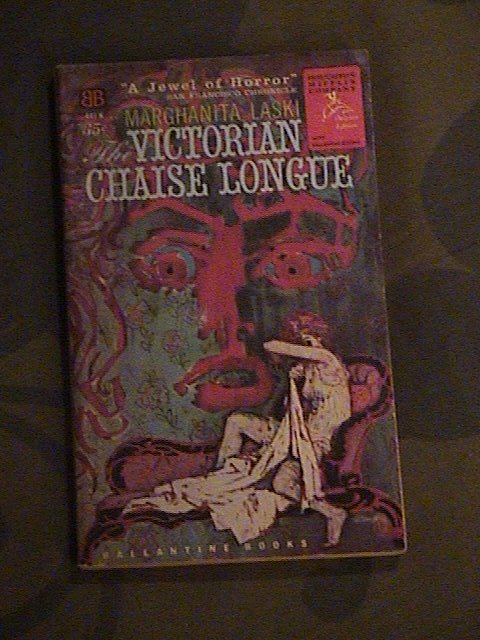
After a particularly stressful meeting last week, I popped into a used bookstore to destress before heading home. I hesitated over a copy of Bruno Schulz's Sanatorium under the Hourglass but turned it down because it smelled funny — I mean, really funny; but I came out with a gem, The Victorian Chaise Longue, by Marghanita Laski (1953). It's been reissued recently by Persephone Books, and I've heard wonderful things about it in various corners of le bloguemonde (from Danielle, among others). While the recommendations were strong, the cover art on the 1960 paperback I found is irresistible.

Equally enthralling is the ad copy inside:

Are you fond of old-fashioned furniture?

Be careful.

Furniture is inanimate — but it is occupied by animate beings subject to fear, love, despair, hatred, happiness — the myriad feelings of which humans are capable. And who knows what the life-span of terror may be? Who can tell what identity one may find woven into a plush old velvet chaise-longue, or what determines the time and setting for acting out a drama of horror?

Be careful. Your antique bargain may be a sink of malignancy.

Just waiting.


I paid about 5 times the 35-cent price boasted on the spine; still a bargain, but this prospect of malignancy has me a bit concerned.

Monday, April 16, 2007

The book reviewer

In the morning he read. This meant that he started on the first page and finished on the last. He was not a skimmer or a sniffer; he read meticulously, as if, swimming, he were being filmed in slow motion. The text swept him away and consumed him — he was like a man (the man in the bedclothes in his father's tale) drawn down by an undertow. Slowly, slowly, the imaginary cinema recorded his heavy resisting gulps. Reading was as exhausting to him as the long, weighted strokes of a drowning man. He gave it all his power. Then he cooked himself a bowl of farina and fell into the wilderness of his quilt.

When he woke at seven into full blackness of night, he felt oddly fat — he was sated with his idea, he understood what he thought. He sat down immediately to his review. He wrote it straight off, a furnace burning fat. It was as if his pen, sputtering along the line of rapid letters it ignited, flung out haloes of hot grease. The air brightened, than charred. He was very quick now, he was encyclopedic, he was in a crisis of inundation. He drove through all the caged hypotheses of his author — some were overt and paced behind bars, others were camouflaged, dappled; he was a dervish, he penetrated everything. When he was within sight of conquest he began to fuzz over with vertigo; he was a little frightened of all he knew. A greased beak tore him off his accustomed ledge and brought him to a high place beyond his control. Something happened in him while he slept. It was not the sleep of refreshment or restoration. He had no dreams. Afterward his lids clicked open like a marionette's and he saw: what he saw, before he had formulated even a word of it, was his finished work. He saw it as a kind of vessel, curved, polished, hollowed out. In its cup lay an alabaster egg with a single glittering spot; no, not an egg; a globe, marvelously round. An eye. A human eye: his own; and then not his own. His father's murdered eye.


He is Lars Andemening (fictional), book reviewer for a Stockholm newspaper. His father, allegedly, is the Polish writer Bruno Schulz (historical).

The book is The Messiah of Stockholm, by Cynthia Ozick, The Messiah being the legendary novel Schulz had reportedly been working on before he was shot by Nazis in 1942, no trace of which was ever found.

Saturday, April 14, 2007

Portraits

Family, left; Mommy (that would be me), right. By Helena.


The resemblance is startling.

Thursday, April 12, 2007

The colour of the book I read

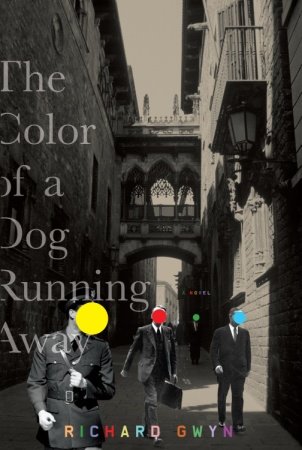
The Color of a Dog Running Away is the first novel by poet and translator Richard Gwyn. Published in Wales and Great Britain in 2005, it's taken its sweet time crossing the Atlantic. (His second novel, Deep Hanging Out, has just been released, but it'll be a while before we see that one either.)

Regarding the title: "In the language here this idiom refers to something of an indeterminate or vague and shadowy appearance, perhaps suggesting a fugitive reality" ("here" being Barcelona).

The book reads like a dream. That is, it has a dreamlike quality. It's a novel the way "Colourless green ideas sleep furiously" is a sentence. All the components are there, and they're awesome, yet they add up to something quite other (certainly not less, but I hesitate to say more — other, like a magic trick) than the sum of the parts.

The components are disparate, pulled out of a hat. Barcelona herself is prominently featured, with her unique history, architecture, and myths. Enter a femme fatale. An air of conspiracy. An expat community that inhales alcohol and drugs faster than Lucas's neighbour's rabbits breed.

Lucas receives a mysterious postcard. He talks through the immediate consequences of the postcard with a close friend:

"It's like a detective story," she said. "But in fact it contains only one element of mystery. The rest of it is simply boy meets girl. What you are trying to do is link the mysterious element with non-mysterious element in order to make your meeting with this girl appear utterly synchronistic, a meaningful coincidence. Or somehow preordained. Which of course it might be. But not necessarily in the way you think it is."


Of course, it's harder to maintain this cool-headed perspective as the mysterious elements pile up on top of each other.

Add a mythic group of roof-dwellers who never touch ground. (They're said to steal babies.) A megalomaniacal cult leader intent on reviving Catharism. A fire-eating prophet. A baron with a tower that served as a gaol during the Inquisition.

There's something about a cat. From a treatise on animal husbandry and the urban mystic, regarding the interesting case of cats:

It would seem that they provide something for their owners to stroke, to be comforted by, and to speak to. However, it is untrue that cats are diabolical. They simply unsettle people by the ease with which they snub affectionate advances, and inspire jealousy in the relaxed and libidinous lifestyles that they pursue amid the toiling masses of humanity.


Nuria, the femme fatale of the story, often has feline qualities attributed to her. When a "witch" gives her "a shell the size of a small cat," Nuria breaks it, and the story and all its characters seem to unhinge. There's something about the cat. It's saying something about Nuria, or about love. Something.

The novel drifts from one aspect to another fluidly, operating by its own internal dream logic. Farfetched, but somehow normalized. An awful lot happens, yet at the same time it feels like nothing at all. There are no tidy endings here, but it's written deftly, such that I feel the loose ends are left lying exactly where they ought to be. I rather like my endings ambiguous; they give bad novels the opportunity for me to forgive them and they keep good novels from ending at all. The Color of a Dog Running Away is sleeping furiously.

Richard Gwyn on Barcelona and how the city helped shape the book.

Excerpts:
The postcard.
The rooftops.

Wednesday, April 11, 2007

Short books, with a side of Hamilton, please

Dan Rhodes lists his top 10 short novels, all under 200 pages. "All killer, no filler." (I've read, and loved, half of them.) Perhaps the novella is due for a comeback.

On the list: The Plains of Cement, by Patrick Hamilton. "The Plains of Cement is brilliantly excruciating — Hamilton tortures his characters, the reader and, I expect, himself. He's the best pub writer I know."

The Plains of Cement is the last book, and my favourite, in the trilogy published as Twenty Thousand Streets Under the Sky. I've quoted from it here, and then discussed it a bit further.

As for short books, I like them. Long is good too. Both have their time and their place. Short has the advantage of slipping into my bag easily. For this reason this morning in my travels across the city I started reading Cynthia Ozick's The Messiah of Stockholm — I'm loving it already and can see it claiming a position on my own list of best short books.

What short novels are your favourites?

Montreal is blue again

The 9th Blue Metropolis Montreal International Literary Festival takes place April 25-29, 2007. This year's theme: free spirits.

The programme is now online.

Margaret Atwood is to be honoured with the 2007 Blue Metropolis International Literary Grand Prix.

Other writers participating in on-stage interviews, panel discussions, and readings include David Bezmozgis (who stood us up last year), Lydia Davis (she who translated Proust), Barbara Gowdy (author of, among other things, The White Bone, one of the saddest books I've ever read), Michael Ondaatje (launching his new book, Divisadero), Michael Redhill, and Jane Urquhart, along with dozens of names I've never heard of. (My foray last year led me to discover José Carlos Somoza, who himself was charming and whose excerpt was fascinating, from a book I later hunted down and loved.)

I'll be pressed for time because of my work deadlines, but I hope to squeeze in an event or two. How to choose?

Tuesday, April 10, 2007

My Easter holiday

Hours spent in a car between Friday midmorning and Monday evening: about 17, or way too many.

Easter eggs painted: countless.

Hours of sleep: quite possibly more than usual, but so restless as to entirely discount any benefits.

Hockey games closely monitored this weekend: 3.
Unhappy Habs fan in the household: the man I sleep with.
Unhappy Leafs fan in the household: my brother.
Tension: yes.

Mother who insists on over-exerting herself even though she's still recovering from a hernia operation: present and accounted for, apparently not to be stopped.

Books received: The Slaves of Solitude, Patrick Hamilton. A copy of my very own! My sister had found 2 different editions for me to choose between, so I read the introductions to both. David Lodge gives an excellent character analysis in the recent NYRB Classics edition, but I chose the Constable edition, which has 2 introductions (one by Doris Lessing, one by Michael Holroyd), providing a little bit more biographical detail and generally more enthusiasm. Also, I like the cover better.

Pages read while away: about one a day (not counting the aforementioned introductions), leaving me to finish my so-close-to-finished-that-I-brought-a-backup novel only on returning to the peace and quiet — the normalcy — of home.

Number of bookstores visited amid a flurry of other activity and in a hurry to do so before closing time, which involved selfishly abandoning a tired and cranky girl to relatives: 4, 2 of them being used bookstores, where my inquiries after Patrick Hamilton were met with, "Never heard of him."

Books purchased: The Purity of Blood, Arturo Perez-Reverte. There will be swordplay. Oh, yes.

Books retrieved from my mother's basement: a nicely illustrated volume from Dandelion Library containing abridged versions of both Alice in Wonderland and Peter Pan. While I recall the book's existence during my childhood, I do not remember reading or being read to from this book, nor do I associate these stories with my childhood. I came to appreciate Alice much later in life; I don't believe I've ever read Peter Pan.

Movies watched in their entirety: none, but I would really like to know how The Machinist ends.
Movie received as gift: Rope (Alfred Hitchcock; based on the play by Patrick Hamilton, hence my recent interest in it).

Amount of chocolate consumed: not nearly as much as I'd anticipated.
Number of wine bottles emptied: 5? 6, 7? Who's counting?

The big takeaway, my mother's implied criticism of me in a general discussion: I am a horrible mother for not teaching my daughter to speak Polish.

Number of words to be copyedited by the end of the month: 100 000, give or take.
Amount of progress made thus far: very little.
Jobs regarding which I have meetings this week: 3.

Rocks I'd like to crawl under: yes, please.

Thursday, April 05, 2007

The canticle

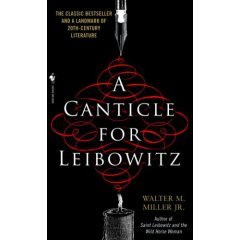
This book: A Canticle for Leibowitz, by Walter M Miller Jr. Very cool.

Have I mentioned? We're suckers for a postapocalyptic tale in this household. (No, I haven't read The Road yet, though I've been wanting to, and now I feel fully primed.) Add to the mix a monastery with all the politics entailed therein, bands of mutants wandering the landscape, and an Immaculate Conception — I am so there.

As I mentioned previously, I've been meaning to read this book forever, so when I learned it was being reissued I jumped at the offer of a review copy. I did manage to finish reading it last weekend, but I'm afraid I haven't many deep insights to share (I'm busy and tired). It's not a masterpiece of prose, but that's OK — it's a novel of ideas, some mind-bending and enduring ones. It's nearly 50 years old (written in 1959) and it's still relevant.

The first part is set approximately 600 years from now. (The second section jumps another 600 years ahead, and the third takes place some 600 years after that.) The world is barely starting to recover from nuclear devastation and the resulting "simplification" (a kind of uprising by the masses to overthrow the political authorities but also technology for the destruction they've wrought, a backlash against progress), and while such a threat no longer seems as imminent as during the Cold War, the implications are still worth considering. (The second and third parts respectively cover something like an age of enlightenment or industrial revolution and then a space age.) All the sections centre around the goings on of a monastery founded by Leibowitz, who is later canonized. Who Leibowitz is is largely irrelevant, a minor revolutionary really and an engineer whose documents survived the Flame Deluge.

One of the major concerns is the preservation of knowledge. The politics of the abbey come into play: who is best suited to preserve knowledge, who has the right to access it, who is equipped to interpret it. Advocates! Excommunications! (For these reasons I'm reminded quite a bit of The Name of the Rose, even though their stories, apart from the monastic setting, may not seem to have much in common at all, but A Canticle is much more accessible.) Of course, the preserved documents and other memorabilia are barely "knowledge" at all, mostly indecipherable information, but from these scraps civilization will rebuild itself.

The 3 sections were in slightly different forms published independently and later reworked to form a novel. And because of the vast time period covered, any attachment formed to a character must be broken. It's the monastery that's the touchstone, and it's rich with the symbols and (metaphorical) ghosts of its residents.

I really liked Brother Francis, who discovers some relics of Leibowitz with the guidance of a stranger in the desert:

This line of questioning was puzzling to Brother Francis. In his own mind, there was no neat straight line separating the Natural from the Supernatural order, but rather, an intermediate twilight zone. There were things that were clearly natural, and there were Things that were clearly supernatural, but between these extremes was a region of confusion (his own) — the preternatural — where things made of mere earth, air, fire, or water tended to behave disturbingly like Things. For Brother Francis, this region included whatever he could see but not understand. And Brother Francis was never "sure beyond a doubt," as the abbot was asking him to be, that he properly understood much of anything. Thus, by raising the question at all, Abbot Arkos was unwittingly throwing the novice's pilgrim into the twilight region, into the same perspective as the old man's first appearance as a legless black strip that wriggled in the midst of a lake of heat illusion on the trail, into the same perspective as he had occupied momentarily when the novice's world had contracted until it contained nothing but a hand offering him a particle of food. If some creature more-than-human chose to disguise itself as human, how was he to penetrate its disguise, or suspect there was one? If such a creature did not wish to be suspected, would it not remember to cast a shadow, leave footprints, eat bread and cheese? Might it not chew spice-leaf, spit at a lizard, and remember to imitate the reaction of a mortal who forgot to put on his sandals before stepping on hot ground? Francis was not prepared to estimate the intelligence or ingenuity of hellish or heavenly beings, or to guess the extent of their histrionic abilities, although he assumed such creatures to be either hellishly or divinely clever. The abbot, by raising the question at all, had formulated the nature of Brother Francis' answer, which was: to entertain the question itself, although he had not previously done so.


(This bit resonates with me, made me laugh even, because I quite famously as a child and teen, and, yes, even later, responded "I don't know" to most questions asked of me, not a shrugging, despondent "I dunno," but a seriously heartfelt "how can anyone really know anything and what are you really driving at by asking me such a thing.")

Miller witnessed the destruction of the monastery at Monte Cassino during World War II, and this allegedly served as inspiration for the novel. This also strikes a personal chord with me, as both my father and my mother's father were there; I wonder if they ever stepped outside of their brutal, personal experience and considered the vaster implications.

I haven't decided yet whether the novel is pessimistic in its view of the cyclical nature of history or whether it ends on a redemptive note. Certainly it's cynical of what we take for knowledge (how myth is made of ordinary man), including religious knowledge (how miraculous is interpreted out of the mundane; the value of faith in myth made of ordinary man). (This book is having a conversation on my shelf (and in my head) with War and Peace and Iron Council (China Miéville).)

I am stunned that no one has attempted to film this novel.

Wikipedia summary.
Study guide.

Miller shot himself in 1996. He'd written most of another "canticle," Saint Leibowitz and the Wild Horse Woman (an excerpt of which is included in my edition but which I've not yet read). It was published posthumously, the writing finished by Terry Bisson.

I wish I'd read this as a teenager. I'd be zipping through school hallways telling all my friends I'd just read the coolest book ever. It strikes me as a great book for teens, one of those first "adult" books, accessible but provocative. This is not to say it's any way juvenile — it's a good read for anybody, and deserves to be called a classic.

Very cool.

Monday, April 02, 2007

Getting an education

The polling station for our provincial election last week was located in the gymnasium of the primary school at the end of our street. In the late afternoon, all 3 us went together. As we approached the door, Helena gripped my hand tight and confided in me, "I feel a little bit shy."

I'd explained where we were going and why, but obviously the why of it didn't make a dent in her excitement to be entering this grand — to her eyes — building.

She expressed some confusion once inside, but no real disappointment. She was delighted to discover a row of drinking fountains, all her size.

Those few moments for me, though, caused months' long emotional turmoil to resurface.

No parenting issue had caused me tears like this one, when in fact there is not an issue, no problem to solve, only the facts to deal with.

Helena will not be starting kindergarten in September. Not because she's not ready, or willing; because she's not old enough. And this riles me. Maybe because I was already in junior kindergarten when I was her age now; she will be an academic year behind where I was at her age. Our birthdays are in November, a day apart. But whereas the cutoff for school entry age in my home province is December 31, it is September 30 in the province we live in now.

(I was first made aware of the situation when we set up an education fund soon after Helena's birth; the dates were presented as a matter of fact, but I've puzzled over them ever since.)

(The trusty internet at my fingertips, I've learned children all over the world begin their formal education, grade 1, at, on average, age 6 (which Helena will also be doing).)

Part of me wonders about the different life we'd be leading if we'd stayed put, not moved here when I was pregnant. It pains me that the distance of a 2-hour drive costs Helena an academic year.

It's inevitable: someone will always be oldest and someone will always be youngest in every class, no matter where the entry age dates are fixed. I was one of the youngest. Perhaps this contributed to the perception, mine as well as of others, that I was bright, ambitious. In retrospect, I can't say it served me particularly well — I would've done better to delay university by a year or two, even more. But Helena will be one of the oldest, and it bothers me no end.

There are several other November birthdays in her current daycare class. I find it strange that none of those parents are bothered; they're very matter-of-fact, it's a matter of fact.

It galls me to know that Helena's "cousin" is already nearing the end of her kindergarten year. She is only 14 months older (barely more than a year!) than Helena but scholastically a full 2 years ahead. Pesky cutoff dates.

More than anything, I'm surprised. Simply, I thought she'd be in school by now. This idea has been reinforced in countless ways. I hear about how important early education is, that children are untapped potential, sponges. It's counterintuitive that school should start so late. Of course, the early years are important for emotional and social development too; but I fail to see what difference an additional year at home or in daycare might make for the child who is not, by age, say, 4, already emotionally well adjusted and in a nurturing environment. Daycare, or community activities, is all very well for socialization, but children are fully equipped to be learning more than sharing, dancing, or colouring. There's so much more to gain at this age by going to school.

I don't want to be a pushy mom, a stage mom or hockey dad. I don't think I will be. If anything, I could use a little more pushy in my life, and would do well to set a more assertive example for Helena.

While I think Helena's smarter than your average bear, I don't claim that she's developmentally a year ahead of her daycare peers. There's plenty of time for competitiveness to rear its ugly head on Helena's own shoulder without my interference this early in the game.

But.

I considered filing for a derogation for Helena. Exceptions to the rule can be made, but anecdotally they're very rare (we don't know anybody who knows anybody who's heard of anybody...). The application requires that the child undergo a thorough psychological evaluation. (J-F is dead set against putting Helena through such a process.) It must be shown not only that the child is ready for school, but that the child would suffer unduly by not attending school at an earlier age. Weighed against staying with her peer group in a good daycare (and she would — will — stay happily, not knowing what she's missing), how does one measure the loss?

But.

I can't help but feel I should be doing something more, that Helena should have more, that this is all very wrong.

Junior kindergarten is uncommon here. I am grateful that her daycare is more pedagogically focussed than many.

Private school is not an option (nor is homeschooling). Financial concerns aside, I back the principle of a public school system.

What's driven home hard to me is how desperately I need to step up. Somehow. Helena lately wants me to play school with her, so I do, regularly; we practice printing letters, she's warming up to reading, she has a facility with numbers, basic arithmetic. But I'm a mom, not a teacher; I haven't a clue how to proceed.

For all the good my "early" education did me, I've learned only that "me" in the parenting equation has produced an infinite not-good-enough, a sequence of fuckups.

I'm tired of crying over this. I'm overwhelmed by the irony, that the one most fundamental, to my mind, aspect of a person's life — an education — the thing a parent is most responsible for managing, is the one I feel I have the least control over and most inadequate to provide.

I'm sincerely interested to know your opinions and your experience. What is the school entry age, and the cutoff date, where you live? Do you have any structured learning time with your child, and just how structured is it? When should children start school?