Helena had egg the other day, and she didn't throw up.
The girl certainly seems to know what she likes and to have a handle on what's good for her.
Last winter, after our offers of egg were hesitantly accepted and them regurgitated, we even had Helena tested for an allergy. Nothing. The doctor's best guess was that Helena had some trouble digesting egg. (Thanks for the professional medical opinion.) Or she didn't like it much. (I guess she'd have to really not like it, to think about it for an hour or two and then decide to vomit it all out of there.)
She's never had a problem with egg as an ingredient in other things — egg bread, for example.
Anyway, she's expressed interest in eating egg, with a decided preference for whites, and intends to digest it thoroughly.
She's a good egg, that girl.
Currently, for the second time in a week, she's staying with J-F's mom, so I can get some, ahem, work done.
Frankly, editing this 98-chapter text on neurological disorders in children is giving me a headache. It reinforces my suspicion that as a child I was severely neurologically disordered, and I continue to be so. The descriptions of migraine onset triggers are acting as triggers in themselves.
But I'd better just buckle down and do it. It's not like I have a real job to go to. Remember my interviews of the other week? Sigh. This makes three times now I've been declared overqualified for jobs in Montreal. What does that mean? When people say "overqualified," I always think "bullshit."
What this means is that people with more professional authority than I think I deserve more money, I deserve to work in a stimulating environment, I deserve far better things. So they say. Well, I don't care what I deserve anymore. I just want a regular paycheck, with regular work hours, so we can buy ourselves a regular condo and go on regular vacations to New York City and Paris, like regular people. I can't wait to show Helena Paris. So many carousels!
I also think Montreal is a little underqualifed for my standards of work. Just get over the bilingualism thing already. English copy deserves the attention of a specialist in English. Ditto French. A bilingual copy editor is generally not a good copy editor. Good enough, you seem to think. Ah, Montreal, you have so much to learn.
So here I sit, editing away on various freelance contracts. And the guilt is unbearable. I'm at home after all — you'd think I could attend to my toddler's needs while I whip out chapter after chapter. It's a tough sell, convincing "others" (all those strangers who pass me in the street and dare to judge me), but most especially convincing myself, that freelance work at home is still real work, like watching a toddler is a different kind of real work, and you just can't do both at the same time. And I can't live on 4 hours of sleep a night.
Yesterday we went to the playground for a couple hours in the morning. Took a jaunt over to Mont Royal to buy whatever vegetable we'd run out of and really needed. Dropped off some film, picked up some Swiffer cloths. Home for lunch, then off to the wading pool for an hour or so. Two loads of laundry, and only two chapters edited. I'm a little tired.
The wading pool is a lot of fun, though I'm still adjusting to the behaviour of children. What odd creatures. (They walk right up to me and try to take the watering can out of my hand. Imagine doing that as an adult...)
Helena decided to move a couple dozen of the communal plastic yellow ducks from the corner of the pool to a highly superior patch of water along one side. Very methodical, focused, two or three at a time. One little girl came to liberate a duck and Helena had the gall to give her some attitude (a brief shout and an outstreched hand). Oh well; only 26 ducks to manage now.
By the time Helena completed her transport efforts, most of the ducks had drifted back to within inches of their original positions. She didn't care.
We walked right across the middle of the pool. It's deeper than I imagined, creeping up on Helena's armpits. She showed a bit of hesitation, but plodded on through. Brave girl.
We were already getting ready to leave when a lifeguard blew his whistle. "Everybody out of the pool." Relative quiet as all the splashing stopped. The kids were out, the ducks stayed in. I looked up to see a young woman wearing the standard-issue "sauveur"-emblazoned white t-shirt standing in the middle of the pool. She was also wearing galoshes up to her knees, a rubber apron, and a gas mask while pouring in what I assume to be chlorine, stirring it up as she walked the perimeter.
We'd been splashing about while the water was at its "dirtiest." We know by the smell that the pool is kept highly chlorinated. I'd rather soak my feet in a bath of chlorine than baby pee. I think. I don't know how long the kids had to wait before going back in.
Wednesday, July 21, 2004

Monday, July 19, 2004
Cat heaven
Margaret Atwood gets cats. I mean, really understands them. My cats anyway.
Read her story in Brick.
My cats like this story. They'll be wanting me to read it to them every night.
I always suspected that if they were bigger, and I were smaller, they'd play with me till I died. In their younger days anyway. Now they only dream.
Read her story in Brick.
My cats like this story. They'll be wanting me to read it to them every night.
I always suspected that if they were bigger, and I were smaller, they'd play with me till I died. In their younger days anyway. Now they only dream.
Picture his words
Alberto Manguel explores the relationship between words and images in the current issue of Geist.
Perhaps the strongest, clearest exposition of the relationship or conflict was given in the eighteenth century by the German scholar Gotthold Ephraim Lessing. . . For Lessing, words could (or should) fully describe and explore the emotions; images, however, required greater restraint and found the power of the emotions. Lessing pointed out that a poet can depict the emotions of a character at any given moment and allow the reader to follow his or her progress through the narrative; a painter or sculptor is bound to the instant and is therefore constrained to a single expression. For Lessing, one “reading” evolves in time, the other in space; both require the active participation of the audience.
In his lovely anecdotal way, Manguel's essay is an ode to the comic book. Words and images, time and space, serving imagination, politics, absurdity, all.
Perhaps the strongest, clearest exposition of the relationship or conflict was given in the eighteenth century by the German scholar Gotthold Ephraim Lessing. . . For Lessing, words could (or should) fully describe and explore the emotions; images, however, required greater restraint and found the power of the emotions. Lessing pointed out that a poet can depict the emotions of a character at any given moment and allow the reader to follow his or her progress through the narrative; a painter or sculptor is bound to the instant and is therefore constrained to a single expression. For Lessing, one “reading” evolves in time, the other in space; both require the active participation of the audience.
In his lovely anecdotal way, Manguel's essay is an ode to the comic book. Words and images, time and space, serving imagination, politics, absurdity, all.
Sunday, July 18, 2004
Scarred
I finished reading The Scar, by China Miéville. It took me a few weeks, but what a ride!
(Both the Pan Macmillan China Miéville site and the Runagate Rampant have articles and tidbits, but neither has been updated recently.)
In so many ways, it is the complete opposite of Perdido Street Station (which, frankly, I preferred, I think.) Perdido Street Station was dark and urban (just like me!); The Scar was a wide open space.
The opening chapters reminded me of, of all things, The Voyage of the Dawn Treader, perhaps for no other reason than that it takes place at sea, and I've never been one for sea-faring tales. There's a sense that somehow it doesn't belong with the others, which is a silly point to make regarding a book that is just the second one set in the world of Bas-Lag. Perhaps it's a strength that it makes you feel adrift, between places, not connected, with nowhere to firmly plant your feet.
Hmm.
With each new New Crobuzon novel, Miéville must specify more and more of his imagined cosmos; there will be fewer shadows at the corner of things, his vision will become more described and less implied. In this book, for example, I found the external perspective of New Crobuzon as a naval and imperial power shrank the city, imaginatively, so that it became just another late nineteenth-century analogue European city, rather than occupying the almost mythic, archetypal and unaccountable place it did in the earlier novel.
Where PSS followed the building of character, making choices, taking responsibility, becoming human, The Scar witnesses the unraveling of character.
Even the "science" at the crux of these novels is opposite.
The Scar mines "possibility." "They set free forces that they were able to tap. Forces that allowed them to reshape things, to fail and succeed simultaneously — because they mined for possibilities. A cataclysm like that, shattering a world, the rupture left behind: it opens up a rich seam of possibilities... For every action there's an infinity of outcomes... Tapped by possibility machines, outcomes that didn't quite make it to actuality were boosted, and made real."
Like being able to watch Schrodinger's cat and choose.
Behind PSS was crisis energy and the "conviction that underlying the facticity of the world, in all its seeming fastness, was an instability, a crisis pushing things to change from the tensions within them... Things, while even as they were, were always in crisis, always pulled to become their opposite."
If what was and what was not were allowed to coexist, the very tension — the crisis at the center of existence — must dissipate. Where was that crisis energy in the real becoming what it was not, if what it was not was right there alongside what it was?
One of the blurbs for The Scar boasts, "This is not your grandfather's science-fiction/fantasy novelist." I don't know what that means.
I can't wait to get my hands on the next Crobuzon novel, but it may be a year or so before it's available in paperback. In the meantime, I read what others have to say about it.
The New York Times says that:
Iron Council, by China Miéville, is an exemplar of what some are calling the Next Wave in British science fiction. The name is a sly reference to the New Wave of the 1960's, when English and American writers . . . cast a suspicious eye on genre staples like space travel and future technology. The Next Wave . . . mixes left-leaning politics and a taste for horror into cautionary tales of societies gone wrong at the core.
The generic comments apply equally to the first two Bas-Lag novels. This world is slowly being revealed to us, for us to figure out as we go.
Without ever spelling out the details (any more than Isaac Asimov explained the intricacies of his robots' "positronic brains"), Miéville treats magic as another form of technology, one that follows dimly apprehended rules and that typically exacts a cost greater than its practitioners anticipate.
Miéville's language is interesting and skilled, chosen with deliberate purpose:
To convey both the weirdness and the familiarity of his vividly elaborated world, he peppers his sentences with unusual words("serein," "strath," "atramentous," "cuneal") that will send most readers to a good unabridged dictionary—- and back again to this challenging but deeply rewarding novel.
Adam Lipkin's review at Bookslut is immensely frustrating. Make up your mind Mr Lipkin:
"clearly an immensely talented writer"
"He nicely nails tough bits of dialogue or characterization."
"The man can write. He just chooses not to."
Mr Lipkin seems intent on disliking this book, not because it's bad but because it doesn't quite break the molds its fans claim, because it's not as good as Miéville's popularity should warrant.
This is a world that is just begging for a good story. If Miéville ever decides to work on his storytelling skills as much as his world-building ones, that story might finally be told.
A great writer could (and should) make their experiments work to forward the plot — or, at the other extreme, lose the pretense that the plot actually matters. Miéville, however, lets his own desires to examine politics and flout literary conventions get in the way of simply writing a good book.
As a fan, I have to say that Miéville's constructed world is so fucking amazing, the storytelling doesn't particularly matter. In fact, the digressions and lost trails help make that world believable. An examination of politics is vital — that's why I read this stuff: to explore ideologies, their social consequences, their moral implications. I don't believe Miéville has any pretense about plot.
(Both the Pan Macmillan China Miéville site and the Runagate Rampant have articles and tidbits, but neither has been updated recently.)
In so many ways, it is the complete opposite of Perdido Street Station (which, frankly, I preferred, I think.) Perdido Street Station was dark and urban (just like me!); The Scar was a wide open space.
The opening chapters reminded me of, of all things, The Voyage of the Dawn Treader, perhaps for no other reason than that it takes place at sea, and I've never been one for sea-faring tales. There's a sense that somehow it doesn't belong with the others, which is a silly point to make regarding a book that is just the second one set in the world of Bas-Lag. Perhaps it's a strength that it makes you feel adrift, between places, not connected, with nowhere to firmly plant your feet.
Hmm.
With each new New Crobuzon novel, Miéville must specify more and more of his imagined cosmos; there will be fewer shadows at the corner of things, his vision will become more described and less implied. In this book, for example, I found the external perspective of New Crobuzon as a naval and imperial power shrank the city, imaginatively, so that it became just another late nineteenth-century analogue European city, rather than occupying the almost mythic, archetypal and unaccountable place it did in the earlier novel.
Where PSS followed the building of character, making choices, taking responsibility, becoming human, The Scar witnesses the unraveling of character.
Even the "science" at the crux of these novels is opposite.
The Scar mines "possibility." "They set free forces that they were able to tap. Forces that allowed them to reshape things, to fail and succeed simultaneously — because they mined for possibilities. A cataclysm like that, shattering a world, the rupture left behind: it opens up a rich seam of possibilities... For every action there's an infinity of outcomes... Tapped by possibility machines, outcomes that didn't quite make it to actuality were boosted, and made real."
Like being able to watch Schrodinger's cat and choose.
Behind PSS was crisis energy and the "conviction that underlying the facticity of the world, in all its seeming fastness, was an instability, a crisis pushing things to change from the tensions within them... Things, while even as they were, were always in crisis, always pulled to become their opposite."
If what was and what was not were allowed to coexist, the very tension — the crisis at the center of existence — must dissipate. Where was that crisis energy in the real becoming what it was not, if what it was not was right there alongside what it was?
One of the blurbs for The Scar boasts, "This is not your grandfather's science-fiction/fantasy novelist." I don't know what that means.
I can't wait to get my hands on the next Crobuzon novel, but it may be a year or so before it's available in paperback. In the meantime, I read what others have to say about it.
The New York Times says that:
Iron Council, by China Miéville, is an exemplar of what some are calling the Next Wave in British science fiction. The name is a sly reference to the New Wave of the 1960's, when English and American writers . . . cast a suspicious eye on genre staples like space travel and future technology. The Next Wave . . . mixes left-leaning politics and a taste for horror into cautionary tales of societies gone wrong at the core.
The generic comments apply equally to the first two Bas-Lag novels. This world is slowly being revealed to us, for us to figure out as we go.
Without ever spelling out the details (any more than Isaac Asimov explained the intricacies of his robots' "positronic brains"), Miéville treats magic as another form of technology, one that follows dimly apprehended rules and that typically exacts a cost greater than its practitioners anticipate.
Miéville's language is interesting and skilled, chosen with deliberate purpose:
To convey both the weirdness and the familiarity of his vividly elaborated world, he peppers his sentences with unusual words("serein," "strath," "atramentous," "cuneal") that will send most readers to a good unabridged dictionary—- and back again to this challenging but deeply rewarding novel.
Adam Lipkin's review at Bookslut is immensely frustrating. Make up your mind Mr Lipkin:
"clearly an immensely talented writer"
"He nicely nails tough bits of dialogue or characterization."
"The man can write. He just chooses not to."
Mr Lipkin seems intent on disliking this book, not because it's bad but because it doesn't quite break the molds its fans claim, because it's not as good as Miéville's popularity should warrant.
This is a world that is just begging for a good story. If Miéville ever decides to work on his storytelling skills as much as his world-building ones, that story might finally be told.
A great writer could (and should) make their experiments work to forward the plot — or, at the other extreme, lose the pretense that the plot actually matters. Miéville, however, lets his own desires to examine politics and flout literary conventions get in the way of simply writing a good book.
As a fan, I have to say that Miéville's constructed world is so fucking amazing, the storytelling doesn't particularly matter. In fact, the digressions and lost trails help make that world believable. An examination of politics is vital — that's why I read this stuff: to explore ideologies, their social consequences, their moral implications. I don't believe Miéville has any pretense about plot.
Saturday, July 17, 2004
Eating sins
We rented The Order last night, or The Sin Eater as it's known outside North America.
This is not a very good film, but it was pretty compelling nonetheless. After all, there's that nugget of an idea of a sin-eater:
a man who for trifling payment was believed to take upon himself, by means of food and drink, the sins of a deceased person.
Sin eaters were not uncommon in the British isles up until the 19th or 20th century. According to this text on Funeral Customs, the practice of sin-eating derives from pagan history.
A less known but even more remarkable functionary, whose professional services were once considered necessary to the dead, is the sin-eater. Savage tribes have been known to slaughter an animal on the grave, in the belief that it would take upon itself the sins of the dead. In the same manner, it was the province of the human scapegoat to take upon himself the moral trespasses of his client--and whatever the consequences might be in the after life--in return for a miserable fee and a scanty meal. That such a creature should be unearthed from a remote period of pagan history would be surprising enough, but to find reliable evidence of his existence in the British Isles a hundred years ago is surely very much more remarkable.
Professor Evans of the Presbyterian College, Carmarthen, actually saw a sin-eater about the year 1825, who was then living near Llanwenog, Cardiganshire. Abhorred by the superstitious villagers as a thing unclean, the sin-eater cut himself off from all social intercourse with his fellow creatures by reason of the life he had chosen; he lived as a rule in a remote place by himself, and those who chanced to meet him avoided him as they would a leper. This unfortunate was held to be the associate of evil spirits, and given to witchcraft, incantations and unholy practices; only when a death took place did they seek him out, and when his purpose was accomplished they burned the wooden bowl and platter from which he had eaten the food handed across, or placed on the corpse for his consumption.
But its link to Catholicism is tenuous. I have no idea what that link might be.
Wikipedia addresses the subject, but provides no insight.
The act of being a Sin-Eater is/was generally considered a cardinal sin by the Catholic Church because it provided absolution outside the purview of the priesthood, and resulted in immediate excommunication.
Frankly, I'm surprised to turn up so little information on the practice. I'm sure I've heard of it before, that it's cropped up in books or movies. The idea of it is not unfamiliar.
The movie also deals with the last of the Carolingians, whose love of knowledge and education rivalled that of the Jesuits. (Myself, I have a lot of trouble distinguishing one order from the next.) But the existence of Carolingians at least has some basis in fact.
The educational influence of the Carolingian revival of learning was continued in some way down to the dawn of the era of university education in the thirteenth century.
Rick McGinnis has interesting things on all these subjects, and others spurred by a viewing of the film, and he includes a lot of links to published reviews.
He calls it "a film whose thematic foundation was a motley pile of rancid old anti-Catholic mythology, some of it dating back as far as Luther and King James."
(I don't know how anti-Catholic it is, though it's definitely anti–Vatican and its politics, which is what Catholicism is all about, I guess.)
If The Order, as a thriller, has any particular flaw, it's the fact that the whole story hangs on a point of theological practice that's not only absurd, but false. Or, as Bob Campbell in the Seattle Times put it:
"Gradually, it dawns on the audience that this is the entire drama. Someone is offering unearned forgiveness to the naughty! He must be stopped!
"This is a problem? The list of sinners saved by last-minute confession is already endless.
"The Order treats these acts of mercy as the ultimate in apocalyptic horror."
Really, how sinful is the eating of sins? Relative to, say, the buying of indulgences? I would eat the sins of some, if it truly eased their burden.
This is not a very good film, but it was pretty compelling nonetheless. After all, there's that nugget of an idea of a sin-eater:
a man who for trifling payment was believed to take upon himself, by means of food and drink, the sins of a deceased person.
Sin eaters were not uncommon in the British isles up until the 19th or 20th century. According to this text on Funeral Customs, the practice of sin-eating derives from pagan history.
A less known but even more remarkable functionary, whose professional services were once considered necessary to the dead, is the sin-eater. Savage tribes have been known to slaughter an animal on the grave, in the belief that it would take upon itself the sins of the dead. In the same manner, it was the province of the human scapegoat to take upon himself the moral trespasses of his client--and whatever the consequences might be in the after life--in return for a miserable fee and a scanty meal. That such a creature should be unearthed from a remote period of pagan history would be surprising enough, but to find reliable evidence of his existence in the British Isles a hundred years ago is surely very much more remarkable.
Professor Evans of the Presbyterian College, Carmarthen, actually saw a sin-eater about the year 1825, who was then living near Llanwenog, Cardiganshire. Abhorred by the superstitious villagers as a thing unclean, the sin-eater cut himself off from all social intercourse with his fellow creatures by reason of the life he had chosen; he lived as a rule in a remote place by himself, and those who chanced to meet him avoided him as they would a leper. This unfortunate was held to be the associate of evil spirits, and given to witchcraft, incantations and unholy practices; only when a death took place did they seek him out, and when his purpose was accomplished they burned the wooden bowl and platter from which he had eaten the food handed across, or placed on the corpse for his consumption.
But its link to Catholicism is tenuous. I have no idea what that link might be.
Wikipedia addresses the subject, but provides no insight.
The act of being a Sin-Eater is/was generally considered a cardinal sin by the Catholic Church because it provided absolution outside the purview of the priesthood, and resulted in immediate excommunication.
Frankly, I'm surprised to turn up so little information on the practice. I'm sure I've heard of it before, that it's cropped up in books or movies. The idea of it is not unfamiliar.
The movie also deals with the last of the Carolingians, whose love of knowledge and education rivalled that of the Jesuits. (Myself, I have a lot of trouble distinguishing one order from the next.) But the existence of Carolingians at least has some basis in fact.
The educational influence of the Carolingian revival of learning was continued in some way down to the dawn of the era of university education in the thirteenth century.
Rick McGinnis has interesting things on all these subjects, and others spurred by a viewing of the film, and he includes a lot of links to published reviews.
He calls it "a film whose thematic foundation was a motley pile of rancid old anti-Catholic mythology, some of it dating back as far as Luther and King James."
(I don't know how anti-Catholic it is, though it's definitely anti–Vatican and its politics, which is what Catholicism is all about, I guess.)
If The Order, as a thriller, has any particular flaw, it's the fact that the whole story hangs on a point of theological practice that's not only absurd, but false. Or, as Bob Campbell in the Seattle Times put it:
"Gradually, it dawns on the audience that this is the entire drama. Someone is offering unearned forgiveness to the naughty! He must be stopped!
"This is a problem? The list of sinners saved by last-minute confession is already endless.
"The Order treats these acts of mercy as the ultimate in apocalyptic horror."
Really, how sinful is the eating of sins? Relative to, say, the buying of indulgences? I would eat the sins of some, if it truly eased their burden.
Not so black after all
Stephen Hawking is set to present findings on black holes at the 17th International Conference on General Relativity and Gravitation in Dublin, Ireland, on July 21.
"A black hole only appears to form but later opens up and releases information about what fell inside. So we can be sure of the past and predict the future."
Hawking did not elaborate on the BBC program how the information could be extracted from the black hole.
Nor does he elaborate on the nature of the philosophical and practical consequences of the information extracted.
Is this where our futures lie? In the shreds that seep into the cosmos from out of the gaping abyss?
"A black hole only appears to form but later opens up and releases information about what fell inside. So we can be sure of the past and predict the future."
Hawking did not elaborate on the BBC program how the information could be extracted from the black hole.
Nor does he elaborate on the nature of the philosophical and practical consequences of the information extracted.
Is this where our futures lie? In the shreds that seep into the cosmos from out of the gaping abyss?
Friday, July 16, 2004
Sense and sensibility
Helena has figured something out. I'm not sure exactly what, but there was a definite lightbulb moment earlier this week that triggered some odd behaviour.
Weird experiments for toddlers:
Sight (or lack thereof)
Close your eyes.
Really, really squinty tight.
Variation 1 – Find your way to Mama, guided only by her voice.
Variation 2 – Spin round and round and round. Try to determine your orientation in the room by flailing your arms about wildly.
Sound (or distortion thereof)
Put your hands over your ears.
Take them away.
Now put them back.
Away.
Back.
Now sing.
Raise your volume. As loud as you can go.
Interesting.
Weird experiments for toddlers:
Sight (or lack thereof)
Close your eyes.
Really, really squinty tight.
Variation 1 – Find your way to Mama, guided only by her voice.
Variation 2 – Spin round and round and round. Try to determine your orientation in the room by flailing your arms about wildly.
Sound (or distortion thereof)
Put your hands over your ears.
Take them away.
Now put them back.
Away.
Back.
Now sing.
Raise your volume. As loud as you can go.
Interesting.
Thursday, July 15, 2004
Freedom
This could be my father's story. Almost. Or my mother's, for that matter.
In May 1944, Stasiek was in a trench looking up at the monastery of Monte Cassino, the Nazi-held stronghold in Italy that commanded the road to Rome, and anchored the German 'Gustav' line. The fortress was considered almost impregnable. . .
My father, also Staszek, was there too.

Labelled 1944, this must be Italy.
That he survived the battle was remarkable. More remarkable yet was what he and his comrades had survived to reach that point.
The Russians would've come for my mother's family in the night, but they had advance word. My grandfather's mistress had "information," and she helped ensure my family's passage to Arkhangelsk, a safer alternative than others.
There was a logging industry. My mother remembers the barges, how her brother nearly lost his life. My mother has a fear of water.
There were many trains and villages. When we watch Doctor Zhivago, my mother says it was like that, the trains, the poverty, the snow.
Samarkand, Tashkent, Dzhambul, Frunze, Alma Ata.
At the Chinese border, they were turned back. The family is being divided.
My grandfather and his oldest son have joined the first division. Marysia volunteers her services to communications efforts in Pahlevi. Dyzio and Krysia are placed in orphanages. My mother is the youngest of the siblings, and my grandmother keeps her close.
The surviving Poles walked or hitched rides on boxcars, thousands of miles over the endless steppe and taiga. Many were walking skeletons by the time they reached their transit camps near the Caspian Sea. Wracked with disease and starving to death, families were separated, never finding each other again. Parents lost their children, children their parents.
Krasnovodsk. The Caspian Sea. Pahlevi. The family is finding each other. Poles have been allowed some freedoms. Someone is in love with Marysia and is helping deliver messages.
Tehran. Ahvaz. My grandmother suffers from dysentery. My mother is blind from malnutrition. Tranports are arriving. There are refugee camps in India.
I don't know precisely how my father came to be thrown in prison. Though only 14 or 15 years old at the time, he was already a subversive, distributing socialist literature. I believe he was taken while at school. He never saw his family again.
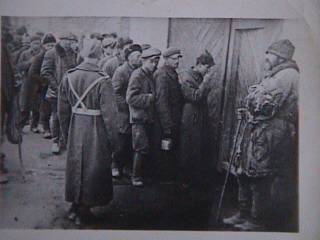
A Russian prison camp. That's my father fourth in line.
He tried to trade his bread ration for cigarettes. A fellow prisoner took him under his wing and set him straight — war is no time to be a smartass. (That man was a prince.)
I never heard the story from my father, but legend has it he escaped. Penza, Mosul, Kirkuk, Baghdad, Aden, Asmara.
He joined with the Polish forces that had been allowed to mobilize under British command.
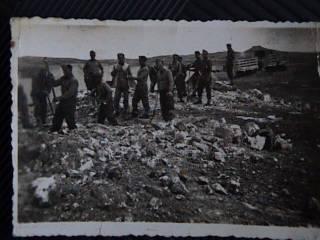
Iraq, November 1942. Setting up camp.
Staszek survived Monte Cassino, survived a bullet to the elbow. My mother's father and her brother were there too, but they wouldn't know Stan till years later, in Coventry, when he'd rent a room from the family.
There is some crucial part of his story that I've missed, something I may never understand. In the long journey from the Soviet gulag, through the battlefields of Italy, to his new homeland, through the losses and the pain, something happened during his trials that freed his soul, something that I may never grasp. He has turned the other cheek and come away with his soul and his humanity intact.
In May 1944, Stasiek was in a trench looking up at the monastery of Monte Cassino, the Nazi-held stronghold in Italy that commanded the road to Rome, and anchored the German 'Gustav' line. The fortress was considered almost impregnable. . .
My father, also Staszek, was there too.
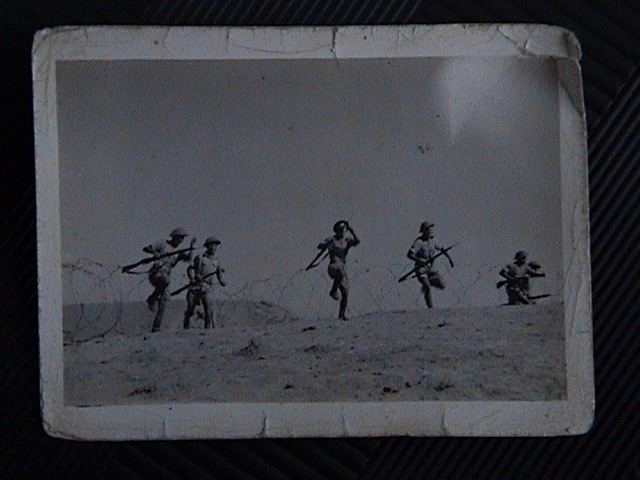
Labelled 1944, this must be Italy.
That he survived the battle was remarkable. More remarkable yet was what he and his comrades had survived to reach that point.
The Russians would've come for my mother's family in the night, but they had advance word. My grandfather's mistress had "information," and she helped ensure my family's passage to Arkhangelsk, a safer alternative than others.
There was a logging industry. My mother remembers the barges, how her brother nearly lost his life. My mother has a fear of water.
There were many trains and villages. When we watch Doctor Zhivago, my mother says it was like that, the trains, the poverty, the snow.
Samarkand, Tashkent, Dzhambul, Frunze, Alma Ata.
At the Chinese border, they were turned back. The family is being divided.
My grandfather and his oldest son have joined the first division. Marysia volunteers her services to communications efforts in Pahlevi. Dyzio and Krysia are placed in orphanages. My mother is the youngest of the siblings, and my grandmother keeps her close.
The surviving Poles walked or hitched rides on boxcars, thousands of miles over the endless steppe and taiga. Many were walking skeletons by the time they reached their transit camps near the Caspian Sea. Wracked with disease and starving to death, families were separated, never finding each other again. Parents lost their children, children their parents.
Krasnovodsk. The Caspian Sea. Pahlevi. The family is finding each other. Poles have been allowed some freedoms. Someone is in love with Marysia and is helping deliver messages.
Tehran. Ahvaz. My grandmother suffers from dysentery. My mother is blind from malnutrition. Tranports are arriving. There are refugee camps in India.
I don't know precisely how my father came to be thrown in prison. Though only 14 or 15 years old at the time, he was already a subversive, distributing socialist literature. I believe he was taken while at school. He never saw his family again.
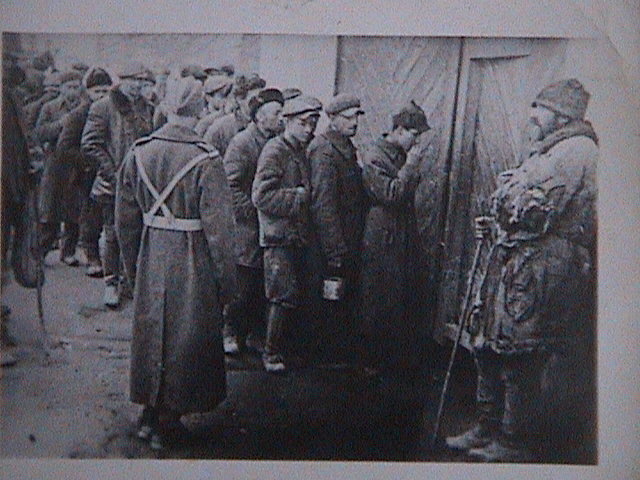
A Russian prison camp. That's my father fourth in line.
He tried to trade his bread ration for cigarettes. A fellow prisoner took him under his wing and set him straight — war is no time to be a smartass. (That man was a prince.)
I never heard the story from my father, but legend has it he escaped. Penza, Mosul, Kirkuk, Baghdad, Aden, Asmara.
He joined with the Polish forces that had been allowed to mobilize under British command.
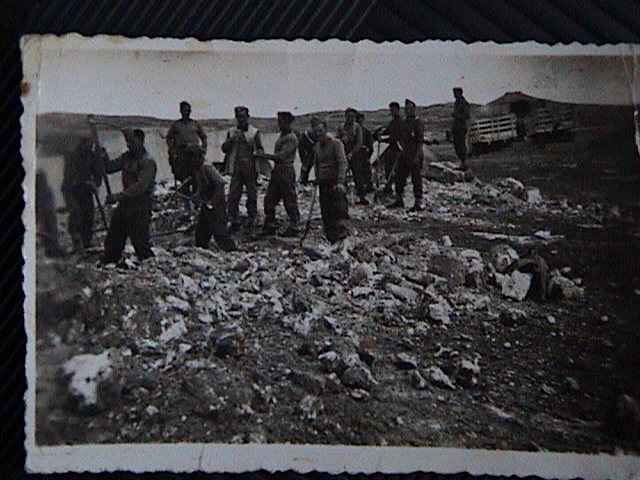
Iraq, November 1942. Setting up camp.
Staszek survived Monte Cassino, survived a bullet to the elbow. My mother's father and her brother were there too, but they wouldn't know Stan till years later, in Coventry, when he'd rent a room from the family.
There is some crucial part of his story that I've missed, something I may never understand. In the long journey from the Soviet gulag, through the battlefields of Italy, to his new homeland, through the losses and the pain, something happened during his trials that freed his soul, something that I may never grasp. He has turned the other cheek and come away with his soul and his humanity intact.
Wednesday, July 14, 2004
I liked The Da Vinci Code, but I watch PBS
Charles Taylor wants to save literature from the literati.
Reading, for Solomon, is always, without exception, a good thing. To hear him tell it, no one ever picks up a trashy book to kill time, no one ever gets around to that classic he always meant to read and finds that it bores him silly. Reading will always leave us better informed and better citizens, Solomon would like to think. But the very nature of a democratic society doesn't offer any guarantees. "Without books," Solomon writes, "we cannot succeed in our current struggle against absolutism and terrorism." Where does he think the terrorists got their absolutist ideas from? And what lessons against absolutism will someone who turns to the works of Ann Coulter or Michael Moore learn?
Solomon wants people to be encouraged to read, and they should be. But it's not going to happen as long as the champions of literature keep telling people the culture they enjoy is nothing but junk, and as long as they keep extolling the highest achievements of language but don't share a language with their countrymen.
Reading, for Solomon, is always, without exception, a good thing. To hear him tell it, no one ever picks up a trashy book to kill time, no one ever gets around to that classic he always meant to read and finds that it bores him silly. Reading will always leave us better informed and better citizens, Solomon would like to think. But the very nature of a democratic society doesn't offer any guarantees. "Without books," Solomon writes, "we cannot succeed in our current struggle against absolutism and terrorism." Where does he think the terrorists got their absolutist ideas from? And what lessons against absolutism will someone who turns to the works of Ann Coulter or Michael Moore learn?
Solomon wants people to be encouraged to read, and they should be. But it's not going to happen as long as the champions of literature keep telling people the culture they enjoy is nothing but junk, and as long as they keep extolling the highest achievements of language but don't share a language with their countrymen.
Patapouf
Helena has a favourite book.
As if it suddenly occurs to her, a smile spreads across her face and she repeats, "Patate. Pata... Patate." She scrambles for her copy of La grosse patate, by Aubrey Davis.
We received this book as gift. It is the French translation of the English text, The Enormous Potato.
This is a retelling of an old folktale, The Great Big Enormous Turnip, credited to Alexei Tolstoy.
One by one, reinforcements are called in to help yank the potato from the ground. This repetitive quality is no doubt the heart of its appeal to Helena.
Amazon identifies the reading level as ages 4 to 8, though I can't see enjoying reading this book so much as being read to from it (like Helena, as a 20-month-old).
Although Helena tolerates my strange French accent, she seems to understand that this books calls out for Papa's expertise. It sounds so natural in French — patate! patapouf! popote! — I can't imagine the English version having the same grab.
The pages are bright yellow. I don't particularly like the illustrations by Dušan Petričić, but I can appreciate how others might attribute to them a certain charm. In fact, I find it very annoying that the focal point of the illustrations is in the fold of the two-page spread, though perhaps this is a deliberate trick to physically draw young noses into the book.
Neither does Helena care for the pictures. But she likes to hear the story told. At least the first 20 pages or so (about two-thirds) — to about where the potato pops out — after which invariably she wanders off to explore much more interesting things.
As if it suddenly occurs to her, a smile spreads across her face and she repeats, "Patate. Pata... Patate." She scrambles for her copy of La grosse patate, by Aubrey Davis.
We received this book as gift. It is the French translation of the English text, The Enormous Potato.
This is a retelling of an old folktale, The Great Big Enormous Turnip, credited to Alexei Tolstoy.
One by one, reinforcements are called in to help yank the potato from the ground. This repetitive quality is no doubt the heart of its appeal to Helena.
Amazon identifies the reading level as ages 4 to 8, though I can't see enjoying reading this book so much as being read to from it (like Helena, as a 20-month-old).
Although Helena tolerates my strange French accent, she seems to understand that this books calls out for Papa's expertise. It sounds so natural in French — patate! patapouf! popote! — I can't imagine the English version having the same grab.
The pages are bright yellow. I don't particularly like the illustrations by Dušan Petričić, but I can appreciate how others might attribute to them a certain charm. In fact, I find it very annoying that the focal point of the illustrations is in the fold of the two-page spread, though perhaps this is a deliberate trick to physically draw young noses into the book.
Neither does Helena care for the pictures. But she likes to hear the story told. At least the first 20 pages or so (about two-thirds) — to about where the potato pops out — after which invariably she wanders off to explore much more interesting things.
Monday, July 12, 2004
Stamps for the storyteller and the most beautiful place on Earth
Maud Newton uncovered a page of postage stamps commemorating Hans Christian Andersen.
My favourite are definitely the series from Poland, although the offerings from Monaco breathe a sweet, soft sadness.

Poland, 1987.
(I have a particular fondness for Polish art of the 1980s, but more on this another time.)
Preparations for the celebrations of the writer's bicentenary are well under way.
He was a storyteller for children of all ages, but he was more than that. He was a critical journalist with great enthusiasm for science, an existential thinker, an observant travel book writer, a passionate novelist, a deft paper cut-out artist, a neurotic hypochondriac and a sex-fixated eccentric. He was a man with demons, dreams, yearnings and visions. He was a man of flesh and blood.
The biography by Jackie Wullschlager promises a colourful portrait.
Perhaps it's time to revisit the fairy tales with Helena. I read quite a number of them while I was nursing her, but I have doubts as to how much Helena retained and I certainly didn't give them my full attention.
They are dark but full of humanity. I don't feel the need to "protect" my baby from these stories. (I'll endeavour to record our progress here.)
Helena's familiarity with Hans Christian Andersen is limited to the musical, starring Danny Kaye, the acquisition of which I viewed as an investment. "Inchworm" is one of our most effective lullabies, though the beauty and simplicity of it may not lull Helena so much as my variations to the lyrics on the theme of mathematical combinations bore her to sleep.
I'd love to show her The Little Mermaid, an animated tale true to the text, from years before Disney Disney-fied the story. I remember seeing it at the theatre — must've been the early 80s — and it devastated me, but it stayed with me (in a good way).
In the spring of 1993 I spent a few weeks in Portugal. On the advice of a stranger, I took the train to Sintra and stayed a week. It's a short trip from Lisbon; by midmorning the main square is packed with tour buses, but they're all gone well before suppertime. No one ever stays. But I did, and to this day I think of it as one the most peaceful times of my life. The morning mist had a meditative quality. After an early breakfast of coffee and oranges, I walked. Just up the street from where I stayed was a modest cottage with a plaque commemorating Hans Christian Andersen's stay.
It's easy to see how that magical place can inspire fairy tales.
My favourite are definitely the series from Poland, although the offerings from Monaco breathe a sweet, soft sadness.

Poland, 1987.
(I have a particular fondness for Polish art of the 1980s, but more on this another time.)
Preparations for the celebrations of the writer's bicentenary are well under way.
He was a storyteller for children of all ages, but he was more than that. He was a critical journalist with great enthusiasm for science, an existential thinker, an observant travel book writer, a passionate novelist, a deft paper cut-out artist, a neurotic hypochondriac and a sex-fixated eccentric. He was a man with demons, dreams, yearnings and visions. He was a man of flesh and blood.
The biography by Jackie Wullschlager promises a colourful portrait.
Perhaps it's time to revisit the fairy tales with Helena. I read quite a number of them while I was nursing her, but I have doubts as to how much Helena retained and I certainly didn't give them my full attention.
They are dark but full of humanity. I don't feel the need to "protect" my baby from these stories. (I'll endeavour to record our progress here.)
Helena's familiarity with Hans Christian Andersen is limited to the musical, starring Danny Kaye, the acquisition of which I viewed as an investment. "Inchworm" is one of our most effective lullabies, though the beauty and simplicity of it may not lull Helena so much as my variations to the lyrics on the theme of mathematical combinations bore her to sleep.
I'd love to show her The Little Mermaid, an animated tale true to the text, from years before Disney Disney-fied the story. I remember seeing it at the theatre — must've been the early 80s — and it devastated me, but it stayed with me (in a good way).
In the spring of 1993 I spent a few weeks in Portugal. On the advice of a stranger, I took the train to Sintra and stayed a week. It's a short trip from Lisbon; by midmorning the main square is packed with tour buses, but they're all gone well before suppertime. No one ever stays. But I did, and to this day I think of it as one the most peaceful times of my life. The morning mist had a meditative quality. After an early breakfast of coffee and oranges, I walked. Just up the street from where I stayed was a modest cottage with a plaque commemorating Hans Christian Andersen's stay.
It's easy to see how that magical place can inspire fairy tales.
Prisoner at the fair
As it happens, we watched another episode of The Prisoner this weekend, The Girl Who Was Death.
Patrick McGoohan, dressed as Sherlock Holmes, follows the girl of the title to a fairground. We reviewed the opening footage of this scene repeteadly; the set looks suspiciously like La Ronde.
The scenes were allegedly shot on location at the now defunct Battersea Funfair in 1967.
However, one shot includes, off in the distance, a flag that looks suspiciously Canadian.
J-F theorizes that stock footage of amusement park rides in action may have been used. I'm not convinced this makes sense if filming was to occur at Battersea anyway, but I have no alternate explanation.
If anyone can supply a reason for a Canadian flag to be flying at Battersea Funfair, or identify the flag that might be mistaken for Canadian, I'd love to hear about it.
Patrick McGoohan, dressed as Sherlock Holmes, follows the girl of the title to a fairground. We reviewed the opening footage of this scene repeteadly; the set looks suspiciously like La Ronde.
The scenes were allegedly shot on location at the now defunct Battersea Funfair in 1967.
However, one shot includes, off in the distance, a flag that looks suspiciously Canadian.
J-F theorizes that stock footage of amusement park rides in action may have been used. I'm not convinced this makes sense if filming was to occur at Battersea anyway, but I have no alternate explanation.
If anyone can supply a reason for a Canadian flag to be flying at Battersea Funfair, or identify the flag that might be mistaken for Canadian, I'd love to hear about it.
Friday, July 09, 2004
No peeking, duck
I'm experiencing significant lag this week. In my head, as well as when it comes to posting. As if I'm not getting around to pulling back my skull cap and shaking the debris loose from inside in time. Everything feels stale and musty.
This was almost the post I would live to regret. But lag saved me from that hell. All the anger and resentment were damped down by confusion.
This is the one where I might've written that J-F can be so infuriatingly thick sometimes, and that I wish Helena would shut up and leave me alone for a minute.
But I don't really mean any of that.
J-F was on holiday from work this week, which meant I had a bit of a holiday too. At least, I got to sleep in a little.
Helena spent a night with my mother-in-law this week as well. I missed her terribly. It was achingly difficult. Having decided to look for work, and to make daycare arrangements for Helena (because it's in her best interest, regardless of the outcome of my job search), I'm painfully aware of how much less time together we will have together. Not only do I genuinely want to spend as much time as possible with her now, before there's no time to spare, I feel doubly guilty for not doing so.
However, Helena had a change of pace — she had the run of the house and yard, and even went swimming; I survived the nightmarish pangs regarding leaving her in my mother-in-law's care in the immediate vicinity of a swimming pool; and J-F and I spent a lovely evening out.
A highlight was venturing into a nearby bar, which until now had seemed intimidating, as if we weren't cool enough to cross its threshold. Sad, because it is the bar closest to home. As it turns out, Bar L'Intrus is a very inviting place. Comfortable. An establishment I'm proud to call my neighbourhood bar. (They were even playing some jazzy Polish tunes, among other ethnically flavoured music.) From now on, I will take all my friends there.
Baby stuff I need to note for posterity before it's forgotten forever:
Helena has developed a taste for tabouleh. She even pinches her pita around it to scoop it up. For some reason, I'm very proud of this. (She still makes a face at hummus though.)
Did I ever mention Helena's heart-shaped nostrils? They were decidedly heart-shaped in her early days, a little less so now.
I remember looking at her tiny hands in those first few days after she was born and remarking on the extraordinary length of her life line, trailing off into the folds of her wrist. Of course, at that time all she had ahead of her was unlimited potential life. I suppose our hands, our lines, are shaped by our experience, and she'd had none. I should look into her palms again tomorrow.
I am awed by Helena's colouring technique. She's master of the light stroke, wisping across the page. But she has experimented with aggressive blots of colour, layered into bumps. I've watched her scratch at her art to peel away some mud, revealing bright colours beneath it. Genius, I say.
Helena takes me by the finger and leads me into the closet alongside her and closes the door, so it's just the two of us standing in the closet in the dark for a minute. Sometimes she babbles a bit or knocks on the door, and often I comment on the dark or question her as to her motives. What on Earth is going through her head?
She can spend easily an hour repeatedly depositing the same $4.32 in small change into her piggy bank. Drop it all in, ask mommy to empty it out, drop it in again...
The doll. It's a really ugly doll, but Helena cares for it. Helena props it up or seats it in her chair, she feeds it and gives it a drink, she adorns it with ribbons and teatowels, she cradles it in her arms.
When the fridge door opens, Helena makes a grab for what she can. Inevitably she comes away with the squeeze bottle of French's mustard (which I don't like and J-F rarely uses and neither of us can remember buying). I've learned to choose my battles, and I don't choose this one. Only once did I find a yellow smear on her cheek. J-F fights the good fight, and it's a struggle. Hence the expression in our household, "like taking mustard from a baby."
This was almost the post I would live to regret. But lag saved me from that hell. All the anger and resentment were damped down by confusion.
This is the one where I might've written that J-F can be so infuriatingly thick sometimes, and that I wish Helena would shut up and leave me alone for a minute.
But I don't really mean any of that.
J-F was on holiday from work this week, which meant I had a bit of a holiday too. At least, I got to sleep in a little.
Helena spent a night with my mother-in-law this week as well. I missed her terribly. It was achingly difficult. Having decided to look for work, and to make daycare arrangements for Helena (because it's in her best interest, regardless of the outcome of my job search), I'm painfully aware of how much less time together we will have together. Not only do I genuinely want to spend as much time as possible with her now, before there's no time to spare, I feel doubly guilty for not doing so.
However, Helena had a change of pace — she had the run of the house and yard, and even went swimming; I survived the nightmarish pangs regarding leaving her in my mother-in-law's care in the immediate vicinity of a swimming pool; and J-F and I spent a lovely evening out.
A highlight was venturing into a nearby bar, which until now had seemed intimidating, as if we weren't cool enough to cross its threshold. Sad, because it is the bar closest to home. As it turns out, Bar L'Intrus is a very inviting place. Comfortable. An establishment I'm proud to call my neighbourhood bar. (They were even playing some jazzy Polish tunes, among other ethnically flavoured music.) From now on, I will take all my friends there.
Baby stuff I need to note for posterity before it's forgotten forever:
Helena has developed a taste for tabouleh. She even pinches her pita around it to scoop it up. For some reason, I'm very proud of this. (She still makes a face at hummus though.)
Did I ever mention Helena's heart-shaped nostrils? They were decidedly heart-shaped in her early days, a little less so now.
I remember looking at her tiny hands in those first few days after she was born and remarking on the extraordinary length of her life line, trailing off into the folds of her wrist. Of course, at that time all she had ahead of her was unlimited potential life. I suppose our hands, our lines, are shaped by our experience, and she'd had none. I should look into her palms again tomorrow.
I am awed by Helena's colouring technique. She's master of the light stroke, wisping across the page. But she has experimented with aggressive blots of colour, layered into bumps. I've watched her scratch at her art to peel away some mud, revealing bright colours beneath it. Genius, I say.
Helena takes me by the finger and leads me into the closet alongside her and closes the door, so it's just the two of us standing in the closet in the dark for a minute. Sometimes she babbles a bit or knocks on the door, and often I comment on the dark or question her as to her motives. What on Earth is going through her head?
She can spend easily an hour repeatedly depositing the same $4.32 in small change into her piggy bank. Drop it all in, ask mommy to empty it out, drop it in again...
The doll. It's a really ugly doll, but Helena cares for it. Helena props it up or seats it in her chair, she feeds it and gives it a drink, she adorns it with ribbons and teatowels, she cradles it in her arms.
When the fridge door opens, Helena makes a grab for what she can. Inevitably she comes away with the squeeze bottle of French's mustard (which I don't like and J-F rarely uses and neither of us can remember buying). I've learned to choose my battles, and I don't choose this one. Only once did I find a yellow smear on her cheek. J-F fights the good fight, and it's a struggle. Hence the expression in our household, "like taking mustard from a baby."
Thursday, July 08, 2004
Prisoner numbers
At Maisonneuve, Frank Smith remembers The Prisoner.
Number Six was a brooding and paranoid figure, quite unlike any hero I’d seen before (or have seen since). While Emma Peel and John Steed were out preventing quirky villains from achieving world domination, Number Six was more likely to be found pacing back and forth in his kitchen after having smashed up his radio, or running along a beach being chased by a weather balloon.
I always liked Number Six. He was cranky and quick-witted; he fought against the system; and despite being brought to his knees each time he stepped outside the box, he never stopped trying and instead grew ever more subversive in his attempts to escape. When you are twelve and living in Ohio, this sort of thing speaks to you in a very specific way.
Like when I was 16, in Southern Ontario.
My grade 8 teacher called us by number. Easier for him to keep track and maintain his files, he said. I was number 8. In an act of civil disobedience, I refused to answer. I pulled that only once. He was a very large and imposing man. He once held Keith by the neck up against the blackboard. At least a foot off the ground. I heard he died some years ago of a brain hemorrhage.
I regret to say we've not yet watched all of the box set. I need to fully digest the episodes viewed to date before proceeding — a slow but satisfying process.
Number Six was a brooding and paranoid figure, quite unlike any hero I’d seen before (or have seen since). While Emma Peel and John Steed were out preventing quirky villains from achieving world domination, Number Six was more likely to be found pacing back and forth in his kitchen after having smashed up his radio, or running along a beach being chased by a weather balloon.
I always liked Number Six. He was cranky and quick-witted; he fought against the system; and despite being brought to his knees each time he stepped outside the box, he never stopped trying and instead grew ever more subversive in his attempts to escape. When you are twelve and living in Ohio, this sort of thing speaks to you in a very specific way.
Like when I was 16, in Southern Ontario.
My grade 8 teacher called us by number. Easier for him to keep track and maintain his files, he said. I was number 8. In an act of civil disobedience, I refused to answer. I pulled that only once. He was a very large and imposing man. He once held Keith by the neck up against the blackboard. At least a foot off the ground. I heard he died some years ago of a brain hemorrhage.
I regret to say we've not yet watched all of the box set. I need to fully digest the episodes viewed to date before proceeding — a slow but satisfying process.
Bad books for kids
Madonna, Billy Crystal, Jimmy Fallon, Paul McCartney, Jay Leno, Will Smith. And on, and on, and on.
Is there any good children's literature being written anymore? Or is it just harder to find amid the big bucks and celebrity hype?
The battle for kiddie lit has been waged, but as yet no one is winning.
Younger children aren't to blame for what is published, because young kids don't pick their reading lists. Parents do. And apparently they suck at it, because there is a smaller and smaller market for really good picture books. . . It is not enough to give kids books. We must give them ones that don't suck ass.
I'm not worried about rich celebrities getting richer by authoring bad picture books. Writers like me aren't underpaid. Teachers are underpaid. Supermarket checkout workers are underpaid. The vast majority of writers (myself included) perform the most minor of services. But the best, whether they write for kids or adults, expand readers' understanding of what words are, and what they do. And that's why we must not give ass-sucking books by Billy Crystal and his ilk to our children, because only great books teach us how to read.
Maybe it's the genuine dearth of good kids' books that makes everyone believe they could write a better one. Everyone. As if it were an easy thing to do. Just whip off a children's story off the top of their head.
Writing for children must be one of the most difficult things a person could choose to do. You must be engaging, without being phony. Smart, without being condescending. All things moral and good, without being preachy.
Children are excellent, honest critics. If little Johnny doesn't want to read, maybe it's because the book you're giving him is crap.
But there is a small window, one in which Helena is perched now, where you can show them the pleasures of reading, the worlds books have to offer. Before she gains full independence to make her own choices.
Do children's authors not realize the responsibility they take on?
Is there any good children's literature being written anymore? Or is it just harder to find amid the big bucks and celebrity hype?
The battle for kiddie lit has been waged, but as yet no one is winning.
Younger children aren't to blame for what is published, because young kids don't pick their reading lists. Parents do. And apparently they suck at it, because there is a smaller and smaller market for really good picture books. . . It is not enough to give kids books. We must give them ones that don't suck ass.
I'm not worried about rich celebrities getting richer by authoring bad picture books. Writers like me aren't underpaid. Teachers are underpaid. Supermarket checkout workers are underpaid. The vast majority of writers (myself included) perform the most minor of services. But the best, whether they write for kids or adults, expand readers' understanding of what words are, and what they do. And that's why we must not give ass-sucking books by Billy Crystal and his ilk to our children, because only great books teach us how to read.
Maybe it's the genuine dearth of good kids' books that makes everyone believe they could write a better one. Everyone. As if it were an easy thing to do. Just whip off a children's story off the top of their head.
Writing for children must be one of the most difficult things a person could choose to do. You must be engaging, without being phony. Smart, without being condescending. All things moral and good, without being preachy.
Children are excellent, honest critics. If little Johnny doesn't want to read, maybe it's because the book you're giving him is crap.
But there is a small window, one in which Helena is perched now, where you can show them the pleasures of reading, the worlds books have to offer. Before she gains full independence to make her own choices.
Do children's authors not realize the responsibility they take on?
Wednesday, July 07, 2004
Let x = x
NASA has an artist-in-residence, and her name is Laurie Anderson.
Why should NASA set aside money for paintings and music? "Art is what's left behind of history," said Bertram Ulrich, curator of the NASA Art Program. "It's a way to document something for future generations."
Science and Art! What a perfect combination! How come nobody ever thought of that before?
NASA began its art program in 1963 but never before had it tapped a resident artist, nor had it pushed the aesthetic envelope so boldly by choosing a performer whose large-scale theatrical productions blended "Star Trek" and Melville. Anderson is no Faith Hill.
A serious musician. Her work is actually supposed to mean something.
The idea of an avant-garde electronic fiddler hanging out with rocket geeks at NASA's research centers may seem like an odd collaboration. At the Ames center in Silicon Valley, Anderson stood inside a virtual airport control tower to view scenes of Mars terrain, taking photos and recording notes in a small red notebook. The researchers' reaction to their visitor was mixed, according to a NASA newsletter. One confessed to being a huge fan; another doubted the partnership of art and science. "What's she going to do, write a poem?" the researcher asked.
In fact, Anderson's passions run parallel with the pocket-protector crowd. She has collaborated with the Interval Research Corp. in California to design a wireless musical instrument called the Talking Stick, which emits sound when touched.
Laurie Anderson has been innovating violin-based instruments for decades, as a musical tool but also as a performance art thing-in-itself.
She took her art to the streets of downtown New York. She once stood on a block of ice, playing her violin while wearing ice skates. When the ice melted, the show was over.
I heard this story for the first time when the school orchestra was visiting Boston as part of a music exchange program in the spring of 1985. Me and this other girl — I can't remember her name, don't know what instrument she played, and have only a vague recollection of what she looked like (big hair) — we were billeted to stay with Kirsten, a violinist like myself.
Kirsten was cool. We smoked cigarillos down by the river. I bought a Clash (Sandinista!) t-shirt. We people-watched. Hordes of Deadheads were in town for a show. More interesting were the cliques of cool people amassing for the Pretenders concert that night.
After wasting away the afternoon, Kirsten thought she'd take us over to a friend's place at the university. But it wasn't really her friend, it was her older sister's friend, and the family didn't know about this friendship, not even the sister knew, cuz they wouldn't approve. In retrospect, I figure Kirsten was probably buying drugs off her.
The thing is, no one knew her real name. She was referred to affectionately as Madwoman. Cuz she was mad. Crazy, that is.
We sit on the floor of Madwoman's room while she gripes about the term paper she's struggling with, and, because it has something to do with said paper, she tells us the story of Laurie Anderson and the ice skates.
Like that, I was a fan.
When I got home, I tried to spread the word about Laurie Anderson, but it didn't go over well. The electric violin connection didn't pass with my music teacher (and I really should've known better since he'd frowned on my report on Erik Satie, dismissing him as trivial). Nobody knew what I was talking about.
See this fan site for more on Laurie Anderson.
Maud Newton headed this news item "Language is a virus from outer space," a famous lyric.
Those famous words are attributed to William S Burroughs (for whom I hold the deepest respect for his attempts to infiltrate the Scientologists). The statement is often abbreviated to "Language is a virus."
I have yet to meet someone who can satisfactorily explain the statement, let alone point to a precise source, and full context, for the quotation.
The gist and intent of the sentiment seem to reside in The Electronic Revolution.
Neal Stephenson's Snow Crash owes a vast debt to the idea.
Language is a virus from outer space. — William S Burroughs
Why should NASA set aside money for paintings and music? "Art is what's left behind of history," said Bertram Ulrich, curator of the NASA Art Program. "It's a way to document something for future generations."
Science and Art! What a perfect combination! How come nobody ever thought of that before?
NASA began its art program in 1963 but never before had it tapped a resident artist, nor had it pushed the aesthetic envelope so boldly by choosing a performer whose large-scale theatrical productions blended "Star Trek" and Melville. Anderson is no Faith Hill.
A serious musician. Her work is actually supposed to mean something.
The idea of an avant-garde electronic fiddler hanging out with rocket geeks at NASA's research centers may seem like an odd collaboration. At the Ames center in Silicon Valley, Anderson stood inside a virtual airport control tower to view scenes of Mars terrain, taking photos and recording notes in a small red notebook. The researchers' reaction to their visitor was mixed, according to a NASA newsletter. One confessed to being a huge fan; another doubted the partnership of art and science. "What's she going to do, write a poem?" the researcher asked.
In fact, Anderson's passions run parallel with the pocket-protector crowd. She has collaborated with the Interval Research Corp. in California to design a wireless musical instrument called the Talking Stick, which emits sound when touched.
Laurie Anderson has been innovating violin-based instruments for decades, as a musical tool but also as a performance art thing-in-itself.
She took her art to the streets of downtown New York. She once stood on a block of ice, playing her violin while wearing ice skates. When the ice melted, the show was over.
I heard this story for the first time when the school orchestra was visiting Boston as part of a music exchange program in the spring of 1985. Me and this other girl — I can't remember her name, don't know what instrument she played, and have only a vague recollection of what she looked like (big hair) — we were billeted to stay with Kirsten, a violinist like myself.
Kirsten was cool. We smoked cigarillos down by the river. I bought a Clash (Sandinista!) t-shirt. We people-watched. Hordes of Deadheads were in town for a show. More interesting were the cliques of cool people amassing for the Pretenders concert that night.
After wasting away the afternoon, Kirsten thought she'd take us over to a friend's place at the university. But it wasn't really her friend, it was her older sister's friend, and the family didn't know about this friendship, not even the sister knew, cuz they wouldn't approve. In retrospect, I figure Kirsten was probably buying drugs off her.
The thing is, no one knew her real name. She was referred to affectionately as Madwoman. Cuz she was mad. Crazy, that is.
We sit on the floor of Madwoman's room while she gripes about the term paper she's struggling with, and, because it has something to do with said paper, she tells us the story of Laurie Anderson and the ice skates.
Like that, I was a fan.
When I got home, I tried to spread the word about Laurie Anderson, but it didn't go over well. The electric violin connection didn't pass with my music teacher (and I really should've known better since he'd frowned on my report on Erik Satie, dismissing him as trivial). Nobody knew what I was talking about.
See this fan site for more on Laurie Anderson.
Maud Newton headed this news item "Language is a virus from outer space," a famous lyric.
Those famous words are attributed to William S Burroughs (for whom I hold the deepest respect for his attempts to infiltrate the Scientologists). The statement is often abbreviated to "Language is a virus."
I have yet to meet someone who can satisfactorily explain the statement, let alone point to a precise source, and full context, for the quotation.
The gist and intent of the sentiment seem to reside in The Electronic Revolution.
Neal Stephenson's Snow Crash owes a vast debt to the idea.
Language is a virus from outer space. — William S Burroughs
Another breach of trust
Journalistic ethics at the National Post may be in question.
In a story mysteriously filed under Arts, the CBC reports:
In a brief note to readers, the Post said it had discovered that medical reporter Brad Evenson had fabricated names and quotes.
The paper said nine articles dating back to December 2002 contained "quotes that were either the result of other conversations, internet exchanges or readings, but they were not made by the people cited."
Although the note does not say Evenson was fired, it indicated that his "articles have not appeared in the paper" since senior editors became aware that he had been making up material for his reports.
First the editorial opinions came under control. Now the facts.
In a story mysteriously filed under Arts, the CBC reports:
In a brief note to readers, the Post said it had discovered that medical reporter Brad Evenson had fabricated names and quotes.
The paper said nine articles dating back to December 2002 contained "quotes that were either the result of other conversations, internet exchanges or readings, but they were not made by the people cited."
Although the note does not say Evenson was fired, it indicated that his "articles have not appeared in the paper" since senior editors became aware that he had been making up material for his reports.
First the editorial opinions came under control. Now the facts.
Monday, July 05, 2004
What I remember
We tuned into CBC in the car on the way home this evening and were lucky to catch Next: "The Pills That Ate My Brain: Neuroceuticals and Freedom of Thought."
This is really exciting stuff, I thought. Enhancing the cognitive function of the brain. Enhancing memory. Erasing memory. Freedom of thought, defining thought in legal terms.
The irony is that, as much as I wanted to blog about some of the issues raised, I'm having trouble recalling most of the show. Only a general impression remains.
It's all about control, of course, and the fear that someone other than yourself may be accessing and controlling your memory, your thoughts, the stuff that makes you you.
Memory-enhancing drugs are already on the market. An aging baby boomer population creates an obvious demand for such a "medication." We've medicalized another natural process.
As with mood-altering drugs one might wonder whether they treat a "disease" or simply make you more "competitive."
We need to acknowledge that many "prescription" drugs are often used illegally and for recreational purposes, purposes other than those for which they've been medically and governmentally approved. That a drug can help Grampa remember the name of his childhood pet has vaster implications.
If a drug can access a memory, perhaps erase a memory, how long before the technology exists to modify one, or to insert a pure fiction? Time-release capsules, like a computer virus, to bend your perception of reality and control your actions.
Some of the dangers of neurotechnology.
Neuroceuticals: nutritional supplements for the brain.
Freedom of thought is a poorly understand constitutional right, but the technologies already exist to threaten it. The Center for Cognitive Liberty and Ethics (CCLE) in Davis, California, tries to provide legal theory and principles to guide courts, policy makers and civil liberty experts.
Brain fingerprinting is designed to determine whether an individual recognizes specific information related to an event or activity by measuring electrical brain wave responses to words, phrases, or pictures presented on a computer screen. [It] is considered a type of Guilty Knowledge Test, where the "guilty" party is expected to react strongly to the relevant details of the event or activity.
See also The Journal of Cognitive Liberties.
Additional links.
Coincidentally, we watched and enjoyed The Butterfly Effect the other night. Chilling and disturbing in ways I hadn't expected. The life-changing events at issue were indeed gruesome and difficult. And this is the only problem with the concept of the film — these events were not butterflies. We can certainly extrapolate to understand that even insignificant events might have profound effects, but on this count I really felt I was slammed in the face with a sledgehammer.
The question of how one accesses memory, and then travels in time to alter the facts constituting the memory, is never satisfactorily addressed (but then we never really expect movies to solve the problem of time travel).
This is really exciting stuff, I thought. Enhancing the cognitive function of the brain. Enhancing memory. Erasing memory. Freedom of thought, defining thought in legal terms.
The irony is that, as much as I wanted to blog about some of the issues raised, I'm having trouble recalling most of the show. Only a general impression remains.
It's all about control, of course, and the fear that someone other than yourself may be accessing and controlling your memory, your thoughts, the stuff that makes you you.
Memory-enhancing drugs are already on the market. An aging baby boomer population creates an obvious demand for such a "medication." We've medicalized another natural process.
As with mood-altering drugs one might wonder whether they treat a "disease" or simply make you more "competitive."
We need to acknowledge that many "prescription" drugs are often used illegally and for recreational purposes, purposes other than those for which they've been medically and governmentally approved. That a drug can help Grampa remember the name of his childhood pet has vaster implications.
If a drug can access a memory, perhaps erase a memory, how long before the technology exists to modify one, or to insert a pure fiction? Time-release capsules, like a computer virus, to bend your perception of reality and control your actions.
Some of the dangers of neurotechnology.
Neuroceuticals: nutritional supplements for the brain.
Freedom of thought is a poorly understand constitutional right, but the technologies already exist to threaten it. The Center for Cognitive Liberty and Ethics (CCLE) in Davis, California, tries to provide legal theory and principles to guide courts, policy makers and civil liberty experts.
Brain fingerprinting is designed to determine whether an individual recognizes specific information related to an event or activity by measuring electrical brain wave responses to words, phrases, or pictures presented on a computer screen. [It] is considered a type of Guilty Knowledge Test, where the "guilty" party is expected to react strongly to the relevant details of the event or activity.
See also The Journal of Cognitive Liberties.
Additional links.
Coincidentally, we watched and enjoyed The Butterfly Effect the other night. Chilling and disturbing in ways I hadn't expected. The life-changing events at issue were indeed gruesome and difficult. And this is the only problem with the concept of the film — these events were not butterflies. We can certainly extrapolate to understand that even insignificant events might have profound effects, but on this count I really felt I was slammed in the face with a sledgehammer.
The question of how one accesses memory, and then travels in time to alter the facts constituting the memory, is never satisfactorily addressed (but then we never really expect movies to solve the problem of time travel).
Sunday, July 04, 2004
Read this book!
The First Century After Beatrice, by Amin Maalouf. It's really happening. Go find a copy right now. It's important.
Bare branches: the branches of the family tree that will never bear fruit.
The technology to identify the sex of a fetus became widespread in Asia in the mid-1980s, and more and more parents each year have used it to weed out less-valued daughters before they are born. Even though identification of the sex of a fetus, as well as sex-selective abortion, is illegal throughout Asia, the balance of boys and girls in the younger generations continues to worsen in many of these countries.
In China, according to the 2000 census, there are 120 boys for every 100 girls.
Scarcity of women leads to a situation in which men with advantages — money, skills, education — will marry, but men without such advantages — poor, unskilled, illiterate — will not. A permanent subclass of bare branches from the lowest socioeconomic classes is created.
And that makes trouble.
Throughout history, bare branches in East and South Asia have played a role in aggravating societal instability, violent crime and gang formation.
Love your daughters! Value them. Tell your governments to treat them fairly. Make sure they are never thought inferior or second-class. Teach your sons to respect them.
Bare branches: the branches of the family tree that will never bear fruit.
The technology to identify the sex of a fetus became widespread in Asia in the mid-1980s, and more and more parents each year have used it to weed out less-valued daughters before they are born. Even though identification of the sex of a fetus, as well as sex-selective abortion, is illegal throughout Asia, the balance of boys and girls in the younger generations continues to worsen in many of these countries.
In China, according to the 2000 census, there are 120 boys for every 100 girls.
Scarcity of women leads to a situation in which men with advantages — money, skills, education — will marry, but men without such advantages — poor, unskilled, illiterate — will not. A permanent subclass of bare branches from the lowest socioeconomic classes is created.
And that makes trouble.
Throughout history, bare branches in East and South Asia have played a role in aggravating societal instability, violent crime and gang formation.
Love your daughters! Value them. Tell your governments to treat them fairly. Make sure they are never thought inferior or second-class. Teach your sons to respect them.
Movie meme
You can see the movie meme Scribbling Woman posted, along with links to its earlier and other incarnations.
I won't reproduce my list here, not because I have anything to hide — I freely admit that I consume crap by the bucketfull — but because I don't think anybody would care.
(Why do we do these things?)
However, following the instructions to add three movies to the list, I would add Pi, The Big Lebowski, and The Cook, The Thief, The Wife, and Her Lover, being films reactions to which offer some insight into the character of people who see them. Maybe.
Shoot. Just three? OK. Scratch those. How about Liquid Sky, Cube, and The Hudsucker Proxy?
Maybe I should simply offer you a list of movies, my favourite, for very different reasons, of all time (in alphabetical order):
The Big Lebowski
Bitter Moon
Breakfast at Tiffany's
Casablanca
Gattaca
Gilda
Three Colors Trilogy (Blue, White, Red) — I'd be hard-pressed to have to choose just one of them. OK, White. White is my sentimental favourite.
Until the End of the World
Wages of Fear
Wings of Desire
Does that make a round number of some kind? My Top X. Aw, fuck it.
To my mind one of the greatest entertainment industry mysteries of all time:
How is it that Tom Cruise, short and a scientologist, comes to choose roles in such very interesting (but not particularly "successful") movies: Eyes Wide Shut, Minority Report, Vanilla Sky (all of which I am considering adding to the above list)?
I won't reproduce my list here, not because I have anything to hide — I freely admit that I consume crap by the bucketfull — but because I don't think anybody would care.
(Why do we do these things?)
However, following the instructions to add three movies to the list, I would add Pi, The Big Lebowski, and The Cook, The Thief, The Wife, and Her Lover, being films reactions to which offer some insight into the character of people who see them. Maybe.
Shoot. Just three? OK. Scratch those. How about Liquid Sky, Cube, and The Hudsucker Proxy?
Maybe I should simply offer you a list of movies, my favourite, for very different reasons, of all time (in alphabetical order):
The Big Lebowski
Bitter Moon
Breakfast at Tiffany's
Casablanca
Gattaca
Gilda
Three Colors Trilogy (Blue, White, Red) — I'd be hard-pressed to have to choose just one of them. OK, White. White is my sentimental favourite.
Until the End of the World
Wages of Fear
Wings of Desire
Does that make a round number of some kind? My Top X. Aw, fuck it.
To my mind one of the greatest entertainment industry mysteries of all time:
How is it that Tom Cruise, short and a scientologist, comes to choose roles in such very interesting (but not particularly "successful") movies: Eyes Wide Shut, Minority Report, Vanilla Sky (all of which I am considering adding to the above list)?
Saturday, July 03, 2004
Wading
Today was the day. A summer's day perfect for intitiation to seasonal water rituals.

Testing the waters.
Helena splashed up a storm.
Exhausted from water play, she was asleep by 6. We'll see if she sticks out the night. . .
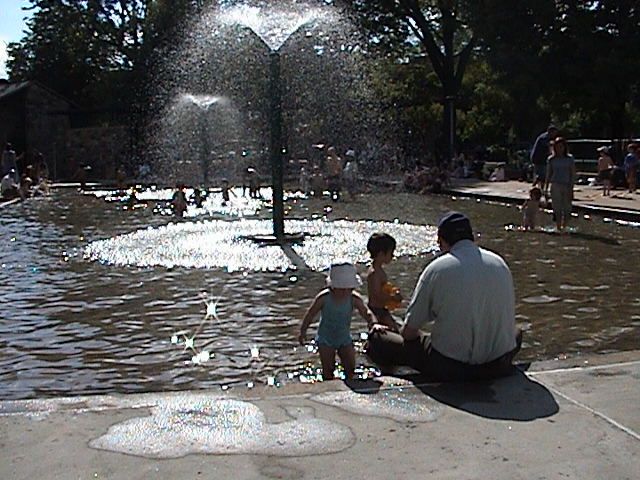
Testing the waters.
Helena splashed up a storm.
Exhausted from water play, she was asleep by 6. We'll see if she sticks out the night. . .
To hell with it
The July 5 issue of The New Yorker finally hit the stands in these parts yesterday (believe me — I've been checking every day this week), though it seems our neighbours south of the border were privileged to see it a few days beforehand.
Helena was asleep in the stroller before we even hit the magazine store. She stayed asleep while I indulged in a cappuccino and burrowed into the comfy chair to read.
Caitlin Flanagan is still infuriating, but a little softer.
According to Rebel Dad:
She seems to have a harder time embracing the kind of all-consuming motherhood that she has sung the praises of in the Atlantic. . . And her transition from at-home mom to magazine superstar has softened her view of working parents, even as she retains fondness for traditional mothers.
See the press release for a summary of the article.
I find it hard to put a finger on what's wrong with the way Flanagan thinks. She's often illogical and her arguments are inconsistent. Like lot of people I know. Real and good people.
She's just so damn self-centred.
She writes:
In my childish apprehension of things, my father was happiest when he was sitting in his armchair reading a big, fat book, and my mother when she was standing at her ironing board transforming a chaotic basket of wash into a set of sleek and polished garments.
Well, it's a sign of maturity that she recognizes this picture-perfect memory as her childish apprehension of things. What freaky world does she think she grew up in?
It's hard to feel sorry for Flanagan. Twelve years old when her mother decides to put her professional training to good use. Now, I can't exactly relate — my mom stayed home. But the moms of many of my friends did not. None of them feel toward their mothers the kind of anger and resentment Flanagan relates. She comes across as a selfish, spoiled, unlikeable adolescent who refuses to make any effort in understanding anything that isn't going her way.
Obviously, there are no easy and universal answers. I'd like to believe that Flanagan has always known that. She's just had trouble expressing it. It's her snobby–preachy writing style that has wrought her so many enemies. The attitude in her writing is softening. With more real-life experience, she's more willing to admit her own shortcomings and hypocrisies.
Apartment 11D nicely sums up what I expect is going through the heads of most mothers reading the article, looking for answers no one can offer:
Are the kids better off with me rather than some professionals who would be making duckies and shit out of yarn and a soda can? With lots of other kids around them?
Duckie crafts and friends v. treats and kisses. I don't know. Maybe it's a draw.
Helena was asleep in the stroller before we even hit the magazine store. She stayed asleep while I indulged in a cappuccino and burrowed into the comfy chair to read.
Caitlin Flanagan is still infuriating, but a little softer.
According to Rebel Dad:
She seems to have a harder time embracing the kind of all-consuming motherhood that she has sung the praises of in the Atlantic. . . And her transition from at-home mom to magazine superstar has softened her view of working parents, even as she retains fondness for traditional mothers.
See the press release for a summary of the article.
I find it hard to put a finger on what's wrong with the way Flanagan thinks. She's often illogical and her arguments are inconsistent. Like lot of people I know. Real and good people.
She's just so damn self-centred.
She writes:
In my childish apprehension of things, my father was happiest when he was sitting in his armchair reading a big, fat book, and my mother when she was standing at her ironing board transforming a chaotic basket of wash into a set of sleek and polished garments.
Well, it's a sign of maturity that she recognizes this picture-perfect memory as her childish apprehension of things. What freaky world does she think she grew up in?
It's hard to feel sorry for Flanagan. Twelve years old when her mother decides to put her professional training to good use. Now, I can't exactly relate — my mom stayed home. But the moms of many of my friends did not. None of them feel toward their mothers the kind of anger and resentment Flanagan relates. She comes across as a selfish, spoiled, unlikeable adolescent who refuses to make any effort in understanding anything that isn't going her way.
Obviously, there are no easy and universal answers. I'd like to believe that Flanagan has always known that. She's just had trouble expressing it. It's her snobby–preachy writing style that has wrought her so many enemies. The attitude in her writing is softening. With more real-life experience, she's more willing to admit her own shortcomings and hypocrisies.
Apartment 11D nicely sums up what I expect is going through the heads of most mothers reading the article, looking for answers no one can offer:
Are the kids better off with me rather than some professionals who would be making duckies and shit out of yarn and a soda can? With lots of other kids around them?
Duckie crafts and friends v. treats and kisses. I don't know. Maybe it's a draw.
Friday, July 02, 2004
Reading in the half-light of semi-consciousness
Disclaimer: This is a record of my emotional reaction to a novel. No critical analysis was involved in the creation of this post.
Finally. Finally, finally, finally! After five long years, I can move Reading in the Dark, by Seamus Deane, from the shelf of unread books in my bedroom to the main repository.
Apparently, "Deane's book is the warmly compassionate, painstakingly gorgeous work of a mature man who wishes to memorialize the dead without yielding to sentimentality."
Yet somehow too sentimental for my taste.
He re-creates a landscape where the two principal modes of Irish myth-making, nationalist and supernatural, intertwine like a double helix, a landscape where the fabulous mingles with the workaday, where fairy children, one eye green and one brown, stand by police cars in the flickering light of Derry's tribal bonfires.
Whatever.
The language was "poetic," and the strung-together vignettes were somewhat poignant, funny, charming, etc.
But I found it all dreadfully boring.
Things Irish hold no particular appeal for me. But there must be more to my disinterest than that.
Family secrets. Skeletons and ghosts. Big deal. Everybody has those. I couldn't bring myself to care.
My fault, or the author's fault?
Reading in the Dark was shortlisted for the Booker Prize in 1996, along with the far superior and vastly more haunting and mysterious Alias Grace, by Margaret Atwood.
A reading guide is available.
Finally. Finally, finally, finally! After five long years, I can move Reading in the Dark, by Seamus Deane, from the shelf of unread books in my bedroom to the main repository.
Apparently, "Deane's book is the warmly compassionate, painstakingly gorgeous work of a mature man who wishes to memorialize the dead without yielding to sentimentality."
Yet somehow too sentimental for my taste.
He re-creates a landscape where the two principal modes of Irish myth-making, nationalist and supernatural, intertwine like a double helix, a landscape where the fabulous mingles with the workaday, where fairy children, one eye green and one brown, stand by police cars in the flickering light of Derry's tribal bonfires.
Whatever.
The language was "poetic," and the strung-together vignettes were somewhat poignant, funny, charming, etc.
But I found it all dreadfully boring.
Things Irish hold no particular appeal for me. But there must be more to my disinterest than that.
Family secrets. Skeletons and ghosts. Big deal. Everybody has those. I couldn't bring myself to care.
My fault, or the author's fault?
Reading in the Dark was shortlisted for the Booker Prize in 1996, along with the far superior and vastly more haunting and mysterious Alias Grace, by Margaret Atwood.
A reading guide is available.
Thursday, July 01, 2004

Wednesday, June 30, 2004
Only in Canada
Canada Day is upon us. July 1. The height of summer. What better time to discuss your favourite hockey jerseys?
(Were it actually hockey season, one would be far too engrossed in the game to follow such a conversation.)
Some odd signs around the park:

The international symbol for No Hockey-Playing.
That means you, you lazy ducks.

The international symbol for No Tobogganing.
The graphic's nothing special (or is it?). I find it amusing primarily for its location — at the bottom of the slope.
Then there's the near indecipherable:

The international symbol for Looney Tunes Incident In Progress.
(Were it actually hockey season, one would be far too engrossed in the game to follow such a conversation.)
Some odd signs around the park:

The international symbol for No Hockey-Playing.
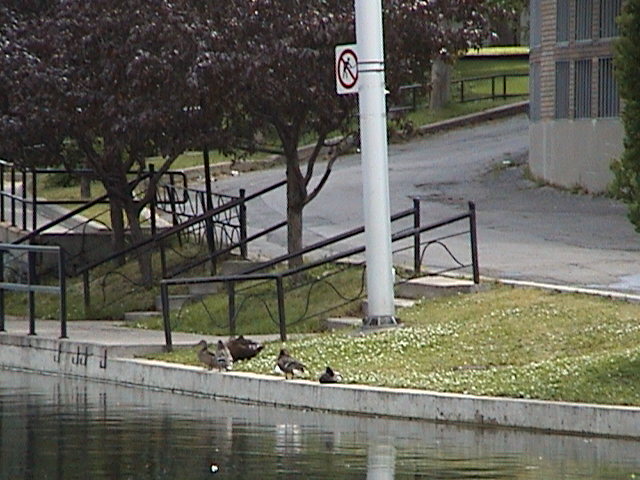
That means you, you lazy ducks.

The international symbol for No Tobogganing.
The graphic's nothing special (or is it?). I find it amusing primarily for its location — at the bottom of the slope.
Then there's the near indecipherable:

The international symbol for Looney Tunes Incident In Progress.
Squirrels with attitude
Consider this post a public service, for all those poor folks who arrive at this blog via their Google search for "aggressive squirrels."
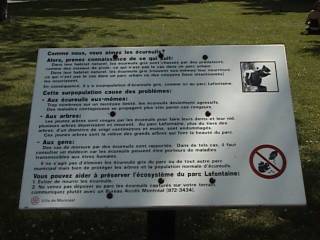
Squirrels are your friends. Kind of.
We stumbled across this valuable information the other day at the park. According to the signage by the kind people of the Ville de Montréal, squirrel aggression stems from overpopulation and the subsequent competition for food.
The population of squirrels in their natural habitat is kept under control by their natural predators (primarily large birds), of which there are none in the park.
There have been reports of squirrels biting people, but we're not told how many, and it's not clear if those incidents occurred in this park or elsewhere.
If you have been bitten, see a doctor.
But as J-F notes, if the squirrels are vying for your crumbs, you'd think they'd be extra nice to you.

The international symbol for No Squirrel-Feeding

Squirrels are your friends. Kind of.
We stumbled across this valuable information the other day at the park. According to the signage by the kind people of the Ville de Montréal, squirrel aggression stems from overpopulation and the subsequent competition for food.
The population of squirrels in their natural habitat is kept under control by their natural predators (primarily large birds), of which there are none in the park.
There have been reports of squirrels biting people, but we're not told how many, and it's not clear if those incidents occurred in this park or elsewhere.
If you have been bitten, see a doctor.
But as J-F notes, if the squirrels are vying for your crumbs, you'd think they'd be extra nice to you.

The international symbol for No Squirrel-Feeding
Tuesday, June 29, 2004
Boring inner world, exciting outer world
Ah, yes. All the debris that was milling about in my head yesterday that I couldn't find time to sweep away.
An article in The New York Times, "Books Make You a Boring Person," by Cristina Nehring, is causing a bit of a stir.
There's a new piety in the air: the self-congratulation of book lovers. Long considered immune to criticism by virtue of being outnumbered by channel surfers, Internet addicts, video maniacs and other armchair introverts, bookworms have developed a semi-mystical complacency about the moral and mental benefits of reading. . . To be a reader these days is to be a sterling member of society, a thoughtful and sensitive human being, a winner.
We assume that reading requires a formidable intellect. We forget that books were the television of previous years — by which I mean they were the source of passive entertainment as well as occasional enlightenment, of social alienation as well as private joy, of idleness as well as inspiration. Books were a mixed bag, and they still are. Books could be used or misused, and they still can be.
There are responses from Maud Newton and Tingle Alley.
The truth is, I am pretty boring. And I do read a ton of crap for pleasure, and I often don't retain much. In one ear (eye?), out the other.
I have sssoooo lost the ability to think critically.
Some people assume I must be smart because I read so much. Honestly, I don't encourage this opinion of me. (I don't really try to dissuade them, though. I'm too lazy for that.)
Maybe my attitude comes from reading too many books and no longer being able to think for myself, but Nehring has a point. We should be active, thinking readers. But fer cryin' out loud, not all the time.
I have to agree with Chicha:
The truth, though, isn’t that books make you boring, but that you can easily pick out a boring person by the way he talks about books.
Another point to be made: If you are a reader of books, don't be a snob about it.
Michel Basilières is contributing a regular column, The Outer Edge, to Maisonneuve that's caught my interest.
This month he discusses "The Treasure Island of SF: Samuel R. Delany’s Nova":
What Ron handed me in 1972 was one of the newer writers, one of those my brother scorned. The author was Samuel R. Delany and the book was Nova. And it changed everything for me. As soon as I started reading it, I was gripped as I never had been before; it really seemed that light was exploding in my head. Reading was no longer just fun. There was something going on in this book, something I’d never seen — or noticed, anyway — in any other book: it wasn’t just about its plot.
For the first time, I understood that writing could be multi-dimensional, that books could mean something as well as just describe, that layers played back and forth in texts. I devoured it.
I'm not familiar with the book or its author (though I may investigate), but I can relate to the sentiment. For me the lightning-bolt book was The Razor's Edge, by W Somerset Maugham. I don't regard it as a "classic" by any stretch of the imagination, but I have a fondness for it and owe it a debt.
In "Death to Realism," Basilières tells us it's the job of science fiction to be ahead of its time.
When William Gibson wrote Neuromancer in the early eighties, it was clearly science fiction. When Pattern Recognition was released last year, it was obviously realism. What’s cool about Gibson is, he still wears the sneakers. He hasn’t changed. The context has.
But we knew that.
Once in a while a really good slap in the face gets published as literary fiction. Just recently Houellebecq’s Elementary Particles was both lauded and derided for this (I’m in the cheering section over here), but does anyone else agree with me that it’s science fiction?
Umm, I don't, not really. It's a dystopian novel. A bit of weird, unrealistic science thrown in toward the end to bring about the utopian society is not enough to qualify it as science fiction. Is it? Just how much science does science fiction need?
It did not provoke outrage in me, but generated profound discomfort.
Coincidentally, I read that on the tail of Oryx and Crake last summer and saw the movie Equilibrium (which we loved) just afterward, and I stood in awe of the triptych these formed before my mind. I was so proud of myself for having written an insightful email, of which I have no record, in a casual correspondence, comparing these dystopias — their reason for being, their means, and where they went wrong. Sadly, those synapses have been unused since, and those musings are now irretrievable.
See? No capacity for information retention or critical thought.
(The Spell Checker wants to replace "dystopian" with "dustbins" and "dystopias" with "Dostoevsky" — how cool is that?)
An article in The New York Times, "Books Make You a Boring Person," by Cristina Nehring, is causing a bit of a stir.
There's a new piety in the air: the self-congratulation of book lovers. Long considered immune to criticism by virtue of being outnumbered by channel surfers, Internet addicts, video maniacs and other armchair introverts, bookworms have developed a semi-mystical complacency about the moral and mental benefits of reading. . . To be a reader these days is to be a sterling member of society, a thoughtful and sensitive human being, a winner.
We assume that reading requires a formidable intellect. We forget that books were the television of previous years — by which I mean they were the source of passive entertainment as well as occasional enlightenment, of social alienation as well as private joy, of idleness as well as inspiration. Books were a mixed bag, and they still are. Books could be used or misused, and they still can be.
There are responses from Maud Newton and Tingle Alley.
The truth is, I am pretty boring. And I do read a ton of crap for pleasure, and I often don't retain much. In one ear (eye?), out the other.
I have sssoooo lost the ability to think critically.
Some people assume I must be smart because I read so much. Honestly, I don't encourage this opinion of me. (I don't really try to dissuade them, though. I'm too lazy for that.)
Maybe my attitude comes from reading too many books and no longer being able to think for myself, but Nehring has a point. We should be active, thinking readers. But fer cryin' out loud, not all the time.
I have to agree with Chicha:
The truth, though, isn’t that books make you boring, but that you can easily pick out a boring person by the way he talks about books.
Another point to be made: If you are a reader of books, don't be a snob about it.
Michel Basilières is contributing a regular column, The Outer Edge, to Maisonneuve that's caught my interest.
This month he discusses "The Treasure Island of SF: Samuel R. Delany’s Nova":
What Ron handed me in 1972 was one of the newer writers, one of those my brother scorned. The author was Samuel R. Delany and the book was Nova. And it changed everything for me. As soon as I started reading it, I was gripped as I never had been before; it really seemed that light was exploding in my head. Reading was no longer just fun. There was something going on in this book, something I’d never seen — or noticed, anyway — in any other book: it wasn’t just about its plot.
For the first time, I understood that writing could be multi-dimensional, that books could mean something as well as just describe, that layers played back and forth in texts. I devoured it.
I'm not familiar with the book or its author (though I may investigate), but I can relate to the sentiment. For me the lightning-bolt book was The Razor's Edge, by W Somerset Maugham. I don't regard it as a "classic" by any stretch of the imagination, but I have a fondness for it and owe it a debt.
In "Death to Realism," Basilières tells us it's the job of science fiction to be ahead of its time.
When William Gibson wrote Neuromancer in the early eighties, it was clearly science fiction. When Pattern Recognition was released last year, it was obviously realism. What’s cool about Gibson is, he still wears the sneakers. He hasn’t changed. The context has.
But we knew that.
Once in a while a really good slap in the face gets published as literary fiction. Just recently Houellebecq’s Elementary Particles was both lauded and derided for this (I’m in the cheering section over here), but does anyone else agree with me that it’s science fiction?
Umm, I don't, not really. It's a dystopian novel. A bit of weird, unrealistic science thrown in toward the end to bring about the utopian society is not enough to qualify it as science fiction. Is it? Just how much science does science fiction need?
It did not provoke outrage in me, but generated profound discomfort.
Coincidentally, I read that on the tail of Oryx and Crake last summer and saw the movie Equilibrium (which we loved) just afterward, and I stood in awe of the triptych these formed before my mind. I was so proud of myself for having written an insightful email, of which I have no record, in a casual correspondence, comparing these dystopias — their reason for being, their means, and where they went wrong. Sadly, those synapses have been unused since, and those musings are now irretrievable.
See? No capacity for information retention or critical thought.
(The Spell Checker wants to replace "dystopian" with "dustbins" and "dystopias" with "Dostoevsky" — how cool is that?)
I love to hate her
Caitlin Flanagan's first Domestic Life column for The New Yorker, "To hell with all that: A mother decides to go to work," appears in the issue of July 5, 2004.
(Is that what I think it's about? How timely.)
Is that on the stands yet? I may have to cut Helena's nap short so we have time to head to the magazine store this afternoon.
(Is that what I think it's about? How timely.)
Is that on the stands yet? I may have to cut Helena's nap short so we have time to head to the magazine store this afternoon.
Waking up in a democracy
You've got to hand it to the Bloc people. Hard workers. I received my 6th phonecall of the campaign from them last night at 8:35, just to make sure I'd voted. I don't think any other candidate in this riding even bothered to campaign. (Maybe we can get Bruce Cockburn to run next time.) Duceppe by a landslide. Sigh.
On the up side, I'm pleased as punch to note Ed Broadbent will be on hand to help restore the concept of right and honorable to Parliament.
My legs have been really itchy these last few days. Mosquitoes, I thought. Sand ticks, J-F says. From the playground. Whatever it is, I know now that these bumps don't remotely resemble mosquito bites, and I'm afraid I've contracted some rare and horrible disease that's begun to cause stomach upset and disturbed sleep (which logically I know to be an effect of stress). It's probably sand ticks.
The itch comes and goes in waves, and when it comes it's almost unbearable. (But it's not nearly as bad shingles.) Yesterday I was wearing pantyhose, mostly cuz it looked nicer (and it was important to look nice) than my bare splotchy red, insect-bitten legs, and I really didn't want to, cuz pantyhose are generally uncomfortable and I thought it would make the itching worse. But they were silky smooth and their hug so soothing, I'm almost tempted to don some today, even though we're going to the park and the post office, to which in cool conditions such as today I would ordinarily wear jeans.
I had a job interview yesterday. Hence the pantyhose. I haven't interviewed, nor worn pantyhose, for a very long time. I think I may in fact be ready for steady employment. Probably.
Helena will benefit by spending time with people her own age while guided by trained professionals, who have some idea how to capture a toddler's attention and encourage her development, all while not going stircrazy.
(As part of the job process, I wrote a test, on which I did not score perfect. Aurgh. For this I feel as if I deserve to be dipped in a vat of acid. (Maybe that would help the itching.) It's going to take me a while to recover from that stark dose of reality. Imagine — me, not perfect!)
J-F stayed with Helena for the afternoon. He looked utterly exhausted when I returned home. I'm grateful for moments like these, when he appreciates the patience and resourcefulness required to tame the hurricane that is our daughter. Every day.
While I was away, the scamp (Helena) got into my Harry Potter Lego, safely stored on a shelf that was until yesterday beyond her reach. Choking hazards everywhere.
Triangle. Helena says "triangle." And "camera." (OK, she actually says "tingle" and "camma" but we know what she means.)
Helena has just learned that even more effective than whining or repeating "Mama" to get my attention, she can simply walk up to me and grab my hand, pulling me in the direction she needs me to go. It's hard to ignore something like that for "just a second while I finish brushing my teeth/washing this glass/sending this email." Mildly annoying. Infinitely endearing.
On the up side, I'm pleased as punch to note Ed Broadbent will be on hand to help restore the concept of right and honorable to Parliament.
My legs have been really itchy these last few days. Mosquitoes, I thought. Sand ticks, J-F says. From the playground. Whatever it is, I know now that these bumps don't remotely resemble mosquito bites, and I'm afraid I've contracted some rare and horrible disease that's begun to cause stomach upset and disturbed sleep (which logically I know to be an effect of stress). It's probably sand ticks.
The itch comes and goes in waves, and when it comes it's almost unbearable. (But it's not nearly as bad shingles.) Yesterday I was wearing pantyhose, mostly cuz it looked nicer (and it was important to look nice) than my bare splotchy red, insect-bitten legs, and I really didn't want to, cuz pantyhose are generally uncomfortable and I thought it would make the itching worse. But they were silky smooth and their hug so soothing, I'm almost tempted to don some today, even though we're going to the park and the post office, to which in cool conditions such as today I would ordinarily wear jeans.
I had a job interview yesterday. Hence the pantyhose. I haven't interviewed, nor worn pantyhose, for a very long time. I think I may in fact be ready for steady employment. Probably.
Helena will benefit by spending time with people her own age while guided by trained professionals, who have some idea how to capture a toddler's attention and encourage her development, all while not going stircrazy.
(As part of the job process, I wrote a test, on which I did not score perfect. Aurgh. For this I feel as if I deserve to be dipped in a vat of acid. (Maybe that would help the itching.) It's going to take me a while to recover from that stark dose of reality. Imagine — me, not perfect!)
J-F stayed with Helena for the afternoon. He looked utterly exhausted when I returned home. I'm grateful for moments like these, when he appreciates the patience and resourcefulness required to tame the hurricane that is our daughter. Every day.
While I was away, the scamp (Helena) got into my Harry Potter Lego, safely stored on a shelf that was until yesterday beyond her reach. Choking hazards everywhere.
Triangle. Helena says "triangle." And "camera." (OK, she actually says "tingle" and "camma" but we know what she means.)
Helena has just learned that even more effective than whining or repeating "Mama" to get my attention, she can simply walk up to me and grab my hand, pulling me in the direction she needs me to go. It's hard to ignore something like that for "just a second while I finish brushing my teeth/washing this glass/sending this email." Mildly annoying. Infinitely endearing.
Monday, June 28, 2004
Vote
From the Shatnerian comes this window into my household — I swear the sentiments were lifted directly out of J-F's head.
Sunday, June 27, 2004
Halide Edib Adivar
I finished reading Halide's Gift, by Frances Kazan (wife of Elia Kazan, as we are reminded in the book jacket bio and in every other reference to this book). She states:
My novel is loosely based on the early life of Halide Edib Adivar, writer, scholar and Turkish nationalist; but Halide's Gift must not be read as fact. . . The real life Halide did not possess the gift. Apart from describing frequent visits to the fortuneteller with her Grandmother, Halide made no reference to mystical interests in either her memoir, or her writing. Her gift came from my imagination.
The "gift" does not belong in this book. Halide's story should be compelling enough.
Kazan's writing is not compelling. Rather than weave an intricate backdrop of political turmoil, chunks of Turkish history are tossed in inexpertly. They interrupt the story more than they enhance our understanding of the times in which Halide lived.
(I find myself thinking Kazan was striving for but failing to achieve the kind of magic found in Moonlight on the Avenue of Faith, by Gina B Nahai — a story of women of strength and great resource amid difficult times, with an "exotic" sociocultural flavour.)
Halide Edip Adivar was a real person — a remarkable woman — witness to, and agent of, the modernization of Turkey. I find myself wishing to hear her tale told by a master storyteller such as Amin Maalouf.
In the meantime, pure fact will have to do:
A brief biography of Halide Edip Adivar: The Republic of Turkey Ministry of Foreign Affairs.
Halide Edib was active in the women's movement prior to the War of Independence, establishing the Society for the elevation of Women in 1908. She dedicated herself to the improvement of education for Turkish women and to furthering relations between them and European women. She was also involved in relief efforts for women and their families left hungry and homeless by war. But it was her fiery address to the women of Istanbul at the famous Sultanahmet meeting of 1919 following the occupation of Izmir which left the strongest mark on people's minds. From that point on she no longer lived as a private individual.
A historical overview of the women's status in Turkish society: Daughters of Ataturk.
A pioneer of women's literature: The Turkish Daily News.
Women writers were rebellious, criticizing the power of men in Turkish culture and acknowledging the importance of women. On sensitive subjects such as marriage and other moral issues they were cautious in voicing their criticisms, but they criticized nonetheless. In creating female characters, they wanted to demonstrate the talents of women, which were often hidden in a male-dominated society. At a time in which women were generally not permitted an education — only a few lucky women were taught by special tutors — these writers wrote about women who could play musical instruments, speak different languages and talk freely about political and other intellectual issues. They wanted to rescue women who were suppressed and possessed by men.
English translations of Halide's work, fiction and nonfiction, are hard to come by.
My novel is loosely based on the early life of Halide Edib Adivar, writer, scholar and Turkish nationalist; but Halide's Gift must not be read as fact. . . The real life Halide did not possess the gift. Apart from describing frequent visits to the fortuneteller with her Grandmother, Halide made no reference to mystical interests in either her memoir, or her writing. Her gift came from my imagination.
The "gift" does not belong in this book. Halide's story should be compelling enough.
Kazan's writing is not compelling. Rather than weave an intricate backdrop of political turmoil, chunks of Turkish history are tossed in inexpertly. They interrupt the story more than they enhance our understanding of the times in which Halide lived.
(I find myself thinking Kazan was striving for but failing to achieve the kind of magic found in Moonlight on the Avenue of Faith, by Gina B Nahai — a story of women of strength and great resource amid difficult times, with an "exotic" sociocultural flavour.)
Halide Edip Adivar was a real person — a remarkable woman — witness to, and agent of, the modernization of Turkey. I find myself wishing to hear her tale told by a master storyteller such as Amin Maalouf.
In the meantime, pure fact will have to do:
A brief biography of Halide Edip Adivar: The Republic of Turkey Ministry of Foreign Affairs.
Halide Edib was active in the women's movement prior to the War of Independence, establishing the Society for the elevation of Women in 1908. She dedicated herself to the improvement of education for Turkish women and to furthering relations between them and European women. She was also involved in relief efforts for women and their families left hungry and homeless by war. But it was her fiery address to the women of Istanbul at the famous Sultanahmet meeting of 1919 following the occupation of Izmir which left the strongest mark on people's minds. From that point on she no longer lived as a private individual.
A historical overview of the women's status in Turkish society: Daughters of Ataturk.
A pioneer of women's literature: The Turkish Daily News.
Women writers were rebellious, criticizing the power of men in Turkish culture and acknowledging the importance of women. On sensitive subjects such as marriage and other moral issues they were cautious in voicing their criticisms, but they criticized nonetheless. In creating female characters, they wanted to demonstrate the talents of women, which were often hidden in a male-dominated society. At a time in which women were generally not permitted an education — only a few lucky women were taught by special tutors — these writers wrote about women who could play musical instruments, speak different languages and talk freely about political and other intellectual issues. They wanted to rescue women who were suppressed and possessed by men.
English translations of Halide's work, fiction and nonfiction, are hard to come by.
Friday, June 25, 2004
Thursday, June 24, 2004
Bonds of many kinds
Miramax Books is signing Charlie Higson (never heard of 'im) to write a series featuring the teenage Bond.
The idea for the "young Bond" series originated with Ian Fleming, the creator of James Bond. Ian Fleming Publications Ltd. is a partner in the deal.
The new Bond series will revolve around a crucial period in the life of James Bond: his school days at Eton College, beginning at about age 13.
Weird, and distasteful in that capitalist let's-milk-this-for-all-its-worth–hey-how-about-a-prequel kind of way, yet compelling.
I'll bet that 6-year-old kid I met at the park the other day will grow up to be Bond.
Quite by accident last night we tuned into the tribute celebrating the 2004 inductees to Canada's Walk of Fame:
Peter Fonda presented the award to John Kay (I didn't know he was Canadian) of Steppenwolf (I really have to read that some day). Rock 'n' roll, man. Born to Be Wild – Easy Rider. See the connection? Now that's a movie-moment song. Rock 'n' roll!
Denys Arcand delivered a brilliant acceptance speech, of which, sadly, I am unable to find a transcript. He talked about his father, how disappointed his father was that he wanted to devote his life to the arts. How he wished his father could see him now, sharing the stage with hockey legend Mario Lemieux — "that for him would've been an epiphany."
Ah, Canadians.
The idea for the "young Bond" series originated with Ian Fleming, the creator of James Bond. Ian Fleming Publications Ltd. is a partner in the deal.
The new Bond series will revolve around a crucial period in the life of James Bond: his school days at Eton College, beginning at about age 13.
Weird, and distasteful in that capitalist let's-milk-this-for-all-its-worth–hey-how-about-a-prequel kind of way, yet compelling.
I'll bet that 6-year-old kid I met at the park the other day will grow up to be Bond.
Quite by accident last night we tuned into the tribute celebrating the 2004 inductees to Canada's Walk of Fame:
Peter Fonda presented the award to John Kay (I didn't know he was Canadian) of Steppenwolf (I really have to read that some day). Rock 'n' roll, man. Born to Be Wild – Easy Rider. See the connection? Now that's a movie-moment song. Rock 'n' roll!
Denys Arcand delivered a brilliant acceptance speech, of which, sadly, I am unable to find a transcript. He talked about his father, how disappointed his father was that he wanted to devote his life to the arts. How he wished his father could see him now, sharing the stage with hockey legend Mario Lemieux — "that for him would've been an epiphany."
Ah, Canadians.
Wednesday, June 23, 2004
Balcony gardens and playground politics
I feel ashamed for the state of my balcony garden boxes.
Helena "helped" to plant a geranium yesterday.
(We have full sun all day long. And this street is a wind tunnel. This makes for great balcony-sitting, so long as one has a firm grasp on one's drink. It does not make for great flower boxes. Every year I want even lower maintenance. Next year I may settle for garden sculpture, sans garden.)
In past years, I might procrastinate getting our outdoor space in order, but there would come a point, usually at the end of May, where I'd say, "Oh I'll just set aside an hour later today and do it — do it all! — plant some stuff, spruce it up, hose down the area."
One geranium yesterday took two hours and a change of clothes for each of us. It produced a planted geranium so desperately over-watered I'm afraid it won't survive. Since it was drizzling outside (too wet for the park but not wet enough to keep us from getting fresh air in a desperate attempt to keep from going stir crazy inside the apartment), and since Helena was in charge of the watering can, we also produced one huge puddle of mud. Today it's not a puddle so much as a really dark stain that raises clouds when the wind gusts over it. I'm not sure how to tackle cleaning it — Helena will want to "help."
Morning glory will fill up the other bare boxes. And that'll have to do.
Helena will help. I just have change my mindset, set it all up as a time-consuming, dirty toddler activity. It's an activity! A day's adventure! I should have the hang of this by next year.
Today we went to park.
Helena was cued up at the top of the slide and waiting momentarily for the bottom of the slide, and for that matter the chute sides with all those grabby parent hands, to clear up. A woman coaxed her granddaughter to walk right over Helena. Walk right over her. Literally. And slide ahead of Helena. Somone coached a child to behave this way.
Helena started crying, I think because this woman spoke loudly and waved her arms a lot in a personal-space-invading kind of way, though I suppose she may have had her fingers stepped on. I could've clocked that woman. But I didn't. I scrambled up to the platform to comfort my child. And I muttered obscenities in this woman's general direction. In English (she was French). And rather quietly, it being a playground with impressionable children within earshot.
Should I have told her off? Corrected the child (had I been close enough, say, to physically bar her with my arm while Helena had her turn)? What is Helena learning from my actions, or lack thereof? Exactly how horrible a mother am I? This playground stuff is really hard.
Helena and I moped about the playground a little while longer, then we left to feed the ducks.
Helena "helped" to plant a geranium yesterday.
(We have full sun all day long. And this street is a wind tunnel. This makes for great balcony-sitting, so long as one has a firm grasp on one's drink. It does not make for great flower boxes. Every year I want even lower maintenance. Next year I may settle for garden sculpture, sans garden.)
In past years, I might procrastinate getting our outdoor space in order, but there would come a point, usually at the end of May, where I'd say, "Oh I'll just set aside an hour later today and do it — do it all! — plant some stuff, spruce it up, hose down the area."
One geranium yesterday took two hours and a change of clothes for each of us. It produced a planted geranium so desperately over-watered I'm afraid it won't survive. Since it was drizzling outside (too wet for the park but not wet enough to keep us from getting fresh air in a desperate attempt to keep from going stir crazy inside the apartment), and since Helena was in charge of the watering can, we also produced one huge puddle of mud. Today it's not a puddle so much as a really dark stain that raises clouds when the wind gusts over it. I'm not sure how to tackle cleaning it — Helena will want to "help."
Morning glory will fill up the other bare boxes. And that'll have to do.
Helena will help. I just have change my mindset, set it all up as a time-consuming, dirty toddler activity. It's an activity! A day's adventure! I should have the hang of this by next year.
Today we went to park.
Helena was cued up at the top of the slide and waiting momentarily for the bottom of the slide, and for that matter the chute sides with all those grabby parent hands, to clear up. A woman coaxed her granddaughter to walk right over Helena. Walk right over her. Literally. And slide ahead of Helena. Somone coached a child to behave this way.
Helena started crying, I think because this woman spoke loudly and waved her arms a lot in a personal-space-invading kind of way, though I suppose she may have had her fingers stepped on. I could've clocked that woman. But I didn't. I scrambled up to the platform to comfort my child. And I muttered obscenities in this woman's general direction. In English (she was French). And rather quietly, it being a playground with impressionable children within earshot.
Should I have told her off? Corrected the child (had I been close enough, say, to physically bar her with my arm while Helena had her turn)? What is Helena learning from my actions, or lack thereof? Exactly how horrible a mother am I? This playground stuff is really hard.
Helena and I moped about the playground a little while longer, then we left to feed the ducks.
We, moviegoers
What with I, Robot the movie on the way, Cory Doctorow's cover story for this month's Wired Magazine is on Asimov and robots.
Asimov's stories aren't brilliant fiction; he was no prose stylist and his characters, especially women, are wooden and one-dimensional. His work is a kind of proto-fiction, stuff caught in the Burgess Shale of the genre, from a time before the field shed its gills and developed lungs, feet, and believable characters. What makes Asimov's robots stand out, even today, is the resiliency of his imagination. Despite the complete failure of anything like a thinking robot to appear on the scene, the vision endures. Many people still believe that someday soon we'll have thinking robots living among us.
Any day now.
Asimov's stories aren't brilliant fiction; he was no prose stylist and his characters, especially women, are wooden and one-dimensional. His work is a kind of proto-fiction, stuff caught in the Burgess Shale of the genre, from a time before the field shed its gills and developed lungs, feet, and believable characters. What makes Asimov's robots stand out, even today, is the resiliency of his imagination. Despite the complete failure of anything like a thinking robot to appear on the scene, the vision endures. Many people still believe that someday soon we'll have thinking robots living among us.
Any day now.
Drinks, milks & pops
The thing that's kept me from purchasing a copy of Lynne Truss's Eats, Shoots & Leaves comes even before the dedication, where Louis Menand (The New Yorker, issue of 2004-06-28) claims the first of the grammatical errors occurs.
I can't get past the front cover. I would've hyphenated the subtitle as follows: The Zero-Tolerance Approach to Punctuation.
Hyphenate an adjectival compound when it comes before the noun it modifies.
However, style guides in recent years tend toward recommending omitting this hyphen so long as it produces no ambiguity. Or if the phrase is sufficiently established in everyday language.
And this is where Truss misses the boat. Acknowledging the fluidity, the differences, the choices, the grey areas.
Though she has persuaded herself otherwise, Truss doesn’t want people to care about correctness. She wants them to care about writing and about using the full resources of the language. “Eats, Shoots & Leaves” is really a “decline of print culture” book disguised as a style manual (poorly disguised). Truss has got things mixed up because she has confused two aspects of writing: the technological and the aesthetic.
The function of most punctuation — commas, colons and semicolons, dashes, and so on — is to help organize the relationships among the parts of a sentence. Its role is semantic: to add precision and complexity to meaning. It increases the information potential of strings of words. . .
What most punctuation does not do is add color, texture, or flavor to the writing. Those are all things that belong to the aesthetics, and literary aesthetics are weirdly intangible.
Menand comes close to correctly identifying the problem, but doesn't, quite.
The problem: punctuation, and grammatical correctness generally, is often a judgement call. When is a phrase "sufficiently established"? When is there no ambiguity? How do you know if a clause is restrictive or nonrestrictive, or when it's been punctuated incorrectly and means something else entirely?
The rest of the article is an interesting discussion of "voice" — the thing writers aspire to imprint on their work and which editors recognize as a thing of great value to be cultivated and preserved.
Grammatical correctness doesn’t insure it. Calculated incorrectness doesn’t, either.
Of course, good writers know when to break the rules, and good editors know when to allow it.
The rules help to carry meaning a far way, but in good writing there's also an ineffable something conveyed. Our aesthetic sensibilities remain largely subjective.
(This is why I love Saramago — his commas pause in the same rhythm as my brain breathes.)
I can't get past the front cover. I would've hyphenated the subtitle as follows: The Zero-Tolerance Approach to Punctuation.
Hyphenate an adjectival compound when it comes before the noun it modifies.
However, style guides in recent years tend toward recommending omitting this hyphen so long as it produces no ambiguity. Or if the phrase is sufficiently established in everyday language.
And this is where Truss misses the boat. Acknowledging the fluidity, the differences, the choices, the grey areas.
Though she has persuaded herself otherwise, Truss doesn’t want people to care about correctness. She wants them to care about writing and about using the full resources of the language. “Eats, Shoots & Leaves” is really a “decline of print culture” book disguised as a style manual (poorly disguised). Truss has got things mixed up because she has confused two aspects of writing: the technological and the aesthetic.
The function of most punctuation — commas, colons and semicolons, dashes, and so on — is to help organize the relationships among the parts of a sentence. Its role is semantic: to add precision and complexity to meaning. It increases the information potential of strings of words. . .
What most punctuation does not do is add color, texture, or flavor to the writing. Those are all things that belong to the aesthetics, and literary aesthetics are weirdly intangible.
Menand comes close to correctly identifying the problem, but doesn't, quite.
The problem: punctuation, and grammatical correctness generally, is often a judgement call. When is a phrase "sufficiently established"? When is there no ambiguity? How do you know if a clause is restrictive or nonrestrictive, or when it's been punctuated incorrectly and means something else entirely?
The rest of the article is an interesting discussion of "voice" — the thing writers aspire to imprint on their work and which editors recognize as a thing of great value to be cultivated and preserved.
Grammatical correctness doesn’t insure it. Calculated incorrectness doesn’t, either.
Of course, good writers know when to break the rules, and good editors know when to allow it.
The rules help to carry meaning a far way, but in good writing there's also an ineffable something conveyed. Our aesthetic sensibilities remain largely subjective.
(This is why I love Saramago — his commas pause in the same rhythm as my brain breathes.)
Tuesday, June 22, 2004
Fowl incidents
Why do I do this to myself?
I set aside another book I was reading so I could eat up Artemis Fowl: The Arctic Incident, the second book in Eoin Colfer's series.
I feel similarly disappointed as after reading the first Artemis Fowl adventure. The action bores me. I'm not convinced that the book needs the Fairy People to be Fairy People (and not just regular human supervillains and talented vanquishers of evil). Yet I really want to know more about this mysterious boy genius criminal mastermind. Why is he a genius? Why is he a criminal? How does he relate to his parents? What makes him tick? The whole series seems to be built on this tease of a character, yet he's practically dispensable to the plot.
Aurgh. I should know better than to be reading books intended for 9-year-olds.
Helena and I spent more than three hours at the park yesterday. Thank God today is dark and damp and not conducive to wandering out of doors.
It was a bit chilly for the wading pool, and Helena seemed bored with the playground, so we were off in search of ducks. Around the lake and over the bridge and back again. Quack, quack, quack. My, how they've grown.
One old man was alternately feeding the ducks and throwing inedible, heavy things at them. He bore a remarkable similarity to Ian Holm portraying Professor Seagull.
Helena climbed up on to and down off of about a million park benches. We circled back to the playground.
One little boy was very polite about asking me if he could get in the fire chief's car with Helena. He took care not to bounce too fast for her. And then he sets about to engage me in conversation. He was utterly charming. How old is Helena? What's her name? He is six years old and in the first grade at St. Joseph — do I know it? If I didn't know better, I'd swear he was trying to pick me up. Figured Helena was a little young and not vocal enough, so he'd try for the mom. His French was far better than mine. I know enough to know he was speaking French well, like a grown-up — no childish inflections or simplistic syntax. A smooth-talking, clean-cut kid. Probably holds a steady, sensible job and season opera tickets.
J-F, when I told him about this interaction later: Did he give you his business card with his lemonade stand address? You didn't give him your phone number, did you? Will he be calling to invite you over to his place to play Lego?
Some things I've finally learned about Helena: If I'm cooking them, she likes her carrots steamed (any other cook is allowed to boil the hell out of them). She loves broccoli, but only if I prepare it, very lightly steamed. And only papa's pasta will do.
I set aside another book I was reading so I could eat up Artemis Fowl: The Arctic Incident, the second book in Eoin Colfer's series.
I feel similarly disappointed as after reading the first Artemis Fowl adventure. The action bores me. I'm not convinced that the book needs the Fairy People to be Fairy People (and not just regular human supervillains and talented vanquishers of evil). Yet I really want to know more about this mysterious boy genius criminal mastermind. Why is he a genius? Why is he a criminal? How does he relate to his parents? What makes him tick? The whole series seems to be built on this tease of a character, yet he's practically dispensable to the plot.
Aurgh. I should know better than to be reading books intended for 9-year-olds.
Helena and I spent more than three hours at the park yesterday. Thank God today is dark and damp and not conducive to wandering out of doors.
It was a bit chilly for the wading pool, and Helena seemed bored with the playground, so we were off in search of ducks. Around the lake and over the bridge and back again. Quack, quack, quack. My, how they've grown.
One old man was alternately feeding the ducks and throwing inedible, heavy things at them. He bore a remarkable similarity to Ian Holm portraying Professor Seagull.
Helena climbed up on to and down off of about a million park benches. We circled back to the playground.
One little boy was very polite about asking me if he could get in the fire chief's car with Helena. He took care not to bounce too fast for her. And then he sets about to engage me in conversation. He was utterly charming. How old is Helena? What's her name? He is six years old and in the first grade at St. Joseph — do I know it? If I didn't know better, I'd swear he was trying to pick me up. Figured Helena was a little young and not vocal enough, so he'd try for the mom. His French was far better than mine. I know enough to know he was speaking French well, like a grown-up — no childish inflections or simplistic syntax. A smooth-talking, clean-cut kid. Probably holds a steady, sensible job and season opera tickets.
J-F, when I told him about this interaction later: Did he give you his business card with his lemonade stand address? You didn't give him your phone number, did you? Will he be calling to invite you over to his place to play Lego?
Some things I've finally learned about Helena: If I'm cooking them, she likes her carrots steamed (any other cook is allowed to boil the hell out of them). She loves broccoli, but only if I prepare it, very lightly steamed. And only papa's pasta will do.
Monday, June 21, 2004
You don't need to spell it out for me
From a review of Steven Erikson's 10-volume series, "The Malazan Book of the Fallen," these sentiments:
Successful fantasy does not require magic swords, or the triumphant overthrow of whatever Evil Dark Lord of Black Shadow Midnight Murk is currently torturing the poor denizens of Happiland. It doesn't even require a subplot involving a teenage boy (or increasingly often, girl) who becomes a Man (or Woman) while on a dire quest to find (or destroy) the Holy Trinket
Give me, instead, the evocation of a rich, complex and yet ultimately unknowable other world, with a compelling suggestion of intricate history and mythology and lore. Give me mystery amid the grand narrative. There's no need to spell it all out; no prefaces, please, elucidating the history of Middle Earth as if to students in a lecture hall. Instead, give me a world in which every sea hides a crumbled Atlantis, every ruin has a tale to tell, every mattock blade is a silent legacy of struggles unknown.
I don't feel compelled by this review to read Erikson any time soon, but I agree strongly that in writing about alternate worlds, this is how it ought to be done.
Two examples of masters of this, whom I've discovered only relatively recently: Richard K Morgan and China Miéville.
I read some crappy SF as a kid — "fantasy," that is, trashy romance novels wearing elfin costumes. Yuk. But that hint of magic, or just plain "other," keeps drawing me back to further explore the genre, most interesting of course when it blurs category lines.
I'm happy to hear that increasingly more writers are getting SF right.
Successful fantasy does not require magic swords, or the triumphant overthrow of whatever Evil Dark Lord of Black Shadow Midnight Murk is currently torturing the poor denizens of Happiland. It doesn't even require a subplot involving a teenage boy (or increasingly often, girl) who becomes a Man (or Woman) while on a dire quest to find (or destroy) the Holy Trinket
Give me, instead, the evocation of a rich, complex and yet ultimately unknowable other world, with a compelling suggestion of intricate history and mythology and lore. Give me mystery amid the grand narrative. There's no need to spell it all out; no prefaces, please, elucidating the history of Middle Earth as if to students in a lecture hall. Instead, give me a world in which every sea hides a crumbled Atlantis, every ruin has a tale to tell, every mattock blade is a silent legacy of struggles unknown.
I don't feel compelled by this review to read Erikson any time soon, but I agree strongly that in writing about alternate worlds, this is how it ought to be done.
Two examples of masters of this, whom I've discovered only relatively recently: Richard K Morgan and China Miéville.
I read some crappy SF as a kid — "fantasy," that is, trashy romance novels wearing elfin costumes. Yuk. But that hint of magic, or just plain "other," keeps drawing me back to further explore the genre, most interesting of course when it blurs category lines.
I'm happy to hear that increasingly more writers are getting SF right.
Window with Glass, blah, blah, blah, and some language stuff
We rented Secret Window the other night. I have nothing to say, really, about the movie itself — there are worse ways to spend a chilly evening at home and it's always a pleasure to watch Johnny Depp.
The scariest thing about the movie was learning that the soundtrack came from Philip Glass. The soundtrack was barely there, which is generally a good thing for soundtracks. But a Philip Glass soundtrack has its own movie presence. I thought.
He should definitely spend less time on film and more time on opera. (I would kill for a recording of "The Making of the Representative for Planet 8.")
We celebrated Father's Day quietly. Helena had picked out a book, On Mars, for Papa when we were downtown earlier in the week (well, she pointed this one out over another I'd suggested from the bargain bin). We had a fancy breakfast, which means we had French toast with stuff instead of regular toast with stuff. It was a nice day.
The Bloc Québécois have been working hard. They've updated all their posters, slapping a big red sticker across them to punctuate their message. "Le 28 juin, on vote!"
The Bloc are to date the only party to have tried contacting me directly. They've phoned no less than four times. Now if they only took a moment to figure out how to pronounce my name (really, it's not that hard), I might give them a minute of my time. Damn ethnic vote.
Helena is happy, happy, happy these days. I swear she was singing (la-la-la-ing) Beethoven's Fifth yesterday (it's our banana song: Bananana. Bananana. Banananabanananabananana...).
Notable new and improved words (in no particular order): up, cup, elbow, mango, belba-a (bellybutton).
Something like "kine" or "cayenne" denotes either crayon or colouring, or both.
Though "cin, cin" comes out "gan, glan" (it is more onomatopoeic), she definitely has the ritual of clinking glasses down pat.
The scariest thing about the movie was learning that the soundtrack came from Philip Glass. The soundtrack was barely there, which is generally a good thing for soundtracks. But a Philip Glass soundtrack has its own movie presence. I thought.
He should definitely spend less time on film and more time on opera. (I would kill for a recording of "The Making of the Representative for Planet 8.")
We celebrated Father's Day quietly. Helena had picked out a book, On Mars, for Papa when we were downtown earlier in the week (well, she pointed this one out over another I'd suggested from the bargain bin). We had a fancy breakfast, which means we had French toast with stuff instead of regular toast with stuff. It was a nice day.
The Bloc Québécois have been working hard. They've updated all their posters, slapping a big red sticker across them to punctuate their message. "Le 28 juin, on vote!"
The Bloc are to date the only party to have tried contacting me directly. They've phoned no less than four times. Now if they only took a moment to figure out how to pronounce my name (really, it's not that hard), I might give them a minute of my time. Damn ethnic vote.
Helena is happy, happy, happy these days. I swear she was singing (la-la-la-ing) Beethoven's Fifth yesterday (it's our banana song: Bananana. Bananana. Banananabanananabananana...).
Notable new and improved words (in no particular order): up, cup, elbow, mango, belba-a (bellybutton).
Something like "kine" or "cayenne" denotes either crayon or colouring, or both.
Though "cin, cin" comes out "gan, glan" (it is more onomatopoeic), she definitely has the ritual of clinking glasses down pat.
Friday, June 18, 2004
Sliding
The wading pool is open and I'm very excited about this.
Helena doesn't have a clue, yet. She didn't seem to notice that the playground was unusually quiet this afternoon and that just over the fence were delighted squeals and splashes and a lot of rubber ducks.
(After play, I directly proceeded to buy Helena a swimsuit. Very chic.)
She enjoyed the calm of the playground today. One could even say she's staked a certain claim on it, established a comfort zone. And she's standing her ground.
Today she started chasing boys. They weren't bothered; in fact, I'm not sure they noticed. Helena had the time of her life. Just running after boys.
The slide tends to have traffic control problems. The ladder is often congested. The platform is a mass of confusion, toddlers moving in all directions, or just sitting there. Access to the actual slide is haphazard at best. It seems toddlers don't quite have the hang of taking turns.
Today, Helena owned that slide. She was firm, without being nasty. She would not be pushed aside. She would not be rushed. She was readying herself for a run when I think someone poked her. She turned and stared him down. She's doing it her way in her own good time.
Oh, I'm so proud.
Helena doesn't have a clue, yet. She didn't seem to notice that the playground was unusually quiet this afternoon and that just over the fence were delighted squeals and splashes and a lot of rubber ducks.
(After play, I directly proceeded to buy Helena a swimsuit. Very chic.)
She enjoyed the calm of the playground today. One could even say she's staked a certain claim on it, established a comfort zone. And she's standing her ground.
Today she started chasing boys. They weren't bothered; in fact, I'm not sure they noticed. Helena had the time of her life. Just running after boys.
The slide tends to have traffic control problems. The ladder is often congested. The platform is a mass of confusion, toddlers moving in all directions, or just sitting there. Access to the actual slide is haphazard at best. It seems toddlers don't quite have the hang of taking turns.
Today, Helena owned that slide. She was firm, without being nasty. She would not be pushed aside. She would not be rushed. She was readying herself for a run when I think someone poked her. She turned and stared him down. She's doing it her way in her own good time.
Oh, I'm so proud.
It's all so very high school
The Atlantic Monthly reviews 3 books on high school culture, and does a pretty poor job of it. At least, Tom Carson doesn't ask any of the interesting questions arising from the scenarios he presents.
Maybe there's nothing to the issues that spring automatically to my mind, and I guess I'll never know because I'm certainly not likely to look at these books myself. I rather hoped a review would undertake the investigation for me.
The basic difference is that our fellow developed countries treat secondary school as the beginning of responsibility. If little Jean-Pierre's fate is to be a mechanic, the stench of cooked goose is mingling with the incipient reek of motor oil by the time he turns fifteen. But for American teens high school is the beginning of freedom — their first crack at making choices. The autonomy involved is restricted, though not as much as parents might wish, and its purposes are generally frivolous — from the outside, anyhow. But the project of self-definition thus gotten under way is neither.
Strong statements here from our reviewer. Why is it that Europeans see secondary school as a lesson in responsibility and Americans see it as an exercise in freedom? Is Jean-Pierre's fate really sealed by age 15? Where do you get your wacky ideas? Did you learn that in high school?
Carson dismisses the "obvious" research and theories in Freaks, Geeks, And Cool Kids: American Teenagers, Schools, and the Culture of Consumption, by Murray Milner Jr.
Carson is so much a product of this school system that he seems unable to step back from it. Everyone "knows" what high school is like — why bother studying it? He seems happy enough with one of the other books he "reviews," which seems merely to identify and illustrate types (the star athlete, the homecoming queen) we encounter in school. You obviously don't care what makes the American high school unique from others.
"Perhaps the thing that American secondary education teaches most effectively is a desire to consume," Milner asserts early on, and 150-odd pages later, the case still unproved, he's only grown more insistent: "I am suggesting that high school status systems have played an important role in the development of consumerism in the United States." Note that both sentences are structured to slide over the niggling question of agency.
He criticizes Milner, that:
to reduce adolescent behavior to consumerism alone, or to status-seeking alone, discredits the loose and variegated social order that emerges even from this monotonous study. (I suppose stoners are consumers in a sense, but I doubt that's really what Milner has in mind.) Don't we all understand that high schoolers' self-devised categories and peer comeuppances, including the petty cruelties Milner deplores, are just tools for the basic project of adolescence, which is a hunt for identity?
Do European adolescents not hunt for identity? Do they hunt for it elsewhere than in high school? Do they not need to hunt one because it is already defined for them? By which forces?
Conspicuous consumerism does indeed set American culture apart from others. It could be a factor.
How is it that European manage to grow up educated, self-assured, career-minded, and ambitious, all without the identity-forming trappings of an American high school?
Carson learns from this book the obvious, that teen social hierarchies exist. However, Milner had stated that "what I have learned about how status systems operate from studying [Indian] castes significantly clarifies what goes on in our high schools." Carson entirely ignores the question of how and why teen cliques come about in the context of American society. He doesn't seem to realize that might be what the book is trying to be about, and he doesn't care.
The book may have missed the boat, but so does Carson's review.
Maybe there's nothing to the issues that spring automatically to my mind, and I guess I'll never know because I'm certainly not likely to look at these books myself. I rather hoped a review would undertake the investigation for me.
The basic difference is that our fellow developed countries treat secondary school as the beginning of responsibility. If little Jean-Pierre's fate is to be a mechanic, the stench of cooked goose is mingling with the incipient reek of motor oil by the time he turns fifteen. But for American teens high school is the beginning of freedom — their first crack at making choices. The autonomy involved is restricted, though not as much as parents might wish, and its purposes are generally frivolous — from the outside, anyhow. But the project of self-definition thus gotten under way is neither.
Strong statements here from our reviewer. Why is it that Europeans see secondary school as a lesson in responsibility and Americans see it as an exercise in freedom? Is Jean-Pierre's fate really sealed by age 15? Where do you get your wacky ideas? Did you learn that in high school?
Carson dismisses the "obvious" research and theories in Freaks, Geeks, And Cool Kids: American Teenagers, Schools, and the Culture of Consumption, by Murray Milner Jr.
Carson is so much a product of this school system that he seems unable to step back from it. Everyone "knows" what high school is like — why bother studying it? He seems happy enough with one of the other books he "reviews," which seems merely to identify and illustrate types (the star athlete, the homecoming queen) we encounter in school. You obviously don't care what makes the American high school unique from others.
"Perhaps the thing that American secondary education teaches most effectively is a desire to consume," Milner asserts early on, and 150-odd pages later, the case still unproved, he's only grown more insistent: "I am suggesting that high school status systems have played an important role in the development of consumerism in the United States." Note that both sentences are structured to slide over the niggling question of agency.
He criticizes Milner, that:
to reduce adolescent behavior to consumerism alone, or to status-seeking alone, discredits the loose and variegated social order that emerges even from this monotonous study. (I suppose stoners are consumers in a sense, but I doubt that's really what Milner has in mind.) Don't we all understand that high schoolers' self-devised categories and peer comeuppances, including the petty cruelties Milner deplores, are just tools for the basic project of adolescence, which is a hunt for identity?
Do European adolescents not hunt for identity? Do they hunt for it elsewhere than in high school? Do they not need to hunt one because it is already defined for them? By which forces?
Conspicuous consumerism does indeed set American culture apart from others. It could be a factor.
How is it that European manage to grow up educated, self-assured, career-minded, and ambitious, all without the identity-forming trappings of an American high school?
Carson learns from this book the obvious, that teen social hierarchies exist. However, Milner had stated that "what I have learned about how status systems operate from studying [Indian] castes significantly clarifies what goes on in our high schools." Carson entirely ignores the question of how and why teen cliques come about in the context of American society. He doesn't seem to realize that might be what the book is trying to be about, and he doesn't care.
The book may have missed the boat, but so does Carson's review.

Thursday, June 17, 2004
Us and them
We arrived at the playground yesterday to find it overrun by about 100 kids.
Helena was not impressed.
She climbed onto my lap. We sat and watched. For a long time, it seemed.
What kind of incompetent mother am I that my little girl isn't socialized adequately to cope with "normal" playground dynamics?
I soon realized we weren't alone. As the daycare centre kids reenacted Lord of the Flies, other park regulars (varying in age up to about 4) also sat quietly on or beside their mommies and daddies, all with the same expression on their face: "What the hell just happened here?!"
The hurricane passed, and regular play resumed.
Helena has discovered the tiny playhouse, with the built-in bench and table. A little girl stayed for a while to make chocolate cake with her pail and shovel, which Helena studied intently, and then some older boys stopped by to take Helena's order and enjoy an invisible meal.
She spent well over an hour in there. Her new office.
There are worse ways to while away the heat of the day.
Helena was not impressed.
She climbed onto my lap. We sat and watched. For a long time, it seemed.
What kind of incompetent mother am I that my little girl isn't socialized adequately to cope with "normal" playground dynamics?
I soon realized we weren't alone. As the daycare centre kids reenacted Lord of the Flies, other park regulars (varying in age up to about 4) also sat quietly on or beside their mommies and daddies, all with the same expression on their face: "What the hell just happened here?!"
The hurricane passed, and regular play resumed.
Helena has discovered the tiny playhouse, with the built-in bench and table. A little girl stayed for a while to make chocolate cake with her pail and shovel, which Helena studied intently, and then some older boys stopped by to take Helena's order and enjoy an invisible meal.
She spent well over an hour in there. Her new office.
There are worse ways to while away the heat of the day.
Subscribe to:
Posts (Atom)
