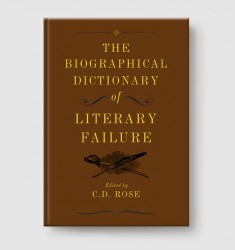
Those who claim to know her, or know of her, have talked of poems whose syntax and diction twist language into new shapes, forming tiny bright daggers sharp enough to pierce the heart. Others have spoken of a novel so compendious and yet so precise it would change our thinking about the form, the last true revolutionary work, a thing that would turn lives inside out after only its first page. Some have claimed she wrote short stories, brief tales that twist and turn, things that would checkmate Chekhov, carve Carver into pieces. Stories that need but a few brief pages to reconfigure our soul.— from "Sara Zeelen-Levallois" in The Biographical Dictionary of Literary Failure, edited by C.D. Rose.
The ephemeral, evanescent, scarcely believable career of Sara Zeelen-Levallois shows us, if nothing else, one important, terrible thing: words will change nothing. Write how we may, the arrogant and corrupt will still run the world, people will starve needlessly, your lover will still leave you.
And yet.
The power of writing is one of the greatest things we have, whether it is read or not.
Showing posts with label C.D. Rose. Show all posts
Saturday, March 07, 2015
Words will change nothing
Labels:
C.D. Rose,
dictionary,
Melville House
Wednesday, January 28, 2015
Neither present nor past
From the entry for Otha Orkkut (1890-1943), poet, translator, and historian, in The Biographical Dictionary of Literary Failure, edited by C.D. Rose:
I treated myself to this lovely volume at Christmas, to add to my shelf of weird dictionaries. This collection of 52 lives, by turns tragic and comic, easily lends itself to browsing; I reach for it for inspiration, for reminders, for warnings.
The introduction alone is worth the price of admission, exploring the concepts of erasure, "faith in the ineffable," linguistic negation, "literature of the unword," "stories that would prefer not to."
Reviews
Biographile: "The simple fact is this: books are real; writers aren't."
PopMatters: "It's questionable whether insanity is a prerequisite for the arts."
Excerpt.
Cimbrian, it is said, was a unique language in that it contained a tense which was used to describe a person or object which had gone missing or been lost: neither present nor past, still existing in a space or time which no non-Cimbrian can ever properly comprehend.Identified as a Bothno-Ugaric language, "Cimbrian" may be referencing the same language known in Italo Calvino's quarters as "Cimmerian," described by Professor Uzzi-Tuzzi as "a modern language and a dead language at the same time."
A number of critics and translators are currently at work on Orkkut's books, her manuscripts now inhabiting the realm of that unique Cimbrian tense.
I treated myself to this lovely volume at Christmas, to add to my shelf of weird dictionaries. This collection of 52 lives, by turns tragic and comic, easily lends itself to browsing; I reach for it for inspiration, for reminders, for warnings.
The introduction alone is worth the price of admission, exploring the concepts of erasure, "faith in the ineffable," linguistic negation, "literature of the unword," "stories that would prefer not to."
Reviews
Biographile: "The simple fact is this: books are real; writers aren't."
PopMatters: "It's questionable whether insanity is a prerequisite for the arts."
Excerpt.
Labels:
C.D. Rose,
dictionary,
Italo Calvino,
language,
Melville House
Subscribe to:
Comments (Atom)