Showing posts with label Marek Hłasko. Show all posts

Monday, March 11, 2019

Desperate, detestable, and unhappy

I never could grasp why Polish literature had such bad luck. Looking at it logically, there are few nations who have so many chances for good literature as we, the Poles, do. We've got everything: misfortune, political assassinations, eternal occupation, informers, mystery, despair, drunkenness. By God, what else could you ask for? When I was Israel, I lived with the scum of the earth, but still I never met people as desperate, detestable, and unhappy as in Poland.
— from Beautiful Twentysomethings, by Marek Hłasko.

I was a beautiful twentysomething myself when I first heard of Marek Hłasko. I had stumbled across The Eighth Day of the Week while trying to reclaim my Polishness, but amid literature and memoirs that were more wartime (say, Gombrowicz and Herling) and thus more relatable to my own family's experience, Hłasko failed to make an impression.

And then I met a whole klatch of Polish beautiful twentysomethings down at the pub, for whom Hłasko was a hero. Poland's angry young man. For them, Hłasko was the epitome of Polishness: he forsook communism for the American dream, even if accidentally, to die tragically young and mysteriously, without having accomplished much of anything. His persona, I think, was greater than his talent, the legend larger than his life. He drank a lot. He played with the gods. His claim to fame: writing a novel censored by the authorities. His greatest trick was looking like James Dean, and exuding that rebel attitude.

Perhaps that's a harsh assessment. Perhaps it's because I don't understand him. (How could I ever hope to understand those beautiful twentysomethings!?) But that's precisely the problem, with him, and the whole of Polish literature. An outsider can never understand, and the Polish ego is such that it dismisses the outsider as incapable of understanding.

One of the more interesting chapters of book tackles the subject of "the unrequited love of Polish people for Americans," though it fails to reach any satisfactory conclusions.

This memoir amounts to not much more than a curiosity, and I don't see it having wide appeal. Hłasko recounts tales of looking for work and circumventing red tape. There's a lot of name-dropping of names I've never heard of. It has no particular style or humour or grace such as would substantiate a literary giant.

In its way, it is entirely representative of the people of a certain era. Like all the beautiful twentysomethings: suffering delusions of grandeur.

There are only occasional glimpses into the problem of art, creation, and critical thought in an oppressed society. But they are beautiful.
All the fellows I started out with, they knew it was fatal, but they waited all those years just to be able to write one poem, one story, just to be able to paint one surrealist painting or make a sculpture that didn't resemble anything. There were people — despite the facts and despite everything going on around them — these were people who kept faith that the moment would come when it would be possible to say: "No."

We — losing our hair, no longer beautiful, twentysomethings not more — we had our moment of glory. Some of us turned out better for it, some worse. There weren't any masterpieces made in those days, but maybe the works will be useful as a chronicle of the past, as proof of misery and lack of talent, as evidence of the powerlessness of a person living in a nightmare who doesn't have the inner strength to recognize it as such. But like I said, there were people who believed they'd one day be free to say the single most important word in every individual's life: "No."

When I meet beautiful twentysomethings today and I talk with them, one thing scares me: they all know things are bad in Poland. Nobody has any illusions about the occupation of Poland. On the other had, nobody's really concerned about it. One of the most beautiful girls I've met recently wants to become a computer engineer. Another handsome twentysomething is studying the archaeology of the Mediterranean Sea. There's one who's a metals engineer. Not a single one of them wants to be writer, painter, or sculptor. None of them are holding their breath for the day when they'll be free to say, "No." If a painter, writer, or director defects to the West, years of anguish and sporadic work are waiting for him. Nights spent in fleabag hotels, women who pay the bills, and personally I don't know of a case besides Miłosz where the artists who fled from behind the Iron Curtain didn't get bumped down a social class. These new beautiful twentysomethings won't have those problems. After seeking asylum, they'll work as doctors, engineers, God knows what else. They won't be tormented by boredom or hunger or by a longing for the homeland they've left behind and which never caused them any suffering. And these are the new beautiful twentysomethings.

Sunday, January 26, 2014

Waiting for socialism

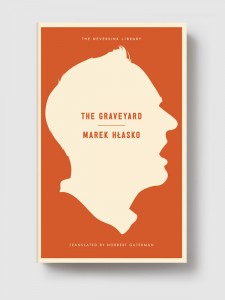
It took me a long time to read The Graveyard, by Marek Hłasko, despite its being merely 140 pages long. It's dense with politics and a whole country's emotional baggage.

I first read Hłasko about 20 years ago — The Eight Day of the Week was just about the only book of his readily available in English. The Polish crowd I ran with couldn't sing his praises strongly enough. Hłasko is Poland's James Dean, its Angry Young Man. It's 1950s angst, but on another planet; Holden Caulfield's life of privilege shrinks to nothing when compared with growing up in the shadow of Communism. You want phoney, try on some party propaganda.
"It's funny," Franciszek said. "Man always dreamed of one thing — knowledge. That was the meaning of his eternal struggle. He dreamed of only one thing — to understand his times, his purpose, his place, his meaning, and his moment in eternity. And now that he has come closest to this understanding, knowledge is his main enemy. It's better not to understand — knowledge is a disease."

"No," the painter said. "it's death. It's worse than death. It's an encore piece, and encore to something that didn't exist, that couldn't be taken seriously." He waved the bottle joyfully. "How about a drink?"
The Graveyard was firmly rejected for publication in Poland. It appeared first in France in 1956.

It's the story of Franciszek Kowalski, a factory worker and party man. He meets up with an old friend and they go for a few drinks. On his way home, drunk, he manages to insult a couple police officers. Very soon, the exact nature of his innocent drunken outburst is called into question. A night in the drunk tank pales against the ensuing difficulties at work, with the party, and at home.

What begins with bureaucratic absurdities moves into surreal, nightmarish wartime flashbacks. And then. One by one, Kowalski hunts down his old comrades in the underground, looking to restore his faith but instead finding deeper truths.
He rose suddenly and began to pace the room. His neck grew purple, and his upper lip quivered. "Goddam it to hell!" he said. "To hell with this goddam chatter! What matters are the consequences, the final consequences. Once you've started a revolution, you have to realize that it can't be stopped, or moderated, or turned off, or delayed. A revolution can be only won or lost, and that's all. What horrifies you? The dimensions? The methods?"

"The consequences," Franciszek said. "What you said a moment ago. Is the revolution a blind, brutal force?"

Birch gripped Franciszek by the arm and led him to the window. Before them lay the wet city, bristling with scaffoldings. "Here, to this place," Birch said, "in I don't know how many years, a man will come who hasn't yet been born. He will come and he'll want to live, to have food, an apartment, children, a family; he will want to live in security and he will expect the time he lives in to provide everything a man is entitled to. I assure you that he won't be concerned with your sufferings and doubts, or mine. He will evaluate the world he finds by the yardstick of his reason. And that's all."
Franciszek wants only to know what kind of man he really is, what he really is, but what a quagmire of mistruths he stirs up. That should teach him drink vodka on a weeknight.

There's joke early on that sums up the moral-political confusion of the times:
Once again he ran in his unbuttoned overcoat through the wet, muddy streets. He stopped suddenly. [...] He heard the furious screech of brakes behind him, and jumped aside.

"What are you waiting for?" the driver screamed, "For applause?"

"For socialism," someone said on the sidewalk.

Reviews
Cleaver Magazine
Numéro Cinq
The School of Washington

Friday, January 10, 2014

Such faces

A corpulent man with a friendly face rose from his seat behind the desk. He had the clay-colored complexion of those who never get enough to eat, live in stuffy rooms, and breathe large amounts of stale smoke. His cheeks were pendulous and his eyes red from constant lack of sleep; most of the people entrusted with looking after the souls of others have such faces.
— from The Graveyard, by Marek Hłasko.

That's how I feel this week. And it shows. All those souls to look after.