Showing posts with label jigsaw puzzle. Show all posts

Wednesday, February 09, 2022

Event-tempered against narrative repolarizations

Clara's body heaved a little, assuming the shape of a soundless sigh. Currents of emotion moved through the room.

My mother moved us to a subdivision when I was 11, a year or two before Rush immortalized the dreariness of conformant living. "Nowhere is the dreamer/ Or the misfit so alone." In my subdivision, everybody listened to Rush.

I hated it.

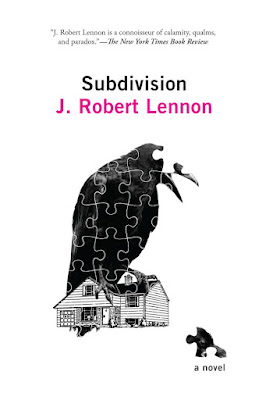
Subdivision, by J Robert Lennon, is weird and brilliant. Part videogame, part fairy tale. It's psychotherapy as written by Douglas Adams. It's Alice in Wonderland if it were an allegory about a grisly car accident. It's The Hearing Trumpet if it were about a young, professional modern woman.

It starts with a jigsaw puzzle. It fully occupies the massive table in the subdivision's guesthouse (why is she here?), and our protagonist is invited, even expected, to work on it. It's maybe three feet by five, but no box, no picture. Its pieces change shape, and the image appears to shift. As progress is made in some areas, other sections are undone. She must not allow things to delay her progress.

(I just bought an 8,000 piece jigsaw puzzle on eBay. Three feet by nine. The Sistine Chapel ceiling. Maybe it is a metaphor for my life. Maybe I will see the hand of god in it. I am saving it for the new house, a new project among others. I am preparing for a major puzzling accomplishment. Maybe I will paint my ceilings. I must make progress.)

"The problem ... with an itch," the man said, grunting and wheezing, "is that it isn't ... in one ... place." His voice, smoke-roughened, stirred a memory just out of reach.

"I'm sorry," I said, "I don't understand."

"An itch ... is a creation ... of the body ... and the mind." His face contorted with the efforts of his hand; the expression, again, struck me as familiar. "The mind ... expresses its need ... for simulation ... through the body. The ... body ... ugh ... tries to ... satisfy itself ... by scratching. But the itch ... is a phantom ... of thought. It moves ... to trick the body ... into gratification."

There's a shapeshifting bakemono, and a house built in a probability well, with windows that aren't event-tempered against narrative repolarizations. "Sometimes you'll see the future through them, or the past, or some alternate version of the present. But they really let the light in on sunny days."

Under the bed, our protagonist finds a marvelous pair of colour-changing shoes — a perfect fit, making her feel light, and strong. She lands a a job as a Phenomenon Analyst, which requires experience in the area of quantum tunneling, about which she knows nothing.

There's a child, who may or may not be hers. There's a solar-powered personal digital assistant, that appears to be evolving, throbbing.

It's completely surreal, and completely logical, a slow release of clues pointing the way to the obvious end, a journey through the subconscious for a reconciliation with tragedy.

The box, eventually found, reveals it to be an "8,000-piece deluxe mutable situation-specific matte-finish bilateral theta cardboard puzzle."

Subdivision will be facing off against Lauren Groff's Matrix in the opening round of the 2022 Tournament of Books in about a month's time.

His words incensed me, and it was time to give him a piece of my mind. I turned to him and said, "I don't know — maybe?"

Sunday, September 18, 2016

The Narcon

As the old Narcons put it: "There is not space in the universe to tell the universe to the universe. Therein lies the peculiar beauty and sadness of stories: to tell it all without all at all."


The Familiar, Volume 1: One Rainy Day in May, by Mark Z. Danielewski. Yeah. I don't know how to talk about this book. I don't even know what this book is about.

I can tell you:
  • This book is beautiful as an object.
  • The experience of reading this book is somewhat otherworldly.
  • I fucking love this book.
  • I wish there were more books like this in the world.
Book as object
This book is heavy. It's printed on art-catalogue-quality glossy paper, 880 pages of it. The binding is such (with pink thread) that if you open the book to any page, it will lay open.

There are full-colour plates between chapters, with epigraphs quoting the likes of Emily Dickinson, Lady Gaga, and Norm Schryer, or featuring lines from movies like Moonrise Kingdom, Blade Runner, and Chinatown.

The top corners are dipped in colour, each chapter colour-coded according to the character perspective (of which there are 9). The beginning and end of each chapter also include a timestamp, place, and date to help orient the reader.

Each chapter picks up at the second the previous one left off — the story covers 08:03:05 to 23:32:09 on May 10, 2014. It spans Los Angeles, Singapore, and towns in Texas and Mexico.

Each character perspective also has its own font (these are detailed in the credits). The text includes Russian, Chinese, and Arabic script, and lines in a few other languages.

There is a design element along the centre seam, which varies from character to character. These are fractal-like, and many forum pages are devoted to theorizing about them: they likely indicate static or frequency, functioning as a narrative ECG.

There is a lot of white space. Some pages have just a single word. On some pages, the text seems to fall away. One chapter has extremely wide margins; the text is focused in a tight block. In another chapter, the text wraps around a circular whitespace; if these pages were flippable, the orb might appear to move across the page.

On other pages, text scatters and runs sideways. This happens consistently with one character, indicating a cognitive break, or sensory overload, or the onset of one of her seizures.

So none of these design elements is arbitrary. Form reflects content.

Pages 563-578 are whiter than white, blank of many of the elements mentioned above. They are distinct from the creamy pages of the rest of the story. These are the pages of a Narrative Construct, or Narcon for short.

Book as story
This is the first volume of a planned 27-volume series. I've heard this book described as the story of a 12-year-old girl who finds a kitten. That's mostly accurate. Even though for the first several hundred pages, she's on her way to pick up a dog.

Xanther has her own thread, and her mother and stepfather each have one too, so it's easy to feel that the story centres on her. As for the other character threads, I have no idea what they have to do with anything.

And I'm fine with that.

Around the world, it's raining.
There was this moment in writing when I realized that every character was in the rain. If Kubrick was the patron saint of House of Leaves, Akira Kurasawa was sort of the patron saint of The Familiar.
The Narcon chapter helps explain things. It describes some of the formulas used to create narrative and develop character, and defines its parameters. It is self-aware but only so far as it's been programmed to be. Well, this chapter may or may not explain things.

Book as experience
This is a puzzle of a book. I love puzzles.

The discovery of all those elements noted above is a pure joy. It makes this a very visual and tactile read.

The Familiar is also full of nested parentheticals, so reading is a bit like diagramming sentences, but on a more psychosemantic level than a mere grammatical one.

Danielewski has spoken about how The Familiar is conceptualized like a ("quality," modern) TV series, like The Wire or Mad Men, in how it develops character over long-form narrative. The way it shifts character focus, the way individual character stories intersect; how small events play into a season-long story arc.

This volume includes season previews (which don't (yet) appear to be linked to the novel proper), and pages of credits at the end.

It's highly conducive to binge reading. Just one more chapter.

The formatting helps pull the reader along. It feels a little like a graphic novel in this way, like where text spans frames and physically leads you where you're supposed to go.

If the text of this novel were conventionally laid out, it would be a standard 300-page novel. I believe I read it at a slightly faster rate than my usual, because the design factors were so compelling. The only hindrance was the weight, making it a bitch to commute with, which led me to plan my reading time a little more carefully.

The future of publishing
As soon as I finished reading volume 1, I rushed out to buy volume 2. I have a couple other things to read first, but I needed to ensure that I have it, for whenever I'm ready. I need to do a little catch-up, but I expect I'll be lined up to get volume 4 the day it's released.

It would be easy to dismiss this book as gimmicky if it weren't so goddamn beautiful and narratively compelling. It must be very expensive to produce; someone must have a lot of faith in this project.

I've showed off this book to a lot of people. This book is coveted. It has been fondled.

What if publishers made books beautiful? Good book design can be more than just a pretty cover. It's the paper, it's judicious use of colour, it's white space (white space is so underrated).

So 27 volumes of 800 pages may be a bit ambitious. Books don't have to be oversized to capture attention. But there are shorter stories. There are short stories, for example. Many texts could lend themselves not just to illustration but to design-sensitive interpretation. Or serialization. Graphic novels do this to a degree, but as mainstream as they are, they're not for everybody.

I happen to love ebooks, and in general I believe that the content of a book is more important than its form(at). But there is a market for beautiful books. People appreciate fine detail.

Make people want to turn pages.

One thing I admire about The Familiar is that it never becomes a graphic novel, can never be a television show. It does not resort to incorporating artefacts or referring to complementary online material; there are no fussy envelopes or reproduced postcards; there is no CD included. This is not amultimedia production, but it is fully immersive.

It's stretching our idea of a novel, but remains contained, remains very definitely a book.

Monday, October 15, 2012

Rainy Sunday

Helena and I spent the afternoon assembling a jigsaw puzzle depicting more than 50 famous scientists. Along with each portrait is a brief description of the scientist's accomplishments.

We talked about Louis Pasteur and Nikola Tesla, Einstein and Oppenheimer, and we looked stuff up, and it was fabulously fun.

Today we managed all the pictures and words; we left blank brown spaces to be filled in later in the week.

I am somewhat peeved that Marie Curie is listed as French (and not French-Polish), annoyed by the inconsistencies in punctuation, and galled by the unnecessary apostrophe ("it's" for "its"). But the benefits of this puzzle, this day, more than compensate.

(And we'll take a red pen to it once all the pieces are in place.)

Henceforth, Ernest Rutherford shall be forever known as the scientist with the mustache.

Monday, January 07, 2008

Colours and follies

Weeks ago, I dipped into Orhan Pamuk's Other Colors: Essays and a Story, as I said I would. I start in the middle and find myself driven forward, wondering what happens next, and finally it occurs to me to ask what came before.

Sampling these essays at random, it turns out, is not the best approach. The preface holds the key. (Sadly I was not forced to read the preface when first I opened the book.) Pamuk has arranged these ideas and fragments deliberately, into a continuous narrative.

I have always believed there to be a greedy and almost implacable graphomaniac inside me — a creature who can never write enough, who is forever setting life in words — and that to make him happy I need to keep writing. But when I was putting this book together, I discovered that the graphomaniac would be much happier, and less pained by his writing illness, if he worked with an editor who gave his writing a center, a frame, and a meaning. I would like the sensitive reader to pay as much attention to my creative editing as to the effort I put into the writing itself.


So I start again from the beginning. And there is a story to be told here.

I don't remember why I turned over the corner of this page in "On My Name Is Red." Maybe for some realization regarding Pamuk's relationship to painting — he grew up wanting to be a painter. Or maybe for this: "My fragility, my filth, my depravity, and my shortcomings — they are not in the fabric of the book, in its language or its structure, but they can be made out in the characters' lives and stories."

I've come to like Pamuk less than I like his novels. He refers often to going through rough times, loneliness, depression. His taking refuge in books quickly loses the sheen of romanticization; his escape into books feels quite desperate. But then I think: this too, this whole book, is contrived to manipulate me. There are essays on and insights into Istanbul, a childhood lived therein, earthquakes, Nabokov, literature in general, and more. They are if sincere, as first I thought, depressing; if not sincere, then a little more awesome for the force of their combined structure, but disillusioning. I'm not sure which state I prefer.

*****

If ever again I turn to freelancing and work from home, I might follow Pamuk's example in establishing routine and discipline: dress and prepare in the morning as if for the office, leave the house, walk round the block, re-enter one's house-as-office, and then at the end of the day pack up and leave to walk back to the same space this time home.

*****

Just before Christmas I picked up Paul Auster's Brooklyn Follies. My expectations were low, as most reviews, both published and personal, were lukewarm about it.

As it turns out, it was, for me, the perfect book at the perfect time, lifting me out of the noise of Christmas, and out of the depressing funk Pamuk had cast, to float just beyond the reach of stress.

For all their outlandish behaviour, grand gestures, and bold words, there was something so perfectly ordinary and believable and interesting about all the characters, which I suspect I may not perceive in this way at any other time of year. I'm losing the details of the story already, but certain observations and characterizations (what kind of man where's a white shirt and tie around the house in the afternoon?) have left a mark.

What lucky fools we all are.

*****

Christmastime is the time of the annual jigsaw puzzle. This year I would initiate Helena into the family tradition — where by family, in this case I mean me and my sister, and it was never really planned so much as it just worked out that way, that we would one or the other of us receive a puzzle at Christmas and have to start it straight away, hunching over the dining room table, squinting, for one, maybe two, near-sleepless nights, our mother pleading with us can we move the puzzle please, where are we going to eat, it's so dusty, but we did this for years, every year, I don't remember how it started, now we have to plan a little because we are less likely to spend sufficiently long periods of time together under the same roof.

I'm surprised at how geeky the whole puzzle endeavour is this year. That I should build up the significance and the fun of the puzzle is one thing, but I was compelled to plan, to consider the initiation — that Helena is capable of 100 pieces on her own but I would not want her to feel daunted at the sight of, say, 3000 pieces each the size of one of her fingers, not her whole hand, that I lit on the perfect enticement: a Doctor Who theme, bearing a geek factor all its own, which I researched and special-ordered, settling on a product not dated by a specific Doctor's face nor that of a specific companion, and a modest piece count, well in advance, and wrapped and put under the tree.

I keep thinking of The Gold Bug Variations: she watches the 2 men puzzle together at the cabin, one of them searching the board to find a fit for the piece in his hand, the other searching the table to find the piece that fits a chosen spot.

For years, forever, I was of the first type. I'm shocked by the realization that I am now the latter. I'm certain that the attitude must reflect one's philosophical approach to life, but I struggle with what exactly that might mean.

*****

Thursday, Helena (age 5), after years(!) of denying her father's teasing suggestions that she has a daycare amoureux — Poilly is the only one, she insists (they do sleep together after all) — announces that Emile est son prince, and they're going to marry — Emile is her amoureux, and today they kissed on the mouth!

She interrupts our occasional stolen moments, in the car, at the grocery: "Why are you doing that? Why are you doing what Emile and I do?"

*****

Friday at lunch I gather myself up to go the post office and discover I must've lost my sister's birthday present on my way into work. This distresses me to tears. The website of the metro's lost and found advises it can take 48 hours for an object to reach the central office; they're closed on the weekend; my sister's present will never reach her in time — and these revised timelines rely on the fact that there is kindness in strangers, to turn in a small plastic bag containing a box and a scrap of wrapping paper sized to cover it, but untaped because we ran out of tape at home. I let myself cry over this, because I can't be seen to be phased by the $5000 mistake I made at work, which was uncovered earlier this week, for which my stomach is in knots, over which I've lost sleep. I spend the afternoon obsessing over what I might give my sister instead, though still late, and fixing other people's faulty graphs and references so they might obtain FDA approval. My way home I scour the ground — the corners of the metro station, and outdoors, the shapes of fresh snow mounds — for that small white plastic bag. I console myself, that this is the cosmos taking a little something back for all the free books and door prizes I've received lately, that someone else may benefit by this.

My sister's birthday present is sitting on the shelf inside my front door.

*****

For the umpteenth time we watch the Doctor Who episode "Utopia," and this umpteenth time it occurs to Helena to ask me, "What does 'utopia' I mean?" I summarize the concept as best as I can, but before I get round to explaining how Thomas More coined the term, she is laughing. "Me-topia, Me-topia, Me-topia!"

I record this here not as an instance of the cute things the child says, per se, but because I marvel at how her brain works.

*****

Saturday we stop for gas. As J-F is pulling back out onto the service road, he asks me for his gloves. "I don't have them." "Where are my gloves?" I make a joke, but as soon as I say it, I know it to be true: "You probably left them on the roof of the car." The car has turned, it's too late to stop, and dangerous now to slow down. We watch in the rearview mirror as one glove flops onto the road. We're halfway into the curve of the exit ramp when the wind lifts glove number two and throws it into a snowbank. I laugh, or else I would cry. The gloves I gave him for Christmas.

We track back through the parking lot that's on the other side of the ditch, only it's winter and the ditch is a 20-foot high pile of snow, the length of... I don't know how to measure length in the suburbs, but it must be about 4 city blocks. J-F stops the car and goes over the top.

Just as I start imagining what terrible accident might've transpired on the other side of that white wall, I notice the dark speck ahead running toward us, waving one black leather glove overhead.

We drive forward, just outside the gas station we'd started from. Repeat.

My unoriginal gift. His gallant grand gesture.

(I think he's lost them since.)

*****

The snow had been falling like oobleck. I take respite in thinking that Montreal that night bore a striking resemblance to a magical Persia of centuries ago.

"The following night it suddenly snowed so hard and became so bitingly cold that tongues froze inside people's mouths." (From The Adventures of Amir Hamza: Lord of the Auspicious Planetary Conjunction.)