Showing posts with label times of plague. Show all posts

Thursday, March 03, 2022

Not to fulfill your desires

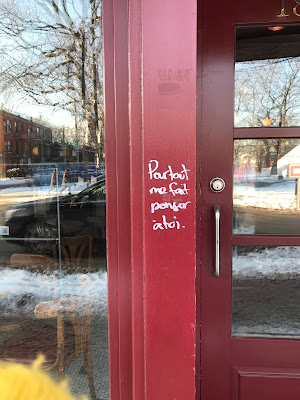
Sprawled across Jackson Avenue is a larger-than-life lady, screaming her "I don't give a fuck" in chemical pink. We come up on her from behind; a slight torque in her repose, I can't see her hand, between her legs I think, and I feel embarrassed to catch her masturbating in the midday sun. She's monstrous and gorgeous, she looks like an armature barely wrapped in plasticine, but she's all bronze, baby. So this is Queens.

We have a few minutes to pop into the bookstore. It's a comforting place, I want to touch all the books, my hand caresses the shelf, my fingertips drag across the tabletops. I want to read all the books I haven't read, but there isn't time, so I reach for a blind date. "Read me if you like... - intense, complicated sibling rivalries/ - carnivals/ - David Lynch films/ - unreliable narrators."

It's only later that I realize I know what the book is, of course I've read it. (And the receipt confirms my suspicion.) I shouldn't play this game. I've read too many books, I read too much about books, to be blind to them. But in that moment I was happy, I must've already known what it was and I reached for it anyway, this mysterious book made me happy.

I watch The Green Knight again, because it is beautiful and dark and mysterious, and it reminds me that an instant can be a lifetime, and I can wonder for all eternity where it all went wrong, and I can't tell if it actually went wrong at all. This is what I do now, I watch this movie at every opportunity, which seems to be when I fly. Who the hell is this green knight anyway? And this time the image of him picking up his head reminds me of Medusa carrying Perseus's head, but not the bronze, rather the recreation by a live model, the photograph we drew from in art class the other week, that haughty smirk. Now I want to sculpt the green knight, but I can't yet, because I don't understand him. I wonder if cutting off my own head would bring clarity, it is my oppressor after all. (And St Winnifred too, everyone losing their head.)

A friend and I are texting about Ukraine, and she sends me a poem by Bertolt Brecht, because we live in dark times. I read it and I am gutted. (Headless and gutted, empty.)

Not to fulfill your desires but to forget them
Is accounted wise.

I can't tell if Brecht is saying it is wise to forget one's desires, or if it is thought wise but isn't. I spend a weekend in New York fulfilling some desires, yearning after others, and all in all not knowing what to do with them any of them anymore.

I have been reading Ferrante and Starnone, and I will write about them someday. I have been reading other things, and enjoying not writing about them. I am working far too much.

A drunk angry Ukrainian spews profanities on the subway platform and a rat makes for the exit. The poster in the elevator in the hotel reminds me that all my desires are worth fulfilling, even as the world burns. 


Monday, January 24, 2022

A condition that causes a dimensional shift

Our love was so strong that it felt like a presence in the communal apartment, as if it were another tenant. It had an amorphous shape and weird density; it was less dense than an actual object, but denser than the air in the room. It felt as if I could touch it. I could move my hand through the air and feel resistance in places were love was.

I thought that the lack of love wasn't only empty space. It had a physical presence too. Negative presence. And like negative numbers, it had the ability to multiply and grow. You couldn't stop it.

Something's happening to me. I have trouble sleeping. I have no time for reading or blogging, but there's the same amount of time there's always been. I am almost proud of not reading and not blogging, like I've stuck to a New Year's Resolution to cut down on bad habits.

But I'm not filling my time with anything new. Maybe I take more baths, listen to more podcasts, do more puzzles. I have maintained a 687-day streak of German lessons.

Nothing feels restful. I feel like I'm moving through negative space.

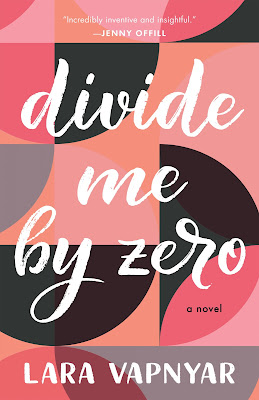
It took me a very long time to read Divide Me by Zero, by Lara Vapnyar. I don't understand why. It's charming, funny, dark. I can relate to the love and loss and death. I can relate to its Slavic outlook, its immigrant status. 

"I'd love to write the novel about Love and Death," I typed. "How both of those words lost their majestic old meanings. People don't really 'love' each other anymore, they either 'worked on a relationship' or 'succumbed to sexual desire.' People don't 'die' either, they 'lost their battles' with various diseases or they simply 'expired' like old products on a shelf. Neither love nor death is considered the most important passage in the life of a person anymore. In my new novel, I would try to restore their proper meanings."

Perhaps, I realize, I've been reading too much of the wrong kind of book. I've been reading to help myself know my heart, I've been going deeper and deeper inside it, probing. But I already know my heart. Perhaps it's time to let it rest quietly, monitor it for anomalies but trust it to function as it's meant to.

I thought that if I could study love the way I used to study math, the knowledge would arm me with some power against the colossal incomprehension and fear I was experiencing.

Divide My by Zero starts and ends with death. In the beginning, as a reflection upon the past, Katya's mother has a gentle death, couched in tenderness and nostalgia. It reaches out beyond the individual; it moves Katya to connect with a stranger, connect with her childhood and her heritage. But in Katya's retelling when we approach her mother's death at the end of the book, it feels abrupt and violent and tragic, isolated in her Escher house, somehow severed from the rest of the world.

One of the results of the compartmentalization was my grossly mistaken belief that what I did in one of my lives couldn't possibly affect people in the others.

I feel like in the six weeks it took me to read this book, my mind was preparing me to read the ending, and stick the landing, to learn this: that despite the playfulness, the wit, the compassion, there is still devastation, and in a very Slavic way life goes on, sometimes better, sometimes worse, often not the way you expected it to.

Sometimes I think that I turned to math the way B. turned to Orthodox Christianity, to fill a spiritual void that became acutely unbearable after my mother died.

If you think about it, math is as good a religion as any. It's both endlessly abstract and irresistibly precise. You can grasp the entire world with the help of math and make it seem less chaotic, unpredictable, and scary. Isn't this why my mother started to work on her last book to begin with? She must have felt that something was wrong; she must have glimpsed into the chaos of death, and she turned to math -- her safe, perfectly structured space.

One way to describe love according to the gospel of math is as a condition that causes a dimensional shift. The emerging new world that contains love becomes so vast that it opens into an entire new dimension, dwarfing all the worlds that existed in your life before you fell in love.

Excerpt.

Sunday, January 09, 2022

We can't feel two things at once

The other night I dream I am in Mexico again, but on the mainland, gently drifting, grazing the treetops. I think I am holding something over my head, maybe a sheet, acting like a glider. I watch the jaguar slink across the open field and think, I shouldn't set down in this tree, let me go a bit further, but I'm not afraid, I am just being sensible. I finally alight outside a hotel that is not a hotel. Someone invites me inside, and I stand on the terrace, watching an older couple lounging in the infinity pool, the milky water spilling seemingly onto these plains of Mexico where somewhere my jaguar is watching out for me, is that me in the pool in the milky future with my longtime lover? I can feel the jaguar prowling (for what?), but I know it will not hurt me.

What would my psychotherapist say?

I need to exercise my patience, I'm out of practice. Steady as she goes.

The sickness is sweeping the city. Friends are sick. Colleagues are sick. We are living in lockdown again, under curfew. There are lineups for liquor and groceries again. There appears to be a shortage of catfood, or maybe I live in a neighbourhood with a high-density cat population that is suddenly demanding more substantial sustenance. 

Practice gratitude. "Research has shown that gratitude displaces anxiety: We can't feel two things at once."

I can't read. I can't sculpt. Television bores me. I don't want to work. I tire easily. I play video games for hours on end. My eyes are tired. It's been 673 straight days of German lessons. Isabella, deine Arbeit ist zu stressig, mach Urlaub. My skin is peeling, I'm shedding the sun of Mexico, but I keep silver coral wrapped around my fingers, a new talisman. I go for short walks and smoke illegal menthol cigarettes.

I do research for work. The future is not only useless, it's expensive, I learn. 

And this is why the future, be it NFTs or Memoji or the howling existential horror of the Metaverse, looks so ugly and boring: it reflects the stunted inner lives of the finance and technology professionals who produced it.

The problem then, apart from the howling existential horror of the Metaverse: how to not be stunted, how to unstunt oneself, how to imagine something beautiful and interesting.

I am trying to understand, and embrace, Massive Change. In how I work and in how I live. In how I interact with people and with the world. Everything is a design problem. Design thinking leads by inspiration. It demands the clarity and courage of its convictions. Design is driven by purpose.

Thursday, December 30, 2021

Like most humans, she had a single heart

The sense of space as a controlled substance is overpowering, except you don't know where it's going to take you.

The Silk Road is magic. I don't understand how any of it works, and I'm sure there are more elements in play than I suspect, but it fills me with awe and joy.

Next she took someone's head and lifted it like it wasn't part of a human body, a cabbage or a planet or the repository of all good thoughts and evil, which, when you think about it, is exactly what a human head is.

The book opens in the labyrinth, one woman guiding bodies on yoga mats in Savasana (corpse pose).

This was the most challenging of the poses if you took into account the fact that the room was filled with people who knew the world was coming to an end and that if we worked at it hard enough we would never die.

One of them dies (murder?). Is it a tenth body, or one of the nine "named" persons (the Astronomer, the Archivist, the Botanist, the Keeper, the Topologist, the Geographer, the Iceman, and the Cook, and Jee Moon)? Is it someone from their past — Mother, Father, or are they already dead long ago? Is it someone they even know at all? 

It's a labyrinth of memory and shared consciousness. While the environs seem to shift from a settlement in the icy lands of caribou to Le Puy-en-Velay and Aubrac, the journey is primarily interior, some spiritual plane on which they remember and commune, though some things they decided to forget. All the paths are marked by cairns.

How is it possible for the solid objects around us to melt away into the past, and for a new order of objects to emerge mysteriously from the future?

I would make the case that the entire novel takes place on their yoga mats, always in the labyrinth, a spiritual investigation, processing life and birth and death and tragedy and love and desire and heartbreak, the mystery of being, and being one with it all.

The journey along the Silk Road is not one from their memory; it is a metaphor of the human condition, travelled "for everything strange or unknown, a variety of alien gods and ideas, and unbounded universe with nothing outside it, the dung-covered eggs of the silkworm." "Everyone was using it, for commerce or as a means of escape." "What everyone had in common was lack of destination."

They had been children together — siblings, it seems. (And Jee Moon, an outsider but always present.) They squabble like children. But they are like some cosmic beings, inhabiting tubes of skin and learning to tell one another apart. One of them has two hearts. One of them may not have a heart. One of them (the Archivist?) will have the black spot on the skin, a sign of the sickness.

The Topologist visits a shrine to Saint Roch. Saint Roch was also their elementary school. There are many dogs (and fleas), and the Plague (are all plagues so much the same?).

Everyone was heading north, the sickness not having arrived there yet. Everyone knew it was a physical condition — they were that knowledgeable — but the extent of what they knew was compromised by exposure to a glut of information and rumor, making it difficult to predict anything.

The Geographer has a husband, and a child. The Cook is a widower. The Topologist met the Swede. The Astronomer fell for Jee Moon. A long time ago, the Archivist fell in love with a poet.

We all had our love stories. This was true even for the Archivist, whose misfortune it had been to fall in love as a child with a girl who grew up to be a famous poet. Like most humans, she had a single heart, and that heart had room in it for only one person — that person being herself. The spirit of the age was compounded of arrogance and inattention, the predominant humor begotten of the chylus, cold and moist.

A game of Hangman: Eight letters, two Es and an X at the end. Sardines. Tarot cards.

While she walked, the Topologist felt herself becoming aroused. It was as if whatever lay beneath her had its attention fixed amorously on the cleft between her legs. She felt like she was naked from the waist down, hungrily observed and getting wet, her breath coming faster and faster. 

Walking can do that, said the Keeper. It's perfectly normal. She was trying to be reassuring, like a mother.

Sphagnum subnitens, said the Iceman. Glittering sphagnum. All it thinks about is sex.

This novel is a puzzle I can't solve, and it's surprising and gorgeous. Expansive, boundless.

Excerpts
Fairy Tale Review
Granta 

Reviews
LARB: Journey to Death: On Kathryn Davis’s "The Silk Road"
Slate: My Soul Is Going on a Trip

Wednesday, December 01, 2021

The vastness of confinement

I remember what's not here. An island of men who are searching for beauty and find it only in the vastness of confinement. I admit I'm sadistic. I'm always saying that nothing is possible without the soul, just as no image is possible without its other. But I have no other. I have no soul. A young lover once promised to write the fatal sign on my womb and take me away with him to fertile lands. What became of him? That night is a hundred thousand nights ago and that lover is lost. I'm still waiting for him to appear among the smoky spirals that emerge from my mouth. I've had a series of smells burnt into me: a pair of hands in the twilight, the soft skin of somebody's back, a bewitched throat. Then it was over, and they were all gone. I'm still a witch who's waiting to cast spells. Our neighbour died of a heroin overdose with his baby in his arms. The woman in the house with the boarded-up windows suffocated on the smoke of her own fire. The animals die out before reproducing. That's what death looks like in these parts. Whereas my sun-soaked nights on the island were filled with stimulating chats, daydreams, furious kisses. Whereas in those golden years of my life, everything was an ecstasy of sexual reawakening. A wave of antipathy to the world wells up from deep within me. I don't know what these animals are up to. They're forming a circle around me and watching me, dumbfounded, their jaws practically unhinged from their bodies. I fall to my knees before them. If a local were to pass by now, basket in hand, gathering mushrooms and berries, they'd think this was some kind of pagan ritual.

I ordered this book for myself in the early pandemic days, I'd read a review, maybe this one, and I thought, perfect, a book about a woman who's dying inside, a victim(?) of all-consuming lust, that's relatable, I wonder how she takes it out on her world, does she interact with her world?, but by the time the book arrived it seemed like too heavy a read, maybe I'd found a way to cope with objectless lust by then, and later I was too happy, then too fragile, but lately was just right for it.

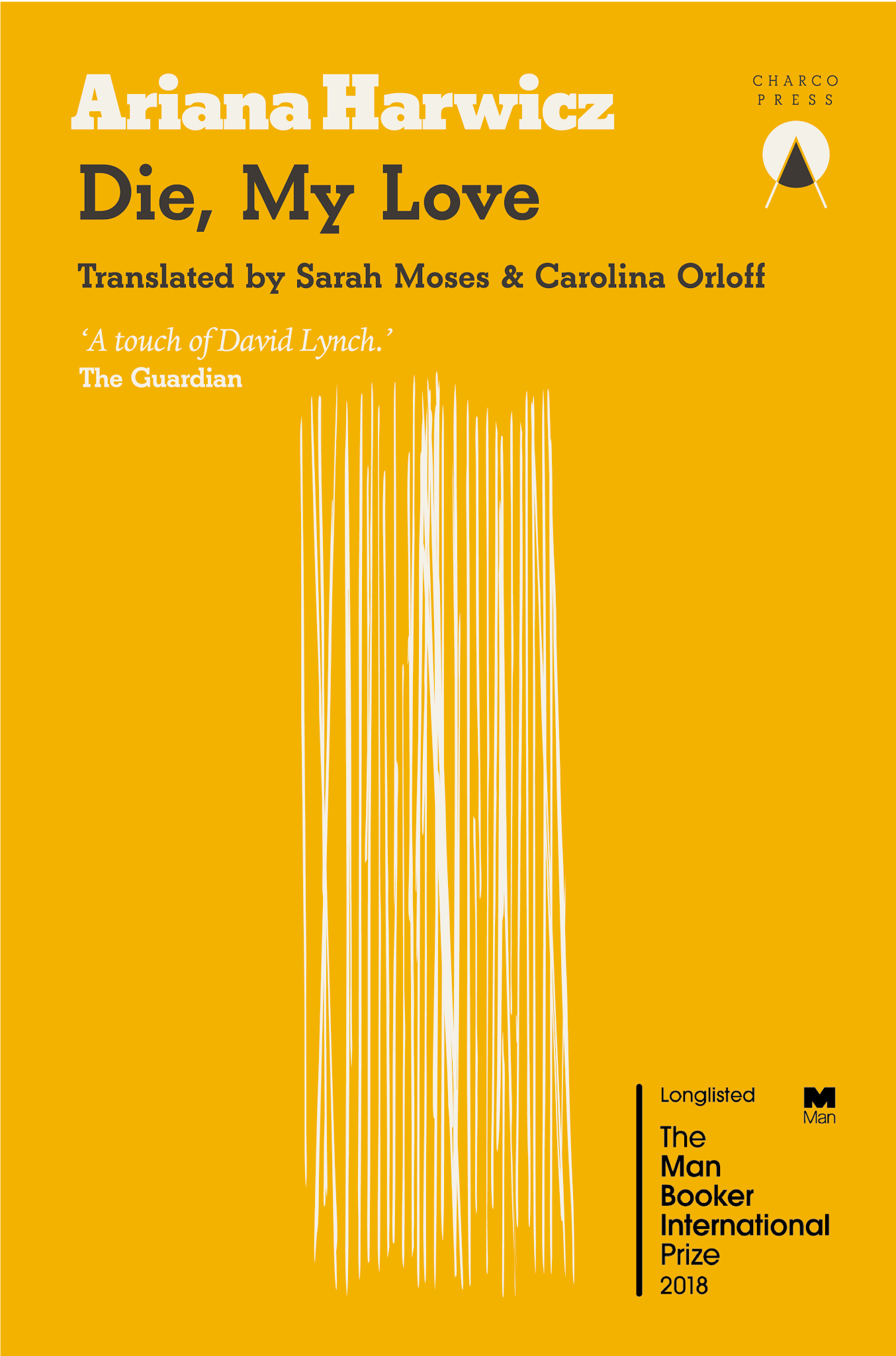
Reading Die, My Love, by Ariana Harwicz, is a descent into the maelstrom.

Not even digging a hole, a pit, would be enough. It needs to be thrown into the desert and devoured by wild beasts. Desire, that is.

The jacket copy goes like this:

In a forgotten patch of French countryside, a woman is battling her demons – embracing exclusion yet wanting to belong, craving freedom whilst feeling trapped, yearning for family life but at the same time wanting to burn the entire house down. 

That seemed to encapsulate lockdown and all the contradictory impulses it elicited, I would battle demons, I didn't need to be trapped in a marriage or by responsibility to small child (again!). Trapped at home, home was the entire world, and I would tear it down around me. 

These people are going to make me lose it. I wish I had Egon Schiele, Lucian Freud and Francis Bacon for neighbours; then my son could grow up and develop intellectually by learning that there's more to the world I brought him into than opening old skylights you can't see out of anyway. As soon as all the others had escaped to their rooms to digest their meals, I heard my father-in-law cutting the grass beneath the snow with his new green tractor and thought that if I could lynch my whole family to be alone for one minute with Glenn Gould, I'd do it.

(All figurative artists, I note. Why? Because the body, I guess. And the physicality of Glenn's art too.)

I have to say, though, that there's nothing to ground this story in the countryside of France. I believe there may have been a vineyard, possibly a road to Switzerland (my memory is hazy). Someone smokes a Gauloise. A reference to the punishment for adultery in medieval France. By this evidence, the novel could be set in my hometown. So it irks me that this "forgotten patch of French countryside" is mentioned in every review, adding colour where none is needed. We know she is a foreigner (I forget how we know, but we know, and we sense it firmly).

I woke up when she crashed through the glass, a scene worth the price of admission, I picture ribbons of blood. I need to start paying attention. "Everything is one big distortion." The fights and the jealousy, the pretense and resentments.

This is a madwoman's story (that's what it was like to be a new mother). A few times it shifts perspective to that of her lover, only now I wonder if it might be his perspective as imagined by her. By the end, I felt like things were told in the wrong order. No one dies, not really. Well, a little. Crazy, desperate, sad.

Saturday, November 27, 2021

All clean lines and precise movement

I was tipsy, yes, but also I was grace itself. There is, below the surface of every conversation in which intimacies are shared, an erotic current. Sometime this current is so hot it all but boils and other times it's barely lukewarm, hardly noticeable, but always the current is present, if only you plunge your hands just an inch or two farther down in the water. This is regardless of the gender of the people involved, of their sexual orientations. This is the natural outcome of disclosure, for to disclose is to reveal, to bring out into the open what was previously hidden. And that unwrapping, that denuding, is always, inevitably sensual. Nothing binds two people like sharing a secret.

I perch on a stool at the counter this morning, large cappuccino at hand, I'll have to go out this afternoon to get milk, there's none left for tomorrow, determined to blog about the book I finished reading earlier this week, not the the one I finished in bed this morning though it's clearer in my head, a few German lessons first (a 631-day streak), I'll revisit the library book, after all I have a time constraint, it'll vanish into the ether within a few days.

My sister meanwhile messages to say Public Health just called her, she has to get tested. It's been less than two weeks since she returned from South Africa. Did she bring omicron with her, could there be a more ominous, more threatening name for a variant, chronic, chronos, it's only a matter of time, it's a time disease, one day stretches beyond capacity, one year mutates into the next. Did she bring omicron into my home, is it on my clothes or on my cat, has it found its way into my suitcase, can I still leave for Mexico in a couple of weeks?

It's not over, I knew it wasn't over, we're all pretending life is fine, it's almost normal again, it's not. I went into the office for a day this week, my first in-office workday since March 2020, with people I remember once having had lunch with, but this day the lineup for lunch was crushing. Protocols have eased. A quick flash of a completed registration, on my honour I have no symptoms, once seated at their desk people remove their masks and neglect to put them on again. I enter a meeting room and can feel the body heat of the people who left moments beforehand. By 4 o'clock the beer taps are open, there are no open plates of snacks but there are individual serving-size chip packets, the cafeteria could be the hottest nightclub in town, I literally squeeze through bodies to get to my desk and I momentarily consider staying longer, working at my desk to wait for the crowd to thin out before I have to make my way through the drunken bodies again to exit the building.

Things are not fine.

I feel overstimulated. On the commute home, I am unable to read. Someone else is reading You Are Not Your Brain. I mull over how ridiculous this statement is. Of course I am my brain, and many other things too.

Being in the company of an exceptionally beautiful woman, all clean lines and precise movement, when I'm sober it makes me feel huge and grubby and spherical, but when I'm drunk, proximity to beauty, it's like being, myself, chosen.

I google some reviews, look at the passages I highlighted, I like to compare my thoughts to those of the published critics, did I get it right, did I read this correctly, do I understand the world the way I'm supposed to. 

Topics of Conversation, by Marina Popkey, reads more like a series of linked short stories than a novel. It took a few chapters for me to understand they were threaded together. There are no passages in the first half of the book for me to refer to. I remember highlighting plenty (well, some), but when the library loan was initially set to expire, I renewed it, without having tracked my notes.

There's a lot of aimlessness and dissatisfaction, and aimless dissatisfaction, I wonder what's the thing that made me what I am, the defining moment, the event that set the trajectory to this place. It could be many events. I connect the dots of my memories.

I love that Popkey includes a list of “Works (Not) Cited,” I keep my own list of works not cited for the book not written that I'm working on. It thrills me to find so much overlap, I guess I shouldn't be surprised, after all I'm a woman, mother, daughter, feminist, single, grappling with love and desire and guilt and other people's ideas of success and how angry I am about what it means to be a woman here and now, despite how much I love being me, and I still don't know what I want from life or men, I don't know how I got here. I'm disappointed to learn that the idea for such a list of works was borrowed from Azareen Van der Vliet Oloomi, whose novel Savage Tongues I did not enjoy.

My sister calls to tell me Health Canada called, and they told her to tell me to get tested. They don't understand omicron. Can I still go to Mexico?

I pull up one of the reviews, I'm confused, it's about two books, this one (Topics of Conversation, by Marina Popkey) and the one I finished reading in bed this morning (Die, My Love, by Ariana Harwicz). How could they know?

"And Jeff told me, kept telling me, that he was going to leave his wife." Another shrug. "And I believed him. Though maybe also I knew he wouldn't because around this time I started riding subways out to the end of the line, subways and also escalators, riding them up and down and then up again. I liked being in motion."

Reviews

The White Review

The New York Review of Books: Wanting Wrong, by Anne Enright
On Miranda Popkey's "Topics of Conversation" and Ariana Harwicz's "Die, My Love"

The New Yorker: Can a novel capture the contradictions of female desire?

Excerpt

Sunday, October 17, 2021

Why is this your life?

"Why is this your life? Why are you not a truck driver in Norway? Why?"

I have recovered from the sickness. I continue to feel tired, but it is a familiar languishing, not the fatigue of physical illness. Some people ask me detailed questions about my symptoms, my circumstances, my vaccinations. I am an oddity, a breakthrough statistic.

I have been attending the Festival du Nouveau Cinéma from the comfort of my reading chair.

I have watched a documentary about women who tie shibari, about how a form of torture can be transformed into a healing practice. Skills can be learned, they reassure; what matters is having a clear vision.

I have watched another, about the intersection of BDSM and Christianity, because sacred ritual interests me. But this film is too cryptic, recommending that we speak from scars instead of wounds.

I have watched a Japanese film, a triptych of bittersweet dramas, about the random nature of love, life, and consequences. In the centre panel, a mature student visits her former professor, and she reads aloud to him an erotic passage from his published novel.

I am reading You Are Eating an Orange. You Are Naked, by Sheung-King. In this novel, a woman tells the narrator (they are lovers, maybe partners) about Kundera's The Unbearable Lightness of Being, and explains the problem of eternal return and its flipside, the burden of self-insignificance.

It reminds me also of a couple other books (more about that another time) — the feeling of drifting back and forth between possible realities. 

I remember lightness, and I remember being, and I remember how both bearable and unbearable it made everything else. I remember eating oranges naked. I remember eating oranges naked with various lovers, they were sweet. I will eat oranges naked again.

This week I bought a new home. It is a midcentury concrete bunker of a building that once housed a printing company, converted into a loft. I feel the ink in its foundations in my bones.

The other night I dream I am exploring a grocery store in my new neighbourhood with my daughter. I sign up for a random activity at a booth. When I am next in line, I see that I have committed to getting a tattoo. I spontaneously announce to my daughter that I will get a tiny black spider on my collarbone (not the octopus I have been considering in real life); she shrieks and squirms away.

I consult the internet to understand the dream. It means something about fear and fearlessness, change and permanence, setting traps and finding freedom, rooting myself in the divine feminine. Clearly it stems from my waking-life anxieties and aspirations. It may also draw on my current research into ayahuasca retreats, which has resurrected my interest in tree spirits. Everything is connected.

I am casting a plaster mould of a clementine, its segments splayed. I have a clear vision.

Saturday, October 02, 2021

The best salve for sadness

"Sad sells." This might sound sadistic but it's true; people want to see their sadness reflected back at them because it makes them feel connected to something and connection is the best salve for sadness. 

I was supposed to wake up in Dublin today. Instead, I'm convalescing. The cold and damp outside is homespun, familiar. I've eaten gallons of soup, and I have a hankering for stew. My week has been imbued with lilting Irish accents on screen, and pub crawls across Temple Bar between the covers too.

I meant to be reading the latest Sally Rooney. I thought I'd pick up a copy there. Instead, I'm here, #42 on the library waitlist for a digital copy. Maybe I'll manage to find my way to Dublin by then.

Today if I had my way I would be adventuring across Victor's Way, the strange and somewhat strangely erotic sculpture garden.

Instead, I stayed in bed, reading Out of Love, by Hazel Hayes.

I offhandedly wrote in a message to someone the other day that it feels like everything is happening to me in the wrong order. I feel like the plague should have cursed me a year ago, punishment for struggling to rise above it, for loosely interpreting the rules of lockdown in favour of meeting new people, daring to fall in love.

Instead, I lay here sad, weary, heartbroken, vulnerable all over again. I've been honing my skills, going back to basics, strengthening the foundation, in every aspect of my life. Careful, emotionally armoured, professionally guarded. And now, fate chooses to strike. What lesson am I to learn? I don't want to be made stronger by this, I am already strong enough, I couldn't bear to be any stronger; I want to be weak and taken care of.

I feel like I have lived my life in the wrong order. I should have started in this city, like I planned to at age seventeen. I would have moved to Europe by now. I would have met my lovers in a different order. I would be financially secure and emotionally independent and sexually confident by now. (But Isabella, you are those things now.) I am the wrong age, or it is the wrong context, or it is too late. Or too early. (Maybe I'm a stopped clock, right only twice a day.) I feel like I'm out of time, but I don't know if it's because I'm outside of time or because it's been depleted.

We're all running on separate tracks, at different speeds, occasionally intersecting, sometimes moving in opposite directions.

Out of Love
, by Hazel Hayes, is a love story told in reverse, from breakup to first meeting. Outside of love? Has everything been sourced from it? Are the stores depleted?

It's not just two people saying good-bye and going their separate ways; it's the excruciating process of untangling two lives, picking them apart like some sad surgical procedure, trying ta detach this thing from that while causing as little lasting damage as possible.

[It's been a while since I had to extricate my life from someone else's. It's been a while since my life was implicated in someone else's. I've always stayed on the periphery, maybe because it's easier to make an escape from there.]

It's a charming story, from Dublin to London, with side trips to Paris and New York. It's a writer's life, as she grows into her voice and her being.

Possibly the best thing this novel gave me was the story of Hayes' inspiration, from Nora Ephron's Heartburn. "If I tell the story, I can get on with it." I know this: I need to tell the story (I know there is art in it), so I can get on with it.

We kissed. And I left. And that was it. I felt at once lighter and infinitely heavier.

Saturday, September 25, 2021

The smell of irritation and boredom

There's a Jewish joke that says God often rereads the Torah to try to understand what's going on in this world he created.

On the 561st day of German lessons, the sickness finally comes. It announces its impending arrival by text from a friend already ill. And its presence is confirmed by phonecall from Public Health.

I keep looking at the photo he took of me at Jazz Festival that Saturday evening. I look so happy. And pretty. And it warms me, to know he saw me that way in that moment. He infected me with his glance.

She wishes she could abandon her body and dissolve into everything outside.

That afternoon I'd been running errands and stopped by the old park with a coffee. But it was fenced off, under construction. How many hours I'd spent there in the cold of last winter, nipping scotch from a flask, stealing time with my old lover, under curfew. All those conversations and kisses now to be excavated. Time to find a new park.

I feel light. I have music in me, jazz, these are the good old days.

Monday, in line at the walk-in clinic, I'm reading The Anomaly, by Hervé Le Tellier (due out in November), pretentious in its intentional stance of antipretentiousness. It is the French intellectual version of The Hitchhiker's Guide to the Galaxy, clever but not very funny. I'm symptom-free, and nervous to be huddling among the potentially infected. But he'd messaged to say he'd tested positive, I should get checked too. Protocol 42 is invoked after a plane lands three months after it originally landed, carrying the same passengers, after experiencing turbulence, presumably a glitch — not in the matrix (the virtual manifestation fed by human energy), but in the coding of the program itself (Slartibartfast asleep at the wheel). Purportedly Oulipian in its design, this wasn't obvious to me, which may be either a strength or a weakness.

It's election day. It wouldn't be right to vote, to potentially expose others; the directive is to isolate while awaiting results. It's Helena's first election. I wait it out at a distance, she is in line for two hours, polls have officially closed and the election is already decided by the time she casts her ballot. It's late and chilly, and my throat feels a bit sore.

The passengers meet themselves three months older, with the exception of one passenger, an author who killed himself. They can see their futures, and try to change them. On Tuesday they tell me I'm already sick, but I'm not sick yet.

We must kill the past to ensure it is still possible.

My contacts are traced, and people worry illogically. How I could infect someone if I hadn't been exposed to the virus yet?

I attend my usual (virtual) meditation session Wednesday. My mind wanders; it is designed that way, our guide reminds me. I practice breathing. I'm good at breathing, I can beat the illness by breathing. For months already I have been feeling that I cannot breathe enough out. My capacity to breathe in is capped; I have first to expel what I have been holding in. There is always more to breathe out, I could breathe out forever. I visualize the viral particles expelled from my body.

She brandishes the empty bottle in her hand, leans forward in a deliciously unfocused way, and blows her warm, hopscented breath at his nose.

"Breathe it in, Adrian, that's the smell of irritation and boredom."

(What if it attacks my lungs? I need to practice breathing.)

I have permission, for the first time in about 600 days, to relax. Because I am physically sick. Never mind wellness culture; however much I try to care for my spirit, every mote of indulgence is tied to a strand of guilt. Work harder, call your mother, be productive, put food on your table, have purpose. 

I force myself to exercise my senses. I had no appetite last night, but I cook sausage so that the house reeks of it. This morning I have quince spread on baguette, just so I can describe it like grainy, tangy chocolate. I've never had quince before.

Over just a few weeks, a graphomanic Victor Miesel fill hundreds of pages in this style, fluctuating between lyricism and metaphysics: "The oyster that feels the pearl knows that the only conscience is pain, in fact it is only the pleasure of pain. [...] The coolness of my pillow always reminds me of the pointless temperature of my blood. If I shiver with cold, it means my pelt of solitude is failing to warm the world."

I spend afternoons on my balcony gazing through the trees at the sky. My temperature climbs another tenth of a degree. Will it stop now? What if it doesn't stop?

I'm fully vaccinated. The friend who exposed me to the virus is fully vaccinated. We were supposed to be allowed to live a little, again. I'm supposed to go to Ireland this week. I need a vacation. I think I have to cancel my flight. Maybe I'll read Ulysses. Maybe I'll sleep. 

There's a helicopter overhead. Maybe it's here to lift me out of myself.

I feel like I'm having weird dreams, only I don't remember them. I feel like I'm on drugs, certain sensations come into hyperfocus and time distorts. Moments of intense clarity. And then they're gone.

We're prepared to warp reality if the stake is not losing altogether. We want answers for even our tiniest anxieties and a way of conceiving the world without reexamining our values, our emotions, and our actions. 

The Anomaly: Excerpt.

Monday, July 12, 2021

Travelling through unfathomable interiors

"A computer is only human," he used to say. "It, too, can break down."

He cancels our meeting at the eleventh hour. I am unlikely to sit on a terrasse in the midday sun drinking orange beer, as was our plan, on my own. So suddenly I have the afternoon free. I find myself walking and making up errands as I go along, things to do, things to accomplish, amid the now nothing of the day. 

At one intersection, my attention turns right, the street is barricaded, pedestrian traffic only. The shops spill their goods out onto the pavement. I move into the current of the crowd, which is not really a crowd, it's a dozen people drifting, and another dozen crisscrossing our paths in the opposite direction, but I gaze up the street, the slight incline to the north, and there I see spaces teeming with faces, colours, movement, I remember this is what it's like to be, to be among people, enjoying summer, profiting from the day, engaging in consumerist activity.

Following this path begins to lead me away from the arbitrary destination I had set, but one more block won't alter the overall trajectory too drastically. I want to reach the crowd, without being in the crowd, but the crowd is an illusion, it keeps receding up the incline of the street — that, or I can't see it when I'm in it.

I need to change my focus, stop looking at what lies in the distance, see what's directly in front of me. I duck into a shop and spend two hours trying on clothes. I have spent a year wearing a black t-shirt dress, I don't trust my fashion sense anymore. What do I want? What do I like? I enjoy the saleslady's attention, she has opinions — not the blue, this one is a better fit, too short, try this. (And this dress is so romantic, so flouncy and feminine, I can't remember if this is the sort of thing I ever wear. Do I still need to project an image onto the world?)

I spend hundreds of dollars on clothes I don't need, but the chartreuse silk is soft like a sunbeam through the honey locust, and my t-shirt dress is threadbare, I imagine I will have to wear proper clothes again one day.

When I get home, all I can talk about is the bookstore a few doors down from the dress shop, with the boxes on tables organized by genre. The sign indicates they are all 0$. I glance through the two small boxes of English books, I recognize several titles as forgettable beach reads of summers past. But one volume leaps out at me, I can't believe my good fortune, Stanislaw Lem's Tales of Pirx the Pilot, I take it to the counter inside to confirm, incredulous, is it really free?, and then nest it carefully in my bag, deep in rayon and chiffon, and I walk away, smiling like chartreuse silk.

Space has three dimensions. . . . Words without meaning. He tried to summon some sense of time, kept repeating the word "time." . . . It was like munching on a wad of paper. Time was a senseless glob. It was not he who was repeating the word, but someone else, inside him. And that someone was enlarging, swelling, transcending all boundaries. He was travelling through unfathomable interiors, a ballooning, preposterous, elephantine finger — not his own, not a real finger, but a fictitious one, coming out of nowhere . . . sovereign, overwhelming, rigid, full of reproach and silly innuendo. . . . And Pirx — not he but his thought processes — reeled back and forth inside this preposterous, fetid, torpid, nullifying mass. . . .

Friday, May 28, 2021

Holding the universe together

Guided meditation this week reminds me: Your heart is devoted to your existence.

Today, after five months, curfew is lifted. Tonight I think I'll take a midnight walk.

It's been 450 straight days of German lessons.

My hanging strawberry plant, purchased prematurely enough to have had to suffer a few too many too cold nights, has yielded one perfect strawberry, which some creature or other helped themself to.

Between other things, I've been reading J.D. Salinger's Early Stories (1940-1948). There's a line I've loved forever, which appears in "A Girl I Knew."

The apartment below mine had the only balcony of the house. I saw a girl standing on it, completely submerged in the pool of autumn twilight. She wasn't doing a thing that I could see, except standing there leaning on the balcony railing, holding the universe together. The way the profile of her face and body refracted in the soupy twilight made me feel a little drunk. When a few seconds had throbbed by, I said hello to her. 

I've always wanted to be that girl, the girl who could breezily hold the universe together such that one poetic soul might actually notice it. 

Today I had my chakras cleared by a Reiki master. Psychotherapy has helped release me, somewhat, from my emotions, yet I still feel blocked, like I have a permanent lump in my throat. Maybe I need spiritual release. What could Reiki hurt?

Research this for too long, and you start to sound vaguely stoned. Is Reiki real? Does it matter whether Reiki is real? And whose definition of real are we working with: Is it real according to the presiding scientific and medical framework, which tells us that phenomena need to be measurable to be taken seriously, or is it real in the looser, unquantifiable way of spiritual practice?

I felt my hands get extremely hot and heavy. I felt paralyzed. I felt like I was breathing without breathing. I had an image flash across my mind, the strangeness and violence of which jolted me out of and into myself.

A friend directed me to an episode of the Invisibilia podcast, The Great Narrative Escape. Storytelling is as old as time, but clearly individuals, for various reasons, are drawn to different types of stories.

This episode resonates with me for a million reasons. I've always been anti-narrative. It shows in the books I choose to read, the movies I prefer to watch, even the people I listen to. I've always felt there's more to "story" than plot twists and character development.

[Perhaps marketers actually get this, as it's surely a stretch to call what they do "story." It's only in the last decade or so that "storytelling" has become the dominant terminology to describe the m.o. of marketing departments everywhere. The decade before that it was about shaping a "narrative." (Remember when marketing was about selling things?) I've witnessed the evolution of marketing's jargon to disguise its own purpose in an attempt to legitimize it. The goal is to make marketing entirely invisible.]

The podcast preamble mentions how people weaponize narrative to advance political agendas. People feel defenseless against narrative. So, does a "boring" story have any power, and where does it come from? 

This episode is primarily about low-narrativity Slow TV. It gives people agency to decide for themselves what's boring, what's interesting. It puts you inside yourself.

It's not actually "slow" — it's real time. What is it that makes us believe that reality is too slow? Why would anyone want to speed up time?

Things I am doing slowly
Writing thoughtful secret things. 
Practicing my penmanship with a fountain pen.
Sanding a sculpture, for about an hour nightly, with no noticeable progress (with the intention of painting it soon).
Healing my heart.

Saturday, May 15, 2021

The first lump of clay: Peter

Trust your hands. Your fingers know things. You have touched faces. You have touched children and lovers. Your fingers remember.

That was the first lesson. The first lesson is always one of trust.

After that came geometry. Twenty pounds of grey were divided to became a sphere on a slab.

Wet, smooth, messy. Returning to childhood, to earth. Primal, satisfying.

We entered a Stone Age and learned to use tools.

Anatomy. Musculature. Proportion.

(Ears are like fingerprints, and they're a bitch to sculpt.)

Think of who they are, where they come from, what their purpose is.

That was the second lesson. Every object has a story.

Peter. He's German, 50-ish, works a soul-killing administrative job. Failed poet. When he was young he fell out of a tree and broke his nose. Every poem he's ever written has been about that tree.

One woman wanted to craft a bust of an African woman basking in the sun. Another was using a photo as her guide, her boyfriend when he was little. Ah. Backstory. 

The writer in me had given this way too much thought, but my sculptor self is grateful for the detail. Character is born of detail.

Peter was abandoned at the arts centre when lockdown was first decreed over a year ago, still wanting a touch up of epoxy, and a coat of matte to reduce the shine. I was finally able to retrieve him, and another work in progress, by special appointment. 

He sits now, at home, in this eternal state of near completion, witnessing my poetic failings, my struggles with trust and love.

My living space has given way to art studio. Art is solace and meditation. Clay is the vessel, my fingers are god. 

Tuesday, May 04, 2021

"Yes, I have loved."

We humans are, in the end, stupid creatures who cannot help desiring that someone know us as we are. 

Our first night together, we made love for endless hours. The hallways creaked with other people's stories, but Room 205 was a haven from the early December cold. The city was in another phase of lockdown, so we'd packed a picnic supper; I don't remember eating. We inhaled each other. 

We stepped out into the night for a cigarette and a stroll, only to encounter hordes of homeless looking for Covid-free shelter. It felt apocalyptic, and possibly we were desperate to lose ourselves. Back inside, he drew us a bath and we washed away the sins of the world.

Finally I was tired and closed my eyes, and he read to me, in French, from one of his favourite novels. I drifted off to hazy images of a solitary man with a gun in early winter who is a hunter but not a hunter, in a muddle of what words mean and who people really are.

It's only now, five months to the day, that I remark how odd it was, that he should have brought with him this treasured book, to commune with me, essentially a stranger then, in a hired bed during such strange times. 

The Hunting Gun, by Yasushi Inoue, is a tragedy told by three players — the lover, her daughter, and the neglected wife — who revolve around a man with a hunting gun, once inadvertently captured in a prose poem. He is a symbol of solitude yet a gravitational force. (This 1949 epistolary novella tells of a love affair that began in 1934 Japan; the translation reads like a smooth and timeless classic.) All three letter writers yield confessions of a sort, acknowledging secrets and shame as the love affair is exposed from each perspective.

A man's lies can sometimes elevate a woman, you know, to the very level of the divine.

Everyone has a snake living inside them, the hunter believes, an idea that haunts his lover:

What are these snakes we carry inside us? Egotism, jealousy, destiny... the sum of all these things, I guess, a sort of karma too strong for us to fight. I regret that I will never have the occasion to learn what you meant. At any rate, these snakes  inside us are pitiful creatures. I remember coming across the phrase "the sadness of living", or something close to that, in a book; as I write these words, I feel my heart brushing up against a similar emotion, irredeemably sad and cold. Oh, what is this thing we carry inside us — intolerably unpleasant, yet at the same time unbearably sad!

The snakes are simultaneously sins and sin-eaters, I think. (The snake inside me eats all my words.)

Excerpt.
Review.

To love, to be loved — how sad such human doings are. I remember once, in my second or third year at girls' school, we had a series of questions in an English exam about the active and passive forms of verbs. To hit, to be hit, to see, to be seen... and there among the other words on that list were two that sparkled brilliantly: to love, to be loved. As we were all peering down at the questions, licking our pencils, some joker, I never knew who, quietly sent a slip of paper around the room. Two options were there, each in a different style of handwriting: Is it, maiden, your desire to love? Or do you rather desire to be loved? Many circles had been drawn in blue and red ink, or in pencil, under the phrase "to be loved", but not one girl had been moved to place her mark below "to love". I was not different from the rest, of course, and I drew my own small circle underneath "to be loved". I guess even at the tender age of sixteen or seventeen, before we know much about what it means to love or be loved, our noses are still able to sniff out, instinctively, the joy of being loved.

When the girl in the seat next to mine took the paper from me, however, she glanced down at it for a moment and then, with hardly any hesitation, pencilled a big circle into the blank area beneath the words "to love". I desire to love. I've always remembered very clearly how I felt when I saw her do it — provoked by her intransigence, but also caught off guard, uncertain what to think. This girl was not one of the better students in our class, and she had a sort of gloomy, unremarkable air. Her hair had a reddish-brown tinge; she was always by herself. I have no way of knowing what became of her when she grew up, but now, as I write these words twenty years later, I find myself recalling, for some reason, again and again, her forlorn face.

When, at the end of her life, a woman lies quietly in bed with her face turned to the wall of death, does God allow her to feel at peace if she has tasted to the full the joy of being loved, or if she is able to declare without any trepidation that, while she may not have been very happy, she loved? I wonder, though — can any woman in this world say with real conviction, before God, that she has truly loved? No, no — I'm sure there are women like that. Maybe that thin-haired girl was among the chosen few when she grew up. A woman like that, I'm sure, would walk around with her hair in a wild tangle, her body scarred all over, her clothing ripped to shreds, and yet she would proudly lift her face and say, "Yes, I have loved." And then, having spoken those words, she would die.

Oh, it's unbearable — I wish I could escape it. But as hard as I try to chase the vision of that girl's face away, I can't do it, it keeps coming back. What is this intolerable unease that clings to me as I sit here, hours before I am to die? I suppose I am simply reaping the punishment I am due as a woman incapable of enduring the pain of loving, who wanted for herself only the joy of being loved.

I was the dying woman, but now I'm the thin-haired girl, with the forlorn face, always by myself. I needed so badly to be seen, I didn't know what it was I was seeing with my own eyes, my own heart, until now. I say with conviction, before God, that I have truly loved. "Yes, I have loved." Poorly and recognized too late, but I understand now that I loved him.

I know you as you are, V., and you are loved. Thank you for teaching me this.

Tuesday, April 13, 2021

Before you became who you are

Here’s the thing: Words arrive rowdily, with all their luggage and definitions. Words that are both what they say they are, and how they say it. Words always arrive a little too late, off to the side, but they hope that what they contain will eventually show up. That it is buried somewhere in the jumble of their word-suitcases. 

— from I Say 'Stone' or 'Flower' – Reflections on a Practice, by Morten Søndergaard.

About a year and half ago, someone came into the office to talk about a game they were developing. While most of the talk covered the technical aspects of photogrammetry, I couldn't help but be charmed by the stop-motion animation, the care with which every element was hand-crafted. What clinched my interest was that the concept development included the collaboration of a poet. At heart, Vokabulantis is about words — their necessity and inadequacy. I'm so happy to see this project moving forward (support the Kickstarter campaign).

The poet involved in the project is Morten Søndergaard, and that one lunchtime session had sent me down a rabbit hole of word games and philosophical inquiry and self-reflection. I asked a colleague to pick up a copy of his A Step in the Right Direction for me when in Copenhagen. It wasn't available it turned out, but it strengthened my resolve to undertake my own walking project, or rather refine a concept that was already in the making.

Rediscovering this game this week has meant turning over all these stones to see what I'd crushed beneath them, or what hid there when I wasn't looking. 

I've started walking again, in earnest. But it's miles before I sleep, and time isn't bending the right way.

One evening I picnicked with a friend and we speculated about the time capsule buried on top of the mountain. Later that night I watched a movie about a woman who gets phonecalls from twenty years ago, but the conversation informs the past, thereby changing the woman’s present. The next day I walked up the mountain, and for a good portion of the way, I inadvertently shadowed a woman who looked like a younger me; we would pass each other, and our paths would diverge, only to cross again ten minutes later. I passed her last at the edge of the cemetery, engaged in conversation — she appeared to be on a date. The time capsule is slotted for opening in 2142.

The destructive force of anti-curfew protests saddens me. 

I can't stop crying today. Hormones, I think. Tired, too. I thought once that I might walk through this pandemic.

It's been 405 days of German lessons, and I still can't say anything meaningful. It's been 50 odd years of English, and same.

I am just a couple hundred pieces away from completing the 4000-piece puzzle I ordered a year ago, a and it feels urgent now, like it's up to me: when I finish, it will all be over.

I am flitting through many books, restlessly. I am reading Red Pill, by Hari Kunzru, and enjoying it. 

You tell yourself you're getting on fine without them, these men who used to be your friends, and you are — until you need someone to talk to, someone who knows you, who knows who you used to be before you became who you are.

Thursday, March 11, 2021

A sleeve of ash falling off a lit cigarette

On my CV it says that I am currently working on a book about the color blue. I have been saying this for years without writing a word. It is, perhaps, my way of making my life feel "in progress" rather than a sleeve of ash falling off a lit cigarette.

— from Bluets, by Maggie Nelson. 

Late-stage pandemic is messing with your brain. "We have been doing this so long, we’re forgetting how to be normal." And "the forgetting feels like someone is taking a chisel to the bedrock of my brain, prying everything loose." 

I have forgotten how to make small talk. (That's OK, I always hated it anyway.) Perhaps because nothing is small anymore. Or everything is. Any conversation that is not related to the pandemic — the procurement of goods, the logistics of curfew, what series to binge-watch, how tiresome it all is — is deep and meaningful, even if it consists only of awkward silences.

Imposter syndrome is on the rise, in part because no one sees us work anymore (watch the webinar! prevent burnout!).

The last day I worked at the office was exactly one year ago. I work too much, except when I procrastinate, and then I spend overly much time and energy on pretending to work.

I am conceptualizing a longform piece of literature. The sculpture is gestating. More than a year of daily German lessons. I have assembled a significant portion of my 4,000-piece jigsaw puzzle, but I can't see the forest for the trees. 

Some days I walk. The urge to move is more spontaneous, less regular. My walks are shorter now. My world has gotten smaller.

My feet are itchy. I can't stand to wear boots anymore. I want to shed my winter skin like a snake.

My 18-year-old caesarean scar is itchy. A numb horizontal line inching across my lower abdomen. It feels like it doesn't belong to me.

I have lost three mittens/gloves in as many weeks (why isn't there a single word that is less weird then "handwear" to encompass both categories?). I have lost three articles of handwear in as many weeks. I have lost one mitten and two (nonmatching) gloves in about three weeks.

Reading often feels like a chore, except sometimes it doesn't.

My life, everything, is a work in progress.

Reading Rachel Cusk (Kudos), I discover Nietzsche's motto, borrowed from Pindar: Become what you are. I will embrace the paradox. I am scheduled to start talk therapy at the end of the month.

Thursday, February 18, 2021

Sometimes it's a hydra writhing

The creative energy seems to be related to that gushing of emotional force slightly diverted by a soothing hand. reassurance of the right kind. That reassurance which transforms the hate into work, may come from a certain amount of past success, or a "certitude" of attaining some may be a form of being wanted,

Sometimes it's a hydra writhing and sometimes it is a sea of lava

In the mornings when I wake up it is right under my fingers if I touch my heart, tense in a angry silence. Any fear as tiny or unjustified as can be open the dam. Pouring of aggressive reproaches, 

—  from The Return of the Repressed: Psychoanalytic Writings, by Louise Bourgeois.

I'm struggling to finish reading a novel I don't like. Everything I read these days starts off as a good idea, until it bores me. Lately I'd arrived at some self-realization, with the further aim to better see myself, know myself — reading no longer provides the access to myself it once did. Instead, finally, I strive to engage in acts of creation, but I struggle to do so.

This is what my days consist of:

  • One lost right mitten, one hyper-insulated left mitten repurposed as a phone case.
  • One 4,000-piece jigsaw puzzle, a landscape in Croatia that radiates a calm, cool, entirely imaginary warmth.
  • One broken fine-crystal champagne flute. I'm devastated for about an hour, and am truly surprised that a possession of this sort, of mine, lasted 30 years (enduring regular usage over the last 5).
  • One 352-day streak of language-app German lessons. Aber ich verstehe nicht.
  • One-third of a 5-pound bag of beets found moldering away in the depths of my refrigerator.
  • Too much work.
  • One box of company swag. Scarf and toque, among other things, but no mittens (or champagne flutes).
  • The occasional respite with a lover and a flask of single malt on a park bench or in a hotel room, violating the spirit of curfew and limitations on social gatherings.
  • One dead houseplant, succumbed to a draft. Two other plants struggling with hydration issues, or possibly fatigue.
  • Three sculptures in progress (two clay, one soapstone). This is the part of the process where I lay down my tools for several weeks or even months and think about what I'm trying to achieve.
  • Contact info for a psychotherapist. Just sitting with it for now.

By chance, while looking for inspiration or guidance, I discovered the art of Louise Bourgeois (how did I not know her name before now?). It speaks to me. It's organic, visceral, and weirdly erotic. I ordered a book, for a more coherent retrospective, and insight, than internet can give me. What I see as "intestinal" may be that internal writhing hydra.

[I want to sculpt bodies, my body, bodies I know, maybe the bodies of insects (see Maman, only think Clarice Lispector). I want to turn bodies inside out. How do you turn stone into pillowy flesh?]

Saturday, January 09, 2021

Look, angels sense through space

Curfew starts tonight. The province-wide reminder alert prompts me to make my way home.

Helicopters circle overhead.

At 7:36 pm, a man sits by himself at the picnic table. I hear the faint strains of an orchestra as I pass within a few metres of him. Music piped in for the skating rink, I assume, before realizing the park's infrastructure is too rudimentary for that. No, he's brought his own accompaniment. He outbelts Dean Martin. "Everybody loves somebody sometime... My sometime is now."

I read little these days. I arduously file away at a block of soapstone, waiting for some secret greatness to emerge. 

Today I completed a 312-day streak of German lessons. This is the power of habit. I have given up hope of ever translating Rilke, I can't even sing along with Nena. But I am loathe to break my streak.

Look, angels sense through space 
their infinite feelings. 
Our incandescence would be their coolness. 
Look, angels glow through space. 

Whilst we, who know nothing more, 
resist one thing, whilst another occurs in vain, 
they stride on, enraptured by their intention, 
across their fully formed domain.

Friday, January 01, 2021

Let's live suddenly without thinking

[Why do I look for signs? To be pointed in the right direction.

Why do I recognize some signs and not others? Because I already know where I want to go.]

One of the first recent signs was the souvenir pencil that rolled off my shelf to land at my feet. Emblazoned on its side: Exterminate all rational thought. Yes, I can do that with a pencil.

On impulse, I bought a magazine a couple of weeks ago: Adbusters #152, The Big Ideas of 2025 ("new ways to live, love, and think"). Because the crop of the future must be seeded now.

Standing in the shop, I open it randomly. A photo of a man on an old tubular-framed bed in what might be a war hospital or a communist-era tenement is set opposite a passage from Samuel Beckett's Endgame. I start to cry. (And if something makes you cry, you should hold it close.) [Downloading Endgame now to read later this week.]

The list of contents boasts love, hate, despair, betrayal. I flip past a quote from e.e. cummings ("let's live suddenly without thinking")

[whereby I (re)discover:

let's live like the light that kills
and let’s as silence,
because Whirl's after all:
(after me)love,and after you.
I occasionally feel vague how
vague idon't know tenuous Now-
spears and The Then-arrows making do
our mouths something red,something tall

(And I feel so vague these days and loving the now-and-then of things.)].

I am struck by an article on Mondrian's trees and Picasso's bulls, "how the evolution of Western aesthetics is one of creeping abstraction." I recognize that this is the philosophy I am attuned to. Strip away all superfluity. Leave only the essential. I want existence to be distilled to a single point in time and space, from which all the rest — from the texture of the sweater dress I wore the day he first kissed me to the hum of the insect gripping the underbelly of a tank rolling across a city I never lived in, in a time before my world began — can be extrapolated, inferred, intuited. A speck that holds the genetic material to clone the details of my universe.

I consider that maybe I am wrong to abstract. That I should wallow more, in loud music, fast images, the stuff of consumerism. 

[We're in the midst of another circuit-breaker-style lockdown. The bookshop has temporarily shut down its webstore. Everyone needs a rest. I take inventory of provisions to restock and plan a schedule for forays into the wild. It's nearing 300 days since I last worked in an office. A streak of just over 300 days of Duolingo German lessons. Another mirror-in-the-bathroom pandemic-chic haircut. We acknowledge 2021 with the merest "Happy New Year!" barely interrupting our evening of champagne and videogames on the couch in pyjamas. These are, in fact, happy days replete with meaningful meaninglessness.]

Pages later, a cut-up graffiti collage of a megaphone yells at me to fuck modernity. I'm not sure what modernity is anymore.

There's a multipage riff on an exchange in Shakespeare's Tempest, in which Sebastian is "standing water" and Antonio tells him, "I'll teach you how to flow." [Teach me how to flow, Antonio.]

The signs are everywhere.

A final exhortation reminds me that it's time to be the person I was always meant to be. "Let's taste the revolutionary sweetness of being out of control. Shall we?"

Thursday, December 10, 2020

An internal necropolis

I'm good at beginnings. I've had millions of them. Beginnings are easy. Practice makes perfect. 

And most of them have had endings. Endings are often brought about by circumstances outside of myself, so while I wouldn't say I have a knack for them particularly, I'm not unfamiliar with their workings. I can recognize their rhythm. I can dance in sync or in counterpoint with the looming end of a thing, apply a slight pressure to adjust the pace or direction in which it unfurls to ensure it's more comfortable for me.

It's middles I have trouble with. Too short, too long. Some blurry, some overexposed. I overthink them, or I don't think about them at all. Too often they are merely a bridge between the beginning and the end, rarely a thing in themselves. When does a beginning become a middle anyway? Is it one of those things you can see only once you've reached the end? Maybe there is no middle, maybe it's all beginning, until the end.

It's exactly this muddle of a thought I've been chewing on over the last couple weeks, as I'm again beginning something new. 

In pandemic times, time and space keep shifting beneath my feet. Beginnings and endings, of all sorts of things, have adapted their forms. Perhaps there is a lesson here for me about standing, or moving, in the here and now.

You are here: Not in Europe, not at the office, not in someone else's bed.

Anticipating the end of the novel I'm reading, I checked the stack by my bedside for what to read next. 

Empty Set, by Verónica Gerber Bicecci, arrived some weeks ago. I was indirectly led to it through Maria Gainza's Optic Nerve and the discussions that surrounded that challenging art novel. I expected visuals, graphs. But since receiving it, I don't recall having opened it. 

So I opened it.

The dossier on my love life is a collection of outsets. A definitively unfinished landscape that stretches over flooded excavations, bare foundations, and ruined structures; an internal necropolis that has been in the the early stages of construction for as long as my memory goes back. When you become a collector of beginnings, you can also corroborate, with almost scientific precision, how little variability there is in the endings. I seem to be condemned to renunciation. Although, in fact, there are only minor differences; all the stories end pretty much alike. The sets overlap in more or less the same way, and the only thing that changes is the point you happen to see them from: consensus is the least common option, renunciation is voluntary, but desertion is an imposition.

I have a talent for beginnings. I like that part. The emergency exit, however, is always at hand, so it's also relatively easy for me to leap into the void when something doesn't feel right. To take flight toward nothingness at the least provocation. 

I skimmed the first page, let the book fall from my hands, and ran from the room.

Thursday, December 03, 2020

A thing that contained you

There's something frustrating about Leave the World Behind, by Rumaan Alam. It's so compulsively readable, so well blurbed and generally highly regarded, so polished — it left me a little cold. It feels overly manufactured, contrived; the writing is near flawless, but lacks humanity.

Maybe that's deliberate, maybe that's for effect. I could rethink my feeling as a manifestation of one of the book's themes.

It's not about the disaster; in fact, we never learn what the disaster truly consists of. It's about the people. It's about people reverting to an animal state and the effort required to prevent that from happening. This would make an excellent bookclub book. There's race and social class and a lot of privilege. 

A middle-aged couple and their two teenagers head out of Brooklyn to some nearby middle of nowhere. They're not wholly likeable people, but they're recognizable. Maybe they should end their marriage. Maybe they escape into work to feel needed and important. Maybe their kids have issues.

There's something off-putting about the way Alam writes about bodies. I found those passages jarring; they didn't fit with the rest of the story, a sudden intrusion of nipples and dicks. Not tender or sad, not erotic or disgusting. Realistic but empty. (Was it by design? I can't tell.)

Her fingers strayed to the parts of herself where they felt best, in search not of some internal pleasure but something more cerebral: the confirmation that she, her shoulders, her nipples, her elbows, all of it, existed. What a marvel, to have a body, a thing that contained you. Vacation was for being returned to your body.

(Is that what vacation is for? Maybe.)

Then one night, there's a knock on the door — the owners of the Airbnb. They're older, wealthy, and black. And they claim the power's out in New York City, that the city is falling into chaos. Would you trust the strangers at the door?

No tv, no phone connection — satellites are down. No news of the outside world. No planes overhead. No one nearby. 

(I remember April, when I turned off the television and stepped outside. Was it better not to know anything? Yes, for days at a time. Going off-grid in the middles of the city, the only way to maintain sanity. The birds chirped loudly for a while.)

The animals, meanwhile, are following their instinct. The deer are migrating. Flamingoes are reconning in the pool. Somehow, they intuit what to do. The people have more difficulty. It's a struggle to maintain the facade of civility. Predictably, it's the pubescent daughter, lost in the fairytale woods, that leads them back to themselves. (Is she most in tune with her animal self?)

Excerpt.

I couldn't put this book down, but I never really connected with it either.

Maybe no one, however much in love, cares about the minutiae of someone else's life.